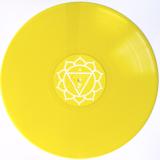
Utter presents Marshall Jefferson's previously unreleased meditation opus 'Yellow Meditation For The Dance Generation' alongside two remixes from French production maestro Joakim.
Marshall Jefferson: Chicago House music pioneer, creator of the anthemic ‘Move My Body’, an original collaborator of Adonis, Ce Ce Rogers and Roy Davis Jr., production mastermind of countless dancefloor classics such as Phuture’s ‘Acid Tracks’, Sterling Void’s ’It’s All Right’, Hercules’ ‘7 Ways’… and the soothing voice behind a 36 minute healing meditation guide. Yes, really.
But let’s rewind, slightly.
In 2017, Marshall was approached and encouraged by Ian ‘Snowy’ Snowball to write his autobiography and the pair set about putting Marshall’s account of the history of House music together. The book, ‘Marshall Jefferson: Diary of a DJ’ was published in 2019.
Following the book’s release, Ian and Marshall's collaboration continued and during the pandemic an outlandish idea arose to create a piece of music combining Ian's interest in meditation (he runs Club Chi specialising in Shibashi Qigong - a form of Tai Chi Qigong - which is a gentle form of movement therapy/exercise) and Marshall's willingness to experiment musically to see what might be possible.
The result is ‘Yellow Meditation For The Dance Generation’, where Marshall vocalises Ian’s lyrics in his instantly recognisable voice. The keen-eared out there may also recognise aspects of the music itself as a stripped back, lengthened and far mellower version of Marshall’s 1985 obscurity ‘Vibe’:
“I would take tapes to the Music Box and Ron Hardy would play my music. ‘Vibe’ was one of those tracks. I recorded ‘Vibe’ in 1985, but it became one of my tracks that I just forgot about until some guy on Facebook sent me a recording of it that was taken from a club. The only person who I ever gave a recording of ‘Vibe’ to was Ron Hardy. The other people I know who had copies of the track were Gene Hunt and Emanuel Pippin (DJ Spookie).
"The original version of ‘Vibe’ was made using a Roland 707, Roland JX-8P keyboard and a Roland 727 drum machine. I was still working at the Post Office at the time, and this was pre-‘Move Your Body (The House Music Anthem)’. ‘Vibe’ has the building blocks for ‘Move Your Body’ because it was using the instruments on the track that I discovered what I could do with the bass sound, to make a track like ‘Move Your Body’.”
Still, Ian’s initial intention for ‘Yellow Meditation’ was function and it was designed to be a ‘Sequential Relaxation Exercise’ focusing on the Solar Plexus. Bearing this in mind, Marshall took a bare-bones and hypnotic approach to this particular re-recording of ‘Vibe’ so that the voice takes centre stage and listeners (hopefully) find themselves on a meditative journey. In fact, this long-form track was always intended as a private tool purely for meditation at Club Chi rather than released to the public - after all, Marshall had also created and released a more drum heavy, ’traditional’ club-focused 'Vibe Three' instrumental version for that very purpose - but a chance airing of the full 36 minute version changed its path.
Much like those 1985 ‘Vibe’ cassettes, Marshall had sent the track to a few close contacts, one of whom was Kieran at Phonica Records who aired it over the shop’s basement soundsystem. Its unorthodox nature caught the ear of colleague Alex (of Utter) and the seeds of a physical release were planted.
Eventually, with the full-version carefully whittled down to a vinyl friendly length of 24 minutes, full track parts in hand and a b-side to fill, Alex sought out one of his favourite producers to take up the remix reigns: Joakim. The Tigersushi co-founder and Crowdspacer boss has a long history of boundary-pushing remixes that straddle both dancefloor functionality and experimentation. This time the original material resulted in Joakim coming up with a number of ideas and he finally delivered two versions - one club focused (‘Vertical’), the other more introspective and meditative (‘Horizontal’), both of which appear on the final 12”.
The limited edition 12” also includes a download code giving buyers access to all of the vinyl tracks plus an 18 minute extended version of Joakim’s ‘Horizontal’ remix, its instrumental counterpart (for those who can live without Marshall's voice) and full 12 minute acapella (for those who can't!)
Alex
a A1. Yellow Meditation For The Dance Generation (Edit) 24:00
b B1. Yellow Meditation For The Dance Generation (Joakim's Vertical Remix) 9:09
9:05
Buscar:ian rogers
- 1
Heavenly return! As fiercely independent as any punk band, but as sweetly melodic as any chart-topping act, Heavenly combine sharp-edged lyrics with shamelessly joyful pop music. The band comprises original members Amelia Fletcher, Peter Momtchiloff, Cathy Rogers and Rob Pursey, who are now joined on drums by Ian Button. An important element of the Heavenly story was the loss of Mathew Fletcher, who took his own life just before the fourth album was released. It took Amelia, Peter, Cathy and Rob a long time to get over the loss; maybe it took even longer to find a drummer as good as Ian. 'Highway To Heavenly' shares its musical recipe with the band's first four albums, all of which were released in the 1990s at a time when sensitive indie types in the UK were sheltering from the prevailing macho-rock storm under the Sarah Records umbrella, and when women in the US were starting to find their Riot Grrrl voices in the small town of Olympia, where labels like K and Kill Rock Stars were designing a new creative space. The new songs are full of anger, of grief, of empathy, of love, and set themselves in opposition to the resurgence of the cold 'masculine energy' that is making the world a miserable, aggressive place today. It's all pop here, but Highway To Heavenly has a huge range of tones and moods. Heavenly have recently enjoyed a huge resurgence of interest from a younger generation of fans, who have cottoned on to Heavenly's music, but also embraced the band's inclusive version of feminism. The new Heavenly have played a number of sell-out shows in the past couple of years, where older fans have mingled with new devotees. Still our love is Heavenly!
- Portland Town
- Someone Who Cares (The Only Ones Cover)
After lot of Skep Waxing Amelie and Rob and Cathy, Ian and Peter are back for indie good! It's been a long time coming but influential jangle guitarpop band Heavenly are releasing a brand new 7" single, with a full album to follow in February 2026. Portland Town is as effervescent a pop song as any of Heavenly's past recordings, with duelling vocals from Amelia and Cathy; looping, twanging, `how-did-he-do-that' guitar escapades from Peter, and a super-catchy melody. As so often with Heavenly, though, the lyrics have real bite. The song embraces those who find themselves on the margins of a hostile world where maleness, straightness and conformity are in the ascendant. So why Portland? It has always been a sanctuary - one of those places where difference is celebrated, a place where, as the song puts it, anyone can fit in. The flip is a cover version of a much-loved Only Ones song, `Someone Who Cares'. Heavenly are: Amelia Fletcher (guitar, vocals), Cathy Rogers (guitar, vocals), Rob Pursey (bass), Peter Momtchiloff (guitar), Ian Button (drums)
- A: Portland Town
- B: Someone Who Cares
Portland Town is as effervescent a pop song as any of Heavenly’s past recordings, with duelling vocals from Amelia and Cathy; looping, twanging, ‘how-did-he-do-that’ guitar escapades from Peter, and a super-catchy melody. As so often with Heavenly, though, the lyrics have real bite.
The song embraces those who find themselves on the margins of a hostile world where maleness, straightness and conformity are in the ascendant. So why Portland? It has always been a sanctuary – one of those places where difference is celebrated, a place where, as the song puts it, anyone can fit in.
The B side is a cover version of a much-loved Only Ones song, ‘Someone Who Cares’.
Heavenly celebrate the release of Portland Town with a show at Islington Assembly Hall, London on 19th July, as part of the Skep Wax Weekender.
Heavenly are: Amelia Fletcher (guitar, vocals), Cathy Rogers (guitar, vocals), Rob Pursey (bass), Peter Momtchiloff (guitar), Ian Button (drums)
A cycle of songs about dead dogs. Dealing with loss, grief and loneliness, they recount the tales of lost dogs both real, metaphoric and mythic, and use our relationship with and treatment of dogs as a measure of our humanity.
Collaborating as The Unattached on this record are Joad R Wren, sister Gwenifer Raymond, uncle Neil White, and daughter Celia, along with friends Darren Hayman, Ian Button, John McGrath and Holly Rogers.
Joad notes: "The album was written and recorded during the height of the pandemic. I've no idea why it's taken so long to release it. I do know that it's a great pleasure to work – even at a distance – with such talented musicians, with many amazing albums in their back catalogues."
The final song was a surprise – especially to Joad – as Neil wrote it years ago about a forgotten dog, and it fitted beautifully as a coda here.
The songs are at once lush, sensitive, bleak and unflinching - there's a similar feeling to something like Lou Reed's 'Berlin', or the darker moments of Roy Harper. The LP comes in a numbered, hand-printed linocut sleeve with a 20 page booklet of lyrics and art.
The sleeve is a bit special. The oil-based ink used on this hand-printed sleeve may feel sticky to touch, and can potentially transfer to other surfaces. Please handle and store this record carefully.
It's an edition of 100, and because of the hand-printing process each cover is imperfectly unique and uniquely imperfect (and hand numbered).
21st Century pop is curiously irrelevant: autotune, twelve 'writers' on a single song, sensationalist yet skin-deep social commentary . . . with none of the joy, excitement and surprises of pop's lengthy heyday, from the Brill Building through the New Wave era. Where did it go? That would be an apt introduction to an album of calculated throwbacks to a three-minute pop ideal . . . but No Place Like Home isn't that record. We doubt even Gemma could tell you where this collection of beguiling jewels came from exactly, each fully-formed, complete and satisfying, no two quite alike, and each devoid of Wet Leg or Dry Cleaning's crafty calculation, but with every bit of those acts' charm. The first single, Stop, is based on an idea so simple that it's nearly unfathomable why no one had come conjured it earlier. Like toilet paper or a pair of scissors, the song feels entirely obvious until one ponders its late arrival. Stop's motorik beat propels verses to a chorus of pure delight, bested by a bridge occurring so late in the tune that it comes across like a surprise second dessert. My Idea Of Fun, a tale of frequent drunken regret, comes with a video of minimalist humour and visual brilliance. On other songs, Gemma channels acts Delta 5, Au Pairs and The Raincoats, along with the humour of Ian Dury and a similar verité of London life found in the best of Madness. The more serious fare is equally compelling. Rabbit Hole projects a daring newness of young freedom, Dance Of A Thousand Faces veers into Sprechstimme and expands into a swooping chorus, the feel of which subtly conveys present-day tensions reminiscent of the Weimar era. Tailspin captures the dark feeling which comes burdened with real-time consciousness of a loss of control, while the album closer, Frida, a tale of the loss of a dear friend manages to end in a guardedly upbeat tone. Gemma's debut album is sure to stir up deep interest and will be supported by a number of videos and live performances, plus free digital singles featuring otherwise unavailable non- album tracks.
Mesmeric and kaleidoscopic, shimmering with electrified unease, Show Me How You Disappear is both an exercise in self-forgiveness and an eventual understanding of unresolved trauma. Jilian Medford’s third record as IAN SWEET unfolds at an acute juncture in her life, charting from a mental health crisis to an intensive healing process and what comes after. How do you control the thoughts that control you? What does it mean to get better? What does it mean to have a relationship with yourself?
Recorded with Andrew Sarlo (Big Thief, Empress Of) and Andy Seltzer (Maggie Rogers), among others, Medford approached this album as a curator. She handpicked the producers that fit each song, which explains the range and experimentation showcased. Medford then recruited Chris Coady to mix and tie everything together into one cohesive piece.
Dizzying and enthralling, Show Me How You Disappear is the sound of someone coming apart and putting themselves back together — the moment an old mantra, repeated into the mirror time and time again, finally clicks. To look at your reflection, and finally feel seen.
- 1



