Composed, performed and produced by Cosey Fanni Tutti, the 9-track album moves between propulsive beat constructions and expansive electronic explorations, continuing themes from 2019’s acclaimed album TUTTI. It is a personal reflection; a sonic realisation of her life, drawing on her powerful inner resolve and expressing it through music. The album finds Cosey making sense of some very tough years, dealing with personal bereavements alongside swingeing world events that have impacted us all. Centring on her own strength and self will, the album’s two distinct sides – one rhythmic, one more meditative – are connected by an overwhelmingly positive mood.
She explains, “My overtone chanting on the track ‘Stound’ was part of that, tapping into the inner self, to the core of your being, emotionally, physically, allowing the sounds to permeate and soothe as well as create a sense of power, resistance and resilience to what we face.” Even in the more melancholic moments, there’s a lightness that she explains is an “acknowledgement that it’s alright to be sad, that’s part of life, but there is so much joy too in our memories of people we lose and in the moments we share with each other. Joy is our resistance.”
There are also threads from her most recent projects running through 2t2. Her latest book RE-SISTERS and the score she wrote for Caroline Catz’s film Delia Derbyshire: The Myths and Legendary Tapes are acknowledged, most directly on ‘Threnody’ which is dedicated to Delia Derbyshire and Andy Christian, an artist friend of Delia’s. He sent Cosey an abstract drawing of the same name, created one night from an improvised evening where he drew while Derbyshire intoned and sang softly as she looked at the drawings, as if reading a score expressing how they made her feel. Cosey’s process and the different strands that make up her work form a totality of vision.
She goes on to say, “Once you get creating and listening, weaving, collaging sound it’s a wonderfully fulfilling feeling that takes you both out of yourself at the same time as essentially deep within.” The artwork reflects this idea that the album is a “sound cameo”, reflecting the light within the music, and the buzz of life that exists within all of Cosey’s work. Musician, artist and author Cosey Fanni Tutti has continually challenged boundaries and conventions through her work. As a founding member of the hugely influential avant-garde band Throbbing Gristle, one half of electronic pioneers Chris and Cosey, and as an artist channelling her experience in pornographic modelling and striptease, her work on the margins has reshaped the mainstream. Her first solo album, Time To Tell (1983) was followed by 2019’s Tutti and 2022’s Delia Derbyshire: The Myths and the Legendary Tapes. Her debut book, the Penderyn Music Book Prize shortlisted Art Sex Music, was published in 2017, followed by RE-SISTERS in 2022 (both Faber), which will soon get a Spanish edition.
Search:imp express 8 1
Chicago-based composer/producer Joey Meland makes music under the moniker Cocojoey. Treating genre conventions and ostensible barriers between disparate musical vocabularies like playthings to gleefully smash and reshape at will, Meland channels decades of experience as a polymathic professional musician adept in styles like metal, jazz, synthpop, and experimental sound design into their infinitely combinatory compositions. STARS, their first album on Hausu Mountain, follows the self-released COCOJOEY’S WORLD with a spellbinding burst of heart-on-sleeve self-expression. The album finds Cocojoey indulging their most adventurous impulses in production and technical instrumental performance, launching into a constantly morphing program that contrasts day-glo earworm hooks against cathartic moments of screaming intensity. Cocojoey’s music exudes warmth and finger-wagging mischief as it exhumes the depths of their psyche with the pure-hearted goal of making their audience smile — when those listening find a chance to breathe within the ecstatic overstimulation.
The album’s tightly constructed song cycle blasts the listener with moment after moment of novel juxtaposition, both in terms of genre and emotional energy, that keep us reeling in a state of delirious whiplash. Warp-speed piano solos over bossa nova-inflected chord progressions segue into detonations of death metal that front-load Meland’s ferocious screaming vocals and meticulously programmed double-kick drum patterns. A strain of iridescent prog emerges in the sheer overload of notes and ideas, as drum n’ bass breaks collide with labyrinthine multi-time signature keyboard lines and bright flashes of clean vocals. Despite whatever contrasting styles might hit within any given Cocojoey song, Meland returns again and again to the upheaval and release provided by extreme metal — though that idiom lands with joyful exuberance, an abrasive yet heartwarming flavor whose positive energy carries through even to those who might not encounter screams and hyper-technical drum breakdowns in their typical listening regimen.
- All I Really Want
- You Oughta Know
- Perfect
- Hand In My Pocket
- Right Through You
- Forgiven
- You Learn
- Head Over Feet
- Mary Jane
- Ironic
- Not The Doctor
- Wake Up
When Alanis Morissette took direct aim at an ex who wronged her on the eviscerating “You Oughta Know” in 1995, everything about the Top 10 song communicated it wasn’t the usual narrative about love gone south. Or the typical wounded singer wallowing in self pity. Morissette, and both the lead single from and her entire American major-label debut — the profoundly personal Jagged Little Pill — represented a sea change. They kickstarted a movement, one whose impact continues to echo throughout the mainstream nearly three decades later.
Ranked the 69th Greatest Album of All Time by Rolling Stone, included on the Rock and Roll Hall of Fame’s list of 200 Definitive Albums, and featured in several books about essential albums, Jagged Little Pill remains more than a blockbuster that has sold more than 17 million copies in the U.S. and 33 million units worldwide. It’s a statement, an attitude, a soundtrack for anyone seeking inspiration, an outlet, or permission to be themselves.
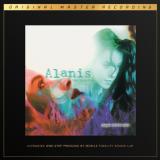
Sourced from the original master tapes, pressed at Fidelity Record Pressing on MoFi SuperVinyl, and strictly limited to 4,000 numbered copies, Mobile Fidelity’s UltraDisc One-Step 180g 45RPM 2LP box set of Jagged Little Pill presents the landmark effort in audiophile-grade sound for the first time. A key part of the record’s appeal and accessibility — Glen Ballard’s smooth production, touches that help Morissette’s exposed-nerve fare seem more accessible and melodic — comes through on this special 30th anniversary edition with an openness, presence, and dynamic explosiveness that make the vocalist’s songs that much more real and visceral.
The singer’s distinctive mezzo-soprano deliveries — the octave-rippling highs, dark-hued lows, dramatic crescendos, belted choruses, wispy reflections, occasional yodels — resonate with full-range ardor and depth. As crucial as anything on the record, Morissette’s confessional words take center stage like never before. Ditto the instrumentation and atmospherics that form the magnetic backgrounds of the songs. Key in on the contributions from Red Hot Chili Peppers Dave Navarro and Flea on “You Oughta Know” to Tom Petty & the Heartbreakers' co-founder Benmont Tench’s organ playing on six tracks.
The deluxe packaging of Mobile Fidelity’s Jagged Little Pill UD1S set underscores the work’s distinguished status. Housed in a slipcase, the LPs come in special foil-stamped jackets with faithful-to-the-original graphics that illuminate the splendor of the recording. Benefitting from an ultra-low noise floor, superior groove definition, and dead-quiet surfaces, this UD1S reissue is for listeners who prize sound quality and desire to engage themselves in everything involved with the album, including the now-iconic cover art that juxtaposes two portraits of the then-21-year-old singer-songwriter and features typewriter font.
That script — which suggests a raw, blood-on-the-floor document created without modern aids like spell check or language correction — hints at the heightened level of unvarnished intimacy, honesty, and catharsis Morissette offers throughout Jagged Little Pill. Named after a phrase uttered on the astute “You Learn,” the album explores the frank emotions, inherent contradictions, and wishful desires people feel everyday but are often too afraid to express. Morissette displays no such fear or shyness.
Akin to a woman reading from a diary, Morissette leaves nothing to the imagination as she skewers hypocrisy during the poignant “Forgiven,” seeks recompense on the vengeful “You Oughta Know,” and spills her guts on the soul-purging “All I Really Want.” For all the anger and bile ascribed to the singer and record, Jagged Little Pill is incredibly healthy and upbeat. Morissette uses the catchy pop-rock frameworks and moody ambience to suss out situations, to learn, to give hope. There’s the clever yearning of “Hand in My Pocket”; wry contrarianism of “Ironic”; kind-heartedness of “Hand over Feet”; the live-and-let-live spirit of “You Learn” – all positive and amiable.
Throughout Jagged Little Pill, the ever-approachable Morissette connects with listeners who recognize themselves in her — and has an intelligent conversation with anyone who wants to participate. It seemed almost everyone did. In addition to the mammoth sales that make the effort the 17th-best-selling album in American history, Jagged Little Pill collected four Grammy Awards, two American Music Awards, three Billboard Music Awards, and eight Juno Awards. In 2018, the record became the basis for a musical that netted 15 Tony nominations on Broadway.
Ironic? Anything but. Jagged Little Pill transcends generations, gender, and trends. As Morissette sings on the opening “All I Really Want,”, the album represents “deliverance” — “a place to find common ground.”
Having crested the west coast modular-ambient wave in just a few releases - including 2018's Sharing Waves on the influential LA experimental imprint Leaving Records - Sean Hellfritsch has swapped the mossy analog synth improvisations of his prior output for refined melodic arrangements dressed in sprightly dawn-of-digital textures. Big Earth Energy plumbs the depths of Hellfritsch's multimedia mind and naturalist heart, spinning an impressionistic narrative world off of cultural touchstones like the PC game MYST, and the work of Studio Ghibli composer Joe Hisaishi. Inspired by the aforementioned, and guided by Hellfritsch's experience as an animator and filmmaker, Big Earth Energy is the soundtrack to a hypothetical video game with a pointedly ecological premise, and a twist of psychedelic charm. In Hellfritsch's imagined virtual journey, the player assumes the perspective of a treefrog sixty-five-million years ago, hopping epochs with each new level, forming a comprehensive picture of the massive changes the planet has gone through over the eons. The ultimate goal of the game is not to amass resources, defeat enemies, or gain power, but to fully witness the unfolding of one of the biggest systems of energy imaginable - or as the album's creator puts it - "to explore the incomprehensibly vast energetic expression and mystery that is Earth." Big Earth Energy is steeped in exploratory RPG intrigue, possibility, and contemplation, lovingly overlaid with Miyazaki-an sentiments and aesthetics. The through-composed, organic, meandering synthesis heard on previous Cool Maritime albums has been fully replaced by meticulous polygonal arrangements that recall the computerized sheen of late 80s work by composers like Hiroshi Yoshimura, and Yoichiro Yoshikawa - using true-to-period gear no less. Even given its referentiality, Big Earth Energy comes off as forward-facing where so much reminiscent music remains fixed to a bygone moment in pop culture. Hellfritsch has created a musical world where the endless verdancy of the biosphere finds its parallel in the golden age of early 1990s video games, and late 80s Japanese environmental music, all while pointing to a hopeful planetary and artistic future that vindicates the motives of all of these muses.
With solid training as a classical musician, Sophie Agnel took a close interest in modern jazz before committing in the early 90s to the shifting, deliciously uncertain ground of free improvisation, thanks to her fascination for the powers of expression displayed by a few great keyboard-heretics such as Keith Tippett, Fred Van Hove or Christine Wodrascka. She began reworking the prepared piano techniques imagined by John Cage and transformed her instrument into a sort of extended piano.
Coming from a Punk music background Joke Lanz started in the mid 80s to play Experimental- and Noise music. Best known for his internationally acclaimed project Sudden Infant, Lanz is presenting his work since 30 years all over the world. Born in Switzerland and currently operating out of Berlin, he is one of the most prolific and profound artists working in the border zones where performance and body art meet Improvisation and Noise.
Agnel and Lanz have performed stunning live shows as a duo, now their debut album is coming out on Klanggalerie. Turntables and piano, a unique combination that is a lot of fun!
- A1: Free State Fence
- A2: The Surfer
- A3: Prayer For Civilisation
- A4: Hillbrow 1
- A5: Hillbrow 2
- B1: Hippo In Town
- B2: Independence Day
- B3: Don't Dance
- B4: Crossed Cheques
- B5: September 1984
This is an album made during a crucial period in South Africa’s history during which there was a palpable feeling of a slow turning towards the collapse of the apartheid state side by side with an increasingly well-organised culture of resistance through the formation of the United Democratic Front (UDF) and various affiliated bodies. However, as a result, there was increased pushback from the state security establishment, a turning to dirty tricks and the formation of hit squads whose members murdered and tortured many of our friends and created chaos throughout South Africa as well as neighbouring countries.
This album is situated in this political environment however it took advantage of the new do-it-yourself music technologies available at that time. Technologies that made it possible to make and release records without interference from traditional record company executives. Two musician friends of mine pooled their resources after their respective bands had broken up. Ivan Kadey (National Wake) and Lloyd Ross (Radio Rats) built an 8-track recording studio control room and fitted it out in a second hand caravan and called it Shifty. They parked it in a garage attached to the only house left in a demolished and derelict mining village near Soweto on the outskirts of Johannesburg.
All the work on this album was completed there, mainly after hours and mostly alone where I enjoyed an exhilarating freedom to develop a whole new set of musical skills and ideas, incorporating my love of a wide range of music I’d grown up with. Influences of 1970s progressive/kraut/and psychedelic rock combined with mbaqanga bass styles, early reggae/dub and Indian tabla rhythms. Stockhausen, early Zappa and Holgar Czukay were radio text and shredding influences, and Chris Cutler’s band Henry Cow & Art Bears helped me see a way to political expression. Mostly though was the exciting post-punk and no-wave music coming through to us from Europe and America: bands like This Heat, the Mekons, Raincoats, Sonic Youth and Pere Ubu were immensely important to me as was my reading from the period: J.M.Coetzee’s first 3 novels are strong influences on Free State Fence; the stark landscape, superstition, ritual, and sexual repression are in many of his settings. JG Ballard was a constant presence throughout that period, especially whilst living in such a surreal environment, surrounded by mine dumps, but mostly I think the whole French post-modern philosophical movement—Derrida, Foucault and of course, Baudrillard’s Simulacra and Simulation—set out a new sense of possibilities, possible ways to express oneself, ways to think, and ways to try and analyse the political intersection of public and private life. Most important at that time was the influence of sound recordings I had made and experiences garnered from working as a sound recordist on documentary films. These financed my work and later the studio and were consistent employment throughout the 1980s. Film work also enabled me to experience much of South Africa that was hidden from most. The track Independence Day is a good example; drawn from some time spent in the rural homeland of Venda. This then was the first full length Kalahari Surfers album, completed in summer of 1984 it was taken to EMI pressing plant but rejected by the cutting engineer as being ""political, pornographic and anti religious"". Chris Cutler at Recommended Records took up the challenge and released the album through his label. He wrote the original liner note
"High urgency music with a very personal expression of the artist: in one way or another", this has always been the important or maybe even the core factor of every Cortizona release so far.
So it was just a matter of time until DJ Marcelle/Another Nice Mess, longtime fan of The Fall and Jiskefet, topnotch producer, dj wizard with three turntables (and a lovely person in general) - and myself - would collaborate towards a Cortizona release.
I guess the initial idea of working together with DJ Marcelle/Another Nice Mess dates back to 2019. One day she called me four times in five minutes just to hear Mark E. Smith's voice message on my phone. Since then there has been no going back. I mean: what's not to love about her?
Some time ago, she sent me the digital files of her new LP 'Sorry, No Service'. One of the tracks, 'Sorry, No Silence', features the Nan Goldin sample: 'this is clearly ethnic cleansing', taken from Goldin's impressive speech to which the audience cheered in support at the opening of her exhibition at the Neue Nationalgallerie in Berlin end of 2024.
Two weeks later Marcelle contacted me again: her German label refused to release the track. This was the moment we had both been waiting for: at last Cortizona and Marcelle would work together!
The album is due to be released later this year, but, with things as they are in Gaza, it is important to issue 'Sorry, No Silence' as a stand-alone track as soon as possible.
Talking about urgency!
'Sorry, No Silence' resonates feelings of global despair over the genocide in Gaza and the moraland political bankruptcy of 'western values'. It does so over a repetitive, militant tribal beat, complete with heavy basslines. The spirits of Mark Stewart, On-U Sound and Muslimgauze loom over the track, but as is always the case with Marcelle, both on stage and in the studio: she has an authentic style of her own, where playfulness meets courage and - also in this case - anger meets rhythm.
'Sorry, No Silence' is a track I didn't know I was waiting for. A track reflecting the sign of the times. The 12'' also features an even more heavy (and faster) dub version and the avant garde track 'Never Again Means', featuring more Nan Goldin samples: 'never again means never again for everyone'.
For obvious reasons the proceeds of this 12 inch and the digital Bandcamp release will be donated to PCRF, Palestine Children's Relief Fund.
Support more than welcome.
(written by Philippe Cortens)
Matching vivid world-building with a full house of kinetic rhythms, Polygonia delivers her latest album to Dekmantel as an invitation to experience 12 different dream scenarios.
As Polygonia, Munich-based Lindsey Wang has established herself as a constantly inventive, omnipresent operator within the modern electronic landscape, exploring varying shades of ambient and deep techno while increasingly spreading into downtempo and leftfield electronica with a playful yet mysterious spirit.
Dream Horizons is an instructive title — Wang approached her new album as a collection of different dream scenarios, with all the creative freedom the concept implies. From oceanic calm to artful propulsion, she was free to shift gears from track to track while relishing the strange and beautiful atmospheres her inspiration pointed towards. A multi-instrumentalist as well as a producer, Wang recorded her own voice, saxophone, flute, violin and percussion to inject organic, human vibrancy into the surreal spaces she was shaping out, capturing the uncanny sensation of alien and familiar that hangs over the places we visit when we sleep.
There are pointedly direct techno workouts on the album, from deft beatdown 'Soul Reflections' to shimmering ear worm 'Set Me Free', and 'Twisted Colours' relishes shifting blocks of flute around a sprightly, footwork-tickled framework. Elsewhere, there's space for softer expressions on pearlescent opus 'Crystal Valley' while elastic rhythms and tactile textures slither around at a lower tempo on 'Flakes Flying Upwards'. In between, Wang plays with fractured beat patterns and sharply sculpted sonic matter with a staggering level of detail and intention. 'Gate To Amygdala' is the perfect example of the bold scope of her expression — the midpoint track thrives on nervous tension and a dislocated sense of momentum without anything like a conventional techno trope. 'Mindfunk' equally pushes and pulls at sensory perception with an off-kilter, awkwardly looped synth phrase that relishes the opportunity to skew dance music conventions within the flexible rules of the dream world.
For all the smart production and knowingly experimental approaches that form the basis of the album's sound, it's also a record charged with the full range of emotions you might expect to experience on a break away from consciousness. Whether it's the melancholic impressions that smudge into incidental pauses on 'Metaphysical Scribbles' or the mantra-like breath and sax combination of 'Essential Breath' that closes the record, Polygonia's heart bursts out of the album's vibrant form as brilliantly as her exacting, studio-synced mind.
Black Vinyl[14,71 €]
Black+ Limited Art Print + Limited 150 Page H[41,13 €]
YELLOW VINYL[16,77 €]
The record is largely sung in Scots language, one of Scotland’s three official languages along with Gaelic and English. “Scots gives me a way of expressing myself which is connected directly with the landscapes I love. It brings the songs alive and it is a fascinating language. The name of the record is in Scots - Forefowk means the people who came before, or ancestors. When we say ‘mind me,’ we can mean a few things- remind, remember, watch over or care for me. The record explores how tradition needs to be constantly reconnected with, built upon, looked after, and shared.”
Quinie sings with a style inspired by Scottish Traveller singers. “I began singing unaccompanied Scots Song in 2015 after hearing Scots Traveller singer Sheila Stewart on the radio. Initially I felt like I shouldn't sing these songs because I'm not a Traveller, and I saw people around me doing that in a way that made me uncomfortable. But on the other hand this music made sense to me and I felt driven to learn. Over the years I have met Traveller friends who taught me that settled people sharing these songs could contribute to raising awareness. Scottish Travellers are marginalised and discriminated against in modern Scotland, despite being custodians of so many of our important traditions. So I started to perform them and tell this story. From there I built on my repertoire and started writing my own songs”.
To develop this record, Quinie travelled across Argyll with her horse. They went on a pilgrimage of sorts through the ancient landscapes of the West of Scotland to explore the interconnected relationships between people, ancestors, animals, and place. The album’s vinyl release is accompanied by a book and film, documenting this unusual research process.
Forefowk, Mind Me was recorded in August 2024 at The Big Shed in Highland Perthshire with support from Creative Scotland. Quinie is accompanied by an ensemble of musicians: Ailbhe Nic Oireachtaigh (viola), Oliver Pitt (duduk, bouzouki, percussion), Harry Górski-Brown (small pipes, violin), and Stevie Jones (double bass, recording, and mixing). Each of these artists brings their own distinctive voice, bridging contemporary experimental practice with worlds of traditional and early music.
Khadim is a stunning reconfiguration of the Ndagga Rhythm Force sound. The instrumentation is radically pared down. The guitar is gone; the concatenation of sabars; the drum-kit. Each of the four tracks hones in on just one or two drummers; otherwise the sole recorded element is the singing; everything else is programmed. Synths are dialogically locked into the drumming. Tellingly, Ernestus has reached for his beloved Prophet-5, a signature go-to since Basic Channel days, thirty years ago. Texturally, the sound is more dubwise; prickling with effects. There is a new spaciousness, announced at the start by the ambient sounds of Dakar street-life. At the microphone, Mbene Diatta Seck revels in this new openness: mbalax diva, she feelingly turns each of the four songs into a discrete dramatic episode, using different sets of rhetorical techniques. The music throughout is taut, grooving, complex, like before; but more volatile, intuitive and reaching, with turbulent emotional and spiritual expressivity.
Not that Khadim represents any kind of break. Its transformativeness is rooted in the hundreds upon hundreds of hours the Rhythm Force has played together. Nearly a decade has passed since Yermande, the unit's previous album. Every year throughout that period — barring lockdowns — the group has toured extensively, in Europe, the US, and Japan. With improvisation at the core of its music-making, each performance has been evolutionary, as it turns out heading towards Khadim. “I didn’t want to simply continue with the same formula," says Ernestus. “I preferred to wait for a new approach. Playing live so many times, I wanted to capture some of the energy and freedom of those performances.” Though several members of the touring ensemble sit out this recording — sabar drummers, kit-drummer, synth-player — their presence abides in the structure and swing of the music here.
Lamp Fall is a homage to Cheikh Ibra Fall, founder of the Baye Fall spiritual community. The mosque in the city of Touba is known as Lamp Fall, because the main tower resembles a lantern. Soy duggu Touba, moom guey séen / When you enter Touba, he is the one who greets you. After a swift, incantatory start Mbene sings with reflective seriousness. Her voice swirls with reverb, over a tight, funky, propulsive interplay between synth and drums, threaded with one-two jabs of bass. Cheikh Ibra Fall mi may way, mo diayndiou ré, la mu jëndé ko taalibe... Cheikh Ibra Fall amo morome, aboridial / Cheikh Ibra Fall shows the way forward, he gives us strength, he gathers his disciples... Overflowing with grace, Cheikh Ibra Fall has no equal.
Interwoven with Wolof proverbs, Dieuw Bakhul is a recriminatory song about treachery, lies, and back-biting. Over moody, roiling synths and ominous, lean bass, Mbene throws out fluttering scraps of vocal, as if re-running old conversations in her head. The music shadows her despair to the verge of breakdown, at one moment seemingly so lost in thought and memories, that it threatens to disintegrate. Bayilene di wor seen xarit ak seen an da ndo... Dieuw bakhul, dieuw ñaw na / Stop judging your friends and companions... A lie is no good, a lie is ugly.
Khadim is a show-stopper; currently the centrepiece of Ndagga Rhythm Force live performances. The song is dedicated to Cheikh Ahmadou Bamba, aka Khadim, founder of the Mouride Sufi order. Serigne Bamba mi may wayeu / Serigne Bamba is the one who makes me sing. The verses name-check revered members of his family and brotherhood, like Sokhna Diarra, Mame Thierno, and Serigne Bara. Though Islam has been practised in Senegal for a millennium, it wasn’t until the start of the twentieth century that it began to thoroughly permeate ordinary Senegalese society, hand-in-hand with anti-colonialism. The verses here recall Bamba’s banishment by the French to Gabon, and later to Mauritania, in those foundational times. During exile, his captors once introduced a lion to his cell: gaïnde gua waf, dieba lu ci Cheikhoul Khadim / the lion doesn’t budge, it gives itself over to Cheikh Khadim. Deep, surging bass, steady kick-drum, and simple, reverbed chords on the off-beat lend the feel and impetus of steppers reggae. A reed plays snatches of a traditional Baye Fall melody; the dazzling polyrhythmic drumming is by Serigne Mamoune Seck. Mbene compellingly blends percussive vocalese, narrative suspense, exultant praise, introspection, and grievance.
Nimzat is a devotional tribute to Cheikh Sadbou, a contemporary of Bamba, buried in a mausoleum in Nizmat, in southern Mauritania. Way nala, kagne nala... souma danana fata dale / I call upon you and wonder about you... If I am overwhelmed, come to my aid. The town holds special significance for Khadr Sufism. An annual pilgrimage there is conducted to this day. The rhythm is buoyantly funky; the mood is sombre, reined-in, foreboding. Punctuated by peals of thunder, Mbene sings with restrained, intense reverence; huskily confidential, steadfast. Nanu dem ba Nimzat, dé ba sali khina / Let us go to Nimzat, to seal our devotion.
Mbene Diatta Seck: vocals.
Bada Seck: bougarabou, thiol, mbeung mbeung bal, tungune.
Serigne Mamoune Seck: bougarabou, khine, mbeung mbeung, tungune.
Text by Mark Ainley (Honest Jons).
Mastered by Rashad Becker.
Everything else by Mark Ernestus.
The debut recording by The Ancients, the intergenerational coalition of Isaiah Collier, William Hooker, & William Parker formed by parker to play concerts in conjunction with the milford graves mind body deal exhibition at the institute of contemporary art los angeles & now a working group. across x2LPs of side-length long-form improvised sets recorded at 2220 arts & archives in LA & the chapel in San Francisco, The Ancients bring the free jazz trio languages first explored by the Cecil Taylor Unit & Ornette Coleman’s -Golden Circle- band (expanded upon in later eras by Sam Rivers' Trio & Parker’s collective trios with Charles Gayle/Graves & Peter Brötzmann/Hamid Drake) into their own unique & scintillating realms of expression.
As we tumble further into the throes of history’s tides, people of hope & creativity rely on the works of our great artists to lift our spirits & focus our resolve. -ascension- was recorded less than a year after the passage of the civil rights act & four months after the assassination of Malcolm X. -journey in satchidananda- was recorded the month reagan was re-elected governor of California. M’boom made its debut recording weeks after the watergate scandal broke & a couple months after the wounded knee occupation ended. The music of the ancients builds on these great musical legacies. it resounds with the pride of survival & the joys of making & sharing music. It delivers to us hope & balm. something real in you, real in history, & real in the music is shared, right on time.
When Eremite records commenced operations during the 1990s free jazz resurgence, heavyweight freedom-seeking tenor saxophonists such as Fred Anderson, Peter Brötzmann, Charles Gayle, Kidd Jordan, & David S. Ware were at the height of their powers. Isaiah Collier’s tenor playing in the ancients is bracing testimony that the wellspring lives on. to hear the young chicago firebrand blowing freely with veteran improvisers in an entirely open-form group music is a revelatory study of his vast talent, personal voice, & the intensity of his expression —as well as a bold complement to his composition-based albums as a bandleader (including -the almighty-, a new york times' best albums of 2024 selection).
I've admired drummer William hooker since first encountering his music in a hartford ct city park, early ‘90s (on a double bill with Jerry González & Fort Apache Band). From the man himself right off the bandstand i bought his even-then rare 1st recording, the 1976 self-released x2LP opus -is eternal life- (reissued 2019 by superior viaduct). An imposing force on his instrument & an intrepid DIY cat, Hooker’s been exuberantly swinging in&out of free time for 50+ years. informed by the innovations of Sunny Murray & Tony Williams yet entirely himself, there is no other term for it than “pure hooker.” at age 78, with the ancients & everywhere else, THE HOOK is in peak form.
With a discography approaching 600 entries & 50+ years working across the musical maps, including in the history-defining bands of Don Cherry, Cecil Taylor, Bill Dixon, Peter Brötzmann, in his own wondrous ensembles from small group to orchestra to opera, a bastion of compassionate leadership & a poetic champion of his musical community, in tireless service to what he rather egolessly refers to as “the tone world”, multi-instrumentalist, improviser & composer william parker is a living hero of the grassroots & the black mystery musics, not to mention one of the great bassists in the history of jazz. To quote George Clinton, conquering the stumbling blocks comes easier when the conqueror is in tune with the infinite.
Live to 2-track concert recordings by Bryce Gonzales, Highland Dynamics. Mastered by Joe Lizzi, Queens, NY.
Movement and Soul Records is the highly-anticipated imprint, founded by Nonna Fab...
The label aims to capture deeper sounds and meditations in rhythm, spanning spiritual jazz, broken-beat and deeper house.
Nature is Enlightenment is the debut release on the label. With flute, keys, bass and drums from Nonna Fab and saxophonefrom Benjamin Ten-Bruggencate.
The B1, 'TROPIC' invites Kali, lyricist, poet and azz influenced vocalist from Sheffield, accompanied on piano/rhodes by Nonna Fab.
The broken-beat focussed B2,'FLOAT' featuring bassist Tom French and an opening poem, that touches on thecosmos, by Kali.
Multi-instrumentalist, producer, band leader, record collector and party'starter, Nonna Fab has launched the label as a platform to push the sound of his own music, working closely with a range of musicians from the North.
"It's come at the right time for me to allow a space to push a very new, organic sound working with a lot of the musicians I play with regularly, interweaving the sound with dance music."
Nonna Fab is behind audiophile party, Apricot Ballroom, which was named in the top 10 nights in the country in TimeOut Magazine as well as being acknowledged for being a pioneer of northern contemporary jazz by BBC for Footprints. As well as this, Nonna Fab is co-owner of Grub Records, which has been written about in DJMag, Mixmag and Resident Advisor.
"The label is a true hybrid of both live sound and electronic dance music and really allows focus on true communication and expression. I have always appreciated more free-form styles of dance music so it really is a space for me to explore the more expressive andspiritual side of my sound"
- Circle
- Eye Contact
- Seventeen Nights
- My Waterfall
- Wasting Time
- Final Lap
- Eraser Ii
- Shipwrecked
- Open Shadow
- Like A Stone
Neo Gibson, born in Virginia and based in New York City, records, performs, and produces as 7038634357. This numerical alias, under which Gibson has been releasing work since 2016, offers a window into the careful ambivalences of the musical project. It conjures the impersonal_the opacity and randomness of data, a number that is hard to remember or even say out loud_while also suggesting a direct line of communication with the artist, down to an area code indexing their biography. 7038634357 uses a restricted palette to achieve music that is formally precise and emotionally direct. Their digital-native approach to production, in which frank melodies cross paths with heavy distortion, contains traces of both trance's maximalist arcs and a songwriterly intimacy. Expressive details may appear submerged or abraded, subjected to a canny sense of dynamics and textural specificity. Waterfall Horizon, Gibson's second vinyl record with Blank Forms Editions under the moniker 7038634357, was written for live performance and workshopped over successive shows during their 2022 European tour. Here, hallmarks of their earlier, studio-crafted recordings_digital distortion that obfuscates their lyrics and a slow-burning ambience_are noticeably pared back. Instead, Waterfall Horizon takes on a pop inflection, adopting more traditional lyric scaffolds so that the interstices from verse to chorus or track to track can flourish within their limited tonal range.Across recordings and performances, Gibson activates wide-ranging mechanisms of audience connection: from the relative anonymity of internet platforms to live experiments with the spatial effects of amplification. They have a particular interest in site-specific performances in non-musical spaces, and have performed in a variety of contexts, including the mezzanine of the West 4th Street subway station in New York City and INA GRM/Radio France's Présences électronique festival. Under their own name, Gibson has maintained a longstanding collaboration with the artist Charles Stobbs, working primarily with FM transmission and techniques derived from the early-seventeenth-century English tradition of change-ringing bells. The first 7038634357 vinyl record, Neo Seven, was released on Blank Forms Editions in 2023; previous releases include self-released cassettes and CD-Rs, as well as a pair of EPs on Genome 6.66 Mbp (2018, 2019).
- Earthrise
- Morning Samba
- Walking On The Yellow Line
- Chai Or Coffee
- Above The Clouds (Feat. Henry Spencer)
- Earth Odyssey
- Beyond The Horizon
- Leah
- Meets Laika (Live At The World Heart Beat)
Elsden Music presents the vinyl version of 'Above The Clouds', by the Ilario Ferrari Trio, with two brand news tracks - a new recording of the title track featuring trumpeter Henry Spencer and a stunning live version of "Leah Meets Laika"
The release of the vinyl comes at the point of an extensive tour across the UK and Europea between now and the end of this year.
On the cusp of releasing this, his fourth studio recorded album, pianist and singer Ilario Ferrari has developed a distinctive compositional style that integrates instrumental contemporary jazz with vocal harmonies, adding hints of sounds and rhythms from both Indian and Mediterranean culture, alongside some classical nuances with additional influences from Ilario's southern Italian heritage. This approach is singular to Ilario Ferrari as an artist: a style that is perfectly complimented by his two well-known collaborators and rising jazz stars in their own right; drummer Katie Patterson and bassist Charlie Pyne.
At the heart of 'Above The Clouds' lies the notion of relationships. Between us and our planet, the musical and personal relationships between Ilario, Charlie and Katie, and, of course, with their loved ones. It is also about elevation and observation, from 'Above The Clouds' and from the grounded embrace of Mother Earth, impressions of love, loss, and home, expressed through a beguiling blend of vocal led songs and instrumentals.
This recording is more than just a simple jazz trio album, with the trio expanding and contracting as the song requires. The Ilario Ferrari Trio's innovative approach combined with their indisputable skill promises to be a breath of fresh air in the jazz world and beyond.
Ilario Ferrari: piano, piano effects & vocals
Charlie Pyne: double base & vocals
Ketie Patterson: drums & vocals
Plus: Henry Spencer: trumpet (on "Above The Clouds")
Carrying on from recent archival releases from masters of Indian classical tradition such as Kamalesh Maitra and the Dagar Brothers, Black Truffle is pleased to present a previously unheard recording of a concert by Pakistani vocalist Salamat Ali Khan. Born to a musician family in Hoshiarpur in the northwestern state of Punjab, Khan moved with his family to Lahore in Pakistan after the 1947 partition of India, becoming a child musical prodigy. Khan was a master of the kyhal form of Hindustani classical vocal music, a style integrating influences from Middle Eastern musical traditions that gives the singer a great deal of improvisational freedom. Travelling widely across the globe from the 1960s until his death in 2001, Khan approached ragas performed in the kyhal style as expressive forums for risk-taking improvisation, enlivened by ceaseless ornamental invention.
This remarkable recording was captured by Michael Hönig (of krautrock legends Agitation Free) in concert at Berlin’s Neue Nationalgalerie as part of the MetaMusik festival in 1974 (which also featured Nico, Tangerine Dream, and Roberto Laneri’s Prima Materia, among many others). Khan, who is also heard accompanying himself on a specially tuned alpine zither (in place of the traditional swarmandal, an Indian style of zither), is joined by Shaukat Hussein Khan on tabla and Hussein Bux Khan on harmonium. The lack of a familiar underlying tanpura drone gives this performance a weightless, floating quality, with all three of the musicians playing masterfully with the interaction between silence and the pulse propelling each section of the raag.
As Khan explains in his opening remarks, this performance of the rainy season Raag Megh is divided into three parts, each with its own tempo and rhythmic scheme (tala). The opening vilambit, in a twelve-beat tala, stretches out for over twenty minutes, lingering for a long time in a space of meditative calm, Khan lightly strumming the zither while exploring the lower end of his range in languorously extended notes. Virtuoso tabla interjections at first barely state the tempo, and the interplay between musicians is so spacious that we hear scraps of audience noise and the squeak of the harmonium’s mechanism in between the notes. Gradually picking up rhythmic definition and melodic complexity, after around fifteen minutes the music builds dramatically, with Khan letting out emotive yelps and swooping scalar shapes ranging across his full vocal range. This flows seamlessly into the following jhaptal, at a faster tempo in ten beats, which then makes way for the concluding teental, very fast in sixteen beats, which becomes a frantic improvisational exchange of daring rhythmic disruptions from the tabla, flowing harmonium melodies, and a stunning variety of vocal approaches from Khan, ranging from rapid-fire staccato consonants to guttural growls.
Accompanied by stunning black and white concert photographs, the LP also contains a moving and entertaining recollection from acclaimed German musicologist Peter Pannke, looking back on his experience assisting Khan and his musicians in Berlin at the Metamusik festival (including a mouth-watering description of a feast cooked by the maestro himself). As Pannke describes in his account of attending the concert, the beauty and spiritual intensity of this music leaves the listener speechless.
Continuing in a series of studio albums, Serwed (OL & Flaty) present their new release - "V" (Five).
Stylistically, this album further develops the idea of blending aesthetics, operating at the intersection of post-club, downtempo, digital dub, electro-acoustic, neo-classical, score music, and musique concrete, creating a unique sonic space.
Catching the subtle nuances of self-reflection, this chamber-like, intimate work is primarily directed toward the subconscious and intuitive perception. The structure and form are driven by emotion, while aesthetics take a back seat, giving way to pure sense.
The compositions capture moments of insight, spontaneity, and live improvisation. Delicate yet expressive, carefree yet precise, "V" is a deeply immersive and personal experience.
DIG Curated is proud to announce its latest release: a jolting EP from Tbilisi's rising producer Uvall. This highly anticipated record is backed by Amsterdam's radiant force Marron, co-founder of the ever-evolving techno event Eerste Communie - a true rite of passage in the underground dancefloors.
Driven by a relentless passion for vinyl, and a vision for techno rooted in shared experiences, DIG Curated stands as a community-driven platform allowing emerging artists to be discovered through the endorsement of established diggers in the scene. Co-founded as a sub-label of DIG, by Berlin-based techno mainstays Olivia Mendez and Chami, the project is nurturing a future of vinyl curation shaped by credibility and collaboration.
For the third release on DIG Curated, Marron steps in to present a trailblazer in Tbilisi's underground scene - Irakli Bregvadze aka Uvall. He is known for groove-driven, high-energy techno, emerging from the heart of Georgia's electronic music movement, where the mantra "We dance together, we fight together" symbolises a commitment to unity and resistance. His production style - a potent fusion of hypnotic rhythms and raw intensity - is designed for big-room club spaces, capturing dancers in an immersive experience throughout. Uvall's magnetic sound lies in touching all elements while never failing to keep the minimalism as intriguing as it is mysterious. His undulating rhythms, draped with enigmatic synths, work seamlessly at both faster and slower tempos, keeping the tracks deeply captivating.
With Northern Lights' heavy pulsations that control and mold the listener, it becomes clear why Marron-who has been consistently curating the steamiest dancefloors-would choose to present Uvall's music as a precious discovery. Both artists seem to be born under similar stars, living and breathing the social movement that techno is, standing up for freedom of expression and border-transcending values.
Renowned for his deep-rooted dedication to the underground techno community, Marron lends his endorsement and artistic appreciation to the release. As a co-founder of Eerste Communie, Marron has consistently championed forward-thinking sounds and community-driven dancefloor experiences, making him the utlimate advocate for DIG Curated's mission. Always in competition with himself, Marron's fast-paced yet highly rhythmic selections are driven by his roots in African groove combined with a powerful, yet hypnotizing and atmospheric techno sound.
"With DIG Curated, we aim to harness the collective power of creativity and knowledge, and spotlight emerging artists. We want to collaborate with esteemed figures in the music scene, who have the credibility to endorse new names with distinct sounds." - Chami, co-founder of DIG Curated.
"As DIG continues to evolve and grow, we are committed to pushing the signature sound of techno that brought us together, and inspire a new movement in vinyl curation by launching DIG Curated." - Olivia Mendez, co-founder of DIG Curated.
DIG Curated 003 is a testament to the power of community, resilience, and the importance of music as an igniting tool to empower and connect dancers in times of polarisation and adversity.
The Ottawa composer/performer and head of Black Bough Records plays every instrument on his CST debut: an accessibly avant-garde work of dark/ambient modern chamber music. Mark Molnar has been a linchpin of the Ottawa experimental music scene for over two decades, spanning contemporary classical, electroacoustic, industrial/noise, and improv. As a string player in a wide range of projects, an organizer and curator of innumerable shows, and via his own avantgarde label Black Bough Records, Molnar's unflagging contributions to independent music culture in Canada's capital city have been significant. EXO is his Constellation debut: a remarkable and bracing suite of post-classical composition on which Molnar plays every instrument. Meticulously self-recorded, primarily with strings, harp, and piano, EXO balances thematic melodicism, polytonality, and dissonance across three elegiac pieces of exquisitely expressive dynamism. This is exacting modern chamber music that blends formal and harmonic complexity with a solemn emotive sensibility accessible to a broad audience. Listeners that yearn for some edge and disquietude in a landscape of often all-too-approachable post-classical music should find EXO eminently worth their time and attention. While Molnar is a highly trained string player, and studied music under Aubrey Wolfe, microtonality with James Tenney, and composition with R. Murray Schafer, his trajectory has been entirely and intentionally outside the academy, signalling a socio-artistic commitment to DIY culture, forged from an early passion for the sonic worlds of post-hardcore, post-punk, no-wave, free improv, power electronics, and other independent/underground musics. His classically-informed works have been described as "tense currents of musical modernism invigorated with punk's raw vitality." EXO carries an undercurrent influenced by dark industrial and ambient metal in particular, with microphones purposely placed to pick up the low-end frequencies of the piano body, and of a bass drum positioned as a resonant skin in the acoustic space; an electroacoustic strategy organically meshed to the crisply defined and pristinely recorded pointillisms and polychords of strings, harp, and piano, which feed into this noisefloor of crepuscular sub-bass disquietude and decay. It's a production aesthetic that lends EXO a distinct undertow of tension and feeling, a sort of roiling maximalism where the chamber instrumentation traces arcs and waves of form and flow as if drawn from a dark, impervious ocean below. It also reinforces the profound hermeticism of Molnar's process, as a forbiddingly solitary creative act of immersion and navigation. The album artwork, featuring semiabstract stills of the sea by British photographer Ed Allen, further reifies this metaphor. The album's opening piece 'Sub Luna' (and its shortest at 8 minutes) showcases Molnar's adeptness at naturalistic and flowing complexity: tight cascades of climbing and descending chordal clusters hold their polytonal densities for various durations, yielding to more clarified harmonic suspensions and motifs, as melodic themes led primarily by violins in the higher registers provide a fractured lyricism. Molnar says: "the opening and closing figures of this piece act as opposing shorelines; the shorelines provide a reliable expression of range and key signature, and the tides come in and swallow them up, the motion of a body that addresses the relationship between states of lucidity and melodic figures." On 'Terre Sacer' everything happens in soupier waters, as a slow and doleful theme, anchored by grinding bass notes, circles in a gyre of dark resonances, until glistening strings gradually ascend to enrobe a plaintive and gently harrowing single-voiced ostinato over the composition's final third. Molnar's drone, ambient, minimalist, and goth-industrial influences are on display here. Side Two of EXO features the 18-minute multi-movement 'pallida Mors' (pale death): a waterfall of heterophony introduces dense chordal movements where strings are recorded and mixed to evoke pipe organ, in the album's most overtly dissonant and (anti)liturgical sequence. This gives way to ever more open and fragile spaces, before a resurgence of dark clusters and noise treatments introduces a final repeating piano coda, shrouded in devastated bass resonance, settling into what Molnar calls "a meditative hollow." Constellation is honoured to release this work by Mark Molnar, a longtime fellow-traveler whose selfless and boundlessly generous activities as an independent arts enabler sometimes obscure his own accomplished and uncompromising artistry. We trust EXO can help shed some much deserved light on this fine composer. Thanks for listening.
"Nilam" folgt auf das letztjährige Album "Daughter Of A Temple", das von Gilles Peterson zum BBC 6 Music "Album of the Year" gekürt wurde. The Guardian erklärte es ebenfalls zu einem der 10 besten Alben des Jahres 2024 und lobte GANAVYAs Fähigkeit, "die Kraft der gemeinschaftlichen Harmonie zu nutzen, um etwas Tieferes als den Gesang zu berühren". Wenn man sich das bemerkenswerte "Nilam" anhört, scheint es unwahrscheinlich, dass jemals Zweifel an seiner Entstehung bestanden haben könnten. Die Stille ist so erstaunlich, die Vermittlung von Gefühlen so tiefgreifend, dass man das Gefühl hat, dass es schon immer so gedacht war. Es ist eine Feier der Bande, die uns verbinden, und möglicherweise die zärtlichste Musik, die wir dieses Jahr hören werden. Sie ist intim und ehrlich, ein ergreifender Ausdruck der Dankbarkeit für die Segnungen, die uns auf dem Boden halten, wenn wir sie nur erkennen und willkommen heißen. In der Tat könnte es direkt von der Seele auf die Stereoanlage übertragen worden sein, von der Art und Weise, wie "Not A Burden" eine Last von den Schultern der Welt nimmt, bis hin zum friedlichen "Sees Fire", mit dem sanften Groove von "Land" voller Raum, dem heiteren "Nine Jeweled Prayer" und durchweg GANAVYAs Gesang wie Wellen in einer Lagune. New York-born, Tamil Nadu-raised singer and transdisciplinarian GANAVYA - "among modern music"s most compelling vocalists," according to the Wall Street Journal - has announced details of a new album, Nilam, due May 23, 2025. It follows last year"s Daughter Of A Temple, Gilles Peterson"s BBC 6 Music Album of the Year, similarly declared one of 2024"s Top 10 Best Global Albums by The Guardian, who applauded GANAVYA"s ability to harness "the power of communal harmony to touch something deeper than song." Co-produced by Nils Frahm at LEITER Studio in Berlin"s Funkhaus complex, the new album by "the singer whose work," says the New York Times, "feels like prayer...with listeners hanging onto her every word" will be released by LEITER on vinyl and via all digital platforms. Listening to the remarkable Nilam, it seems implausible now that its inception might ever have been in doubt. So astonishing is its stillness, so profound its communication of sentiment, it feels as if it was always meant to be. A celebration of the ties that bind, and possibly the most tender-hearted music we"ll hear this year, it"s intimate and honest, a poignant expression of gratitude for the blessings which keep us grounded, if only we"ll recognise and welcome them. Indeed, it could have been transmitted directly from soul to stereo, from the way "Not A Burden" lifts a weight off the world"s shoulders to the peaceful "Sees Fire", with "Land""s gentle groove full of space, "Nine Jeweled Prayer" serenely precious, and, throughout, GANAVYA"s vocals like ripples on a lagoon.
- 1: Intro
- 2: I Was Disconnected Feat Sam Castell Ward
- 3: Mystery Man Feat Sebastian Golgiri
- 4: Intense Love
- 5: Credits Side A
- 6: On Connection
- 7: We Are All Human
- 8: Are You A Lost Sock? Part 3 ( K Edit)
- 9: Credits Side B
- 10: All Aboard (Digital Only)
- 11: The Aliens Have Arrived (Digital Only)
- 12: New York Shuffle (Digital Only)
- 13: We Are Connected (Digital Only)
Robyn is doing brilliant and important work - the world needs more music like this. Just one word: listen!" Giles Peterson “Even aside from her skills on her instruments and unique approach to music, Robyn devoted an immense quantity of emotional resources to the delivery of this record, and seemed to take its challenges on as a chance for personal growth. It was consistently clear that the personal input of the players was welcome in a fundamental way, and we all responded to Robyn’s efforts that went to the limits of her capacity and her love for bringing her project to you, the listener” Alabaster DePlume “It has been such a joy to work with Robyn, especially when entering the fascinating world of Robyn’s Rocket and Avant Garde jazz. We had our fun moments, like when the fire alarm went off during our recording session of Mystery Man, and we just rolled with it and kept it in. It’s like nothing matters. It’s such an honour to be part of the world of Robyn’s Rocket and to listen to the many stories, expressions and colours that shine throughout the album.”Sebastian Golgiri What happens when you bring together familiar faces at London experimental music venue Café OTO, Charles Hayward (drummer Abstract Concrete, This Heat) and John Edwards (double bass), and the Total Refreshment Centre (hub of new london jazz scene recording studio ) like Alabaster DePlume (singer and saxophonist) and Danalogue (synths from Soccer96, The Comet is Coming), and the learning disability autism art scene like singers/spoken word artists Sebastian Golgiri and Dean Rodney Jnr (Fish Police), on a magic carpet with space trumpeter Robyn Rocket? The answer materialises in the groundbreaking collaboration 'Robyn Rocket and People You May of Heard of'. Recorded across three days in three different studios connected to the three communities Robyn Rocket calls home, each session brought together musicians from these diverse backgrounds—many meeting for the first time. Together, they improvised and created a musical journey that transcends conventional boundaries.
This cosmic voyage features more than 20 musicians and a dog ( Taz from lost socks), gliding through free jazz, danceable tunes, loopy vistas and spoken word doors into different ways of seeing the world. At its heart lies a profound message about community as a vital part of existence and difference as something to embrace and value. The project culminates in the final single and focus track 'We Are All Human', featuring a poignant speech by Rocket from her night 'Robyn's Rocket - a residency at cafe OTO featuring experimental music and live visuals by artists with and without Learning Disabilities/ autistic and non autistic artists ' in the speech rocket talks about supporting each other—words she actively lives by and encourages others to embrace. Like many autistic people, Rocket has experienced abuse, bullying, isolation and feeling unwelcome in the world. “This project is like my nights but you can carry it around with you”, she explains. “I started my own night to share my work. I also recognised, it was a privilege to have my own night, I wanted to help other artists share their work too, and create an environment where people with and without learning Disabilities/Autistic and non autistic people as audience and performers could come together and get to know each other”. Historical Context