New album from London-based Dutch-Zimbabwean pop
innovator Rina Mushonga.
Mushonga doesn't follow a linear path. The artist's music -
a blend of Afropop, indie and electro flourishes - is
informed by her own zigzagging life journey: Mushonga
emigrated from Zimbabwe to the Netherlands, then to the
diverse South London suburb of Peckham, where she now
lives and works.
Having read 'Metamorphoses' for the first time,
Mushonga's self-confessed 'year of transformation' ensued,
drawing upon myriad ideas and personal experiences.
Full of reflections on the cosmos and our place within it,
'In A Galaxy' is the musical embodiment of these musings,
whilst Mushonga also admits there's more than a passing
nod to the opening text on 'Star Wars' but on the whole
refers to how relative space and time are in how we
interact.
Four years in the making, 'In A Galaxy' was recorded in
Mushonga's adopted home in Peckham with producer Brett
Shaw, whilst having laid much of the foundations of the
tracks together with musical bestie and synth whisperer
Frans Verburg in his Rotterdam basement studio. The
resultant cornucopia of intelligent, diverse pop - that
Mushonga herself describes as sounding like 'Paul Simon
in a sweaty, African dancehall club' - is a welcome
introduction to 2019.
LP pressed on pink vinyl
Cerca:in
Shortly after Joe Lewandowski's afro-house explorations comes the sophomore EP of Les Yeux Orange Records young alumni Ensthal (formerly known as n.stal) with a four-tracker depicting the dream-like state and excitation of a hazy night wandering in Paris, his hometown. While its opener, « Selective Behavior », is a full-on disco-house joint inviting us to put an end on quick judgments and hypocrisy, N.M.W. channels a Parisbound Detroit techno vibe and takes us to a journey of unadulterated warehouse fun, one organ at a time. On the flip comes « The Liquor Store », a five-minute auditory hallucination where keys and strings collide and disappear in the echoes of the heights of Montmartre. « Charlotte À L'Étage » finally closes our adventure on a jazzier note, an improvisation of sorts for the early-risers and those who, most likely, did not chose to sleep.
Dutch producer Tripeo returns to his self-titled imprint this March to release four ethereal cuts entitled 'We Have Power In Numbers'.
With a discography of over thirty releases across nearly two decades, Darko Esser aka Tripeo has truly established himself as a key figure within the techno world. His open-minded and forward-thinking approach to music allows his ideas to continually develop and transform, which reflects through his vast material on his Wolfskuil Records imprint. The label recently hosted an exciting new wave of techno artists such as Shlømo, Rumah, PTA (Ambivalent & Physical Therapy) and Cadans, who collaborated with Tripeo on a Rekids release at the end of 2018.
'We Have Power In Numbers' kicks off with sparkling, acid arpeggios, encapsulating pads and weaving modulations before 'Hoax' delivers shuffling percussion, shimmering synth lines and stabbing, bass grooves.
'Pandora's Box' follows on the flip with haunting oscillations, growling resonations and an off-beat 909 clap throwing you right in the groove until 'Pay It Forwards' finishes things off with electro-tinged flavours, tantalising pads and stirring melodies.
R&S Records present the first key transmission from the Lost Souls Of Saturn's multidisciplinary conceptual project. The title track of the LSOS debut EP is revealed immediately, with the full 'Holes In The Holoverse' EP to follow on the 1st March.
Primarily LSOS are Seth Troxler and Phil Moffa, with opaque additional participants congregating to combine music, imagery, storytelling and communion into an inextricably linked whole, all wrapped-up in a philosophy of their own making.
Check the launch visual for 'Holes In The Holoverse' here:
The EP follows their performance debut as part of the 'GaiaMotherTree' installation with artist Ernesto Neto at Zurich Main Train Station, and a second show at Houghton Festival. Following these site-specific ambient renditions, the full LSOS live experience will be unveiled at the Village Undergound in London on the 18th April 2019, with further live performances to follow (including Field Day) and to be announced.
The classic-R&S-style groover 'Holes In The Holoverse' propels ever starwards, whilst the acid techno of 'World of the Wars' evokes a probe motoring through the cosmos. Further solar system surfing comes from world-renowned, Turner prize winning artist and photographer Wolfgang Tillmans. For his first ever remix, Tillmans tweaks the frequencies, adds extra percussion and his own 'va va voom' vocals.
Attempting something creatively that's above-and-beyond, LSOS explore new ways to open doors of perception and challenge the presumed reality, whilst capturing the spirit of Alejandro Jodorowsky, HG Wells, Sun Ra and the KLF within their music, live experiences and forthcoming films.
These spiritual, psychoactive aural vibrations resonate for a long distance, all the way back to something deeper and more enchanting than the prosaicism of modern life:
'We're searching for signs from another dimension and channelling a higher consciousness. We want to explore the concepts of reality vs simulation/hologram, ancient knowledge and ritualistic experiences. We're inspired by art, film, literature, astrology, mysticism, cults, rituals, paganism, synchronicity, conspiracy, altered reality, virtual states, spiritualism, chaos, cosmology and science. Both sci-fi and real science especially interest us - from Philip K. Dick books, to NASA articles, to the hexagonal storm at Saturn's North Pole.'
Lost Souls Of Saturn are preparing their debut album for release in June 2019.
Genre: Electronic, World (Arabic). 180gram vinyl includes 12'x24' art print poster + 320kbps DL card. RIYL: Matar Mohammad, Pauline Oliveros, Nadah El Shazly, Lucrecia Dalt, Chino Amobi, Sote, Arca, Fatima Al Qadiri, Tacita Dean, Stan Brakhage. Jerusalem In My Heart (JIMH) returns with Daqa'iq Tudaiq, the third full-length album from the Montréal-Beirut contemporary Arabic audio-visual duo, following the acclaimed 2015 release If He Dies, If If I f If If If (ye ar-end li sts at The Wire (#39), The Quietus (#24) and A C loser Listen (Top 10), among other accolades).
Featuring voice, electronics, buzuk and other instrumentation from composer-producer Radwan Ghazi Moumneh (Matana Roberts, Suuns, Big Brave) and abetted by the 16mm analog film work of Charles-André Coderre in live performance, JIMH continues to expand the horizons of its profound conceptual and aesthetic engagement with Arabic/Middle-Eastern traditions. Daqa'i q Tudaiq translates as 'minutes that bother/oppress/harass'—which presumably needs no further explanation—and features two distinct album sides of music. Side One realizes a long-held dream of Moumneh's to record a modern orchestral version of the popular Egyptian classic 'Ya Garat Al Wadi' by the legendary composer Mohammad Abdel Wahab. JIMH assembled a 15-piece orchestra in Beirut, enlisting the celebrated Montréal-Cairo composer Sam Shalabi (Land Of Kush) as arranger and musical director for the session. Anchored by the stately hypnotic pace of mallet and percussion instruments (riq, santur, derbakeh, kanun), the piece unfolds with lush, languid, reverb-drenched manoeuvrings through virtuosic Maqam shifts (Oriental scales). Moumneh's melismatic lead vocals and electronic production sensibility pay homage to the genre's documented historical recording traditions, while pushing things subtly and respectfully into new territories of sonic distortion and noised, artefact-laden transmission.
The song's original title (with lyrics penned in 1928 by the poet Ahmad Shawqi) translates as 'Oh Neighbour Of The Valley', but JIMH takes a different line from the original lyric as the new title for its orchestral-electronic re-interpretation. 'Wa Ta'atalat Loughat Al Kalam' (' The Language Of Speech Has Broke Down') is an expression of wordless love and transcendent communication between two lovers' eyes in Shawqi's poem; JIMH re-titles the song with this line, exploding the sentiment with more complexity, tragedy and socio-political meaning - also prefiguring the formal aesthetic ruptures JIMH bring to the piece itself. Love in a time of politics, politics in a world conspiring against love, and the specificity of Arab diasporic experience in our brutish 21st century. Side Two comprises four tracks of non-ensemble 'solo' material by Moumneh which push rupture and decomposition/recomposition of tradition further into avant-garde territory - voice, buzuk and electronics take the lead on a suite of emotive and evocative songs, including the percussive loopdriven instrumental 'Bein Ithnein' ('Between Two' ) and the stunningly unsettling processed vocal track 'Thahab, Mish Roujou', Thahab' ('(The Act Of) Departing, Not Returning, Departing'). Daqa'iq Tudaiq is a masterful, mesmerizing artistic statement and confirms Jerusalem In My Heart as one of the most engaged and forward-looking avant-Arabic projects at work in contemporary music today. Thanks for listening.
Limited retail edition in double transparent yellow vinyl.
Explosions in Slow Motion is the new album from Brock Van Wey's transcendent bvdub project.
Van Wey's previous n5MD album Heart- less found him harnessing the turmoil around him to create something vast, emotive, and brooding, yet somehow comforting, allowing you to cradle in its weight.
Months after Heartless' release Van Wey moved from turbulent times of his native California home to the chilling winter of Warsaw Poland. A divergence. Alone against the icy cold, confined to the indoors in search of protection against the world outside, Van Wey channeled, as he always does, his surroundings as they coalesced with his self-imposed aberration. The outcome of this move, and period of near total isolation, is Explosions in Slow Motion.
Featuring four long-form songs accompanied by four 'ember' vignettes, Explosions in Slow Motion is quite possibly Van Wey's most mournfully isolated work in his massive discography to date.
Filled with swelling arcs of spectres from the past appearing then slowly drift away. Foggy memories of friends, loved ones, and even adversaries seem to achingly sweep across Explosions in Slow Motion's eighty-minute runtime.
There is a forlorn thread of shrouded nostalgia throughout the album which by album's end leads to catharsis, acceptance and the finality of progres- sion.
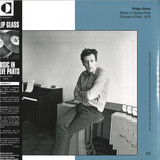
Lost PHILIP GLASS Recordings from 1975 - ORTF
The newly discovered and unreleased concert from 1975 recorded by the Philip Glass
Sextet at La Maison de la Radio, Paris.
The sextet is composed of Philip Glass, Jon Gibson, Dickie Landry, Michael Riesman, Joan
La Barbara and Richard Peck.
Music in Twelve Parts is a set of twelve pieces written between 1971 and 1974. This
performance in France includes part 1, 2, 3, 11 and 12 on a double LP.
Also included a very rare Philip Glass interview from 1974 in his NYC loft during the
rehearsals of this piece, produced for the French radio by Daniel Caux - musicologist and
co-founder of Shandar Records.
A never before released -Philip GLASS (1975) live recordings, released in partnership with
the National Audiovisual Institute - INA.
"A new sound and a new chord suddenly break in, with an effect as if one wall of a room
has suddenly disappeared, to reveal a completely new view." - A. Porter
NCZ007, 'In Memory Of,' brings together Stanislav Tolkachev, VSK, JoeFarr and ONTHEGROUND for a 4 track compilation. Each artist has contributed a track to the general theme of 'broken techno,' with outstanding, stylistically diverse results.
'Ant Parade' by Stanislav Tolkachev opens the record with a hypnotic march. Over a gently lulling rhythm, a bright melody repeats over an eerie and disorientating soundscape. VSK's 'Blue Snake' ratchets up the energy, with skittering percussion and tense, murky bleeps propelling the track frantically onwards.
Nicz records owner Myztical teams up again with Diagnetic Origin as ONTHEGROUND on 'Interstellar Gardening.' A sonorous melody emerges from rattling beats, serving up a heady communion of intangible, elusive euphoria and melancholy. JoeFarr concludes the record with 'I am a Visitor.' Staccato kicks and fuzzed out synths stretch and twist, while a dislocated, brash voice announces itself to the listener.
Payfone bring a double header of NYC styled heat for the inaugural release on their newly launched Otis Recordings. Marrying modern boogie and classic R&B, with cosmic leanings and Balearic touches, Payfone manage to keep all the essence of the early days whilst bringing a contemporary swagger to the floor.
Each element in 'I Was In New York' gets the space it deserves. Palm muted guitars and sashaying synth echoes flutter over the top of a strutting slap bass courtesy of Giulio Granchelli. A simplicity that sings - simultaneously giving your mind the space it needs to drift off into a daydream of sunsets over cityscapes. Introspective, meditative and innocent, Dayna Talley's spoken word vocals lull listeners into memories of tranquil times. Set to be one of 2019's standout songs, its refreshingly original and sure to cut through the noise.
The B side, 'A Prayer For Maya Angelou' takes a Balearic boat out across calming seas. Gravitating around a metallic, pulsating synth, modulated to bounce at points and brood at others, mystic flurries drift in the distance, as pads wash across the horizon. Len Xiang's melancholic tale reverberates throughout, with those sweet sax sounds from Billy Brooks Paul and a spring reverbed guitar riffing off into the ocean - elevating this into pure paradise.
A welcome branching out into the reggae universe, Rocafort is proud to present The Circle of Confusion featuring the legendary sweet falsetto voice of Cornel Campbell. Lausanne Switzerland meets Kingston Jamaica in this heartfelt, stripped back, feel-good homage to the late 70s roots reggaestyle.
The Circle of Confusion are a Swiss production duo: Seb.K (Shakedown productions) and Phil'eas (Black Diamond Sound). Diehard reggae fans, they dared to contact their favourite Jamaican singer and got a result with Campbell delivering the lyrics on the spot, written on the day of Nelson Mandela' death. There's depth and feeling in this wonderfully lilting, plaintive song, typical of Campbell's social consciousness and beautiful soul. Hard to believe it was all strung together in a shiny, clean Swiss studio when the sound is so simply warm and Jamaican. Beautiful run on the keyboards by Jah Lou.
If you were moved by the Rhythm and Sound album of 2001, you will not be disappointed with this splendid roots collaboration. We can only hope there's more to come.
Mystique Sound Explorer Scherbe Is Bursting Out Danceable Groove Science Between Epiphany And Delusion. Urban Misty Visions Of A Past And Current Future Deconstructed And Cludged Together Again, Twisted And Dubbed Into Danceable House.
The Ep Contains 6 Tracks In Mid Tempo, Each Of Them Having A Distinct Emotive And Dense Energy. Ready To Be Played In Clubs As Well As Tailored To Accompany You In Your Everyday Frenzy.
Steady Work By Dear Friends, A Heidelberg (germany) Based Label, Is Feeling Honoured To Disseminate His 3rd Release Featuring Scherbe, Who Used To Live A Long Time In Heidelberg And Is Now Based In Dresden. This Release Fits Well Into Scherbe¥s Discography Who Yet Released A Variety Of Records On Numerous German Underground Labels Like Uncanny Valley, Or*s, Kashual Plastik And Big Bait.
The Brooklyn-born and Berlin-based artist Dustmite returns to his own Supervoid Records imprint with 'Deep In' EP. The warm, percolating melodies, velvety textures and rocky percussion in these four techno tracks create an undeniable sense of positive tension that is deep and impactful, yet still agile and nimble.
White Shadows In The South Seas is the title of a book written in 1919 by Frederick O'Brien as part of a trilogy he wrote based on his experiences living in the Pacific islands in the early part of the 20th century. His book was taken as the starting point for a film to be directed, initially, by Robert Flaherty (famous at the time for his groundbreaking documentary / fiction film Nanook Of The North) with W.S.Van Dyke as his support. The film, ultimately, apart from the title, had little to do with O'Brien's book and Flaherty left the film after a few months leaving Van Dyke to finish it.
I purchased O'Brien's book, along with many others, from Basement Books, a secondhand bookstore in Melbourne/Australia. Part of my 'Islomania' and on going fascination with all things Pacific. When I discovered there was a 1929 silent film based on the book I sought it out and started to present it as part of my 'Live Music/Silent films' repertoire. Tabu by Frederick Murnau, which coincidently also had Flaherty as co-director originally, was the first film I ever wrote / improvised a score for and presented as a live film/music performance. My repertoire extends to over 23 films now.
My eclectic and diverse musical and artistic interests extend into 'Hawaiian', 'Exotica', 'Ambient' and 'Electronic' Music. I have produced several volumes of so called 'Electronic, Ambient, Exotica' on CD and Vinyl, including Kiribati, Globe Notes, Rayon Hula ( on Vinyl, CD and digital format ) and most recently, New Globe Note on Vinyl and White Shadows In The South Seas on CD.
White Shadows In The South Seas features some of the music presented in my live screenings of the 1929 silent film.
The film is the story of Dr. Matthew Lloyd, an alcoholic doctor who is disgusted by the exploitation by white people of the natives on a Polynesian island. The natives dive for pearls, however, numerous accidents occur and one diver dies. In anger, Dr. Lloyd punches Sebastian, the employer. As revenge and to prevent further interruption of his activities, he tricks Dr. Lloyd onto a ship with a diseased crew (thinking they are ill) and his men rough him up and send the ship off into a storm. Dr. Lloyd survives and is washed ashore on an island where none of the natives have ever seen a white man before. Lloyd is rescued and ultimately falls in love with the chief's daughter, who is Taboo, hence Lloyd is prevented from pursuing his love for her. An incident occurs and a young boy is thought to have drowned but Lloyd is able to revive him, earning him points and permission with the chief's daughter. Lloyd begins to realise that the local islanders have no sense of the value of the black pearls which grow in abundance around their island and he starts to dive for them and collect them. One morning the white man Sebastian unexpectedly turns up on a scooner and starts to offer the islanders trade for their pearls. Llloyd tries to interrupt the encounter and is shot and dies. His wife and the islanders morn for his dead body and, symbolically, the passing of a way of life.
Mike Cooper plays - Electric and acoustic lap steel guitars / electronics / Zoom Sampletrack / Kaos Pad / Casio SK1 / Korg Drum Machine / Self Made Instruments.
It also features field recordings made on Pulau Ubin by Mike Cooper during a month as Artist In Residence for The Artist Village / Singapore.
I would like to acknowledge and thank Lawrence English (Room40 Records) for his assistance and encouragement with the original recordings and the CD version of White Shadows In The South Seas.
All music written and played by Mike Cooper PRS/MCPS - except Po Mahina (trad. Arr. Cooper) and Hilo Hanakahi (trad. Arr. Cooper)
Recorded and Mixed at the Steelworks in Rome 2012/2013.
A White Shadow In The South Seas
In February 2014 'A White Shadow In The South Seas' was the title of an audio-visual installation I made at the Teatro In Scatola in Rome, Italy, presented as part of a series of sound installations titled 'Visitazioni' produced by Proposte Sonore.
The essay below, as well as our collection of Hawaiian shirts, Exotica and Hawaiian vinyl records, was an inspiration for this installation.
'..the transformation and reconstitution of the souvenir commodity as an indigenous ethnic art form and a scarce relic of Hawai'i's romanticized past...' from - Clothing and Textile Reasearch Journal - From Kitsch to Chic by Marcia A. Morgado.
And....
Michael Thompson's Rubbish Theory (1979)
' ...a critical aspect of Western culture is the pre-disposition to see objects in terms of two overt categories: the transient and the durable. Objects identified as transient have finite life spans and lose value over time, whereas those identified as durable have infinite lives and over time increae in value....category assignments are arbitrary, but once assigned a category membership determines relative value. Fashion apparel-by defenition-is assigned to the transient category; paintings commonly are designated durables....how is it that transient objects.. ( e.g. Hawaiian shirts and vinyl records ) ..sometimes become durables.
Objects assigned to the rubbish category are largely invisible, have no value and, ideally, no life span. Fashion for example, no longer worn and relegated to the back of the wardrobe has fallen into the covert rubbish category. But rubbish can be rescued and transformed. Thompson says ' What I believe happens is a transient object gradually declining in value and in expected life span may slide across into rubbish. Here it exists in a timeless and valueless limbo where it has a chance to be re-discovered and be successfully transformed to a durable. Such transferes are radical: objects gradually slide from transcience to rubbish, but the transformation from rubbish to durable involves an all-or-nothing leap across two boundaries, that separating the worthless from the valuable and that between the covert and the overt. Things drift into obscurity but they leap into prominence.
The delightful consequence of this hypothesis is that in order to study the social control of value we must study rubbish.
The rubbish-to-durable transformation is accompanied by the development of highly specialized knowledge derived from the discovery of subtle variations and complex details that went unnoticed in the objects transient stage. The discoveries initiate renewed interest in the object and its market value begins to climb. As prices soar beyond the reach of ordinary people, the object becomes available only in high priced collectors' markets. Furthermore, as market values rise, the aesthetic value of the object undergoes a reassessment as well, and it becomes increasingly apparent that the objects intrinsic beauty has been overlooked. Ultimately the object is re -assigned as a durable and becomes recognized as a timeless classic.
Exotica, Ambience and Pacificism - A dialogue with Mike Cooper & Professor Philip Hayward Deputy Pro Vice Chancellor of Research Southern Cross University, Lismore, Australia.
Rebar continue their geography-infused musical journey with the second EP, Lost in New York City. While the first release unveiled the majestic anthropophony of the Japanese capital, this release is centered around the city of New York. As in the previous offering, the three tracks all pertain to different styles, exploring different facets of techno, while carrying the common soundprint of the American metropolis. The first cut unveils a mesmerizing techno construction, while the second makes for a groovy interlude, rounded up by rolling techno in the third track. A mysterious and compelling affair, released on vinyl and digital at exactly one year from the inaugural opener.
Family is a sometimes great, if big, notion. Hard to sustain, most often dysfunctional. At LDDLM, we do not put pressure on anyone, and certainly not ourselves. But bounds are sometimes tightened, some artists we would never consider ours, but most certainly as closed friends.
This is the 3rd EP (a house record) by Antoine Harispuru aka GOLDEN BUG but the first, excitement renewed, in company of IN FIELDS.
They push the boundaries of GB's trademark ghost funk on this EP: BONES features once again Diego Hdez for a smacked out yet epic pop number (we would not call it shoegaze). CRACKS dissolves its ethnic funk into pure psychedelia, SHAKES dubbing itself out into oblivion. All in all, 3 strong bongs. Finally FANTASTIC TWINS (Hippie Dance/Optimo/Microdosing) builds her own wall of sound, expanding BONES into a mind bending prison.
Turn on, tune in, never drop out.
Norwegian artist Tarjei Nyga°rd first touched on the ESP Institute spectrum in 2016 with a limited red flexidisc of Bleusa that accompanied issue 21 of New York City's acclaimed Love Injection fanzine, and since then, his poetic music has been a staple in our arsenal (especially during Summer), for its ability to effectively direct moods is second to none. Across the four tracks on this debut EP, Tarjei paints quite viscerally using the most fundamental of tools—melodic and rhythmic hooks—and as obvious as this may sound on paper, its his deliberate approach to songwriting that brings these productions to life. Bleusa is literally dripping with a sense fantasy and adventure—island pads, golden bent notes, even a cameo bird-call from the infamous Acid House loon—yet Tarjei exhibits a mature level of restraint, a highly sophisticated sleaze recognizable to refined pleasure-seekers. Forus Echo furthers this notion but expands into full-blown rapids of ecstasy, rolling over soft-thumping percussion that mimics the human heart while smothering the listener in euphoric waves of pads and delays. Side B shifts us from the melodic dynamic heard thus far over to a strong rhythmic palette, not acknowledging any specific reference point but loosely hearkening back to early-era turntablism, the demented title track Lost In Lindos is a aquatic beat thats both deep and buoyant, the type of liquid tool that works at any BPM. Øylie closes the EP with a signature ESP vibe that has us lying on our backs, drawing finger pictures in the opium smoke above, feeling the warm embrace of collective consciousness while telepathically harmonizing our plans for a bright utopian future.
When Dunham Records/Daptone producer and musician Thomas Brenneck first heard the close family harmonies of the Sha La Das he had a revelation; he knew he had to get it on tape.
Direct from Staten Island, the four Schaldas, father Bill and sons Will aka Swivs, who also toured the world playing keyboard for Charles Bradley and his Extraordinaires, Paul of Paul and the Tall Trees and Charles Bradley and his Extraordinaires, and Carmine had come into the studio in Brooklyn to record background vocals on Charles Bradley's Victim of Love. It was a passion that drove Brenneck from the very beginning.
'Hearing them sing together in the studio was incredible', says Brenneck. He collaborated with Bill Schalda writing songs and applying harmonic sensibilities rooted in doo wop, blues and soul. It wasn't a stretch for Bill, after all he'd been second tenor when still a teen in Brooklyn vocal group, The Montereys in the 1960s (their 45, Face In The Crowd/Step Right Up on Blast records sells for $500 these days) who would play venues from neighborhood bars to the 1964 World's Fair in Queens.
'Bill is the genuine article, just like Charles Bradley and Sharon Jones, he came directly from the source,' says Brenneck. Indeed, Bill Schalda was right there amongst doo wop and r&b groups of the era, singing Moonglows and Flamingos tunes.
'You'd go out on the street and constantly hear a bunch of guys singing on the corner, they'd finish playing handball in the schoolyard during the day and then they'd start singing at night,' says Bill. 'We were all just guys in the neighborhood in Brooklyn, who gradually found each other.'
After their children were born, Bill and wife Linda moved the family across the Verrazano-Narrows bridge to Staten Island. Growing up, sons Will, Paul and Carmine remember summer nights singing group harmonies on the stoop of their home with their father Bill guiding them. 'He would bring us out on the stoop on Staten Island and he would teach us each parts of say, the sesame street song - we were his backing group very early on - that was fun,' says eldest son, Will.
On this, their debut, the talent is harnessed in 11 songs, each tender-voiced delight delivered with absolute conviction combined with musicians that have help define the Daptone/Dunham Records sound including Brenneck, Homer Steinweiss, Dave Guy, Leon Michels, Nick Movshon and Victor Axelrod. 'I wanted to take the Sha La Das outside of the doo wop genre,' says Brenneck. 'To take the whole vocabulary of doo wop harmony and reapply it to soul - so you get super soulful harmonies along the lines of The Manhattans & The Moments.'
From the opening atmospheric guitar strum of Open My Eyes via a walk along the Coney Island boardwalk catching the last glimpse of sunlight at dusk of Carnival to the sublime crescendo of harmonies of the winsome Love in the Wind, each song evokes a deeply personal yet universal yearning that none of us can escape. Quite simply every song yields magic.
There's something special when a family can meld voices in close harmony. The Everly Brothers had it, The Beach Boys had it, the Schalda's have it.
Samo Records is very pleased to introduce the debut EP from Russian Chandeliers, a new project by Julian Grefe (Pink Skull) and Fringe Society (formerly known as Quell). Berliners by way of Philly and Athens (Greece), respectively, the studiomates have perfectly fused the best bits of their signature styles to create a record that's equally suited for headphones and dancefloors.
"Worm In Worm Out" (A1) kicks things off with a chunky, chuggy rhythm that indeed worms its way into your brain, sprinkling vaguely psychedelic echoes throughout.
"Stay In Seattle" (A2) is a slow-burning charmer that layers bleeps and sizzles over a dark and mesmerizing bassline.
Zombies in Miami put a slightly spooky, frantic spin on "Stay In Seattle" for their mix (B1), turning the moody paranoia into a deliciously foreboding frenzy.
MR TC's take on "Worm In Worm Out" (B2) ups the psychedelia, tones down the bass, and gently hypnotizes you into the best kind of euphoric haze.
"Kosmonauten Aceed" (B3) is an immediately captivating slice of industrial-laced acid with just the perfect amount of krautrock drizzled in.
- A1: Yoko Hatanaka - More Sexy
- A2: Masumi Hara - Kimi No Yume
- A3: Yuki Nakayamate - Silhouette Call
- B1: Mari Kaneko - Get To Paradise
- A4: Atsuo Fujimoto - Theme Of High School Student
- B2: Tomoko Aran - Hannya
- B3: Masako Miyazaki - Fantasy
- C1: Junko Sakurada - Watashi No Koukoku
- C2: Kangaroo - Sunshine Bright On Me
- C3: Maiko Okamoto - Stranger's Night
- C4: The Fad - Singing Lady
- D1: The Eastern Gang - Magic Eyes
- D2: Rinda Yamamoto - Crazy Baby
- D3: Tomoko Aran - I'm In Love
2024 Repress
midnight in tokyo is a compilation series that aims to be the perfect companion to nights in tokyo, collecting tracks by japanese artists that sound best at night. while vol.2 focused more on '80s jazz fusion, the latest installment, vol.3, picks up where vol.1 left off, bringing together forgotten soul, disco, and new wave gems. the compilation opens with japanese rare groove classic 'more sexy,' a provocative song by 'the queen of sexy songs,' yoko hatanaka. 'kimi no yume,' from the album yume no yonbai by the wandering poet masumi hara, is one of the best balearic acid folk song to come out of japan. 'silhouette call' is an electric bossa nova track—in the vein of antena—taken from a rare album called octopussy by yuki nakayamate, a singer songwriter who also worked as a backing vocalist for motoharu sano. 'theme of high school student' is a dubby cut featured on the soundtrack to the japanese '80s film kougen ni ressha ga hashitta, written by atsuo fujimoto of colored music—one of the key artists in the recent wave of global interest in japanese music. 'get to paradise' is a stone cold funk jam by mari kaneko, who was known as the janis joplin of shimokitazawa in her heyday, and is now known as the mother of the drummer and the bassist of popular rock band rize. following that is one of japan's greatest new wave disco track, 'hannya,' taken from tomoko aran's popular third album fuyu-kukan—produced by masatoshi nishimura who was part of the friends of earth project with haruomi hosono. masako miyazaki—whose rendition of seawind's 'he loves you' is a fan favorite—puts her own spin on the earth, wind & fire classic, 'fantasy,' singing in her accent-heavy english which gives the song an undeniable character. 'watashi no koukoku' is a certified disco boogie classic by popular singer junko sakurada. the brazilian-esque jazz fusion, 'sunshine bright on me' is by a fusion group called kangaroo, who were often billed as 'the japanese shakatak.' 'stranger's night' is a synth-pop number by pop idol maiko okamoto, which bears a suspicious resemblance to rah band's 'the shadow of your love.' electro-pop disco 'singing lady'—off the sole album released by the one-off project the fad—sounds like something giorgio moroder could've cooked up. 'magic eyes' is a disco anthem recorded by songwriter tetsuji hayashi's disco project, the eastern gang. following that is japanese soul gem 'crazy baby,' found on a rare 7 inch entitled minato no soul by rinda yamamoto—also composed and arranged by tetsuji hayashi. and last but not least, closing out this collection of 14 japanese rare groove goodies is 'i'm in love', a bittersweet mellow dance number by tomoko aran.