Lee Perry's time at WIRL Records, later to be renamed Dynamic Sounds Studios, was a very productive time
in his career. A run of great singles and the shaping of a new sound, the beginning of what we know today as
Reggae .
Lee Perry (b. Rainford Hugh Perry, 28 March 1936, Hanover,Jamaica) began his entry into the music business at
the age of 16.Moving up to Kingston Town and working around various Sound Systems, before finding
employment at Coxonne Dodd's Studio One set up, in the late 50's early 1960's. Perry started out as a record
scout, organising sessions and supervising auditions at Dodd's record shop on Orange Street. Helping to make
hits for Delroy Wilson ( 'Joe Liges','Spit In The Sky') and the Maytals, which would lead to his own vocal records
released through Studio One.The musical backing for which, came from legendary Studio One house band The
Skatalites. Another important relationship for Perry, his first recordings with Bob Marley came in the form of
the Wailers, also providing backing, alongside the Soulettes who featured Rita Marley. Cutting such tunes as
'Chicken Scratch' around 1965/1966. This tune was also to provide him with one of his future nicknames
'Scratch'. A dispute over credits and money saw Perry leave Studio One and work with various producers
including Clancy Eccles and J. J. Johnson, before arriving at the door of producer Joe Gibbs in 1967. Here he
would write songs and produce hits for artists such as, Errol Dunkley and the Pioneers. A tune cut during his
time with Gibbs, voiced a snipe at fellow employee Dodd, a trademark that would become an outlet for his
frustrations in the business.This particular tune 'The Upsetter' would also provide another moniker and a name
for his label 'Upsetter'. Again lack of musical credit and financial reward saw Perry move on this time to WIRL
(West Indies Records Limited) Records, working alongside manager Clifford Rae, who would provide studio
time and pay for pressings in return for helping to promote and distribute WIRL product, which Perry would
carry out on his trusted Honda 50 motorcycle around Kingston town.
This period at WIRL saw some inspired work from Perry. 'Run For Cover' was another musical blow to a
previous employer, Coxonne Dodd and featured the Sensations on backing vocals and Lynn Taitt's guitar
picking skills. 'People Funny Boy' was a massive hit for Perry going on to sell over 60,000 copies. Joe Gibbs
would be at the end of this musical attack. Perry had felt Joe Gibbs had turned his back on him, after he had
provided hits for groups like, The Pioneers amongst others. The song would be one of the first records to
feature a New Beat (Reggae) inspired by the sounds coming out of a Pocomania Church, Perry had heard one
night.The congregation inside, wailed in a more slower way than the current musical style of the time Ska!. Perry
worked up this new style with Clancy Eccles, who would come under attack himself in 'You Crummy'. Their
closeness, which as detailed in that song would find them, 'Even shared the same Gal' but 'Now it's plain to see we
reached the end'. 'Set Them Free' was an answer record to Prince Buster's 'Judge Dread' (which had
featured Perry on it) a plea to the Judges in Jamaica that handed out extremely harsh sentences to the young
offenders of the time. The track was cut on the same rhythm as 'Run For Cover' . 'Django Shoots First'
inspired by the Spaghetti Western film of the same name, features Sir Lord Comic. One of the early DJ's who
used a jive talking style over rhythms. 'Night Doctor' was a hit instrumental that featured the organ talents
of Ansel Collins, that really push the tune along. 'Something You Got' was a cover of an USA R& B track by
Chris Kenner and 'Wind Up Girl' was cut at the same session. 'Water Pump' was a rude style track that
was cut later and originally released in 1974.As was 'People Sokup Boy' a later version of 'People Funny Boy'.
'Labrish' which means idol talk and gossip, was one of the first great talk over tunes that features Lee Perry
and producer Bunny 'Striker' Lee talking about the Political situation in Jamaica at the time and their own
financial situation and stories of various comrades.The track was originally released in 1973.
Bunny Lee would play a major part in lee Perry's career around this time and they were very close, often
sharing sessions and rhythms. Ironically it would be Bunny Lee that took over Perry's roll at WIRL and become
responsible for the labels products in years to come. Clifford Rae who give control to Bunny for a lot of the
WIRL product and even gave him his shop 101 Orange Street. So here we have a collection of music born out
of a time spent at WIRL Records and providing an important chapter in Lee Perry's career and indeed to the
story of Reggae itself.
Hope you enjoy the set.
Cerca:indeed
Boris Werner is known for producing quality music and filling venues with crowds who can't get enough of his energetic and inspiring sound. These are a couple of the reasons why Boris Werner stands with us here today and proudly presents the Slow Dancin' EP, and we think you are really gonna love it. Strings and a relaxed rhythm user in the title track, complete with ambient vocal samples. Then, all at once the bass hits and the kick fills the void; instant groove. A jumpy synth dances over the track and invites friends to the show. Before you know it you've got a full track on your hands. Don't be fooled by the title, as it is indeed misleading. There will be no slow dancing to this gem. 'Missing Out (Dedicated to Ed & Emma) is a bit deeper, but with a warm feel (e-piano on reverb). Then, like 'Slow Dancin'', it catches you off guard with the beat. This is a feel good track, perfect for evenings, deep nights, and early mornings. Not to mention some of the years last open-air festivals. 'Did It In Miami' opens with caution, an indecisive kick with other percussive elements slowly build into an invigorating tech house beat. Grimy vocal samples creep in and the bass line slips under the beat, holding up the track well on a packed dancefloor.
Until now, David Mayer needs to be on every radar as a young producer, breathing new life into classic Techno-virtues. Within his productions it seems to be the men-machine pulling the strings. They are grooving through plant floors, they are pumping blood into boilers and with just subtle manoeuvres, they are altering the soil temperature from stonecold to sweat inducing, depending on the current requirements.
Mayers new offering is directly taking on those qualities, while entitling it 'Celsius'. It is indeed glowing floormaterial. It's taking a rampant Techhouse-beat into a well heated Techno-basement, to add more and more condensing arrangements and finally open up for the instantly catching synth-hook. While he's at it, Mayer controls a whole lot of scenes on the side. What he is offering here as particular finetunings and detailed soundmanipulations might lead into hourlong journeys under headphones. At the same time, the floor-efficiency of this tune couldn't be more in your face.
Then there's the synth-tool on the flipside, leaving the kickdrum's thickness behind, opening the door a bit more into the crystal clear synth-arrangements. Without a doubt, it'll equip you with a tool, that's letting the crowd feel save in the believe of having a little breather, to finally cook them in their own excitement in almost no time.
Oh Holy Molar is the second album from UK trio Felix. The group produces a bewitching, minimal chamber pop that works as the perfect framework for singer/songwriter Lucinda Chua's oblique and emotionally immediate stories of superstition and searching for protection against bad omens.
*As a follow up to their debut You Are The One I Pick, the band return with a collection of songs with a sound stripped back to its very core. Something is said to have "teeth" when it has the ability to make an impact. This record certainly has "teeth", and sharp ones at that.
*" The album was recorded in a vast, spooky 1940s cinema in Nottingham, England, now converted into a studio. After recording was completed the band discovered that underneath the live room lay an abandoned Dental Laboratory. "Oh Holy Molar" indeed.
*" Since the release of the rst Felix album, pianist/vocalist Lucinda Chua, also an accomplished photographer, has been working on a number of projects, most recently with Wallpaper* in Detroit. Guitarist Chris Summerlin has been recording and touring with his new band Kogumaza. The group is completed with the recent addition of drummer Neil Turpin who, when not performing with Felix, can also be found touring the world with French composer Yann Tiersen.
press quotes for You Are the One I Pick
'It's a gateway into another headspace, one aglow with uncertain magic. As statements of romantic intent go, 'Death To Everyone But Us' must represent either the most straightforward, honest distillation of the love song, or the creepiest.' BBC
'In Felix's world, everyday mundanities give rise to furtive explorations of human interaction and ineptitude in a manner as oppressive as it is oddly and honestly addictive.' Drowned in Sound
'The duo keep things refreshingly simple, with single strands of piano, guitar, and cello in quiet symmetry, leaving the listener ample room to savor Felix's knotty, enigmatic songcraft.' Pitchfork
'There is mystery and elegance in the marrow of this music, and I imagine this record will prove to stand the test of time, reserved to be pulled out for the perfect accompaniment to just the right brooding but whimsical mood.' Delusions of Adequacy
track list:
1.The Bells 2. Sunday Night 3. Oh Thee 73 4. Don't Look Back (It's Too Sad) 5. Hate Song 6.Oh Holy Molar 7. Blessing Part I 8. Blessing Part II 9. Rites 10. Who Will Pity the Poor Fool 11. Pretty Girls 12. Practising Magic 13. Little Biscuit
With his sophomore album Ghost People appearing on 2011's end of the year charts for the likes of Mixmag (#6), Clash Magazine (#9), DJ Magazine (#9), Data Transmission (Album of the Year), Martyn returns to Brainfeeder to release a follow-up 12' this March.
The 12' leads with "Hello Darkness", previously unreleased and exclusive to the release, Martyn shuffles through a rhythmic bassline and feeling of, indeed, darkness from the very first beat. In typical Martyn fashion, the track skips its way through genre conventions, landing in a flux between 2-step, driving techno and old rave (the latter specifically heard in his ethereal and scaling upper melodies). "Hello Darkness" could lend itself to the rawest, grittiest warehouse, yet simultaneously breeds a subtle feeling of elation and release, and keeps the listener guessing with a variety of quirky sound collages.
It also features a remix of "Bauplan", Night Slugs bosses L-Vis 1990 and Bok Bok bringing the most sinister corners of London into their remix, with a heavy grime lean and a pervading feeling of tension. Erratic samples (sounds of a tweeting bird one moment, the cocking of a gun the next) appear in-between a snap beat, metallic stabs and an apocalyptic build-up of percussion and synths. Pulsing in and out of a highly volatile atmosphere, almost as if the track is alive and breathing, this "Bauplan" almost feels like an unrelated beast until Martyn's melody lines start to unfold halfway through the track.
To finish there is an exclusive remix of "We Are You In The Future", a favourite from the Ghost People LP amongst critics and DJs across the board. Techno's notorious man in the red mask - Redshape - steps up to create a deep and dark Detroit interpretation of Martyn's freewheeling, sci-fi-enhanced joyride. Laced with ominous vocal samples ('It may be an accidental side effect of the drug'), the future takes on a slightly more dystopian feel with Redshape's melancholic strings, unpredictable percussion builds and a lingering, creeping reinterpretation of the track's original melodies. A definitive nod to the epic work of Derrick May and Carl Craig, with a hint of Kenny Larkin's intricate builds.
"By the time the imitators catch up, he'll be light years ahead." DJ Mag
Up and away / To your journey to the sun / Drink your rocket juice / Fly away (Hey, Shooter).
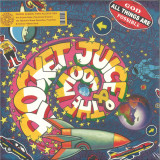
High up in the skies, amongst the clouds, Rocket Juice & The Moon was born. Literally. It happened back in 2008, when Damon Albarn, Flea and Tony Allen convened on the same Lagos flight, to play and exchange musical ideas in that city as part of the Africa Express collective. Relishing a shared enthusiasm for one another's work, and bonding immediately, there and then the triumvirate laid down the blueprint for Rocket Juice.
Still, more than a year passed before conditions were set for three weeks together at Albarn's West London studio, recording and refining two-dozen startlingly out and deeply funky instrumental grooves. The next stage was to invite onboard some extremely talented friends, with further sessions in Dallas, New York, Chicago and Paris... Erykah Badu, no less, queen of contemporary soul. Three companions from Africa Express: Malian singer Fatoumata Diawara, whose debut album has topped World Music charts since its release last Autumn; her multi-talented compatriot Cheick Tidiane Seck, whose prodigious keyboardism has lit up releases by artists ranging from Youssou N'Dour to Hank Jones; the young, Ghanaian rapper M.anifest, quizzically existential, switching seamlessly between Twi and English. And the Hypnotic Brass Ensemble, long-time stalwarts in the Honest Jon's set-up — since one of the team discovered them busking near the shop in Portobello Road, on his lunchbreak — with a second album for the label due in May... Finally, the tracks were dispatched for mixing to Berlin, to be meticulously honed, polished and envenomed by Mark Ernestus, one half of the legendary Basic Channel and Rhythm & Sound partnerships.
The result is Rocket Juice & The Moon — out March 26, 2012, on Honest Jon's Records — a triumphant exploration and proliferation of kinetic Afro-funk rhythms: organic, exuberant, communal music-making, evidenced by the project's live debut on stage as part of the Honest Jon's Chop Up in late 2011, which hit London, Marseille, Dublin, and Cork to such great acclaim (witness the flurry of smart-phone film-clips uploaded in the days thereafter).
From the inaugural bars — that absurdly funky slice of instructional timekeeping, 1-2-3-4-5-6 — the liquid pulse of Fela Kuti's classic recordings drives the action through a suite of 18 shape-shifting compositions. The greatest drummer in the world has never sounded so good as he does here. His intricate cross-patterns jostle and lock with Flea's nimble, rumbling bass riffs. Joined by Seck on There and Extinguished — 'when you dispose of something burning, be sure it's out' — Albarn's keyboards spray synth fusillades up top, over, and under... splicing into the mess of wires running between the freaked Afro-disco of William Onyeabor and the space-jazz-moog of Sun Ra. The HBE brings extra intensity and drama to Leave-Taking — likewise Flea's trumpet to Rotary Connection — teasing out the haunting melody coiled in the mix.
Where the best of vintage Afrobeat sides sustained their concentrated energies over the course of sprawling, marathon jams, RJ & TM manages something altogether different: the group bottles the idiom into capsules of funk... and real songs. Beautifully buoyed by Erykah Badu's unmistakable vocals, Hey, Shooter brilliantly traverses metaphysical spaceways sans any semblance of noodling. Lolo and Follow-Fashion — featuring the open-hearted sensuality of Diawara's singing, M.anifest's quick, brawny science, and more brass blasts — play like its musical cousins or codas. Indeed, the album's shrewd sequencing creates the composite effect of tracks working both individually or within the context of an extended song-cycle.
The lovely ballad, Poison, is bittersweet and ruminative: 'If you're looking for love, beware the signs / They will paralyze you one by one / Poison, it will only break your heart.' Down-tempo and dubby, Check Out and Worries amplify the range of styles and moods. And by the time of Fatherless — a chugging Afro blues that evokes John Lee Hooker lost in Lagos, one gets the sneaking suspicion there's very little outside the reach of this collective's inventive musical grasp.
There is, in fact, a palpable openness pervading Rocket Juice & The Moon — the sense of a limber willingness to follow creative impulse — right down to how the group acquired its name. When Ogunajo Ademola — the Lagotian commissioned to do the album's cover artwork — dubbed his submission 'Rocket Juice & The Moon', it quickly morphed into the formal name of the project, like trying to hold onto mercury.
Surely, the stars above also approved.
Kaspi & Stride is a new project from Justin Tripp, best known as one half of the Georgia equation. Leanings has its origins in rigorous yet laid back studio sessions, dual personal practice sensibilities that seem to get at Tripp’s creative ethos as well as any descriptors might. The material here was born out of collaborative studio sessions with multi-instrumentalist Jimy Seitang (Conga Square/Stygian Stride) - the “Stride” of K&S. The music from these sessions has been reworked and recontextualized by Tripp to form the eight tracks found on the record. These compositions are heady and diverse, anchored by infectious drum patterns and intricate electronics, capably occupying a somewhat hard to define space between “club ready” and “home listening.”
“Vishing” throbs with a wide-eyed intensity, infused with the type of deceptively rudimentary synth stabs and bass swells that wouldn’t be out of place on an early Hype Williams record. With contributions from Mary Lattimore and Jon Leland, “Kaptoxa” charts a more ethereal, if no less dizzying, course. Indeed, this is an album that navigates dense, tactile passages and airy, celestial planes with aplomb, making a case for Tripp’s prowess as both composer and arranger with equal priority. The most important thing is to keep moving.
"Actoma" is the new full length record by New York–based musician James Emrick. Emrick may be best known for his work with Kinet Media, handling sound design and scoring for a number of their projects. He utilizes an array of granular and feedback processes within Max/MSP environments to arrive at an idiosyncratic form of computer music that feels willfully opposed to operating within the sediments of the genre. Techniques such as real-time granulation of samples, Shepard tones, grain diffusion, and complex windowing allow Emrick to dramatize his source material in fascinating ways, and each moment of "Actoma" teems with widescreen textural allure. Perhaps Emrick’s greatest accomplishment is creating a music that remains rigorously committed to severe levels of abstraction while avoiding sterility and coldness entirely. It is a strange and otherworldly landscape indeed, but there is a consciousness there to perceive and record it.