repress !
A lovely selection of mixes from Paolo Baldini’s Dubfiles, all mixed
at his Alambic studio in San Foca Italy. The vocal is supplied by Al Brown and music is from his band from the 80s the Inner Force.
There are 3 rumbling dubs as well as the opening vocal cut from
Al Brown. We have added some keyboard action from Toike Mitsuhiro.
The best of the traditional elements of Jamaican music, with modern mixing, and all done with a strong sense of respect towards
the original recording and playing. Comes in a custom Pressure Sounds sleeve.
Buscar:inner sense
Keiji Haino/Jim O'rourke/Oren Ambarchi
With pats on the head, just one too few is evil one too many...
- My “Watashi Dake?” Is Definitely Not Included In This Unequal Treaty, Is It?
- Right Brain, Left Brain; Right, Left; Right Wing, Left Wing. Just How Many Combinations Can Be Made From These?
- “Critical Consciousness?” That’s Been Abandoned In Corner Of A Shower Room In A 53-Storey Apartment Building Inhabited By Extra-Terrestrial Lifeforms…
- I Thought I Had Pulverized It Summarily But There Are Just Too Many Who Lack Reality Or Who Are Cowards So I Cannot Change A Thing
- E1: Still Divided Into Pieces? Let’s Reconnect Them Recognise That You Are A Point And The Longest Line Let It Become Light
- I Can No Longer Sense That Sacred Feeling Of Expression Just The Loitering Of Vulgar Vibrations That Can Only Be Described As A Half-Hearted Class Reunion Will You Consent To This?
- There Are Always Things I Wish To Say But I Can Only Convey Them In This Language August 6 August 9
The heavyweight trio of Keiji Haino, Jim O’Rourke and Oren Ambarchi return with their 12th and most epic release to date, the triple LP With pats on the head, just one too few is evil one too many is good that's all it is. Documenting the entirety of their final performance at the dearly departed Roppongi home of Tokyo underground institution SuperDeluxe in November 2018, the music spread across these six sides splits the difference between the guitar-bass-drums power trio moves and experiments with novel instrumentation that have defined the trio’s decade of working together. Containing some of the most delicate music the three have committed to wax since the gorgeous 12-string acoustic guitar and dulcimer tones of Only wanting to melt beautifully away is it a lack of contentment that stirs affection for those things said to be as of yet unseen (BT011), this wide-ranging release also offers up some of their most blistering free rock performances yet.
The side-long opening piece finds Haino on a single snare drum in duet with O’Rourke on unamplified electric guitar, playing in the lovely post-Bailey vein heard on his classic 90s recordings with Henry Kaiser and Mats Gustafsson. Spiky dissonance and ringing harmonics interweave with flowing melodic fragments as Haino single-mindedly explores the resonance of the snare like an untutored Han Bennink. On ‘Right brain, left brain; right, left; right wing, left wing. Just how many combinations can be made from these?’, O’Rourke moves to synth and electronics, joined by Ambarchi on drums, who at first focuses on sizzle cymbals before hypnotic cycles of gentle tom rhythms combine with electronic burbles and flutters to suggest a dream collaboration between Masahiko Togashi and Jean Schwarz. Ambarchi’s percussion is then joined by Haino on wandering, overblown flute, before the man in black switches back to the snare for a bizarre, stuttering drum duet.
For the first trio performance, Haino makes another new addition to his seemingly infinite catalogue of instruments, this time a homemade contraption he refers to as ‘Strings of Dubious Reputation’. Joined by O’Rourke on increasingly spaced-out electric guitar and Ambarchi on skittering percussion, Haino’s wonky, slack strings adds a definite ‘musique brut’ edge to this side-long performance, certainly one of the most enchantingly odd in the trio’s discography. When the group reconvene for the second set, spread out across the final three sides, they seem ready to breathe fire from the first instant. O’Rourke slashes distorted chords on the six-string bass, Ambarchi breaks into his signature irregular caveman thump, and Haino squeals and squawks on heavily delayed oboe before unleashing an overpowering electrical storm when he first picks up the guitar. For over half an hour, the trio pound out one of their most relentless performances, a constantly rearranging kaleidoscope of tortured fuzz guitar, insanely busy bass riffing and propulsive, tumbling drums. A hushed atmosphere initially reigns on the final long piece, given the mournful title ‘There are always things I wish to say but I can only convey them in this language August 6 August 9’. Haino’s clean guitar strumming calls up the shimmering tones of his PSF classic Affection, gradually building to a surging wall of sound, bass and drums lumbering through a roar of jet-engine guitar. Arriving in a deluxe trifold package with photos by Lasse Marhaug alongside inner sleeves with extensive live images, this epic release is perhaps the most remarkable document yet of this unique trio’s stamina and continuing inventiveness.
Samosa Records quickly follows up the first volume of Afrikano treats with Volume 2; a veritable melting pot of Afro beats and rhythms packed in to an exceptional four tracker.
Kicking the EP off on the A-side is Vincent Galgo and J’ngolo. This hypnotic Afro sizzler takes full advantage of the effortless bass, congo beats, African horns and (subtle) funky guitar. Add the mesmerising chanting and you have a perfect ‘Bunny Chow’ of a tune that will tantalise the tastebuds for a long time after the music has stopped. Second helpings? Why not?
A2 unleashes ‘Zaire’ by the supremely talented Matalo! Dark and broody beats take centre stage with this one, as you’re slowly enveloped in a ritual you never knew you were part of but now you can’t help sway with the rest of the worshippers. ‘Zaire’ is one of those rare tracks that you feel could create fire if you let it. With sweeping synths, tribal chanting and a detached sense of being, this monster lives under your bed and waits for lights out. Beware!
On the B-side Leslie Lello ups the tempo with ‘Alcyone’. Solid, punchy bass, driving guitar and gorgeous piano riff and vocal combine with a synth lead you absolutely need in your life. The track morphs and transforms into a full-on (almost housey) stomper; nailing its tribal colours to the mast with intent. A real beast of a tune.
Closing this superbly diverse EP is label boss De Gama and ‘E.T.A’. You know De Gama doesn’t mess about. You know De Gama wants to hit you with all he has and with ‘E.T.A’ he unleashes his ‘inner Chief. Indigenous beats pound, roll and build up to a Ramkie guitar infused chorus that’s as joyful, uplifting and inspiring as the dawn itself. A genuine, incredible slice of Afrikano from a master of the genre.
Afrikano Vol. 2 proves once again that Samosa Records know this genre like no other label out there. If this isn’t in your record box on release day, then we simply can’t be friends.
Seven suites of deep and sprawling sonic meditations built around ‘call and response’ improv sessions between Randy Raine-Reusch and Michael Red.
Slow and tempered recordings of Asian flutes, African harps, temple gongs and a myriad of obscure instruments from Randy Raine-Reusch's deep collection mutate and ebb into swirling gossamers of tone. Sonic incantations stretched and magnified further by Red's Sends. An otherworldly play between light and shadow worlds; at times idyllic and light-filled, at times dark and eerie– all engrossing. Dream-reality reconciliations weave between the spectral world of Michael Red's sound processes and the direct physicality of Raine-Reusch's playing. The tension across the pieces builds between the live playing and processing techniques, dutifully revealing a growing familiarity with collective transcendence through sound (bigger than the sum of its parts). Real-time interactive dream music.
Initially realized over the course of a few days in Randy’s instrument museum in Vancouver BC December, 2014 'ERAS' is made up of processed, and sometimes multi tracked, improvisations between Randy and Michael. Through these sessions Randy would choose instruments he sensed possibilities within, and Michael then revealed and sculpted these possibilities. Both resonating, sensing sonic structures, environmental nuances, and further worlds in each other’s art, all within the moment. Being present for each other, they acted on instinct, trusting a first thought, trusting each other; committing, responding to that commitment, then mutating and letting go. Always moving forward, synthesizing and letting the living moment lead the way.
The recordings were left to distill and mature for many years before the composers felt it was ready. With minimal judicious edits and a very light dusting of FXs, both careful to preserve the direct and intuitive process that permeates the recording, ERAS now emerges.
Tricatel is proud to present, in a limited edition of 777 hand-numbered copies, the superb double vinyl/book dedicated to 7×7, inspired by Bertrand Burgalat.
Seven notes in the scale, seven days in the week, seven colors in the rainbow, seven wonders of the world, seven virtues and seven sins, seven ages of life, seven samurai, seven dwarfs for Snow White… Under the sign of 7, Belgian artist Jean Pierre Müller, in close collaboration with seven music legends (Robert Wyatt, Archie Shepp, Sean O’Hagan, Mulatu Astatke, Kassin, Nile Rodgers, Terry Riley), has conceived a magical project combining visual and sound compositions, in all senses and meanings.
In the summer of 2012, 7×7 was first presented to the public in its entirety at Edinburgh’s Summerhall, the start of a series of high-profile exhibitions and shows that have taken 7×7 from New York to Cannes. Ten years later, Jean Pierre and Tricatel would like to dream again with you, this time of a physical object celebrating 7×7 and offering the general public the opportunity to own a piece of the 7 colors dream.
This art and music object is a Gatefold double-vinyl, comprising two white vinyl records in printed inner sleeves and a 64-page booklet in the center, like a book.
Dais Records, das in LA/NYC ansässige Label, das klanglich ausdrucksstarke und visuell dynamische Künstler vertritt, ist mit dem analogen Innovator und Produktdesignstudio Retrospekt eine Kooperation eingegangen. Das Vermächtnis und die Tradition von Dais passen hervorragend zum Leitbild von Retrospekt: "Wiederbelebung von Retro-Tech für eine neue Generation". Das Ergebnis ihrer ersten Zusammenarbeit ist ein schickes, weißes, limitiertes Exemplar des tragbaren Kassettenspielers CP-81 von Retrospekt, das eine exklusive 19-Track-Kompilationskassette mit unveröffentlichtem Material aus den Reihen des Labels mit dem Titel C23 enthält. Nathaniel Young, Kreativdesigner bei Dais, hat die Standardpräsentation des CP-81 sowohl für den Player als auch für die Verpackung neu gestaltet. Die weiße Dais-Edition des Kassettenspielers wird in einer weißen Schachtel mit schwarzem Text verpackt, zusammen mit einem Satz weißer Dais-Kopfhörer und dem C23-Compilation-Tape. Das Gerät verfügt über alle wichtigen Funktionen eines Kassettenspielers: Abspielen, Vorspulen, Zurückspulen, Aufnehmen und wird mit einem verstellbaren Dais-Kopfhörer geliefert.
Zu den Funktionen gehören: Wiedergabe, schneller Vorlauf, Rücklauf, Aufnahme, Mikrofonbuchse, Kopfhörerbuchse, Typ-C-USB-Stromversorgung, Batteriebetrieb möglich.
Enthalten sind: Tragbarer Kassettenspieler, C23-Kassettenband, 2x AA-Batterien, Verstellbare Dais-Kopfhörer, Benutzerhandbuch.
Der Dais x Retrospekt Kassettenspieler ist auf 1000 Stück limitiert - die Kassette wird nicht separat verkauft.
Der Compilation-Titel C23 bezieht sich auf die Katalognummer (DAIS223), das aktuelle Jahr und ist eine Anspielung auf die kultige britische Indie-Kassettensammlung C86, die 1986 einer Ausgabe des New Musical Express (NME) beilag. C23 enthält unveröffentlichte Tracks von High Vis, High-Functioning Flesh, RIKI, Private World, Helm, Tor Lundvall, CoH, AURAGRAPH, ADULT., Drew McDowall, SRSQ, Cold Gawd, Remixe von SPICE und Cold Showers sowie Demos von Body of Light, Choir Boy, VR Sex und Xeno & Oaklander.
[m] CAMINO DEL SOL [ANTENA COVER]
Having gathered up praise from Mary Anne Hobbs, Cerys Matthews, Jamie Cullum, Gilles Peterson, Huey Morgan, The Guardian, Jazzwise and more, for his lauded ‘Crisis & Opportunity’, drummer and composer Myele Manzanza returns with the fourth instalment of his series, titled ‘Meditations’.
On ‘Meditations’, we see Myele revert to a purely acoustic line-up, channeling a focused and razor-sharp return to his Jazz roots. Showcasing an incredible level of musicianship between three musicians at the top of their game - including Matthew Sheens (Ross McHenry, John Patitucci) on piano and Matt Penman (Joshua Redman, SFJAZZ Collective) on double bass - the trio exchange motifs over the length of 7 tracks.
Opening proceedings with frenetic rhythmic improvisation, complimented by melancholic and cinematic layers of sound, ‘Crayford’s Room’ is a tribute to Myele’s musical mentor back in New Zealand. Remembering his time as a student in Wellington, Myele shows his deep connection to his origins, manifesting itself as lament on ‘Winter’ and ‘Homesick’. Introducing hypnotic, contemplative melodies take centre stage on ‘Something Old Something New’ (the first single to be released from the project)’ It maintains a sense of tension and intrigue throughout, and intensity rises to a crescendo sending sonic particles sprawling into space.
Intuitive, darker and deeply contemplative, Myele shares his innermost thoughts on ‘Crisis and Opportunities Vol.4 - Meditations’. He divulges:
‘The personal angst and existential frustration I was going through across 2020 - 2022 I believe is well reflected here. The album is deeply informed by the musicianship and sound of my trio, Matthew Sheens on piano and Matt Penman on double bass. Knowing that musicians of their calibre were going to be involved gave me licence to go further in my writing, deploying odd time signatures, sharing the melody roles across the piano and the bass, and delving deeper into the nuances of what the acoustic piano / bass / drums trio can do. The compositions present a challenge even to the best musicians, and I knew that it was essential to have a team on this level to really move the music beyond an academic exercise and draw out the emotion and colour from the material.’
The composer behind one of the most sensational breakthroughs in Danish music invites you on a crackling, ever-changing and deeply personal journey. His third album Atmospherics drops after a decade in which Mike Sheridan has searched deeply to find and capture his inner sound.
Films, theatres and art museums have benefited from Mike Sheridan‘s sense of sound and melody for the past 10 years. An album has been a long time coming because, in the wake of his breakthrough at the age of 16, he needed to listen extra closely to his inner sounds.
With Atmospherics, he unfolds the music in a meeting between who he once was and who he is today.
Three years ago, he began to create what is now the album Atmospherics. The term refers to electrical disturbances in the atmosphere, such as during a thunderstorm, which can interact with and distort wireless signals. Here, the title refers to both the sound of the album itself, where computer collages, classical instruments crystal clear melodies and heavy rhythms collide, and to the electronic processing and reworking. But really, he thought it would be a quiet release, almost devoid of melodies. Themes and music slide in and out of each other on the album. There are moments of dub, techno, pop and modern compositional music.
There are sounds and beats that crackle, dissolve, replace each other, or connect with each other in new ways.In this way, Atmospherics can be listened to as a long exhalation from an artist who has dared to hold his breath longer than most.
Atmospherics features both Danish and international guests such as Agnes Aldén (a singer, songwriter and producer from Falun, Sweden), Indra Rios-Moore (a singer, songwriter and arranger, from the Lower East Side of Manhattan), BYLJA and Janus Rasmussen - as well as a host of Sheridan‘s regular musicians.
The artwork for Atmospherics is created by visual artist Nicolai Howalt.
‘Double Pink’ is the debut album by And Is Phi (Andrea Isabelle Phillips), a multidisciplinary artist from Norway and the Philippines now based in South East London. ‘Double Pink’ is a nuanced world that draws on colours and texture; with influences of Joni Mitchell and Frank Zappa, 90's R&B and Madlib’s ‘Shades Of Blue’ blending languidly to produce a base for uncovering layers of self, a deep release, and fragile new form.
Written by Andrea and co-produced with Fiona Roberts and Lorenz Okello over a nine month period; ‘Double Pink’ thematically explores the many movements of internal change, speaking from a deep inner voice inside the body. The title track is an invitation to be as unapologetically hungry as you please after a long absence of life giving passion and trust in oneself. ‘White Noise’ is a recovery song playing in your soul the first time you made it back out to the dance floor after a heart break so massive it laid rest to the person you used to be. Songs like ‘Working’ and ‘Staaar’ come from a candid and contemplative aspect. Stages of grief and resilience and wonder and wisdom are all touched upon.
“The album explores metamorphosis, liminal spaces, and the multiple faces of love”, says Andrea. “I mention love as a key ingredient, because anyone who has had to push and pull and hold and yield themselves through great loss and transformation knows it ain’t gonna happen without love. Tough times ask for double love, a stronger heart, something like a double pink”.
Andrea’s story dots between periods spent living in Norway, the Philippines and England - experiencing joy and beauty battling corruption and violence in Manila, DJing in Oslo, losing her sizable record collection in a warehouse fire before making friends and family in the jazz scene in London. Every story needs a scene, a landscape, an environment; all things Andrea visualises when writing songs.
“At my heart I am emotional and imaginative, searching for freedom for my spirit. What grounds it all is coming from a family of storytellers. My father played drums and percussion, he was a great dancer and a true collector and connoisseur of music from everywhere. My wise mother instilled in me a sense of faith and grace”.
Andrea is far from new to the scene, having performed with Steamdown, Emma Jean Thackray, Hector Plimmer, Scrimshire, William Florelle and many more as a valuable and inspiring creative force within the South London music scene. Andrea also created the album’s artwork and music videos: musicality and painting evolved from her initial creative languages of drawing and dance. All aspects are dialects of her common language: singing what can’t be painted and painting what can’t be sung.
- 01: Subterraean Futari Botchi - Nanako Sato
- 02: Silhouette - You & The Explosion Band
- 03: I Wish You Love - Hatsumi Shibata
- 04: Kirameku Inner Space - Yuji Ohno & Galaxy
- 05: Speak Low - Ann Young & Yuji Ohno Trio
- 06: Lilac-Gai No Aki - Ken Tanaki
- 07: I Want To Be Happy - Mieko Hirota
- 08: The Soaring Seagull - Electric Keyboard Orchestra
- 09: Mouchido Kikasete - Hatusmi Shibata
Wewantsounds is delighted to announce the release of "TOUCH," a selection of sought-after tracks produced by Yuji Ohno, one of the most revered producers and arrangers on the Nippon music scene. His blend of Jazz, Space Funk and Disco have long been highly sought-after by DJs around the world and we've been given unique access to the Nippon Columbia vaults and to Mr. Ohno himself to come with a versatile selection from his 70s body of work, all bearing his uniquely recognisable sound. The set includes works with singers Nanako Sato, Hatsumi Shibata and Ken Tanaka alongside tracks from his cult anime soundtracks for "Lupin III" and "Captain Future." Approved by Yuji Ohno himself, "Touch" was remastered in Tokyo by Nippon Columbia and features liner notes by Nick Luscombe in conversation with the maestro and artwork by Optigram's Manuel Sepulveda.
Born in Atami in 1941, Yuji Ohno started learning the piano at a young age and formed his own band during his teenage years, getting into Jazz in the process. After high school, he entered the prestigious Keio University in Tokyo and played in the revered university big band alongside two other pianists, Masahiko Sato and Hirosama Suzuki, who would have an illustrious career in their own right. After University, Ohno became a professional musician and started playing with the new wave of Japanese Jazz musicians forming his own trio and recording with the likes of Hideo Shiraki, Terumasa Hino and Masahiko Togashi from 1967 onwards.
At the turn of the 60s, Ohno started to veer away from the Jazz scene as he realised, as told to Nick Luscombe that "the jazz music being played by the Japanese at the time was only chasing the cutting edge, and was ignoring the roots and origins of jazz." Ohno therefore shifted his efforts to film and TV and also to producing artists for various Japanese labels, becoming one of the most in-demand composers, arrangers and producers in Japan. This is when Ohno developed his unique sound across a wide variety of styles. More than anything else, he got renowned for his anime soundtracks, particularly with the Lupin III series - represented here by the superbly funky "Silhouette" - which made his fame in Japan
Whether it's jazz, funk, disco or Pop, the "Ohno Sound" is unmissable both in terms of melodies and arrangements, on a par with those of such legends as Quincy Jones and Michel Legrand. Ohno's melodies are sophisticated yet accessible and there's a great sense of space in his productions especially when it comes to slow-burning grooves as heard on "Kirameku Inner Space" from the cult anime soundtrack "Captain Future" or "The Soaring Seagull" from the sought-after 1975 album "Electro Keyboard Orchestra." This album was recorded with seven fellow musicians including Kentaro Haneda and Ohno's old friend, Masahiko Sato and using twenty Korg synths to create a unique blend of futuristic jazz funk. "The Soaring Seagull" could be the perfect embodiment of Ohno's signature sound when it comes to instrumentals. The producer was however equally at ease with producing lush disco extravaganzas such as "Subterranean Futari Botchi" by Nanako Sato or "I Wish You Love" by Hatsumi Shibata, a revamp of Charles Trenet classic, both colourful and glitzy.
Ohno's versatility is on display here with a couple of jazz vocal tracks, "Speak Low" by Ann Young accompanied by the Yuji Ohno Trio and Mieko Hirota's fast and furious "I Want to Be Happy" while he also excelled at crafting gorgeous mellow songs such as Ken Tanaka's "Lilac-gai No Aki" and Hatsumi Shibata's "Mouichido Kikasete" closing the selection on a perfect note. "Touch" is just a tiny selection from Yuji Ohno's immense body of work and it will hopefully open the ears of Japanese music lovers to one of the most important musician, producer and arrangers of his generation.
Fantastic Twins, the ongoing project of Julienne Dessagne, is a sonic exploration of dual characters born from one distinct perspective. A producer, songwriter, and acclaimed live performer, Dessagne has spent the last decade sculpting a unique world.
On an ambitious new album entitled ‘Two Is Not a Number’, Dessagne immerses herself more fully than ever in the concept that inspired her artist name, exploring the entwined lives and fates of her imaginary twins, their schizophrenic dreams, small dramas, and big tragedies - a metaphor for our own psyche, our inner conflicts, and our relationship to others and otherness. These musings on the psychological, emotional, biological, and metaphysical qualities of Twins are expressed with assured clarity, using a palate of icy deep techno, eerie atmospheric soundtracks, tranced-out dark wave, and synth pop-noir. Whether through airborne dancefloor ascension, diamond hard rhythms, electronic thundercracks, or empathy drenched vocals and the palpable sense of unease, this standout album brings Dessagne’s powerful, affecting art into sharp focus.
I Was First takes listeners to the Fantastic Twins’ origin, a vocal transmission from within a sonic womb, as our protagonists prepare to emerge. Sisters at Odds sees our siblings emerge incongruous and freshly awoken to life’s absurdities in slow-motion. Suspensefully, the percussive heartbeat of Land of Pleasure Hi Fi wrings tension from numerology, blossoming into a scorched industrial ballet, a mirage of multiplicity.
Following the gothic connection of Master & Disciple, Silver Moon Dial incants a trance-like state that captures the physical energy of Dessagne’s live show, as Fantastic Twins take advantage of ‘putting the moon on speed dial.’ Euphoria soon splinters into tragedy with Twins Can’t Love, extracting unexpected melody and melancholy in brittle, IDM tinged electronics, beautifully tangled with Dessagne’s longing intonations.
From Above sees Dessagne’s vocals once again shift into a new form for a haunting interpretation of something approaching a ballad, echoing around a chamber from which the Twins have seemingly disappeared. Ultimately All of This is Resolved, both in title and form, within this album’s cathartic yet uneasy conclusion. Dessagne sends the siblings home at last... But what will we find if we follow?
On her new album Queen of Time (due September 29th from Kill Rock Stars), Lou explores that quest across ten tracks of tender, heartbreakingly beautiful music.
Featuring a gamut of guests including GRAMMYr Award-winners Billy Strings and Jerry Douglas, Queen of Time celebrates love and loss, but above all, the art of living as an unattainably--a vibrant, powerful woman who can share herself with the world, and yet define a mighty sense of inner self as well.
Jacob Bellens’ new solo Off My Meds took shape over two turbulent years in Jacob’s life. Several major life events happened back to back in a very short time, and it ended up breaking him down to a point of total exhaustion. The energy needed to uphold the outer self we all need to function was no longer there, and his inner actual beliefs and values began to show themselves one by one, which was not pretty to look at. Change was inevitable, simply because the price of not changing would be much higher in the long term.
The album is a pop-poem about accepting the premise of the life given to you. It is an ode to the perils of modern existence and our birthgiven right to love, laugh and cry, whatever hand we may have been dealt to begin with. Lyrically it is centered around self care and the courage to love someone and be loved in return. About taking responsibility for everything in your life instead of using your life history as an excuse for not living, no matter how tragic or unique your situation might be or seem to yourself.
Musically it draws upon an eclectic mix of influences and genres, while still maintaining a distinct underlying red thread throughout the album. It is a melancholic funk hybrid with a positive DNA, and though it sounds like pop music in the best sense of the word, it doesn’t quite look and feel like pop music. It is rather a collection of sounds and feelings put into words that are deeply personal - but personal for all.
Black Truffle is pleased to announce Tender Membranes, the label’s first release from Swedish-Finnish sound artist and electro-acoustic composer Marja Ahti. Active for a decade in the Finnish underground music scene, in recent years Ahti has developed a distinctive approach to patiently unfolding electro-acoustic constructions, documented on a string of solo releases and collaborative projects with Judith Hamann and her husband Niko-Matti Ahti. Working with concrete and instrumental sounds, field recordings, and electronics, Ahti favours neither disjunctive collage nor monolithic consistency; rather, her work is composed of organically unfolding sequences of details and textures, which, as she says, ‘can stretch out or cut fast as long as they have a sense of inner stillness’, a sense that she connects to moments of heightened attention in everyday life. Tender Membranes consists of four lengthy pieces, partly inspired by the image of the senses and mind as membranes allowing for the passage between inner and outer spaces, sensation and its causes, creating a world. Ahti’s unhurried pacing encourages this sense of listening as an opening or surrender to sound, which can often create the impression that the listener is moving through a space zooming in on details. The opening Shrine (Aether) exemplifies this aspect of Ahti’s approach: a bell clears the air with a single long tone, followed by the ambience of outdoor spaces, crackling electronics, an archival recording of a horsefly on a windowpane. Dozens of these moments, varying in length, density, and intensity, move past the listener’s attention, momentarily brought into focus then slipping away. Like those of the masters of the French musique concrète tradition, Ahti’s sounds are not often recognisable, though they might suggest proximity or distance, open environments or closed spaces, the urban or rural, day or night. In Ahti’s work, we do not encounter spectacular metamorphoses à la Parmegiani but rather a state of ambiguity where the listener is often unsure what is organic and what is inorganic, where the careful productions of the synthesizer might end and sounds discovered in the environment begin. What Ahti calls her ‘poetic way of experiencing and organising the familiar and the unfamiliar’ is sustained throughout Tender Membranes, but each piece has its own character. On Dust / Light, human presence is more overt, as what appear to be whispers, singing, and distant speech thread between high frequencies, untraceable drips and pops, and metallic shimmers. In all this there is a melody that you can sing and to which you may dance makes more prominent use of musical instruments, gaining a sombre beauty from half-buried piano chords and organ tones. On the closing Oh Fragrant Witness, a delicate cloud of subtly bending pitches is repeatedly disrupted by a resounding, almost ominous mass of low tones, at once a strange detour from much of what has gone before and an almost classical finale. Arriving in a sleeve reproducing contemporary Finnish photographer Sini Pelkki’s fragmented visions of the everyday, Tender Membranes is a balm to reawaken tired ears.
- A1: Kaoru Inoue ‘Em Paz’
- A2: Gabby And Lopez ‘Drive From Miracles ‘ (Kaoru Inoue Remix)
- A3: Inner Science ‘Alight’
- B1: Aquarium ‘Rainy Night In Shibuya (外神田Deepspace Slow Down Mix)
- B2: Naohito Uchiyama ‘Shugetsu’
- B3: Keta Ra ‘Equals’
- C1: Yuu Udagawa ‘Infinite Possibility’
- C2: Noah ‘Gemini ― Mysterious Lot ‘
- C3: Sauce81 ‘Sign Of Secret Love’
- C4: Keita Sano ‘Tai + Dai’
- D1: Waltz ‘Folkesta’
- D2: Kuniyuki ‘ Free’
- D3: Ken Ishii Presents Metropolitan Harmonic Formulas
Vol. 2[29,20 €]
Still on and about after years of the most intense crate digging, gem mining, desperate head-scratching and avid schooling, thirsty as ever for the next musical thrill to wrap our ears and brains around, here comes the fruit of our life-long love story with Japanese electronics, Denshi Ongaku No Bigaku Vol. 1 and Vol.2. From the soul-fulfilling first crush felt upon hearing the iconic soundtrack of ‘Merry Christmas Mr. Lawrence’ by Ryuichi Sakamoto onto our release of Inner Science ‘Cosmo Tracks’, through the life-affirming sets of Laurent Garnier at Dijon’s seminal club, l’An-fer, which have at all times nurtured and expanded our taste for Easternmost delicacies, the influence of Japanese music on our vision and endeavours was paramount to the development of our catalogue, whether directly or indirectly.
This first volume gets the ball rolling with a fine assortment of mostly ambient, electronica and deep house-focussed joints. Draped in organic membranes and ASMR-like synth tapestries, K. Inoue’s nu-agey opener ‘Em Paz’ takes us on a ride across the most serene dreamscapes. Jazzing up these lush and oneiric coastal vibes, Gabby & Lopez ‘Drive form the Miracle’ merges a sense of Californian psychedelia with a straight out hard-bop swing. No stranger to our catalogue, Inner Science returns to serve up a crystalline slice of laid-back house on a mystique-imbued tip he holds the secret to. Flip it over and here comes Aquarium with the splendidly immersive ‘Rainy Night in Shibuya’, which very much feels like wandering amidst its neon-upholstered streets and swarming hallways in a bubble of your own.
Naohito Uchiyama treats us to a synth-drenched nocturnal ballad with the ‘80s-inflected vibes of ’Shugetsu’, whereas Keta Ra cuts a path of ethereal sublimation via the mischievously fun and bouncy balearic lounge of ‘equals’. Masterly crafted by Yuu Udagawa, ‘Infinite Possibility’ eases us in a realm where weightless pop and low-slung abstract hip-hop combine to further exhilarating effect. All in harp-driven brittleness and velveteen sub-bass stealth, Noah ‘Gemini - Mysterious Lot’ has us drifting to a lavishly orchestrated headspace, laying down an impressive work on textures and arrangements. All in on the sedated drip-tease flex, Sauce81 ’Sign of Secret Love’ is a blast of freaky hedonism, just as ready to cast its hypnotic spell down the sweatbox as it was upon its original release ten years ago.
Languid jacking house tune ’Tai+Dai’ from Keita Sano blows the winds of discoid luvin’ across the room with its impeccable balance of sharp, glimmering synthwork and driving bass onslaughts from the depths. An odd slice of reshuffled folk music, Waltz ‘Folkesta’ makes for some eerie invitation of sorts, enchanting and spookily haunting in equal measure. Back to a fevered, hip-swaying mindset, Kuniyuki hi-NRG jazz number ‘Free’ is an absolute wonder of piano and drums-driven boogie, cut from the same cloth as some of Blue Note’s finest Cuban jazz classics. Rounding off the package, Japanese legend Ken Ishii’s version of Larry Heard’s house Hall-of-Famer ‘Can You Feel It’ is pure bliss in a can, tailored to turn any crowd into a shapeless cloud of balmy euphoria and universal love, whatever the place or time.
- A1: Seiji Ono - Celebrate Your Life
- A2: Uyama Hiroto - Compass
- A3: J A.k.a.m - Pray
- B1: Yuu Udagawa - We Float
- B2: Jazztronik - Neon Forest (Vinyl Only)
- B3: Brisa - State Of Mind
- C1: Ryoma Takemasa - Deepn’(The Backwoods Remix)
- C2: The Backwoods - Cloud Nine
- D1: 909 State - Ratatatam (Hiroshi Watanabe Instrumental Remix)
- D2: Tomi Chair - Remorse (Satoshi Fumi Mix)
Vol. 1[28,53 €]
Still on and about after years of the most intense crate digging, gem mining, desperate head-scratching and avid schooling, thirsty as ever for the next musical thrill to wrap our ears and brains around, here comes the fruit of our life-long love story with Japanese electronics, Denshi Ongaku No Bigaku Vol. 1 and Vol.2. From the soul-fulfilling first crush felt upon hearing the iconic soundtrack of ‘Merry Christmas Mr. Lawrence’ by Ryuichi Sakamoto onto our release of Inner Science ‘Cosmo Tracks’, through the life-affirming sets of Laurent Garnier at Dijon’s seminal club, l’An-fer, which have at all times nurtured and expanded our taste for Easternmost delicacies, the influence of Japanese music on our vision and endeavours was paramount to the development of our catalogue, whether directly or indirectly.
This first volume gets the ball rolling with a fine assortment of mostly ambient, electronica and deep house-focussed joints. Draped in organic membranes and ASMR-like synth tapestries, K. Inoue’s nu-agey opener ‘Em Paz’ takes us on a ride across the most serene dreamscapes. Jazzing up these lush and oneiric coastal vibes, Gabby & Lopez ‘Drive form the Miracle’ merges a sense of Californian psychedelia with a straight out hard-bop swing. No stranger to our catalogue, Inner Science returns to serve up a crystalline slice of laid-back house on a mystique-imbued tip he holds the secret to. Flip it over and here comes Aquarium with the splendidly immersive ‘Rainy Night in Shibuya’, which very much feels like wandering amidst its neon-upholstered streets and swarming hallways in a bubble of your own.
Naohito Uchiyama treats us to a synth-drenched nocturnal ballad with the ‘80s-inflected vibes of ’Shugetsu’, whereas Keta Ra cuts a path of ethereal sublimation via the mischievously fun and bouncy balearic lounge of ‘equals’. Masterly crafted by Yuu Udagawa, ‘Infinite Possibility’ eases us in a realm where weightless pop and low-slung abstract hip-hop combine to further exhilarating effect. All in harp-driven brittleness and velveteen sub-bass stealth, Noah ‘Gemini - Mysterious Lot’ has us drifting to a lavishly orchestrated headspace, laying down an impressive work on textures and arrangements. All in on the sedated drip-tease flex, Sauce81 ’Sign of Secret Love’ is a blast of freaky hedonism, just as ready to cast its hypnotic spell down the sweatbox as it was upon its original release ten years ago.
Languid jacking house tune ’Tai+Dai’ from Keita Sano blows the winds of discoid luvin’ across the room with its impeccable balance of sharp, glimmering synthwork and driving bass onslaughts from the depths. An odd slice of reshuffled folk music, Waltz ‘Folkesta’ makes for some eerie invitation of sorts, enchanting and spookily haunting in equal measure. Back to a fevered, hip-swaying mindset, Kuniyuki hi-NRG jazz number ‘Free’ is an absolute wonder of piano and drums-driven boogie, cut from the same cloth as some of Blue Note’s finest Cuban jazz classics. Rounding off the package, Japanese legend Ken Ishii’s version of Larry Heard’s house Hall-of-Famer ‘Can You Feel It’ is pure bliss in a can, tailored to turn any crowd into a shapeless cloud of balmy euphoria and universal love, whatever the place or time.
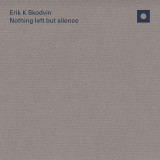
'Nothing left but silence' is Erik K Skodvin’s third solo album for Sonic Pieces and his most quiet to date. Subtitled as "Musical improvisations and quiet collages from the subconscious”, Skodvin reduces his instruments to guitar, reverb and amp - and creates a skeleton of eight hypnotic ragas that meanders in an eternal loop between ephemeral and singular.
Only on the horizon it’s possible to sense that Skodvin has also touched the neoclassical terrain in earlier productions - on Nothing left but silence, however, he acts as a twilight player who is not afraid of the coldness of endless space and who knows how to subjugate the shadowiness of the visible world. Carried by the noise of the amp and the occasional click of the effects pedals, a monolithic, reduced blues emerges, whose mediumistic quality nevertheless reveals that Skodvin's music always comes from the body - and as such is always searching for space. A space that - in this case - blends the vastness of the Norwegian steppe with the brittleness of American wasteland (as if Deathprod and Loren Connors were one and the same person), creating a persistent state between deceleration and absence of presence - that leads Skodvin ever closer to the inner essence of sound.
Initially recorded at Saal 3, Funkhaus, Berlin by Nils Frahm in 2015, the album has itself been subjected to silence as a forgotten relic, re-found and now released in a time where it might connect more with the contemporary state of mind. Welcome to the entrance to the periphery.
Following nearly 20 years of working together as a trio, and numerous cross-collaborations in different configuration between them, Ideologic Organ presents Placelessness, the debut full-length by Chris Abrahams, Oren Ambarchi, and Robbie Avenaim, comprising two long-form works at juncture of ambient music, minimalism, rigorous experimentalism and improvisation, and machine music. Having carved distinct pathways across a diverse number of musical idioms for decades, Chris Abrahams, Oren Ambarchi, and Robbie Avenaim are each, respectively, among the most noteworthy and groundbreaking figures to have emerged from Australia's thriving experimental music scene. Ambarchi and Avenaim first encountered Abrahams when seeing the Necks - the project that has served as the primary vehicle for his singular approach to the piano since its founding in 1987 - together during the late 1980s, not long after having met in Sydney's underground music community. The pair's collaborations date back more than 35 years, criss-crossing Ambarchi's pioneering solo and ensemble work for guitar and Avenaim's visionary efforts for SARPS (Semi Automated Robotic Percussion System), robotic and kinetic extensions to his drum kit. In 2004, fate brought the three together in a trio performance at the What Is Music? Festival, the annual touring showcase of experimental music founded and run by Ambarchi and Avenaim between 1994-2012. For the nearly two decades since, Abrahams, Ambarchi, and Avenaim have intermittently reformed in exclusively live contexts, in Australia and abroad, cultivating and refining the fertile ground first tilled in that early meeting. Placelessness is the first album to present this remarkable trio's efforts in recorded form. Placelessness is the joining of three highly individualised streams, working in perfect harmony; the point at which friendship, mutual respect, and decades of creative exploration produce a singular spectrum of sound. Featuring Abrahams on piano, Ambarchi on guitar, and Avenaim on drums, the album's two sides draw on each artist's enduring dedication to long-form composition. Its two pieces, Placelessness I and Placelessness II, initially began as a single, 40 minute work, before being divided and reworked into distinct, complimentary gestures for the corresponding sides of the LP. Beginning with restrained clusters of reverberant piano tones, Placelessness I progresses at an almost glacial pace, with Abrahams' interventions increasing met by sparse responses, darting within vast ambiences, on guitar and percussion by Ambarchi and Avenaim. Remarkably conversational within its convergences of tonal, rhythmic, and textural abstraction, over the work's duration a progressive sense of tension unfurls and contracts, refusing release, as each of the ensemble's members contribute to an increasingly tangled sense of density at its resolve. While an entirely autonomous work, Placelessness II rapidly realises a distillation of the energy hinted at across the length of its predecessor. Following a luring passage of harmonious calm, Abrahams' launches into shimmering lines of repeating arpeggios, complimented at each escalation of tempo by Avenaim's machine gun fire percussion work and Ambarchi's masterful delivery of tonality and texture, as the trio collectively generate dense sheets of pointillistic ambience within which individual identity is almost lost, before slowly unspooling into unexpected abstractions and dissonances that deftly intervene with the work's inner logic and calm. What could easily be termed a maximalist take on Minimalism, Placelessness is a masterstroke of contemporary, real time composition, that blurs the boundaries between ambient music, experimentalism, free improvisation, and machine music. Drawing on Chris Abrahams, Oren Ambarchi, and Robbie Avenaim's decades of respective solo and collaborative practice, and the culmination of nearly twenty years of working together as a trio, it's two durational pieces - Placelessness I and Placelessness II - take form with a startling sense of effortlessness and grace, neither shying away from explicit beauty or rigorously tension within their forms.
A long-in-the-works project of ours, here comes A Tribe Called Kotori's first foray into full-length territories, as the immensely talented Rampue takes us on a melancholy-riddled ride across his phantasmatic mindscapes. A true sound explorer, deftly steering his ship down the junction of electronica, abstract and balearic-infused prog house, the Berlin-based vibist has us transfixed and elevated throughout the twelve cuts that form the backbone to this lushly textured promenade in sound - at times understatedly euphoric, at others rivetingly exotic.
Of the creative process that lead to 'Bubblebath Trance', Rampue explains "It all started and ended in the same moment: my cherished feline companion, my laptop awash with an unintended bath, and alas, a dearth of backups. The resultant calamity, an echo of chaotic tranquility." Under the generous layer of irony lies some unaltered truth about Rampue's debut long-player for A Tribe Called Kotori: this sense of serenity that goes with stepping into this warm and bubbling primitive chaos of sorts infuses the listening experience far and wide. Distantly emulating the "euphonious strains" of iconic PS1 video games soundtracks from his youth days, the album has us surfing a constant paradox of emotions, wistful but not abandoning itself to sorrow, dynamic yet suspended in some sort of mind-expanding stasis. As if you were looking at the world beneath you in exploded view, conscious of all thing, slowly moving up the many layers of our atmosphere towards uncharted skies.
A paragon of Rampue's most poignant take on classic electronica tropes, 'Harmonie' blazes with a poetic fire that engulfs about everything in its wake. Just figure yourself riding a chocobo across the sand-covered expanse of North Corel (toasting to the FFVII nerds here) as this blasts out in the distance. From this trancey bubblebath emerge lots of musical shades and nuances, from the nicely dubbed-out, brass-heavy coastal jazz of 'Schattenschranz' to the choppy, trip-hop-adjacent future electronics of 'Inside', via the exuberantly joyous mess of faux-organic number 'Tripomatic' and cinematic charisma of 'Ich hasse Sonne' high-flying orchestrations.
Connecting the dots between that trance-indebted ebullience and further downtempo-friendly attraction, 'Verfahren' perhaps encompasses best what 'Bubblebath Trance' is about: gracefully walking the tightrope in-limbo nostalgia-soaked inner movements and a powerful outward thrust, burning to let the feelings ooze out from the shell that holds them.Clad in purely 90s-compatible breaksy motion, 'Salz' is another attempt to reconcile emotional and physical dissonance, like kneading all states - solid, liquid and vaporous - into an impossible mega-vibe of its own; malleable, strong and enveloping in equal measure. Borrowing from two-step and UK garage, 'Take Away' is a definite high in Rampue's master unfolding of musical twists and turns, summoning a Boarder Community-esque atmosphere and clashing it alongside floor-ready footwork motifs to fascinating effect.
An ode to his studio companion, 'Buchla Trip' finds Rampue's exploring his machinic friend's quirky yet soulful array of electronic potentialities - making it sound like a conversation you'd have with R2-D2 in the heart of a Sandcrawler, whereas 'Kajal' beams us up to a fragmented headspace, halfway altered PC-Pop and arps-loaded electronica on amphetamines. Effusive and transporting, the title-track 'Bubblebath Trance' could well figure as the album's no.1 medley in essence: a bountiful lucid dream of dancing forms, colours and sentiments to wrap your head around, confidently drifting from a liminal state of consciousness down the rapids of one's troubled inner workings.
Rounding off the package, the languid ambient finale of 'Die Leiden des hungrigen Fruehstuecks' rubber-stamps the feeling that 'Bubblebath Trance' belongs to that rare category of albums. The ones that mint their own alphabet aside from typical norms and expectations, teaching you the ropes of their new language as it unreels between your ears - real and unreal, elusive to any other meaning than the one your guts and brains will be inclined to give it to, in real time. A crystal-pure object if you will, that shall not reveal its secrets, even after a thousand listens and just as many wowing moments.
NEW 45 BY DEEP-FUNK PIONEER LUCKY BROWN RECORDED DURING THE NOW LEGENDARY SPACE DREAM SESSIONS!
In around 2001, Joel Ricci, the trumpet player/composer behind his former stage alias, Lucky Brown, went traveling on a worldwide "quest for funk". During that pilgrimage, he went to London England in time to attend Keb Darge's 'Legendary Deep Funk' 6-year anniversary at Madame Jojo's. While in the middle of the dancefloor, he was moved so significantly by this obscure brand of 'deep funk' Mr. Darge was unveiling, he became overcome by a mystical sense of 'coming home'. Additionally, he spent a week at Camden's Jazz Cafe to meet The Poets of Rhythm, The Breakestra, The Sugarman Three, DJ Snowboy, DJ James Trouble, and others. When Joel mentioned the nature of his quest to Neal Sugarman, he warmly invited him to come visit Brooklyn and kick it with members of Antibalas, Binky Griptite & The Mellomatics, and the Dap Kings. But before the trip back to the states, Joel spent some time in Paris playing his trumpet at a club called 'Cithea' where they would host weekly 'rare groove' jam sessions. During the jams, Parisian students of Tony Allen would overtake the stage with their instruments and their full African clothing, chant the word, 'Fela', and begin to play this intense free improvised funk and afrobeat. While traveling by train from Paris to the south of France to visit family, Joel began hearing this inspiring polyrhythm swirling in his inner ear and mixing with the "clack-clacka" of the train moving down the track. As soon as he arrived at his destination, he sat down at a piano and jotted down the polyrhythm, bass line and fundamental horn cluster on a piece of sheet music paper. The simple tune was finally rendered to tape ten years later with Lucky Brown's Crawdad Farmers aka The Funk Revolution on the Magik Carpet at drummer Olli Klomp's Lakeside log cabin in Stanwood, Washington. The tune became the title track to Lucky's first full-length on Tramp Records (Lucky Brown's Space Dream, TRLP-9011).
Space Dream is so titled in part to commemorate a soulfunk masquerade party Joel threw at a temporary all-ages Bellingham Washington music venue called 'The Pickford Dream Space'. This is Joel's stripped-down tape-only remix and re-edit which has never before appeared on 45RPM and commemorates the re-release, remaster and repackaging of upcoming Tramp LPs, "Space Dream" and "Don't Go Away", the fully realised 'director's cut' featuring Ricci's early group funk experiment: "The Funk Revolution."