The first 2000 copies of the LP will be available on transparent turquoise or pink vinyl, randomly picked. 'All The Time', Jessy Lanza's first album since 2016's 'Oh No', is the most pure set of pop songs that she and creative partner Jeremy Greenspan have recorded, reflective and finessed over time and distance. Innovative juxtapositions sound natural, like rigid 808s rubbing against delicate chords in 'Anyone Around', subtle footwork flutter giving a nervous energy to 'Face', unusual underwater rushes underpinning 'Baby Love'. The songs also sound more "live" than ever before. Jessy's voice is treated, re-pitched and edited on songs like 'Ice Creamy' and gestural sounds seem to respond to her lyrics in songs such as 'Like Fire', which reward the listener on repeated plays. More than previous albums, the lyrics on 'All The Time' became an important focus for Jessy too, channelling the negativity of anger and frustration arising from some significant changes in her personal situation into the text. These lyrics sometimes process raw feelings, which aren't obvious to begin with, but are soon felt, standing in stark contrast to the cushioned settings of the music. 'All The Time' has ended as a triumph and an abstracted diary of a sometimes difficult, but enduring friendship and creative relationship, and it's their best work yet.
Search:inno
YELLOW VINYL LP
It's hard to speak about unspeakable things - violence, abuse, addiction and abandonment; especially when these things rupture the innocence of childhood. But one of the merits of Luke Jenner's new solo project is that he not only speaks of these things but he does so in a way that wrests them from the dark, small cubicle of shame, placing them firmly in the light so that we, as listeners and fellow survivors, can start to maybe walk with our head high. In this moment of empty pop music séance, the scope and ends of this project - to try and help people - feels almost revelatory. Revelatory is the right word here in that it carries with it, of course, the sense of religious or spiritual insight. As front man for the legendary post-punk NYC band, The Rapture (a band name that already attests to Jenner's abiding faith and interest in the force of spiritual reckoning), Jenner has never shied away from his belief in God, community, family - all as a means of recovering the fractured x of y. "How Deep is Your Love", "Grace"...
On the Corner Records was awarded 'Label of the Year' at the Worldwide Awards 2018. OtC is a story of artists and scenes that goes way beyond being a record label. DJ and label owner Pete On the Corner has created a home for innovative, bordercrossing, genre pushing artists. The OtC vision is to bring music to the world that is knocking at the 'Door To The Cosmos'. The label is an inimitable mixture of Miles Davis 'call it what you want' attitude, Sun Ra's Afro Futurism and the ecstatic soul lifting influence of black music on electronic dance music. On 'Door To The Cosmos - Dancefloor Sampler' Pete has curated a volume of cuts from present and future label family. This first in the series, is not just knocking at the door but giving it a kick! It's club music referencing the source, be it Detroit, or UK bass culture combined with future sounds rising from cosmopolitan hotbeds of sonic heat. On this maxi EP Venezuela meets India via New York, the street sound of Dar Es Salaam, Tanzania pulses through UK Jungle. Undergrounds pushing the dance, breaking borders and genre alike. Rhythms from the ancestors channelled for future times.
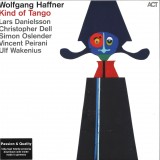
‘Kind of Tango’ is a kaleidoscope of shifting emotions. Wolfgang Haffner’s conception of tango has drama and propulsion in it but also melancholy and longing, with room for frenetic outbursts too. All this is unified by his inimitable groove and feel that commentators have called “an absolute dream,” “magical” and “profoundly relaxed.” Alongside trusted co-protagonists Christopher Dell and Lars Danielsson, he has two guests with him who defy all the clichés associated with tango: guitarist Ulf Wakenius cut his teeth musically in Oscar Peterson’s band and his Swedish heritage always shines through in his playing; Vincent Peirani is one of the leading innovators on the accordion and he finds new ways to define the instrument’s role in the tango. Also, young pianist Simon Oslender makes a first appearance with the band. Jazz and tango find a natural yet constantly shifting equilibrium - to be heard particularly effectively on ‘Close Your Eyes And Listen’ by Astor Piazzolla. In addition to compositions by Haffner himself and by his band members, pieces by the celebrated Argentinian bandoneon player and composer are the focal point of the album. Piazzolla’s innovations with the tango, such as bringing jazz into it, date from around 1955. Haffner and the tango
seem perfectly matched to each other. Tango is no longer a fixed style nowadays, it is above all an attitude to playing and an attitude to life. Wolfgang Haffner’s approach to tango is both authentic and new. It is his and his alone and it is irresistible.
FELA Jonathan Loma mix When Spain meets Africa. Musician Jonathan Loma from Spain on the mix with this joyful, innovative rhythm, infused with African sounds and samples. Noticeably, Nigerian legend Fela Kuti can be heard during the latter parts of the track behind the shifting drum patterns which give this record a very catchy beat. Swinging hats and rolling snares keep the beat flowing over a loopy and swirling melody. The unpredictable and spontaneous sounds sliding in and out display creativity from the Spanish producer, but the highlight here is the subtle African background chants. Just wait for the smooth sax to appear.FELA H2H mix contrast to the Jonathan Loma mix and edging things into deeper territories, the Chez Damier and Ben Vedren (Heart 2 Heart) take on the track is a deep and driving dance floor mover. Quite literally talking toyou with an African accent throughout the majority of the track, the locked groove engages the listener and has you wondering if it will ever end. Loud claps, well-placed short and sharp snare rolls, and like that ofthe Loma take; spontaneous sounds creeping in and out are all included over this cleverly layered deep beat
Two leaders from very different musical worlds, the innovative pianist Bruce Brubaker and scientist-now-electronic-artist Max Cooper collaborate to create this latest expression of music by Philip Glass and tell a story of diversity and vulnerability.
Commissioned by and introduced at the Paris Philharmonie in 2019, Glassforms melds the acoustic concert grand piano with synths and cutting-edge electronic production techniques to create a compelling album and a dynamic live experience.
Rather than just reworking or augmenting via traditional means, Max Cooper and Bruce Brubaker fundamentally rewire Glass’ forms in a manner that’s not possible with human composition tools. Max built a new system for musical expression through coding with software developer Alexander Randon, creating a tool for taking live data from the piano and transforming it into new but intimately related forms which drive his synths on stage.
The result is that each of the pieces by Glass becomes its own electronic “instrument,” an instrument Bruce plays in addition to, and simultaneously with the original piece. As Bruce plays the piano and controls synths with his playing, Max modulates and augments, sometimes adding his own melodies to form hybrid variants.
Siti of Unguja tells the story of pioneering women, of the ‘golden
voice’ of Siti Muharam, heiress to the singular legacy of her great
grandmother, the mother of taarab, Siti Binti Saad.
On the Corner teases this first taste of a landmark recording that the
label embarked upon two years ago on Zanzibar. Siti of Unguja has a
transformative atmosphere, brimming with romance, passion and
protest.
Zanzibar is an Island archipelago that lies 6 degrees South of the
equator and 30 miles off the East African coast out in the Indian
Ocean. Known for its spices, traditional Dhow sailing boats and being
a mercantile trading capital of Swahili culture.
The modern history of Zanzibar can be animated through the life and
legacy of one artist, Siti binti Saad. Born in 1890 in the small fishing
village of Fumba, on Unguja (Zanzibar’s largest island), she became
the first Zanzibari recording artist and her recordings sold in tens of
thousands across the swahili world.
The tracks recorded for Siti of Unguja demonstrate Siti Binti Saad’s
eclectic influence on Zanzibari taarab and her great granddaughter,
Siti Muharam imbues the compositions with feeling. Siti Muharam’s
golden voice carries the poetry and invects a timeless passion. It is
Muharam’s deep humility and love that brings the spirit of these two
women together.
With Sam Jones at the controls, taarab’s conservative layers were
opened up and given more than a little wiggle room. Under the
direction of Matona, the recording of this album paid homage to Siti
Binti Saad’s innovations by bringing back the percussive Kidumbak
style of music that originated on the streets of Zanzibar. By strippping
back the typically dense string section of taarab a space was created
for Muharam’s beguiling timbre that is gilded with emotion.
- A1: Oneness Of Juju - African Rhythms (Album Version)
- A2: Oneness Of Juju - Follow Me
- A3: Oneness Of Juju – Nooky
- B1: Oneness Of Juju – River Luv Rite
- B2: Roach Om – No Name #3 / Love Is… / My Nigger & Me
- B3: Juju – Nairobi / Chants
- C1: Oneness Of Juju – Chants / Don’t Give Up
- C2: Oneness Of Juju – Be About The Future
- C3: Juju & The Space Rangers – Got To Be Right On It (Original 45 Version)
- D1: Oneness Of Juju – Space Jungle Funk
- D2: Oneness Of Juju – West Wind (Previously Unreleased)
- E1: Juju & The Space Rangers – Plastic (Original 45 Version)
- E2: Plunky & Oneness Of Juju – Every Way But Loose (Original Version)
- E3: Okyerema Asante Feat Plunky – Sabi (Black Fire Mix)
- F1: Okyerema Asante Feat Plunky – Asante Sana
- F2: Oneness Of Juju – Bootsie’s Lament (Unreleased Version)
Strut kick off a brand new deal with the seminal independent black jazz and soul label Black Fire in May with 'African Rhythms 1970-1982', a comprehensive 2CD / 3LP compilation of Oneness Of Juju, led by Plunky J. Branch. Tracing their career from the band's earliest work in 1970 with South African exiled jazzman Ndikho Xaba in San Francisco, the compilation covers the band's journey to New York's loft jazz scene, forming Juju and releasing two landmark albums of hard-hitting percussive jazz on Strata-East. "I saw myself as a cultural warrior," explains Plunky. "We studied about Africa and tried to infuse our music with an African spirit." Moving back to his hometown of Richmond, Virginia during the mid-'70s, Plunky drew in a superb new group of musicians and vocalists and created the band's new incarnation, Oneness Of Juju, retaining the African influence but fusing his sound with funk and R'n'B on the classic 'African Rhythms' album. "We realised that, if we put a backbeat to the Afro-Cuban rhythms, people in Richmond and Washington D.C. could be drawn into it; it didn't change anything about our message." The change would lead to a series of enduring soul-jazz classics on Jimmy Gray's Black Fire label, including 'River Luv Rite', 'Plastic' and 'Don't Give Up' and their biggest crossover international hit, 'Every Way But Loose' in 1982, later famously remixed by Larry Levan. The band received renewed interest in their music during the mid-'80s as Washington D.C.'s go-go innovators cited the band as a major influence and rare groove DJs revived their albums for London dancefloors.
Bari's based Dj/Producer, Innocent Soul, brings his Disco, Italo and House influenced sound to French label Happiness Therapy’s eight release. Having previously teamed up with Black Loops on a few acclaimed productions on labels such as Toy Tonics, Rough Limited and Defected’s sub-division Classic Music Company, his biggest impact has possibly been with his DJing. Having found success and notoriety as a resident in Barcelona’s club scene, Innocent Soul, makes a bigger name for himself as a producer with his latest release ‘Poison’.
Opening up is title track ‘Poison’ a throwback to the 80’s dance music with an italo touch, driving percussion and mesmeric synths. This track highlights the diversity of Innocent Soul’s production style. The following track is ‘Don’t Make It’ a heart pounding, trance inducing progressive disco track with a prominent foot stomping kick drum, looping Afro-Caribbean percussion, rolling bassline and spacey synths. Next up on the release is a heater, ‘Feelin’ Love’ is a raw soulful house track with an infectious rhythm that gets your head nodding from the get go, beautiful female vocals with bright and uplifting melodies. If you’re looking for a feel good track this is it! Closing out the EP is ‘Bring Your Mind’ a bumpin loop oriented house track with hypnotic basslines, horns and vocals. The perfect after hours track.
The second volume of Nothing Is Real’s self-titled compilation builds on their towering reputation as leading lights within the global electronic music community. As the label’s first release distributed by the respected Dutch record label and store Bordello A Parigi, the collection is set to further establish their international presence and spread their eclectic sound far and wide.
Bringing together diverse influences from across the spectrum of electronica and into new wave and ambient music, Nothing Is Real stand at the forefront of modern dance music as sonic innovators that continue to push boundaries with each offering.
Curated by Alberto Iovine and Alessandro Fumagalli, also known under the stage name Modular Project, this four-track collection takes listeners on a journey through the outer atmosphere of techno, expanding and evolving the genre into new forms along the way.
Cantor’s opening track kicks things off with a hypnotic, driving groove built on acidic synths before Niv Ast & Roe Deers bring a human touch to the proceedings with a vocal-led heater that recalls classic ‘80s sounds. Dharma pairs shuffling rhythms with extraterrestrial soundscapes that recall Squarepusher and Aphex Twin, before Argia closes the record with force and momentum, surrounding voltaic synthesizers and tribal drums with expressive atmospherics.
On The Corner Records is delighted to announce the release of Dialectic Soul, the debut album from one of Cape Town's most cuttingedge, visionary artists and musicians, the drummer Asher Gamedze. This is Jazz at its most spiritual, most progressive and most appealing form. As Asher himself says: Dialectic Soul is about motion and a refusal to remain static or stay still. It's the commitment to be continually moving'. Recorded live over two days at the Sound and Motion Studios in Cape Town with renowned musicians (Thembinkosi Mavimbela (bass), Buddy Wells (tenor sax), Robin Fassie-Kock (trumpet) Nono Nkoane (voc)), Dialectic Soul is breathtaking in its musical vitality and expression of soul seeking truth. By incorporating the concept of the Total Art for this project, it fits perfectly within On The Corner's aesthetic of music, art and vision for creative innovation. Label art director Victoria Topping created the sleeve design working with Asher's drawings and concept.
Our first vinyl will go with a big bang!
Early support from Mano Le Tough, Dave DK, Maceo Plex, John Digweed, Gardens of God, Ame, Silicone Soul, Hunter/Game, Kevin De Vries, Massimiliano Pagliara, Fideles, Paul Ritch, Shall Ocin, Raxon, Mind Against, Ae:ther, Ilija Djokovic, Jeremy Olander, Frank Maurel, Alexi Delano & more
Barcelona based producer Adwer returns to his Bolygo Records imprint in 2020 with five alluring cuts entitled "Our Genome" EP with remixes from Amandra and Marc Pinol. Adwer has left his mark on the overall electronic music scene in the last few years through his melodic leaning productions that've picked up support from the likes of Sasha, John Digweed, Joris Voorn and Laurent Garnier. Adwer aims to capture emotion within his music with his synth focused tracks and euphoric vibrations that continue to solidify his reputation of being a purveyor of innovative sound design and gentle sonics.
"Our Genome" EP sees him deliver the first release of the new decade on his Bolygo label where he invites remixes from the Ahrpe Records label boss and French producer Amandra and Spain's Marc Pinol who is renowned for releases on John Talabot's Hivern Discs imprint.
"Messing with the DNA" begins proceedings with thudding kicks, growling bass rolls and dreamy oscillations fluttering underneath before "Recombinant" deploys undulating euphoria through tranquil tones, deep vibrations and progressing synth notes that unravel escapist intentions.
Amandra's remix of "Recombinant" lays focus on raw, crunchy percussion, lo-fi experiments and murky pads that keep you locked throughout whereas Marc Pinol's remix of "Messing with the DNA" offers up electro-styled grooves, cosmic waves and acid-tinged oscillations that carry outer space feels.
"Our Genome" then rounds things off with meandering, 80s styled synths, ethereal, revolving modulations and rumbling bass frequencies to finish.
Arguably poised as Kool Keith’s most sophisticated release to date, “Saks 5th Ave” serves as both a stepping stone forward in the artist’s prolific career, as well as a much needed reminder that the world’s most innovative emcee has a thorough grasp on far more than your average rapper. Touching on everything from the use of high fashion products to personal experiences including a near fatal car crash which occurred in 2017, The 16 track studio album produced by the versatile beat maker Dean “Landon Price Beats” Trotter channels Keith in a smoothly conscious state while laying down effortless bars over modern yet timeless hip hop production. From the artist who brought you "Dr. Dooom”, “Sex Style”, “Keith” and everything in between, “Saks 5th Ave” is the latest and greatest haute couture in a world of Gap and Old Navy hip hop.
Part two in his trilogy of what seems like an aural romp through dance music’s key components, Luke Vibert follows up his ode to the ‘Amen break’ on the sumptuous ‘Luke Vibert presents Amen Andrews’, with a pretty damn thorough modelling of rave roots, in ‘Luke Vibert presents Modern Rave’.
When it comes to bashing out creative, highly complex, yet seemingly simplistic rave bangers, Luke Vibert certainly has the chops for delivering the goods in spades. As an innovator in the field for labels like Ninja Tune, Warp and Rephlex, Vibert digs deep into his floppy disc collection for a glorious ride through familiar samples and hooks, breakbeats and funky basslines and earworm melodies for an indispensable collection of feel good modern rave.
The latest project by belgo-moroccan producer Reda Senhaji, alias Cheb Runner, focuses on breeding a new style of music between electronics and Gnawa. Taking inspiration from New Beat to Techno, Acid House and Gabber, the grooves are relentless, stiff and club oriented, relying heavily on analog synths and drum-machines. The sound is darker, more experimental and mature than his previous Gan Gah project.
Cheb Runner digs into the acoustic sounds of his youth, for an organic feeling of warmth and celebration. The syncopation of the classic Gnawa percussions, the “Tagnawit”, its groove is undeniable. Featuring two traditional Gnawa singers based in Brussels, Mâalem Driss and Mâalem Hicham, the EP is a reunion for the belgian Gnawa scene, keeping the vibe alive.
In a world of dematerialized culture, we tend to forget where we come from : by putting Gnawa music at the center of his production, Cheb Runner creates a bridge with the past. The young producer is a son of Gnawa himself, this is the music he grew up with and played as a kid.
Now he brings it to the club scene; Cheb Runner’s first EP is experimental, brutal, innovative. Getting past definitions and genres, it opens new horizons for North-African producers, showing them how to use their roots to make new beats. It encourages both tradition and modernity in Music. In 2019, Gnawa music, dance and culture was added to the UNESCO Intangible Cultural
Heritage list, demonstrating both the relevance of the genre and the necessity to preserve it.
of the genre and the necessity to preserve it.
Cheb, the Arabic word for “young boy”, is traditionally used to describe the young generation of Raï singers – like Cheb Hasni, Cheb Mami or Cheb Khaled. It means the new generation is here, to create something new with something old. The reference to the Ridley Scott movie Blade Runner is just that: while the Cheb comes from the bled, a moroccan village in the Agadir region, the beats come from the club scene of an industrial city, like Berlin, Detroit or Molenbeek/Brussels.
Cheb Runner takes you on a trip through space and time, as well as to pass on ancient rhythms to inspire the next generations.
Ambient and environmental Japanese scene has flourished stronger than ever in the last years. The pioneers of this sound and the creators of an innovative way of making and understanding ambient music, such as Hiroshi Yoshimura, Yoshio Ojima, Toshifumi Hinata or Takashi Kokubo have been championed and their works have been successfully unearthed by reissue labels.
Continuing in this endless path, Glossy Mistakes adds Takashi Kokubo’s brilliant “Volk Von Bauhaus” to its catalogue, with the Japanese masterpiece as the third official release of the Spanish label.
As most of 80’s Japanese ambient and environmental music, “Volk Von Bauhaus” is an audio impression designed to give a multi-sensory experience to the listener. An effort to make things audible, an exercise of understanding and soundtracking objects or situations. The main objective of this sound is to create an iconic musical landscape to accompany a specific place.
Though his name might be unfamiliar to many, Kokubo has crafted music that has impacted virtually all of Japan, from national mobile phone earthquake alerts to contactless card payment jingles. He was one of the first artists to create ambient music strictly through loops. As he mentioned when release this album, "this recording used no keyboard players, no multitrack tape recording techniques, no analog sounds”. A shift on the process of imagining sound.
“Volk Von Haus” is and ode to this ambient, new age and environmental music created in Japan throughout the 80’s. Throughout 9 cuts, Kokubo handcrafts his own sound and immerses the listener in a peaceful yet challenging adventure. The record is the first piece of his Digital Soundology series, and arguably his most interesting work due to the groundbreaking techniques he used.
"A revolutionary musical expression that shatters the old values”, explains Kokubo about this piece. And its just what we can hear when we play “Volk Von Haus”.
The album includes an unheard exclusive track by Takashi Kokubo an insert with an interview made by Takashi Kokubo. A true gem that must land in every ambient head’s musical library.
Remastered from master tapes by Frederic Stader.
Melvin Bliss’ iconic ‘Synthetic Substitution’ (1973) has been sampled hundreds of times. Gracing records from Naughty by Nature’s ‘O.P.P’ to Public Enemy’s ‘Don’t Believe the Hype’, it’s one of the foundations of hip-hop. However, there’s a school of thought that says the sample could have been retired forever after Ced Gee used it for ‘Ego Tripping’. It was the first song to use those wonderful Bernard Purdie drums, and arguably the best.
Their first release on Next Plateau Records, this instant 1986 classic slams from the first bar, that hard-as-hell beat underpinned by stabs and the breathy ‘ultra-magnetic-magnetic’ chant beneath. Meanwhile, Ced and future legend Kool Keith go to town with pseudo-science and a thinly veiled diss of Run DMC – ‘Say what, Peter Piper, to hell with childish rhymes’. It’s a song shot through with promise they’d more than fulfil on their debut album, 1988’s landmark ‘Critical Beatdown’.
The flip, ‘Funky Potion’, doesn’t coalesce with quite the same genius but is still more than a curio, with the MC’s doubling down on their futuristic nonsense approach to lyricism. Rufus Thomas’ ‘Do the Funky Penguin’ is the base for yet more stabs, discordant scratches and a kitchen-sink approach that shows just innovative the group were prepared to be.
Never before released before on 7”, this undeniable hip-hop classic comes complete with bespoke hype stickers incorporating one of the great rap logos of all time.
Presenting Shirley Scott’s deeply personal album, ‘One for Me’ - a defiant tribute to the music she always desired to create but was shrouded by the demands of her vibrant career. Thoughtful curation of the band, tracks, and completely self-funded, this project set off on an innovative trajectory supported by Harold Vick on tenor saxophone and Billy Higgins on drums. Originally released on the revolutionary artist-owned label, Strata-East Records, in January 1975, this unique project will be available to enjoy again on Arc Records from 15th May 2020.
The impetus for this record was a real desire for Shirley to express herself more freely and create something for herself, taking back the power she’d seemingly relinquished throughout her career. Maxine Gordon, Scott’s close friend, and executive producer on the original record, expresses thatthey often had intimate discussions about how Scott was being told what to play, what to wear, how to look and how to speak in public for many years. Having had enough of these restrictions, she created this record to please no one but herself.
As Scott expresses on the back of the original LP sleeve:
“All of the music recorded in this album is both personal and very purposeful to me, because it is the first step toward honesty about what and how I want to play. I’ve done a lot of other albums, a lot of different ways for a lot ofdifferent people and now, with the help of the Creator, in whom all things are possible, I have done one for me too.”
Having self-raised funds to make the record, with complete control over the masters, and with her dream band together, Scott recorded at Blue Rock Studio in November 1974. Harold Vick, often referred to as one of the “unsung tenor saxophonists” of his time, was cherry picked to bring Scott’s vision to life. Throughout his career, he released records on Blue Note, RCA as well as performing and recording with a string of legendary artists such as Ray Charles, and Aretha Franklin. Completing the dream trio was highly sought out drummer Billy Higgins, who is the most recorded drummer in the history of Blue Note Records, having played on 45 Blue Note albums. The key to their success was that Higgins tuned his drums to fit with the organ’s bass sound which, of course, Scott played with her feet.
Scott was also known as “Little Miss Half-Steps,” a name given to her by tenor saxophonist George Coleman, (who wrote a composition by that name in her honor) - she regularly played with both George & Harold. Coleman is known to have admired Scott’s half-steps (when you play two adjacent keys on the organ or piano) and their close bond and mutual respect is solidified on this record through a track titled ‘Big George’ - specifically written for Coleman.
“Queen of the Organ”, Shirley Scott was born in Philadelphia in 1934 and lived there most of her life until her early death in March 2002 at the age of 67. Having mastered the piano at an early age, Scott switched from piano to organ at the tender age of 21. Scott had a legendary recording career as a leaderwith 45 albums mainly released on Impulse and Prestige and is often remembered for her work with Eddie “Lockjaw” Davis and Stanley Turrentine.Boasting a thriving career as a musician and composer, Scott progressed to a professor at Cheyney University in her later years. She was a treasured mother and grandmother, and a cherished friend of music scholar, Maxine Gordon, who’s honour it is to collaborate with Arc Records on shining a new bright light on this monumental body of work.
Composed as a means to map the cultural translation between Chinese culture and European traditions, Piotr Kurek’s A Sacrifice Shall Be Made / All The Wicked Scenes is comprised of pieces composed between 2016 and 2018 specifically to accompany theatre performances directed by Tian Gebing (500m and The Decalogue) and Grzegorz Jarzyna (Two Swords). Kurek attended performance rehearsals in Beijing and Shanghai, with additional preparations and recording sessions taking place back in Warsaw.
While most of Kurek’s past work is unaccompanied by other musicians or outside help, A Sacrifice Shall Be Made / All The Wicked Scenes features various Polish and Chinese musicians both from classical and experimental scene (Barbara Kinga Majewska, Grzegorz Hardej, Łukasz Rychlicki and Hubert Zemler) as well as by actors of Paper Tiger Theatre Studio from Beijing. This approach of Kurek exploring new players and places is further juxtaposed as Kurek recycled samples from his own past, including various recordings with musicians he did throughout years, found sounds from the Internet, or cannibalised old solo work.
Recorded over the course of several years, this aural report of a monumental multi-disciplinary venture is in the end an enthralled and enthralling survey of a contemporary composer who is unencumbered by geographic or cultural boundaries. Concurrently, ditching any resemblance to local musical traditions and rearranging the compositions for all three performances, Kurek has formed an architecture that allows the phases of rituals to unfold while projecting social structure assumed in myth making. The regrouping of different moments in these stories is a curious way of narrating another myth — a synthetic, polyvalent story set in a city that strangely reassembles Beijing, Giza, and Prague at the same time.
Piotr Kurek is a Warsaw based musician and composer who straddles the world of electronic music taking inspiration from various genres but fitting comfortably in none. Through his unconventional use of a wide array of instruments both electronic and acoustic, he built a reputation for himself as a qualified inventor of hypnotic worlds drenched in uncanny arrangements.
Kurek has already released a range of idiosyncratic, forward-thinking works on a variety of imprints (including but not limited to Sangoplasmo, Black Sweat Records, Hands In The Dark, Dunno Recordings, Crónica, Foxy Digitalis) and participated in numerous music festivals including Unsound, CTM, OFF, TodaysArt and UH Fest as well as participating in extensive tours in Poland and abroad. In 2014 and 2015 he opened for Bonnie “Prince” Billy’s two European mini-tours. In 2016 he has been selected as a part of Shape platform for innovative music and audiovisual art from Europe.