The writer Max Sebald often pondered over the nature of human memory, specifically, how our thoughts and desires - and their results - overlap and mutate over time. In A Place in the Country, he writes of the significance of what see as “similarities, overlaps and coincidences”. Are they the “delusions” of the self and senses, or manifestations of “an order underlying the chaos of human relationships, ... which lies beyond our comprehension”?
Song of the Night Mists, the new album by post-classical composer Stefan Wesołowski, often feels it draws on Sebald’s premise.
On a simpler plane, the one where the market dictates the neatly ordered information we consume, Song of the Night Mists can be described thus: recorded in the main by Stefan Wesołowski in Gdańsk, both in his studio and in Saint Nicholas' Basilica, the album incorporates acoustic instruments - piano, violin, double bass - and classic synthesizers such as the Roland Jupiter-8, the Soviet Polivoks. A Roland Space Echo RE-150 tape delay was also pressed into service as an instrument. We also hear the basillica’s organ and field recordings from the Tatra Mountains. Other musicians were Maja Miro, who played the flute parts on ‘Glacial Troughs’ and brother Piotr Wesołowski, who played the organ on ‘Wilhelm Tombeau’. Sound engineer was Marcin Nenko, who was also on hand to record the basilica organ parts. The album was mixed in New York by Al Carlson (Oneohtrix Point Never, Jessica Pratt, Zola Jesus, Lady Gaga, and Liturgy) and Rafael Anton Irisarri handled the mastering.
Ostensibly, Song of the Night Mists is the last in a trilogy, following on from albums Liebestod (2013) and Rite of the End (2017). All three deal with existential matters such as love, death, decay and “an ultimate end”; apocalyptic and Promethean in spirit, and betraying very human conceits. The Sebaldian nature of the new record starts to make itself felt when Wesołowski talks of how he used sampling. One element is unexpected, that of sampling himself: “I go back to dozens of my own unused sketches and recordings, treating them as raw material to cut, slow down, reverse, and transform in every possible way.” Memory as sound, to be reemployed by the listener through their own imaginings.
Another set of samples made by Wesołowski plays another role. These are field recordings, originally created for an audio illustration of the formation of the Tatra Mountains, and used in a film by sound designer Michał Fojcik. Wesołowski: “You can hear cracking ice, streams, footsteps in the snow and the wind, and a real avalanche, recorded from the inside.” The “Tatra connection” on the album is also found in samples referencing composer Karol Szymanowski. The album’s title alludes to a poem about the mountains by Polish poet, Kazimierz Przerwa-Tetmajer.
Wesołowski’s Tatra recordings are “about a world without humans - about the fact that the world existed, was beautiful, and had meaning long before people arrived, and for the vast majority of its history, it was a place without us.” Wesołowski, using one iteration of the natural world, plays out in sound Sebald’s idea of another order, underlying the chaos of human relationships lying beyond human comprehension.
These feelings play themselves out on the five album tracks. Sonorous and rich, they illustrate tectonic shifts we have no control over. Wesołowski hints that the overall sound is a “meditation on the metaphysics of the non-human set against the spirituality that human presence has brought into it.” In that light, the opening number, ‘Core’, with its slow build, and crackling and straining sound effects, create an effect of the earth groaning into life in a creation myth. Once the piano part raps out a simple melody and modulated tonguing trumpet samples add to the overall atmosphere, the listener can certainly find a cue in the “spiritual”, or “human” side of the story. Human versus nature: from the strains and harmonic muscle stretches of the second number, ‘Glacial Troughs’, through to the powerful and filmic ‘Stalagmite’ and heart-on-sleeve romance expressed in closer, ‘Wilhelm Tombeau’, we listeners are cast as Friedrich’s wanderer, looking out over a landscape that will appear only if we engage with it.
Formations of melody appear incrementally, almost appearing by chance - like hidden footings in the rock shelves to give us something to grasp onto. Rhythms are used sparsely: the prolonged percussive taps on ‘Glacial Troughs’ are an anomaly and maybe there to give pace to the album to come; essentially to keep the listener strapped in. Elsewhere, percussion is used as an aid to mood, the two thudding, timpani-style passages on ‘Peak’ there to offset the short, beautiful, kosmische passage that splits them.
Elements of the borderline religious spirit that drove German electronic music in the late 1960s and 1970s also find a place on Song of the Night Mists. The swells and recessions of the organ find their emotional climax on ‘Wilhelm Tombeau’, a track which summons up echoes of the “mountain magic” vistas created by Popol Vuh or Tangerine Dream, especially with the slightly atonal wobble of the Mellotron that counters it.
This is a dramatic album, but it does feel a strangely short, or curtailed listen on ending, evoking the feeling one gets when waking from a dream, and, for all its incipient grandeur, a track like ‘Stalagmite’, for instance, ends on a minor note. Wesołowski admits that Song of the Night Mists is born of the all too human process of temptation, doubt and recalibration - Sebaldian overlaps and coincidences forming something that must live another life, away from its creator. In Wesołowski’s words, the album is “a newborn foal must stand up and walk right after birth.” Now it is yours to ponder.
quête:instruments
- A1: Psicolimite
- A2: Sexy
- A3: Psicolimite (Perverse Flute)
- A4: Revelations Blues
- A5: Psicolimite (Perverse Synth)
- B1: Strip
- B2: Psicolimite (Perverse Sex)
- B3: Sexy (Ballad)
- B4: Revelations Rhythm
- B5: Psicolimite (Perverse Flute #2)
- C1: Sexy (Gotico)
- C2: Psicolimite (Perverse Sex #2)
- C3: Rivelazioni Di Uno Psichiatra
- D1: Sexy (Romantico)
- D2: Psicolimite (Perverse Sex #3)
- D3: Carica
- D4: Psicolimite (Perverse Flute #3)
- D5: Peanuts
- D6: Psicolimite (End Titles)
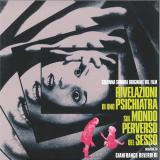
Four Flies is thrilled to present the very first release of Gianfranco Reverberi's hidden masterpiece: a mind-blowing soundtrack, possibly his wildest and most daring. This Italian score is sort of a Holy Grail for fans of the spaghetti sound, especially thanks to the legendary track "Psicolimite".
In 1973, a mysterious 45 rpm single surfaced under the name 'Sharon Chatam e la sua Orchestra.' The single seemed to be a harmless cover of the theme from Last Tango in Paris, complete with a typical image from the film. But behind the innocent facade, a secret was hidden: the B-side track, "Psicolimite," was actually the main theme from Rivelazioni. When someone in the United States figured this out and realized the 'Sharon Chatam' moniker was a pseudonym for Reverberi and his team, the price of the record skyrocketed, making it a coveted collectible.
This makes the discovery of the full soundtrack even more exciting, considering that the music Reverberi composed for the infamous film by Renato Polselli - one of the most outrageous and uncompromising Italian genre cinema directors - was thought to be lost forever, perhaps vanished into the depths of some film processing lab. But thanks to the sleuths at Four Flies, this enigmatic masterpiece has been resurrected and presented in all its glory. It's available now as a luxurious gatefold double LP with original artwork by the brilliant Eric Adrian Lee.
While the film, despite some critics praising it as "psychotronic," is a bizarre mishmash of rambling pseudo-psychoanalytic theories and sexual deviance voyeurism, the music stands out as a foremost, vital element, able to exist on its own.
Reverberi's reputation as a serious, refined producer (for artists like Lucio Dalla, Gino Paoli, Luigi Tenco, and many more), however, led him to keep his distance from exploitation films like Rivelazioni. To maintain his image, he had his friend and former schoolmate Umberto Cannone take credit for the score – a tactic he also used for Polselli's next film, Mania (1974).
But this anonymity might have unexpectedly increased his creative freedom, for the score he put together and recorded is experimental, at times raw, and driven by a relentless rhythm section where bass and drums lay down the groove. The use of electronic instruments is impressive for the time, with drum machines and spacey synths creating a dark and dreamlike atmosphere. Psychedelic flutes, piano phrases, crazed percussion, filters, compressors, and jazzy improvisations on sax and vibraphone complete the mix.
The full soundtrack was recovered following the discovery of the original 1-inch, 16-track tapes, which were transferred, mixed, and mastered for optimal listening on both vinyl and digitally, with the digital version featuring 8 bonus tracks.
Available from November 22!
JULIAN JONAH featuring MARVA KING - BETTER MAKE ROOM FOR LOVE (FULL LENGTH & 7 INCH VERSIONS)
IZIPHO SOUL is thrilled to announce that producer extraordinaire JULIAN JONAH has a new creation - featuring on vocals, the marvellous MARVA KING. To have an artist of this magnitude is a massive coup - we are truly blessed.
The enchanting soulful boogie production of BETTER MAKE ROOM FOR LOVE is permeated with real instruments - lush strings, infectious bass guitar riffs, synths, horns and combined with Marva King’s soulful vocals - it’s a perfect concoction!
Armand is the debut of a sound collage project called PVNCTVM, which refers to Roland Barthes' term "Punctum". A handful of field recordings, taken during extensive walks through nature and landscapes of certain places, evoke memories in a similar way as sometimes photographs do. Based on this material, personal impressions, literature, photographs, sketches and more a process of various sound experiments begins to create soundscapes which reflect the deterioration of memories between various states of mind. Instruments and other sound sources are used symbolically, as are elements of musique concrete, ambient, glitch and drone.
Formed in the legendary Italian disco scene of the late 70s, CHANGE's produced hits such as 'The Glow of Love' and 'Searching', transcending national borders to become global icons of a soulful dance music that fused European sophistication with American soul influences. This new single featuring the beautiful voice of Tanya Michelle Smith perfectly captures the essence of soulful disco, blending live instruments with delicious vocals and should appeal to a wide range of dance music fans old and young…Package includes 2 MM & AT’s remixes plus Original and Figo Sound & JL Remix.
- A1: Nine Tailed Demon Fox
- A2: Rocks
- A3: Sadness | And Sorrow I
- A4: Naruto Main Theme I
- A5: Kakashi's Theme I
- A6: Need To Be Strong I
- A7: Fighting Spirit
- A8: Need To Be Strong Ii
- A9: Sadness And Sorrow Ii
- A10: Wind
- A11: Predator And Predator
- A12: Strong And Strike
- A13: Orochimaru Fight I
- A14: Beautiful Green Wild Beast I
- A15: A Crisis After Another
- B1: Haruka Kanata
- B2: Afternoon Of Konoha
- B3: Jiraya’s Theme
- B4: Sexiness
- B5: Nine Tailed Demon Fox Ii
- B6: Heavy Violence I
- B7: Victory I
- B8: Beautiful Green Wild Beast Ii
- B9: Heavy Violence Ii
- B12: Avenger
- C1: Naruto Main Theme Ii
- C2: Hokage
- C3: Naruto Main Theme Iii
- C4: Broken Bonds
- C5: Hokage's Funeral
- C6: Kanashimi O Yasashisa
- C7: Sasuke’s Theme
- C8: Loneliness
- C9: Predator
- C10: Demon
- D1: The Fifth’s Fight
- D2: Victory Ii
- D3 Sarutobi I
- D4: Sarutobi Ii
- D5: Heavy Violence Iii
- D6: Orochimaru Fight Iii
- D7: Naruto Main Theme Iv
- D8: Seishun Kyosokyoku
- D9: Go !!!
- B10: Rochimaru Fight Ii
- B11: Orochimaru’s Theme I
"Three years ago, Jérôme Leclercq and I from Mediatoon Licensing came up with the idea of creating a cinema concert to celebrate the 20th anniversary of Naruto. Why a cinema concert? The music is part of the success of the licence and fans have a particular attachment to the credits and the original soundtracks. The originality of the music by Toshio Masuda, the composer of Naruto, comes from the clever mix of traditional Japanese instruments, such as the Shakuhachi or the Shamisen, with guitar and other pop/rock instruments. So we came up with the idea of bringing this music to the stage with a 50-strong orchestra, accompanied by an original montage of the best moments from the anime. This orchestra is made up of three parts: symphonic instruments, pop/rock instruments and traditional instruments.
To do this, we approached the ODINO orchestra and its conductor Sylvain Audinovski. The ODINO orchestra is one of those capable of mixing musical styles while maintaining a very high level of performance. We have also chosen traditional Japanese instrumentalists to complete the orchestra's core, especially for the show.
The arrangements and musical direction are the fruit of a collaboration between Quentin Benayoun, Sébastien Caviggia and myself. My two accomplices, with whom I formed the group P.U.S.S. in 2007, have a great mastery of rock and orchestral music writing. This mix is essential to keep the promise made to the fans of the series and required several months' work to select the music and write the scores for the whole orchestra.
How do you tell the story of Naruto to fans, but also to those who don't know the anime? That's the real challenge of this unique film-concert. How do you select the best moments in the story of this young ninja apprentice from the vastness of the first 220 episodes? Six months of selection and research enabled me to choose the key images in the narrative, while preserving certain dialectics to match the anime's incredible music.
This original film-concert, lasting almost 2? hours, is a real Rock-Symphonic show paying tribute to the work of Masashi Kashimoto and the music of Toshio Masuda."
Motor City great Omar S is not just a don when it comes to programming drums and laying down his irresistible synth lines and heart aching melodies. He can also play a wide array of instruments, and in fact does just that here as he plays all instruments played you can hear across all three cuts of this new one on his FXHE label. Things kick off with the wonderful 'Featuring Omar S (instrumental)' and then 'Sayoungaty Nig' is a hazy, lo-fi ambient sound with occasional synth smears and a barely-there rhythm implied by the odd kick drum sound. 'Featuring Omar S' is a signature deep house joint with bristling metal hi-hats, rickety drums and edgy drones that keep you on edge as more soulful chords rise up through the mix.
Francis Bebey was a visionary who explored the intersection of African traditions and global music long before it became a global trend. Born in Cameroon, Bebey's sound was an eclectic blend of his rich cultural heritage and his deep exploration of modern music, spanning genres from traditional folk and jazz to funk and electronic experimentation. As an artist, Bebey was ahead of his time, using his unique voice and instruments to forge new paths for African music to be heard worldwide. His legacy is not just in the music he created but in the way he opened doors for the global recognition of African artists, influencing generations of musicians, producers, and fans alike.
This release marks an exciting moment, as we introduce remixes of bebeys iconic productions by contemporary electronic producers, giving new life through creative re imaginings.
Tracks:
Le Grand Soleil De Dieu (Psychemagik Remix): The UK-based musical duo are known for their eclectic blend of electronic music, psychedelic rock and mystical global sounds. Formed by Danny McLewin and Tommy McLewin, the duo has carved out a unique niche within the global music scene though their intricate arrangements. Their Remixes and Collaborations have been with artists like Fleetwood Mac, Tame Impala, and Hercules & Love Affair. Their psychedelic dub remix has otherworldly qualities, with dreamy atmospheres and bouncing baselines throughout this brilliant opening track.
Guinee (Turbotito Edit): The Berlin-based DJ and producer known for his infectious blend of house, disco, and funk. With a knack for smooth, groovy beats and a deep love for melody, Turbotito's music brings a fresh, energetic vibe to the dance floor. On this track, he effortlessly re-imagines and elevates the world of Guinee to match his signature sound. A combination of a great pulsing base line, ethereal vocals and bird sound effects incorporated into the percussion makes this track an absolute stand out.
Agatha (Voilaaa Remix): Bruno "Patchworks" Hovart from Lyon is the brains behind the Voilaaa project. Fusing soulful grooves, funk, and disco with an unmistakable French touch, Voilaaa creates infectious, feel-good rhythms that blend classic and contemporary influences. In this track we find the first big hook of the album vocally, coupled with Bebey's lively humour in spoken French on top of joyous instrumentation. The smooth vocals, catchy melodies, and vibrant arrangements, bring a fresh energy to the original hit track - a brilliant homage.
Forest Nativity (Red Axes Edit): Red Axes are a dynamic electronic music duo from Tel Aviv, blending disco, house, and psychedelic influences into infectious, genre-defying tracks. Known for their unique sound, warm analog textures, and hypnotic rhythms, Niv Arzi and Dori Simao craft music that moves both the body and the mind. Forest Nativity arrives as a full circle closer, incorporating some of the most authentic African instruments such as a Balafon, an instrument similar to a xylophone and a Djembe, a hand drum central to many West African traditions. The 7 minute track is guaranteed to take you on a fascinating journey through Bebey's culture and livelihood.
It’s been a journey, but thanks to the guys at Universal Music we are very grateful and privileged to bring you this fine piece of modern soul music on vinyl.
Both tracks, on the 7-inch, are taken from the MP3 only 2020 album “Vintage R&B”.
It’s an Anglo-Swedish affair, delivered to you by Swedish songwriters, composers and musicians, Henrik Wikstrom and Anders Lewen, together with UK producer Andrew Stannard.
Side A “Time to Make A Change”, features in Episode One of the 2023 BBC documentary “Fight the Power – How Hip Hop Changed the World”. A track to surely get the dancefloor moving.
After some deliberation of which track to include as a Side B, it was decided as a “Thank you” gesture to invite Universal Music to pick the song of their choice from the MP3 album. “Good, Good Feeling” was the proposal, a song title that is reflected in the composition.
The top side, with its driving beat and the strong vocal ability of Liverpudlian Tommy Blaize, is reminiscent of a Motown track at the peak of its popularity. After listening to the lyrics, it is understandable why this track was used in a “Civil rights” segment within a documentary. A timeless message that can be applied to many social and personal life situations. Listen to the tight musical arrangement. These guys know what they are doing. A track that will surely even get my ageing hips loosened up for the dancefloor. Don’t be tricked by the “paused” ending, a wonderful touch!
The title of the flip side, “Good, good feeling” is exactly that……… A “good feeling” song. Here, the tempo is lowered slightly and the sixties vibe here also leads to a more mainstream direction compared to the A side. Those floaty soulful tones from the UK’s Louise Marshall are very pleasant to the ears, lifting your spirits on any day of the week. Like the A side, get your earlobes in to that musical arrangement. There was no holding back with the broadness of musical instruments in the studio and I especially like the sound of the flute happily skipping throughout. Overall, an enjoyable easy listen.
gold vinyl[14,71 €]
The new release on Flaneurecordings by Dana Shanti with her song 'Rain' promises an exciting sound experience. Dana Shanti is known for her remarkable musical talent and her ability to combine different instruments to create a unique sound. The remixes by Charles Webster, known for his deep and atmospheric soundscapes, add a special flavour to Dana's voice. Especially the 'Charles Webster Dub' is a highlight and perfect for the dancefloor.
A remix by Oliver Marquardt, also known as DJ Jauche, enriches the release. A representative and avant-garde of the early Berlin club scene, he brings his own creative influences to the track. With this combination of talented artists and innovative remixes, 'Rain' is sure to win the hearts of music lovers and clubbers alike.
On Soft Wish Oslo based soundartist Erik M merges noisy home recordings of acoustic instruments with fluctuating bass elements and his own voice to create a personal, muted landscape that carries notions of longing as well as contentment.
This is Erik Mowinckel’s first release on Kora and the first music arriving under his new moniker Erik M
Black Truffle is thrilled to announce Spilla, the second album from Nantes-based Ensemble Nist-Nah, 48 minutes of music for Gamelan, drum kits, wood and metal percussion instruments, and plucked strings that will surely count as one of the most electrifying records you hear this year. Founded by the Australian drummer/percussionist Will Guthrie in 2019, continuing the explorations begun in solo form on Nist-Nah (Black Truffle, 2020), the ensemble (eight or nine core members with occasional guests) has been consistently active in the half-decade since: composing, rehearsing, recording and touring Europe (with a mass of equipment in tow) to great acclaim. Spilla tracks the continuing evolution of the project since the recording of their first album, Elders (Black Truffle, 2022). The two sides of this record document two different iterations of the group, and the members' compositional input has increased: each side contains one piece by a member other than Guthrie. It has become clearer than ever that Ensemble Nist-Nah is not an attempt at a European Gamelan ensemble but rather a hybrid percussion ensemble that uses instruments from a Javanese Gamelan alongside other percussion to perform original music informed by a variety of South East Asian music but also by everything from free jazz to contemporary hip-hop: while Nist-Nah and Elders both featured traditional Javanese pieces, on Spilla the only tune not generated by a member of the group is by Guthrie’s long-time musical hero and occasional collaborator Roscoe Mitchell.
The two short pieces that open the record could almost be the two sides of a wild 7” selected to show off what the Ensemble can do. On opener ‘Gerak Maju’, intricately skittering open-snare patterns bounce over clanging metal, chiming bell-like tones and deep gong hits, adapting the rhythm-register connections heard in traditional Gamelan musics—where the lowest pitched sounds are heard least frequently—to a cut-up breakbeat straight off Feed Me Weird Things. ‘Strollabout’ then moves into an entirely different realm of meditative repeating patterns, performed entirely on Chinese, Javanese and Vietnamese gongs. The remaining seven pieces, ranging from three to twelve minutes, offer up a wealth of different percussive, compositional and arrangement possibilities. On ‘Ghostly Klang’, two drumkits mirror each other’s moves, bouncing hats and snares across the stereo field in a way that recalls On the Corner and the jittering hi hat patterns of trap, while slow moving melodies on the tuned instruments add a sense of majesty contrasted by scurrying details in resonant wood. The epic closing track presents a take on Roscoe Mitchell’s ‘Uncle’, performed by the Art Ensemble of Chicago on their classic Urban Bushmen live album. Where the Art Ensemble used Mitchell’s dirge-like melody as a jumping off point for virtuosic improvisational flights, Ensemble Nist-Nah rethink the piece as a near-static dialogue between the monumental, slow-moving sequence of unison tuned percussion notes and a textural cloud that grows in richness and intensity from whispering cymbal rolls into a mass of gong overtones and bowed metal.
Beautifully recorded and mixed, Spilla arrives in a sleeve decorated with core member Charles Dubois’ drawings of cymbals and gongs. Against the backdrop of a wider musical landscape dominated by over-produced electronic slop and bland harmonic wallpaper, Ensemble Nist-Nah stands out as a reminder, vital and unpretentious, of the joys and possibilities of human beings playing instruments together.
Le Chatroom, a record label established in 2016 by the English producer Kouslin, searches for the missing link between underground bass music and outer national sounds. Its music is defined by the blend of synthetic and organic tones, modern / classic instruments and low- end heavy percussive rhythms.
Pushing artists from all around the globe that share the same love for this newfound sound, Kouslin's aim with Le Chatroom is to promote musical diversity, open-mindedness and experimentation at a time when unity between cultures is crucial. With 'LCR001' the label advances into a new physical environment from which this release should be experienced.
Real talk and native percussion establish the steady climax of 'Brothers', the A-side of Le Chatroom's inaugural wax release. Kouslin cuts through this sediment with a bright flute, before the state of the sound switches into something far darker and meditative. By placing several samples at irregular intervals, the Londoner achieves a fascinating charm that'll unite us all.
Booming bass in 'Gyals' lingers with a steady pace while percy tribal hits forge a raw groove that's far from common. With this movement, the producer from Bristol disintegrates the sense of a generic production and sticks to his true nature. Through this it becomes clear that Galtier has his polyrhythms down to a science.
Londoner Sheik clinches the B-side with a craze that unveils a nearly psychotic sense of sample architecture. Pushing crystal clear 808 kicks in- between the haunting atmospheres and a wall of pressure simply becomes one of his most inventive takes documented on wax. If you love to swerve through a minefield, the odd 'Oxram' would be your favourite pick off this first outline.
The three producers that feature on 'LCR001' pass on their fundamentals to conjure Le Chatroom's philosophy red-handed. Together they do the imprint's name justice by handing over critical bass repertoire that'll excite many!
Simon Herody put together a live solo performance sequencing electronic devices on stage for him to jam over with acoustic instruments. He played a lot in hotels and lobbies. The music had to be present but not too intrusive. Subtle electronics to guide his saxophone and flute playing. The setup proved successful and inspired him to compose the works that would become 'Hard Lounge'.
'At the same time, I was working at a bar/record store in Neukölln called Motif. Everything changed when I discovered the album "Heisei No Oto - Japanese Left-field Pop From The CD Age." I remember this guy, Jamie, who would sometimes bring new releases to the shop. This album really changed things for me; I was constantly playing it and it inspired the creation of these works tremendously.
The composition process for "Hard Lounge" was pretty unclear. I never really made conscious choices; I wanted to escape the conflicts that come with picking the right chords. I aimed to create music that transports your imagination to a sort of retro 80s jazz lounge, where people feel comfortable and at ease just sitting and listening. I wanted to act like a music designer, giving people a chance to listen without demanding too much of their attention.'
- A1: Korogi ‘73 - Fushigi Song
- A2: Yas-Kaz - Hei (Theme Of Shikioni)
- A3: Yoichiro Yoshikawa - Tassili N'ajjer
- A4: Norihiro Tsuru - Farsighted Person
- B1: Geinoh Yamashirogumi - Theme Of Kaneda
- B2: Yoichiro Yoshikawa - Fiesta Del Fuego
- B3: Columbia Orchestra - Heart Beats / Theme For Andrew Glesgow
- B4: Kan Ogasawara - Gishin Anki
LP vinyl only release + 4 page liner notes (comes with hype sticker)
The percussive new age soundtracks of '80s and early '90s Japanese TV, anime and manga built alternative worlds and pushed boundaries in the process.
When Japanese composer Yas-Kaz left Tokyo for Bali in the mid 1970s he had little idea of how influential his trip would become. In studying the storied art of gamelan, the jazz and avant-garde percussionist opened a door to a world of sound and rhythm left behind by the West. The music he and his contemporaries made would become known as new age. It also happened to soundtrack the golden era of anime.
Awash with money and with the prerogative to entertain the burgeoning middle classes, anime in the 1980s experienced a creative and commercial boom. Not constricted by generic expectations, production houses such as the now renowned Studio Ghibli were able to experiment liberally with both form and content. And with it came the space for composers to be similarly adventurous.
TV, Anime & Manga New Age Soundtracks 1984-1993 charts this moment across eight tracks spanning classics of the genre and previously unknown rarities. The collection brings together music that found kinship in electronic and acoustic instrumentation, often combining spiritual or environmental themes with percussive, varied and highly refined syncopations of non-Western musical traditions.
Among them is ‘Kaneda’ by Geinoh Yamashirogumi, the shape-shifting group of self-styled musicians, anthropologists and computer scientists that masterminded the soundtrack to game-changing dystopian anime Akira - and with whom the sound, tuning and breakneck speed of Balinese gamelan has become indelibly entwined.
Reflecting the desires of the era to reach beyond Japan’s borders, many of the soundtracks featured were commissioned for narratives set in distant lands or alternative worlds. There’s violinist and composer Norihiro Tsuru’s ‘Farsighted Person’, written for The Heroic Legend of Arslān, set in ancient Persia; Yas-Kaz’s own ‘Hei (Theme of Shikioni)’, for period sci-fi manga & anime series Peacock King - Spirit Warrior; and two tracks - Tassili N’Ajjer and Fiesta Del Fuego - from Yoichiro Yoshikawa’s soundtrack to NHK’s proto-Planet Earth series The Miracle Planet.
Such was the variety and quality of the music produced, if there is a guiding principle to the tracks collected here it is a sense of escapism and adventure that came with the confluence of modern electronic instruments and a fascination with percussive traditions.
Elsewhere, pioneering children’s TV composer Chumei Watanabe’s ‘Fushigi Song’ (performed by a vocal group Korogi ‘72) offers a trippy and infectious groove with sonic similarities to Don Cherry’s ‘Brown Rice’; little-known jazz-funk library group Columbia Orchestra showcase the best of Tokyo’s session musicians on ‘Hearts Beats - Theme for Andrew Glasgow’; before lawyer-turned-composer Kan Ogasawara closes out the compilation with a dramatic flourish on ‘Gishin Anki’.
Following on from Time Capsule’s acclaimed deep-dive into the world of manga & anime synth-pop in 2022, this vinyl only collection is set to broaden and diversify an understanding of how soundtracks shaped the sound of new age music in Japan for a generation.
Curators: Kay Suzuki, Rintaro Sekizuka (Vinyl Delivery Service)
Artwork: Tu-yang
CAM Sugar is proud to present the first physical release, on LP and double CD, of the original soundtrack to the TV series “MEDICI - MASTERS OF FLORENCE” (2016-2019), that received international praise following the Netflix distribution. The original score composed by Paolo Buonvino brings the Italian Renaissance back to life. The soundtrack mixes traditional instruments belonging to classical music (a common practice with historical dramas) with smooth electronic elements, allowing the listeners to take a journey of exploration through one of the most exciting periods of European history as much as into one’s intimacy. The result is a score that is impactful and enjoyable for a broad audience, also thanks to the voice of Skin (Skunk Anansie), who performs “Renaissance” and “Revolution Bones”, respectively the theme songs to season 1 and season 2 & 3. The LP version offers a selection of the best tracks composed for the 3 seasons, while the double CD edition features the series’ complete soundtrack.
Moom Sound are delighted to present a 3 track EP of timeless Chicago house tinged tracks from the maestro Stefan Braatz; ‘Timeless Altitudes’.
Omnipresent on the Berlin scene, Stefan began DJing and producing in the 90’s, and is passionate about working in the analogue space with physical instruments – drum machines and synths – rather than computers.
Alongside friends, he organised underground parties on old demolition sites, as well as playing at legendary Berlin events like Tresor, Globus and Stellwerk.
With breakout releases on Nu Groove, King Street and Poker Flat, there are very few discerning parties that haven’t danced to Stefans beat.
“Timeless Altitudes” drops v soon on Moom Sound and it’s definitely one for the house heads.
"Non Rompere" is a dark, decidedly experimental song from the disco era, a style embraced in the second half of the 70s by Amanda Lear and then in the early 80s by Italian showgirls such as Nadia Cassini, Patrizia Pellegrino, Pamela Prati, who considered disco-music the most transgressive genre of the time (which later often became ''trash''). G.Bri, namely Vanna Brosio, a seductive actress and TV presenter, follows this trend with an equally bold approach, making use of the shameless lyrics of Cristiano Malgioglio (Cristiano Facile) and the arrangement and orchestral direction of Beppe Cantarelli, one of the key figures of Italian music in the world (with over 100 million records sold). The record production of ''Non Rompere', longed for by followers for decades, nevertheless needs to be enriched. Dave Mathmos takes care of it, choosing to keep the original version intact and faithful to his style he creates two alternative versions: the ''Remix'' oriented towards High Energy, replacing the rock guitar with synthesizers that evoke the sounds of artists such as Giorgio Moroder and Patrick Cowley; the "Italo Dub", draws on the roots of Italo-Disco, highlighting the melodies of the chorus and adding another layer of melodic depth, all through the use of synthesizers (Additional instruments used: Linndrum drum machine, Roland TR-707 drum machine, Moog V - Synth, Jupiter 8V - Synth, Diva - Synth). This approach shows once again the talent of the Italian-Australian DJ in fusing and reinventing the genre, while preserving the energy and innovation, characteristics of the Italian Disco music scene of that time.
Totoyov is back with a new identity and is pleased to present its fourth vinyl release, featuring four tracks by the talented Brazilian artist, and one of our label heads, Dru.
Giuliano Lomonte and the rising Romanian star Constratti complete the record with their powerful and refined touches on A2 and B2. A perfect combination of meticulously crafted drums, instruments, and groove that will keep you engaged.
“Unlikely Possibilities EP” is a manifestation of powerful moments in life that happen for a reason, when you least expect them.
The record’s artwork is created by the talented Juliette Siraj, a French artist with synesthesia—a rare condition that allows her to see colors and shapes while listening to music. Each of her paintings is a visual translation of the sounds she perceives. For this release, Juliette painted while immersing herself in the EP’s tracks, transforming the sonic experience into a unique and sensory artwork.
200 copies. No repress!
- A1: Patrick Bernard - Interieurs
- A2: Cecilia Angeles - Climax Our First Day Of Love Its A Love Day
- A3: Carla Music Orchestra - A Meet With Bond
- A4: Remy Boussengui - Coco Lando
- B1: Francisco Et Son Orchestre - Cafe Rete
- B2: Francis Bebey - Crocodile Crocodile Crocodile
- B3: Michel Lorentz - Zantye An Metro
- B4: Egide Sadey - High Emotion
- B5: Princess Erika - Trop De Bla Bla Dub Version
Isle of Jura teams up with French digger Switch Groove on the next compilation titled ‘Archipelago – Cosmic Fusion Gems from France (1978-1988)’.
Switch Groove explains the concept “When I seriously began to search for and collect records, I was mostly interested in sounds from african-american, afro-latin and UK contemporary scenes. Sounds from distant territories, faraway from my native Massif Central, a highland region in the middle of France. The grass is always greener, I guess however, as I was digging in fleamarkets in the early sunday morning light, as well as spending regular sessions in second hands record shops, I began to discover hidden treasures, underground gems and side-projects of an unknown French musical repertoire.
French music is often reduced to its most famous musical forms, characters and signatures : French songwriting and voices, 60s yéyé, prog rock concept albums and soundtrack explorations, 80’s indie rock scene or more recently electronic French touch. All these sounds have a common feature : a geographical link, forged on mainland French territory, following the contour of the so-called Hexagone, the border that shapes the grounds for an homogeneous cultural expression. But beyond this showcase lie more complex, hybrid and global French productions. From French Caribbean Antilles to Parisian suburbs - especially during the ‘Sono Mondiale’ era -, in French areas outside urban cultural centers, musicians have created fusion and cosmic musical expressions. As the mid-seventies meant a greater freedom to make and record music, a wider use of electronic instruments like synthesizers and drum machines helped to deliver some magical projects you could only find lost in the middle of cheap records during a sunny record digging session. I selected these tracks, in an attempt to shape an ARCHIPELAGO that highlights significative contributions of African diasporas and ultramarine territories into French musical borders. It is the map of a land I have gradually drawn, thanks to deep listening of amazing cosmic and fusion tunes. I hope you enjoy the journey.”