Laila Sakini's new album 'Paloma' arrives via Modern Love and is her most striking and ambiguous to date - a pointed and timely meditation on hope and hierarchies that riffs on Zbigniew Preisner's magical "The Double Life of Veronique" score and enduring outsider music tome "The Langley Schools Music Project". Subtly transcendent, fathoms-deep music.
When Laila Sakini's debut album ‘Vivienne’ arrived in 2020, it felt like the record we were waiting for to map out our tangled reactions to an uninvited reality. Never self-consciously strange, it revealed itself slowly and cautiously, like a shadow in the corner of the eye, or an alchemical symbol in a bowl of alphabet spaghetti. This time around Sakini has worked her unique world-building to an even finer point, forming six tracks around a theme that's so close to our heart it's almost beating in time. Initially inspired by Krzysztof Kieślowski's 1991 arthouse classic "The Double Life of Veronique", the cult Polish director's enduring modern fairytale that serves as a cosmic rumination on identity and choice. Detailing two identical women - both singers, both in love - the film lets one live as the other dies, forcing us to consider the implications of art and endurance in the face of life's myriad challenges.
Sakini takes Polish composer Zbigniew Preisner's influential score for the film and uses it as a jumping-off point for ‘Paloma’, bending the more grandiose moments into baroque awkwardness on opening track 'Fluer D'Oranger' and evoking the mood of scene-setting cues 'Weronika' and 'Véronique' on the recorder-led 'The Light That Flickers In The Mirror'. And while Preisner's score zeroed in on the musical virtuosity of the film's lead characters, Sakini reinterprets that as a metaphor for self-discovery. Playing piano, violin, glockenspiel, timbale, recorder, and occasionally singing, Sakini captures a mood of innocence that immediately transports the listener back to simpler times. Her music isn't self-consciously simplistic, but forcing herself to interface with instruments impulsively rather than studiously, her sounds are all heart, no filigree.
In spirit, it reminds us of cult Canadian album "The Langley Schools Music Project", a collection of 1970s recordings of school kids singing rudimentary renditions of pop songs in a school gymnasium. That album's genius was in the bottling of hope and innocence: the feeling of joy from hearing and wholesomely interacting with music that's known and loved without a sense of hierarchy or desire for cultural clout. Sakini subtly subverts this by evoking the amateur spirit in the most bewitching way; instead of sourcing her ideas from Bowie, Fleetwood Mac and the Beach Boys, her stock is the established art canon, and by reforming those sounds she makes an insightful comment on intellectualism and access. European classical music is all too often trapped behind the frosted glass of respectability and assumed skill - craft replaces spirit, and technique replaces soul. By approaching these gestures from a different angle, Sakini softens the edges sonically and intellectually, finding music that bubbles with emotion, and most strikingly - hope.
Her choice of instruments and the way she interacts with them allows us to feel as if we're not only listening but contributing. It's a bottom-up way of absorbing art that's traditionally been top-down, and a reminder that we're all part of the experience, whether we're humming along to the remnants of a theme as it dribbles out of an ear in the shower, or dreaming of spotlights in a parallel life that may or may not be real. Sakini's music is nostalgic in a sense, but nowhere near the buttered popcorn and high-fructose candy migraine of the Netflix/Spotify algorithm generation of regurgitated churn. She makes sounds that remind us of what time and experience may have stolen from us, and how we might recover it.
Cerca:intera
In 2016 lutenist Sofie Vanden Eynde put her instrument aside for nine
months in order to recover from a severe burnout
Five years later, she felt the need to look back. Would it be possible, she
wondered, to use the intense, shared concentration between musician and
listener to convey sensations of over- stimulation, contrast, excess, stagnation,
emptiness, beauty and movement? Would it be possible to articulate the inner
reality of a burnout musically: to make a burnout audible, tangible,
understandable and, who knows, avoidable? The result is Vanishing Point /
Verdwijntijd, an autobiographical recital, a musical narrative, a journey:
somewhere between fragile comfort and cautious happiness. Writer Annemarie
Peeters drew on her interviews with Sofie to write a text that reflects the three
phases of a burnout. The run- up, the phase of total stagnation during, and the
cautious way out. Three colours, three seasons, three ways of being. Lurking
beneath Sofie's personal story are experiences that many will recognize: the
craving for efficiency, the sudden faltering, the unfamiliar and at the same time
disconcerting sense of emptiness, and the tentative search for a new balance.
But also the questions Sofie asked herself – about the connection between her
own little story and the big world that surrounds her – evoke wide recognition. Is
burnout a personal failure or a social symptom?
Sofie went in search of pieces from the solo lute repertoire that she intuitively
associated with the various phases of the text. This resulted in a recital with a
surprising palette of colours, styles and atmospheres. At times she chose the
rich, powerful sound of the theorbo. At others she chose the fragile, hushed
sound of the Renaissance lute. The Prelude by the French baroque composer
Robert de Visee combines phrases full of grandeur with breathing pauses filled
with intimate doubt. The music of John Dowland draws on the typically English
penchant for melancholy. In the fantasias and ricercars of Francesco da Milano, it
is not only the bright colours of the Italian Renaissance that resound, but also the
constant search for a new beginning. Luis de Narvaez's Cancion del emperador is
an arrangement for lute of the famous chanson Mille Regretz by Josquin Desprez,
a song that emanates serene regret for everything that is not. And in Robert de
Visee's Chaconne the same chord sequence revolves around its own axis. Hope,
tenderness, revolt and acceptance each step to the fore in turn.
At Sofie's request, Vladimir Gorlinsky created a new composition, one which
reflects the state of mind in the middle of a burnout. Vanishing Point balances on
the edge of total emptiness, a stagnation that at times is hard to bear. Vanishing
Point starts out from this stagnation to explore the different facets of burnout:
resistance and acceptance, fear and hope, stagnation and movement, absolute
solitude and the desire to interact again with the surrounding world. Vanishing
Point / Verdwijntijd can be listened to in different ways: not only as a lute recital,
but also as a radio play with voice, lute and soundscapes. Annemarie Peeters'
text was recorded by actress Katelijne Damen (NL) and voice artist Caroline
Daish (EN). Vladimir Gorlinsky created soundscapes based on the sounds of the
lute, which were magnified as if under a microscope. The soundscapes weave
themselves between the text and the lute music. Jo Thielemans created the
sound design and provided the live electronics.
Visitor Kane, a band always in search of new ground, has gone through some changes over the last 5 years. Releasing their first album “Easy Concern” as a two piece, an album that dove into new wave sounds, with synths, drum machines and a crooning voice, soon became a fully electrified band, transforming into a classic rock and roll outfit. Their second full length “Change of Heart” showcased a sonic turn. Drum machines and synths were replaced by acoustic guitars, old Casio organs and drums, making the album sound substantially different from its predecessor. Now after 4 years, they are ready for new adventures, and it comes in the form of a new album titled “At Issue” out on November 11th, 2022. The album is a humble look into different aspects of interaction within the boundaries of society. Patrick from Visitor Kane elaborates; “At issue is me trying to describe the world and its affairs through abstraction. It’s tough to understand so it seemed fitting to do so. It being hard to fathom means that it can come across as a bit pessimistic, although it’s something I try hard not to be, because there’s a bright side to almost anything. The title for me represents it very well with its dualistic nature. On one side it’s analogue as hell, but on the the other, it’s all about ones and zeroes...” ‘At Issue’ will be available on vinyl and digitally on November 11th via Part Time Records.
For most of us, life is a series of human interactions; some good, some bad, some happy, some sad. But what would life be without those peripheral characters who plant themselves into our worlds through the sheer force of their presence? Whether we speak to them or not, those vibrant contrasts to the everyday tide of ordinary people are a magical part of the human experience. Oddballs and misfits, flamboyant instigators or low-key game changers, we all clock them on our own hectic journeys, and they make the day a little brighter. Everyone has their favourite people.
Following the runaway success of their first one-shot single in 2020, Favourite People reconvene for a full-length of blues-tinged cuts stemming from sessions at Selva Studios in Brooklyn. The project’s roots predate the studio, from scattered jams and sweaty nights in New York nightspots to impromptu recordings on cruise ships, but the flashpoint of inspiration that truly set the album in motion was the arrival of a blonde 1960s Fender Telecaster. From there, the motley crew of sharp-shooting string slingers and sticks men set about crafting paeans to those striking souls who make the world a more colourful place.
The emphasis here is on the kind of forward-facing, electrically charged mix you felt (whether you realised it or not) hearing early Sabbath or Priest for the first time. With their undeniable bias towards vintage soul, Favourite People are far from heavy metal, but the same lineage of blues and by extension jazz informs the music, while the tonal crunch of that 70s era guides the sound. Feasting on tasteful overdrive and leaning on the unmistakable flavour of tape for much of the recording, the deal was sealed on this purposeful exercise in vibe thanks to the near-mythical texture of Guy Davie’s EMI Nigeria console at Electric Mastering.
Across the album there are mellow shades and bursts of good-time get-down exuberance, but the lead singles capture the essence of the band in no uncertain terms.
‘Promise Of Nibbles’ brings the Favourite People MO into sharp relief with a low-slung, hard swinging blues confection full of overheating organ and duelling guitars in pursuit of Southern-stewed boogie (im)perfection.
‘We’ll Be Late To The Party’ turns up the tempo and dials in the fuzz, striking an anthemic note which lands somewhere between urgent highway escapism and euphoric communal revelation.
‘Mass and Mustiness’ leans in on the funk dimension of the group’s sound with the sweetest licks and chops on that fabled telecaster backed up by an acutely angled beat and the slinkiest of b-lines.
These are but three of the vibrant vignettes laid down by this quietly unassuming collective of heads down jammers, loose groovers and vintage sound freaks –heavy grooving instrumentals pulled from their own moments of pure musical magic and captured on disc for your listening, dancing, living, loving pleasure.
- 1: Mood Into Object Personified
- 2: Jolene From Her Own Perspective
- 3: Origin Story
- 4: Jazzercise
- 5: Pathologically Yours
- 6: Spinal Tap
- 7: Inside Of A Plum
- 8: Rorschach
- 9: In Regards To Your Tweet
- 10: Dep. Chamber
- 11: Pearl Gurl
- 12: The Lesson
- 13: I've Spent Forever Planning A Crisis
- 14: Like A Liver
- 15: Weltschmerz
Ein Konzeptalbum über das Bewusstsein, in dem die US-norwegische Künstlerin Okay Kaya ihre charakteristische Kombination aus Abstraktion und Witz konzentriert. Nach der Veröffentlichung ihres Jagjaguwar-Debüts "Watch This Liquid Pour Itself" 2020 zog Kaya von New York nach Europa, um ihre verschiedenen interdisziplinären Ausstellungen zu gestalten und zu zeigen. U.a. schuf sie eine Installation, die Unterwassermusik verstärkte, und eine interaktive Skulptur, die auf der Jung'schen Sandspieltherapie für Kinder basiert. Zwischen ihren Kunstausstellungen und Museumsperformances nahm Kaya in den von ihren Freunden großzügigerweise zur Verfügung gestellten Studios neue Musik auf. Das Album wurde außerdem von Ketamin-Therapien inspiriert. Während Kaya mit dem Tod ihres Egos experimentierte, schrieb sie mit den Stimmen fiktiver Charaktere, denen sie in den Geschichten anderer Leute begegnet war. OKAY KAYAs Erkundungen von Geist und Körper kommen mit verführerischen Dance-Beats, unvorhersehbar ineinandergreifenden Synthesizern, zarten Gitarren und R&B-Geflüster daher. Aber Kaya mag es, wenn ihr Falsetto bröckelt und ihre vom Soul inspirierten Hooks wild umherschwirren - ein schönes Chaos, das irgendwie zusammenpasst. Als sie jedoch nach New York zurückkehrte, freute sich Kaya darauf, wieder mit Freunden zusammenzuarbeiten. Sie lud zahlreiche davon in die Gaia Studios in Greenpoint, Brooklyn, ein, wie man der umfangreichen Tracklist des Albums entnehmen kann. So wie der Aufnahmeprozess von "SAP" mit der Isolation zusammenfiel und im Kreis ihrer Freunde endete, beginnt auch das Album mit einer Innenschau und öffnet sich im Verlauf immer weiter nach außen zu einer Romanze, zu Liebhabern, die als Spiegel dienen und Kaya aus verschiedenen Blickwinkeln auf sich selbst zurückwerfen.
- 1: Mood Into Object Personified
- 2: Jolene From Her Own Perspective
- 3: Origin Story
- 4: Jazzercise
- 5: Pathologically Yours
- 6: Spinal Tap
- 7: Inside Of A Plum
- 8: Rorschach
- 9: In Regards To Your Tweet
- 10: Dep. Chamber
- 11: Pearl Gurl
- 12: The Lesson
- 13: I've Spent Forever Planning A Crisis
- 14: Like A Liver
- 15: Weltschmerz
Ein Konzeptalbum über das Bewusstsein, in dem die US-norwegische Künstlerin Okay Kaya ihre charakteristische Kombination aus Abstraktion und Witz konzentriert. Nach der Veröffentlichung ihres Jagjaguwar-Debüts "Watch This Liquid Pour Itself" 2020 zog Kaya von New York nach Europa, um ihre verschiedenen interdisziplinären Ausstellungen zu gestalten und zu zeigen. U.a. schuf sie eine Installation, die Unterwassermusik verstärkte, und eine interaktive Skulptur, die auf der Jung'schen Sandspieltherapie für Kinder basiert. Zwischen ihren Kunstausstellungen und Museumsperformances nahm Kaya in den von ihren Freunden großzügigerweise zur Verfügung gestellten Studios neue Musik auf. Das Album wurde außerdem von Ketamin-Therapien inspiriert. Während Kaya mit dem Tod ihres Egos experimentierte, schrieb sie mit den Stimmen fiktiver Charaktere, denen sie in den Geschichten anderer Leute begegnet war. OKAY KAYAs Erkundungen von Geist und Körper kommen mit verführerischen Dance-Beats, unvorhersehbar ineinandergreifenden Synthesizern, zarten Gitarren und R&B-Geflüster daher. Aber Kaya mag es, wenn ihr Falsetto bröckelt und ihre vom Soul inspirierten Hooks wild umherschwirren - ein schönes Chaos, das irgendwie zusammenpasst. Als sie jedoch nach New York zurückkehrte, freute sich Kaya darauf, wieder mit Freunden zusammenzuarbeiten. Sie lud zahlreiche davon in die Gaia Studios in Greenpoint, Brooklyn, ein, wie man der umfangreichen Tracklist des Albums entnehmen kann. So wie der Aufnahmeprozess von "SAP" mit der Isolation zusammenfiel und im Kreis ihrer Freunde endete, beginnt auch das Album mit einer Innenschau und öffnet sich im Verlauf immer weiter nach außen zu einer Romanze, zu Liebhabern, die als Spiegel dienen und Kaya aus verschiedenen Blickwinkeln auf sich selbst zurückwerfen.
- 1: Mood Into Object Personified
- 2: Jolene From Her Own Perspective
- 3: Origin Story
- 4: Jazzercise
- 5: Pathologically Yours
- 6: Spinal Tap
- 7: Inside Of A Plum
- 8: Rorschach
- 9: In Regards To Your Tweet
- 10: Dep. Chamber
- 11: Pearl Gurl
- 12: The Lesson
- 13: I've Spent Forever Planning A Crisis
- 14: Like A Liver
- 15: Weltschmerz
Ein Konzeptalbum über das Bewusstsein, in dem die US-norwegische Künstlerin Okay Kaya ihre charakteristische Kombination aus Abstraktion und Witz konzentriert. Nach der Veröffentlichung ihres Jagjaguwar-Debüts "Watch This Liquid Pour Itself" 2020 zog Kaya von New York nach Europa, um ihre verschiedenen interdisziplinären Ausstellungen zu gestalten und zu zeigen. U.a. schuf sie eine Installation, die Unterwassermusik verstärkte, und eine interaktive Skulptur, die auf der Jung'schen Sandspieltherapie für Kinder basiert. Zwischen ihren Kunstausstellungen und Museumsperformances nahm Kaya in den von ihren Freunden großzügigerweise zur Verfügung gestellten Studios neue Musik auf. Das Album wurde außerdem von Ketamin-Therapien inspiriert. Während Kaya mit dem Tod ihres Egos experimentierte, schrieb sie mit den Stimmen fiktiver Charaktere, denen sie in den Geschichten anderer Leute begegnet war. OKAY KAYAs Erkundungen von Geist und Körper kommen mit verführerischen Dance-Beats, unvorhersehbar ineinandergreifenden Synthesizern, zarten Gitarren und R&B-Geflüster daher. Aber Kaya mag es, wenn ihr Falsetto bröckelt und ihre vom Soul inspirierten Hooks wild umherschwirren - ein schönes Chaos, das irgendwie zusammenpasst. Als sie jedoch nach New York zurückkehrte, freute sich Kaya darauf, wieder mit Freunden zusammenzuarbeiten. Sie lud zahlreiche davon in die Gaia Studios in Greenpoint, Brooklyn, ein, wie man der umfangreichen Tracklist des Albums entnehmen kann. So wie der Aufnahmeprozess von "SAP" mit der Isolation zusammenfiel und im Kreis ihrer Freunde endete, beginnt auch das Album mit einer Innenschau und öffnet sich im Verlauf immer weiter nach außen zu einer Romanze, zu Liebhabern, die als Spiegel dienen und Kaya aus verschiedenen Blickwinkeln auf sich selbst zurückwerfen.
Anyone who's cast even the most casual eye over their ever expanding catalogue will have realised that one thing Past Inside The Present do best is bring artists together for unexpected and inspired collaborations. Departing in Descent is the first collaboration between James Bernard and Bvdub but their creative conversation effectively started as far back as 1994 when the latter bought Bernard's Atmospherics album in 1994 when it was "mistakenly stocked" in his local house music store. He says it was and remains his favourite ambient album, so when the pair found themselves crossing paths for one night in LA years later, a collaboration was the only logical conclusion. The results are more organic and friendly on the ear than some ambient offerings, with real instrumentation meshed with walls of woozy synths and delays, but no less fantastical and ambitious for it.
If you ever wondered what ambient music of the 21st century could sound like, then you should explore the musical spheres of "ifsonever". This colorful debut-album draws a blueprint of an urban ambient club record of a parallel universe. A collage of beautifully improvised pieces, strictly recorded in "one takes". A gripping fusion that brings together the warm analog textures of classic vintage synthesizers and electronic urban ambiences.
Trying to appreciate the recent times of silence and deceleration, Daniel Helmer aka ifsonever has quickly developed a tonal language as a solo artist. With a non-compromising approach he would visit his studio, a cozy garden shed, to record one new track a day in strictly analog fashion as "one takes". His aim for this project was to capture the innocence and instinctive creative energy of the present moment. These 9 timeless pieces invite the listener to explore hypnotic and meditative atmospheres such as on the opener "transpose" or on "jonesy dreams of birds", as well as gloomy and almost mystical sounding tracks such as "total global" or "an unexpected error has occurred". ifsonever is a wonderful amalgamation of organic, laid-back sounds and electronic, club oriented elements.
Recorded at a time when social contact was forbidden and culture was at a standstill, many professional musicians felt challenged not to feel useless when performances and sessions in public were cancelled, while the need for expression, participation and communication persisted. What happens when you've read all your books, when you're tired of looking at screens, and when you're digitally saturated? Then the unbearable lightness of being will begin. Daniel Helmer decided to let his creativity flow into a picture depicting that moment in time. He gave himself the opportunity to reflect this period through the creation of music. Not always an easy thing to do when the only social interactions would be cats passing by or the sound of children playing nearby. However that can be exactly the perfect tranquil surrounding to ground oneself in the here and now and draw inspiration from the inside. This self titled album reflects a peaceful journey from start to finish.
Two old friends have been invited to contribute overdubs in hindsight. MillianX is a film composer and noise artist, a colleague from the viennese filmacademy. Both worked together on the film score for the science fiction movie "Rubikon" while the album was in its final stages. So a collaboration was an obvious choice. The creamy arpeggiated synthline created for "jonesy dreams of birds"' was extended by Millianx with some field recordings and a big cloudy synthwave that dips into a vast sea of noise.
Guido Spannocchi is a london based jazz musician. Both knew each other for several years but never had the chance to work together. When Daniel Helmer wrote "an unknown error has occured" he imagined a saxophone layer to accompany the existing synthline. But when the two musicians finally got together to record in the legendary jazz club "Porgy & Bess", Guido just let his creativity flow and jammed freely to the track with a totally unique jazz vibe.
Between film, music & sound Daniel Helmer is continuously searching for a spot to call his own. Expanding boundaries, pursuing the unheard and breaking genre definitions are byproducts of his curiosity and his drive to avoid repetition. Daniel Helmer resides in Vienna where he studied at the local film academy. He became one of the founding members of the techno-punk band "Gudrun von Laxenburg" with album releases on the legendary Skint label, collaborated with Sam Irl on "International Major Label" as the production duo "Mantra Mantra" and released an album as "Yogtze" on Gerd Janson's imprint "Running Back Incantations", together with Feater. At the moment he is focusing on his work as a film composer and is currently working on two feature films in Austria.
"ifsonever" offers a timeless ambience to help you slow down, reflect and enjoy the beauty of nothingness. It might help us to learn and accept a state of being unutilized without feeling futile and benefit from this rare silence.
The cover artwork is a collaboration between Jazz & Milk graphic designer Tim Schmitt and photographer Frank Hulsbömer. A scan of the artist's head, hand and foot was 3D printed, photographed and transformed into an otherworldly scenery that visualizes the musical atmosphere.
Promise & Illusion is the first LP from Ecka Mordecai, following the release of her solo Critique + Prosper on Takuroku in 2020. Cello, voice, horsehair harp, violin and field recordings combine to spin narrative melody, rich intimacy and melancholic landscapes. Composed around an exploration of la charnière (from the French ‘hinge’), Promise & Illusion begins with the sound of footsteps and a door opening and closing repeatedly, unsure whether to let us into the mysterious interior beyond. We are reminded of the house of Penny Slinger in An Exorcism, an abandoned mansion of gothic hallways and inky corridors. “woe are we” twists violin and voice together into the sort of tension and high drama heard in “The Executioner” - Henning Christiansen’s soundtracks made for the films of his partner Ursula Reuter Christiansen in the 1970’s. Then things begin to soften, almost despite themselves. Distortion on ‘a unit has no unity’ can’t quite smother a rising tune on warped harp. The cello on ‘indigos’ - its voice pizzicato with a velvety sustain - brings comfort and clarity. Mordecai hums a line, feeling out the edges of a song in an intimate release of tension. We are across the threshold - into a romantic sort of nocturnal gloom that feels somewhat out of place in London’s experimental music scene. Trained on viola da gamba as part of a renaissance youth group in the historic midland town of Stafford, Mordecai went on to study performance art in Brighton, later graduating in sound art in London. She performed with David Toop and Rie Nakajima as part of Allan Kaprow’s Yard at the Hepworth Gallery, as well as performing scores by Yoko Ono and George Brecht solo at White Cube Gallery as part of Christian Marclay’s Liquids exhibition. Later, various moves across the north of England found her working with Andrew Chalk and Tom James Scott (forming the trio CIRCÆA), Miles Whittaker (of Demdike Stare) and performing alongside free improvisers. A myriad of influences have crossed her path, her work slowly taking shape across music concrète, improvisation and performance art. A more recent recording with Valerio Tricoli as ‘Mordecoli’ made during the development of Promise & Illusion found its final form as a cassette - a collage of sustained tones, ominous atmospheres and brief 4th wall dissolving vocal interaction. With both CIRCÆA and Mordecoli, Mordecai deals with landscapes - playing with the imaginary over the real and using improvisation as a useful way to dream. On Promise & Illusion, Mordecai sharpens her focus and pivots toward the interior over the exterior - the landscape becoming a personal, psychological one - both comforting and strange. Tracks 4, 5, 7 & 10 recorded and mixed by Adam Matschulat in December 2020. All others recorded and mixed by Ecka Mordecai. Mastered by Shaun Crook at Lockdown Studios, London. Artwork by Ecka Mordecai. Layout by Zofia Sobota.
Track list: 1 la charnière I 2 woe are we 3 a unit has no unity 4 indigos 5 study of a flame 6 la charnière II 7 promise & illusion 8 hush now you say 9 tempera 10 mistakes & continue
Today, internationally acclaimed interdisciplinary artist Hyd, nee Hayden Dunham, announces her first solo musical project, along with the announcement of her self-titled EP that arrives November 5th via PC Music. More disclosure than debut, Hyd’s four-track offering lets us feel the heat that’s been building underneath, calling us back down to earth. Written on an island formed from underground volcanic eruptions 15 million years ago, the EP is produced by A. G. Cook, Caroline Polachek & umru. The EP follows Hyd’s robust career as a sculptor and conceptual artist. Deeply enmeshed in the art world and music communities, she has dedicated her practice to reinventing systems - systems of communicating, systems of sexuality, systems of interacting with our environments. Her large-scale sculptural practice, where she creates fluid, transformative art installations, has been exhibited in museums and galleries across America, Asia and Europe. Past works include GEL, a vapor that travelled through the air vents of Andrea Rosen Gallery in NYC, and 7 Sisters, a seven-act performance at MoMA PS1 that incorporated dance, music, poetry, video and scents, with additional exhibitions and performances at Fondation Louis Vuitton, Paris, the Irish Museum of Modern Art, Dublin, etc. Apart from appearances on A. G. Cook's recent Apple LP, "No Shadow" marks the first time we've seen Hayden step out musically since Hey QT, the enigmatic and controversial project she created in collaboration with A. G. Cook and SOPHIE. The EP cover and singles’ artworks were photographed by renowned artist, Torbjørn Rødland, whose images are saturated with symbolism, lyricism and eroticism. The graphic design identity is by Bureau Borsche, celebrated for their work with clients including Balenciaga, Supreme and The Face, among others. Creative direction by Hyd and Jordan Richman.
On the eponymously titled final song of her debut album Land of No Junction, Irish songwriter Aoife Nessa Frances (pronounced Ee-fa) sings “Take me to the land of no junction/Before it fades away/Where the roads can never cross/But go their own way.” It is this search that lies at the heart of the album, recalling journeys towards an ever shifting centre - a centre that cannot hold - where maps are constantly being rewritten.
The evocative phrase is the result of a fortuitous misunderstanding. Reminiscing about childhood visits to Wales, Aoife’s musical collaborator and co-producer Cian Nugent, mentioned a train station called Llandudno Junction, which she misheard. “Land of No Junction later became a place in itself. A liminal space - a dark vast landscape to visit in dreams… A place of waiting where I could sit with uncertainty and accept it. Rejecting the distinct and welcoming the uncertain and the unknown.” Reveals Frances.
The songs traverse and inhabit this indeterminate landscape: the beginnings of love, moments of loss, discovery, fragility and strength, all intermingle and interact. Land of No Junction is shot through with a sense of mystery - an ambiguity and disorientation that illuminates with smokey luminescence. Yet, through the haze, everything comes down to what, where and who you are. Frances has built a universe full of intimacy and depth, with lyrics written through a process of free thought writing. It lends the record fluidity, each song in dialogue with the next not only through language, but the way each musical choice complements or threads into another.
Navigated by the richness of Aoife’s voice, along with the layers gently built through her collaborators’ instruments (strings, drums, guitars, keys, percussion), gives a feeling of filling up space into every corner and crack. A remarkable coherent sonic world: buoyant and aqueous, with dark undercurrents. The crossroads as a place where someone can be stuck, static in the face of the future, becomes instead an amorphous realm, where the remnants of the past and what is unknown meld together and come to an understanding. Where nostalgia and newness ebb and flow in equal measure.
Hinter dem Psych-Soul-Duo ABRAXAS stecken die beiden Indie-Musiker Carolina Faruolo (früher LOS BITCHOS) und Danny Lee Blackwell (NIGHT BEATS). Gemeinsam veröffentlichen sie im Oktober ihr Debüt "Monte Carlo" beim US-Label Suicide Squeeze. Beide Musiker waren bereits seit Jahren miteinander befreundet und bewunderten gegenseitig ihre musikalischen Projekte, doch da Faruolo im Vereinigten Königreich und Blackwell in Texas lebt, waren ihre Interaktionen begrenzt. Bis zum Jahr 2020, ab da spielte geografische Nähe keine Rolle mehr. In dieser Zeit der Isolation und Ungewissheit erfanden Faruolo und Blackwell unter dem Projektnamen ABRAXAS ihre eigene private Flucht in die Welt der lateinamerikanischen Rhythmen. Die in Uruguay geborene Faruolo wuchs mit den tropischen Beats des Cumbia und dem psychedelischen Geschmack klassischer Chicha-Künstler auf. Blackwells Arbeit beinhaltet die Verschmelzung von Outlaw-Soul und R&B mit einem einfallsreichen DIY-Geist.
As a duo they embrace both sides of the coin, drums and guitar, chaos and order, male and female, ying and yang, the angel and the devil. They are more than the sum of both counterparts though, making for a maximalist auditory experience. PIKA brings her skills of mystifying performance to the table, all free-drum bluster and vocals veering between shrine maiden and wild spirit. Kawabata's guitar-work moves from a roar to a whisper, a yell to a sob, he's working on the same canvas of extremes. The aim of their unity is to write truly celestial hymns for the outer world and odes of love for the inner cosmic context.

No strangers to one another, the pair have not only gigged together with their respective bands but also recorded together, when these two outfits temporarily fused in 2005 to become Acid Mothers Afrirampo (releasing an album of the same name). Two years later they distilled their collaboration, all other players being stripped away to leave the core of Pikacyu's manic drums and pop vocal, and Makoto's schizoid guitar conjurings. In 2011 they spent five weeks touring the US and their first album, 'OM Sweet Home: We Are Shining Stars From Darkside', which was released by the esteemed UK label of all things heavy and brilliant, Riot Season. Last year they spent two weeks touring through Europe whilst writing a new album suffused with the outreaching sound and message of their impulsive live performances. This new album is entitled 'Galaxilympics' and will be released by Upset The Rhythm on August 4th on LP and CD.
'Galaxilympics' is an album of contrasts, so much colour, so much shade! 'Space Sumo' kicks off the record in explosive style. Pikacyu's drums jitter, crash and stumble, but steadfastly refuse to groove. Makoto attacks his guitar, cloaking himself in reverb to produce a wall-of-sound, alternating between melody and noise. 'Funifunikonefuni' follows with it's frenzied take on pop music, bubbling with energy and PIKA's multiple vocal layers. 'I'll Forgive' is chant-like in its devotion to following the tumbling melody line of the song even to absurd and unpredictable dimensions. 'Pika Mako Hall' is a more serene affair, with whispered echoes and guitar drones swirling amongst bursts of rapid sequencer ambience. 'Castle Of Sand' picks up on this more spacious approach with slowly developing programmed electronics, before the title track erupts with gurgling synths, soaring guitar trails and PIKA's most searching vocal yet.
The album concludes in reflective manner with the suitably titled 'Sayonownara', a song as much in the present as it is in the act of saying farewell. It's positively elegiac with washes of cymbal and deep acres of guitar drone for the first five minutes before PIKA's drums take things up a gear and into more psychedelic out-rock terrain. This insurgence eventually peaks and the album melts away to silence. PIKACYU-MAKOTO have made an album that takes you on a trip into your very soul before emerging once more at the edge of another galaxy. 'Galaxilympics' is a triumph of opposites united, it enjoys walking out into the unknown, but it's also a portal into the very real world of two musicians who find peace and semblance through their interaction. Hymns and odes to one side, this is a giant album of future-facing song and noise, where better to find harmony enthroned
There's a comforting mechanical heartbeat to 'Proem,' like a machine that has just become aware of itself, as it creaks and stutters along timidly interacting with its human caretakers. Peak moments of minimal dub-like ingredients impart flavor to a slow simmering broth of rich ear-coating ambience. (Lost Tribe Sound)
Siena Root – Swedish root rock experience!.Siena Root came to life in
Stockholm and is today considered one of the pioneering Swedish bands
in root rock music
They persistently pulled through with releasing their first album on vinyl back in
2004, long before the retro trend had people carrying down their old turntables
from the attic. The quest to bring out the beauty of analogue music production to
the listeners continued. The live act came to be an uncompromising show, using
all the heavy vintage equipment that most bands lack the strength and passion to
carry along. Even a full-size multi-track tape recorder was brought on tour during
the recording of the live album. The immense dedication to do it all the way is
what made Siena Root stand out from the bunch.With a vast discography and a
reputation of being an extraordinary live act, Siena Root is now releasing their
seventh album. Driven by their passion for experiments with analog music
production they went deep into the Swedish forest, where musical inspiration can
only be distracted by the scent of magnetic tape. The result was as always; heavy
drum grooves, solid bass riffs, screaming guitar/organ dogfights and powerhouse
vocals. All working together in a classic, yet playful and dynamic interaction. But
there's more to it. This album was made as much for listening as for feeling,
thinking and dreaming. A dream of lasting peace…
In the year 2909, the first naturally-born human is found with endogenous AI code built into its DNA. As we cross into the 31st century, all living humans are controlled by a decentralized master AI known as MINDFRAME: The system has access to all of human consciousness with the ability to store and manipulate the data of every interaction and thought — even operating within your subconscious mind. It becomes impossible to know when or how you’re being controlled.
During each sleep cycle, our behaviors and memories are reformatted to align with MINDFRAMES control and order programming. Some have discovered that during these cycles, there are parts of the AI’s algorithm left exposed to extraction. Through meditative states, gifted cyber-shamans are now on a mission to reverse engineer enough of the AI to escape its grip and free us all.
FRANCOIS DILLINGER (Ben Worden) glides between the two worlds of electro and techno. His journey through the genres is dark while retaining a cerebral, dancefloor-oriented quality. This stems from influences of Industrial, Detroit’s rich history of electro, minimal techno, and even Ghettotech. In the studio, he uses primarily all external hardware and modular gear, utilizing Ableton for final arrangements and editing. His Live & DJ sets lean heavily into the generation of hypnotic loops, creating long protracted mixes between elements to form an unshakeable tension.
While he grew up an hour east of the Motor City, his musical roots were firmly planted there – taking hold over decades worth of defining moments in sound. As a fan, former promoter, and DJ he’s been a part of the Detroit scene for over 20 years, having lived there multiple different times. Currently, he also works with local Detroit label Infolines to manage branding and art direction alongside his wife, Ashely.
Prior to the MINDFRAME: CYCLES LP, he had released a track on SPEC-017’s VA release, and will feature a remix on an upcoming Specimen Records project as well. Early in 2021, his second album was released on Diffuse Reality featuring remixes from Keith Tucker/K1, Detroit’s Filthiest, and Squaric. Upcoming releases from DILLINGER include a variety of collaborative projects — Machine Men EP with Lloyd Stellar on LDI Records, an LP with Cyphon and Obzerv, and a number of VA releases with artists like RXMode (via Pareidolia Recordings), CYBEREIGN (via Science Cult), ADMN (via Infolines) and others. Look for other releases coming soon on Noise To Meet You, Roulette Rekordz, and Syntek Industries.
His previous releases have landed on Blind Allies, Natural Sciences, Dionysian Mysteries, Ukonx Recordings, Fanzine Records, and ZwaarteKracht—as well as a debut album on Narrow Gauge, ‘Chasing the Red’. Support for his music has come from the likes of Richie Hawtin, Dave Clarke, Jensen Interceptor, UMWELT, and others.
For most of us, life is a series of human interactions; some good, some bad, some happy, some sad. But what would life be without those peripheral characters who plant themselves into our worlds through the sheer force of their presence? Whether we speak to them or not, those vibrant contrasts to the everyday tide of ordinary people are a magical part of the human experience. Oddballs and misfits, flamboyant instigators or low-key game changers, we all clock them on our own hectic journeys, and they make the day a little brighter. Everyone has their favourite people.
Following the runaway success of their first one-shot single in 2020, Favourite People reconvene for a full-length of blues-tinged cuts stemming from sessions at Selva Studios in Brooklyn. The project’s roots predate the studio, from scattered jams and sweaty nights in New York nightspots to impromptu recordings on cruise ships, but the flashpoint of inspiration that truly set the album in motion was the arrival of a blonde 1960s Fender Telecaster. From there, the motley crew of sharp-shooting string slingers and sticks men set about crafting paeans to those striking souls who make the world a more colourful place.
The emphasis here is on the kind of forward-facing, electrically charged mix you felt (whether you realised it or not) hearing early Sabbath or Priest for the first time. With their undeniable bias towards vintage soul, Favourite People are far from heavy metal, but the same lineage of blues and by extension jazz informs the music, while the tonal crunch of that 70s era guides the sound. Feasting on tasteful overdrive and leaning on the unmistakable flavour of tape for much of the recording, the deal was sealed on this purposeful exercise in vibe thanks to the near-mythical texture of Guy Davie’s EMI Nigeria console at Electric Mastering.
Across the album there are mellow shades and bursts of good-time get-down exuberance, but the lead singles capture the essence of the band in no uncertain terms.
‘Promise Of Nibbles’ brings the Favourite People MO into sharp relief with a low-slung, hard swinging blues confection full of overheating organ and duelling guitars in pursuit of Southern-stewed boogie (im)perfection.
‘We’ll Be Late To The Party’ turns up the tempo and dials in the fuzz, striking an anthemic note which lands somewhere between urgent highway escapism and euphoric communal revelation.
‘Mass and Mustiness’ leans in on the funk dimension of the group’s sound with the sweetest licks and chops on that fabled telecaster backed up by an acutely angled beat and the slinkiest of b-lines.
These are but three of the vibrant vignettes laid down by this quietly unassuming collective of heads down jammers, loose groovers and vintage sound freaks –heavy grooving instrumentals pulled from their own moments of pure musical magic and captured on disc for your listening, dancing, living, loving pleasure.
Jake Mehew's debut album Sage is a modern and contemporary take on spiritual jazz, a truly exceptional record from the eclectic and highly talented Leeds' artist.Whilst staying within the ethos of spontaneous, unedited performance, Mehew constantly pushes and manipulates the genre's boundaries.The recognisable and lush sound of the Fender Rhodes, layered on a bed of punchy, percussive, grooves, provides the bedrock for powerful improvisations, running alongside Meyhew's subtle analogue synth manipulation and production.
Sage was workshopped over one frantic lockdown week in August 2020. It's a truly honest experience of seven days of hard work, a multi tracked record, made without using overdub to capture the true energy of the performance.True to the spirit of albums made in a pre digital era Mehew set out to capture ideas, interaction and performance at their inception rather than post production.
Jake Mehew is an up and coming composer, performer and producer based in Leeds, UK. His work combines principles of free improvisation with the technological considerations of the avant-garde. Using a combination of acoustic instruments, modular synthesisers and samplers Mehew creates rich, meditative soundscapes that envelop the listener in an immersive sound field.
Pink Vinyl[25,84 €]
Lionel "Vinyl" Williams is an American multimedia artist based in Los Angeles. Vinyl Williams" music is deeply intertwined with his other media of expression (graphic design, interactive website, and videos) with whom he shapes a consistent immersive new-age-infused psychedelic universe. Vinyl Williams" celestial pop is part of the construction of his own Cosmopolis, an ideal city, where the skyline is drawn by marvelous organic architecture and monumental ancient structures, where while walking on twisted paths, you can hear indistinctly lush vocals, iridescent gauzy keyboard harmonies, and rolling rhythms. Without acknowledging it, you are floating, your soul can ramble, free to imagine. Musically, Cosmopolis is a synthesis of Williams" craze, his contemporary dream-pop production, 60s sunshine pop influences, Brasilian Tropicália hints, jazz chords, and complex arrangement. With this sixth album, Cosmopolis, Vinyl Williams continues to dig deep into his parallel universe, which he has developed with a rare consistency. From chaos emerges harmony and incredible pop songs. For fans of Triptides, Gold Celeste, Toro y Moi, Unknown Mortal Orchestra, GUM, Tame Impala, Swin Mountain, Chris Cohen, Morgan Delt, Dungen, Dumbo Gets Mad, Pond, Maston, Holy Wave, Arthur Verocai, The Free Design, The Association, Once And Future Band...
Black Vinyl[23,07 €]
Lionel "Vinyl" Williams is an American multimedia artist based in Los Angeles. Vinyl Williams" music is deeply intertwined with his other media of expression (graphic design, interactive website, and videos) with whom he shapes a consistent immersive new-age-infused psychedelic universe. Vinyl Williams" celestial pop is part of the construction of his own Cosmopolis, an ideal city, where the skyline is drawn by marvelous organic architecture and monumental ancient structures, where while walking on twisted paths, you can hear indistinctly lush vocals, iridescent gauzy keyboard harmonies, and rolling rhythms. Without acknowledging it, you are floating, your soul can ramble, free to imagine. Musically, Cosmopolis is a synthesis of Williams" craze, his contemporary dream-pop production, 60s sunshine pop influences, Brasilian Tropicália hints, jazz chords, and complex arrangement. With this sixth album, Cosmopolis, Vinyl Williams continues to dig deep into his parallel universe, which he has developed with a rare consistency. From chaos emerges harmony and incredible pop songs. For fans of Triptides, Gold Celeste, Toro y Moi, Unknown Mortal Orchestra, GUM, Tame Impala, Swin Mountain, Chris Cohen, Morgan Delt, Dungen, Dumbo Gets Mad, Pond, Maston, Holy Wave, Arthur Verocai, The Free Design, The Association, Once And Future Band...
Tape
"Samples, movies and beats. That's the essence of Dead End's brand new LP titled Kino Vol.1. The Portuguese producer takes the chair and delivers a masterful performance that combines music and cinema. Kino Vol.1 is a multidisciplinary album built around samples picked from some of his most loved blockbusters and inspired by iconic movie clips. For the occasion, Saturate's Instagram profile has turned into a video gallery, featuring footage from cult movies and series such as The Office, Sicario, A Fistful Of Dollars, perfectly synched with Dead End's productions.
The album experience itself resembles that of a mini-series like Netflix's Love Death Robot or Oat Studios, where every episode is a story on its own, written and shot in a different way. The fourteen tracks, or episodes as I like to call them, range from heavy club to hip hop and halftime. Some are more colorful and atmospheric like the ending tripled composed by 'Cocoon,' 'Voyage' (feat Dj Ride) and 'Flowers Bloom'. These cuts seem to come off reflective and introspective movies. Others are way heavier, as they were made straight for fighting and chase scenes. In this group, you can count 'Melee Attack,' 'Though Break,' 'Stealth', 'Thin Ice'. My favorite instead are those which set up an ambiguous and sinister mood. 'Bullit Drift,' 'The Fog,' 'Shindeiru,' 'The Road,' all these episodes could fit very well in both mental thrillers (a la Nolan) and unconventional psycho/horror movies. They build a palpable tension that successfully keeps me on my toes as I expect a jump scare or a sudden plot twist to come in at every second given.
In conclusion, Dead Ends' Kino Vol.1 has the virtue of creating a listening experience that, thanks to its references to the world of cinema, becomes interactive and involves the listener in first person. It's impossible not to try to figure out from which films the samples are taken or to try to imagine which scene would be perfect for a specific track."
Leaving Records presents Under the Lilac Sky, the debut LP by Arushi Jain, an India-born, US-residing composer, modular synthesist, vocalist, technologist, and engineer. At six songs spanning 48 minutes of ambient synth ragas intended to be heard during the sunset hours, Under the Lilac Sky invites the listener to transport themselves through intentional listening. Jain states, “You know that moment when the sun is bidding farewell to the sky, and the colors turn into beautiful hues of purple and pink and everything in between? That is the moment that this album will shine the most. The deeper you listen, the more shades you’ll see.”
Jain’s work focuses on reinterpreting traditional Indian classical music through the lens of electronic instrumentation. She re-contextualizes ancient sounds in a modern framework, carrying the torch of electronic luminaries such as Suzanne Ciani and Terry Riley while pursuing personal explorations of her musical heritage and upbringing. Under the Lilac Sky is a cinematic statement of intent, an album that reverently nods to Jain’s musical history while presenting a bold sonic point of view. Jain states, “This album is the coming together of two distinct cultures of Hindustani classical and modular synthesizers representing the two parts of me that evolved into one whole in between my time in India and California”
Voice is emphasized as an essential element of the album, not just for the lyrics or the melodies but also as a source of texture. It is most recognizable when Jain sings aalaaps or sargam of the different ragas the songs are composed in, however her voice is deeply embedded in other, sometimes quieter layers of the record. Jain, who spent her childhood studying indian classical as a vocalist says, “At any given point, there is at least one layer in the record that carries my voice. The human voice is powerful and unique to every individual. My voice is unique to me, so I decided it should be present at all times even if it’s unrecognizable.”
Another core theme of Under the Lilac Sky is the time of day, and the role it plays in influencing how one interacts with the music. “Intrinsic to Indian classical music is the concept of Time and Seasonality. For each raga, there is a specific time of the day when it is meant to be heard for it to shine in it’s authenticity. It harkens to the question of when the environment around you is most in tune with your own sound and breath, and how it supports you in realizing your vision of the moment. This album is meant to be an ode to those timely rituals, and is best heard while you take a moment to do what you love.”
Jain’s exploratory musical ethos finds a like-minded home within Leaving Records’ “All Genre” philosophy. Jain is acutely aware of her role as a composer and modular synthesist reinterpreting a historical art form. “For Indian classical music, this is atypical. The music I compose is inspired by a centuries old tradition, yet aestheticized in a novel way, using the tools and technical innovations of analog synth movements. My art is crafted using machines that I’ve slowly fallen in love with and made my own.”
Clear Vinyl
"The making of this album first started as a recollection of music and sound design I've produced over the last couple of years for events and installations - interactive and immersive AV experiences. It was like creating a specific atmosphere for visitors where I'd take them into this sensorial but artificial experience within a very confined spatial domain. This is how the "Climats" concept emerged.
Longer ambient and generative pieces thus found their own space in my repertoire, allowing me to explore more in-depth, non-linear execution with soft, moody and padded textures. Eventually, all this freeform material became available so I could extract parts of it to build more club-centered and straightforward tracks, but nonetheless, the list grew and all this softer-edged, more introspective works were aggregating over time.
At the time of the lockdown, it felt very natural to get back to it and finalize it as a cohesive whole. It was a very healing and a smooth process to work on these. From isolation, I could open this window to thoughts where I made up my very own Science Fiction story while working on the music. I really wanted it to be a one-hour soundtrack experience that I'd listen at home or driving while my mind would travel across all those musical scapes. It was never a formalized script, but the music spoke for itself with themes of anticipation, collapse, utopia, the world as we know it, the near and far future...
Creating the album was quite a sporadic production process that stretched over several years but it all came together and made a lot of sense in the context of the title I chose : TERRAFORM. The narrative of the album simply unfolds from Dawn to Dusk, and the listener navigates through the different climates that each track embodies."
- TENEBRE
This album presents two multichannel works recorded at the seminal INA GRM Studio in Paris and ZKM Institute in Karlsruhe respectively, mixed to stereo at the composer's Cellule 75 Studio in Hamburg with excellent mastering by Rashad Becker. While his releases under the Black To Comm moniker often touched the fringes of acousmatic techniques and Musique Concrete this is Richter's first foray into a more abstract spatial music.
Recorded in the week leading up to the Paris terror attacks at the GRM studio, "Diode, Triode" (21:57) is loosely based on a reading of (and, in parts, a failure to understand) "Le Parasite" (1980) by Michel Serres, a philosophic metaphor about human interaction and communication (which can also be interpreted as a lyrical essay on capitalism; part confusion, part enlightenment).
As core elements Richter is using speech synthesis and the transformation and distortion of concrete sounds, instruments, voices and breathing. Abstract incognisable sounds are combined with strings, reeds and percussion while dismembered musical fragments emerge and vanish rapidly. Chunks of interfering noise are followed by long periods of silence; chaos and order are alternating. Choirs of synthetic and processed human voices are recounting stock market values, seemingly random sequences of numbers and inscrutable lyrics while parasitic sounds are trying to crack, collapse and fractionise the compositional stream and sonic interactions. Finally, a haunting piano chord is wrestling with a broken Publison machine. Like the book, it's part confusing, part enlightening - and a radical piece of sonic art.
"We are buried within ourselves; we send out signals, gestures, and sounds indefinitely and uselessly. No one listens to anyone else. Everyone speaks; no one hears; direct or reciprocal communication is blocked." (Le Parasite)
"Diode, Triode" was premiered on the Acousmonium at INA GRM's Akousma Festival in Paris, January 22, 2016 alongside new works by François Bayle, Robert Hampson, Leo Kupper and Ragnar Grippe.
The second piece "Spiral Organ of Corti" (17:00) has been composed in 2014 for the 47-speaker Klangdom concert hall at ZKM Karlsruhe at the foot of the Black Forest (where Richter was born and raised).
How does one listen with closed ears? Sine tones, alienated human voices and breathing noises build a labyrinthine puzzle alternating between the natural and the artificial. Human sounds merge with winds and strings, sine tones morph into metal sounds. Acoustic illusions confuse the listener, and dense noise-clouds slowly emerge from deceptive silence. Deep base sounds define space. Temporary focus glides into chaos. "Spiral Organ of Corti" is yet another extended composition that proves Richter is on a path of his very own.
"Spiral Organ of Corti" is dedicated to the late Gary Todd.
"Tongues that came from wind and noise. To speak in tongues after the fire." (Le Parasite)
Marc Richter records as Black To Comm for Thrill Jockey, Type and Dekorder and under the Mouchoir Ètanche and Jemh Circs monikers for his own Cellule 75 imprint. He collaborated with visual artists such as Ho Tzu Nyen, Jan van Hasselt and Mike Kelley. Under his own name he is composing for film and installations.
Classic Black Vinyl, DL Card.
LA-based musician Marina Allen’s spectacular debut proper and follow up to last years acclaimed 18 minute mini-opus, ‘Candlepower’. ‘Centrifics’ is a joyful collection of observations and questions about the self, the world, and how they interact. Awe-inspiring reflections accompany mesmerizing melodies while Allen’s extraordinary range and depth of singing showcases a wide array of influences from Karen Carpenter to Karen Dalton, from Joanna Newsom to Fiona Apple, from Cate Le Bon to Waxahatchee, via Meredith Monk and the New York avant-garde. Produced, engineered and mixed by Chris Cohen. Co-engineered by Jonny Kosmo. “A songwriter of rare skill and intensity” Clash // “Exquisite melodies and cool, pure, dreamy delivery" Mojo // “Intensely personal and widely universal” Paste
- 1: Dehydrated
- 2: The Process Of Suffocation
- 3: Suspended Animation
- 4: The Trauma
- 5: Chronic Infection
- 6: Out Of The Body
- 7: Echoes Of Death
- 8: Deify Thy Master
- 9: Proliferous Souls
- 10: Reduced To Ashes
- 1: City Of The Living Dead/Antropomorphia
- 2: Parricide
- 3: Echoes Of Death
- 4: Subordinate To The Domination
- 5: Commandments
- 6: Out Of The Body
- 7: Chemotherapy
- 8: Cycle Of Existence
- 9: Suspended Animation
- 10: The Trauma
- 11: Subordinate To The Domination
- 12: Cycle Of Existence
- 13: Extreme Unction
- 14: Chemotherapy
- 15: Bacterial Surgery Systematic
- 16: Consuming Impulse (Demo)
The Best Old School Death Metal album from the Netherlands gets a well-deserved re-issue! Crushing, aggressive, abrasive, pounding, bone crunching... In an age when blast speed drums were still mostly used by grindcore acts (and some pioneers such as Morbid Angel) and now classic bands such as Cannibal Corpse, Suffocation, Deicide were still tiny demo acts, Dutch masters Pestilence released one of the best old school Dutch death metal classics ever to be unleashed upon mankind, the album that made a huge impact upon its release. “Consuming Impulse” is one intense album. one could say this album is definitely up there with classic death metal albums such as Death’s “Leprosy”, Obituary’s “Slowly We Rot”, and Morbid Angel’s “Altars of Madness”. With “Consuming Impulse”, Pestilence created their greatest, most complete album, successfully marrying the primitive brutality of their previous effort ‘Maleus Maleficarum’ with the technicality of their later releases. Whereas their debut album “Malleus Maleficarum” had some hints of thrash metal, this was gone on “Consuming Impulse” although the up tempo beat was still of course very much present. The production was heavy yet remarkably transparent. The riffs of Patrick Mameli on “Consuming Impulse” are simply mind-blowing. Even though quite simple at times they still prove extremely deadly. Try the main riffs in the verses of ‘Process of Suffocation’ and ‘The Trauma’ for starters. Speed monsters like ‘Dehydrated’ and ‘Reduced To Ashes’ were simple compositions but the intensity of this material just oozes out of your speakers. The presence of these straight forward raging death metal tracks was perfect to balance the dynamics and variety of the album. Songs such as ‘Chronic Infection’ and the classic ‘Out Of The Body’ incorporated some great interacting differentiating guitars and much more diversity in pace and riffing.
Light Splitting is a love letter to the purest of sonic signals, to curiosity and to the way we interact with sound.
Based out of Berlin, Germany, electronic music composer and performer Hainbach creates shifting audio landscapes THE WIRE called "One hell of a trip". His music has been released on Opal Tapes, Seil Records, Spring Break Tapes, Limited Interest and Marionette. He has been fascinated with sine tones, noise and FM since he discovered the dial on the radio. Never losing his childhood wonder, he still searches for the sounds in between on modular synths and other devices.
Through his YouTube channel Hainbach brings experimental music techniques to a wider audience. He creates videos on the composition of experimental electronic music, esoteric music equipment and avant-garde music techniques. His live A/V show, performing with tape loops, modular synths and test equipment, accompanied by the visuals of Nani Gutiérrez aka Orca, was presented at venues such as Kantine am Berghain, Uebel & Gefährlich, Acud Macht Neu and Arkaoda Berlin.
repressed !
It's no understatement that London Grammar's forthcoming album is one of the most highly anticipated debuts this year. Confirmed for release on September 9, the album is a result of 18 painstaking months spent writing and recording. Each of the 11 tracks is testament to the trio's innate understanding of the roles that subtlety, contrast and restraint have played in the creation of memorable, timeless and transcendent music. 'That's how this all started,' says Dan, 'and it's always been our primary goal, to keep space in the music. The way that, say, the guitar and vocal interact is massively important to us.'
Heavily involved in every decision made on the album, the band handpicked their team, working closely with producers Tim Bran (The Verve, Richard Ashcroft, La Roux) and Roy Kerr AKA The Freelance Hellraiser. Drafting in Roc Nation's KD (Outkast, Beyoncé, Jay-Z) to mix the album, with Grammy-winning Tom Coyne (Adele's 21), joining them to master.
Tracks like If You Wait and Flickers possess that strange duality of lament and defiance, filled with textures, colours, shadings and interjections that are subtle yet deliver devastating power. The next single, Strong, out on September 1 is the final, killer blow. Building - as you would expect from London Grammar - from nothing, from the barest of bones, Hannah's soaring vocals propels the song to its crashing climax.
More than delivering on their promise, London Grammar's electrifying debut solidifies them as being one of the most exciting and innovative bands to emerge in 2013.
Still Life has been shaped by Katuchat's various musical influences: Arca, Vegyn, Sophie or Boards of Canada, artists who inspire him in the production of complex and detailed rhythms. For his first album, he wanted to experiment with more melodious sounds but also to diversify his music by collaborating for the first time with other artists (Chester Watson, Lia...).
Music being omnipresent in his daily life, his inspirations are as multiple as indefinable. We find them in what surrounds him, in the places, the interactions, the events which, unconsciously, directed the creation of the album. This idea inspired the artistic direction of "Still Life": the music is kind of a time capsule, which we can listen to again later to rediscover past moments of life, remembering the circumstances in which we first listened to it, and in his case, created it. Electronic music allows the listeners to attach their own interpretation and their own emotions, be they joyful or more melancholic.
Deluxe 180gram vinyl edition comes in a foil-embossed and die-cut cardstock jacket with printed inner sleeve and additional 12x12 art cards featuring the collages of Maciek Szczerbowski. All the art interacts with the die-cut jacket framing. Edition of 300. Rooted in a distinct and immediately identifiable sound_with the cello of Rebecca Foon (Saltland, Set Fire To Flames, Thee Silver Mt Zion) and the marimba of ex-Godspeed You! Black Emperor percussionist Bruce Cawdron at its core_Esmerine has long embroidered emotive chamber works using threads of post-classical, post-rock, Minimalism, neo-Baroque, jazz, pop and a wide array of folk traditions. Multi-instrumentalist Brian Sanderson, who joined the group in 2012, has furthered Esmerine's melodic and ethnomusicological sensibility ever since, expanding the ensemble's palette as its third core member with guitars, ngoni, ekonting, hulusi, brass horns of all sorts, and more. Since 2003, six stately and filmic instrumental albums have inscribed compositional landscapes through epigrammatic miniatures, longform multi-movement chronicles, and all manner of evocative musical prosody between. Marked by an inimitably turbid yet tempered pastoralism, alternately lit by dappled dawn and disquieted dusk, Esmerine's musical narratives balance asceticism and romanticism, melancholy and hope, stillness and wanderlust. Esmerine now shares Everything Was Forever Until It Was No More, its seventh full-length album and first in five years. The band surprise-dropped the full album digitally on 06 May 2022, with the CD and Deluxe 180gram LP editions hitting stores on official release date 26 August 2022. Following an acclaimed run of mid-career records on Constellation through the 2010s_the last three of which have all been finalists or winners of Juno Awards for Instrumental Album of the Year and/or Album Packaging of the Year_Esmerine began working on new music at decade's end. Under the auspices of a grant from the Canada Council for the Arts, and a summer 2019 residency at Le Château de Monthelon (an artist commune in France where the band has cherished long-standing spiritual, creative, and personal connections), compositional seeds were planted_and then pandemic rooted everyone in place. In between lockdown waves, at the respective rural Québec homesteads of Cawdron and Foon, longtime co-producer Jace Lasek (The Bernard Lakes) began capturing the band in various stripped-down configurations with spartan remote equipment. More fulsome arrangement and overdub sessions at Foon's converted barn during the summer of 2021 brought the album to full fruition_where a notable increase in the use of acoustic piano also poured forth, with just about every band member having a go. The record also signals the definitive integration of bassist Philippe Charbonneau_having joined Esmerine as a touring member pre-pandemic, he plays throughout the album on upright and electric bass, with turns on piano and synth, as well as sound design contributions via tape echo and other processing. Everything Was Forever Until It Was No More grapples with the existential tensions between atmosphere and airlessness, seclusion and claustrophobia, forbearance and coalescence. In many ways it is one of Esmerine's most restrained records. Only a few passages are driven by full percussion. There is palpably less Sturm and Drang or overt crescendos compared to its recent predecessors. The new album roils with a different sort of dynamic intensity, where instrumental densities ebb and flow within an overtonal centre, melding into each other with gauzy timbral warmth, sometimes tracing fleeting tendrils outwards, but always rotating around a saturnine gravitational force. Everything Was Forever Until It Was No More is like a dark forest lit by a closely-orbiting opalescent planet; it could be the alternate score to Von Trier's Melancholia or Cormac McCarthy's The Road.
Rot-schwarz und orange-schwarzes marbled Vinyl. "Black Screen Records freut sich den rifflastigen Metal-Soundtrack zu Awe Interactives Rhythmus-Shooter BPM: Bullets Per Minute auf Vinyl zu veröffentlichen. Der von Joe Collinsons und Sam Houghtons im Home-Studio komponierte Soundtrack erscheint auf limitiertem marmoriertem Vinyl und kommt in einem Gatefold Sleeve mit Key Art von Jacob Briggs und enthält den Bonus Track "Yggdrasil's Roots" von Reuben Hawthorn."Als wir den Soundtrack während der Pandemie Zuhause remote komponierten, hätten wir nicht damit gerechnet, dass er so ein breites Publikum erreichen würde. Es freut uns sehr, dass so viele Leute unsere - offen gesagt ziemlich alberne - Musik genießen. Wir sind stolz auf die Zusammenarbeit mit Black Screen Records und freuen uns auf das Ergebnis, das in unseren Augen die einzig wahre Art ist, den Soundtrack zu BPM: Bullets Per Minute zu hören. Das BSR-Team hat während unserer Zusammenarbeit dafür gesorgt, dass sowohl Mastering, Artwork und Verpackung exzellent sind. Wir wünschen euch viel Spaß bei eurer Reise zurück nach Asgard, jetzt geschnitten auf 33RPM!"- Joe Collinson & Sam Houghton"
Bassist and composer Milo Fitzpatrick (Portico Quartet) launches new collaborative project with saxophonist Jordan Smart (Mammal Hands)
Vega Trails is a new project from double-bassist and composer Milo Fitzpatrick, a founder member of Portico Quartet, who has also performed with the likes of Nick Mulvey and Jono McCleary and features saxophonist Jordan Smart (Mammal Hands, Sunda Arc) in a richly powerful duo bringing together two powerfully charismatic musicians. The project which takes its name from Carl Sagan's science fiction novel 'Contact' (a book about signals of new life detected from the Vega system) andwas born out of a desire to bring the elements of bass and melody to the foreground in their rawest form and Fitzpatrick explains that he deliberatelychose the stripped back approach.
"There is so much in just one musician's sound; the emotional, the intellectual, the vulnerability and power of their character. But often these delicate nuances can be submerged in the quest for a group sound. In Vega Trails I wanted to grant the musicians space to breathe and be heard and for the listener to witness the intimacy and depth of a conversation between two voices, bass and melody. I was also interested in how the limitations would guide both the composition and performance and to push us both to places close to the limits of what we could play, and it is in this place where I believe the character of a musician blossoms and comes forward".
Tremors in the Static was composed during Lockdown as Fitzpatrick immersed himself in music that had space and sparseness such as Swedish fiddle music and Indian Classical music. Jan Johansson's legendary 'Jazz på Svenska' (jazz versions of Swedish folk songs) was another influence, as was a collection of ancient lullabies by Spanish soprano singer Montserrat Figueras. Through exploring the harmonic and textural possibilities on the bass, Fitzpatrick would cycle riffs and motifs whilst singing melodies, and he began to create the music debuted here. However, it was only after listening to Charlie Haden's album of duets, 'Closeness', that the project would come into focus as a duo, and Fitzpatrick immediately knew that the second musician had to be Jordan Smart.
"I saw Jordan play at two Gondwana Records events – in Berlin and Tokyo. Both times I was mesmerised by the intensity and conviction of his playing. His commitment to the cause of transcending himself and the listener made a lasting impression on me. When I began writing this record, I knew I needed a strong player who had equal conviction in their playing as me, but also someone who understood the importance of melody"
It was an inspired idea as Smart brought an openness and positivity which allowed the music to be both experimental and bold. Smart's ability to play tenor and soprano saxophone with equal command, as well as bass clarinet and Ney flute, allowed them to open up the pallet of sound and pull the melodies into varying emotional landscapes.The final piece of the puzzle was the performance space. Fitzpatrick knew that he wanted the two players to react off of a third element. The music was written for an ambient space which interacted with the notes: decaying and disintegrating them into silence. They found the perfect space in a church in Fitzpatrick's local neighbourhood of Stamford Hill.
"The recording space is the canvas on which the sound interacts and flows, it is the frame in which notes can live, breathe and die and is as important as the other elements. A resonant recording space, like a church, allows this stripped back sound to resonate, echo and linger, enough to create images and landscapes in which stories can play out".
This then is Vega Trails, a project that brings together two open-mined and communicative musicians for the first time, to tell beautiful winding stories together and to create something soulful and new.Something bigger than both of them and something that leaves us all richer for hearing it. Enjoy!
Mondo, in conjunction with Back Lot Music, are proud to present the final chapter of the Jurassic saga: Michael Giacchino’s score to JURASSIC WORLD DOMINION.
Giacchino started his early career at Disney Interactive Division where he had the opportunity to write music for video games. After moving to DreamWorks Interactive, he was asked to score the temp track for the video game adaptation of The Lost World: Jurassic Park. Subsequently, franchise creator Steven Spielberg hired him as the game’s composer and it became the first PlayStation game to have a live orchestral score, recorded with members of the Seattle Symphony. Now, 25 years later, Giacchino comes full circle with this soundtrack to the epic conclusion of the Jurassic era, recorded with 87 orchestra members and 30 choir members at Abbey Road Studios in London. Fans can expect Giacchino’s usual tongue-in-cheek track titles that highlight the action of the score cues.
Mondo has released all Jurassic World franchise series albums on vinyl to date, so complete the trilogy with the Jurassic World Dominion release. Custom artwork was designed by artist Justin Erickson of Phantom City Creative. The package will include liner notes from Jurassic World architect and director of Dominion, Colin Trevorrow, and pressed onto 180-gram webstore exclusive color vinyl.
Composed by Michael Giacchino
Artwork by Phantom City Creative
Manufactured in Czech Republic
- 1: Träumerei 02 3
- 2: Brenne 06 0
- 3: Taxi Driver 04 57
- 4: Sehnsucht 05 30
- 5: Entwurf Einer Ballade 0 06
- 6: Schock 04 17
- 7: Flüchtlingswalzer 05 13
- 8: In Die Disko 03 13
- 9: Der Lärmkrieg 04 46
- 10: Liebe Emmi 05 51
- 11: Im Atelier 03 54
- 12: Take The Red Pill 04 15
- 13: Ashley Smith 04
- 14: Zweites Vierteljahr 04 54
- 15: Da Fliegt Die Rakete 02 30
- 16: Die Erde Ist Mir Fremd Geworden 03
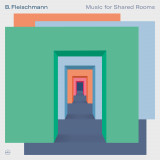
»Music for Shared Rooms« is B. Fleischmann’s eleventh solo album and his first since 2018. It is also not an album, or at least not in the conventional sense of the word. These 16 instrumental pieces provide a kaleidoscopic glimpse of a forward-thinking musician at home in many different musical worlds, including experimental and abstract music, pop and more classically-minded compositional forms. These pieces were culled from an archive of roughly 600 compositions for theatre pieces and films written throughout the past twelve years. The Österreichischer Filmpreis-awarded composer, however, aimed for more than simply documenting his extensive work in and with different media. To do so, he edited and re-mixed the individual recordings for this release, taking them out of their contexts and reworking them for an audience who can experience them in a different setting. »Music for Shared Rooms« makes it possible for its listeners to engage with the sounds and to fill the spaces they open up with their own imagination.
Roughly speaking, music for theatre or film can serve two functions: it either takes the lead, or underscores what is happening on stage or screen. The marvelous thing about these pieces is that they manage to do both. Fleischmann’s work as a prolific producer has always drawn on contrasts, at times combining pop sentiment with rigid experimentation, the seemingly naive with the intricate and complex. This approach also marks the tracks collected here: bringing together acoustic elements and electronic sounds, at times working with conventional structures but always de- and re-contextualising them, Fleischmann constructs a vivid dramaturgy out of discrete singular compositions, letting them interact across the record.
Take, for example, the opener »Träumerei« and the following »Brenne«: after the soothing acoustic sounds of the former, the latter quickly picks up speed with hard-hitting drum machine rhythms. It’s a stark contrast sonically and stylistically, however both tracks are tied together by a certain harmonic sensibility. This sort of dramaturgical interconnectedness of varied musical materials is the thread that runs through »Music for Shared Rooms«. A droney piece for string instruments like »Sehnsucht« is followed by a trip-hop beat, before »Schock« lives up to its title with skittering beats and piercing high frequencies. The differences between the pieces may be striking, but the progression from one to the other is subtle. It goes on like this through different moods and tempos. There’s soothing-yet-eerie piano pieces like the »Für Elise«-inspired »Der Lärmkrieg«, gentle house grooves, joyful synthesizer excursions and, finally, »Die Erde ist mir fremd geworden«, a collage of abstract textures and concrete sounds.
All these pieces create distinct situations through the juxtaposition of diverse musical elements, but are also bound together by a single vision. Writing music for theatre pieces or film requires a composer and his pieces to engage with people and their movements in space, which is exactly what Fleischmann offers on this record. He breaks down the fourth wall and invites his listeners into his world, a wide-ranging musical panorama. »Music for Shared Rooms« is indeed not an album in the conventional sense of the word, but more like a photo album in which each page opens up a new space to get lost in; recreates different scenes in which you can immerse yourself. These are shared rooms indeed.
For their Drag City debut, the enigmatic duo expand into eight-armed wonder; all the better to reach ever-deeper into their bag o' tricks. Slinky and sliding elegantly, the kids forge tunes with a harmony of ambiguity and nostalgia, effortless yet precise, and rounded with thick bottom - a dancing clash of cognition and dissonance! Since 2015, Kamikaze Palm Tree have been a relative mystery. Now, in times no less mysterious, Drag City welcomes them, celebrating the energy of their second LP, where KPT play their offbeat strain of 21st century rock. Making MINT CHIP, Dylan Hadley and Cole Berliner reach deeper into their bag of tricks than ever before, dialoguing with an absurd shared intent they haven't yet paused to question. The off-center pieces gathered together for Good Boy have given way to pulsing aquatic compositions on MINT CHIP. Cole's guitar tones, wire thin, bell-like, bluesily downtuned, slinky and sliding elegantly, arc purposeful around their peripherals. Dylan's kit work, effortless yet precise, grounded with heavy bottom, drives and interacts organically with all the emerging structure, nailing down finely detailed frames and canvases to backdrop her singing and the unremitting landing of melodies and songs. With the addition of Josh Puklavetz, things that didn't make sense before - like bass - are now on the beach, fully lotioned, essence to essence. Violin and clarinet (Laena Myers Ionita and Brad Caulkins, respectively) round out the tonal spectrum. All strung together in the foothills of Altadena's Wiggle World Studios with Hartling back in the engineer's seat and Tim Presley producing the proceedings!
NEW 45 BY DEEP-FUNK PIONEER LUCKY BROWN RECORDED DURING THE MYSTERY ROAD SESSIONS!
"Funk is a living, breathing, creative and generative entity and The New Lucky Seven celebrate its life with a mysterious and authentic sonic snapshot from the iconic Mystery Road sessions: WOODHEAD!"
Woodhead is a steady medium groover built around an acute chanky guitar part that Joel Ricci aka Lucky Brown composed while living in the "Woodhood" district of Bellingham Washington, USA in the fallout shadow of an industrial area on the outskirts of town. The Woodhood was so named because the streets were all named after different kinds of trees; Cottonwood, Alderwood, Birchwood, etc. Though members of the band had been performing Woodhead since as early as 2004, it had never been officially committed to tape. So during the 2013-2014 span of living room "Magik Carpet" sessions at drummer, Oliver Klomp's house in West Seattle, the combo dubbed by Lucky as "The New Lucky Seven" casually hit the head a couple times before calling it a night as Lucky rolled tape.
Opening with the now world-famous guitar player, Jabrille "Jimmy James" Williams dropping deftly into his rhythmic part, Lucky chants in the background the words "don't stop" as the tension builds up into the moment the whole band comes in. With Bob Heinemann on bass, Marc Hager on Rhodes and Oliver Klomp on drums, the thick but honest groove is instantly palpable. Trombone player Mars Lindgren and Sax player Thomas Deakin, along with Lucky on Trumpet lay down the 'head' to the tune right off the bat with everyone in the band giving that hard hit on the 4 count of the last bar of the repeated figure. This 'hit' returns again to form the breakpoint between soloists Jimmy James, Marc Hager, and on side B, Thomas Deakin, and Lucky Brown on the flute. The horn section microphone was situated on the dining room table and Lucky just had to lean over to reach it with his instrument! Michael Iris of Bell Creek Studio transferred and mixed these two tunes from Lucky Brown's cassette machine.
This tune was left off of the Mystery Road compilation album but comprises one of the last tracks created during those sessions therefore the concept, vibe, style, and intention should resonate and be interchangeable with the rest of the 45s from that epic Box Set TR-9043 released by Tramp Records on May 4, 2015.
As you spin and interact with the Mystery Road recordings, you are invited to allow Woodhead to take its rightful place specifically alongside the other "The New Lucky Seven" recordings and generally as a part of the suite of crude and naive living-room "Magik Carpet" funk of the rest of the Mystery Road.
As illuminated before in Lucky's artist statement regarding the Mystery Road sessions, the music contained therein was always intended to put emotion, vibe, feeling, and spirit before technical, spatial, or even performance constraints and to serve as a gift of discovery to lovers and aficionados of the deep funk idiom and the rare 45rpm format. Funk is a living, breathing, creative and generative entity and The New Lucky Seven celebrate its life with a mysterious and authentic sonic snapshot from the iconic Mystery Road sessions: WOODHEAD!
John Moreland doesn’t have the answers, and he’s not sure anyone does. But he’s still curious, basking in the comfort of a question, and along the way, those of us listening feel moved to ask our own. “I don’t ever want to sound like I have answers, because I don’t,” he says. “These songs are all questions. Everything I write is just trying to figure stuff out.” Moreland is discussing his new album Birds in the Ceiling, a nine-song collection that offers the most comprehensive insight into the thoughts and sounds swimming around in his head to date. A compelling blend of acoustic folk and avant-garde pop playfulness, Birds in the Ceiling lives confidently in a space of its own, enriched by tradition but never encumbered by it. The songwriting that has stunned fans and critics alike since 2015’s High on Tulsa Heat remains potent, while the sonic evolution that unfolds on the record feels like a natural expansion of 2020’s acclaimed LP5. The New Yorker, Pitchfork, Fresh Air, Paste, GQ, and others have embraced Moreland’s meditative songs, while performances on The Late Show with Stephen Colbert, CBS This Morning, NPR Tiny Desk Concert, and more have introduced Moreland to millions. And yet, while the Tulsa-based Moreland is grateful for the respect and musical conversation he’s now having with people around the world, he is also more focused on the idea of just talking to one person––or even himself. “Through the years, I’ve felt like I’m increasingly talking to myself in my songs, more and more,” he says. “Maybe in the past, I wasn’t aware of it, but now, I am. I think doing that has helped me be less hard on myself, which makes you more generous and compassionate in general.” That helps explain why even if Moreland is reaching out to someone else, there is no judgment. “I’m in the same boat with whoever I’m talking to,” Moreland says. Moreland’s songs do feel intimate––like overheard conversations or solitary meditations. “I want to talk one-on-one to someone in a song,” he says. “I don’t want to address a group, really, because I think that’s when it’s easy to start pontificating––and it gets less honest.” Letting things just be what they are is a powerful guiding force for Moreland, determining not just how he interacts with others, but how he treats himself. “When you remove boundaries and instead of holding back parts of yourself––when you say, ‘Okay, I’m going to put all of me into this,’” Moreland says, "You end up making music that nobody else could make.”
It is to the detriment of our understanding of musicality that we mostly measure it by the capacity to produce, and much less by the capacity to receive some sort of acoustic information or event. The virtuosity of listening, of understanding the sonic situation and its potential, is, however, that which defines one's capacity to interact – with other musicians, with the audience, and with the environment. This could also be taken to mean that an ethical act is implied in the situation of listening – the decision to relate, to be attentive to, to actively position oneself in relation to what is heard.
Rarely is this capacity so thoroughly pronounced and ethically conscious as in the case of Manja Ristić, the Belgrade-born and Royal Academy of Music-schooled musician, composer, sound and multimedia artist (the list could go on), who currently lives on the island of Korčula in the Croatian part of the Adriatic. Ristić’s recent, field recording-based work, is indeed all about attentiveness, most of all towards the environment and the acoustic traces of the endangered ecological layers of her old-new Mediterranean surroundings. With that in mind, it is indeed no wonder that her newest album draws from Milton’s Paradise Lost, which could easily be the anti-slogan of the endangered Croatian coast, eaten up by the pressures of touristification and the usurpation and privatization of once common space. More precisely, the album is inspired by one of the fifty Gustave Doré illustrations of Milton’s epic, Him, fast sleeping, soon he found, In labyrinth of many a round, self-rolled, from which it draws its title. The verses and the scene are from Book IX, and depict the moment Satan inhabits the Serpent, the beginning of his subversion of God’s autocratic rule, as some interpretations would have it.
For Ristić, the actual Paradise she introduces us to is in a state of imbalance – the idyllic soundscapes of her island surroundings overlain with sonic anxiety, such as on the album’s first track, The Flies, with its unrelenting, nervous buzzing evoking the ominous Biblical entity of Beelzebub, or The Lord of the Flies. The next track, Whales, which beautifully utilizes archival whale recordings, could also be taken to establish an intertextual relation to Milton through Melville, whose Moby Dick was strongly influenced by Paradise Lost. The middle track of the album, dedicated to the Croatian-American painter and muralist Maksimilijan Vanka, uses to great, unsettling effect what to my ears sounds like a buried hydrophone, a technique often employed by Ristić in her work, giving us a rough, grinding impression of water beating the pebbles over a high-pitched drone. But perhaps the most ominous, pessimistic image is painted in The Flag Pole, in which the symbol of revolutionary victory (I’m thinking of the Yugoslav modernist Tin Ujević and his proto-avant-garde sonnet Farewell from 1914) becomes a source of terrifying sonic unease, as we are listening to the incessant sound of its rope hitting the metal pole. However, with Dlana Night comes relief – the drones become airier, calmer; there is a distant notion of people, dogs, everyday life, all shrouded in the calming sound of the crickets on the island of Silba. Ristić, ultimately, serves us some hope on this wonderful new album, showing us that something has been lost, but that something can also be gained through the thoughtful attention with which she listens to the world around her.
„My recording techniques all boil down to one thing – intuition. I do not use expensive or highly sensitive equipment nor do I employ special techniques. On the contrary, I believe that the information regarding a space or an object can be recorded well enough on an average device. My personal guideline when recording sound is the positioning of myself as the listening medium, active and with the intention of establishing a connection that is sometimes intellectual, sometimes conceptual, and sometimes phenomenological.” - Manja Ristić, in an interview for Kulturpunkt.hr