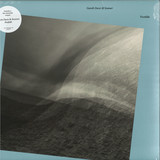
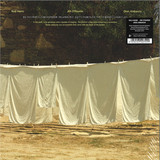
The two collaborators, known separately for contemporary electronic music & free clarinet experimentations team up to create the delirious trip, Footfalls.
Two scenes are presented here, seemingly taken from different sides of the same desolated seaside setting, loosly inspired by poet and novalist T.S Elliot and Samuel Becket. In Towards the Door, Gareth Davis´ bass clarinet breathes slow, wave-like tones that merge with the oft-rythmic electronic textures from his counterpart. A third of the way in, Robin Rimbaud´s synth erupts into a Blade Runner-esque epic harmonic section that disappears as suddenly as it arrives - leaving ripples of oscillation in its wake, slowly unfolding into the sound of waves, as it arrives back where it begun : as a full circle, drawn in echo´s of sound.
Smokefall begins with the words „Invisible choirs“, subtly spoken by a woman’s voice among a blurred distant conversation, as textural sound effects creep forwards to the point where a slow progressing but steady LFO rhythm enters. Water, metal & smoke are absorbed into a creeping tribal passage, acompanied by long clarinet tones. The piece expands further and further into a state of ecstatic harmonic noise that fulfills all parts of your body – if played loud. Both artists from here on move into full on crushing electronics, all while Rimbaud´s Kilpatrick Phenol synth drives the background with its pulses and repetative bassline. The piece has an ellipse like rotation that makes one feel a sort of blissful vertigo that reverberates in your mind after the piece has ended.
Footfalls is an euphoric trip from two artists that – although prolific - manages to arrive at the perfect meeting point to deliver two hard to shake pieces of dizzying electro-acoustic perfection.
Suche:it electronics
Planning the imminent arrival of the 50th release on Touchin’ Bass, label boss Andrea Parker was digging through the warehouse during a stock take and it became apparent that there was something missing. There was a gap in the catalogue numbers. Where was TB036? Searching the archives it transpired that, for one reason or another (not least Parker’s inability to count), there actually wasn’t one.
So what better way to backfill this now documented gap than to welcome the multitalented guitarist and drummer, mathematician and multidisciplinary improviser Maria Gamboa Perez into the Touchin’ Bass fold with an updated focus for 2019.
Perez combines elements of rage, chaos, tension and anguish to form a visceral style. Her musical terrain and talent is shaped by dissonance and NO art. Under the moniker NonZero!, Perez brings Matrix Equation to the fore; a heavy 8 track EP with electro aesthetics from none other than Carl Finlow Scarletron/Silicon Scally/Voice Stealer.
Beginning her artistic career as a teenager playing as a bassist and guitarist in groups with influences from Noise, Avant Garde and the No-Wave, Perez was introduced into several areas of electronic music during the club culture years in Madrid and opted for styles such as Electro or Industrial, at which point she began to be interested in the introduction of rhythm boxes together with traditional drums.
Her passion for sound synthesis and musical exploration led Perez to introduce electronics into a solo project under the pseudonym NonZero!. Under this name she aims to make electronic music her field of sound research and for years has been continuously searching for existing relationships between sound and mathematics, focusing on the perceptual limit between music and noise.
Matrix Equation indulges in an evidential brooding angst, shifting between abstraction and the kind of elevated introspection carefully harvested over the years. With dramatic frontage in parts, blasts of boisterous energy and machine mayhem, its deployment of surprise, shifting focus and spontaneity operate in an assured statement.
Splintered beats and a foreboding sense of tension give way to a more DJ friendly logic of instinctive introductions and codas of gradual builds and breakdowns as Finlow further reworks the results to great effect.
Schmer Records is proud to announce the upcoming EP from Liquid Asset. It is an entire rave on a 12 inch disk and has something for every stage. From the acid in your face of Wambulance to the bliss of Moon Beams ON Your Face. When not In Laboratory cooking up amazing tracks Liquid Asset is bringing them directly to your party. This EP also has the amazing Isabella providing an entire rave in a single remix. We're sure you'll enjoy playing it as much as we do releasing it.
Liquid Asset is the hardware techno project of Alene Marie, a Philadelphia-born,North Carolina-based producer with releases on New York Trax, Summer Isle, Primitive Languages, Jacktone, Acid Etch and now Schmer. A self-described nerd who started building electronics in 2010, she brings a scrappy, DIY sensibility honed in the noise / hardcore scene and hacker-spaces of Philly. Her punchy, loop-based and heavily rave-oriented mutations of classic dance cannon sounds, beamed out of a self-built rig of modified 303s, 909s, and 808s, have earned enthusiastic support from North American dance music underground institutions including Bossa Nova Civic Club, Hot Mass, and Sustain-Release.
Italian producer and Fine Human Records label head Dino Lenny lands on Crosstown Rebels for the first time this November, bringing his distinct and personal style to the label on the absorbing Doctor, also featuring a remix from Nuiton. The haunting, emotive vocals of Dino impress throughout on Doctor, chugging groove moves alongside waves of dark electronics and panic-struck, devilish synth. A track crafted to capture the inner workings of Lenny’s mind, transforming them into a hypnotic piece. Nuiton remixes Doctor on the reverse, adding energy to the original with skipping hats and quirky arrangements, building tension that reaches an intense jazzy crescendo of percussion and brass to leave you in a headspin. On the digital release a dub version loses the voice but retains the mysticism. With almost 30 years of releasing records under his belt, Dino Lenny has naturally built an incredible back catalogue of remixes and collaborations. He’s worked with some of the biggest names in the business, yet his productions retain a unique style that is all his own. A true lover of the 80s, when he needs that extra touch he will add his vocals to the music, always trying to deliver something original that will stand the test of time, often opting for imperfect unique experience over precise emotionless never-ending loops. Alongside this, he has remixed huge names like Missy Elliott and Timbaland and has collaborated with legends including Madonna, Wu-Tang Clan, Seth Troxler and Dixon. Lenny has been named as “a wizard of electronic music” by the Chemical Brothers, played live with Underworld, released music on the likes of Crosstown Rebels sister label Rebellion, Innervisions, Diynamic, Cocoon & Correspondant, and is currently signed to Ellum. Constantly evolving his sound, Dino is unpredictable & eclectic.
Maybe it’s too much to ask for a moment of your attention. As we grow older and keep
diving into this era of information, disinformation, fake news and all that, we also tend to
take a step back and listen to the intents of those social media adverts that tell us to slow
down, breathe in, breathe out, enjoy everything around you a little bit. So, if it’s not too
much to ask, you can press play and start enjoying “D-A-D”. If you’re doing that, you can
even stop reading this, because you don’t need further instructions.
It’s the second time in less than two years that we release music from London based
Greek musician Tasos Stamou (Athens, 1978). The wordplay of “Musique Con Crète”
(CREP54, 2018) was a backdoor to an adventurous and ‘concrete’ experience with
sound. “D-A-D” follows up on that. Recorded between 2015-2018 as an homage to both
his Dad and the more commonly used tuning on the Greek Bouzouki, D-A-D, Stamou
delivers 40 minutes of music that explores ancient and modern languages, while crossing
his unique instrumentation with celebrations of new/old folk, field recordings and
electronics. In his music, there’s a constant flow of ideas that defy standard tonalities and
the conception of “traditional”.
Improvisation was the starting point for the creation of some of the nine pieces Tasos
Stamou wrote for “D-A-D”. The electronics often serve to interact with field recordings that
are wisely manipulated, while acoustic instruments, like a Bouzouki, build up the
connection with the tradition and the necessity to slow down.
With his unique atmospheres, Tasos is whispering some life hacks to build a better life.
Nowadays, it’s quite rare for a record to organize the way the listener wants to listen to
music, to sounds. “D-A-D” creates a beautiful systematization between old and new,
folk/traditional music and the technology in sound. There’s – still - some boldness in that.
All songs by Tasos Stamou
Mastered and Cut by Rashad Becker
In late 1997, unsigned Melbourne producer Castel won a competition at a local club. The prize was certainly sought-after: a CD single release on leading local label DanceNet. That EP, “Estrel”, subsequently appeared in stores in 1998, but within two years Castel had packed away his Atari-ST, sold off his hardware and quit music for good.
Thanks to Echovolt Records, Castel’s story now has a happier ending. 22 years after it was recorded, the unfeasibly gorgeous “Estrel” is finally appearing on vinyl alongside original bonus cut “Me & You” and a trio of similarly impressive unreleased productions from the period.
“Estrel” is positivity personified – a melodious, morning-fresh blast of deep electro bliss rich in bustling drums, tuneful IDM style lead lines and darting, psychedelic electronics. It’s joined on side A by “Me & You”, a pitched-down chunk of hazy ‘90s electronica that wouldn’t have sounded out of place on one of Warp Records’ legendary Artificial Intelligence compilations.
On side B, Castel opens up his archive of unreleased recordings for the very first time. The rush-inducing, bass-heavy swirl of “Safer Somewhere” – one of the last tracks he ever recorded and reminiscent of some B12 recordings from the period – is followed by the intergalactic ambient brilliance of “Latch” and the lilting, sun-bright bliss of breakbeat-driven shuffler “16/11/1998”, whose combination of weighty bottom-end and layered electronics neatly sums up the unheralded qualities of Castel’s previously forgotten work.
French wielder of exotic machine music Epsilove debuts a full EP of sensuous, melodic electro on Dekmantel. Formerly one-half of Syracuse, Isabelle Maitre depicts a vision of daring, yet euphoric vocal-led, dreamy electro that oscillates with sturdier, warehouse sounds full of heaving 808s, and experimental qualities.
‘Time is the longest distance’ preaches the qualities that brought Antinote’s Epsilove to the distinguished status she has today. It is the sound of chic dancers, shuffling-together leisurely under neon lights, pressing against each other along to nostalgic acid basslines, interstellar synths, and dreamy, cinematic vocals. Rich with harmony, emotion, and cold-wave sensuality. ’Sea Snakes’ pulses faster under a Drexciyan dream-state, painting kaleidoscopic motifs, as the 808 rattles out multi-paced tempos, driving levels of uncompromising Detroit velocities, through to Lynchian-mirror-world listlessness. It’s an acid-acid test of colourful, pulsing electro.
On the remixes are fellow Parisian’s Ali Bobo (Bruits De La Passion) and Shelter (Bigwax Records), who rework ‘Time is the longest distance’ into something more sinister, reflecting the dystopic IDM aesthetics of early Rephlex Records with playful, darkened electronics. The more elusive pairing of French producer HAJJ (Dawn Records) and Lastrack (BFDM) meanwhile, team up to turn ‘Sea Snakes’ into something that harkens towards the world of Warp-like experimental and progressive contemporary post-trap, and breakbeats.
"À dix mètres sous moi, l'eau invisible. Entre l'eau et la brume, pas de frontière, la brume aussi lourde que l'eau, l'eau aussi irréelle que la brume. Passage dans un autre monde, transition par une osmose où toute forme ancienne est désagrégée et dissoute.” Raymond Abellio, Heureux les Pacifiques (1946)
And we used to be such a nice record label .... BKV 026 swells up from the Bristol swamp in the forms of post-human industrial duo Bad Tracking. Here they have assembled variously, one spacious black metal intro (with original screams), an industrial-pop earworm not unlike Depeche Mode imploding in a feedback tunnel, two itch-tek dancefloor riddims namecheking local venue bans and I just don't know what to call 'Wellspring' really, the end of days? Well you had it coming anyway…..
Known in town for upsetting local MPs and lisencees with their live performances as 'naked technology sex slaves' think cassette-induced self harm, total nudity, blood from ears, Bad Tracking are the most visceral thing we've seen in this new wave of Avon experimental - a breath of life into the longstanding tradition of industrial performance art (and an antidote to idle BR club culture). Lyrically touching on censorship and tech // sonically they use feedback as a punishing instrument of anguish and expression.Widower EPis truly chewed nail sonics, more human than all your noise records, genuinely more scary than your edgelord power electronics nonsense, more forward than all yer government funded experimental think-records.
You may remember Bad Tracking from their remix of 90s soundsystem legends Bush Chemists on Bokeh last year. It sounded like they played the original through 1,000 knackered tape decks and added one kick drum. It was total sacrilege and we loved it. Bad Tracking is Gordon Apps aka reputed jungle/drumfunk producer Relapse (who also moonlights as Avon Terror Corp's Olivia Mutant John, buy his shit) and poet / VHS video artist Max Kelan (who has lent his visuals to MVs from Hodge, The Pop Group, OM Unit, Young Echo to name only 4). They've released on tRewdindForward family labels like Mechanical Reproductions and champions of bad taste and good music - Fuckpunk.
Director Amanda Kramer’s prompts for composer Ben Babbitt’s soundtrack to her enigmatic film Paris Window read like magnetic fridge poetry – “warped ambient bumper muzak tension” – but the results skew closer to some hypnagogic contemporary noir: lulling, low-lit, and laced with lingering dread. Electronics, strings, and percussion swoon and seethe in heady mirages of dreams and delirium, romance and menace. The narrative it accompanies is equally opaque and out of time: two eccentric siblings psychologically unravel through divergent fixations, one obsessed with the hypnotic infomercials of a mysterious self-help institute while the other falls in love with an ambiguous doppelganger.
Babbitt’s background scoring experiential video games (Kentucky Route Zero) and collaborating with exploratory songwriters (Angel Olsen, Weyes Blood, Eartheater) is evident in his versatility and finesse, flowing fluidly between minimal and maximal modes. Like all dynamic film music, the pieces weave a story of their own. Serene synthetic swells decay into murmuring television static and eerie vocal fragments; close-mic’d drones turn acidic then claustrophobic, mirroring sleep paralysis transformed into panic. Babbitt builds a window into a surreal world, seen through shadows and smeared, street-lit glass.
Delsin founder Marsel Van Der Wielen revives his Peel Seamus alias for a debut album proper. The leading Dutch techno label began in 1996 with a cassette-only Peel Seamus release, Publik Draft, which Van Der Wielen primarily distributed through early online channels of communication. There was a small flurry of 12" releases from the project around the turn of the century, but for a long time Peel Seamus has been quiet. Now Van Der Wielen has gathered together tracks from his archives, mostly written and recorded circa 2000, to present the Peel Seamus debut album proper, Susurro. Rooted in the classic Detroit and European techno that Delsin's identity is forged on, it's a deep, rich listen laden with heart and soul to match the mechanics of Van Der Wielen's chosen tools - a masterclass in expressive electronics and a fascinating insight into the musical DNA behind one of the world's finest techno labels.
Jatinder Singh Durhailay and David Edren released Tea Notes as a cassette back in April of 2018. London-based Jatinder Singh Durhailay is a painter and student of Indian Classical music. He has trained in both the sitar and the Hindi singing technique, Dhrupad. He also plays two traditional Sikh instruments; the bowed, stringed Dilruba and Taus. Poetic Pastel Press issued his solo debut, The Last Ballad Of Mardana, in 2017. David Edren`s expertise lies with machines and modular synthesis. His Kosmische and New Age-Inspired electronics have featured on numerous cassettes, and compilations, produced for imprints from the current Belgian underground, such as Jj Funhouse, Social Harmony, and Ultra Eczema. These recordings appearing, since the turn of the millennium, either under his own name, or the moniker DSR Lines. Jatinder and David’s collaboration, Tea Notes, is a celebration, a meditation, on both the beverage, and the communal time shared imbibing. The coming together to partake in its ritual. Each of the six tracks represents a different infusion. The opening piece is a tribute to semi-oxidised Oolong, from China`s Wuyi Mountains, with hammered dulcimer-like glissando. Gongs shimmering, gently crashing, as if signaling a change in the weather. A calm of thin, stretched synths and Ai angels introduces Tulsi from India. The Holy Basil of Hinduism, used in the worship of Vishnu, Krishna, and Rama. A traditional herb of Ayurveda and Siddha medicine. Automated arpeggiated sequences raising a vibrating wall of hallucinatory sound. Pairing swooning strings with a racing robot heart. Ceylon is a modern twist on the classical raga. Serving to tell the story of a tea smuggled into Sri Lanka in the 19th century. Plants stolen from South West China, where the brew had been enjoyed since the days of the Shang Dynasty (1766 to 1122 BC). The contraband founding fresh industry in its new home when the indigenous coffee crops failed. Muted organ and sleepy, treated sine wave microtones describe Kava, the Polynesian fireweed root, whose extract serves as both sedative and euphoriant.Shincha are the first young leaves of the season. Picked in Southern Japan and steamed to prevent oxidization, retain their flavour and green / gold colour. Their musical counterpart finds Edren establishing an ecclesiastical drone, while Durhailay`s strings chart an ancient romantic ache. Sonic stars shine. Singing out to the infinite, the universe, before dissolving into knots of Radiophonic Workshop noise.Melodies treated with subtle sustain and delay denote Pu-Ehr, from the Yunnan province. The only truly fermented black tea - made distinctive by the action of bacteria, moulds, and yeasts. Its musical themes hovering in the vapour trails, the atmospheres, they themselves create. Spiraling, soaring, reaching for the heavens, while pretty music box glitches - tiny chimes turned in on themselves. Catching, reflecting, like light at play on fresh running water. (words: Robert Harris)
"Celebrity clouds" is compiled of four songs, which have been produced and recorded in 2018. It's an online collaboration of Alexandre Kordzaia (kordz) and Natalie Beridze. These two came up with the concept of the record uneventfully, after recording their first track "Celebrity clouds". Beridze's lyrics came out completely irrelevant to Kordz's music, that adopted a flair of humor and sarcasm to it. After that, they decided to stick the line of weird lyrics on top of synth, piano and ambiance recordings, played live by kordz. Musical ideas belong to kordz. Beridze would complete the tracks, adding few instruments (or none, in some cases), wrote lyrics and recorded vocals.
The artwork of the vinyl, made by Georgian artist Thea Djordjadze, resembles the concept of the music nonetheless. As though having nothing to do with neither celebrities, nor their clouds, it shows the sadness and the beauty of half-molten candle.
Alexandre Kordzaia aka kordz is a Georgian composer. After moving to Switzerland at a young age, he professionally studied piano and drums, audio design and recording acoustic music. shortly after he started producing electronic music.
Kordzaia is currently studying in Hague, Netherlands, where he is accomplishing his master's degree in composition. He releases on labels such as: Prrrrrrrr Records, Medschool Records, Hospital Records, Majestic Casual Records. Kordzaia also writes for acoustic instruments and orchestras with live electronics: for the Junge Norddeutsche Philharmonie, the Georgian Philharmonic Orchestra, the Residentie Orchestra (The Hague), the Dortmunder Philarmoniker, the Zagareli String Orchestra, the Nieuw Ensemble (Amsterdam) and Kluster5 (The Hague). To pack his music into popular categories is not easy: "His music is a mesh of carefully balanced oppositions: deliciously snappy transients punctuate shimmering soundscapes, gently morphing into funk; a melancholic post-soviet feel pays sentimental homage to a private vision of the 80s. Acoustic instruments sit side by side with analogue synthesizers and drum machines; field and foley recordings blend the recognizable into the fuzzy and surreal.
Natalie Beridze (tba) is a Georgian music composer and songwriter, considered a pioneer of Georgian electronic music. She has released over 10 records on labels such as Cologne based Max.E, Berlin based Laboratory instinct, CMYK, Chainmusic, CES Records and Berlin's Monika Enterprise, which has become her main label. Beridze's collaborations include: Thomas Brinkmann, AGF (Antye Greie), Gudrun Gut, Joerg Follert, Marcus Schmickler, Nika Machaidze aka Nikakoi, Sonae, Ryuichi Sakamoto, Gacha Bakradze, Alex Kordzaia.
Beridze works on music for acoustic instruments, orchestra and choir.
Her recent work - "Mapping Debris" was written for Swiss "Mondrian Ensemble" piano and string trio and electronics, performed in Zurich, in 2019.
Beridze collaborates with a Georgian string ensemble "Zagareli and strings", composing pieces for electronics, strings and viola.
Keiji Haino,Jim O'rourke,Oren Ambarchi
In the past only geniuses were capable of staging the perfect...
- A1: In The Past Only Geniuses Were Capable Of Staging The Perfect Crime (Also Known As A Revolution) Today Anybody Can Accomplish Their Aims With The Push Of The Button Part 1
- B1: Decorously Decorously Decorously Decorously Decorously Decorously Decorously Decorously Decorously Decorously To Make Something Beautiful And Then To Smash It Decorously
- C1: Head-On Collision If It Still Has Bones It Shall Move Forward (Which Is Different To Progress)
- D1: In The Past Only Geniuses Were Capable Of Staging The Perfect Crime (Also Known As A Revolution) Today Anybody Can Accomplish Their Aims With The Push Of The Button Part 2
For its 50th release, Black Truffle presents the 9th album from one of the label’s core ensembles, the power trio of Keiji Haino, Jim O’Rourke and Oren Ambarchi. Drawn from a November 2015 performance at Tokyo’s now-defunct SuperDeluxe, the record’s opening piece drops us immediately into the maelstrom, abruptly cutting into an extended episode of Ambarchi’s pummelling drums, O’Rourke’s fuzzed-out 6 string bass and Haino’s roaring guitar and electronics. Eventually settling into a hypnotic bass and drum groove over which Haino unleashes some almost Ray Russell-eque skittering atonal screech, these opening 13 minutes act as a potent reminder of the trio’s power. Alongside showcasing the steady development of a unique language for the guitar-bass-drums power trio, the group’s succession of releases over the last decade has demonstrated a constant experimentation with new instruments, which continues here with O’Rourke use of Hammond organ (played at the same time as his roaming, sometimes knotty basslines). On the album’s second piece, the organ plays a key role, furnishing a harmonically rich shimmer over O’Rourke’s angular 6 string bass chords, Haino’s distant, chirping electronics and Ambarchi’s crisp cymbal work; arriving somewhere halfway between Albert Marcoeur and Terje Rypdal, this piece is undoubtedly a highlight in the trio’s catalogue so far. Sides two and three are given over to slow-burning, multi-part epics that range from spacious reflection to furious tumult. Where the trio’s previous 2LP set (This Dazzling, Genuine “Difference” Now Where Shall It Go?, 2017) was primarily instrumental in focus, here we find Haino’s voice taking the spotlight on the expansive third side, intoning, wailing and exhorting in Japanese and English over a backdrop that moves from hushed bass and organ atmospherics to rolling toms and cymbal crashes before arriving at an ecstatic finale of searing guitar, tumbling drums and reverb-saturated bass. The fourth side returns to the hypnotic grooves of the opening piece, fixing on an relentless riff and riding it into oblivion under Haino’s roaming psychedelic soloing and jagged chordal slashes.
- A1: I Like Your Embouchoure
- A2: “Bam-Bam” Is Taking A Beating
- A3: ب ن یعك نویز (Noise Bni‘ak)
- A5-: Unplugged Modular Synthesizer
- A5: Just Before The Flood
- B1: Insufficient Creative Input
- B2: Lass Uns Kämpfen
- B3: Please Choose Another Pedantic Title For This Track
- B4: Pour Michel (In Memory Of Michel Waisvisz
Comic book artist, graphic designer and free jazz improviser are only some of the many talents from Beirut born Mazen Kerbaj. After appearing as part of various ensembles on the label, Ariha Brass Quartet (CREP46) and Johnny Kafta Anti-Vegetarian Orchestra (CREP22), Kerbaj finally lands a solo outfit of his own onto the Discrepant dancefloor of misdemeanour.
14 years after his first (and only) solo album "Brt Vrt Zrt Krt" (Al Maslakh, 2005) Mazen returns with a series of loud oozes (entirely) of his own with not one but two(!) solo albums of prepared trumpet that further cement his international position as a serial trumpet botherer.
Showcasing his very own and singular arsenal of squawks, cackles, howls and squeals the notion of being transported to a luring mutant underwater alien community is only occasionally dispelled with the sporadic passages of fluctuating tones and pulsations, like a restful humpback whale puffing on a hookah pipe at the ocean’s deep end. Mazen pulls out all the proverbial stops here, displaying a unique mastering of the instrument and its improbable add-ons creating various vignette like episodes rich in texture and variations - unlike anything else out there – not that you’d knew anyway.
Where Vol. 2.1 shows an astounding use of the instrument without recurring to cuts, overdubs or electronics, Vol. 2.2 raises (or shatters) the bar with its intentional use of everything Vol. 2.1 was denied. And Mazen is right about advising us, the sounds emitted on each record are beyond the limits of believable. Either he is using tricks or just prepared techniques the results go far beyond the reach of a normal or casual listener. Listen to the albums back to back and you’ll know what we mean.
Hailing from Chicago, Beau Wanzer has carved out a singular voice in electronic music since debuting on the L.I.E.S. label in 2013. Wanzer’s music is not industrial, wave, electro, or techno - it’s a unique and twisted amalgamation of all that, and more. Crazy as it sounds, we at Suction Records have been sitting on this Beau Wanzer material since 2003. Back then Beau was working at Weekend Records And Soap — a Chicago hub for the city’s exploding electro scene — when Solvent and Lowfish rolled into town to perform at an Ersatz Audio label showcase. We met Beau at the shop and he gave us a 21-track CDR. We were instant fans, fast friends, and went on to the share the stage with him several times, well before he released his first records. That CDR contains these 6 tracks now released on 10”-vinyl as the “Do The Spider Shimmy” EP. This is suction049.
Had that CDR not been held onto, and recently-unearthed by Solvent, this music would have disappeared into digital oblivion; Beau had long forgotten them and didn’t even have a copy of these CDR tracks. Beau Wanzer’s trademark sound — raw, minimal electronics and effected-beyond-recognition vocals — were already in full-effect circa 2003, but what makes this material different from his contemporary output is the dry, drumbox-funk influence of Detroit’s Ersatz Audio label (Le Car, ADULT.), which is also heard loud and clear across the EP.
Porridge Bullet reveals it’s third “Bullets” compilation with five dancefloor lifters.
AIWA is on warm up duties stomping away with bubbly saturated electronics. He hails from Budapest by the way. On to Madis Puuraid aka Profile and “Teramachi's” shimmering ambience lead by a funky drummer. Let this one roll a while before you show off your mixing skills. Estonia’s ug-scene oldtimer Neuronphase makes his second appearance on the label with nods to breakbeat. “I Have None” will make them come closer. Fact. There’s a second track by him on here too… Ruutu Poiss stretches his wires between Amsterdam & Tallinn with ease –– “Mjau” purrs in his unique broken-not-broken style.
Hey kids –– no digi!
After 10 years of vinyl pressings on Lapsus Records it's now time for our first ever "vocal" release!
Many of our Lapsus Radio (Radio 3) followers may already be aware of our fondness for synth-pop, however as a label we have never dabbled with this often unfairly maligned genre, until now...
From the moment we first heard the material from British artist Circa 2000 something magical transpired. William Wiffen's production blueprint signals a new twist in this forty-year old genre. ‘Thoughts In Vias’ –the album released in 2017 on Computer Club, the sub-label of influential Sheffield label Central Processing Unit– offered the first opportunity for us to witness the work of Circa 2000, the UK producer and composer residing in the costal city of Brighton. After his debut, in 2018 William released the ‘The Sun To The Waxing Moon’ EP on the multifaceted Chilean platform Infinito Audio, in which he delved into his more experimental production side.
Circa 2000 now joins Lapsus Records to present ‘Faith Healer’, his most personal work to date and a palpable tribute to the work of Scottish composer Alex Harvey, during his time leading The Sensational Alex Harvey Band. ‘Faith Healer’ is a seven-track album that revisits the nascent days of new wave and synth. It is an exercise in raw and analogue electronics that transports us back to the golden era of synthetic electronica, in which bands like Deux, Victrola and Monoton redefined minimalism and underground pop.
‘Faith Healer’ will be released in July and available on limited edition vinyl and all digital formats. As always, the Basora studio has once again provided us with stunning artwork for this release.
All producers on this timeless EP known for their contribution to NuDisco/Deep House Music. 1 Life records has enlisted the services of top talents. U.S deep house veteran Vincent Floyd wrap drifting deep spheres, lilting electronics & warm synth rhodes chords around a chunky groove on his fine beat interpretation for a brighter & breezier deep house vibe on a remix that benefits greatly from a squeezable synth bassline & some undulating TB-303 style acid motifs, while Rico De Almenda deliver a driving chunk of dub-disco/deep house fusion rich in sparkling synthesizer lines, sun-kissed chords & his own rubbery post-punk bass. Studio don Vincent Inc always bring unforgettable impressions & inspiration for mind, body & soul. 4 tracks came together to tell music stories about hypnotic deepest stuff, depression, happiness, loneliness, love, miracles & magical experiences. And now we're asking other's to join the sound conversation
Light of the Fearless, Hybrid's fifth artist album, brings together UK-based, Mike and Charlotte's passion for combining emotionally powered cinematic pieces with astute, intricate and intelligent electronic production. This long-awaited work is firmly based on the foundation of the principles and standards set by previous albums but here there's a clear development and evolution. Never wanting to write the same album twice, Mike and Charlotte have taken another step forward and have created a cinematic, electronic album with songs that stylistically borrow from their childhood soundtracks of soul, funk & hip-hop.
With songs have been inspired by not only events in their own lives but also by movements such as the Heads Together campaign, March for Our Lives 2018 and the Women's March of 2017. The album provides a positive and confident stance on moving forward through adversity and regaining empowerment. This is "The Light Of The Fearless". This inspiration certainly hasn't led to an album encumbered by political statements, but instead gives all the summery buoyancy you'd want to hear at your next festival.
Since their last album in 2010 the band have not only expanded their ever growing body of film score work (Fast and Furious 8, Interlude In Prague, Hercules, Dead in Tombstone, Take Down, Luther, X-men, Deja Vu ) but also saw the departure of band member, Chris Healings in 2015. The cinematic ethos is deep throughout the album with The City of Prague Philharmonic Orchestra performing on eight tracks. Unsurprisingly, the album as a whole works almost as a kind of score, and it's intriguing to be guided through the plot from the outset in the album's first track "We Are Fearless" through to the final track on the album. The expansive and unique cover of Tom Petty's "I Won't Back Down". Hybrid certainly haven't lost their flair for combining cinematic soundscapes, electronics and breakbeats.
“Following on from Homenagem, Lugar Alto’s first critically acclaimed project, the São Paulo label's new endeavour is the reissue of another neglected masterpiece. This time, it’s “Poema da Gota Serena” turn by Zé Eduardo Nazário from 1982. This unique work gathers elements of free jazz, Brazilian Northeastern rhythms, Asian percussive instruments and electronics.
Zé Eduardo is a virtuoso drummer and percussionist with a prolific career as a musician and teacher. He was introduced to music in his youth and started playing professionally at the age of thirteen. In the late 60’s he was a regular at the famous Totem night club in São Paulo, where he performed alongside the pianist Tenório Jr. and other exceptional instrumentalists. It was there that he met Guilherme Franco, and together they formed the Grupo Experimental de Percussão. This period defined Nazário’s interest in different sonorities involving percussion, and he broke away from the more traditional genres, such as bossa nova and jazz. Over time, this distinctiveness in sound and playing allowed him to create his own path which culminated in an extensive number of remarkable works, including the colorful and psychedelic “M andala”, which examines Indian and hippie themes. He also played with Hermeto Pascoal’s group and joined him and Jaques Morelenbaum for the recording of the cult classic “Imyra, Tayra, Ypy” by Taiguara. For Egberto Gismonti’s “Nó Caipira”, Nazário performed with the khene, a mouth organ from Laos, a present from Gismonti himself.
But it is Nazário’s work with the 1976 collective Grupo Um which is his most well-known, who, during their 6-year legacy recorded, amongst movie and ballet soundtracks, 3 albums: “Marcha Sobre a Cidade”, “Reflexões Sobre a Crise do Desejo” and “Flor de Plástico Incinerada”. The combo is considered one of the most innovative formations of its time, unusually combining electro-acoustic elements, jazz and Brazilian traditional music.
Poema da Gota Serena was Zé Eduardo's first solo project and it was financed by the legendary Lira Instrumental, a collaboration between the ground-breaking venue, label and publisher for the São Paulo avant-garde, Lira Paulistana, along with the always interesting Continental Records, home to such luminaries as Tom Zé. The album was offered as a package deal simultaneously with the production of “Flor de Plástico Incinerada”, ensuring 2 studio sessions at JV studios in October 1982.
Each side of the album explores different duets which, with its suite formated tracks, give the album the feel of a cohesive whole. The first half of the A side, “Energia dos Três Mundos”, is shared with the improvised saxophone of Cacau. Nazário delves into free jazz rhythms and plays his drums with a rolling and tumbling swing, using the kit in full, demonstrating the power of Brazilian jazz fusion. The second half of the suite takes us into a more tranquil mode. “Só Prá Ouvir”, demonstrates Zé’s mastery on the glockenspiel, and Indian percussion instruments, such as the tabla and mridangam. Cacau, on his side, switches his saxophone for more delicate dancing flute driven passages, equal parts northeastern rhythms and deep Amazonian indigenous influences. The B side, with “Prá Pensar / Prá Sentir e Prá Contar”, contrasts heavily with the A side’s more organic and natural feel. In Prá Pensar Lelo Nazários’s synth clusters and electronic blasts strangely interact with the exploring, wandering percussion. This track leads into the sublime “Prá Sentir e Prá Contar” where South Indian inspired vocals, performed by Zé Eduardo, accompany the graceful synth chords and fluttering percussion. The result is a hypnotic, otherworldly feel to the music that is infectious and takes the listener on an extraordinary journey.
With Poema da Gota Serena, it is possible to hear music that extrapolates the lines of the avant-garde and popular music. It is an album the demonstrates that Brazilian jazz fusion can be both spiritual and challenging at the same time.
All the tracks were expertly remastered by Lelo Nazário, directly from the original tapes, maintaining the high quality of production that Lugar Alto are becoming renowned for. All the artwork was reinterpreted by the São Paulo design studio Sometimes Always, including an exclusive insert and unpublished images.
It seems that Lugar Alto have managed to excavate yet another gem from the seemingly bottomless Brazilian mines. Long may they continue to do what they do so well.”