It started with a night out at New York’s Sound Factory - and turned into an obsession, Inner City main man Kevin “Reese” Saunderson and his then manager, Neil Rushton, were at the NY uber house club when The Pressure by The Sounds Of Blackness got its’ debut World play, with the ecstatic response from the crowd meaning it was spun three times in a row.
Nobody was more knocked out than Kevin who vowed there and then to come up with a Detroit answer, much to the delight of Soul mad Rushton, co-owner of the Network label.
The idea of The Reese Project was quickly turned into House Heaven reality as Kevin recruited Detroit vocalist diva Rachel Kapp to record the anthemic Direct Me & The Colour Of Love as the first two singles.
Network made the group a main priority, coming with a whole slew of remixes to complement the original USA mixes on the subsequent album. Three of the most loved Network remixes are on this wonderful timeless 12.
The Dave Lee Joey Negro mix from 1991 is rated by many as one of Network’s finest moments, and maybe Lee’s finest ever “remixed with extra production” epics.
Rushton remembers meeting Lee to collect the remix, and instantly phoning Saunderson proclaiming “you won’t believe this”.
Underground Resistance’s Mike Banks added his magic to the 1991 original mixes of “The Colour Of Love” and the results were so overwhelming great that the idea of subsequent remixes was daunting.but the classic 1994 Network remix by The Playboys flew the flag for U.K. House.
C.J, Mackintosh set the production standards for U.K. Soul filled House and his 1993 remix of “So Deep” - sung by La’Trece - is a gem to be cherished forever and a day.
Network’s passionate crusade to crossover The Reese Project from House Music superstars to Pop success came tantalising close but never quite happened. But the Network remixes are a glorious legacy of House Music’s golden age and three of the very finest are remastered here and presented on one glorious 12.
Reese Project - Songs Not Slogans.
Suche:its not over
'Accosting Form, Pure Intent" - Nathaniel Young's new album for Mysteries of the Deep - is a contradiction that makes sense. At once raw and elegant, it emerges from a place of constraint and desire. Its individual tracks reflect this paradox as the album unlocks itself like a koan: a riddle that, once solved, dawns on the listener like an epiphany.
Metallic emanations in "Communal Dysphoria" and "Comfort in Form," interpolated with echo and reverb, arise from the void and disappear back into it, moving like scattered precipitation over rugged, rhythmic terrain. Certain tracks speak to certain influences: in "Extrasolar" and "May I Speak Candidly," drone is tempered by synth pads and wistful ambience. "Zion Waits for No One" brings to mind a sense of the Chthonic: a dark, primitive creature submerged. A monster from the loch that at times breaks through the still, watery surface.
Despite the assorted elements at work, a visceral quality binds everything together. Even the record's more subdued works are textured and tangible, at times balancing or playing against the serrated edges of its more structured pieces. Like all compelling works, the sounds here exist in a liminal space that is not entirely classifiable. Still, it is wholly cohesive in both its moodiness and its adeptness.
Releases on Umor Rex, Blankstairs, Phinery Tapes, Hospital Productions
The Lost Daughter is a critically acclaimed 2021 psychological drama film written and directed by Maggie Gyllenhaal in her feature directorial debut, based on the 2006 same-titled novel by Elena Ferrante.
The film stars Olivia Colman, Dakota Johnson, Jessie Buckley, Paul Mescal, Dagmara Domińczyk, Jack Farthing, Oliver Jackson-Cohen, with Peter Sarsgaard, and Ed Harris. Colman also serves as an executive producer on the film. The film follows Leda (Colman) who is on a solo-vacation at the seaside and becomes consumed with a young mother and daughter as she watches them on the beach. When a small, seemingly meaningless event occurs, Leda is overwhelmed by memories of the difficult, unconventional choices she made as a mother and their consequences for herself and her family. The seemingly serene tale of a woman’s pleasant rediscovery of herself soon becomes the story of a ferocious confrontation with an unsettled past.
The Lost Daughter premiered at the 78th Venice International Film Festival, where Gyllenhaal won the Golden Osella Award for Best Screenplay. At its opening night world premiere, the movie received a four-minute standing ovation from Venice Film Festival attendees. The film also received three nominations at the 94th Academy Awards for Best Actress (Colman), Best Supporting Actress (Buckley), and Best Adapted Screenplay.
Thescore is composed by Dickon Hinchliffe, founding and former member of Tindersticks. Dickon’s unique style of composition and arrangements developed from his classical study of the violin and song writing and recording in bands.
The Lost Daughter is available as a limited “Peal it like a snake, don’t let it break” edition of
750 individually numbered copies on orange marbled vinyl. The LP features alternative artwork designed by Yelena Yemchuk, a Ukranian professional photographer, painter and film director, best known for her work with The Smashing Pumpkins. The vinyl package includes an inset with pictures and liner notes by both Maggie Gyllenhaal and Dickon Hinchliffe.
(Incl. Nick Holder & AceMo Remixes)
BURNING HEAT is a potent tincture, a focused distillation now years in the making. Carefully chosen from over 20 new productions and extensively play-tested at parties across New Orleans and beyond, BURNING HEAT is the latest collaborative effort by locals Quickweave (Jalen Dilosa) and Redance (David Yaconi); a split EP forthcoming on Hiatt dB’s New Orleans-based Mystery Zone Records July 1st 2022.
The 180-gram 12 inch features 2 tracks from each artist along with a pair of remixes split evenly between the “WHITE HOT” and “RED HOT” sides courtesy of Toronto’s Nick Holder and NYC’s AceMo, respectively. Its sound draws inspiration from the lessor-dug House stylings of the early 00s. With BURNING HEAT, Quickweave and Redance have repositioned the era’s lush textures and sensual atmosphere against heavier rhythms and more circular, hypnotic arrangements. The result? Deep club workouts focused on fostering connection, joy and romance on the dancefloor.
These hard-hitting, DJ-friendly productions were made in part to power the duo’s post-lockdown come-back party venture, Mercy. Early demos and updated edits became part of the sound of our collective reconnection as lockdowns relaxed and infection numbers fell in Summer 2021. On BURNING HEAT you’ll hear late-night New Orleans in the dead of Summer – warm and inviting club cuts to soundtrack a low-lit, neighborhood backroom disco-dive. Polished from a trove of DJ tools made for the artists’ personal sets, this selection features nothing but guaranteed party-starters, vetted both in the studio and behind the booth.
MASTERED FROM THE ORIGINAL ANALOGUE MASTER TAPES AND PRESSED ON MOFI SUPERVINYL
· A Bold Celebration of Romantics, Escapists, and Dreamers: Electric Light Orchestra’s Eldorado Marries
Rock and Symphonic Elements, Includes the Aptly Titled Hit “Can’t Get It Out of My Head”
· Mastered from the Original Analog Master Tapes for Audiophile Quality: Mobile Fidelity 180g Vinyl LP and
· Melodic, Beatles-Inspired Tour de Force Features Full Orchestra and Choral Section: Arrangements and Lyrics
Transport the Listener to Faraway Horizons
Electric Light Orchestra leader Jeff Lynne did more than figuratively reach for the sky on Eldorado. Daring to be bold, and creating imaginative worlds that invite the listener to escape the mundane, the visionary composer-musician achieved a multidisciplinary fantasia and, in the process, a prog-rock landmark. Nearly 50 years later, the concept album's brilliance can be experienced like never before in cinematic fashion.
Mastered from the original analogue master tapes, pressed on MoFi SuperVinyl vinyl at RTI, and housed in a tip-on jacket, Mobile Fidelity's numbered-edition 180g LP of Eldorado allows the long-time audiophile staple to resonate with previously unheard dynamics, tones, and colours. Conjuring the feeling of journeying to different horizons, the record's songs teem with layer upon layer of details, which can now be heard as the producers intended.
Presenting the album with breath-taking clarity yet retaining the warmth, texture, and emotion that differentiate live music from reproduced sounds, this collectible reissue features reference-quality levels of in-the-moment presence, grand-scale sound-staging, and instrumental balance. Bursting with a veritable cornucopia of stimuli, MoFi's Eldorado LP also benefits from superb separation and immersive atmospherics that stem from the meticulous remastering process – as well as an ultra-low noise floor, industry-leading groove definition, and dead-quiet surfaces courtesy of the MoFi SuperVinyl properties.
An artistic breakthrough that established Electric Light Orchestra as a pioneering band (and confirmed Lynne as the leading practicing Beatles disciple), the 1974 effort remains notable for its involvement of a full orchestra and choral section, the range of which are captured with exquisite results on this LP. Eldorado distinguished itself from the band's first two works not only via Lynne's sharpened songwriting but due to the hiring of an orchestra that augmented the group's three string players. Co-arranged by Lynne and conductor Louis Clark, the symphonic movements bolster the contagious fare without ever drowning it. The accents also act as transports into the varied narrative universes.
Finished as a story before Lynne put notes down on paper, Eldorado ironically owes its inspiration to Lynne's father. In response to his dad's criticisms about the band, Lynne conceived a melodic tour de force that, like The Wizard of Oz, which informs the cover art, emphasizes the power of everyday dreams and everyman heroism. It's no coincidence that the sonic journey begins with an overture punctuated by the words of a cynic who condemns "the dreamer, the unwoken fool."
Beautiful yet fun, ambitious yet consistent, Eldorado proceeds to celebrate such romantics and escapists. A Technicolor escapade marked by lush melodies, fluid crescendos, and an intoxicating blend of energetic rock and sweeping orchestral elements, the album weds rich imagery and sweeping sounds in manners that make the two inseparable. In Lynne and company's hands, reality and fantasy collide, and dissolve any dividing lines. The proof is not just in the epic production, but in the timeless (and catchy) nature of songs such as the balladic "Boy Blue," power-pop packed "Illusions in G Major," and, of course, the aptly titled hit, "Can't Get It Out of My Head."
Decades later, Eldorado doubles as the equivalent of an out of body experience, an invitation to break away from monotony whether you're listening to your Mobile Fidelity reissue on a large system or an excellent pair of headphones.
MoFi SuperVinyl
Developed by NEOTECH and RTI, MoFi SuperVinyl is the most exacting-to-specification vinyl compound ever devised. Analog lovers have never seen (or heard) anything like it. Extraordinarily expensive and extremely painstaking to produce, the special proprietary compound addresses two specific areas of improvement: noise floor reduction and enhanced groove definition. The vinyl composition features a new carbonless dye (hold the disc up to the light and see) and produces the world's quietest surfaces. This high-definition formula also allows for the creation of cleaner grooves that are indistinguishable from the original lacquer. MoFi SuperVinyl provides the closest approximation of what the label's engineers hear in the mastering lab.
Japanese experimental group Les Rallizes Denudes are the ultimate rock ‘n’ roll enigma. Sometimes referred to as Hadaka no Rallizes or even as Hadaka no Rarizu, each appellation a variant of the name “Fucked Up and Naked” which equates to being high on hard drugs, they are seen as noise-rock pioneers, yet sifting fact from fiction isn’t easy with their oddball tale. Emerging from the radical hippie communes of Kyoto during the late 1960s, the band was formed in November 1967 by university student Takashi Mizutani, taking the overamplified, distorted guitar of the Velvet Underground as a starting point. Early demo recordings apparently suffered from poor sound quality, leading the perfectionist Mizutani to retreat from the studio environment, meaning that most of the group’s output has appeared as live bootlegs, with the occasional studio demo surfacing as well. Performances were initially staged as part of avant-garde theatre, though the band’s propensity for super-loud noise soon put paid to such collaboration; the ever-changing membership saw Mizutani the only permanent force, despite his embroilment in the 1970 Red Army hijacking of a civilian Japan Airlines flight, enacted partly through bass player, Moriaki Wakabayashi, who defected to North Korea in its aftermath. Though perhaps not quite as notorious, fellow improvisational group, Taj Mahal Travellers, has a backstory of random international travels that is almost as intriguing as that of Les Rallizes; formed in 1969 by six experimental musicians and an electronic engineer, they embarked on a series of improvisational gigs across Japan, notably including an all-day marathon held at a Kanagawa beach, and made their way to Europe in 1971, where they crossed paths with Don Cherry and other likeminded practitioners. They later drove from Holland to the Pakistan border, acquiring santoors in Iran on the way to help broaden their already unpredictable repertoire. The Oz Days Live release is culled from the Oz Last Days festival held in the autumn of 1973, to benefit Tokyo’s Oz Rock Café, which had been closed following repeated drug busts. Here the Taj Mahal Travellers are suitably cosmic, their echoing jams featuring looped vocal chants, disjointed string instruments and sparse, off-kilter percussion; in contrast, the contributions from Les Rallizes are more standard examples of instrumental psychedelic rock, which veers more towards the acid rock end of the spectrum as the performance progresses.
Having kicked off in Galway and then quickly on to Brisbane, we travel across the pond to Durham, to pick the brains of one dance music’s freshest minds and most exciting talents, Tommy 2000, for the all-encompassing GTOWN 003 - ‘2K Musik’.
5 tracks that will travel the length and breadth of your brain; from the epic opener and lead single, ‘Whales’, to the algebraic break sequences of ‘T-2000’, Tommy’s follow up to his debut EP on DJ Haus’ Dance Trax is about as mature a sound you could expect from any artist, let alone an 18 year old just dipping his toes in the water.
‘Whales’ leads the way as an almost orchestral breakbeat builder-style track that reaches its peak gradually and really takes us for a ride as we step into the world of 2K Musik. Following on from that, is the most classically-conventional track of the lot, ‘Baff’. The four to the floor backbone lulls the listener to be sucked into what is an entirely unique club track they’ve never even come close to hearing before. That is then spun on its head entirely when Tommy’s almost bookmark sound comes into play on the title track, ‘2K Musik’. Hammering us with breaks and unapologetic bass, this marriage of old school sounds with entirely dynamic arrangement and all around ingenuity tells us exactly what 2K Musik is all about.
We swap over to the B side then, without much of a break for air, and kick off with the ever-nautically themed ‘Tuna’. At this point, it’s more than evident that Tommy 2000 is entirely worthy of his placement as an artist that’s here to stay, as if he’s pulled us underwater to listen to what the sea creatures have to say to us. Totally transforming even more modern sounding breakbeat drum patterns and bending them to his will, GTOWN003 is almost like a portal into the mind of a music genius, not just an EP you sit down and listen to; this is an immersive exhibition into the world of Tommy 2000. The final stop on the line is ‘T-2000’. You want to stop and get off, but you can’t. Everytime you think you’ve got this track figured out, you haven’t. Snares coming crashing down and attacking the breaks just as you’ve began to comprehend the synthlines and pads that eb and flow off of each other as this crescendo takes us home and back to reality, as the needle lifts on what is only the beginning for one of dance music’s brightest stars on one of its realest labels.
GTOWN003 - 2K MusiK by Tommy 2000 lands on G TOWN RECORDS on June 24th. Are you Ready?
Winston 'Niney' Holmes AKA The Observer, must be one of Reggaes finest Roots Rebel producers. Capable of making some of the heaviest, innovative music, not only in sound but also in the Cultural/Political sense.
Born George Boswell, Montego Bay, Jamaica 1951, and name checked 'Niney' due to losing a thumb in a workshop accident. He began his career in music by organising bands to play at school dances. But his first steps learning the musical ropes came working under the tutelage of producer Bunny Lee around 1967, organising sessions for Bunny's stable of artists. He moved on to work alongside Lee Perry at Joe Gibb's 'Amalgamated' label setup, where on Lee Perry's leaving in 1969 to start his own 'Upsetter' label, Niney became chief engineer.
Inspired by Perry's success it wasn't long before his own 'Destroyer' label was under way. It was 1970, and his first production entitled 'Mr Brown' by DJ's Dennis Alcapone and Lizzy, proved to be a minor hit, but his own 'Blood and Fire' track released in December of that year would become a major hit. After initial problems with it's likeness to Bob Marley's track ' Duppy Conqueror' being ironed out, it's reissue on his now named 'Observer' label, saw it go on to become, Jamaican Record of the Year 1971. Far out selling Bob Marley's track to the tune of 30,000 copies in Jamaica alone. A roots classic...
Niney's reputation for building great roots tracks, was furthered with more success working with singer Max Romeo. Issuing cuts such as 'Beard Man Feast', the great 'Reggae Matic' and 'Aily Ailaloo' and renewing his friendship with Lee Perry on the track 'Rasta Band Wagon', who's production credit read Perry, Niney, Maxie. In 1973, Niney began working with Dennis Brown, who was already an established star from an early age, they found a chemistry that went on to produce some of Dennis' finest work. The 1973 hit 'Westbound Train' was followed in 1974 by 'Cassandra', 'I am the Conqueror' and the timeless 'No More Shall I rOam'. Another important connection around this time was the great King Tubby who Niney would take his tapes along to and even record some of his tracks at Tubby's house, 18 Drummlie Avenue, Kingston, which doubles as his Studio of Dub.
It's these tracks that we are concentrating on here. Tubby would strip the tracks back to the bone and rebuild then sometimes leaving off the hook line. Whether that be the horn line or keyboard line and adding effects over the top that could disguise the cut even more. Even Niney stating that when Tubby had finished with a cut, he found it hard to recognise the track himself. Its these tracks as dub plate specials that Tubby would play on his Hometown HI-FI Sound System and it's these such tracks that we have compiled for this release. Dub Plated that have not seen the light of day since tragically the great Osborne Ruddock AKA King Tubby was gunned won and murdered on the 06th December 1989. For a few dollars and a gold chain, reggae music has lost one of it's most creative, inventive forces.
Niney also cut tracks with many other Reggae giants such as Gregory Issacs, Michael Rose, Junior Delgado, Horace Andy and Delroy Wilson to name but a few. As in house producer at the legendry Channel Studios and supervising sessions at Dynamic and Randy's Studio 17, his magic touched many. DJ, Arranger, Producer, his Roots Rebel music still stands the test of time.
Hope you enjoy the set.....
Numbers will release ‘Clear’, the debut album by FFT, on 24th June 2022.The result of three years of focused writing and programming by the London-based producer, ‘Clear’ is deeply psychedelic, defined by a mature sense of melody and structures crafted at a monumental scale.
Though FFT has previously released a handful of tracks under various names, it wasn’t until 2017’s ‘FFT1’ EP on theUncertainty Principle label that his production talents began to fuse into a distinct and personal style, especially evident in FFT’s‘Regional/Loss’ EP on The Trilogy Tapes in 2019, multiple releases on Bruk Records and2021’s ‘Disturb Roqe,’also released on Numbers.Through it all, FFT has mastered a complex sense of mood catalyzed by sound itself: He builds patches and presets from scratch, and feels these synths and software have their own objectives and reactions, creating a kind of compositional feedback loop.The result is an album that brings to mind a collision of electronic pioneers like Delia Derbyshire and Bernard Parmegiani, 2000’s braindance, the Max-imized wares of an OPN or Objekt and the rough rhythmatics of SND or Mika Vainio
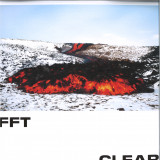
The layering of sonic elements and intentions is starkly audible across these nine tracks.They can be seismically concussive and grandiose, but granular and fluid - echoing the Icelandic volcanic eruption that features in the artwork photography byGeorge Cowan. ‘Clear (Eight-Circuit Mix)’sets a euphoric tone immediately accelerated by the jagged sounds and vocal textures of ‘Redeemer’. ‘3 Sided’ channels hyper-urbanity from its almost entirely analogue palette, and by contrast ‘Disturb Roqe 2’is bracingly digital, gyrating in random cycles between clustered percussion, metallic splinters of audio and artificial vocal tics.
Opening side two, ‘You’ve Changed’ adheres to a more abrasive core, while ‘Heal’ and ‘Heal (Alt Mix)’evolved out of linked pieces in FFT’s live sets that grew into complete tracks in the months before Covid-19.The significant intensity of ‘Heal’ in particular was refined during strobe-heavy live performances and is the album at its most turbulent, the claustrophobia interrupted by dazzling arpeggios.The overall impact of 'Clear' is cinematic and precise, marking the arrival of an impressive electronic musician who is not new but has come into his own as a fully developed artist
Joona Toivanen Trio makes their We Jazz Records debut with their new album "Both Only", out 25 Feb 2022. A landmark work for the long standing group, the album showcases a new sound for the band, trekking deep into new ideas for an acoustic jazz piano trio. Since their formation as teenagers in mid-1990's, the trio of pianist Joona Toivanen, bassist Tapani Toivanen and drummer Olavi Louhivuori (of Superposition, Ilmiliekki Quartet and Linda Fredriksson "Juniper") has developed their remarkably coherent band sound step by step, touring the world over. Nowadays, the trio is geographically split between Gothenburg, Sweden (Joona), Copenhagen, Denmark (Tapani), and Helsinki, Finland (Olavi), but the unit has never sounded so together as one, and as adventurous as on "Both Only".
"Both Only" by Joona Toivanen Trio is a cocoon, a welcoming shelter of sound that opens up naturally for the listener to inhabit. The album is moody and introspective, even dark at times, but by the time you get to the closing track, "This and This", you'll likely notice something hopeful brewing up. This is not music dealing with nostalgia or a world lost. Instead, it's a body of work with delicate dynamics, taking a minute just to listen and to look inwards to learn something, to move forward.
The first single "Enlightened" is perhaps the most traditional piece on the album, yet it flows like a vessel beyond genre, conveying a mood, a feeling and an idea. Listen to how the piano, bass and drums discuss, how the groove moves with the instruments having their clear roles but also supporting each other and documenting a musical aging process exactly as that of a quality bottle of red wine. As a song like "Direction" proves, the melody is there all the way, yet there is nothing obvious about how it's carried by the trio. Things remain surprising, fresh and moving at all times. "Except For" keeps its intensity, while nearly erupting into a full on 4-to-the-floor banger. Nearly! The key here is how the energy sustains itself, building the intensity within the music.
"Both Only" is a powerful statement from a band ready to renew itself time and again, and one willing to do it slowly, outside of the hype. This process makes the impact enduring, nuanced and lovely.
WJLP37 Joona Toivanen Trio "Both Only" is available on vinyl as a black vinyl edition and as a LP+7" bundle also including WJ0716 "Except For (7" Edit)" / "Keyboard Study No. 2".
“More excellent poetic soundscapes from We Jazz! Love the flow through the tracks here – textural pieces moving into more rhythmic jazz abstractions. Beautifully recorded too.”
Quinton Scott — Worldwide FM
“Following on from the excellent Linda Fredriksson album We Jazz extend the journey with this innovative Joona Toivanen Trio set.”
Paul Bradshaw — Straight No Chaser
“You’ll look in vain here for extravagant splashes of color or bright swathes of sound, but what you will discover are a finely-chiselled set of compositions that make the most of the trio’s limited palette: flint-sharp melodies hewn from the ice, crisp and crackling rhythms.”
Cal Gibson — Ban Ban Ton Ton
“Incredible album from Joona Toivanen Trio and a strong start to the new year from We Jazz.”
Kerem Gokmen — Dubmission
“Encapsulating a new movement in jazz.”
Jay Scarlett — Sounds Supreme
“Interesting listen on the shortest day of the year. They have a very definite and saturated style.”
John Chacona — All About Jazz
“Airplayed the track”
Tom Ravenscroft — BBC6 Music
“Jazz album of the year released already in February?”
Ralf Sandell — Hufvudstadsbladet
“★★★★★”
Iida Simes — Voima Magazine
Mallrat's prized pop songwriting has become a beacon the music industry
eagerly follows, and on her debut album Butterfly Blue, she embodies the
spirit of its titular creature – but without the delicacy that keeps you at a
distance
Over a dozen clever and open-hearted tracks, Mallrat – aka Grace Shaw – draws
you in close and shows you the world through her wide, hopeful eyes...
White & Black Splatter Vinyl[40,04 €]
James 'Perturbator' Kent and Cult of Luna are the masters of their respective worlds. Over the last decade, the French maestro has become the most expectation-breaking name in synthwave, transcending its '80s video game aesthetic with metal and post-punk.
Meanwhile, the Swedish sextet have affirmed themselves as post-metal's biggest stars. Seismic riffs, earth-quaking growls and brave collaborations with everyone from Julie Christmas to Colin Stetson have ensured they're as blistering as they are forward-thinking.
Eclecticism and violence are married in Final Light: Perturbator's team-up with Cult of Luna singer/guitarist Johannes Persson. The pair's self-titled debut album is the perfect conglomerate between seemingly incompatible sounds.
On its opening track, the insidious "Nothing Will Bear Your Name", synths bubble to construct an arresting opening half. Then, release. Johannes' roar strikes and guitar chords boom as computerised beats anchor the chaos.
"It Came with the Water" echoes Cult of Luna's 2013 titan Vertikal, invoking images of an urban dystopia as its deep guitar melody grinds beneath sci-fi electronica. The title track's distorted EDM beats, on the other hand, are all James 'Perturbator' Kent, capable of invigorating the seediest of underground nightclubs. Both parties are clearly playing to their strengths - but for them to do so in such perfect harmony is, in itself, a genre-demolishing feat.
Lyrically, Final Light seethes with anger. "There was so much that I was so fucking pissed about," Johannes explains. "Some of my friends were dealing with a poisonous person: a narcissistic, crazy person. I was walking around full of anger and hate, so I think that came out in those lyrics."
The tandem's story began in 2019. Walter Hoeijmakers, the artistic director of the Netherlands' lauded Roadburn festival, approached James 'Perturbator' Kent with the opportunity of doing a commissioned piece with any musician of his choosing. As soon as the pair began work on their boundary-decimating songs, they knew that they had to be immortalised as an album.
"It was immediate," states Perturbator. "It's a project that I really want to share; it's not only the fruit of a collaboration between me and one of my favourite musicians, but also very unique and once-in-a-lifetime."
They wrote and recorded together in Paris before the start of the pandemic. Covid, which postponed the Roadburn festival at which the band would have debuted, gave them time to perfect what they'd crafted.
Johannes recorded additional vocals at Cult of Luna's resident studio in Umeå, Sweden, fully capturing the rage of his apocalyptically harsh voice.
Borders were built to be shattered. This is the sound of their destruction. Single-handedly, Final Light have birthed a new, bleak breed of experimental metal.
Black Vinyl[34,03 €]
James 'Perturbator' Kent and Cult of Luna are the masters of their respective worlds. Over the last decade, the French maestro has become the most expectation-breaking name in synthwave, transcending its '80s video game aesthetic with metal and post-punk.
Meanwhile, the Swedish sextet have affirmed themselves as post-metal's biggest stars. Seismic riffs, earth-quaking growls and brave collaborations with everyone from Julie Christmas to Colin Stetson have ensured they're as blistering as they are forward-thinking.
Eclecticism and violence are married in Final Light: Perturbator's team-up with Cult of Luna singer/guitarist Johannes Persson. The pair's self-titled debut album is the perfect conglomerate between seemingly incompatible sounds.
On its opening track, the insidious "Nothing Will Bear Your Name", synths bubble to construct an arresting opening half. Then, release. Johannes' roar strikes and guitar chords boom as computerised beats anchor the chaos.
"It Came with the Water" echoes Cult of Luna's 2013 titan Vertikal, invoking images of an urban dystopia as its deep guitar melody grinds beneath sci-fi electronica. The title track's distorted EDM beats, on the other hand, are all James 'Perturbator' Kent, capable of invigorating the seediest of underground nightclubs. Both parties are clearly playing to their strengths - but for them to do so in such perfect harmony is, in itself, a genre-demolishing feat.
Lyrically, Final Light seethes with anger. "There was so much that I was so fucking pissed about," Johannes explains. "Some of my friends were dealing with a poisonous person: a narcissistic, crazy person. I was walking around full of anger and hate, so I think that came out in those lyrics."
The tandem's story began in 2019. Walter Hoeijmakers, the artistic director of the Netherlands' lauded Roadburn festival, approached James 'Perturbator' Kent with the opportunity of doing a commissioned piece with any musician of his choosing. As soon as the pair began work on their boundary-decimating songs, they knew that they had to be immortalised as an album.
"It was immediate," states Perturbator. "It's a project that I really want to share; it's not only the fruit of a collaboration between me and one of my favourite musicians, but also very unique and once-in-a-lifetime."
They wrote and recorded together in Paris before the start of the pandemic. Covid, which postponed the Roadburn festival at which the band would have debuted, gave them time to perfect what they'd crafted.
Johannes recorded additional vocals at Cult of Luna's resident studio in Umeå, Sweden, fully capturing the rage of his apocalyptically harsh voice.
Borders were built to be shattered. This is the sound of their destruction. Single-handedly, Final Light have birthed a new, bleak breed of experimental metal.
It's dark in the forest. Especially in the »northwest«. You have to adjust all your senses. But once you have, the forest will take you in his arms. The forest will protect you. Just like Daniel Herrmann's first album for Live At Robert Johnson will protect you.
Herrmann is far from being unknown in the world of music - let alone in the art or photography world. In the music field, he is probably much more known under his Flug 8 moniker where he released five albums on Disko B, Doxa Records, Ransom Note, and Acid Pauli's Smaul Recordings. Under his given name, Daniel Herrmann's relationship with LARJ's label boss Ata Macias goes way back. As an artist and photographer Herrmann was the only one allowed to take pictures inside Ata's ROBERT JOHNSON club, thus creating an iconic series of pictures of clubbers and club life in general. Herrmann’s pictures of the partying punters themselves were presented as wallpaper all over Robert Johnson back in 2002.
With »Enroute« Herrmann enters new territory: It is his most ambient work up to today. And yes, it is a piece of work created during the lockdown. Herrmann's studio is situated in the outskirts of Frankfurt, near the forest - a quite remote place already in-between the Taunus mountain range. Imagine life during the lockdown in such a place … This is where Herrmann set up his former basement studio in the large living room with a variety of instruments besides a cozy fireplace spending warm light and warmth. A warmth that despite its seemingly rather "cold" atmosphere can be heard all over »Enroute«. Once you soak in the sounds (or get soaked into the sounds) of the first tracks like album opener »northwest«, »Fly By Wire« or the 11min »Dark Trace« you might feel this warmth too. A cold warmth you could say, yet a warmth that only modular systems and synthesizers can create.
There is a change of mood with »Intercontinental« - literally as it seems that Herrmann indeed is on an intercontinental journey here despite the strolls and long walks in silence through the Taunus forest. This is also the place where Herrmann took many photographs of the forest and its trees (to be seen on his Instagram account) - and the picture on the cover: This spooky yet fragile high seat in the mist in front of those trees. Yet darkness alone is not dominating this album. Even during these dark days, there was a bit of light at the end of the tunnel. And it shows in the beauty of »Bouncing Rays«.
»Enroute« is done all alone and in total isolation. And one can hear it. But it also invites the listener to be a part of this lonely world. And we all know that being lonely is made easier with someone on your side - »Enroute« to a better place. A place that isn't lonely at all.
PS: For all digital music lovers we have included two bonus tracks: The GLOK remix of »Bouncing Rays« and Herrmann's clattering and creaking tune »Economy« - enjoy!
»Tableau« is Rolf Hansen's second full-length album under his given name and acts as a sequel to his solo debut »Elektrisk Guitar«, released in 2019 through Karaoke Kalk. On the 14 new pieces, the Copenhagen-based composer and musician further explores the sonic possibilities of the electric guitar by opting for a radically different approach and putting great limitations on himself as a performer. »Tableau« is an experimental record in the truest sense of the word, eschewing conventional modes of playing the instrument and instead turning the guitar into a sound source for compositions that are at once abstract and concrete.
Already on his last album, Hansen had found a different approach to playing and composing, but this time went even further and created a set-up in which the electric guitar becomes a different instrument altogether. This is also expressed in its title: a tableau is, broadly understood, an image-forming momentary bodily pause in a dramaturgical or narrative process. In the context of the album, tableau is the form and sound that emerge when the musician’s usual approach to playing and the compositional practice is halted and transformed. To achieve this, the guitar is placed on a table with microphones installed around it and tuned in a static microtonal modality thanks to wooden replacement frets that have been inserted under the strings. This alters how the sounds are being generated with the instrument, which is now played from above, occasionally strummed or stroked with a tool.
The opener »Begyndelse« already sets the tone by punctuating dense layers of sound with a one-note melody that provides a rough rhythmic structure and harmonic anchor for the track that still seems to mutate wildly the further it progresses. Even in moments in which Hansen opts for a more directly accessible approach like on the following »Over Grænsen« or »Tid«, the pieces’ emotional qualities are greatly amplified by their sonic idiosyncrasies. This is best exemplified by the first track on the second side of the LP, »Højre hånd«. Using high microphone gain to magnify the high-frequency acoustic sounds of the electric guitar, Hansen captured a rich near-symphonic changing spectrum of overtones. This is typical for the attention to detail put into the overall record whose approach maximises the music’s affective impact by focusing on minute nuances.
»Tableau« is full of moments marked by almost unnoticeable shifts and changes, offering a wealth of sounds that are as evocative as they come unexpectedly. Despite their aesthetic differences, the kinship between its predecessor »Elektrisk Guitar« and these 14 compositions is undeniable. Both are based on self-imposed constraints, a radical form of reduction that made it possible for Hansen to broaden his sonic palette and compositional approach. Though mostly short, concise, and abstract-sounding, the pieces on »Tableau« speak a clear, varied and simple language.
The “Tumult Hands” duet is made by Jacek Sienkiewicz and Jerzy Przezdziecki - the producers
whose composition has - to a large extent- defined the Polish techno music. Sienkiewicz - as
early as Recognition - started his adventure with music in the late 1990s. Subsequent records,
already under his own name, were released, among others, at Cocoon Records, Trapez, Klang
Elektronik and WMFRec. Przezdziecki started publishing a little later. Over the last two
decades, he has been presenting various types of electronic music, among others, as Praecox,
Epi Centrum and Jurek Przezdziecki.
“Tumult Hands” has two EPs on its account – “Tumult Hands EP” (2014) and “Tropic
Factory” (2016). Both were published by Recognition. So a full record was a matter of time.
The album titled: “TH” (Recognition, 2022) has been prepared for many years. The repertoire
was created mainly out of improvisation. As artists themselves say, “it is the result of
discovering and accepting a chance event.” For both producers, close contact with
instruments was important during their composition; the type of interaction between the maker
and an electronic device. Individual works have been maturing for a long time. Paradoxically -
the lapse of time did not cause them to be ageing but vice versa - allowed them to mature and
gain natural weight.
“TH” brings very diverse music. In part, it is the repayment of the debt that Sienkiewicz and
Przezdziecki incurred towards the most creative techno period, that is, the 90s of the 20th
century. The lovers of experimental dance music from before the quarter of the century will
easily capture in the duet’s themes the art of Cristian Vogel, producers known from the tin
series of Chain Reaction record company or early recordings of Richie Hawtin (Plastikman,
F.U.S.E.). This is a very similar, non-standard approach to sound structure and an original
approach to rhythmic structures. Minimalist melodies, accompanying e.g. the opening of the
“enter TH” or “pow” set, contribute to the composition an element of some sublimity and
metaphysical anxiety. Obviously, it is still the dance music but the duet - to some extent by
abandoning the club functionality (understood in the techno convention) - has given its music
a definitely sophisticated, artistic elegance.
Publishing cooperation between such important makers, as well as high quality of recordings,
leads us to see “TH” as something more than just another techno record. It is an event and an
electronic adventure that all lovers looking for dance music will appreciate.
FRENCH COMPOSER, PRODUCER AND MULTI INSTRUMENTALIST ADRIEN DURAND’S THIRD ALBUM
"Our last album, “La Course” was released in 2020 during the lockdown. Inspired by the feedback from listeners, who received the music with special attention, the idea and need for “(Loin des) Rivages” was born.” - Adrien Durand
Bon Voyage Organisation is the story of the construction of an ensemble, the quest for harmony, through music, between beings. This story has been the central leitmotif in Adrien Durand's composition and production work for almost ten years. Adrien Durand is a renowned Parisian bass keyboard player, composer, producer and mixing engineer having worked with noteworthy projects such as Amadou & Mariam and Papooz among others. Known for his knowledge of ensemble recording and arrangement techniques, BVO is his attempt at meticulously creating a musical dialogue around his compositions with a distinguished cast of musicians from di?erent backgrounds without the pressure associated with pop music recordings reminding us of the musical ensembles of the 70’s such as that of Carla Bley, Soft Machine or Irakere. (Loin des) Rivages was recorded over five days in June 2020 at Studio Atlas, the studio of Air’s Jean- Benoit Dunckel and mixed the following summer by Adrien Durand in his Parisian studio, Bureau 12. It was an orchestrated performance considering that all ten tracks of the album were played live, gathering up to thirteen musicians in the same room. The album follows what was initiated with BVO’s previous album La Course: an entirely instrumental sound free from any constraints. The close collaboration between Adrien Durand and the members of the ensemble allowed for an exquisite completion. Together, they deliver the incredible energy of "Le Sentier des Orpailleurs", the depth of melancholy of "Apacheta", and the originality of "Et s’éveillent"... Inspired by the great explorers of the soul: Sun Ra, Moondog and Coltrane - a cover of his Naïma actually opens the album - Adrien Durand mixes humanity’s first instruments (percussion and the wind) with its latest ones (mixing desks and synthesizers). Thus, he continues the most interesting yet rewarding artistic journey: The journey inward, far from the standards of civilization, in the heart of what some can take for madness, reaching into a jungle of the soul so marvelously represented in Clément Vuillet’s artwork. This is not an intellectual record but rather a spiritual e?ort, because, as Adrien Durand likes to repeat in his concerts: "Let us step into music as we step into a sanctuary."
- A1: Grand Master Caz & Chris Stein - Wild Style Theme
- A2: The Chief Rocker Busy Bee Vs Lil Rodney Cee & Dj Grand Wizard Theodore - Mc Battle
- A3: The Cold Crush Bros Vs The Fantastic Freaks - Basketball Throwdown
- A4: Kevie Kev, Master Rob, Prince Whipper Whip, Mc, Rubie Dee, Dota Rock & Dj Grand Wizard Theodore - Fantastic Freaks At The Dixie
- A5: Grand Wizard Theodore & Dj Kevie Kev Rockwell - Military Cut (Scratch Mix)
- A6: Grand Master Caz, Jdl, Easy Ad, Kg, Dj Charlie Chase & Dj Toney Tone - Cold Crush Bros At The Dixie
- B1: Double Trouble, Rodney Cee & K K Rockwell - Stoop Rap
- B2: Rodney Cee, K K Rockwell & Dj Stevie Steve - Double Trouble At The Amphitheatre
- B3: Grand Master Caz & Chris Stein - Wild Style Subway Rap
- B4: The Chief Rocker Busy Bee & Dj Aj - The Chief Rocker Busy Bee, Dj Aj At The Amphitheatre
- B5: Dj Grand Wizard Theodore & Kevie Kev Rockwell - Gangbusters (Scratch Mix)
- B6: Rammellzee & Shock Dell & The Grand Mixer Dst - Rammellzee & Shock Dell At The Amphitheatre
Animal Records – founded by Chris Stein of Blondie fame – only ever released one album in its brief early-80s history, but what an album that was. Wild Style remains the most seminal soundtrack in hip-hop history, a snapshot of the scene as it evolved from the streets to the recording studio. But it’s not just a vital document, it’s also a damn good listen.
The line-up is a who’s who of those who stood out from hip-hop’s nascent block party days. The Double Trouble pairing of Rodney Cee and KK Rockwell, The Chief Rocker himself, Busy Bee, the mighty line-ups of both The Cold Crush Brothers and The Fantastic Freaks. The music captures the free-form, roaming nature of the film – it’s rough at the edges, it’s occasionally amateurish, but it’s completely, utterly glorious.
The original Animal tracklisting, of which this is a reissue, is full of recurring sounds and motifs, all of them co-produced by Chris Stein and Fab Five Freddy, stepping away from breakbeats to produce a sound that reminds you of them, while being totally unique. The epic drums are courtesy of Lenny ‘Ferrari’ Ferraro, a Vietnam vet and punk drummer whose career spanned stints backing Aretha Franklin and Lou Reed.
Over time, those sounds – the Charlie Chase and Grand Wizard Theodore scratches, the indelible lyrics - have become hip-hop touchstones, endlessly sampled and referenced, the bedrock of so much music to follow. That’s because the soundtrack perfectly encapsulated the essence of the film, the scene and hip-hop’s emergence from The Bronx to the attention of the wider world. Presented in this reissue with the original artwork, it remains the blueprint.
Since slipping out a decade ago, Fürsattl’s sole 12” on Claremont 56 has become an in-demand item, thanks to a mixture of its’ undeniable quality and the patronage of several high-profile, well-regarded DJs. Because of this, the label has responded to demand for a reissue of those two tracks and announced the release of a double-album of the krautrock-inspired trio’s works for the label.
Presented in a gatefold sleeve sporting Mark Warrington’s original 2012 artwork and limited to 400 copies, the 2022 album edition of Rheinlust not only tells the tale of the band’s now decade-long association with Claremont 56, but also features a previously unreleased track from the archives, ‘Für Paul’. Tucked away at the end of the LP, the track is amongst the most atmospheric in their catalogue – a slowly building number in which celestial synthesizer chords, ambient textures, echo-laden electric piano chords and lilting synth strings rise above a rubbery bassline and Jaki Liebezeit style drums.
It provides a superb conclusion to a genuinely evocative album of music you can get lost in, but it’s by no means the only highlight. Fittingly, the album’s first slab of wax boasts both tracks from Fürsattl’s hard-to-find debut 12”: title track ‘Rheinlust’, a driving but deep and hypnotic krautrock masterpiece full of elongated chords, restless bass, twinkling motifs and cascading electronic melodies, and the wonderfully epic ‘Links Der Pegnitz’. Clocking in at just under 15 minutes, this sublime excursion features band members trading glistening guitar and colourful synthesizer solos over a funky but laidback groove that sits somewhere between krautrock and cosmic funk.
The album’s second slab of wax showcases Fürsattl’s lesser-known tracks for Claremont 56, alongside the previously mentioned unreleased cut. These two workouts were originally featured on the label’s Claremont Editions compilations and further expand on their now trademark krautrock sound. There’s ‘Leerlauf’, a breathlessly up-tempo, weighty and immersive chunk of low-slung dancefloor creepiness that you’ll want to get lost in time and again, and the twangy and buzzing ‘Haru’, a birdsong-splattered affair that sounds like their tribute to krautrock originals Neu! and Harmonium. Like the rest of the album, these are seriously seductive outings that slowly build towards impactful, emotive conclusions.
Mr. K is back again with a double-sider that tackles the ups and downs of love and does it in fabulous style with two solid soul classics.
Yvonne Fair was a veteran of the soul music world when she finally got the chance to record her first full length album in 1975. She had recorded multiple singles under the guidance of James Brown (her “I Found You” was reworked by Brown into the chart-topper “I Got You (I Feel Good)”) and, after leaving the JB camp for the auspices of Motown, a clutch of 7-inches with Norman Whitfield. These were gathered together to form her first (and only) full-length, but before the album was completed a final song was added to fill things out. This last minute touch would turn out to be the crowning achievement of her career. “It Should’ve Been Me” didn’t seem to be a notable addition at first. The song was originally done by Kim Weston a decade earlier and then by Gladys Knight. But Fair’s version had something special. In addition to the novel addition of a percolating drum machine pulse, Fair imbued the lyrics with a heartfelt sincerity and gruff emotion that touched listeners in a way that other versions had missed. Released as a single in the UK in late ’75, the song rose to the top ten of the British charts by February of the following year, inspiring Motown to release it as a US single. The song never replicated its UK success in the States, but went on to have a long life as a staple of drag performances and gay club life. Gay club life being the heart of all great club life, it’s only natural that the impact of the song has continued to spread, from Adeva’s hit house version in 1991 to Miley Cyrus’s recent revival of the song. Danny Krivit pays tribute to this storied history with his own version, a simple yet effective edit that stays true to the original but gives DJs a little more room (and fans a little more time to sing along!) than the all-too-brief original.
Continuing on our theme of lovelorn loss and redemption, Mr. K turns his attention to the New Birth’s “Brand New Lover” for our B-side. While the original slowly moves from the tentative, immediate aftermath of breakup to the eventual positive path forward, Krivit’s edit jumps straight to the joyous resolution to find new love, riding a delicious call and response chorus punctuated by signature breakdowns from master producer Harvey Fuqua. Danny’s edit provides a natural uplifting opportunity that never stops building over the course of its extended five minutes. Until now, the track has only been available on the group’s debut 1970 full-length, and never on a 7-inch single.
As always, this release has been mastered to the highest standards and is certain to find a spot in the bags of discerning listeners and DJs alike.