Art is a term that's often associated with Robert Hood's work and the next vinyl release on M-Plant comprises his recent digital releases - the March single "Art Form" and April's double-header "Art Class / Art School" to create the "Art Project EP".
The acidic "Art Form" is Hood's first Techno release since 2024's "Alpha Key EP". The Minimal Techno originator continues to show off his prowess with "Art Class" which stays on the Acid path we hear on "Art Form" but delves even deeper. Meanwhile, "Art School" on the B-side brings sci-fi sounds and an atmospheric punch.
Robert Hood has said of his M-Plant label: "M-Plant is what I've always wanted to hear: the basic stripped down, raw sound. Just drums, basslines and funky grooves and only what's essential. Only what is essential to make people move. I started to look at it as a science, the art of making people move their butts, speaking to their heart, mind and soul. It's a heart-felt rhythmic techno sound. M-Plant is just M. minimal."
Buscar:j bass
Oslo-based label Boring Crew Records (BCR) makes its vinyl debut with the Prærien EP. The EP showcases the label’s diverse range and vision, with six tracks that span various moods and genres, setting the stage for what’s to come.
BCR01 kicks off with Oasen by Anders Hajem, a dark and chugging track. The title track, Prærien, seamlessly picks up where Oasen left off, delving deeper into the atmosphere with a hypnotic bassline and subtle tension. Perkules rounds off the A-side with his Oasen remix, stripping it down into a raw, minimal version with a heavy(!) bottom-end.
On the B-side, Henrik Villard’s Cowgirl hits hard with raw and gritty drums, with a touch of dubbed-out vocals. Woodfall Temple follows, enveloping listeners in its tribal and slight meditative energy. Canadian producer Cooper Saver then closes the EP with his mesmerizing remix of Woodfall Temple, ramping up the tempo with layered synth lines that create an irresistible, trance-like atmosphere.
Boring Crew Records’ Prærien EP offers a captivating and dynamic introduction, teasing more exciting releases on the horizon.
José James just can’t leave the ’70s alone. Or maybe it’s the other way around. The singer, songwriter, bandleader, and producer was born in 1978, after all, but over his past 17 years of fundamentally forward-looking, blessedly mercurial music, he keeps getting pulled back in. His 2013 Blue Note breakthrough No Beginning No End revisited the hooky, funky, jazz-streaked songcraft of the time through a modern crate-digger’s ears. On 2020’s No Beginning No End 2 — James’ debut on his own Rainbow Blonde Records — he went back through the portal with a small army of fellow celebrated eclecticists. Just last year, there was the album 1978, a richly layered love letter to said year that felt deep, luxe, and cool. It’s as if — vested with the restless fluidity of jazz, the tuned-in sensitivity of soul, and the revisionist grit of hip-hop — he is trying to play his way into the exact moment when, culturally speaking, everything was about to change.
“I'm still so fascinated by the tension in that era of all these seemingly clashing things happening at once,” says James. “The loft scene, the jazz scene, Elton and Billy, Bob Marley, the Isleys, Funkadelic, disco being this behemoth in a way I don't think we even understand today… And then there’s where everybody went from there — into hip-hop, into punk rock, exploding jazz. It's like a summation of the ’70s, and it's about to transform. It's the peak of the rollercoaster.”
Literally breaking into history is impossible, of course, but James’ new LP, 1978: Revenge of the Dragon, does feel like breaking through or bursting out. In loving contrast to its predecessor, the fresh set plays hot, like a Friday night out at the Mudd Club in its prime. Though he’s dreamt up albums with collaborator counts approaching the dozens, James gathered a tight crew for this one. Himself and Taali on vocals. BIGYUKI on keys and analog synth. Jharis Yokley on drums. Bass split between David Ginyard (Blood Orange, Terence Blanchard) and Kyle Miles (Michelle Ndgeocello, Nick Hakim). And an all-star brass lineup: Takuya Kuroda on trumpet, young lion Ebban Dorsey on alto sax, and genre-spanning ronin Ben Wendel on tenor sax. They set up in Dreamland Studios near Woodstock, a restored 19th century church, and recorded live to tape, two tracks, drums pushed to the max — “a small homage to the rise of punk,” says James.
In that place out of time, the band laid down a handful of choice covers and some wild originals, like the single “They Sleep, We Grind (for Badu),” a decades-collapsing cut powered by an ugly groove. Steeped in dub, funk, and sampledelia, James chants an artists’ mantra (“They sleep, we grind / Man, f--- your nine to five”), makes lyrical callouts to Marley and Nas, and channels everything from George Clinton to J Dilla, not to mention the earthy mysticism of Erykah Badu. In 2023, James released and toured his Badu covers LP, On & On. “Living in her musical house for a year was transformative,” he says. “This is my summary of everything I learned through her, tying it to this idea that artists move differently. We are in society but we are outside, too, looking out and in at the same time. Our hours are different, our schedules are different.”
To that point, James and co. actually began each day in the woods, filming the album’s visual companion piece, Revenge of the Dragon, an honest-to-God kung-fu short complete with bad overdubs, training montages, camera tricks, and plot twists. The film pays tribute not only to the genre’s greatest year (1978, of course), but also its cinematic exchange with Blaxploitation, plus James’ own recent Shaolin training and admiration for Bruce Lee as a culture-bridging force (the LP’s cover recreates an iconic shot of Lee). On top of that, says James, “We had this immediacy in the studio. Live, one take, no overdubbing. I feel like that's where the martial arts piece comes in, where it's about being relaxed but also aware, and there's immediacy in your movements.”
Across the project, tribute takes that refracted, multifaceted form. From his personal late-’70s playlist, James chose four covers reflecting the era’s disco-fied churn: the MJ-meets-Quincy dancefloor masterpiece “Rock With You”; Herbie Hancock’s prescient vocoder fever dream, “I Thought It Was You”; and a pair of Black-radio hits from two bands whose fans typically wouldn’t have been caught dead in the same stadium: “Miss You” by the Rolling Stones and the Bee Gees’ “Inside and Out.” All of it gets filtered through a contemporary Black (and beyond) lens, coming out loud, free, funky, and buzzing — dynamic, yes, but also of a joyous piece.
1978: Revenge of the Dragon transports you to a crowded room where all this is playing out in real time. That feeling is helped out by opener “Tokyo Daydream,” a bass-driven swan dive into a neverending night of boutique bar-hopping and neon revelry. Later, “Rise of the Tiger” finds James bringing rare braggadocio to a propulsive track with growling synth lines and a hunger for whatever comes next. And then there’s the closer, “Last Call at the Mudd Club,” which with its upbeat energy and string of Stevie-inspired pickup lines, evokes the sort of unabashedly elated track the DJ throws on at 3:56 a.m. before everyone is kicked out. “I wanted to leave the album on that note,” says James. “If this was a night out in New York, this would be the last thing you hear before you get in that taxi and go back to your apartment.” Or, perhaps, back to 2025.
A Side – Peg (Smoove Multitrack Rework)
Smoove gets his hands on the ultimate multitrack studio separates and goes to town peeling back the layers, revealing crisp drums and iconic slap bass from Chuck Rainey, rearranging the structure to spotlight the lush backing vocals -A fresh spin on a classic, with every nuance shining through.
B Side 1 – Baby Be Mine (Smoove Multitrack Rework)
Smoove dives in from the start, isolating Rod Temperton’s iconic parts, showcasing the synth bass line with groove-heavy drums while drawing out every breath and detail in MJ’s vocals. A loving, funk-infused rework.
B Side 2 – This Time (Smoove Multitrack Rework)
Smoove takes a bold approach, stripping the track down to its essentials, creating an extended live drum intro section dubbed in space echo effects. Original vocal samples and acoustic guitar breakdowns with additional fender rhodes piano provide contrast, while the string section steals the spotlight in a stunning finale.
Single Sided Repress!
We've watched the movies, seen the photos, heard the stories. As in all of New York City, crime was as rampant in the subway as it was on the streets. Thefts, robberies, shootings and killings were a frequent reality throughout the 1970s. In 1979, a group of angered residents led by Curtis Sliwa began taking crime prevention into their own hands, donning red berets - looking very much like a gang and calling themselves the Guardian Angels. This funky track produced by the Legendary Patrick Adams and uptown empresario Peter Brown is an ode to what was hapenning at the time. Like many of the P&P records of the time, this wasn't dance music for flashy downtown clubs, it was the real uptown funk! With bass as heavy as rolling stock, and field recordings from the subway tannoy echoing along almost empty train carriages late at night, Margo Williams's vocals supply the inner city funk menace with some almost ethereal soul.' At a crossroads between funk, soul and an emerging Hip Hop culture this track apealled to both the disco crowd and the bravado of the uptown b-boys.
- A1: Say Ahhh
- A2: Mind Melt
- A3: Buttersweet Loving
- A4: River Of Freedom
- B1: Somebody
- B2: When You Told Me You Loved Me
- B3: Stay In Bed, Forget The Rest
- B4: Call Me
- C1: Music Selector In The Soul Reflector
- C2: Sampladelic
- C3: Bring Me Your Love
- C4: Picnic In The Summertime
- D1: Apple Juice Kissing
- D2: Party Happening People
- D3: Dmt (Dance Music Trance)
- D4: What Is This Music?
When one makes mention of Deee-Lite, the 90's house-funk trio of Lady Miss Kier, and DJs Dmitry and Towa Tei, invariably their Billboard smash single “Groove Is In The Heart” will come up, and for good reason. With its Herbie Hancock-sampling bassline, some classic rhymes from Q-Tip, and guest vocals by Parliament-Funkadelic legend Bootsy Collins, the song became an indelible classic of 90s music, a massive commercial hit for Deee-lite and is widely considered one of the greatest dance songs of all time. Although a massive success for the group, “Groove Is In The Heart” led to some pigeonholing from critics and reviewers, who had specific expectations for future records. Rather than deliver more of the same free-wheeling, breezy dance music of World Clique, Deee-lite took a more politically-minded approach with their second album, spurred largely by front-woman Lady Miss Kier, who had a lengthy history of political activism prior to forming the group. 1992's Infinity Within rendered several Dance-chart hit singles, but was not as commercially or critically lauded as its forebear. Deee-lite were undaunted by their change in commercial fortune, regrouping with the addition of junglist DJ Ani, replacing the absent Towa Tei to record their third record. 1994's Dewdrops In The Garden was the result of their efforts, which struck a remarkable balance between the celebratory grooves of World Clique, and the social justice-driven Infinity Within. Lady Miss Kier had done a lot of world-traveling in the time between albums, and the material in Dewdrops was a reflection of her experiences, applying a spirit of global togetherness to their house-funk grooves. Regrettably, Dewdrops In The Garden was not a commercial success, yet it still managed to render its share of #1 Dance Chart singles; the atmospheric techno bounciness of “Bring Me Your Love”, and the spacious funk-house track “Call Me.” Though Deee-lite would disband soon after Dewdrops In The Garden's release, the record remains an unheralded favorite among dance music devotees for its coupling infectiously bright, and soulful melodies, with banging dance-floor grooves, and unshakably optimistic vibes.
Voidless Records debuts with Tectonics, a four-track EP by Barcelona-based producer Cyberdom, where Electro collides with a narrative of collapse and transformation.
What if collapse isn’t the end, but the beginning?
The main theme of the release draws inspiration from the natural forces that shape our planet. Plate tectonics. This cycle of breakdown and reformation becomes a metaphor for social crises, collective uprisings, and personal processes of transformation.
The journey begins with ‘Mariana Trench’, a dense ambient piece evoking a descent into the deepest ocean trench. ‘Collapse’ follows with tight beats and simmering synths building slow-burning tension. The title track ‘Tectonics’ delivers syncopated basslines, robotic patterns, and vocoders that encapsulates the concept of the release. The EP is brought to a close with ‘System Strikers’ a four-on-the-floor weapon driven by heavy kicks, vocoders, and sharp arpeggiated basslines.
This first release lays the foundation for Voidless Records — a forward-thinking imprint rooted in concept, where each work carves its own path, unbound by genre and driven by deeper artistic intent.
2025 Repress
OSLO is happy to welcome new artist Federico Lijtmaer to the family with his wonderful EP Impermanencia.
Inpermanencia on the A-side is a superb deep house track with the right kind of funkyness for the cool. Federico combines smooth bass with shifty drums and classy synth action. This track will conjure a smile on your face and we are happy as hell to be able to release this little gem.
Unselfish on the B-side is as funky as its big brother on the flip-side. A throwback to bygone times in a way, if you consider labels as Mosaic or Trelik. However, Federico definitely succeeded in terms of a modern interpretation. The inclined listener will recognize his musical roots anyway.
After recent excursions on X-Kalay and Craigie Knowes, Melbourne's Escape Artist follows on from his excellent 'Energy Breakthrough EP' on Phonica's main label with another special release, the 'Forgot Who I Was / Remembering' 12".
As ever, euphoria and energy are his production calling cards, with A-side 'Forgot Who I Was' gradually building and releasing its intensity, all delicately programmed melodies underpinned by a potent shapeshifting bassline.
B-side 'Remembering' is almost a flipside of the same coin, maintaining aspects of the previous track's two-step-esque drum pattern yet slowing and gliding along in a more uplifting direction, touching on ambient techno with flourishes of acidic breaks.
With their EP triptych "Thee Church Ov Acid House Volume 1–3," Oliver Bradford and Jörn Elling Wuttke created a holy trinity of diverse dancefloor variations, a self-contained circle of rave history.
In itself already a heavyweight statement, which they now crowned with “Bells & Whistles - Thee Remixes”. So to speak the quadrature of the circle And as with their original material, this release also reveals a profound knowledge of dance history in the selection of remixers - combined with the best of the here and now.
A1:
The trip begins with Jamie Hodges' ( Born Under A Rhyming Planet ) version of “Acid House Planet”. Hodge was responsible for a number of legendary EPs on Richie Hawtin's Plus 8 label in the early 90s, which explored the deep poetry of techno music. In this sense his remix is also a delicate affair of rarely heard beauty.
A2:
There's Thee Church Ov Acid House themselves, who stretch the swinging groove of Tyson's “G Phunk”, far too short in the original, to almost six minutes. A groove that won't stop.
B1:
And that brings us to the next two legends, this time from the local area. D-Man and Move-D have had a significant influence on dancefloor culture between Heidelberg and Mannheim since its inception. Their lysergic “Theme” remix, with Terrence McKenna vocals and acid twist in the middle, is an epic open air classic to come.
B2:
Lennard Poschmann's aka O-Wells' version of “Rave Mantra”, on the other hand, is deep, digging bass techno for the darkest moments of the night.
Vinyl EP2 featuring remixes of Man Power, As One ( Kirk Degiorgio ), HRDVSION ( Nathan Jonson ), Cosmic Cars ( Pudel Produkte, Smallville, Bureau B )
The Ottawa composer/performer and head of Black Bough Records plays every instrument on his CST debut: an accessibly avant-garde work of dark/ambient modern chamber music. Mark Molnar has been a linchpin of the Ottawa experimental music scene for over two decades, spanning contemporary classical, electroacoustic, industrial/noise, and improv. As a string player in a wide range of projects, an organizer and curator of innumerable shows, and via his own avantgarde label Black Bough Records, Molnar's unflagging contributions to independent music culture in Canada's capital city have been significant. EXO is his Constellation debut: a remarkable and bracing suite of post-classical composition on which Molnar plays every instrument. Meticulously self-recorded, primarily with strings, harp, and piano, EXO balances thematic melodicism, polytonality, and dissonance across three elegiac pieces of exquisitely expressive dynamism. This is exacting modern chamber music that blends formal and harmonic complexity with a solemn emotive sensibility accessible to a broad audience. Listeners that yearn for some edge and disquietude in a landscape of often all-too-approachable post-classical music should find EXO eminently worth their time and attention. While Molnar is a highly trained string player, and studied music under Aubrey Wolfe, microtonality with James Tenney, and composition with R. Murray Schafer, his trajectory has been entirely and intentionally outside the academy, signalling a socio-artistic commitment to DIY culture, forged from an early passion for the sonic worlds of post-hardcore, post-punk, no-wave, free improv, power electronics, and other independent/underground musics. His classically-informed works have been described as "tense currents of musical modernism invigorated with punk's raw vitality." EXO carries an undercurrent influenced by dark industrial and ambient metal in particular, with microphones purposely placed to pick up the low-end frequencies of the piano body, and of a bass drum positioned as a resonant skin in the acoustic space; an electroacoustic strategy organically meshed to the crisply defined and pristinely recorded pointillisms and polychords of strings, harp, and piano, which feed into this noisefloor of crepuscular sub-bass disquietude and decay. It's a production aesthetic that lends EXO a distinct undertow of tension and feeling, a sort of roiling maximalism where the chamber instrumentation traces arcs and waves of form and flow as if drawn from a dark, impervious ocean below. It also reinforces the profound hermeticism of Molnar's process, as a forbiddingly solitary creative act of immersion and navigation. The album artwork, featuring semiabstract stills of the sea by British photographer Ed Allen, further reifies this metaphor. The album's opening piece 'Sub Luna' (and its shortest at 8 minutes) showcases Molnar's adeptness at naturalistic and flowing complexity: tight cascades of climbing and descending chordal clusters hold their polytonal densities for various durations, yielding to more clarified harmonic suspensions and motifs, as melodic themes led primarily by violins in the higher registers provide a fractured lyricism. Molnar says: "the opening and closing figures of this piece act as opposing shorelines; the shorelines provide a reliable expression of range and key signature, and the tides come in and swallow them up, the motion of a body that addresses the relationship between states of lucidity and melodic figures." On 'Terre Sacer' everything happens in soupier waters, as a slow and doleful theme, anchored by grinding bass notes, circles in a gyre of dark resonances, until glistening strings gradually ascend to enrobe a plaintive and gently harrowing single-voiced ostinato over the composition's final third. Molnar's drone, ambient, minimalist, and goth-industrial influences are on display here. Side Two of EXO features the 18-minute multi-movement 'pallida Mors' (pale death): a waterfall of heterophony introduces dense chordal movements where strings are recorded and mixed to evoke pipe organ, in the album's most overtly dissonant and (anti)liturgical sequence. This gives way to ever more open and fragile spaces, before a resurgence of dark clusters and noise treatments introduces a final repeating piano coda, shrouded in devastated bass resonance, settling into what Molnar calls "a meditative hollow." Constellation is honoured to release this work by Mark Molnar, a longtime fellow-traveler whose selfless and boundlessly generous activities as an independent arts enabler sometimes obscure his own accomplished and uncompromising artistry. We trust EXO can help shed some much deserved light on this fine composer. Thanks for listening.
Repress of 2018’s classic compilation from Brownswood.
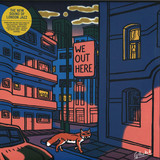
A primer on London’s bright-burning young jazz scene, this new compilation brings together a collection of some of its sharpest talents. A set of nine newly-recorded tracks, We Out Here captures a moment where genre markers matter less than raw, focused energy. Looking at the album’s running order, it could easily serve as a name-checking exercise for some of London’s most-tipped and hardworking bands of the past couple of years. Recorded across three long, fruitful days in a North West London studio, the crossover between each of the groups speaks to the close-knit circles which make up the scene.
Surveying the way that London’s jazz-influenced music had spread outside of its usual spaces in recent years, this album bottles up some of the vital ideas emanating from that burgeoning movement. Giving a platform to a scene where mutual cooperation and a DIY spirit are second-nature, it’s a window into the wide-eyed future of London’s musical underground.
Ubiquitous, much-lauded saxophonist Shabaka Hutchings is the project’s musical director. His own recent projects span from South Africa-connected, spiritually-minded jazz players Shabaka and the Ancestors to Sons of Kemet, who match diasporically-connected compositions with viscerally-direct live shows. His entry on the album, ‘Black Skin, Black Masks’, is typically difficult-to-define: with an off-kilter, shifting rhythmic backbone, repeated phrases – mirrored between clarinet and bass clarinet – shape the track with an alluring hue. His input ties together a deft, genre-agnostic sensibility that’s shared through all the players on the record.
Theon Cross – who’s also part of Sons of Kemet with Hutchings – starts his track, ‘Brockley’, with the solo, distinctive low rumble of his tuba. Winding and mesmeric, it sees tuba and sax lines winding together in rhythmic and melodic parallels. Ezra Collective – whose drummer and bandleader Femi Koleoso has toured with Pharaohe Monch – run a tight, Afrobeat-tipped rhythm on ‘Pure Shade’, with the final third changing gear into a melodic, momentous closing stretch.
Joe Armon-Jones, whose ludicrous chops on the piano have seen him touring with the likes of Ata Kak, showcases earworm-like, insistent motifs on ‘Go See’, balanced with a playful, improvisatory approach with room for ad-libbing and solos a-plenty. Taking a softer tact than many of the other entries, Kokoroko – whose guitarist Oscar Jerome has been making waves with his solo material – spin a lyrical, steady-paced meditation on ‘Abusey Junction’, matching chanted vocals with gently-played guitar.
Nodding to spiritual jazz influences, Maisha’s ‘Inside The Acorn’ is a wandering, explorative rumination, balancing delicate washes of piano and percussion with sharp interplay between flute and bass clarinet. In contrast, Nubya Garcia’s ‘Once’ is taut and carefully-poised, her tenor sax guiding a carefully-built energy to an explosive conclusion. And finally, Triforce’s ‘Walls’ is a performance in two parts: starting with Mansur Brown’s languorous, lyrical guitar, the second half switches up to a low-slung, g-funk-tipped groove.
- A1: Aseurai
- A2: Not A Necessity
- A3: Mandarin Tree
- A4: Get Up
- A5: Playground Song Side
- B1: Fading Star
- B2: Static
- B3: Drifting
- B4: Blue Butterfly
- B5: Goodnight
o encapsulate the themes. “Aseurai means around you in the atmosphere, hard to reach, fading away,” Choi says. “It’s a poetic expression. You wouldn’t say it in normal conversation, but I like that.”
Following the four-piece band’s 2024 self-titled EP, Aseurai adds disco and city-pop influences while staying true to dream-pop roots. While Phoebe Rings was originally a solo project of Choi’s, Aseurai marks a shift with contributing songwriting credits from the whole band. The four musicians cut their teeth working on other notable NZ projects such as Princess Chelsea, Fazerdaze, Tiny Ruins, AC Freazy,, Sea Views and Lucky Boy.
With a more ambitious collection of instruments, Choi says this album heralds the start of true collaboration: “I feel more precious about this LP because it includes everyone’s gems.” Guitar/synthesist Simeon Kavanagh-Vincent spearheads unexpected arrangements, with bold fuzzy guitar textures, to spice up the mix. Benjamin Locke adds maturity to the lyrics, paired with perfectionist bass lines. And drummer Alex Freer’s slick production soars Aseurai to diverse and synergetic heights. The broth is richer with more cooks in the kitchen, and the brewing of textures creates a distinct ‘Phoebe Rings’ sound.
If the EP was spacey, then Aseurai settles on earth, rooted in tangible moments. “Without getting too gloomy, it’s a weird world out there. A lot has changed in the world since the EP came out,” says Kavanagh-Vincent on this transformation. The album delves into hope and longing across all possibilities, and this exploration of holding on and letting go is organically threaded throughout. Across ten songs, Phoebe Ring’s storytelling ranges from tongue-in-cheek musings on gentrification to tender autobiographical memories.
아스라이 흩어지는 하늘의 별이 (May the falling light of faraway stars) / 그대의 손 끝에 닿아 숨이 돼주길 (Reach your fingertips and let you breathe),” Choi sings in the title track “Aseurai.” Imagined as a breezy track inspired by a 90’s Korean pop band, Choi discovered, when fleshing out the lyrics, that it was about yearning for people she couldn’t see anymore. In the old-school disco track, “Get Up,” Locke addresses struggles with mental health in a Matrix-inspired driven mantra: ‘Just get up / Just get up.’ The groove persists with ‘Fading Star,” a quirky ballad filled with steely jazz/rock guitar solos dedicated to a suburban aging musician. Kavanagh-Vincent’s lead single ‘Drifting’ is an unrequited celestial love song with bouncing bass and playful synths.
The band wrote, produced, and engineered the album across studios and band members’ homes in 2023/2024 in Tāmaki Makaurau (Auckland). It features mixing/mix production by local legend Jeremy Toy (Bic Runga, Aaradnha, Princess Chelsea) and mastering by Kelly Hibbert. With Aseurai, Phoebe Rings mark out a brilliant new constellation in their sky, bringing their individual compositions to the fore whilst seamlessly threading them into one celestial body - launching skyward on Carpark Records in June 2025.
ALDORANDE is a band of five groove adventurers, led by their founder and captain Virgile Raffaëlli, who are pushing the boundaries of music with boundless passion and unparalleled instrumental mastery. After two critically acclaimed albums, the group returns with Trois, the final chapter of their cosmic trilogy, recorded on tape at a prestigious Parisian studio.
Trois is an epic album, driven by bold instrumental explorations and waves of celestial choirs. Drawing inspiration from the 70s fusion movement, it honors the genre’s masters while adding a unique, contemporary twist. The galactic textures and sophisticated arrangements transport the listener on an unforgettable astral journey.
Once again, Favorite Recordings has poured its heart and soul into this album. Every note, every arrangement has been meticulously crafted to capture the essence of that era, with a relentless drive to ensure that every step of production and recording stays as true as possible to the genre’s iconic references.
On drums, Mathieu Edouard lays down a killer groove that leaves no one indifferent. Florian Pellissier, on keyboards, unfolds an interstellar sound palette with a spectacular collection of instruments: Fender Rhodes, Yamaha CP-70B, Moog Minimoog Model D, Sequential Prophet 5, ARP Solina String Ensemble, Roland Juno 106, Roland Jupiter 8, and Oberheim OB-8. On percussion, Erwan Loeffel scatters a jungle of intoxicating rhythms. Laurent Guillet, on guitar, fires off hypnotic, irresistible riffs, while Virgile Raffaëlli, on bass, anchors the entire experience with deep, melodic bass lines that give the band a captivating and unique dimension.
Get ready to take off with ALDORANDE and their album Trois, which promises to take you beyond the stars.
- A1: Return To The River Ganges (Distant Green Shore Dub)
- A2: Mediolana (Ambrosirus Dub)
- A3: The Galicians Of Asia Minor
- B1: Indika Keltika (Fiery Pharoah Mix)
- B2: Dhaka Corinthia
- B3: Delfic Tongue (Hercynian Forest Dub)
- C1: Voyage Of The Pytheas (Pagan Dub)
- C2: Benares Eternal City (Eryri Dub)
- C3: Sumerian Odyssey
- D1: King Of The Faeries (Demnoriax ‘King Of The Lower World’ Dub)
- D2: Deer Hunter (Aeduan Druid Odyssey Mix)
- D3: Atmabodha (Ritual Focus Dub)
Black[30,21 €]
OVERVIEW: DUB TREES is one of Youth’s most revered dub projects, it helped define the Liquid Sound Design sound that fans around the world hold dear. This project is the third in a triptych of albums Youth has made with a specific Celtic / Hindu fusion. Starting out with the classic Celtic Cross ‘Hicksville’ 20 years ago, featuring the mythical Simon Posford (Shpongle) through to ‘East of the River Ganges’ (ft Klaus Shultz / Tangerine Dream amongst many others) in 2004 followed by the last piece of this mystical puzzle ‘Celtic Vedic’ ,released on compact disc only in 2016 , which charts the journey of the Celt from Northern India to Snowdonia. The idea stems from Youth’s firm belief that there is a strong correlation between Celtic and Vedic cultures and their Northern Indian roots. Youth has assembled a host of collaborators to weave their labrynthine magic on ‘Celtic Vedic’: Jah Wobble (PiL) on bass, Matt Black/Coldcut (Ninja Tunes) on warped soundscaping duties, Galician Celtic pipe and flute player Daniel Romar, Bollywood contemporary Indian singer Shridevi Keshavan and Elfic Circle. It features many field recordings made by Youth on his various Indian odysseys and is all harnessed together with cutting-edge electronica that the Liquid Sound Design team pioneered 20 years ago. The team today are still pioneering new directions within ‘Downtempo Electronica Music’ and beats that create 3 dimensional landscapes for the helioscopic imagination to explore and psychoactive maps for the inner astronaut in all of us. ‘Celtic Vedic’ promises unchartered bass annihilation and heliotropic soundscapes, pounding basslines overlayed on 3D holographic beats and wrestles with serpentine melodies and psychedelic textures.
A welcome repress of an essential dub set from The Disciples, originally appearing on the Boom Shacka Lacka label in 1995.
Featuring 8 heavy bass-laden digital dubs from the mid-90’s that featured heavily on The Disciples own Boom Shacka Lacka sound system as well as getting heavy play from the likes of Jah Shaka and Aba Shanti I.
Limited to 500 copies only.
Swiss saxophonist Gilles Torrent, perhaps known from our recent Spiritual Jazz collection 'A Tribute to 'Trane', leads the way with his new album 'Buleria'; a mesmerizing set of modal jazz pieces that will speak directly to any listener who has felt the other-worldly depths of John Coltrane. The album comprises of Torrent originals and explorations of Coltrane standards. It reaches for something beyond the mundane, and blends complex harmonic structures with raw, improvisational energy.
The Torrent original, 'Danse Tropical', opens the set with a contemplative tone. Led by a sax that pulls the listener through a maze of scales and modes, the rhythm section remains steady, creating a grounding space for exploration.
'Quannassa' drives the energy forward, and the band moves seamlessly through shifting tensions as Torrent's saxophone searches for answers within a pantheon of harmonic structures.
The standout track, "Buleria" is a daring 8-minute piece, with an evolving, meditative flamenco piece that showcases the saxophonist's raw improvisational skill, a spiritual journey that takes us to the windswept plains of Iberia.
The quartet is a faithful tribute to classic modal jazz, with the interplay between piano, bass, and drums feeling natural and organic. They provide a harmonic foundation that encourages the saxophone to glide and soar, pushing into new emotional territory, going from tender and melodic to fiery and free. This interplay gives the album its distinctive feel - while drawing from Coltrane's influence, it's clear the musicians are searching for something new, something personal.
- A1: Breaking Out
- A2: Go To Ground
- A3: Shouldn't Have Been This Way
- A4: Sincere To Some
- A5: Able Eyes
- B1: Thrills, Kicks And Lies
- B2: Triggers Us
- B3: Loose Cut
- B4: Truth Dare
- B5: Seen As A Lifeline
Hot Pink Vinyl + Baby Blue 7"[30,46 €]
Seit 2020 vereinen Sea Fever Kunstfertigkeit, Handwerk und Bühnenerfahrung der beiden New Order-Mitglieder Tom Chapman und Phil Cunningham mit dem Johnny Marr-Bassisten Iwan Gronow (ex-Haven), Sängerin Beth Cassidy (Section 25) und Schlagzeuger Elliot Barlow (Brix, The Extricated). Ermutigt durch kollektive Widerstandskraft kündigt die Band aus Manchester ihr neues Album "Surface Sound" an, Nachfolger ihres 2021er Debüts "Folding Lines". Der britische Musikblog Louder Than War beschreibt Sea Fever als "eine Band aus Manchester, die eine wunderbare Mischung aus fast westküstenartigen Sixties-Psych-Melodien und -Harmonien mit einem Post-Factory-Electropop-Kern spielt".