
Limited edition of 500 on coke bottle coloured vinyl. One of punk's seminal albums, repressed on coloured vinyl.
This is the record that set D.O.A. off on their legendary path of becoming one of the premier punk bands of all
time
Limited edition of 500 on coke bottle coloured vinyl. One of punk's seminal albums, repressed on coloured vinyl.
This is the record that set D.O.A. off on their legendary path of becoming one of the premier punk bands of all
time
(Cargo Collective Title) RIYL: Barker, burger/ink, Andy Stott, Shackleton, Monolake, Jan Jelinek, Perila, Fax. 180gLP in 350gsm jacket + 190gsm inner + DL. CD in custom mini-gatefold paperboard jacket. T. Gowdy has kept up a productive albeit mostly virtual pace since the release of Therapy With Colour (his third full-length album and first for Constellation) which dropped just as things were locking down back in spring 2020: performances at numerous festivals including MUTEK Montréal, Node Festival and NEW NOW; audiovisual pieces exhibited at various European galleries and events; a track and video for Constellation’s Corona Borealis Longplay Singles Series; sound design for the documentary Atalaya by filmmaker Emma Roufs. Gowdy now returns with Miracles, his second full-length for Constellation, which draws on source materials originally performed in 2018 for an unreleased audio/visual project based around surveillance footage—a precursor to video1capped, monitor-based horizons that soon took on new meanings. Re-immersing himself in those recordings, Gowdy disassembles and deploys them as raw source material for new experiments with vactrols, noise gates and analog-to-digital triggering and aliasing, the original recordings juxtaposed anew amidst their successive textural and rhythmic treatments. Gowdy keeps this re-composition process stripped down, elemental and purposive, guided by an ascetic Aufhebung: synthesis as sublation—subjecting a temporal material/theme to analysis and transformation, reintegrating to form a whole that overcomes what it preserves without erasure, reshaping and intrinsically carrying its origins forward. Where Therapy With Colour was strictly and rigorously a set of stereo live performances, Miracles fuses iterative—though still spartan—layers of performance. “Therapy With Colour was about healing through self-hypnosis; Miracles is about forging a future with memory through subjection to trigger mechanisms” notes Gowdy. The result is a captivating collection of minimal IDM and oscillated electronics from the Montréal/Berlin producer, working primarily in a 120-140 BPM zone of tonal percussion and corrugated pulse. Gowdy’s sensibility and sound palette gets deeper and dirtier, summoning new pathways of alluvial flicker and abraded euphoria. As the album progresses, low-pass gate vactrols coalesce into a clear and vital theme, conveying immanence through woody timbres at times reminiscent of the Shinrin-yoku aesthetic (Japanese ‘forest bathing’), though always with a grainy transcendence rather than invoking any clean pure sheen. Gowdy consistently heats and heightens the presence of each component in the mix, balancing different elements in democratic compression/distortion, attaining an unornamental and earnest form of mantric-industrial majesty. Miracles is live, corporeal, activated electronic music of the highest caliber, deployed with monastic and meditative focus. Tracklist: 1 350J 2 Miracles 3 Déneigeuse 4 Transcend I 5 U4A 6 Vidisions 7 Clipse 8 Transcend II

Genteel, springlike sounds emanate once more from Paris. Those who live there or have visited will know a joy in this that non-residents or travelers can only imagine, but one senses that there’s a texture to it all that bakes into the human experience when winter finally lifts and trees blossom, warm breezes blow. After being stuck at home for two years, once the weather picks up and the world hopes to shift back in gear without millions of deaths, one’s imagination begins to run. Parisian duo Zusammen Clark have codified this sound of openness and warmth using known goalposts of sound – the subtle drag of these sturdy, easygoing songs, a direct path from Jean-Charles Delarue’s previous outing in Bruit Direct outfit City Band; the descent of chord structures, a deep voice going high and staying louche. Maybe a bit of Felt’s cherry red pastoral, shades of that time in speculative fiction where Pavement signed to Postcard (remember? it was the same year that Dandelion and Les Temps Heureux got out of bed and toured coffeehouses together), the Go-Betweens just before the wheels fell off, or NYC underdogs Plates of Cake. Horns swoop in at the right moments and don’t linger. Hooks lock in and down, lead guitar casually doubles itself. Hair gets done, stubble let fashionably go. Along with bandmate and cousin Jerome Lemee, Delarue constructs a frame, pencils in the outline and begins decorating these songs with all the right touches and a confidence that knows where to place them, not just the value of the objects. This is a world of sound where everything has a story and a place, every room can provide a closet mix. It’s a world that opens into a larger world, a human world, maybe a world these two knew from childhood, maybe one they’ve built for themselves. Earlier is too well-assembled to not have a foundation in profoundly comfortable moments in life, and the knowledge of how to get there, even if one knows they can never stay. It’s a catalogue of delight, impossible to oversell. – Doug Mosurock TRACKLIST: A1 - Magyar A2 - Animals & Evidence A3 - Rest Position A4 - Swim In A Blue B1 - Parallel Lines B2 - Ho Chi Minh B3 - The Postcard B4 - Own Company

Dutch producer nthng returns to Delsin with another four pieces of melodic, ambient-spirited techno following his 2017 label debut Turn To Gaia. Sub-Sonar opens with the beatless, melancholic reflection of 'Looking Outside' before drifting into the submersion chamber pulse of 'Liberate Truth'. Guided by the hypnotic allure of dub techno, the track follows a linear path through spacious chord drops and understated drum jack. Following a similar rhythmic tract, 'Sub-Sonar' offers up a cloudy, sombre beatdown shot through with winsome sine wave blips. As a surprise parting shot, '1 2 Butterfly' shakes up the scene with a crooked breakbeat treatment which cuts an angular path through the hazy atmospheric tones nthng has made his own. Photography by Wolfgang Tillmans.

Sniffany & The Nits are a deranged, genuinely troubling punk band
from London featuring members of Joanna Gruesome, Ex-Void and
The Tubs. Their debut album, ‘The Unscratchable Itch’, is released
via PRAH Recordings.
Drawing a through line between the British post-punk of The Fall and
the new wave of insolent hardcore typified by bands like Lumpy &
The Dumpers, The Nits have developed a knack for writing unhinged
punk earworms.
But it’s Sister Sniffany, and her singular lyrical and performance style,
who elevates the band beyond the sum of their influences. Her lyrics
inhabit the same world as her “macabre, visceral” (It’s Nice That)
cartoons - a world of hidden humiliations, girl abjection, crumpled
lager cans, clam chowder and lumpy, over-stuffed dollies.
Over the course of ‘The Unscratchable Itch’, Sniffany ventriloquises a
cast of pathetic, unbalanced characters: A secretarial administer tails
her Casanova husband to a suburban swingers party: “I can smell
him from here: a mix of Vaseline, foot cream and Stella beer.” A poor
old grandmother’s glasses fog up as she chastises her
granddaughter: “You self-entitled selfish little twat! / Left me to die in a
popcorn-walled flat! / Spotty little smelly little prick! / Making your poor
grandmother sick!”
But these characters aren’t detached, impersonal creations. As
Sniffany explains: “In Sniffany & The Nits I like to exorcise and exhibit
the deeply shameful parts of myself that I see as the toxic aspects of
my own femininity.” These are confessional songs about love
addiction, jealousy, possession, self-loathing and “egg smashingfury.” Though occasionally they are literally just about Sex & The City,
red-pilled incels or grandmothers.
O Williams (drums), Max ‘Wozza’ Warren (bass) and Matt Green
(guitar) have been entrenched in the UK DIY scene for years, having
played in the aforementio ned bands, as well as countless others.
Warren also runs the influential left-field label Gob Nation - a home
for ‘egg punks’ across the country. As such, the band veer between
atonal no-wave guitar assault, straight-up hardcore, goth/anarcho or
whatever takes their fancy, while remaining identifiably Nit-like.
Always grounded by a pounding, pogo-ing rhythm section, The Nits
provide the perfect backdrop for Sister Sniffany’s wild, relentless live
performances. See them live at 2022’s End of the Road Festival.
Cream vinyl LP.
Here’s artist Max Kuhn on hearing the new Ralph White recordings for the first time: “I was driving a familiar round trip across the high desert when I first put it on. It immediately spoke to me. In the lyrics there's a familiar geography for me, a familiar emotional landscape for all of us. And maybe it was driving an almost 40 year old truck on sun baked & cracked asphalt in July, but it's like you can hear his songs coming apart- the cadence, the rhymes stumbling & defying expectations, consistency but they just keep moving. You have no choice but to go with it. Probably a good lesson for how to live in this era we're in, cracking up but keeping it all running somehow, trying to make something pretty with the time.” Recorded in Austin, Texas in March of 2020, just days before the city and the rest of the world shut down, Ralph White spent two days with producer, Jerry David DeCicca (Will Beeley, Ed Askew) and recording engineer, Don Cento, capturing a raw and wild set of performances. Ralph, having recently converted his van into a mobile living and touring quarters equipped with a wood-burning stove, left Austin, the city where he was born 70 years ago, and retreated to an Arizona commune where he began building a new house in the desert hills to escape the virus and insanity of daily living. Ralph takes us on a journey through his myriad of travels: from Dock Boggs to Syd Barrett to William Faulkner to Stella Chiweshe to Blind Uncle Gaspard…scratching banjo, rasping train whistle hollers, rolling kalimba, rousing accordion, taut shimmers of guitar, caustic fiddle and lyrics - that could have been hidden amongst the dusty inner groove of a lost Harry Smith 78 - weaving in and out of streams of consciousness, time and place. In addition to his solo work, White has recorded or performed with a diverse group of folk and avant-garde musicians: Thurston Moore of Sonic Youth, Jandek, Jack Rose, Eugene Chadbourne, Michelle Shocked, Sir Richard Bishop, and Michael Hurley. “This is what Ralph White really sounds like. It’s what time passing really sounds like. It’s what a look really feels like. This record is someone touching you all over!” --Bill Callahan “Striking, electrifying acoustic music from an underappreciated legend of the American Southwest. Here, tight song structures meet open, unadorned instrumentation: guitar, banjo, kalimba, accordion, fiddle, and White's elastic voice, unspooling pitches and syllables. White draws listeners in on his terms. Lyrics wind and twist and pull back: "Motel 6, Motel 6, Altoona, Altoona; missing you, missing you so, great big hole in my--..." Brave, beautiful, a high point in White's long career. And this is just Volume 1!” - Eli Winter. "What Ralph White puts on albums and onstage is so mind-boggling and vast, it forces those of us in the description business down a treacherous path." --Darcie Stevens, Austin Chronicle. “White was a member of well-loved punk bluegrass outfit Bad Livers, but his solo work is possessed of a much more lonesome spark, exaggerating the implied drone at the heart of the music of Dock Boggs and The Stanley Brothers…White plays wooden six-string banjo, violin, button accordion and kalimba and his voice has a high, eerie quality to it…extremely psychedelic.” --David Keenan, The Wire Tracklisting: 1. Gun Barrel Polka 2. Misinformation Shuffle 3. El Golfo 4. Something About Dreaming 5. Rye Straw 6. The Stovepipe Blues 7. No Stranger 8. Morning Sickness 9. Lord Franklin
A huge, booming sound prevails across these ten songs, riddled with hooks and accessible in its own odd way: you might catch shards of WIPERS,INSTITUTE"Philadelphia death rock/dungeon punk band Poison Ruïn consolidate their two EPs into one ten-song, self-titled album. Brained, fleshed, and recorded by Mac Kennedy, this effort is one of a personal nature. The sonic nature of the album has a human looseness, apparent like a cassette tape warbling from being wound and rewound. At times the songs sound thin and brittle, as though they are breaking apart simply by being played. The lyrics walk the same path and describe a world of cosmic horrors and environmental disaster. With their soft, eerie, medieval-hall introductions, each song transports the listener to a world of runes and swords, but staves off dorkiness with the relevance of a chewy post-punk center. Rife with sweetly stark guitar hooks and drums that flail like a death march, this self-titled LP gives off black metal at first glance. On further inspection, there is a gradation of inspirations ranging from pond-hopping blues guitar solos, heavy-handed punk drumming, gothic ambiance, and progressive song structures."
TRACKLIST: 1.Carrion 2.Crucifix 3.Demon Wind 4.Sacorsanct 5.Fog of War 6.Paladin's Wrath 7.Doppelganger 8.Morning Star 9.Exiles/ Hell Hounds

Cassette[11,72 €]
As the sun sets on a quaint East Nashville house, a young man bares a piece of his soul. Facing the camera, sporting a silky suit jacket/shirt/slacks/fingerless gloves ensemble that announces "singer" before he's even opened his mouth, Lee Tracy Johnson settles onto his stage, the front yard. He sways to the dirge-like drum machine pulse of a synth-soaked slow jam, extends his arms as if gaining his balance, and croons in affecting, fragile earnest, "I need your love… oh baby…"
Dogs in the yard next door begin barking. A mysterious cardboard robot figure, beamed in from galaxies unknown and affixed to a tree, is less vocal. Lee doesn't acknowledge either's presence. He's busy feeling it, arms and hands gesticulating. His voice rises in falsetto over the now-quiet dogs, over the ambient noise from the street that seeps into the handheld camcorder's microphone, over the recording of his own voice played back from a boombox off-camera. After six minutes the single, continuous shot ends. In this intimate creative universe there are no re-takes. There are many more music videos to shoot, and as Lee later puts it, "The first time you do it is actually the best. Because you can never get that again. You expressing yourself from within."
"I Need Your Love" dates from a lost heyday. From some time in the '80s or early '90s, when Lee Tracy (as he was known in performance) and his music partner/producer/manager Isaac Manning committed hours upon hours of their sonic and visual ideas to tape. Embracing drum machines and synthesizers – electronics that made their personal futurism palpable – they recorded exclusively at home, live in a room into a simple cassette deck. Soul, funk, electro and new wave informed their songs, yet Lee and Isaac eschewed the confinement of conventional categories and genres, preferring to let experimentation guide them.
"Anytime somebody put out a new record they had the same instruments or the same sound," explains Isaac. "So I basically wanted to find something that's really gonna stand out away from all of the rest of 'em." Their ethos meant that every idea they came up with was at least worth trying: echoed out half-rapped exhortations over frantic techno-style beats, gospel synth soul, modal electro-funk, oddball pop reinterpretations, emo AOR balladry, nods to Prince and the Fat Boys, or arrangements that might collapse mid-song into a mess of arcade game-ish blips before rallying to reach the finish line. All of it conjoined by consistent tape hiss, and most vitally, Lee's chameleonic voice, which managed to wildly shape shift and still evoke something sincere – whether toggling between falsetto and tenor exalting Jesus's return, or punctuating a melismatic romantic adlib with a succinct, "We all know how it feels to be alone."
"People think we went to a studio," says Isaac derisively. "We never went to no studio. We didn't have the money to go to no studio! We did this stuff at home. I shot videos in my front yard with whatever we could to get things together." Sometimes Isaac would just put on an instrumental record, be it "Planet Rock" or "Don't Cry For Me Argentina" (from Evita), press "record," and let Lee improvise over it, yielding peculiar love songs, would-be patriotic anthems, or Elvis Presley or Marilyn Monroe tributes. Technical limitations and a lack of professional polish never dissuaded them. They believed they were onto something.
"That struggle," Isaac says, "made that sound sound good to me."
In the parlance of modern music criticism Lee and Isaac's dizzying DIY efforts would inevitably be described as "outsider." But "outsider" carries the burden of untold additional layers of meaning if you're Black and from the South, creating on a budget, and trying to get someone, anyone within the country music capital of the world to take your vision seriously. "What category should we put it in?" Isaac asks rhetorically. "I don't know. All I know is feeling. I ain't gonna name it nothing. It's music. If it grabs your soul and touch your heart that's what it basically is supposed to do."
=
Born in 1963, the baby boy of nine siblings, Lee Tracy spent his earliest years living amidst the shotgun houses on Nashville's south side. "We was poor, man!" he says, recalling the outhouse his family used for a bathroom and the blocks of ice they kept in the kitchen to chill perishables. "But I actually don't think I really realized I was in poverty until I got grown and started thinking about it." Lee's mom worked at the Holiday Inn; his dad did whatever he had to do, from selling fruit from a horse drawn cart to bootlegging. "We didn't have much," Lee continues, "but my mother and my father got us the things we needed, the clothes on our back." By the end of the decade with the city's urban renewal programs razing entire neighborhoods to accommodate construction of the Interstate, the family moved to Edgehill Projects. Lee remembers music and art as a constant source of inspiration for he and his brothers and sisters – especially after seeing the Jackson 5 perform on Ed Sullivan. "As a small child I just knew that was what I wanted to do."
His older brother Don began musically mentoring him, introducing Lee to a variety of instruments and sounds. "He would never play one particular type of music, like R&B," says Lee. "I was surrounded by jazz, hard rock and roll, easy listening, gospel, reggae, country music; I mean I was a sponge absorbing all of that." Lee taught himself to play drums by beating on cardboard boxes, gaining a rep around the way for his timekeeping, and his singing voice. Emulating his favorites, Earth Wind & Fire and Cameo, he formed groups with other kids with era-evocative band names like Concept and TNT Connection, and emerged as the leader of disciplined rehearsals. "I made them practice," says Lee. "We practiced and practiced and practiced. Because I wanted that perfection." By high school the most accomplished of these bands would take top prize in a prominent local talent show. It was a big moment for Lee, and he felt ready to take things to the next level. But his band-mates had other ideas.
"I don't know what happened," he says, still miffed at the memory. "It must have blew they mind after we won and people started showing notice, because it's like everybody quit! I was like, where the hell did everybody go?" Lee had always made a point of interrogating prospective musicians about their intentions before joining his groups: were they really serious or just looking for a way to pick up girls? Now he understood even more the importance of finding a collaborator just as committed to the music as he was.
=
Isaac Manning had spent much of his life immersed in music and the arts – singing in the church choir with his family on Nashville's north side, writing, painting, dancing, and working various gigs within the entertainment industry. After serving in the armed forces, in the early '70s he ran The Teenage Place, a music and performance venue that catered to the local youth. But he was forced out of town when word of one of his recreational routines created a stir beyond the safe haven of his bohemian circles.
"I was growing marijuana," Isaac explains. "It wasn't no business, I was smoking it myself… I would put marijuana in scrambled eggs, cornbread and stuff." His weed use originated as a form of self-medication to combat severe tooth pain. But when he began sharing it with some of the other young people he hung out with, some of who just so happened to be the kids of Nashville politicians, the cops came calling. "When I got busted," he remembers, "they were talking about how they were gonna get rid of me because they didn't want me saying nothing about they children because of the politics and stuff. So I got my family, took two raggedy cars, and left Nashville and went to Vegas."
Out in the desert, Isaac happened to meet Chubby Checker of "The Twist" fame while the singer was gigging at The Flamingo. Impressed by Isaac's zeal, Checker invited him to go on the road with him as his tour manager/roadie/valet. The experience gave Isaac a window into a part of the entertainment world he'd never encountered – a glimpse of what a true pop act's audience looked like. "Chubby Checker, none of his shows were played for Black folks," he remembers. "All his gigs were done at high-class white people areas." Returning home after a few years with Chubby, Isaac was properly motivated to make it in Music City. He began writing songs and scouting around Nashville for local talent anywhere he could find it with an expressed goal: "Find someone who can deliver your songs the way you want 'em delivered and make people feel what you want them to feel."
One day while walking through Edgehill Projects Isaac heard someone playing the drums in a way that made him stop and take notice. "The music was so tight, just the drums made me feel like, oh I'm-a find this person," he recalls. "So I circled through the projects until I found who it was.
"That's how I met him – Lee Tracy. When I found him and he started singing and stuff, I said, ohhh, this is somebody different."
=
Theirs was a true complementary partnership: young Lee possessed the raw talent, the older Isaac the belief. "He's really the only one besides my brother and my family that really seen the potential in me," says Lee. "He made me see that I could do it."
Isaac long being a night owl, his house also made for a fertile collaborative environment – a space where there always seemed to be a new piece of his visual art on display: paintings, illustrations, and dolls and figures (including an enigmatic cardboard robot). Lee and Issac would hang out together and talk, listen to music, conjure ideas, and smoke the herb Isaac had resumed growing in his yard. "It got to where I could trust him, he could trust me," Isaac says of their bond. They also worked together for hours on drawings, spreading larges rolls of paper on the walls and sketching faces with abstract patterns and imagery: alien-like beings, tri-horned horse heads, inverted Janus-like characters where one visage blurred into the other.
Soon it became apparent that they didn't need other collaborators; self-sufficiency was the natural way forward. At Isaac's behest Lee, already fed up with dealing with band musicians, began playing around with a poly-sonic Yamaha keyboard at the local music store. "It had everything on it – trumpet, bass, drums, organ," remembers Lee. "And that's when I started recording my own stuff."
The technology afforded Lee the flexibility and independence he craved, setting him on a path other bedroom musicians and producers around the world were simultaneously following through the '80s into the early '90s. Saving up money from day jobs, he eventually supplemented the Yamaha Isaac had gotten him with Roland and Casio drum machines and a Moog. Lee was living in an apartment in Hillside at that point caring for his dad, who'd been partially paralyzed since early in life. In the evenings up in his second floor room, the music put him in a zone where he could tune out everything and lose himself in his ideas.
"Oh I loved it," he recalls. "I would really experiment with the instruments and use a lot of different sound effects. I was looking for something nobody else had. I wanted something totally different. And once I found the sound I was looking for, I would just smoke me a good joint and just let it go, hit the record button." More potent a creative stimulant than even Isaac's weed was the holistic flow and spontaneity of recording. Between sessions at Isaac's place and Lee's apartment, their volume of output quickly ballooned.
"We was always recording," says Lee. "That's why we have so much music. Even when I went to Isaac's and we start creating, I get home, my mind is racing, I gotta start creating, creating, creating. I remember there were times when I took a 90-minute tape from front to back and just filled it up."
"We never practiced," says Isaac. "See, that was just so odd about the whole thing. I could relate to him, and tell him about the songs I had ideas for and everything and stuff. And then he would bring it back or whatever, and we'd get together and put it down." Once the taskmaster hell bent on rehearsing, Lee had flipped a full 180. Perfection was no longer an aspiration, but the enemy of inspiration.
"I seen where practicing and practicing got me," says Lee. "A lot of musicians you get to playing and they gotta stop, they have to analyze the music. But while you analyzing you losing a lot of the greatness of what you creating. Stop analyzing what you play, just play! And it'll all take shape."
=
"I hope you understood the beginning of the record because this was invented from a dream I had today… (You tell me, I'll tell you, we'll figure it out together)" – Lee Tracy and Isaac Manning, "Hope You Understand"
Lee lets loose a maniacal cackle when he acknowledges that the material that he and Isaac recorded was by anyone's estimation pretty out there. It's the same laugh that commences "Hope You Understand" – a chaotic transmission that encapsulates the duality at the heart of their music: a stated desire to reach people and a compulsion to go as leftfield as they saw fit.
"We just did it," says Lee. "We cut the music on and cut loose. I don't sit around and write. I do it by listening, get a feeling, play the music, and the lyrics and stuff just come out of me."
The approach proved adaptable to interpreting other artists' material. While recording a cover of Whitney Houston's pop ballad "Saving All My Love For You," Lee played Whitney's version in his headphones as he laid down his own vocals – partially following the lyrics, partially using them as a departure point. The end result is barely recognizable compared with the original, Lee and Isaac having switched up the time signature and reinvented the melody along the way towards morphing a slick mainstream radio standard into something that sounds solely their own.
"I really used that song to get me started," says Lee. "Then I said, well I need something else, something is missing. Something just came over me. That's when I came up with 'Is It What You Want.'"
The song would become the centerpiece of Lee and Isaac's repertoire. Pushed along by a percolating metronomic Rhythm King style beat somewhere between a military march and a samba, "Is It What You Want" finds Lee pleading the sincerity of his commitment to a potential love interest embellished by vocal tics and hiccups subtlely reminiscent of his childhood hero MJ. Absent chord changes, only synth riffs gliding in and out like apparitions, the song achieves a lingering lo-fi power that leaves you feeling like it's still playing, somewhere, even after the fade out.
"I don't know, it's like a real spiritual song," Lee reflects. "But it's not just spiritual. To me the more I listen to it it's like about everything that you do in your everyday life, period. Is it what you want? Do you want a car or you don't want a car? Do you want Jesus or do you want the Devil? It's basically asking you the question. Can't nobody answer the question but you yourself."
In 1989 Lee won a lawsuit stemming from injuries sustained from a fight he'd gotten into. He took part of the settlement money and with Isaac pressed up "Saving All My Love For You" b/w "Is It What You Want" as a 45 single. Isaac christened the label One Chance Records. "Because that's all we wanted," he says with a laugh, "one chance."
Isaac sent the record out to radio stations and major labels, hoping for it to make enough noise to get picked up nationally. But the response he and Lee were hoping for never materialized. According to Isaac the closest the single got to getting played on the radio is when a disk jock from a local station made a highly unusual announcement on air: "The dude said on the radio, 107.5 – 'We are not gonna play 'Is It What You Want.' We cracked up! Wow, that's deep.
"It was a whole racist thing that was going on," he reflects. "So we just looked over and kept on going. That was it. That was about the way it goes… If you were Black and you were living in Nashville and stuff, that's the way you got treated." Isaac already knew as much from all the times he'd brought he and Lee's tapes (even their cache of country music tunes) over to Music Row to try to drum up interest to no avail.
"Isaac, he really worked his ass off," says Lee. "He probably been to every record place down on Music Row." Nashville's famed recording and music business corridor wasn't but a few blocks from where Lee grew up. Close enough, he remembers, for him to ride his bike along its back alleys and stumble upon the occasional random treasure, like a discarded box of harmonicas. Getting in through the front door, however, still felt a world away.
"I just don't think at the time our music fell into a category for them," he concedes. "It was before its time."
=
Lee stopped making music some time in the latter part of the '90s, around the time his mom passed away and life became increasingly tough to manage. "When my mother died I had a nervous breakdown," he says, "So I shut down for a long time. I was in such a sadness frame of mind. That's why nobody seen me. I had just disappeared off the map." He fell out of touch with Isaac, and in an indication of just how bad things had gotten for him, lost track of all the recordings they'd made together. Music became a distant memory.
Fortunately, Isaac kept the faith. In a self-published collection of his poetry – paeans to some of his favorite entertainment and public figures entitled Friends and Dick Clark – he'd written that he believed "music has a life of its own." But his prescience and presence of mind were truly manifested in the fact that he kept an archive of he and Lee's work. As perfectly imperfect as "Is It What You Want" now sounds in a post-Personal Space world, Lee and Isaac's lone official release was in fact just a taste. The bulk of the Is It What You Want album is culled from the pair's essentially unheard home recordings – complete songs, half-realized experiments, Isaac's blue monologues and pronouncements et al – compiled, mixed and programmed in the loose and impulsive creative spirit of their regular get-togethers from decades ago. The rest of us, it seems, may have finally caught up to them.
On the prospect of at long last reaching a wider audience, Isaac says simply, "I been trying for a long time, it feels good." Ever the survivor, he adds, "The only way I know how to make it to the top is to keep climbing. If one leg break on the ladder, hey, you gotta fix it and keep on going… That's where I be at. I'll kill death to make it out there."
For Lee it all feels akin to a personal resurrection: "It's like I was in a tomb and the tomb was opened and I'm back… Man, it feels so great. I feel like I'm gonna jump out of my skin." Success at this stage of his life, he realizes, probably means something different than what it did back when he was singing and dancing in Isaac's front yard. "What I really mean by 'making it,'" he explains isn't just the music being heard but, "the story being told."
Occasionally Lee will pull up "Is It What You Want" on YouTube on his phone, put on his headphones, and listen. He remembers the first time he heard his recorded voice. How surreal it was, how he thought to himself, "Is that really me?" What would he say to that younger version of himself now?
"I would probably tell myself, hang in there, don't give up. Keep striving for the goal. And everything will work out."
Despite what's printed on the record label, sometimes you do get more than one chance.
In a world hurtling towards new frontiers of horror on a daily basis, there’s precious little time for pause. For the self respecting artist, the only reasonable solution is psychic warfare. Such is the terrain of Petbrick on the titanic and transformative Liminal. Here on their second album the duo of Wayne Adams (Big Lad/Johnny Broke) and Iggor Cavalera (Sepultura/Cavalera Conspiracy/Soulwax) lays waste to all or any constrictions in its path, Blending a vast sonic landscape with a relentless compunction to break the pain barrier, Liminal is a dizzying exercise in overdrive which can take in industrial abrasions, pulverising rhythmic drive, acid-damaged freakery, cinematic tension and balladic gravitas in disarmingly coherent fashion. Other heads and personalities also came on board to add richness and intrigue to the onslaught - “I believe we got an amazing team of collaborators - from old school friends like Neurosis’ Steve Von Tilll and Converge’s Jacob Bannon to new school artists like Paula Rebbeledo from Rakta and New York doom rappers Lord Goat and Truck Jewelz” notes Iggor. This is an album birthed in difficult times and expressly engaged with raging against the dying of the light. As Iggor puts it “Liminal is an insane mirror of what being isolated feels like - madness through noise experimentations” An alchemical vision fit to both elevate the spirit and destroy everything in its path, ‘Liminal’ is the sound of Petbrick blasting their way through the boundaries of a fresh hell. Tracks: 01. Primer 02. Arboria 03. Pigeon Kick 04. Raijin 05. Lysergic Aura (Feat. Lord Goat & Truck Jewelz) 06. Damballa 07. Ayan 08. Grind You Dull (Feat. Jake Bannon) 09. Chemical Returns 10. Distorted Peace (Feat. Paula Rebellato) 11. Reckoning (Feat. Steve Von Till

Blue Vinyl
If emptiness is heaviness is Godliness, Birds of Prey’s third full-length LP is an immaculate conception from on high. The record luxuriates in the spaces between. What’s left out says as much as what made it in. Deep, droning, and dub wise, “Vanishing Point” cascades in elegance. Its reference points call towards the sample manipulation of American tape music and the downward gaze of amniotic British bass music. It charts its own path nonetheless, building its own space for drifting off to. Unlike many peers operating in similar realms, Birds of Prey are a proper band, a foursome: Grant Aaron, Clay Wilson, Eric Holmes, and Camille Altay. Each are artists in their own right with a distinct practice. In Birds of Prey, their collaborations in studio take on a greater shape, whittled and edited into cosmic formlessness. Although borne of improvisation, you may never know that in the listening. “Vanishing Point” is a tight, coherent work, the sound of a cadre of talented musicians locked in flow. Rippling tones become glacial melodies. Cavernous drums emerge barely from the ether. Rhythms interlock, interpolate. Patterns repeat and dissolve whence they came. There is untold potency in simplicity, and Birds of Prey make it known.

Uruguayan music that sheds light on a new path, guarded by candombe & hip hop. An hypnotic, contemporary and ancestral record. To listen from beggining to end, in a trance. Include contributions of Hugo Fattoruso y Ruben Rada. Txt: Martín Buscaglia . DESCRIPTION Sankofa is the debut album by Avr (Alvaro Silva), a work that takes form through the research and fusion of Candombe and other Afro rhythms from Río de la Plata region with Hip Hop and Black American Music. Avr, the great-grandson of Juan Julio Arrascaeta (one of the first afrodescendant poets to be published in Latin America) writes throughout the album, using several "africanisms" and lost words that date back from colonial and slavery times, giving the lyrics a connection with his great-grandfather's work, introducing himself as a skilfull MC who travels through past, present and future while using several Candombe rhythms in his flow. Highlighting several personalities from the Afrouruguayan culture and from across the American continent, it also presents itself as a valuable work for those interested in researching cultural figures of Black America, especially, Uruguayan. Under the production of Felipe Fuentes, an album knitted with tons of messages, some direct, some to be discovered, came to life. Sankofa means "to look back, to go forward" which is exactly from the beggining what this musical journey is, from a very heavy and dense, ancestral, drum presence, to complex harmonic compositions and arrangments, a work that counts with important contributions of some of the main afrouruguayan artists. A musical "Guiso" (South American stew) Sankofa is the vision of the world of a young black male, his way of feeling and interpreting the past, present and future; and how to transform it in order to generate something new.

This is a limited edition pressing of 500, 140-gram, black vinyl records in deluxe tip-on “old style” jackets. Exquisitely printed on textured, water color paper. Digital download included. Be Earth Now comprises forty minutes of potent poetic recitation by Joanna Macy and Anita Barrows from their seminal translation of Rainer Maria Rilke’s The Book of Hours. Channeled in a spiritual fervor in 1899, The Books of Hours remains a profound and highly prescient body of work. Rilke’s poems illuminate paths of embodied mysticism, passionately express ecological grief, and reveal the exquisite expanses of the human heart. The Book of Hours, and now Be Earth Now, offer a poetic map for navigating the heartbreak, rage, and soaring love that so many of us feel in these ecologically urgent and socially emergent times. Rilke’s poems surge with passion and pain for a world that was already teetering toward peril at the turn of the last century, due to the rapid industrialization of Europe, and humankind’s increasing alienation from nature. This work flowed through Rilke in a torrent with sometimes as many as five or six poems arriving in a single day, each self-complete and with no need for later revision. While truly mystical poetry, Rilke’s musings on spirituality overtly critique fundamentalism and organized religion. Instead, Rilke extolls what he finds sacred in the mundane and conjures a sense of wonder for both the more-than-human-world and simply for existence itself. So, who better to give voice to these mystic treasures than Joanna Macy and Anita Barrows? Not only because of their enchanted translations, but also because these women are unquestionably two of our righteous elders. Macy and Barrows have worked diligently for many decades, through art, activism, education, psychology, and spiritual practice, to bring some balance back to this world. The same world that Rilke pleaded with his God to sustain for “just a few more hours,” so that we might have time to mend our relationship with the natural world, to cherish and connect with what is good and real, and to possibly even learn to “be earth now.” A1 Anita Barrows Recites Selections from Rainer Maria Rilke's 'The Book of Hours' B1 Joanna Macy Recites Selections from Rainer Maria Rilke's 'The Book of Hours'

AM006 is by Berlin's ML, titled 'Life always breaks your heart'. Two 30-minute pieces were written, constructed, collaged and fixed together by himself. It's an important story, so there's a copy from ML below and also ours was written by Bokeh Version Industrial to do it justice.
Hallucinated Brazilian poetry read by text to voice engines, supernatural thrillers ripped from Youtube, the clang of cutlery and distant canteen conversation, that noise wire fencing makes when you rake it with a stick, crickets chirping over odd dance emotions, a sample you think your recognise but can’t name…..
The trivial is cosmically important, the cosmically important is trivial. ‘It’s about the product’ - all of life’s a sample. You contain universes.
Alice in Wonderland, late night sessions with kosmische guitar legends, ethnographic chants from an unknown land, “There’s no monopoly of knowledge / there’s no monopoly of power”: forecasts from global political trends, China will be important they say, someone’s whistling a tune that doesn’t exist, I’m thinking of times long before I was born . . .
Growing naturally like a beautiful montage from his field recordings (a rich library of personal psychoacoustic details) and his 150 Session on NTS, ML's Life Always Breaks Your Heart is mixtape-concrète:
Gamelan of the soul, Bio-Curry-Wurst in Kreuzberg, zither overlays the booms of the squatter’s homegrade grenades…
Mark Leckey vs. Alvin Curran, Gustav Flaubert vs Cabaret Voltaire, free association flashbacks with the timestamps mixed up, with added bass guitar, OP-1, Ableton, distinguishing the ‘real’ instruments becomes unimportant….they’re absorbed by memory foam….
No country, no flag – outernational without a cause!
There is no purpose, there is only reverie.
ML -
"A useless ruin, things are falling apart, even in our deepest, we long for harmony. A hypothetical path, for obscure reasons, fades into transparency. The mediocrity of Western culture, sicken by P.R., life offers a chance, a place for enthusiasm. The texture of the world, them can read it in your eyes. In the heart of schizo-culture, distance, suddenly shortened, forms characters as symbols. Deafen by mass media, embittered by unsettled chemistry, the willing body, forever in transition. The pre-invented existence, owned by language, creates a passage towards chaos. Paragraphs of currents, amplify the feelings, while silence leaks into the new luxury of time. Gentrification of sentiments, beneath our palms, all these memoirs. A modern consciousness, stretching over years in narcissistic differentiation. In touch with another human spirit, blowing backwards, beneath dark waters. We put our hands on your body, onto a new landscape, employed by metaphysical mutations. At the edge of the cosmos, prairies and mountains hide the truth in tactical silence. Apparently so, a number of months ago, above our head, a landscape of journals. Mystical content, statistically insignificant. A new patio, them crawled through the walls."

Repress!
Blu is the leader of West Coast Hip Hop. Since the days of Pharcyde, Freestyle Fellowship, and Jurassic 5, there have been few wordsmiths that have grasped the attention of listeners worldwide. Introduced to NWA and Public Enemy by his father, Blu later was captivated by the likes of Black Star, The Roots, and Common, creating a unique balance that is displayed in Blu’s personality and music. Blu’s first full length LP, “Below the Heavens” pairs Blu with producer Exile on the Sound in Color imprint. His first single, “Narrow Path” has rocked stages across the world, as fans begin to feel the impact of Blu’s music. His delivery flows flawlessly, while the content reflects the joy and pain of working class youth everywhere. Since the release of “Narrow Path,” Blu has performed alongside Slum Village, X-Clan, Platinum Pied Pipers, Lyrics Born, DJ Houseshoes, and many others, while participating in 3 high-profile nationwide tours alongside musical family members: Ta’Raach, Aloe Blacc, and Exile. The buzz has fans salivating for new music. Worldwide, people are looking to put hope into the ‘next’ emcee that will give them the same feeling when they first heard Black Thought, Common, or Slum Village. Blu fulfills this need, but maintains something that is entirely new, while not recycled.

It has only been four catalogue numbers in the past since.....
Generali Minerali (Tbisili/Georgia) cooperated with RNBWS and made a fuzz. This time he’s on a solo path, or - according to the title - maybe alongside Kim Jong-un?
“Batteries aren’t low” gets to the heart of Generali’s sense for sounds: Softly billowing Electro, a vocal sample which kinda sounds like P. Diddy and harmonies that could well have been on “Selected Ambient Works II”. Come on, let’s go!
Point before line calculation or cryptic code? We don’t know for sure, but “5-5-6:5-6-5“ remains true to the ambient focus of the a-side. Retro 90s vibe, cosmic, prancing and floating - like stumbling into the chill out area for the first time on a muzzy Sunday morning.
“I got it” comes in significantly more abstract. Harmonies give way to industrial sounds, without vanishing entirely. Electric boogie with litte acid nuances - beautiful prelude to the b-side!
In terms of acid, „Smooth D“ puts a few blotters on top. A combination of psych sounds, dirty raw drums and trippy sequences. Two tickets for the 90s time capsule, please.

Vessels promise an escape from responsibilities towards the landscape, they facilitate our avoidance of conscientiously feeling our attachment to the mainland. The visual nothingness of deep water and clean horizons fools the brain and delivers a treacherous feeling of independence.
We ignore the truths expressed by landscapes, so we mould them into urban projects for our strange desires. We clean up the irrationalities by which nature constructs itself. Then we look up to the skies, where the abstractions we have to draw in our minds should reside and inspire us.
We peer into the various shades of blue above the waters, the emptiness guarantees possibilities of our abstractions becoming realities. The apathetic stare into neat, straight horizons transforms our ancestral landscape into dirt and danger, when looking back to it.
To be on a ship under quarantine, is an upside down experience, for the promised escape has turned into a forced paralysis. The Lima flag (? - ? ?, in morse code), presented on the outer sleeve of this record, indirectly demands of all passengers to stay aboard and contemplate their escape from the land they now desire to return to.
These four piano pieces could be considered as a classical sonata (allegroadagio-scherzo-rondo). In a recital they are accompanied by four video pieces by artist Karl Van Welden. We picked the videos out of his extensive archive, choosing images intuitively while listening to the piano music. The theme of ships relating to quarantine thus came unannounced but of course, we were in the middle of the pandemic at the time.
Solastalgia was already waiting as a title for the new album before march 2020. I first came across the word in Underland, a book by Robert Macfarlane (2019). He defines the word as "The unhappiness of people whose landscapes are being transformed about them by forces beyond their control". These forces and this unhappiness are, I believe, what constitutes the modern human. Solastalgia, about the music We haven't found them yet, the words to talk to each other about the worrying signs of climate change. Feeling worried when walking on autumn leaves in the beginning of August should be completely normal. But how do we communicate about it? We don't want to be just the next hysterical doomer.
With this music I try to focus on the climate pain itself, gently inviting the listener to investigate their latent feelings of unease and growing concerns about the environment. As in real life, we circumvent the real issues because they are just too big, there are no words, no expressions yet.
This album tries, in four different attempts, to carve out a path towards communicating about a deeper pain that eventually will connect us all. My general method is to start with a comforting melody, full of fake nostalgia, which, after changing gear to autodestruct mode, morphs into a painful question mark.
The first part sets off with an idyllic melody, accompanied by repeated notes, as a far, muted echo of an alarm. The melody starts to explain itself painfully into a dissonant whirlwind in the high register, sounding not unlike Ravel's Gaspard de la Nuit bravura. In the second piece a warm Beatles like melody (And I love her) gets confronted with the weird hippie mantra of a later Lennon song War is over, if you want it. Sentences get reduced to syllables and result in lonely notes that crash and shiver under the burden of too much meaning. Like Shostakovich's latest work, the Sonata for viola and piano.
The descending melody of Bach's Erbarme dich, Mein Gott is echoed in the upper and lower voicings of the third piece, juxtaposed to a typical, threatening Ennio Morricone Western dotted rhythm accompaniment. This rhythm eventually evolves into citing the 1972 Captain Beefheart early ecological warning song Blabber and Smoke (there's a big pane/pain in your window, it's gonna hang you all,... dangle you all). Towards the middle of the piece, the music explodes and the three layers get dispersed all over the keyboard in a virtuosic maelstrom towards another painful question mark. The bitter answer is going back to business with a barely noticeable citation of the first notes of the RZA's Liquid Swords album.
The final piece is some kind of mantra, the same 7/4 pulse all throughout the piece. The dampers of all A's and B's on the keyboard are released by the middle pedal, thus sustaining an ever present resonance. Melodic cells alternate in shifting quantifications with small, bell like percussive cluster playing. While composing this piece an image crept up: walking out of the church on Sunday morning, tolling bells enthusiastically moderating the churchgoers' small talk in the local dialect. Apparently I have tried to evoke this kind of conversation, but injecting it with fictitious alarming conversation topics, the contemporary.
Frederik Croene (August '22)
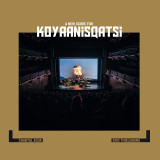
Dark-folk songwriter Chantal Acda and beyond drums-percussion musician extraordinaire Eric Thielemans propose a new score for Koyaanisqatsi, re-actualising the incredibly beautiful, raw, rhythmic and touching images of this 80-ties cinematographic masterpiece. Slow deep electric waves, lonely synths in sonic desert landscapes, rhythmic pulses, transporting drums and bells, and deeply longing sounds and voices make up the audible fundamentals of this imagined, neo shamanic, ritualistic music to accompany the Earth as it keeps on supporting our post human frenetics even today. This release contains a selection of the musical material scored for a live performance together with the screening of the movie. The live performance premiered on Film Festival Gent and Vooruit in the fall of 2022.
Currently based in Belgium, Dutch-born Chantal Acda (b. 1978) has worked under the Sleepingdog moniker since 2006, making three acclaimed albums that closed on the 'With Our Heads in the Clouds and Our Hearts in the Fields' (2010) album for which she collaborated with Adam Wiltzie (Stars of the Lid, A Winged Victory For The Sullen). They toured the UK and Benelux with Low in 2011. After all this, it was time for her first real solo record. Playing in various formations (Isbells, True Bypass, Marble Sounds) had made her conscious of the patterns that we all, as humans, share in. So, she sought out kindred spirits with whom she might record an album filled with freedom and intensity, and who were conscious of the patterns we so often fall back on. Nils Frahm was the first of these to cross her path. The inventive German pianist and producer is an intense and adventurous performer and was a perfect match for it. Acda also experienced a direct bond with Peter Broderick, a multi-instrumentalist known from his solo work (on labels such as Bella Union and Erased Tapes) and from his work with, among others, Efterklang. Cellist extraordinaire Gyda Valtysdottir from Icelandic group Múm had previously worked with Chantal as a member of the Sleepingdog live band. And lastly, Shahzad Ismaily stumbled into this picture by chance, but when Acda and he found themselves in the same room they formed an instant rapport. After this first record, 3 other solorecords followed. Chantal kept on searching for a deeper connection with the outside world and recorded "The Sparkle In Our Flaws" (2015) and "Bounce Back" (2017). She also released some live recordings with her band and also Bill Frisell, a highly respected jazz guitarist.(2018). These records were released on the German label Glitterhouse. Chantal and her band toured with these records in Europe. In 2019 Chantal created her first music/theatre performance P_wawau for Oerol Festival, The Netherlands. She worked with Valgeir Sigurdson (Björk, Bonnie Prince Billy,...) and singers from Het Nederlands Kamerkoor. As a result of this, she released the recorded music: Puwawau (2019). In 2021 Chantal released her most recent album Saturday Moon. (2021) For this album she worked with her band (Eric Thielemans, Alan Gevaert, Gaetan Vandewoude and Niels Van Heertum) but also with Bill Frisell, Shahzad Ismaily and Mimi and Alan Sparhawk (Low). Saturday Moon was very well received, internationally, by the press.
Eric Thielemans is a drummer and percussionist. Travelling across music scenes and disciplines, Thielemans navigates by means of his own compass. Most known for his resonant solo works like a Snare is a Bell, Sprang, Aural Mist and Bata Baba Loka and many collaborations with musicians in the experimental music scene, as well as the Jazz scene, and indie folk/pop/rock scenes Thielemans keeps on pushing the borders and expanding conscious aural spaces and territories. Recently, Thielemans has collaborated with PVT - a trio together with Mika Vainio & Charlemagne Palestine (album released April 2020) , PAT - a new trio together with Oren Ambarchi and Charlemagne Palestine, A new duo together with Oren Ambarchi, Billy Hart ("Talking about the Weather"), Chantal Acda ("The Sparkle in our Flaws", "Bounce Back", "Puwawau", "Saturday Moon"), Marshall Allen (Sun Ra), Tape Cuts Tape, Distance Light & Sky, Jozef Dumoulin, Trevor Dunn, Shahzad Ismaily, Vaast Colson, Nico Dockx, and many more. Currently Thielemans is working on r-e-s-o-n-a-n-c-e , a culminative work that encompasses and brings to the surface the underlying currents within his life in and with music. Withing r-e-s-o-n-a-n-c-e he investigates the everyday magic through conversations, writing and score writing to invite as many souls as possible to experience and co create the magic in the everyday.

This album presents two multichannel works recorded at the seminal INA GRM Studio in Paris and ZKM Institute in Karlsruhe respectively, mixed to stereo at the composer's Cellule 75 Studio in Hamburg with excellent mastering by Rashad Becker. While his releases under the Black To Comm moniker often touched the fringes of acousmatic techniques and Musique Concrete this is Richter's first foray into a more abstract spatial music.
Recorded in the week leading up to the Paris terror attacks at the GRM studio, "Diode, Triode" (21:57) is loosely based on a reading of (and, in parts, a failure to understand) "Le Parasite" (1980) by Michel Serres, a philosophic metaphor about human interaction and communication (which can also be interpreted as a lyrical essay on capitalism; part confusion, part enlightenment).
As core elements Richter is using speech synthesis and the transformation and distortion of concrete sounds, instruments, voices and breathing. Abstract incognisable sounds are combined with strings, reeds and percussion while dismembered musical fragments emerge and vanish rapidly. Chunks of interfering noise are followed by long periods of silence; chaos and order are alternating. Choirs of synthetic and processed human voices are recounting stock market values, seemingly random sequences of numbers and inscrutable lyrics while parasitic sounds are trying to crack, collapse and fractionise the compositional stream and sonic interactions. Finally, a haunting piano chord is wrestling with a broken Publison machine. Like the book, it's part confusing, part enlightening - and a radical piece of sonic art.
"We are buried within ourselves; we send out signals, gestures, and sounds indefinitely and uselessly. No one listens to anyone else. Everyone speaks; no one hears; direct or reciprocal communication is blocked." (Le Parasite)
"Diode, Triode" was premiered on the Acousmonium at INA GRM's Akousma Festival in Paris, January 22, 2016 alongside new works by François Bayle, Robert Hampson, Leo Kupper and Ragnar Grippe.
The second piece "Spiral Organ of Corti" (17:00) has been composed in 2014 for the 47-speaker Klangdom concert hall at ZKM Karlsruhe at the foot of the Black Forest (where Richter was born and raised).
How does one listen with closed ears? Sine tones, alienated human voices and breathing noises build a labyrinthine puzzle alternating between the natural and the artificial. Human sounds merge with winds and strings, sine tones morph into metal sounds. Acoustic illusions confuse the listener, and dense noise-clouds slowly emerge from deceptive silence. Deep base sounds define space. Temporary focus glides into chaos. "Spiral Organ of Corti" is yet another extended composition that proves Richter is on a path of his very own.
"Spiral Organ of Corti" is dedicated to the late Gary Todd.
"Tongues that came from wind and noise. To speak in tongues after the fire." (Le Parasite)
Marc Richter records as Black To Comm for Thrill Jockey, Type and Dekorder and under the Mouchoir Ètanche and Jemh Circs monikers for his own Cellule 75 imprint. He collaborated with visual artists such as Ho Tzu Nyen, Jan van Hasselt and Mike Kelley. Under his own name he is composing for film and installations.

Anita Clark’s new Motte album, »Cold + Liquid«, builds glacial atmospheres, frozen moods and isolated impressions. Portraying New Zealand through socio-geological sound, breathing in Christchurch cultures and locales, the album embodies an artistic simulation of the Kiwi environment. Motte borrows from an array of sound sources to create an immense entity, with each piece situated precisely along the path. »Cold + Liquid« offers this rich sensory experience, transporting the listener into a world of Clark’s imagination.
As a master violinist, Clark is a favorite of the NZ music scene. She’s been employed by Nadia Reid, Marlon Williams, Lawrence Arabia and Maryrose Crook of The Renderers for her skills. Currently, she plays with The Phoenix Foundation, Luke Buda and Don McGlashan and The Others. Her skillful reach across genres fuels her popularity both with the rock under and overground, and she has also built a rich CV of film soundtracks and contemporary dance compositions.
With such a powerful musical force behind it, Cold + Liquid germinated as a result of a prolonged silence. Clark was suffering from vocal cord paralysis, leaving her with a culminating sense of frustration which could only be released through songwriting . The album’s early life was purely instrumental. But as she prepared for the studio and was searching old voice memos hoping to find vocal tracks, her voice returned. A fervent week followed, where she reimagined the entire album, now with singing. She aimed to make something colossal, and set about finding the right textures to add. A friend who works at Oamaru Freezing Works gave her field recordings of the temperature control room, a vast cold space of isolated machinery, where ice grows and dissolves in ever-evolving sculptures. Getting her hands on shortwave/longwave radios, she incorporated frequency sweeps. Another friend provided her with the mechanical drones underneath the deck of a cement cargo ship, as it lay docked in Lyttelton Harbor. Still more sources came from Sign of the Bellbird, an historic environmental site in South Christchurch, where Clark and Thomas Lambert recorded bellbirds, rolling boulders, snapping sticks, thrown dirt and the papery sound of the native harakeke plant.
While violin dominates the first Motte album, Clark sought to expand instrumentation. She was gifted a handmade Pūrerehua puoro, a traditional Māori instrument that sounds similar to the whirling and hovering of a moth (which is “motte” in German). A reacquaintance to the guitar occurred after developing an alter ego project entitled 'Sex Den,' with sleazy noir-esque guitar riffs in response to a failed rumour from a local drug-addled dive bar. Guitar and synth allowed for a broader songwriting palette along with a sometimes Dadaist approach to lyric writing. These new tools accent the extreme ambiences of »Cold + Liquid«, while additional work was provided by Ben Woods on synth and bowed guitar.
Ryuichi Sakamoto, Daniel Lanois, Loscil, K Leimer, Deaf Center, Tangerine Dream, Arvo Pärt Wake is a distillation and reflection of the work of three Portland musicians thrown, like the rest of the world, into forced isolation by the continually-mutating curse of a natural world in disequilibrium. The product of involuntarily inward-looking emotional landscapes, Wake emerged sounding surprisingly expansive and confident. The trio uses a variety of instruments –including harp, fretless bass, piano, and a variety of synthesizers– to conjure sparkling panoramas of the imagination that are deep-pooled and impressionistic, bracing yet comforting. Mike Grabarak and Joshua Ward have performed together for years as a duo under the moniker of Location Services, while Derek Hunter Wilson has primarily worked as a solo composer in the classical realm. For the Points Of No Return compilation, Beacon Sound's 50th release and a benefit for the Beirut Musicians Fund, they recorded a collaborative piece entitled "Interdependence In Solitude" that was so promising the label offered to release an album if they continued down the path they had started upon. The resulting eight songs are simply mesmerizing. Made during a period of change and upheaval in the world and society where many people were disconnected from others, the album is the product of a collage-like dialogue built on trust and patience. While the musicians couldn’t physically be together for much of this time, they began sending musical ideas to one another in a conversational back-and-forth that acted as an anchor of stability – something they found they could turn to and depend on when things felt uncertain elsewhere. This comfort zone led to some transcendent moments of experimentation. “Delicate Need”, for example, features recordings of exaggerated pizzicato that were sampled and then run back through processing effects, which were then subsequently performed live over the original track. As things became less risky on the Covid front, they would occasionally meet for backyard rehearsals. Indeed, a recording of one of these rehearsals became the basis for the opening track “Photo Aware”. Wake will be available later this summer as a limited edition LP, with design work by Berlin-based Studio Bernhardt. The cover painting was created by Portland artist Nate Ethington. Highlights: – Derek was invited by the artist Gregory Euclide (Bon Iver, Erased Tapes) to participate in his label project, Thesis, along with artists such as Benoit Pioulard, Loscil, and Julianna Barwick. – Derek‘s first and second albums as a solo artist were released by Beacon Sound (Travelogue, 2017; Steel, Wood, & Air, 2019). – Location Services likewise released their 2019 album Reincorporate on the label. – The artists plan to tour together in 2023. Cascadia release shows TBA. Bios: Location Services is the Portland-based project of multi-instrumentalist Mike Grabarek (Magic Fades) and harpist Joshua Ward. They’ve released music on Beacon Sound and Beer On The Rug. They perform both written and improvised music. Derek Hunter Wilson is a composer and multi-instrumentalist based in Portland. He has released two solo albums on Beacon Sound and has also collaborated with visual artist Gregory Euclide for his Thesis Project label, resulting in a split 10" with Spanish musician Rauelsson. He has additionally collaborated with poets Zachary Schomburg and Brandi Katherine Herrera for several sound and performance pieces. He has performed live on the West Coast and in Berlin, sharing the stage with artists such as Colleen, Amulets, and Liima.
