Obscure & outstanding free jazz album reissued for the first time since it’s original release in 1969. Old-style gatefold sleeve LP, with liner notes by Ed Hazell.
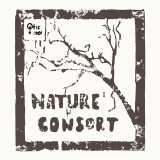
In the late 1960s, young jazz musician Bobby Naughton, a keyboardist and vibraphonist, faced significant challenges as he sought to record his first album. With major record labels and jazz clubs catering only to big names, Naughton and other creative musicians of his generation found themselves sidelined by the mainstream music industry. They turned to self-reliance and self-production, becoming part of a movement of independent musicians. Naughton’s debut album, Nature’s Consort, was a DIY effort in every sense—recorded on home equipment and featuring a hand-printed woodblock cover. The album was distributed independently at concerts and by mail, receiving little attention initially, but over the years it gained a reputation as a rare, sought-after artifact of the period.
Though recorded during an outdoor concert in Connecticut, Nature's Consort reflected the "loft jazz" scene in New York City. This avant-garde jazz movement centered around musicians who lived and played in loft spaces in lower Manhattan. Naughton commuted from his home in Southbury, Connecticut, to play with his bandmates Mark Whitecage, Mario Pavone, and Laurence Cook in New York's lofts. These musicians regularly performed at venues like Studio We, a key gathering spot for free-form jazz, where musicians could experiment and develop their sound, often with no audience present.
Naughton’s journey into jazz was a winding one. Originally from Boston, he played rockabilly and blues-rock before transitioning into free jazz. Inspired by avant-garde artists like Carla Bley and Paul Bley, Naughton sought to explore new forms of music that went beyond traditional jazz structures. His bandmates, Mark Whitecage and Mario Pavone, were both deeply affected by the death of John Coltrane in 1967, which prompted them to quit their day jobs, attend Coltrane’s funeral, and move to New York to pursue jazz full-time.
Nature’s Consort was a collective project, with band members sharing equally in any profits. However, Naughton was the driving force behind the group’s creative direction. He composed much of the original material and selected pieces by Ornette Coleman and Carla Bley for the band’s repertoire. Jazz critic Nat Hentoff praised the album for its “high-risk improvisation” and the musicians' ability to anticipate each other’s moves. Though Nature’s Consort received little press at the time, it has since been recognized as a significant early document of the loft jazz era, representing Naughton’s disciplined, improvisational approach to music.
quête:j period
- I'll Never Be The Same 05:06
- Barbados 05:13
- You Won't Forget Me 05:11
- Just In Crame 05:51
- Very Early 05:40
- Last Night When We Were Young 05:35
Critically-acclaimed German pianist Pablo Held announces TRIO PLAYS STANDARDS, the seminal new trio album which captures Held and his comrades Robert Landfermann & Jonas Burgwinkel paying tribute to the rich legacy of Jazz.
Reflecting on the album’s theme, Held shares:
"On our previous 14 recordings, Robert, Jonas, and I have explored a wide range of musical realms: my original compositions, classical pieces, works by my father Peter Held, and occasional tunes by some of my favorite artists. Delving deeply into each of these musical environments has played a pivotal role in shaping the trio's sound over these years. Now, we've finally fulfilled a dream: recording an album of standards."
The album showcases Pablo Held’s unique arrangements of broadway classics as I’LL NEVER BE THE SAME, YOU WON’T FORGET ME and LAST NIGHT WHEN WE WERE YOUNG, reworkings of Charlie Parker’s BARBADOS and Bill Evans’ VERY EARLY, alongside Held’s own JUST IN CRAME - a contrafact on the old standard JUST IN TIME - each imbued with the trio's signature improvisational spirit and collective synergy.
Pablo Held, who’s not only known as a revered pianist and composer, but also a musical researcher, knows the value of deep study and cherishes its effect on his work: "The more I study this music, the more it propels me forward," says Held, echoing the sentiment of his personal hero Wayne Shorter about the past being “the flashlight that guides the way into the future”.
The trio recorded the album at Jazz Campus Basel’s pristine studio facilities on October 29th 2023 in front of a live audience of attentive students who witnessed the trio’s explorations first handedly in this intimate setting.
TRIO PLAYS STANDARDS was recorded and mixed by recording engineer Daniel Dettwiler and mastered by Christoph Stickel, who mastered the majority of Pablo Held’s expansive discography as a leader.
Legendary vocalist Norma Winstone penned the liner notes, and its timeless cover design is by Christian Schäfer, featuring captivating photos by Linghuan Zhang.
TRIO PLAYS STANDARDS marks the 6th release on Held’s own label HOPALIT RECORDS.
After the success of the previous trio album WHO WE ARE, Held favors a double-release method for his records going forwards: a 6 month pre-release period, where the album is exclusively available via Bandcamp and on live shows, leading into the official release in stores and streaming platforms.
As an additional incentive every (physical & digital) copy includes the bonus album TRIO PLAYS STANDARDS - LIVE, recorded during Held’s own curated festival STANDARDS WEEK at the LOFT Köln in 2022.
Texas born Freddie King was one of the all time great Blues guitarists. He is considered one of the "Three Kings of the Blues Guitar" (along with Albert King and B. B. King, none of whom are related). Mostly known for his soulful and powerful voice and distinctive guitar playing, King had a major influence on electric blues music and on many later blues guitarists including the likes of Eric Clapton, Jeff Beck, Peter Green, and Mick Taylor.
This selection showcases live recordings from his classic repertoire over a period from 1969 to 1975. His signature tune “Hideaway” was named after a nightclub on Chicago’s Westside; “Mel’s Hideaway lounge”.
Black[23,49 €]
Ben Lukas Boysen’s new album, Alta Ripa, signifies a seismic shift in his artistic journey. It revisits the foundational impulses of his youth, shaped amidst the serene beauty of rural Germany—a bucolic backdrop where his creative palette flourished. However, it was his move to Berlin in the early 2000s that electrified his sound, infusing it with the city’s pulsating energy and diverse cultural influences. Alta Ripa captures this transformative experience, blending the introspective melodies of his rural beginnings with the bold, experimental tones born from Berlin’s vibrant electronic music scene. This album is a testament to Boysen’s evolution, showcasing how geographical shifts can profoundly shape artistic expression.
Boysen’s fourth studio album under his own name, Alta Ripa is a nod to his beginnings as much as a hint to his future, and as a work, it’s almost contradictory in its boldness and humility. He invites the listener on a journey of self-discovery; both for himself and for them, describing the music as “something the 15-year-old in me would have liked to hear but only the grown-up version of myself can write.”
His last two albums involved working closely with other musicians, including cellist Anne Müller, flugelhorn player Steffen Zimmer, and drummer Achim Färber. However, inspired in part by a recent return to live performance, Alta Ripa sees Boysen circling back to his passion for pure computer music.
For Boysen, the return to his youthful musical language marks a major turning point in his career. It represents a departure from his roots in classical music – his mother was an opera singer and his father an actor with an appreciation for Wagner, Arvo Pärt, Keith Jarrett, and Stockhausen. Although these are still important influences, Alta Ripa encapsulates a new, exploratory interplay between Boysen’s careful craft and his ability to let go of some of the process.
The album’s title comes from the original Roman name of the town that Boysen grew up in, Altrip, where he lived until his early twenties. This formative period is central to the ideas behind this album, from Boysen’s parental ‘schooling’ in classical music through to his sonic journeys through drum and bass, Aphex Twin, and Autechre — all of which changed his idea of what music could be. The extreme energy of tracks like ‘Acperience 1’ by Hardfloor, ‘Tracks & Fragment’ by Cari Lekebusch, ‘Focus2 Implan’ by Jiri.Ceiver, and ‘Low On Ice’ by Alec Empire are also pivotal influences.
For Boysen, this time of his musical development also involved knocking down the pillars that he previously thought had carried his world. A key moment for Boysen was being given a precious (pre-internet) club cassette at school that featured artists like Source Direct, Photek and Goldie. Excited by this new discovery, he introduced his father to the song ‘Dred Bass’ by Dead Dred. After the song finished, Boysen Sr. turned off the tape and proclaimed it was “the end of all music”. This heated exchange sparked a new, and more mature dialogue between the two that involved them sharing and discussing music on a regular basis.
Boysen’s classical and jazz music upbringing might not be easily noticeable from the electronic palette that he uses. But it can be found in its bones; the structure of the tracks and their dynamic shifts. On Alta Ripa, he intentionally embraces a spirit of controlled chaos, churning out sonic ideas to see what sticks.
One of Brian Eno’s Oblique Strategy cards contains the phrase “gardening, not architecture”, and the trajectory of Boysen’s creative path reflects this metaphor. In much of his previous work he followed a sort of Brutalist architect’s approach; here, he was fully responsible for the tracks’ austere structures and planned them with deliberate care. But by sacrificing some of that control on Alta Ripa, he sets the right conditions for a dark and unpredictable, organic growth. It’s a push forward into a new world.
Alton Ellis is one the finest soulful voices to come out of Jamaica. As well as writing hit singles himself, he could make a cover version known as a foreign tune sound like a Jamaican reggae tune with the greatest of ease.
As the more upbeat rhythms of the earlier 'Ska' period began to slow down around the turn of 1966 some say due to the extreme heatwave that hit the island of Jamaica that year, slower rhythms suited the people to groove to at the various sound systems and dances. This also allowed the singers to express themselves more and allow the song to shrine through. No one did this better than Alton Ellis.
Alton Ellis (b.1944, Kingston, Jamaica) started off singing at an early stage as part of a duo with singer Eddie Perkins and recorded for both Studio One and Randy's as 'Alton and Eddy' and had a massive hit with the song 'Muriel'. The singing pair went their separate ways with Alton going solo with Studio One and being a much in demand voice also recorded with Duke Reid's Treasure Isle Studio as 'Alton Ellis and The Flames'. As we stated earlier as the beat slowed down the top singers shined through and Alton Ellis reigned supreme. One of his tunes that we feature on this set 'Get Ready(Do the Rocksteady') even gave this period in reggae's history its name 'Rocksteady'. It's this fantastic period Rocksteady 1966-1968 that we feature on this release. This set carries all the big hits 'Ain't That Loving You', 'Girl I've Got A Date', 'Cry Tuff' alongside many more classics. All the cut at Treasure Isle songs that really defined the era.
So sit back and enjoy the Rocksteady sound it's finest....
We hope you enjoy the set....
Way back in 2008 Soul Junction released a 45 on Duane Williams “Yes My Love Is Real” with Duane being one half of the Detroit husband and wife singing duo Beverley and Duane. The duo under the guidance of their lifelong friend Will Hatcher recorded six songs of which two “ We Got To Stick Together” and “Glad I Got You Baby” were picked up by local Detroit label president Woodrow ‘Woody Wilson for release as a 45 single on his Fee label. The popularity of the 45 was to attract attention from the major Ariola label, who picked it up for national distribution during 1978 leading to the subsequent Ariola album ‘Beverley & Duane”. As the 1980’s dawned Beverley and Duane recorded a solitary 45 single for the independent Detroit Brown Bomber label “Love/You Belong To Me”. The label was owned by John L. Barrow a nephew of former heavyweight boxing champion Joe Louis, (Brown Bomber being Louis’s nickname). Beverley and Duane later moved to the west coast until their amicable divorce which led to Duane returning to his native Detroit to reacquaint himself with his former mentor Will Hatcher. This meeting of old friends led to the creation of Duane’s first solo project which Will brought to Soul Junction in late 2007. Hot on the heels of Duane’s hugely popular Soul Junction 45 came his subsequent CD album “These Songs Are For You” (SJ5001) released in 2009. Contained within this album was the very pertinent gospel/social commentary song “Father We’re Having Trouble” a song which two very close and knowledgeable friends of mine the late John Anderson and Bill Randle claimed had all the right ingredients for a potential hit record. Over the ensuing years this song has always remained in my thoughts until a few years ago I broached the idea with my good friend Jesse James recording a cover version of it, Jesse upon hearing the song was very receptive to the idea. Another period of time elapsed before we again reignited the idea. A decade or so on from Duane’s original version and the lyric’s of this particular song still remain as pertinent as ever, if not more so! During early 2020 Jesse entered, Con Funk Shun multi-instrumentalist and vocalist Felton Pilate’s Felstar Studio in Atlanta to lay down the basic tracks with Felton acting as co-producer on this project. Everything was progressing nicely until a worldwide pandemic intervened. With Jesse locked down in his new home on the West Coast and Felton in Atlanta the project unfortunately came to a holt. During this enforced period of inactivity further racial and political upheaval occurred which only added more poignance to the project. Eventually with the lifting of lockdown restrictions Jesse finally made it back to Atlanta to finish the project, the fruits of which you have before you now.
2024 Repress
Johnny Clarke stands tall as one of the great vocalists that ruled the Jamaican reggae scene from the mid 1970's to the early 1980's Dancehall period. This re-issue of his 'Don't Stay Out Late' set shows his versatility to sing any song that was put in front of him and make it his own. Under producer Bunny 'Striker' Lee's guidance, Mr Clarke produced a run of singles and albums few could match.
Johnny Clarke (b 1955, Jamaica, West Indies) cut his first record 'God Made the See and Sun', after winning a local singing contest in the Bull Bay area of Jamaica. Although the single was not a hit, it led to two follow up tracks for producer Rupie Edwards, '
Everyday Wandering' and 'Julie' that fared much better, both on the island and overseas in England and Canada. These tracks also brought the singer to the attention of producer Bunny Lee and a working relationship that would go on to produce a prolific catalogue of music.
Johnny Clarke's Dread Conscious/ Love Song style were to grace many hits around this time in 1974. Such tunes as 'None Shall Escape The Judgement' , 'Move Out Of Babylon' , 'Rock With Me Baby' , 'Enter The Gates With Praise' to name but a few. All new songs added to a host of cover tunes, recommended by Bunny Lee, many taken from singer John Holt's catalogue, that suited Clarke's vocal style.
The rhythms were cut at various studios around the Island. Randy's Studio 17, Channel I, Treasure Isle, Dynamic Sounds and Harry J's by a group of musicians loosely called The Aggravators and voiced King Tubby's studio.
All great tracks backed by great rhythms, cut by Mr Johnny Clarke with a voice that few could equal.
The last couple of years have seen a renaissance for West Coast singer-songwriters. LA-based youngsters such as Drugdealer and Sylvie have attracted considerable attention releasing warm and mellow records tonally reminiscent of the early 70s. Most fans of this new/old sound are unaware of Bart Davenport's early explorations in the same sonic territory. His now 20-year-old "Game Preserve"album should gain an appreciative new audience with its first ever vinyl release.
In the year 2000, Bay Area troubadour Bart Davenport and several other musicians were recruited by a major tech corporation in Seattle to work on an algorithm-based music matching/search engine. It was what looked like the beginning of a promising career. After a year, however, the project was shelved. Bart and his colleagues were laid off with a healthy severance package... on the 12th of September, 2001. Not only had the musician's life changed, so had the world. Rather than blow the money on a holiday or new car, Bart knew he had to make a record. A proper album that meant something.
Back in Oakland, he entered Wally Sound Studios with former Kinetics bandmate Jon Erickson at the controls, and a swathe of talented local musicians. "With Game Preserve," Bart explains, "Jon and I really wanted to knock it out of the park. I wanted to utilize people from my old bands like Loved Ones drummer John Kent. I also invited my newer indie-pop friends from Call & Response, and a young Nedelle Torrisi. Harmony singing by The Moore Brothers was an essential ingredient on Game Preserve as well."
Both Erickson and Davenport fondly recall growing up in households where the music of The Carpenters, Joni Mitchell and The Eagles soundtracked their young lives. By the early 00s they were ready to reconnect with what is often referred to as the "Laurel Canyon" sound. "I'd buy used tapes at garage sales and play them in the car. "Ladies Of The Canyon" by Joni and Jackson Browne's first album were both in heavy rotation. Jon Erickson was getting deeper into the Steely-Mac-Doobie yacht-rock sound in earnest. A certain amount of childhood nostalgia led a lot of us back to that part of the 70s. I'd flirted with classic soft-rock on my first album, but that record was pretty scattered esthetically. I wanted my next one to be more focused. Jon and I made some ground rules: no electric guitars (except on 'Bar-Code Trees'). No synths. Most importantly, all the songs have an air-tight, super dead, close mic'd drum sound. Putting these sorts of limitations on the sessions will give your record a specific quality. In the case of "Game Preserve"it's mostly about tight drums, acoustic instruments and analog production. We used a 24-track, two-inch tape machine for tracking, then ran the mixes through an analog board straight to a 1/4 inch master tape."
While the album's sonic palette may be firmly planted in 1970, Davenport's songwriting covers a sizable landscape of moods and reflections. From the quasi-flamenco intro of 'Sweetest Game' to the somber Wurlitzer of 'Nowhere Left To Go', to the 12-string shimmer of 'Intertwine', "Game Preserve" tells a story of young love, lost innocence and redemption, crossing borders and oceans along the way.
Released in 2003 on family-run Oakland label Antenna Farm, the ultra-analog sounding "Game Preserve" was only made available on digital formats, including CD. Copies were later pressed by labels in Germany and Spain; the latter being one country the album actually did well in, establishing Bart Davenport with a small but loyal fanbase he still enjoys today. Two European tours as support for Kings of Convenience also helped gain a foothold on the continent. Back in the US, however, Davenport and his sophomore album remained quite obscure.
Limited promotion meant it did little, but for the music lovers that heard it, the album undoubtedly remains a classic of the era, deserving far more. Twenty years on, it now finally receives its vinyl debut. "I personally think it holds up well," says Bart of the album two decades later. "The idea was to make something that could be an homage to late 60s/early 70s West Coast pop but hopefully timeless as well. Years on, I hear it as just that. It was a colorful and brief period of my life that felt at times like it could last forever. I discovered the joy of working in a proper studio with a perfect cast of characters. I'm still very close with all these people and still play music with many of them."
Having worked silently in her sonic philosophy for almost a decade, vocalist, music producer and Dj Telva has launched her music label byt’, starting with the publication of her debut album. The album, ‘Revelation’, opens with an unusual and experimental offering, which sets the tone for the label's subsequent eclectic and unexpected releases. The compilation of 10 tracks, has been documented for 5 years through an experimental vocal, instrumental sonic journey, that is composed of Telva's life experiences during this period.
Telva is a vocalist, producer and only vinyl Dj based in Berlin. Defining her path through art in every sense of it by turning passion into a way of life, she has been playing and collecting records as main craft since 2016. Followed by uninterrupted hours in the studio, her creations and sonic philosophy, aka record label byt’, have been materialized by the wide range of influences she’s been absorbing along her way as an artist, where different cultures, scenes, and places have shaped and influenced her understanding and projection of her musical vision. Her love for the underground movement and the deep work in silence have made her music shows special and respected. For listeners and dancers, her well-chosen exposure is an unexpected experience. Her purpose is to offer quality music based on eclectic diversity, that surprises the audience with the love it spreads through sound, aiming to touch their hearts. ‘Music is a channel of transmission in where to materialize one’s lifetime vision’
Byt' (быть in Slavic meaning 'to be' / pronounced 'beat') is a music philosophy, also known as a record label, focusing on the connection between music and artist as a primary form of communication and source of expression. It represents 'the music of the being'.
The meaning and purpose are to comprehend the concept of musical interpretation through the artistic vision of the person behind it, by appreciating the significance of conveying a life experience through sound, making a recognition on what is behind the music we listen to. The label will be composed of solo releases, sonic cinematic experiences, collaborations and other archives, spanning an unlimited wide range of genres, yet rooted mainly in electronic music.
- K Street Walker
- Duck Eat Duck World
- Junk
- Widow
- I Threw Glass At My Friend's Eyes And Now I'm On Probat
- No Respect
- Goldilocks Spot
- Cattywampus
- Word Salad
DESTROY BOYS" catalog vinyl is back in stock!
2024 has been a big year for the band with the release of their new album, Funeral Soundtrack #4 (available on Hopeless Records) and Epitaph Records are harking back to these two seminal vinyl releases from the band"s early days, just in time for Black Friday!
"Sorry Mom" (2017) ( on vinyl for the first time!) and "Make Room" (2018)- both albums will be available on black vinyl. DESTROY BOYS formed in 2015, when founding members Violet Mayugba and Alexia Roditis were just 15 years old, and each release has marked a period of growth and change. "Looking back, our first three albums marked the deaths of things," says guitarist Violet Mayugba. "They were soundtracks to our funerals, whether they were for our ages, our mental states. We"ve gone through a lot of changes as a band and as people." "The first one (Sorry, Mom) was our high school album," Mayugba explains. "On the second record (Make Room), we went to college and were saying goodbye to our childhood. On the third one, we"d just gone through COVID and, speaking for myself, I lost my entire sense of self and gained a new one." Now, at 24, Mayugba and Roditis are standing firmly on solid ground with more resolute and confident than ever in their place as musicians.
- A1: The Wind (Talking To The Pines)
- A2: Mississippi Queen - Samsum
- A3: Road To Kingdon Come
- A4: Sunshine
- A5: Kentucky Pearl
- B1: I Am A New Orleans (Genevieve)
- B2: Bringing It All Back Home
- B3: Only For The Summer
- B4: Take Me Back To The Water
- B5: Heartbeat
Kevin Parrot, Brian McGladdery, Roger Tweedale, Gary McDougall and Tony Bamforth formed Samsun at the beginning of 1969. After several tours abroad they came to the attention of Geoff Gill (ex-The Smoke), Wil Malone (ex-Orange Bicycle) and Cliff Wade (ex-Fickle Pickle). They spent a week at Morgan Studios recording an entire album but only three songs were released for the Dutch and UK markets. A few years later, the band rebranded as Oscar.
Buried until now in the vaults, Samsun's self titled album finally emerges blinking into the daylight a mere 52 years after it was recorded to provide yet another missing piece of the seemingly forever incomplete Morgan jigsaw. Taken from the original master-tapes, it provides yet more evidence that, during a five-year period in the late Sixties/early Seventies, the in-house Morgan team was as productive as any similar-sized British pop collective. Available on both vinyl and CD with comprehensive sleeve notes.
Introducing Wishy, a brand new band from celebrated Indiana songwriters Kevin Krauter and Nina Pitchkites. Wishy came to life as a musical partnership between the two Indianapolis musicians when Pitchkites moved back home from Philadelphia in 2021. The two bonded over their love for 90s alternative bands like The Sundays and My Bloody Valentine and soon began crafting their own brand of swirling pop-rock with an introspective, grungy flair. By day Krauter works as a music teacher, giving drum and guitar lessons to students, while Pitchkites is a seamstress by trade and often makes embroidered merch for the band. While Krauter spent the better part of the last decade cementing his place as a torchbearer of Midwestern dream pop with 2018's Toss Up and 2020's Full Hand, Pitchkites delved into her own indie electro-pop project Push Pop, writing songs like "Spinning" that would later be reworked for Wishy. To round out the live band, Pitchkites and Krauter enlisted guitarist Dimitri Morris, bassist Mitch Collins, and drummer Conner Host. Across two trips to Los Angeles in late 2022 and early 2023, Krauter and Pitchkites linked up with friend and producer Ben Lumsdaine, who had some spare time between Durand Jones tours to record the pair's newly written songs. The result of their fruitful time in sunny California is the aptly named Paradise, a breezy and melodic EP that puts on full display the songwriter's musical fluency. Tastefully blending shoegaze, dreampop, and alt-rock into a heavenly haze, Wishy delivers a strong 5-song introduction that's dense with melodic earworms and stirring sentiment. Wishy's debut single for new label home Winspear, the driving and distorted "Donut," showcases Pitchkites' hypnotic vocal and Krauter's melancholic wash of guitars. Written after a period when Pitchkites was driving on a spare, "Donut" laments the cynical capitalism of Midwest living and the reliance on a car to get around. Of the song Pitchkites says "When you've got the possibility of the open road plus the limitations of your shitty car-and you're stuck driving on a donut spare tire- it's a Catch 22." Throughout Paradise, the band laments on American loneliness and idealism as it relates to our everyday lives. Across the EP's five tracks, Pitchkites and Krauter trade bittersweet reflections on love and self actualization over vast, scrappy guitar chords. The whole thing feels equally indebted to early aughts alt-rock and '90s jangle pop. Wishy's music is cathartic, yet underlined by a subtle brooding energy-sitting nicely alongside the work of their contemporaries like Momma or Tanukichan, both of whom Wishy will have shared the stage with. Wishy will be touring this Fall supporting Tanukichan, and the band will make their first festival appearance at LEVITATION in Austin, TX. After that, they have their eyes set on finishing their debut album, slated for release via Winspear in 2024
The Invisible Road: Original Recordings, 1985–1990 compiles an unheard, previously unreleased body of recordings by Sussan Deyhim and Richard Horowitz, dissidents from diametric backgrounds who met during the heady days of Downtown New York in the 1980s. This collection reveals the creative and life partners’ radical shared vision of avant-garde pop in all of its boundary pushing freedom, combining Deyhim’s singular approach to vocalization, Horowitz’s invention of new musical languages, and touchstones of traditional music from around the world, creating a new music that ultimately retains a voice entirely its own. Despite their difference in backgrounds and respective journeys, at the time of their meeting in the early 1980s in New York City, Sussan Deyhim and Richard Horowitz were both products of the search for freedom and understanding (and resultant awakenings) that swept the globe and helped culturally define the late 1960s and 70s. Deyhim, born and raised in Tehran, spent her teens dancing with Iran’s Pars National Ballet company, performing weekly on Iranian national television, and travelling her home country studying with master folk musicians and dancers, before relocating to Belgium and joining Maurice Béjart’s prestigious Béjart Ballet of the 20th Century. Horowitz, born and raised in Buffalo, New York, had spent much of the decade before abroad, first departing for Paris under the shadows of the Vietnam War, where he studied piano, Eastern philosophy, and became entrenched the city’s free jazz scene, playing with the likes of Steve Lacy, Anthony Braxton, and Alan Silva, before embarking south to Morocco where his friendship with Paul Bowles helped cultivate a deep passion for the country’s musical traditions and a shift in his musical practice.
The pair met by chance sometime in 1981 at Noise New York, a small studio on West 34th Street founded by the musician and recording engineer, Frank Eaton, as a utopian creative laboratory that beckoned artists and bands like Arthur Russell, Christian Marclay, Liquid Liquid and Butthole Surfers into its orbit. Both artists had recently relocated to the city, Horowitz having recently released his debut album, Oblique Sequences (Solo Nai Improvisations), on the legendary Paris based imprint Shandar, and fallen in with members of New York avant-garde like La Monte Young, Jon Hassell, David Byrne, and Brian Eno, and Deyhim having begun to more actively incorporate singing into her practice, notably recording a vocal score for choreography she was doing at La MaMa Experimental Theatre.
Initially bonding over a cassette tape of field recordings made by Paul Bowles that had been given to mutual friend and writer Brian Cullman (seeking answers for Ornette Coleman’s question “what is the sound of sound”), their earliest collaboration was documented on Horowitz’s 1981 album, Eros In Arabia, with Deyhim contributing vocals to the track “Queen Of Saba.” Over the coming years, their deep connection would routinely gravitate them into the studio, culminating in the body of recordings that would appear on their 1986 album for Crammed Discs, Desert Equations: Azax Attra. Unknown to nearly all but the artists, laying in wait over the decades on numerous multi-track and stereo reels, DAT tapes, and reference cassettes, were a vast array of recordings made by Deyhim and Horowitz bookending Desert Equations. The 13 pieces represented on The Invisible Road: Original Recordings, 1985–1990 were recorded largely between Noise New York and Daylight Studio in Brussels, during a period that Deyhim describes the partnership between herself and Horowitz’s as seeking a music “free of any specific cultural reference, with a personal musical signature,” blossoming into a body of sonority that embraced the energy of contemporary boundary pushing pop and the avant garde, filtered through their mutual love and study of various musical traditions from across the globe and deep engagement with the ideas and tactics of experimental music.
Undeniably rooted in Horowitz’s study of the North Africa ney and the music of the Berber and Gnawa cultures during his time in Morocco, Deyhim’s deep engagement with the folk traditions of Iran, and the couple’s immersion in the interconnected Downtown underground music scenes, each piece on The Invisible Road offers its own vision creative and cultural hybridity. Deyhim sings in both English and Farsi, as well as a composite tongue that she developed by drawing upon numerous indigenous vocal techniques from around the world, intuitively responding to Horowitz’s simultaneous sound syntax forming and combining a wide range synthetic and acoustic instrumentation, and experimental tape techniques, within a visionary series of free-standing expressions.
"‘One of the most exciting composers alive.’ – Daily Telegraph
Nonesuch will release the original score for Ken Burns’s new two-part documentary, LEONARDO da VINCI, with new compositions by Caroline Shaw; the documentary airs on November 18 and 19 on PBS. The album features performances by the composer’s longtime collaborators Attacca Quartet, Sō Percussion, and Roomful of Teeth as well as John Patitucci. Shaw wrote and recorded new music for LEONARDO da VINCI, marking the first time a Ken Burns film has featured an entirely original score.
In celebration of LEONARDO da VINCI, New York City’s historic venue The Town Hall presents an evening of performances from Shaw’s score by Attacca Quartet, Sō Percussion, and Roomful of Teeth on October 29. The filmmakers will also preview excerpts from the four-hour film..
LEONARDO da VINCI is directed by Ken Burns, Sarah Burns, and David McMahon. The film, which explores the life and work of the fifteenth century polymath Leonardo da Vinci, is Burns’s first non-American subject. It also marks a significant change in the team’s filmmaking style, which includes using split screens with images, video, and sound from different periods to further contextualize Leonardo’s art and scientific explorations. LEONARDO da VINCI looks at how the artist influenced and inspired future generations, and it finds in his soaring imagination and profound intellect the foundation for a conversation we are still having today: what is our relationship with nature and what does it mean to be human?
“No single person can speak to our collective effort to understand the world and ourselves,” said Ken Burns. “But Leonardo had a unique genius for inquiry, aided by his extraordinary skills as an artist and scientist, that helps us better understand the natural world that we are part of and to appreciate more fully what it means to be alive and human.”
“To help give depth and dimension to Leonardo’s inner life, and to carry our viewers on his personal journey, we enlisted the composer Caroline Shaw,” McMahon says in the album’s liner note. “Caroline’s existing body of music—joyful, daring, at times transcendent, and wholly unique—seemed to speak directly to Leonardo, a seeking soul who, 500 years after his death, can come across as strikingly modern. A fully original score, we believed, would add crucial connective tissue to areas where the record of Leonardo’s life is thin and it’s possible to briefly lose his trail. The music Caroline created is dynamic, enthralling and filled with wonder.
“This soundtrack is a testament to the inspired efforts of Jennifer Dunnington, who marshaled it into being, the brilliant musicians and vocalists who, with the help of Alex Venguer, Neal Shaw, Colton Dodd and Tim Marchiafava, made it soar, and most of all Caroline Shaw, who might be Leonardo’s soulmate from across time,” he continues. “With her help, the Leonardo who emerges is no wizard shrouded in mystery, but a prideful, obsessive, at times lonely or flustered, occasionally ecstatic, and, in the end, content man who is in ways both modern and thoroughly of his time.”
“As we set out to explore Leonardo’s life, we realized that while he was very much a man of his time, he was also interested in something more universal,” said Sarah Burns. “Leonardo was uniquely focused on finding connections throughout nature, something that strikes us as very modern today, but which of course has a long history.”
Caroline Shaw is a musician who moves among roles, genres, and mediums, trying to imagine a world of sound that has never been heard before but has always existed. She is the recipient of the 2013 Pulitzer Prize in Music, several Grammy awards, an honorary doctorate from Yale, and a Thomas J. Watson Fellowship. She has worked with a range of artists including Rosalía, Renée Fleming, and Yo-Yo Ma, and she has contributed music to films and TV series including Fleishman Is in Trouble, Bombshell, Yellowjackets, Maid, Dark, and Beyoncé’s Homecoming. In addition to three albums with Sō Percussion, Narrow Sea, Let the Soil Play Its Simple Part, and Rectangles and Circumstance, Nonesuch has released her two Grammy-winning albums Orange and Evergreen, both of which feature Attacca Quartet. “Two-Step” and “Ghost,” Shaw’s songs with Ringdown, her duo with Danni Lee Parpan, are available now on Nonesuch. Caroline Shaw is Wigmore Hall’s 2024-25 Composer in Residence."
After Denzel’s debut EP ‘Techniques 4 Life’ last year, the quest for finding those approaches continues. The Helsinki night owl draws from a range of influences here on his sophmore EP ‘Glorified Intake’, taking things into a murkier territory than his previous, made during a transitional period of his life between two cities, H & B.
The first track HKI 13 is an ode to roots. The track is held together by a swerving astral arpeggio combined with chants from a village dance off and stabs that liken to that one Balearic house anthem… The Sun is well on its way below.
Nightrun reduces things to a darker core, howling into the night, embodying a state rather than telling a story. Time goes by, how is it already tomorrow? An after hours tune with a bassline for a hook. Doesn’t get much sleazier than that. Getting down, getting low.
On the flipside, we’ve made it to the beginning of the end, phased out the doubts and gathered up the strength to go on — things are looking brighter. A voice inside your head — trust only yourself.
Finally on the last stretch, light has subsided and darkness has landed once again. We’ve thrown out any notion of what, where and who. Those things don’t matter anymore: we’ve perfected “the state”. It’s go time.
»Nuts of Ay«, the thirteenth album by the Berlin-based electronic pop duo Tarwater (Ronald Lippok and Bernd Jestram), is their first in a decade, since 2014’s »Adrift«. Beautifully poised and smartly dressed, it's an album that draws Tarwater’s various pasts into a high-definition present, while bringing the duo, yet again, into productive dialogue with all kinds of fellow travellers.
Tarwater’s music has always been marked by a hypnotic pop-ness, but that’s particularly evident on »Nuts of Ay«, where a song like »Hideous Kiss« weaves together jangling guitar, pastoral flute, and flittering electronics into a gem-like construction. While the lyrics of »Hideous Kiss« are written by the duo, »Nuts of Ay« also continues a longstanding Tarwater tradition of recasting the words of others in their own mould. This time, their remit is broad: poetry from Derek Jarman (»All Nuns«) and Millner Place (»Trapdoor Spider«); lyrics from Jean Kenbrovin (»I’m Forever Blowing Bubbles«), the late Shane MacGowan (»USA«) and, again, John Lennon (»Everybody Had a Hard Year«).
This cast of found and borrowed lyricists also finds collaborative echo in the guest musicians dotted throughout »Nuts of Ay«. Schneider TM turns up on the lovely, Felt-like »Spirit of Flux«, where guitars channel the tangled reveries of Vini Reilly and Maurice Deebank into lush pop. Carsten Nicolai joins, as Alva Noto, dappling »On Waves and Years« with intimate glitching textures; he also provides the album cover art. Elsewhere, Masha Qrella appears on »Down Comes the Goose«, and actor Lars Rudolph pitches in for »USA«.
It may have been ten years since the album's predecessor, but Lippok and Jestram have kept active with other projects. They’ve collaborated with Masha Qrella, Immersion, and Iggy Pop; worked on radio plays with Kai Grehn, some based on the writing of Nick Cave (»The Sick Bag Song«, featuring Tilda Swinton, Paula Beer and Alexander Fehling) and William S. Burroughs (»The Cat Inside«); and made music for several radio-tatorts (radio plays based on »Tatort«, a long-running German police TV series) by playwright Tom Peuckert.
Both voracious and committed in their creative energies, Jestram and Lippok report back from these experiments with »Nuts of Ay«, one of their most compelling, deeply lustrous, dreamlike albums yet. They say there was no concept for the album, which is surprising, perhaps, given its holistic mood, explaining it »grew together like a coral reef in the studio over a period of several years«. There’s something to be said for letting an album gather and mutate naturally, without an overarching framework in place, and »Nuts of Ay« certainly feels like an unforced collection of material that nonetheless inhabits a similar space, one where guitars twist like driftwood next to amorphous, aqueous electronics, Lippok’s droll yet completely convincing vocal delivery riding songs that pulse and plume with curious, unpredictable rhythms.
But you can also hear elements – submerged but still present – of other music that’s inspired the duo: they’ve drawn some connections for us with psychedelic folk, Bowie in Berlin, Burial, and the film music of Popol Vuh and Krzysztof Komeda. This music shares a strong sense of place – whether in the world, or the mind – and the twelve songs on »Nuts of Ay« have such similar presence; a shared mood, a shared world, a shared sense of the possibilities of what electronic pop music could, and should, be. A bold and brave pop experiment.
Artwork by Carsten Nicolai
Mastering by Bo Kondren, Calyx Berlin
»Trapdoor Spider«, »On Waves and Years« & »Breaking Day«: lyrics by Milner Place
»All Nuns«: lyrics by Derek Jarman
»USA«: lyrics by Shane MacGowan
»Down Comes the Goose«: lyrics from a traditional song
»Forever Blowing Bubbles«: lyrics by Jaan Kenbrovin
»Everybody Had a Hard Year«: lyrics by John Lennon
A collaboration between Duncan Bellamy (Portico Quartet) and Belinda Zhawi (MA.MOYO), Jump Ship, Sit Lean, Be Still, Stand Tall is a collection of sonic-poetry that sets Zhawi’s illuminating, elliptical words in dialogue with diffuse, explorative music and sound by Bellamy. Fluctuating between expansive contemporary classical arrangements and intimate layered vocal experiments, together they render these disparate forms into something distinct, melancholic and luminous.
Belinda Zhawi is a literary & sound artist based in London & Marseille, author of Small Inheritances (ignitionpress, 2018), & experiments with sound/text performance as MA.MOYO. Her work explores African diaspora research and narratives, and how art and education can be used as intersectional tools. Her literary & sound works have been featured on various platforms including The White Review, Vogue, NTS, Boiler Room & BBC Radio. She’s held residencies with Triangle-Asterides, France; Cove Park, Scotland; Serpentine Galleries; ICA London and was a Brixton House Associate Artist 2022 - 24. Belinda’s the co-founder of literary arts platform, BORN::FREE. She is working on her first full poetry collection.
Duncan Bellamy (b. Cambridge, UK, 1986) is a multidisciplinary artist based in London. His diverse practice encompasses painting, silkscreen, photography, sound and music. His work examines the shape of time, loss and our relationship to the past and present in a period of compressed transformation. He is a founding member of Mercury Prize nominated Portico Quartet, and has contributed sound work to the artist Hannah Collins audio-visual installation I Will Make Up A Song. Bellamy is working on a debut exhibition and new music.
This third volume of Universal Synthesizer Interface delves further into early MIDI sequencing software for personal computers, focusing on Intelligent Music Software founded by Joel Chadabe in 1984. In a short period of time (1986-1990) Intelligent Music published a series of MIDI sequencing software titles that would have rippling effects throughout the music world: M, Jam Factory, UpBeat, MidiDraw, Ovaltune, Realtime, as well as an unreleased first version of Miller Puckette’s Max. These programs were a reflection of Chadabe’s desire to create interactive and intelligent algorithmic tools for home computers. Intelligent compositional tools had been floating around for decades in mainframe computer labs, but they had largely only been accessible to people working in academic or corporate laboratories. With the birth of Intelligent Music, these tools became available to anyone with a home studio. As the personal computers of this era had become less expensive and more accessible, they had also grown exponentially in processing power and seeming intelligence. In the music press from this time, we find the same two words used again and again to describe algorithmic computer systems: smart and intelligent. The tone of such articles may seem quaint by today’s standards, when AI and algorithmic control underpin so much of our technology, but the question of machine intelligence remains. Universal Synthesizer Interface VOL III Focuses exclusively on one of the more obscure of Intelligent Music’s software creations - UpBeat: The Intelligent Rhythm Sequencer, released in 1987, and hailed by reviewers of the time as “the world’s best drum machine.”
Black[28,99 €]
200 COPIES MARBLE COLOURED VINYL Jailcell Recipes: Perhaps the last untold chapter in the story of the rapidly-detonating, late 80’s UK Hardcore scene. Often overlooked in favour of their contemporaries, this re-mastered/re-modelled retrospective collection of songs finally puts the record straight, giving them the recognition they deserve. It showcases the band’s importance within that scene and throws light on their unique standpoint and their growth over a 4 year period. This release is not intended as a discography, rather a selected ‘strongest hand’ from between the years 1988 to 1992. It features the definitive line up of Robbie Reid (vocals), Jamie Owen (guitar), Dave Arnold (bass) and Ian Barwick (drums). It's a game of two halves; the faster, straight ahead hardcore stylings make up Side One (practically the entire first album recorded in 1988), whilst the more melodic, mid-tempo material completes the set on the flipside - Robbie's unmistakable vocals being the constant throughout that makes it all work, he provided the band with a unique identity. Side Two closes with previously unreleased studio tracks from 1992 - virtually unheard until now, we believe these final three tracks to be amongst their best. The songs now sound as the band intended all the way back in 1988. Largely down to a relentless run of gigs back in their heyday, Jailcell Recipes gained a strong reputation for being an exciting and energetic ‘live’ hardcore band, playing with Bad Brains, All, Gorilla Biscuits and including tours with Youth Of Today (1989), Green Day (1991), Naked Raygun (1988). It’s the 35th Anniversary of the release of their debut album “Energy In An Empty Tank World” and after all these years, we finally have the recorded output to match the ‘live’ performance!
Marbled[28,99 €]
200 COPIES MARBLE COLOURED VINYL Jailcell Recipes: Perhaps the last untold chapter in the story of the rapidly-detonating, late 80’s UK Hardcore scene. Often overlooked in favour of their contemporaries, this re-mastered/re-modelled retrospective collection of songs finally puts the record straight, giving them the recognition they deserve. It showcases the band’s importance within that scene and throws light on their unique standpoint and their growth over a 4 year period. This release is not intended as a discography, rather a selected ‘strongest hand’ from between the years 1988 to 1992. It features the definitive line up of Robbie Reid (vocals), Jamie Owen (guitar), Dave Arnold (bass) and Ian Barwick (drums). It's a game of two halves; the faster, straight ahead hardcore stylings make up Side One (practically the entire first album recorded in 1988), whilst the more melodic, mid-tempo material completes the set on the flipside - Robbie's unmistakable vocals being the constant throughout that makes it all work, he provided the band with a unique identity. Side Two closes with previously unreleased studio tracks from 1992 - virtually unheard until now, we believe these final three tracks to be amongst their best. The songs now sound as the band intended all the way back in 1988. Largely down to a relentless run of gigs back in their heyday, Jailcell Recipes gained a strong reputation for being an exciting and energetic ‘live’ hardcore band, playing with Bad Brains, All, Gorilla Biscuits and including tours with Youth Of Today (1989), Green Day (1991), Naked Raygun (1988). It’s the 35th Anniversary of the release of their debut album “Energy In An Empty Tank World” and after all these years, we finally have the recorded output to match the ‘live’ performance!


