Corduroy's third album 'Out Of Here' updated their sound, taking in
1970s influences that would later be defined at yacht rock. The
Iconic cover with the band about to take off in a bubble-fronted
helicopter the album shows the band at the height of their powers.
The track features the Top 75 hit 'Mini', the anthemic tribute to
Japanese jazz star Monday Michiru 'Don't Wait For Monday' and their
reverent cover of 'Motorhead'.
Available on LP for the first time in two decades, it comes pressed on
shiny blue vinyl, re-mastered from the original tapes.
The perfect companions to the comeback album 'Return Of The
Fabric Four', which was released earlier this year.
Suche:jap
* Packaged in re-sealable polybag with A4 artwork insert. Comes with EOC logo sticker and download code.
* Katsunori Sawa returns to his EOC (Enormous O'Clock) alias for Mirae Arts. Hailing from Kyoto (Japan), Katsunori Sawa is the co-founder of 10 Label with techno producer, Yuji Kondo. Currently producing and performing as a solo artist as well as in collaboration with Yuji Kondo (as Steven Porter), Anthone (as BOKEH), and Chafik Chennouf (founder of Leyla Records). EOC debuted on the legendary UK label Ai Records in 2008 with an album called Information Warfare. Katsunori Sawa has since then developed a catalogue of deep techno escapades for labels such as Weevil Neighbourhood, Opal Tapes, Leyla Records, and 10 Label.
* The Path of Untitled Memories is a project grounded in neon excess and delicate balance of modern conformity. Ceaseless wriggles beyond pleasures. Electro excursions for the curious minded.
* Logo and sticker design by Jason Smith (founder of Ai Records). Artwork by Elbert Choi (founder of Mirae Arts).
* Vinyl pressed at the highly reputable Gotta Groove Records, Cleveland, Ohio.
Love Not Sex is the second Stubb 12" from Paper Recordings' Ben Davis.
The original is a melancholic slice of sunshine that draws inspiration from MOR and blue-eyed soul with a hefty dose of Balearica.
Acoustic guitars, Rhodes, live drums and strings plus Crazy P's Tim Davis on bass provide the perfect cinematic backdrop for the plaintive vocals of Huw Costin (Torn Sail) and Rachel Foster.
Japanese edit hero Mori Ra delivers his first ever remix and its a doozy. Keeping the bones of the original track, he takes it in to dark psychedelic waters with the help of former_airline's tripped out guitar.
A spoken vocal tips it in to full balearic wonkiness that will have the likes of DJ Harvey and Bjorn Torske getting hot under their disco beards.
Bergen's Leca employs his trademark stripped back crisp production for a warm, dreamy remix. Steel guitar, clicks, whirrs and a Nordic playfulness make for a cosmic journey in to the Northern Lights.
The 12's will be a limited run of 300, screen printed in West Yorkshire by The Egg Factory with artwork by artist Rachel Johns in a project that celebrates community and collectivism.
- Beautiful 1 LP Edition 140g Vinyl, Heavy 350gsm Sleeve, Sticker WRWTFWW Records is extremely excited to present the official reissue of cult album Lingua Franca-1 (originally released in 1983) by groundbreaking Kyoto band EP-4, available on vinyl housed in heavy 350gsm sleeve and digipack CD. Straight from the delirious minds of unconventional geniuses Kaoru Sato (who had previously released an album as R.N.A. Organism on legendary Osaka label Vanity Records) and Yuji 'Banana' Kawashima, Lingua Franca-1 is a seamless voyage of spellbinding mutant funk grooves, joyful post-punk explorations, synth fantasies, sexy distortions, and fluid cool-no-sweat vocals. Constantly mutating in an almost biological way (similarly to Colored Music's self-titled album), always mysterious and seductive, sometimes reminiscing of a freaky cross between PiL, Liquid Liquid, Bowie and Yello, EP-4's debut is hard to label, although 'Debonair Wave' could be a legitimate way to describe this Japan's best-kept-secret of an album. Defying the rules wasn't limited to sonic experimentations for band leader Kaoru Sato. To promote Lingua Franca-1, he and his crew plastered gigantic (illegal) billboards all over Shibuya and Harajuku, announcing performances in four different cities on odd hours of the same day (May 5th 1983). Other of his notable antics included originally sub-titling the album Death to the Emperor Showa causing a controversy (which led to censorship and a title-change), trying to release two albums on the same day without the concerned labels being aware of the plan or, in the R.N.A. Organism days, fooling Vanity Records into believing the demo he sent them came from a foreign band (it worked). Unique personality, unique music!
Standard Edition, Mastered at half speed, 140g vinyl, Sticker We Release Jazz (WRWTFWW Records' new sister-label) is thrilled to present the official reissue of criminally overlooked Japanese jazz gem Mellow Dream (1977) by Hokkaido pianist wunderkind Ryo Fukui, released in conjunction with the its legendary predecessor Scenery, sourced from the original masters and mastered at half speed. Firmly standing on the foundation he laid down with Scenery, Ryo Fukui continues his exploration of modal, bop and cool jazz sounds with meticulous grace and absolute mastery. As its title suggests, Mellow Dream ventures into slightly mellower, more soulful, and sometimes more contemplative territories (the Bill Evans-reminiscent 'Mellow Dream' and 'My Foolish Heart") while still packing the commanding punch Fukui's work is loved for, as heard on the amazingly bombastic 'Baron Potato Blues' or the gigantic McCoy Tyner/John Coltrane-influenced 'Horizon' which sees each member of the trio (Satoshi Denpo is on bass and Yoshinori Fukui is on drums) demonstrating their virtuosity for 9 exhilarating minutes. With his sophomore album, Ryo Fukui swings from melancholy to vibrant joy with ease, reminding us that jazz is best served with a pinch of blues, and displays an immensely rare combination of pure talent, unique personal approach and focused discipline. The man undeniably deserves a spot in the pantheon of all-time great jazz pianists. After releasing the outstanding Scenery and Mellow Dream back to back, Ryo Fukui worked on developing his live skills, often performing at Sapporo's Slowboat Jazz Club (which he co-founded with his wife Yasuko Fukui), and even releasing 2 live albums. He sadly passed away in March 2016, leaving behind a legacy of works that all jazz lovers should explore.
David Holmes was drawn to DIE HEXEN by their 'magical sensibility that has both shades of dark and light, which is something that always appeals to me in music'. After featuring in his edition of the famed Late Night Tales compilation with a take on the original suicide song 'Gloomy Sunday', DIE HEXEN returns to expand upon their dark ambient journey towards transcendence with an eagerly awaited debut album.
DIE HEXEN's genre eschewing synth driven compositions draw inspiration from the disturbing beauty of Hieronymus Bosch's artwork and several brushes with death, evoking a spirit who traverses realms of the underworld to bring forth knowledge of an Ancient past and in doing so, to reveal the not so distant future.
The Garden of Unearthly Delights transports the listener through strange visions of darkness, beauty, creation, destruction, death & rebirth. An exorcism of body, gender, tribe towards a place of ultimate transcendence.
Somewhat of a polymath, DIE HEXEN has already shown their prowess with live performances part music/part performance art spectacle, as an avant-garde filmmaker and as an award-winning multi-instrumentalist, sound designer and film scorer.
DIE HEXEN's divergent interests from Japanese Butoh theatre to Wiccanism, Shamanism, celestial mysticism and time travel informs their method, as they explain themself; 'The compositions I write are not written, at least not by me. They appear to me as audio/visual hallucinations. I can hear, visualise, and feel the whole composition before me. My hands know instinctively what notes to play and like a stream of consciousness, voices emerge. Having suffered severe head trauma that resulted in a heightening of the senses, the theme of death is an increasingly present theme in my work. With this, my perception of death and what is beyond changes as I contort between this world and the next physically and mentally, musically and visually. Working with music or film, my vision is one. The calling to express these auditory hallucinations is inevitable'.
Mastered at half speed, 140g vinyl,
Sticker We Release Jazz (WRWTFWW Records' new sister-label) is proud to present its first release, the official reissue of Ryo Fukui's highly sought-after masterpiece Scenery (1976), sourced from the original masters and available on limited edition 180g vinyl mastered at half speed for audiophile sound and on digipack CD. Unquestionably one of the most important Japanese jazz albums ever recorded, Scenery reveals Ryo Fukui as a miraculously brilliant self-taught pianist fusing modal, bop, and cool jazz influences for a very personal, dexterous and game-changing take on classic standards made famous by Bing Crosby and John Coltrane among others. From 'It Could Happen To You' and its serene and calm intro which magically flows into a jubilant and upbeat piece, to the out-of-this-world piano solo of 'Early Summer", or the incredible teamwork of 'Autumn Leaves' where Fukui leads Satoshi Denpo (bass) and Yoshinori Fukui (drums) into groove heaven, every single note on the album oozes precision, confidence and flair and every single section slides seamlessly into one another, creating a supreme and elegant blend of jazz. Often compared to McCoy Tyner or Bill Evans, Ryo Fukui was a genius in his own right, a true master of his craft whose perfectionism gave birth to some of the greatest music ever recorded. Scenery is his magnum opus and an absolute must-have. The Hokkaido wizard-pianist followed Scenery with the soulful gem Mellow Dream (also available on We Release Jazz) in 1977. He then focused on improving his live skills, often performing at Sapporo's Slowboat Jazz Club (which he co-founded with his wife Yasuko Fukui) and releasing 2 live albums. Ryo Fukui sadly passed away in March 2016, leaving behind a legacy of works that is sure to captivate jazz lovers for generations to come.
righteous expensive: motohiko hamase's 1986 album "reminiscence" scores a decent prize at online vinyl selling platforms and it is worth each coin!
it's a perfect "refuge from nasty reality", as the glorious british 20jazzfunkgreats blog once said. and it comes from a man that knows his trade: bass play - an artisan on which he also already wrote many theoretical books in his more than four decades long career.
in the 1970's hamase was no stranger to tokyo's vibrant jazz scene. together with jazz pianist tsuyoshi yamamoto and jazz-rock guitar-ist kazumi watanabe he played in the isao suzuki sextet and was part of their classic landmark jazz-funk album "ako's dream" from 1976.
in the following years he also participated on records like mikio masuda's latin-funk-jazz gem "moon stone" or japanese female jazz singer, actress, and essayist minami yasuda's last album "moritato". in the early 1980ees his work shifted from pure jazz to electronic and ambient spheres and he started to compose his own music around his deeply emotional bass play.
from 1985 to 1993, hamase released five solo albums. just recently studio mule dropped his first one, "intaglio", in a new recording that sounds as stunning as the original release from 1986.
now the previously mentioned "reminiscence", his second work for the celebrated defunct japanese new age record label shi zen, follows in a fresh shape on studio mule.
as the original, it features deeply touching moments of sheer pristine perfection and distributes hamase's inner emotional landscape with a bewitching bass performance. a soothingly beauty of an album, that reflects hamase's search for spaces of melancholy.
a rhizome of soundscapes that capture, settle and sound elusive while simultaneously being awe-inspiring. as for "intaglio", the 66-years old artist gathered again some befriended musicians, rented a studio, staged his gear and recorded most of the original "reminis-cence" material new, while keeping the moving musical story arc of the original album alive in a fresh wrapping.
the result is a dazzling, blue mood seething, strongly hypnotic longplayer, full of personality and hybrid ambient electronic jazz spheres that open doors to unheard sound universes and that perfectly work for all those stress-relieved souls that love the disclosure of the mind and seek for a "refuge from nasty reality".
Hosono's solo career would take many twists and turns from this point forward, with forays into exotica, electronic, ambient, and techno, culminating in the massive success of techno pop group Yellow Magic Orchestra (YMO), who made their debut in 1978. Admired by artists ranging from Van Dyke Parks to Mac DeMarco, Hosono continues to forge ahead as he heads into his fifth decade as a musician. With the re-release of his key albums for the first time outside of Japan, his genius will be discovered by a whole new generation of fans around the world.
.
The unbelievably prolific Haruomi Hosono is one of the major architects of modern Japanese pop music. With his encyclopedic knowledge of music and boundless curiosity for new sounds, Hosono is the auteur of his own idiosyncratic musical world, putting his unmistakable stamp on hundreds of recordings as an artist, session player, songwriter and producer.
Born and raised in central Tokyo, his adolescent obsession with American pop culture informed his early forays into country music, which he would revisit later in his career. Hosono made his professional debut in 1969 as a member of Apryl Fool, whose heavy psychedelia was somewhat at odds with his influences, which leaned towards the rootsy sounds of Moby Grape and Buffalo Springfield. The latter was one of the main inspirations for his next group, Happy End, whose unique blend of West Coast sounds with Japanese lyrics proved to be highly influential over the course of three albums. After the band’s amicable break up in 1973, Hosono began his solo career with Hosono House, an intimate slice of Japanese Americana recorded inside a rented house with recording gear squeezed into its tiny bedroom.
- Spectral Decay' is a collection of musical reflections about the paradoxical contemporary state of humankind, whereas its own technological, social, cultural and economical development seems to entrench the possible points of a structura downfall. The narrative of - Spectral Decay' starts with heavy, mesmerizing industrial vibes. Due to the notable sound design techniques of Japanese artist Tetsumasa, his hefty piece - Nex' evolves into a harsh but still amazingly cinematical music sculpture.
Subsequent mid-tempo composition - Onzour Shayatini' by Meer dynamically follows the dark, experimental path of drone and noisy structures. Violent accents smoothly lead to the deconstruction of drum & bass patterns and turn into strident 90s metal riffs. The track progressively penetrates obscure subterranean abysses and becomes a perfect introduction to the next theme by Yuji Kondo - - Hades'. In Greek mythology Hades was the ancient god of the underground kingdoms, darkness, death and metals. Therefore, Kondo's music piece turns into an infernal portrayal of the underworld where tenebrous layers of bass frequencies, raw textures and Drexciyan sounds build up an enormous and lasting tension.
Side B begins with the track - Anthropocene' produced by Arboretum co-founder - Mogano. The whole composition refers to the present geological epoch we live in, characterized by environmental pollutions, depletion of fossil fuels and accelerated urbaniza- tion of the world. It is a deeply conceptual soundscape of a powerful system, that incorporates both - the destructive forces of technology and the infinite energy of the whole universe, that interweave in a devilish dance of post-techno, breakbeat and dub tones.
Thereafter, ~Raw in his piece - Poly Bios' pictures the interference of human structures in the nature. Creating a mosaic from indus- trial and tribal, organic sounds, he tells a mystical story of fear, hope, escape and primeval instincts.
The narration concludes with an atmospheric composition of NWRMNTC - solo project of Ana Quiroga from experimental ambient duet LCC. - Beyond' is a boundless, spectral reflection on collective human consciousness, where haunting vocals evoke a recon- dite, ineffable pain, leaving the listeners in a profoundly meditative state.
Laura Polan´ska
Experiential composer Tim Hecker's ninth official full-length, Konoyo ('the world over here') was largely recorded during several trips to Japan where he collaborated with members of the gagaku ensemble Tokyo Gakuso, in a temple on the outskirts of Tokyo.
Inspired by conversations with a recently deceased friend about negative space and a sense of music's increasingly banal density, Hecker found himself drawn towards restraint and elegance, while making music both collectively and alone.
As with the Icelandic choir he arranged on 2016's Love Streams, the heights of Hecker's talent emerge in his manipulation of source material, bending and burnishing it into fantastical new forms. Keening strings are stretched into surreal, pixelated mirages; woodwinds warble and dissipate as fractal whispers of spatial haze; sparse gestures of percussion are chopped, isolated, and eroded, like disembodied signals from the afterlife. Both in texture and intent, Konoyo conjures a somber, ceremonial mood, suffused with ritual and regret. Visions flutter and fade; dreams gleam and decay.
Hecker will stage a series of special performances in tandem with the album's release, featuring members of the gagaku ensemble on sho¯, ryuteki and hichiriki, accompanied by Kara-Lis Coverdale.
This is Amsterdam based Musique Exotique's launch realised in the form of a seducitive solid white, blue & purple 12' record that includes a free digital download (printed on the label) as well as wonderful cover art by the infamous Japanese twins, Hamadaraka.
Dutch artists Machinegewehr and Ayden Vice team up to bring that timeless retro Italo vibe with Moroder inspired bass arpeggiation, mysterious vocals and epic pads.
On the B side, San Francisco based Dutch artist, Yobkiss, offers up a masterful remix taking the track into darker electro territory. His offering includes beautifully haunting Japanese vocals by the producer's long time collaborator Yuko Araki for exceptional exotiqueness.
is it the best jazz record from japan, as the french-born english disc jockey, record label owner and music collector gilles peterson once assumed or is it maybe the best jazz record of all jazz records
well, everybody needs to decide by himself and has to listen to 'watabase', the second solo piano album of the japanese jazz pianist fumio itabashi, that was originally released in 1982.
tokyo based mule music unearth it, remastered the original recordings and brings it back to the global stores in order to seduce all music lovers that embrace notes who come straight from the heart and soul.
while diving deep into the seven compositions on 'watarese', any sensible listener finds out, that the instrumental piano pieces are somehow soulfully connected to what keith jarret plays on his legendary 'the köln concert' live album for the munich based ecm record company.
like jarret, itabashi does not play his notes academic. he let them fly, gives them some kind a life of their own, hits the piano keys deeply emotional and injects his compositions and interpretations some kind of nervous human soul.
in terms of style some call his 'watarase' recordings post-bop, others contemporary jazz. none of such definitions fit really, as all is just that kind of agitating jazz that melts spirituality with humanity. three tunes, the epic 'someday my prince will come' as well as 'msunduza' and 'i can't get started', are interpretations of compositions by the us-american movie score pioneer frank churchill, south african pianist dollar brand and russian-american composer and songwriter vernon duke.
all other four compositions been written and recorded by the 1949 born itabashi who started to play the piano when he was eight years old. while studying at the tokyo based kunitachi college of music, he fell in love with jazz.
his love was so deep, that he starts to work in the 1970's with such legendary japanese jazz musicians like trumpet player terumasa hino, drummer takeo moriyama and saxophonist sadao watanabe.
till today fumio itabashi is a vital part of the japanese jazz culture as a live performer and film score composer. those who want to see how he makes love with his piano should check the world wide web for the french documentary 'jazzed out', that captured his unique way of playing in one episode.
but as music is always firstly for the ears, and not for the eyes, this little letter in-front of you would rather like to recommend to play the 'watarase' recordings loud to get hooked by the highly infectious piano gems that have been recorded at nippon columbia 1st studio in tokyo on 12th and 13th of octo-ber 1981.
they will haunt you. they will come for good. and they will force you to be a good friend with the repeat button - whatever medium you chose to surrender to the piano jazz music of fumio itabashi.
third release of studio mule's new project with miyako koda aka dip in the pool.
following the cover versions of ohnuki taeko's carnaval&mariah's shinzo no tobira,we made the new version of japanese pop ambient classic 'face to face by yumi murata'.
extended edit on a side is full of the respect for the original version and ambient version on b side is simply emotional.
the first album of studio mule is coming in the beg of next year.
stay tuned.
House, disco and hip hop smashed together from
cut&paste producer Jun Kamoda, who also raps in
Japanese on a couple of the songs.
Previous releases on Mister Saturday Night and
Mallgrab's Steel City Dance Discs, as well as two
EPs on Black Acre.
For fans of Daphni, Avalanches and Beastie Boys.
Full colour vinyl sleeve by the painter Hisano (Jun's
wife) and cartoon booklet insert by Jun (who is
also a cartoonist).
Highly Limited To 298 Copies, Vinyl Only
Indigo Aera Is Proud To Release A Truly Special Project From Japan's Yamoaka.
Yamoaka Was Originally Formed By Renowned Japanese Duo Kenichi Oka And Yoshinori Yamazaki, Until 2007 When The Project Was Continued Solo By Kenichi Oka. Drawing Inspiration From The Likes Of Kraftwerk And Y.m.o., Oka Masterfully Uses Hardware To Creates Unique Loop Based Sounds Drawing Resemblances To Minimalist Steve Reich's Signature Sound, While Blending In Techno-esque Elements Comparable To Those Of Terrence Dixon's 'population One' Alias, Finding A Harmonious Middle Ground Between The Two. Kenichi Achieves A Live Feel To All His Work, Recording His Tracks In Real Time Without The Use Of Daw's Or Computers, Instead Utilising His Roland Mc50 Sequencer With Perfect Effect.
Horrorfilm 'The Johnsons' was one of the biggest productions of 1992 in The Netherlands. The film won international acclaim and became a cult classic in the U.S. and Japan, yet failed to make an impact on the Dutch cultural landscape. Or so it was
thought... 25 years later, the celebrated documentary 'XANGADIX LIVES!' (Bram Roza & Yfke van Berckelaer, 2017), shines a new light on the untold story behind the film's troubled
production and the legacy it left behind...
XANGADIX LIVES! the original motion picture soundtrack, is composed by award winning producer and Deformer initiator, Mike Redman. It's now available on limited edition blood splattered vinyl. Get it now, because when we say limited edition, we mean limited edition!
HINOSCH are a duo of Koshiro Hino from Osaka and Stefan Schneider from Düsseldorf, they first (met and) began their collaborative work of musical interaction and exploring contrasting possibilities in 2017. After a number of concerts in the EU and in Japan a debut EP (HINOSCH EP/TAL05) was released in late 2017. Fully instrumental, their first full-length album HANDS offers a more steeply focussed approach than its largely improvised predecessor.
Encouraged by the momentum generated during a number of on-the-spot recordings in Osaka, where Schneider had held a residency in April 2017, the overall sound of the album has been honed down through meticulous studio engineering. One of the outstanding qualities of HANDS certainly is an unprejudiced approach of sound and song structures. The instrumentation is condently reduced to a small range of analogue and digital machines. Snatches of tape-loops deliver lower-pitched vocal and drum machine samples. This characteristic technical set up soon proved ideal in order to dene a tactile vocabulary of fully unsynchronized rhythm patterns. The word tactile perfectly conjures that quality which is the very essence of HANDS. It is the result of the manner in which interdependent threads of rhythm units are deliberately disconnected to form a cohesive, soulful and exible whole. Most tracks on HANDS are devoid of a central motif and examine an unpredictable dialogue. A fantasy of constant change and a search for musical suggestions is the most vital ingredient in this abstract environment.
The album title HANDS refers to physical aspects of electronic music production. Every live concert of Hinosch usually starts out with a hand shake between Hino and Schneider. The general process of collective music making, programming, button pushing, playing, recording, decision making, all demand utmost concentration. The image on the front of the abum sleeve (designed by Takashi Makabe) reects the general approach of HANDS: layers of tuckled fabrics confronting one another to articulate a form for themselves to no other end than their own orchestration.
After having emerged from the ever thrilling Osaka music scene onto the international playgrounds of electronic music just a few years ago Koshiro Hino's solo activities as YPY and his involvement with the band GOAT have already garnered him a very favourable international reception. Stefan Schneider has over the years produced and collaborated with a.o. Joachim Roedelius (Cluster), Arto Lindsay, Klaus Dinger (NEU!), Dieter Moebius (Cluster), Alexander Balanescu, John McEntire (tortoise), Katharina Grosse, Bill Wells and St.Etienne.
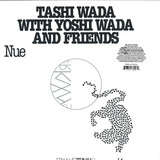
Composer Tashi Wada has performed for years with his father Yoshi Wada—artist, composer, and early member of the Fluxus movement. However, they have rarely appeared together in studio settings. Nue, the fourteenth entry in RVNG Intl.'s intergenerational FRKWYS series, finally brings Tashi and Yoshi, along with an eclectic group of close friends and extended family, together on tape.
Nue draws on aspects of Tashi's background for his widest vision to date—among them the minimalist bagpipe music of Yoshi, who co-composed three of the tracks, the psychoacoustic and perceptual explorations of his mentor, composer James Tenney, and reimagined forms of ancient and devotional music. The album, however, is not a tribute to the past or a recapitulation of familiar sounds. Instead, Nue is an intertwining of people and ideas as a means of growing, of looking inward to move outward, and of looking back to move forward.
To achieve this growth, Tashi assembled a core group of fellow travelers, including Yoshi, composer Julia Holter, producer Cole MGN, and percussionist Corey Fogel, to give life to this multifaceted suite. As an experience, Nue subtly navigates the interactions, intimacy and spaciousness of this group.
The album's title itself is a nod to Tashi's abiding interest in duality and the unknown: nue is a mythological Japanese chimera with the face of a monkey, the legs of a tiger, and a snake for a tail, a composite form, at once disturbing and otherworldly. But, as the composer points out, nue is also French for naked—stripped of complexity, bare and exposed, but also raw and essential.
From the doubling of tones—and the world of harmonic nuances such an action produces—to the rich interplay between individual musicians, all baring their own personalities and experiences through shared performance, Tashi's compositions allow space for these elements to join and grow. The multipartite creature that is an ensemble melds in the simplicity and purity of the music itself.
As explained by Tashi, each part was written with an individual in mind, not simply an instrument. And each individual performer makes their mark, from Holter's vocal performances on the cresting, oceanic 'Mutable Signs' and 'Ondine' with guest vocalists Simone Forti, Jessika Kenney and Laura Steenberge, to Fogel's resonant, precise percussion on 'Bottom of the Sky.' Producer Cole MGN, who has worked extensively with artists like Beck and Ariel Pink, helped to create a world of sound with minimal yet multi-dimensional materials. Like many of its influences, Nue uses deceivingly simple means to create complex, coherent worlds and narratives.
Tashi notes the influence of legendary Brazilian writer Clarice Lispector, whose work looked inward, investigating memory and emotion and dream, to understand the often overwhelming world outside the self. Like Lispector's classic novel Near to the Wild Heart, Nue cleaves these archetypal dualities—world/self, old/new, complex/simple—to create a work that allows them to coalesce into something singular.
As Tashi states in his liner notes: 'My desire was to create something both old and new sounding—ancient and futuristic—and ultimately something of its own world and other. Nue is a vision, an endless night of dreams, and a personal history of sorts, full of joys and demons.'