All of us carry a piece of where we’re from with us, but these parcels of fallow land often in a uniquely mysterious way become the prey that nourishes our aspirations. Agnès Gayraud a refined thinker by day that transforms into la Féline at night left Tarbes many years ago in search of greener pastures. After making a name for herself with Adieu l’Enfance (2014), Triomphe (2017), and Vie Future (2019), the author and musician has evolved once again. Her latest release Tarbes reinvents the circle of life and challenges our preconceived notions. She welcomes us to her hometown with sweet and clear melodies over the backdrop of an electronic hum, reminiscent of Mark Twain classic Tom Sawyer. Tarbes is no more than a listen away. Physically prevented from returning to her hometown by the viral threat we all know all too well, Agnès found her way back with a small Electone home organ. The constraints of off-peak hours that called for some DIY savvy, slowly but surely, roused her spirit. With a drum machine, a bass and a guitar, she succeeded in making the young girl inside her smile again. With 13 songs and just as many adventures Tarbes is a concept album that tells the story of a young woman’s formative years, as spent in her hometown. The returning hymn doesn’t only imprint nostalgia, it paints the full emotional portrait of a town. Because for Agnès, Tarbes is not just her theater, but her whole world, showing how fiercely protective she is of her hometown in the song Solazur. Under a magnifying glass of emotion, and with the sentimental testimony that is La Panthère des Pyrénées, the artiste shows us the skeletons in our own closets. Tarbes, more than a brief stopover in a rail journey to the coast, broaches issues that touch on abandonment, desertification, aging and redevelopment that many French towns and cities face today. Alexandre Guirkinger’s photographs serve as album art that illustrates this strangely unique singularity. While fine-tuning this collection of stories, in an oh-so-intimate album where solitude rips away the mask of confidence, Agnès found solace in uniting with other spirits. For 3 songs Tarbes, Jeanne d’Albret and Fum, inspired by an Occitan poem of Louisa Paulin (1888-1944), she invited the young voices of Conservatoire Henri Duparc a building she knows intimately, despite never feeling allowed to enter as a child to breathe the energy of their adolescence into this record. She also collaborated with Lyon’s own François Virot to imbue his delicate rhythms into her work, as well as Belgian guitarist Mocke Depret. Lastly, La Féline entrusted the last production stages to her eternal partner in music, Xavier Thiry, with Stéphane “Alf” Briat on the mixing board. The final piece has a complex tranquility, surrounded by non-verbality, with Jeanne d’Albret, Louisa Paulin and the Pyrénées safeguarding Agnes’ secrets. With the calm reassurance of her metamorphoses, La Féline delivers a slice of silence to her town, serving as both her cradle and theater. Tarbes’ Théâtre des Nouveautés is where Agnès Gayraud, La Féline, has decided to present Tarbes to its residents on October 14, 2022. While “nouveautés” evokes newness, this theater is reminiscent of a future which is already outdated, where modernity is only vague and fictional, carrying reminders of French haute-kitsch accordionist Yvette Horner, whose parents were the caretakers of what was then called the Cani Eldorado a bastion of virtue through the 30s, with its lineup of Catholic films. However, by the 60s, it would have become a temple of pornographic cinema. Tarbes, “Les Nouveautés”, end card. In the mid 90s, then 16 years old, Agnès discovered the volatile dust and the ghosts of the past that were hidden in this apostate theater. This phantom bequeathed song the teenager with the gift of her undeniable talent at her first appearance on stage a high school performance of a guitar-laden ballad sung in Spanish, a language her Andalusian mother has infused her with. On October 14, 2022, Agnès returns to the stage, bass in hand and joined by François Virot (drums), Mocke Depret (guitar), Léa Moreau (keyboard) and the Conservatoire de Tarbes singers to perform the album in its entirety
Поиск:jeann
Все
Back in print, note new price. San Diego's own The Sure Fire Soul Ensemble’s sophomore LP on Colemine Records! Cinematic soul is the order of the day from this west coast group. Covering a lot of soulful territory here: deep funk, soul jazz, breakbeats, and more!
- 1: Life Ain't Worth Livin'(If I Can't Have You)
- 2: That Man Of Mine
- 3: Woman Do Something Nice
- 4: Mississippi Moonshine
- 5: Don't Make Me Cry
- 6: Tied Down
- 7: Music Soft And The Lights Down Low
- 8: California You're Slippin
- 9: The Good Book Says It's Wrong
- 10: Back Streets Of Your City
- 11: Love In My Heart
- 12: When You Belong To Me
- 13: California You're Slippin
- 14: Lost Highway
Mississippi Moonshine Vinyl[24,75 €]
A '70s homemaker stuck between the studio and a getting dinner on the table, Joyce Street eked out an arresting countrypolitan discography in the margins of an otherwise traditional American life. With lyrics drawn from the pages of her diary, Street's stirring Mississippi warble led her into the fly-by- night world of custom studios, cutting tracks for upstart country concerns like Reena, Sonobeat, Revelation, and Arc. Channeling the honky tonk angel energy of Bobbie Gentry, Lorretta Lynn, and Jeannie C. Riley, Tied Down compiles a decade's worth of melodies disguised as lottery tickets.
- 1: Life Ain't Worth Livin'(If I Can't Have You)
- 2: That Man Of Mine
- 3: Woman Do Something Nice
- 4: Mississippi Moonshine
- 5: Don't Make Me Cry
- 6: Tied Down
- 7: Music Soft And The Lights Down Low
- 8: California You're Slippin
- 9: The Good Book Says It's Wrong
- 10: Back Streets Of Your City
- 11: Love In My Heart
- 12: When You Belong To Me
- 13: California You're Slippin
- 14: Lost Highway
Black Vinyl[23,49 €]
A '70s homemaker stuck between the studio and a getting dinner on the table, Joyce Street eked out an arresting countrypolitan discography in the margins of an otherwise traditional American life. With lyrics drawn from the pages of her diary, Street's stirring Mississippi warble led her into the fly-by- night world of custom studios, cutting tracks for upstart country concerns like Reena, Sonobeat, Revelation, and Arc. Channeling the honky tonk angel energy of Bobbie Gentry, Lorretta Lynn, and Jeannie C. Riley, Tied Down compiles a decade's worth of melodies disguised as lottery tickets.
[m] 13 CALIFORNIA YOU'RE SLIPPIN' [DEMO]
- A1: Life Ain't Worth Livin' (If I Can't Have You)
- A2: That Man Of Mine
- A3: Woman Do Something Nice
- A4: Mississippi Moonshine
- A5: Don't Make Me Cry
- A6: Tied Down
- A7: Music Soft And The Lights Down Low
- B1: California You're Slippin
- B2: The Good Book Says It's Wrong
- B3: Back Streets Of Your City
- B4: Love In My Heart
- B5: When You Belong To Me
- B6: California You're Slippin
- B7: Lost Highway
A ’70s homemaker stuck between the studio and a getting dinner on the table, Joyce Street eked out an arresting countrypolitan discography in the margins of an otherwise traditional American life. With lyrics drawn from the pages of her diary, Street’s stirring Mississippi warble led her into the fly-by-night world of custom studios, cutting tracks for upstart country concerns like Reena, Sonobeat, Revelation, and Arc. Channeling the honky tonk angel energy of Bobbie Gentry, Lorretta Lynn, and Jeannie C. Riley, Tied Down compiles a decade’s worth of melodies disguised as lottery tickets.
[m] B6. California You're Slippin' [Demo]
"Dans cent ans" is not a record: it’s a talisman.
Flavien Berger doesn’t make music, he makes time machines.
In 2015, he released his first album, Leviathan, which he’d imagined like a moment suspended into the bowels of present time.
In 2018, Contre-Temps, his critically acclaimed second album, was narrated like a flashback.
Dans Cent Ans (“In 100 Years”) ends this trilogy and launches into the future with the grace of a poisonous serpent.
Flavien had just finished producing Pomme’s last album and was simultaneously scoring Céline Devaux’s feature film Tout le monde aime Jeanne, when he recorded this album, during six months of isolation.
In the garret of a Belgian house in construction, these 12 tracks were born, close to the sky, both direct and mysterious.
Because Flavien Berger knows how to make machines sound sensual (a key example is the pop song “D’ici là”) and dares to interweave electronics, chanson and art music, organic instruments and synthetic choirs, without ever falling into parodic territory.
Because his voice, more precise, unreverbed, and close-mic’d than ever, sings to our ears – using multisyllabic rhymes (“Trop ivres pour te plaire / Tropiques du cancer”) and surrealist imagery (“la neige restera rose” – “the snow will remain pink”) – stories that feel unknown yet obvious.
And like both previous albums ended with a long eponymous track like a breath of air, “Leviathan” and “Contre-temps”, so does “Dans Cent Ans”, a 15-minute long saga where vocals, wind instruments and machines converse, as if Debussy, Etienne Daho and a Sufi Dervish met in a dream.
After listening to this album, the vertigo of love and the collision of times are one and the same.
In one hundred years, music will survive us all, and its dangerous beauty will awaken other lives. In the meantime, Flavien Berger keeps stunning ours.
"Dans cent ans" is not a record: it’s a talisman.
Flavien Berger doesn’t make music, he makes time machines.
In 2015, he released his first album, Leviathan, which he’d imagined like a moment suspended into the bowels of present time.
In 2018, Contre-Temps, his critically acclaimed second album, was narrated like a flashback.
Dans Cent Ans (“In 100 Years”) ends this trilogy and launches into the future with the grace of a poisonous serpent.
Flavien had just finished producing Pomme’s last album and was simultaneously scoring Céline Devaux’s feature film Tout le monde aime Jeanne, when he recorded this album, during six months of isolation.
In the garret of a Belgian house in construction, these 12 tracks were born, close to the sky, both direct and mysterious.
Because Flavien Berger knows how to make machines sound sensual (a key example is the pop song “D’ici là”) and dares to interweave electronics, chanson and art music, organic instruments and synthetic choirs, without ever falling into parodic territory.
Because his voice, more precise, unreverbed, and close-mic’d than ever, sings to our ears – using multisyllabic rhymes (“Trop ivres pour te plaire / Tropiques du cancer”) and surrealist imagery (“la neige restera rose” – “the snow will remain pink”) – stories that feel unknown yet obvious.
And like both previous albums ended with a long eponymous track like a breath of air, “Leviathan” and “Contre-temps”, so does “Dans Cent Ans”, a 15-minute long saga where vocals, wind instruments and machines converse, as if Debussy, Etienne Daho and a Sufi Dervish met in a dream.
After listening to this album, the vertigo of love and the collision of times are one and the same.
In one hundred years, music will survive us all, and its dangerous beauty will awaken other lives. In the meantime, Flavien Berger keeps stunning ours.
"Ela", Dom La Nena's first album, was released in 2013. Co-produced with the complicity of Piers Faccini, the album received the highest praise from the international press (New York Times, NPR, Les Inrocks, Wall Street Journal, etc). On the occasion of the 10th anniversary of its release, here is a reissue of the record, now available on vinyl.
Dom La Nena is a Brazilian singer, cellist, songwriter and producer based in Paris. Having accompanied artists such as Jane Birkin, Jeanne Moreau, Etienne Daho and collaborated with the likes of Marcelo Camelo, Julieta Venegas and Piers Faccini, Dom's solo work has drawn comparisons as disparate as “a young Brian Wilson” (Wall Street Journal), “a bossa Joanna Newsom” (Time Out New York) and “Cat Power’s lost sister” (Pop Dose).
Dom sings in Portuguese, Spanish, French and English. Her lyrics touch upon feelings of longing, melancholy, and nostalgia of a childhood spent living in Brazil, Argentina and France. Performing in a solo capacity alone on stage with her cello, ukulele, electric guitar, keyboard and percussions, Dom employs sophisticated looping techniques, layering vocals and instrumental tracks, building audio soundscapes that create a full band atmosphere in each venue.
Dom’s debut solo album, “Ela”, was released during 2013 and immediately praised by the international music press including the New York Times, Wall Street Journal, Le Figaro, Les Inrockuptibles, Voir, O Globo and many other media outlets. Dom's second album “Soyo”, an internationally flavored collection of indie-folk songs with wandering melodies and lightly layered vocals, was released in 2015 and co-produced with Brazilian musician Marcelo Camelo (Los Hermanos).
Dom's third full length album, titled "Tempo", was self produced and mixed by Noah Georgeson (Devendra Banhart, The Strokes, Rodrigo Amarante) and is scheduled for a spring 2019 worldwide release.
Paris, 1965. Pianist François Tusques laid the foundation stone of French-style free jazz with his first, soberly titled, album “Free Jazz”. Also in the team were several future key names of the French scene, (Michel Portal, Bernard Vitet, Beb Guérin, Charles Saudrais and François Jeanneau) all of whom honed their skills at the beginning of the decade in Jef Gilson’s groups, although he was none too fond of the turbulent new face of jazz at the time.
Ten years later, Jef Gilson had obviously changed his tune, as the label Palm that he had created in 1973 was now the launch pad for what would become the cream of French and international avant-garde jazz. This would notably be the case for François Jeanneau and “Une Bien Curieuse Planète”. His first album as leader (after briefly erring into pop with Triangle) was recorded in 1975, a few months after “Watch Devil Go” by his old friend Jacques Thollot, and with more or less the same casting: Jeanneau on sax of course, Jenny-Clark on bass and percussions, Lubat replacing Thollot on drums and Michel Grailler (plucked out of Magma) was called in as a reinforcement for his completely ‘out of space*’ synthetiser sounds. Thus began a strange trip to a very strange planet, at the border of experimental jazz and swinging avant-garde.
From 1960 to nowadays, from Georges Arvanitas to Laetitia Shériff, from Manu Dibango to “Mama” Béa Tékielski, everyone has wanted to play with François Jeanneau at some point. There is a good reason for this. The saxophonist is a formidable improviser, but also a solid composer, as he demonstrates on this record with, for example, the monumental “Droit d’Asile”, the spooky “Theme For An Unknown Island” or the Coltranesque “Mr J.C. For Ever”. Over half a century later, the planet seems far more familiar to us. And François Jeanneau is always on the front line for a guided tour.
Jérôme « Kalcha » Simonneau
- A1: Marie-Jeanne Astique Le Pont Croisiere Pour Couples En Chaleur (5.41)
- A2: Post Scriptum Post Coïtum Croisiere Pour Couples En Chaleur (8.29)
- A3: Annie A Le Vent En Croupe Croisiere Pour Couples En Chaleur (3.27)
- B1: Kikumi, Paravent Et Par Derrière Infirmieres A Tout Faire (3.54)
- B2: Partenaires Particulières Pour Parties Fines. Infirmieres A Tout Faire (2.07)
- B3: Go Go Go Reggae Croisiere Pour Couples En Chaleur (4.49)
- B4: Birgit Et Le Mâle Du Pays La Petite Etrangere (3.23)
- B5: Juliette, Décoincée Dans L'ascenseur Le Droit De Cuissage (2.19)S
2022 Repress
A brand new selection of unreleased musics composed by the great Alain Goraguer (working with Serge Gainsbourg & Boris Vian, as well as having released on the great "Cosmic Machine" Compilation and known for his Cult Soundtrack "The Fantastic Planet. ".
Today we present his works
for movies from the golden age of french pornography, brought together on a collector vinyl, object of all desires.
To stress the Cult Status of this, MCX was previously released only through a crowfuding campaign in july 2018 - which reached 700% of ist initial goal
Eight never released before tracks composed by Alain Goraguer, orchestrator and composer of an impressive number of monumental french pop songs, from Boris Vian to Serge Gainsbourg, and well known by hip-hop fans and sampling lovers for his cult soundtrack for The Fantastic Planet.
Tracks saved from oblivion and fully restored, from the soundtracks of these evocative titles : Swinging Couple Cruise, Private Nurses, Right of the First Night and A Foreign Girl in Paris
Comes with a 12 pages color X-Rated Excercise book, with the classics : coloring, points to link and carvings, with a gallery of characters to carve and to layout of the included locations, to elaborate your own orgy, with any outside help ! Designed by famous french illustrateor Erwann Terrier.
Newly mastered to vinyl from original BYG tapes. Lacquers cut by Alchemy Mastering at AIR STUDIOS. Insert with exclusive liner notes by author, journalist and BYG-authority Kevin Le Gendre. CD: Original 1969 BYG album. Digitally mastered from original BYG tapes by Nick Robbins. 16-pages booklet with photos & exclusive liner notes by author and journalist Kevin Le Gendre. *** Florida-born saxophonist, composer, poet, actor and playwright Archie Shepp was one of the most articulate exponents of politicized black culture in the late ‘60s, a time of enormous upheaval and radical thought. Relocating to Paris he made a number of highly influential albums, such as Blasé, that broached the essential themes of freedom and racial equality, and tapped into the bedrock of African-American music. Gospel and blues were a major part of the work, which also had a strong avant-garde sensibility. The band featured stellar vocalist Jeanne Lee and members of Art Ensemble Of Chicago. These trailblazing artists who combined jazz, poetry and radical politics made a definitive musical statement. “This re-mastered version of a seminal album still has great musical and emotional power... “ Kevin Le Gendre, 2022
Miet, the solo project of musician Suzy LeVoid, was born out of a form of absolute urgency, to make music at all costs Self- taught, when she started playing bass in 2013, the desire to compose and perform on stage quickly led her to create this one-woman band, where the bass
and the voice are the foundations of a raw, sincere, skin-deep music.Only backed
by a looper, she writes and performs alone, and quickly made her way onto the
French stages, appearing alongside Jeanne Added or Shannon Wright.
Although she's always alone on stage or in the studio, Miet expresses how much
the discovery of otherness nourishes her creation, to the point of having chosen
for this second album, still in English, a title in German 'Auslander'. For the
Nantes-based singer, this term means the magic of an unexplained but familiar
word. This "foreigner", or more exactly this "other", seems to take on the
appearance of a character that we learn to discover throughout the ten tracks of
the album.
Suzy LeVoid's newest offering is full of her unique signature sound : abrasive
rock, a deeply personal blend of sound loops, hypnotic rhythms and powerful
distorted bass lines. Strongly inspired by the work of Walt Whitman, Miet, like the
American poet, subtly uses repetition to give a hypnotic character to her lyrics.
This feeling of hypnosis is largely accentuated by the sequence of sound loops,
creating a perception of an infinite cycle and thus giving birth to an almost
mystical atmosphere.
- A1: The Dukes - Mystery Girl
- A2: Prime Time Band - Fall In Love In Outer Space
- A3: Kenny Nolan - You're So Beautiful Tonight
- A4: Peter Skellern - Now That I Need You
- B1: Marc Jordan - Generalities
- B2: Severin Browne - Stay
- B3: The Faragher Brothers - Stay The Night
- B4: Alan Price - Groovy Times
- C1: James Felix - Open Up
- C2: Hirth Martinez - Altogether Alone
- C3: Max Leake - Tell Me The Reasons Why
- C4: Stpehen Encinas - Music In Me
- D1: Eric Andersen - Can't Get You Out Of My Life
- D2: Jimmie Spheeris - Beautiful News
- D3: Jeannine Otis & Heikki Sarmanto - Magic Song
- D4: Pleasure - Nothin' To It
Purple Vinyl[25,17 €]
mp3 Download PostCard
After smooth detours into Soul covers, French Neo-Disco, modern Sunset Disco and Brazilian AOR, in 2022 DJ Supermarkt's Too Slow to Disco series makes a joyous return to its original Westcoast AOR/Yacht roots. Celebrating the 10th TSTD compilation. Who would have thought….
The Berlin curator releases a killer 4th edition of the original compilation art form, "Too Slow to Disco", featuring forgotten and overseen gems from the mid 70s to the early 80s from a global world of smooth, brilliant lost and overproduced tracks from Finland via London and L.A. to Trinidad and beyond.
The great 'un-vanisher' of lost lazy classics, DJ Supermarkt once again unearthed some incredible music that labels, publishers (in many cases also those, who actually own the rights to those tracks…) and streaming services have often long overlooked. You're welcome, world!
- A1: The Dukes - Mystery Girl
- A2: Prime Time Band - Fall In Love In Outer Space
- A3: Kenny Nolan - You're So Beautiful Tonight
- A4: Peter Skellern - Now That I Need You
- B1: Marc Jordan - Generalities
- B2: Severin Browne - Stay
- B3: The Faragher Brothers - Stay The Night
- B4: Alan Price - Groovy Times
- C1: James Felix - Open Up
- C2: Hirth Martinez - Altogether Alone
- C3: Max Leake - Tell Me The Reasons Why
- C4: Stpehen Encinas - Music In Me
- D1: Eric Andersen - Can't Get You Out Of My Life
- D2: Jimmie Spheeris - Beautiful News
- D3: Jeannine Otis & Heikki Sarmanto - Magic Song
- D4: Pleasure - Nothin' To It
Black Vinyl[25,17 €]
LP ltd colored vinyl, 140 gram, gatefold, mp3 Download PostCard
After smooth detours into Soul covers, French Neo-Disco, modern Sunset Disco and Brazilian AOR, in 2022 DJ Supermarkt's Too Slow to Disco series makes a joyous return to its original Westcoast AOR/Yacht roots. Celebrating the 10th TSTD compilation. Who would have thought….
The Berlin curator releases a killer 4th edition of the original compilation art form, "Too Slow to Disco", featuring forgotten and overseen gems from the mid 70s to the early 80s from a global world of smooth, brilliant lost and overproduced tracks from Finland via London and L.A. to Trinidad and beyond.
The great 'un-vanisher' of lost lazy classics, DJ Supermarkt once again unearthed some incredible music that labels, publishers (in many cases also those, who actually own the rights to those tracks…) and streaming services have often long overlooked. You're welcome, world!
Content:
- Softcover: 300g/m² raw cardboard, granular lamination, open spine binding
- 352 pages: Neon CMYK print on Lessebo Smooth Natural 90g/m² and Galaxi ArtSamt 115g/m²
- Dimensions: 22,0 x 30 x 2,2cm (1,4kg)
Tresor: True Stories is the first printed excavation of Tresor’s legendary history. Digging deeply into its rich
archives, the venerable institution has unearthed countless treasures from its over three-decade old history.
Over 400 never before seen photographs, flyers, faxes and other artefacts illustrate a story that intersects
with the most important social and musical trend in the modern history of Berlin. The story is told with the
voices of those that were there - over 40 protagonists share their first-hand reminiscences of the ‘big bang’
that launched techno into the world. Through the story of Tresor, the book charts the heady days of 80s West
Berlin through to the explosion of new energy that midwifed in the new social reality of reunified Germany.
This is a unique and essential printed monument to the institution that changed electronic music forever,
and the city that allowed it to exist.
Chapters:
I. Dada at the End of the World
II. The Wild Years
III. Tresor Never Sleeps
Editors:
Harry Glass, Paul Reachi, Sven von Thülen
Authors:
Dimitri Hegemann, Paul Hockenos, Regina Baer
Interviews and transcriptions:
Felix Denk, Jeannette Goddar, Jürgen Laarmann, Ruro Efue
Digitization:
Felix Moser, Rüdiger Müller
Translations, proofreading and copyediting:
Edessa Malke, Paul Fleischmann, Paul Sabine
Photography:
Gustav Volker Horst
Oliver Wia
Tilman Brembs
Wolfgang Brückner
Additional photography:
Anja Rosendahl
Carlos Alberto Heinz
Carola Stoiber
Daffy
Eberle & Eisfeld
Ernst Stratmann
Jan Hillebrecht
Jo?rg Blank
Helge Birkelbach
Helge Mundt
Marie Staggat
Martin Holkamp
Norbert Smuda
Susanna Kubernus
Susanne Deeken
Uwe Reineke
Concept, layout and design: onlab
Vanja Golubovic, Matthieu Huegi, Thibaud Tissot
8 rue des Vieux Grenadiers, 1205 Geneva, Switzerland
Lithography, printing and binding: Druckerei zu Altenburg GmbH
Gutenbergstrasse 1, 04600 Altenburg, Germany
- A1: Robson Jorge & Lincoln Olivetti - Eva
- A2: Chene Noir - Le Train
- A3: Metropolis - Every Time I See Him
- A4: The Brand New Heavies - Stay This Way (Feat N'dea Davenport - The Lunar Dub)
- B1: Typesun - The Pl (Extended Edit)
- B2: King Errisson - Space Queen
- B3: Yusef Lateef - Robot Man
- C1: Daniel Humair, Francois Jeanneau & Henri Texier - Le Cyclope
- C2: Airto Moreira - O Galho Da Roseira (The Branches Of The Rose Tree) (The Branches Of The Rose Tree)
- C3: Francisco - Wache
- D1: Nar'chiveol - Apocalypse Now Ho
- D2: On - Southern Freeez
- D3: Soylent Green - After All
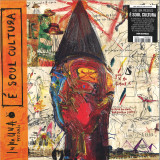
With some of the best DJs and selectors there is a certain mysterious sound or underlying feeling which unites the music they play, regardless of genre, year or tempo Luke Una is a master of telling a story through music and this compilation is a perfect example of his musical alchemy in action. Featuring tracks from Yusef Lateef, Airto Moreira, Crooked Man, Henri Texier and many more, it is a collection of new, old, rare and under-discovered music from around the world, all united by Luke under the banner of "E-Soul Cultura".It's best described by Luke himself, who writes: "As the 5AM city sleeps and the strobe lights are slowly turned off, we gather on the wrong side of town in a transcendental journey alone together. We are the late night disenfranchised holding on in various after parties, flats, lofts, random kitchens and basements into the outer cosmos with É Soul Cultura.
Music from exotic tear jerkers, Afro- spiritual jazz, cosmic Brazilian celestial grooves, machine street soul, dark horses, lost B- sides, £1 bargain- bin bombs, hidden gems, late night Italo dubbing, deep velvet N.Y.C garage, bass buggin sonic futurism, wrong speed 33BPM pitched up +8 new beat, majestic sunset strings, sweet vocals from heaven, no half steppin jazz dancing in outer- space and odd numbers. Yes… magical moments, together, holding on in witness protection suburban cul- de- sacs and Castle Court flats. Cosmic É high, 3000ft above the city getting evangelical to murky, wonky timeless beautiful music. This thing of ours dreaming of better days. Fail we may, sail we must, the sun will come up again."
- 01: Mister Don Cherry Comprit Que Leur Esprit Etait Abattu Et Repeta Dune Voix Musicale Quelques Blagues Reservees Pour Les Temps De Detresse
- 02: Sunny, Archie, Clifford, Meme Combat
- 03: Que 100 Fleurs Sepanouissent
- 04: La Revolution Est Une Transfusion Sanguine Voila La Mer, Voila La Vie
- 05: La Bourgeoisie Perira Noyee Dans Les Eaux Glacees Du Calcul Egoiste
- 06: Liberez Michel Le Bris_
- 07: Vie Et Mort De Lalexandrin
To avoid the “Quésaco?” on the sleeve of Piano Dazibao, François Tusques explains everything: A wall mural on which the Red Guard expressed their opinions during the Chinese proletarian cultural revolution. So much for the “Dazibao”, very good; but the piano in all that?
The piano, François Tusques was self-taught and his work was influenced by Jelly Roll Morton and Earl Hines before discovering Thelonious Monk, Bud Powell and then... free jazz. In Paris in 1965, Tusques mixed with Michel Portal, François Jeanneau, Jean-François Jenny-Clark, Aldo Romano or Jacques Thollot. He also met Don Cherry and above all recorded, with other like-minded Frenchmen (Portal and Jeanneau alongside Bernard Vitet, Beb Guérin and Charles Saudrais), the first album of free jazz in France, named... Free Jazz.
In 1967, Tusques again served up Le Nouveau Jazz, this time in the company of Barney Wilen (and Guérin, Jenny-Clark, Romano). Three years later his thirst for freedom led him to isolation; between May and September 1970, the pianist recorded, at his home, the first of two albums that he would release on Futura Records: Piano Dazibao and Dazibao N°2.
Under the influence of Mao and Lewis Carroll, the free spirit roamed and composed seven tracks which are not so much free as libertarian. As an homage to some friends (Don Cherry, Sunny Murray, Archie Shepp, Clifford Thornton but also Colette Magny, Michel Le Bris or the Théâtre du Chêne Noir), the pianist played cascading bouquets of notes, free-form wanderings, blues-ambushed dances, growls, discords, a fatal requiem... A cherished freedom, songs of hope and demands, François Tusques offers the most unrelenting of independent records.
Catalina Matorral is a duo; Marion Cousin and Borja Flames make up its double head and four hands. At the beginning of the 2010s, they were called June et Jim -- they released some disturbing EPs before joining the label Le Saule (a small, chivalrous table whose holy grail is everything unheard, where folk- singing is avant-garde and avant-garde is synonymous with enchantment). Their first LP, Les Forts (2012), evoked the songwriting of indie-hobos inspired by Latin America, contributing to the rejuvenation of French music. Noche Primera (2013) went even further by vibrating in various reveries, from African songs to Spanish medieval music, from Purcell to Bach. It blew hot and cold under a psychedelic candlelight. The record in question has been maturing for seven years in eccentric barrels, marinating in the shadow of Marion and Borja's respective evolutions, nourished by their individual obsessions. Marion fixated on songs and dances from the Iberian Peninsula. This gave birth to a minimalistic, organic record featuring the cellist Gaspar Claus, where humming trembles among frowning pizzicatos, thin drones and throbbing arpeggios. She went on to release another album with the electronic duo Kaumwald, an oeuvre at the crossroads of vernacular narratives and experimental music, simmering everyday songs in an insolently modern production. Meanwhile, Borja leaned towards an intellectual, synthetic and furious pop; made two albums to awaken the dead, somewhere between Moondog and Battiato. They are two conceptual, electrifying and dance-inducing recordings for the phosphorescent masses. ...chimeric narration, heady verses, pop fragments, horizontal synths, distorted technologies. One would think they're listening to an opera composed by Robert Ashley or Laurie Anderson, based on an improbable libretto written by anthropologist Jeanne Favret-Saada, and performed by holograms of Brigitte Fontaine and Areski -- who unexpectedly regurgitate bits of blunt folk, binary jazz, baroque songs and ghostly madrigals. Micro-events, great enchantments. This record was written and recorded by two people, tinkering feverishly for seven years. It was blessed with the furtive appearances of faithful friends: Gaspar Claus played the cello; Igor Estrabol the clarinet, trumpet and flugelhorn; Renaud Cousin the drums; Ernest Bergez played the violin and whimsically mixed the tracks like a bonesetter-scientist. At the crossroads of worlds, eras and moods, Catalina Matorral invents a curiously rural science fiction that confounds poetry with white magic and puts French music in a permanent tension between the cosmos and manure...
"Stand In The Fire" - Warren Zevon (voc, g, p); Zeke Zirngiebel (g, voc); David Landau (g); Bob Harris (synth, p, voc); Roberto Piñón (b, voc); Marty Stinger (dr)
Warren Zevon had toured for quite some time as a songwriter in the rock scene, released a few singles and landed a flop with his debut LP in 1969 before the tide finally turned. Roughly ten years later, his live album – put together from a five-day residency at the Roxy Theater in West Hollywood – entered the annals of vinyl history as one of the best live albums of all time and was awarded four stars by the magazine Rolling Stone. Ambiguously entitled by the comprehensively educated Zevon, who had been confronted with the tough side of show business, "Stand In The Fire" delivers genial simple pure and straightforward rock right from the start, which hit the public with a vengeance. Full of vim and elation, the band pours out the significant, biting verses with fire ("Jeannie Needs A Shooter") and fuels the emotional inferno with high-speed bursts of rock ("Excitable Boy"). Zevon proves his skills as a singer and songwriter in the ballad-like yet powerful "Mohammed’s Radio". In a direct comparison to this number we have the forthright, no-nonsense hit "Werewolves Of London" with its close harmonies. Just how Zevon manages to succeed in getting his delicate voice and lyrics over to the public is shown in the powerful mix of heavy and honky-tonk ("I’ll Sleep When I’m Dead") and finally in the thunderous final number – "Bo Didley’s A Gunslinger" – with its percussive and metrically complicated antiphony.
This Speakers Corner LP was remastered using pure analogue components only, from the master tapes through to the cutting head. More information under pure-analogue
All royalties and mechanical rights have been paid.
Recording: August 1980 live at The Roxy Theatre in West Hollywood, CA., by Billy Youdelman and Greg Ladanyi
Production: Greg Ladanyi & Warren Zevon