The Havoc guys have been on an enforced hibernation through the winter due to a lurgy that had been affecting the planet. They have remained in the cave throughout this time huddling up to keep warm and exploring what had become their home away from home for months on end. One night, whilst lighting a fire, trying to find motivation for the next release (basket weaving had lost its appeal) they spotted a glint across the way – On further inspection, it was a small bottle and had a label of sorts – It looked to be medicine or smelling salts – Liquid Gold. Curious creatures they are they all took a long good sniff of this elixir. And just like that, they rummaged around the records stacked in the corner put some more coal in the old computer and began their work.
Soon the A-Side of the new EP was born. Most certainly a step up in the BPM from the previous A-Side off EP1. A1 kicks off with a Germanic Proto Throb Job, that's sure to cause errr...Havoc on the dance floor. Whilst A2 is a Bassline Driven, Reconstructed Austrian Euro Pop Monster. One for late-night Discos.
After a while they had stopped sweating, hearts had stopped beating quite so quick. Whilst the creative juices were flowing a few more records were dug out and a log put on the fire and a cup of fungus juice imbibed. B2 came rattling out the speakers in no time at all in all its chugging glory, the vocals take in a nod to god after the devil has done his dirty work.
At this point, the sun was starting to peek through the mouth of the cave and a new day was upon them. One last record had been found, earlier, that was decided would work at this time, actually after consideration, any damn time... B2 Is like a familiar Balearic Back rub with pop-infused French vocals and beats for days...So now EP2 is complete. Back out into the world our intrepid or is it tepid threesome went... Let's only hope their wives haven't left them after all this time locked away.
DJ Support:
Jim (HMD)
Bill Brewster
Kelvin Andrews
Eric Duncan
Al Mackenzie
James Holroyd (Begin)
Pete Herbert
Phil Mison
Nick The Record
Justin Robertson
Coyote
Mind Fair
Steve KIW
Craig Christian
Dr Rob
Dave Jarvis
Max Essa
Andy Simms (Soft Rocks)
Howler
Jaye Ward
Nancy Noise
Andy Taylor (WATS)
Graeme Fisher
Severino (HMD)
Search:jim e stack
- 1
Like every record Superchunk has made over the last thirty-some years, Wild Loneliness is unskippably excellent and infectious. It’s a blend of stripped-down and lush, electric and acoustic, highs and lows, and I love it all. On Wild Loneliness I hear echoes of Come Pick Me Up, Here’s to Shutting Up, and Majesty Shredding. After the (ahem, completely justifiable) anger of What a Time to Be Alive, this new record is less about what we’ve lost in these harrowing times and more about what we have to be thankful for. (I know something about gratitude.
I’ve been a huge Superchunk fan since the 1990s, around the same time I first found my way to poetry, so the fact that I’m writing these words feels like a minor miracle.) On Wild Loneliness, it feels like the band is refocusing on possibility, and possibility is built into the songs themselves, in the sweet surprises tucked inside them. I say all the time that what makes a good poem the “secret ingredient” is surprise. Perhaps the same is
true of songs. Like when the sax comes in on the title track, played by Wye Oak’s Andy Stack, adding a completely new texture to the song. Or when Owen Pallett’s strings come in on “This Night.” But my favorite surprise on Wild Loneliness is when the harmonies of Norman Blake and Raymond McGinley of Teenage Fanclub kick in on “Endless Summer.”
It’s as perfect a pop song as you’ll ever hear sweet, bright, flat-out gorgeous and yet it grapples with the depressing reality of climate change: “Is this the year the leaves don’t lose their color / and hummingbirds, they don’t come back to hover / I don’t mean to be a giant bummer but / I’m not ready / for an endless summer, no / I’m not ready for an endless summer.” I love how the music acts as a kind of counterweight to the lyrics.
Because of COVID, Mac, Laura, Jim, and Jon each recorded separately, but a silver lining is that this method made other long-distance contributions possible, from R.E.M.’s Mike Mills, Sharon Van Etten, Franklin Bruno, and Tracyanne Campbell of Camera Obscura, among others. Some of the songs for the record were written before the pandemic hit, but others, like “Wild Loneliness,” were written from and about isolation.
I’ve been thinking of songs as memory machines. Every time we play a record, we remember when we heard it before, and where we were, and who we were. Music crystallizes memories so well: listening to “Detroit Has a Skyline,” suddenly I’m shout1singing along with it at a show in Detroit twenty years ago; listening to Overflows,” I’m transported back to whisper-singing a slowed-down version of it to my young son, that year it was his most-requested lullaby.
Wild Loneliness is becoming part of my life, part of my memories, too. And it will be part of yours. I can picture people in 20, 50, or 100 years listening to this record and marveling at what these artists created together beauty, possibility, surprise during this alarming (and alarmingly isolated) time. But why wait? Let’s marvel now. - Maggie Smith
- Sorry Again
- There's Only One Thing Left To Say
- Tripping Wires
- I Can't Stop Smiling
- The All-Consumer
- Drug Girls
- Rubble
- Labrador
- Hey You, Get Off My Moon
- Medio Core
- What You Left Behind
- Wake Up, I'm Leaving
- Marzipan
- Labrador (Drum Machine Version)
- Diamond Jubilee
- What You Left Behind (Reprise)
- Your Silent Face
- You're So Good To Me
- Seven Seas
- Breaking Lines
2LP-Erstauflage auf farbigem Loser-Vinyl: "BIO PETROL" Disk 1 und "MAGENTA" Disk 2. "¡Simpatico! (Remastered and Expanded)" bringt das lange vergriffene zweite Album von Velocity Girl aus dem Jahr 1994, "¡Simpatico!", mit einem superfrischen Mastering und einer Menge Bonus-Tracks aus der "¡Simpatico!"-Zeit endlich wieder raus. Das Originalalbum klingt besser als je zuvor und wird durch ein komplettes Album mit B-Seiten und Raritäten ergänzt. Velocity Girl wurde um 1989 an der University of Maryland außerhalb von Washington DC gegründet, mit dem Gitarristen Archie Moore (Black Tambourine), dem Gitarristen Brian Nelson (Black Tambourine), dem Schlagzeuger Jim Spellman (Starry Eyes, Foxhall Stacks, High Back Chairs, Julie Ocean, Piper Club), dem Bassisten Kelly Riles (Starry Eyes) und der Sängerin Sarah Shannon (Starry Eyes, The Not Its). Die Band kombinierte englisch inspirierten, lauten Shoegaze-Fuzz mit rauem US-Indie-Rock und klassischem Pop-Songwriting im Stil der 60er Jahre. Eine Killer-Single auf Slumberland und ununterbrochene Tourneen erregten die Aufmerksamkeit der Indie-Rock-Kenner, und bald darauf unterschrieb Velocity Girl einen Vertrag mit Sub Pop auf einer Motorhaube in Hoboken, New Jersey. Nach der Tournee zur Unterstützung ihres Debüts ,Copacetic" verbrachte die Band den größten Teil des Jahres damit, eine Reihe von Songs für ein zweites Album zu schreiben. So hatten sie noch nie gearbeitet - es war eine neue Erfahrung, Zeit und Budget (vom Label!) darauf zu verwenden, ein Album zu produzieren, das kein selbst produziertes Punkrock-Studioalbum war. Nachdem sie ihr neues Material monatelang im lauten Stil von ,Copacetic" gespielt hatten, waren die Bandmitglieder von den Songs begeistert, wollten sich aber von der rauen, amateurhaften Atmosphäre ihrer früheren Alben lösen. Und ihre Einflüsse waren diesmal etwas anders: weniger My Bloody Valentine und Wedding Present, mehr New Order. Jemand bei Sub Pop brachte die Band mit John Porter zusammen, dem ehemaligen Mitglied von Roxy Music, der The Smiths, Billy Bragg, The Alarm und eine Reihe anderer Acts der 80er Jahre produziert hatte. Sie trafen sich während einer Tournee in Los Angeles. Er erklärte sich bereit, das Album in einer dreiwöchigen Session in den Cue Studios in Falls Church, Virginia, zu produzieren. Er war genau das, was die Band brauchte: ein Redakteur, Arrangeur und Zuchtmeister. Als er gnadenlos jeden unnötig wiederholten Takt herausschnitt, merkte die Band, dass sie sich zu einem klareren Sound hingezogen fühlte und fast komplett auf die laute Gitarre verzichtete, zweifellos beeinflusst durch Porters Präsenz. Velocity Girl waren super zufrieden mit dem Ergebnis, und ,¡Simpatico!" kam im Juni 1994 raus. Diese erweiterte Neuauflage enthält eine Reihe von Songs, die einige Monate nach den Albumaufnahmen in den Inner Ear Studios in Arlington, Virginia, aufgenommen wurden. Die Sessions lieferten spielerisch-experimentelle B-Seiten für die Singles des Albums, zwei Cover-Songs (das New-Order-Cover ,Your Silent Face" und ein Beach-Boys-Cover) für eine Single auf Merge Records und einen Compilation-Track.
- Ice In My Oj
- Glum
- Kill Me
- Whim
- Mirtazapine
- Disappearing Man
- Love Me Different
- Brotherly Hate
- Negative Self Talk
- Ego Death At A Bachelorette Party
- Hard
- Discovery Channel
- True Believer
- Zissou
- Dream Girl In Shibuya
- Blood Bros
- I Won't Quit On You
- Parachute
Limitiertes "26 Highlighter Yellow" Vinyl. Hayley Williams ist eine dreifache GRAMMY-Gewinnerin, Sängerin, Songwriterin und Musikerin, die vor allem als Frontfrau der legendären Rockband Paramore bekannt ist. Nachdem Paramore mehr als 20 Jahre lang ihren Vertrag mit Atlantic Records erfüllt hatten - einen Vertrag, den Williams als Teenager unterzeichnet hatte -, gaben sie im Dezember 2023 bekannt, dass sie nun endlich eine unabhängige Band seien. Diese Überraschungssammlung wird von Hayley Williams auf ihrem neuen Label Post Atlantic selbst veröffentlicht und zeigt sie in ihrer ganzen Bandbreite. Williams hat eine Reihe von verschiedenen Instrumental-Parts geschrieben, gespielt und aufgenommen, wobei langjährige Kollaborateure wie Brian Robert Jones und Joey Howard projektübergreifend mitgewirkt haben und Jim-E Stack bei "True Believer" mitgewirkt hat. "Mirtazapine" ist eine Liebeserklärung an Antidepressiva im Stile des Alternative Rock der späten 90er Jahre, während sie in "Glum" ihre eigene Stimme mit beeindruckenden Effekten durch Vocal-Presets untergräbt, während der Track über Einsamkeit meditiert. Weitere Höhepunkte sind "Whim", ein eingängiger Americana-Ohrwurm, dessen Songwriting an ihre Wurzeln in Nashville anknüpft, und "Ice in My OJ", ein durch und durch moderner Track, der eine scharfe Produktion mit einigen der bis heute bissigsten und humorvollsten Texte von Williams verbindet. Langjährige Paramore-Fans werden den Refrain von "Ice In My OJ" möglicherweise schnell wiedererkennen, da Williams diesen erstmals 2004 auf "Jumping Inside" von den Mammoth City Messengers gesungen hatte. Die Sammlung fängt die ganze Dynamik ein, die Williams bereits im Laufe ihrer Karriere und ihrer Kollaborationen gezeigt hat. Im Kern sind diese Songs das Werk einer äußerst begabten Künstlerin mit einem unersättlichen, genreübergreifenden Appetit auf Musik und kreative Entdeckungen. Diese Songs sind die dritte Veröffentlichung von Williams als Solokünstlerin. In der COVID-Ära veröffentlichte sie zwei außergewöhnliche Alben - ,Petals For Armor" (2020) und ,Flowers for Vases" (2021). Beide Alben waren wunderschöne und eindringliche Meditationen über den Verlust und standen im Kontrast zu der energiegeladenen und temporeichen Kraft, die sie bei Paramore zeigt. ,Das Album - das Verletzlichkeit und transformatives Wachstum verkörpert - offenbart eine reifere und introspektive Seite von Williams", schrieb Pitchfork über ,Petals" und fuhr fort: ,Ihre Stimme ist zweifellos das herausragende Merkmal ... rau und sanft, gefährlich und doch warm", und erklärte, dass die minimalistische Produktion ,dies zu einem bewussten Neuanfang macht".
Co-produced by Lorde and Jim-E Stack, with contributions from Devonte Hynes (Blood Orange), Dan Nigro, Fabiana Palladino, Buddy Ross, and Andrew Aged, Virgin is the sound of Lorde returning to the beat-driven and raw lyricism that propelled Pure Heroine and Melodrama to commercial and critical success. Preceded by lead single ‘What Was That’ (which peaked at #1 on the US Spotify Chart), Virgin marks the return of a truly generational artist.
- Things Behind Things Behind Things
- S P E Y S I D E
- Awards Season
- Short Story
- Everything Is Peaceful Love
- Walk Home
- Day One (Feat. Dijon And Flock Of Dimes)
- From
- I'll Be There
- If Only I Could Wait (Feat. Danielle Haim)
- There's A Rhythmn
- Au Revoir
"SABLE, fABLE" ist das fünfte Album des Projekts von Justin Vernon und enthält eine Liebesgeschichte, die mit üppiger, strahlender Popmusik unterlegt ist. Während das Album mit der verletzlichen Entlastung der im vorangegangenen Herbst erschienenen "SABLE," EP beginnt, geht das Triptychon nahtlos in eine neue, neunsongige Saga über, in der aus einer Person zwei werden, Dunkelheit sich in lachsfarbene Schönheit verwandelt und Traurigkeit in unbändige Freude umschlägt. Während SABLE eine karge und einsame Abrechnung mit einem Schmerz ist, der lange die Vergangenheit bestimmte, blickt fABLE in eine lebendige Zukunft voller Licht, Sinn und Möglichkeiten. "SABLE, fABLE" wurde von Justin Vernon und Jim-E Stack produziert und hauptsächlich in Vernons April Base in Wisconsin aufgenommen, nachdem das Studio während einer Renovierung jahrelang still lag. Das Konzept für das Album entstand am 22.2.22, als Stack mit Danielle Haim dort eintraf. Mehrere Tage lang eingeschneit, vereinten sich Vernons und Haims Stimmen auf "If Only I Could Wait", einem Duett mit entscheidender Perspektive, in dem es darum geht, dass man nicht die Kraft hat, die beste Version von sich selbst außerhalb des Glühens einer neuen Liebe zu sein. Wenn SABLE der Prolog war, ein Prolog in der Dunkelheit, eine kontrollierte Verbrennung, die den Weg für neue Möglichkeiten ebnet, dann ist fABLE das Buch, das folgt. Wo SABLE, ein Werk der Einsamkeit war, ist fABLE eine ausgestreckte Hand. Strahlende, verschnörkelte Popmusik umspielt Vernons Stimme, während er sich auf eine neue und schöne Ära konzentriert. Bei jedem Lied sind seine Augen auf eine bestimmte Person gerichtet. Es ist Liebe, was bedeutet, dass in fABLE eine intensive Klarheit, Konzentration und Ehrlichkeit herrscht. Es ist das Porträt eines Mannes, der von dieser ersten Begegnung überflutet und überwältigt ist ("Everything Is Peaceful Love"). Es ist ein Tableau, das von Sex und unbändigem Verlangen geprägt ist ("Walk Home"). Ein Mann, voller Licht und Tatendrang, der eine ganze Zukunft vor sich sieht. Verliebtheit hat etwas unbestreitbar Heilendes an sich, und die intensive Klarheit, Konzentration, Ehrlichkeit und Feierlichkeit, die sie in diese Songs bringt. Doch der Schatten von SABLE liegt noch immer in der Luft, und alte Gefühle können zurückkehren, selbst wenn man sich die Mühe gemacht hat, neu anzufangen. Wie in einer Fabel vermittelt jeder Track eine Lektion, und in fABLE geht es um den selbstlosen Rhythmus, der erforderlich ist, wenn man mit einer anderen Person verstrickt ist. Der vorletzte Song - und im weiteren Sinne das ganze Album - ist ein Versprechen. Er ist bereit, diesen Rhythmus zu finden.
PRESSED ON RED SMOKE COLORED VINYL
Starting in the late 60s, jazz music started to take an interesting, and very soulful turn. Influenced by the funk of the day – from James Brown to Sly & The Family Stone – the art form, generally not considered a funky musical genre, started to stretch out and fit into the times. It was a fertile era, and to reciprocate, funk, soul and groovy rock fans started to discover accomplished, open-minded jazz artists like Les McCann, whose tunes made sense to their ears, even if bebop hadn’t grabbed them. This incredible album – long a favorite of forward-thinking hip-hop producers and DJs – washes over listeners from the first chords of the incredible album opener, “Sometimes I Cry,” led by McCann’s array of analog synthesizers and backed by an excellent rhythm section (Donald Dean on drums; Ralph McDonald on percussion and Jimmy Rowser on bass). Truth be told, highlights are hard to pick out, but fans never go long without returning to the fuzzed-out funk of “The Harlem Buck Strut Dance,” “Let’s Play (Til Mom Calls)” and “It Never Stopped In My Hometown.” These keyboard-drenched grooves sat alongside record stacks brimming with Stevie Wonder, Funkadelic, Marvin Gaye’s 70s soul and, of course, Miles Davis’ space funk experiments of the era (like Bitches Brew).
Support from: Dave Lee ZR, Birdee, Mousse T, Da Lukas, Dr Packer, John Morales, Terry Farley, Horse Meat Disco, Basement Jaxx, Oliver Dollar, Yuksek, Bill Brewster, Bibi Seck, Chloe Callait, Glenn Underground, Nick The Record, Mark Brickman, Jimpster, Damian Lazarus, NTS Radio, BBC Radio 1, Joey Chicago & many more..
Full steam ahead! Put on your dancing shoes and jump aboard The Disco Express as the much loved London label unveils its hugely anticipated Best of 2024 compilation.
Pressed on special edition purple neon vinyl, this electrifying compilation showcases the wider breadth of the label's sound. Best of 2024 ventures into a multitude of styles: Soul, Disco, Italo and House, all made with cutting-edge production.
A brilliant fusion of established and emerging artists, the compilation boasts a stacked line up of talent; celebrating the vibrant spirit of The Disco Express whilst perfectly infusing modern twists, optimised for contemporary dance floors.
This is original house & disco for 21st century dance floors and this train ain't slowing down anytime soon...
- Pretty Sister
- Crazy Town
- Copacetic
- Here Comes
- Pop Loser
- Living Well
- A Chang
- Audrey's Eyes
- Lisa Librarian
- 57: Waltz
- Candy Apples
- Catching Squirrels
- Warm/Crawl
- Creepy
- Stupid Thing
- Even Die
- Here Comes (Peel Session Version)
- Always (Peel Session Version)
- Crazy Town (Peel Session Version)
- 57: Waltz (Peel Session Version)
- Copacetic (Peel Session Version)
Doppel-LP auf rotem Vinyl, limitiert auf 2000 Stück. Das lange vergriffene Debütalbum der beliebten Indie-Rock-Band Velocity Girl aus dem Jahr 1993 ist wieder erhältlich, mit einem neuen, von der Band genehmigten Mix und einem kompletten Album mit Bonustracks, das Singles, Outtakes und die Peel Session der Band von 1993 enthält. Velocity Girl gründeten sich etwa 1989 an der Universität von Maryland außerhalb von Washington DC und setzten sich kurz darauf aus Gitarrist Archie Moore (Black Tambourine), Gitarrist Brian Nelson (Black Tambourine), Schlagzeuger Jim Spellman (Starry Eyes, Foxhall Stacks, High Back Chairs, Julie Ocean, Piper Club), Bassist Kelly Riles (Starry Eyes) und Sängerin Sarah Shannon (Starry Eyes, The Not Its) zusammen. Die Band kombinierte englisch inspirierten lärmenden Shoegaze-Fuzz mit rauem US-Indie-Rock und klassischem 60er-Jahre-Pop-Songwriting. Eine Killer-Single auf Slumberland und pausenloses Touren erregten die Aufmerksamkeit der damaligen Indie-Rock-Kenner, und nach einem hitzigen Werben, das sowohl Abendessen als auch Nachtisch beinhaltete, unterzeichneten Velocity Girl in Hoboken, New Jersey einen Vertrag auf einer Motorhaube, und machten Sub Pop zu ihrer Heimat. 1992 begann die Band mit der Arbeit an ihrem Debütalbum "Copacetic" in den Easley Studios in Memphis - einst Heimat der Bar-Kays und anderer klassischer Soul-Bands - unter der Leitung von Bob Weston (Volcano Suns, Shellac), und mischte das Album anschließend mit Weston in Chicago. Obwohl das Album starke Songs enthielt - Popsongs wie "Audrey's Eyes", "Pop Loser" und "Living Well" neben ehrgeizigen Erkundungen wie "Pretty Sister" und "Here Comes" - hatte die Band wenig Erfahrung mit der Produktion und es fehlte ihr an den Fähigkeiten, im Studio "das Boot zu steuern". Infolgedessen war das Album eine eher schlichte Angelegenheit, der es an der Üppigkeit der früheren Aufnahmen mangelte. In den Ohren der Band war das ein Schock, und sie merkten bald, dass dies nicht die Platte war, die sie zu machen hofften. Bob Weston hatte genau das getan, was von ihm verlangt wurde, und die Klänge eingefangen, aber die Band hatte nicht ihren Teil dazu beigetragen, eine klare Vision zu formulieren. Aber die Zeit der Band im Studio war vorbei, und Polvo war gerade aufgetaucht, um an ihrem Album zu arbeiten, also machten sich Velocity Girl auf, um das Video zu Audrey's Eyes" zu drehen. "Copacetic" kam 1993 auf den Markt und die Leute schienen es zu mögen, aber innerhalb der Band gab es ein Gefühl der Enttäuschung bis zu dem Punkt, an dem die meisten Mitglieder es nicht mehr ertragen konnten, die Platte zu hören. Seitdem hat die Band viel über Aufnahmen gelernt, und Archie Moore eine Karriere als Tontechniker eingeschlagen, so dass die Band schließlich beschloss, sich mit "Copacetic" nochmal auseinanderzusetzen. Nach umfangreichen Ausgrabungen tauchten die 2"-Bandspulen im Haus der Mutter von Jims Ex-Frau auf, und im Frühjahr 2023 begann Archie mit der Arbeit an einem Remix. Song für Song entstanden die neuen Abmischungen genau so, wie die Band sie sich vorgestellt hatte. Der erhabene Gesang von Sarah (die am College Oper studiert hat), die klingende Leadgitarre, die saftigen, verwaschenen Rhythmusgitarren und das klare, stampfende Schlagzeug. Die Popsongs sind viel poppiger. Der Klang ist kraftvoller, und die Platte ist ein zusammenhängendes Werk, das von Song zu Song fließt. Der Ansatz war nicht, ein Album zu machen, das nach 2024 klingt, sondern sich auf das Jahr 1992 zurückzubesinnen und das Album zu machen, das die Band damals hätte machen sollen. Das Ergebnis, "UltraCopacetic (Copacetic Remixed and Expanded)", ist eine spannende alternative Geschichte von "Copacetic". Und während sie dabei waren, hat die Band den Rest ihres Studiomaterials aus dieser Zeit ausgegraben und aufgefrischt: "Ultracopacetic" enthält "Warm/Crawl" von der Velocity Girl/Tsunami Split 7", ,Creepy' von der Crazy Town 7", "Stupid Thing" von der Audrey's Eyes 7" und die unveröffentlichte Albumauskopplung ,Even Die'. Abgerundet wird das Ganze durch die komplette John-Peel-Session der Band aus dem Jahr 1993 mit fünf Liedern, darunter zwei Tracks, die seit der ursprünglichen Sendung nicht mehr zu hören waren. "UltraCopacetic" ist wirklich die definitive Version von Velocity Girls erstem Album.
Black Vinyl[23,49 €]
Written with no big plan in mind, Reverend Baron's "Overpass Boy" becomes a Los Angeles meditation, an eight song prayer of poetic topography. The album gives the city its own sound, and its own songs to hum. Recorded in several different locations of LA, and loosely sketching the story of a young wanderer, the album is an easy current of observations and longings. Slices of soul and doo-wop emerge in stacked harmonies, while the percussion and grooves are the blooms that could only come from East LA. Garcia's investment to vocal tenderness and instrumental high style strikes our universal center. His soft serenade reconnects us to something misplaced. Playing almost every instrument on the album, Garcia's spirit is tailored into the sound, designing an amalgam of tones and frequencies as idiosyncratic as the singer himself. Traversing the alleys, passing the sous-chef's cigarette smoke, under the shaking bridges, behind a velvet curtain in a good suit, with a slide guitar in the rain, the titles quilt together for us: Every promise out here walks and waits in the little hours. Jackie and Jimmy drive away and we're left in that little valley, suspended. Recorded and digitally released in 2019, "Overpass Boy" will be re-released by Karma Chief Records on 8/2/2024
LTD. COKE BOTTLE CLEAR VINYL[23,49 €]
Written with no big plan in mind, Reverend Baron's "Overpass Boy" becomes a Los Angeles meditation, an eight song prayer of poetic topography. The album gives the city its own sound, and its own songs to hum. Recorded in several different locations of LA, and loosely sketching the story of a young wanderer, the album is an easy current of observations and longings. Slices of soul and doo-wop emerge in stacked harmonies, while the percussion and grooves are the blooms that could only come from East LA. Garcia's investment to vocal tenderness and instrumental high style strikes our universal center. His soft serenade reconnects us to something misplaced. Playing almost every instrument on the album, Garcia's spirit is tailored into the sound, designing an amalgam of tones and frequencies as idiosyncratic as the singer himself. Traversing the alleys, passing the sous-chef's cigarette smoke, under the shaking bridges, behind a velvet curtain in a good suit, with a slide guitar in the rain, the titles quilt together for us: Every promise out here walks and waits in the little hours. Jackie and Jimmy drive away and we're left in that little valley, suspended. Recorded and digitally released in 2019, "Overpass Boy" will be re-released by Karma Chief Records on 8/2/2024
- A1: I Am Missing You
- A2: Kahān Gayelavā Shyām Saloné
- A3: Supané Mé Āyé Preetam Sainyā
- A4: I Am Missing You (Reprise)
- A5: Jaya Jagadish Haré
- B1: Overture
- B2: Festivity & Joy
- B3: Love - Dance Ecstasy
- B4: Lust (Rāga Chandrakauns)
- B5: Dispute & Violence
- B6: Disillusionment & Frustration
- B7: Despair & Sorrow (Rāga Marwā)
- B8: Awakening
- B9: Peace & Hope (Rāga Bhatiyār)
Purple Vinyl[27,52 €]
Out of print as a stand-alone release for decades since its original 1974 issue. Produced by George Harrison, Shankar Family & Friends is an almost-forgotten masterwork – an emotional and sonic pact between two like-minded souls to both advance their spiritually minded bond and unite musical styles, cultures, and sounds in wondrous fashion Contributions from Ringo Starr, David Bromberg, Billy Preston, Nicky Hopkins, Jim Keltner, Klaus Voorman, and a host of virtuosic Indian musicians add to a diverse album that melds Eastern and Western traditions; encompasses jazz, funk, bhajan, Indian, and pop; and represents the spirit and breadth of Harrison's Dark Horse Records imprint.
Memorable contributions from an A-list of American and English musicians — Ringo Starr (drums), David Bromberg (electric guitar), Billy Preston (organ), Nicky Hopkins (piano), Jim Keltner (drums), Klaus Voorman (bass), Robert Margouleff (Moog), Malcolm Cecil (Moog), Tom Scott (saxophone) included — add to the richness of a set that melds Eastern and Western traditions. These “names” mesh with a host of Indian virtuosos — Alla Rakha, Ashish Khan, Kamala Chakravarty, Hariprasad Chaurasia included — who turn Shankar Family & Friends into a journey laced with percussive, string, and vocal components that aren’t soon forgotten.
Throughout, Shankar Family & Friends remains true to its title — a mesmerizing record named to reflect the group participation approach of its creators. The idea started when Shankar told Harrison about a ballet he wrote. The Beatle, who first met Shankar in June 1966 — roughly a year after Harrison became interested in Indian music after overhearing it in a restaurant while filming Help! — immediately was convinced they needed to record it. Harrison’s staunch admiration of Shankar and serious approach to Eastern styles are reflected throughout the album.
Indeed, for Harrison, Shankar Family & Friends marks the culmination of a years-long effort to master the sitar, study Hinduism, and incorporate elements such as drones, unusual chords, and expressive picking into his own songs. The seeds of this unique collaboration can be heard in Beatles works such as “Norwegian Wood,” “Love to You,” and “Within You Without You.” Both musicians were also fresh from performing at the 1971 Concert for Bangladesh shows. Yet Shankar Family & Friends remains entirely unique in each visionary artist’s history — and ultimately, led to a collaborative tour Harrison and Shankar staged across North America.
Encompassing jazz, funk, bhajan, Indian, and pop, Shankar Family & Friends is thematically split into halves. Side One reveals Shankar’s uncanny ear for melody — even when applied to Western forms. The lead-off “I Am Missing You,” the first single ever released by Dark Horse Records and reportedly the first pop composition Shankar completed, underscores his skills as a composer and global ambassador. Beautifully sung across three octaves by his sister-in-law, Lakshmi Shankar, the devotional song features multiple drummers and production that mirrors Phil Spector’s Wall of Sound approach. Harrison plays autoharp and guitar; Starr sits in on drums; Scott handles flute and soprano saxophone. It’s the inviting start of a musical adventure teeming with color, majesty, and mysticism.
A second version of the track — designated with a “(Reprise)” tag — appears minutes later. Unfolding in different ways, it follows a folk ballad structure stitched together with Indian instrumentation. Here, according to Shankar, the musicians “attempted to convey the sounds and atmosphere of Vrindavan, the ancient holy place where Krishna grew up.” Both renditions speak to the cross-continental fusion that came so naturally to Harrison and Shankar, whose oversight on the side’s other vocal tracks ensures listeners familiar with Western methods gain easy access to the hypnotic allure of his native country’s music.
Nowhere is this more evident than on Dream, Nightmare & Dawn (Music for a Ballet), the side-long piece that served as the genesis for Shankar Family & Friends. Launched with an airy overture and unfolding across three movements, the mostly wordless suite features everything from call-and-response interplay and classical lyricism to uptempo dance figures, stacked rhythms, and intoxicating grooves. Blurring the lines between contemporary and traditional, and Western and Eastern, the inspirational work is the exclamation point on a record that defined “world music” well before the term became co-opted as a catch-all genre.
- A1: Wear Your Love Like Heaven
- A2: Mad John's Escape
- A3: Skip-A-Long Sam
- A4: Sun
- A5: There Was A Time
- B1: Oh Gosh
- B2: Little Boy In Corduroy
- B3: Under The Greenwood Tree" (Words By William Shakespeare, Music By Leitch)
- B4: The Land Of Doesn't Have To Be
- B5: Someone Singing
- C1: The Enchanted Gypsy
- C2: Voyage Into The Golden Screen
- C3: Isle Of Islay
- C4: The Mandolin Man And His Secret
- C5: Lay Of The Last Tinker
- D1: The Tinker And The Crab
- D2: Widow With A Shawl (A Portrait)
- D3: The Lullaby Of Spring
- D4: The Magpie
- D5: Starfish-On-The-Toast
- D6: Epistle To Derrol
Donovan’s Original
A Gift From a Flower to a Garden made for a few firsts: the first double LP of Donovan’s
career, one of the first box sets in pop and, most importantly for Donovan himself; the first
pop album for the children of tomorrow.
He resolved to make A Gift From a Flower to a Garden an album of two halves. The first,
Wear Your Love Like Heaven, was intended for his own generation as they started to think
about the kind of world they wanted to leave behind. The second, For Little Ones, was for
the children they had or would have in the years to come. The result was a kaleidoscopic
folk-jazz suite on the power of love, imbued with all the romance and mystery of an Arthur
Rackham illustration for an ancient English fairy tale. The songs, remarkably adventurous
given Donovan was a globally famous singer at his commercial height, combined the
influences he had amassed so far.
There is something about A Gift From a Flower to a Garden that could never be repeated,
though. It is such an innocent evocation of the childlike imagination, so redolent of its time,
yet set apart from it too. All these years later, the peaceful qualities of this pioneering,
enchanting, deeply unusual album feel more valuable than ever.
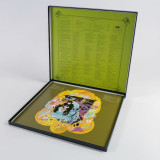
The state51 Box Set
With authenticity core to the project, The state51 Conspiracy engaged one of the UK’s
leading experts in box set design, Daniel Mason at Something Else, to painstakingly recreate
the box, records and accompanying ephemera. The first challenge was to find the deep blue
leatherette paper the original box set was covered in; a problem since it was no longer in
production. “I knew people who had stacks of it, gathering dust on top shelves, so I bought it
up wherever I could find it,” says Mason. Then came the reproduction of 12 loose leaf lyric
sheets on fine art watercolour paper, each of them featuring a watermark and a fairytale-like
illustration by Donovan’s artist friends Sheena McCall and Mick Taylor. Where, though, to
find the same paper stock? “I found out that it was made at a paper mill in North Wales
called Abbey Mills. Unfortunately the mill dissolved in the early 70s and very little of the
paper remained. However enough paper remained to allow us to produce the numbered
certificate also signed by Donovan that sits within the box.”
Then to the iconic cover image. Donovan and Jimi Hendrix’s personal photographer Karl
Ferris, used infra-red film to achieve the psychedelic effect on the cover, but the original
negatives couldn’t be found. Mason then used digital technology to ramp up the colour levels
on a reproduction from an original copy of the album while allowing it to remain a little bit
faded, as it would be after half a century. The same labour of love and care has gone into
producing all elements of the box; from the rebuilding of the famous front cover font to the
hand-numbered and signed certificate; letterpress printed on the original paper stock of the
1968 UK release lyric sheets.
To cap it all off the original mono master tapes were waiting safely in the EMI Donovan
Archive and transferred from tape to digital by Abbey Road Studios where new lacquers
were cut, ensuring Donovan's favoured mono version of the album would be presented both
physically (and digitally for the very first time) in striking audiophile quality. The final touch to
Der weltweit gefeierte und Grammy-dotierte Electronic-Artist & Produzent Flume veröffentlicht am 17. November seine Rarities-Compilation "Arrived Anxious, Left Bored" mit ungehörter Musik aus dem letzten Jahrzehnt auf Vinyl.
Die Musik, die Tracks mit Emile Haynie und Jim-E Stack sowie Flumes erste eigene Vocals auf "All There 1.9 2019 Export Wav" enthält, umfasst Hip-Hop, Pop und Ambient-Beats sowie Produktionen, die für seinen Aufstieg in den frühen 2010er Jahren stehen. Artwork von Jonathan Zawada.
Released via Columbia Records, "Sunburn" is Dominic Fike's highly-anticipated sophomore full-length album, and the follow up to 2020's What Could Possibly Go Wrong. This 14-track collection finds the artist going back to Naples, Florida, as he sets to explore his childhood, family history & the meaning of home. The album has production credits for Dominic Fike, as well as Jim-E Stack and Kid Harpoon, alongside a collaboration with Weezer. Standard Black LP Vinyl. Limited stock. Marketing.
Wildly acclaimed, Grammy-winning artist Flume is releasing his surprise album; a surprise package of unheard music from the last decade ‘Arrived Anxious, Left Bored’ on vinyl on November 17th via Transgressive Records.
Arrived Anxious, Left Bored, released via Transgressive Records, is work reflective of the eclectic nature of Flume’s output over the past ten years since his 2012 self-titled debut album, which launched the iconic producer''s career. Spanning from underground house to atmospheric ambient tracks, Arrived Anxious, Left Bored features collaborations with celebrated producer Emile Haynie (Dua Lipa, Lana Del Rey, A$AP Rocky) and Jim-E Stack (Bon Iver, HAIM, Sudan Archives), as well as his first foray into using his own vocals with “All There 1.9 2019 Export Wav.”
a A1."SKY SKY 1.3 [2016 Export Wav]"
[b] A2."Chalk 1.3.3 [2017 Export Wav]"
[c] A3."All There 1.9 [2019 Export Wav]"
[d] A4."Road To Japan [2017 Export Wav]"
[e] A5."Jerry 1.6 [2017 Export Wav]"
[f] B1."N1cevib3 1.3 [2015 Export Wav]"
[g] B2."Arrived Anxious, Left Bored 1.4 [2020 Export Wav]"
[h] B3."Habibi [2019 Export Wav]" (feat Emile Haynie)
[i] B4."Miss U [2020 Export Wav]"
[j] B5."No Other 1.2.2 [2021 Export Wav]"
Hailed as "gospel titans" by Rolling Stone, the Blind Boys of Alabama defied the considerable odds stacked against them in the segregated South, working their way up from singing for pocket change to performing for three different presidents over the course of an 80-year career that saw them break down racial barriers, soundtrack the Civil Rights movement, and help redefine modern gospel music forever.
The five-time Grammy-winners’ latest album, Echoes Of The South, draws its name from the Birmingham radio program that hosted the group’s very first professional performance back in
1944. Pairing traditional spirituals and long-lost gospel classics with vintage soul and R&B tunes, the collection is as moving as it is timeless, transcending genre and era to touch something deep and fundamental about the human condition.
These are songs of love and friendship, joy and gratitude, faith and perseverance. Uplifting as they are, the recordings can feel bittersweet at times, too: 91-year-old Jimmy Carter retired from performing following the sessions, while two longtime members, Paul Beasley and Benjamin Moore, Jr., have since passed away. Despite the losses, the Blind Boys of Alabama show no signs of slowing down.
“The spirit of the Blind Boys isn’t about what you can’t do it’s about what you can do,” says singer Ricky McKinnie. “As long as we stay true to that, as long as we sing songs that touch the heart, this group will live on forever.”
The most honored and revered group in Gospel music.
Winners of 5 GRAMMY; including Lifetime Achievement.
Echoes of the South brings the group back to Muscle Shoals, Alabama to record, album produced by
Matt Ross-Spang and Ben Tanner, band features Phil Cook, Dennis Crouch and Chad Gamble.
Global touring schedule planned for 2023/2024.
Documentary film to be released in conjunction with the album, book on career to be released in early 2024.
SQÜRL, the duo of filmmaker Jim Jarmusch and Carter Logan, have announced their debut album, Silver Haze, out May 5th via Sacred Bones.
‘SilverHaze’ was produced by Randall Dunn, who has also worked with the likes of Sunn O))), Boris, Earth, Zola Jesus, and Marissa Nadler, all of whom are artists that SQÜRL cite as inspirations. The album enlists Charlotte Gainsbourg, Anika, and Mark Ribot as collaborators, resulting in a communal offering that shares an energetic lineage with the New York School of Poets.
‘SilverHaze’ expands on SQÜRL’s passion for creating rich textural sounds, finessed by a keen ear for production. The band is known for playing with everything from analogue synths to broken radios and pulling inspiration from painters, writers, and birds on the street. ‘Silver Haze’ is a poetic journey of spoken words, dynamic instrumentals, drone riffs and distorted effects, one that features tubular bells and a cello in addition to their signature stacks of delay, encircling the listener in a warm oscillation both delicate and devastating.
The announcement of ‘Silver Haze’ comes on the back of sold out live shows across Europe. Originally intended to happen in 2020, the rescheduled dates saw Jarmusch and Logan perform an original live score to four films by Man Ray. More live dates will follow in due course.
SQÜRL was formed by Jim Jarmusch and Carter Logan in 2009 to score Jarmusch's movie The Limits of Control. Over a decade later and with numerous EPs and film scores under their belt, SQÜRL are set to release their very first full length record. Silver Haze was produced by Randall Dunn, who has also worked with the likes of Sunn O))), Boris, Earth, Zola Jesus, and Marissa Nadler, all of whom are artists that SQÜRL cite as inspirations. The album enlists Charlotte Gainsbourg, Anika, and Mark Ribot as collaborators, resulting in a communal offering that shares an energetic lineage with the New York School of Poets, a school they nod to on the track "John Ashbery Takes a Walk," which features Gainsbourg and turns two early Ashbery poems into an irresistible melodic siren's song. Silver Haze expands on SQÜRL's passion for creating rich textural sounds, finessed by a keen ear for production. The band is known for playing with everything from analogue synths to broken radios and pulling inspiration from painters, writers, and birds on the street. Silver Haze is a poetic journey of spoken words, dynamic instrumentals, drone riffs and distorted effects, one that features tubular bells and a cello in addition to their signature stacks of delay, encircling the listener in a warm oscillation both delicate and devastating.
When the 60’s turned into the 70’s there was a musical crossroads. The American blues had had it’s run with teens on both sides of the Atlantic long enough so that the blues-offspring named rock’n’roll had to expand or die. It did not die, it expanded in all kinds of directions! And right there in the crossroads between blues-based rock and all the world’s other sub-genres of rock, something happened to the blues. The format got experimented with, expanded and almost made unrecognizable. But at the same time the roots to the original ’real’ blues was never lost. Where Peter Green left Fleetwood Mac in 1970 with the track «Green Manalishi», where Johnny Winter stretched his musical legs, where ZZ Top bought Marshall full stacks and shot from the hip, and last but not least where the legend himself, Muddy Waters, stretched the limits of that was ’legal’ with the album «Electric Mud». And not to forget Jimi Hendrix, Free, Canned Heat and the rest of the gang from the Woodstock-era. The result was a highly electric musical revolution, where e.g. the newly born genre hard rock walked hand in hand with traditional delta blues. It is out from this musical mud The Devil and the Almighty Blues have found their inspiration. Formed in 2010, their music is slow, heavy, melodic and raw, all without losing the almighty blues out of sight. Filled with a profound love for the old heroes of the blues walking hand in hand with rock, metal, country and last but not least punk.
"Half a Klip" is a Vinyl Reissue of Kool G Rap's first solo release It was originally released in 2007: As is to be expected, G Rap fills out the lyrics sheet here with banana clips and stacks of body bags -- certainly not a disappointment (he played a big part in inventing this agenda after all), though the MC's steady, workmanlike approach and topical sameness leaves a lot of responsibility on the shoulders of his producers. t's open to debate as to whether there has ever been a rapper more influential, yet somehow less celebrated, than Kool G Rap. From his seminal work on Marley Marl's Juice Crew productions and Cold Chillin' Records, to the major contributions he gave to the blueprint of gangster storytelling in rap, the Kool Genius has remained relevant and consistent despite heaps of record label drama and the ever-diminishing attention span of the listening public. It's unlikely that the new Chinga Chang Records EP Half A Klip will do much to elevate G Rap's legacy, but there are still shining moments to remind us why the legendary MC is more than deserving of the little reverence he receives.IThus, the EP's best moments come when he is united with a strong hand behind the boards. Marley Marl's sinister keys and kettle drum composition for "With A Bullet" (inexplicably buried at track eight on this 11-track offering) is probably the best canvas for Rap's gangster mentality. DJ Premier contributes a strong track (merely serviceable by Premier standards, but a standout here) and the lesser-known Domingo also seems to be able to give G Rap room to run. Unfortunately, the rest is just middling with one true mistake, Critical Child's dismal "Turn It Out", which sounds like a cast-off from a Jim Jones studio session. In any event, this collection of new and unreleased material is not the next Road to the Riches. On the bright side, the MC behind Road to the Riches is still here (in every sense) and still doing it 20 years later.
- A1: Homage
- A2: Rolling 50 Deep (Feat. Sheek Louch, Styles P, Benny The Butcher, Bun B, Ghostface Killah, Raekwon, Az, Papoose, Ransom, Memphis Bleek, Billy Danze, Lil Fame, Dave East, 3D Natee, Joell Ortiz, Saigon, Mistah F.a.b., Chris Rivers, Jon Connor, Twista, E-40, Nino Man, Shoota, Mysonne, Sauce Money, Ice-T, Trick Trick, Rj Payne, E-A-Ski, Fred The Godson, Loaded Lux, Termanology, Young Noble, Edi, Locksmith, Cassidy, Maino, Vado, Rockness, Dj Paul, Mc Gruff, Stan Spit, Uncle Murda, Cory Gunz, Melle Mel, Grandmaster Caz, Trae Tha Truth, Bynoe, Hocus 45Th & Royce Da 5'9)
- A3: It's About To Go Down (Feat. Ghostface Killah, Busta Rhymes & Junior Reid)
- B1: Where Is The Love (Feat. Conway The Machine, Sheek Louch & Jhonni Blaze)
- B2: Man Down (Feat. Juicy J, Jim Jones, Phresher, Bun B & Pesh Mayweather)
- B3: Rhyme Or Die (Feat. Joell Ortiz, Papoose, Ransom & Tre Williams)
- B4: We Get Busy (Feat. Az, Papoose, Bun B, Benny The Butcher, Trae Tha Truth, Zone & Ghostface Killah)
- B5: Lose Control (Feat. Emc Scotty, Billboard Baby, 6 Keys & Sammi J)
- B6: Street Life (Feat. Dave East, Vado & Julian Morgan)
The longstanding DJ comes through with a brand new album for the modern times, keeping the tradition alive through a stacked tracklist of heavy hitters. With an extension of the popular posse cut, “Rolling 25 Deep,” DJ Kay Slay ups the ante with an 18 minute anthem, “Rolling 50 Deep,” featuring the likes of Benny The Butcher, Bun B, Styles P, Ghostface Killah, Raekwon and more. He further adds to his track record of pairing together artists for hit records with cuts from Ghostface Killah & Busta Rhymes, Conway the Machine & Sheek Louch, and Juicy J & Jim Jones.
Maybe We Never Die, Anderson East's third release for Elektra/Low Country Sound takes the Alabama born, Nashville-based singer-songwriter’s seductively vintage voice in a decidedly fresh direction. The 12 tracks flow together with an overarching sense of ambience but maintain distinct musical boundaries. The energy toggles between a hunger for vulnerability in togetherness and a clinging to solitude as a romantic self-defense. There is consternation with the speed and volume at which the world operates and solace to be found in the simple act of getting up and going. And the beguiling title track, with its woozy strings swirling around East’s celestial falsetto as it curls towards the ceiling like smoke is, as they say, a whole mood; a sense of a single night’s dusk-to-sunrise contemplation. Collaborating once again with Dave Cobb along with longtime bandleader and now co-producer Philip Towns, East has found an enticing new avenue, one that maintains a connection to his past but keeps his eyes on the road ahead.
Maybe We Never Die is East's first new music since 2018's breakthrough album, Encore, which featured the Grammy-nominated #1 AAA radio single, "All On My Mind." Heralded by critics, The New York Times praised Encore as, “…an often lustrous revisiting of raucous Southern soul, rousingly delivered and pinpoint precise. He has a voice full of extremely careful scrape and crunch, but his howls never feel unhinged," while Rolling Stone declared, “On Encore, East’s influences meld seamlessly, stacking the album with Stax-worthy R&B grooves, gospel-blues ooohs and aaahs, surging keys and blasting brass.” Known for his magnetic live performances, East and his band have performed sold-out shows worldwide and have been featured on ABC's "Jimmy Kimmel Live!," CBS' "The Late Show with Stephen Colbert" and "CBS This Morning Saturday," NBC's "TODAY" and "Late Night with Seth Meyers," PBS' "Austin City Limits" and more.
- 1