TONICO 70'S SOULFUL SIDE SHINES THROUGH IN NEW ALBUM CO-PRODUCED WITH PEPPE MAIELLANO (BANDA MAJE)
The cover of the new album by musician, rapper, DJ/producer and Banda Maje's co-founder Tonico 70 features an honest, unfiltered photo his mother took of him with a disposable camera – a photo that is as blunt and sassy as hip hop, but at the same time filled with the sweetness of soul music. The style of Antonico is all there, in that shot of a nine-year-old kid that was just beginning to discover and love music – a passion that, as he says now, "has been driving me for over thirty years."
Coming after many years of songwriting, beatmaking, MCing, live performances and collaborations, this new album, his first released on Four Flies Records, connects the dots between past, present and future, presenting Tonico 70 as a fully-rounded artist rather than just a rapper, and one aware of his own many facets.
Co-produced with Peppe Maiellano, Banda Maje's other founder, Antonico offers an intimate portrait of Tonico 70, who has put his 'tough-music-smuggler' persona aside to let his soulful side shine through, giving us a warm, funk-inspired and very original take on the so-called 'Napoli power' sound.
Lyrically too, the album takes us deeper into his world. Here, Tonico 70 evaluates his personal history, speaking about his joys and disappointments, his highs and lows, and the friends and lovers who are or were in his life.
Sometimes his flow is confidential and nocturnal – in "Vic'l", for instance, where the sound is smooth and sweet, rife with contrapuntal notes and harmonies that are clearly reminiscent of 70s soul, but also in the bluesy rap of "Doppia Chance" and the prayer-like song "For For". Other times he gets bolder and brasher, like in the reggae-inspired in "Quaqquara Qua", or in "The Revolution Will Not Be Telefonin", which is obviously a (cheeky) tribute to Gil Scott Heron.
A number of tracks feature long-time friends and collaborators: rapper Morfuco in "Italia 90" (a funky uptempo song with powerful gospel vocals in the chorus), the Funky Pushertz crew in "Sai Com'è" and, perhaps most importantly, the Salifornian soul-funk collective Banda Maje, who give new life to three songs from the artist's previous discography: "Vir Buon", "Gente Antica" and "Fantasie".
This album shows that Tonico 70 has reached a stage of maturity in his career, one where his music extends beyond rap and hip-hop to incorporate rich instrumentals and multiple genres that carry the echoes of his experiences and encounters in the lively alleys of Salerno's historic district, and of the people whose lives unfold there, in the heart of the Mediterranean.
Cerca:just her
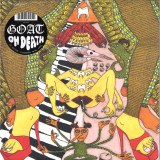
Formidable psychic warriors, channelers of the mystic and proponents of a spiritual quest that transcends this realm, Goat remain a band shrouded in mystery. Travelling from their inscrutable origins in the Swedish village of Korpilombo across the stages and festivals of the world in the last decade, this band has created their incendiary music entirely according to their own co-ordinates. With all this in mind, the casual observer might have guessed from its title that ‘Requiem’, their beatific and melancholic album of 2016, was to be their last. Yet the ancestral spirits summoned by their art are always restless. Thus the eternal cycles of rebirth have triumphantly produced ‘Oh Death’ - a ceremonial conflagration as powerful as any this band has made. Invigorated by forces we can only guess at the origins of, ‘Oh Death’ is a party to which all are welcome. Blithely waving away easy classification, these heat-hazed serenades are just as comfortable in the headspace of vicious ‘70s funk as they are in zesty ZE records post-punk. Folk-haunted incantations and free jazz skronk here find common ground, buoyed by relentless forward motion and raucous energy. Yet all of the above is locked into a delirious gnostic groove that threatens to throw the whole shebang spiralling into orbit. ‘Oh Death’ is driven by a supernatural charge that unifies, invigorates and transcends borders, whether geographical, musical, or between this world and the next. In the hands of these sages and soothsayers, this is just the beginning.
Special 10th Anniversary Edition In Brown Card Artboard Sleeve With Additional Lyric Print Insert
Slowdive singer and songwriter’s third solo album, which was originally released in November 2012. It is a stunning record and one which, upon its release, underlined the claims that Neil was one of the finest and most underrated British songwriters of recent times. It’s also a very special release in the Sonic Cathedral catalogue; the shoegaze label licensed the record from Jack Johnson’s Brushfire imprint for the UK and Europe and it was the start of a relationship that also gave us the Black Hearted Brother album in 2013 and, ultimately, brought about the reformation of Slowdive in 2014. But Palindrome Hunches is a very different beast. Both stately and understated, this moody and mesmerising collection of peculiarly British folk songs was made with the Band of Hope, a Wallingford, Oxfordshire based collective consisting of Ben Smith (violin), Drew Milloy (double bass), Paul Whitty (piano) and Tom Crook (guitar). Together with producer Nick Holton, banjo player Kevin Wells and backing singer Aimee Craddock, they recorded the album to tape over a few weekends in the music room of their local junior school. “At first we were going to record in a studio, but everything seemed too clean,” said Neil at the time. “We just went through the songs and recorded them live without very much rehearsal. We wanted to be spontaneous and simple and to keep the little mistakes that sneaked in.” This goes a long way to explaining the album’s humanity and intimacy, and also why it has had a quiet life of its own over the past decade, gradually growing in stature alongside Neil’s more high-profile activities with Slowdive; copies of the 2012 original and even the 2017 repress currently fetch up to triple figures on Discogs. The stunning opener ‘Digging Shelters’ was used to devastating effect in the posthumously released James Gandolfini movie Enough Said – a fitting home for a song that rubs shoulders here with ruminations about love and loss such as ‘Tied To You’ and ‘Spin The Bottle’ and, on ‘Wittgenstein’s Arm’, an Austrian pianist who had his right arm amputated in World War I and lost three of his brothers to suicide. The wordplay of the title track is almost light-hearted in comparison; “I wanted to write a song that was the same forwards and backwards, but it didn’t quite work out,” explained Neil, adding that he also chose ‘Palindrome Hunches’ for the album’s title because “I like the idea of things being reversible”. A couple years later, by reforming his old band, he proved that. And now, ten years on, it’s the perfect time to rewind to this understated, underrated classic. Side A 1 Digging Shelters 2 Bad Drugs and Minor Chords 3 Wittgenstein’s Arm 4 Spin The Bottle 5 Tied to You Side B 1 Love Is a Beast 2 Palindrome Hunches 3 Full Moon Rising 4 Sandy 5 Hey Daydreamer 6 Loose Change. Praise for Palindrome Hunches on its original release: ““Nope, it ain’t shoegaze as it's been codified and re-codified. But why be disappointed in someone following his muse to a logical conclusion when that path was always the one he walked on?” – Pitchfork An exquisite set of dark folk music” – The Times “Draws from the same understated, reflective well as John Martyn” – MOJO “‘Tied To You’ doesn’t merely evoke Nick Drake but withstands the comparison – evidence of the songs’ quality” – Financial Times “Halstead’s songs breathe the sort of honesty and goodness that’s harder and harder to find in the iTunes age” – The Independent “Given the chance, they could be songs that continue to enchant for many years to come” – The Line Of Best Fit
To listen to Sarah Mary Chadwick's music is to be a quiet observer to her
thoughts on love, death and mental health - Sometimes anguish bears
itself in sullen, dreamy vs dreary moments, but more often torment
manifests at the break of Chadwick's voice as she sings painfully
vulnerable, self-aware lyrics
Chadwick is a singer/ songwriter and visual artist, based in Melbourne. After
moving to Australia from New Zealand to pursue a career in music, Chadwick
spent a decade fronting the grunge band Batrider. In 2012 she shifted focus to
her now prolific solo career. Essentially Chadwick's work is basic reportage of
events and observations from her own life, creating something exactly realised
yet completely relateable. Chadwick's performance remains singular and complex
as she simultaneously savors and is repelled by the podium that her creativity
affords her, acknowledging that it's a position of power being on a microphone
and how ..it's a desperate demand to be seen. It's funny and really sad. These
days, I just want to be an entertainer.''
I always write a lot so I love it when songs can find homes in the outside world.
Track one 'Flipped It' was recorded in the "Me and Ennui" session, and I couldn't
find a comfortable place for it on that record. Track Two 'All the things...' was
recorded during the "Please Daddy" sessions, earlier that same year in 2019.
Pressed on 7" White Color vinyl.
White Vinyl
Technological agitation. Narcissism fatigue. A galaxy of isolation. These are the new norms keeping Weyes Blood (aka Natalie Mering) up at night and the themes at the heart of her latest release, And in the Darkness, Hearts Aglow. The celestial-influenced folk album is her follow-up to the acclaimed Titanic Rising. (Pitchfork, NPR, and The Guardian admiringly named it one of 2019's best.) While Titanic Rising was an observation of doom to come, And in the Darkness, Hearts Aglow is about being in the thick of it: a search for an escape hatch to liberate us from algorithms and ideological chaos. "We're in a fully functional shit show," Mering says. "My heart is a glow stick that's been cracked, lighting up my chest in an explosion of earnestness." And in the Darkness, Hearts Aglow opens with the wistful, winsome "It's Not Just Me, It's Everybody," a song about the interconnectivity of all beings, despite the fraying of society around us. "I was asking a lot of questions while writing these songs. Hyper-isolation kept coming up," Mering says. "Our culture relies less and less on people. Something is off, and even though the feeling appears differently for each individual, it is universal." Other tracks follow in kind. The lullaby-like "Grapevine" chronicles the splintering of a human connection. The otherworldly dirge "God Turn Me into a Flower" serves as allegory about our collective hubris. "The Worst Is Done" is an ominous warning, set against a deceivingly breezy pop melody. "Chaos is natural. But so is negentropy, or the tendency for things to fall into order," she says. "These songs may not be manifestos or solutions, but I know they shed light on the meaning of our contemporary disillusionment."
Super deep n’ rolling ambient junglist mutations from hyped cloakroom attendent Florian T M Zeisig and mysterious XPQ? operator PVAS, uniting under the NUG moniker for a highly atmospheric session beamed directly from that short-lived, elusive sweetspot in the mid 90’s when Omni Trio and DJ Crystl collided with Mo Wax’s Some Scientific Abstract Type Shit! and Gescom’s Disengage, all red lights dappling thru a dense fog of smoke.
Rinsed out under the timeless influence of “bong & sterni” - who sound like a legendary Berlin ambient duo, but are just weed and beer - Zeisig and PVAS collide in midair for a stereo-swirled recollection taking us back to 1995 - that Autechre radio show on Kiss FM, peak Mo Wax, Kodwo Eshun’s ‘club trax’ column, just before everything went fully tasteful. Throwing links to more contemporary refractions found on various J. Albert workouts as much as Skee Mask’s most vapourised breaks, the NUG sound keeps toes and heads off the ‘floor with a rugged but lush suite of rave suspension systems making critical use of negative space and recoiling dub dynamics.
One for the early hours of the club, ‘Not Many People Here yet’ gives acres of room to bounce off the walls, while the ruder ‘Filthy Club’ sounds like the backroom heard from ceramic tiled bogs, and you’re already healthily zonked for the zombie float of ‘Is Under The Blanket.’ The radiant pads and swingeing breaks of ‘Morpheus’ dial up Skee Mask’s most pendulous rave visions, and ‘Napping Under God’ rolls out on 9 minutes of webbed breakbeat for the locked-in steppers, with Florian’s ambient texturing fully coming into effect on the blurry-eyed flex of ‘Lite.’
New pressing of the old RSD LP , now on black vinyl. An essential vinyl release of the Throwing Muses’ mainstay’s 2016’s CD and essay book that featured stories from “her life's most perception-altering junctures” (NPR). “As memoirs, her albums are so intensely personal... as art, they’re arguments for the value of unapologetic individuality” Pitchfork. “This music reminds you how alone you are; it consoles you through its insolubility, comforts you by jabbing you in the chest and letting you know how complex the struggle is, how inaccessible we are to each other but just how universal our pain can be.” The Wire. This sonically rich and fragmented record references to Hersh’s past material and sees her perform on guitar, bass, drums, piano, horns and cello. There’s a mysticism and sense of life wonderment throughout ‘Wyatt At The Coyote Palace’ that also has death as a central theme rather than the contemplation of death itself it’s reaching the end of something and beginning a new life. Tracklist: Side A. 1 Bright 2 Bubble Net 3 In Stitches 4 Secret Codes 5 Green Screen 6 Hemmingway's Tell. Side B. 7 Detox 8 Wonderland 9 Day 3 10 Diving Bell 11 Killing Two Birds 12 Guadalupe. Side C. 13 American Copper 14 August 15 Some Dumb Runaway 16 From the Plane 17 Sun Blown 18 Elysian Fields. Side D. 19 Soma Gone Slapstick 20 Cooties 21 Christmas Underground 22 Between Piety and Desire 23 Shaky Blue Can 24 Shotgun
Peter Shaw - ein Mörder? Ganz bestimmt nicht! Da sind sich Justus und Bob sicher. Können die beiden die Unschuld des Zweiten Detektivs beweisen?Peter sieht ihn fallen, doch die Teufelsklippe gibt ihn nicht wieder her. Verschluckt von den tosenden Wellen bleibt der Mann verschwunden ... Was ist passiert? Ausgerechnet der Zweite Detektiv wird beschuldigt, Paul Forsters ins Meer gestoßen zu haben. Im Verhör wird Peter bis ins kleinste Detail befragt. Justus und Bob versuchen derweil mehr über den seltsamen Fall herauszufinden. Können die beiden ihrem Freund helfen?Sprecher:innen Erzähler Axel MilbergJustus Jonas, Erster Detektiv Oliver RohrbeckPeter Shaw, Zweiter Detektiv Jens WawrczeckBob Andrews, Recherchen und Archiv Andreas FröhlichDetective Ella Neda Rahmanian Officer James Sascha GutzeitMr. Shaw Michael Grimm Paul Forsters Achim Buch Esprit Matthias KellerAnthony Spring Douglas WelbatButch Tom PiddeInspektor Cotta Holger MahlichBlacky Heikedine KörtingGodween André MinningerPolizist Frank Meyer-BrockmannProduktionshinweise:Buch und Effekte: André MinningerRegie und Produktion: Heikedine KörtingRedaktion: Maike MüllerTitelmusik: Simon Bertling & Christian Hagitte (STIL)Musik: Constantin Stahlberg, Jens-Peter Morgenstern, Jan-Friedrich Conrad, Betty GeorgeCover-Illustration: Silvia ChristophDesign: Atelier SchoedsackBasierend auf dem gleichnamigen Buch von Ben Nevis, erschienen im Kosmos Verlag, Stuttgart. Mit freundlicher Genehmigung der Universität Michigan. Based on characters created by Robert Arthur.Die drei ??? © 2022 Franckh-Kosmos Verlags-GmbH & Co. KG.(P) & © 2022 EUROPA a division of Sony Music Entertainment GmbHAuch erhältlich als MC 19439931694 und LP 19439931691.
If you're among the legions of Widespread Panic fans, you already know
that the band is legendary for never playing the same show twice or the
same song the same way twice - What makes this performance that
much more special is the inspiring presence of founding member
Michael Houser (whose nickname Panic inspired the band's name), who
died of pancreatic cancer less than two years later
As much as anything, this is a celebration of Houser's life and the sheer joy he
brought to a band that became one of the biggest draws on the international
concert circuit and created a vibe that makes the Panic experience unique in the
pop rock world.
But anybody who knows anything about them knows that Widespread Panic is so
much more than just a jam-happy rock band. From the time Houser and John Bell
(JB) began playing duets around Athens, Georgia, in the early 80's, their repertoire
ranged from early covers of the Grateful Dead and Bob Marley to a host of
original songs (among them Space Wrangler , included here) that demonstrate, as
The Village Voice wrote, a willingness to dip their collective toe into just about any
genre. This is classic Widespread Panic, including David Schools on bass, John
Hermann on keys, Todd Nance on drums and Domingo Ortiz on percussion.
One look at this show and it'll quickly become obvious there was something
strange going on in the house that night. Yes, it was Halloween, 2000, and the
rabid fans went beyond even their usual hard-core delirium. This was one time the
audience almost threatened to steal the show!
-Terry Lickona (Producer Austin City Limits).
In what's been a stand out year for the Berlin based, London born, DJ & producer, Amy Dabbs has dropped releases on Lobster Theremin, launched her own label 'Dabbs Traxx' and collaborated with junglist Coco Bryce on new label project 'LT CODA'. With a distinguished sound and undeniable flair, both behind the booth and in the studio, Amy's brand of classic house and radiant jungle now comes to Low Battery with her 'Baddest Gal' EP.
'Don't Go' opens the EP with shimmering synths and lighter than air percussion. The mood is light and understated, conjuring warm and affectionate emotions without the need for amplified design. 'No You' then welcomes us with mid-summer melodies and sprawling pads; vocal loops adding to that feeling of fuzziness and warmth.
The B side opens with title track 'Baddest Gal' an emotional percussive workout that combines thoughtful arrangement with euphoric and dreamy notes. It's one of those tracks that could work just as well in a DJ set or cloud watching as the world slowly drifts by. 'Your Move', The record's finale shows a different side to Amy's dynamic productions; the track ebbs and flows and could be likened to the mixed emotions of meeting an old friend: Excited but nervous, happy but always with a heartheavy goodbye.
The Jive Aces are the UK's top jive and swing band and are renowned for their high-energy jump jive and spectacular stage show in their hallmark yellow suits. The band’s repertoire stretches from the timeless tunes of the swing era to the glitz of the Rat Pack, with a dash of rhythm & blues, swinging jazz and the roots of Rock ‘n’ Roll and Elvis.
Originally forming in London the band gained steady success year by year and are the first live band to reach the semi-finals of "Britain’s Got Talent" famously putting grumpy Simon Cowell “in a good mood”. This was followed by a performance to the late Her Majesty The Queen as part of her Diamond Jubilee celebrations. They are unquestionably the UK’s finest band in their genre.
They performed at hundreds of festivals including Glastonbury, Montreux Jazz Festival and The Hop Farm Festival to name a few. They also headlined and sold out the first ever swing dance at the Royal Albert Hall. By popular demand the band will be featuring in their own show in London’s West End at the Aldwych Theatre this December.
During the pandemic, the band performed consecutively for over 500 days with free concerts on line to cheer people up and help get through the tough times.The band has a one month US tour scheduled for 2023 and diary full of shows throughout UK and Europe. They are in constant demand.
FIRST VINYL (VOL. 1)
SIDE 1:
1. I’m Gonna Sit Right Down And Write Myself A Letter
2. On A Slow Boat To China
3. Sweet Sue, Just You
4. On The Sunny Side Of The Street
5. Jeepers Creepers
6. It’s Been A Long, Long Time
SIDE 2:
7. I Can’t Give You Anything But Love
8. It Had To Be You
9. Wrap Your Troubles in Dreams
10. Ain’t She Sweet
11. I’m Confessin’ That I Love You/ It’s Only A Paper Moon
12. Ain’t Misbehavin’
SECOND VINYL (VOL. 2)
SIDE 3:
1. Rock ’n’ Roll Movie Star
2. Feeling Happy
3. Mama, He Treats Your Daughter Mean
4. No. 13 (Fruit Boots)
5. Choo Choo Ch’Boogie
6. Giddy Up A Ding Dong
SIDE 4:
7. Bad News
8. Alright, OK, You Win
9. I Want You to Be My Baby
10. Rock ’n’ Roll Boogie
11. Ain’t Nobody Here But Us Chickens
12. Jump, Jive and Wail
Green Vinyl
Föllakzoid are nearly unparalleled in the hypnotic lysergic drenched neo-psychedelic experience. On their debut it is mostly a rather bulky one, determined by the downright dirty, distorted electric guitar, which is also usually accompanied by a spacey, howling and herbaceous howling one. In addition, there is fat bass and powerful drums. During the prolific post-napster musical era dominated by myspace, the Chilean musical field opened up so that many bands could broaden their creative spectrum by taking global and timeless references as an aesthetic holy grail. This experimentation had the internet and specialized forums as a search engine, which not only provided the world parameters in trends, but also allowed to find true hidden gems, bands that were adored by a few connoisseurs of the real quality left behind by the record labels. In this context, a group of university students who have known each other from school began to rehearse in the Caracol Vip underground (Santiago, Chile), in a room owned by a local heavy-metal legend, Juanzer. Equipped with tube amplifiers, Marshall and other custom made, the members of that time: Gonzalo Laguna on vocals, Juan Pablo Rodriguez on bass, Domingo García-Huidobro on guitar, Diego Lorca on drums and Francisco Zenteno on second guitar, they began to play endless jams without a strict sense of songs or directed compositional notion. The rule was to follow the noise in a journey through valleys and peaks that allowed the spontaneous appearance of textures, lyrics, phrases and some invented chords that did not resemble anything that had been heard at that time. The rehearsals were transformed into true live performances without an audience, which were only seen by a few curious, among alcohol, smoke and deafening noise, which could only end when the owner of the room (Juanzer) entered to turn off the equipment. Over time he himself stayed as an auditor, witnessing how the musicians stripped themselves in their rehearsals. Considered at that time as play or fun, the idea of forming a band with a name came with the real live performances to which they were invited, without yet having songs made, at the end of 2006. The myth of their first live performance alludes to a numerical superstition, on July 7, 2007, in a small bar in Providencia (Santiago), which also provided the band with an upward recognition for the psychedelic-punk music they were doing, with a voracious vocalist who destroyed everything on stage and a band that stood firm on the endless songs they built. The name that was invented for that occasion was the result of a nonsense about the German word feuerzeug brought to the group by their close friend Alfredo Thiermann (who would later make the cover of the first album and become keyboardist), which the members of that time took and Spanishized at will. This neologism represents the second founding myth of the band since the interest in bands like Can, Neu! and AMON DUUL II and the characteristic motorik rhythm would soon arrive, in the form of kosmische musik. By 2008 the band had already added several live performances and some songs appeared, among which were Directo al Sol and Loop (nod to the English band), which allowed a greater deployment of ambient-noise resources, almost close to the 'concrete' music. The deconstructed rock of Spacemen 3 was also present in the form of repeated sequences on the bass and drums, as the layers of shrill guitars formed the foam of the tide bursting in the darkness of space. With the ideas and general feeling of the sound that they already had, the band made the decision to record their first album with the sound engineer and Juan Pablo's brother, Ignacio 'Nes' Rodríguez, who later together with JP would form the BYM label to make the first CDs of the forthcoming debut of Föllakzoid and other bands that Nes was recording. Sheltered that winter in the studio that Nes had built in an old house in Recoleta, the band recorded the bulk of the songs on the album with a new jam that emerged in that room composed of 1 note and moments of rising intensity: Sky Input I and II appeared to complete a set of songs that came from rock but were slowly passing to a level of trance and cacophony typical of orchestrated and atonal music. With three takes per song but only one take of the jam, the album was finished with a few extra takes and overdubs, some made in the house of Nes himself, who contributed a guitar to Loop, although it does not appear in the credits, and additional takes of "Pelao" Zenteno with delay and reverse for almost all songs. The names of the songs came from the lyrics that Laguna had worked from the live versions to the studio finals, except for Loop, Sky Input and El Humo. The cover of the album, which as mentioned was made by Thiermann, represents well the spirit of those days, when creative magma looked for an outlet through the instruments without any restriction or explicit direction from any of the members of the group. The image of the tree towards the sky speaks of the roots that rise towards the immensity, the nature projected towards the stratosphere. Ideas that the neo-psychedelia of those years seemed to capture well, echoing in the Chilean bands that at that time were gathering around the BYM label. Both the creative fluency and the lack of a musical director ensured that Föllakzoid was an original band that did not impose themselves a way of doing things or sounding, collective music took shape in the most wonderful way, without characters, without a record name, without faces. Just an instant in space. 2022 GALAXY GREEN coloured vinyl
Felix Laband’s The Soft White Hand is the masterwork of an artist who expresses himself through musical and artistic collage acting together to reinterpret his sources and to express significant elements of his own personal story.
Released by Munich-based Compost Records, the 14-track album is Laband’s first full-length offering since the critically acclaimed Deaf Safari in 2015. It is heralded by the single “Derek and Me”, and is being pressed on vinyl for distribution globally.
In The Soft White Hand Laband works with source materials that will be familiar to those who know his previous four records – Thin Shoes in June (2001), 4/4 Down the Stairs (2002), Dark Days Exit (2005) and especially Deaf Safari which reached deep into the South Africa scene and its political culture to inspire its vocal and music sampling. However, the disengagement he felt from his homeland during his latest album’s creation – an abiding sense of untethered-ness to place and space, exquisitely rendered in tracks like “Death of a Migrant” – is perceptible in Laband’s desire to illuminate instead aspects of his own life.
“For this album, my source material became almost autobiographical as opposed to African statements I’ve worked with previously,” says the artist. “I have sampled a lot from documentaries from the 80s crack epidemic in impoverished African American communities and believe my work speaks unapologetically for the lost and marginalised, for those who are the forgotten casualties of the war on drugs. In the past, I have had my issues with substance abuse, and I know first-hand about the nightmares and fears, what it feels like to be isolated and abandoned.”
Few artists have managed to air these intimate aspects of their life so luminously as Laband does in tracks like “5 Seconds Ago”, “They Call Me Shorty” and in the strange and meditative “Dreams of Loneliness”. “I’ve been building this weird, autobiographical story using other people talking. It’s kind of humorous but it is also sad and beautiful,” says Laband.
Yet, as in all of Laband’s recorded output, the delineations between emotions are never starkly drawn and The Soft White Hand is also shot through with beauty. Nature appears in recordings made in his garden in the intimate early morning hours, whether as in the calls of the Hadada Ibis and other birdsong in “Prelude” or of the vertical-tail-cocking bird in “Derek and Me”. The last is a wonderful track with Derek Gripper, the South African experimental classical guitarist of international renown, whose 2020 song “Fanta and Felix” imagines a meeting between Fanta Sacko and Laband.
Laband’s eloquence in reinterpreting classical composers such as Beethoven in “We Know Major Tom’s a Junkie” is another thrilling aspect of the new record. “I’ve been properly exploring classical music on this album,” explains Laband, “taking melodies from classical compositions and reinterpreting them”. A fresh quality comes to his work through this sonic adventuring: the tender manipulation of the mundaneness of the computer’s AI voice to reimagine and reinvent iconic lyrics and melodies in strange and unexpected configurations.
The Soft White Hand is Laband’s most cohesive body of work to date. Yet it remains, in its sheer artistic scope, impossible to describe fully. Darkness abuts the gossamer light. A song that summons the sunrise and all the hope of a new day could also be about the final dipping down of the sun that portends a troubled night ahead. Interludes are invitations to expand outwards or shift inwards. Mistakes and “weird fuckups” in the sound are cherished as convincing statements against what Laband calls the “grossness” of perfect sound in modern music.
For this world-leading electronic artist, the boundaries are unfixed. He is inspired by the German Dada artist, Hannah Höch, who memorably declared: “I wish to blur the firm boundaries which we self-certain people tend to delineate around all we can achieve.” His music consequently reflects a primal artistic impulse that is also visible in Laband’s considerable visual art output as seen recently in several solo exhibitions such as that held in the No End Gallery in Johannesburg in 2019 and in the works he produced during his 2018 Nirox Foundation Artists Residency. “My music is always about collage, as is my art,’’ he affirms. “Everything I do is collage. It is a medium I find very interesting because you are taking history and distorting it and changing its meaning and turning it upside down and back to front.” In her book Recollections of My Non-Existence, Rebecca Solnit calls collage “literally a border art”; it is “an art of what happens when two things confront each other or spill onto each other”.
With The Soft White Hand, Laband is confirming his singular ability to achieve this in both art and music, melting the divisions between the two creative disciplines until they become one. He is also affirming his belief that an album of music should be more than a collection of unrelated tracks, but should unfold a fully integrated, cohesive story as in the song cycles of the great classical composers. In doing so, he claims his position as one of the most significant artists working today.
Artist Statement – Felix Laband – August 2022
When the Khmer Rouge took their captives for processing, they identified their class enemies by looking at their hands. If they were sunburned, rough and calloused, they were those of a peasant, a proletarian to be spared. But if they were soft and white, then they were those of a city-dweller, an intellectual or bourgeois, an adversary to be liquidated.
In calling this album The Soft White Hand, I was reflecting on the Cambodian genocide and how it resonates in contemporary South Africa. The apartheid era is over, and gone with it is white political domination. Yet economic and social privilege is still held in soft white hands. But those who grasp it know just how tenuous is their hold, how it singles them out, and my music reflects their subconscious fears, the stress and guilt of clinging on to what others envy and desire.
The soft white hand of the title suggests to me a further image, one that relates to all of postcolonial Africa. In my mind’s eye, I see the soft, duplicitous handshake of the smooth representatives of the superpowers making deals and promising gifts that benefit only them, and not their African dupes.
Yet, soaring above the wailing of sirens sampled from the first day of the invasion of Ukraine, my music is also about love gained and passion lost. It is about the tender caress of a soft white hand that conducts you into a place of dreams to be enfolded by nocturnal melodies.
The essential series from the ’80s has been rebuilt, remastered, and carefully portioned onto a five disc set of 7-inch singles, including all the classic vocal bits that became iconic samples, and more than a few new additions to bring things up to date.
Where would dance music be without Acapellas Anonymous? Although many records claim to have changed the game, the arrival of the Acapellas Anonymous series in the mid/late ’80s actually did just that. A hugely popular, multi-volume set of vocal tracks sourced from a wide variety of dance classics, AA was used extensively at the dawn of sampled music to provide hooks for numerous hits. “I’ve Got the Power,” “Ride On Time,” multiple Clivillés and Cole tracks, Pal Joey’s “Party Time,” ’90s Italo house and rave cuts, and untold others all found their choruses among the many acapellas collected on the series. As Ultimate Breaks & Beats was for funk and hip-hop sampling, so was AA for dance music, both for producers and as a must-have for the creative DJ. Sure, before these records came along, DJs had their own choice vocal bits that they used in sets or layered into edits. But suddenly, much like Ultimate Breaks, these carefully guarded secret sources were available easily, and in convenient form, for the first time. And the response, from DJs and a new generation of producers, was immediate.
That part of the story is widely known, and indeed, was widely experienced by anyone paying attention to music of the time. But the questions linger: who was it that found these acapellas, many of them only existing on promo singles, or as tiny fragments buried on obscure B-sides? Who edited and put them together? By now, you may have guessed that once again we owe an enormous debt to the maestro of edits and our hometown hero, Danny Krivit. And it’s to him we must tip our collective caps for this latest release, a carefully revised, fully remastered, and immaculately executed update to the series — this time on 7-inch.
All of the classics are here, rinsed but still powerful: “Let No Man Put Asunder,” “Weekend,” “Don’t Make Me Wait,” “You Don’t Know,” and dozens more. New additions make a few clever appearances as well, with Roland Clark’s “I Get Deep” (used for Fatboy Slim’s “Star 69”), and Rickie Lee Jones’s stoned rambling known as “Little Fluffy Clouds” showing up for the first time. This is no nostalgia trip — Acapellas Anonymous was recently tapped for a Cardi B megahit, and naturally you’ll find that source, Frank-Ski’s “Whores In This House,” included. All in all, an astounding 80 high-quality acapellas and vocal hooks are spread across the five 7-inch, 33RPM singles, which have each been sequenced thematically with attention paid to timings and tempos to provide maximum utility for the working DJ. And if the past is any indicator, we will likely see a new crop of tracks spring up as these find their way into the production toolkits of the world’s track-makers.
4 Cuts Placed In "A First Quarter", the companion piece to Solos, is the sonic result of a collaboration with artist Lawrence Weiner. As Landry remembers, “I was working for Keith Sonnier at Castelli Gallery and met Lawrence. He asked ‘can you make a video for me?’ So we did "To and Fro..." At some point he was working on "A First Quarter" (1973) and wanted me to do the music. I said ‘I already have the music.’ He said ‘what do you mean?’ I had recorded several pieces with Kurt Munkcasi and walked around the set playing the music on a boom box.”
The set features one solo each by Landry and contrabassist Rusty Gilder, a duo for the tenor saxophones of Landry and Richard Peck, and an ensemble piece for Landry, Peck, Gilder, trumpeter Robert Prado, and drummer David Lee, Jr. Starting the record off is “Requiem for Some,” inspired by Gil Evans’ long, placid tones. The anchor is Lee’s dry cymbal attack and fancy footwork, dancing around overlapping and recombining horns, chords held just shy of splintering. “4th Register” is a grainy delayed solo tenor piece, presaging “Kitchen Solos” from Fifteen Saxophones by several years. “Piece for So” was, according to Landry, “a chance to give Rusty a solo”. Mostly known as an ensemble bassist, Gilder bounced between Lafayette, Charlotte, and New York, leaving a slim recorded legacy. Here, he stretches out for twelve minutes and change – with keen upper register detail and meaty up-tempo walk, he could have been mentioned in the same breath as players like Dave Holland and Barre Phillips. The closing “Duo Vivace” finds Landry and Peck sparring on tenors, the latter holding a melodic line while Landry leans into explosive glossolalia, until both become birds in flight.
- A1: Raymond Guiot - Quintett Flash
- A2: Herve Roy - Repetition Echo
- A3: Raymond Guiot - Primitive Spirit
- A4: Jean-Pierre Martin - Jelly Roll Dance
- A5: Pierre Dutour - Savage Trumpet
- A6: Pierre-Alain Dahan & Slim Pezin - Slim Bertha
- B1: Jean-Pierre Martin - Sesame
- B2: Sauveur Mallia - All The Bass
- B3: Michel Gonet - Cuica-Racas
- B4: Pierre-Alain Dahan & Mat Camison - Baby Rider
- B5: Pierre Bachelet & Mat Camison - Miami Blues
- B6: Guy Pedersen - Bass Session
- C1: Andre Arpino & Maurice Plessac - Pop Drums
- C2: Guy Pedersen - Indian Pop Bass
- C3: Michel Gonet - Nuclear Tension
- C4: Michel Gonet - Red Sunset
- C5: Pierre-Alain Dahan & Mat Camison - Rythmiques No. 10
- C6: Pierre-Alan Dahan & Slim Pezin - Soul Car
- C7: Pierre-Alain Dahan - Slowrama
- D1: Sauveur Mallia - Double Polygone
- D2: Pierre-Alain Dahan & Mat Camison - Long Time Playing
- D3: Michel Gonet - Devil Dance (Version B)
TELE MUSIC is a label of Éditions Musicales Sforzando now owned by BMG Production Music. It is entirely devoted to the music library, that is to say, music for sound illustration used in audiovisual productions. Created in 1966 by Roger Tokarz,
just before advertising was allowed on French television, Editions Sforzando specialized from the outset in sound illustration for radio and television.
This collection, soberly entitled “Volume 2”, is the sequel to “Volume 1”, produced with equal care, passion and fervour by Lord Funk & DJ L.C. In the mid-90s, Tele Music vinyl was sold at ridiculously low prices. Often disparaged by collectors and record shops, considered by some as lift music or vulgarly called “music by the meter”, the music store was only of interest to fans of instrumental music! But in the 2000's, it had a second life and saw its prices soar on Discogs, thanks to sampling and digging in Hip-Hop mainly. This advent of the library is an era that Lord Funk, curator of this compilation, experienced when he brought several music library collections to New York City (NYC) to his A1 Records stronghold in 1997.
In this 2nd volume, Lord Funk & DJ L.C. have chosen a range of music from 1969 to 1983, from psychedelic jazz to electro funk via rnb, soul and jazz-funk. Most of the titles in this collection were recorded in the magic place that was the famous CBE recording studio set up by Georges Chatelain, Janine Bisson and Bernard Estardy. Bernard, nicknamed the giant, was a sound genius and a mixing perfectionist. Georges Chatelain was an electronic engineer. Together, they brought a sound,
a colour, a trademark. Bernard Estardy was also considered as one of the greatest French sound engineers and an energetic organist for Nino Ferrer or Nancy Holloway. We warmly thank Julie Estardy for her total and unreserved involvement in these reissue and compilation projects.
The combination of all these prodigies has given TELE MUSIC a phenomenal and unique sound colour in the service of a sound repertoire that is now part of the French heritage.
- A1: Strip-Tease
- A2: Wake Me At Five
- A3: Solitude
- A4: At Maxim’s
- A5: Rafa Temporel
- A6: Ariane Audition
- A7: Some Small Chance
- A8: Safari
- A9: Bath Dance
- B1: Serge At Sam’s
- B2: Strip-Tease Instrumental
- B3: At Elephant Blanc
- B4: Poupée La Rose
- B5: Effeuillage
- B6: Serge And Sam
- B7: Crazy-Horse Swing
- B8: Hurry
- B9: Strip-Tease Piano
- B10: Rendez-Vous A La Calavados
Another side of Serge Gainsbourg permeates this 1963 film soundtrack about ‘a stripper lost in the nocturnal world’ of Paris, according to director Jacques Poitrenaud, who cast Nico in the lead role (after her appearance in La Dolce Vita and just prior to the single she cut with Jimmy Page for Andrew Loog Oldham). Created by Gainsbourg with arranger and longstanding collaborator Alain Goraguer, the music is fittingly the cool jazz of dingy nightclubs and seedy bordellos, with Gainsbourg on piano, and there’s the sultry title track, delivered breathlessly by Juliette Greco. Another lost gem for all serious Gainsbourg and Goraguer fans.
It’s almost four years since their last opus - two years since the most-recent run
of live shows. Now, Bitchin Bajas return from whatever kind of rare ether they
occupy when they’re at home, bearing the riches of the whole cosmos in their
hands. And strictly OG as well - on cassette only.
‘Switched On Ra’ is the outcome of a typical Bajas exercise: pouring some out
for the pioneers that came before (as they’ve done with Bitchitronics and their
participation in the annual Chicago performance of ‘In C’ over the years). It’s a
nice way to get a flow - they play a little of themselves, then some for the
pioneers, then a little more for the band. Before long, they’re playing with the
inspirations twined, as they can only come from within.
For ‘Switched On Ra’, this meant a deep delve into the song-book of one of their
soul-predecessors, Sun Ra, whose music is literally written in the Bajas DNA.
Digging into this music sounded wild on paper: the drone synth group taking on
the Arkestra harmonies and Ra’s loose grooves? The trick was to get that sense
of rhythm to translate across the spectrum from Ra to Bajas, in a way that
worked for them both.
Their rearrangements of the tunes went good - up and down the EQ band, they
were finding the round sounds and jagged edges that brought Ra’s music into
their own thing. Then at the last minute, there was another twist - why not pay
tribute to the Queen herself, and think of the arrangements with a Wendy Carlos
vibe? A little side homage? After all, ‘Switched on Bach’ was visionary, bringing
analogue synths from the outside all the way into the mainstream in the late 60s -
and this take on Ra is meant to take him to new ears everywhere.
Sun Ra of course was his own kind of original keyboard visionary, using electric
keyboards in the late 40s and 50s to fill a role in jazz that had traditionally been
played on acoustic piano only. Once he’d done so, he took his writing in
directions inspired by the electricity, places no one had thought to go before
then.
Bitchin Bajas have been content to dominate in a microtonal world, usually
without a single chord to be found anywhere. But here, they step up righteously,
their vibe triangulated as they bring Ra’s music forward with some Wendy C
style, making an unexpected space for all to thrive. There’s a real feeling of joy
as these collected signals bounce off the tape and through the speakers into
your space.
To get this unique colloid exactly right, Bitchin Bajas used nineteen different
keyboards. They abstained from deploying their arsenal of reed and woodwind
instruments: everything had to be on the keys. This meant Yamahas, Rolands,
Korgs, Casios, a MicroMoog and of course their trusty Ace Tone organ. They
even broke out the Crumar DS-2, to have some of Ra’s chosen tone in the mix.
Then Jayve Montgomery added an EWI as a solo voice on a few tunes, just to
get some air-blown signal (and a natural shout out to EWI master Marshall Allen)
in there, after all. It felt like somewhere in the universe, Ra was decreeing it.
White Vinyl[28,53 €]
There are only a few figures in music whose work influences and
shapes a genre as a whole. This is undoubtedly true of the Swede
Esbjörn Svensson. With his trio e.s.t., the pianist and composer
wowed audiences beyond age and genre affiliations. And his
influence on jazz as a whole reverberates to this day and already
within the second and third generation of musicians worldwide.
‘HOME.S.’ is Esbjörn Svensson’s only solo album and the sheer
existence of such a recording and its completely unexpected
discovery over a decade after its creation are nothing less than a
sensation: Since the early 1990s, Svensson focused almost his entire
creative energy and recording activities on his work with e.s.t.. Thus,
these new recordings are not only the first, but practically the only
ones that show Svensson in a setting other than that of the trio:
Intimate, concentrated and completely one with himself. The
recordings for ‘HOME.S.’ were made only a few weeks before
Esbjörn Svensson’s sudden death on June 14, 2008. Svensson
recorded the music in his Swedish home.
For almost ten years afterwards, the album rested untouched in his
wife Eva Svensson’s personal archive. Here, she tells the story
behind the discovery of the album and the music: “After Esbjörn’s
passing, I made sure all the contents of his computer were saved to
backup hard drives. And then I basically left them untouched for the
next ten years. At the point where I eventually felt ready to look into
the material, I soon realised that there was something I wanted to
look into.
“I took the hard drive and went to Gothenburg to meet with Åke
Linton, the sound engineer who had worked on all e.s.t. albums as
well as on their live shows. He was also the one who had helped me
to save the material from Esbjörn’s computer in the first place. So he
probably already knew that there was something hidden in there. But
nobody had listened to it.
“We went to his studio. And we pressed the start button. Then there
was a total silence and we couldn't speak for the entire time the music
was playing. After it finished, at first we were not able to say anything,
because we were both so touched and surprised that it was all there,
and that it was so beautiful. The tracks seemed to follow one another
like pearls on a string. After we just had sat there for a while we
agreed: This is really good. Musically, but also from a sound
perspective.”