In striking daubs of bled-out colour and finely sculpted layers of instrumentation, Lord of the Magi arrives on Tartelet Archives with an album of ambient reflections.
Copenhagen-based Theo Nicola Anker has different sides to his musical output. But on Soul Exchange, he shakes off stylistic concerns to focus on a purer emotional expression. It’s an instinctive paean to the pastoral life he grew up with, sent with love from his city-centre apartment. His chosen tools – guitars, pedals, synths – are the medium of the message. “I appreciate music with personality, character, and charisma,” Anker says, “so I always strive to create tracks that tell a story and evoke a specific atmosphere. No single idea for a track is solely melodic, rhythmic, compositional, or focused on mix techniques. It's always about the bigger picture, the overall vibe.”
On Soul Exchange, the overarching mood is an inviting, becalming one, but there’s plenty of space for melancholy and even a little friction. That’s apparent in the natural synergy of the organic and electronic elements as much as the emotional content, rounding out as a wholesome, holistic listening experience.
Поиск:k natural
Все
Grupo Rebolu has been a mainstay in the extensive Colombian community of New York City for well over a decade, bringing the quintessential sounds of their home country to countless live shows and events throughout the five boroughs. Musically steeped in the folkloric traditions of the Afro-Caribbean discourse, the band has consistently combined first class musicianship with the echoes of their upbringing. Throughout their four self-produced albums, they have incorporated some of Colombia's most cherished traditions —gaita,cumbia, andbullerenguebeing just a few of the disciplines that Rebolu has infused with the modern songwriting and compositions of band leader Ronald Polo. As a natural step in the band's continued musical evolution, Rebolu has connected with Names You Can Trust for a one-off recording to deliver two original songs and productions that seamlessly fit the preferred format and the label's catalog, while further incorporating the group's sound into the wider NY musical spectrum. Whether it's champeta gone disco, or bullerengue gone reggae, this handy double-sided single packs a fresh take on the roots and traditions of Rebolu's musical lineage.
I Talk To Water, the fifth album for Kompakt by Danish producer Kölsch, is the artist’s most personal statement yet. While all the trademarks that make his music so popular and powerful are still present – lush, melodic techno; swooping, trance-like figures; sensuous, shivery texturology – I Talk To Water is also a deep and intimate rapprochement with family and history, a beautiful, finely detailed document of loss and memory, and a tracing of the long, unbroken thread of grief that runs through our lives once we’ve lost those we loved.
The emotional core of I Talk To Water, then, is a cache of recordings by Kölsch’s father, Patrick Reilly, who passed away in 2003 from brain cancer. With time rendered elastic by the pandemic and its associated lockdowns, its sudden, alienating shifts in everyday living, Kölsch found himself reflecting on his father’s passing and ongoing spiritual presence, thinking about how best to memorialise such a significant figure in his own life. Those recordings opened a gateway, of sorts, for Kölsch to move through – a way to bring past and present together and entwine them in a sensitive, poetic manner.
Kölsch’s father was a musician – “touring in the sixties and seventies, in the Middle East especially, he was doing the whole hippy trail, playing guitar, and wrote some songs over the years,” he recalls. “But all in all, he decided to focus on family rather than pursue a musical career.” Reilly kept playing and writing music over the years, though Kölsch hadn’t listened to the material for some time: “I’d never had the guts to listen to it, because I just felt too fragile listening to his voice. It’s such a tough thing to go through.”
During the pandemic, though, Kölsch listened through the fragmented body of work that his father had produced over the years. “I decided I’m gonna finally release my dad’s music twenty years after his passing,” he reflects. “This whole album is about the process of loss, and for me it’s been one of my main driving forces in my musical life, the whole emotional aspect of whatever I’ve done has been based in that feeling that he’s not there anymore.”
Recordings of Reilly appear on three songs across I Talk To Water. His guitars drift pensively across “Grape”, offering a lush thread of melody that Kölsch wraps with clicking, driftwood rhythms and droning, melancholy bass. “Tell Me” is a lovely three-minute art song, a sadly beautiful reflection, minimally adorned with gentle keys and a muted pulse. And on the closing “It Ends Where It Began”, Kölsch lets his father’s acoustic guitar take centre stage for a lament that’s unexpectedly folksy, a guitar soli dream, which Reilly originally recorded in 1996. “He actually recorded it for my first album that never came out,” Kölsch reveals, “and I had it sitting around forever. That is purely him.”
These three imagined collaborations between father and son are poised and delicate. But their relationship also marks the gorgeous music Kölsch has made across the rest of I Talk To Water, from the itchy yet lush “Pet Sound” (titled in tribute to one of Reilly’s favourite albums), the flickering synths and yearning vocal samples that slide through “Khenpo”, the ecstatic shuddering that marks “Only Get Better”, or “Implant”’s slow-motion pans and subtle reveals.
There’s also the title song, where Kölsch is joined by guest Perry Farrell (Jane’s Addiction, Porno For Pyros), singing a mantra for internal reflection: “I talk to water / Searching for myself / Looking for answers / Oceans of you.” Farrell’s appearance brings another timbre, another spirit to the album, aligning neatly with his recent interest in electronic music. “He was completely taken by this idea of talking to water,” Kölsch says, thinking about the ways we collectively lean towards the natural world as a comfort and a listener, a guide through mourning, a way to map out the terrain of the heart. This mapping is something that Kölsch has proven remarkably adept at through the years; dance music for both body and mind, but also both for the here-and-now, and for the hereafter.
“I Talk To Water”, das fünfte Album des dänischen Produzenten Kölsch für Kompakt, ist zweifellos das persönlichste Statement des Künstlers bislang. Während alle Markenzeichen, die seine Musik so beliebt und kraftvoll machen, immer noch präsent sind – üppige, melodische Techno-Tracks; schwebende, tranceartige Elemente; sinnliche, fiebrige Texturen – ist “I Talk To Water” auch eine tiefe und intime Annäherung an Familie und Geschichte. Es ist ein wunderschönes, fein ausgearbeitetes Dokument des Verlusts und der Erinnerung, und es verfolgt den langen, ungebrochenen Faden der Trauer, der durch unser Leben läuft, sobald wir diejenigen verloren haben, die wir liebten.
Der emotionale Kern von “I Talk To Water” besteht aus Aufnahmen von Kölschs Vater, Patrick Reilly, der 2003 an Hirnkrebs verstarb. Durch die Pandemie und ihre damit verbundenen Lockdowns, die plötzlichen, entfremdenden Veränderungen im Alltag, fand Kölsch sich in Gedanken an den Tod seines Vaters und seine fortwährende spirituelle Präsenz wieder. Er überlegte, wie er eine so bedeutende Figur in seinem eigenen Leben am besten verewigen könnte. Diese Aufnahmen öffneten ihm sozusagen ein Portal, um Vergangenheit und Gegenwart miteinander zu verbinden und sie auf sensible und poetische Weise zu verweben.
Kölschs Vater war Musiker – “er tourte in den sechziger und siebziger Jahren, vor allem im Nahen Osten, auf dem Hippie Trail, spielte Gitarre und schrieb im Laufe der Jahre einige Songs”, erinnert sich Kölsch. “Aber alles in allem entschied er sich, sich auf die Familie zu konzentrieren, anstatt eine musikalische Karriere zu verfolgen.” Reilly spielte und schrieb jedoch im Laufe der Jahre weiterhin Musik, obwohl Kölsch das Material lange Zeit nicht angehört hatte: “Ich hatte nie den Mut, es anzuhören, weil ich mich einfach zu zerbrechlich fühlte, seine Stimme anzuhören. Es ist so schwer, das durchzustehen.”
Während der Pandemie hörte sich Kölsch jedoch durch das fragmentierte Werk, das sein Vater im Laufe der Jahre produziert hatte. “Ich beschloss, die Musik meines Vaters zwanzig Jahre nach seinem Tod endlich zu veröffentlichen”, reflektiert er. “Dieses ganze Album handelt von dem Verlustprozess, welcher für mich generell eine der Hauptantriebskräfte in meinem musikalischen Leben ist. Der ganze emotionale Aspekt von dem, was ich getan habe, basierte auf dem Gefühl, dass er nicht mehr da ist.”
Auf “I Talk To Water” sind Aufnahmen von Reilly in drei Songs zu hören. Seine Gitarren ziehen nachdenklich durch “Grape”, bieten einen üppigen Melodiefaden, den Kölsch mit klickenden, treibenden Rhythmen und dröhnendem, melancholischem Bass umwickelt. “Tell Me” ist ein schönes dreiminütiges Kunstlied, eine traurig-schöne Reflexion, minimal geschmückt mit sanften Tasten und einem gedämpften Puls. Und auf dem Abschlusstrack “It Ends Where It Began” lässt Kölsch die akustische Gitarre seines Vaters im Mittelpunkt stehen, ein überraschend folkiger Klagegesang, den Reilly ursprünglich 1996 aufgenommen hatte. “Er hat es tatsächlich für mein erstes Album aufgenommen, das nie veröffentlicht wurde”, enthüllt Kölsch, “und ich hatte es ewig liegen.”
Diese drei erdachten Kollaborationen zwischen Vater und Sohn sind ausgewogen und zart. Aber ihre Beziehung prägt auch die wunderschöne Musik, die Kölsch im Rest von “I Talk To Water” geschaffen hat, angefangen bei dem nervösen, aber üppigen “Pet Sound” (benannt als Hommage an eines von Reillys Lieblingsalben), den flimmernden Synthesizern und sehnsüchtigen Vocal-Samples in “Khenpo”, den ekstatischen Erschütterungen in “Only Get Better” oder den langsamen Schwenks und subtilen Enthüllungen in “Implant”.
Es gibt auch den Titelsong, in dem Kölsch von Gast Perry Farrell (Jane’s Addiction, Porno For Pyros) begleitet wird, der ein Mantra für die innere Reflexion singt: “I talk to water / Searching for myself / Looking for answers / Oceans of you.” Farrells Auftritt bringt eine weitere Klangfarbe, einen weiteren Geist in das Album, der gut zu seinem jüngsten Interesse an elektronischer Musik passt. “Er war völlig fasziniert von der Idee, mit Wasser zu sprechen”, sagt Kölsch und denkt darüber nach, wie wir kollektiv zur Natur als Trost, Zuhörer, Führer durch die Trauer neigen, um die Gelände des Herzens zu kartieren. Diese Kartierung ist etwas, in dem Kölsch im Laufe der Jahre erstaunlich geschickt war; Tanzmusik für Körper und Geist, sowohl für das Hier und Jetzt, als auch für das Leben danach.
"Industrial punk from this mysterious duo, primitive but original and catchy.Punk as it used to be, confrontational, cynic, mean and with a dark sense of humour. Hailing from Barcelona they also are part of the infamous duo Ca de Bestiar, which is sort of the reverse of this project: while in Ca de Bestiar the punk component prevails over the industrial one in España the punk element is only left on the vocals and the attitude. And as with Ca de Bestiar, they enlist Viktor L.Crux as producer and mixer.
They avoid cliches but also avoid pretension, these tracks sound natural like there was not much thought put into it but pure instinct, which is an exceptional feature these days. Daring djs will find that tracks like ""Bushido"" or ""Ayudame"" are unexpected bangers.
FFO: Esplendor Geometrico, Dame Area, Liasons Dangerouses, Le Syndicat Electronique, Ca de Bestiarr"
Sept duos pour guitar acoustique et piano préparé is the second duo recording from Stephen O'Malley and Anthony Pateras. Their first together, Rêve Noir (2018), took an electro-acoustic scalpel to a 2011 duo concert for electric guitar and piano, using Revox and digital treatments to twist and smear gig documentation into ghostly echoes and fractured drones. Here, in contrast, the music is entirely acoustic and presented as it was performed, without overdubs. Both players’ choices of instruments are notable: this is O'Malley’s most extensive recording on steel string acoustic guitar (playing an instrument whose previous owners include Marissa Nadler and Glenn Jones) and Pateras return to the prepared piano, which he has rarely employed in recent years, after spending much of the first decade of the 21st century exploring its possibilities.
Recorded during O'Malley’s residency at La Becque on Lake Geneva in the summer of 2021, from the first moments of the opening ‘déjà revé’ the music immediately establishes the distinctive landscape of chiming tones and hovering clouds of resonance explored throughout its one-hour running time. Pateras’ preparations create tolling bell-like tones alive with complex overtones, alongside which O'Malley’s open strings and natural harmonics add a sparkling clarity. While Pateras’ music often uses a densely chromatic harmonic language, these duos are remarkable for their modal simplicity. However, the interaction between the pure intervals of O'Malley’s just-intoned strings and the unstable harmonies created by the piano preparations suspends the music in an oneiric state of hazy ambiguity. Without obvious reference to tempo or meter, the music floats in what the composer Ernstalbrecht Stiebler has called a ‘bottomless sound space’, the temporal placement of events determined by bodily rhythms and the performers’ own listening to (and enjoyment of) the sounds being made.
Heard one way, this music can seem striking in its consistency, almost environmental. Attending more carefully, the listener hears the pitch sets and tunings changing throughout the album’s length. Each piece has its own character, subtly distinguished from the others through mood, pacing, and timbre. On ‘déjà voulu’, for instance, O'Malley makes prominent use of slide, the woozy, bending pitches weaving through a series of lush arpeggiated chords from the piano. ‘Déjà senti’, on the other hand, is particularly spare, the gestures spaced out to the extent that they often float in isolation against the background of fading resonance. Much of ‘déjà su’ is built around a slowly pulsing single prepared piano tone, creating an almost ominous tension, whereas the sparkling guitar harmonics and arpeggios of the closing ‘déjà raconté’ have a gently triumphal air. While the music’s calm, rippling surface is immediately entrancing, these seven duos – in the tradition of the best improvised music – also reward close listening, which reveals sonic details and focuses the listener’s attention on how the music unfolds spontaneously from decision to decision, from gesture to gesture.
Recorded during a period when O'Malley and Pateras were grieving the loss of recently departed friends and collaborators, these seven duos possess a reflective, at times almost mournful quality. More importantly, though, they are imbued with other qualities that can arise from personal loss: a clarity that allows one to clear away the inessential, to begin again, to renew one’s faith in friendship and music.
John Ghost (Ghent, Belgium) is the sextet led by guitarist/composer Jo De Geest. As a group, they draw influences from jazz, rock, and contemporary classical music. Minimalism, electronics, and an overall cinematic quality characterize their instrumental sound. The ensemble's sound can be described as a symbiosis of Hidden Orchestra, Portico Quartet, and James Holden.
After the critically acclaimed “Airships Are Organisms” (4-star reviews in The Guardian and Financial Times, as well as airplay on BBC 6 and Worldwide FM) John Ghost is back with “Thin Air . Mirror Land”, to be released on October 6 via Sdban Ultra, the label of ECHT!, Black Flower, Glass Museum, STUFF. and more.
For this album, they continued their fruitful collaboration with legendary producer Jørgen Træen, known for his work with Jaga Jazzist, Electric Eye, Kaizers Orchestra, and numerous projects on the Hubro Record Label. The result is an album with a slightly more somber tone, focussing on a broader range of instruments and an emphasis on percussive elements."Thin Air . Mirror Land" unfolds as an aesthetic refuge in stormy times. It is a musical urge for introspection in a chaotic reality, and a longing to reconnect with a natural environment.
During the creative process, Jo drew inspiration from the music of artists such as Hans Zimmer, György Ligeti, Magma, The Residents, Disasterpeace, James Holden & The Animal Spirits, Do Make Say Think, William Basinski, and Jóhann Jóhannsson. The album title "Thin Air . Mirror Land" and the song titles are driven by a fascination with the artwork of Edvard Munch. Jo found inspiration in Munch's painting "The Storm" (1893) as a catalyst for the writing process, exploring a dystopian backdrop and the intriguing interplay between comfort and unrest. Heavily inspired by the music, Jaak De Digitale created the gloomy artwork for the album.
Members of the band are Jo De Geest (Endlingr), Rob Banken (Rapidman, HAST), Wim Segers (Compro Oro, PAARD.), Karel Ceulenaere (Black Flower), Lieven Van Pée (Echoes of Zoo, De Beren Gieren) and Elias Devoldere (Nordmann, Elias) who went through a thoughtful studio process, with the result being a conceptual and slightly dystopian atmosphere.
At times where technology inexorably infuses into humankind, Ammar808’s next adventures lays within the realms of Stambeli’s invisible creatures, an old genuine Tunisian tradition that has roots spreading out within the depths of the African continent.
Stambeli is a Tunisian musical therapeutic ritual that was implanted by afro-descendant communities. During the ceremonies, music, dance and chants are blended so as for some participants to reach the alternate state of trance while they are possessed by super natural entities. It is a syncretism between Islam and animist Yorisha religion’s voodoo beliefs, that has been disseminated during slave trade by Yoruba populations originating from current Benin’s gulf. Stambeli is a precious legacy the symbolizes the outstanding diversity and complexity of the North-African identity.
Using drum machines and analog synthesizers, he summons super natural creatures to visit our material world and taste human incarnations, form the audience’s collective experience. The album features vocals and gumbri from Bellassan Mihoub, who inherited his father’s knowledge and mastery, and currently embodies the avant-guarde of Stambeli’s revival. Two additional choristers round off the stage band, also playing the krekebs: these are pairs of large castagnet-like instruments oscillating in the limbo between binary and ternary rhythmic patterns. They breathe life and motion into this pagan communion, blessed by VJ Sia original visuals synchronized to the thundering music.
Super Stambeli is a contemporary interpretation of the Stambeli traditional repertoire, processed through a time-travel washing-machine, a parallel-dimension earthquake portal, that aims to echoes ancestral ceremonies through sub-harmonic speakers. It’s a dialogue between the wailing of the gombri, known to call for the spirits to descend into the bodies of the participants, but this time AMMAR808 directs them straight into the digital circuits of his clockwork-crafted machineries.
Bar Musica kicks off 2016 in style with a new EP from Bartomoleo that features one hot original as well as remix from Einzelnkind.
Unlike many in the dance world, Bartomoleo has formal training in classical music behind him. He is influenced by everything from jazz to blues to new wave and exploring electronic music comes naturally to him. His beats are richly detailed and expertly produced and his DJ sets are equally considered. Essentially, he has a delicate and emotive touch and that shows in this new EP.
The excellent L'Azdora is a deep and bubbly home cut with loose percussive patterns and rubbery drums full of warm human feelings. Trippy synths add a curious vibe and colourful pads help flesh out the groove. It is a turning track full of feeling and musical invention and is sure to get into the soul of all who hear it.
German Cocoon star Einzelnkind remixes and does so with a more uptempo slant. His version is slick and tech house feeling, with watery droplets, energetic drums that have real force in them and lots of fluid percussive lines that make you want to move.
This is a tidy two track package that confirms both label and artists to be right on form.
NOAR is a young collective of enthusiasts in electronic music from Dresden.
The aim is to bring locals from dresden and eastern germany on the screen of like minded people. The scene is bursting with talents and audiophiles of several generations and therefore we want to give these talents a platform and make their output accessible to like-minded people.
‘Clone Scratch’ by Friedrich Ernst comes with a distinct electro vibe for build ups in a club and vocals in dreamy watery manner reminds us what’s up to us.
‘locknr01’ by The Isolator gives us a cold industrial goosebumps. A whole factory is under pressure performing that straight electro tune while heavy strings foreshadow its collapse. Here and there screws turn out of the steel beams, soft like bubbles. You have to take cover to avoid being shot.
A3 by Anachronism follows straight up. ‘Lost Control by Distance’ shows us what unconsciousness feels like. In this breakbeat thunderstorm we are sitting in a crashing airplane not quite ready for what's coming next.
With ‘Establishment’ the thunderstorm lightens and suddenly soft sunrays from Planetary Secrets come through the cloud cover. You are dreaming with soft melodies warming up your face while your body is moving to uk influenced breakbeat.
The duo KAWA KAWA is making their release debut with B2. This track clearly serves you on peak times with lovely and rough vocals while its energy easily lets you understand what a desire means.
The EP is finished with a fast electro belter from Otis Key. With it’s minimalistic approach
‘Copy Natural Processes at the Nanoscale’ lets you dive into the grid of existence with your electron microscope. From time to time you can see light coming from underneath with cold strings layered between the rhythm.
Dude what if...Is it… the matrix?
Voted DJ Mag’s Underground Hero in 2022, DJ & producer Lauren Flax has been a fixture in Brooklyn’s electronic scene for two decades. On her latest project Liz & Lauren EP, she teams up with Liz Wight of shoegaze techno duo Pale Blue, whose sultry vocals explore questions of love and isolation to the tune of Detroit house and acidic techno.
Flax and Wight became fast friends in 2021 after being introduced by Pale Blue member & 2MR co-founder Mike Simonetti, who’d enlisted Flax to remix Pale Blue’s “Breathe.” Naturally, when Flax needed a vocalist for some tracks she was working on shortly after, she knew just who to call. “I was in my last year of grad school doing an internship in community mental health helping kids cope with the trauma of the pandemic,” Wight says of the time. She channelled this experience as she wrote and recorded the lyrics to Liz & Lauren EP from her home in Los Angeles.
As a result, the lyrics on Liz & Lauren EP are open-ended musings on connection, isolation, and convention. Lead single “Fix Everything” can be read both as an indictment of the trappings of marriage or, on Flax’s view, a rousing call to action, applicable to issues ranging from the degradation of the environment to the attack on LGBTQ+ rights in America. As the EP progresses, Wight’s airy vocals consider the pitfalls of love, from the destructive power of infatuation to the pain of outgrowing a relationship.
Sonically, Liz & Lauren EP feels like a natural progression from Flax’s first release on 2MR, 2021’s Out Of Reality, which saw her exploring a more minimalist production style for the first time in her work. “I Don’t Want To Hurt You” and “Fix Everything” pulse with bright, dynamic production, while slow burner “Return To Love” takes a sparser approach, anchored by a muted drumbeat and a simple, earworm synth refrain. “I’d Risk It All To Be With You” is a masterful balance of both; it even gets the club treatment on the EP’s closing remix, courtesy of Flax’s friends Mark Archer and Simon Neale (Shadow Child) of MASC.
Liz & Lauren EP is an impassioned collection that showcases both Flax and Wight’s artistry in equal measure. For both artists, it’s a testament to stepping outside the norm (DJing for Flax, performing in Pale Blue for Wight) and collaborating with others, the fruits of which are sure to be felt on the dancefloor for years to come.
Red hot Italian DJ and production collective Aura Safari is back with a second full-length album, Island Dreams. It lands on Hell Yeah Recordings on September 15th and is another live and sun-kissed odyssey through balmy Mediterranean evenings, gorgeous sundown sessions and funky analogue grooves.
Andrea Moretti, Lorenzo Lavoratori, Daniele Melloni, Nicholas Iammatteo, Lorenzo Francioli, Ruggero Bonucci and Nicola Pitassio are Aura Safari, and between them they play drums, percussion, bass, keys, and guitar. They contributed to the first volume of the Buena Onda compilation in 2020 on this label, a year after serving up a debut album on London's Church Records. Since then they have become ever more entrenched in their local scene in Perugia, playing summer sets at the Umbria Jazz Festival, winter warmers at the legendary Red Zone Club and host their own Tropical Climax parties each month in the town centre.
Aura Safari are also deep-digging music collectors who have extensive and far-reaching tastes. When cooking up their sounds they draw on everything from Afro to Italo, house to disco, 80s boogie to world music, jazz and Balearic beats. This new album shows that once more across four sides of vinyl that sweep you up and transport you to somewhere idyllic.
The title track kicks off with steamy Mediterranean grooves embellished with lush Rhodes chords and sprinkles of cosmic magic. 'Sur Mon Balconnet' then slips into dubbed-out disco territory with 80s synths and leggy drums while 'Riserva Naturale' is a new-age jazz house sound with majestic lead synths and heart-melting chords that speak of a sunset dance on the beach. 'Onda' has squelchy boogie bass with hip-swinging drums, 'Wave Riding' is a lo-fi funk excursion with hints of West Coast Californian swagger and 'Magic Malbe' is loose-limbed Balearica with clear blue skies and blissed-out chords.
'Dancing in the Moonlight' feat. Zeke Manyika has all the vibrant feelings of bubblegum pop with Afro vocals and steel drum sounds next to rich xylophone sounds. There is plenty of heat and exotic charm to the proto-Afro house of 'Tropical Climax' and as well as dub versions of 'Sur Mon Balconnet' and 'Dancing in the Moonlight' come the scuffed-up Dam-Funk style beats and boogie of 'Disco Mantra' before closer 'Patagonia' shuts down with elastic drums and bass and playful synth leads that send you home wanting more.
Island Dreams is a tropical escape to a rich world of fusion sounds that look back to go forwards. It's a feel-good record to accompany hot nights and lazy afternoons, cocktails at dusk and dancing till dawn.
To Celebrate their 3rd anniversary Berlin’s Pure Hate Trax hand the
reigns to resident artist Slave To Society. Andrew Bowen aka Slave To
Society provided the debut EP on the label with his now infamous ‘Path Of Self Destruction EP’ which also featured a remix from UK Techno pioneer Perc. Since then Andrew has gone onto release on some key labels including PI Electronics, Scuderia, Natural Selection, PRSPCT & his own self titled Slave To Society imprint. This time on remix duty Birmingham born Berlin based Rebekah steps up to remix lead track
Thrown To The Wolves. As one of the most respected figures in the
world of hard-edged Techno, Rebekah has carved out an infallible
reputation as a consummate artist and has established herself as one
of the leading UK exponents of the sound currently operating on the
global circuit. With 3 Experimental, Industrial, Breakcore originals
packed full of Esoteric Noise, Distortion and Breaks with a straight up
Hard Techno/Hardcore floor focused remix, Pure Hate Trax stamp their
intent as they move into the next chapter. PH006 is available in stores
from 23rd August 2023, distributed by Ready Made Distribution, Berlin.
Mastered by Joe Farr. Artwork by Slave To Society.
c B1. Thrown To The Wolves Rebekah Remix
Carved out from between the cracks of life over a 2 year period, Low Flung presents his eighth full length album ‘The Wheel’. Together, the 11 tracks provide a space to process and sit with difficult change. This takes the form of microscopic minimalist landscapes. Presented in both audio and physical form as micro grooves on a 12” vinyl.
At times the sound wanders and walks, other times it remains still, clear and precise. The omni-present artifacts found in ‘The Wheel’ are left to breathe a different life during each listen. Drones act like familiar trails losing their path as space transforms like a breeze over a table of sand. Hyper focused spores evolve around blurred waves of time. Electronic tones are captured flowing to the rhythm of a decaying natural world.
‘The Wheel’ is a patchwork of sonic experiments made using modular synthesis, fixed architecture synthesis, Buchla Music Easel (replica), outboard effects, cassette manipulation techniques, samplers and field recordings taken along the texturally rich and historically questionable eastern coastline of Australia.
The tracks have been composed with a materiality that embraces the acoustics of different listening environments. Much like mood, this means each listening experience is unique due to the natural acoustics of your listening space. The sounds on this album embrace this phenomena, creating a rich, visceral listening experience that slowly scratches away at discrete moments of time
Rather than attempting to traverse new sonic fields of experimentation in ‘The Wheel’, the album touches on the various spaces Danny has explored over the past ten years as an Audio Visual artist. Although technically eighth, it would be more fitting to say this album draws a clear line from ‘Blow Waves (2018)’ to ‘Outside The Circle (2020)’ to become the third and final chapter in the expanded non linear, unintentional landscape series. Serendipitous that each was conceived over 2 year periods of time.
While the key focus is sitting with difficult change, this album is also a celebration of any moment you might find yourself in. Good, bad, easy or hard, this album is an attempt to help with feeling content wherever you are along your path. With each cycle a new context.
Evelyn spreads her wings and prepares to fly. This is her first offering for the ESP Institute. On side A, 'Tremors' slams together a plethora of seemingly disparate rhythms, organic percussion, field samples, hypnotic chants and a relentless low end punch, that when in full-swing, works some seriously deep sorcery. Contrasting her pounding kick and rolling sub combo are a softer grouping of melodies, soft mallets and muted tones that lay subtly beneath the aggression, skillfully playing with a sense of spatial depth and room size. Its the kind of track that draws you in with meditative bars, concentric cycles that sit ever so slightly off-axis, inducing the mind and body to obsess and regulating its timing, and then drops you into a very intentionally arranged soundstage giving expansive space to explore. On the flip, 'Pregunta' continues this approach of natural versus industrial instrumentation. The consistent machine kick has a powerful but playful tone, the negative space between each stroke evoking a mighty gesture as its note bends in the decay. Set in 3/4, a community of live percussion successively adds and subtracts, each player’s imperfect attack accumulating into a mechanically smeared and addictive loop that toys with peaks a handful of times yet restrains any unnecessary climax for the betterment of a driving groove. Near the end, as the kick and various players mute and the base of the track is given a moment to breathe, its apparent just how layered the production was in the moments prior, as we’re suddenly at home, smitten with the wobbly and lopsided innocence of the foundational percussion. These two songs will push you headfirst into the light.
“Crazy for the disco dance" was born from the collaboration of two musician producers, the "In da club" with Theo Spagna.
The request for a song to be produced came after the two grammys, from ASCAP Americana, assigned to Theo Spagna as co-author of the song "Ritmo" by the Black Eyed Peas and after the success of the song "Clap your hands" by the French DJ Kungs which sees Ivana Spagna as author.
"Crazy for the disco dance" is a song that deliberately recalls the atmosphere and sounds of the 80s and choosing Spagna as the featuring was a natural choice. The artistic production is by Theo Spagna. Executive producing by Angie C.
Video production "Mars Entertainment" for In da Club.
Contain 2 big rmxs by Joe T Vannelli!.
Intergenerational trio Dry Speed is one of the best-kept secrets of the Belgian free jazz and improvisation scene. Formed in the early 2000’s, trumpet player Joachim Devillé and saxophonist Thomas Olbrechts were in their twenties at that time, while drummer – their teacher at the art school in Brussels - Dirk Wauters was already in his fifties. Logically, twenty years later the first one are in their forties and the third one in his seventies. They only released a couple of CDs before “Indium” but never stopped to play, for themselves and for audiences, in concerts.
'Too often we describe music using classifications; genres like “jazz,” “experimental,” “avant- garde” are an easy shorthand to relay the rough parameters of the music to another person who may not have heard it. But these words are useful because they’re so vague, and they are most often used when the impression the music makes is equally vague. But when a group makes sounds that move the listener, these terms don’t hold up.
Dry Speed has released a record that is, at turns, futuristic and organic. It feels alien and new, like plastic or titanium, but at the same time as if it is shrouded in the natural, growing like moss or amplifying the sound of a great tree’s roots. ‘Indium’ gives the listener multiple entry points into the trio’s music: from a broad soundscape to a densely knitted series of minute and exacting musical gestures.'
- Nate Wooley
12" + 7" !
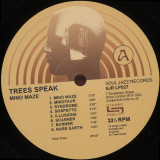
Mind Maze is, amazingly, Trees Speak’s fifth album to be released on Soul Jazz Records in the space of little over two years– an output matched only by the intensity of their music created during this short time.
The first pressing only of the album comes with a bonus seven-inch single containing two tracks that are not available on vinyl anywhere else.
As with all their previous releases, ‘Mind Maze’ is a mind-boggling tightrope walk across an array of musical influences that seamlessly create the unique present-day world of Trees Speak.
The band’s sound is characterized by a combination of German krautrock motoric-beat rhythms, angular New York post-punk attitude, 60s spy soundtracks, psych, rock, jazz, and 70s synthesizers and vocoders. There is also a cosmic spatial awareness to their sound; both personal inner space and galactic outer space, as well as a wilful pushing of sonic boundaries.
Trees Speak are a musical duo based in Tucson, Arizona, composed of Daniel Martin Diaz and Damian Diaz. Their music is heavily influenced by the cosmic magic of the natural desert landscapes of Arizona, creating a unique and captivating sound that is both experimental and innovative.
Here you will find the myriad sounds of 1970s German electronic music (everything from Can to Cluster, Popul Vuh to Tangerine Dream); 1980s New York post-punk and synthcore (from No Wave to Suicide); John Barry’s 1960s movies, John Carpenter’s 1970s horror. You will also hear the influences of French and Italian progressive rock (Magma, Goblin) as well as cosmic, new age and experimental space soundscapes …. an almost endless list of diverse influences that ebb and flow like an ocean of sound, in the process creating a truly unique soundscape that Trees Speak have made wholly their own.
The name Trees Speak reflects their interest in the concept of using future technologies to store information and data in trees and plants, with the idea that trees communicate collectively. This interest in nature and technology, combined with their passion for experimentation, has led Trees Speak to create a truly one-of-a-kind listening experience that is both unique and engaging.
If you ever wanted to hear Can, Neu!, Destroy All Monsters, Pere Ubu, electric eels, John Cage, Liquid Liquid, Tangerine Dream, Suicide, Laurie Spiegel, Art Ensemble of Chicago, John Barry, Mother Mallard’s Portable Masterpiece Company, Sun Ra, Stockhausen, John Carpenter, Electro-Acoustic and Musique Concrete and Mars in one band - then this is it! Trees Speak are a band that defies categorization and offer an eclectic listening experience, both exciting and memorable.
The two bonus tracks (‘Seraphim’ and ‘Orpheus’) included with the album give us a further window into the complex mind maze of the group - two stunning acoustic tracks that explore a distinct early 70s sound of Yes, Argent and other progressive rock accolytes.
Eternally Frozen consists of a series of canon based compositions for brass ensemble, percussion and synthesizer by Andrea Belfi. The canon is an ancient compositional technique in which an initial melody is imitated at a specified time interval by one or more parts, creating illusionary never-ending musical journeys.
The work is inspired by the evocative image of the Deprong Mori, a mythological bat with the alleged ability to fly through solid matter by bending atoms by its natural skill of audio echolocation. The myth suggests that one of these bats had been “eternally frozen” in a wall of solid lead in 1952 by the researcher of the Rockefeller University, Donald R. Griffith. This story is exhibited in a display at the Museum of Jurassic Technology in Los Angeles, an institution renowned for both speculative, fantastical reinforcement of mythology and playful and beguiling distortions of mysterious could-be truths.
Both the canon and the “frozen” Deprong Mori are man-made illusory simulations of eternity. Their attempt is to create mirages, where the insinuation of facts is more meaningful than the reality.
After many years of sonic explorations with percussion, drums, and electronics, Belfi is here projecting himself as a composer through the direction of an astonishing brass ensemble in the realization of these canonic works. There are evident echoes of the works of Arthur Russell, Miles Davis, Moondog, William Basinski, and the Italian soundtrack tradition of Ennio Morricone and Egisto Macchi.
Acclaimed Stirling-based group Constant Follower, led by Stephen McAll, and renowned folk guitarist Scott William Urquhart have today announced their forthcoming collaborative album, ‘Even Days Dissolve’, which will be released on 14 April 2023.
The album follows on from Constant Follower’s lauded debut long-player ‘Neither Is, Nor Ever Was’, which was released in 2021 and nominated for the 2022 Scottish Album of the Year (SAY) Award.
‘Even Days Dissolve’ is an enchanting, deeply absorbing, and meditative album, the product of a musical affinity between two thoughtful and uniquely talented Scottish songwriters and musicians.
The songs that make up ‘‘Even Days Dissolve’ were inspired by ‘the grand old man of Scottish poetry’, Norman MacCaig (1910-1996), whose work is characterised by its gentle humour, precise observation and love for the natural world, which forms another key theme for the album.
MacCaig’s poetry holds great significance to McAll, as it formed a major source of comfort and support to him during a long period of recovery following a violent and unprovoked attack that left him with catastrophic head injuries, partially paralysed and unable to write or play guitar.
‘Even Days Dissolve’ is McAll’s nod of respect to McCaig, and the great man’s unmistakable words and inimitable voice feature on two of the tracks - single ‘Wildlife Cameraman’, and ‘Comes A Silence (Basking Shark)’ – sensitively set over the backdrop of beautiful and exquisitely crafted songs.
Scott William Urquhart’s masterful acoustic guitar playing is a stunning centrepiece of the album, imbuing the songs with a moving sense of atmosphere, and sounding at once both elegant and robust. Urquhart’s unassuming yet compelling vocals also feature throughout ‘Even Days Dissolve’.
Speaking about ‘‘Even Days Dissolve’, Stephen McAll said: “The magic in music for me is all about collaboration. Finding people who inspire me to make better music, then working with them and creating something between us that’s better than what either of us could have made alone. It’s been an honour to work so closely with Scott William Urquhart on this album. He’s someone whom I’ve admired for some time - unquestionably up there with the best acoustic guitarists at the moment in Scotland, and such a beautiful writer of songs.
“Bringing two of these songs together with the voice of our beloved Norman MacCaig has been a real highlight of this project. His poetry was introduced to me by my high school teacher Mrs Tatarkowski, and it was the first prose I was able to read and understand when I was recovering from a traumatic head injury. So his work holds a deep space in my heart. I don’t think any poet or songwriter has matched his ability to capture the space and wonder of the natural beauty of Scotland.”
"We entered the shadowy mouth of a new space, descending into a realm that precedes the underworld, the arcane, far from our time. We met beasts that gave us lessons about their language which we started learning without grammar."
'The animal world is a constant in the work of Milan improvisational duo Rosso Polare. If Cani Lenti was guided by the diaphanous birdsong integrated into their sparkling mix of folklore, ambiences and occasional humming, on Bocca D’ombra the themes go darker, textures are harder to pin down and the animal presence takes on new connotations.
Instead of an anonymous, patchworked outdoors we enter a cavernous space that invokes the collective unconscious with bestial and funereal undertones, as the animals take on the role of the psychopomps, ancient guides through the shadow realm.
The album is influenced by Timothy Morton’s Dark Ecology, a thinker who sees the constant exchange between the human and natural world as an ongoing dialogue, the two influencing each other, in a series of reverberating loops. This looping is also reflected in their compositions, where improvisations with traditional instruments like electric and acoustic guitars, monophonic synths, horns or flutes meet natural noise-making tools like branches, rocks or nuts that amount to lugubrious, often dissonant textures. Bocca D’ombra is built on a series of whispers, breaths, panting and rustling, creating a feeling of closeness sometimes verging on the claustrophobic, ingeniously set against sounds evoking space – fireworks crackling, crows echoing, church bells reverberating, indistinct cries from a children’s playground.
Distance and repetition are deeply ingrained in their own understanding of sound and their surroundings, becoming the building blocks of their practice. Just like Gregory Bateson in the ‘70s, the duo believes in a more romantic approach to ecology, seeking a porous border between self and environment, human and animal, internal monologue and external ambient hum.
If earlier releases were noisier and denser, Bocca D’ombra is tight and focused - every sound and melody is given room to breathe and develop on its own, enhancing the haunting, otherworldly aspect of the music. The result is heady, intoxicating mix which sublimates chaos into sparkling compositions of contemporary animism.'