Studio One was founded by Clement "Coxsone" Dodd1 in 1954, and the first recordings were cut in 1963 on Brentford Road in Kingston.1[2] Amongst its earliest records were "Easy Snappin" by Theophilus Beckford, backed by Clue J & His Blues Blasters, and "This Man is Back" by trombonist Don Drummond. Dodd had previously issued music on a series of other labels, including World Disc, and had run Sir Coxsone the Downbeat, one of the largest and most reputable sound systems in the Kingston ghettos.
In the early 1960s, the house band providing backing for the vocalists were the Skatalites[3] (1964–65), whose members (including Roland Alphonso, Don Drummond, Tommy McCook, Jackie Mittoo, Lester Sterling and Lloyd Brevett) were recruited from the Kingston jazz scene by Dodd. The Skatalites split up in 1965 after Drummond was jailed for murder, and Dodd formed new house band the Soul Brothers (1965–66), later named the Soul Vendors (1967) and Sound Dimension (1967-). From 1965 to 1968 they played 9 a.m. to 5 p.m., 5 days a week, 12 rhythms a day (about 60 rhythms a week) with Jackie Mittoo as music director, Brian Atkinson (1965–1968) on bass, Hux Brown on guitar, Harry Haughton (guitar), Joe Isaacs on drums (1966–1968), Denzel Laing on percussion, and on horns (some initially and some throughout): Roland Alphonso, Dennis 'Ska' Campbell, Bobby Ellis, Lester Sterling, among others on horns during the era of Rock Steady. Headley Bennett, Ernest Ranglin, Vin Gordon and Leroy Sibbles were included among a fluid line-up, to record tracks directed by Jackie Mittoo at Studio One from 1966-1968.
During the night hours at Studio One from 1965-1968, singers like Bob Marley, Burning Spear, The Heptones, The Ethiopians, Ken Boothe, Rita Marley, Marcia Griffiths, Judy Mowatt, Alton Ellis, Delroy Wilson, Bunny Wailer[4] and Johnny Nash, among others, would put on headphones to sing lyrics to original tracks recorded by the Soul Brothers earlier each day. These seminal recordings included "Real Rock" (by Sound Dimension), "Heavy Rock", "Jamaica Underground", "Wakie Wakie", "Lemon Tree", "Hot Shot", "I'm Still In Love With You", "Dancing Mood", and "Creation Rebel".
Jackie Mittoo, Joe Isaacs, and Brian Atkinson left Studio One in 1968, recorded drums and bass for Desmond Dekker's and Toots' biggest hits at other Kingston studios, then moved to Canada. Hux Brown stayed in Jamaica to record on the soundtrack The Harder They Come, The Harder They Fall, and toured in Nigeria with Toots and the Maytals and Fela Kuti. The Soul Brothers (a.k.a. Sound Dimension) formed the basis of reggae music in the late 1960s, being versioned and re-versioned time after time over decades by musicians like Shaggy, Sean Paul, Snoop Lion, The Clash, String Cheese Incident, UB40, Sublime, and countless other Billboard originals and remakes trying to emulate their original Rock Steady sound at Coxsone's Studio One.
The label and studio were closed when Dodd relocated to New York City in the 1980s.
Buscar:k soul
Cam Cameron appears to be another one of those performers from an infinite list of Black American artists that cut a solitary 45 single and then disappear into obscurity never to be seen or heard from again. Couple this with the passing of any of the relevant protagonists from the time along with any of the surviving ones ever diminishing memories and the job of collating events and artists back stories from over 50 years ago becomes that much harder.
Cam Cameron appears to be one of those artists (although our investigations are ongoing). Therefore, from the information currently gleaned, the artist Cam Cameron was none other than Alvin Cameron the writer of the featured song “You Say”, with Cam being a kind of nickname. The string arrangements on both “They Say” and “I’m A Lonely Man” were provided by the late John Andrew Cameron a hugely respected arranger, producer and songwriter within the Chicago music scene of the 1960’s and early 70’s, more often credited as Johnny Cameron. Johnny’s credits can be found on many recordings of the time often working with fellow Chicago music scene producer Clarence Johnson, some of the highlights from this liaison being the song “I Really Love You” recorded by both Jimmy Burns (Erica) and Bobby James (Karol) and the girl group, ‘The Lovelites’, on their acclaimed album “With Love From The Lovelites” (Uni). Johnny’s involvement with the Scott Brothers goes as far back as 1965 when he provided the musical arrangements on The Howard Scott penned song “I’ve Got To Get Over” recorded by Syl Johnson for the TMP-Ting label. Although they share the same surname, Alvin (Cam) Cameron is believed to be of no relation to Johnny Cameron.
“You Say” would gain a release on the independent Capri label owned by Sephus Howard Scott who together with brother Walter Scott composed the 45’s flipside “I’m A Lonely Man”. Howard also featured as one of the songs producers alongside the mysterious Edgar Mullins (a name which has been found on a couple of other tape boxes, the investigations continue).
Musical accompaniment was provided by The Scott Brothers Band, with both songs being recorded at RCA Victor’s Chicago number 2 Recording Studio at 445 North Lake Shore Drive, in the Navy Pier section. on the 10th of August 1967 and released on Capri Records during the month of February 1968.
Cameron’s “You Say” was another 45 that was first introduced to UK Soul Collectors via those much lamented and fondly remembered soul packs, always regarded as a quality collector’s 45 the only regular turntable action remembered was provided by Northampton’s very own discerning DJ Cliff Steele at venues such as ‘Detroit Academicals’, ‘Bretby Country Club’ and later ‘Albrighton’ during the leaner days of the UK Rare Soul Scene?! Hopefully a wider appreciation of both sides of this soulful Windy City 45 beckons! The second release in Soul Junction’s Capri series.
- 1: Afrique - House Of The Rising Funk
- 2: Blue Mitchell - Soul Village
- 3: Sarah Vaughan - Magical Connection
- 4: Art Farmer - Soulsides
- 5: Shelly Manne - Mask 7:30
- 6: Alice Clark - Never Did I Stop Loving You
- 7: Buddy Terry - Abscretions
- 8: Maxine Weldon - Right On
- 9: Barry Miles - Scatbird
- 10: Jack Wilkins - Red Clay
- 11: Clark Terry - Rum And Mumbles
- 12: Ellerine Harding - I Ain't Got Much (But Whatever I Got It's Yours Baby)
- 13: Blue Mitchell - Granite & Concrete
- 14: Hadley Caliman - Quadrivium
- 15: Carmen Mcrae - Feelin' Good
A compilation of rare spiritual jazz and funk grooves culled from the archives of producer Bob Shad's Mainstream Records. Alice Clark's cult classic Never Did I Stop Loving You' features here alongside many gems uncovered for the first time.
Bob Shad worked with titans such as Charlie Parker and Lightnin' Hopkins in the 40s, founded the EmArcy jazz label in the 50s, and discovered Janis Joplin in the 60s, and started the Mainstream label in 1964.
From Afrique's classic House of the Rising Funk' and its funky wah wah frenzy, to Hadley Caliman's deep jazz Flute ode, From one of Clark Terry's famous Mumbles (Shad produced the original with Oscar Peterson) to Jack Wilkins' Red Clay' sampled by both A Tribe Called Quest and Chance the Rapper. A Soul Music lover, Shad also excelled in soul divas and produced Ellerine Harding, Maxine Weldon and of course the mighty Alice Clark. Carmen McRae, one of Shad's long time collaborators, gives a soulful, conga-led version of the classic Feelin' Good, originally made famous by Nina Simone
black LP[33,82 €]
gold LP[35,50 €]
- A1: I Really Love You (Full Length Studio Version) 4 38
- A2: Your Love Is Smokin' (Previously Unissued) 4 40
- A3: What's That Sound (Full Length Studio Version) 4 48
- A4: Free To Be Me (Previously Unissued) 5 28
- B1: You Changed Me (Part 1 & 2) (Full Length Studio Version) 7 10
- B2: Nice Beat (Easy To Dance To) (Previously Unissued) 5 28
- B3: Get The Funk Off My Back 3 20
- B4: Get It From The Bottom (Previously Unissued) 4 02
Impulse’ was a band of Milwaukee, Wisconsin musicians whose members included Michael Reese (Rhodes Piano and background vocals), Cedrick Rupert (Lead and Rhythm guitar), Jeffrey Williamson (Drums and background vocals) and Robin Gregory (Bass and background vocals). They would become a group in their own right with the eventual addition of another local artist John Gee, who joined them as their lead singer. The Impulse musicians formed the backing/touring band for another Milwaukee outfit, a vocal quartet, The Quadraphonics who recorded the solitary 45 single “Betcha If You Check It Out/Prove My Love To You” for the Carl Davis/E. Rodney Jones owned ‘Innovation II’ Record label during 1974. This release would later be nationally distributed by the major Warner Brothers label. With import copies of “Innovation II” single finding their way into the UK the record became popular with the devotees of Blackpool Mecca’s Highland Room.
During 1976 the members of Impulse migrated to Oakland California, they had hoped that, The ‘Quadraphonics’ would join them but instead The Quadraphonics chose to remain in Milwaukee and eventually broke up. It was fellow Brewtown producer/recording artist Harvey Scales who was responsible for inviting ‘Impulse’ to the west coast. Under the auspice of Scales, Impulse recorded their self-titled debut album project at Wally Heider’s Studio in San Francisco. The album was initially offered to Casablanca Records but no firm interest was to materialise, a subsequent approach to Jerry “The Ice Man” Butlers newly formed Chicago label, Fountain Records again failed to secure a release of the album, sadly leaving the project unreleased in the can. In the ensuing years, the former group members have continued with their respective careers, the late John Gee embarked on a solo career, recording the 1980 release “Not Enough Love Makin’/ you Are That Man (Why Don’t You Be That Man)” for Leroy Smith’s Oakland C.A, Pashlo label followed by his 1985 modern favourite “So Good To Me/Just Get On” recorded under the artist name of Jon Pierre Gee on his own newly formed Kandi Inc, Record label. Later Kandi projects included the 1995 Jon Pierre Gee & Touch album and the 2005 Ah’VantSoul cd album project, which featured Jon’s business and real-life partner, Kathryn Hannemann (a.k.a the performing artist Kat Webb).Throughout all the aforementioned projects Jon continued to use and enjoy performing with his former fellow ‘Impulse’ musicians of which the two surviving members Robin Gregory and Michael Reese can still be found jamming to this day in the renowned Milwaukee Restaurant/Coffee House by the name of ‘Coffee Makes You Black’. Sadly, drummer Jeffrey Williamson passed away during 2015 with Coley Jackson coming in to pick up the sticks! Lead and Rhythm guitarist Cedrick Rupert left the group in the 1970’s moving to Lake Charles, LA, sadly, he too passed away in 2020.
The Impulse album project having lain dormant since the 1970’s was resurrected during 2018 when Jon Pierre Gee in conjunction with Stephen Chin of Nice Choice Records (USA) and Soul Junction Records (UK) breathed new life into the project. Beginning with the release of the first of two ‘Impulse’ 45 singles on Jon’s Kandi imprint. Firstly “What’s that Sound/You Changed Me” followed in 2020 by a second 45 “I Really Love You/Get The Funk Off my Back” with all four soul and funk tracks receiving worldwide acclaim. Initial plans for the release of the whole album project had been set in place but we’re unfortunately brought to an unexpected halt with the passing of Jon Pierre in November 2020.
Undetered Soul Junction have finally been able to bring this amazing ‘Impulse’ project to life as a limited vinyl press I’m sure once heard, the old adage of “Good Things Come To Those Who Wait” will certainly ring true, enjoy.
After the fall of the Deep City label, Rocketeers bandleader Frank Williams set up shop under the name of his twin daughters Saadia and Giwada and got to work reinventing the Miami Sound. Tracked between 1968-1970, this LP gathers 15 of Saadia's funkiest and deeply soulful moments, featuring Pearl Dowell, Joey Gilmore, Little Beaver, Frank Williams' Rocketeers, Robert Moore, Brother Williams, and Sam Baker. Your next sample, first dance, workout jam or closing credits is buried in here somewhere.
Super Funky Forest Green and Blue Splatter Vinyl.
After the fall of the Deep City label, Rocketeers bandleader Frank Williams set up shop under the name of his twin daughters Saadia and Giwada and got to work reinventing the Miami Sound. Tracked between 1968-1970, this LP gathers 15 of Saadia's funkiest and deeply soulful moments, featuring Pearl Dowell, Joey Gilmore, Little Beaver, Frank Williams' Rocketeers, Robert Moore, Brother Williams, and Sam Baker. Your next sample, first dance, workout jam or closing credits is buried in here somewhere.
Two highly sought after tracks from Jackie Mittoo's legendary 'Showcase' album, originally released on Studio One in 1980.
Hypnotic, blissed-out funky reggae from Jamaica's finest – Bagga Walker on bass, Leroy 'Horsemouth' Wallace on drums, Ernest Ranglin on guitar and, of course, the inimitable Jackie Mittoo on keyboards.
Cut super loud on a 12" single, it’s literally impossible to find a copy of this album, and if you did it would set you back hundreds of £s.
Housed in a heavyweight card Studio One sleeve these won't be around for long! Very Limited edition 1000 copies worldwide 12” pressing.
- A1: Josephine Taylor - Good Lovin
- A2: Jackie Beavers - Sling Shot
- A3: Five Stairsteps - Come Back
- A4: Betty Everett - Bye Bye Baby
- A5: Tim - My Side Of The Track
- A6: Tyrone - You Made Me Suffer
- A7: Cash Mccall - You Mean Everything To Me
- A8: Andrea Davis - You Gave Me Soul
- B1: Jamo Thomas - Stop The Baby
- B2: Jean Dushon - All Of A Sudden My Heart Sings
- B3: Jimmy Dobbins - What Is Love (I Found Love) (I Found Love)
- B4: Chuck Bernard - Let's Go Get Stoned
- B5: Sonny Warner - Been So Long
- B6: The Cod's - It Must Be Love
- B7: Joyce Davis - Along Came You
- B8: Johnny Sayles - Deep Down In My Heart
In the 1950s Chicago was the blues capital of the world. But by 1966 musical tastes had changed. R & B had morphed into hard soul and newer soft soul musical stylings had coalesced from earlier doo wop motifs, with bigger and more sophisticated productions. This was the era of the small independent owners / producers, all vying for airplay and sales in a hugely competitive marketplace. This landmark LP showcases many of the best of this output – the sounds that hit music listeners and buyers straight from the street. The mix here is a perfect blend of the tough hard soul style and the softer soul sounds. Just right for the feet and the heart. Enjoy!
- A1: Roscoe Robinson - You Don't Move Me No More
- A2: Lamp Sisters - No Cure For The Blues
- A3: Lh & The Memphis Sounds - Out Of Control
- A4: Marvin Preyer - Climbing Up To Love
- A5: Oscar Toney Jr - A Love That Never Grows Cold
- A6: Lee Rogers - The Same Things That Make You Laugh (Make You Cry) (Make You Cry)
- A7: Shortkuts - Your Eyes May Shine (Feat Eddie Harrison)
- A8: Bobby Womack - Take Me
- B1: James Fry - Tumblin' Down
- B2: Joe Simon - Looking Back
- B3: Lc Cooke - Half A Man
- B4: Masqueraders - Sweet Lovin' Woman
- B5: Bart Jackson - Dancing Man
- B6: Homer Banks - Foolish Hearts Break Fast
- B7: Double Soul - I Can't Use You
- B8: Terry Felton - I Don't Want To Have To Wait
- B9: Ted Ford - You're Gonna Need Me
Most southern soul fans will tell you that that the music produced in Memphis in 1967 and 1968 was the pinnacle of quality. So following on from our look at the River City’s soul output in 1967, we now turn our attention to an album covering the next year. As before, the singers here are a heady mixture of local Tennessee talent and welcome soulful guests who journeyed down south hoping that a little of the famous Memphis magic would rub off on their songs. There are soul genres to suit all tastes here – from the deepest ballads to upbeat tracks that will rock your socks off. Soul doesn’t get much better than the artists and their tunes on this LP!
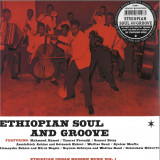
- A1: Wallias Band - Muziqawi Silt
- A2: Alemayehu Eshete And Hirut Beqele - Temeles
- A3: Samuel Belay - Aynotchesh Yerefu
- A4: Ayalew Mesfin - Hasabe
- A5: Seyoum Gebreyes And Wallias Band Muziqa Muziqa
- B1: Getatchew Mekurya -Yegenet Muziqa
- B2: Mahmoud Ahmed - Kulun Mankwalesh
- B3: Tamrat Ferendji - Antchin Yagegnulet
- B4: Asselefetch Ashine And Getenesh Kebret - Amiak Abet Abet
Repress.
"Urban Ethiopian music stands out within the African continent thanks to its creativity and originality. Whatever the shade -- pop, blues, jazz or soul -- it comes from a fusion of local musical traditions mixed with an echo of Western music. It bewitched Ethiopia during the Swinging Addis decade before recently winning the favors of a well-informed audience all over the world. This first vinyl volume of Ethiopian Urban Modern Music presents some of the Ethiopian grooves & jewels drawn from the essential CD Ethiopiques series directed by Francis Falceto and published by Buda music;
A real soul gem from 1970 on the James Brown affiliated Deluxe label, the first and only album by this mysterious singer: Marie Queenie Lyons.
It is perhaps apropos that Queenie Marie Lyons’s best known song is titled ‘See And Don’t See.’ For all the acclaim that song has accrued, and all the times it has been compiled, reissued and, yes, bootlegged — for all the times it has been seen — Queenie herself has somehow remained unseen. How did a singer from Ashtabula, Ohio record one of the great female-led soul albums and then simply fall off the map, never to record or perform again? Queenie was a natural performer and a gifted singer. At the age of fifteen, she was doing three shows a week at a local venue. In early 1962, Queenie moved to Queens and was soon playing gigs across the city — an early engagement was with Gene Krupa at the famous Metropole Café in Times Square — as well as touring with established acts like Fats Domino and Ray Charles. The following year, Queenie made her debut recording, for a subsidiary of RCA called Groove, credited to an entirely fictitious “Shelley Shoop and the Shakers.” It remained Queenie’s only presence on wax until early 1968, when a Nashville-based label called Sims gave her her first accurately attributed single, “A Minute Of His Goodtime / Good Soul Lovin’.” Although the 45 is now a highly collectible part of the Northern Soul and Lowrider Oldies pantheons, it made no impact at the time, as Sims was focused on more typical Nashville sounds. A few months later Queenie was back in New York City, performing R&B and pop covers with her band when a man passed her his business card at a performance. The card read James Brown Enterprises. James Brown “was my idol,” she says, and someone whose business acumen and stage presence she strove to emulate. Although Queenie ended up on tour with James Brown for only a month or so, when the group reached Cincinnati in mid-’68 she entered the King Records studio there to record what would become the
album you hold in your hands. The songs were a combination of covers, some of which she’d been doing in her live shows, like ‘Fever’ and ‘Try Me,’ and originals written by producer Henry Glover and pianist Don Pullen, who was the bandleader on the session. The album opener, ‘See And Don’t See,’ was also recorded by the veteran R&B singer Maxine Brown, but Queenie’s version blows hers away. “Soul Fever” is a supremely funky and soulful affair, with Queenie’s powerful and captivating voice magnetically attractive, with an urgency that is impossible to ignore. ‘Your Thing Ain’t No Good Without My Thing,’ ‘Your Key Don’t Fit It Anymore,’ and ‘I Don’t Want Nobody To Have It But You’ are as funky and soulful as the best of Tina Turner and Aretha — a statement not to be made lightly!
The album was critically acclaimed — the October 10, 1970, issue of Billboard listed it as their sole “four star” pick in the Soul category — but perhaps due to the tumult at Starday-King, whose stewardship had turned over several times in only a few years, it never seemed to be able to break through to a larger audience.
- A1: Larry Marshall - I've Got To Make It
- A2: Horace Andy - Every Tongue Shall Tell
- A3: Alton Ellis - The Well Run Dry
- A4: Johnny Osbourne - Water More Than Flour
- B1: Anthony Rocky Ellis - I'm The Ruler
- B2: Cornell Campbell - Pretty Looks Isn't All
- B3: Alexander Henry - Please Be True
- B4: Burning Spear - Them A Come
- B5: Joe Higgs - Change Of Plan
- B6: Devon Russell - Roots Natty
- C1: Ken Boothe - Be Yourself
- C2: Freddie Mcgregor - I Shall Be Released
- C3: Freddie Mckay - Father Will Cut You Off
- D1: The Ethiopian - Locust
- D2: George Philip - One One
- D3: John Holt - I Don't Want To See You Cry
- D4: Delroy Wilson - Won't You Come Home
This is a very special one-off new special edition of one of the most popular of all the Soul Jazz Records" collections that has been out of print for many years! Featuring great new sleeve design as well as a special coloured vinyl pressing, Studio One Kings is a "who"s who" of the world"s greatest reggae artists. Studio One"s list of singers launched at the famous label reads like a roll call of Jamaican music. Horace Andy, Alton Ellis, Ken Boothe, Freddie McGregor, Johnny Osbourne and more. This album features classic and rare tracks that span the breadth of the legendary Studio One catalogue: Ska, Roots, Rocksteady, Lovers and more from the 1960s and 70s. The album also comes with sleeve-notes by the great writer Chris Salewicz, author of books on Reggae Explosion, Rude Boy as well as books on Bob Marley, The Rolling Stones, Jimmy Page, Joe Strummer and more.