Disclosure returned in February with the brand new ‘Ecstasy’ EP where they rolled out a track a day over five days in the same vein to their last release, the ‘Moonlight’ EP (2018). Only this time, the ‘Ecstasy’ EP was in fact, a precursor to their third album ‘ENERGY’ – set for release on August 28th on Island Records.
Buscar:k step
Welcome to the curious world of Peter Graf York: a world full of city centre safaris and epic train journeys, Soviet cosmonauts and Oakland rappers, filtered synths and plucked mbiras. It's a wild ride inspired as much by Jamaican dub sorcery as by playful minimalism outta the Pacific Northwest.
Many of these tracks were composed on the hoof - literally en route across sections of the ever-reliable Deutsche Bahn network. As such, there’s a certain travellin-without-moving dynamic across this collection, capturing that cinematic feel of window frames flickering past graffiti'd signal exchanges, morphing into rolling hills and green forests. Expedition Bahn is the sound of ideas being set in motion, each track heralding the arrival of an uncanny destination. Blazed beats give way to acid-fuelled electro, and dub rhythms step aside for 4th world meditations as readily as sleepers on a train track.
We can leave the last word to heroic USSR cosmonaut Vladimir Komarov, who spent the final moments of his fateful re-entry giving the administration an earful of righteous proportions (regarding the technical failures of the spacecraft). Taking his place as the first martyr of space travel, Komarov accepted the Soyuz mission despite safety concerns, in order to protect the other cosmonauts. It's an attitude that echoes throughout PGY’s sonic universe - make the most of the trip you're on... ‘cause you never know just which way it will go.
Gear used: Tascam MIDISTUDIO 644, MPC1000, Roland JX-3P, MODE MACHINES DT200, Electro-Harmonix MEMORY BOY analog delay, Nord Drum 3P, MacBook Pro, Logic Pro 9
New album of one of the biggest Reggae/Dub french soundsystem starring MacGyver, Rooty Step & Pupajim (who worked with Alpha Steppa, Biga Ranx, High Tone, Mungo's Hi-Fi ...).
Available as super limited edition including 60x60cm Poster !
Since their inception at start of the 2000s, Stand High Patrol have rocked sound systems to their own riddim, assimilating and re-purposing the codes of the genre in their own unique style. From tiny bars in Brittany to huge festival stages, on independent radio or across national airwaves, the crew have quietly trod their own path, never compromising their core value of independence. Connoisseurs have long recognised Stand High’s credentials both as a dub group and a leading sound system, but they stand out from the crowd because of their ability to deliver the unexpected, whether live or on record. Their ability to draw such a diverse audience is testament to this atypical approach to making music.
In 2020, almost 20 years since their humble beginnings, the collective presents their fifth album, “Our Own Way”. As with their first two albums “Midnight Walkers” and “Matter Of Scale”, now considered as classics in their genre, this new opus asserts itself as the latest representation of the crew’s versatile approach to crafting sound. Their music, a blend of its own known as “Dubadub”, has always borrowed influences from multiple sources, and over the course of their career their roots in dub and reggae have intertwined with hip-hop, jazz, new wave, trip-hop and numerous other genres. The ‘Dubadub Musketeers’ have never ceased experimenting, forever seeking to increase the sonic territory they cover, day after day. Both live and recorded, they’ve made it a point of honour to never offer up the same thing twice. Any resemblance that “Our Own Way” might bear to those first two albums is a consequence of this obvious creative continuity, rather than of going “back to basics”.
In contrast to the last two Stand High Patrol records, the hip-hop inspired “The Shift”, or the Bristol indebted “Summer On Mars”, “Our Own Way” doesn’t have a unifying concept or theme. Rather than being limited to a single aesthetic, the LP pays respect to the entire canon of Jamaican music, all unified under Stand High’s inimitable production values. With the wealth of experience gained during the recording of their last two records, the collective decided to aim for a freer project, letting themselves be guided by their own music and their own instincts. The end result is a musical portrait of what Stand High Patrol is in the present moment.
The tracks that make up the new LP burst out of the studio, each born out of unbridled, impulsive creativity. Previously unheard compositions and specially re-tooled dub plates have been assembled into a tracklist that shifts and moves like a classic Dubadub Musketeer live set. Each step of the process has been refined by years of practice : composition, effects, and the final mix. Throughout “On Our Way”, the brutal dub stepper, though still a favourite for sound system sessions, is noticeable by its absence. Instead, it’s the full weight of the crew’s reggae heritage that’s expressed in the mix. It's not just the depth and weight of each tune that strikes the listener, but also the spaces heard between the notes that grab and hold their attention.. The sense of a trip, whether musical, internal or geographic, is omnipresent throughout the LP, linking each track to those before and after. “Our Own Way” finds Stand High Patrol exploring as usual, yet also narrating their journey as they’ve rarely done before
Sublime, unique, sexy and peculiar unreleased scores by electronic and jazz pioneer Ron Geesin, made for the sublime, unique, sexy and peculiar films by maverick director Stephen Dwoskin. There. we’ve said it. And if you have not heard of one or either of these two dudes it doesn’t really matter. Geesin made great music and worked with Pink Floyd. Dwoskin made odd films, most of them are in the BFI permanent collection. They are great and a bit strange.
These superb unreleased soundtracks come from a fascinating, progressive and important period in British film history. They represent an intriguing collaboration between the lively Ron Geesin from Scotland and the American Stephen Dwoskin, who both met in London.
Musically they are minimal, charismatic and quite groundbreaking. Here is the story…
HISTORY:
Steve Dwoskin arrived in London in 1964, aged 25, with several 16mm films in his trunk, shot in the cold-water flats of Greenwich Village. He had been on the fringe of the Factory scene, and some of his films starred Beverly Grant, ‘the queen of the underground’. But they had scarcely been seen, and they didn’t have soundtracks. For almost a year they stayed in the trunk, and stayed silent. Then he met Ron Geesin, somewhere around Portobello Road.
‘Slept last night, completely dressed after working over 12 hours on sound tracks at Ron’s,’ wrote Dwoskin in his diary for 29 July 1965. ‘My films are not anywhere near being anything. I need more energy, more concise and positive ideas and less inhibition. And of course space, money and people.’ Dwoskin, who taught and practised graphic design by day, had recently decided to stay in London beyond the term of the Fulbright scholarship that had brought him there.
Ron, living with Frankie in a basement flat in Elgin Crescent – they would marry the next year, with Dwoskin as best man – was about to leave the Original Downtown Syncopators, the trad jazz band he had joined aged seventeen-and-a-half, and was trying to go solo. On stage he would make vigorous use of piano and banjo; at home Frankie had bought him a new kind of instrument – a tape recorder. ‘Soon I had one tape recorder, two tape recorders, three tape recorders.’
Ron, wrote Dwoskin in his unpublished autobiography, ‘loved to record, and to cut and splice the quarter-inch recording tape to make new sounds. This triggered in me the idea of getting back to my films and finishing them’. Soon he was living in a dank basement in Denbigh Road, a few minutes’ walk from Elgin Crescent. Ron’s soundtracks for Dwoskin’ films, recorded in the Geesins’ flat, encompassed Ron’s very eclectic range of styles – madcap piano and fretted banjo as well as tape manipulation.
Aside from Ron’s soundtracks, some of which belong to films that no longer exist (including Pot Boiler), Frankie would act in one of the films that Dwoskin either lost or never finished during these years. He was disabled, having contracted polio as a child, and Ron and Frankie were both carers and collaborators; Ron had met him when he was struggling into his car.
There was no London equivalent to the underground film scene that Dwoskin had known in New York, and his films remained unseen until such a scene began to come into being, in the autumn of 1966. Some of them made their debut at the Mercury Theatre, near Notting Hill Gate, that September. Dwoskin wrote that Alone, starring Zelda Nelson (from Ron Rice’s Chumlum), and Chinese Checkers, with Beverly Grant and Dwoskin’s friend Joan Adler, went over best.
Soon both Dwoskin and Geesin became involved in the nascent London Film-Makers’ Co-op, which put on screenings in Better Books on Charing Cross Road – ‘if you can call them screenings,’ Ron recalls; ‘I’d call it fifteen blokes in various stages of disarray, peering through the smoke’. One or more of the films had been ‘striped’ with magnetic audiotape; with others ‘we had no means of direct syncing to the picture, so he started the film and I started the tape recorder’.
In the same autumn, Dwoskin moved into a flat almost opposite the Geesins on Elgin Crescent. More collaborations followed, including Naissant, on which Gavin Bryars, whom Geesin had met during a stint on the northern club circuit with novelty act Dr Crock and His Crackpots, played double bass.
Around the end of 1967 Geesin released his first solo LP, A Raise of Eyebrows, and Dwoskin won recognition the Fourth Experimental Film Competition, aka EXPRMNTL 4, an occasional film festival staged at Knokke-le-Zoute in Belgium. By now the films had optical soundtracks.
It was only after this that Dwoskin completed his first ‘British’ films, including Me Myself and I, with Barbara Gladstone, an American dancer who had appeared in Barbara Rubin’s Christmas on Earth, and with whom Dwoskin and Geesin had at one point devised a stage show, never produced. For Moment, a single-shot film, Geesin provided his most experimental score yet. At the time of its debut in 1970, Dwoskin and the Geesins were sharing a house in Ladbroke Grove.
By then, Ron was working with Pink Floyd, and soon afterwards he and Frankie moved out to the country, to be replaced by Bryars both in the house and as Dwoskin’s principal collaborator.
Until now these scores have remained part of the Geesin Archive and have never been issued.
- A1: Dim Arc - Breeze Shapes
- A2: Sunmoonstar - Sleepy Dragon
- A3: Emily A Sprague - Flew
- A4: Fools - I Can See Your Voice Thru The Trees
- B1: Cool Maritime & Kaitlyn Aurelia Smith - Daybreak
- B2: Constant Shapes - Wind Leaf Shimmer
- B3: Kathryn Shuman - Objects
- B4: Jeremiah Chiu - Poems One & Fourteen (Feat Stephen Honer)
- C1: Kacey Johansing - Whales Of Agate
- C2: Julianna Barwick - Newborn
- C3: Mary Lattimore - She Remebers Sitka
- C4: Geotic - Uncaught
- D1: Andy Strain - Patience
- D2: Bana Haffar - Circulations
- D3: Ulfur - Feathered (Feat Gyda Valtysdottir)
Compilation album curated by Kaitlyn Aurelia Smith
The directive for the composers featured on Breathing Instruments was, in effect, to accentuate the ways in which instruments sound like they are breathing. Some have recreated the literal experience of feeling or hearing the human breath. Others take a more abstract approach, where “breathing” is more motif than object of emulation.
From hushed pulsations and distant vocals in Kathryn Shuman’s ‘Objects creating a womb-like environment to Julianna Barwick’s blissful ‘Newborn’ the tracks give sonic form to the experience of emerging from the womb.
There is also a striking concurrence of woodland sounds throughout this collection from the ghostly tones of Emily A Srague’s ‘Flew’ to Cool Maritime and Kaitlyn Aurelia Smith’s dew dripped ‘Daybreak’.
Meanwhile the undulating seascape of Geotic’s ‘Uncaught’ conjures moments of Evening Star by Fripp/ Eno, but supplants that album’s crystalline production with the warm crackle of vinyl.
If we learn anything from Breathing Instruments it is that we are inextricable from the natural world.
Minyo Crusaders rework historic Japanese folk songs (min'yo) with Latin, African, Caribbean and Asian rhythms for their debut album 'Echoes of Japan'.
Releases from Ryuichi Sakamoto, Haruomi Hosono and Midori Takada have re-ignited global interest in Japanese music and 'Echoes of Japan' marks the arrival of a big band like no other.
'For Japanese people, min'yo is both the closest, and most distant, folk music' explains band-leader Katsumi Tanaka: 'We may not feel it in our daily, urban lives, yet the melodies, the style of singing and the rhythm of the taiko drums are engrained in our DNA'. Initially indifferent to min'yo, a tragic event in recent Japanese history set Tanaka on his current path: 'Following the Tohoku earthquake of 2011, I reflected on my life, work and identity. A fan of world music, I began searching for Japanese roots music I could identify
with. Discovering mid-late 20th century acts Hibari Misora, Chiemi Eri and the Tokyo Cuban Boys, I was
captivated by their eccentric arrangements and how they mixed min'yo with Latin and jazz.'
Originally sung by fishermen (Kushimoto Bushi; Mamurogawa Ondo), coal miners (Tanko Bushi) and sumo wrestlers (Sumo Jinku), these songs deal with topics such as the returning spirits of ancestors (Hohai Bushi), Japan's smallest bird (Toichin Bushi) and a bride's love for her husband's pockmarked face (Otemoyan).
Minyo Crusaders are one of the most hyped acts on the Tokyo music scene that went national in 2018 through festivals such as Fuji Rock. The band features veterans of the Tokyo roots music scene such as bassist DADDY U (Ska Flames), keyboardist Moe (Kidlat), sax player Koichiro Osawa (Matt Sounds/ J.J. Session), Yamauchi Stephan (J.J. Session), percussionist Mutsumi Kobayashi (Banda de la Mumbia), conga player Irochi (Cubatumb) and vocalist Meg (DJ collective Tokyo Sabroso).
- Wild blend of Japanese folk music with cumbia, boogaloo, Ethio jazz, Afro funk + more
- Ry Cooder, Mario Galeano (Ondatropica/Frente Cumbiero), Clap! Clap! are all fans
- European touring plans for autumn/fall 2019
- Includes Japanese lyrics + English translations
- Lacquers cut @ The Carvery
Moonshine Recordings and Steppas Records have reconnected to deliver the 3rd instalment in the Moonshine Steppas series, a debut release of Modi Bardo featuring Carlton Livingston backed by remixes from Alpha Steppa & Bukkha. Same as with the previous releases, it's a limited edition one time vinyl pressing.
While Nat Birchall is naturally best known for his jazz work, he's no stranger to the world of dub and reggae. In fact, "Tradition Disc In Dub" is his second full-length collaboration
with roots reggae musician, producer and mixer Al Breadwinner (the first, "Sounds Almighty", dropped in 2018). It's a little more spaced-out than its predecessor,
with both Birchall and Breadwinner emphasizing weighty riddims, echoing instrumentation (sax, flute, organ etc.) and the kind of analogue effects
that marked out the golden age of dub. In fact, the "golden age" reference is particularly relevant, because while there's plenty of subtle variety on show throughout,
it's closer in tone to King Tubby and Lee 'Scratch' Perry's 1970s work than, say, Mad Professor or Iration Steppas. More importantly, it's also superb.
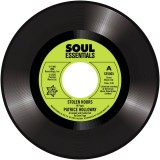
- A1: Stolen Hours
- B1: Love And Desire
PATRICE YVONNE HOLLOWAY was born in Los Angeles and is perhaps best known as the younger sister of Motown’s Brenda Holloway, the darling of the Northern Soul scene, particularly in recent years. Patrice also signed to Motown and recorded an unreleased version of “The Touch Of Venus” made famous by Edna Wright (aka Sandy Wynns).
In the mid-sixties Patrice signed to Capitol records and recorded “STOLEN HOURS”, arranged by the great Gene Page and written and produced by his brother Billy Page – she was only 15 years old at the time. It failed to hit Stateside but some thirty years later it became a Northern Soul anthem of the nineties, although it was originally played in the early days of Wigan Casino.
Our chosen flip-side, the follow-up single, “LOVE AND DESIRE”, was also penned, produced and arranged by the Page brothers. It failed to even get a commercial release in the U.S. although it was released in the U.K. and commands big money in today’s collectors market. Her final 45 for Capitol came in 1972 and was a credible version of the Sam Nesbit classic “Black Mother Goose”. Sadly, ill health, forced Patrice to step back from performing and she died before her time of a heart attack in 2006.
Patrice was also known as ‘Valerie’, singer with the animated girl-band Josie And The Pussycats produced by Hanna-Barbera and aired on CBS in 1971. She would beome the first black character to regularly appear on U.S. commercial TV.
Djebali and Jorge Savoretti combine to deliver their ‘Fraires’ EP on Infuse, accompanied by a remix from Stephan Bazbaz.
Two producers at the heart of today’s modern house and minimal scenes, Paris favourite Djebali and Argentinian DJ and producer Jorge Savoretti have grown to become two of the most consistent and impressive talents active within the scene today. With over thirty years of experience between them, releasing material via the likes of Freak’n’Chic, Raum…musik and Cadenza plus Djebali’s own self-titled imprint, the pairing now turn their attention to new ground as they make their collaborative debut on FUSE sister imprint Infuse this summer, offering up three fresh productions via their ‘Fraires’ EP alongside a remix from Tel Aviv’s Stephan Bazbaz.
The slow-blooming and hypnotic sonics of ‘101’ open the EP in style as the two talents merge sweeping synth lines atop of warped electronics and slick percussion shots, whilst Stephan Bazbaz’s remix ups the tempo and builds on the original with a combination of energetic builds and icy hats. On the flip, ‘Pigalle’ delves into a deep journey guided by a resonant lead line and hazy background murmurs, before closing with the classy ‘Devote Ville’ – a smooth and well measured production which oozes sophistication and quality from the opening minute.
Principal is the new solo project by producer and musician Rasmus Allin, who’s first album Treacherous Dub will be released on the Copenhagen-based label StereoRoyal in July 2020.
Best described as an homage to old-school Jamaican dub, Principal’s music features live recorded drums and other instruments. Fused with electronic elements, it celebrates the sound of the original dub pioneers.
Born in 1970, Rasmus Allin has been working as a producer, musician, and songwriter since the mid-nineties, primarily within the realm of electronic music. Inspired by the British trip hop and drum ‘n’ bass scene, he soon gravitated towards Jamaican dub, rocksteady, and reggae. "I found my inspiration in the old Jamaican dub masters like Lee Scratch Perry, King Tubby, Augustus Pablo, and Scientist. I’ve spent endless hours in the studio trying to replicate their sound, using old tape delays, filter boxes, and modulation effects,” he says.
In 2002, Allin formed the band Junkyard Productions, playing major venues and festivals like Elysee Montmartre, Le Triptyque, Télérama Dub Festival, and Roskilde Festival while touring through Denmark, Germany, Switzerland, and France. Alongside this, he continued to hone his skills in producing, co-writing, and remixing music, working with top Danish pop and reggae acts the likes of Natasja, Pharfar, Wafande, Shaka Loveless, and the British girl band All Saints.
Treacherous Dub will be released on vinyl and all major streaming platforms, and will be Allin’s first album of pure instrumental dub tracks —an ambition he’s been wanting to fulfil for years. Marking his debut as a solo artist, the album also marks his premiere as a visual artist, with the album cover lithograph made by Allin himself. For Rasmus Allin, the collaboration with StereoRoyal offered “the perfect opportunity to give the tracks the finishing touches.”
StereoRoyal is a Danish library music label founded in 2010 by and specializes in off-kilter music for film and TV. Originally, the label focused on electronic genres, but over the years has grown to include a broader variety of music produced by some of the most talented composers in Scandinavia.
Re-release of the record originally released on 2016-02-05!
Remastered and cut by Rashad Becker at D&M Berlin and presented in an exact replica sleeve of the original 1966 release by Stephen O'Malley.
sales information: Black Truffle is honoured to present the first vinyl reissue of the classic debut album from AMM, AMMMusic. Coinciding with the 50th anniversary of its recording in 1966, this reissue makes one of the cornerstones of the experimental music tradition available again in its original form, replete with Keith Rowe's beautiful pop art cover and the terse aphorisms by the group that served as its original liner notes. A testament to the interaction between the experimental avant-garde and the countercultural underground, the album was originally released on Elektra, recorded by Jac Holzman (the label's founder, responsible for signing The Doors, Love, and The Stooges) and produced by DNA, a group that included Pink Floyd's first manager Peter Jenner. (Pink Floyd paid tribute to AMM's influence on their improvisational sensibility with the track 'Flaming' on their debut album, named after the piece that occupies AMMMusic's first side, 'Later During a Flaming Riviera Sunset').
Formed in 1965 by three players from the emerging British jazz avant-garde - Keith Rowe and Lou Gare had played with the great progressive big band leader Mike Westbrook and Eddie Prévost played in a post-bop group with Gare - AMM quickly evolved from a free jazz group into something decidedly more difficult to categorise. By the time these recordings were made, two more members had joined the group: another Westbrook associate, Lawrence Sheaf, and the radical composer Cornelius Cardew. Then at work on his masterpiece of graphic notation Treatise, Cardew brought with him extensive experience of the post-serialist and Cageian currents in contemporary composition. Using a combination of conventional instruments and unconventional methods of sound production (most famously Keith Rowe's prepared tabletop guitar, but also prepared piano and transistor radio), the group performed improvised pieces often running for over two hours and ranging from extended periods of silence to terrifying cacophonies.
Evan Parker famously described the improvisational logic of AMM's music as 'laminal', in contrast to the 'atomistic' approach more common among the generation of British improvisers (Bailey, Rutherford, Stevens and co.) to which he himself belonged. AMM improvised in layers: layers of sound subtly rising and falling or abruptly starting and stopping without being propelled by the implied pulse of free jazz improvisation. Rather than a pulse, AMM's music began with the sound of the room in which it was played, the Cageian anarchy of silence. By embracing the non-synchronous simultaneity of layered sound, AMM was able to create a musical container into which nearly anything could be incorporated at any moment: on AMMMusic, long tones sit next to abrasive thuds, the howl of uncontrolled feedback accompanies Cardew's purposeful piano chords, radios beam in snatches of orchestral music (and, on the LP's second side, an extended fragment of 'Mockingbird').
AMM's clearest break with jazz-based improvisation concerned the idea of individuality. Where improvised music has tended to foster the development of idiosyncratic stylists who move freely from one group to another, AMM, initially through an engagement with eastern philosophy and mysticism and later though a politicized communitarianism, sought to develop a collective sonic identity in which individual contributions could barely be discerned. In the performances captured on AMMMusic
the use of numerous auxiliary instruments and devices, including radios played by three members of the group, contribute to the sensation that the music is composed as a single monolithic object with multiple facets, rather than as an interaction between five distinct voices.
- Francis Plagne
Ramrock Red Records are incredibly excited to present Kameelah Waheed – straight outta New Jersey. Brought to our attention by London DJ/promoter, Barry King, Kameelah immediately delighted us with her direct, no messin’ delivery, compelling, earworm hooks and beautifully crafted lyrics.
Teaming up with Kelly Murray on co-production on the ‘Original Version’, Kameelah unleashes a stripped back, jazzy hip-hop vibe punctuated with a Donald Byrd’ish trumpet riff. The North Street gang take the Donald Byrd flavour a step further with a full on nod to the Mizzell Brothers in the first North Street West dusty funk production. Releasing digitally around April 24th as a five track EP with a further 7” vinyl release around May/June, ‘Holding On’ is set to tick a lot of musical heads boxes.
Growing up in an Islamic household, sneaking snippets of worldly music into her household was close to pulling off a major heist during Kameelah’s teenage years. She was introduced to the world of sound from MTV, rap and house music and the live bands of the 80's courtesy of her older sister, along with tribal and island music that her mother played. Kameelah was encouraged to consider song writing as a career option when she received an opportunity to write for Bunny Sigler of Philadelphia International Records. Heading up the hip-hop rock band band, Gov’t Cheaze in 2000, Kameelah performed at Philadelphia’s Black Lily Film Festival as well as a set at the very first Roots Picnic.
Previous releases have included ‘Traveling’ by Kameelah Waheed & GC, produced by Larry Gold, featured on the ‘Beat Generation Compilation’ released on BBE, making the Top 10 Most Played on UK urban radio stations. In 2011, Kameelah Waheed and Government Cheaze signed with indie label, Philly Through My Ear (PTME) founded by Will Smith Sr. The self-titled CD can be found on iTunes.
About a year ago Leroy Se Meurt delivered a simply hard-hitting and smashing debut EP… which quickly sold out at the ET HQ… the mixed background of this duo from Paris in electronic music and in punk-rock shapes the distinctive sound of Leroy Se Meurt… you can call it synth-punk or elektropunk… or simply post-punk for that matter… Not only their debut EP did have impact… possibly even more did their live shows… their live performance is wild and in your face…
Now there is the follow up to that acclaimed debut EP… this time Leroy Se Meurt takes a little step back from the totally in your face attitude… the sound is a bit darker and aims less on a direct confrontation but works to crawl under your skin… the energy and tension is still there but is building up gradually… and has a bigger impact that way… Don’t miss out on this next step in the campaign of Leroy Se Meurt!
What is Randolph & Mortimer? A folk duo, a pair of accountants, a techno act…a law firm? What started off as an ‘art project’, influenced by 80s Industrial, 90s rave music and inspired by the documentaries of Adam Curtis, has morphed into a full on New Beat / Body Music dance-floor moving machine. Their studio releases have gained support from some of the biggest underground DJ’s in the world like Ancient Methods and gone on to top various genre sales charts on Bandcamp. Whilst the R&M live shows have seen them share bills with Godflesh, Youth Code, PIG and 3Teeth.
In 2019 it was time for R&M to throw a marker down and so came “Manifesto For A Modern World”, the debut album comprised of tracks from the “$ocial £utures”, “Hope Tragedy Myths” and “Citizens” EP’s plus some additional songs. This album is basically a greatest hits of Randolph & Mortimer. A statement of intent. All killer and no filler. The original limited edition CDs and tapes sold out and it had some incredible reviews. A Model Of Control called it “An absolutely outstanding release” and super cool New York DJ Andi Harriman (Synthicide) made it one her of top 10 albums of 2019 on Post-Punk
So here we are in 2020 and the Randolph & Mortimer story has seriously stepped up a gear with this double vinyl version of the album featuring all Manifesto tracks plus the acid styled dance-floor favourite “Apply Yourself” and four brand new tracks (“Crystal Peaks”, “Stateless”, “What Are You?”, “Fantasy Land”) which make up a whole new EP.
Limited edition of 400 copies with folded poster/insert and sticker.
Fredfades and Jawn Rice call on the extended family for a remix package. Featuring material from their sizzling 2019 LP Jacuzzi Boys, a track from their upcoming swelter Luv Neva Fades, and some previously unreleased pieces, the Norwegian House duo gets the remix treatment from Chmmr, Deep88, and Hugo LX while Fredfades & Jawn Rice goes OG on a demo version from their highly anticipated LP.
Basking in the warmth of the duo’s analogue sounds, Chmmr transports Show me How to the farthest recesses of the galaxy with some spacy synths and cool reverbs blowing through Dreamcast’s sensual vocal before Fredfades & Jawn Rice tempers Travels through Air with an OG lean on the A side.
Meanwhile on the B-side; Deep 88 carve a yawning a trench for Stimulator Jones’ airy vocal before Hugo LX puts a bounce in the step of Mutual Love to close out the exciting remix package.
The sound of Fred and Jawn peek through consistently, with each artist putting their own distinctive stamp on the originals. Elements of Jazz, Soul and Hip Hop create a heady fusion of sounds breaking loose from the House foundations for this series of heavy steppers.
It's no big secret: The elements of trance music have always played a vital part in the music of Prins Thomas. In fact, there are scholars who argue that these stylistic attributes were the ramp that shot his disco into space. But let's not pour hot coffee onto the cold one. When the king they call Prins sent a loose bunch of tracks to Gerd Janson to get some sort of feedback, it was like an epiphany: the calling for the missing link between "Logic Trance" compilations of yesteryear and the honey for the strobe light bees of today has finally been answered. Naturally, it's not all ice cannons and glow sticks, endorphins and euphoria. The private and poetic Prins stands just one step behind the sweaty one - in alphanumeric track list order. If there has ever been something like thinking-(wo)mans-trance, this is the album for it.