Previously unissued 1999 live set from Alex Chilton (The Box Tops/Big Star) and Hi Rhythm Section Hi Rhythm Section has performed on seminal recordings from Ann Peebles, Ike & Tina Turner, O. V. Wright, Otis Clay, and Al Green Packaging contains liner notes from Memphis Mayhem author and Producer David Less “I never saw him have so much fun on stage. Without rehearsal, Alex called songs and the band locked in. The horn section consists of top Memphis session guys who huddled together when each song was called creating parts on the fly. The pure joy of playing this music so freely with such legendary musicians comes across in every groove of the record.” —David Less, from his liner notes Memphis is a city with music in its blood. When Fred Ford, co-founder of the Beale Street Music Festival, was diagnosed with cancer, David Less organized Fredstock, a fund raiser to help with his medical bills. Less contacted Memphis legend Alex Chilton (The Box Tops, Big Star), who was living in New Orleans, to ask him to participate. Alex said he didn’t have any musicians to play with in Memphis, so Less suggested the Hi Rhythm Section (the band behind classics from artists including Ann Peebles, Ike & Tina Turner, O. V. Wright, Otis Clay, and Al Green). Alex replied, “That will work.” This previously unissued live set contains versions of soul classics from The Supremes and Otis Clay, rock numbers from Chuck Berry and Little Richard, and even a cover of the KC & The Sunshine Band title track. Available on CD, Digital, and LP
Cerca:ka§par
This 4th full-length album by the legendary Congolese collective marks a new milestone in their already rich history, as the band have incorporated their own approach to electronic music into their new compositions. The album was produced by guitarist Mopero Mupemba, who also wrote about half of the songs. Mopero also took care of the often intricate programming, which is perfectly adapted to Kasai Allstars' peculiar rhythmic patterns drawn from traditional trance and ritual music. The album features Kasai Allstars mainstays such as vocalist Muambuyi (whose voice and personality inspired the making of multi-awarded feature film Félicité), vocalist and electric likembe player Kabongo, powerful singer Mi Amor, and instrumentalists Tandjolo and Bayila. Wonderful young vocalist Bijou makes a notable first appearance on several tracks. As is well-known by now, Kasai Allstars was born from the reunion of five bands, all from the Kasai region, but originating from five different ethnic groups whose diverse musical traditions were thought to be incompatible until these musicians decided to pool their resources and work together, an inspiring example of collaboration transcending ethnic and language barriers. Ever since the debut release in 2008, Kasai Allstars' music struck the imagination of music lovers and artists worldwide. They're particularly admired by avant-indie rock, electronic & hip hop musicians and media, who consider it as a kind of "primal rock", an accidental blend of trance and avant-garde. They're admired by artists such as Saul Williams, Questlove and Björk, have engaged in live collaborations with Deerhoof, Juana Molina and Konono Nd1, and have had their tracks remixed by the likes of Animal Collective, Deerhoof, Aksak Maboul, Jolie Holland, Shackleton and more.
- A1: Daughters Of Darkness (Opening)
- A2: Amour Sur Les Rails / Love On The Rails
- A3: Les Lèvres Rouges / Red Lips
- A4: Arrivée Au Manoir / Arrival At The Manor
- A5: La Comtesse Bathory (Halo) / Countess Bathory (Halo)
- A6: Ballade À Bruges / Ballad In Bruges
- A7: La Comtesse Et L’inspecteur / The Countess And The Inspector
- A8: Le Récit Des Tortures Et Des Vampires / Tale Of Torture And Vampires
- A9: Valérie, Ilona Et Stefaan
- A10: Les Dunes D’ostende, Flagellation / The Dunes Of Ostend, Flagellation
- B1: Le Baiser De La Comtesse / The Countess’s Kiss
- B2: La Morsure De La Comtesse / The Countess’s Bite
- B3: L’orgue Et Le Piano Fantômes / The Phantom Organ And Piano
- B4: Poursuite Sur Les Dunes D’ostende / Pursuit On The Dunes Of Ostend
- B5: Accident Et Cymbalum / Accident And Cymbalum
- B6: Daughters Of Darkness (Ending) Bonus (Not Used In Movie)
- B7: La Fanfare De Bruges / The Bruges Band
- B8: Dracula 68 Woodstock (Des Poissons Et Des Hommes / Of Fish And Men)
- B1: Les Lèvres Rouges
- B1: Les Dunes D’ostende, Flagellation
Daughters of Darkness is a 1971 English-language Belgian horror film. Directed by Harry Kümel this cult erotic vampire film stars Delphine Seyrig, Danielle Ouimet, John Karlen, and Andrea Rau. The film was well received, and a retrospective poll by Time Out in the early 2010s placed the film at number 90 in their top 100 horror films.
Its score was created by multiple award winning composer François de Roubaix. It has long been a much sought after title, with De Roubaix’ son Benjamin commenting that the “composer achieves a perfect balance and the result is a bleak and eerie soundtrack that stands on a par with the music of Ennio Morricone in A Lizard in a Woman’s Skin or - in a different style - that of Isaac Hayes for Shaft”. Parts of score would eventually be sampled by several hip- hop artists, including American rapper Lil Wayne on his song “President Carter”.
In many ways, DJ Black Low's debut album, Uwami, shows the signs of an artist's first offering in any musical genre. Showcasing fluency in a broad range of styles and stuffing a number of ideas to the record's brim is the 20 year-old producer's attempt to both introduce himself to a wide listenership and stamp a recognizable sound in their minds. In other ways, somewhat out of the young South African producer's control, Uwami goes against the grain. The album comes at a time when South African electronic music is being fundamentally disrupted. Amapiano, the electronic music movement which first gained popularity with a small, core group of followers, now dominates the mainstream. Well-known and pervasive, amapiano borrows from a diverse palette of musical styles which are popular in South Africa's largely Black townshipsjazz, kwaito, dibacardi, deep and afro house among them. Instead of pandering to the seemingly insatiable local appetite and growing global penchant for amapiano though, on Uwami DJ Black Low seeks out the limits of the sound du jour and tries to stretch them. On his solo productions, he uses the samples and compositional norms that make amapiano hits the bedrock on which to experiment and improvise. With collaborators, DJ Black Low improvises within the boundaries of listener-friendly grooves. The sound he creates has foundations of what could easily have progressed into captivating amapiano songs on their own. But he uses improvised but structured electronic percussion and distortion sounds to drive the tracks in a particular direction. What remains is something like a deconstructed amapiano. For a young producer living in the townships of the greater Pitori area of South Africa's Gauteng province, there were few avenues available for Radebe to pursue a career in music. His trajectory shows the vulnerability of this pursuit. "I had started producing in 2013 and it so happened that I lost my equipment in 2014. I couldn't afford to buy equipment. In 2017, a friend of mine who had been making music found a job and decided to quit music. He gave me his equipment and I was able to start producing again. That's when I started getting back to it. I tried to pick up where I had left off, with hip hop and commercial house but I found that amapiano was the popular music. I liked it, so I started producing it."
black vinyl in mirrorboard gatefold jacket with die-cut! Much like the New Orleans-born artist who created it, Second Line is an unapologetic genre bender that pushes boundaries, expands possibilities, and shatters expectations. It's more than just an album: Second Line is a cohesive sensory experience that questions traditional ideas of sound, production, and visual aesthetics as they relate to music. Its interlocking parts tell an epic story about the quest for artistic expression, with Dawn describing her project as "a movement to bring pioneering Black women in electronic music to the forefront." She elaborates: "You never see women appreciated as producers and artists alike _ especially Black women in the electronic space. The time is now for us to start recognizing their talent, not only in electronic music but in all genres. I wanna be the reason why a young Black girl from the South can be whoever she wants to be musically, visually, and artistically." Second Line cuts to the chase with its opening suite of dancefloor bangers, immediately displaying Dawn's mastery of layered production and melodic hooks. Second Line treats Louisiana Creole culture, New Orleans bounce, and Southern Swag as elemental, allowing Dawn to weave in and out of house, footwork, R&B, and more. As she says, "I am the genre." The story of Second Line centers on Dawn's persona King Creole, assassin of stereotypes, a Black girl from the South at a crossroads in her artistic career. To move forward, she decides to look back, but where previous album New Breed took influence from her father, Second Line is illuminated by Dawn's mother. Her proud repeated proclamation of "I'm a Creole Girl" introduces the ecstatic dancehall pop of "Jacuzzi," and later, on the cinematic album centerpiece "Mornin | Streetlights," she answers Dawn's question of how many times she has been in love. Intimate conversations like this between the two are interlaced throughout Second Line, giving credence to how the protagonist came to be, and direction to build a lane forward. It's no surprise that King Creole's story parallels Dawn Richard's. As a founding member of Danity Kane, and later with Diddy's Dirty Money, Dawn was able to explore the ins and outs of commercial pop music. As a solo artist, she opted to selfrelease her music. Over the span of five critically acclaimed full-length albums, Dawn has made the message clear that she will not bow down or bend to industry norms. All the while, she's built her resume with enough extracurriculars to make your head spin: Cheerleader for the New Orleans Hornets? Check. Animator for Adult Swim? Check. Owner-operator of a vegan pop-up food truck? Check. Martial arts expert? Check! Second Line embodies the heritage of soul music and the roots of New Orleans, all surrounded by the influences of electronic futurism. "The definition of a Second Line in New Orleans is a celebration of someone's homecoming," says Dawn. "In death and in life, we celebrate the impact of a person's legacy through dance and music. I'm celebrating the death of old views in the industry. The death of boxes and limits. I'm celebrating the homecoming of the Future. The homecoming to the new wave of artists. The emergence of all the King Creoles to come." Dawn Richard is bold, confident, purposeful, and a King throughout Second Line. Are you ready to dance?
Stahlschrank sind Sun Ray (Fred und Luna) und Brain Emo (Ufo Hawaii).
Nach ihrer Erfolgssingle „Egal ist sehr gut“ peitschen Stahlschrank mit ihrer zweiten Veröffenlichung „Karin / Inge“ ihr Konzept des Elektrodadakraut weiter nach vorne. Ein Musikstil, der noch nicht vollständig erforscht und entwickelt ist.
„Karin“ ist eine Reflexion über die Vergänglichkeit des Daseins und eine moderne Parabel über Kontrolle und Unterwerfung.
Die Single-B-Seite „Inge“ ist die zweite Exkursion in das Stahlschrank-Konzept des „Electronic Irritainment“.
„Inge“ ist eine Reflexion über das Ringen des Individuums vor dem Hintergrund zeitgenössischer Clubkultur, die sowohl die Grenzen der Studioumgebung als auch die Geduld der Nachbarn ausreizt.
Stahlschrank arbeiten derzeit an ihrem ersten Longplayer, möglicherweise ein Vierfach-Album.
GEORGIA's new kaleidoscopic hyper-music-entity "State Effect (Accel)" expands the NYC's duo project in a high-dimensional phase space—and does so within their all-kind-of-music frame.
State Effect (Accel) is happening this very moment, it is a positive cry for change—a brilliant plan.
This record is "viscous" — whatever I do, wherever I am, it sort of "sticks" to me.
It is "nonlocal" — its 'accelerated' effects are globally distributed through a huge tract of time. It forces me to experience time in an unusual way.
It is "phased" — I only experience pieces of it at any one time.
It is "inter-objective" — it consists of all kinds of other/multiple entities but it is not reducible to the sum of its parts.
This music reveals the present and its psychic dimension, no titles could have been more relevant.
Justin Tripp and Brian Close's new kaleidoscopic hyper-music-entity expands their GEORGIA project in a high-dimensional phase space. A great work of cognitive music mapping that plots all the states of a system — Lovely bubbly HTML.
The eight tracker long playing make extensive use of the vocal participation of Paris/Berlin-based artist/DJ MARYLOU aka OISEAU DANSEUR and Gabi Asfour of visionary NY fashion collective threeASFOUR.
‘The Watchful Eye Of The Stars’ is Adrian’s ninth studio album.
Produced by luminary John Parish (Aldous Harding, PJ
Harvey), this sublime collection of ten songs invites us to join
Adrian at his storytelling best, regaling us with tales of travel
and wonder, by sea, by road, all quietly transfixing,
transformative and wholly captivating.
Suffused with a hazy and surreal quality, Crowley describes
‘Watchful Eye’’s poignant narratives as those which insisted
themselves upon him. After the fact, it seemed these songs
came to him more or less fully formed. “It’s a beautiful and
mysterious thing,” he says. Perhaps it is a tendency to hold onto
memories (“It’s taken me so long to write to you / Well I just
couldn’t find a pen,” he laments in ‘Bread And Wine’), that
allows him to unleash them lyrically in completion. For Crowley,
the creative process is an organic event rather than a practice
he feels compelled to regulate or control. He approaches lyrics
much like he does short story writing. “The songs straddle the
conscious and subconscious world and some are even
psychedelic in my mind, but to me they are all at once true
stories and born of another place,” he shares.
In making the album, Crowley moved between studio and at
home recording, while John Parish produced. The pair worked
from tracks made initially by Crowley on a charity shop ¾ size
nylon string guitar or Mellotron: “In this way, John wanted to
keep some of the magic of that first take,” says Crowley.
Contradictions and complexities are left intact, initial recordings
were limited to one or two takes and the songs feel more like a
dream recounted upon waking.
Jim Barr of Portishead contributed double bass and was
brought in to engineer parts of ‘Watchful Eye’ in Bristol. Nadine
Khouri and Katell Keineg were invited in as guest backing
singers.
The heavyweight vinyl includes a digital download card.
Pixey grew up in the sleepy but picturesque village Parbold, Lancashire before moving to Liverpool for school and remaining there to this day. Now signed to Chess Club - a label famed for breaking new talent, where recent exciting signings include AlfieTempleman and Phoebe Green, and past successes include Jungle, Wolf Alice and Easy Life - Pixey is making more waves than ever before. ‘Just Move’ drew attention from BBC Radio 1 DJs Jack Saunders (who made Pixey one of his Next Wave artists) and Huw Stephens amongst many other admirers like Radio X’s John Kennedy who added the band to the X-Posure playlist at the station in October. Pixey has also featured as the cover artist of Spotify’s Indie Brandneu (GER) and Peach editorial playlists, and wasamongst the artists named in major annual tips lists, the Dork HYPE List and the NME 100.
New single ‘Electric Dream’ - with its accompanying video by Thomas Davies - combines cavernous drum machines and dreamy pop melodies with a signature dance stomp. Speaking about new single, Pixey explains: “‘Electric Dream’ was originally written as a piano ballad but after finishing the lyrics I felt the song worked as a dance track. I wrote it to make sense ofbeing locked in with nothing to rely on but technology. The verses are all of my anxieties that come with that - like trying to simulate humanity digitally and what kind of a future that would be - but the choruses are about the imperfections of real life that technology and AI can’t give us.”
Debut EP Free To Live In Colour was written, recorded and produced in Pixey’s bedroom in Liverpool - with additional production added by frequent Gorillaz and Jamie T collaborator James Dring - and draws inspiration from genres like hardcore breakbeat and
dream pop. Pixey says: “I wanted a collection of tracks which gave a quick snapshot into me and my brain - where I’m from, where I want to be and what I’m thinking about. I hope people can take something meaningful from it or simply have a dance.”
Pixey first discovered music as a toddler - she remembers not even being able to walk yet but desperate to sing and dance to Queen - before discovering the likes of Kate Bush, Björk, and George Harrison, whose classic songwriting struck a chord with her in her youth. The catalyst for Pixey’s musical coming of age however, was a near fatal viral illness suffered in early 2016 which hospitalised her, she says: “When I thought I was going to die I thought of all the things I wish I’d done and music was the first thing I thought of. As soon as I started recovering I started learning to record and produce.” She taught herself Ableton production software before mastering guitar and eventually drums and bass after her previous (and current) boyfriend(s) left their instruments lying around to prove she could learn it quicker and play it better.
Once able to carve out her own sound, Pixey turned to The Verve, The Prodigy and De La Soul for sonic inspiration, adding: “I particularly like the idea of using samples/making my own riffs sound like samples which was heavily inspired by the De La Soul album 3 Feet High and Rising. Starting out initially though Grimes was a huge catalyst when I realized she wrote, recorded &produced herself.” Her prolific and unusual songwriting style stems from an original riff or beat, with further layers added as she records and produces, and lyrics being added last - the process taking only a day or two.
With Free To Live In Colour and a whole arsenal of further material being readied on her new label home, Chess Club, Pixey is primed for big things in 2021 and beyond.
The 'Abroad EP' catalogues a period of time spent travelling Japan in the spring of 2019. Throughout the course of the month-long trip, Rudy carried around a portable recorder, capturing various sounds that caught his ear. That collection of found sounds would eventually become the foundation for the EP, each track utilizing a handful of different recordings ranging from bird calls in Tokyo's Yoyogi Park, to windchimes in the coastal town of Kawazu. The EP took a full year of patient, daily work to complete, during which time Rudy invited a diverse group of collaborators in to help finish the songs. Throughout the recording process, harp, saxophone, and violin parts were added to create a unique blend of organic and electronic sounds.
POSY is the recording name of Rudy Klobas, Portland-based producer and multi-instrumentalist with a unique sound that intersects jazz, R&B, and electronic music. Originally trained on classical guitar, POSY gradually taught himself piano, bass, and drums and began writing and recording his first songs on a four-track cassette recorder. POSY's music is lush and densely layered, but maintains an element of simplicity that ultimately leaves one feeling relaxed, nostalgic, and hopeful all at the same time.
Just in time for the holidays comes a brand new Christmas classic from Academy Award-winning composer Michael Giacchino (Up, Ratatouille & Lost) and if the world ever needed a shot of positivity right now then this is it!
The idea of writing a Christmas single happened whilst hosting a Christmas party with Richard Kind at the Royal Albert Hall in 2019. During that party, they heard a radio announcement regarding a Christmas song competition, and they immediately began trying to
write a song and find someone to sing it! Throughout the party, guests turned up, but no one wanted to sing the song, that is until Himesh Patel and UK band Itchy Teeth knocked on the door and took up the challenge. Himesh was fresh from starring in Danny Boyle’s film Yesterday, and Itchy Teeth were the band that performed with him throughout the movie.
Recalling classic Christmas earworms such as Wings ‘Wonderful Christmastime,” the single is written by Michael Giacchino, Elyssa Samsel and Kate Anderson and performed by Itchy Teeth. The B-side is a beautiful smokey lounge version of Christmas Number One performed by the John Robert Wood Yule Sextet.
The LTD 7’ comes complete with a digital download card and is presented in gatefold Christmas card cover, ready and waiting to be given as a gift and inscribed with your very own holiday greeting.
Let us see 2020 out in a flurry of positivity, optimism and fun, so get ready to be singing this song around the christmas tree this year with all your family (even if that mean doing so on Zoom)
Happy Holidays!!!
On October 12, 1929, Kathryn Culp and Sammie Lee Brown had the idea to name their first-born baby Napoleon. With such a vital beginning, little Nappy was already predestined to hit the mark, so from a very young age he stood out for his vocal qualities, well cultivated in gospel, which he practiced assiduously in The First Mount Zion Baptist Church run by his father.
To Mr. Brown's chagrin, after his first forays into religious music participating in vocal gospel groups such as The Golden Crowns, Golden Bell Quintet and The Heavenly Lights, with whom he recorded his first single for Savoy in 1954, the young Napoleon decided to try his hand at secular music, convinced by Herman Lubinsky, the big boss man of the New Jersey label.
In this way, between 1954 and 1962, Napoleon recorded a total of 28 singles at Savoy, clearly marking the transition from Rhythm & Blues to Rock’n’Roll, and also his subsequent jump to Soul, being the natural link between the late 40s southerners like Wynonie Harris or Big Joe Turner and artists like Jackie Wilson or James Brown, who cemented the black sounds of the 60s.
This LP includes a compilation of some of his best songs at Savoy, high class rock'n'roll, with a lot of dancefloor favourites like DON'T BE ANGRY, compiled in its two versions, or JUST A LITTLE LOVIN ', but also his more Bluesy sides, with songs like the fabulous DOWN IN THE ALLEY, which would be recorded years later by that certain singer born in Tupelo, Mississippi, that many times declared how much he dug Nappy Brown’s Rhythm & Blues.
In the same bluesy way Nappy wrote the iconic THE RIGHT TIME, one of the first stones of the Soul cathedral, originally recorded by Nappy on 1957, and revised one year before by Ray Charles. Ray’s version, renamed Night Time Is The Right Time, would be included as the main theme of the award-winning film IN THE HEAT OF THE NIGHT. We´ve also included Nappy’s own answer to this song, recorded in 1961 and titled as ANY TIME IS THE RIGHT TIME.
Finally can´t avoid to name some of the backing musicians you´ll hear in these tracks, Sam ‘The Man’ Taylor, Mickey Baker, Panama Francis… have a look on notes bellow, oh boy! the A-Team of the mid-century New York Rhythm & Blues!
Nappy disappeared from the music scene in 1962, remaining anonymous until 1969, when he would return to Rhythm & Blues on Elephant Records with an LP whose title could not be more eloquent: THANK YOU FOR NOTHING.
Since then, Nappy was very active until his death in 2008, alternating his love for gospel and Rhythm & Blues, touring the United States and Europe and releasing no less than a dozen LPs.
Favorite Recordings and Charles Maurice proudly present the 5th edition of the AOR Global Sounds compilations series: 8 rare and hidden tracks, produced between 1977 and 1984 in various parts of the world. Started in 2015, the AOR Global Sounds series was born from the will of Charles Maurice (aka Pascal Rioux) to share his longtime love for the AOR and WestCoast movement and highlight its influence for many artists in the late 70s and early 80s. In this 5th volume, he selected again highly forgotten productions, deeply infused with Disco and Soul flavors.
Half of the compilation’s tracklist is naturally coming from the US, homeland of this music style, while the other half is made of productions from all over the globe, from France or United Kingdom to Venezuela. And for most of these beautiful songs, it came from artists and bands rather unknown and often released as private press.
Often, these records will have a special story, sometimes they’re just part of the universal quest of finding true love. Nonetheless, they all carry a wide range of emotions magnified by the music.
For example, “Don’t Take It Away” by Westside is as a love song about a new relationship, recorded in Minnesota and mastered on Sunset Bld. (Hollywood) by Bernie Grundman, who worked on Thriller – funny thing, the original LP is a picture-disc, which was still quite rare back in the days because the singer saw one from Mickael Jackson when visiting the studio. “Til’ Mornin’ Comes”, the only release by The Ferry Brothers, is also a love song, recorded in NYC with notably Gwen Guthrie, Vivian Cherry & Patti Austin singing as backup vocalists. On “What Its Meant To Me”, Jonathon Hansen remembers with emotion the good times spent with the members of his band including the vocalist he was in love with. On “J’Irai Squatter Ton Cœur”, Didier Makaga better-known as a French Boogie & Pop singer, arranger & composer, sings a charming declaration of love on a heavy and groovy eighties production. “You Never Know” by Rhapsody, recorded in Connecticut, sounds more like an East coast fusion of Soul and Jazz-Funk à la James Mason. “What You Do To Me” by Sugar Cane was highlighted on a Pittsburgh Rock Radio compilation: listening to this smooth ballad with its amazing Moog synth break will lift your soul. “Kailua” by Venezuelan Jazz-Funk band Esperanto, is a song about Hawaii which evocates bucolic dreamy nights facing the ocean, a typical AOR vibe. Finally, “I Need You” from Mark Williamson is a blue-eyed soul UK groover ending on a four-on-the-floor climax!
And we could detail stories but our guessing is the best way to learn more about all these gems is to listen to the compilation, fully remastered from originals, and whether your preference is for vinyl or CD formats.
- A1: Willie Dunn - I Pity The Country
- A2: John Angaiak - I'll Rock You To The Rhythm Of The Ocean
- A3: Sugluk - Fall Away
- A4: Sikumiut - Sikumiut
- A5: Willie Thrasher - Spirit Child
- A6: Willy Mitchell - Call Of The Moose
- B1: Lloyd Cheechoo - James Bay
- B2: Alexis Utatnaq - Maqaivvigivalauqtavut
- B3: Brian Davey - Dreams Of Ways
- B4: Morley Loon - N' Doheeno
- B5: Peter Frank - Little Feather
- B6: Ernest Monias - Tormented Soul
- C1: Eric Landry - Out Of The Blue
- C2: David Campbell - Sky Man & The Moon
- C3: Willie Dunn - Son Of The Sun
- C4: Shingoose - Silver River (Poetry By Duke Redbird)
- C5: Willy Mitchell & Desert River Band - Kill'n Your Mind
- D1: Philippe Mckenzie - Mistashipu
- D2: Willie Thrasher - Old Man Carver
- D3: Lloyd Cheechoo - Winds Of Change
- D4: The Chieftones (Canada's All American Band) - I Shouldn't Have Did What I Done (Canada's All American Band)
- D5: Sugluk - I Didn't Know
- D6: Lawrence Martin - I Got My Music
- E1: Gordon Dick - Siwash Rock
- E2: Willy Mitchell & Desert River Band - Birchbark Letter
- E3: William Tagoona - Anaanaga
- E4: Leland Bell - Messenger
- E5: Saddle Lake Drifting Cowboys - Modern Rock
- E6: Willie Thrasher - We Got To Take You Higher
- F1: Sikumiut - Utirumavunga
- F2: Sugluk - Ajuinnarasuarsunga
- F3: John Angaiak - Hey, Hey, Hey Brother
- F4: Groupe Folklorique Montagnais - Tshekuan Mak Tshetutamak
- F5: Willie Dunn - Peruvian Dream (Feat Jerry Saddleback - Part 2)
Deluxe 3LP mit 34 neu gemasterten Tracks und einem 60-seitigen Buch mit ausführlichen Linernotes, Interviews, bisher ungesehenen Archivphotos und den Texten (samt Übersetzung) in einem ,Tip On"-Schuber und drei ,Tip On"-Sleeves. Linernotes von Kevin ,Sipreano" Howes. Bisher fast nicht an die Öffentlichkeit gedrungen, kaum dokumentiert, aber im Kern ungeheuer revolutionär, nehmen die Aufnahmen verschiedenster Gemeinden amerikanischer Ureinwohner endlich in Form von ,Native North America (Vol. 1): Aboriginal Folk, Rock, and Country 1966-1985" den Platz ein, den sie verdienen. Eine Anthologie von Musik, die einst fast ausgestorben, aber nun für alle zu hören, ist ohne Frage eins der ambitioniertesten Projekte in der 12-järhigen Geschichte von Light In The Attic. ,Native Norht America (Vol. 1)" versammelt Musik der eingeborenen Völker Kanadas und der nördlichen USA, die in den turbulenten Jahrzehnten zwischen 1966 und 1985 aufgenommen wurde. Die Musik spiegelt die Zusammenführung globaler Popkultur und die Neuerweckung der eingeborenen Spiritualität und Ausdruckskraft wider. Der größte Teil dieses Materials war über Jahrzehnte lang durch fehlende Distributionskanäle und wenig Präsenz in den Massenmedien in Vergessenheit geraten - bis jetzt! Hier versammelt sich Garage Rock vom Polarkreis aus der Nunavik Region des nördlichen Quebec, melancholischer Yup'ik Folk aus Alaska und flüsternder Country Blues aus dem Wagmatcook First Nation Reservat in Nova Scotia. Man vernimmt Echos von NEIL YOUNG, VELVET UNDERGROUND, LEONARD COHEN, CREEDENCE CLEARWATER REVIVAL, JOHNNY CASH und anderen in den Songs, die jedoch mit eingeborenem Bewusstsein, Erzählkultur, Poesie, Geschichte und Zeremonie angereichert werden. Die Compilation ist gewidmet dem legendären Métis Singer/Songwriter und Dichter WILLIE DUNN, der auf der Anthologie auftritt, während der Zusammenstellung des Albums jedoch verstarb. ,Native North America (Vol. 1)" ist nur der Anfang; eine Zusammenstellung von Folk, Rock und Country aus den südlichen 48 Staaten der USA und Mexiko wird momentan in der Light In The Attic Goldmine ausgegraben.
Veteran NYC based Scottish electronic musician Drew McDowall's latest work is his loftiest, most liturgical, and least industrial outing to date —and potentially the apex of his recent discography.Named after an ancient Greek word for votive offering, Agalmaexudes a hooded, devotional aura, creaking and keeling under vast rafters of stone, stained glass, and shredded wires. It's a music of majesty and mystery but also modernity, McDowall's refined modular system shape-shifting strings, piano, pipe organ, and choral masses into disorienting synthetic mirages of the sacred. He cites the intersection of “joy, terror, and the elegiac” as a centering inspiration –or, phrased more bluntly, “that 'what the fuck is going on' feeling.”
As a career collaborator himself, with stints in Coil, Psychic TV, and countless other shorter-lived partnerships, it's telling that McDowall chose this project to gather such an impressive spectrum of peers. Italian synthesist Caterina Barbieri, American drone organist Kali Malone, prolific multi-instrumentalistRobert Aiki Aubrey Lowe, operatic Humanbeast vocalist Maralie Armstrong-Rial, Saudi producer MSYLMA, and warped futurist beat-makers Bashar Suleiman and Elvin Brandhi cameo across the album's 42 minutes, contouring McDowall's nuanced negative spaces with shudders, shadows, and shivering flickers of serenity. Each of them shines in their spotlight, elevating these elusive alchemical states into surreal revelations of texture and transcendence.
McDowall's original working title for the record is revealing: Ritual Music.He speaks of his creative practice in ceremonial terms, negating binaries by seeking the middle path to anuminousequilibrium that erases the distinction between the inner and outer worlds.These compositions feel similarly processional and intuitive, at the crossroads of holiness and hallucination, the sacred vertigo of yawning naves rising into untouchable night skies. It's a vision of industrial music as enigma and invocation, cryptic hymnals of shroudedbeautysummoned in catacombs and crumbling cathedrals.
Despite its depths, Agalmais also an album of immediacy and emotion. Celestial laments of and for times of unrest and suffering. McDowall characterizes his initial intention for this music as an to attempt to convey experiences he felt incapable of putting into words: “To try and approach sublimity, or at least acknowledge it in some way.”Agalmamore than acknowledges the ineffable –it embodies it.
- A1: The Killers - Mr Brightside
- A2: Franz Ferdinand - Take Me Out
- A3: The Fratellis - Chelsea Dagger
- A4: The Bravery - An Honest Mistake
- A5: Mgmt - Kids
- A6: Yeah Yeah Yeahs - Maps
- A7: The Libertines - You're My Waterloo
- B1: Kasabian - Club Foot
- B2: The Dandy Warhols - Bohemian Like You
- B3: The Vines - Get Free
- B4: The Hives - Walk Idiot Walk
- B5: Black Rebel Motorcycle Club - Whatever Happened To My Rock 'N' Roll (Punk Song) (Punk Song)
- B6: The Rapture - House Of Jealous Lovers
- B7: Razorlight - Rock 'N' Roll Lies
Exclusively on vinyl - 14 defining tracks from the most glamorous indie rock & roll legends.
Kicking off with The Killers ‘Mr Brightside’ and Franz Ferdinand’s ’Take Me Out’ - both huge anthems from the post-punk revival of the early 2000’s - a genre that took inspiration from the distorted rock scene of the late ’60s alongside the guitar & synth driven new wave of the early ’80s and produced some of the most creative and bruised tracks of the past twenty years. Some acts found mainstream appeal and delivered huge radio and chart friendly pop - The Bravery, Razorlight and Kasabian (represented here with ‘Club Foot’ which sounds as fresh today as it did when it was released).
The scene gave rise to bands whose growing fanbases could easily identify with them, not only for the music, but also the look and attitude. From New York, Yeah Yeah Yeahs and The Rapture are included here and from the West Coast, Dandy Warhols hit big with ‘Bohemian Like You’ and Black Rebel Motorcycle Club who scored a Top 5 album with their debut release. With particular emphasis on captivating live shows and an alignment to grittier rock aesthetics, The Vines, The Hives, The Libertines and The Fratellis all represented different elements of Indie Glam, while MGMT delivered one of the greatest debut albums of the period by melding Indie Pop with synth-driven psychedelia which included the incredible cut ‘Kids’, also featured here.
14 Essential Tracks on one vinyl album - ‘Glamorous Indie Rock And Roll’
- A1: Thanatos (Dubfire Remix)
- A2: Mother Wading In The River (Evs Remix)
- B1: Heathen (Vril Remix)
- B2: Mother Wading In The River (Flug Broken Remix)
- C1: Mother Wading In The River (Cassegrain Remix)
- C2: Heathen (Steve Rachmad Remix)
- D1: Wolfman’s Dream (Yotam Avni Remix)
- D2: Heathen (Intercity Express Remix)
- E1: Wolfman’s Dream (Markus Suckut Remix)
- F1: Mother Wading In The River (Flug Trip Remix)
- F2: Mother Wading In The River (Yagya Remix)
Out last year via SCI+TEC, Nagaya's 'Dream Interpretation' was an immersive masterclass inritualistic simplicity. Floating in a cloud of billowing ambiance, it's nine tracks inviting thelistener to traverse a broad spectrum of spirit. Now, almost exactly a year later, the Tokyo master returns, this time drafting in an impressivearray of names to reinterpret the very same tracks. First up SCI+TEC head honcho Dubfiredelivers a wonderfully atmospheric and glitchy rework of 'Thanatos,' before EVS (the designerand owner of LA jewelry brand Parts of Four,) brings things down a level with a dark andhypnotic version of 'Mother Wading In The River.' Elsewhere German producer VRIL presents adistorted techno remix of 'Heathen,' the prolific Steve Rachmad puts his own unique spin on onthe same track, and Argentinian master Flug showcases his magic with two sublime offerings.
- A1: Harry Wolfman - Upstream (2021 Version)
- A2: Kiwi - We Are Here
- A3: Jad & The - 232 (Raw Tool)
- B1: Karl Hector & Nicolas Tounga - Ngunga Yeti Fofa (The Joaquin Joe Claussell's Electric Afrika Version (2021 Version)
- B2: Vito & Druzzi - Night Masquerade
- C1: The Barking Dogs - Mamarracho Feat Marcelo Burlon (2021 Version)
- C2: Capablanca & T Keeler - No Hay Ritmo
- C3: Kapote - Besamo Fly
- D1: Hard Ton - Food Of Love (Dj Sprinkles Grub Dub (2021 Version)
- D2: Munk - The Bolero Bunuel (Red Axes Remix)
- D3: Art Alfie - Dance To The Conga (Edit)
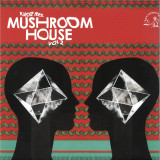
The MUSHROOM HOUSE compilation is a collection of balearic, afro and cosmic disco tracks that have been released on several Toy Tonics EPs over the last 5 years. Toy Tonics now releases some of these EPs on a double vinyl together. This is the second part. Featuring eleven tracks. (Vol 1 was released in 2020.)
Original tracks and remixes by friends of the label: Kiwi, Red Axes, Karl Hector, Hugo Capablanca, Harry Wolfman. Very special contributions by New York's legendary Joe Claussell and fashion designer Marcelo Burlon, who contributed the vocals to a song by Milan’s Barking Dogs. Art Alfie from Studio Barnhus is featured also with an exclusive track and legendary DJ Sprinkles with a magic rework of a Hard Ton song.
A few of the tracks had been already released on Gomma records. The now sleeping indie-electronica label that was the „mother“ of Toy Tonics records. Some were made exclusively for Toy Tonics.
The third in Karate Boogaloo's series of mixtapes exploring hip hop sample material in their off-kilter cinematic soul approach
Includes pieces byMarvin Gaye,Isaac Hayes, Bernard Herrmann, Dolly Partonand themes fromDiamonds Are Forever, Rocky,Psychoand more.
Karate Boogaloo are the quartet at the coalface of Melbourne, Australia's emerging instrumental soul movement