
out of Stock
Order now and we will order the item for you at our supplier.
6,38 €
Order now and we will order the item for you at our supplier.
2x12"[30,21 €]
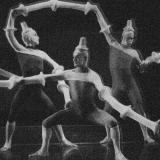
Often credited as the father of multi-media theatre, Alwin Nikolais (1910-1993) took complete creative control over his productions - including cutting-edge approaches to lighting and costume that transformed human bodies into shifting sculptural shapes, while also composing wildly innovative electro-acoustic and synth-based audio as accompaniment.
After initially experimenting with musique concrète and tape manipulation (as demonstrated on the 1959 LP Choreosonic Music of the New Dance Theatre of Alwin Nikolais) Nikolais became the first owner of Robert Moog's synthesizer at the Audio Engineering Society convention in New York in late 1964. Relying heavily on the Moog and later the Synclavier synth/sampler, these 21 tracks document Nikolais' highly-prescient compositions across the mid 1960s through to the late 1980s - existing not only as extensions of his other-worldly choreographic productions, but standalone pieces of foundational mid-century American electronic and experimental music.
"Born in Southington, Connecticut in 1910, Nikolais’s early years and early career were in acting, music and puppetry. It was not until the late 1930s that he began his work as dancer/choreographer in Hartford, Connecticut, where he was commissioned by the Avery Memorial Theatre, a part of the Wadsworth Atheneum, to create an evening-length work to the music of Ernst Krenek. Previously his work and study as a pianist-organist found him accompanying silent films. This sort of accompaniment required from the musician not only a playing skill but also a versatility in improvisation, matching movement to sound, and evoking mood to situation.
Nik was drawn initially to dance by his involvement with the percussion scores used by the illustrious early twentieth century German dancer Mary Wigman. In trying to learn more about percussion, he was lured into dance class and thus his career began. His development of music and dance occurred simultaneously. His introduction to the twelve-tone technique opened his mind to the expanding areas of atonal music, and his dealing with music as sound per se. In 1948, after being appointed director of the Henry Street Playhouse in New York, Nikolais formed the Playhouse Dance Company, later known as the Nikolais Dance Theater, and began his aesthetic orientation toward dance as a study of motion. By the 1950s, he had ceased creating literal dances and began his explorations and eventual milieu as an abstractionist.
Sound became an important part of his abstract theatre. For his first dances, which involved his new thinking of dance as both a visual and kinetic art, he used live percussion scores in which he directed his dancers to play instruments of all nature. There was a combination of children’s toy instruments as well as harsh and resonant automobile brake drums, and other pitched auto parts which he also used to accompany classes. Once he installed his own tape recording machines, he quickly used the limited range these instruments provided in a new way, slowing and increasing speed and reversing sound. He also made the sounds adhere to the choreographic structure (not the other way around), thereby giving the dance its independence from the musical phrasing. But the real need remained: the search for new sound. Nik made a sound library, recording noises and percussion and vocal sounds, which the French aptly called musique concrète. Needless to say, he became a master at splicing bits and pieces.
From 1956 to 1962 Nikolais composed eleven major scores for his theatre pieces using such techniques. In 1963, James Seawright, who at the time was assisting Nik in his productions and also working at the Columbia-Princeton Center for Electronic Music, recorded a sound bank for the production Imago (1963). With this material, Nikolais created his first synthesizer score. Imago won the Paris Grand Prix in 1968 and launched the Nikolais Dance Theatre towards its national and primarily international acclaim.
During the same period, Seawright came to Nik and told him of a young man who had invented and constructed a simplified synthesizer and insisted that Nik visit the electronic fair currently being held in New York. Nik did so and met Robert Moog. He was completely taken by the new machine and after making some suggestions to Moog, (which Moog made), Nik bought the inventor’s first machine with the aid of a Guggenheim Fellowship. Moog himself was astonished by what his machine could produce for Nik. This machine was later acquired by the Museum of Musical Instruments at the University of Michigan at Ann Arbor as the first Moog synthesizer. The Synclavier was Nik’s next source of sound and since the mid-1970s remained the major instrument in the Nikolais soundroom.
Alwin Nikolais has been honored and awarded throughout the world. He has received the French Legion of Honor, the Kennedy Center Honors, National Medal of the Arts, two Guggenheim Fellowships, as well as Mellon, Ford, and Rockefeller grants. He has been a recipient of NEA grants since 1966, been awarded five honorary doctorates, all for his remarkable achievements in Dance Theater. His genius has influenced several generations of artists."
—Murray Louis
expected to be published on 05.10.2026

For more than two decades, AJJ has been writing albums that attempt to make sense of an increasingly confusing world. And the Arizona band has repeatedly succeeded, somehow managing to find the small traces of hope and beauty buried in the wreckage of a decaying planet. But on their ninth album, Dirty Old Power, they are coming to terms with the fact that they may no longer have the words to express it all. In fact, the proper words of communication may not even exist anymore.
Dirty Old Power takes stock of this surreal moment in American history where the post-World War II power structures of capitalism have given rise to full-on techno-fascism, and where humanity is being displaced by data centers, VR headsets, doomscrolling, and artificial versions of our loved ones.
To capture the disparate array of unique styles that make up Dirty Old Power, AJJ returned to Animal Rites studio in Los Angeles to record with their pal, Grammy-winning producer John Congleton, who also produced 2014’s Christmas Island and 2016’s The Bible 2. And for the cover artwork, the band turned to Winston Smith, the legendary visual artist known most famously for his iconic designs and logo for Dead Kennedys.
expected to be published on 16.10.2026

2026 Repress
DJ Koze unveils a spiritual and surprising journey into rapturous spheres with Wespennest EP. The visionary artist and master of electronic sound, presents his first own release after 2018's global club hit "Pick Up".
"Candidasa" and "Wespennest" are the result of DJ Kozes inspiring stay in a secluded Benedictine monastery on the enchanting island of Sulawesi. Amidst this idyllic setting, he found the perfect environment to unleash his musical vision. He composed all of the music of "Candidasa" while lying on his stomach, in an act of deepest devotion and self-reflection. In doing so, he fed exclusively on so-called heroin kebabs to immerse himself in a trance-like state of creative flow. The result is a soundscape of unimagined depth and beauty that enchants the senses and transports listeners to another dimension by massively increasing the frequency of flicker fusion.
On "Wespennest” the wonderful Sophia Kennedy takes the stage and breathes a new dimension into the music with her impactful lyrics and vocals. With generous dedication, Sophia has provided exclusive excerpts of her yet unreleased songs, giving this track a radiant psychedelic power. The combination of DJ Kozes musical genius and Sophia Kennedy's glorious vocals creates a club track full of wonderment, opening up a mystical rapturous world for listeners. Already an instant classic of German dance music.
With "Candidasa" and "Wespennest" DJ Koze has once again pushed the boundaries of electronic sounds and created a spiritual journey that touches the soul and frees the mind. This EP is the first harbinger of his highly anticipated new album, which will be released in 2024. The time until the release can be wonderfully bridged with the magical album "Hit Parade", which DJ Koze has produced for the British legend Róisín Murphy and on which we can be carried away into the world of musical brilliance.
On Stock and ready to ship

Tape[16,60 €]
Often credited as the father of multi-media theatre, Alwin Nikolais (1910-1993) took complete creative control over his productions - including cutting-edge approaches to lighting and costume that transformed human bodies into shifting sculptural shapes, while also composing wildly innovative electro-acoustic and synth-based audio as accompaniment.
After initially experimenting with musique concrète and tape manipulation (as demonstrated on the 1959 LP Choreosonic Music of the New Dance Theatre of Alwin Nikolais) Nikolais became the first owner of Robert Moog's synthesizer at the Audio Engineering Society convention in New York in late 1964. Relying heavily on the Moog and later the Synclavier synth/sampler, these 21 tracks document Nikolais' highly-prescient compositions across the mid 1960s through to the late 1980s - existing not only as extensions of his other-worldly choreographic productions, but standalone pieces of foundational mid-century American electronic and experimental music.
"Born in Southington, Connecticut in 1910, Nikolais’s early years and early career were in acting, music and puppetry. It was not until the late 1930s that he began his work as dancer/choreographer in Hartford, Connecticut, where he was commissioned by the Avery Memorial Theatre, a part of the Wadsworth Atheneum, to create an evening-length work to the music of Ernst Krenek. Previously his work and study as a pianist-organist found him accompanying silent films. This sort of accompaniment required from the musician not only a playing skill but also a versatility in improvisation, matching movement to sound, and evoking mood to situation.
Nik was drawn initially to dance by his involvement with the percussion scores used by the illustrious early twentieth century German dancer Mary Wigman. In trying to learn more about percussion, he was lured into dance class and thus his career began. His development of music and dance occurred simultaneously. His introduction to the twelve-tone technique opened his mind to the expanding areas of atonal music, and his dealing with music as sound per se. In 1948, after being appointed director of the Henry Street Playhouse in New York, Nikolais formed the Playhouse Dance Company, later known as the Nikolais Dance Theater, and began his aesthetic orientation toward dance as a study of motion. By the 1950s, he had ceased creating literal dances and began his explorations and eventual milieu as an abstractionist.
Sound became an important part of his abstract theatre. For his first dances, which involved his new thinking of dance as both a visual and kinetic art, he used live percussion scores in which he directed his dancers to play instruments of all nature. There was a combination of children’s toy instruments as well as harsh and resonant automobile brake drums, and other pitched auto parts which he also used to accompany classes. Once he installed his own tape recording machines, he quickly used the limited range these instruments provided in a new way, slowing and increasing speed and reversing sound. He also made the sounds adhere to the choreographic structure (not the other way around), thereby giving the dance its independence from the musical phrasing. But the real need remained: the search for new sound. Nik made a sound library, recording noises and percussion and vocal sounds, which the French aptly called musique concrète. Needless to say, he became a master at splicing bits and pieces.
From 1956 to 1962 Nikolais composed eleven major scores for his theatre pieces using such techniques. In 1963, James Seawright, who at the time was assisting Nik in his productions and also working at the Columbia-Princeton Center for Electronic Music, recorded a sound bank for the production Imago (1963). With this material, Nikolais created his first synthesizer score. Imago won the Paris Grand Prix in 1968 and launched the Nikolais Dance Theatre towards its national and primarily international acclaim.
During the same period, Seawright came to Nik and told him of a young man who had invented and constructed a simplified synthesizer and insisted that Nik visit the electronic fair currently being held in New York. Nik did so and met Robert Moog. He was completely taken by the new machine and after making some suggestions to Moog, (which Moog made), Nik bought the inventor’s first machine with the aid of a Guggenheim Fellowship. Moog himself was astonished by what his machine could produce for Nik. This machine was later acquired by the Museum of Musical Instruments at the University of Michigan at Ann Arbor as the first Moog synthesizer. The Synclavier was Nik’s next source of sound and since the mid-1970s remained the major instrument in the Nikolais soundroom.
Alwin Nikolais has been honored and awarded throughout the world. He has received the French Legion of Honor, the Kennedy Center Honors, National Medal of the Arts, two Guggenheim Fellowships, as well as Mellon, Ford, and Rockefeller grants. He has been a recipient of NEA grants since 1966, been awarded five honorary doctorates, all for his remarkable achievements in Dance Theater. His genius has influenced several generations of artists."
—Murray Louis
On Stock and ready to ship
2026 Repress
***
He strode towards a long drink.
Running in the gutter,
scanning patterns.
Skin staring, stirring unbelief.
Scarred metal faces
on the iron streets,
spitting blood.
***
Early support by: Luke Slater, Tommy Four Seven, Dave Clarke, Marcel Dettmann, Chris Liebing, Ben Klock, Oscar Mulero, Speedy J, Len Faki, Shifted, Psyk, Pfirter, Objekt, James Ruskin, Sigha, Myler, Stanislav Tolkachev, Rebekah, Par Grindvik, Max M, Gary Beck, Dave Tarrida, Kike Pravda, Samuli Kemppi, Happa, DVS1, Joseph Capriati, Juho Kusti, Cassegrain, Kwartz, Clouds, Pacou, Octave, Stranger, Ansome, Black Asteroid, Hector Oaks, DJ Hyperactive, Christian Wunsch, Endlec, Kriz, Paula Temple, Exium, AnD, Joe Farr, Martyn Hare, Eomac, Dimi Angelis, Norman Nodge, Xhin, Dax J, Wire, Drvg Cvltvre, Sawf, Jamie Bissmire, Paul Mac, Inigo Kennedy, D. Carbone, J. Tijn, CTRLS, The Noisemaker, Jeroen Search, Dustin Zahn, Svreca, Unbalance, Truncate, Jeff Derringer, Jonas Kopp, Developer, 3.14..
On Stock and ready to ship
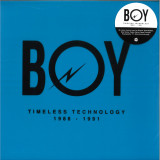
BOY Records was founded by Michael Zosel back in 1987 but it was after a few releases that he started to work with producer Arno Müller. “Brian” by Absurd was the first techno release on the label and a great success in the German techno scene. The cooperation continued with singles by Hypnopedia and New Scene that worked very well and put the name of BOY Records in the charts and clubs all around Germany and abroad. In 1990 another massive success came with the single “Kennedy” by Deep Thought and since there the label did not stop to release hit after hit by lot of names like Time Modem, “O”, Cybex Factor, Sonic System, Moskwa TV, MCL and lot more.
“Timeless Technology 1988-1991” compiles some of the best singles released on label’s most fruitful years. A selection of 24 classic tekkno traxx. Four records with printed inner sleeves packed on a silk-screened transparent Pet-Gag box. Limited edition of 500 copies.
On Stock and ready to ship

2026 Repress
&Me, the chunky critter, did it again! This hypnotic one-off was stoically crafted to be lifted into the next dimension with thousands of people. Where the hospitality of all-encompassing love and euphoria awaits with arms raised and eyes closed.
Mano le tough found the original Muddy Funster so boring that he ran out of cigarettes. Even as a non-smoker! With his congenial version of this evergreens, this deranged pig forces his cranky perception on us and takes us into a mystical world in which no two stones are alike, but whose unique construction represents an earthquake-proof pyramid of love whose dimensions have perfect relationships to the size of the earth and to mathematical laws. Illumination feat Roísín Murphy as Mano Le Toughs needs A Birra Light Remix persistently pulls us music-loving dance muffins under the disco ball with all the TikiTaka tricks in the book, only to let us go and spin gloriously free at the crucial moment. So beautiful, we dance, wow.
On Stock and ready to ship

Molecular Recordings proudly announces the release of "Structure Series 1," a special vinyl collection marking the label's 30th anniversary.
This release features unreleased tracks from both veteran artists and emerging producers, highlighting the label's ongoing commitment to innovative and high-quality techno music.
For three decades, Molecular Recordings has been a leader in the techno scene, continually pushing the genre's boundaries and redefining its sound. "Structure Series 1" is a testament to this legacy, blending the work of established artists who have shaped the label’s history with fresh talent poised to influence its future.
"Structure Series 1" is more than a collection of tracks; it is a celebration of Molecular Recordings' journey and a glimpse into its future. This release commemorates 30 years of musical innovation and signals the beginning of a new chapter in techno.
This item has not yet been released. You can pre-order the product now.

AUMATRA VOL. III — FANZINE TR with Inigo Kennedy, SCHRZØ, Carmelo Ponente, NX1 and Bartig Move The third volume of AUMATRA brings together five essential artists from the contemporary electronic scene in a new release from Fanzine TR. credits releases June 19, 2026 Artwork by Burgalego Masters by Human Mastering Studio
On Stock and ready to ship

Auf ihrem selbstbetitelten zweiten Album taucht das Cosmic Tones Research Trio - bestehend aus Roman Norfleet, Harlan Silverman und Kennedy Verrett - tiefer in die spirituellen Klanglandschaften ein, die ihren genreübergreifenden Ansatz ursprünglich geprägt haben. Das in Portland, Oregon, ansässige Trio schafft ein transzendentales Hörerlebnis, das sowohl in meditativer Stille als auch in rhythmischer Dynamik verwurzelt ist. Mit einer Mischung aus Cello, Altsaxophon, Klavier, Flöten und einer eklektischen Palette von Texturen und Percussions vermittelt das Album eine heilige Energie, die sich sowohl uralt als auch zukunftsweisend anfühlt. Es ist Musik zum Nachdenken, zum Bewegen und für innere Reisen. Die Stücke entfalten sich mit geduldiger Anmut, pulsieren jedoch mit bewussten Rhythmen, die den Zuhörer erden - und damit den zeremoniellen Geist des kosmischen Jazz und tiefer Improvisationstraditionen widerspiegeln. Dies ist keine Hintergrundmusik, sondern eine Einladung, sich ganz einzulassen, mit den Instrumenten zu atmen und den Grenzraum zu erkunden, in dem Klang zum Gebet wird. Mit dem Cosmic Tones Research Trio setzen Norfleet, Silverman und Verrett ihre Erkundung klanglicher Territorien fort, in denen das Mystische und das Musikalische verschmelzen.
On Stock and ready to ship
On Stock and ready to ship

Gems return with another superb signing from the 90’s the mighty Eagles Prey. The release reworks a 1992 underground classic, originally produced by John Kennedy (Apple Records) alongside Lee Grainge (Fat Cat Records) and Paul Coleman (Rocket Science , Rehab/Offshoot , Zoom Records) — a lineage deeply rooted in UK electronic history.
On remix duties, the Circulation Mix delves deep and hypnotic already receiving heavyweight support from Laurent Garnier and John Digweed, underlining its club and tastemaker appeal.
Jim Rivers, a proven serial producer and DJ, adds his signature depth and precision, balancing modern floor functionality with timeless underground sensibility.
Rounding out the package Ranj Kaler continues his standout run, currently omnipresent across production, remixes, and DJ sets, delivering contemporary drive while respecting the original’s DNA.
A release that bridges heritage and forward momentum, built for discerning DJs, specialist radio, and late-night systems.
On Stock and ready to ship

Pilot Talk II is the fourth studio album by New Orleans rapper Curren$y, and follow up to his widely celebrated release, Pilot Talk. Originally released in November 2010, and initially only available on CD & digitally, Pilot Talk II was first pressed on vinyl and exclusively available in the Jet Life: Pilot Talk Collection Vinyl Box Set. For the very first time ever and after much anticipation from fans, Pilot Talk II will be released as a standalone vinyl product, exclusively available for Record Store Day Black Friday 2025 to celebrate the album's 15 year anniversary. Pilot Talk II includes standout tracks such as "Michael Knight," "Famous," "Hold On (feat. Trademark Da Skydiver & Young Roddy," & perhaps one of Curren$y's biggest solo songs, "Airborne Aquarium." Pressed on stunning Purple, Black & White 3 Color A Side B Side Vinyl and limited to 3000 copies worldwide, Pilot Talk II is a must have for any Curren$y or blog-era rap aficionado.
On Stock and ready to ship

Berlin's ://about blank club has long been a top hangout for the city's more discerning heads and this year it marks 15 years in the game. It does so with this tenth release on its label arm - a triple EP compilation that brings together 12 exclusive tracks from key artists tied to the venue and who reflect its adventurous musical identity. Kalipo's vocal-driven anthem 'My Heart Is A Hotel' kicks off with cold wave synth energy, then Lawrence's dreamy minimalism casts your mind adrift. There is also Alex.Do and Sylvie Maziarz deliver high-energy techno and rave, deeply cinematic cuts from Inigo Kennedy and Hagen Richter, while Rodmin and Ahu offer lush, hopeful house. The final slab offers moody hypnosis from Anja Zaube, Erik Jaahalli, Irakli and Fragen shuts down on a cosmic note. A great snapshot of ://about blank's sound.
On Stock and ready to ship

Mr Bongo proudly presents the third album by Melbourne/Naarm multi-instrumentalist, Don Glori, entitled ‘Paper Can’t Wrap Fire’. A kaleidoscopic genre-surfing odyssey that brings together the worlds of jazz, soul and funk. Feeling both contemporary and classic, familiar yet novel, it’s an assured third release that sees an artist in full flight, showcasing their creative prowess and the uniqueness of their musical voice.
Steering in a new direction, Don Glori (aka Gordon Li) has delved headfirst into his songwriting with ‘Paper Can’t Wrap Fire’. Deftly showcasing his talents as a writer and bandleader, he brings with him a whole host of friends from the creative crossroads that is Naarm. It’s an album enriched with more soul, R&B, and funk-oriented songs than his previous jazz-rooted productions, yet there’s still plenty of jazz material for those familiar fans of Don's earlier works.
The album’s title is an old Chinese proverb, roughly translated as 'you can’t deny the truth'. This underlying thread is woven between the songs. “A lot of them are in some way about truth-seeking, observations and the masks you put on to deal with life (hence the cover art)”, Don mentions. Take, for instance, the sensational soul single 'Brown Eyes' featuring silky lead vocals by ML Hall. A dissection of the minority experience, and the power and comfort in building those communities. Elsewhere, 'Disaster' is a satirical take on the structures serving everyone but the artists, and 'Flicker' tackles notations of truth and clarity after introspection.
To marry that meaning with the level of musicianship on these tracks is what really stands out. Don has set out his stall here as an artist who can write songs that hit home in the heart, as much as they do in the head. It’s a journey infused with a glistening jazz finesse, layered with nourishing vocal harmonies and powered by an instantly relatable human soul.
Recorded over two hot summer days in Rolling Stock Studios in Collingwood, Naarm, the lineup of musicians is built up of Don's friends and family. Featuring the backbone team of Tim Cox, Al Kennedy, Joel Trigg, Robyn Cummins and Lachlan Thompson, who were part of Don's touring band before he relocated to London, and a stunning selection of vocalists in the form of ML Hall, Ruby Dargaville, Isadora Lauritz, and Bianca Kyriacou. Also gracing the album are trumpeter extraordinaire Audrey Powne, saxophonist Joshua Moshe, and Alcides Neto who sprinkles some Brazilian magic into the record.
Taking influence from artists including Azymuth, SAULT, Jordan Rakei and Lynda Dawn, as well as from London musical beacons such as NTS and Total Refreshment Centre, Don has run with this, leaned in and come out with a record truly unique to himself and his distinctive core, with no mask necessary.
On Stock and ready to ship

Portland's finest practitioners of Great Black Music offering to the planet! All Is Sound could not be a more apt title for this. Through saxophone, cello, piano, and flutes The Cosmic Tones Research Trio created a truly beautiful record. All Is Sound breaks new ground. At its heart, it's healing/meditation music, but the Gospel and Blues roots are in there too...as well as hints of forward-looking Spiritual jazz.
As sincere a record as you could ever hope for. Music is indeed the healing force of the universe. Formed by alto sax player and composer Roman Norfleet, cellist and multi-instrumentalist Harlan Silverman, and pianist Kennedy Verrett—who also plays a wide variety of wind instruments—, The Cosmic Tones Research Trio focuses on healing music. In All is Sound, delicate, profound melodies create peaceful, immersive soundscapes, which the group develops through their combined background in acoustic ecology, sound meditation, mindfulness, and active community involvement.
A noteworthy follow up to Norfleet’s first length with Mississippi Records (the self-titled Roman Norfleet and Be Present Art Group, from 2023), All is Sound offers the chance to engage with songs intended for healing. Following the steps of musicians such as Sun Ra, Alice Coltrane, and Pharoah Sanders, The Cosmic Tones Research Trio delivers music that is both restorative and sonically rich—each tone falling into perfect place, as if by magic. Praise for Roman Norfleet and Be Present Art Group: “A free-flowing suite.” — The Quietus // “Life-affirming music.
On Stock and ready to ship

Pacific Rhythm’s “Rhythms Of The Pacific” series returns with a 12” sampler of material that will be included as part of a larger 10-year anniversary compilation later this year. Tunes from LNRDCROY, Khotin (under his Waterpark alias), Active Surplus, and Kennedy are on deck to set the tone. Limited and downright essential for enthusiasts of the sound Pacific Rhythm has cultivated since 2013.
On Stock and ready to ship
There is propably no single event that has as potent of an
effect on the german Techno- scene as the fall of the Berlin
Wall. A city divided suddenly, in one single night, became
uni¦ed, opening up both sides for the new experiences and
ways to view life the other might have. Berlin’s eastside with
it’s empty, unused warehouses proved to be a fertile breeding
ground for free spirits and those carrying a newfound ¦re in
their eyes. This was the zero hour. The Consolidation. And it
is this mindset, spirit and ¦re of Consolidation that Shaleen
conjures on her debut EP of the same name. The title track
opens up by sampling John F. Kennedy’s legendary “Berlin”
speech from 1964, before absolutely caving in the concrete
with a beyond-heavy kickdrum and a very stripped down but
effective 909-percussion section. Spursed in along the track’s
runtime are droning sirens and JFK continuing to beckon you
to lose yourself in the metropolitan bowels. This is the
anthem of a past revolution. On Deconstruction, Shaleen
goes down a slightly more basement oriented route. The
Percussion shares the title track’s stripped down
effectiveness, but the Groove is more rolling, the Vocal
samples are more distorted and there are sharp synths
cutting through the beats like shards of broken glass. Of
course, a revolution wouldn’t be complete without a mob so
both Cadency aka Hector Oaks and New Frames have put
their spin on the EP’s title track. Mr. Cadeny is up ¦rst and,
being no stranger to revolutionary anthems, has given
Consolidation an almost contemplative mood in his Remix,by adding a very subtle melody. This doesn’t mean it hits any
less hard, mind you, there is an incredibly strong drive to the
track, paired with an almost constantly looping vocal and the
sirens going into overdrive, this would be the track to drive
crowds into a frenzy. Meanwhile New Frames’ track is the
kind of thing you wouldn’t want to encounter alone in a dark
alleyway. The sub-basses are heavy enough to terraform
Mars, the Jungle-esque Synthlines roar and snarl at the
listener and every drop feels like a right hook to the chin. The
original’s vocal is cut in a way that it only adds to the
stomping rhythm, putting you in a mood to throw bricks. So
while this record showcases an aggressive sound and a
mood for revolution, it is important to remember it’s title.
Consolidation. It echoes a message of uni¦cation. Of
standing together. Because together we are, have been and
will always be stronger than by ourselves.
On Stock and ready to ship

repress
This December, Slovenian label Cogo is presenting their second release. After the amazing success of the first release by Tonske with remixes from Magna Pia and Volster, Cogo presents this four track various artist vinyl release with modern and futuristic techno sound. The EP contains tracks by Stanislav Tolkachev, Inigo Kennedy, Samuli Kemppi and Tonske. Early support by: Marcel Dettmann, Ben Klock, Dax J, Josh Wink, Charlotte de Witte, Terence Fixmer, The Advent, Benjamin Damage, Wata Igarashi, Electric Rescue, Takaaki Itoh, Svreca, Ness, Kaiser, Dimi Angelis, Orde Meikle, Kr!z, Stephanie Sykes, Arnaud Le Texier, Arjun Vagale, Kessell, Tensal, Hd Substance, MTD, Brendon Moeller, Juho Kusti, Leiras, W.I.R.E., Joton, Xhei, JP Enfant, Audio Units, Alderaan etc.
On Stock and ready to ship
Repress
I lean upon this,
I lean on all of this
and I know
her dress upon my arm
but
they will not
give her back to me.
Early support: Truss, Tommy Four Seven, Truncate, Marcel Dettmann, Psyk, AnD, Pfirter, Eomac, Perc, Rebekah, Svreca, Paula Temple, Dax J, Joseph Capriati, Joachim Spieth, Henning Baer, Lag, Takaaki Itoh, Go Hiyama, D. Carbone, Par Grindvik, Max M, Wire, Paul Mac, Kriz, Octave, Drvg Cvltvre, Dimi Angelis, Joe Farr, Ryuji Takeuchi, Slam, Rivet, Gary Beck, Nuno dos Santos, Manni Dee, Luis Ruiz, Mark Morris, Mattias Woot, Mike Darkfloor, Erphun, Radial, Exium, P.E.A.R.L., Mr. Jones, Joseph Mcgeechan, Joton, UVB, Juho Kusti, Aiken, Operator, Jeff Rushin, Martyn Hare, Inigo Kennedy, Sebastian Kokow, Roberto, Shards, L.A.W, Ricardo Garduno, Space DJz, Operator, Blank Code, Patrick DSP...
On Stock and ready to ship

Vol. 1[22,27 €]
Vol.2 Black Vinyl[24,79 €]
Vol.2 Limted Red Vinyl[26,01 €]
Vol. 3 Transparent Violet Vinyl[27,52 €]
Standard version on 2LP black vinyl in gatefold sleeve. ‘Lefto presents Jazz Cats' is back with volume 3 and still doing what it does best: putting you in the front row of what the thriving Belgian jazz scene currently has to offer and revealing a melting pot of the musical talent.
'Lefto presents Jazz Cats' is back with volume 3 and still doing what it does best: putting you in the front row of what the thriving Belgian jazz scene currently has to offer and revealing a melting pot of the musical talent coming out one of the smallest countries in Europe. Never change a winning team they say, so we're happy to have Belgian DJ and eclectic connoisseur Lefto on board again.
Although you expect thecompilation to be talking jazz, volume 3 explores a broader array of styles, genres, and sounds than ever before, arriving at a point where the 'young cats' of today don't bother no more. It may focus on the Belgian scene, but let's face it, seeing the influences, this one could be compiled from all over the world. From the empowering and bittersweet voices of Oriana Ikomo and Adja, over the more acoustic-electronic productions of Moodprint, Ciao Kennedy, Kassius and echofarmer. It's even expanding the Jazz Cats universe to dub and bass-heavy tracks with Kin Gajo and Le Ministère, Ethio-jazz from Azmari, while sending you back to earth with bodies' swirling sax and drums. That saxophone still rings in your ears when you end up in the orbit of the march-like drums of Bodem, Orson Claeys' piano testing your ability to follow him, slamming the breaks to go smooth cruisin' with HONEY (Morricone meets Khruangbin, anyone?), to crashing in a raging tempo on that last track of Bruno x Soet x Moene. And there you are, back with us.
2018's 'Lefto presents Jazz Cats' included tracks from some of Belgium's biggest hitters, including Black Flower, STUFF. De Beren Gieren and Glass Museum who have all gone on to receive global acclaim. The album was given the accolade of 'Album of the Week' on Worldwide FM and also received further radio support from Jazz FM in addition to numerous glowing reviews. The 2022 follow-up 'Jazz Cats volume 2' paved the way for a new generation inspired by its peers, entering another era of very talented individuals and collectives. Maybe even more so than 4 years before. It uncovered a beautiful balance of more established but also obscure musicians and artists. Opening up to electronics and dance, enter bands like ECHT!, Stellar Legions and TUKAN. Thrilling innovative soundscape grooves and jazz fusion with Bandler Ching and L?p?GangGang, not to forget about the weaving musical odyssey that is M.CHUZI. In addition, there's the balanced unease of One Frame Movement, the laidback 'acoustic electronica' of Boombox Experiments, the classic funky jazz stylings of Cargo Mas and cinematic The Brums, all of these have set volume 2 on the map as an essential release for any jazzhead with a passion for new sounds.
Tastemaker, selector, curator, DJ and producer, these words often get mentioned when Lefto's name pops up in discussions. And rightly so. If you've ever had the pleasure to listen to one of his incredible Boiler Room sets or one of his many radio shows, you'll know why. Famed for his gloriously eclectic taste on the decks, he switches effortlessly between hip hop, funk, breaks, neck-snapping beats, future bass, South-American influences, bruk riddims, some wild African rhythms and of course, jazz.
Growing up as a child, his father would have the sounds of jazz flowing through the speakers. Which led him to bars around town to hear the latest jazz ensembles. Falling in love with the genre, he would later refine his knack for record digging and fine ear for music working at Belgium's legendary Music Mania record store in his hometown Brussels. Which makes that Lefto is consistently a couple steps ahead. He doesn't wait for the next thing to land in his lap, but actively seeking it out.
Lefto on Jazz Cats volume 3:
"Another release in less than two years! I am very impressed by the amount of creative "jazz" talent we've managed to compile over the last couple of years. Thanks to the internet, young musicians find inspiration from around the globe and incorporate diverse influences into their work. Given the history and heritage of jazz in this country, it has managed to create a healthy jazz scene supported by festivals, venues, press, and labels. Therefore, I am very proud to present to you the thirdinstallment of Jazz Cats. This compilation is dedicated to the young and hardworking musicians who are the present and the future of Belgium's jazz scene."
On Stock and ready to ship

August Greene culminates years of mutual respect and friendship, channeling the musicians’ various talents into a cohesive project. The perfect marriage of jazz, hip-hop and soul, it’s music that just is. This is black expression the way God intended: earnest, unfiltered, and harmonious. Throughout August Greene, you feel the abundance of Glasper’s rolling keys, the sheer honesty of Com’s lyrics, and the nuanced subtlety of Riggins’ drum work. It’s a fluid sound that’s sorely needed in today’s landscape, and a teachable moment for the next wave of creators. “I feel like we need to set the bar for this generation of musicians and producers,” Riggins says. “There’s a lot of computer-driven music. This is the opposite of that. We’re showing you can still use your creative muscle on an instrument to generate your own sound.” August Greene is a meditative offering that stands tall against the era of “fake news.” “They body snatching black girls in D.C. / Politics and propaganda on the TV,” Common observes on the opening track. On “Nirvana,” the lyricist uses a stuttering percussive loop and faint piano chords to search his inner being: “Thought I was gonna fly when Obama became the king … when it’s all done, will I have heaven’s dress code, and been able to let God and let go.” As Com puts it, Glasper and Riggins’ soundtrack allowed him to open up in ways he hadn’t done previously. Like on “Fly Away,” for instance, where he riffs on the public relationships he’s had. Other songs, like “Black Kennedy,” feel spacious and scenic. “I got to go new places with the music, and it didn’t have to fit within a genre for me to participate on it,” he says. “This gave me an experience I haven’t had in a long time, so I want people to feel that. I want this to be a cleansing of whatever doesn’t feel good or inspiring.” In the end, August Greene speaks to those pushing through the dark for brighter days. It's a masterpiece from which virtue can shine. “I want people to go on the ride and be open,” Glasper says. “We just created and it became a sound. I want people to approach this with an open mind and without expectations.” —Marcus J. Moore
On Stock and ready to ship

Early support by: Marcel Dettmann, Takaaki Itoh, Gary Beck, DVS1, Adam Beyer, Randomer, Jeroen Search, Speedy J, Jonas Kopp, Tommy Four Seven,Slam, Mosca, Psyk, Paul Mac, NX1, Manni Dee, Progression, Scalameriya, Thomas Hessler, Juho Kusti, Ryuji Takeuchi, Mr Jones, ANFS, Dustin Zahn, Kyle Geiger, Joton, Paul Birken, Hector Oaks, Charlton, Dario Zenker, Kwartz, Dimi Angelis, Drvg Cvltvre, Stranger, Mikael Jonasson, Arnaud le Textier, Dax J, Jerome Hill, 3.14, Pfirter, Echologist, Darko Esser, Tripeo, Endlec, Stenny, Clouds, I/Y, Rivet, Henning Baer, Dave Tarrida, Rolf Mulder, W.I.R.E, SHDW, Pacou, Patrick DSP, Ansome, Sebastian Krenzlin, Rebekah, Gareth Wild, Domenico Crisci, Perc, Setaoc Mass, J.Tijn, Radial, Aiken, The Black Dog, Ness, Developer, Exium, Sawf, Joseph Capriati, Svreca, Shards, Truss, Truncate, Myler, Inigo Kennedy, Advanced Human, Operator
On Stock and ready to ship
Life Creates Itself is the new album by Bill Baird, releasing September 25th, 2026 on Royal Oakie Records. After years of restless wandering that took him from the Bay Area to India to Abbey Road and back again, Baird has returned home to San Antonio, Texas. Inspired by Lone Star legends Doug Sahm and Roky Erickson, the album inhabits a world where outsider country, avant-garde pop, and psychedelic folk dissolve into one.
Produced by longtime collaborator Jasper Leach (Tony Molina, Color Green) and mastered by indie-rock legend KRAMER (Galaxie 500, Daniel Johnston, Will Oldham), Life Creates Itself was recorded at Sear Sound in New York City in a single remarkable day — fitting for an album as indebted to Arthur Russell and Captain Beefheart as it is to Sir Douglas Quintet and Townes Van Zandt. The sessions brought together a constellation of collaborators around Baird and Leach, including Pedrum Siadatian (Allah-Las, PAINT), Phil Carluzzo, Austin Day, Oliver O'Haver, Jordan Johns, Michael Vattuone, Clara Kennedy, and Carluzzo’s dog Ernie.
Lead single "Yanaguana" — the original Payaya name for San Antonio, meaning either "land of many waters" or simply "where I am right now" — serves as a thesis statement for the album, a restless soul reckoning with what it means to finally come home. Meanwhile, "Karma Loan" is a fuzzy, sprawling psych track that spilled out of Baird during a deep immersion in Bach that features cello by Clara Kennedy and closes with a sound collage of spiritual gurus hawking easy paths to enlightenment. Then there's "Horse Moon" — built around pedal steel that shimmers like rays of moonlight, drifting through vignettes from a late night walk across New York City, with Pedrum Siadatian's lead guitar lending the whole thing an unhurried, dreaming quality. The night they tracked it, Baird climbed to the roof of Sear Sound and watched a full moon wash the city in a warm glow.
Baird has never sounded more at home, and Life Creates Itself may be his most cohesive record yet – a songwriter record through and through that stands apart from the rest of his discography. Royal Oakie Records is proud to release Life Creates Itself on September 25th, 2026, available on vinyl LP, CD, and digital download/streaming worldwide.
expected to be published on 25.09.2026

2026 Repress
Son of sins.
Black days, asphalt jungle.
Silence,
while she was out there.
***
Early support by: Blawan, Surgeon, Dave Clarke, Tommy Four Seven, Speedy J, Chris Liebing, Gary Beck, Marcel Dettmann, Truncate, Pfirter, Rebekah, Chris Finke, The Public Stand, Radial, Clouds, Paul Birken, Kriz, Mr. Jones, Lag, Sunil Sharpe, Charlton, D. Carbone, Juho Kusti, Jeff Derringer, Pacou, Paula Temple, Erphun, P.E.A.R.L. , Thomas Hessler, Paul Mac, Henning Baer, Luis Ruiz, Gareth Wild, NX1, Sandrien, J. Tijn, Joachim Spieth, Exium, Nuno dos Santos, Octave, Markus Suckut, The Black Dog, Xhin, The Zone, Blindspot, Samuli Kemppi, Hans Bouffmyhre, Fran Hartnett, Christian Wunsch, Wire, Sawf, Inigo Kennedy, Hector Oaks, Kontort, Adam X, Rich Jones aka Operator, L.A.W, Mark Morris...
Hot off the heels of a stack of fine singles, they found love with the likes of Nels Hylton, Amy Lame, John Kennedy, Visions, NTS, Bring The Noise, Upset, arts culture, Distorted Sound, The Punk Site and many more - building a buzzing community, touring with Don Broco and Weakened Friends, finding favour with scribes at the likes of Kerrang, Rock Sound and Clash and popping up on the BBC Radio 1, Radio X and BBC 6 Music airwaves with alarming regularity... Signed to Alcopop! (UK/ ROW) and Grand Hotel van Cleef (GAS) they drop fiery choruses, grungy riffs and catchy hollering britpop sensibilities. With these future anthems all wrapped around vocalist jim heffy's lyrics of angst, depression and medication, break- ups, drinking and problematic housemates, it's prescient to remember the most important message that resides in the beating heart of these songs - 'be kind and be free to express yourself, no matter who you are'.
expected to be published on 21.08.2026

Futurismo are thrilled to present Give Thanks, the long out of press 1984 hardcore classic by Articles Of Faith. Produced by Bob Mould, and newly remastered directly from the original tapes, this powerhouse of a record is now coming on both LP and CD after being unavailable for decades. Originally released in 1984, the debut LP Give Thanks by Chicago hardcore legends Articles Of Faith, is proof a hardcore record can be both political and poetic. Fuelled by rage, introspection and a musical progression that could be seen as a blueprint for what would later become known as post-hardcore, this album ticks every box you want from a record of the era: intense, emotive, scathing, unpredictable, all topped off by the masterful production of Bob Mould (Hüsker Dü/Sugar). Give Thanks is perhaps overlooked in many top ten’s of the genre, but leaving the bands debut LP off that list would be a mistake. A demonstration in raw emotion and political angst, Give Thanks harnesses a sound that could have only happened during the Reagan era. Hardcore was of course a musical explosion built upon aggression and discontent, yet Give Thanks forcefully fuses this concept of raw power with a multitude of musical influences at a time when some of their contemporaries perhaps seemed to tread water. Whilst the principles and sonics harnessed on AOF’s debut album may have had more in common with the sounds coming out of Washington D.C., this record has an authentic Chicago savvy running through it, effortlessly projecting a street level tone whilst simultaneously aiming to show the possibilities of what a hardcore record could be. In retrospect, AOF’s debut was a hardcore album ahead of it’s time, perhaps the reason it’s fervent themes and artistry still feel so fresh and relevant. Whether that’s due to Vic Bondi’s gravelly tones geared to critique the societal regime at play, or the considered guitar work aimed to both blast and texturize, or the intense drums rhythms inspired by jazz and dub, there is a depth to the final album that feels like a band testing their parameters, one listen to ‘Every Man For Himself’ and you know you are listening to something special. Familiarity and originality rarely crossover, but in this case they coexist to leave us with a forward thinking punk record that is more interested in shouting it’s emotions from the street, than it is screaming into a vacuum.
A true American hardcore record, and a must for fans of Minor Threat, Dead Kennedy’s, Bad Brains and Fugazi.
Gloss laminated digipak CD & Limited edition pink & white colour vinyl.
expected to be published on 17.07.2026

Ever since the late 1950s bossa-nova revolution, Brazil’s influence on French music has been undeniable. Pierre Barouh, Georges Moustaki and a vast array of lesser known artists, all made the Musica Popular Brasileira (MPB) an axis of promotion at the service of a cool and metaphysical, modern and mixed Brazilian lifestyle. Some were seduced by the poetic languors of the bossa, some were looking for fun, and others just loved the American hybridization of jazz-bossa, jazz-samba.
What is bossa nova? One of its creators, Joao Gilberto said: "Its style, cadence, everything is samba. At the very start, we didn't call it bossa nova, we sang a little samba made up of a single note - Samba de uma nota so .... The discussion around the origins of bossa nova is therefore useless”. It is nevertheless useful to remember that these magnificent Brazilian songs, which the guitarist describes as samba, were shifted and balanced around improbable chords. "I like things that lean, the in-betweens that limp with grace," said Pierre Barrouh, quoting Jean Cocteau.
With emotion, arrangements for violin and supple guitar licks, bossa nova rapidly changed. A transformation that can be heard in the Tchic, tchic, French Bossa Nova 1963-1974 compilation, the result of a cultural reappropriation, which traveled through the United States and supplemented itself in France.
A musical revolution that has remained significant, bossa nova was born in Rio. From 1956 to 1961, Brazil lived through its golden years. In five years, the country had invented its modernist style. Elected president in 1956, Juscelino Kubitschek de Oliveira, an elegant man with a broad forehead, brandished a promising slogan: "Fifty years of progress in five years". He quickly got to work. Not worried about increasing debt, he launched the project for a new federal capital, Brasilia, designed by the communist architect Oscar Niemeyer. Volkswagen opened state-of-the-art factories and created the “fusquinha”, the Beetle. In Rio, the Vespa made its first appearance. The Arpoador Surf Club crew run into the “girl” from Ipanema, Helô Pinheiro - the tanned garota ("chick"), between a flower and mermaid, who at 17 walked by the Veloso bar, where the fiery author and composer, Tom Jobim and Vinicius de Moraes, were getting drunk on whiskey. From then on, bossa symbolized cool.
In 1958, Joao Gilberto recorded Chega de Saudade, which the directors of Philips denied, calling it "music for fagots". The marketing director, who believed in it, secretly pressed 3000 78-inch vinyls and distributed them at schools around Rio, creating a tidal wave.
American jazzmen then took over. In particular, trumpeter Dizzy Gillespie and guitarist Charlie Byrd. In November 1962, the Brazilian Ministry of Foreign Affairs funded a "Bossa-Nova" concert at Carnegie Hall in New York, inviting the genre’s pioneers. Unprepared, the show soon turned to disaster. But the troupe was invited to the White House by Jackie Kennedy. The first lady loved "the new beat" and in particular Maria Ninguem, a song by Carlos Lyra, later covered by Brigitte Bardot.
In Brazil, the 1964 military coup quickly ended this euphoria. The destructive atmosphere that ensued pushed many Brazilian musicians to leave, if not to exile. Thus, Tom Jobim, Sergio Mendes and Joao Gilberto arrived to the United States. In New York, Joao Gilberto met saxophonist Stan Getz. At the time, he was married to the Bahianese Astrud Weinert Gilberto, who had a German father. She had never sung before, but she knew how to speak English. Getz therefore asked her to replace her husband on The Girl From Ipanema. The Getz/Gilberto record with Tom Jobim on piano, was released in March 1964. Phil Ramone, the "pope of pop" was in charge of sound.
Bossa nova arrived in Paris through the classic “guitar-voice” channel (Pierre Barouh, Baden Powell, Moustaki…) But France loved jazz and Paris had already welcomed its American contributors. All these good people were to pass through Saint-Germain-des-Prés. The cabaret l'Escale became the Mecca of Latin American sound where one could find Pierre Barrouh and his friends, such as the Camara Trio, samba-jazz aces, whose only record was published by the Saravah label. With a band strangely called Les Masques (a band that included Nicole Croisille and Pierre Vassiliu, among others), the Camara Trio recorded an interesting Brazilian Sound, including the track Il faut tenir which is present on this tasty compilation of rarities.
Other enlightened musicians can also be found on the compilation, such as Jean-Pierre Sabar (songwriter for Hardy, Auffray, Leforestier ...) and the French pop rock organist Balthazar. In 1975, Sabar recorded Aurinkoinen Musiikkimatka on a Finnish label, which featured the crazy Vai, Vai, included on this record. We are now following the footsteps of Brazilian electronic musicians such as Sergio Mendes, Eumir Deodato or Marcos Valle who created funk and disco sounds on their keyboards and synthesizers. A style that influenced Véronique Sanson when she wrote Jusqu’à la Tombée de la nuit in 1969 for Isabelle de Funès, the niece of Louis and a great friend of Michel Berger - Sanson did end up singing this track on her 1992 Sans Regret record.
The pinnacle of exoticism and travel, Sylvia Fels’ Corto Maltese includes bongos, sea mist and ocean sounds. The title was taken from Jacky Chalard’s concept album written in 1974, Je suis vivant, mais j’ai peur (I am alive, but I am scared), based on Gilbert Deflez’s science fiction novel.
However, bossa nova extended the scope of popularity. "In the 1970s, I was a fan of Sergio Mendes, Getz / Gilberto. I fell in love with this music that I knew because I had been an orchestral singer, " explained Isabelle Aubret, who in 1971 delivered a composite record of covers by the very funky Jorge Ben, Orfeu Negro, Tom Jobim, Vinicius de Morais and Jean Ferrat. "I recorded this album for Meys Records in Paris, far from Brazil, with wonderful musicians, François Raubert, Roland Vincent, Alain Goraguer...". The latter wrote the arrangements for Casa Forte, a very percussive title borrowed from Edu Lobo, one of the initiators of the bossa who spent time in California. "Jazz and bossa came together and produced very rhythmic music. I love singing, it allows me to dream, to have fun, to feel a high on stage, and these songs brought me joy, made me swing, my singing felt like a dance.”
The world tours of French singers and their desire for the tropics, often brought them to Rio with its hills, forests, caipirinhas and tanned bodies. There are surprises though, like this Iemenja (Iemenja is the goddess of the sea in the Afro-Brazilian candomblé religion). Not unlike the composer and musician Jean-Pierre Lang, based in Sao Paulo, Claire Chevalier taught Brazil to Brazil. In 1970, the singer and painter published a 45-inch vinyl, Mon mari et mes amants (My husband and my lovers), under the improbable pseudonym of Clarinha (little Claire). She was then living in Rio, with her husband, Joël Leibovitz, who founded a band called Azimuth, and who owned a record label specialized in "sambas enredos" songs for samba school parades.
For its B side, she asked Pierre Perret to come up with lyrics for a song composed by Carlos Imperial: "Oh goddess of the sea, o goddess Iemenja, I bring a white rose to adorn your long hair ..." . "Perret came to see us, and we had fun, remembers Joël Leibovitz. We wrote Lemenja for fun, we recorded it at the Havaí studio, behind the Central do Brasil the central station. Erlon Chaves, the arranger who worked with Elis Regina, joined us" adding his share of Afro-Brazilian percussions and funky brass to the mix.
There is a common misunderstanding in Franco-Brazilian history: that bossa, admittedly hedonistic, is perceived as funny, even though the poets who wrote the texts are often philosophizing on the human condition. Its French interpreters pull it towards a carnival inspired universe, far removed from its fundamental essence. Thus, Jean Constantin covered the famous Samba da minha terra, an ode to the art of samba written by the classic Bahian composer Dorival Caymmi, renaming it with the enticing title of Pas tant de tchi tchi pompon: "On your pier there is no tchi tchi / when you arch your back, you know everything is alright ”(lyrics by Gérard Calvi). This expedited bossa aims for the absurd, but retains a certain elegance.
Indeed, Jean Constantin was not an idiot, the rather large man had a huge mustache and liked fantasy, (Les pantoufles à papa, Le pacha, inspired by cha-cha-cha-cha, salsa and jazz) but he was also the lyricist of Mon manège à moi interpreted by Edith Piaf, the composer of Mon Truc en plume by Zizi Jeanmaire and the soundtrack of François Truffaut’s 400 Blows. Le Poulpe, published in 1970, from which this bossa is extract, was arranged by Jean-Claude Vannier, an accomplice of Serge Gainsbourg’s Melody Nelson. In short: "There is enough of samba / By looking at the parasol / Because my poor cabeza / Is going to die in the sun".
Even the American actress Marpessa Down, who was at the heart of the bossa nova revolution with her role as Euridyce in Marcel Camus’ film Orfeu Negro, winner of the 1959 Cannes Palme d'or, fed the clichée with Je voudrais parler au petit cuica - "Tell me how you manage to always make people want to dance / It's true, I must admit that I cannot resist your magic" - in consequence, once can hear the cuica, a little drum inherited from the Bantu.
But bossa nova had many angles. Societal, of course, pushing actresses who were symbols of women's liberation like Brigitte Bardot, Jeanne Moreau, or Sophia Loren to engage in the exercise of accelerated bossa. In February of 1963, Sophia Loren made a record in French in Rome, Je ne t'aime plus, featuring the song De jour en jour, a bossa written by two Italians, Armando Trovajoli and Tino Fornai, which was released a little later by Barclay. Bossa accompanied the 1960s, a decade of moral liberation. Ann Sorel, who interpreted La Poupée des favellas, caused a sensation with L’amour à plusieurs, a provocative song written by Frédéric Bottom and Jean-Claude Vannier. As for the actress Andrea Parisy, she displayed her bourgeois cheekiness in Marcel Carné's Les Tricheurs before interpreting Les mains qui font du bien. And Magalie Noël, the friend of Boris Vian, who sung Johnny fais-moi mal, was hired to sing Une énorme Samba, composed by Alain Goraguer (arranger to Gainsbourg, Bobby Lapointe and Jean Ferrat) with lyrics by Frédéric Botton.
But in the end, of what wood is bossa nova made of? The answer is given by Christianne Legrand, daughter of Raymond the conductor, and sister to Michel the composer: "With me, with jà" - jà means "immediately" in Portuguese. In 1972, the singer, an expert in vocal jazz and a member of the Double Six, published Le Brésil de Christianne Legrand. Two songs included on the Tchic Tchic compilation that demonstrate how bossa, jazz, funk, rock, etc. work like a swiss army knife: the music is used to denounce broken systems, or miracles, HLM et ciné roman, Cent mille poissons dans ton filet, two songs from the O Cafona soundtrack, a successful telenovela broadcast, at the time in black and white, on TV Globo. The first was adapted in French by the fighter and friend of the Legrand tribe, Agnès Varda. The second is content with a play on words, jostling them into a summer fun.
Véronique Mortaigne
Order now and we will order the item for you at our supplier.

Vacation. A backpack trip through Australia, a campfire in the Schrebergarten. Cruising in the car with friends through the Lüneburger Heide or just a short holiday in the mind, during a rainy lunch break or with a glass of Sprizz on the balcony. And this all includes music, music, music! Grooves which roll like an intercity train into the horizon, Rhodes chords as soft as sand on the beach and synthesizers that sparkle like the reflections on the ocean. Music as colourful as a Hawaiian shirt and as warm as the morning sun.
Welcome to Erobique’s second album “Erobique No. 2”. Here even the song titles are in a holiday mood: “Ahoj!” greets the young “Springinsfeld”. The “Mantas” glide elegantly around the “Acquamarina”. “Salut Les Copines!” we shout to the yacht next to us. “Come on the ‘Ravedave!’” they echo cheerfully. “Riding Low” is the motto while the “Arpeggiator” beautifully condenses the “Synaesthesia” of our dazed senses. The “Italotape” in the cassette deck plays the “Hitsong Von uns Beiden”. It’s all so beautiful “Verkackt”, it sounds like “Zukunftsmusik”!
Carsten Meyer released his debut album “Erosound” in 1998 under the name “Erobique”. Exactly 25 years later, the now 50-year-old releases his second Erobique album on his own label A-sexy. Thirteen diverse tracks ranging from holiday disco to rhythm box rave, recorded and produced with many of his friends and companions. Twenty-five years, that's pretty much the time it took disco to evolve from the legendary loft parties of pioneer David Mancuso to the impressive mass spectacles of Daft Punk's performances, or from Meyer's birth to his first full-length record. So why only now a second album as “Erobique”?
expected to be published on 26.06.2026

‘Falling Backwards’ is the debut album from Him & Earl via Wah Wah 45s, serving up a mystic brew of desert blues, English folk, Americana and stirring southern soul, with tentacles stretching out into psychedelia and prog, across 11 hot and hazy tracks.
Singer-songwriter Olly Him and DJ, producer and composer Wyndham Earl both have deeply-dug roots in the south coast of England, with the former making his name as a solo artist before exploring his soulful folk/prog sound with a number of live acts, and the latter collaborating on albums and sharing stages with Bonobo, Khruangbin, Alice Russell and TM Juke, having remixes released by Tru Thoughts and Mr Bongo Records and releasing his solo projects on his Time Spun imprint.
The pair first met in 2015 when Wyndham produced some songs for now defunct hypnotic Afro-folk outfit Creatures Of The Deep, of which Olly was a founder member. They instantly clicked, but after the group broke up it was a few years before serendipity brought them back together; a chance encounter at a gig saw them begin hatching plans to make a full album under the name Him & Earl with Olly writing the songs and Wyndham arranging and producing the project.
After so long floating in the creative ether, the connective power of these songs has been strikingly immediate. The debut Him & Earl live show in early 2026, before any tracks had even come out, blew Olly and Wyndham’s expectations out of the water as their five-piece band found themselves toe-to-toe with a sellout crowd – a sweaty room full of happy music fans, on an otherwise bleak January night, throwing shapes to live percussion showdowns, losing themselves in psychedelic guitar and bass wig-outs, and singing along to choruses they’d never heard a note of before.
Since then, the first two singles “Bottled Up” and “Away” have had high profile airplay from the likes of BBC 6 Music’s Huw Stephens and Cerys Matthews, and Radio X’s John Kennedy, adding to widespread tastemaker and specialist support around the world, as excitement builds for the album.The LP’s introspective and philosophical lyrics are brought to life by a sonorous yet strangely uplifting sound palette that morphs by stealth into a darkly propulsive, psychedelic and bluesy trip.
Opening song “Away” taps straight into a key theme of the record – journeying, in both a physical and mental sense, and the quest to move on and embrace the unknown – and its sunny guitars, trumpet and violin barely even hint at the tumultuous sonic adventure that’s set to unfold. A stronger indication comes in the title track,“Falling Backwards”, as its elegant web of staccato finger-picked hook, fluid piano melodies and strings unfurls into a six-minute exploration of what Olly describes as “going through every day normality while feeling close to chaos and like things could fall apart at any moment… when there is a myriad of different things holding everything together and if one thing goes wrong everything can fall apart around it.”
“Better Days” swiftly restores a sense of upbeat calm, with lively Kora and Afrobeat-inspired guitar licks, atmospheric trumpet and a harmony-clad mantra of hope on the horizon; the folky “Bottled Up” continues that blissful notion with undulating finger-picked guitar, earthy clarinet counter-melodies and celestial murmurations of delicately plucked strings. The magnetic pull toward more mysterious horizons comes via the dusty twang of Wild West-esque guitars on “Open Road”, a nomadic journey of self-discovery through spacious sonic plains embellished with eerie flickers of flute and clarinet. This leftward turn gathers pace in the trancelike
psych-prog depths of “Preside”, an instrumental cut at the album’s pivotal halfway point. Hypnotic, guttural desert blues-infused riffs on “Inside” channel the feeling of a psychedelic or spiritual trip where, in Olly’s words, “something clicks and you understand things on a different level – it makes you see inside yourself and see things in a different way.” “Shadow overhead” brings a lighter touch to a darker subject – the feeling of paranoia and being locked away from the world – drawn from Olly’s own experience and also his years of working in and around mental health.
Exuberant horns lend hope to loosely looping suspense on “Blindside” (about being caught out by the unexpected, and searching for something to see or hear to pick you up again) and then mesh with urgent strings, low-slung guitars and subterranean bass on “Around Again”, which explores the modern fight to stay afloat amid the endless churn of information and distractions. Still plumbing the bassy, bluesy depths of this journey into the psyche, “You Can Only Know” is a dreamlike revelation about finding someone or something that helps to make sense of the world. Luminescent synths duck and weave, while a rock-solid bass riff is tracked by a soul-soothing four-part “hey hey” harmony, reassuring as a glowing lamp in the window at the end of a life-changing trip.
expected to be published on 26.06.2026

Soul Jazz Records celebrate 25 years of working in partnership with Studio One with brand new editions of FIVE of their best-selling CLASSIC Studio One collections all released on limited-edition one-off pressing coloured double vinyl. Also available in new limited-edition card wallet CD editions. The new edition featured albums are Studio One Funk, Studio One Dub, Studio One Ska, Studio One Roots and Studio One Classics.
A blistering collection of non-stop Ska classic tunes featuring classic cuts from the originators of Ska alongside a heavy dose of superb rarities from the might vaults of 13 Brentford Road - pure fire! This compilation features classic tracks from The Skatalites, Bob Marley & The Wailers, Delroy Wilson alongside super-rare tracks from the likes of Ken Boothe, The Maytals, Jackie Mittoo, Tommy McCook and many more. Clement ‘Sir Coxsone’ Dodd’s musical empire was founded on Ska, the first explosive and most exciting music to come out of newly independent Jamaica. This album is a celebration of the music of Studio One Records’ seminal Ska releases and features a who’s who of some of the most important artists in the history of reggae music.
Order now and we will order the item for you at our supplier.

Side A’s “Mysterious Vibes” comes from Action (1977), the later-era The Blackbyrds LP produced by Donald Byrd. By this point the group had fully locked into that hazy jazz-funk pocket—rhodes, bassline glide, & drums that feel tailor-made for loops. It’s been a quiet weapon for producers: Kurious (“I’m Kurious”), Paris (“The Days of Old”), plus later flips from Big K.R.I.T. & Dom Kennedy. The Jazz Dub leans into that—stretching the groove, letting the atmosphere breathe, keeping it playable.
Flip side is certified soul-collector territory. Tom Brock’s “When There’s Nothing Left…” is lifted from I Love You More and More (1974), produced by Barry White & Gene Page. Lush, aching, full orchestration—exactly why Just Blaze flipped it for Jay-Z’s “Girls, Girls, Girls” off The Blueprint. One of those samples that instantly connects eras.
This isn’t just a “nice edit” 45—it’s a bridge between jazz-funk heads, soul collectors & hip-hop producers. Both sides rooted in records that already did damage, now reworked for the floor.
Order now and we will order the item for you at our supplier.

Wheelchair Sports Camp is certainly not your average hip-hop act. Hailing from Denver, CO, fronted by Kalyn Rose Heffernan—a wheelchair using, profanely queer and tiny rapper, with a very distinctly high-pitched sense of humor. Backed by her gimp Greggy on drums, the band combines fantastic beats with an absolutely face shredding live show. Playing shows everywhere they could, the band has expanded into performance art, museum takeovers, politics, prison tours, permanent installations, theater, film, and now the release of their newest album, “Oh Imperfecta!” on Alternative Tentacles Records. They bring together contributions from Jello Biafra (twice), Radio Pete (who happened to come up with the name Dead Kennedys when Biafra was a teen in Boulder, CO, and this is their first time ever collaborating musically), Kimya Dawson (Moldy Peaches), Oliva Jean, Junia-T, Amy Goodman, and some honorary WSC members: Qknox, Michelle Rocqet, Wes Watkins, RAREBYRD$, and many more; to create 11 absolute bangers.
expected to be published on 29.05.2026

Following the strong reception of their second album, Totem of Quiet Mystic (2023) Jiyu have earned praises from outlets such as Jazzwise, Enlace Funk and The Chillout Tent, as well as support from a wide range of iconic DJs including Patrick Forge & Chris Coco. The singles to this new album, Cumulus & the Subterranean, Smell of Fire and Deep Woods, have immediately been embraced—drawing glowing reactions and airplay from dj's like, Phil Cooper, Dj Vadim, Fred Everything, David Patterson, Jon Kennedy and Curtis Colin
On this third album from Jiyu, the Copenhagen band stretch their cosmic–spiritual jazz language into deeper, wilder terrain. Dropping April 10th on vinyl and digital via Dubsoul Records, the record captures six musicians in full telepathic flight, recorded at 12 Ton Studio in Copenhagen. Across eight tracks, elastic basslines, jazz-dub-soul—tinted drums and percussion, Wurlitzer and jazz-guitar glow and flute-swept atmospheres drift between grounded groove and open-sky improvisation, while guest vocalist Mai Lan Doky adds dreamlike textures on Cumulus & the Subterranean. From the shuffled broken-beat pulse of Smell of Fire to the slow-burn haze of Deep Woods, the Wild Things album is a rich analogue-soul excursion—earthy, exploratory and tuned to the outer frequencies.
expected to be published on 10.04.2026

expected to be published on 27.03.2026

Auf dem komplett unübersichtlichen Markt der Vinyl-Wiederveröffentlichungen rarer Aufnahmen aus dem im weitesten Sinne Rock & Roll/Rhythm & Blues/Popcorn-Umfeld hat sich die Serie DOWN AT THE UGLY MEN’S LOUNGE mit einer komplett eigenständigen konzeptionellen Farbe etabliert. Das authentische 10“-Format und die Covergestaltung mit obskuren und anonymen Musikerfotos der ersten fünfzig Jahre des 20. Jahrhunderts sind gleichermaßen unverkennbar wie unwiderstehlich.
Das stilistische Spektrum der neuen Auswahl rarer und rarster Trouvaillen aus dem legendären Archiv von Prof. Bop bleibt dem Ursprungskonzept treu: Zwischen Boogie und Mambo, zwischen Blues und Bop, zwischen Exotica und Egozentrik...weniger amateurhaft gespielter Teenager-Rockabilly, eher Rock & Roll etc. von musikalisch versierten und Jazz-geschulten Vollprofis. Allesamt Aufnahmen der goldenen Epoche 1950 – 1962.
expected to be published on 20.02.2026

Much more than just another punk band, Ideal Victim is a wildfire fueled by fury, grit, and defiance. Formed in Porto in 2022, this young outfit proposes a seemingly improbable formula that proves to be both unique and cohesive: over the raw, unyielding energy of 1980’s British hardcore, they layer the hypnotic vibes of surf rock and the nervous tension of rockabilly—crafting a taut and irresistible balance between atmosphere and aggression.
At the forefront stands the fierce and outspoken roar of vocalist Mariana, supported by the driving cadence of drums and bass, and by a guitar that writhes as it drowns in distortion.
Ideal Victim belong to a lineage of bands that never asked for permission to exist: from Discharge to Bikini Kill, from The Cramps to Dead Kennedys, their influences are undeniable. Yet, Ideal Victim refuse to echo them in exercises of nostalgia. Their music is urgent, combative, and strikingly current—a visceral response to the shackles of patriarchy and the open wounds of a world in accelerated collapse.
Propelled by the impact of their demo Diary of a Pig and a considerable amount of stage experience, Ideal Victim now presents Rage Letters, a debut album that reflects the band's evolution through a set of six brief tracks—where nothing is left unsaid, nor unshouted.
With Rage Letters, Ideal Victim extend us an invitation to insubordination—and it's one we can't help but accept.
expected to be published on 13.02.2026

This item has not yet been released. You can pre-order the product now.

Die Dead Kennedys, eine der einflussreichsten Punkbands aller Zeiten, lieferten 1981 mit „Nazi Punks Fuck Off“ eine ihrer legendärsten Singles ab. Roh, unglaublich schnell und kompromisslos ist diese Platte eine zeitlose Momentaufnahme des rebellischen Geistes und der kompromisslosen Vision der DK.
expected to be published on 05.12.2025
