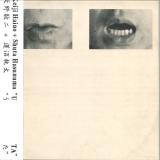
Haino sings. Hasunuma plays. It’s a minimal framework, but what emerges is a boundary-blurring sonic exploration. Across the album, Haino’s voice threads through Hasunuma’s layered soundscapes built from analog synths, electric guitar, piano, field recordings, and more. Haino entered the studio with only lyrics in hand, improvising melodies in response to Hasunuma’s evolving arrangements. The result is a work of deep trust, intuition, and sonic tension.
Keiji Haino and Shuta Hasunuma’’s creative connection began in 2017 with an impromptu performance in Shibuya—Hasunuma on a Buchla modular synthesizer, Haino responding with the Japanese national anthem, “Kimigayo.” That moment sparked their unlikely collaboration.
In 2018 Haino appeared at the Hasunuma-organized event “MUSIC TODAY IN KYOTO” at Rohm Theater, alongside Nobukazu Takemura, Manami Kakudo, Elena Tutatchikova, Kukangendai among others. In September 2021 during the pandemic, the two performed "U TA" for the first time at in Shibuya. They began planning the album soon afterwards.
For the recording of U TA, Haino entered the studio with only the lyrics in hand, with no knowledge of what sounds Hasunuma would produce. Responding to Hasunuma’s music in real time, Haino composed the melodies and layered in his voice on the spot. With additional sessions at Hasunuma’s private studio and Haino’s preferred studio, the album was completed.
All melody and vocals by Keiji Haino
All instrument, written, played, arranged, mixed and produced by Shuta Hasunuma
Recorded by zak at st-robo studio, Shuta Hasunuma at Studio i.M.O and windandwindows
Mastered by Rashad Becker at clunk
Production Management: Eishin Yoshida, Kento Ono (windandwindows)
For Temporal Drift: Yosuke Kitazawa, Patrick McCarthy
Art Direction: Aiko Koike
Special Thanks to Toshihiko Kasai, Ryoichi Kiyomiya, zAk, Yumiko Ohno
license
quête:kiyom
- 1
When The World Was One is something of a companion piece to Matthew Halsall’s 2012 album Fletcher Moss Park (much of the music was written at the same time) but draws more explicitly on Halsall’s love of spiritual jazz and Eastern music as well as his own studies in meditation and travels in Japan. Beautifully recorded at Hasall’s favourite studio, 80 Hertz in Manchester, and engineered by Brendan Williams and George Atkins it features the recording debut of Halsall’s large ensemble, The Gondwana Orchestra, which utilises the exotic flavours of harp, koto and bansuri flute and Eastern scales to create a global palate for Halsall’s life-affirming sounds.
Over the course of four albums, Manchester based trumpeter, composer, arranger and band-leader Matthew Halsall has carved out a niche for himself on the UK music scene as one of it's brightest talents. His languid, soulful music has won friends from Jamie Cullum and Gilles Peterson to Jazz FM and Mojo as well as an ever-growing international following. His label Gondwana Records is home to GoGo Penguin and his own albums have found Halsall exploring the modal jazz of John and Alice Coltrane, paying tribute to the hard bop of the late '50s and early '60s or most recently on Fletcher Moss Park drawing on Eastern influences in his most personal statement yet. His latest album When The World Was One is something of a companion piece to Fletcher Moss Park (much of the music was written at the same time) but draws more explicitly on Halsall's love of spiritual jazz and Eastern music as well as his own studies in meditation and travels in Japan. Beautifully recorded at Hasall's favourite studio, 80 Hertz in Manchester, and engineered by Brendan Williams and George Atkins it features the recording debut of Halsall's large ensemble, The Gondwana Orchestra, which utilises the exotic flavours of harp, koto and bansuri flute and Eastern scales to create a global palate for Halsall's life-affirming sounds.
The Gondwana Orchestra features long time collaborators Nat Birchall, saxophone, Gavin Barras, bass and Rachael Gladwin, harp as well as Taz Modi on piano. Modi who also plays with Halsall in their more electronic trio shares his passion for spiritual jazz and plays the music with real feeling while the role of the harp here is to bring a touch of 'magical reality' a floating dreaminess that is a vital part of Halsall's elegiac and beautiful music. The drummer Luke Flowers is perhaps best known as part of Cinematic Orchestra, and Halsall describes him as 'one of the best drummers in the world' and hails him for 'playing the music exactly as I heard it in my head', Keiko Kitamura is a Japanese Koto player who is becoming an increasingly important part of the Gondwana Orchestra, her role is similar to Gladwin's in that the koto helps free up the music while also bringing a real sound of the East. Finally, flautist Lisa Mallett brings a love of Indian music to the orchestra, much travelled on the continent she brings all of her knowledge and experience to play offering a unique texture to Halsall's dreamy melodies.
The album opens with the title track, When The World Was One, an expansive ascending tune that nods to Art Blakey and McCoy Tyner and draws the listener in before giving way to the dreamy, meditative A Far Away Place which features great work from Gladwin on harp and draws on Eastern influences alongside the music of Alice Coltrane and Yusef Lateef. Falling Water which features the beautiful soprano of Nat Birchall nods to classic spiritual jazz as well, but mixes in the more contemporary influences of Nostalgia 77 and Cinematic Orchestra, while the hard-driving Patterns conjures an up-lifting celebratory vibe with fine work from pianist Modi to set the mood. The beautiful Kiyomizu-Dera is inspired by Halsall's travels in Japan and in particular his visit to the Buddhist temple of the same name. Likewise Sagano Bamboo Forest is named for another place that left a deep imprint on Halsall and aims to capture his feelings as he worked through the vast maze of bamboo trees. Finally the album closes with the self-explanatory Tribute To Alice Coltrane a grooving tribute to one of Halsall's key influences. Driven by a powerful bass line and featuring wonderful work from Mallet on bansuri flute and harpist Gladwin, the band all really find their way into Halsall's groove before the leader plays a beautiful wistful solo of his own and it is the oneness of the Gondwana Orchestra that makes it such a powerful vehicle for Halsall's music as the leader takes you on his very own journey through his musical and spiritual world.
- A1: Hidden Element - Intro
- A2: Hidden Element - The Night
- A3: Hidden Element - Sunday
- A4: Hidden Element Feat. Kiyomi - Without You
- A5: Hidden Element & Detail - Zago
- A6: Hidden Element - Across The Universe
- A7: Hidden Element - Who Knows
- B1: Hidden Element - Bridge
- B2: Hidden Element Feat. John Lamonica - The Next Day
- B3: Hidden Element - No More Drama
- B4: Hidden Element & Physical Illusion - Long Way Home
- B5: Hidden Element & Sunchase Feat. Scoda Galina - Quiet Place
- B6: Hidden Element - Aura
Call it future-step. Call it deep-step. Call it autonomic. Call it whatever you wish, but one thing is for sure - Hidden Element hailing straight from Kiev, Ukraine fail to make their music disappoint. With a fresh take on electronic sounds ranging from breathtaking beat-less layers to +/- 170 BPM heavy hitters, these two have been making waves in the industry for some time already, releasing on 22:22, Alphacut, Med School, Pinecone Moonshine, and Translation - to name a few. But it is Absys Records that is the home for their full-length album entitled 'Together'. The release is a collection of 13 amazing pieces of work, each hitting a slightly different tone, but making a wonderfully coherent whole. An entity that is enjoyed best when all of its components are played together, as the title suggests. The album focuses in majority on a rather home-listening experience, with tracks like 'Aura' or 'The Night' setting the pace for a pleasant evening chill and boosting the laid-back mood even further with "Quite Place" or 'Without You feat Kiyomi' - both infused with lovely vocals - that can serve well as modern-day lullabies. But there are also more lively accents ('Long Way Home with Physical Illusion', 'Who Knows'), traces of live instrumentation ('The Next Day feat John LaMonica'), or ambient ('Bridge'). All in all, you get a fantastic cross-section of contemporary electronic music, a masterfully composed package of nothing but pure listening pleasure.
- 1


