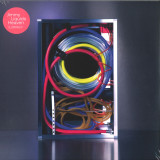
*MILKY CLEAR VINYL - 300 COPIES ONLY FOR WORLD!!* Technology + Teamwork’s fizzling synths, interweaving textures and punchy rhythms are beguiling on their long-awaited debut album We Used To Be Friends. However, at the heart of it all it’s the connection between the group’s two members, Anthony Silvester and Sarah Jones, the friendship the much-travelled duo have managed to maintain for nearly 15 years and a showcase of the slow-burning construction of the electronic world that they’ve surrounded themselves with. We Used To Be Friends is ultimately the tale of two storied artists in their own right, holding onto each other through personal and career twists and turns, relocations and broader movements through respective phases of their lives. Silvester and Jones first met and then collaborated as part of biting post-punk five-piece XX Teens in 2008, eventually breaking off to forge their own path together even as the latter’s demand as a drummer grew. Performing with everyone from Hot Chip, Harry Styles and Bloc Party among many others, Jones has been a constant percussive presence across the sphere of alternative UK pop music – she’s also found time for her own solo project Pillow Person and played on records by the likes of Puscifer and Kurt Vile. Silvester meanwhile has performed in art galleries across Europe including: Fridericianum in Kassel, Kölnischer Kunstverein in Cologne, and Vleeshal in Middelburg, as well as providing sound design and composing work for several art films. Technology + Teamwork is the constant throughout all of that though. “Technology + Teamwork's name perfectly describes how we work” Silvester explains. “Sometimes the teamwork is between each other and sometimes it’s between us and the technology.” Although going by the name Technology + Teamwork as far back as 2014, two events conspired that pulled the project into focus for the pair of them: firstly, Silvester spent a year constructing a soundproof studio shed on the border of London and Essex where he lives. Secondly, inevitably, the pandemic brought the globe-trotting Jones back home to just seven miles away from her long-time collaborator and friend. “We probably hung out more than we had for a few years” says Silvester. “Also, after all her Pillow Person releases Sarah had gotten really good with recording vocals and knowing what did and didn’t work and had a really good home studio set up. We still worked separately though, exchanging ideas via email and WhatsApp.” As with many artists through 2020 and early 2021, working separately was a new necessity that they were forced to adapt to. However, it became clear that there were creative benefits to it. “It really changed our sound and our sounds became a lot more focused as a result” Jones says. “I wanted to use the same ideas of improvisation that I might use while playing the drums for myself and apply that to melodies and lyrics.” The album bristles with hyperpop modernity. You can hear it in the manipulated vocals most prominently on Big Blue’s disco strut and on Moving Too’s heady mix of pitched up voice and burrowing sub bass. However, the pair also looked to San Francisco and the West Coast synthesis movement of the 60s, Silvester inspired by the likes of Suzanne Ciani and Don Buchla. The plaintive lo-fi and melancholy of Amsterdam incorporates Mutable Instrument’s Marbles by Émilie Gillet which – inspired by Buchla’s own synthesis work – outputs random voltages to give the track an air of unpredictability. It’s something that occurs throughout the album, the duo revelling in the happy accidents that disrupt the flow of their hook-laden pop. “The ‘Buchlian’ ideas of music having randomness and uncertainty, completely freed us up” Silvester explains. “It felt a bit like having more members in the band, machines that didn't do what you expected or intended.” Perhaps more subtly, is the influence of 17th and 18th century Baroque music, with Silvester drawing a line between it and the 90’s R’n’B he and Jones both love – exemplified perhaps best on K+B’s percussive claps and sultry grooves. The portentous juddering synthpop of the title track, meanwhile, alludes specifically to Handel’s Sarabande. It’s typical of an album that only needs a scratch of its seemingly glossy surface to unearth a myriad of contorted touchstones and reference points that’ve fermented beneath it. Thematically there’s an anxious sense to the record, with tracks often balancing above a quiet sense of unerring tension even at their most bombastic. Moving Too is the result of an existential doubt that hit Silvester while out cycling, with the outro refrain "it's not enough to die you also have to be forgotten" a take on something Samuel Beckett once said. These worries are echoed on the album’s closing track What A Year, which borrows a lot of lines from the late drag performer and fashion designer Dorian Corey including the grimly defiant "you're gonna leave your mark somewhere in this world just by getting through it”. Those clouds offer a counter point to We Used To Be Friends, but then isn’t that what great pop albums do? Technology + Teamwork undoubtedly love the craft of the hook and the song, but they always position themselves left of centre, prepared to scuff things up, pull something out of shape or manipulate something to leave it sounding warped. Much like their friendship, nothing here is particularly linear – and it’s all the better for it. Bio: Anthony Silvester & Sarah Jones first collaborated as part of biting post-punk five piece XX Teens in 2008, eventually breaking off to forge their own path together even as the latter's demand as a drummer grew. Performing with everyone from Hot Chip, Bat for Lashes, Harry Styles and Bloc Party (among many others), Jones has been a constant percussive presence across the sphere of alternative UK pop music - she's also found time for her own solo project Pillow Person and played on records by the likes of Puscifer and Kurt Vile. Silvester meanwhile has performed in art galleries across Europe including Fridericianum in Kassel, Kölnischer Kunstverein in Cologne, and Wleeshal in Middelburg, as well as providing sound design and composing work for several art films. Technology & Teamwork is the constant throughout all of that though. "We Used To Be Friends" proves that Technology & Teamwork undoubtedly love the craft of the hook and the song, but they always position themselves left of centre, prepared to scuff things up, pull something out of shape or manipulate something to leave it sounding warped. Much like their friendship, nothing hear is particularly linear - and it's all the better for it.
Cerca:l ow project
Since Interstellar Space, John Coltrane's posthumously released duo album with Rashied Ali, the combination of sax and drums has received an aura of sublime spiritual ambition. It is where tireless truth seekers come together to aim for something transcendental. Something too big for words. Of course, a lot has happened in the meantime.
The available options - philosophically, stylistically, temperamentally - are endless. Musicians are aware of those historical turning points, yet they also try to add their own twists and interpretations. Some of them succeed. One of reed player Mattias De Craene's many projects - MDC III - is a project involving drums and saxophone. A striking difference: De Craene invited two drummers (Simon Segers, Lennert Jacobs), that have been active in the worlds of jazz, pop, free improvisation and experimental music. They are the ideal foil for De Craene's vision, which seems to exclude no opposites. While the use of a recorder, electronics and percussion steers the music beyond the classic acoustic limitations, the result becomes strikingly rich with contrasts. What is abstract and introspective the first moment can switch - gradually or abruptly - to moments of fierce ecstasy the next.
The music feels free (free from limitations, free to choose its own logic), but also invites. Shifting moods and textures are combined with intricate rhythmical patterns, as the drummers lock together in dense, complex and/or ritualistic grooves. A minimal pulse, accompanied by murmuring hisses of brushes and a serenading sax is contrasted with moments of exuberance. The result is many things at once, but despite these wildly varying colors, sounds, textures, rhythms and moods, they are all linked, part of a generous, iridescent whole.
The trance-inducing trio MDCIII is back. And that equals yet another delicious load of modular drums, wildly processed saxophone sounds, improvisation & pulsating grooves.
After their first EP, MDCIII ft. Sylvie Kreusch, and their subsequent first (internationally) acclaimed album 'Dreamhatcher', the 'double drums' saxophone trio with Mattias De Craene, Simon Segers & Lennert Jacobs is all set to show what angle rock 'n roll can really come from. On their new album 'Drawn In Dusk' (release: end of September via W.E.R.F records) the trio delivers a whole new palette of sounds that are just as mystical, energetic and wild as 'Dreamhatcher'.
- A1: More Than Abstract Hip-Hop (Mounika Remix)
- A2: Final Round (The Architect Remix)
- A3: Betty (Scratch Bandits Crew Remix)
- B1: Nuday Feat Andrre (Feat Andrre - Souleance Remix)
- B2: The Lsa Theme (Kognitif Remix)
- B3: Favelas (La Fine Equipe Remix)
- C1: Straight Murder (Feat Asm & Miscellaneaous - Senbei Remix)
- C2: Un Jour Comme Un Autre (Moderator Remix)
- C3: Too Shy To Dance (Feat Astrid Van Peeterssen - Al'tarba Remix)
- D1: Stay In Your Lane (Feat Miscellaneous - Dj Vadim Remix)
- D2: Avant (Proleter Remix)
- D3: Kolata (Izem Remix)
- D4: Qu'attendez-Vous De Moi? (L'orange Remix)
Degiheugi presents his new project “Remixed Treasures”. A project that bears its name well. Like seabed adventurers, the remixers have been asked to rework in their own way some of the most significant tracks of a career spanning more than 20 years.
Starring L’Orange, Moderator, Souleance, iZem, The Architect, Senbei, Al Tarba, Mounika, DJ Vadim, La Fine Equipe, Kognitif, ProleteR and Scratch Bandits Crew, the XXL cast of this impressive crossover melts genres (hip-hop, electro, ambient, drum & bass, jazz…) and brings together no less than 13 beatmakers from different scenes and generations.
We're thrilled to release two exciting electro tracks by Art P, as well as the classic minimal synthwave tune 'Der böse Osten' by related band project Die Synthetische Republik on this limited split 12".
The single kicks off with 'Genscher Pull and Push', an incredible and previously unreleased electro/wave/proto-techno tune from the P.A.P. archives, recorded in October 1982 with a political background. The song was only available on a demo cassette for a radio show and had been forgotten since then. Genscher was a long-time Federal Minister for Foreign Affairs and Vice Chancellor of Germany, who played a key role in a coalition change in September/October 1982, leading his party, the FDP, to leave the Helmut Schmidt cabinet with the SPD and continue with the opposition, the CDU/CSU. As a result, the German lyrics of the song shout 'bitte geh nach links / bitte geh nach rechts' ('please go to the left' - meaning the left-leaning SPD, and 'please go to the right' - meaning the right-leaning CDU), and so on.
Unfortunately, this track was never released, as the topic of the coalition change quickly became uninteresting and outdated. If it had been issued on vinyl in late 1982, it would probably be considered one of the first proto-techno tracks ever. With its driving and heavily-punching 808 rhythms, and the bending synth bass leads played on the Jupiter 4 synthesizer, it gives you a groove that owes as much to Kraftwerk's 'Computerwelt' album as it may rhythmically pre-date the sound of Detroit's Juan Atkins. The energetic German vocals are giving the track a unique Neue Deutsche Welle touch. They are heavily left/right panned to fit the political topic.
Next up on the Art P side is a remix of 'Polaroid', originally found on the No Message LP that we re-released last year. The track was recorded in 1985, and at that time, the duo of Frank Grotelüschen and Jens-Markus Wegener had become bored with the sound of the Roland 808 drum machine, so they made the track with a DrumTraks by Sequential Circuits. However, for this remix, DJ Scientist, the curator of this 12", wanted to recreate the typical electro-funk sound of the era and added 808 bass drums and claps. The track was also shortened to a more DJ-friendly arrangement. The result is a dancefloor delight for all lovers of classic electro and SVC-350 vocoder sounds!
Die Synthetische Republik was a project by Wegener of Art P and Olav Neander. The track 'Der böse Osten' can originally be found on the cassette album 'Faktor D', recorded in just two weeks on a Tascam Portastudio 245. The original recording sessions were pure fun but also rushed. Hence, none of the tracks was perfectly mixed. With digital technologies, we remastered 'Der böse Osten' to achieve the best possible result and are pleased to release this serious synth wave gem on a loud 12" for the first time as an exclusive extended mix.
The split 12" is released in a picture sleeve with a unique artwork on each side. It is limited to 500 copies.
KAU is an instrumental project based in Brussels consisting of André Breidlid (drums), Matteo Genovese (bass) & Jan Janzen (keys). Representing various European backgrounds, their coming-together is in the spirit of the city they grew up in.
Taking inspiration from jazz, they create a head-bobbing atmosphere using bassy beats and catchy melodies. By implementing acoustic instruments, the trio stays true to an organic and rich sound, granting themselves the liberty for improvisation & spontaneous happenings. Influenced by artists like BADBADNOTGOOD & Christian Scott, their music is contemporary, powerful, and audacious.
The EP "III" is the collaboration between the three core members of the band and Maxime Dereux, talented French saxophonist already guested on "II". Having built strong musical ties over the course of the last years, the idea to make more music together arose naturally without a shadow of a doubt.
The result is a 4 track EP with a high concentration of powerful riffs and sharp themes. The title song 'Mad Max' perfectly represents madness incarnated. On "Moonwalker" they go to new places with ever-changing melodies and sax lines. 4 minutes of holding on to your seat in anticipation of the next measure.
This EP also features Brussels born and bred rapper "Jay MNG" who has made a name for himself around many concert halls & festivals in Belgium. Having collaborated notably with Commander Spoon and Kuna Maze, the polylinguistic rhymes of Jay MNG left a mark on this emerging music scene. Enraged, banging in whatever language that may be, Dutch, French or English, he manages to make a massive impact on the atmosphere of the tracks and add his own flavour.
“Preparing Singularity” is the debut album by Berlin-based EBM act Transhuman Rebirth, currently a one-man side project of renowned German synth-punk artist Ben Bloodygrave.
Already instantly recognizable on the European synth/wave scene and touring circuit with his high octane aggressive minimal synth, Bloodygrave started this new project over the past few years focusing more on classic, first-wave EBM, moulding the nine tracks on “Preparing Singularity” into a sound that’s recognizable to fans of the starting foundations of the genre. While retaining a sound that’s unique and solely its own, elements of minimal wave and synth-punk are fused in these propulsive tracks, with nods to old idols such as Deutsch Amerikanische Freundschaft, Front 242 and Absolute Body Control.
Transhuman Rebirth is subjectually futuristic to dystopian, interspersed with political statements. The lyrics focus on topics that are current and modern, including science, technology, surveillance and artificial intelligence — all delivered through Bloodygrave’s well-known vocal style with a sound that is much rougher and with compositions and sound designs that are more complex than his main Ben Bloodygrave persona.
- A1: Euphoria (Feat Liz)
- A2: Everybody (Feat 10K Caash & Zelooperz)
- A3: Dreams 1000000 (Feat Milk)
- A4: Slip N Slide
- A5: Bite That 2 (Feat Trinidad James)
- B1: Sideroom
- B2: Bunny Lava (Feat Virgen Maria)
- B3: No Antidote (Feat Ripparachie)
- B4: Static (Feat Banshee)
- B5: Ya! (Feat 645Ar)
- B6: Never Leave (Feat Milk)
JIMMY EDGAR's latest release for Innovative Leisure, LIQUIDS HEAVEN, is a psychedelic canvas of future R&B, euphoric bass, mutant tear-theclub-up rap, foundation-splintering noise, and gossamer soul.
On a surface level, it is a starburst of avant-garde fusion, collecting a diverse cast of eccentric geniuses and re- configured into an anthology of n - musique concrete.
As with all of his work, there is a deeper and subversive intent.
Do not mistakenly believe that LIQUIDS HEAVEN is merely a technicolor dream of ethereal abstractions. It bangs as hard as anything to ever bump from a subwoofer.
Over a polychromatic blast of crunk, bounce on Everybody like a rap
rave inside a 31st century space station. Bite That 2 finds Trinidad James spitting flames over booty- shaking, wall- crumbling bass. On Ya, 645AR chirps over a metallic chassis of booming industrial funk.For all the high energy propulsion, there is a counter-balance of melancholic beauty.
The album's opener, Euphoria features a Liz Y2K vocal that levitates with plaintive longing. The Milk- aided Dreams 1000000 sounds like the chimerical soundtrack to a manga utopia that needs to be imagined. Milk also appears on the finale, Never Leave, which
captures a bittersweet sadness, the wistful emotion of the tide slipping away.
Jimmy's career has been a series of fascinating left- turns. Signed to Warp Records as a teenage electronic music prodigy, his work needs a scholarly bibliography to properly assess. He's recorded for the world's most respected imprints (Warp, K7, Hotflush, Innovative Leisure and his own New Reality Now).
Raised in Detroit, there have been stints soaking up inspiration in Berlin, Atlanta, LA, and New York. His list of close collaborators includes the most innovative musicians of the millennium, including Hudson Mohawke, Danny Brown, SOPHIE, DAWN, Mykki Blanco, Vince Staples, and several full projects with Machinedrum
as J-E-T-S.
Since the release of the highly acclaimed album Mamari (2021), the Muito Kaballa project has continued to develop.
The new album Little Child (2022) starts with a cracker called Inside Outside. The song addresses the hypocrisy and double standards of the European Union when it comes to refugee policy. The group works together with the renowned German/Nigerian musician Ade Bantu and the Angolan guitarist Juresse Amie Tieti Ndombasi and picks up their listeners where they were parked with Mamari. Fat grooves with clearly recognizable Afrobeat influences.
However, the musical journey leads step by step away from the usual sounds of the band. Already the second track Dansez! Dansez! shows that. The sound leads to Angola, Congo and a bit of Mali. The band stacks so many rhythms on top of each other that the word poly appears in a whole new light. It becomes clear that the nine deal intensively with the music that is the source of their inspiration. The gifted guitarist Juresse Amie Tieti Ndombasi puts the icing on the cake with his sound.
Let's continue with No = No. Here at last it becomes clear: Muito Kaballa has escaped from his drawer and is now in free flight, somewhere between jazz, fusion, afrobeat and whatever. But who cares? The sound is convincing, the feet shake to the beat and cannot be calmed down even with great effort and the message "Don't protect your daughter, educate your son" can't be said often enough.
The next song, Memories, reveals completely different sides of the band. While the sound is suddenly much more relaxed and, let's call it jazzy, the lyrics also become much more intimate and poetic. "Keep in mind, it makes you blind, starring in the sun". We don't find out what memories Niklas Mündemann, composer of the song, has in mind here but that shouldn't bother us. We just put on our sunglasses and let ourselves be carried away by the almost epic track, which with its ten minutes of playing time leaves nothing to be desired in terms of diversity. Sophisticated listeners will wonder if Niklas Mündemann listened to a bit of Kamasi Washington while composing. Maybe even a lot? Be that as it may - a special treat in the piece: the trombonist Saskia-Marleen Dahms, who makes a guest appearance on this song, rounds off the sound of the brass section again.
Last but not least, we come to the namesake of the album: the song Little Child builds on the mood of the previous track and rounds off the musical odyssey with a good portion of goosebumps. But the song doesn't just leave its mark on the surface, no, it also gets under your skin. While the melody has considerable catchy tune potential, it is above all the lyrics and the message that grab you here. Niklas Mündemann wrote the song during a phase of mental depression. Above all, psychotherapy helped him to think more positively again and to comfort his own inner child. We've all heard about that child in us. But when was the last time we hugged it? The song Little Child is the perfect accompaniment for this, because when you hear it, you immediately feel hugged, pressed and safe. Another highlight are the incredibly beautiful solos, played by Benjamin Schneider on guitar and Saskia-Marleen Dahms on trombone.
That's the end of the album and, to be perfectly honest, you don't feel left out in the rain, but you do feel left out in a (warm) shower. Time flies when you hear Muito Kaballa's new album and in the end you want more. 4 remixes for the dancefloor are delivered by French producer Kuna Maze, Polish/Angolan duo Lua Preta, French producer La Dame and Brazilian producer Badsista, tipping the remix balance into more female input.
"Non Masse" is the new LP from Brussels-based artist and producer Apulati Bien.
After several notable releases on the Parisian label Promesses ("OO:NÉ", "RER TRACKS" & "Azone", jointly released on the Belgian label KRAAK) in solo or via the duo XOLOT he forms with artist Vica Pacheco, navigating in a neo-futuristic aesthetic with glitch and experimental influences mixed with juke, footwork and more broadly bass music heritage, Apulati Bien explores this time new territories, devoid of preconceived forms and leaving more space to each element.
Recorded at the time of the finalization of his last album "Azone" released in February 2022, with the will to proceed with a different method, even opposed to the one he knows, "Non Masse" (whose title is equivocal of the approach) is a more aerial object, with unquantified structures and sliding material, reflecting a feeling of "wanting to get out of (his) own mass", according to his words. A feeling certainly shared by many during the troubled period of the last two years, and which echoes a general desire for detachment, for withdrawal combined with a search for discovery in these overloaded times.
"Non Masse" is not however an object apart from Apulati Bien's discography, where we find the main elements of his music : futuristic references, glitch and digital contortions, which should not be approached as a light object but as a complex one, where the subtle details don't aim at diverting the attention, but on the contrary at nourishing a more global speech. The title "Alone Global" of one of the tracks is probably the most accurate definition of this project.
repressed !
From samba and bossa nova through to baile funk, with carioca expressions of jazz, rock and hip hop in between, the sound of Rio de Janeiro, while continually evolving, has always held an unnameable quality which reflects the magic and mystique of the city itself. Multi-instrumentalist and arranger Antonio Neves is the city’s newest trailblazer: the enfant-terrible of Rio’s music scene, leading a vital and diverse constellation of both emerging and well-known artists advancing the city’s musical legacy.
“It all started one sleepless night, after watching a Quincy Jones documentary”. Inspired by the legendary music magnate, Neves began writing a list of artists residing in Rio de Janeiro “people that I admire, that I consider geniuses of their instruments, who share with me affinities, anxieties and projects.” The list included some of Brazil’s most revered living musicians who Neves has worked with in recent years: Hamilton de Holanda, Leo Gandelman and Dorival Caymmi. Neves also called on some of Brazil's most exciting emerging talents including Alice Cayymii and Ana Frango Eletrico.
A Pegada Agora É Essa (The Sway Now) is Neves’ second album: a vibrant portrait of the current Brazilian music scene. From the regional to universal, popular to erudite, samba to rap, Latin rhythms to jazz, MPB and pop to good old rock'n'roll, Neves walks with fluency and mastery amongst all the musical genres that Brazil has to offer.
“My offer to the musicians was complete freedom to express themselves through the songs I proposed – classics like “Summertime”, “Luz Negra” and “Noite de Temporal”, and compositions of my own – creating a space of authorship for the band and the guests. A space for inventions, purges, delusions, laughter. The idea was to bring the freedom of jazz crossed by Brazilian rhythms, such as the traditionals Partido Alto (A Pegada Agora É Essa) and Jongo (Jongo no Feudo and Luz Negra); rhythms of African-Brazilian religions like Candomblé (Noite de Temporal) and Umbanda (Forte Apache); and a tribute to newest Rio de Janeiro’s contribution to Brazilian music, the Funk Carioca (Simba)”.
Coming from a musical family, Antonio’s father, Eduardo Neves, was a renowned conductor and a professor at Juilliard School of Music and the California Jazz Conservatory. In the bohemian neighbourhood of Lapa, aged 14, Antonio began his career as a drummer, before experimenting with brass. He would soon become a skilled trombonist and arranger achieving the recognition of his teachers and peers. It wasn’t long before he would be playing with some of the biggest names in Brazilian music, such as Hamilton de Holanda, Leo Gandelman, Moreno Veloso, Kassin and Elza Soares.
His debut album as a trombonist was PA7 (2017, Rock It), released at the same time he was travelling the world playing with artists like Moreno Veloso, Kassin and Leo Gandelman, and recording the albums Jobim, Orquestra e Convidados (2017, Biscoito Fino), with Mário Adnet and Paulo Jobim; and Elza Soares Canta e Chora Lupi (2017, Coqueiro Verde Records). More recently, Neves was the arranger for the acclaimed Little Electric Chicken Heart album, by Ana Frango Elétrico, which has been nominated for a Latin Grammy and voted 2019’s ‘Brazilian Music Revelation’ by The Art Critics Association of São Paulo.
- A1: Interlude Between Brussels & Rio
- A2: Dead End (Ft. Janet King)
- A3: Clout Chaser's Anthem (Ft. Janet King , Hua Li)
- A4: Jazz Cats Run (Ft. Sarah Mk)
- A5: 1996 Inner G
- A6: Shore Apart
- A7: Lord Have Mercy (Ft. Judith Little D ,Raveen)
- B1: Nunca Mais
- B2: In The Gaze
- B3: Mascarade
- B4: Moon Rising (10 Years) (Ft. Judith Little D)
Gayance joins forces with Rhythm Section for her debut album ‘Mascarade’ - a swaying dance that moves between poetic, soulful odes to the past, accounts of the Afro-diasporic feminine experience and playfully energetic dance floor grooves.
Mascarade is a collection of dancey, broken rhythms, interwoven with heartfelt stories and bright, unapologetic outpours of joy. In her own words, “It's the story of my 20's. I wanted to pay homage to this kid everybody knew, but not deeply. It's about taking back a power that is mine and was always in my hands...It's about making peace with the past and moving forward”.
Gayance (real name Aïsha Vertus) takes her alias from the Haitian creole word for joyfulness.Based in Amsterdam, born and raised in Montreal-Nord, she started as a DJ in 2013, and has toured the world with shows in Paris, Brooklyn, Marrakech, Berlin, Sao Paulo and more, bringing electrifying and contagious energy wherever she goes.
Her own production is influenced by underground UKG and the respective house scenes of Detroit and New York, with nods to the vivid, sun-soaked colours of Latin America. Shades of blues, jazz and gospel can also be heard in her newest project, pulling together styles from each corner of the world. Following her catalog of entirely self-released projects, Gayance announces her full-length debut album on Rhythm Section, bringing some fellow Montrealers along for the ride.
- A1: Out Of Town
- A2: See It Coming
- A3: Torn Up
- A4: Save Me Saturday (Feat Kat Ott)
- A5: Drifting (Feat Lucy Kruger)
- A6: Ain't No Love In The Heart Of The City
- B1: Born To Lose (Feat Jesper Munk)
- B2: Sweet Remedy (Feat Aydo Abay)
- B3: Your Heroes (Feat Jesper Munk)
- B4: Under The Sea
- B5: Pierdete
- B6: Sad But True
- B7: Vertigo (Feat Aydo Abay)
- B8: Veil
SHIFTING - The brandnew album by FRANK POPP ENSEMBLE, the first since 2005! It has been quiet during the last years, apart from an album as „Frank Popp“ called „Receiver“ in 2009 on his own label TV Eye Records. Frank Popp was always busy tho, working as a producer for other bands (Odd Couple, Sun And The Wolf, etc), designing hundreds of posters and booking top notch concerts in Berlin (The Jesus And Mary Chain, Billy Childish or 60s legends The Pretty Things, just to name a few. Once a month Mr. Popp runs several dance partys since many years. Now he is back at his desk for his own musical project FRANK POPP ENSEMBLE! And again he got help from many wonderful special guests lending this project their voices, such as Jesper Munk, Aydo Abay, Lucy Kruger, Kat Ott from 24/7 Diva Heaven, Anna Glahn and classic FPE singer Sam Leigh-Brown. Mr. Popp wrote, recorded, produced and mixed „Shifting" in Spain between january and march 2021, accompanied by Jascha Kreft (Odd Couple) for the songwriting sessions. The 16-song heavyweight takes us on a colourful journey through vintage soul scorchers, psychedelic soundtrack scapes, spector-esque sound walls, bootboy glamrock and even a riviera space-disco tune can be found on the new longplayer. Of course lotsa things changed in that many years. Many lyrics are written by Popp himself, out for trouble in impertinent phrasing here and there. The music has become mature and deeper and his voice can be heard on two songs, the first time ever. It sure is a remarkable piece of high quality music, that’s been delivered here. Watch out, world!
Oyez ! Oh yeah ! Cheval Detroit is here! Mmmh presents his new project with his most accomplished piece of music, a triple albummmh curated in his Parisian basement aka the sm dungeon. For 2 years, Mmmh has seen no other light than his own computer screen. No need, indeed, to confront the world and its urban apocalypse when you have a vessel shaped to produce light and hope. Hidden behind a rough cover, we have no doubt the music will penetrate your heart. As in a video game experience, you can dive and evolve in his childish world, level after level, adventure after adventure. This very colorful album is not your usual techno tool - It jumps from aquatic and dancefloor beats to hopeful ambient textures, or fast paced, funky and threatening techno. We must warn you : This is highly addictive.
- A1: Approach 1' 52
- A2: Omaggio A Fellini 1' 50
- A3: Pipes 4' 05
- A4: Orgal 3' 38
- A5: Babbel 3' 54
- A6: Yaya 4' 21
- B1: Ba Loon 3' 17
- B2: Clocking 3' 37
- B3: Wail 8' 34
- B4: Bottom 3' 34
- B5: Feeder 1' 36
- C1: Spindrift 3' 35
- C2: Surfer 4' 00
- C3: Low Roller 3' 24
- C4: Still 4' 56
- C5: Beating 3' 51
- D1: Picolo 5' 41
- D2: Wire 2' 07
- D3: Knock 6' 21
- D4: Wah 3' 02
- D5: Aah 1' 40
Tod Dockstader's Aerial series, an electronic/drone masterpiece, is cherished among fans of the artist's work and this second volume is available in an audiophile quality double LP edition.
Tod Dockstader's Aerial series is sourced from his life long passion for shortwave radio. Dockstader collected over 90 hours of recordings, made at night, and comprised of cross signals and fragments plucked from the atmosphere.
Opening with airwave drones, Dockstader gradually allows elements to slowly come and go, summoning an ominous atmosphere of ethereal cloud clouds. Malignant placidity continues, giving the feeling of eavesdropping upon late-night audio activity not unlike discovering number stations while sweeping the dials. These sounds pull you in as their density and rhythms come and go.
Backward voices, deep echoing choruses of conversations flowing under the surface, ocean sounds, pulsing electro-rhythms, all seem to be created via the collaging of many hours of source recordings. A masterwork of collage and juxtaposition by an overlooked pioneer of American electronic music.
Artwork by John Brien (Imprec) is inspired by the propagation of shortwave radio signals throughout the earth's atmosphere.
"This return of Dockstader is something to cherish, not just because his output has been so limited and scarce but because what we do have is so intriguing, persuasive and cliche-free; the music of an inspired explorer who trails in nobody's slipstream." The Wire
"One of the great figures of musique concrete composition." Dusted
The Aerial project
I've written before of my interest in shortwave radio, in the notes to the Quatermass CD. Also, in the notes to the Omniphony CD (which has my first "Aerial" mix, "Past Prelude," in it), I mentioned "The Aerial Etudes," which was my working title for what became the three CDs you have. And, at the end of an interview with Chris Cutler (which can be found in the "Unofficial TD Website"), the piece I mentioned I was starting to work on at the time became Aerial.) When I was very young, people got most of their entertainment from radio. They called it "playing the radio," as if it were a musical instrument. That's what I've tried to do in this piece. About this time, a few people encouraged me to look into using a computer for this work.
I'd never used one, but I saw it would allow me to keep my mixes digital - no more transfer losses. So, at the end of 2001, I got a computer and an editing program for it, and spent what seemed a long time learning it. I began selecting mixes and loading them into the computer in late March, 2002. Out of the 580, I selected 90 "best" mixes - eventually reduced to 59, the ones on the CDs. Finally, in assembling the CDs, I followed David Myers' suggestion to allow each piece to flow into the next - making a continuous journey to the end. Tod Dockstader, 14 september 2003
About Tod Dockstader: Dockstader moved to New York in 1958 and became a self-taught sound engineer and sound effects specialist and apprenticed as a recording engineer at Gotham Recording Studios. It was around this time that he started to use his off-work hours to experiment with mixing and manipulating sounds on magnetic tape (musique concrète). By 1960 he had amassed enough material to assemble his first record Eight Electronic Pieces which was released on the Folkways label in 1961 (this would later be used in the soundtrack of Fellini’s Satyricon). The last of the eight pieces was later re-worked into his first stereo piece. In 1961 he applied to use the facilities at the Columbia-Princeton Electronic Music Center and was denied access by Vladimir Ussachevsky. Ussachevsky’s official reason was the “overstrained” scheduling of the studios, although many suspect that Dockstader’s lack of academic training was a factor in the decision. He continued to create music throughout the first half of the 60s, working principally with tape manipulation effects. His last piece at Gotham was Four Telemetry Tapes in 1965, after which he left to work as an audio-visual designer on the Air Canada Pavillion at Montreal’s Expo ‘67. It was around this time in 1966 that some of Dockstader’s pieces were released on three Owl L.P.s, and his work became known to a larger audience. He achieved modest recognition and radio play alongside the likes of Karlheinz Stockhausen, Edgard Varèse, and John Cage.
Berlin based sound artist Sa Pa delivers AI-33, titled ‘Atmospheric Fragments’. Originally intended as a soundtrack to accompany ten short experimental films as part of a physical exhibition in 2020 curated by Manon Bernard, Atmospheric Fragments was alternatively premiered online as a digital showroom - with its music performed and recorded both live and independently in 2021.
Atmospheric Fragments was conceived as a collaborative audio-visual project, positing the viewer inside a sonic boom of introspective parenthesis and offering a place for internal dialogues under the circumstances of a largely unknown and rapidly changing modern world.
Sa Pa’s work presents a fresh sonic reinterpretation of urban landscapes, skylines and modern environments, procuring from its source material a whole new kaleidoscopic world of its own. The record consists of two mixes - ‘Studio’ and ‘Live’ - which demonstrate a deep explorational study of our everyday surroundings, plunging the listener into a realm of heightened sense experience and microscopic detail. Where the ‘Studio’ mix embodies the precision and management of the studio workspace and is more ambient in nature, such intricacies are exchanged for a larger, livelier sound stage and alternative sonic material in the ‘Live’ mix.
A nebulous ocean of shifting spaces and effervescent textures, Sa Pa augments and modulates field recordings into a fluid and ever-evolving narrative. Seen through a viewfinder of deep and immersive observation, new transients, momentary artefacts and poetry in motion begin to reveal itself. In a world caught in momentary stasis, Atmospheric Fragments is a forensic inquiry into our perceptive environment, with its augmented lens placing us on the cusp of the ungraspable.
August Greene culminates years of mutual respect and friendship, channeling the musicians’ various talents into a cohesive project. The perfect marriage of jazz, hip-hop and soul, it’s music that just is. This is black expression the way God intended: earnest, unfiltered, and harmonious. Throughout August Greene, you feel the abundance of Glasper’s rolling keys, the sheer honesty of Com’s lyrics, and the nuanced subtlety of Riggins’ drum work. It’s a fluid sound that’s sorely needed in today’s landscape, and a teachable moment for the next wave of creators. “I feel like we need to set the bar for this generation of musicians and producers,” Riggins says. “There’s a lot of computer-driven music. This is the opposite of that. We’re showing you can still use your creative muscle on an instrument to generate your own sound.” August Greene is a meditative offering that stands tall against the era of “fake news.” “They body snatching black girls in D.C. / Politics and propaganda on the TV,” Common observes on the opening track. On “Nirvana,” the lyricist uses a stuttering percussive loop and faint piano chords to search his inner being: “Thought I was gonna fly when Obama became the king … when it’s all done, will I have heaven’s dress code, and been able to let God and let go.” As Com puts it, Glasper and Riggins’ soundtrack allowed him to open up in ways he hadn’t done previously. Like on “Fly Away,” for instance, where he riffs on the public relationships he’s had. Other songs, like “Black Kennedy,” feel spacious and scenic. “I got to go new places with the music, and it didn’t have to fit within a genre for me to participate on it,” he says. “This gave me an experience I haven’t had in a long time, so I want people to feel that. I want this to be a cleansing of whatever doesn’t feel good or inspiring.” In the end, August Greene speaks to those pushing through the dark for brighter days. It's a masterpiece from which virtue can shine. “I want people to go on the ride and be open,” Glasper says. “We just created and it became a sound. I want people to approach this with an open mind and without expectations.” —Marcus J. Moore
Mystical, minimal house offering hailing from South Africa in the mid-2000s courtesy of Cape Town indie labels Sharp-Flat and Roastin' Records.
RockArt was a hybrid-electro performance art project that emerged during a golden age for electronic music in the Cape, the post-Y2K scene spurred by the maverick African Dope record label that marked the rise of cult outsiders Felix Laband and Tudor Watkins Jones. Harnessing the combined powers of seasoned jazz musicians Hilton Schilder and Alex van Heerden, RockArt cooked up a signature futurist formula laced with musical bows and voice samples that was unmistakably indigenous. Intended as a companion to the group's Future Cape album of 2006, House was conceived as a long-form soundscape of tribal electronica that could stand alone on its own merits but also provide a backdrop for live instrumental improvisation. The project was shelved following the untimely death of Alex van Heerden in 2009 but emerges from Hilton Schilder's archive as a reminder of the duo's profound collaborative alchemy.
Running at 28 minutes over two sides of 12-inch maxi cut at 45RPM, House is available as a boutique vinyl offering with a psychedelic art sleeve pressed in a first edition of 300 copies.
Powerful rave tracks by the talented Ukrainian producer Daniel Syenichkin aka Bejenec on the first vinyl release of his own label "& The Refugees" (Inspired by his artist name which translates as "Refugee"). This 4 track ep has it all! An energetic hybrid of break-beats, Acid, playful trance elements and beautiful emotions. The young and promising artist has made a big name in the eastern parts of Europe where he is known for his energetic and upbeat live performances. He now is ready to take his artistic inspirations a step further with the start of his new label project!
The moons of Saturn are the inspiration for this brooding, often soaring and searching odyssey of dark electronica.
The second largest planet in the solar system after Jupiter, and the sixth planet from the sun, Saturn is orbited by 53 confirmed moons, with another 29 that are unnamed and still being studied.
Saturnian is a suite of thirteen choral tracks taking their names from some of Saturn's known moons; Dione, Daphnis, Phoebe, Prometheus, Rhea, Janus, Titan, Enceladus, Tethys, Telesto, Mimas, Hyperion and Iapetus, all named after figures from Greek and Roman mythology, each loaded with their own turbulent back stories. It is the debut release by Holmes + atten Ash, written, recorded and produced remotely in Edinburgh and Bristol by the duo Simon Holmes and Paul Nash.
Their project began during the 2020 lockdown. For Simon, time was spent exploring the Pentland Hills south of Edinburgh. For Paul, the Mendip Hills, south of Bristol. Both would experience the darker side of our human impact on the environment. Simon observed the wilderness as a wasteland, finding discarded, rusting metal littering the Pentland Hills while Paul witnessed the decimation of the ancient woodland of the Mendips' King's Wood due to the destructive tree fungus ash dieback.
These field trips fuelled a desire to navigate not just the landscape, but the duo's emotional place within it. Their collaboration led to a concept album that explores the outer reaches of the solar system, while simultaneously grounding them in a specific place. Looking inwards as much as outwards, theycreated soundscapes based on deeply imagined and felt connections to their surroundings.
After Simon had created a choral piece to accompany Luke Jerram's enormous, world touring artwork Museum of the Moon, Saturnian was a natural progression. When Simon was sent an initial score for the ethereal track Enceladus, composed by Paul in Bristol, he added choral arrangements recorded in Edinburgh. Their shimmering, tense opus continued to evolve from there. Just as the discarded bed springs and abandoned car parts that Simon stumbled upon in the Pentland Hills seemed to him at once "horrible but also oddly beautiful", Saturnian melds together melancholy and levity, fusing moments of dark angst with a celestial calm.
Opening with the glistening, hopeful brightness of Dione, increasingly urgent rhythms give way to digital, otherworldly calls from what might be rainforest creatures chirping into life with robotic squawks and delicate keyboard lines on Phoebe, followed by slowed down, monastic song on Rhea. Tethys is a hypnotic blur of synthesiser and soft chanting, while Rhea is a mysterious, echoing chasm, lifted by melodic, gentle male vocals. Janus has a glowing, effervescent energy, swiftly followed by a sense of tension on Titan, which throbs with driving percussive unease.
The album artwork is a pencil drawing created by Edinburgh artist Simon Kirby. It was made by a robot drawing machine, using custom algorithms that bring to life recordings of the sound of magnetic waves near Saturn's icy moon, Enceladus. The lines in the centre of the drawing are distorted by sound captured by the Cassini spacecraft which studied Saturn for over a decade.
Much like Saturn and its frozen, rocky moons, this debut album from Holmes + atten Ash is mysterious and beguiling, with a hint of foreboding in the depths of its powerful beauty and epic scale.
Swell Maps / Television Personalities affiliated C86-era indie pop rescued from sheer obscurity and thrust into semi-obscurity by FELT. The Catburgers were a short-lived Scottish group, this recording initially primed for release on Dan Treacy’s Dreamworld imprint yet placed on the perennial backburner as so many creative projects inevitably are.
Soundcloud uploads dating back over a decade ago and the odd blog/twitter post aside, the group seemingly lived on only in the memories of those who happened to catch them on the Edinburgh scene back in the day. Until now! With the help of the National Sound Archives, the original master tape containing these three tracks has been rebaked, cut and mastered for seven-inch.
‘Holiday House’ sounds immediately at home in the Postcard Records nexus, the influence of 1980 particularly tangible. Slower paced and with a touch more melancholy than its companions, the song sounds both in and out of time, as if some young teens raised on a hand-me-down diet of Pastels CDs might have laid it down yesterday.
Jowe Head of Swell Maps joins the group for ‘The Acid Tree’, whilst EP closer ‘Diving For The Brick’ sees the band ruminating on weak knees, sore lungs and stinging eyes down at the local swimming pool.
Accompanying the release is the original demo tape predating this record, recorded at The Rocking Horse Studios in Bathgate in Autumn 1986. The demo is restored from a tape copy owned by journalist Simon Reynolds and contains some of the tracks that made it onto the 7".