Soft Machine is a surreal wander through the mystical sonic forest. A vision curated and designed by Chicago native Justin Aulis Long. A Cyclopian point of view while gazing through a wide lensed scope, which exists in the liminal spaces where light meets dark and angelic forces bath in the sludge and stardust of unfiltered eroticism.
Eye of the Minotaur - collage 001 is a collection of artists working in varying musical practices that are channeling the solitude of mutantness, strolling through the familiar yet unfamiliar halls of the uncanny, refusing ordinary structures of the mundane, grasping the cold humor of cynicism, basking in the dichotomy of cosmos and chaos, and invoking the energies of Eris and Eros.
Setting the ground is Ciarra Black, a Berlin based New Yorker who makes no apologies for her bare knuckled soundscapes. DuPont Street is a ritualistic unification of discordant entities that summons visions of Pazuzu (lord of the demons) and Inanna (goddess of love) fornicating beneath The Tree of Life. Razor edged synthesizers slice through the atmosphere with the precision of an avenging angel’s flaming sword, while a psychedelic drum code activates ritual movement of the body.
As the needle passes beyond the next threshold it is met by a towering totem, bristling with the illuminated light of the sonic astral plane. Erected from the foundational matter that birthed the Detroit electro punk sound, Eyes Up continues to add to the narrative that is drenched in deranged electronics intuitively mangled in a post punk tradition. Dystopian percussive rhythms generate an unorthodox domain where muffled utterances present an aural Rorschach test. Could this be the riddle of the Sphinx, or an ancient spectral being that possesses secret knowledge? Only its creator, Stallone the Reducer, holds the key.
Fixed at the axis of the journey, Perfect Headache Forever, a mystic operating within the DIY spaces of Chicago, levitates on a transcendental mass that is equally melancholic and optimistic. Her voice hosts a strength equal to a pantheon of titans. Armed with a magical electronic musical box, she weaves narratives that are prophetic. Itself Ecstatic is a voyage through a misty soundscape that begins at one point, but ends in a distant other, in accordance with a system of divination.
Gazing into the murky waters of the oracle’s cauldron, Circling Vultures, (a collaborative effort by Justin Aulis Long and Kenneth Zawacki) channel and evoke the spirits of Antonin Artaud and Geroges Bataille. The poet’s voice, engaged in an act of mutilation and self cannibalization, howls while projecting visions of sacred conspiracies, sensations of vertigo while peaking over the edge of the abyss, and the looming weight acquired from the solitude of the Minotaur alone, sitting silently at the center of the labyrinth. Accompanying the mystical bard’s verbal declaration is a triggered mechanized synth that roars with the vitality of Cold War era Wave music, which is then juxtaposed against applications of loose keyboard playing. The artist’s hand is revealed against the calculated actions of machines.
Bringing the document to its finale, Libby Del Barrio, a multi disciplinary artist based in San Antonio, performs a closing ritual in a manner that only she knows. Setting fire to the Elysium Fields while personified as Moze Pray, Del Barrio rejects plastic narratives that aim to pacify. No Tears, is an unapologetic account of life’s feedback loop around the Wheel of Fortune. Sacrificial actions through ceremonial performance reveals a gateway founded on truth and torment. Moze Pray’s ability to combine musical production, poetic vocalization and ritualistic body performance is charged by chaos and amalgamates into a product of pure expression that defies the rose colored filters aiming to conceal harsh realities.
quête:l t j sound machine
This new set of compositions retreats towards a quieter and more contemplative zone, weaving together the soft accents of field-recordings, microscopic sound fragments and modular synthesis. The result is a hypnotic mesh of musique concrète, drone, prepared sounds and shimmering electronic synthesis. The pieces fluctuate between the machine-like and the organic, and sometimes combine the two to create a beguiling sonic ecology. It's with a kind of forensic precision that Prudence has reconstructed from his palette these unexpected chance encounters of sound. Modular rhythmic collages are grafted onto subtle melodic phrases, stuttering percussive structures are held in orbit by elliptical sinusoidal drones. Prudence talks about these compositions as being audio-visual experiences without the visual part. The tracks create a sense of motion in space, kinetic activity and the existence of teeming entities.
Led by Saxophonist Rob Mitchell, Abstract Orchestra have been a consistent presence on the u.k. music scene, touring constantly in the promotion of their debut LP "Dilla" and follow up 45 "New Day feat. Illa J", steadily building a loyal and supportive fanbase. Inspired by the legendary live performances of The Roots with Jay-Z and the 40 piece orchestral arrangements by Miguel-Atwood Ferguson of the work of J Dilla, classic arranging techniques underpin modern loop-based structures, breathing new life into familiar material.
The band itself is based on the classic jazz big band instrumentation of saxes, trumpets, and trombones and features the cream of the north of England's jazz scene who collectively have played with Jamiroquai, Corinne Bailey Rae, Mark Ronson, Martha Reeves, John Legend & the Roots, Roots Manuva and Amy Winehouse.
"Madvillain Vol. 2" follows on from the 2018 release "Madvillain vol. 1" and further explores the jazz, TV soundtrack and film score aspect of the original work, combining it with classic big band writing and a focus on improvisation. As with vol 1. there is a strong influence of Quincy Jones, Lalo Schifrin and David Shire(Composer of the soundtrack to The Taking of Pelham 123) on the album, and the arranger Rob Mitchell crafts his own sound that inhabits the space between Madlib's production and Quincy Jones' writing.
As a bonus track to the album, Abstract reworks Dabrye's 'Air' and have included the original vocal of MF DOOM. Dabrye's original is heavily soaked in synths and drum machines, with an almost sci-fi, Blade Runner or Tron-esque sound . Mitchell explores this further and is influenced by Bob Brookmeyer's late work 'Electricity', which explores synths and jazz orchestration.
Madvillain Vol. 2 will build on the success of vol. 1 which received enormous support from Gilles Peterson & Huey Morgan on BBC6 Music as well as numerous airplay on Worlwide FM and Jazz FM, and reviews from soulbag in France and ukvibe, qwest.tv, and vinyl district online.
This is the companion to Disco 3000, made on the same classic Italian quartet tour with John Gilmore, Michael Ray (trumpet) and the minimal but perfect Luqman Ali (drums). Ra himself plays piano and electronic keyboards, including the mysterious Crumar Mainman, which Ra describes as 'like a piano, organ, clavichord, cello, violin and brass instruments' and which also, importantly, has a facility for pre-programmed bass-lines and electronic percussion, which Ra uses constantly and to great effect in this small ensemble setting and seldom, if ever, elsewhere. The best of this collection (most of CD1) is luminous: very electronic, often rhythmical and melodic, always economical and making every sound count. These tracks are like no other jazz ensemble and, although recognisable as Ra - who else could think of, and then get away with, this - unlike any other Ra ensemble either. Ra makes the machines do amazing, visionary things while the band exercises restraint, remaining always in focus. In between, there are piano, saxophone, trumpet and drum vignettes, fresh and perfectly judged; this real was a fine band. This places the original vinyl release (and related releases, Sound Mirror and Disco 300) back into the context of the concerts, from which they were drawn. An important addition to the Sun Ra canon, since it is a rare document of an unusual Ra project that produced three classic late '70s LPs. Beautifully packaged and well annotated.
- A1: Moondog - Fur Fritz (Chaconne In A Minor)
- A2: Emilie Levienaise-Farrouch - Louella
- A3: Bryce Dessner - Ornament 2
- A4: Bryce Dessner - Ornament 3
- A5: Meredith Monk - Railroad (Travel Song)
- A6: Philip Glass - Etude No 9
- B1: William Susman - Quiet Rhythms: Prologue & Action No 9
- B2: Hans Otte - Das Buch Der Klange (Part 2)
- B3: Moondog - Elf Dance
- B4: Michael Nyman - The Heart Asks Pleasure First
- C1: Gavin Bryars - Ramble On Cortona
- C2: Peteris Vasks - Balta Ainava
- D1: Nico Muhly - A Hudson Cycle
- D2: Philip Glass - Etude No 5
- D3: Wim Mertens - Struggle For Pleasure
The title of this new album by Vanessa Wagner refers to John Cage's Imaginary Landscape (1939), one of the first works to use electronic devices. After all, when Cage wrote his manifesto The Future of Music in the late 1930s, he already knew that the merging of written and electronic music would bear exquisite fruits. The album is the lone protuberance from 2016 album Statea, on which Wagner, alongside producer Murcof (she on the piano, him manning the machines), reinterpreted pieces from the fathers of minimalism: Arvo Pärt, Philip Glass, Morton Feldman, Erik Satie, or John Cage. The same secret conversation between the artist, the piano, and contemporary music is now continuing on Inland. Making more with less, the album turns long harmonies into multicolored prisms, miniature detailed embroidery, sighs and breaths, syncopated or restrained chants. In this brave new world, sounds exist for themselves, and silence comes to life. While the repertoire remains in the minimalistic vein, it gives priority to living composers, of which almost all are still active.
Slagmann is the new collaboration between producer Talismann and music ensemble Slagwerk Den Haag. Their first album 'Krysalis' is an adventurous synthesis of hypnotizing rhythm patterns, organic soundscapes and captivating scenography - or, as the artists themselves like to call it, a "ritualistic experience." Sometimes dreamy and dark, euphoric and explosive at other times. This mesmerizing cross-pollination between ritualistic percussion and drum machines will lure you into the murkiest depths of electronica and classical minimal music. For the visual identity of 'Krysalis' Slagmann works together with visual artist Heleen Blanken. Who is responsible for the scenography of the live show and capturing the cover image.
Exactly two years after their latest Front Teeth LP, the Zürich-based duo VEIL OF LIGHT is back with a new album called Inflict which will be out May 10 on Avant! Records. This is their fourth full-length and their industrial-tinged synth-based post-punk keeps on getting better, making Inflict their strongest release to date. In these eight new cuts you'll hear how their sound has gotten heavier, bulkier, even more beat-driven. Tracks like So Hard and Holy Wars display drums pounding like noises from a rusty machinery, synths on You Done Me Wrong and Fact2019 they’re so sharp they can slice through your skin, Europe and Animal Instinct feature melodies from the abandoned industrial district of your ghost town. We could go on but you are probably aware of what these two Swiss are all about, and if you don’t you'll know the Veil Of Light when you face it. Artwork by Basel-based visual artist and photographer Samuel Trümpy. Limited edition LP on orange vinyl!
A product of the transformative power of dance music, Ede moved Berlin after he experienced something magical while dancing to Ame at
Berghain. So enchanted was he by the pivotal moment that he set his sights on making music to be released by Innervisions… And that happened
three years later when his track ‘Jenny’ made it into the label’s ‘Secret Weapons 11’ compilation. Ede’s dark, new wave style has also
piqued the interest of Jennifer Cardini, who signed his music to a V/A on her Correspondant Music label recently. Now the producer joins the
TAU family for a full EP, featuring four original cuts.
‘Raum’ jumpstarts the collection with menacing allure. Whirring analogue forms the core of this deadly track, keeping it tight in the low end
while various layers of synth fizz and snarl. An urgent riff joins the fray, adding depth and energy. Across almost 10 minutes Ede showcases his
ability to create a dark atmosphere and imbue his music with spinetingling theatrics. Fans of the riff will be pleased to find a beatless version of
‘Raum’, which will be useful for creating dramatic moments during DJ sets no doubt.
On side B, ‘Zeit’ brings the pace down slightly. A melancholy synth line evokes feelings of sorrow, while the beat pumps along. Ede uses the full
8 minutes of this track to really build the tension, finally unleashing it halfway through. This could easily be used on the soundtrack for a cyborg
action movie set in the future.
Last up, ‘Unendlichkeit’ is a further demonstration of Ede’s love of futurism, new wave and film noir circa 2080. Here he tells a story with the
machines, each one adding their contribution to the narrative which gets more and more chaotic as the tune progresses.
A very impressive EP, and we’re sure you’ll agree it’s something quite special.
Repress available in early May.
Faitiche releases a new collaboration between the Japanese sound artist ASUNA and Jan Jelinek: the album Signals Bulletin brings together joint improvisations and compositions made over a period of three years in Berlin, Kyoto and Kanazawa. ASUNA’s meandering organ drones merge with Jelinek’s pulsating synthesizer and field recording loops to create dense superclusters that span broad harmonic arcs.
"Watching the Japanese sound artist ASUNA playing the organ, some people might be surprised. ASUNA is no virtuoso flying over the keyboard in a rage. Instead, with the calm gestures of an office worker, he cuts strips of adhesive tape to the correct length before sticking them onto the keys of his instrument. In this way, large clusters of keys are held down, creating a dense and sustained range of frequencies, while the sound artist continually prepares further sets of keys or removes tape again. I have rarely seen a more convincing performance concept, with such a power to fascinate.
I first met ASUNA when we both gave a concert at the 21st Century Museum of Contemporary Art in Kanazawa, his home city. He performed the organ drones as described above and I immediately knew I wanted to collaborate with him. Six years and five meetings later, we completed Signals Bulletin. The album includes both joint improvisations and compositions, recorded in Berlin, Kanazawa and Kyoto.
Whether using prepared organ, Casio keyboards or mechanical plastic toys, ASUNA creates rich textures of sound that barely change over long stretches of time. It is a music without breaks. For a while, I was unsure how my loops made using modular synthesizers and live sampling fitted here – until I realized the role I had to take in this duet: I would provide the rhythmically pulsating foundation over which his dense continuums could unfold.
The result is harmonically drifting superclusters that put us into a meditation-like state. It can perhaps be compared to Automatic Writing – a mode of creative expression floating somewhere between concentration and distraction. Both the structure of our pieces and our approach to our instruments allow a similar “absence”: we let the machines play and repeat themselves – while we, in a mild form of trance, adopt the role of observers, intervening only occasionally.
It is no coincidence that ASUNA owns a collection of Doodle Art – drawings jotted down during conversations or while talking on the phone. It is said that works made like this point to the unconscious and reveal pet motifs – because a doodler always inadvertently returns to his or her favourite themes. The artwork for Signals Bulletin features pictures from the collection, in this case sheets of paper from the pads provided in stationery shops to test out pens. The special quality of such doodles is that the jumble of drawings is the work of a collective whose individual members do not know each other. Layer by layer is added, by someone different each time – until it becomes a dense cluster of lines and symbols ..."
Jan Jelinek, Berlin 2018
The aptly-titled ‘Sunrise’ sets the deep, confident tone and sound that runs through the release, mixing wholesome, contemplative house chords with a warm, generous acid line emerging organically. On the flip, ‘Sunset’ dives further into this sound, diving back beneath the horizon.Almost beatless, ‘Midnight’ produces more intense oscillations for a weightless trip that transcends mere machine manipulation. Gnork & 130eOa reinstall a subtle groove for their understated but irresistible remix contribution.
An LP of tracks, taken from various cassette releases, by Belgian synthwave luminaries The Misz (Jan Van den Broeke and Dries Dekocker)! 600 copies on 180 grams vinyl.
The Misz formed in Gent in 1983 by Jan Van den Broeke and Dries Dekocker at a time when they had both just relocated from the country. They lived on the same street and collaborated freely with the limited equipment they had, which always centered around the Fostex 250 4-track tape recorder. They used an unknown monophonic synthesizer, casio synths, roland drum machines, hand drums and guitars through effects pedals, improvising with their voices and often and included friends for additional voices and sounds. They captured these sonic experiments and sometimes released them on cassette in editions of 100-200. They were also included on numerous cassette compilations throughout the 1980s on labels like Mad In Belgium, The Cassette Factory, 3RIO Tapes, Minimart production, Fraction Studio, Cauchy Productions, Home Product, R.R. products, ZNS Tapes, and Body Records. They described themselves as young, immature and bit strange yet totally bold and fearless. They sang about what surrounded them from world politics and environmental catastrophes to love and lust. The songs on The Lonely Crowd span from various cassette releases and have been remastered from their original reel to reel tapes.
Schmer Schmer has been looking for the next Prototype 909 since 1995. While they may never be found, we have instead found a few artists that with the same spirit of adventure have taken electronic music to new frontiers of unimaginable creativity. Primary among them is Lena aka Galcid aka Lenacid.
Lena's electrifying live performances utilizing eurorack modular synths with vintage and modern machines follow three simple 3 rules:
NO PCs, NO Presets, NO Preparation!
She has been called Jeanne d'Arc of modular because her style her appearance and her fearlessness.
For Schmer, Lena has created an EP made for the melting of your mind, if it doesn't first melt your speakers.
Lena uses her electronics in the most effective way possible. The classic acid machines are deployed to establish the themes the modular synths bring in sounds that take these tracks to another level. The eponymous track will hypnotize you into the state of focus necessary to allow you to go deep inside. Then the Acid Police show up! A funky drum machine rocker sure wake you out of your trance. Steel Vein has the intensity to rewire your modular mind. bpmf provides an hard driving aggressive take on Melting to help us turn on the switch.
Legendary DJ and producer Hisashi Saito has been making acid and techno since the early 90s. Using his unique
skills this EP has a rare clarity of sound not often heard on such ambitious recordings. Lenacid “Melting EP” opens up a new frontier for acid, for Schmer and for Lena that you are invited to explore with us this spring.
As Galcid, she has played alongside world renowned artists such as Nina Kraviz, Daniel Miller, Oval, DJ Nobu, Isao Tomita, Takkyu Ishino, Ken Ishii, G-man (LFO) among others. In 2016, she was invited by the Japan Media Art Festival to play at the special exhibition, held at the Eyemyth Media Arts Festival in Mumbai, India. Her 1st album “Hertz" received a worldwide release in digital format on the Detroit Underground label. The release attracted the attention of Karl Hyde (Underworld), Chris Carter (Throbbing Gristle) among other well-known musicians the world over. Shortly thereafter, Galcid played at "Boiler Room Tokyo". In July 2017, she embarked on her first EU tour playing shows in Barcelona, London, and Madrid, after she came back, she participated in Iron Island Festival and Mutek Japan garnering high praise in the media. In December 2017, she was invited to headline Future Mix's 20th Anniversary event and workshop in Shenzhen where she performed and held a talk with techno pioneer Mijk Van Dijk.
Five years after his track 'Mr. Croissant Taker' appeared on Soulwax's Grand Theft Auto V radio station, Belgian producer Transistorcake releases his official debut release, the 'Future Plans' EP on Eskimo Recordings. Featuring 4 tracks of hazy electronica that would sit neatly alongside early releases on Aphex Twin's Rephlex label or recent excursions by the likes of Palmbomen and Betonkust.
Opening tracks 'Future Plan I' and 'Future Plan II' sets out Transistorcake's stall nicely. Swirling synth melodies, an ever evolving bassline that leads you down a labyrinthine maze and diaphanous strings and pads all add up to create an ecstatic yet at the same time melancholic quality to the music that manages to sound both ancient and modern.
"Future Plans I and II are constantly changing routes of ideas, improvisations and coincidences," explains Transistorcake, "nothing is a constant in the two numbers, outside the pulse of the drums. You can see them as two possible versions of the future or as an old version of the future alongside its current variation."
Whilst cut from the same cloth as the previous tracks 'Ribbles' has more than a touch of the Nordics to it. Sparkling, playful melodies glitter like snowflakes caught in the flash of a strobe light before a pulsing disco beat rockets the track into the stratosphere. In his own words the track is "an ode to spontaneity and dancing without braking. I pictured it being played by a live band next to a pool at an LA cocktail party in the '80s."
Closing the EP we have 'Kluts', driven by a stuttering, head-nodding, rhythm that recalls that rapping sound of a woodpecker in the forest, the track is gently swaddled in a warm embrace of synthetic stings that gradually develops and asserts its dominance over the course of nine, all-too brief as it happens, minutes. For all its gauzy textures there's also an undeniable solidity to these tracks, an underlying organic quality and nostalgic warmth that permeates them.
Having previously studied jazz composition and played in several bands over the years, Transistorcake brings a sense of spontaneity to the often all-to-structured world of electronic music. This EP just capturing a snapshot in time of these songs that can be endlessly reworked and reimagined in his live set, where live bass and drums, are added to his collection of vintage synths to an endless back and forth between man and machine.
The 10th Snaker is straight out of Bucharest, Rumania. Eirwud Mudwasser dreams about an imaginary tropical planet from his quiet place somewhere in between. Organic yet electronic past-futuristic soundscape created from daily ideas, in combination of FM synthesizers and African instruments (i.e. Balafon) and off course with interesting samples. 'Contemporary Library Sound' --an ongoing theme of Snaker -- is expressed again in 11 distinctive songs, treated with touch of East-Europianic feeling.
- A1: Three 4:28
- A2: Uncle Joe 3:05
- A3: Seriousfeaturing - Joell Ortiz 2:38
- A4: By Law Featuring - Jazzy 3:55
- A5: Flex Featuring - Fabolous, Tory Lanez 4:11
- A6: Forget 1:31
- B1: I Gotta Ask 2:55
- B2: Time For Work Featuring - Emanny 3:25
- B3: Wrong One 3:28
- B4: I Wanna Know Featuring - Stacy Barthe 5:54
- B5: Idols 6
oe Budden is one of the mainstays of rap. Originally hailing from New Jersey, Budden entered the game after heating up the streets via mixtapes that made the rounds, and eventually caught the attention of Def Jam recordings. After a successful stint there, and a Grammy Award for “Best Male Rap solo Performance” for “Pump It Up”, Budden parted ways and soon after formed the supergroup, “Slaughterhouse” alongside Royce Da 5’9”,Joell Ortiz, Crooked I, which were signed to Eminem’s, Shady Records. After a slew of releases and starring 2 successful shows on VH1; “Love & Hip-Hop: New York”, and “Couples Therapy”, Joe Budden’s brand has never been bigger. Throughout the summer he dominated headlines and timelines via an open and running dialogue with Drake, a dialogue that has resulted in millions of Soundcloud and Youtube streams. With momentum at its peak, Joe Budden returns with his highly anticipated new solo album Rage & The Machine.
Rage and the Machine, is produced entirely by super producer, AraabMuzik and features the likes of Tory Lanez, Fabulous, Joell Ortiz, and more. The music, as Joe describes it is for listeners who still appreciate lyricism with an updated twist. Backed by AraabMuzik’s sonic landscape, the album delves into Joe’s life, thoughts, and perspectives. Budden, never one to shy away from the spotlight announced the album via Complex by jumping out of a plane.
DJ Tennis's Life And Death welcomes electronic innovator Moscoman for a label debut that superbly showcases his broad array of club-ready but widescreen sounds. Moscoman is based in Berlin but brings plenty of worldly influences to his music, not least from his homeland of Israel. Next to musical explorations on his own Disco Halal label, he has served up everything from raw and rugged machine disco to melodic techno via wonky house on ESP Institute, Diynamic and I'm A Cliché. He is someone who embraces whatever takes his fancy and has a wilfully random approach to making music that results in never less than thrilling and original tracks. That is the case again here: right from the off 'Wave Rave' is an unusual but effective offering that pairs hands-in-the-air, trance-inducing chords with more reflective melodies and rugged drums. After that one packs a truly emotional punch, 'Dinner For One' is downright dirty. Wild, detuned synths spray about over 'Spastilk'-era snares and rolling drums and the whole thing works you into a lather. On the flip the mood changes again. This time, '550' is a dreamy and zoned out house track with a gorgeous and acoustic lead melody that encourages your mind to wander as you drift along in the warming groove. Last of all, 'Space Comfort' is playful number with sci-fi keys bleeping up and down the scale while harmonic keys and withering retro synth chords bring a sense of spookiness to the fore.
A new addition to the label’s extended family, Tracey arrives on Dial with his debut LP, Biostar. Following previous releases on Aus Music, Voyage Direct and Intergraded, ‘Biostar’ pushes the technical and emotional craft of this vital young producer in exciting new directions, submerging listeners in thirteen tracks of sublime electro, ambient experimentation and warm, tonal techno. Based in the Netherlands, Tracey’s music is undoubtedly indebted to a legacy of emotive electronic music, the sort whose stark futurist vision cannot be equalled. Instead he strives and succeeds to create something personal and charismatic from a perhaps familiar palette of sounds. Somewhere between experimentation and understated songwriting, ‘Biostar’ is a worthy edition to Dial’s legacy of unique, artist-led albums. In the tradition of established Dial artists such as Lawrence, Roman Flugel and Efdemin, Tracey’s immediately apparent strength is an almost supernatural ability to conjure affecting and memorable melodies with minimalist intent, often just utilising the raw textures of his machines. From album-opener ‘THRRVL’, Tracey tracks the initially gentle undulations of his studio seemingly waking to life, plotting a neat melodic shuffle on ‘TRR’ and then, by, ‘CCLRT’, something dense, trippy and yearning. From hereon in, ‘Biostar’ plots an intriguing course through hypnotic, clockwork crunch (‘THWRD’), to Drexciyan submersion (‘HDRCSTCS’) and rhythmic experimentation on ‘PHTCPHRK’. Some of the more affecting moments on ‘Biostar’ emerge from it’s more obtuse sections; ‘DTFNK’ deciphers a surprisingly catchy melody among waves of scrambled signals, while the initially skittish ‘DRMRBT’ blossoms into an electro lullaby at 126bpm. By the arrival of wistful closing track ‘CLSTLBNG’, listeners are likely to emerge content from the deepest exploration yet of Tracey’s unique analogue ecosystem.
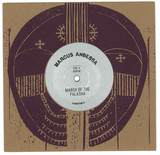
ZamZam 70 is our first team-up with the man of mystery known as Marcus Anbessa. An enigmatic figure whose identity must remain secret for the time being, his infrequent releases on labels such as Lion Charge, Tribe 12, and The Most High (as “Unknown Artist”) are eagerly awaited by those who know, charting an uncompromising vision down a path untrod by the weakheart or the follow-fashion. We love music that builds its own sound world with only passing reference to familiar genres or signposts, music that believes in itself utterly - for this reason we feel genuinely blessed to present these two sides.
“March of The Falasha” is pure roots music that, firmly planted in the soil of dub and sound system, reaches back even further into the mists of time through technological means. Downbeat steppers is the idiom, pure heartbeat is the pulse. Like an old soul young in years but full of wisdom, a distorted flute melody wanders ahead through the undergrowth of bass, light filtering through the ancient canopy above in the form of swung percussion and flickering echoes overlapping and intertwining like vines and creepers weaving on temple walls. Ancient-to-the-future.
“Creator” strikes a different yet equally dread chord, 140-ish post-apocalyptic Rasta business focused squarely on bass and space, hard, insistent drums and infinite echo trails flinging from the snares and percussion, creating hypnotic tracers like sparks swirling heavenward from a well-tended fire in blackest night.
Imagine African Headcharge on Jah Tubbys, or a rootsman groundation resuscitating ancient machines in the crumbling ruins of a near-future world and you begin to see what Marcus Anbessa brings. This music reminds us that nature herself will some day claim Babylon and grind it to dust, regardless of our efforts to save it or hasten its fall.
Margino (real name Kim Kallie) is a South African artist. She recorded her first song
at the age of eight, when she performed ''Montreal'' with her mother Judy Page. She
sang with the reggae group Kariba and jazz rock outfit Turbo in the early 80's, and
later did backing vocals for Future and others. She first shot to fame as a solo star
with a version of ''Holiday'' (written by Lisa Stevens and Curtis Hudson, credited as
Cathy Hudson), which was released at the same time as Madonna's version.
Margino also had a hit in 1983 with a cover of In-Deep's ''Last Night a DJ Saved My
Life'', that went to #16 on the South-African Top 30 and charted for 10 weeks. She
now runs a Performance Academy from her studio, and continues to perform on
stage at events around Cape Town.
Recorded at RPM Recording Studios (Johannesburg, South Africa) in 1985, Happy
People is a flawless album with dancefloor hits such as ''Happy People'', ''I'm
Getting Out'' and ''One Hot Night'' and downtempo tunes such as ''You Turn Me On'',
''You Need A Woman'' and ''You''. All rhythm tracks were played by Attie Van Wyk
(Keyboards, Synthesizer, Drum Machine) and Danny Bridgens (Guitar). The full
album is a cream of boogie funk, disco and pop.
For this reissue, Jamwax took the pleasure to remaster the sound from the original
tape. The artwork was also remake with Andy Warhol ''Marilyn Monroe'' pop art
style, for your eyes pleasure.
With a discography held in such high esteem amongst fans of conceptual French pop and soundtrack composition, the likelihood of finding an unturned stone amongst maestro Jean-Claude Vannier’s fertile psychedelic rockery falls somewhere between slim and skeletal. Even the most intrepid explorers of the most fearless and fastidious nature should naturally expect to encounter one or two shadowy characters when braving the oblique corners of the Vannier vault, but few lost souls cast a darker silhouette than the cinematic obscurity known only as La Bête Noire (The Black Beast).
Lost and presumed missing for decades the soundtrack tapes to this lesser-known 1983 French thriller (featuring a cast culled from films such as Alphaville, The Modern Couple and Sweet Movie) captures the revered composer and arranger of Serge Gainsbourg’s Histoire De Melody Nelson embarking on a darker exploration of free jazz, frenzied batucadas and cyclic carousel psychedelia. Counting key players of the French jazz scene within its ranks, The Insolitudes group comprises a crack team of Palm/Futura/Actuel/Saravah regulars such as saxophonist Philippe Mate´ (Acting Trio/Mate´-Vallancien/Tacet) alongside drummer Bernard Labat (Mad Ducks) and legendary Arpadys/Voyage rhythm masters Marc Chantereau and Pierre-Alain Dahan (Brutus Drums) all of whom alongside Michel Zanlonghi (Ensemble De Percussion De Paris) make up this thunderous, tumultuous, four-headed rhythm machine bridging an authentic gap between The Jef Gilson Groups and France’s signature “cosmic” revolution. Naturally these previously unheard compositions are spearheaded by lead pianist and composer Vannier and for devotee’s of his 1972 concept album L’Enfant Assassin Des Mouche there is much to admire and cross-reference herein.
Having been the most loyal and long-running guardians of Jean-Claude’s monster archive over the past two decades Finders Keepers Records are proud to present this first catch of newfound vintage Vannier discoveries on this limited and unlikely free jazz 45 single (which should find a perfect home between coveted Euro jazz 7”s by Krzysztof Komeda, Franc¸ois Tusques and Brussels Art Quintet). Almost 15 years since Finders Keepers once liberated the Mouches it is now time to set free another Black Beast amongst discerning listeners.