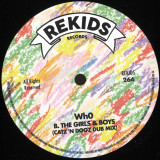
Wh0 arrives on Rekids with ‘Girls & Boys’. The Grammy-nominated producer’s next single comes with a remix from Catz ‘n Dogz.
Wh0 lands on Radio Slave’s Rekids with new single, 'Girls & Boys', out 13th June 2025. A full-throttle piano jam, the track distils a range of House styles into one expressive, infectious, modern-day classic. Powered by a raw, rolling bassline and loopy chords, it brings unrelenting energy built to raise hands in the air all summer long.
Polish duo Catz ‘n Dogz step up on remix duties with a chunky dub mix. Stripping things back, they reimagine the original into a thudding Techno cut, complete with eerie vocal chops and a deliciously deep, driving groove.
Formerly a member of legendary House duo The Rhythm Masters, Wh0 has since made his mark as a solo act with sold-out shows at places like Printworks, XOYO and Fabric. The Wh0 Plays and Wh0 Worx label boss boasts production credits for artists like Ten City, Royksopp and Idris Elba and collaborations with the likes of David Penn, David Morales and Nile Rodgers, with his work often topping digital charts and his Spotify clocking up more than a million streams a month.
Radio Slave’s Rekids was founded in 2006 and has since spawned successful off shoots with the Techno-focused Rekids Special Projects in 2017 and its newest sublabel, REK’D, in 2024. With Matt Edwards as the sole A&R, Rekids has been crucial in developing early artist careers and has become a haven for established acts operating in House and adjacent genres, having recently featured the likes of Harry Romero, Tal Fussman, Spencer Parker, The Hacker, and many more.
Search:lan
Alien D, aka Daniel Creahan, is a staple in the NYC underground, known for his releases on labels including Lillerne, 1432 R and Banlieue Records. On his latest album, For the Early Hours of a World in Bloom – his first for Theory Therapy – Creahan takes us deeper into the dubby landscapes of his previous work, with a renewed focus on groove and movement.
Where Lillerne’s Spiritual World leaned toward ambient abstraction, Early Hours pulses with kinetic energy, with tracks like “Soil Dub” and “Sleepy’s Gambit” propelling us forward with dubwise rhythms crafted for the dancefloor.
The album thrives on its infectious, steady groove, with repeating phrases and subtle shifts that keep the music in constant motion. Nowhere is this more evident than on the gentle roller, “Breather.” Over 13 minutes, Creahan lets small variations in tone and a propulsive low-end evolve gradually alongside Ben Seretan’s guitar.
While Early Hours embraces a more rhythmic direction, it still retains the eccentricity and atmosphere that defines Alien D’s sound. Conceived in the first days after the COVID lockdown, there’s a hopeful quality to the music – flickering tones, soft percussive elements and organic textures that hover just behind the beat – making it feel both intimate and expansive. It’s as though Creahan has bottled those transcendent moments that can occur during the early hours of a party, when everything feels suspended in a state of potential.
Run time - 33 minutes
Credits:
Written & produced by Daniel Creahan
Guitar on 'Breather' by Ben Seretan
Mastered by Special Guest DJ
Cover & design by Gary Hunter
Majestic Fantasies, debut album from the duo Space Ghost & Teddy Bryant, is the second release on Space Ghost’s new record label, Peace World Records. Produced by Space Ghost, with Teddy Bryant’s powerful vocals at the forefront, this new album sees the two artists effortlessly blend their shared influences from the late '80s and early '90s.
Over three years in the making, in Majestic Fantasies Space Ghost & Teddy Bryant look to the past for inspiration as they explore genres, techniques, and moods. Across the record, Bryant’s vocals shine as he demonstrates a strong ability to create memorable nostalgic hooks and catchy backing harmonies. Similarly, Ghost displays his knack for dissecting vintage production tropes and breathing life into them in a modern context.
Filled with underground, soulful gems, Majestic Fantasies draws deeply from the duo's passion for R&B, UK Street Soul, New Jack Swing, House, and G-Funk. Their 10-track LP freely blend these genres, paying homage to song writers like Teddy Riley, Jam & Lewis, Carl McIntosh, an DeVante Swing. On the album you’ll find tracks like “Some Things Last Forever” which explore New Jack Swing drum patterns and vocal hooks. Additionally the record holds dancefloor-ready House tracks including “Majestic Fantasies”’ and “Unconditional” which sit side by side with heartfelt ballads such as “Cheer Me Up, ” and “Ultimate Love, ”
Although the two have never met in person, Space Ghost and Teddy Bryant still find a way to connect through their music. Throughout the album, they demonstrate a mutual understanding of the sound they like to produce together: tasteful and playful love songs that feel positive and optimistic, bringing classic songwriting styles from the past into the modern music landscape.
Majestic Fantasies lands on Peace World Records June 13th, 2025.
DUVEL & GIT HYPER - De Rode Draad
Duvel is een pionier binnen de Nederlandse Rap-scene. Met z'n herkenbare stijl en vooruitstrevende visie heeft hij menig artiest geinspireerd en is zijn naam in steen gehouwen. Dit geldt eveneens voor DJ en producer Git Hyper, wiens naam sinds de 'golden era' van de Rap niet is weggeweest. De samenwerking van Duvel & Git Hyper vormt dan ook een nieuwe HipHop mijlpaal. De solide productie ligt in handen van Duvel en Git Hyper en vormt de fundatie voor de scherpe teksten van Duvel, ondersteund door klinkende namen als $keer&Boo$, Faberyayo, Nosa en Maximilli. Het album wordt uitgebracht door Redrum Recordz, het underground label wat Duvel ooit z'n eerste wapenfeiten bracht. Tezamen met de geschiedenis die hij met Git Hyper heeft, is de muziek het kloppende hart en HipHop 'De Rode Draad'.
Featuring: Coby Sey, Mica Levi and Mark Pell (Good Sad Happy Bad / Micachu & The Shapes)
‘Affectionately’ is the debut album by London based songwriter and musician Raisa K. With self produced instrumentals supporting Raisa’s signature vocal performance, the record delves into the intricate emotional cycles of relationships with heartfelt sincerity. Melodies appear simple and direct, while the themes explored present a great level of complexity. Whether about trust, kindness, doubt, frustration, annoyance, regret, honesty, insecurity, loneliness or friendship, each of the album’s twelve songs lie somewhere in between a diary and a letter.‘Affectionately’ is almost entirely produced on Raisa’s laptop and written in her home in London, as well as finding small pockets of time on trains and buses, during breaks at work, during the kids' nap-times, at the playground, in the park. The production's backbone is formed by a synthesiser sample, weaving together a range of recordings and sonic textures.
This creates a consistent expression where diverse electronic styles merge with Raisa's crisp, candid vocals in unique and personal songwriting. Some listeners might recognise Raisa’s voice and musical language from records by the band Good Sad Happy Bad, which she is a part of. While ‘Affectionately’ certainly moves in its own space, a kinship with fellow London artists is also present, as the record includes a feature with Coby Sey as well as instrumental contributions from long-time collaborators Marc Pell and Mica Levi.
Nonverbal Language unveils its third chapter with CVRDWELL at the helm, delivering two originals shaped by emotional depth and precise sound design, backed by remixes from Casual Treatment and Mathys Lenne.
"The Message" blends groovy low-end, lush textures, and melancholic energy into a powerful statement for the dancefloor. Casual Treatment (Hayes, Token, Mord) transforms it into a deeper, hypnotic techno voyage.
"Haunted" descends into eerie, cinematic territory-slow, brooding, and charged with tension. Mathys Lenne (Mord, Hayes, Float) amplifies the unease with a remix that's both refined and fearsome
ANORAX sticks to its’ #eatsleepmantra with the reissue of the perennially in demand TIGHTEN UP by Melbourne soul disciples THE BAMBOOS.
The track - a catchy as you like instrumental slant on Archie Bell & The Drells USA #1 million selling smash from 1968 - was originally released in 2006 on Kenny Dope and Keb Darge’s KAY-DEE label.
It immediately became a favourite in Soul & Acid Jazz circles, and it’s’ popularity rapidly spread across all dance genres, THE BAMBOOS main man LANCE FERGUSON showed genius by ditching the idea of vocals and lyrics in a composition hailed by Rolling Stones magazine “as one of the greatest songs of all time” and instead coming up with the quirky irresistible instrumental we all love. Funky flute anyone?
The Kay Dee 45 was reissued some years ago but enduring demand has outstripped supply.
Limited edition press so grab em while you can….
- A1: Dj Koze I Haven't Been Everywhere But It's On My List (Dj-Kicks
- A2: Dimlite Can't Get Used To Those (Kosi Edit) / Efdemin - Ohara
- A3: Clouddead Dead Dogs Two (Boards Of Canada Remix)
- A4: Strong Arm Steady Best Of Times (Instrumental)
- A5: Homeboy Sandman Holiday (Kosi & Fink's Edit)
- A6: Freddie Gibbs & Madlib Shame (Instrumental)
- B1: Mndsgn Camelblues (Kosi Edit)
- B2: Broadcast Tears In The Typing Pool
- B3: Daniel Lanois Carla
- B4: Hi-Tek / The 2 Bears Come Get It (Tekstrumental) / Modern Amily (Kosi Kos Mélange)
- B5: William Shatner It Hasn't Happened Yet
- C1: Marker Starling In Stride
- C2: Session Victim Hyuwee (Dj Koze Remix)
- C3: Frank & Tony Bring The Sun Feat. Gry (Kosi Edit)
- D1: Marcel Fengler Jaz (Kosi Edit)
- D2: Portable Feat. Lcio Surrender (Kosi Edit)
- D3: The Gentle People Superstar
2023 Repress
DJ Koze - with his friendly and sometimes slightly melancholic take on the world - is one of the greatest auteurs of club music today, and one of the few internationally active DJs who dares to make music that has relevance beyond the dance floor. During the 70-minute journey on his DJ Kicks - the 50th edition - Kosi
Kos manages to establish a uniform color even though genres alternate in a way that is rarely heard on a mix CD: the stripped down hip hop of Madlib, brutalist Berghain techno, timeless songwriting, floating indie-pop and outlier numbers that oscillate between absurdity andmelancholy. Koze's disregard for the stylistic yoke presents him with an immense challenge. Hence, almost all the tracks are more or less edited, and one is fully rhymed (Session Victim: Hyuwee).Koze rambles on here himself: "I didn't want to kick around ophisticated knowledge, but rather try and weave together some good gems that would make sense to anyone, even people who aren't necessarily music nerds". But this is blabbing that you can count on, also because he approaches the term "mix" from a different angle and doesn't even try to make something fit that doesn't fit: "During the day, I don't need to hear anything that's mixed on the beat. I put the focus on making sure that it works harmoniously - the idea is more to create the impression of a radio show, like people such as John Peel did so uniquely. There is a giant cosmos of music and it runs through my filter".
»White Noise« is a cooperation project between raster-media and the Max Planck Institute for Empirical Aesthetics. Artistic sound projects generated in the context of the scientific research institute will appear at irregular intervals. The themes and questions of empirical aesthetics research are taken up, questioned or challenged in very different ways. »White Noise« is conceived as an audio archive of the MPIEA artists in residence which records the artistic works on vinyl and documents the respective concepts and working methods in text form.
Victioria Keddie’s »Pshal P’shaw« (white noise #002) is a multimedia exploration delving into phonetic expression’s auditory and rhythmic nuances of phonetic expressions through an amalgamation of text, sound, video, data, and customized learning software. Drawing inspiration from the painter and architectural theorist Hermann Finsterlin who made speculative architectural renderings, the project originated during a residency at the Max Planck Institute of Empirical Aesthetics in Frankfurt in 2023.
The project’s engagement with the sonic landscape of the eight diphthongs in US English, documented through recorded sessions at EEG labs with participants of diverse international backgrounds, is not just a technical analyses. The applied script for the recording session, infused with a contemporary Western US dialect, ventures beyond, exploring the primal essence of phonetic expression and its impact on the oral landscape of mouth, throat, and tongue.
This work focuses on the spoken aspect of language: the art of oration, conversation, and mimicry. It reflects the beauty of our perpetual change, speaking directly to our humanity and the raw, tender moments of existence. It embraces the awkward, beautiful and vulnerable essence of our shared human experience.
Victoria Keddie is a multidisciplinary artist delving into sound, video, installation, and performance. Her work uncovers hidden narratives within ordinary artifacts and spaces, emphasizing their role in shaping our collective story. The examination of acoustic phenomena and language is a recurring theme in her artistic work. Keddie’s current projects navigate the acoustic complexity of language and dialects.
For over a decade, Keddie was co-director of E.S.P. TV, exploring the televisual medium for performance and sound. Keddie has performed and exhibited internationally. Recent fellowships include the NYSCA/NYFA for Music/Sound (2022), the Max Planck Institute for Empirical Aesthetics (2023), and the Bemis Center for Contemporary Art, Sound Art and Experimental Music Fellowship (2024).
»White Noise«, 40 p. magazine English/German, vinyl LP, cardboard box
Part 1[11,72 €]
A noughties classic, an earworming anthem, an eventual schoolyard ringtone favourite; Roman Flügel’s once inescapable ‘Geht’s Noch?’ celebrates turning 21 on Running Back, refreshed and remixed by a scene-spanning set of artists paying keen tribute to its absurdist energy.
Casually released as part of a Cocoon Records compilation in 2004, ‘Geht’s Noch?’ rose from the depths with the support of Sven Väth, becoming an international phenomenon, conquering and uniting the dominant scenes of minimal and electroclash alike. Some have said it laid the foundations for the ‘Dirty Dutch’
house scene, albeit from over the border in Germany.
Well known for injecting much-needed levity into the contemporary club landscape via her Live From Earth parties, DJ Gigola adds additional firepower to ‘Geht’s Noch?’, inducing a planet-shaking kick drum, before sending the track’s signature bleeps into nonsensical Morse code for even greater pleasure. Another rave
culture connoisseur, Luca Lozano, offers two alternate takes; his ‘Technocs’ mix rolls deep with additional cowbells, robotic voice commands and stadium-sized claps. Meanwhile, the ‘Gehts Garage Remix’ draws a savvy connection with the original’s as-yet-untapped UK funky potential.
Peder Mannerfelt, who straddles the line between innovation, functionality, humor and seriousness quite like its original author, takes ‘Geht’s Noch?’ to truly wuthering heights. His remix builds unexpected drama and catharsis around the enduring riff, before a collaboration with studio partner Par Grindvik as Aasthma
spins the club out with a glossy, anime-tinted take, full of whimsy and colour.
And while the digital release of Geht’s Noch? also spans interpretations from Audion, Domnik Eulberg & Moguai, this vinyl release presses Steve Angello vs Who’s Who remix to wax, that which helped take ‘Geht’s Noch?’ out of the underground and into the stratosphere. Twenty years on, and Flügel’s offbeat hit is always ascending. Love it or hate it, ‘Geht’s Noch?' will still get you good.
Words by John Loveless
We’re hyped to welcome back the French producer Carriego, who already made waves with a standout EP on our sister label Cosa Vostra. This time, he lands on Griffé with a four-tracker that dives deep into stripped-back grooves, rhythmic precision, and textured soundscapes.
True to his style, Carriego merges Detroit roots with early 2000s minimal vibes—tight drum machine programming, detailed sound design, and a strong focus on mood and arrangement. The drums hit with intent, and every element feels built for purpose.
The EP unfolds like a proper journey: Hazard sets the tone with tension and space—ideal for an opening move. The Bridge follows up with drive and pressure, perfect for peak-time intensity. Curtain Call brings in a hypnotic, late-night energy, subtly nodding to the Time Passages spirit—refined, trippy, and deep. Then comes Seems Like to close the ride—more introspective, with a dub techno edge that lets everything breathe again.
Techno, minimal, electro, dub—Carriego connects the dots without forcing it. Just functional, thoughtful club music that works on multiple levels.
2025 Repress!
Debuting on Life In Patterns, Sera J presents his EP "Chapter One". This release marks the beginning of a new chapter, characterized by more organic sounds and landscapes. Each track possesses its unique character, yet together they create a harmonious record perfect for the dance floor.
- A1: Iron Butterfly - Iron Butterfly Theme
- A2: Rare Bird - Devil's High Concern
- A3: Paul St. John - Flying Saucers Have Landed
- A4: Chris Hodge - We're On Our Way (2010 Remaster)
- B1: Juantrip - Shadows
- B2: 62 Miles From Space - Time Shifts
- B3: White Trash - Road To Nowhere
- C1: Blue Phantom - Diodo
- C2: The Mannheim Rock Ensemble - Hungarian Dances
- C3: Limousine - Barriers
- D1: Ugo Busoni - Rullio
- D2: Bernard Estardy - Cha Tatch Ka
- D3: Kate - Shout It
- D4: Dyna-Might - Need You
- D5: La Metamorfosi - Scusa, Eh!
"Throughout all my time as a musician and producer, ever since Jack the Tab, I've been focused on developing a single idea: Blending psychedelic sounds and effects with rhythm." Richard Norris, Strange Things Are Happening White Rabbit 2024
Over the past few years Eskimo Recordings have invited some of thebest crate diggers around to curate compilations that don't just reveal the hidden contents of their record bags but something about themselves too. Now, following in the footsteps of the likes of Bill Brewster and Psychemagik, producer, musician, DJ, writer and more, Richard Norris, takes us on a globetrotting psychedelic journey with the epic 42 track collection, Mr Norris Changes Brains.
For over forty years Richard has played a part in many of the UK's most important music subcultures. Whether sharing stages with the likes of Tracey Thorn as a pubescent punk in St. Albans, or running freakbeat nights in Liverpool and working at the pioneering psychedelic label Bam Caruso, co-producing the UK's first acid house inspired LP with Throbbing Gristle's Genesis P. Orridge or riding the wave of creativity that the second summer of love unleashed all the way to the Top of the Pop studios as The Grid, Richard's career has continually seen him work to expand both his own and the public's musical horizons.
With Mr Norris Changes Brains it's the most recent part of his mercurial career that he's focused on. Drawing inspiration from his post 2006 adventures as one half of Beyond the Wizard's Sleeve, alongside Trash's Erol Alkan, this compilation shows how a more connected world has blown the dust off a paradoxically sometimes straightjacketed scene. The result is a dizzyingly wide-ranging collection that explores the further out there reaches of worldwide psychedelia and dancefloor mayhem.
"A lot of these tracks are fairly recent discoveries, things that I've discovered from around the time I started working with Erol and going right up to today," Richard explains. "Whether that's from going out to play and finding new records in places like Istanbul or just connecting with people online from all around the world. Psych can sometimes be a sort of narrow-minded field, with everything having to sit in its specific niche, but more and more people are open to new sounds and that's allowed for a much broader selection."
Despite their disparate origins what does unite these tracks is that they aren't just there to zone out to on a bean bag as projections of swirling coloured oils and psychedelic patterns wash over you. Mr Norris may change brains but his DJ sets also move feet, and whether it's their killer guitar riffs, oscillating synths floor shaking drums or soulful Hammond organs these are all cuts that from festival tents to underground clubs have proven time and time again to get people dancing.
"With a lot of these tracks there's a kind of fun element in them," says Richard. "It's still psychedelia, but they've also got these solid, funky grooves. They sound phenomenal on the dancefloor and as much as these records might excite old psych heads, this compilation is also for a new generation out there who might have never heard anything like this before and, just like when I was 18 and heard The 13th Floor Elevators for the first time, think 'Oh, my God, what on earth is this and more importantly what else is out there?'"
- A1: Korogi ‘73 - Fushigi Song
- A2: Yas-Kaz - Hei (Theme Of Shikioni)
- A3: Yoichiro Yoshikawa - Tassili N'ajjer
- A4: Norihiro Tsuru - Farsighted Person
- B1: Geinoh Yamashirogumi - Theme Of Kaneda
- B2: Yoichiro Yoshikawa - Fiesta Del Fuego
- B3: Columbia Orchestra - Heart Beats / Theme For Andrew Glesgow
- B4: Kan Ogasawara - Gishin Anki
LP vinyl only release + 4 page liner notes (comes with hype sticker)
The percussive new age soundtracks of '80s and early '90s Japanese TV, anime and manga built alternative worlds and pushed boundaries in the process.
When Japanese composer Yas-Kaz left Tokyo for Bali in the mid 1970s he had little idea of how influential his trip would become. In studying the storied art of gamelan, the jazz and avant-garde percussionist opened a door to a world of sound and rhythm left behind by the West. The music he and his contemporaries made would become known as new age. It also happened to soundtrack the golden era of anime.
Awash with money and with the prerogative to entertain the burgeoning middle classes, anime in the 1980s experienced a creative and commercial boom. Not constricted by generic expectations, production houses such as the now renowned Studio Ghibli were able to experiment liberally with both form and content. And with it came the space for composers to be similarly adventurous.
TV, Anime & Manga New Age Soundtracks 1984-1993 charts this moment across eight tracks spanning classics of the genre and previously unknown rarities. The collection brings together music that found kinship in electronic and acoustic instrumentation, often combining spiritual or environmental themes with percussive, varied and highly refined syncopations of non-Western musical traditions.
Among them is ‘Kaneda’ by Geinoh Yamashirogumi, the shape-shifting group of self-styled musicians, anthropologists and computer scientists that masterminded the soundtrack to game-changing dystopian anime Akira - and with whom the sound, tuning and breakneck speed of Balinese gamelan has become indelibly entwined.
Reflecting the desires of the era to reach beyond Japan’s borders, many of the soundtracks featured were commissioned for narratives set in distant lands or alternative worlds. There’s violinist and composer Norihiro Tsuru’s ‘Farsighted Person’, written for The Heroic Legend of Arslān, set in ancient Persia; Yas-Kaz’s own ‘Hei (Theme of Shikioni)’, for period sci-fi manga & anime series Peacock King - Spirit Warrior; and two tracks - Tassili N’Ajjer and Fiesta Del Fuego - from Yoichiro Yoshikawa’s soundtrack to NHK’s proto-Planet Earth series The Miracle Planet.
Such was the variety and quality of the music produced, if there is a guiding principle to the tracks collected here it is a sense of escapism and adventure that came with the confluence of modern electronic instruments and a fascination with percussive traditions.
Elsewhere, pioneering children’s TV composer Chumei Watanabe’s ‘Fushigi Song’ (performed by a vocal group Korogi ‘72) offers a trippy and infectious groove with sonic similarities to Don Cherry’s ‘Brown Rice’; little-known jazz-funk library group Columbia Orchestra showcase the best of Tokyo’s session musicians on ‘Hearts Beats - Theme for Andrew Glasgow’; before lawyer-turned-composer Kan Ogasawara closes out the compilation with a dramatic flourish on ‘Gishin Anki’.
Following on from Time Capsule’s acclaimed deep-dive into the world of manga & anime synth-pop in 2022, this vinyl only collection is set to broaden and diversify an understanding of how soundtracks shaped the sound of new age music in Japan for a generation.
Curators: Kay Suzuki, Rintaro Sekizuka (Vinyl Delivery Service)
Artwork: Tu-yang
Apnea welcomes VC118A to the label for the first time with Back To Life, his next album following the 2024 collaboration Flow Zone with CRC. Across nine tracks on two 12''s, he delivers a potent mix of deep electronics, acid bleeps, mechanically crafted rhythms, and atmospheric dub infusions--pulling the listener into a hypnotic, meditative space. Driven by futuristic machine grooves and evolving textures, Back To Life moves between fluid, weightless passages and tightly constructed sequences, balancing structure with deep immersion. Each track unfolds with intention, guiding through shifting sonic landscapes that blur the line between motion and stillness. Landing April 2025 on Apnea.
*all original recordings from mid 90s Estonian released cassettes. Fascinating interpretations of the UK breakbeat and Jungle sounds recorded when the world felt like a much bigger place.
Since hearing the first breakbeats via the Finnish radio nightly shows introducing the burgeoning UK scene, Virko Veskoja, later head figure of Lu:k, was completely swept away by this new technological language that sounded like machines trying to initiate contact with people. The fluttering rhythm patterns, strings and vocal lines haunting the pathways of the infinite network. Like hip hop taken over by Skynet.
Reimagining it all in mid-90’s Estonia, a fresh and dirt-poor republic newly welcomed to the family of sovereign states on the outskirts of Eastern Europe, was challenging, to say the least. Finally, with the help of entry level music programs, custom-made soundcards and self-built computers by the other Lu:k-head Tõnis Valk, Lu:k took the first tentative steps in the history of Estonian jungle.
Eight Lu:k cuts have been compiled into a handy selection, a true sign of the times when uncertainty came with certain hope and optimism – new territories to chart, new frontiers to conquer. A time of innocence captured so sublimely in Lu:k’s music.
The compilation starts with menacing orchestration that sounds like the birth of a civilization, like in „2001: A Space Odyssey“, or the arrival of Godzilla, only to give way to sweeeet strings and the inimitable Minnie Riperton in “Lovin U”, combining all the essential elements of Lu:k in a track that has remained uncorroded by time since its inception in 1994.
The following “Demo 3” is its antithesis – fast and nervous, a harbinger of the darker days of neurofunk and techstep ahead. More in line with the social realities of the time, when something (or someone) could materialise out of thin air and attack you just as violently as those beats here.
“La:v” was Lu:k’s signature track throughout their brief career that went on only for a few years, 1994-1997. Lifted to heaven’s by Petula Clarks’s wonderful vocals, it perfectly captures the pure essence of creation. “I made it in my bedroom. Something like that just came out. Sorry”, says Virko apologetically.
From the themes of love we are led towards darker scenarios again with “Drunk-Drive”, a more vengeful cut reminiscent of early Ram Records’ nocturnal dangers, skylines shaped by basslines. Previously only available on the uber-rare “Raadiomaja valvelauas” CD compilation from 2005.
“In the Limelight” is lifted from their second album “Dreams in Drums” from 1996 (only released on cassette), and if it’s meant to address their new-found underground celebrity status in Estonia, there is surprisingly little elation here – the track rather consists of introspective strings and beats that sound almost melancholic.
Out of the remaining three tracks, “Proov2mix” and “Kadunud leitud” are the result of a treasure hunt amongst the old, obsolete harddrives – little nuggets that were condemned to obscurity until now. Between them, another vocal-led cut “010”, a non-album track only featured on two comps until now, is a strong reminder of Lu:k’s prodigious ability to handle vocal lines and morph them together with their own weaving synthetic melodies, strong pads and commanding beats.
Lu:k’s music has been largely unavailable for the better part of this century, with original tapes and CD’s changing hands for a small fortune. This vinyl release couldn’t come at a better time, bringing a seminal chapter of Estonian dance music’s mythical history to light again, both for the old-school acolytes and new converts.
All music by Virko Veskoja
When you’re running a label, a demo occasionally comes across your desk that makes you reconsider everything you thought your label was all about. For Balmat, such was the case with this stunning album from Stephen Vitiello, Brendan Canty, and Hahn Rowe. It sounds like nothing we’ve released so far—and that very otherness opened up a whole new world of possibilities for us.
Fans of ambient, experimental electronic music, and sound art will be familiar with Vitiello, a New York native, long based in Virginia, who has collaborated with a cross-generational list of greats: Taylor Deupree, Steve Roden, Lawrence English, Tetsu Inoue, Nam June Paik, Ryuichi Sakamoto, Pauline Oliveros, and many more. On labels like 12k, Room40, and Sub Rosa, he has explored a wide range of minimalism, microsound, lowercase, ambient, improv, and other styles. But this album is something different. It may begin in ambient-adjacent territory, but it quickly veers off, and it just keeps zigzagging, taking on elements of krautrock, post-punk, dub, and the groove-heavy interplay of groups like Natural Information Society and 75 Dollar Bill.
This stylistic turn is thanks in large part to Vitiello’s choice of collaborators. “We’re coming from three different schools,” Vitiello says: “sound art, art rock, and punk rock.”
Active since the early 1980s, Rowe—a violinist, guitarist, and producer/engineer—has played with, or manned the boards for, a frankly jaw-dropping list of musicians: Herbie Hancock, Gil Scott-Heron, the Last Poets, Roy Ayers, John Zorn, Glenn Branca, Swans, Live Skull, Brian Eno, David Byrne, Anohni, R.E.M., Yoko Ono, and many more. But he might be most closely associated with Hugo Largo, a one-of-a-kind New York quartet—two basses, vocals, and Rowe’s violin—that in the late 1980s helped lay the groundwork for what would eventually become known as post-rock.
Canty, of course, is the legendary drummer of Fugazi, the visionary DC post-hardcore group, as well as Rites of Spring before them, and, currently, the Messthetics, a Dischord-signed instrumental trio with guitarist Anthony Pirog and Fugazi bassist Joe Lally.
Vitiello’s trio first collaborated on First, a 17-minute piece released on the Longform Editions label in 2023. Second picks up where the freeform drift of First left off, channeling the trio’s exploratory energies into more intentionally structured tracks and—in a real first for Balmat—some almost shockingly muscular grooves. “Sometimes my projects are more conceptually driven,” Vitiello says, “but I think this was more musically geared. I just wanted to open up the references and bring in an incredible drummer, bring in some melodies, and I’m sort of the center.” But his collaborators, he stresses, are “vastly creative in making anything I might suggest better.”
Like its predecessor, Second took shape in phases, shifting between improvisation and collage. Vitiello laid down the skeleton of the music at home, sketching out initial ideas on Rhodes keyboard and acoustic and electric guitar; he then fed the parts through samplers and his modular system, recording 10- or 20-minute jams. Once he had edited them into more structured forms, he hit the studio with Canty, who added not just drums but also bass and piano; finally, Vitiello took the results of those sessions to Rowe, who played violin, viola, electric bass, and 12-string acoustic and bowed electric guitar, and assisted in some of the final structuring and mixdown.
A few more surprises along the way: Reanimator’s Don Godwin, the studio engineer where Vitiello recorded with Canty, contributed what he calls “resonant dustpan”; and none other than Animal Collective’s Geologist, who just happened to be in the studio that day, sits in on hurdy gurdy on “Mrphgtrs1,” the album’s gorgeous, stunningly atmospheric drone closer. “I love these chance encounters,” Vitiello says. “Somebody I admire, a group I admire—that was an unexpected gift.”
An unexpected gift is a great way of describing Second as a whole: three veteran musicians venturing outside their usual zones and finding a new collaborative language together. The results can’t be neatly slotted into any given genre; they belong not to any given category, but to the spirit of conversation itself.
- A1: One O'clock Junk
- A2: Before The Rain
- A3: Circles
- A4: Dark Eyes Of Martha Hirsch
- A5: The Bridge That Broke On A Blue Monday
For years, whispers circulated through the jazz scenes of Denmark and Poland - rumours of a lost recording session featuring the legendary Polish trumpeter Tomasz Stanko and a group of Scandinavian and Polish musicians. Now, nearly a decade after the session and seven years after Stanko's passing, these long-awaited recordings are finally seeing the light of day. The project originated at Vallekilde Højskole in Denmark, where Stanko was invited to teach at JazzDanmark's annual Summer Session. A storied program that has hosted luminaries including Bill Frisell and Anat Cohen, the summer school became the birthplace of this unexpected ensemble. Here, alongside a dynamic ensemble of young musicians, Stanko found renewed inspiration, embracing their compositions as much as his own - a rare occurrence for an artist known for leading his own groups. Scandinavian Art Ensemble with Tomasz Stanko is the result: two albums of expansive, deeply expressive music that merge the melancholic depth of Polish jazz with the spacious, atmospheric qualities of the Scandinavian sound. As trumpeter Tomasz Dabrowski recalls, Stanko wasn't just a mentor - he was an equal, driven by curiosity and the desire to push boundaries. "He wanted to play our music. He was always listening, always searching." Across these two albums recorded at The Village Recordings in 2016, listeners will hear Stanko's unmistakable tone interwoven with compositions by both himself and the ensemble members. Pieces like 'The Dark Eyes of Martha Hirsch' and 'Before the Rain' showcase not just his signature lyricism, but also his willingness to step back, listen, and let the younger generation shape the sound. Beyond his unmistakable sound, Stanko's influence was about energy - his presence elevated those around him. Bassist Richard Andersson put it simply: "He brings together the energies, and makes us all play better than usual." This project captures that essence: a legendary artist meeting the next generation on equal footing, creating something entirely unexpected. A decade after the session, the members of the Scandinavian Art Ensemble have forged their own paths, shaping the jazz landscapes of Copenhagen, Malmö, Reykjavik, and beyond. But the impact of their time with Stanko remains profound. "Releasing these albums is about more than just the music," D?browski says. "It's about preserving the spirit of Stanko - his generosity, his curiosity, his way of bringing people together. Even after all these years, his presence can still be felt in every note we played."