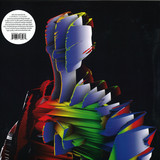
LYBES DIMEM is a project by visual artist and musician Lukas Rehm. With a focus on digital sound-de- sign, elaborate beat structures and the use of error, the music plays with cognitive phenomena and abstraction while maintaining an emotional refuge. LYBES DIMEM is presented in formats ranging from spatial sound experiences to sy- nesthetic shows complementing the auditive layers with visualiza- tions of real-time data, computer graphics and moving image. Lukas Rehms installative art, and compo- sitions have been internationally presented and awarded with multi- ple emerging arts prices.
SYNCLEFT CHRONEM is the first album released by LYBES DIMEM in both digital and vinyl format and accompanied by a moving image artwork. The title reflects the pro- jects interest in the potential of difference, cognitive frictions and exertion: sync = variability in the processing of auditive and visual signals, syncleft = the synaptic cleft, which is a crucial empty spa- ce in biological neural networks, chronem = the chroneme as a the- oretical unit to measure the time of
an articulated sound. Mathemati- cally clean sounds juxtapose pat- terns and transitions familiar from the realm of organic acoustics. Multi-layered noise textures ex- plore the simulated space. A tem- porary continuity is provided by percussive and melodic elements, right until the next escalation, eventually awaiting a concluding resolution.
The visual language explores dif- ferent phenomena and techniques of cognition inspired by the rhe- torics of big science (computer graphics, discontinuity of materi- al, pop cultural references). Both the moving image artwork and the graphic design of the release pay tribute to the multi-layered appro- ach of the music. The design of the vinyl cover by studio BNAG.cc uses subtractive colour synthesis to interchange between abstract for- mality and representationalism.
SYNCLEFT CHRONEM is the first release by LYBES DIMEM on SVS Records following a first encounter at the SVS residency at the 4D Spa- tial Sound Institute in Budapest.
Buscar:lang es
Ein 44 Minuten starkes Instrumental-Album inklusive eines Akere Vocal-Features.
Es ist Ansichtssache, ob ein Antlitz unfassbar schön oder besonders verstörend sein kann, sodass der bloße Anblick den Betrachter seiner Handlungsfähigkeit beraubt. Man sollte sich jedoch nie einzig von einer Erscheinung erstarren lassen.
Also heißt es:
Augen schließen und die Schönheit einer Mischung aus zeitlosen Vibes, warmen Klängen und verschobenen Rhythmen irgendwo zwischen Trip Hop, Boom Bap und G-Funk auf sich wirken zu lassen. Die Reise führt durch Höhen und Tiefen, beeinflusst von Musik aller Himmelsrichtungen und Sonderbarkeiten verschiedener Genres.
L One´s Medusa ist durchaus in der Lage den Hörer in den Bann zu ziehen. Jedoch ergibt sich dadurch keine langfristige Betäubung, sondern vielmehr ein Moment, der sämtliche Wahrnehmung der äußeren Welt an einen Ort unendlicher Möglichkeiten lenkt. Wo es hingeht und was passiert, bleibt jedem selbst überlassen. Quasi ein Mythos!
Medusa ist nach der Farska LP bereits die zweite Zusammenarbeit zwischen dem jungen Münchner HipHop Produzenten und dem jungen Münchner Label Beat Art Department und erscheint in Kooperation mit dem renommierten HipHop Label 58Beats, dem Label der Band Main Concept.
Radical Connector was originally released in 2004 and is now fnally back on vinyl. This re-issue is pressed on mixed splatter color vinyl and presented in a high gloss jacket with free download card.
Though reference points like Daft Punk and Prince have rightly been thrown around, Radical Connector is in fact a strange album that doesn't sound like much else.' - Pitchfork
Mouse on Mars is recognised as one of Germany's most defning and versatile electronic music projects. With their
anarchic mixture of sound that oscillates between uncontrollable chaos and meticulously arranged structures,
Jan St. Werner and Andi Toma have forged a unique musical language, which is readily decomposed by the
unpredictability of its myriad mutations. Free from schools of thought, genre conventions, and from the constraints
of the music establishment, they have worked under the Mouse on Mars alias for 24 years, mapping their own
idiosyncratic trajectory through a no man's land between pop, art, club music, and the avant-garde. - Jan Rohlf
Sexy robot vocals slip and slide all over juicy squeals, raindrop plops, and jungle-thick beats.'
- Entertainment Weekly
Stirring songs drift out of its frantic aural mishmashes, fnding a controlled center amid all the dizzy spin.'
- AV Club
Mouse on Mars have a gift for making electronic bleeps and buzzes sound like tangible objects that bounce,
bend and collide in physical space.' - Rolling Stone
Japanese vocal performer Hatis Noit will release her enigmatic EP Illogical Dance via Erased Tapes worldwide on 23rd March 2018.
The arresting 4-track record creates unique song-worlds with transcendent vocal interpretations that at once deconstruct and recombine Western Classical, Japanese folk and nature's own ambience atmosphere. Illogical Dance also features Björk-collaborators Matmos, who were so impressed with Hatis Noit's recordings, they volunteered to edit the lead track Illogical Lullaby.
Hailing from the distant Shiretoko, a small town in Hokkaido, which is the largest island in north Japan, Hatis Noit's accomplished range is astonishingly self-taught, inspired by everything she could find from Gagaku — Japanese classical music — and operatic styles, Bulgarian and Gregorian chanting, to avant-garde and pop vocalists. The sounds she created on Illogical Dance, co-produced by Haruhisa Tanaka and Matmos, bring to mind the experimental vocal patterns of Meredith Monk with the attentive production of Holly Herndon.
It was at the age of 16, during a trek in Nepal to the Buddha's birthplace, when she realised singing was her calling. While staying at a women's temple in Lumbini, one morning on a walk Hatis Noit heard someone singing. On further investigation it was a female monk singing Buddhist chants, alone. The sound moved her so intensely she was instantly aware of the visceral power of the human voice, a primal and instinctive instrument that connects us to the very essence of humanity, nature and our universe.
The name Hatis Noit itself is taken from Japanese folklore, meaning the stem of the lotus flower. The lotus represents the living world, while its root the spirit world, therefore Hatis Noit is what connects the two. For Hatis Noit, music represents the same netherworld with its ability to move and transport us to the other side, the past, a memory, our subconscious. It is the same for Illogical Dance, a set of transformative songs that taps into our most primal instincts.
The human voice is our oldest, most primal yet most powerful instrument. I use it to describe nature's many sounds, a language that isn't logical. Yet it forms a beautiful conversation that isn't restricted to words like the human language is. I want my music to remind us of that.' — Hatis Noit
Wanting to interpret and mimic the sounds Hatis Noit hears in nature, Illogical Dance is as unpredictable, beautiful and mysterious as the world around us. Each track is made up from multi layers of vocals, all improvised and without words, before being carefully pieced together. Astonishingly no samples are used throughout, even the sound of crushing leaves came from Hatis Noit's own vocal chords.
The result is a stunning array of sound sculptures that see her switching between multiple styles with great ease. From the sweet operatics on Illogical Lullaby, the manipulated vocal loops duplicating electronic production on Anagram c.i.y. to the primordial chanting call to arms of Angelus Novus, a 10-minute odyssey that features whispering and leaves crunching, it showcases Hatis Noit's full range and introduces a truly original artist.
Previously only available in Japan, Illogical Dance will receive a worldwide release on 23rd March 2018 including a first edition on 12' vinyl. After participating in a ceremony for memorial and appreciation tailored to the withdrawal of the evacuation area in Fukushima on 31st March 2017, Hatis Noit collaborated with renowned visual artist Nobumichi Asai on a project titled INORI (prayer) which they premiered live as part of an Erased Tapes showcase at Mutek Japan in Tokyo.
Having recently moved to London and performed a first string of UK shows, followed by a special live performance at the Milan Fashion Week and Mutek Japan appearance, Peter Broderick has invited Hatis Noit to support him at the Jazz Cafe on April 15th. She's also been announced as part of this year's Sea Change Festival line-up, and asked to participate in a workshop with the London Contemporary Orchestra.
Here Appear is an invocation, a salutation, and a celebration — of past and perfect lives, forgotten and remembered, exchanged and borrowed. Eve Essex's solo debut is a multi-instrumental fea(s)t combining synthesizer, drum machine, alto saxophone, piccolo, electric organ/harpsichord, harmonica, slide whistle, bells, guitar pedals, and voice— composed, arranged, and performed by Essex herself. What began as an improv set at Berlin's Harlekin bar, developed over the past two years into a complete body of work evoking multiple time periods, genres, characters, and sonic landscapes. The seven tracks that make up Here Appear harness elements of classical, drone, avant-jazz, and distorted pop, coupled with an ambitious vocal delivery that draws on the phrasing and articulations of Essex's own woodwind playing, to create a quasi-narrative me´lange retaining the vulnerability of live performance. On the opening track Grind Away,' otherworldly harmonica strains set the stage for lyrics citing Chinese sci-fi novel The Third Body Problem as source material. Saxophone and piccolo interludes Immediate Communicator' and Colorless Stone' move between medieval-tinged melodic inventions and textural noise, recalling a Pharoah Sanders-influenced fever dream, while the linguistic abstractions of Russian conceptual poet Lev Rubinstein guide the looped, layered, and textured vocals of title track Here Appear.' The album closes with a languid take on Jacqueline Humbert & David Rosenboom's 1978 composition Clear Light' from My New Music, recently reissued by Unseen Worlds. Here Appear owes its minimal production to the conditions of its genesis, evidencing the restrained process of the solo artist, instrumentation is confined to what can be played simultaneously. True to the album's avant-garde roots, each song involves an element of improvisation, often taking the form of prompts or variations on a melody rather than explicit compositions. Even its most structured pieces make use of live-sampled loops, which inject a spirited unpredictability into the songwriting process and subsequent performance. Classically trained in bassoon at New England Conservatory before receiving a BFA in sculpture from RISD, Eve Essex has performed as a solo artist at Artists Space, Commend, Safe Gallery, Signal, Trans Pecos, and U.S. Blues, in New York, Harlekin/Mathew Gallery and StudioAcht in Berlin, and the PUFFERSS Festival in Providence, RI. In addition to her solo practice, Essex regularly performs as one half of Das Audit (with Craig Kalpakjian), as well as in trios Hesper (with James K and Via App) and HEVM (with MV Carbon and Hunter Hunt-Hendrix), and has collaborated extensively with Juan Antonio Olivares as installation/performance-art duo Essex Olivares. Prior to the LP release on Sky Walking (April, 20), Here Appear arrives via New York City-based label Soap Library on March 9, 2018 in both cassette and digital format, mastered by Helmut Erler at Dubplates & Mastering, Berlin and recorded by Al Carlson at Gary's Electric, Brooklyn.
LP+DL
To those familiar with the output of Cologne-based imprint Firm from back in the early '00s, the name of Geiger, alias Nass, shall undoubtedly ring a bell. Herald of an hedonistic melange of funk- soaked electro pop and guitar-riddled synth music, sitting somewhere close to acts like Ween and Junior Boys, Alexander Geiger is about to break a eight-year hiatus with the drop of his debut album under the newly-founded moniker of Fahrland. A release that both encompasses a healthy dose of the discoid tropes from the Firm era but also aspires to split with a segment of it, geared towards exploring further undisclosed fringes of his shape-shifting sound universe, 'Mixtape Vol.1' is the fruit of a decisive move from the sleepless Berlin to the peaceful countryside landscapes of Fahrland - a lushly forested area near Potsdam which you'll have understood played an essential role in Geiger's longed-for return. Versatile and inclusive, the album sweeps a polyamorous gamut of styles and tempos like an answer to the virtual prisons that inhibit us on a daily basis, straying away from normative standards and classic full-length calibration as a result. Instead weaving a singular narrative course, clear from all type of shackles and chains, Geiger navigates on sight, reflecting on notions as wide and universal as freedom, friendship and love across a multiversal patchwork of sounds and feels. From the languid sexy vibe of 'Beggin', 'Plastic People' and 'Yesterday' - all three featuring the sensual whispers of multi-talented vocalist and artist MZ Sunday Luv, through the heavily vocodized, chip- implemented groove of I AM ROBOT - reminiscent of Telex and Space Art, balearic jazz & rap shine of 'Sky So High', smokey lounge ambience of 'L AND H' onto broader ambient-friendly spans such as 'Suspension', 'Windshield Gently Wipers' and the smooth, sun-basking closer 'Get Down', each track holds a fragile cocooned world at its heart.
Bei denjenigen, die mit dem Output vom Kölner Label Firm aus den frühen Nullerjahren vertraut sind, sollte der Name Geiger alias Nass zweifellos die Glocken klingeln lassen. Als der Herold einer hedonistischen Melange aus Funk durchdrungenem Elektro-Pop und Gitarren durchzogener Synthie-Musik irgendwo zwischen Ween und den Junior Boys, bricht Alexander Geiger seine achtjährige Schaffenspause mit der Veröffentlichung seines Debüt-Albums unter neuen Pseudonym: Fahrland.
Ein Release, das sowohl die diskoiden Tropen der Firm-Ära affirmiert, als auch danach strebt ein bestimmtes Segment davon zu spalten. Aufgenommen um ungeahnte Interferenzen seines gestaltverändernden Sounduniversums zu entdecken, ist 'Mixtape Vol.1' das Resultat eines bewussten Umzugs aus dem schlaflosen Berlin in die friedliche Landschaft von Fahrland - einem üppigen Waldgebiet in der Nähe von Potsdam, das eine entscheidende Rolle in Geigers ersehnter Rückkehr zur Musik gespielt hat.
Vielfältig und offen erforscht das Album polyamorös eine Skala von Stilen und Tempi als Antwort auf die virtuellen Ketten, die uns tagtäglich hemmen. Bewusst vergessen werden dabei normative Standards und klassische Langspieler-Kategorien. Geiger webt stattdessen ein einzigartiges Narrativ, frei von jeglichen Fesseln und Ketten und führt uns auf seinem multiversalen Flickenteppich aus Sounds und Gefühle mit Sichtkontakt an so allgemeingültige und universelle Begriffe wie Freiheit, Freundschaft und Liebe.
Vom nochalanten Vibe von 'Beggin', 'Plastic People' und'Yesterday' (alle drei mit der sinnlich wispernden und vielseitigen Sängerin MZ Sunday Luv), bis zu dem durch den Vocoder gejagten und computergenerierten Groove von I AM ROBOT; Reminiszenzen an Telex und Space Art, balearischen Jazz und Rap erklingen in 'Sky So High', rauchiges Loungeambiente auf 'L AND H' bis zu völliger Ambient-Anschlussfähigkeit in 'Suspension', 'Windshield Gently Wipers' und dem sanften, Sonne anbetenden Schlusslied 'Get Down' - jeder Track hält eine Welt für sich in seinem Herzen.
LP+DL+MC Limited
To those familiar with the output of Cologne-based imprint Firm from back in the early '00s, the name of Geiger, alias Nass, shall undoubtedly ring a bell. Herald of an hedonistic melange of funk- soaked electro pop and guitar-riddled synth music, sitting somewhere close to acts like Ween and Junior Boys, Alexander Geiger is about to break a eight-year hiatus with the drop of his debut album under the newly-founded moniker of Fahrland. A release that both encompasses a healthy dose of the discoid tropes from the Firm era but also aspires to split with a segment of it, geared towards exploring further undisclosed fringes of his shape-shifting sound universe, 'Mixtape Vol.1' is the fruit of a decisive move from the sleepless Berlin to the peaceful countryside landscapes of Fahrland - a lushly forested area near Potsdam which you'll have understood played an essential role in Geiger's longed-for return. Versatile and inclusive, the album sweeps a polyamorous gamut of styles and tempos like an answer to the virtual prisons that inhibit us on a daily basis, straying away from normative standards and classic full-length calibration as a result. Instead weaving a singular narrative course, clear from all type of shackles and chains, Geiger navigates on sight, reflecting on notions as wide and universal as freedom, friendship and love across a multiversal patchwork of sounds and feels. From the languid sexy vibe of 'Beggin', 'Plastic People' and 'Yesterday' - all three featuring the sensual whispers of multi-talented vocalist and artist MZ Sunday Luv, through the heavily vocodized, chip- implemented groove of I AM ROBOT - reminiscent of Telex and Space Art, balearic jazz & rap shine of 'Sky So High', smokey lounge ambience of 'L AND H' onto broader ambient-friendly spans such as 'Suspension', 'Windshield Gently Wipers' and the smooth, sun-basking closer 'Get Down', each track holds a fragile cocooned world at its heart.
Bei denjenigen, die mit dem Output vom Kölner Label Firm aus den frühen Nullerjahren vertraut sind, sollte der Name Geiger alias Nass zweifellos die Glocken klingeln lassen. Als der Herold einer hedonistischen Melange aus Funk durchdrungenem Elektro-Pop und Gitarren durchzogener Synthie-Musik irgendwo zwischen Ween und den Junior Boys, bricht Alexander Geiger seine achtjährige Schaffenspause mit der Veröffentlichung seines Debüt-Albums unter neuen Pseudonym: Fahrland.
Ein Release, das sowohl die diskoiden Tropen der Firm-Ära affirmiert, als auch danach strebt ein bestimmtes Segment davon zu spalten. Aufgenommen um ungeahnte Interferenzen seines gestaltverändernden Sounduniversums zu entdecken, ist 'Mixtape Vol.1' das Resultat eines bewussten Umzugs aus dem schlaflosen Berlin in die friedliche Landschaft von Fahrland - einem üppigen Waldgebiet in der Nähe von Potsdam, das eine entscheidende Rolle in Geigers ersehnter Rückkehr zur Musik gespielt hat.
Vielfältig und offen erforscht das Album polyamorös eine Skala von Stilen und Tempi als Antwort auf die virtuellen Ketten, die uns tagtäglich hemmen. Bewusst vergessen werden dabei normative Standards und klassische Langspieler-Kategorien. Geiger webt stattdessen ein einzigartiges Narrativ, frei von jeglichen Fesseln und Ketten und führt uns auf seinem multiversalen Flickenteppich aus Sounds und Gefühle mit Sichtkontakt an so allgemeingültige und universelle Begriffe wie Freiheit, Freundschaft und Liebe.
Vom nochalanten Vibe von 'Beggin', 'Plastic People' und'Yesterday' (alle drei mit der sinnlich wispernden und vielseitigen Sängerin MZ Sunday Luv), bis zu dem durch den Vocoder gejagten und computergenerierten Groove von I AM ROBOT; Reminiszenzen an Telex und Space Art, balearischen Jazz und Rap erklingen in 'Sky So High', rauchiges Loungeambiente auf 'L AND H' bis zu völliger Ambient-Anschlussfähigkeit in 'Suspension', 'Windshield Gently Wipers' und dem sanften, Sonne anbetenden Schlusslied 'Get Down' - jeder Track hält eine Welt für sich in seinem Herzen.
There are some records that manage to sound both of a time and utterly timeless and Bon Voyage Organisation's Jungle Quelle Jungle (a nod to Supertramp's Crisis What Crisis) is one of those albums. Its silken-smooth production, irresistible grooves, funk-tinged guitars, lush soundscapes and general glowing presence could easily lead one to believe that have dug up a lost disco gem from the 1970s. However, behind the disco-pop gleam lies eerie dystopian sci-fi ruminations of a futuristic bent and tones that can often feel as French as they do Asian or African.
This sort of cross-continental exploration is an expansion on BVO's previous two EPs, the man behind the Organisation, Adrien Durand, says. 'I tried to continue the musical expedition between dystopian Science-Fiction Haunted Africa - plus Haitian Vaudou on 'Soleil Dieu' - and futuristic Asia. Addressing, in a double entendre manner, some of the political issues that I am sensitive to.' In fact the jungle in question in the album's title is a metaphorical one and one that creates a vast series of environments for Durand to explore such subjects as world trade, utopian ideals and themes of idols, as well as of time and communication. However, one will need to speak French to decipher such explorations, as well as shake off the natural impulse to move with every glorious beat on its 13 tracks, of which are moved along by Maud Nadal and Agathe Bonitzer's golden vocals.
Durand is a full-time producer based in Paris, working with the likes of Amadou & Mariam, so it makes sense that this record would absolutely sparkle in this department. Durand feeds off the variety of musicians coming and going during recording sessions as well as the rotating members and numbers of people involved with the band but fundamentally he writes all songs on piano first before bringing them to record live. 'We recorded a rhythm section of five - drums, percussion, guitar and myself on bass/synth bass and keyboards - at La Frette which is a studio located in a mansion outside of Paris and fitted with a beautiful 1973 NEVE desk. We only used analogue gear, by taste really, and found it a pretty reliable way of doing things. This simply consists of putting good players together in a room and waiting for the right take to happen.' Two four-day sessions and a 'cooling off' period (to let the recordings settle) soon followed before Durand picked the material back up to give it a final polish.
The resulting album is one loaded with intricacies and idiosyncrasies, something that Durand puts down to his own unique approach. 'I don't consider myself much of a songwriter but I love arranging rhythm sections and I'm pretty proud of the ones on this record.' This applies when it comes to working with such musicians as Inor Sotolongo Zapata, who with Durand used traditional Cuban percussive instruments and explored Haitian rhythms. When Durand expands on some of the ideas and influences that were funnelled into the record, you begin to get a sense of the vastness of the sounds that fill his world, from Trevor Horn's production work on ABC's Lexicon of Love, to the literary work of JG Ballard to the visual flair of the original Blade Runner and even the Tuareg sounds of Tinariwen, due to the fact that his studio neighbours their manager's and he would hear their rhythms bleeding through the walls. You therefore end up with an album that offers tracks such as 'GOMA' that fuses Chinese and African rhythms as well as 'SI D'Adventure' a piece of pop music that is dazzlingly hook-laden.
As a result of this cooking pot of sounds, influences, thoughts and creations, Durand has more of a gumbo approach to making this music than a set-out scientific formula. 'There is no definite recipe for me to like the production of a record,' he says. 'Of course it really sticks out that my work is really influenced by the 1978-1983 period, the golden age and last stand of analogue studios and session musicians.' Whilst Durand adores the traditional and conventional music, he really views this as something bigger and wider. 'I have a taste for the otherworldly vibe from records coming from less sought-after musical scenes, particularly Poland, Haiti, Ethiopia, Somalia, Congo and early Cantonese pop. Languages and the rapport of the people involved in the making of those records really inspires me. I particularly hate the use of the word 'World Music' as a potpourri for everything that doesn't sound quite western enough.'
Nat Birchall charts new paths toward spiritual communion, connecting jazz with classical Indian influences guided by the wistful flow of the harmonium.
Cosmic Language sees the UK-based saxophonist, composer and arranger return to Jazzman Records with a cross-cultural approach: an exploration of the parallel musical paths of jazz and Indian ragas. Here he takes influence from spiritual jazz forebears such as Alice Coltrane and Yusef Lateef and introduces the Indian harmonium to his band, where it takes the place of the piano. Making new connections to realise his transcendental ambitions, it's a logical next step in making music as spiritual cleanser.
The idea for the album was spawned from a one-off performance at a meditation centre, the Maharishi Golden Dome in West Lancashire. Seeking to bring a band set-up that was fitting to the quiet-minded setting, Birchall brought the harmonium with him. A small pump organ, it's an instrument he'd been in possession of for many years but hadn't previously used in his music. Building on the spiritual context of that show, and the associations of that instrument, it led naturally to the musical approach undertaken on the album.
Both the album and the show which preceded it were recorded with the same tight-knit group of players which have featured on Birchall's previous albums. All members of the group are part of the same like minded circle of Manchester-oriented jazz musicians, sharing stages and acquaintances with the likes of Matthew Halsall (a longtime collaborator with Birchall) and GoGo Penguin.
Birchall has always channeled wide-ranging ideas into music that's simple to understand, and this album is no exception. Album opener 'Man From Varanasi' is an ode to Bismillah Khan, one of Birchall's heroes of Indian music who hailed from the northern Indian city named in the title. It also sees him taking cues from the Indian raga tradition which, as with most other traditional Indian music, is a foundation which underpinned Khan's music.
Crucially, the ragas tap into the idea of of music as a means of spiritual release. As Birchall explains, "The whole act of making music is a spiritual experience. It's during performance and when playing music that I look for a kind of truth. It's with music where I find myself feel closest to attaining that 'enlightened' kind of feeling." "On rare occasions I've actually felt as though I was listening to the music being played rather than being involved in making it, almost like an out-of-body experience."
This natural feeling comes from Birchall's attitude toward jazz music. He sees it as an essential part of day-to-day life: instead of brightly-lit, occasional entertainment in lugubrious concert halls, he considers it an everyday, vital source of inspiration. At a moment where jazz-influenced music is undergoing creative renewal and wider appreciation, it's an important perspective that's found resonance elsewhere. His experiences and the world around him are filtered through his music, and he looks to have his music - be it live or on record - absorbed in the same quotidian way. "To me, it's an integral part of society, an everyday thing," he says. "You should hear the music every day."
Mouse on Mars is recognised as one of Germany's most defning and versatile electronic music projects. With their
anarchic mixture of sound that oscillates between uncontrollable chaos and meticulously arranged structures,
Jan St. Werner and Andi Toma have forged a unique musical language, which is readily decomposed by the
unpredictability of its myriad mutations. Free from schools of thought, genre conventions, and from the constraints
of the music establishment, they have worked under the Mouse on Mars alias for 24 years, mapping their own
idiosyncratic trajectory through a no man's land between pop, art, club music, and the avant-garde. - Jan Rohlf
Idiology takes the acoustic experiments of Niun Niggung even further, and it's this combination of electronic
and 'traditional' music -- melding keyboards and synthesizers with french horns and guitars and trumpets into a
seamless whole -- that points the way through the dead-ends of most electronica.'
- PopMatters
Andi Toma and Jan St. Werner continue to create soundscapes that blur the line between programming and live
musicianship, and sometimes between Earth and outer space.' - The A.V. Club
On April 13th Mouse on Mars will release Dimensional People,
their brand new studio album on Thrill Jockey.
The album features Werner and Toma joined by a number of
prolifc guests: Justin Vernon (Bon Iver), Zach Condon (Beirut),
Spank Rock, Aaron and Bryce Dessner (The National), Swamp
Dogg, Eric D. Clarke, Lisa Hannigan, Amanda Blank, Sam
Amidon, Ensemble Musikfabrik, and about 20 more musical
collaborators.
After a series of notorious dance oor releases, Dimensional
People reveals them working deep within their own vernacular,
digging into fertile terrain of their inexhaustible vault of digital
and acoustic experimentation, and charismatically making
elemental components new again. This album makes clear how
their craft is of discovery, of fnding new contexts for places,
sounds, memories, sensations, ambiences, technologies,
relationships, and of course, people.
- A1: Get Wid It Feat. Tyna (Visioneers Version)
- A2: Happy Days Feat. Bagi & Sarah Ann (Peter Kruder Remix)
- A3: Code Of The Snake Feat. Blabbwona (Pulsinger & Irl Codeine Shake Dub)
- A4: Why We Feat. Ward 21 (Jstar Remix)
- B1: Holdin´ Back Feat. Wordsworth (Flip Remix)
- B2: Concussion Feat. Blurum13 (Trishes Remix)
- B3: Get Wid It Feat. Tyna (Visioneers Version Instrumental)
- B4: Holdin´ Back Feat. Wordsworth (Flip Remix Instrumental)
- B5: Concussion Feat. Blurum13 (Trishes Remix Instrumental)
Die zweite Runde von Remixen zu dem selbst betitelten Album von Urbs ist eine fesselnde Zusammenstellung von zeitlosen HipHop sowie Downtempo Nummern.
Marc Mac: Gibt es zu dieser Person etwa noch was zu sagen Als Teil des UK Duos 4Hero hat er Musikgeschichte geschrieben und sein Visioneers Projekt setzte neue Standards in Sachen organischem HipHop. Sein Remix zu - Get Wid It featuring Tyna aus Neuseeland, besitzt alles, was man sich von diesem Musikgenie erwartet. Ein souliges, harmonisches Meisterwerk, welches auch auf einem seiner legendären Visioneers Alben hätte veröffentlicht werden können.
Peter Kruder hat als Teil von Kruder & Dorfmeister sowie mit seinem Projekt Peace Orchestra Musikgeschichte geschrieben. Sein Remix zu - Happy Days feat. Bagi und Sarah Ann ist eine Reise zurück zu seinen musikalischen Wurzeln, welche ihn berühmt gemacht haben - eine relaxte Downtempo-Nummer. Der Remix weckt Erinnerungen an die Zeit, als seine Musik Millionen von Menschen berührte.
Patrick Pulsinger ist der dritte im Bunde aus der Riege der Helden der 90s. Gemeinsam mit Sam Irl, seinem derzeitigen Komplizen, zeigen die beiden was herauskommen kann, wenn ein Studio-Zauberer mit Techno Wurzeln auf ein Musikgenie mit HipHop Wurzeln trifft. Ihr Remix zu - Code Of The Snake feat. Blabbwona ist eine trippige HipHop-Tech-Dub Nummer mit viel Bass und als solches absolut einzigartig.
Jstar aus London hat sich bereits einen Namen gemacht als Produzent von unzähligen Remixen und Edits auf seinem eigenem Label Jstar. Seine Spezialität sind Dub und Reggae Remixe von HipHop Classics. Er ist ein Großmeister des Digital Dancehall und transformierte den Golden Era Sound von - Why We feat Ward 21 (aus Kingston Jamaica) in etwas absolut Futuristisches.
Flip: Rapveteran von Texta aus Linz, der zuletzt durch sein Soloalbum auf dem New Yorker Raplabel Ill Adrenaline Records aufgefallen ist, bringt einen Remix zu - Holdin' Back feat Wordsworth. Mit einem genialem Chuck D Sample und einem funky Beat setzt dieser Remix Tanzflächen von Alaska bis Auckland in brannt.
Trishes: Last but not least: Moderator der legendären HipHop Radioshow Tribe Vibes auf FM4 und integraler Bestandteil der Wiener HipHop Szene. Für seinen Remix zu - Concussion feat BluRum13 von Oneself, setzte er auf einen heftigen Groove mit lauten Becken um einen Underwater-Funk-Beat zu kreieren und somit einen neuen Hintergrund für diese echt verrückte Geschichte zu gestalten.
Über das Album 'Urbs':
Ganze elf Jahre sind seit - Toujours Le Meme Film', dem letzten Album von Urbs vergangen. Auf Kruder & Dorfmeisters G-Stone Label lieferte der Wiener Musiker, DJ und Producer damals den Soundtrack zu einem fiktiven Film Noir, zog sich aber nach einer Europa-Tournee fast gänzlich aus der Öffentlichkeit zurück. Er sieht sein Schaffen nicht als Karriere, sondern als Teil seines Lebens, welches in den seltensten Fällen einer konkreten Planung unterliegt, und deshalb hat Urbs sich auch bewusst viel Zeit gelassen für sein aktuelles -unbetiteltes - Album.
Urbs: - Der Vorgänger "Toujours Le Meme Film" kam bei sehr vielen Leuten extrem gut an, und über die Jahre habe ich mitbekommen, daß es manchen Leuten richtig viel bedeutet. Das war eine gewisse Belastung, weil man diese Leute natürlich nicht enttäuschen will. Mittlerweile denke ich, daß genug Wasser die Donau runtergeflossen ist, um vielleicht den einen oder anderen mit etwas ganz Neuem zu überraschen. Die Leute, die mich kennen, wissen ja, daß ich im Grunde immer dopen HipHop produziert habe.'
Konsequenterweise handelt es sich diesmal nicht um ein Instrumental-Album sondern um eine Sammlung von 12 souligen HipHop Nummern, die mit handverlesenen Vokalisten der internationalen Rap-, Dancehall- und Soul-Szene aufwarten. Neben den New Yorkern Wordsworth von EMC sowie R.A. The Rugged Man, finden sich unter anderem Ward 21 aus Kingston, Jamaica, Voice Monet aus New Orleans, Blu Rum 13 von One Self aus Washington DC, als auch alte Weggefährten wie dem Wiener Skero oder dem Wahl-Münchner Blabbwona von Abstract Art auf dem Album.
Auf die Frage, wie es sich anfühlt, nach mehreren Instrumental-LPs erstmals ein Album mit Vokalisten aufzunehmen, erwidert Urbs mit einem Augenzwingern: - Generell war es für mich schwierig die Songs loszulassen und mich den MCs auszuliefern. Man verbringt viel Zeit mit einem Stück und baut eine gewisse Beziehung auf. Die Musik erzeugt Bilder im Kopf und hat oft eine schwer fassbare Bedeutung für den Producer. Dann geht ein MC drüber und es ist ein bisschen als würden die brutalen Freunde deines älteren Bruders dein Kinderzimmer verwüsten- in deiner Anwesenheit.'
Wieso das Album keinen Titel trägt, ist auch schnell beantwortet: - Dieses Album ist nun sozusagen meine Leistungsschau auf diesem Gebiet und durch den unendlich langen Reifeprozess, ist es auch schön intensiv eingekocht und auf dem Punkt. Deshalb auch keine Intros, keine Interludes, kein Titel, no Gimmicks, einfach 12 gute Songs - Punkt.'
Neben dem Album werden auch zwei EPs mit Remixes von Retrogott, Brenk Sinatra, Visoneers (Marc Mac von 4 Hero), Peter Kruder, Cookin' Soul, J*Star, Flip (Texta) und anderen veröffentlicht. Für das Artwork zeichnet DJ DSL verantwortlich.
Ilija Rudman presents Andre Espeut 'Tears To Sound'
featuring Ron Trent Mix
Over the last decade and a half, Ilija Rudman has been responsible for many high quality releases, delivering distinctly warm, sun-kissed, analogue-rich material on labels including Bearfunk, Instruments Of Rapture, Compost , 20/20 Vision, Electric Minds, Is It Balearic Recordings, Rong Music , Classic Music Company and of course, his own Red Music imprint.
Even so, the Croatian has rarely made anything quite as deep and sensual as the material showcased on this first full EP for NuNorthern Soul. Top billing must go to the "Aquapella" version of "Tears To Sound", a spellbinding acapella cut that puts the enchanting vocals of storied soul man Andre Espeut front and centre.When Rudman sent the track to old friend Phil Cooper, the NuNorthern Soul boss thought it sounded like something he'd hear from US deep house legend Ron Trent. So, he approached the Prescription co-founder to see if he fancied remixing it. As you might expect, the results are astonishingly good.
Rich in rising and falling new age melodies, darting synthesizer motifs, languid piano flourishes and heavy analogue bass, Trent's wonderfully ultra-deep interpretation naturally gives pride of place to Espeut's seductive vocal. Even by the Chicagoan's infamously high standards, his epic Vocal Mix is incredibly special.
All versions of the single also feature two other original Rudman productions, both of which are wonderfully deep and dreamy. "Distant Feelings" is fluid, deep and yearning, with twinkling electric piano motifs and dreamy chords reclining over sizzling drum machine cymbals, no-nonsense beats and a gently pulsing analogue bassline. Those who enjoy the Balearic side of Rudman's work should also check out "Deep Sensation", a jazzy and breezy fusion of tumbling, vibraphone style melodies, rolling electric piano riffs and rubbery boogie bass. Both tracks are every bit as magical in their own way as the producer's thrilling Andre Espeut collaboration.
Alan Abrahams aka Portable aka Bodycode is an artist very much defined by his past and his journey from South Africa to Paris via Berlin and Lisbon has seen him develop into a critically acclaimed producer, singer and video artist working with some of the biggest players in house and techno.Part of his constant drive to evolve and challenge himself, this autumn Abrahams launches new project RANGEr, teaming up with London label Waella's Choice for the debut release. The five tracks on Portable Presents RANGEr are a delicate mélange of jazz , soul and electronic and one of Abraham's most explicit nods to his South African roots.
On the A-side, the EP makes a steady start with 'Bazokonwaba' accompanied by a lullaby from South African a capella group Korus, hailing from the small township of Mbekweni in the Western Cape. They also feature heavily on the EP's most exuberant moment in 'Nomaliso' - already a favourite in Esa's recent Boiler Room - and the more languid B-side opener 'Indaba' with a choir of cowbells all harmonizing in unison. 'Reset' and 'Vessel' provide a self-reflective conclusion to the EP, holding their own as instrumentals with Cameroonian bass player Stan on bass and Parisian saxophonist Chisneg lending a hand on the latter. Early support from Tama Sumo, Lakuti, Gilles Peterson, Rinse FM, Esa, Stamp The Wax, Dimensions Recordings
Hailing from Mali, Amadou Bagayoko and Mariam Doumbia first met as children at Mali's Institute for the Young Blind—both lost their vision at an early age. It was here that they started performing in the institute's Eclipse Orchestra, eventually marrying and began recording together in the '80s.
Over the span of three decades Amadou (guitar and vocals) and Mariam (vocals) developed an international following having recorded eight full-length albums and toured around the world. Their album Welcome To Mali (2008) was nominated for the Best Contemporary World Music Album' at the 52nd Grammy Awards. Tour highlights for the duo include supporting U2 on their U2 360 Tour, performing at the 2010 World Cup for FIFA's Kick-Off Celebration and performing alongside major acts across multiple genres such including Blur, Coldplay and Pink Floyd's David Gilmour.
The album also includes the hit single Bofou Safou,' which Stereogum calls the funk, the whole funk, and nothing but the funk.' The band discussed La Confusion and performed new music on a recent stop at KCRW's Morning Becomes Eclectic' during their recent sold out North American seventeen city headline tour — watch HERE. The band played major markets including New York, Los Angeles, San Francisco, Chicago, Washington D.C., Philadelphia, Montreal.
Amadou & Mariam recently released the Bofou Safou EP via Because Music. The EP includes the first two La Confusion singles, Bofou Safou' and Filaou Bessame,' alongside remixes of the EP's title track by Fatima Yamaha, Africaine 808, Henrik Schwarz and more. The term bofou safou' is a Bambara (the Malian national language) nickname given to nonchalant young men who would rather dance than work. Of the new EP, the group notes, We really like the remixes that were made for the EP. You get to hear our music in a different form, which is great. All five remixes manage to catch the essence of our song while really pushing those enticing afro pop and electronic vibes further.'
- A1: Tender Surrender (3:59)
- A2: Let's Talk About Privileges (4:03)
- A3: Mona-Lisa's Smile (3:10)
- A4: Memory Foam (3:45)
- A5: American Express (4:34)
- A6: Money Never Dreams (3:09)
- B1: Not Today Satan (4:28)
- B2: Think Pink (3:14)
- B3: Modern World (2:46)
- B4: Inner Cities (3:59)
- B5: Theory Of Life (3:41)
- B6: Afterlife (3:34)
That we live in a world changed is beyond question. Since 2015's Zenith, Berlin-based songwriter Molly Nilsson has surrendered to the world, traveling from Mexico to Glasgow, observing the changing socio-political landscape and imagining a better world. For an artist who has so successfully created her own environment and gradually let others in, her 8th studio album Imaginations sees Nilsson directly engaging with her surroundings, engendering change and allowing love in. Imaginations dreams big, recasting storming, stadium-sized pop into the internal language of the solo auteur. Imaginations is not escapism, it's a kaleidoscope and an alternative view, an agent of change.Opener Tender Surrender encapsulates Imaginations, a tango on the ruins of the past, like many of Nilsson's best songs a collision between the political and personal. Though potentially a love song, there's a glowing anger in the lines I want your ruin, I want destruction, I won't be through until we mend this...' this is rapturous transformation, order and chaos. Molly has built an almost 10 year career on perfectly summing up how we feel and this is no different... Who else could write a song about privilege (Let's Talk About Privileges) and make a heart-rending chorus of It's never being afraid of the police, it's expecting every thank you, every please.' The artist's vision on this album is perhaps more forceful than the emotionally fragile moments of previous album Zenith, at times exemplified on songs like Memory Foam, a bright, driving pop song that belies themes of nostalgia and the past, reminding us that Molly alone can make us feel so welcome in loneliness. If there's overt anger in songs like Money Never Sleeps, an anthem for a post-capitalist utopia if ever there was one, there's also seams of optimism sewn into the album's genetic code. Any revolutionary will tell you that anger alone achieves nothing - Nilsson's mission on Imaginations is to offer some alternatives we can hold close. Not Today Satan is a song about accepting love as the agent of change, Don't be sad, but do get mad at all the small men who act so tall, in the end they always fall, there ain't no sin in giving in to love, that's just how we're winning the fight.' Love can be visceral, a weapon with which to fight the power.On Imaginations Molly is recasting her interior monologue as a prism through which to see the world, a means to live differently and to reject the status quo. We can Think Pink, change our destiny together. This is an optimism about the future when we need it the most. New boys, new girls.. give me your smile and I'll give you mine' Clearly, we are living through a transformation but with alchemists like Molly Nilsson, we're never alone in the process.
Visible Cloaks' Lex proposes a utopian dream language and its accompanying sound, a limitless, delicate space developed by fluid musical techniques and subconscious voices. The six pieces comprising Lex simulate a more peaceful future, their mysteries telling a new tale in an unknown but imaginable melodic language. Visible Cloaks are the Portland-based musicians Spencer Doran and Ryan Carlile. Utilizing software-based composition rooted in randomization, MIDI-translation and chance operations, the duo has established an improbable humanist mode of music from esoteric processes. Following their self-titled debut album, Visible Cloaks offered Reassemblage, an album simultaneously honoring the post-Yellow Magic Orchestra school of avant musical adventure and diverging from it. Veering from the paths cleared by Japanese and Italian electronic pop and ambient artists of the mid-80s / early-90s, Reassemblage established Visible Cloaks' own camp in a forest of deep sound canopied by trees grown from synthetic seeds.The sound represented on Lex is webbed with sculptural arrangements and interpolated by the sounds of alien speech. These strange and serene utterances were created by Doran feeding a chain of multiple dialects and accents through a language translation software to create an auditory poetry of an evolved place and time.
Lex features both the final version of this process and earlier, simplified experiments with it ( Keys'). The idea - building on 'fourth world' or 'global village' type concepts - was to create a projected language that was a fusion of many,' Doran explains. The result was a very disorienting form of non-language that amplifies the lapses in meaning that occur with the inaccuracy of auto-translation software.'
Permutate Lex, a companion short film to Lex made by Visible Cloaks in collaboration with artist Brenna Murphy (who also created the artwork for Reassemblage and several virtualist videos for the album), is an integral counterpart, both visualizing an aesthetic alive with human form and guiding the sonic experience of the first five pieces: Wheel,' Frame,' Transient,' Keys,' and title track Lex.' World,' the longest piece presented on Lex, is redrawn from a generative composition originally produced for an installation Doran made with Murphy.
The original work incorporates LFOs and randomized MIDI-information, and was intended to variate indefinitely. In this 'fixed' version, World' provides a more conclusive view into the impossible musical environments Visible Cloaks make real. Longer than any track on
Reassemblage, World' expresses the deepening, patient intimations suggested by Lex.
Doran says the Lex attempts to communicate the essence of a world distant enough that it can't be captured or comprehended from the present, appearing only surreal and inscrutable.' The statement reveals a broader musical philosophy fueling this new moment, an awakened voice woven through complex melodic shapes and phrases establishes communication between listeners and the unknown, here presented by Visible Cloaks as sounds coloring the very edge of the envisionable.
A Certain Ratio aus Manchester repräsentieren beispielhaft die Ästhetik und Kultur der Postpunk-Explosion der späten Siebziger. Mute schickt sich nun an, den Katalog der Band in einer mindestens länger währenden Veröffentlichungsoffensive erneut verfügbar zu machen. Die Reihe beinhaltet das Debüt "The Graveyard And The Ballroom", das im Original im Dezember 1979 auf Factory Records veröffentlicht wurde. Es erscheint als limitierte Vinyl-Edition mit einem farbigen PVC-Sleeve inklusive CD- und, analog zur Erstveröffentlichung, Kassettenbeilage. Gleichzeitig erscheinen die Alben "To Each" (1981) und "Force" (1986) auf farbigen Vinyl und als CD.
What attracts us to Chilean-born artist Ricardo Tobar is the notion of intersection, and although fusion is nothing new, as a concept it will always pull our heartstrings. Applying influence is amateur, we see this over and over again as we endure trend-driven appropriation of cultures the world over, but the epiphany when an artist finds true synergy between heritage and influence is a pivotal moment that the inspired will seek, even though it may take the length of one's career to behold. As pretentious as that may sound, it is precisely the hybrid born from that place of intersection that
excites us at the ESP Institute, the 'A plus B that equals 3'. We hear this in Ricardo's music — the Latin American instinct in his drums and percussion, sometimes tightly aligned with body movements and other times hauntingly mis-aligned and chaotic, intersects with his rock influence of ethereal (micro) melodies that slowly layer and layer until we're climbing a glorious (macro) wall of sound — but most importantly we hear where these different parts of his life come together to further create one unique voice. On both sides of his ESP Institute debut Liturgia, Tobar couples one pulsing dance-driven track with another atmospheric and immersive track, requiring we educate ourselves in the polarity of this language he's building, one that will expand to tell a broader story later this year with his debut album. We welcome Ricardo Tobar, another forward-thinking artist, to the ESP Institute, and are proud to support any direction his compass points from here, as we believe he'll never follow but will always lead.
In recent years the clamour for the funkier side of AOR, Blue eyed soul, funky rock or any other description you'd care to imagine has reached heightened places. The hardest diggers have been endlessly searching for breezy, soulful and rock-infused R&B gems hidden away in the recesses of the major and independent label archives. Miami's CAT Records - one such independent, and an off-shoot of the hugely successful TK Disco empire had made it's mark since the early 70's with stellar sides from Little Beaver, George & Gwen McCrae, Raw Soul Express and many more. It was later, 1977 to be precise, in the height of the Disco era when Chocolateclay appeared. Their self-titled and sole LP has long been a thing of sought after beauty, a real Miami rarity that showcases a classy blend of funk, soul and AOR stylings delivered by the solid pairing of George 'Chocolate' Perry and Clay Cropper. Perry's name is well known among rare soul aficionados due to his involvement in some classic underground records from that scene (Wizzdom 'I'm So In Love With you' etc) and his part in writing, producing and arranging for artists like Blowfly, Milton Wright, King Sport, Bobby Caldwell, Latimore, Joe Walsh and many more. Cropper was also well known as a solid Miami session man who played keys, wrote and produced for a plethora artists from that part of the world throughout the 70's and 80's including Betty Wright, George McCrae, Frederick Knight and more. To say these 2 guys were seasoned pro's would be an understatement. No surprise then that their contribution to the CAT catalogue is a finely tuned, funky, sunkissed LP of jams that will bring unlimited joy and warmth to you via your turntable. Languid, melodic, grown-up soul music here folks, drenched in that sunshine state goodness. Oozing positivity and class - Chocolateclay is as deep as it gets. Often selling on-line for tidy sums (£60 +) this LP is a true gem, now is your chance to own a %100 legit, TK Disco sanctioned, vinyl copy of this killer Soul LP. Re-issued just the way it originally came out in 1977, no tricks. Essential!
(180gr) An incredible album from Lo Borges - one of the best singer/songwriters on the Brazilian scene of the 70s!
An incredible album from Lo Borges - one of the best singer/songwriters on the Brazilian scene of the 70s! Borges first burst into the spotlight for his work on the Club Da Esquina album by Milton Nascimento - and his work as part of Milton's "corner club" really helped shape the style of the more famous singer. Yet Borges is almost an equally great talent on his own - with a soaring, soulful approach that's every bit as great as the best Nascimento material from the period - and recorded in a wonderfully similar spirit! The sound here is completely sublime right from the start - music that moves us, even if we can't understand the language of the lyrics - like some of the best work by Caetano Veloso and Gilberto Gil. There's maybe a bit more guitar than on some of the Milton Nascimento work of the period - but used in a fuzzy way that slides in nicely with some of the jazzy phrasing of the instrumentation - which is delivered with help from key contemporaries who include Beto Guedes, Nelson Angelo, Toninho Horta, and Tenorio Jr. The songwriting is amazing - and titles include "Cancao Postal", "Voce Fica Melhor Assim", "Nao Foi Nada", "Calibre", "Faca Seu Jogo", "Toda Essa Agua", "Pensa Voce", "Como O Machando", and "Aos Baroes".