Clystre's debut album 'Arpichelago' is reminiscent of Kraut, early synth pop, psychedelic and electronica. Carefully crafted synth voices, rhythms and textures form this joyous yet compelling sonic menu. With his album Carsten Rochow invites us to the eastern German countryside where we witness how a multitude of electronic music gear and natural surroundings can lead to detailed compositions whose repetitive but multifaceted structures provide a sense of timelesness and immersiveness. 'Arpichelago' is a ticket to a sonic vacation including the four seasons:
After days with '15 Inches of Snow', vernal gardening sessions do follow in 'Gartentraum'. While the title track of the album reminds of hot, summery moments, 'Cutting Wind' reminds of a long autumn walk out in the Fields of the Altmark. Includes our 'Eggplant Kraut Salad' recipe - a ¬avorful starter/side dish for your next asian-in¬uenced tapas night.
Suche:le car
“Powerhouse Duo” (TODAY) The War And Treaty return with their new album Plus One. The album includes "Can I Get An Amen," "Leads Me Home," "Stealing A Kiss," "Called You By Your Name" and “Carried Away” "Every song on this album deals with some aspects of him and some aspects of her and some aspects of us. The ideal of sharing space with someone can be challenging no matter how short or long. We’ve had moments of doubt, moments of clarity, moments of regret and moments of solid faith." - Michael and Tanya
- Tout Tremblant De Fièvre (1969, Single "Tout Tremblant De Fièvre")
- Fac,On De Parler (1971, Album "Acte Ii")
- Annie, Christine Ou Patricia (1972, Single "Il Faut Rêver")
- A Bas Tous Les Privilèges (1973, Compilation "La Révolution Française")
- Les Indiens Du Dernier Matin (1974, Album "Acte Iii")
- Mon Premier Hold-Up (1975,Album "N°1 Usa Hits Of The 60'S")
- Disco Circus (François K Edit) (1978, 12" Single)
- Bains Douches (1980, Album "De Sang Froid")
- J't'ai Vu Dans Le Canoe' (1983, Single "Solange")
- Pourquoi Tu M'la^ches Pas? (1985, Single "Trop Sentimental")
As soon as Martin Circus was born in 1969, the band laid foundations for the French "Pop Musique" genre, deliberately turning its back on both French yéyés and rock'n'roll to better embrace psychedelia and the French language. In 1971, they were a pioneering, innovative group moving as fast as a speeding train, building upon everything they found on the way. However, faced with band members changing often, management issues and music evolution, Martin Circus ended up trying to fit in every style: soul, R&B, glam rock, disco, new wave, 80s mainstream music. To follow their journey is to listen to the world shifting along music charts. Behind the scenes, since the very first days of the band, one man had been pulling all the strings. Manager and artistic director Gérard Hugé used to work for both the band and the label - this has never been good news. What he cared about the most was getting records out, no matter who played on them. In the mid-70s, he registered the Martin Circus name, granting himself full power over the band. Deciding that it no longer had either a lyricist or a composer, he made the remaining musicians embark on a series of American 60s hits adaptations. As a result, they made tons of money : "Marylène" was a huge hit and gave them a new impulse. The Martins adopted a new look by wearing shiny Courrèges-style suits and platform boots, and on stage they performed dance moves choreographed by the eccentric Amadeo. They completely fit into the disco craze which was about to take over. Still, their music blended doo-wop and rockabilly with glam rock and funk music. They eventually hit disco with a soundtrack in the mannerof French disco groups such as Space and Voyage. Effortlessly, they released the epic 14- minute "Disco Circus", a track which was to become a real underground gem. DJ and remixer François Kevorkian then released it on the American Prelude label in a self-edited version, shortened to 7 minutes while retaining all the dazzling passages of the original track. It came to be a hit in the clubs of New York and Chicago, making a lasting impression on everyone who heard it. It got sampled on at least 40 tracks over the following decades and featured in dozens of bootlegs and prestigious compilations - by Laurent Garnier, Carl Craig, Juan Atkins, Joey Negro, The Beatnuts, The Rapture, and by Danny Krivit in the DJ culture film Maestro. As the 80s arrived, Martin Circus once again changed the way they looked and their style. Inspired by Devo and their cold dance music, by Buggles' synthpop and Plastic Bertand's postpunk. Throughout their career full of ups and downs, Martin Circus nonetheless managed to keep up with one stable element: contrary to what they seemed, the musicians never took the easy way out. Their playing and arrangements were consistently flawless and polished, they relentlessly dedicated themselves to playing quality music and this can only compel admiration. As Coco Chanel once said, "Fashion goes out of fashion, style never does."
- Prologue Amateur
- Sax Addict
- Otre Soleil Est Mort
- Tinder Surprise
- Igor Stravestit
- Amoureuse
- 5: Th
- Ok Boomer
- Ouais
- Je Cours
- Conversation
- Laura Palmer
- Yaourt A L'italienne
- T'es Ou?
Back in the day, when he was the drummer for Poni Hoax, Vincent Taeger would sing in French whatever came to his mind backstage after concerts, just for fun, to amuse his friend the late Nicolas Ker. Since then, time has flown by, undoubtedly bringing its share of ups and downs. Nonetheless, today, this artist with a long career is finally releasing his debut album as a singer, OK Crooner. It's indeed an album for a singer, but also one for a musician. For this part, Taeger doesn't come alone; he brings along the Jazz Kamasutra, a sexy sextet that knows how to play everything and will later accompany him on stage. To get to this point, Vincent Taeger had to stop playing around with big names like Air, Damon Albarn, Justice, Lenny Kravitz, Skepta, Tony Allen, Oumou Sangaré, Jeff Mills, Archie Shepp, Sampa the Great, Andrea Laszlo de Simone... More than half of the major artists with whom he once collaborated, contributing to their albums or simply laying down a drum, bass, or any other heavy instrument line. Before OK Crooner, he also transformed into Tiger Tigre. This roaring alias was used for a first solo album, instrumental and so deep that one might have thought the ghost of François de Roubaix had taken shape. But that was before, before this exceptional musician decided to dive into the vast ocean of French variety to give a sequel, a culmination to this project. During COVID, Vincent Taeger started frantically listening to Souchon, Chamfort, Gotainer, and Christophe. Inspired by his elders, while not renouncing his attachment to the meticulous arrangements reminiscent of Alain Goraguer's soundtracks, he picked up a pen to jot down snippets of songs to accompany his increasingly sophisticated compositions. And the worst part is that he enjoyed it! Coming from rap, he has a knack for punchlines. Throughout the album, he delivers just as many harsh or soft words as good ones, alternating between risqué humor, Gaulish wit, and poetry. Partially recorded at Studio Ferber, but mainly at home with his partner, known by the alias La Plongée, who co-produced the album for the occasion, OK Crooner is a key album in Vincent Taeger's discography. Besides being the one where he finally unveils his voice to the public, without pretense as it is prominently featured and minimally, if at all, retouched, Taeger also offers music that suits him perfectly. Sharp yet accessible, jazz, pop, baroque, classical, modern, and resolutely marked by Tony Allen's legacy, which he daringly mixes with Beethoven in the Fifth Symphony. His alter ego, Vincent Taurelle, with whom he has produced many albums, took care of mixing this one.
Poet, novelist, musician and academic, Anthony Joseph teams up with legendary UK producer Dave Okumu for forthcoming album, ‘Rowing Up River To Get Our Names Back’
Dave Okumu, known perhaps best as frontman for The Invisible, though digging deeper into his production credits, huge names emerge such as; Grace Jones, Amy Winehouse, Jesse Ware, Rosie Lowe and Eska. On this album, the magic and alchemy of Dave’s production style showcase subtle sonics and deep layering resulting in a contemporary sound to carry Anthony’s afrofuturistic metrical meanings.
Anthony and Dave first came across each other when working with Shabaka Hutchings during Covid broadcasts, and then after Anthony performed some poems on Dave’s 2023 album ‘I Came From Love’, the seeds of collaboration were sown.
With a little more psychedelia, a little more experimentation, Dave’s eclectic vision focuses on the actual sounds on these pieces. Anthony stated that “The best producers guide you, not push you” now add to that the fact that both these humans were born on the same day, a concoction of laid back attitudes in people with strong purpose, some real magic can happen, naturally.
Early writing sessions for this record took place in 2022, around Mount Blanc in France. Anthony was away touring with long-time collaborator, Jason Yarde. Ideas were a little thin and they found themselves somewhat repeating previous work resulting in Anthony rethinking things a little, and so entered Dave Okumu.
LP opener ‘Satellite’ is a fine example of how this new partnership pans out. New musicians have been enlisted; Dan See (Drums), Aviram Barath (Synths), Nick Ramm on Fender Rhodes and Byron Wallen (Trumpet). Add to that the mighty vocal power house of Eska and we have a whole new dimension of soul and depth, to carry Anthony’s statements. “You build a wall, we go under, you build it higher, we go higher, like a satellite” .
On the album's second single, ‘Tony’ - there’s a nod to all drummers and creators of African rhythms, from the point of view of Afrobeat legend Tony Allen. Highlighting this is drummer’s drummer Richard Spaven as Dave’s choice of skin beater. He successfully reminds us that Tony was someone who understood the real power of rhythm and how it is used to unite people.
As well as the new musicians on this LP, Dave Okumu played all the guitars and used the studio as his tool. On ‘A Juba for Janet’ - a poem to Joseph’s mother, and a track so bass heavy that it feels as though it could sit in a deep dubstep set in Plastic People days, - Anthony’s voice reaches straight down your ear canals next to dark drums, huge synths and delayed saxophone stabs from Colin Webster. Slightly more introspective verses on ‘An Afrofuturist Poem’ see Dave’s beats show off the real future sound of this record, kalimba, moog bass and guitars all played by the man himself.
Mellower and deeper moments are also present, Anthony’s cryptic yet informative storytelling is at its absolute best on ‘Churches Of Sound (The Benetiz-Rojo)’ - Caribbean and Windrush history reeled off alongside a linear musical timeline of Black music in the diaspora.
A reminder that this body of work is first of 2 volumes, ‘Rowing Up River To Get Our Names Back’ is not a follow up to Anthony’s previous album, but more a development of his 2006 novel, ‘The African Origins of UFOs’ a book where experimental elements of afro-futurism, metafiction, science fiction, surrealism, mythology are rewritten in Anthony’s innovative language. Look out for Volume 2 also coming in 2025.
Anthony Joseph releases, ‘Rowing Up River To Get Our Names Back’ (Vol. 1) via Heavenly Sweetness 7th February 2025 and he will play live at Ronnie Scotts in London on 14th March 2025, with Dave Okumu as a special guest.
CREDITS:
Vocals - Anthony Joseph
Additional vocals, vocal arrangements - Eska Mtungwazi
Producer - Guitars, Bass, Moog, Synthesisers, Programming, Percussion - Dave Okumu
Drums - Dan See
Drums on ‘Tony’ - Richard Spaven
Synthesiser - Aviram Barath
Fender Rhodes, Synthesisers, Nick Ramm
Trumpet - Byron Wallen
Saxophones - Colin Webster
Trombones - James Wade Sired
Prehistoricisms by Intronaut is a landmark album in progressive metal, merging complex rhythms with deep, atmospheric textures. Originally released in 2008, this album showcases the band’s unique approach to combining elements of jazz, sludge, and progressive metal, setting a new standard in genre-blending. Intronaut, formed by accomplished musicians Sacha Dunable, Joe Lester, Dave Timnick, and Danny Walker, stands out for their technical mastery and innovative soundscapes, drawing listeners into a journey through ancient themes and explorations of human existence. Prehistoricisms is revered for its intricate compositions, with tracks that seamlessly shift between aggression and introspection, highlighting the band's bold musical vision and mastery of dynamics. This exclusive vinyl reissue is carefully crafted to preserve the album's original depth and clarity, making it the definitive version for discerning listeners. Perfect for both long-time fans and new listeners, "Prehistoricisms" remains a testament to Intronaut’s legacy in modern metal and is an essential addition to any vinyl collection. Experience the immersive power of this high-quality pressing and rediscover the timeless impact of Prehistoricisms.
Universally hailed as the King of the Blues, the legendary B.B. King was without a doubt the single most important electric guitarist of the second half of the 20th century. His bent notes and staccato picking style influenced legions of contemporary bluesmen, while his gritty and confident voice -capable of wringing every nuance from any lyric- provided a worthy match for his passionate playing. In The Many Faces of B.B. King we will review many of his most celebrated collaborations including Stevie Ray Vaughan, Etta James, Chaka Khan and Pat Metheny, enjoy plenty of his hits that spanned a six-decade career and finally, enjoy a list of who’s who in The Blues Hall of Fame with names such as Howlin’ Wolf, Elmore James, Slim Harpo y Muddy Waters. The Many Faces Of B.B. King is a fantastic album that showcases the work of one of the most celebrated musicians from our time.
Also, remember that it is not available on any streaming platforms.
South-London, British-Bengali musician Tara Lily shares her debut album 'Speak In The Dark'. The LP is about "speaking your truth" and combines alternative R&B, jazz, electronica and traditional Indian sounds into a unique fusion. The record, produced by Dom Valentino, features American jazz trumpeter Theo Croker, UK rapper Surya Sen, and Archy Marshall (aka King Krule) on guitar.
Growing up in Peckham as part of a British Bengali family has given Tara Lily a unique perspective on music and global culture. She has spent her life absorbing a multitude of sounds and genres from her surroundings, ranging from electronica to jazz and RnB to traditional Bengali folk music. From training at the Trinity Laban Conservatoire of Music (where she studied jazz piano and voice) to learning Indian classical music and being the first act signed to Motown Records UK. Tara is a musical anomaly.
Debut album from South-London, British-Bengali musician and rising star Tara Lily, featuring American trumpeter Theo Croker & UK rapper Surya Sen
LP produced by Dom Valentino with additional contributions from Bad Sounds, Jaz Lee, Archy Marshall, Chiranjeeb Chakraborty, Akash Parekar, Mei Kerby, Ian Stratford
European Tour supporting JP Cooper (1st week of October, 2024)
UK Tour w/ Juabi - Manchester, Barbican (London) - Sept 2024
Artwork by Jay Vaz (Dreaming Vinyl)
"No Way Out" video shot in association with The North Face in the Himalayas, Nepal. Directed by Siddanth Ghosh
Press support - The Guardian, Evening Standard - "One to watch", Wonderland, ID, Notion, Clash
Radio support - 'Double Time' was track of the week on BBC Radio 1, other spots plays - BBC 6Music, Jazz FM (playlisting), BBC Asian Network, NTS
Recipient of the FAC x Amazon Music - Step Up Fund
Tours - UK, India (Echos Of Earth / Vh1 Supersonic festival / Jazz
Weekender), Nepal, Bangkok, Hong Kong, EU
Festivals - Glastonbury (3 sets - BBC introducing - Televised / Leftfield B2B Billy Bragg / PRS), We Out Here, Shambala, Daytimer Dialled In, Wilderness, Cross The Tracks
Career highlights - SHAKTI JAZZ NTS show, joined King Krule on stage at Apollo Theatre and supported RAYE at the Royal Albert Hall, Jazz Cafe w/ Mahalia, playing live on TV on BBC2 (The Kia Oval)
- A. You And Me
- B. You Are Giving Me Some Other Love
Blue Valentine Vinyl[15,08 €]
Sometime in 2005, a lone box of master tapes escaped an estate sale and made its way through a network of collectors, record dealers, and “junkers” into the hands of leading Ohio soul expert Dante Carfagna, who linked them to Columbus, Ohio’s mysterious Prix label (See: Eccentric Soul: The Prix Label). A bit of research turned up Prix proprietor George Beter, who identified most of the unlabelled material. All it took was an endless series of phone calls and letters and two fields trips in Columbus. But one complete mystery wended its way onto our final Prix compilation. “You and Me,” a simple but irrepressible demo credited only to Penny & the Quarters, was found tacked onto a mixed studio reel. Our survey of every willing lifer left on the Columbus soul scene, including retired DJs, producers, and important local artists, produced not so much as a glimmer of recognition at the name Penny & the Quarters. Though we loved the song from the first play, it may’ve ended up a bit buried on our original compilation, as #18 of 19 tracks.
- A1: That's All Right
- A2: Mystery Train
- A3: Heartbreak Hotel
- A4: Blue Suede Shoes
- A5: Tutti Frutti
- A6: My Baby Left Me
- A7: Hound Dog
- B1: Don't Be Cruel
- B2: Love Me Tender
- B3: So Glad You're Mine
- B4: All Shook Up
- B5: Let Me Be Your Teddy Bear
- B6: Jailhouse Rock
- B7: Baby I Don't Care
- B8: Doncha' Think It's Me
- C1: King Creole
- C2: Trouble
- C3: Stuck On You
- C4: Fever
- C5: Such A Night
- C6: It's Now Or Never
- C7: Are You Lonesome Tonight?
- D1: Mess Of Blues
- D2: Tonight Is So Right For Love
- D7: Night Rider
- D8: Return To Sender
- D3: Surrender
- D4: (Marie's The Name) His Latest Fame (Marie's The Name)
- D5: Little Sister
- D6: Can't Help Falling In Love
Of all the nicknames given to Elvis, only one of them really seems to reflect his importance in the history of rock: they called him The King.
Together with Chuck Berry, Elvis represented the young generation that vibrated to the music with new rhythms that appeared in the Fifties: Rock’n’Roll. Presley’s personality, not to mention his voice, charm, and a whole series of chart hits, guaranteed Elvis a special place in the hearts of his fans; and not only in his own lifetime, because the same is true some fifty years later.
The thirty titles included in this album are a brilliant demonstration of Elvis’ talents, and the music alone is enough to explain the cult following of his fans, who will worship him forever.
In the late 1980s, as techno and house made its way around Europe, mutating as it hopped from city to city, one young DJ from Curacao made a mistake that would inspire a brand new sound. While he was performing at Den Haag's Club Voltage, DJ Moortje accidentally dropped a dancehall track at 45RPM rather than 33, and let it play out. Thirsty for a hi-NRG sound, the crowd loved the squeaky vocals and rapid beat, and bubbling (or bubbling house) was born.For the next couple of decades, bubbling was a crucial part of Holland's Afro-diasporic club landscape. And as a new generation of wide-eyed young DJs and producers began to take the reins, it evolved accordingly. In the late-2000s, Den Haag-based teenage prodigy Guillermo Schuurman followed in the footsteps of his uncle DJ Chippie (one of the genre's co-founders) and cousins DJ Daycard, DJ Master-D, Stiko Jnr and DJ Justme, and began performing and writing beats. Using Fruityloops, he fused familiar bubbling rhythms with rap and R&B samples, trance synths and electro house wobbles, and his tracks quickly became a regular fixture on the Dutch circuit."Bubbling Inside" is a collection of Schuurman's most essential cuts from the era (2007-2009), with a couple of newer productions added for context. Crafted solely for the dance, most of these tracks were never properly released and have been painstakingly hunted down and collected by the Nyege Nyege Tapes together with Sascha Roth from Pantropical in Rotterdam and De Schuurman himself. Hearing them together highlights just how forward thinking the young producer was, steering a Dutch institution into the future.2008's 'First One' is a proto-Berghain belter, with booming bass-heavy kicks underpinning the kind of cheeky melodies that remain the calling card of the genre. 'Pier Je Bil!!' ratchets up the tempo, twisting bubbling's syncopated dancehall kicks into a rapid-fire club clatter and decorating them with steel-pan melodies. Elsewhere, 2019's 'Domina' shows how Schuurman's production style has developed as he mutates trap percussion, dubstep bass and eerie synth textures, while retaining the DNA of bubbling. "Bubbling Inside" is a testament to the evolution of the bubbling genre, as witnessed by one of its most visionary producers.
Hidden Harmony presents the first full-length LP from Estonian composer and keyboardist Volodja Brodsky. The six compositions on 'Whispering Ln.' were entirely recorded during Brodsky's trip to the USA in 2018-2019 and showcased his passion for the transformative power of minimalism as an art form. The follow-up to his keyboard duties on psych funk/rare groove Estonian outfits Estrada Orchestra, Centre El Muusa, Misha Panfilov Septet, on ‘Whispering Ln’ Brodsky reinventing himself as a minimalism evangelist in his own right. From space age pop shimmering sonatas to the monolithic drone/overtone hypnotics, Brodsky created an ascetic yet complex sonic landscape where less is more.
"During this period, I was deeply engaged in the study of this art form. The compositions are meticulously distilled to their most primitive form, crafting an immersive experience that beckons to embark on a journey into the very core of emotions and thoughts. Every pause and each meticulously chosen sound within the album serves a purpose, orchestrating a delicate interplay between simplicity and depth. I hope this music carries you to a place of introspection and serenity, where you may discover the profound beauty within the plainness of life" – Volodja Brodsky
- A1: B-Rock & Mono Junk - My Mind Is Going
- A2: Orchestra Guacamole & Mika Vainio - Theme For The Lost Diamonds
- A3: Mr Velcro Fastener& Mesak - Robotic Appliances (Original Demo)
- B1: Jori Hulkkonen - Whispers (Extended Dance Version)
- B2: Markus & Kristian - Hän Malli On
- B3: Spektor - Rubic`s Cube
- C1: Imatran Voima - It`s Time To Testify
- C2: Decepticons - We Are The Decepticons
- C3: Dr Robotnik - Own Commands
- D1: Feng Shui - Hao Hao (I`m Back)
- D2: Brothomstates - Naeae Eletrok
- D3: Tero - Music
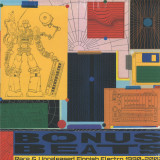
Cold Blow proudly presents Bonus Beats: Rare & Unreleased Finnish Electro 1990–2002, a landmark compilation capturing Finland's underground electro scene from the late 1990s and early 2000s. This double-LP features 9 rare and 3 previously unreleased tracks from pioneering Finnish artists, showcasing a distinctly Nordic approach to the genre. With contributions from notable names such as Jori Hulkkonen, Mr. Velcro Fastener, Mono Junk, and the late Mika Vainio, this release highlights the experimental and DIY ethos that defined Finland's electronic music scene during this period.
Carefully curated by Erkko Lehtinen, a key figure in Finland's electro scene as a DJ and promoter, the compilation explores a broad sonic palette, spanning early techno influences, robotic allure, and dark, bass-heavy tracks. Standout contributions include Decepticons and Dr. Robotnik's unreleased dark electro cuts, with the latter veering into minimal wave territory. Feng Shui feat. Monsieur delivers a striking collaboration that fuses a trance-like lead with raw, industrial beats, uniting members of Huoratron, Nu Science, Polytron, and Op:l Bastards. Keeping alive the legacy of Perttu Häkkinen (aka Randy Barracuda), this release wouldn't be complete without Imatran Voima's bass-driven anthem from their debut EP. Also featured are Spektor's retro synth experiments, Tero's Commodore 64-based creations, Brothomstates' (later a Warp signee) futuristic soundscapes, and a rare cover of Kraftwerk's The Model by the anonymous duo Markus & Kristian. Erkko's extensive liner notes provide additional insight into this culturally and musically significant era. Available in double-LP, this collection is a must-have for electronic music aficionados and vinyl collectors.
j 10: Feng Shui - Hao Hao (I`m Back) feat. Monsieur
The influence of the UK’s Steel City on electronic music is well documented and undisputed and continues to push the envelope with key figures such as Winston Hazel (Forgemasters, The Step), DJ Parrot/Crooked Man, Richard Benson (RAC, SWAG, Altern 8), Chris Duckenfield (RAC, Popular Peoples Front, SWAG, All Ears Distribution), a thriving underground club scene and the likes of Synaptic Voyager reinforcing the city’s rich musical legacy.
Matt White and Paul Baines have been making off-kilter, emotive, late night electronic jams since meeting in the early 90’s and while life took them on different paths for a while, they have recently blown the thick layer of dust from their synths and drum machines and got busy in the studio to create some amazing new music which draws influence from that classic UK techno sound which played such an important part in the development of dance music culture around the world. With recent releases on Frame Of Mind, Acquit and Telomere Plastic the duo are clearly on a roll, wearing the heritage of their city on their sleeve and delivering what can only be described as heartfelt, authentic machine music made with love and soul.
From the opening beats of lead track Dawn Till Dusk we are drawn in to another place which feels comfortably familiar yet organic, fluid and loose in a way that tugs on the heartstrings. A million miles from cookie-cutter tech house, this is two guys in a bedroom studio, digging deep on hardware machines to create a sound to get completely lost in. Lonely Promontory takes things deeper still with immersive pads, taught electro beats and blissed-out melodic lines which give just hint of optimism and recall those beloved sounds of B12, Redcell and Likemind.
Flipping over we have Stellar Engine which goes a littler heavier on the beats and bass whilst still retaining a floating quality, once again highlighting the hardware jam workflow that Synaptic Voyager utilise in their studio. Once Exposed takes us back to those heady days of the early 90’s when techno, house and ambient electronics combined to create a heady blend of deep atmospherics and driving beats which could work on both dance floors and car stereos alike. Rounding off the EP we have Cognitive Network which goes for a straighter four on the floor techno groove and a killer bassline to lose yourself in. These recordings were delivered to the label in unedited long form (some tracks totalling 15 minutes or more in length!) which Jimpster lovingly edited into the versions which you hear on this release.
- A1: Progetto Tribale - The Sweep
- A2: Onirico - Echo Giomini
- A3: Open Spaces - Artist In Wonderland
- B1: Alex Neri – The Wizard (Hot Funky Version)
- B2: M C.j. Feat. Sima - To Yourself Be Free - Instrumental Mix Energy Prod
- B3: Mato Grosso - Titanic Expande
- C1: Dreamatic - I Can Feel It (Part 1)
- C2: Carol Bailey - Understand Me Free Your Mind (Dream Piano Remix)
- C3: The True Underground Sound Of Rome - Secret Doctrine
- D1: Don Carlos - Boy
- D2: Lazy Bird – Jazzy Doll (Odyssey Dub)
Vol 2[28,99 €]
Volume 1 of this expertly curated project of 90s Italian House - put together by Don Carlos.
If Paradise was half as nice… by Fabio De Luca.
Googling “paradise house”, the first results to pop up are an endless list of European b&b’s with whitewashed lime façades, all of them promising “…an unmatched travel experience a few steps from the sea”. Next, a little further down, are the institutional websites of a few select semi-luxury retirement homes (no photos shown, but lots of stock images of smiling nurses with reassuring looks). To find the “paradise house” we’re after, we have to scroll even further down. Much further down.
It feels like yesterday, and at the same time it seems like a million years ago. The Eighties had just ended, and it was still unclear what to expect from the Nineties. Mobile phones that were not the size of a briefcase and did not cost as much as a car? A frightening economic crisis? The guitar-rock revival?! Certainly, the best place to observe that moment of transition was the dancefloor. Truly epochal transformations were happening there. From America, within a short distance one from the other, two revolutionary new musical styles had arrived: the first one sounded a bit like an “on a budget” version of the best Seventies disco-music – Philly sound made with a set of piano-bar keyboards! – the other was even more sparse, futuristic and extraterrestrial. It was a music with a quite distinct “physical” component, which at the same time, to be fully grasped, seemed to call for the knotty theories of certain French post-modern philosophers: Gilles Deleuze, Félix Guattari, Paul Virilio... Both those genres – we would learn shortly after – were born in the black communities of Chicago and Detroit, although listening to those vinyl 12” (often wrapped in generic white covers, and with little indication in the label) you could not easily guess whether behind them there was a black boy from somewhere in the Usa, or a girl from Berlin, or a pale kid from a Cornish coastal town.
Quickly, similar sounds began to show up from all corners of Europe. A thousand variations of the same intuition: leaner, less lean, happier, slightly less intoxicated, more broken, slower, faster, much faster... Boom! From the dancefloors – the London ones at least, whose chronicles we eagerly read every month in the pages of The Face and i-D – came tales of a new generation of clubbers who had completely stopped “dressing up” to go dancing; of hot tempered hooligans bursting into tears and hugging everyone under the strobe lights as the notes of Strings of Life rose up through the fumes of dry ice (certain “smiling” pills were also involved, sure). At this point, however, we must move on to Switzerland.
In Switzerland, in the quiet and diligent town of Lugano, between the 1980s and 1990s there was a club called “Morandi”. Its hot night was on Wednesdays, when the audience also came from Milan, Como, Varese and Zurich. Legend goes that, one night, none less than Prince and Sheila E were spotted hiding among the sofas, on a day-off of the Italian dates of the Nude Tour… The Wednesday resident and superstar was an Italian dj with an exotic name: Don Carlos. The soundtrack he devised was a mixture of Chicago, Detroit, the most progressive R&B and certain forgotten classics of old disco music: practically, what the Paradise Garage in New York might have sounded like had it not closed in 1987. In between, Don Carlos also managed to squeeze in some tracks he had worked on in his studio on Lago Maggiore. One in particular: a track that was rather slow compared to the BPM in fashion at the time, but which was a perfect bridge between house and R&B. The title was Alone: Don Carlos would explain years later that it had to be intended both in the English meaning of “by itself” and like the Italian word meaning “halo”. That wasn’t the only double entendre about the song, anyway. Its own very deep nature was, indeed, double. On the one hand, Alone was built around an angelic keyboard pattern and a romantic piano riff that took you straight to heaven; on the other, it showcased enough electronic squelches (plus a sax part that sounded like it had been dissolved by acid rain) to pigeonhole the tune into the “junk modernity” section, aka the hallmark of all the most innovative sounds of the time: music that sounded like it was hand-crafted from the scraps of glittering overground pop.
No one knows who was the first to call it “paradise house”, nor when it happened. Alternative definitions on the same topic one happened to hear included “ambient house”, “dream house”, “Mediterranean progressive”… but of course none were as good (and alluring) as “paradise house”. What is certain is that such inclination for sounds that were in equal measure angelic and neurotic, romantic and unaffective, quickly became the trademark of the second generation of Italian house. Music that seemed shyly equidistant from all the rhythmic and electronic revolutions that had happened up to that moment (“Music perfectly adept at going nowhere slowly” as noted by English journalist Craig McLean in a legendary field report for Blah Blah Blah magazine). Music that to a inattentive ear might have sounded as anonymous as a snapshot of a random group of passers-by at 10AM in the centre of any major city, but perfectly described the (slow) awakening in the real world after the universal love binge of the so-called Second Summer of Love.
For a brief but unforgettable season, in Italy “paradise house” was the official soundtrack of interminable weekends spent inside the car, darting from one club to another, cutting the peninsula from North to centre, from East to West coast in pursuit of the latest after-hours disco, trading kilometres per hour with beats per minute: practically, a new New Year’s Eve every Friday and Saturday night. This too was no small transformation, as well as a shock for an adult Italy that was encountering for the first time – thanks to its sons and daughters – the wild side of industrial modernity. The clubbers of the so-called “fuoriorario” scene were the balls gone mad in the pinball machine most feared by newspapers, magazines and TV pundits. What they did each and every weekend, apart from going crazy to the sound of the current white labels, was linking distant geographical points and non-places (thank you Marc Augé!) – old dance halls, farmhouses and business centres – transformed for one night into house music heaven. As Marco D’Eramo wrote in his 1995 essay on Chicago, Il maiale e il grattacielo: “Four-wheeled capitalism distorts our age-old image of the city, it allows the suburbs to be connected to each other, whereas before they were connected only by the centre (…) It makes possible a metropolitan area without a metropolis, without a city centre, without downtown. The periphery is no longer a periphery of any centre, but is self-centred”.
“Paradise house” perfectly understood all of this and turned it into a sort of cyber-blues that didn’t even need words, and unexpectedly brought back a drop of melancholic (post?)-humanity within a world that by then – as we would wholly realise in the decades to come – was fully inhuman and heartless. A world where we were all alone, and surrounded by a sinister yellowish halo, like a neon at the end of its life cycle. But, for one night at least, happy.
- Cue Cards
- Cue Cards
Like so many bands that cut their teeth playing basements, rental halls, and teen centers around the Puget Sound in the early '90s, the Olympia trio Lync may have had similar roots to the local rock heroes of the era but were conscientiously averse to the trappings of mainstream success. Lync kept the grit, the shouted vocals, and the rough-hewn choruses, but eschewed the machismo and metal swagger. Their song 'Cue Cards' is a perfect encapsulation of their overall approach-heartfelt melodies, bashed drums, hoarse throats, gritty bass lines, and fractured guitars. Lync's legacy was interwoven with fellow PNW artists like Modest Mouse, 764-Hero, and Red Stars Theory-bands that were crucial to the foundation of Suicide Squeeze Records. It only made sense for Suicide Squeeze to reissue Lync's lone LP, These Are Not Fall Colors back in 2023. And in conjunction with the reissue, Suicide Squeeze is proud to announce the second single featuring a choice cut from Fall Colors paired with a current artist's reinterpretation of the song. On their latest 7", Lync's original version of 'Cue Cards' is paired with a cover by Julia & The Squeezettes-a Suicide Squeeze-centric all-star line-up featuring Julia Kugel of The Coathangers and Julia, Julia, Staz Lindes of The Paranoyds, Bonnie Bloomgarden and Rikki Styxx of Death Valley Girls. On their rendition, Julia & The Squeezettes excise the half-time distorted bombast of the original in favor of up-tempo minimalist pop. Guitars are reduced to a few choice phrases, putting the song's luring vocals and lyrical charms at the forefront. Paired with the tasteful yet propulsive rhythm section, this new approach to 'Cue Cards' demonstrates the timeless songwriting of Lync while simultaneously showcasing the creative vision, timbral aptitude, and resourceful production savvy of four contemporary artists in the ongoing lineage of American indie rock. Suicide Squeeze is proud to release these two versions of 'Cue Cards' to the world on a pressing of 500 Ocean Blue-colored vinyl 7" singles.
Recorded in 1997, Mountain Top features the commanding vocals of Tony Roots, backed by the legendary Firehouse Crew and produced by the visionary Fada Waz (Clifton Carnegie). This record’s release was driven by the people, evidenced and encouraged by the countless wheel-ups and sing-alongs during King Original’s international tour dates over the last three years whenever this seminal recording was dropped in the set.
Tony Roots, known for his cultural and spiritual themes, delivers a powerful vocal performance, reminding us that life’s most important journey is overcoming obstacles to find ‘Jah Love on the Mountain Top.’ This message is as relevant in today’s fast-paced, easy-come-easy-go consumer culture as it was when recorded three decades ago.
The Firehouse Crew renowned for their work with iconic acts like Luciano and Sizzla—shine brightly on this riddim, with the MPC drum machine-centered sound of 90s Jamaican roots reggae. An up-tempo 4/4 steppers beat layered with rich analogue textures and soulful instrumentation defines this timeless recording.
The first of many collaborations between Studio 55, Before Zero Records, and Footsie, the King Original legacy continues into the future, honouring the enduring contributions of Fada Waz and his collaborators.
Clifton Carnegie aka Ras Wazair aka Fada Waz - Clifton Carnegie, known as Ras Wazair, founded King Original Sound System in 1973, establishing it as East London’s foremost reggae sound. Operating under his Studio 55 moniker, he collaborated with legends like Johnny Osbourne, Barry Brown, Michael Prophet, Cornell Campbell, and Frankie Paul through imprints such as Original Sounds, Studio 55, and Original International. A mentor to many of the UK’s top sound systems and a key figure in London’s RasTafari community, Ras Wazair’s connections with prominent Jamaican artists, bands, and producers like Fattis Burrell ensured that Jamaican music remained an influential force in the UK sound system scene.
King Original
Founded in 1973 by Fada Waz, King Original Sound System shaped East London’s reggae scene for over two decades. Fada Waz and his son Footsie—a UK Grime pioneer who in later years expanded the legacy through his KO LP series and sold-out King Original mixed-genre events at London’s top venues—worked together until Footsie assumed full control following Fada Waz’s passing in 2021. Having worked with artists such as Dizzee Rascal, Arctic Monkeys, The Prodigy, D-Double E, Wiley, and Skepta, Footsie’s dedication to King Original has reinvigorated the legacy that underpins all UK bass music—the reggae sound system. Joining Footsie is his brother, Wazair’s last born Ras D also Jah Model, and long-time collaborator Sir Spyro, producer of two UK number-one hits with Stormzy and son of UK reggae stalwart Nerious Joseph. Armed with cutting-edge QSS sound system technology, King Original continues to set trends, shaping the future of UK bass music.
Tony Roots
Hailing from Manchester, Jamaica, in the 1980s, Tony Roots emerged alongside iconic figures like Garnet Silk and Tony Rebel. While his peers remained in Jamaica, Tony moved to the UK, where he went on to release ten albums and numerous singles, including hits like Grow Your Natty Dread Locks and Hola Zion. A steadfast champion of Rastafari, Tony has collaborated with legends such as the Firehouse Crew, earning worldwide respect and a devoted following within both the reggae community and the UK sound system scene.
The Firehouse Crew
Formed in 1986, The Firehouse Crew became a cornerstone of the 1990s roots-reggae revival. Initially associated with King Tubby’s Firehouse label before establishing their own, the band rose to prominence through collaborations with producer Philip “Fattis” Burrell at Xterminator Records. Their contributions to timeless albums like Luciano’s Where There is Life highlight their extraordinary musicianship. Over the years, The Firehouse Crew has backed iconic artists such as Sizzla, Buju Banton, and Beres Hammond, cementing their legacy as masters of roots reggae.