One of the essential ‘global’ albums of 2019 gets its first pressing on ‘kimono blue’ vinyl.
Ahead of the release of their second album and their collaboration with cult Japanese kimono label Nakai Shoten, Minyo Crusaders come with a limited edition of their classic debut album.
Since their 2020 collaborative EP with Frente Cumbiero amassed almost 1m listens on Spotify plus over 1m views for the lead video on both Facebook and Twitter, the band’s popularity has soared.
quête:le disco
Sub Rosa presents in their Early Electronic series, the final chapter of music by Beglian key composer of early electronic experiments, André Stordeur (1941-2020). Side A features a previously unreleased, stark and poignant composition from 1979; while the B side is vibrant and almost playful of pieces from the 2000s.
André Stordeur His musical career started in 1973 with a tape composition for the soundtrack to a film on Gordon Matta-Clark titled Office Baroque. Later in the 1970s, he participated to avantgarde music ensemble Studio voor Experimentele Muziek, founded in Antwerp, Flanders, by Joris De Laet. Since 1980, Stordeur composes exclusively on Serge synthesizer, either a Serge series 79 and a Serge prototype 1980, which was especially built for him by Serge Tcherepnin himself. In 1981, Stordeur composed the music of Belgian film director Christian Mesnil's documentary Du Zaïre au Congo. He studied at IRCAM in 1981 with David Wessel and then flew to the US to study with Morton Subotnick. Stordeur became an influential sound synthesis teacher and, in 1997, completed his Art of Analog Modular Synthesis by Voltage Control,4 a guide to everything modular.
Oberheim While 'Oberheim' is the centerpiece of this LP, we pressed for the first time on vinyl three pieces from the session André called 'Synthesis Studies,' previously featuring on Complete Analog and Digital Electronic Music, 1978-2000. 'I was helped in my studies by a must-have book: The Techniques of Electronic Music, by Thomas Wells and Eric Vogel (University Stores, 1974). That book aside, I learned synthesis on my own. After a trip to India in 1968, I discovered Indian music and took tabla and sitar classes in New Delhi; my teachers were students of Chatur Lal and Ravi Shankar. Later, in the 2000s, while living in the US, I tried to recreate through synthesis all the Indian musical instruments I loved so much.' 'Drone' is one of his most spectacular works.
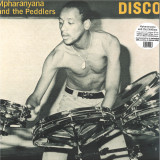
Kalita are proud to announce the first ever official re-release of Mpharanyana & The Peddler's 1979 South African disco and funk recordings 'Disco' and 'Freak Out With Botsotso', backed by a devastating extended edit of 'Disco' courtesy of Amsterdam-based DJ and producer Jamie 3:26. Cut on a loud 12" single and accompanied by an extended edit of 'Disco' courtesy of Jamie 3:26, this truly is another no-brainer from the Kalita camp.
Born on 15th November 1949 in Kattlehong, South Africa, Jacob ‘Mpharanyana’ Radebe was one of South Africa’s greatest ever musicians, releasing a canon of legendary soul, jazz and disco albums before his untimely death in August 1979 at the age of just twenty-nine.
Here, Kalita select his highly sought-after disco and funk recordings ‘Disco’ and ‘Freak Out With Botsotso’, both selected from his 1979 invisible final album, ‘Hela Ngwanana’, re-releasing them for the first time in forty years. Including Paul Simon and Herbie Hancock session musician Bakithi Kumalo on bass and Themba Mokena of Dick Khoza ‘Chapita’ fame on lead guitar, the recordings feature some of the country’s top contemporary musicians joining forces to glorious effect.
With the original album currently fetching eye-watering prices on the rare occasion that they turn up for sale, the time is now ripe to share this masterpiece with the world once more.
After severals EPs on labels such as Lumière Noir, Kill the DJs or Bahnsteig 23, here is the first album of french duo Il Est Vilaine, infused with a "Yellow Magic Orchestra-ish" touch, rooted in the french musical landscape.
A road trip in Brittany as a red thread, the two hooligans of Il Est Vilaine revisit Kawaii pop, crazy rock like DEVO and Detroit techno with a surprising coherence. An album long matured and awaited by the band's fans.
Il Est Vilaine aren’t Bretons, but they sure are tricksters. The Francophiles among you might have caught on to the corny pun in their name (beating a certain presidential candidate to the punch all while turning the name of the pastoral Ille-et-Vilaine region into, literally, “he’s a nasty woman,”) but the real takeaway is that these born-and-bred Parisians don’t take themselves too seriously – especially in an era in which there is much too much of that happening.
It was in 2014 (and on Dialect Recordings) that Florent and Simon tossed their debut 12” into the ring, the rightfully named Scandale – a tight little bombshell released that roused the electronic music scene out of its complacent little catnap.
So there we had it, two outcasts refusing to eat at the same table as the tech-house scene queens, serving up three whiplash-on-the-dancefloor cuts drenched in sweaty hedonistic disco and wrapped in a battered motorcycle jacket (with a gooey post-punk-pop core for good measure.) A clear mission statement right out of the gates, watermarked with mystical incantations and throbbing with rock ’n’ roll’s primitive drive. Everything and the kitchen sink, and a bag of chips – an invitation to just let lose that’s even better than the sum of its parts.
Soft-spoken with the look of a slightly disaffected 1950s matinee idol, Aaron Frazer possesses a unique voice that's both contemporary and timeless. On Introducing... -- his debut solo album produced by The Black Keys' Dan Auerbach, co-released on Easy Eye Sound and Dead Oceans -- Aaron melds mid-`60s soul with Auerbach's particular sensibilities (`Over You'), songs with a message in the key of Gil Scott-Heron (`Bad News'), and uplifting tales of love told through a blend of disco, gospel, and doo-wop (`Have Mercy'). The Brooklyn-based, Baltimore-raised songwriter first came into the international spotlight as multi-instrumentalist and colead singer of Durand Jones & The Indications, but he's more than a revivalist act. "I didn't want Introducing... to be an exact recreation of an era or a style," Frazer says. "I'm excited to keep breaking some of the expectations around what exactly I'm supposed to be artistically and musically, or what this scene as a whole can be." On Introducing..., Aaron expertly calibrates consciousness-raising and the desire to be enveloped by love. Where previous records were written in a partial state of turmoil, Aaron's debut LP shows maturation and range. Introducing... is both loving and gracious, critical without losing hope, and a showcase of a young artist on a seriously soulful ascent.
Bosq & Pat Kalla have been traveling parallel paths from across the Atlantic ocean without ever intersecting for too long. They have both been deeply involved in the modern / retro Afro Disco scenes in their respective countries but it wasn’t until the legendary French producer & label head GUTS asked Bosq to remix Pat Kalla & Le Super Mojo “Canette” that they met musically. That remix was received so well by the public as well as the artists themselves that they decided to work on an original track together.
“Mouna Power”, sung in a mix of French, English & the Cameroonian dialect of Pat’s heritage places Pat’s smooth vocals over Bosq’s raw & heavily layered, percussion & horn driven Disco Funk. The Dance Dub strips back some of the vocals, pushes the percussion even further up in the mix, and stretches out the grooves, focusing more on the infectious B-section than the original. This makes for a perfect body moving excursion that will let the dancers delve deeper into the groove while being carried along by the horn blasts and Pat’s chanted vocals.
The record features the renowned horn section of the Bogota Orquesta Afrobeat, and djembe work from “Beto” Salas, a world class percussionist from Turbo on Colombias Caribbean coast. Bosq as usual handles all the rest of the percussion, instrumentation & production.
Australian artist Indigo Sparke has signed to Sacred Bones and announced a new release date for her debut album, echo, now due May 21st. To celebrate, she has shared a video for the album's latest single "Everything Everything."
Of the song, Sparke says "I wrote this song not long after coming back from a magical castle in Italy where a group of us had been making music and soaking in the golden honey days. I met a beautiful human Shahzad Ismaily who had discovered I also write poetry. One night around midnight he called across the castle and asked me to come over and speak some of my poetry over an instrumental track he had recorded. The only thing he asked me to do was to sing a line or so if I felt it. That song was dog bark echo. He invited me back to NYC and I was living in his empty spare room in Brooklyn briefly. I borrowed this little parlour guitar of his and completely fell in love. I just sat in that room for hours and days playing around and just laying next to the guitar looking at the ceiling thinking about life and death and the poetry of it all. How life and death will hold us up to light. How grief ripens inside us
all and we all decay and everything changes and flies away. I remember feeling this liberating sense of freedom and melancholic nostalgia. It was so hot and the wind almost blew through from a different dimension or plane. I guess the song came through from that place too. It just came out. I can almost still feel that time on my skin, or in my breath."
Indigo Sparke brings her deeply personal lived experiences to her music, highlighting the spaces between the polarity of softness and grit. Pulling from her experiences of addiction, of healing, of queerness, of heartbreak, of joy, of connection, of the softness and of the grit alchemizing it all into tenderness through her music, she conjures up a myriad of feelings that is undeniably potent.
echo was co-produced by Sparke, Big Thief's Adrianne Lenker and Andrew Sarlo.
Australian artist Indigo Sparke has signed to Sacred Bones and announced a new release date for her debut album, echo, now due May 21st. To celebrate, she has shared a video for the album's latest single "Everything Everything."
Of the song, Sparke says "I wrote this song not long after coming back from a magical castle in Italy where a group of us had been making music and soaking in the golden honey days. I met a beautiful human Shahzad Ismaily who had discovered I also write poetry. One night around midnight he called across the castle and asked me to come over and speak some of my poetry over an instrumental track he had recorded. The only thing he asked me to do was to sing a line or so if I felt it. That song was dog bark echo. He invited me back to NYC and I was living in his empty spare room in Brooklyn briefly. I borrowed this little parlour guitar of his and completely fell in love. I just sat in that room for hours and days playing around and just laying next to the guitar looking at the ceiling thinking about life and death and the poetry of it all. How life and death will hold us up to light. How grief ripens inside us
all and we all decay and everything changes and flies away. I remember feeling this liberating sense of freedom and melancholic nostalgia. It was so hot and the wind almost blew through from a different dimension or plane. I guess the song came through from that place too. It just came out. I can almost still feel that time on my skin, or in my breath."
Indigo Sparke brings her deeply personal lived experiences to her music, highlighting the spaces between the polarity of softness and grit. Pulling from her experiences of addiction, of healing, of queerness, of heartbreak, of joy, of connection, of the softness and of the grit alchemizing it all into tenderness through her music, she conjures up a myriad of feelings that is undeniably potent.
echo was co-produced by Sparke, Big Thief's Adrianne Lenker and Andrew Sarlo.
Every Dunbarrow album has a hauntingly classic sound of, in the band’s own
words, “an eerie rawness.” But their third album feels like you’ve discovered a
mysterious half-century old recording tucked away in a decrepit abandoned
mansion. Perhaps there’s a note attached, begging its courier to beware. Alas,
whoever possessed the tape apparently never survived. ...that is to say, it feels like there’s a solemn
story to this album, not just in the
lyrics, but in the sound itself. Much like
the eponymous debut of Black Sabbath,
the band uses subtle sound effects to
dramatically set the scene for its mostly
clean tones and masterful use of open
space for which the band has become
known. But unlike their first two albums,
this one does see the band branching
out just a bit into heavier, more distorted
guitars. The result is a much more
in-your-face sound, while retaining the
Haugesund, Norway quintet’s masterful
proto-metal sound.
The album opens with the sound of falling
rain as Lønning and Eirik Øvregård’s
guitars seep into the speakers like
funereal bells and haunted drones on
“Death That Never Dies.” Drummer Pål
Gunnar Dale slams down three snare
beats as bassist Sondre Berge Engedal
slinks in harmony over it all. Andersen’s
crisp vocals paint a bleak picture of
dark perdition until the band slips into
a swaggering piano-led coda reminiscent
of “Sabbra Cadabra.” The 7-minute
psychedelic folk masterpiece “Turn In
Your Grave” is the album centerpiece,
replete with mournfully shimmering
Mellotron and bleak folkloric lyrics. Its
hypnotically spinning guitar notes and
old European parlando-rubato singing
hearken to dark early Steeleye Span with
a sinister edge. “In My Heart” perfectly
showcases the band’s penchant for folk
based, yet head-banging riffs that break
with tradition that has stilted modern
heavy music.
“I think with this record, we have managed
to create our own unique sound
with its own Dunbarrow tag,” says the
band. With that sound comes the perfect
artwork: A cover illustration from the
early 1900’s by artist Harry Clarke from
his work for Edgar Allen Poe’s Tales of
Mystery and Imagination.
Every now and then a release comes along which is destined to unite, bring down the walls and basically, be a force for good. Your Kissing by Belcampo does just that, and with a style and panache which defies it’s lo-fi, handstamped limited white label aesthetic. The beauty of Your Kissing is in the way it successfully melds together elements of deep house, disco and the French Touch sound to form a track which will appeal to anyone who simply likes decent music. Belcampo keeps things stripped back just enough to give that beautiful, rolling, hypnotic atmosphere, whilst remaining lush, warm and uplifting, constantly teasing us with the repeated filtering guitar and string hook. Legendary British singer and songwriter Elisabeth Troy provides the cherry on top with her sweet vocal line giving us the hook which will get under your skin in all the right ways.
In addition to the main vocal mix we have a Belcampo Remix going heavier on the filters and pumping groove, calling to mind the glory days of Cassius, Motorbass and Super Discount with that distinctive feel-good French sound of the 90’s.
Closing out the EP we find Delisei which cranks up the jackometer for a peak time slice of looped-up heads down filter madness guaranteed to nice up the dance.
Sandy Grooves Vol.1 is the debut compilation release from Boogie Bodega, a newly formed label based in Bali set up by Mexican Disco wizard Sould Out. Comprising of some of the most sought-after producers within the Disco & Edits scene of the last years, Sandy Grooves vol.1 tickles all the Disco senses with something for everyone. From laid back Balearic inspired incarnation to a more uptempo dance floor heaters, this comp focuses on the full spectrum of the Disco & Funk arena.
Opening things up, “Easy Way To Groove'' could not have a better title for the music to match, it's a definite “does what it says on the tin” kind of vibe. Hotmood works his magic once again with this bass led stomper, tidy guitar licks and cinematic string section that’s sure to get butts off seats and wiggling
Stepping up next, New York’s Razor N Tape boss JKriv fires off with his atmospheric builder “Sunshine”; a slice of filtered, loopy Disco House goodness with progressive percussive elements.
On the B side, Disco Deviance Pete Herbert & Dicky Trisco compliment the more downtempo offering of this selection with a dubbed-out guitar laden trance inducing gem that is sure to spin a few heads. Following that, Igor Gonya’s “Habibidisco” holds its place as a romantic vocal Disco funk journey through Arabia with plenty of energy - another one for the dancefloor crew.
Finally, “Keep You Burning” by Clean Is Good is a mid-tempo swinger that’s sure to heat up the listeners ears. Sleek, smooth vocals, classic disco beat and undeniable funky guitar - I dare you not to groove to this one!
Originally released as a 12” single in 1982, ‘Every Brother Ain’t A Brother’ was the final record from Brooklyn multi-instrumentalist and producer Freddie Thompson’s Panaché band. Built around a fully cleared sampled bassline from ‘The Message’ by Grandmaster Flash & The Furious Five, ‘Every Brother Ain’t A Brother’ plays out like a summertime stroll through New York in the early 80s. The streets are full of excitement, but as the lyrics, written by vocalist Denise Williams (not to be confused with Deniece Williams of ‘Let’s Hear It For The Boy’ fame) make it clear, they’re dangerous as well.
Thirty-nine years later, Isle of Jura is proud to present the first official 12” reissue of ‘Every Brother Ain’t A Brother’. A cult classic from the disco-rap era, the reissue includes the original vocal and instrumental versions of ‘Every Brother Ain’t A Brother’ plus a Jura Soundsystem special version with additional live percussion.
Originally made up of Freddie, his wife, the singer Debra Thompson and keyboardist Douglas Glover, Panaché formed at the behest of a local disco DJ, Carl Nelson. In the wake of Chic’s early singles, Carl felt a French name would give Freddie a competitive edge. “He explained it to us that it was a French word for style and elegance. Panaché, a step above chic,” Freddie reflects.
Business minded, Freddie formed his own label, Roché Records and joined SIRMA - The Small Independent Music Manufacturers Association. “It was very hard for the independent manufacturers to get airplay and distribution at the time, so we all came together,” he remembers. Through SIRMA, Freddie met Joe and Sylvia Robinson from Sugar Hill Records, who several years later, let him sample ‘The Message’ for ‘Every Brother Ain’t A Brother’.
In 1979, Panaché scored some radioplay when they covered ‘Not On The Outside’ by ‘60s D.C R&B group The Moments. Emboldened, they brought onboard backing vocalists and recorded their only album. This Is Panache saw the band blurring the boundaries between soul, jazz-funk and disco and become a sought after collectible.
By 1982, Debra had stepped back, and one of Panaché’s backing singers was center stage, Denise Williams. “Denise was good with writing poetry,” says Freddie. "She had one called ‘Every Brother Ain’t A Brother’. It was about the unrest that was going on in the city at the time. I thought I could do something with that.”
After releasing ‘Every Brother Ain’t A Brother’ in 1982, Panaché quietly moved from center stage to behind the scenes. Over the last thirty-nine years, Freddie has continued to work in the music industry as a session musician and producer. “As soon as we stopped trying to become stars as Panaché, we became busy working in the industry,” Freddie laughs.
After 12 years in the game, Spanish nu-disco stable have reached the 100-release milestone, and they're celebrating with this vinyl sampler of the digital compilation. Includes 4 cuts by Dj Rocca, Eric Duncan, Mushrooms Project, and Rayko, putting the emphasis on heavily electronic grooves with a dark and leftfield twist.
- Two Moons (Osaka 1995)
- Replicant
- Porcelain Hands
- Doesn’t Want/ Doesn’t
- Stop (Feat. Channy
- Leaneagh)
- Particle Of
- 陽の光 (Hi No Hikari)
- Still/ On Hold (Feat
- Ambrose Akinmusire
- Immanuel Wilkins)
- Polaroid (Feat. Channy
- Leaneagh)
- Tower Of The Sun
- Expo 70’ (Feat. William
- Brittelle)
- Poe (Feat. Andy Akiho
- Immanuel Wilkins)
- Water Drop (Mizu No
- Shizuku)
- Dioscuri
Osaka-born and New York-based pianist Erika Dohi is a multi-faceted
artist with an eclectic musical background. From highly polished
raditional classical to bold improvisation, she is a dynamic performer
whose timeless style and unidiomatic technique sets her apart in
contemporary NYC avant-garde circles.
Dohi’s vast repertory is impressive but what makes her truly such a
barrier-defying artist is what lies ahead. ‘I, Castorpollux’, Dohi’s debut
solo album, is a profound personal excavation set to a gripping
andscape of wild, genre-fluid composition, a virtuosic but emotionally
generous convergence of the technical and the spiritual. With
understated piano and keyboards at its centre, ‘I, Castorpollux’ is
equal parts hazy nostalgia, science-fiction soundtrack and
electroacoustic experimentation.
The project features contributions from Channy Leaneagh (Polica),
Andy Akiho and Immanuel Wilkins, among others, and is produced by
William Brittelle.
The central theme to the album is the ‘split-self’ and variable
perceptions of time that Dohi has faced at formative moments in her
ife. She experienced the 1995 Kobe earthquake at age 7. Hiding
under a table during the worst of it, she later emerged to find the
world around her crumbled. In her immediate vicinity, a fixture of her
childhood remained standing. The Tower of the Sun, a type of three
aced time machine itself from Expo 70, designed by artist Taro
Okamoto, is a trail-marker on Erika’s journey, a stand-in sigil to
unlock the mysterious sounds of her work, with 70s synths and retro
sci-fi aesthetics permeating the album’s narratives.
Much of the album was written while living in Texas where the split
between her Asian self and the idea of being an American
necessitated a near mountain of self-discovery to reconcile how she
elt and who she was within the social backdrop of a strongly
conservative environment. It is no wonder that the character of the
Dioscuri, Castor and Pollux from Greek and Roman mythology
esonate so deeply with her, or Haruki Murakami’s Two Moons and
heir strange light.
From her contributions to various projects and her participation in the
Artist in Residency collaborations, Erika has become a staple of the
37d03d community.
Backed by members of the David Nance Group, Rosali (Long Hots, Wandering Shade, Monocot) wades through the emotional mire with infectious, earworm melodies led by her luminous voice. With their rich, raw instrumentation, these rock ballads sound like the resilience discovered in facing one’s darkest moments, the assurance of the calm and clarity that comes after the storm. As she sings on the second track, “Bones,” “Through the darkness of the field / I walk through without yielding / To the rest of the feelings / I’m carrying.” With her confident song craft, Rosali illustrates the ability to push through, moving toward something greater without being destroyed by the weight of trauma.
Engineered by James Shroeder and featuring Kevin Donahue (Simon Joyner), James Shroeder (Simon Joyner, DNG, Connor Oberst), David Nance, Noah Sterba, Colin Duckworth, and Daniel Knapp, the album was recorded in ten days and the raw immediacy of the music is palpable across these ten tracks. Added adornment was contributed by Philadelphia's Robbie Bennett (War on Drugs) on organ and keys, and Matt Barrick (The Walkmen, Jonathan Fire Eater, Muzz) makes a percussion cameo on “Whisper,”which was tracked at Philly’s Silent Partner Studio, where No Medium was mixed by Quentin Stoltzfus (Mazarin, Light Heat). The open creative collaboration elevated the songs, resulting in the exciting, vibrant sound of the album.
Rosali wrote the bulk of these songs in January of 2019 while on a self-imposed two week residency in the hills of South Carolina. Alone in an old farmhouse, she experienced supernatural events and faced her own demons in the deepest darkness. Perhaps as a result, there is a boldness that permeates the album, a daring vulnerability in both the lyrical themes and their musical accompaniment. Rosali says, “I approach guitar playing the same intuitive way I sing, which is profoundly spiritual for me. Where words fail, the guitar becomes the conduit for raw feelings, providing a direct connection to them. I’m constantly working on being fearless in my work, which means showing the rough side, the mistakes along with the triumphs.”
While writing No Medium, Rosali was inspired by harmonographs—swinging pendulums that create beautiful illustrations of the mathematics of music—considering how the mind, too, creates images through song. She imagined herself as the swinging pendulum—“a body suspended from a fixed point” (Encyclopedia Britannica), governed by the forces surrounding her. She thought about the pendulum’s relationship to time, movement, and even its use in divination practices. The album’s title, lifted from Charlotte Brontë’s, Jane Eyre, resonated with this vision: “I know no medium: I never in my life have known any medium in my dealings with positive, hard characters, antagonistic to my own, between absolute submission and determined revolt. I have always faithfully observed the one, up to the very moment of bursting, sometimes with volcanic vehemence, into the other.” With the multiple meanings of “medium”—as middle ground, a term for psychics, and as the material of artistic expression—No Medium felt like the appropriate name, describing how the self is shaped by the patterns of life .
The influences for the sound of No Medium reflect this pairing of assured vulnerability, in the stylistic coherence of Bob Dylan’s Desire, the tender delivery in Iain Matthews’ Journey From Gospel Oak, the strut and swagger of Bowie’s Hunky Dory, the ambition and beauty of Gene Clark’s No Other, and the playful catharsis of Harry Nilsson’s Nilsson Schmilsson. The Richard and Linda Thompson-esque album opener “Mouth,” places Rosali within both a physical and emotional space. “East of the river I was travelling on / watch me lie, undone / rest me in a forest, overgrown / until I am free of all that I’ve known,” she sings. There is movement, both within a cityscape, and in her outlook on love. Speaking of her thought process when writing the song, she says, “I imagine confidently walking away from the past, toward a new approach to love and intimacy to achieve a closer relationship with myself.”
In “Pour Over Ice,” Rosali explores her relationship with alcohol and her former reliance upon it as a social lubricant to quell her social anxiety, an energizer to keep moving, a means to cope and self-medicate, and most addictively, to lure out her wild side as a free flowing, good time girl. While drinking helped her through some shitty times, it eventually got the upper hand and became an insatiable hole within. She says, “The ‘you’ in the song is really me, talking to that component of myself struggling with drinking and self-sabotage, caught up in the cycle, and all the bad choices I made.” She sings, “Maybe I didn’t care enough / or can’t remember / chasing small pleasures / making fire from embers.” Rosali wanted her lead guitar on this track to simultaneously sound like a slow motion car crash propelling her through the day, and the sound of a gnawing hunger for something more.
Rosali’s alliance with the Omaha musicians that orbit David Nance Group (including Nance himself) came about while on a Long Hots / DNG tour in the summer of 2019. Great friendships formed and one night after playing in Detroit, Dave suggested they be her backing band. The pairing was effortless and natural, and in November of the same year, they were recording No Medium in a basement in Omaha.
Glasgow post-punk six-piece Kaputt aren’t strangers to directing their explosive energy and maximalist vibrancy in the name of allegory and critique. Their 2019 debut album on Upset the Rhythm ‘Carnage Hall’ confidently deconstructed themes of surveillance, paranoia, and cultural identity through a sonic lens of high-tempo, bright, danceable pop hooks and technical, polyphonic rhythms which border on the bombast of Zeuhl.
New EP ‘Movement Now/Another War Talk’ continues the synthesis of animation and discontent with an ethos that exemplifies post-punk’s most original and guiding purpose: casting aside the rigid, signifying fashions of modern performative genre tropes and instead combining a vast fluidity of influence, tone and style to create something as unique and personal as it is counter-cultural. The result is a release that responds to the apathy of our current situation with a positive thesis, breathing life into the lived-in, bursting through every vessel, leaving nothing unturned.
‘Movement Now’ enters with the distinct high-low drive of guitar whines and racing low toms, emblematic of the presence one feels when pushing past bodies in a heaving DIY venue, but it is not afraid to play with expectations. When the song thematically opens out, disrupts convention and progressively rebuilds upon itself, the track, a comment on the ever-lagging pace that jaded, old values take to transform, transitions from a goth aesthetic to the optimism characteristic of any indie heavyweight.
‘Another War Talk’ shines in production and composition as arguably one of the best examples of distilling the band’s manic live energy into a studio recording. The divergent vocal duality of Cal D. and Chrissy B. accompanied by competing percussionists and dynamic saxophone lines encapsulates the performative strengths that has allowed the band to become a constant highlight in Glasgow’s ever exciting DIY scene. It is, in essence, the naturalness by which six passionate voices can combine into one vision so seamlessly, which one who has not experienced the band live should take away from the track for now in anticipation of the future.
The Black Keys release their tenth studio album, Delta Kream, via Nonesuch Records. The record celebrates the band’s roots, featuring eleven Mississippi hill country blues standards that they have loved since they were teenagers, before they were a band, including songs by R. L. Burnside and Junior Kimbrough, among others. Dan Auerbach and Patrick Carney recorded Delta Kream at Auerbach’s Easy Eye Sound studio in Nashville; they were joined by musicians Kenny Brown and Eric Deaton, long-time members of the bands of blues legends including R. L. Burnside and Junior Kimbrough. The album takes its name from William Eggleston’s iconic Mississippi photograph that is on its cover.
Auerbach says of the album, “We made this record to honor the Mississippi hill country blues tradition that influenced us starting out. These songs are still as important to us today as they were the first day Pat and I started playing together and picked up our instruments. It was a very inspiring session with Pat and me along with Kenny Brown and Eric Deaton in a circle, playing these songs. It felt so natural.”
Carney concurs, “The session was planned only days in advance and nothing was rehearsed. We recorded the entire album in about ten hours, over two afternoons, at the end of the “Let’s Rock” tour.”
Auerbach says of Delta Kream’s first single ‘Crawling Kingsnake’: “I first heard John Lee Hooker’s version in high school. My uncle Tim would have given me that record. But our version is definitely Junior Kimbrough’s take on it. It’s almost a disco riff!” Carney adds, "We fell into this drum intro; it's kind of accidental. The ultimate goal was to highlight the interplay between the guitars. My role with Eric was to create a deeper groove."
The music from northern Mississippi, which came to life in juke joints, has long left an imprint on the band’s music, from their cover of R.L. Burnide’s ‘Busted’ and Junior Kimbrough’s ‘Do The Romp’ on their debut album, The Big Come Up; to their subsequent signing to Fat Possum Records, home to many of their musical heroes; and to their EP of Junior Kimbrough covers, Chulahoma.
Formed in Akron, Ohio in 2001, The Black Keys, who have been called ‘rock royalty’ by the Associated Press and ‘one of the best rock ‘n’ roll bands on the planet’ by Uncut, are guitarist/singer Dan Auerbach and drummer Patrick Carney. Cutting their teeth playing small clubs, the band have gone on to sell out arena tours and have released nine previous studio albums: their debut The Big Come Up (2002), followed by Thickfreakness (2003) and Rubber Factory (2004), along with their releases on Nonesuch Records, Magic Potion (2006), Attack & Release (2008), Brothers (2010), El Camino (2011), Turn Blue (2014) and, most recently, “Let’s Rock” (2019), plus and a tenth anniversary edition of Brothers (2020). The band has won six Grammy Awards and a BRIT and headlined festivals in North America, South America, Mexico, Australia, and Europe.
‘Voyager’, the seventh album from Current Joys, rattles with the
live-wire feeling that’s thrummed through all of Rattigan’s previous
releases: quavering, scream-itself-hoarse vocals and selfinterrogation via song. But here, that bristling, sentimental rock ‘n’
roll cacophony is overlaid with a soundtrack orchestra guiding it
along. It’s an odyssey, a grand-sounding journey of self-discovery
spread across sixteen tracks.
Part ekphrasis, part personal, it’s Rattigan learning new ways to
understand his own feelings and identity while inspired by the
highly-stylized, striking storytelling of filmmakers like Alfred
Hitchcock, Terrence Malick, Agnès Varda and Andrei Tarkovsky.
‘Voyager’ is unlike anything Current Joys has released before.
On his new album, Rattigan eschews lo-fi home recordings for a
full band and recording sessions at Stinson Beach Studios. As a
vocalist/drummer in his other band Surf Curse, Rattigan had finally
opened up to the possibility of working in a professional studio.
It’s all held together by the fervour of Rattigan’s creative process.
He believes in the premonitory power of music and he latches onto
the song ideas that strike him in the moment, propelled by an
abstract existentialism or burst of feeling more than anything else.
It imbues ‘Voyager’ with an intensity and intimacy - with the sense
that you’re getting to hear, all at once, the disparate parts that
make a project - or person - into a sprawling, cinematic whole.
Similar to Tame Impala or Mac Demarco in their early days,
Current Joys is singular and with a fanbase that extends far
outside of traditional indie fans. The band managed to establish an
indie and mainstream audience while flying under the radar of
DSPs and nearly all other industry levers. They are one of the first
indie bands to have their place fully created and cemented by
TikTok.
Double LP packaged in a gatefold sleeve
- A1: (Family Tree) Make A Change (Family Tree)
- A2: Run Away Bay
- A3: Love's Wonderland
- B1: Every Way But Loose
- B2: Higher
- B3: Always Have To Say Goodbye
- C1: Every Way But Loose (Extended Studio Version)
- C2: Run Away Bay (Extended Studio Version)
- D1: Plastic (Previously Unreleased Version)
- D2: Time (Extended Studio Version)
- D3: Always Have To Say Goodbye (Extended Studio Version)
Strut present the definitive edition of a 1977 classic, Plunky & Oneness OfJuju's 'Make A Change' album featuring the international hit 'Every WayBut Loose' and five previously unheard studio takes. Recorded at Omega studios in Maryland, the album marked a transition forthe band with lead vocalist Jackie Eka-Ete recording her last sessions withPlunky and Virtania Tillery taking over lead vocal duties. "'Make A Change'was always designed as a slightly more commercial entry in our discography," says Plunky. "We approached the sessions in the same way that we had approached all of our music since the early '70s. We played extended jams because we would always find something within those explorations. The songs had enough organic qualities to be considered R&B and enough rhythm to be Afro funk." After catching fire in Washington DC clubs through local record pools, the dancefloor favourite 'Every Way But Loose' famously became an anthem for Larry Levan at New York's Paradise Garage, kick-starting international success for the track. Other album cuts like funk workout 'Higher' and the wistful stepper 'Always Have To Say Goodbye' have remained staples among soulful DJs worldwide. "The songs and lyrics on this album have come back around full circle," continues Plunky. "With songs like '(Family Tree) Make A Change' and 'Every Way But Loose', we don't have tochange one word for them to be relevant all these years later. The positive messages are universal and timeless." This definitive edition of 'Make A Change' features the full original album alongside five previously unheard studio takes, all remastered by TheCarvery from the original tapes. Bonus tracks include extended studio versions of 'Every Way But Loose' and 'Always Have To Say Goodbye'and a previously unheard version of 'Time'. Package features brand newliner notes by bandleader Plunky Branch.
Cuernavaca / Stateville / Frankincense And Myrrh / Apsara / Ancestral / Spin / Zincali
Approaching his eighty-fifth birthday, sharp and lean, Phil Cohran lives a couple of blocks from the lake on the north side of Chicago. His modest apartment is filled with a palpable richness. His cornet and trumpets, zithers, French horn, harp and frankiphones (an electric kalimba of his own invention); his beloved telescope; African art; a mural of the Chinese monastery where Muslim monks bestowed on him the name Kelan ('holy scripture'); hand-printed posters from the culture wars of 1960s Chicago; all reflect a life dedicated not just to music, but also to science and astronomy, to history and activism. In its range of subject matter the track-list of Kelan Philip Cohran & The Hypnotic Brass Ensemble embodies this invigorating and all-embracing curiosity: a Mexican hill-town filled with perfume and flowers... an Illinois state prison where Cohran taught inmates in the 1960s... heavenly dancers in the temples of Cambodia... a tribute to a sixteenth-century Venetian musicologist. Welcome to the musical world of Kelan Philip Cohran.
Cohran was born in Mississippi and grew up in St Louis. In the immediate post-war years St Louis was a jazz heartland, home of stalwarts like Clark Terry and Oliver Nelson (both of whom he played with), not to mention a genius called Miles Davis. In 1950 Cohran moved to another heartland, Kansas City, where he played trumpet in one of the hardest swinging swing-groups, led by Jay McShann (who famously had given Charlie Parker his first job). With McShann he spent 'the best year of my life', touring as far as Mexico and playing proto-rock'n'roll in Texas with the likes of Big Mama Thornton on vocals. Back in St Louis Cohran led his own group, the Rajas Of Swing, whose show involved wearing red jackets, grey slacks, blue suede shoes and turbans.
Then in the mid-50s he moved to Chicago. He had a small group with a friend, the legendary tenor saxophonist John Gilmore, whose regular gig was to play at Sarah Vaughan's weekly 'birthday' parties, an excuse for the Sassy One to splash the cash and have some fun. ('What, Sarah Vaughan would sing with you and John Gilmore' 'No way, Sarah didn't sing, she was too busy partying.') And in 1959, through Gilmore, he was invited to join Sun Ra's Arkestra, at a crucial period in the evolution of that extraordinary group. Effortlessly wrapping traditions as divergent as boogie-woogie and electronica in an Afro-centric, intergalactic mythology of his own making, Sun Ra casts a huge shadow across conventional narratives of jazz history. 'With Sunny', Cohran simply says, 'I found my own voice'.
You can hear the emergence of this voice on the LP Angels And Demons At Play, recorded in 1960 - Sun Ra's masterpiece from the period. On the track Music From The World Tomorrow, against the urgent whipped and chopped percussion of the Arkestra, it is Cohran's zither, initially bowed and then plucked and strummed, which is the track's magic ingredient. More profoundly it was Sun Ra's example - his defiant self-confidence and sense of purpose - that set Cohran on his own (to quote another Ra composition) 'pathway to unknown worlds'. Indeed this spirit of self-belief led Cohran to turn down the invitation to accompany the Arkestra when Sun Ra moved east in 1961.
Staying in Chicago, Cohran founded the Affro-Arts Theater and performed with the Artistic Heritage Ensemble, recording the group for his own Zulu Records imprint. (Co-members went on to become Earth Wind & Fire; Cohran taught the group's leader Maurice White the mysteries of the frankiphone). The AACM, a musicians' collective of immense influence and importance, had its first meeting in Cohran's front room. With Oscar Brown Jr and Gene Page he wrote and performed in a show celebrating the nineteenth-century Afro-American poet Paul Lawrence Dunbar. He taught music tirelessly in schools and prisons. His studies into music theory and history led him to the discovery of a key book in his life, Gioseffo Zarlino's treatise on harmony, published in Venice in1558. Astronomy is another passion and another area of expertise. One of the gems of the Cohran discography is African Skies, with its lovely harp playing, commissioned by the Chicago Planetarium in 1993.
In Chicago he also raised a large family. Many of his children have gone on to become professional musicians; eight of them are the Hypnotic Brass Ensemble. For each of them, their first teacher was their father, who famously insisted on giving them music lessons not just for several hours after school, but for several hours before school as well. Their father's music was all around them as children; they all vividly remember lying in bed at night not being able to sleep because their father was rehearsing with the Jazz Workshop downstairs.
For the Hypnotic Brass Ensemble, the voyage to where they are now - whether tearing up festivals from Glastonbury to Melbourne, or touring with Gorillaz, or recording their first album on Honest Jon's - has involved a necessary stepping away from their father's shadow. Phil Cohran is the first to recognise this, happily allowing their sound - heavy on the funk, with the urgency of hip hop never far away - to blossom.
But likewise this album is for all of them a natural step. Recorded in Chicago in June 2011, the idea was beautifully simple - 'my music and their band' as Phil puts it, 'we don't have to rattle on more than that'. Only to point out perhaps that here - in the majestic surge of Zincali, for instance, or in the sheer verve and bounce of Cuernevaca - is music not just filled with the warmth of home. This is music that plumbs the depths and rings with joy.
'Cuernevaca is a town in the mountains south of Mexico City. I was there in 1950 when I was on the road with Jay McShann's band. It's a place close to paradise, a city filled with the fragrance of flowers. I always wanted to go back... In 1974 I taught workshops at the prison in Stateville, the Big House where Al Capone spent time. There's a huge wall around the prison, and once I took Hypnotic there - ha - to see what the future holds for them... Makeda, the Queen of Sheba, sent a caravan of gifts to King Solomon - a caravan that took more than a day to pass one point - and the main gifts were Frankincense And Myrrh... I wrote Apsara in 1967, when Jackie Kennedy was in the news with her visit to the temple of Angkor Wat in Cambodia. Apsara were celestial beings, dancers who brought forth the civilization of ancient Cambodia, by dancing in the holy nectar called Amrita... Ancestral is a meditation drone written for my Friday-night residence at the Ethiopian Diamond Restaurant in Chicago's Rogers Park... Spin is the latest of these compositions. Everything in the cosmos spins, from the smallest objects we can see in a microscope to the largest galaxies. Spin is the motion of all things whether it looks like it or not... Zincali is a name Spanish gypsies call themselves. 'Zin', East Africa; 'cali', the people. One of the offshoots in my research into Moorish Spain has led me to Gioseffo Zarlino, the sixteenth-century master of music at St Mark's in Venice. It's said that Bach lost his sight reading Zarlino's treatise on counterpoint. His greatest composition is his setting of the Song of Songs - 'Nigra Sum', 'I am black'. This is my tribute to Zarlino and to the zincali.'