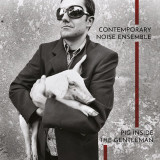
After a creative break of more than 10 years finally the comeback: In line with the long-awaited new album called "An Excellent Spiritual Serviceman" a limited colored vinyl reissue of the classic Contemporary Noise Ensemble debut record "Pig Inside The Genleman" from 2006.
"Jazz music without jazz, film music without movie but something splendid instead! Despite the band's name suggesting noisy music for the chosen ones, Contemporary Noise Ensemble appears to be a revelation for everyone. Beautiful, hard, romantic piano tunes in the dialogue with brass section. Simple and extraordinary emotional compositions leading to the climax which makes the flesh creeps while listening. Hair bristle on the heads of those who remember the musical past of the The Contemporary Noise Ensemble members..."
"The Contemporary Noise Ensemble impresses with maturity and class. There's elegance as well as punk energy. The compositions are unbelievably spacious but on the other hand all fulfilled with instruments - from the superb rhythm combo to the greatly equipped brass section. The roots of the most of The Contemporary Noise Ensemble musicians reach harder music, sometimes even heavy metal what bears excellent interest. The compositions are vigorous and expressive. The name of the band must be remembered because it undoubtedly is Polish export commodity."
"There’s no doubt that the Contemporary Noise Ensemble is one of the most fascinating musical projects from Poland which catches the attention of both pure jazz fans and people who are interested in experimental instrumental music in general. For fans of Cinematic Orchestra & jazz influenced film sounds."
Cerca:le sound express
ULTRADISC ONE-STEP BOX SET OF BRUCE SPRINGSTEEN'S 1973 DEBUT PLAYS WITH AUDIOPHILE SOUND: LIMITED TO 7,500 NUMBERED COPIES.
1/4" / 15 IPS analogue master to DSD 256 to analogue console to lathe
Teeming with identifiable characters, youthful romanticism, vivid narratives, and sophisticated arrangements, Greetings from Asbury Park, N.J. is a personal postcard from the heart, soul, and mind of a rock ’n’ roll lifer bent on discovering his world and what lays beyond it. The 1973 album establishes many of the signature themes and sounds Bruce Springsteen would embrace throughout his unparalleled career. No wonder a majority of the songs — “Blinded by the Light,” “Lost in the Flood,” “Spirit in the Night” included — remain staples of the New Jersey native’s fabled concerts.
Sourced from the original analog master tapes, pressed at RTI on MoFi SuperVinyl, and strictly limited to 7,500 numbered copies, Mobile Fidelity's UltraDisc One-Step 180g 33RPM LP set is the definitive-sounding version of Springsteen’s daring debut. Afforded the benefits of SuperVinyl’s nearly non-existent noise floor, Greetings from Asbury Park, N.J. plays with a clarity, directness, and emotionalism that practically whisks you into the New York office in which Springsteen — accompanied by then-manager Mike Appel — played a few originals for legendary Columbia Records executive John Hammond and earned a record deal.
That solo-centric aspect of Greetings from Asbury Park, N.J. — credited only to Springsteen and featuring only a handful of accompanying musicians — helps make it unique in his catalogue. So do the acoustic-based frameworks, revealed on this pressing with newly exposed detail, nuance, and immediacy. The music emerges with an openness that gives flight to the Boss’ storytelling. His words flow with unbridled, stream-of-conscious pacing and vibrant imagery; they pay homage to and update a tradition established by Bob Dylan, Woody Guthrie, and Jack Kerouac. Equally important, Springsteen’s still-underrated vocal performances can now be appreciated in full-range fidelity. Earnest, transparent, and sincere, his singing comes across with an urgency that distinguishes him from the era’s singer-songwriter mold and a raw energy that underlines his unflinching belief in rock ’n’ roll.
Recorded in just three weeks, Greetings from Asbury Park, N.J. also stands out by way of its insightful artwork. Designed by Grammy winner John Berg, the inviting cover is appointed with images of the local landmarks, beachfronts, and geography that provide the backdrops for some of the songs. Those graphics are complemented by the beautiful packaging of Mobile Fidelity’s UD1S edition. Tucked in a sleek slipcase, the LP is housed in a special foil-stamped jacket with faithful-to-the-original graphics. In every way, this reissue is made for listeners who prize sound quality and who want to engage themselves in everything involved with this invigorating album.
An aspirational declaration by a then-23-year-old musician who was already a seasoned veteran of the Jersey Shore bar-band scene, Greetings from Asbury Park, N.J. can in many ways be seen as a semi-fictional autobiography released more than four decades before Springsteen penned his official tome. Elaborate, descriptive, and absorbing, Springsteen’s lyrics spark with the enthusiasm and exuberance of a wide-eyed adventurer ready for possibility, excitement, and fun — but who is also mindful of loss, pain, and disappointment. Words often tumble and collide like dice spilling from a jar; shaken and fully intact, they pour forth with purpose and without self-conscious concern.
One of two songs composed after label president Clive Davis cited the need for a radio-friendly single, the opening “Blinded by the Light” provides an unforgettable introduction. It flares with a blend of confidence, fun, and poetry that helps define Greetings from Asbury Park, N.J. Crackling with wiry guitars, funky chords, Clarence Clemons’ cool-toned saxophone, and action-packed lyrics, the shuffle simultaneously expands and contracts — and establishes Springsteen as a master of rhyme, alliteration, and breathless expression. The thread continues on “Growin’ Up.” Steered by ascending piano lines, soulful grooves, and frisky rhythms, the coming-of-age confessional is at once rebellious and controlled, fearless and vulnerable, honest and boastful. It is a tale to which multiple generations still relate.
Such universality has always been a Springsteen trademark. It surfaces throughout Greetings from Asbury Park, N.J., as does another Boss hallmark: the importance of friendship and tight bonds. These concepts relate to the fact many of the songs — see the feverish “Does This Bus Stop at 82nd Street?,” strutting “It’s So Hard to Be a Saint in the City,” and tender “For You,” the latter complete with brilliant Hammond organ shading — are directly tied to the friends, acquaintances, places, and happenings he knew. “Lost in the Flood,” whose cinematic drama and epic scope hint at the directions Springsteen would pursue on his next LP, extends that familiarity while addressing the kind of socially conscious issues with which he’s forever been associated.
Balancing the label’s vision of him as a folk-based singer-songwriter and his own desire to play rock ‘n’ roll with a full band, Springsteen never again made a record like Greetings from Asbury Park, N.J. One of the most captivating debuts in history, it heralds the start of a legacy whose import Springsteen seemingly foretells on “Blinded by the Light”: “He’s gonna make it tonight.” And how.
- A1: Erstes Kapitel (Verschliffen)
- A2: Zweites Kapitel (Ruckartig)
- A3: Drittes Kapitel (Ungesagt, Dann Vergessen)
- A4: Viertes Kapitel (Bewusstseinsfrei)
- B1: Fünftes Kapitel (Kreuzweis)
- B2: Sechstes Kapitel (Herausgewunden)
- B3: Siebentes Kapitel (Verflochten)
- B4: Letztes Kapitel (Halb Vermutet, Halb Gesehen)
11th album by the one-of-a-kind collective: psychedelia and free form jazz (not jazz) trigger a sophisticated excursion into weird textures with drastic turns. Dislocated dense music full of secret connections!
Kammerflimmer Kollektief – "Schemen"
Before reason prevails, invoked by those who want everything to remain as it is, Kammerflimmer Kollektief disrupts the established supply chains of sound. It seeks more interesting ways to assemble them. Trusting in this, because of the fact that every sound that still comes out of a guitar, a bass, a harmonium, drums and electronic devices has already been taken into the common mangle of meaning anyway. Enough of all that. Here, nothing is explained. Here we speak in schemes. Polished and jerky.
The images that Kammerflimmer Kollektief conjures up therefore happen not in the focus of consciousness, but rather in its outer realms. In those to which one does not give one's full attention at the moment, but which are nevertheless perceived. For example, when a leaf falls from the ground back up to the tree in the corner of your eye, and for an instant you think this is possible, before you realize it was a small bird flying into the tree; it is in just such irritating moments between perception and realization that the art of the Kollektief also unfolds. On "Schemen", familiar fragments float gently around their core – a Fender Rhodes tone, a bass figure, a guitar motif, a masterful drum shuffle, a moment of icy stasis borrowed from the harmonium playing of Christa 'Nico' Päffgen. Triggering brief associations, they slowly rush off in other directions through free jazz-informed editing work, whereupon such zones can also arise in which perception has a few tricks ready and earlier experience suddenly breaks into the now in a completely different way. Half suspected, half seen.
Half-music like Can from Cologne – also masters of improvised editing – sometimes produced a few decades ago in their in-between moments. The first minutes of "Future Days" for example, which fade in gently, sketch a barely graspable figure emerging from all directions of the room. Kammerflimmer Kollektief also engages in similarly open moments of development. Loosely, it eludes the first formative impressions, keeping itself ready for moments that do not follow any logic of appointment. This looseness in handling makes Kammerflimmer Kollektief so fluidly audible, even when dissonant peaks and free playing arise. What Karlheinz Stockhausen is to Can's understanding of composition, the recordings of The Cocoon are to Kammerflimmer Kollektief. The Cocoon, a meeting of garage psychedelics from the Hannover area with free jazzers from the Galaxie Dream Band, whose album "While The Recording Engineer Sleeps", recorded in 1985 in unguarded moments, operates in a very similar way with decentralized perceptual ambivalences and only appeared more or less secretly four years later on Wilhelm Reich Schallspeicher. Other traces of "Schemen" lead to the debut album of Quicksilver Messenger Service. The guitars of Gary Duncan and John Cipollina, which refer to themselves in an unforced manner, are instructions to let go. They don't want to be traced in every note as a solo, but they give their music a sense that the essential takes place off center, in the mutual and intuitive gift of loving attentions. Consciousness-free.
Loving turns like the little guitar phrase that, like a kind of leitmotif, is repeatedly ghosting more or less unchanged through all of the Kammerflimmer Kollektief albums. A Coricidin induced, very catchy slide idea filtered out of ancient Æther, which – who knows – maybe even centuries ago found its way from somewhere to America – the old, the eerie – and from there wafted on through the ages to southern Germany, to a smoky studio in the Upper Rhine lowlands. A memory of which even the memory no longer knows what it once reminded. Unsaid, then forgotten.
In Kammerflimmer Kollektief you will also find a friend of slowly building, unhurried music, which probably would have been appreciated by the old Franz Mesmer, who 200 years ago, after tranquilizing treatments, sometimes used to play for his patients ambient melodies on the enormous glass harmonica. However, in order not to surrender completely to the flow of one's own life energy, as Mesmer had in mind with his therapies, Kammerflimmer Kollektief occasionally adds hectic tensions, gently embraced by the droning of a sine wave generator, as if a trance could briefly refesh. This old analog sine wave generator is new in the Kammerflimmer assortment of sounds. So, the art of the Kollektief likes to dock occasionally in modern times, yet with the past in mind. Mental states begin to flicker between imagination and certainty, between culture-bound art expression and coincidences: A cawing and scraping can always just be a cawing and scraping with Kammerflimmer Kollektief, the way Andy Warhol's mushroom eater just eats a mushroom.
Heike Aumüller's cover works, which illustrate all the Kammerflimmer Kollektief albums, additionally act as amplifiers of unexplained refractions. Her style consists of eye-corner art that remains so, even when looked at directly. Her shots remain disquieting because they do not jolt themselves into a reassuring order, even in retrospect. Rather than evading the fear that arises when looking at them by trying to impose some irrational rhyme or reason, that fear must simply be endured. This strategy of endurance is equally applicable to the music. The trick is to let parts be parts without compulsively seeking delusional patterns that lull us into a false sense of security and in doing so, possibly delude ourselves. In this context, freedom means not having to anxiously attach a fantasized superior meaning to everything. "Schemen" has an conspiracy disintegrating effect.
b A2 Zweites Kapitel (ruckartig) [feat. Heike Aumüller]
Entirely remastered from the original analogue tapes and featuring brand new artwork designed by Luke Insect, this Four Flies reissue finally brings back to life one of the most surprising albums from the strange phenomenon that was the Italian library music of the Seventies.
Gianni Safred's Electronic Designs was released in 1977 on the Milanese label Jump, in their "Music Scene" series, simply as a collection of musical pieces intended for use in television programmes. However, hidden behind a nondescript cover were twelve electronic music tracks revealing a recognizable style of composition; twelve little gems masterly combining experimentation, catchiness and practical functionality thanks to a unified and unique style. Each through a specific mood, these tracks give expression to Safred's distinctive sound, where irresistible mechanical grooves are over-layered with melodic lines perfectly played on a Polymoog or ARP Odyssey.
A native of Trieste, Safred started out with little swing bands soon after WW2, before eventually playing with great soloists like Django Rheinhardt. Ultimately, it is his background as a jazz pianist that makes Electronic Designs so special. As with other Italian jazzmen who got into synthesizers (above all, Piero Umiliani), Safred's blend of complex harmonies and (quasi-) bebop virtuoso flourishes, with its obsessive repetitions and refined tone colours, gives a retro-futuristic quality to this library album, whose electronic music islight-years ahead ofthe 'pop' electronic music of the time and, in many ways, anticipates the best stylistic features of early-Nineties dance music.
Safred best expresses his experimental verve – and does a great job in creating the 'electronic designs' of the title – in "Mystification", "City Problems", "Trapdoor", "Planetarium" and "Poe's Clock", all of which unfold through hypnotic beats and sinusoid or square wave explosions. In other tracks, however, the compositional style is less unconventional, with relaxed yet not banal atmospheres ("Spheres", "Elastic Points", "Sacred Interlude"), as well as flashes of irresistible groove inspired by Herbie Hancock's more pop-oriented work ("Automation Age", "Jazz Motion Study", "Bottom Up"). The album's masterpiece is arguably "Hasty Chant", a detective-funk ride with an unforgettable theme, which manages to pull all of the album's various strands into a cohesive whole – as a side note, the allusive and apt description of the song on the back cover reads: "Things are happening".
DAFNE VICENTE-SANDOVAL - MINOS CIRCUIT (2021)
Minos Circuit is the resonance of a double exploration, that of an instrument, the bassoon - an instrument dear to Dafne Vicente-Sandoval - and that of a listening, of a gaze, almost. The first exploration deconstructs the instrument, tearing it apart, reducing it to an archipelago of sound bodies stimulated by an electro-acoustic device that generates feedback and infiltrates each part of the bassoon, in order to carry out a methodical, systematic examination. The second exploration is the inner one of attention and listening, the one that measures, at each moment, the necessity or not of an intervention in the very act of the musical work, of this subtle balance that is established between composition and observation, between action and contemplation.
(fr) Minos Circuit est la mise en résonance d’une exploration double, celle d’un instrument, le basson — instrument cher à Dafne Vicente-Sandoval — et celle d’une écoute, d’un regard, presque. La première exploration déconstruit l’instrument, le met en pièce, le réduisant en un archipel de corps sonores stimulés par un dispositif électroacoustique générateurs de larsens qui vont s’infiltrer dans chacune des parties du basson, pour en faire l’examen méthodique, systématique. La seconde exploration, c’est celle, intérieure, de l’attention et de l’écoute, celle qui mesure, à chaque instant, la nécessité ou non d’une intervention dans l’agir même de l’œuvre, de cette bascule subtile qui s’établit entre composition et observation, entre action et contemplation.
LARS PETTER HAGEN - TRANSFIGURATION 4 (2018)
Both a “meditation on musical ruins” and “a study of the material of Richard Strauss’s Metamorphoses”, Transfiguration 4 works on the musical fragment as an expressive and poetic possibility that can be deployed below or beyond simple musical syntax, a syntax that is still too often equated with music itself. What Lars Petter Hagen highlights in this remarkable work is that the power of music lies at its fringes, that is, at the edge of its own disappearance. Transfiguration 4 floats in a particularly moving way in these troubled lands, where nothing is ever resolved, and where everything, however, is suspended, like a stream of blurred memories that memory would summon to form an intuition. A musical intuition.
(fr) A la fois « méditation sur les ruines musicales » et « étude du matériau de Metamorfosen de Richard Strauss », Transfiguration 4 travaille le fragment musical comme possibilité expressive, poétique, pouvant se déployer en-deçà ou au-delà de la simple syntaxe musicale, syntaxe encore trop souvent assimilée à la musique même. Ce que met en lumière Lars Petter Hagen dans cette œuvre remarquable, c’est que la puissance de la musique se situe à ses franges, c’est-à-dire aux lisières de sa propre disparition. Transfiguration 4 flotte de manière particulièrement émouvante dans ces contrées troubles, où rien jamais ne se résout, et où tout, pourtant, se suspend, comme un flux de souvenirs flous que la mémoire convoquerait pour former une intuition. Une intuition musicale.
Veteran artist Sebra Cruz releases his debut album ‘Don't Worry Psy Happy’ on DJ Tennis’ revered Life & Death imprint. The daring eleven track LP is as experimental as it is definitive and encapsulates the Italian spirit in perfect style.
The LP follows two previously teased singles; ‘Margaret’, an ode to Cruz’ girlfriend which is a deeply passionate and expressive melodic house offering and album title ‘Don’t Worry Psy Happy’ a hedonistic, tripped out soundscape.
The lead track ‘Sunfish’ is a melange of powerful synths overlaid with sporadic vocals and a swinging breakbeat which make the record the perfect soundtrack for early morning dancefloor euphoria.
The album continues its genreless motif and is hard to pin down. It broaches a variety of styles including cinematic and ambient leaning sonics such as ‘Optimist’ and ‘Poliziesco’, the latter which includes Gabriele Fabbri’s atmospheric guitar riff throughout.
‘The Siebel Road To Mars’ is a similarly powerful yet emotive record which samples current Italian President Sergio Mattarella between the piano and the extraterrestrial sound palette. Continuing with the more abstract tracks ‘Flying Junior’, which was named after Cruz’ own sailboat, emulates the peacefulness and tranquillity of the sea. It’s yet another reflection of Sebra Cruz’ artistic personality.
Juxtaposing the calm and serene records from the album, ‘AltreCose’, inspired by the energy of the Neapolitan people during Sebra’s DJing residency in the 90s, is a more high energy disco-infused record. Similarly ‘When Life Was Slow’, released on Life & Death back in 2020, is another upbeat dance interpretation and a tribute to Cruz’ passion for Italian composers from the 60s and 70s.
Speaking about the album Sebra says: “What emerges is in my opinion an album with predominantly Italian spirit, disco, house with both edgy and gentle influences. I never decide what to do first, I simply follow my spur of the moment instinct. Releasing an album for Life & Death is cool because I've always had huge respect for Manfredi.”
Sebra Cruz and DJ Tennis have a long lasting and trusting collaborative relationship exhibited by the former's numerous releases on Tennis’ Life and Death label. DJ Tennis’ encyclopaedic musical brain and shared passion for Italian composers perfectly complements Sebra’s stylings.
Striking an impeccable balance between abstract and obscure sonics and more methodical and conventional melodies, 'Don't Worry Psy Happy’ is a body of work that exquisitely expresses Sebra Cruz’ personality via different worlds and mediums.
3 capital letters, 2 cities, 2 boys, 1 project. Bordeaux, Berlin. Guillaume Laidain, Andrew Claristidge. Songs for concrete / Electronic.
An apartment building, floors, songs. In the stairwell, a meeting: sound artist, radio interference manipulator and musician-producer-arranger. The bass escapes from the cellar and vibrates along the corridors. A door opens, oscillations swirl, clash, and blur the tracks. A voice rises. Concrete architecture. Bodies armed for expression. In the distance, the echo of a rave party …
Remixes by The Hacker, Arnaud Rebotini and Pablo Bozzi.
Pink Blue Marbled Vinyl
Angelo is an EP, named after a car, featuring nine songs Brijean have crafted and carried with them through a period of profound change, loss, and relocation. It finds percussionist and singer Brijean Murphy and multi-instrumentalist/producer Doug Stuart processing the impossible the only way they know how: through rhythm and movement. The months surrounding the acclaimed release of Feelings, their full-length Ghostly International debut in 2021 which celebrated tender self-reflection and new possibilities, rang bittersweet with the absence of touring and the sudden passing of Murphy's father and both of Stuart's parents. In a haze of heartache, the duo left the Bay Area to be near family, resetting in four cities in under two years. Their to-go rig became their traveling studio and these tracks, along with Angelo, became their few constants. Whereas Feelings formed over collaborative jams with friends, Angelo's sessions presented Murphy and Stuart a chance to record at their most intimate, "to get us out of our grief and into our bodies," says Murphy. They explored new moods and styles, reaching for effervescent dance tempos and technicolor backdrops, vibrant hues in contrast to their more somber human experiences. Angelo beams with positivity and creative renewal _ a resourceful, collective answer to "what happens now?". Angelo the car is a 1981 Toyota Celica they got off Craigslist during their first stint in Los Angeles, where Murphy and Stuart have since settled. "Such a bro-y, `80s dude car, it's been super fun to drive around in a new town," Murphy says. "He's older than us, he's a classic, he's got a story." It is a spiritual vehicle with a cinematic appeal, first dropping them off in an alleyway for the scene-setting intro, "Which Way To The Club." The question is quickly resolved by "Take A Trip" as a cruising bassline mingles with crowd sounds, hand-claps, cuíca hiccups, whip-cracks, even a horse neigh. Brijean have found some club on this cross-dimensional trip - the kind of imagined space or chamber within one's self capable of "shifting a fraction of who you are," says Murphy. They wrote the track with the simple intention to be "as free as we could be," adds Stuart, likening the flip on the B section to a realm unlocked: "What if the world changed completely? You open the door to a new room." Next is "Shy Guy," a motivational anthem for the wallflowers among us. Murphy sets up the daydream: "We are in junior high, we're on the dance floor, what's going down, who is dancing, who is not, how are we gonna make them dance?" The narrator, the MC, hypes up the room as conga-driven rhythms bounce between languid synth and guitar lines. "Show me how to move...I feel something...I know you feel it too," Murphy sings sweetly, calling back to the opening lines of Feelings, and this time the audience chants it back. It is easy to picture Brijean performing this one - something they only got to do a handful of times until more recently, opening shows for Khruangbin and Washed Out, an experience they found informative. Murphy explains, "It was inspiring to be out there and let loose more. To see how people can expand their expression on stage gave me more liberty with how I viewed my musicianship. My role for so long was to be a backup percussionist, so why would I ever leave the drums, you know? But then after playing all these runs, you see these artists and realize you can, you have permission." "Angelo" and "Ooo La La" deliver the danciest stretch in Brijean's catalog to date. The title track adopts a deep house pulse replete with strings, hi-hats, and kicks. The latter opts for a funkier groove that foregoes verses in favor of warbled hums and extended breakdowns. What follows is perhaps the duo's dreamiest run, a comedown initiated with the honey-hued interlude "Colors" drifting into "Where Do We Go?", a tropicália reverie where Murphy contemplates the passage of time and space. It all culminates in "Caldwell's Way," a fond farewell to their Bay Area community - "a part of my life that I knew couldn't come back," says Murphy. Above shimmering organ sounds, lush strings, and the birdcall of their former neighborhood, she wistfully articulates the uncertainty of moving on by remembering the characters dear to them. There's the wisdom of their neighbor, Santos, who refused payment when helping them move out: "I'd rather have 100 friends than 100 dollars." And the song's namesake, Benjamin Caldwell Brown, a friend and club night cohort for many years. "I'm only miles away, maybe I'm just feeling lonely," the line resigns to warm nostalgia, and "Nostalgia" runs the closing credits to this healing and transportive collection.
‘’Ace Todmorden label makes a significant discovery on its own doorstep: a superb cache of ‘loner folk’ songs recorded in the early-70s by Hebden Bridge’s answer to Nick Drake’’ UNCUT PLAYLIST
"This is music that can confidently hold its own with pioneers such as Davey Graham, Michael Chapman, Bert Jansch and Jackson C Frank, as influenced by jazz, blues and steel guitar as any of the old songbook classics from ancient Albion.” Benjamin Myers
"Defiantly Northern and out of this world" Folk Radio
Anti-counter culture loner folk from a teenage attic in the heart of rural Northern hippiedom.
Today the valley town of Hebden Bridge in West Yorkshire is world-renowned as something of a bohemian backwater. It wasn’t like this back in the late 1960s and the early 1970s, when a disparate selection of radicals, drop-outs, heads, musicians, artists and writers started to be attracted to the Calder Valley. Local lad and future poet laureate Ted Hughes called the area “the fouled nest of industrialisation”.
Over time, those seeds of radicalism and collectivism ensured Hebden Bridge evolved into a place where people could be themselves and all shades of individual oddness not only tolerated but actively encouraged. But back at the turn of the dreary 1970s it remained a monochrome world defined by its unforgiving surrounding landscapes, where the old gritstone over-dwellings were stained with soot and rain lashed down for weeks.
It was here that Trevor Beales, who was born in 1953, grew up, and from where he drew musical and lyrical inspiration.
Perhaps it was this dual nationality heritage, unusual in the valley’s largely white working class population at the time, that gave the teenager Trevor Beale’s music an outsider’s perspective. The discovery of Bob Dylan, Django Reinhardt, The Byrds and James Taylor at a young age, lead to him picking up a guitar at the age of ten, and he was soon writing his own originals and performing them at local (though often remote) folk clubs and pubs.
Recorded in the attic of the family home at Ivy Bank in Charlestown on the verdant wooded slopes at the edge of Hebden Bridge between 1971 and 1974, these early recordings are collected here for the first time and mark Trevor Beales long-overdue solo debut.
In these songs is a suffer-no-fools sense of realism that is defiantly Northern, yet also expresses a worldliness that belies Beales’ young years, whilst also showcasing an inherent storyteller’s ear for narrative. Here is a postcard from the past at that crucial musical period of transition, when the idealistic exponents of the 1960s emerged into an austere new decade that was to be shaped by strikes, rising unemployment and economic upheaval.
Two aspects of this music make it remarkable: Beales’ natural ability showcases a sophisticated guitar-picking style that was leagues ahead of many of his (older, more recognised) contemporaries. This is music that can confidently hold its own with pioneers such as Davey Graham, Michael Chapman, Dave Evans, Bert Jansch and Jackson C Frank, as influenced by jazz, blues and steel guitar as any of the old songbook classics from ancient Albion.
Secondly, his lyrics are a far cry from either the naïve bedroom scribblings of a teenager who has barely left his upland home, nor do they fall foul of the type of lazy cliches and sub-Tolkien imagery that was still in abundance in the early 1970s. Most remarkably the earliest songs here were laid down less than a year after he left school (an unearthed report written by his headteacher on July 3rd 1970 noted he had “a considerable ability and interest in music”, though his education ended abruptly when he simply walked out of a science lesson one sunny day while at sixth form, never to return).
Trevor’s music is grounded in reality – his reality. ‘Then I’ll Take You Home’, for example, considers the Guru Marajai, who encouraged his acolytes to give over their worldly possessions, yet who drove a Rolls Royce and lived like a playboy. Unsurprisingly, this latest in a long line of spiritual charlatans found several followers in Hebden Bridge, and Beales casts a disdainful eye over the growing popularity for such false prophets.
With its ancient narratives and propensity for myth-making, folk has certainly produced it’s fair share of cult figures who have enjoyed rediscovery or career resurgence and with this debut compilation of home recordings, rescued from cassette tapes, Trevor Beales might just be the latest addition. Certainly he was the real deal.
Crucially, Beales' music is never jaded or cynical, but instead possesses a poet’s ear, a strong sense of self and some sound critical faculties. And much of it recorded at an age when he could neither vote nor order a pint of heavy.
Trevor Beales died suddenly and unexpectedly on March 29th 1987, aged 33. He left behind Christine and their young child Lydia.
When we established Balmat in 2021, neither of us could have imagined that within two years, we’d be putting out an album by one of our musical heroes: Mike Paradinas, aka µ-Ziq. The British producer has been an inspiration to label co-founders Albert Salinas and Philip Sherburne since the 1990s. In fact, his album-length remix project The Auteurs Vs µ-Ziq was one of the very first pieces of electronic music that Philip bought, way back in 1994. To have the opportunity to release his music now feels like a real full-circle moment.
Paradinas, of course, needs no introduction. Under a slew of aliases, chief among them µ-Ziq, the British artist revolutionized leftfield electronic music in the 1990s—coincidentally, this year marks the 30th anniversary of his debut album, Tango N’ Vectif, for his friend and sometime collaborator Aphex Twin’s Rephlex label—and his label Planet Mu has built up a formidable catalog of visionary, forwardlooking records, mapping virtually every corner of the electronic spectrum. With 1977, he turns the clock backward in a sense, and not just with the album’s title: Rooted in classic ambient and electronic sounds, these 15 tracks evoke the anything-goes spirit of the early ’90s, before the tools and tropes had calcified into cut-and-dried styles.
There’s no shortage of familiar sounds on 1977. There are echoes of raves and chillout rooms and transmissions from the fringes of techno; there are detuned synths and glistening reverb tails and, above all, gauzy vox pads, the eerie glue that holds it all together. The title, he says, is meant to invoke a general sense of nostalgia, bookmarking a year in his boyhood when he became more selfaware. More than anything, 1977 sounds like µ-Ziq distilled: Stripped of his signature breakbeats and customary chaos, Paradinas’ first-ever strictly (well, mostly) ambient album presents the essence of his music in a whole new light.
Along the way Paradinas touches on dark-ambient drones (“Marmite”), horror-film themes (“Belt & Carpet”), jungle breaks (“Mesolithic Jungle”), and even house music (“Houzz 13”), which marks the first bona fide dance-floor moment on Balmat to date). Yet the album never—to our ears, anyway— feels expressly retro. Rather, Paradinas plucks timeless sounds out of the ether and gives them a gentle tap, spinning them into unexpected new orbits. At times, 1977 feels like an experience of extended déjà vu: When we first listened to it, we had the sense that we already knew this music. It was as though we had heard it years ago, perhaps on a battered cassette tape lent to us by a friend, and been searching for it ever since. We hope you feel the same.
"This is a melancholy, broody, moody and fun project to get lost in” – CLASH
★★★★★ “Few bands are brave enough to try something this ambitious, even fewer have the talent to pull it off” - UPSET
Accompanied by an awe-inspiring film that immerses viewers in 180 degrees of virtual reality, the brand new album finds the band reinvigorated once again, delivering a serene salvo of songs that defy the heavy weight of adulthood, faith and self-redemption through sounds unlike anything they have made before. Following their previous 2021 LP, The Million Masks of God - an acclaimed collection that cried for help as it explored a man’s encounter with the angel of death - The Valley of Vision puts forth a collective, cathartic expression of gratitude that is brought to life in both the songwriting of frontman Andy Hull, and the cinematic story directed by Isaac Deitz.
Writing for the record began with a chance occurrence in the summer of 2021. Hull was looking through his suitcase for his lyric notebook, but instead found a 1975 book of Puritan prayers called The Valley of Vision, which his mom had gifted to him the previous Christmas. The title became a mantra that helped inspire the idyllic yet otherworldly energy that permeates throughout the album and film. An evolution from its predominantly guitar-driven past, the band almost completely abandons the instruments it is used to, and instead plays with primitive yet powerful piano leads and shimmering atmospheres, backed by sub-synth frequencies of bassist Andy Prince and shapeshifting sounds of drummer Tim Very.
"
Emotional Rescue is delighted to debut a first. Rather than a straight reissue of an (obscure) classic or a collection of music by an artist or label, here presented is a compilation of various artists centered around a sound and movement reggae-tinged music and how it influenced and spread from the Caribbean and diaspora.
Drawn from the off kilter digging of archivist, DJ and collector Bruno (perfectliv.es), Nowhere Like Here is not a follow up, but a sideways accompaniment, to his recent and already cult like 'Perfect Motion' collection of left field pop and new wave, recently self-released with Flo Dill (NTS).
This is a special release to celebrate the label's 10th year and beyond, offering a treasure trove of lo-fi and often pop inspired reggae cuts, mixing heartfelt Lovers Rocks style paeans and quirky private press oddities, all guaranteed to 'make-a-move and tap', these are, in the main ridiculously rare or impossible to find alternative bombs, that are just as sound system rocking and massive bass line quaking showcases of the enduring legacy of this Jamaican music phenomenon.
As with much of the early 80s period, the music community was in the throes of a Do-It-Yourself cultural renaissance as small labels, where crazy limited, one off White Labels Onlys came and went. Songs like Avalanche 's 'Your Love is Such a Good Thing 'or Warp Speed's 'Take It To The Night' were part of the claiming the means of production in to their own hands, pressing up the records and self-distributing. This raw, naive exuberance can be heard in the songs themselves. This is not reggae or Lovers as known, but something more expressive. Musical, simply produced, but with intelligible and uplifting optimism that is just superlatively catchy.
While Paul Thompson's 'Can I Take You Home' and Ras Ibuna's 'Black Beauty' are more straight-ahead Lover's style cuts, there is the parallel dance pop private pressing vibrations of the two Keith Robinson songs and Majority's 'Caroline' included all part of a thread; a joining the dots that Nowhere Like Here is at its most basic, a warmth the whole album exudes.
This is not a Lovers Rock Hits of some, but a left-of-center versioning, spread across Double Pack and cut loud for DJ play, fitting the ethos of Emotional Rescue by presenting something most will not have heard before and all the better for it.
Magna Pia, a.k.a seasoned producer, DJ, and composer Hüseyin Evirgen, announces his second full-length album, ‘QUT’, arriving on Inland’s Counterchange label in March on double vinyl.
After 2 steamrolling EPs of club tracks on the label - now entering its tenth year of action - Magna Pia presents his most complete and advanced body of work to date, weaving a dense narrative of drone, figurative synthesis, bass-heavy electronica, and abstract techno.
Over eight tracks each referencing his rich cultural and musical background, we are treated to a unique overview of a producer at the crest of his art. The word ‘Qut’ is an ancient positive affirmation, in one short word encompassing all that is scared, pure and good. The Old Turkic term meaning not only ‘good fortune’ and ‘joy’, but in shamanic circles, the ‘wonder of the heavens’, permeates the roots of Evirgen’s multi-heritage history.
That Evirgen expresses his interpretation of this central theme through the marriage of bewitching melodies with atonal, experimental and rumbling electronics is a conscious comment on the distortions and mutations of our Modern Era. We now exist in the digital age of the Technosphere for better or worse, and must seek beauty where-ever possible.
The opening ‘Prologue’ invites the listener into a futuristic yet organic sound world, where lush stereo processing goes hand in hand with rumbling bass and subtly detuned drone languages. From the echoes of traditional Uyghur folk music, translated via synthesizers into a glistening slow-diving opus (‘Qizil’), to churning dub-techno adorned with a symphony of evolving sine-waves (‘Venus M’), Evirgen then deploys ‘X’ - a haunting experimental piece composed predominantly with his voice and electronic processing.
The interweaving synth lines of ‘Gudanna’ pierce the fog with a radiant and transcendent club-techno bounce before the ode to the ancient Bronze Age goddess ‘Astarte’ unfolds its snare-driven broken-beat formations. The title track ‘Qut’ embodies by far the heaviest club track of the album, in a deadly, stripped-back moment of future-techno hypnotism. Dancing flames of purple-tongued synthesis are held (just) in line by a wonderfully tough throb of drums.
With his ‘Epilogue’, Magna Pia allows the spectral ideas and concepts laid out across the LP to connect and travel full circle, confirming our suspicions that this could be one of the most coherent and exciting works to emerge in the brave new field of introspective, and sensitive techno-electronic language.
- A1: Time? One Of The Most Complex Expressions?
- A2: Ian Fish U.k. Heir (Moonage Daydream Mix 1)
- A3: Hallo Spaceboy (Remix Moonage Daydream Edit)
- A4: Medley: Wild Eyed Boy From Freecloud
- A5: All The Young Dudes
- A6: Oh! You Pretty Things (Live)
- A7: Life On Mars? (2016 Mix - Moonage Daydream Edit)
- A8: Moonage Daydream (Live)
- B1: Medley: The Jean Genie / Love Me Do / The Jean Genie (Featuring Jeff Beck)
- B2: The Light (Excerpt)
- B3: Warszawa (Live Moonage Daydream Edit)
- B4: Quicksand (2021 Mix - Early Version)
- B5: Medley: Future Legend / Diamonds Dogs Intro / Cracked Actor
- C1: Rock ?N' Roll With Me (Live)
- C2: Aladdin Sane (Moonage Daydream Edit)
- C3: Subterraneans
- C4: Space Oddity (Moonage Daydream Mix)
- C5: V-2 Schneider
- D1: Sound And Vision (Moonage Daydream Mix)
- D2: A New Career In A New Town (Moonage Daydream Mix)
- D3: Word On A Wing (Moonage Daydream Excerpt)
- D4: Heroes? (Live Moonage Daydream Edit)
- D5: J. (Moonage Daydream Mix)
- D6: Ashes To Ashes (Moonage Daydream Mix)
- E1: Cygnet Committee/Lazarus (Moonage Daydream Mix)
- E2: Memory Of A Free Festival (Harmonium Edit)
- E3: Modern Love (Moonage Daydream Mix)
- E4: Let's Dance (Live Moonage Daydream Edit)
- E5: The Mysteries (Moonage Daydream Mix)
- E6: Rock ?N' Roll Suicide (Live Moonage Daydream Edit)
- E7: Ian Fish U.k. Heir (Moonage Daydream Mix 2)
- F1: Word On A Wing (Moonage Daydream Mix)
- F2: Hallo Spaceboy (Live Moonage Daydream Mix)
- F3: I Have Not Been To Oxford Town (Moonage Daydream A Cappella Mix Edit)
- F4: Heroes": Iv. Sons Of The Silent Age (Excerpt)
- F5: ? (Moonage Daydream Mix Edit)
- F6: Ian Fish U.k. Heir (Moonage Daydream Mix Excerpt)
- F7: Memory Of A Free Festival (Moonage Daydream Mix Edit)
- F8: Starman
- F9: You're Aware Of A Deeper Existence?
- F10: Changes
- F11: Let Me Tell You One Thing?
- F12: Well You Know What This Has Been An Incredible Pleasure?
- D7: Move On (Moonage Daydream A Cappella Mix Edit)
- D8: Moss Garden (Moonage Daydream Edit)
Nach der Veröffentlichung der 2CD-Version des Albums Moonage Daydream im letzten Jahr, wird der Soundtrack nun am 31. März als 3LP Vinyl veröffentlicht.
"Moonage Daydream" beleuchtet das Leben und Genie von David Bowie, einem der produktivsten und einflussreichsten Künstler der jüngeren Musikgeschichte.
Auf Spielfilmlänge nimmt uns Brett Morgen mit in die Welt Bowies, erforscht anhand von großartigem, vielfältigem und nie zuvor gesehenem Filmmaterial, Live-Auftritten und Musik (Morgen sichtete vier Jahre die Archive des David Bowie Estates) seine kreative, musikalische und spirituelle Reise.
Durch den Film führt uns dabei die Erzählerstimme von David Bowie selbst.
Das Begleitalbum zu "Moonage Dream" enthält Songs aus Bowies gesamter Karriere, darunter bisher ungehörtes Material, speziell für den Film und dieses Album angefertigte Mixe und Gesprächspassagen Bowies.
Zu den Highlights des Tracklistings zählen ein bisher unveröffentlichtes Live-Medley von "The Jean Genie / Love Me Do / The Jean Genie", aufgenommen beim berühmt-berüchtigten letzten Ziggy-Stardust-Konzert im Londoner Hammersmith Odeon 1973 und mit Jeff Beck an der Gitarre. Weitere Raritäten sind eine frühe Version
des Hunky-Dory-Favoriten "Quicksand" und eine bisher unveröffentlichte Live-Version von "Rock 'n' Roll With Me", mitgeschnitten bei der legendären "Soul Tour" 1974.
- A1: Jazz Is Merely The Negroes Cry Of Joy & Suffering
- A2: Introit- Joy N’ Suff’rin
- A3: Jazz Is The Musical Expression Of The Triumph Of The Negroes Spirit
- A4: Kyrie Eleison- Lawd Hav’ Merci
- B1: This Endless Repetition Is Like A Chain Around The Spirit. And Is A Reflection Of The Denial Of A Future To The Negro In The American Way Of Life
- B2: Dias Ire- Chain Around The Spirit
- B3: Another Restraining Factor In Jazz Are The Changes
- B4: Tuba Mirum- The Changes
- C1: The Negro Experiences The Endless Daily Humiliation Of American Life Which Bequeaths Him A Futureless Future
- C2: Rex Tremendae –Futureless Future
- C3: The Negro Transforms America’s Image Of Him Into A Transport Of Joy!
- C4: Recordare-Recall The Joy 02:06
- C5: Jazz Reflects The Improvised Life Thrust Upon The Negro
- C6: Confutatis-Repression
- C7: Through Spirituals, Through The Blues, Then Through Jazz We Made A Memory Of Our Past And A Promise Of All To Come
- C8: Lacrimosa- Weeping Our Lady Of Sorrow
- D1: Because Jazz Is The One Element In American Life Where Whites Must Be Humble To The Negro
- D2: Offerturium-Hostias-Humility
- D3: Only When Whites Have Paid The Price In Suffering To Be The Negroes Equal
- D4: Sanctus- Holy, Holy, Holy
- D5: The Jazz Body Is Dead But The Spirit Of Jazz Is Alive
- D6: Agnus Dei-Jazz Is Dead!
- D7: Lux Aeterna – Eternal Light (Angel Bat Dawid) / My Rhapsody (Severson-Leist) Feat. Marshall Allen & Knoel Scott
- D8: Long Tone For Rayna Golding (A Binti Zawadi Our Future)
Requiem for Jazz is a 12-movement suite composed and arranged by Angel Bat Dawid, inspired in part by dialogue from Edward O. Bland’s 1959 film “The Cry of Jazz.”
The original form of the music was premiered at the 2019 edition of the Hyde Park Jazz Festival in Chicago, where Angel conducted a multigenerational fifteen-piece instrumental ensemble (all Black musicians from Chicago’s creative music community) alongside a four- person choir (featuring singers from Black Monument Ensemble), dancers, and visual artists in performance.
Angel mixed and post-produced recordings from the performance – adding interludes, vocals and additional sounds, as well as transcribing a piece from “The Cry of Jazz” film. The final movement of Requiem for Jazz features Marshall Allen and Knoel Scott of the Sun Ra Arkestra. Their contributions were recorded remotely at the historic Arkestral Institute of Sun Ra in Philadelphia in late 2020.
The final Requiem for Jazz work in album form is an immersive 24-track, double LP experience. The physical package is a deluxe, heavyweight gatefold jacket with liner notes by South African writer Nombuso Mathibela, artwork by Damon Locks, and a large fold out poster designed by Jeremiah Chiu, featuring poetry written by Angel Bat Dawid in dedication to all of her collaborators on the project. Additionally, there is a limited Thy Kingdom Come purple color vinyl edition of Requiem for Jazz available for the first pressing only.
The axolotl is a species of salamander native to Mexico, living in a state of larva and having the capacity to regenerate damaged organs. This brief introduction doesn’t tell us if the axolotl sings. But, for the one that concerns us here: yes indeed.
In Paris, at the end of the 1970s, Etienne Brunet and Marc Dufourd would improvise regularly, inspired by some other saxophone-guitar duos: Claude Bernard-Raymond Boni firstly, then Evan Parker-Derek Bailey. When Jacques Oger (a saxophonist whom Brunet had met at a workshop given by Steve Lacy at the Châteauvallon festival in 1977) joined the duo Brunet-Dufourd, Axolotl was born.
Iconoclastic, the trio was bound to please Jac Berrocal, and he proposed to record their first album on the label ‘D’avantage’. In spring 1981 three days were just enough for Oger (tenor and barytone saxophones), Brunet (alto saxophone, bass clarinet and ‘things’) and Dufourd (electric guitar) to complete Axolotl, the first album by a group which would record ... two.
If there was a collective of iconoclasts, the trio would be there with some relatives: Alterations, Fred Frith, John Zorn, the ROVA Saxophone Quartet... and then because we mention a collective, Axolotl steps (considerably) beyond the domain of free improvisation to lean towards jazz (“Illusion”, “Paris, froissé”), No Wave (“Ombre pilée”, “Trottoirs défunts”), contemporary (“Oreiller”, “D’autres seuls”), and even what we could call ... acid fun (“Dehors”).
Above all, Axolotl wanted to really get to grips with sound via an expression as direct as it was liberating, as can be heard on “Ozone, flocon, torsion”, producing a noise that, even today pierces the brain. All we can hope is that now, thanks to this wonderful reissue, listeners will be able, like the axolotl, of regeneration.
Growing up in South Korea was difficult for the young Sun-Mi Hong, intent on a musical path but experiencing restrictions and negativity. Drumming became a refuge, a place to escape to. It took over her life and became an obsession for her. The sound and energy was a huge inspiration and helped channel the emotions she was feeling. Surrounded by negativity, criticism of her chosen path and pressure to follow a more secure, traditional career, her persistence and resilience prevailed and she made the move, a little over 10 years ago, to study in Amsterdam, an undertaking full of risk, facing a new culture with barriers in spoken and musical language. Step forward a decade and Sun-Mi has built a formidable reputation in her city, in the Netherlands and beyond, and is fast cementing her position as one of the leading up-and-coming talents on the European scene. Sun-Mi’s new record with her long-running quintet, balances meticulously crafted compositions with investigations into the great unknown of improvised music. Each record she’s released with the quintet up until this point, (First, Second and now Third Page: Resonance), chronicles her life as an artist and her unique path to her goal. Drifting between expressions of warmth and appreciation contrasted with moments of pure passion and catharsis, this is an album that cannot be ignored – it demands your attention and your focussed listening unlike anything else you are likely to hear.
- A1: Garbage Day #3
- A2: Get-U-Now
- A3: What A N*Gga Know?
- B1: Sweet Premium Wine
- B2: Plumskinzz (Loose Hoe, God & Cupid)
- B3: Smokin’ That S*#%
- C1: Contact Blitt
- C2: Gimme
- C3: Black Bastards!
- D1: It Sounded Like A Roc
- D2: Plumskinzz (Oh No I Don’t Believe It!)
- D3: Constipated Monkey
- D4: F*#@ Wit’ Ya Head
- D5: Suspended Animation
Red Coloured Vinyl[41,60 €]
Before MF DOOM donned his mask and became one of the most prolific MC-producers of modern Hip-Hop, he was a member of KMD, an early ‘90s rap group whose work still goes criminally under-appreciated to this day.
Following their 1991 debut album, Mr. Hood, the former trio shed one member leaving only two remaining – Subroc and his brother, Zev Love X (better known today as MF DOOM). Originally scheduled for release in 1994, their sophomore album Black Bastards showed clear progression from their debut. It was a truly amazing record, both sonically and lyrically, full of youthful creativity and tinged with the stresses of growing up as Black men in urban America. Songs like the lead single “What A N*gga Know”, the slippery, bass-driven “Get U Now”, and the album’s title track explore Black consciousness viewed through young-but-experienced eyes. Musically alternating between bouncy and raw – many times both, concurrently – the tracks gave the MC’s the springboard they needed to express themselves clearly.
Sadly, Subroc would face a sudden and untimely death in 1993, just as the duo were finishing the album. Grief-stricken, his brother Zev Love X – now the sole remaining member of the group – was determined to carry the legacy of KMD onward, but Elektra Records unceremoniously shelved the project in the eleventh hour, due to controversy surrounding the album’s provocative cover art. Following the fallout with Elektra, Zev tried for years to release the album on other labels, but he was continually met with dead ends. Struggling through the pain of losing his brother, coupled with the inability to release their final project together, a discouraged Zev Love X quietly withdrew from the scene and began quietly plotting his revenge on an industry that had broken him spiritually. Thus, in order to understand the true origin story of the super-villain, MF DOOM, one must recognize and appreciate the evolution of his former group, KMD, and the backstory of their pivotal album, Black Bastards.
- A1: The Leaders - Wait A Minute
- A2: Archie Shepp - Song For Mozambique
- A3: Oliver Lake Quartet - Tap Dancer
- A4: Karl Berger And Friends - Guitar Vibes
- B1: Sun Ra Arkestra - Mayan Temples
- B2: Muhal Richard Abrams Octet – Laja
- B3: Andrew Cyrille & Maono - Metamusicians’ Stomp
- C1: The John Carter Octet - Ode To The Flower Maiden
- C2: Diedre Murray, Fred Hopkins - Zebra Walk
- C3: Joseph Jarman, Don Moye Feat Johnny Dyani - Mama Marimba
- D1: Sun Ra Arkestra - Love On A Far Away Planet
- D2: The Don Pullen Quartet - The Sixth Sense
- D3: World Saxophone Quartet
Woke rhythms and high-spirited grooves from the vaults of two seminal Italian jazz labels, between the 70s and 80s. Intensely curated by Khalab.
Hyperituals is a philological investigation that deeply delves into the possibilities of sound, rhythm, remix, and endless sampling. Inspiring listening, interpretation, and reinterpretation.
This volume is dedicated to the catalogue of the Italian Black Saint. Thanks to a constant, cutting-edge, and meticulous commitment, Black Saint & Soul Note established themself as two of the most important imprints for international jazz. They always placed the artists, their visions, and their music at the centre, giving them total freedom of creative expression. By combining jazz tradition with the political vanguard sentiment of the time, the two labels were able to press and produce more than five hundred records, many of which are by some of the brightest names in creative jazz or the ‘avant-garde’ of the era.
Curated by Khalab, the selection - focused on rhythms, grooves, and Afrocentric traditions - blends moments in which the rhythmic aspect is powerfully explicit, with others in which the kinetic aspect dialogues on different levels with African American cultural contexts.
Sintering or frittage is the process of compacting and forming a solid mass of material by heat or pressure without melting it to the point of liquefaction. The material produced by sintering is called sinter. The word sinter comes from the Middle High German sinter, a cognate of English cinder.
Born in the mid-60s, German musician and sound designer Uwe Zahn came on the scene of electronic music with his debut full-length album for DIN, titled “Atol Scrap.” In the very same year of 2000, the influential City Centre Offices label has signed Arovane for his majestic “Tides,” which has withstood the test of time for over two decades now. Back then, electronic music was split between the dance floors and the bedroom listening, with the latter carrying the now-famous acronym for Intelligent Dance Music. And Zahn’s compositions were indeed just that – more than a gimmicky, knob-twisting, stuttering randomization of experimental rhythms and tone, Arovane’s music evoked real emotion which has assembled his followers from around the globe. But his arrival on the scene was more than a predictable trajectory. Zahn’s sound began to take shape in the late 80s when the cut-up hip-hop beats were layered with synthesizer pads and looped samples. This experimentation progressed into what the 90s coined as breakbeat and glitch.
As the 2000s rolled over, and the monumental imprints, such as Skam and Warp, honed their staple repertoire defining the future of electronic music, City Centre Offices had a staple of their own. Often referenced alongside Boards of Canada and Autechre, Arovane’s sound quickly gained a discerning audience, tuning into his melancholic melodies, advanced textures, and complex polyrhythms. The pinnacle of his production was released in 2004, when suddenly, on “Lilies,” Zahn signed off with the final track, which he has titled “Good Bye Forever.” And then there was silence. For nearly nine years, the scene and yours truly mourned the loss of Arovane, assuming that he’s given up. That is until, in 2013, Zahn came out with a brand new album, “Ve Palor,” on the surviving post-IDM imprint, n5MD.
While on hiatus, Uwe spent his time researching, reconnecting, and reflecting on all he’s built. The sound experiments went on, and so did the music scene, morphing, dissolving, re-shaping itself into a new form for new followers. During that time, Zahn spent some time with sound design, creating patches for Access Virus TI, as well as sample packs for various sound developers. After “Ve Palor,” Zahn began collaborating with various musicians from around the world, exploring, directing, and fusing their distinguished sound with his own. On his subsequent releases, he shared credits with ambient artists Porya Hatami, Hior Chronik, Darren McClure, and even yours truly. During our collaboration, Zahn often described the process of building a new vocabulary for our very own defined language, with which my piano spoke through sound.
With nearly two dozen studio releases under his belt, numerous EPs and singles, and just as many appearances on various compilations, Zahn continues to split his time between his fascination with sound design, sonic programming, and musical composition, which sees the light via his ongoing projects, releases, and contributions towards audio plug-ins, software synths, and sound sets for advanced hardware. It’s effortless to slot Zahn’s sound between the genres, scenes, and names, but very difficult to peel apart, define, and then express the essence using words. However, what is simple and essential for the ones who understand, is recognizing, admiring, and subsequently falling in love with all that is encompassing of Arovane. (by Mike Lazarev)


