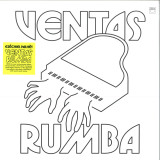
With his new instrumental album Ventas Rumba, the French composer (and singer) returns to his signature instrument, the piano, blending it with warm synth tones. This album represents a "return to his roots ", allowing Ezéchiel Pailhès to reinvent himself in a seamless way while still exploring ballads and ritornellos, halfway between light-heartedness and melancholy. Ezéchiel Pailhès has been meaning to write a solo piano album for as long as he can remember. Hardly surprising, of course, for this academically-trained pianist, brought up on classical music and then studied jazz. Yet, since his 2001 debut with the electro-pop duo Nôze, and his subsequent four albums, the artist had constantly postponed this project that was so close to his heart. Then in 2022, just as he was getting ready to start producing an album of new songs, this long-standing aim finally materialized.
The melodies he wrote seemed to stand on their own naturally, spurring him on to compose this series of fourteen tracks, recorded in sessions split between France and Latvia.
A new piano: the Una Corda
Ezéchiel wanted this project dedicated to the piano to begin a new narrative, to explore new instrumental terrain and new tones, something far removed from the familiar piano he has been playing all his life. He opted for the Una Corda piano, designed by David Klavins, a groundbreaking instrument builder renowned for his distinctive pianos with vertical shapes and frames.
The Una Corda, created in 2014, is an upright piano with a single string per note (unlike three strings on traditional pianos). Enticed by the "crystalline and unique" tones of this instrument, which is hard to find in France, Ezéchiel travelled to Kuldiga, Latvia (where David Klavins set up his workshops and studios), to record the first part of the album. Although the title of the album may initially conjure up images of a distant, sensual dance, the reality is quite different. Ventas Rumba indeed refers to the waterfall and rapids (in Latvian: rumba) of the river Ventas, which runs near this small village in the western part of the country. Ezéchiel chose to blur the lines, as the sound and musicality of the title likely evoke both his short stay in the Baltic country, and also a form of distant exotic imagery perfectly in tune with his own mischievous wit. Tracks as short stories
Back in France, Ezéchiel enhanced the first tracks recorded in Kuldiga with subtle synth tone layers, and added other tracks composed and recorded at his Montreuil studio. The album reflects a deliberate and sensitive orchestration of piano, synth keyboards and digital effects, as he puts it: "playing to erase the differences between the tones of the various instruments", as if each instrument's texture echoed the others. According to Ezéchiel, you can listen to Ventas Rumba as you would leaf through "a collection of short stories", through compositions that rarely exceed three minutes and evoke figures of movement, lightness, curves or modulation, such as "La ligne", "La valse des singes" or "Fly Finger". Others more seriously relate to a kind of spirituality, which quietly infuses such different tracks as "Ferveur", "Éclair" and "Louanges". Ezéchiel adds: “I’m by no means religious, but I like what God has managed to get musicians to achieve (laughs)". "Louanges", for instance, despite its electronic edge, "refers to Olivier Messiaen, a very devout composer who I greatly admire". Other tracks are directly inspired by the classical music he listens to on a daily basis. For example, Chopin's “8th Nocturne” formed the backdrop of “Pianovado”. Likewise, the harmonic structure of Beethoven's “Waldstein Sonata No. 21” inspired “Opus 53”. Aside from these multiple references and inspirations, which quickly recede behind a style that is uniquely his, Ezéchiel Pailhès keeps exploring ideas already found on his first solo albums, this time in an instrumental format, undoubtedly purer, fostering an imaginary world that evokes the shapes and themes of ballads, ritornellos, light-heartedness, passing time, reverie or a universal subdued melancholy.
Search:life s track
Church Andrews and Matt Davies weave intricate patterns from Fibonacci sequences on new mini-album, Yucca.
Producer and composer Church Andrews (aka Kirk Barley) and drummer Matt Davies return to explore the outer limits of rhythm on a six-track suite that is at once angular and fluid, natural and systematic. Drawn to the restrictions of working solely with one synth and live drums, the pair found creativity in limitation, developing a compositional dialogue between the sonic timbres of Kirk’s productions and Matt’s percussive practice.
Evoking the primitive yet complex form of the plant from which it takes its name, Yucca features tracks that are built around rhythmic ratios of the Fibonacci sequence. Mirroring spiral patterns exhibited in nature, each track evolves like a cellular structure of its own, from the livewire syntax of ‘Chirp’ and the deconstructed ebb and flow of ‘Ferns’, to the mini-album’s title track, where crisp grooves flit between modulated electronics like fireflies.
“I’ve always been inspired by music that is complex without sounding complex,” Matt explains. He maintains a sense of bounce amid the intricate phrasing and cites drummers Roy Haynes and his grandson Marcus Gilmore as inspirations, alongside sabar drummers from Senegal and Mridangam drumming of South India.
With a shared background in hip-hop and the swung beats of J Dilla and Flying Lotus, Kirk Barley and Matt Davies were also inspired by the minimalism of Terry Riley and the sparse palette of dub techno.
Written and recorded in Lewisham in the spring and summer of 2023, Yucca follows the release of Axis in 2022, with the duo having also performed at festivals such as Rewire and Waking Life, and recorded live sessions for FACT magazine and Worldwide FM.
The third release on Yorkshire-based Odda Recordings, following Kirk Barley’s Marionette and Flaer’s Preludes, Yucca confirms the label’s reputation for championing music on the unstable ground between the organic and the synthetic.
2024 Reissue
This is a very collectable EP within the breakbeat/hardcore scene with copies changing hands in excess of £350.00. Written by London born Mixmaster Max whose first step into public life was that of a breakdancer in the early 80’s when he was just a kid with a crew called The Back Street Warriors, showcasing his talents at the infamous Covent Garden jams of the same era. He then got into DJing and scratching and entered the DMC Championships and is credited as the inventor of the Topsy Turvey – stacking turntables on top of each other for a DJ routine!
As like many DJ’s around the late 80’s in London he gravitated out of hip hop and into the rave culture and from here he started to perform at many events such as Fantazia, The Pirate Club, Turnmills and the Hacienda in Manchester as well as a residency on a Friday night alongside John Saunderson - the General Manager of DMC - at Camden Palace. From his club work he started to play on the London pirates Kool FM and Centreforce and on legal stations Peoples Choice and Avenues FM.
These tracks are precursors to the soon to blossom jungle scene and highlight Max’s musical history with his creative sample play. You won’t find much more authentic hardcore than this EP, which really highlights the sound of London back in 1993.
- 140G schwarzes Vinyl inkl. 4-seitigem Booklet und Downloadkarte
Beth Gibbons veröffentlicht ihr erstes Soloalbum Lives Outgrown am Freitag, den 17. Mai 2024. Das Album enthält 10 wunderschöne neue Tracks, die über einen Zeitraum von 10 Jahren aufgenommen wurden. Produziert wurde das Album von James Ford & Beth Gibbons mit zusätzlicher Produktion von Lee Harris (Talk Talk).
Lives Outgrown ist in gewisser Weise Beths bisher persönlichstes Werk, das Ergebnis einer Periode anhaltender Reflexion und Veränderung - "viele Abschiede", wie Beth sagt. Abschiede von der Familie, von Freunden, sogar von ihrem früheren Ich. Es sind Lieder aus der Mitte des Lebens, wenn der Blick nach vorn nicht mehr so viel bringt wie früher und der Blick zurück plötzlich einen schärferen Fokus hat. Die Lieder handeln von Mutterschaft, Ängsten und den Wechseljahren (die Beth mal als "massive Prüfung" und mal als "massiven Abstieg" beschreibt, der "dich in die Knie zwingt") sowie zwangsläufig auch von der Sterblichkeit. Aber nach diesem Jahrze hnt des Wandels und der Neuausrichtung hat Beth das Gefühl, eine neue Bestimmung gefunden zu haben. "Jetzt, wo ich am anderen Ende angekommen bin, denke ich einfach, dass man mutig sein muss", sagt sie.
Göden’s second endeavor Vale of the Fallen out on 17th of May 2024 Göden is back, and on their latest album the sound is heavier than ever. Guitarist/Bassist Stephen Flam is best known for his previous work with the band Winter, whose sludgy dirge earned a cult following for years to come. Göden is the spiritual successor to Winter. One could say Celtic Frost is to Triptykon what Winter is to Göden. Their debut album, “Beyond Darkness” stood on its own in creating a distinctive world. Now, four years later, they explore new sonic territories with their second album, “Vale of the Fallen”. While "Beyond Darkness" was a concept album that propelled listeners into space, whether inner or outer, “Vale of the Fallen” brings us back to twisted reality. Their more in-your-face approach should only intensify the experience-much like a walk through a post-apocalyptic landscape in the bleakest imaginable conditions. Sound-wise, Stephen Flam's heavier-than-life riffs, Vas Kallas's sardonic delivery and Tony Pinnisi's keyboards create oppressive atmospheres atop Jason Frantz's powerful drumming, while Margaret Murphy’s violin weaves ghostly motifs. Like its predecessor, “Vale of the Fallen” features interludes which provide brief respites between some tracks, only to return to the crushing heaviness in yet another avalanche of sound. This might be your favorite album of 2024.
Black Vinyl[25,17 €]
Göden’s second endeavor Vale of the Fallen out on 17th of May 2024 Göden is back, and on their latest album the sound is heavier than ever. Guitarist/Bassist Stephen Flam is best known for his previous work with the band Winter, whose sludgy dirge earned a cult following for years to come. Göden is the spiritual successor to Winter. One could say Celtic Frost is to Triptykon what Winter is to Göden. Their debut album, “Beyond Darkness” stood on its own in creating a distinctive world. Now, four years later, they explore new sonic territories with their second album, “Vale of the Fallen”. While "Beyond Darkness" was a concept album that propelled listeners into space, whether inner or outer, “Vale of the Fallen” brings us back to twisted reality. Their more in-your-face approach should only intensify the experience-much like a walk through a post-apocalyptic landscape in the bleakest imaginable conditions. Sound-wise, Stephen Flam's heavier-than-life riffs, Vas Kallas's sardonic delivery and Tony Pinnisi's keyboards create oppressive atmospheres atop Jason Frantz's powerful drumming, while Margaret Murphy’s violin weaves ghostly motifs. Like its predecessor, “Vale of the Fallen” features interludes which provide brief respites between some tracks, only to return to the crushing heaviness in yet another avalanche of sound. This might be your favorite album of 2024.
Rund sechs Jahre nach ihrem Debütalbum kehrt die aufstrebende Symphonic Metal-Band ELVELLON mit ihrem zweiten Werk und Napalm Records-Debüt zurück: Ascending in Synergy enthält zehn brandneue Tracks der deutschen Symphonic Metal-Hoffnung.
Ascending in Synergy ist der Nachfolger des hochgelobten Erstwerks Until Dawn (2018), das auf die 2015 erschienene EP Spellbound folgte. Das offizielle Musikvideo zum Track „Born From Hope" zählt bis dato über 1,3 Millionen Aufrufe, die EP-Version des Songs wurde weit über 2,5 Millionen Mal auf Spotify gestreamt und im Metal Hammer wurden ELVELLON bereits als „Helden von morgen“ gefeiert. ELVELLON teilten die Bühne bereits mit bedeutenden Szene-Bands wie Visions of Atlantis, außerdem konnten sie ihre einnehmende Live-Präsenz auf zahlreichen Festivalbühnen im Inund Ausland unter Beweis stellen, wie etwa dem RockHarz, M'era Luna oder dem Rock Fest Barcelona.
Das neue Album Ascending in Synergy beweist das herausragende Feingefühl der Formation um Sängerin Nele Messerschmidt, stilistisch gekonnt zwischen den frühen Anfängen des Symphonic Metal auf der einen, und einem modernen, zeitgemäßen Ansatz auf der anderen Seite zu balancieren. Dabei vereinen sie beide Welten zu ihrem ganz eigenen, Sound, der sowohl Genre-Liebhaber als auch neue Fans in den Bann ziehen wird.
Inspired by the Buddhist sutras, Blitzen Trapper’s radiant new album, 100's of 1000's, Millions of Billions, offers a captivating take on rebirth and transcendence, navigating its way through the space beyond dreams and reality, beyond gods and mortals, beyond life and death. The songs here are as sincere as they are surreal, rooted in rich character studies and deep reflection, and the production is intoxicating to match, blending lo-fi intimacy and trippy psychedelia into a mesmerizing swirl of analog and electronic sounds. Add it all together and you’ve got a gorgeous collection of stripped-down bedroom folk wrapped in lush layers of synthesizers and washed out electric guitars, a poignant, expansive exploration of perception and purpose that manages to look both forwards and backwards all at once. This LP is pressed on clear blue vinyl and limited to 1,000 copies worldwide. Launched roughly two decades ago in Portland, OR, Blitzen Trapper broke out internationally with 2008’s Furr, which cemented their status at the forefront of the modern indie folk revival. Rolling Stone hailed the band’s “hazy, psychedelic Americana,” while NPR praised their “explosive live performances and infectious roots-rock swagger.” Dates with Fleet Foxes, Wilco, and Dawes followed, as did festival appearances at Bonnaroo, Lollapalooza, Newport Folk, and Coachella, among others. The band would go on to release six more similarly lauded studio albums, culminating with 2020’s Holy Smokes Future Jokes, which Mojo proclaimed “sounds like the Beatles at Big Pink.”
100's of 1000's, Millions of Billions by Blitzen Trapper, released 17 May 2024, includes the following tracks: "Cosmic Backseat Education", "Cheap Fantastical Takedown", "Planetarium", "Long Game" and more.
- Come In
- Older Than Before (Oswald Made No Way For Himself)
- Mio, Min Mio
- Sleep In While You're Doing Your Best
- My Sputnik Sweetheart
- Cut Lips
- Embarrassing Paintings (Agatha Showed Great Initiative In Art Class This Week)
- Water Dreamer The Same
- Painted Girl's Theme
- Агaтка (Agatha! You're Being Melodramatic)
- Porcelain Hands
- Darling Of Loving Vows
"Weatherday is the noise-pop project of the mononymous Swedish artist Sputnik. While they have also found success with their side project, Lola's Pocket PC, it is their cult-acclaimed album Come in that has garnered them a large and dedicated following through its raucous musical universe and serpentine sparklepunk stylings. Often heralded as an achievement of lo-fi bedroom pop tangled with threads of emo and DIY, Come in is better described, in its author's own words, as a 'life goal.
The initial spark that ignited the fiery, heated debut from Weatherday originated from Sputnik's desire to write, perform, and produce a record all on their own, from the ground up. Starting in 2014-2015, their preliminary attempts at what would eventually become Come in first materialized as a shoegaze EP, and then a dream-pop meets chamber-pop LP. Ever the perfectionist though, Sputnik wasn't satisfied with the results and deleted the releases without a trace, finally deciding to set out in the direction of something more akin to their longtime influences of emo and its various subgenres.
After two years of tinkering in this stylistic sweetspot, Sputnik settled on the eleven knotted, maximal tracks that comprise Come in. From the caustic, harsh peaks of 'Sleep in while you're doing your best' to the soothing piano-laden passages of 'Embarrassing paintings' and experimental, granular coda of 'Water dreamer the same,' the range of Weatherday's debut is doubtlessly a product of an artist who refuses to compromise a single shred of their vision."
Genre-defying Dutch death metal legends Pestilence have singled-out and re-recorded twelve emblematic anthems from across their 38-year career into "Levels of Perception". Patrick Mameli - whose signature vocal, guitar and songwriting skills constitute the hallmark of Pestilence - finds "Levels of Perception" to be a testament to the band's role in death metal's progression. Re-recording of the tracks has not only managed to breathe new life into them - half thanks to new line- up, and other half by implementing subtle changes which reflect Mameli's matured vision and refined with years of experience aesthetic - but also sets them apart from cheap, unimaginative compilations, by unifying the album's sound as befits a full-length release. "I've always wanted to do a best-of album, because it would mean that I've achieved something in the past; something that still has its value today," Mameli comments. "To be able to choose from songs that I composed in the distant past, transporting them into the now, with the line-up of the recordings that consisted of Michiel van der Plicht (drums), Rutger van Noordenburg (guitar) and Joost van der Graaf (bass) - I found this to be of great value and sheer awesomeness."
Inspired by the Buddhist sutras, Blitzen Trapper’s radiant new album, 100's of 1000's, Millions of Billions, offers a captivating take on rebirth and transcendence, navigating its way through the space beyond dreams and reality, beyond gods and mortals, beyond life and death. The songs here are as sincere as they are surreal, rooted in rich character studies and deep reflection, and the production is intoxicating to match, blending lo-fi intimacy and trippy psychedelia into a mesmerizing swirl of analog and electronic sounds. Add it all together and you’ve got a gorgeous collection of stripped-down bedroom folk wrapped in lush layers of synthesizers and washed out electric guitars, a poignant, expansive exploration of perception and purpose that manages to look both forwards and backwards all at once. This LP is pressed on clear blue vinyl and limited to 1,000 copies worldwide. Launched roughly two decades ago in Portland, OR, Blitzen Trapper broke out internationally with 2008’s Furr, which cemented their status at the forefront of the modern indie folk revival. Rolling Stone hailed the band’s “hazy, psychedelic Americana,” while NPR praised their “explosive live performances and infectious roots-rock swagger.” Dates with Fleet Foxes, Wilco, and Dawes followed, as did festival appearances at Bonnaroo, Lollapalooza, Newport Folk, and Coachella, among others. The band would go on to release six more similarly lauded studio albums, culminating with 2020’s Holy Smokes Future Jokes, which Mojo proclaimed “sounds like the Beatles at Big Pink.”
100's of 1000's, Millions of Billions by Blitzen Trapper, released 17 May 2024, includes the following tracks: "Cosmic Backseat Education", "Cheap Fantastical Takedown", "Planetarium", "Long Game" and more.
Repress!
THE M.V.P.'s burst into life on the Northern Soul scene back in 1975 courtesy of Blackpool Mecca DJ Ian Levine and has long since divided opinion. Is it pop, is it soul, are they black, are they white, etc etc. Well, it's a rock record from 1971 and has nothing to do with soul... but everything to do with Northern Soul! It packed the floor at the Highland Room and was adopted as a Wigan Casino anthem and immortalized by Tony Palmer in his 1977 Granada TV documentary This England. It was reissued by UK Buddah, due to popular demand, driven in no small part by the TV show and its 20 million viewers. Now, some 40 years on, we present the iconic track, both stereo and mono mixes, as mastered at the time by Bell Sound's senior engineer Joe Breschie.
SALES POINTS:
All time Northern Soul Classics - Two fabulous sides
Massive appeal to ALL Northern Soul fans
As featured in the film Northern Soul
Bruno Berle, the young songwriter and poet originally hailing from Maceió, the capital of Brazil’s Alagoas state, crafts songs that are simple, direct, and full of tender nuance. With his first album No Reino Dos Afetos (which translates to "In the Realm of Affections” and was released in 2022), Berle firmly established himself as a unique and important voice in the burgeoning scene of new Brazilian artists making a global impact, including peers like Ana Frango Elétrico, Tim Bernardes, Bala Desejo, Sessa and more. Now back with his second album, No Reino Dos Afetos 2, he stretches that further.
Bruno Berle’s music lives between two worlds – a traditional Brazilian folk talent steeped in history, and a contemporary, dreamy electronic pop; the result is songwriting that’s genre-bending, intentional, iconoclastic and consuming, spacious and sinewy and singular, a striking reflection of its composer while leaving space for the listener to settle in. The album follows Bruno’s relocation to São Paulo, and the songs are a reflection of his past and present. A rebuke of former categorizations of his work in Brazilian music scenes, and an idea of where his music can move, unfettered.
Berle’s music is purposeful in being a true portrait of himself, and a reflection of the music, art, and fashion scenes he personally moves through. Berle aims to provide an entrypoint for Black queer joy in his music, in his storytelling, in his presence and vision as a creative. For him, it feels subversive to be playing MPB laced with dubstep and lo-fi, a sort of intentional sacrilege, capturing a dialogue of modernity in traditional music.
Berle wrote most of the arrangements and co-produced his new album, Reino Dos Afetos 2 with longtime friend and musical partner Batata Boy, who is also from Maceió; the album was recorded in Rio de Janeiro, Maceió, and São Paulo, his new home, and picks up the conversation begun in 2022 on Berle’s debut album No Reino dos Afetos. Both records are the result of a nonlinear but coherent seven-year music creation process culminating in these albums, holding hands across space and time.
“Tirolirole,” the first single from the record, was released at the end of 2023; sun-soaked rhythms and soft voice coat the song, the lilting refrain of “Tirolirole” throughout – hushed, gentle, but somehow almost tactile, a golden-hour moment unlocked in the mind. “Tirolirole” is a triumphant future classic about the temporality of a blossoming love, with Bruno’s stunning vocal soaring over melodies which ebb and flow like the waters on the Atlantic shore. Of the track, Berle explains: “Despite ‘Tirolirole’ being an expression that evokes my childhood, just like the light words about nature, the harmony, and the poetry are epic, carrying a great hope for love.”
In fact, the guiding theme of No Reino dos Afetos 2 is a relationship, unfolding in the arc of a weekend. It traverses the innocence of an early young love, how that can be formative, can stretch on to take new shapes, or shape you. The album happens at the genesis of meeting someone and falling for them, before the relationship is thrown into overdrive – set in a big city, against a backdrop of major life changes, rising energy, the sound of São Paulo.
Something transcendental emerges in “Dizer Adeus,” with an arrangement that echoes a gospel atmosphere (evangelical and Catholic environments were pivotal to Berle’s upbringing). On “É Só Você Chegar,” piano and flute gracefully intertwine, a dance, while “Quando Penso” skews sparser, the voice-and-guitar minimalism somehow cultivating an entirely different shape – somehow both cozy and melancholy, with the background sound of a rainy day. Coupled with the lo-fi aspects that shape much of the album’s personality in the vocals and the production, No Reino Dos Afetos 2 is meticulously elaborated by Berle’s sonic alchemy, like on the mid-album instrumental “Sonho,” which feels like floating. “It’s the apex. It’s when lovers are sleeping together,” Berle explains of the feeling he wanted to encapsulate in the song.
On “Love Comes Back” Berle interprets Arthur Russell, the late Iowa musician who only reached greater visibility after he died in 1992. “His way of making music is similar to mine,” Berle explains. “He sings in a more fragile way, has more of an experimental way of recording, letting ‘chance’ appear in the final work.”
Even so, Berle doesn’t want his music to be buried in sentimentality – and the purposefulness of his craft serves as a sort of north star. The production, the arrangements, his restraint and intentionality in crafting his songs feel just as vital as their emotional cores. His songwriting is amorphous, fluid, an encompassing genre-bending movement in-and-of-itself, quietly daring. The songs are often in conversation with other works – drinking in fountains as diverse as the filmmaking of Ingmar Bergman, the poetry of Walt Whitman, the rhythm of Djavan, and the painting of Maxwell Alexandre. Musically he weaves together a rich tapestry of Brazilian folk, UK 2-step garage/dub, trip hop and sun soaked west coast songwriters; something akin to the worlds of Milton Nascimento, Arthur Russell, James Blake, Feist, and Sade colliding into one. But even then No Reino Dos Afetos 2 floats separately, a romanticism driven by a simplicity and intimacy, an open-ended possibility, Berle’s singularity as an artist at the helm of the ship.
It's the one all the massive have been waiting for! Part 2 of the Salford sage - DJ Absolutely Shit's 'Memoirs Of A Crust Monster'. More hyped up tear outs, soundsystem ruffage, and bass 'n breaks love songs from our Hell's Angel-dodging beat freak.
Kicking things off with glowing neons and super-charged subs is 'Higher', a modern jungle monster decorated with classic hip-hop samples and a well known diva vox squealing through the melee.
A serious 'watch your bassbins' track - RL HQ have safety tested this on the most robust car stereo systems and so far have yet to avoid any cabinet damage - proceed with caution!
'Lost In Space' rolls outta the speaker stacks with a b-boy swagger and loose breaks. A tribute to classic breakdance electro galvanized with Ab Shit's intricate trademark production chops. You'll want to crack out your finest red Puma classics and a slick tracksuit for this one.
Onto 'Out On Love' and between you and me, someone needs to call the social service for samples - as it's unlikely you'll ever witness a more blatant case of sample molestation. Squeezing every last drop out of a catchy piano lick, TV snippet and drum break; the track really does highlight the unrivaled programming prowess of our Irlam renegade who's taken SP1000 trickery to its absolute zenith.
'Money Talks' sees our cheeky ragamuffin dictate a life affirming sunrise over Pomona - pre-gentrification of course; a thousand smiles and memories of old Mancunia shimmering in the early morning industrial haze. And an abject slight at those who put profits above people - another poignant ode to our changing cityscape driven by the most addictive boogie-based groove and clattering Linn drums.
Spine-tingles and fanny flutters guaranteed ALL DAY on this one cru!
Look out for the full 16 track album due on C90 cassette and digi download coming very soon...
RL x
Both Tymon Dogg and Richard Dudanski had musical roots playing in The 101'ers with future Clash singer/guitarist Joe Strummer. All three shared a deep love for southern Spain, due perhaps to the influence of the Romero sisters, Paloma (later "Palmolive" of The Slits) and the artist Esperanza, who were among the first Spanish punk refugees in London. Tymon's career began with beguiling interactions with Apple Records, The Moody Blues and future Led Zeppelin members John Paul Jones and Jimmy Page before he discovered his true musical self as a punk / folk experimentalist, opening shows for the likes of The Slits, Raincoats and Pop Group and becoming the longest-running musical foil in Strummer's career, continuing into The Clash and Mescaleros. Similarly, Richard played in Basement 5, Public Image Ltd, The Raincoats and others before following Esperanza back to Granada...which subsequently became second home to Tymon and Joe. Spain is not without its own punk heroes, and chief among them was Granada's Antonio Arias, another pal of Joe's and leader of Spain's musical heroes, Lagartija Nick, which also included Dacoits members Juan Codorniu and JJ Machuca. Antonio sings the albums two Spanish-language songs. while Tymon sings the other nine...and there's an instrumental, "Mongols", which the band considered too epic as a stand-alone instrumental to mess with! Tymon sings three songs from his past: "The Wheel Of Life And Death" has been heard before as a live bonus track on the expanded reissue of "Battle Of Wills", "Conscience Money" was heard in a very different version on the impossible-to-find "Made Of Light" album, and an embryonic take of "Something To Prove" turned up the even rarer 1989 solo album, "Relentless". If you imagine the playful elasticity of "Sandinista!" recast into a more straightforward record, with Tymon taking the lead on something more than that album's "Lose This Skin", you're halfway there. Guests include Killing Joke bassist / famed producer Youth and Dr Robert from The Blow Monkeys
Maximilian Skiba, an Eminent Figure in the World of Electronic Music, Makes a Triumphant Return to Skylax After an Absence Spanning Over a Decade. His Resurgence Is Nothing Short of Exceptional, as He Joins Forces With the Legendary Snax to Deliver a Musical Offering That Rekindles the Very Essence of House Music's Illustrious origins.
Skiba's Two New Tracks, "Pushing My Buttons" and "In Motion," Serve as a Compelling Testament to His Impeccable Craftsmanship as a Producer. the Influence of the Pioneering triumvirate—Larry Levan, Ron Hardy, and Frankie Knuckles—is Palpable Within These Compositions. Both Tracks Are a Masterful Blend of Nostalgia and Innovation, Perfectly Aligning With the Playlists That Once Defined the Heyday of House Music's Most Celebrated luminaries.
"Pushing My Buttons" and "In Motion" Evoke an Air of Sophistication, Exuding a Smooth, Velvety Quality That Transports Listeners to the Cherished Era of Original Disco. Drawing Parallels to the Timeless Classics Like Dinosaur’s "Kiss Me Again" or Loose Joints "Is It All Over My Face", Skiba's Creations Pay Homage to the Bygone Era While Injecting a Modern Edge. This Phenomenal Ep Goes Beyond Skiba's Original Works, Offering Two Exceptional Remixes That Elevate the Experience. the First Remix, a Balearic Interpretation by the Emerging Talent Maltitz, Adds a Refreshing Dimension to the Tracks. the Second Remix, Helmed by the Skilled Apollon Telefax, Ingeniously Transforms the Already-Classic Tunes Into an Explosive Italo-Disco Sensation. These Remixes Seamlessly Weave Together the Past and the Present, Creating a Bridge Between Different Eras While Keeping the Music timeless.
In Essence, This Ep Is Not Just a Musical Offering; It's a Journey—a Seamless Fusion of History and Innovation That Transports the Listener to an Era of Musical Brilliance, All the While Redefining the Boundaries of Contemporary Sound. Skiba and Snax's Collaboration Is Not Merely a Comeback; It's a Testament to the Enduring Legacy of Electronic Music, Encapsulating the Spirit of House Music's Golden Age While Breathing New Life Into Its Timeless Allure....
After several successful singles, Ella’s only Sound Stage 7 release was recorded at Music City Recorders in Nashville, Tennessee. The self-titled LP is all classic, no filler and surely ranks among the deepest soul in her catalogue. Full of strong ballads that showcase her raw and emotive style each song is perfectly arranged to showcase Ella's powerful vocals. Standout tracks include ‘Sit Down and Cry’, ‘All The Time’, and ‘ Stop Giving Your Man Away’. The LP also features Ella’s 1969 hit ‘He Called Me Baby’ which entered the top 40 R&B charts and garnered a Grammy nomination. Newly remastered and pressed on audiophile virgin vinyl. Limited to only 500 copies.