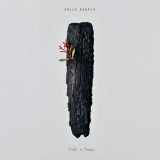
Pieces of debris washed up on a coastline shrouded in mist. Gratification comes from an eternal search for solace. Locked away at the top of a lighthouse somewhere on an unnamed isle, Grady Steele broadcasts to those within the beacon’s reach. A soundsystem built of driftwood and salvaged car stereos is pieced together with precision and laboriously dragged to the top of the obelisk. A timeless fugue state spent playing arpeggios on a Spanish guitar, the PA system ebbing out phasing loops across benevolent waters. Layering, occasionally faulting, stopping, recording, starting again. The phosphorescent glow atop the obelisk is ever-present.
Perhaps the first release on Archaic Vaults to feature (at least prominent) use of the guitar, these six compositions feel sketch-like and yet burned into the retina, like that of a passing car’s headlights leaving an impressionistic imprint of the source material. To mention this is Grady Steele’s debut release is not to imply he is new to working with sound, having been the proprietor of one of London’s most important soundsystems for the last decade. An obsession with fidelity can be heard and and at times deliberately perverted amongst the body of work. The warm and melancholic tones of the Spanish guitar evident in almost all songs are juxtaposed with various collaged material, including what sounds like hastily captured iPhone recordings and drum machines neglected at the back of the studio, dragged out for one or two stubborn, lurching takes and then once more committed to storage. The 90s voice-imitator pads glowing with undulance are reminiscent of John T. Gast’s early studio takes, and the synergy and precision in guitar layering could lend a clue as to what Fuck Buttons would have sounded like had they sold off their studio equipment for a couple of wooden 12-stringers. Stare long enough at those Windows 95 screensaver-esque rolling hills, and one might witness some miniscule movement in the growth.
Music composed and arranged by Grady Steele Painting by Antoine Larrera Mastered by Owen Pratt Design by Severin Black
Поиск:like a tim
Все
Sonic Behavior by Driftmachine & Ammer is an album exploring the origins of sound, noise, and various music genres. Alongside lyrical declarations of love for noise ("Song To Noise"), the album delves into sonic reflections on how beauty and emotion emerge from mundane vibrations in the air ("The Siren Is A Simple Device"). For the first time, the analog sound researchers of Driftmachine (Andreas Gerth, Florian Zimmer) incorporate spoken language and noise into their sound research. They have collaborated with word and sound artist Andreas Ammer, renowned for his radio plays with Acid Pauli, aka Console ("Spaceman 85"), or FM Einheit ("Radio Inferno," "Symphony of Sirens").
In "The Siren Is A Simple Device," the words are spoken by 81-year-old musician and poet legend Ted Milton (Blurt, Loopspool). Despite its simplicity and obvious ability to produce high volumes, the siren has led a marginal existence as a musical instrument. Yet, it is capable of evoking the most intense emotional states in the listener in the shortest possible time, like almost no other sound-producing mechanism. "Sonic Behavior" capitalizes on this fact. The familiar hypnotic sounds of Driftmachine are accompanied by a siren organ inspired by the revolutionary Russian futurist Arsenij Avranov and built by Andreas Ammer, while the lyrics talk about the simple physical reasons behind the sound chaos that has just been unleashed: A siren ... chops the air into sound.
The core of the album is "Song To Noise," an electro-acoustic mini-symphony about the beauties of noise and all its producers, which is based on a poem by the British poet Deryn Rees-Jones and spoken by the poet herself and Alexander Hacke (Einstürzende Neubauten, Hackedepicciotto). Driftmachine & Ammer develop a soundtrack that is as powerful as it is loud and danceable (which is why the LP also includes a textless version of the composition).
"Sonic Sculpture" is the zenith of the work: a text/music track spoken by Ted Milton, which creates the possibility of a sound sculpture that encompasses the universe: What if one could imagine the infernal sound that encompasses all conceivable harmonies at the same time? A piano does when you throw it down an earthly staircase (the epitome of music is a piano falling down the stairs) through silent space to the next theoretically life-filled, Earth-like planet, Proxima Centauri B. The radio makes it possible. Driftmachine & Ammer tried it. The result will be heard there in 4.24 light-years. On planet Earth, the time has come on May 2, 2024. On this day, Sonic Behavior will be released, a conceptual album by Driftmachine & Ammer exploring sound, its creation, and its power.
Today, the Toronto-born-and-raised singer, songwriter, producer, and multi-instrumentalist Charlotte Day Wilson announces her highly-anticipated sophomore album Cyan Blue out May 3rd via Stone Woman Music / XL Recordings Along with the announcement of her new album comes the release of first single, "I Don"t Love You", a stark and devastatingly beautiful confessional, highlighting Wilson"s immaculate production skills and chill inducing vocals laid atop smooth groove piano chords and soft drums. The track also arrives with a visual directed by Dani Aphrodite featuring layered low fi footage of the artist and producer performing at home, living every day life and having moments of solitude in her car, a theme that comes up throughout the album. Cyan Blue finds Wilson crafting a smoothly woven cyan tapestry of her eternal influences; thumping gospel piano, warm soul basslines, atmospheric electronics, and penetrating R&B melodies. Yet, it possesses a sense of vastness that rings in a new era for Wilson, one in which she"s embracing collaboration and newfound creative openness tinged with wistfulness and yearning and a reflection on youthful innocence. "I want to look through the unjaded eyes of my younger self again," Wilson explains of making Cyan Blue. "Before there wasn"t as much baggage, before so much life was lived. But I also wish that my younger self could see where I am now. It would be nice to be able to impart some of the wisdom and clarity that I have now onto her." Working with producers like Leon Thomas (SZA, Ariana Grande, Post Malone), and Jack Rochon (HE.R, Daniel Caesar), Cyan Blue demonstrates Wilson"s sonic expertise while also showcasing the next evolution of her time-bending songwriting. Through 13 hypnotizing tracks, she continues to use music as a vessel for unpacking relationships, which in turn allows her to meet and understand herself in life-spanning, panoramic focus. But, on Cyan Blue, she challenged herself to kick her perfectionist tendencies. "Before, I was extremely intentional about creating music with a strong foundation, a bed of artistic integrity," Wilson reflects. "But that was a bit stifling, like, "Let me just make a great piece of art that will stand the test of time, no pressure." Now, I think I"m getting out of this frozen state of needing everything to be perfect. I"m more interested in capturing feelings in the moment as they happen and leaving them in that moment." While this is only her second album, Wilson"s influence in music has made a major mainstream impact. Wilson broke out in 2016 with her critically acclaimed EP, CDW, followed by 2018"s Stone Woman and made her debut studio album an official coming out moment in 2021 with the critically acclaimed, self-released Alpha. Over the past decade, she"s been sampled by Drake, John Mayer, and James Blake, while Patti Smith has recently praised and covered Wilson"s 2016 breakout single "Work." Additionally, she"s collaborated with artists like Kaytranada, BADBADNOTGOOD, and SG Lewis, demonstrating that there"s no sound Wilson can"t adapt to and sprinkle her cyan-colored magic over.
- Adouma
- Nothing At All (Ft. Musiq)
- The Game Of Love (Ft. Michelle Branch)
- You Are My Kind (Ft. Seal)
- Amore (Sexo) (Ft. Macy Gray)
- Foo Foo
- Victory Is Won
- America (Ft. P.o.d.)
- Sideways (Ft. Citizen Cope)
- Why Don T You & I (Ft. Chad Kroeger)
- Feels Like Fire (Ft. Dido)
- Let Me Love You Tonight
- Aye Aye Aye
- Hoy Es Adios (Ft. Alejandro Lerner)
- One Of These Days (Ft. Ozomatli)
- Novus (Ft. Placido Domingo)
"Carlos Santana’s nineteenth studio album Shaman was released in 2002 and debuted at #1 on the Billboard 200. Just like its predecessor Supernatural, Santana invited contemporary artists to collaborate with him across genres including neo-soul, pop, rock, metal, and opera. Artists such as Seal, P.O.D., Chad Kroeger, Dido, Michelle Branch, Macy Gray, Music, Citizen Cope, Alejandro Lerner, Plácido Domingos, and Ozomatli can be heard on the album. Four tracks were released as singles: “The Game Of Love”, “Nothing At All”, “Why Don’t You & I”, and “Feels Like Fire”. Shaman is being reissued for the first time since its original release. A limited edition is available of 2000 individually numbered copies on translucent purple coloured vinyl and includes an insert."
Shaman by Santana, released 3 May 2024, includes the following tracks: "The Game Of Love (ft. Michelle Branch)", "Amoré (Sexo) (ft. Macy Gray)", "Victory Is Won" and more.
This version of Shaman comes as a 2xLP. This release comes with (a) Insert(s).
The vinyl is pressed as a translucent, purple disc. Another vinyl is pressed as a translucent, purple disc.
The opening line of Emily Dickinson’s short poem ‘‘Hope’ is the thing with feathers’ inspired the central image of Emily Barker’s new single ‘Feathered Thing’, written while she navigated cumulative grief.
When Barker was first introduced to producer Luke Potashnick (Gabrielle Aplin, Jack Savoretti, Katie Melua) in May 2022, she brought with her a full album’s worth of songs. But after visiting Potashnick’s storied studio, The Wool Hall and hearing his ambitious production ideas, she was inspired to write one more song.
“I also needed to process some heavy news” she comments. Barker and her husband Lukas Drinkwater had been trying to start a family. Following a couple of failed IVF cycles (and other “starts that we’d lost”), they investigated adoption and had decided to relocate to Australia to be closer to Barker’s family.
“It felt like we couldn’t work out what we wanted, but we finally reached a point where we both felt at peace with not having kids,” Barker recalls. “It had been an incredibly intense time, coinciding with a house move and the pandemic.”
And then Barker found she was pregnant. “We’d done all these things to try to make it happen, and then it happened naturally (and against all biological odds). Having previously navigated losses throughout our pregnancy journey, we now had to get our heads around what having this new person in our lives might look like - emotionally and practically.”
Soon after work began on the album, Barker had a miscarriage.
“Songwriting has always been a way of processing throughout my life.” Barker reveals how the new song came quickly as she sat at her piano at home. She shared an early version with Potashnick and remembers him politely asking, “Do you mind telling me what this is about?”
“I think I’d left it too abstract, initially,” she reflects. “It was difficult to open up about the miscarriage, but Luke was very supportive and encouraged me to dig a little deeper without necessarily being specific. I revisited the lyrics, and the result is much stronger.”
“I went to the burnt-out woods/ A tourist with some damaged goods/ Remembered how the trees withstood fires before…”
“The opening line is a metaphor for knowing that I’ll get through this,” Barker clarifies. “It’s about recovery and hope, allowing yourself both the space to grieve and permission to move on”. But Barker’s optimism is never misplaced – she knows the imprint of imagined futures and lost children are carried in hearts and minds forever:
“It’s so hard to let go, wanted to know wanted to know you …”
“I think that it's important to share and normalise these stories, which are all too common, yet not openly spoken about. People hide their pain and don’t want to burden friends and family. I think behind all this anguish, there’s a deep, often untold story.”
Now that Barker is settled back in Western Australia, she’s embracing being an auntie. “I’ve got three younger siblings over here who I’m close to, and they all have kids,” she enthuses. “I look after my brother's kids, aged two and five, one morning a week.”
Recorded - along with the entirety of the new album - at The Wool Hall, ‘Feathered Thing’ begins gently, with oscillating piano and distant drums, until the arrangement gradually transforms into an instrumental dervish of vibrant strings, bass drones and cymbal crashes. Throughout, Barker’s vocals float tantalisingly like a slipstreaming feather.
Watch the video, filmed at The Wool Hall here. The Wool Hall is a studio in Beckington, Somerset, set up by Tears for Fears in the 1980s and used by artists including The Smiths, Pretenders, Joni Mitchell and many more.
Emily Barker is an award-winning singer-songwriter, best known as the writer and performer of the theme to the hugely successful BBC crime drama ‘Wallander’ starring Kenneth Branagh.
Her last album, 2020's ‘A Dark Murmuration of Words’, was produced by Greg Freeman and recorded at StudiOwz, a converted chapel in the Welsh countryside. Lyrically probing, by turns both dark and optimistic, Barker searches for meaning through the deafening clamour of fake news and algorithmically filtered conversation, delivering a timely exploration of the grand themes of our age. It garnered widespread acclaim, with Uncut calling it “…a kind of Australian equivalent of PJ Harvey’s Let England Shake”.
Barker has released music and toured as a solo artist as well as with various bands and collaborations, most notably her long association with Frank Turner, and has written for TV and film, including composing the soundtrack for Jake Gavin’s lauded debut feature ‘Hector’ starring Peter Mullan and Keith Allen.
‘Fragile as Humans’ is scheduled for release on May 3rd 2024 through Everyone Sang/Kartel Music Group. The album will also feature earlier singles: the vast, cinematic ‘Wild to be Sharing This Moment’ and the meditative, crestfallen ‘Loneliness’.
Nourished By Time follows up his 2023 critically-acclaimed, breakout album Erotic Probiotic 2 with his debut EP on XL Recordings: Catching Chickens, set for physical release on May 3rd. Written between 2022 - 2023 in his home studio in Baltimore, and along his world travels this past year, Catching Chickens is derived from the film Rocky, and the iconic scene in which Rocky’s trainer makes him chase and catch a flock of chickens as a test of agility. With tracks like “Hell of a Ride,” in which Nourished By Time contemplates the fall of the American empire and late-stage capitalism loneliness, and “Hand on Me,” which traces the paranoia from distrust in a post-traumatic world, Nourished By Time chronicles his own test of agility as he weaves through the motions of his newfound notability.
Culled from three 1985 gigs in the UK during a transitional and transcendent time in the band's story, Sonic Youth's `Walls Have Ears' appeared as a 2LP set in 1986, not just a live album but an artful tapestry full of live experimentation with songs, between-song tape segues, darkness, humor and audio verité on par with elements of side B of `Master Dik' to come later. With a bit of complexity to the situation of the release itself. But that's a different story. Deleted as quickly as it appeared then, it's now issued for the first time officially under the band's auspices. In this 2LP set brimming with primitive classics like "The Burning Spear", "I Love Her All The Time", "Death Valley 69" and "I'm Insane" (uncredited on sleeve), segues and live guitar changes ooze together threaded by Madonna tapes and vocal loops off the board. The first two sides of `Walls' are massive, cavernous, with newly-drafted drummer Steve Shelley in tow taking on past tunes and unveiling "Expressway To Yr Skull" in glorious form. They tear it up especially on one trash-fi excerpt of "Blood On Brighton Beach" (actually "Making the Nature Scene") from a legendary outdoor gig November 8th where Moore, Gordon and Ranaldo's guitars treble-blast dissonant shockwaves over the black-stoned beach of Quadrophenia fame. The record's second slab spotlights an April 1985 pre-Shelley gig supporting Nick Cave at London's Hammersmith Palais and was one of the final appearances live of Bob Bert, again featuring some molten takes on "Brother James", "Kill Yr Idols", "Flower" (Iisted as "The Word (E.V.O.L.)"), "Ghost Bitch" and others. The emergence of the Jesus and Mary Chain in the world gave Brit scribes a lazy and easy parallel, addressed here with a wink with the inclusion of "Speed JAMC", another offstage tape interlude playfully scrolling through one of that band's songs at fast-forward. This document remains an essential representation of some lean and mean years of the quartet's throttling march out into the world in the mid eighties. Coloured vinyl, one red, one yellow LP.
- 1: Freda Payne - Band Of Gold (Single Mix)
- 2: Chairmen Of The Board - Give Me Just A Little More Time
- 3: Flaming Ember - Westbound #9
- 4: Silent Majority - Frightened Girl
- 5: Chairmen Of The Board - You've Got Me Dangling On A String
- 6: Honey Cone - Girls It Ain't Easy
- 7: Chairmen Of The Board - Pay To The Piper
- 1: Chairmen Of The Board - Everything's Tuesday
- 2: Freda Payne - Unhooked Generation
- 3: Glass House - Crumbs Off The Table
- 4: Chairmen Of The Board - All We Need Is Understanding
- 5: Freda Payne - Deeper And Deeper
- 6: 100 Proof Aged In Soul - Somebody's Been Sleeping
- 7: Honey Cone - Want Ads
- 1: Freda Payne - Bring The Boys Home
- 2: Barrino Brothers - I Shall Not Be Moved
- 3: 8Th Day - You've Got To Crawl (Before You Walk)
- 4: Lucifer - Don't You (Think The Times A-Comin')
- 5: Honey Cone - Sunday Morning People
- 6: Glass House – I Surrendered
- 1: Freda Payne - You Brought The Joy
- 2: General Johnson - I'm In Love Darling
- 3: Chairmen Of The Board - Working On A Building Of Love
- 4: Honey Cone - Stick Up
- 7: 8Th Day – Eeny-Meeny-Miny Mo
- 1: Holland-Dozier Featuring Lamont Dozier - Why Can't We Be Lovers
- 2: Chairmen Of The Board - Elmo James
- 3: Silent Majority - Something New About You
- 4: Barrino Brothers - Try It, You'll Like It
- 5: Danny Woods - Let Me Ride
- 6: Glass House - Thanks I Needed That
- 7: Laura Lee - Crumbs Off The Table
- 1: Warlock - You've Been My Rock
- 2: Laura Lee - Woman's Love Rights
- 3: Holland-Dozier Ft Brain Holland - Don't Leave Me Starvin’ For Your Love
- 4: The Politicians - Free Your Mind
- 5: Harrison Kennedy - Sunday Morning People
- 6: Satisfaction Unlimited - Let's Change The Subject
- 7: 100 Proof Aged In Soul - Nothing Sweeter Than Love
- 1: Eloise Laws - Love Factory
- 2: Freda Payne - We've Got To Find A Way Back To Love
- 3: Brian Holland - I'm So Glad Pt.1
- 4: Honey Cone - If I Can’t Fly
- 5: Tyrone Edwards - Can't Get Enough Of You
- 6: Chairmen Of The Board - Skin I'm In
- 7: New York Port Authority - I Got It Pt. 1
- 1: Chairmen Of The Board - Finders Keepers
- 2: Hi-Lites - That’s Love
- 3: Freda Payne - Two Wrongs Don't Make A Right
- 4: Holland-Dozier Featuring Lamont Dozier - New Breed Kinda Woman
- 5: 8Th Day - She's Not Just Another Woman (Single Mix)
- 5: Eloise Laws - Put A Little Love Into It (When You Do It)
- 6: Melvin Davis - You Made Me Over
- 7: Honey Cone Featuring Sharon Cash – Somebody Is Always Messing Up A Good Thing
- 6: Flaming Ember - Gotta Get Away
Holland, Dozier and Holland are arguably the greatest songwriters ever. More prolific than Lennon and McCartney, they shaped “the Sound of Young America” and propelled the Motown sound in the mid-1960s into a creative stratosphere unmatched by any other independent music label. Their trademark catchy teenage love songs were delivered energetically by previously unknown Detroit groups like The Supremes, the Four Tops, Martha & the Vandellas & Marvin Gaye. Although synonymous with Berry Gordy’s Motown, it was their departure from Motown after a stand-off strike in 1967 and a brutal legal battle that led them to run their own group of labels, Invictus, Hot Wax and Music Merchant. This compilation is a definitive look at this period in history, exploring how H-D-H, under a new guise ‘The Creative Corporation’, drove the next generation of soul music in a myriad of different ways, towards funk, underground disco and jazz. Featuring 55 tracks, this collection documents HDH’s creativity and growth over this seminal 8 year period. During this time the trio developed new artists to rival Motown’s success such as Chairman Of The Board, Freda Payne, Honey Cone, Glass House, Flaming Ember, 8th Day, Laura Lee & Eloise Laws. The collection is complete with a detailed depiction of this period in history by award winning author Stuart Cosgrove who wrote the Soul Trilogy, a series of books on soul music and social change - Detroit 67: the Year That Changed Soul, Memphis 68: The Tragedy of Southern Soul which won the Penderyn Prize, as Music Book of the Year in 2018, and Harlem 69: the Future of Soul. Stuart’s notes detail the relationship with Motown in the final days, the immediate fall out after the trio left Motown and the creation of the new labels Hot Wax, Invictus & Music Merchant
Ice Cream Vinyl
Since the release of their debut studio album Do Hollywood (on 4AD) in 2016, The Lemon Twigs_the New York City rock band fronted by brothers Brian (27) and Michael D'Addario (25)_have waved the same revivalist torch as Alex Chilton and his Big Star crew, working to prove that archaic music from the `60s and `70s can still be relevant in digital world. Alongside peers like Foxygen and Drugdealer, The Lemon Twigs have explicitly documented a synchronistic blend of contemporary narrative motifs, old-school recording techniques, and flawless, consistent attitudes collaged from various crucial stages of rock 'n' roll. After a whirlwind 2023, the D'Addarios are continuing the momentum of their own evolving vision and voice, distilling a history lesson of baroque and power pop into A Dream Is All We Know (out May 3 on Captured Tracks). Garnering the top-to-bottom critical acclaim the brothers have long deserved, their 2023 LP Everything Harmony was spearheaded by an impressive string of singles, including "Corner Of My Eye" and "Any Time of Day." It was the kind of record that put all of Brian and Michael's talents on display, be it the former's multi-instrumentalist gifts or the latter's boyish, explosive pop-rock charisma and eye for engineering and vocal layering. But A Dream Is All We Know is not the acoustic, nylon string-based project that Everything Harmony was. Instead, it's a return to the form the Lemon Twigs first introduced on Do Hollywood_an electric guitar-centric, anthemic assemblage of, really, everything the band does great. These two companion records are an immediate example of a band capitalizing on their fire-in-the-belly appetite to make tunes that boast ubiquitous chemistry. A Dream Is All We Know is grandiose yet grounded; meticulous, yet wild and glowing. Made with analog precision, the album was finished in the immediate months after the band completed Everything Harmony during a vibrant, prolific period split between three studios on separate coasts. A Dream Is All We Know is a profoundly dense and charged album, rife with string arrangements and a sonic thesis statement that has quaked through phases of glam, conceptualism, baroque, and Mustang-loud, stone-cold rock `n' roll for more than half-a-century. A Dream Is All We Know sounds like it's lived a thousand lives already.
Red Vinyl[26,26 €]
Deluxe edition Tan and Black Marble Vinyl[28,36 €]
Cassette[14,50 €]
It's been a decade since John Carpenter recorded the material that would become Lost Themes, his debut album of non-film music and the opening salvo in one of Hollywood's great second acts. Those vibrant, synth-driven songs, made in collaboration with his son Cody Carpenter and godson Daniel Davies, kickstarted a musical renaissance for the pioneering composer and director. In the years since, Carpenter, Carpenter, and Davies have released close to a dozen musical projects, including a growing library of studio albums and the scores for David Gordon Green's trilogy of Halloween reboots. With Lost Themes IV: Noir, they've struck gold again, this time mining the rich history of the film noir genre for inspiration. Since the first Lost Themes, John has referred to these compositions as "soundtracks for the movies in your mind." On the fourth installment in the series, those movies are noirs. Like the film genre they were influenced by, what makes these songs "noirish" is sometimes slippery and hard to define, and not merely reducible to a collection of tropes. The scores for the great American noir pictures were largely orchestral, while the Carpenters and Davies work off a sturdy synth-and-guitar backbone. The noir quality, then, is something you understand instinctively when you hear it, as in connected in an emotional way. The trio's free-flowing chemistry means Lost Themes IV: Noir runs like a well-oiled machine_the 1951 Jaguar XK120 Roadster from Kiss Me Deadly, perhaps, or the 1958 Plymouth Fury from John's own Christine. It's a chemistry that's helped power one of the most productive stretches of John's creative life, and Noir proves that it's nowhere near done yielding brilliant results.
Black Vinyl[24,79 €]
Deluxe edition Tan and Black Marble Vinyl[28,36 €]
Cassette[14,50 €]
It's been a decade since John Carpenter recorded the material that would become Lost Themes, his debut album of non-film music and the opening salvo in one of Hollywood's great second acts. Those vibrant, synth-driven songs, made in collaboration with his son Cody Carpenter and godson Daniel Davies, kickstarted a musical renaissance for the pioneering composer and director. In the years since, Carpenter, Carpenter, and Davies have released close to a dozen musical projects, including a growing library of studio albums and the scores for David Gordon Green's trilogy of Halloween reboots. With Lost Themes IV: Noir, they've struck gold again, this time mining the rich history of the film noir genre for inspiration. Since the first Lost Themes, John has referred to these compositions as "soundtracks for the movies in your mind." On the fourth installment in the series, those movies are noirs. Like the film genre they were influenced by, what makes these songs "noirish" is sometimes slippery and hard to define, and not merely reducible to a collection of tropes. The scores for the great American noir pictures were largely orchestral, while the Carpenters and Davies work off a sturdy synth-and-guitar backbone. The noir quality, then, is something you understand instinctively when you hear it, as in connected in an emotional way. The trio's free-flowing chemistry means Lost Themes IV: Noir runs like a well-oiled machine_the 1951 Jaguar XK120 Roadster from Kiss Me Deadly, perhaps, or the 1958 Plymouth Fury from John's own Christine. It's a chemistry that's helped power one of the most productive stretches of John's creative life, and Noir proves that it's nowhere near done yielding brilliant results.
Who is Leon Dinero? From whence did he come? The soulful singer dropped his first single this past June, tearing up a ska version of Lee Fields & Sugarman 3's classic "Lover Like Me". Backed by The Frightnrs, and with Victor Axelrod in the producer's chair Leon returns with "If You Ask Me", a gorgeous piece of wax that draws inspiration from the deep vaults of Jamaican Rocksteady.
Originally penned for The Frightnrs' debut long player but never tracked as such, this version showcases Dinero's timeless vocal delivery - his voice etched with honey-dipped imperfections that call to mind the classic vocals of Alton Ellis and Hopeton Lewis. Gracing the flip-side is"Bandits", a lyrical takedown of the continuing gentrification of New York City that rides the A-Side's instrumental in pure Jamaican DJ style. Vocal duties for this stellar side are brought to you by Screechy Dan, who's often described as the glue that holds the NYC reggae community together.
Beyond his classic tunes like"Pose Off" and "Big Bills", Screechy has nurtured generations of young artists, sound systems and selectors, forging deep ties that bind Jamaica to New York and veteran artists to the new school. Victor Axelrod expertly handles the production by employing the rhythmic powerhouse that is The Frightnrs to help mine the sweetness of rock steady for the A-side whilst tempering it with the drum and bass toughness of classic rub-a-dub for the flip. We're looking forward to much more to come from this extraordinary group of musicians!
In the dynamic landscape of contemporary jazz, Scottish pianist and composer Fergus McCreadie has carved a remarkable niche. Since 2021, his career has skyrocketed, marked by two acclaimed album releases that propelled him into the limelight – shortlisted for the Mercury Prize and clinching the Scottish Album of the Year (SAY) for "Forest Floor." His debut with Edition Records, "Cairn" (2021), set the stage for a journey deeply rooted in natural themes. McCreadie's latest venture, "Stream," continues this intriguing exploration, this time delving into the essence of water. Accompanied by his long-standing comrades, David Bowden and Stephen Henderson, the album flows with the fluidity of its namesake. It's a musical stream that flows through the rich landscapes of Scottish folklore and the sophisticated avenues of contemporary jazz, blending them seamlessly. The album's narrative is a testament to the trio's evolving musical identity, meticulously crafted to mirror a journey from darkness to light. McCreadie shares, "What I like most about this album is that it evolves from dark to light as the album goes on. It's a sort of cloudy skies to sunnier skies journey, quite different from previous albums where the track sequence was more arbitrary." Their sound, a nuanced tapestry woven with delicate touches and bold strokes, speaks of their confidence and exuberance in forging a distinct path. "Stream" is an exploration of shared passions and expressions, pushing the boundaries of their musical language and vocabulary to new depths. With "Stream," Fergus McCreadie, Bowden, and Henderson offer a refreshing antidote to the predictable. Their music is a celebration of individuality, a journey that resonates with the trio's unique voice. It's an invitation to listeners to immerse themselves in a soundscape that's both familiar in its Scottish roots and revolutionary in its jazz execution – a goal every artist aspires to achieve. "Stream" is a musical narrative that flows like water – sometimes calm, sometimes tempestuous, but always moving forward. For those seeking a fresh, engaging, and authentic musical journey, Fergus McCreadie's "Stream" is a listening adventure not to be missed.
Stream by Fergus Mccreadie, released 3 May 2024, includes the following tracks: "Driftwood", "Sun Pillars", "Stony Gate", "Coastline" and more.
Chris Whitley was an artist with his feet planted in two very different worlds. On one side was a guitarist/ songwriter who grew up with the Delta and Chicago blues of Robert Johnson, Muddy Waters and Howlin’ Wolf, with some Bob Dylan thrown in. But at the same time, he was hanging out with NYC Lower East Side avant-gardeists like Arto Lindsey and Michael Beinhorn during his early ‘80s formative years. And it is precisely that tension between tradition and experimentation that makes his music so interesting and unique among “roots rock” artists. That tension is palpable on 1995’s Din of Ecstasy, his second record; Whitley abandons the acoustic blues-rock of his Living with the Law debut in favor of an album, that at first listen, owes a lot to the early-‘90s grunge movement. But Din of Ecstasy is hardly a johnny-come-lately to that sound; those are some truly weird tunings and chords being played by Whitley. It’s almost like he’s reinventing grunge in his own fashion, soaking it in blues and seasoning it with dissonance and feedback. Add some dark, druggy lyrics to the mix and Din of Ecstasy takes its place as one of the decade’s most adventurous albums, a cult classic way overdue for a vinyl release. Limited edition “clear smoke” vinyl, nestled inside a printed inner sleeve. Don’t sleep on this one
Legendary Swiss punk band from the late 70s - "You can't dispute Liliput's status as pioneers of feminist art-punk - Along with fellow travelers like the Slits and the Raincoats, this (mostly) female Swiss group took advantage of punk's anything-goes attitude and created jittery, spirited pop that was both in step with the times and completely singular. The early material is a riot of exuberant energy, taking stylistic cues from peers like Gang of Four and Wire-- propulsive bass, skittering pop rhythms, slashing guitars-- and adding distinctive overlapping vocal patterns, which are sung, shrieked, and hiccupped in three languages and made- up dadaistic slang. More than 20 years on, it still sounds fresh." - Lisa Gidley
On a cold December's night, we packed the Paradiso in Amsterdam, ending our tour in glorious fashion. This night felt like a homecoming show, marking my seventh time headlining the "pop temple". The "creme de la crème" line up included one of my oldest friends Marnix. Slider returned on keys for this tour, having been a crucial member of our musical family for years. We brought out the big guns for these shows, having a crazy variety of classic keys on stage. These included an electric grand, clavinet, multiple synths and multiple electric pianos. Needless to say, the stage was pretty full! Willem being the powerhouse he is, raised the bar as usual. An amazing drummer and an amazing singer! Last but not least, returning to Paradiso with Xander felt incredible. Him and I have been doing this even before I descended down to earth and became Jett Rebel. All of us are friends and being on stage with these people is a privilege and a blessing. You'll be able to hear the crowd's excitement in the way we play. My primary goal was to make it feel like you were actually there. I live for this...
Third Child album Soul Murder released for the first time on vinyl and digipak. Combine the heavy emotion of the blues, the tone and raw power of hard rock, the finesse of soul and a twist of 60's psychedelia. It will give you a visceral musical experience that plays directly to your being. That is CHILD. Living for their art, the pubs, the booze, the endless highways and the blues is what makes this band who they are. Child are a must see for those who are worshippers at "the electric church". The freedom and power of a live performance is important to CHILD in their approach to music, endeavouring to never perform the same way twice. They look forward to once again bringing this to the world on their continued search for sonic paradise. Since the release of their runaway self-titled debut in 2014, Child have continued to develop their unique brand of heavy blues through constant writing and extensive national/international touring. The band released the follow-up 'Blueside' in December 2016, which builds on this foundation to deliver a disc of pure sonic expression whilst following in the long tradition of the blues. 2018 saw the release of Child's first EP, simply titled 'I'. Recorded live to tape, 'I' is a glimpse into the boundless directions that could be taken on upcoming releases.
Blood red vinyl, limited to 350 copies. Third Child album Soul Murder released for the first time on vinyl and digipak. Combine the heavy emotion of the blues, the tone and raw power of hard rock, the finesse of soul and a twist of 60's psychedelia. It will give you a visceral musical experience that plays directly to your being. That is CHILD. Living for their art, the pubs, the booze, the endless highways and the blues is what makes this band who they are. Child are a must see for those who are worshippers at "the electric church". The freedom and power of a live performance is important to CHILD in their approach to music, endeavouring to never perform the same way twice. They look forward to once again bringing this to the world on their continued search for sonic paradise. Since the release of their runaway self-titled debut in 2014, Child have continued to develop their unique brand of heavy blues through constant writing and extensive national/international touring. The band released the follow-up 'Blueside' in December 2016, which builds on this foundation to deliver a disc of pure sonic expression whilst following in the long tradition of the blues. 2018 saw the release of Child's first EP, simply titled 'I'. Recorded live to tape, 'I' is a glimpse into the boundless directions that could be taken on upcoming releases.