Search:linear movement

Styles
All
Linear Movement - On The Screen

2023 Backstock

MW present a repress of their thirteenth release, Linear Movement's ‘On The Screen’ LP (2008), a collection of songs originally slated for release in 1983. Linear Movement is Belgian mastermind Peter Bonne (A Split-Second, Twilight Ritual, Autumn) joined by Peter Koutstaal, and Lieve Van Steerteghem on vocals. Some tracks appear on the exquisite Pulse Music cassette (released by the Micrart Group) while the rest are previously unreleased.

Linear Movement was featured on The Lost Tapes LP compilation in 2006 with their highly acclaimed “The Game,” described as an “unstoppable pop song”. Due to so much interest in this song and this record as a whole, we decided a full LP needed to be released and so we present it to you: a hand-numbered, limited re-press on 180 gram vinyl, accompanied by a large glossy postcard collage of the band playing live.

out of Stock

Order now and we will order the item for you at our supplier.

29,37

Last In: 9 months ago
Hannah Lew - Hannah Lew LP

“One foot out the door, another in the otherworld…”
So begins Hannah Lew’s debut, self-titled solo record, soaked in imperious, wide-eyed pop songwriting and a girl-group/post punk aesthetic that belies the artist’s history in the U.S. underground. A towering, hook-laden album, it’s infused with an optimism and surrealism that conversely deals with the times we find ourselves in.

Recorded at home in Richmond, CA and in The Best House studio with Maryam Qudus in Oakland CA, with the assistance of a crack team of West Coast musicians, this album sees Hannah Lew stepping out from behind the legacy of her two groups Grass Widow and Cold Beat. While musically bearing similarities with her previous work, “Hannah Lew” is a bold leap into direct pop territory, making ample use of a vocal style that teases out the inherent melancholy in her melodies. Mastered by Sarah Register, each song is a perfectly honed nugget that frequently pulls the heart in two directions at once.

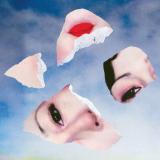
Themes of change, breaking up, shattering old ways of being are shot through the record. For the front cover, a photograph of the artist’s face was printed, ripped up and re-assembled, resembling the creative process embarked upon by Lew for her first “solo” material. The album feels instinctual, almost dream-like in its assemblage of sweeping synths and pulsating, propulsive drum machine beat patterns with Lew’s vocal performances sensitive and caressing over the top. Increasingly relying on the subconscious and dreams to guide her creative process, Hannah Lew frequently abandons literal interpretations or linear narratives, the songs seeming to exist in a swooning, effortless flow-state while remaining emotionally hard hitting.

On an album where every song could be a single, there are kaleidoscopic shades and varying emotional tones in abundance. First single Another Twilight is carried along a pumping, Italo-disco-style 4/4 beat and mono-synth bass line, the low end pulling at the heart and body. Lew’s vocal melody teases the track before swan-diving into a gorgeous chorus as she sings “it’s all over baby and I don’t mind… in decline, I take my time…” The album is suffused with moments like this. On slow builder Damaged Melody, an arpeggiated synth elongates the verse before a cascading synth showers down melodic glitter. The stunning Replica uses dual swirling synth patterns before a driving, synthpop chorus for the ages carries Hannah Lew’s vocal into the stereo field, sailing in on a high register singed with the embers of a break up.

In a departure from previous groups, her solo songs are guided by dreams and free association inspired by Dada and the Surrealist movement and sculpted afterwards. As such, the songs reveal themselves on repeated listens, revealing traces of heartbreak inspired by both personal and global elements - Hannah Lew regards the album “a wartime album.” On Move In Silence, Lew intones “there’s a war outside, just out of view,” revealing the dichotomy at play throughout. With the songs evolving naturally and in a flow state, the pressures and sadnesses of the modern age bleed through, mixed in with Lew’s inherent love, sensitivity and fractured-but-intact optimism. On the swooning, sublime Sunday layers of Numanoid synths open up for the commanding vocal performance pontificating on grief, love, pain as she “feels the ache on Sunday…” As the chorus builds and Lew’s call-and-response vocal adds to the emotional tension, it almost feels like too much to take.

Elsewhere, there are echoes of Hannah Lew’s previous work. On Time Wasted a bass guitar comes in with a heavy, punk attack before the synths and vocal harmonies reminiscent of later Cold Beat elevate everything. The glassy, sweetly resigned closer The Clock sounds like so classic it could be cover, a sweetened Jesus & Mary Chain tune perhaps, before it erupts into volcanic chorus that could only come from Hannah Lew in 2026.

pre-order now18.05.2026

expected to be published on 18.05.2026

23,32
IADI - Under My Skin

IADI

Under My Skin

12inchNEOLIFE003
Neo Life
23.04.2026

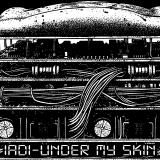
Between flesh and silicon. “Under My Skin” (2026) is the first album by IADI, released by Neo Life. A record like few
others, highly conceptual, cover art included. Its essence lies in the folds of the increasingly ambiguous relationship
between man and machine, where the former designs the latter and, perhaps without fully realizing it, is gradually
destined to adapt and be reprogrammed by it. Each track of “Under My Skin” is, in fact, a sort of interface, connector, or
any other imaginative point of contact between two creative phases, amid emotional impulses and binary calculations.
The sonic architecture oscillates between analog warmth and algorithmic coldness, constructing landscapes in which
pulsating synthesizers and mechanical rhythms seem to question each other. There's no linear narrative, but rather a
progressive immersion in a zone of near-friction, where the comfort of technology coexists with more than a faint
musical uneasiness, like a background noise that never ceases to remind you who's truly in charge. In “Under My Skin”,
the machine is neither an enemy nor a simple instrument: it's a real presence, intimate, even tactile, amplifying desires,
fears, and dreams of dawns beyond the digital realm. Intelligent dance music. Less noise, more sensations. Electronic,
but profoundly human.
The final result, then, is a music project that speaks to the present, yet sounds like an X-ray of the future, capturing that
fragile moment when humanity and technology stop observing each other from afar and begin to merge, track after
track. It's no coincidence that IADI's album opens with “Impulse”, an immediate expression of an electrical impulse, for
both humans and machines, which is also the language of the nervous system, as fast as it is vital—pure energy and
rhythm, a track as intense as it is irregular. And after this introduction, it's the turn of the equally erratic “Axon”, whose
title describes the neuron that transmits the signal over distance, telling the listener to sit back and relax for a new
journey through the notes toward the more melodic “Cortex”. The cerebral cortex, the ultimate seat of thought and
memory, becomes the source from which the musical flow of the first part of the work is drawn.
Then, suddenly, an automatic, or instinctive, response to the constant succession of impulses: “Reflex”, or zerotemperature techno, with a fragmented pace, featuring vocal samples, breaks, and restarts. In the producer's
imagination, the subsequent, and conversely placid, “Neuron” represents the emotional core of the second part of the
work, providing a kind of respite from the seething vibrations. While the neuron is the basic unit of the nervous system,
the synapse is the functional connection point between one neuron and another effector cell, essential for the
transmission of nerve impulses and communication in the nervous system, enabling functions such as learning and
movement. Likewise, a track like “Synapse” once again illuminates the path traced by IADI. The more experimental and
streamlined “Static” instead suggests true ordered chaos. “Dreamstate” is the conclusion suspended in the void, relating
to that dreamlike state between waking and sleeping, where consciousness fades toward infinity and visions begin. Pure
fading into the subconscious. Eternal return to where it all began. Dancing is a form of consciousness. Every beat is a
question. IADI, however, holds all the answers you need.

In Stock

On Stock and ready to ship

21,81
Geoglyph - Hidden Frequencies

Geoglyph is the new duo project by Alohn and Khey Mysterio, a convergence of two deeply singular practices into a single subterranean signal. Their debut album arrives as the eighth reference on Organic Signs, not as a collection of tracks but as a carved artifact: six inscriptions pressed into vinyl, mapping a sonic territory where time, rhythm and texture are no longer linear, but layered like geological memory.

Through Geoglyph, Alohn and Khey Mysterio convey a message from below, or beyond. A pulse engraved from forgotten times in the basement of reality, reactivated by abyssal basses, vibrating layers and fractured textures. Exhumed from the subterranean strata where psychedelic dub, mineral techno and fractal dubstep fuse into raw energy, their music becomes a point of contact: every beat, every silence, every oscillation acting as a coordinate toward another perception. What unfolds is not simply sound design, but an invocation, rhythms as sigils, timbre as gnosis, signals that seem to arrive already charged with intention.

Across the album, Alohn’s guitar notes fall like cascades through the mix, dissolving at times into controlled feedback and crystallizing into melodic fragments that hover between tension and release. These organic gestures are interwoven with Khey Mysterio’s dense low-end architectures and rhythmic frameworks, creating a constantly shifting terrain: from weightless transmissions and ritualistic voices to moments of overwhelming propulsion where the music suddenly breaks open with tectonic force. The record moves fluidly between meditative suspension and explosive motion, never settling into a single state for long.

A strong undercurrent of what has come to be known as “druidstep” runs through the album, a term coined within the 95 Open Tabs universe to describe a form of dubstep untethered from genre convention, rooted instead in bass as ritual, in groove as invocation. Here it meets dub-techno pulse, psychedelic echoes and high-velocity 4×4 pressure, drawing subtle influence from underground bass cultures without ever becoming referential. The result is a body of work that feels both ancient and forward-leaning, cyclical rather than linear: a living geoglyph that reveals different meanings depending on how (and where) it is read.

As the final movement accelerates into its closing phase, the album releases its energy outward, with frequencies stretched toward their limits, leaving behind the trace of a completed ceremony. In this sense, Geoglyph’s debut stands as a defining moment within the Organic Signs continuum: a record that unfolds rather than explains, offering an experience to be entered, absorbed, and carried. With this release, the label continues to explore new sonic spaces, evolving and expanding while giving deeper meaning to its own essence. A message from beneath the surface, waiting for those willing to tune in.

Más de este género

In Stock

On Stock and ready to ship

16,77
Tim Paris - That Boy Remixes feat. Foremost Poets

Incl. Remixes by Red Axes, Roman Flügel & Abe Duque

What does it mean to exist in sound?

It does not begin with a beat, but with a choice. With the moment when someone decides not merely to inhabit the space, but to shape it – and in doing so, makes themselves visible.

Roman Flügel stands as a constant in the background. Not as an authority, but as a collective consciousness. Since the 1990s, he has moved through club music like a seeker, never content with the first answer. House, techno, experimentation – these are not genres, but states of being. His remix thinks, hesitates, opens, strikes like a surging acid wave, warping reality and demanding true presence.

New York taught him that club music is never neutral. It is body, friction, attitude. Abe Duque’s remix carries a strangely enchanting relentlessness, a resistance to smoothness – as if the dancefloor were a place where freedom is not claimed, but fought for.

Red Axes do not enter this space; they conjure it. Their sound is raw, repetitive, circular, as if deliberately refusing linearity. House, dub, and acid elements become material for a movement that is more trance than structure. Their remix does not ask where it is going; it asks why one should ever stand still.

And then there is Tim Paris. Not at the center, but as a narrator. As someone who knows that the voice is an attitude. “That Boy” is not a pose, but a mirror, ironic, direct, vulnerable. Paris moves between new wave house and club, always aware that identity is never fixed, but formed in the moment.

This remix record is not a gathering of names. It is a situation, four perspectives on the same question:

What does it mean to exist in sound?

Yet sound alone does not tell the full story: like music, the visual is a space to be shaped, felt, and deciphered. The cover of Tim Paris feat. Foremost Poets – That Boy, created by Konstantin Fürchtegott Kipfmüller, a visual artist at the Hochschule für Gestaltung in Offenbach under Heiner Blum, embodies this principle. Drawing inspiration from the urban environment, Kipfmüller transforms traces of decay, weather, and time into abstract narratives that, like the music of Tim Paris, Roman Flügel, Abe Duque and Red Axes, unfold meaning layer by layer. The result is no mere adornment, but a mirror of the sonic landscape: every line, every surface an echo of the question of what it means to exist – fully, in the moment, in sound.

In Stock

On Stock and ready to ship

18,45
Vince Void / DJ Gamba - Magnetica EP

Vince Void / DJ Gamba

Magnetica EP

12inchPHP004
Phosphor
24.02.2026

Phosphor’s fourth release connects two promising talents from Barcelona’s underground scene: French producer Vince Void and Mexican DJ Gamba. Together, they deliver a finely crafted EP that blends punchy club dynamics with dreamy, psychedelic touches. From electro with 80s Italian accents to glitchy grooves and spacey breaks, PHP004 stands as a floor-ready release, moving with a subtle balance of tension and elevation.

Vince Void takes the A-side with two effective cuts. “Thunder” builds on a saturated Italo-style bassline and crisp, stripped-back drums, creating a steady tension that works perfectly at the start of a set. “Fashion Victim” switches the mood with acid-tinged grooves, glitchy stabs and a playful swing. It’s less linear but just as effective, adding contrast and movement to any DJ set.

On the B-side, DJ Gamba goes deeper. “The Universe”, in collaboration with Quim, weaves lush pads and shimmering arps into a rolling club structure, with subtle breakbeat accents that add lift and fluidity. To close, “Your Vision” slows the pulse slightly, blending filtered melodies, melancholic textures and a steady groove, locking in emotion without losing the club energy.

In Stock

On Stock and ready to ship

13,87
L.F.T - Hell Was Boring LP 2x12"

Between 2023 and 2025, L.F.T. split his time between Hamburg and Berlin, slowly piecing together what would become his most ambitious work to date. The result is Hell Was Boring - a double album that plays like a fever dream, unfolding as a dark, mythical tale about life, death, and the strange spaces in between.


L.F.T. - the alias of German producer and multi-instrumentalist Johannes Haas - has always thrived on tension: between punk urgency and electronic precision, between raw emotion and mechanical repetition. On Hell Was Boring, those tensions are amplified. Drawing on the spectral drama of Bauhaus, the melancholic minimalism of Linear Movement, the futuristic romanticism of Gary Numan, and even the sly swagger of Falco, the album feels at once deeply personal and part of a much older musical lineage.


The sound is stripped down to its bones: drums snap and rattle from a Roland TR-808, TR-707 and Korg KR-55; basslines growl from a Roland SH-101 and Korg MS-20; shards of guitar cut through clouds of tape hiss. Everything was tracked to a Teac Tascam 80-8 reel-to-reel, giving each track a lived-in, imperfect warmth. Nothing is overpolished - L.F.T. wanted the listener to hear the edges, the grit, the moments when the music almost comes apart.


Along the way, he invited friends and long-time collaborators into the fold - Das Kinn, Rosaceae, Felix Kubin, Children Of Leir, and Konstantin Unwohl - each leaving their own fingerprints on the record’s world of shadows and static.


Hell Was Boring isn’t a mere collection of songs; it’s a narrative that drags you into its orbit and doesn’t quite let go. It’s music for the late hours when reality feels porous, and for those moments when you’re not sure if you’re waking up or still dreaming.

In Stock

On Stock and ready to ship

25,63
ESTADO DE BIENESTAR - CAPÍTULO III: LA ANARQUÍA SÓNICA LP

EdB keeps pushing deeper into sonic chaos with “La Anarquía Sónica” — a raw, proto, and visceral journey built on hand-crafted beats, deliciously unhinged basslines and immersive field recordings. Music for the restless. For those obsessed with sound. For anyone tired of hearing the same thing over and over again. Dystopian music for a universal shift. This time, EdB joins forces with Belgian synth guru Peter Bonne / Chayell Zenn (Linear Movement, Twilight Ritual) to rework “The Enochian Keepers of Time” — also included in its original version on the EP — into an emo- electro industrial aberration titled “Guardianes del Tiempo.” Presented in ONE-OFF truly limited edition of 300 copies lacquered pressed on 180 gr. high quality solid BLACK vinyl. Includes printed innersleeve. All tracks have been specially remastered for vinyl by Daniel Hallhuber at Young and Cold Studios (Germany).

In Stock

On Stock and ready to ship

19,12
DAVID AUGUST - VIS LP 2x12"

David August

VIS LP 2x12"

2x12inchCHANTSL9912
99CHANTS
06.10.2023

A lavish four chapter chronicle that imagines an alternative evolution of mankind through sound, VIS (Latin for energy or force) is the result of a lengthy process of self-discovery, collaboration and research for Italian-German composer David August. The son of a classical pianist, August slipped from the academic music world into an early career as a dance music producer and DJ before he felt his artistic outlook shifting considerably. He established the adventurous 99CHANTS label in 2018, and has since used it as an output for his most progressive notions, collaborating most recently with jazz-noise vocalist Cansu Tanrikulu and Carnatic singer Sushma Soma on last year"s acclaimed "Imaginary Landscapes" compilation. VIS then is a chance for August to reconcile his personal narrative, leveling it with concepts that touch on history, transformation and metaphysics. He wrote the album"s 13 pieces to play like a linear storyline, tracking the development of culture from its illusory beginnings in Plato"s cave into the wider world and observing its progression and adaptation.

August represents these themes with levitational orchestral drones, choirs and bells that slowly bend to long-forgotten ancestral rhythms, inevitably colliding with the digitized chaos of the information age. Motion guides everything, whether it"s shadows on a wall projected by dancing flames, or dramatic, overlayed rhythms that vibrate the air and excite the feet. VIS is a dynamic attempt to show the movement of time on a macro scale, looking backwards in order to move forwards. It charts mankind"s journey from its cosmic beginnings through the awe-inspiring world of flora and fauna, grounding the experience in rhythmic expression and dance before we"re returned to the stars in transcended form. Crucially, it"s a hopeful articulation of ideas and concepts that continue to echo throughout history, inviting us to imagine greater and cherish the teeming landscape that surrounds us.

In Stock

On Stock and ready to ship

31,05
TECHNOLOGY & TEAMWORK - WE USED TO BE FRIENDS LP

*MILKY CLEAR VINYL - 300 COPIES ONLY FOR WORLD!!* Technology + Teamwork’s fizzling synths, interweaving textures and punchy rhythms are beguiling on their long-awaited debut album We Used To Be Friends. However, at the heart of it all it’s the connection between the group’s two members, Anthony Silvester and Sarah Jones, the friendship the much-travelled duo have managed to maintain for nearly 15 years and a showcase of the slow-burning construction of the electronic world that they’ve surrounded themselves with. We Used To Be Friends is ultimately the tale of two storied artists in their own right, holding onto each other through personal and career twists and turns, relocations and broader movements through respective phases of their lives. Silvester and Jones first met and then collaborated as part of biting post-punk five-piece XX Teens in 2008, eventually breaking off to forge their own path together even as the latter’s demand as a drummer grew. Performing with everyone from Hot Chip, Harry Styles and Bloc Party among many others, Jones has been a constant percussive presence across the sphere of alternative UK pop music – she’s also found time for her own solo project Pillow Person and played on records by the likes of Puscifer and Kurt Vile. Silvester meanwhile has performed in art galleries across Europe including: Fridericianum in Kassel, Kölnischer Kunstverein in Cologne, and Vleeshal in Middelburg, as well as providing sound design and composing work for several art films. Technology + Teamwork is the constant throughout all of that though. “Technology + Teamwork's name perfectly describes how we work” Silvester explains. “Sometimes the teamwork is between each other and sometimes it’s between us and the technology.” Although going by the name Technology + Teamwork as far back as 2014, two events conspired that pulled the project into focus for the pair of them: firstly, Silvester spent a year constructing a soundproof studio shed on the border of London and Essex where he lives. Secondly, inevitably, the pandemic brought the globe-trotting Jones back home to just seven miles away from her long-time collaborator and friend. “We probably hung out more than we had for a few years” says Silvester. “Also, after all her Pillow Person releases Sarah had gotten really good with recording vocals and knowing what did and didn’t work and had a really good home studio set up. We still worked separately though, exchanging ideas via email and WhatsApp.” As with many artists through 2020 and early 2021, working separately was a new necessity that they were forced to adapt to. However, it became clear that there were creative benefits to it. “It really changed our sound and our sounds became a lot more focused as a result” Jones says. “I wanted to use the same ideas of improvisation that I might use while playing the drums for myself and apply that to melodies and lyrics.” The album bristles with hyperpop modernity. You can hear it in the manipulated vocals most prominently on Big Blue’s disco strut and on Moving Too’s heady mix of pitched up voice and burrowing sub bass. However, the pair also looked to San Francisco and the West Coast synthesis movement of the 60s, Silvester inspired by the likes of Suzanne Ciani and Don Buchla. The plaintive lo-fi and melancholy of Amsterdam incorporates Mutable Instrument’s Marbles by Émilie Gillet which – inspired by Buchla’s own synthesis work – outputs random voltages to give the track an air of unpredictability. It’s something that occurs throughout the album, the duo revelling in the happy accidents that disrupt the flow of their hook-laden pop. “The ‘Buchlian’ ideas of music having randomness and uncertainty, completely freed us up” Silvester explains. “It felt a bit like having more members in the band, machines that didn't do what you expected or intended.” Perhaps more subtly, is the influence of 17th and 18th century Baroque music, with Silvester drawing a line between it and the 90’s R’n’B he and Jones both love – exemplified perhaps best on K+B’s percussive claps and sultry grooves. The portentous juddering synthpop of the title track, meanwhile, alludes specifically to Handel’s Sarabande. It’s typical of an album that only needs a scratch of its seemingly glossy surface to unearth a myriad of contorted touchstones and reference points that’ve fermented beneath it. Thematically there’s an anxious sense to the record, with tracks often balancing above a quiet sense of unerring tension even at their most bombastic. Moving Too is the result of an existential doubt that hit Silvester while out cycling, with the outro refrain "it's not enough to die you also have to be forgotten" a take on something Samuel Beckett once said. These worries are echoed on the album’s closing track What A Year, which borrows a lot of lines from the late drag performer and fashion designer Dorian Corey including the grimly defiant "you're gonna leave your mark somewhere in this world just by getting through it”. Those clouds offer a counter point to We Used To Be Friends, but then isn’t that what great pop albums do? Technology + Teamwork undoubtedly love the craft of the hook and the song, but they always position themselves left of centre, prepared to scuff things up, pull something out of shape or manipulate something to leave it sounding warped. Much like their friendship, nothing here is particularly linear – and it’s all the better for it. Bio: Anthony Silvester & Sarah Jones first collaborated as part of biting post-punk five piece XX Teens in 2008, eventually breaking off to forge their own path together even as the latter's demand as a drummer grew. Performing with everyone from Hot Chip, Bat for Lashes, Harry Styles and Bloc Party (among many others), Jones has been a constant percussive presence across the sphere of alternative UK pop music - she's also found time for her own solo project Pillow Person and played on records by the likes of Puscifer and Kurt Vile. Silvester meanwhile has performed in art galleries across Europe including Fridericianum in Kassel, Kölnischer Kunstverein in Cologne, and Wleeshal in Middelburg, as well as providing sound design and composing work for several art films. Technology & Teamwork is the constant throughout all of that though. "We Used To Be Friends" proves that Technology & Teamwork undoubtedly love the craft of the hook and the song, but they always position themselves left of centre, prepared to scuff things up, pull something out of shape or manipulate something to leave it sounding warped. Much like their friendship, nothing hear is particularly linear - and it's all the better for it.

In Stock

On Stock and ready to ship

20,97
Vlad Caia - Source of movement EP

Vlad Caia

Source of movement EP

12inchSYNKRO002
SYNKRONIQ
24.01.2022

The second installment of Synkroniq meticulously crafted by Vlad Caia, presents us with two distinct cuts. On the A side we find "Linear Movement", a rolling track with a deep bassline and a tech housey vibe. "Source of Certainty" builds nicely on the B side with its calming introduction and flavorful build-up, completing this well rounded release.

In Stock

On Stock and ready to ship

9,45
Guilty Razors - Complete Recordings 1977 - 1978

UILTY RAZORS, BONA FIDE PUNKS.


Writings on the topic that go off in all directions, mind-numbing lectures given by academics, and testimonies, most of them heavily doctored, from those who “lived through that era”: so many people today fantasize about the early days of punk in our country… This blessed moment when no one had yet thought of flaunting a ridiculous green mohawk, taking Sid Vicious as a hero, or – even worse – making the so-called alternative scene both festive and boorish. There was no such thing in 1976 or 1977, when it wasn’t easy to get hold of the first 45s by the Pistols or the Clash. Few people were aware of what was happening on the fringes of the fringes at the time. Malcolm McLaren was virtually unknown, and having short hair made you seem strange. Who knew then that rock music, which had taken a very bad turn since the early 1970s, would once again become an essential element of liberation? That, thanks to short and fast songs, it would once again rediscover that primitive, social side that was so hated by older generations? Who knew that, besides a few loners who read the music press (it was even better if they read it in English) and frequented the right record stores? Many of these formed bands, because it was impossible to do otherwise. We quickly went from listening to the Velvet Underground to trying to play the Stooges’ intros. It’s a somewhat collective story, even though there weren’t many people to start it.
The Guilty Razors were among those who took part in this initial upheaval in Paris. They were far from being the worst. They had something special and even released a single that was well above the national average. They also had enough songs to fill an album, the one you’re holding. In everyone’s opinion, they were definitely not among the punk impostors that followed in their wake. They were, at least, genuine and credible.

Guilty Razors, Parisian punk band (1975-1978). To understand something about their somewhat linear but very energetic sound, we might need to talk about the context in which it was born and, more broadly, recall the boredom (a theme that would become capital in punk songs) coupled with the desire to blow everything off, which were the basis for the formation of bands playing a rejuvenated rock music ; about the passion for a few records by the Kinks or the early Who, by the Stooges, by the Velvet mostly, which set you apart from the crowd.
And of course, we should remember this new wave, which was promoted by a few articles in the specialized press and some cutting-edge record stores, coming from New York or London, whose small but powerful influence could be felt in Paris and in a handful of isolated places in the provinces, lulled to sleep by so many appalling things, from Tangerine Dream to President Giscard d’Estaing...
In 1975-76, French music was, as almost always, in a sorry state ; it was still dominated by Johnny Hallyday and Sylvie Vartan. Local rock music was also rather bleak, apart from Bijou and Little Bob who tried to revive this small scene with poorly sound-engineered gigs played to almost no one.
In the working class suburbs at the time, it was mainly hard rock music played to 11 that helped people forget about their gruelling shifts at the factory. Here and there, on the outskirts of major cities, you still could find a few rockers with sideburns wearing black armbands since the death of Gene Vincent, but it wasn’t a proper mass movement, just a source of real danger to anyone they came across who wasn't like them. In August 1976, a festival unlike any other took place in Mont-de-Marsan – the First European Punk Festival as the poster said – with almost as many people on stage as in the audience. Yet, on that day, a quasi historical event happened, when, under the blazing afternoon sun, a band of unknowns called The Damned made an unprecedented noise in the arena, reminiscent of the chaotic Stooges in their early adolescence. They were the first genuine punk band to perform in our country: from then on, anything was possible, almost anything seemed permissible.

It makes sense that the four+1 members of Guilty Razors, who initially amplified acoustic guitars with crappy tape recorder microphones, would adopt punk music (pronounced paink in French) naturally and instinctively, since it combines liberating noise with speed of execution and – crucially – a very healthy sense of rebellion (the protesters of May 1968 proclaimed, and it was even a slogan, that they weren’t against old people, but against what had made them grow old. In the mid-1970s, it seemed normal and obvious that old people should now ALSO be targeted!!!).
At the time, the desire to fight back, and break down authority and apathy, was either red or black, often taking the form of leafleting, tumultuous general assemblies in the schoolyard, and massive or shabby demonstrations, most of the time overflowing with an exciting vitality that sometimes turned into fights with the riot police. Indeed, soon after the end of the Vietnam War and following Pinochet’s coup in Chile, all over France, Trotskyist and anarcho-libertarian fervour was firmly entrenched among parts of the educated youth population, who were equally rebellious and troublemakers whenever they had the chance. It should also be noted that when the single "Anarchy in the UK" was first heard, even though not many of us had access to it, both the title and its explosive sound immediately resonated with some of those troublemakers crying out for ANARCHY!!! Meanwhile, the left-wing majority still equated punks with reckless young neo-Nazis. Of course, the widely circulated photos in the mainstream press of Siouxsie Sioux with her swastikas didn’t necessarily help to win over the theorists of the Great Revolution. It took Joe Strummer to introduce The Clash as an anti-racist, anti-fascist and anti-ignorance band for the rejection of old-school revolutionaries to fade a little.

The Lycée Jean-Baptiste Say at Porte d’Auteuil, despite being located in the very posh and very exclusive 16th arrondissement of Paris, didn’t escape these "committed" upheavals, which doubled as the perfect outlet for the less timid members of this generation.
“Back then, politics were fun,” says Tristam Nada, who studied there and went on to become Guilty Razors’ frontman. “Jean-Baptiste was the leftist high-school in the neighbourhood. When the far right guys from the GUD came down there, the Communist League guys from elsewhere helped us fight them off.”
Anything that could challenge authority was fair game and of course, strikes for just about any reason would lead to increasingly frequent truancy (with a definitive farewell to education that would soon follow). Tristam Nada spent his 10th and 11th unfinished grades with José Perez, who had come from Spain, where his father, a janitor, had been sentenced to death by Franco. “José steered my tastes towards solid acts such as The Who. Like most teenagers, I had previously absorbed just about everything that came my way, from Yes to Led Zeppelin to Genesis. I was exploring… And then one day, he told me that he and his brother Carlos wanted to start a rock band.” The Perez brothers already played guitar. “Of course, they were Spanish!”, jokes their singer. “Then, somewhat reluctantly, José took up the bass and we were soon joined by Jano – who called himself Jano Homicid – who took up the rhythm guitar.” Several drummers would later join this core of not easily intimidated young guys who didn’t let adversity get the better of them.

The first rehearsals of the newly named Guilty Razors took place in the bedroom of a Perez aunt. There, the three rookies tried to cover a few standards, songs that often were an integral part of their lives. During a first, short gig, in front of a bewildered audience of tough old-school rockers, they launched into a clunky version of the Velvet Underground's “Heroin”. Challenge or recklessness? A bit of both, probably… And then, step by step, their limited repertoire expanded as they decided to write their own songs, sung in a not always very accurate or academic English, but who cared about proper grammar or the right vocabulary, since what truly mattered was to make the words sound as good as possible while playing very, very fast music? And spitting out those words in a language that left no doubt as to what it conveyed mattered as well.
Trying their hand a the kind of rock music disliked by most of the neighbourhood, making noise, being fiercely provocative: they still belonged to a tiny clique who, at this very moment, had chosen to impose this difference. And there were very few places in France or elsewhere, where one could witness the first stirrings of something that wasn’t a trend yet, let alone a movement.

In the provinces, in late 1976 or early 1977, there couldn’t be more than thirty record stores that were a bit more discerning than average, where you could hear this new kind of short-haired rock music called “punk”. The old clientele, who previously had no problem coming in to buy the latest McCartney or Aerosmith LP, now felt a little less comfortable there…
In Paris, these enlightened places were quite rare and often located nex to what would become the Forum des Halles, a big shopping mall. Between three aging sex workers, a couple of second-hand clothes shops, sellers of hippie paraphernalia and small fashion designers, the good word was loudly spread in two pioneering places – propagators of what was still only a new underground movement. Historically, the first one was the Open Market, a kind of poorly, but tastefully stocked cave. Speakers blasted out the sound of sixties garage bands from the Nuggets compilation (a crucial reference for José Perez) or the badly dressed English kids of Eddie and the Hot Rods. This black-painted den was opened a few years earlier by Marc Zermati, a character who wasn’t always in a sunny disposition, but always quite radical in his (good) choices and his opinions. He founded the independent label Skydog and was one of the promoters of the Mont-de-Marsan punk festivals. Not far from there was Harry Cover, another store more in tune with the new New York scene, which was amply covered in the house fanzine, Rock News (even though it was in it that the photos of the Sex Pistols were first published in France).
It was a favorite hang-out of the Perez brothers and Tristam Nada, as the latter explained. “It’s at Harry Cover’s that we first heard the Pistols and Clash’s 45s, and after that, we decided to start writing our first songs. If they could do it, so could we!”
The sonic shocks that were “Anarchy in the UK”, “White Riot” or the Buzzcocks’s EP, “Spiral Scratch” – which Guilty Razors' sound is reminiscent of – were soon to be amplified by an unparalleled visual shock. In April 1977, right after the release of their first LP, The Clash performed at the Palais des Glaces in Paris, during a punk night organised by Marc Zermati. For many who were there, it was the gig of a lifetime…
Of course, Guilty Razors and Tristam were in the audience: “That concert was fabulous… We Parisian punks were almost all dressed in black and white, with white shirts, skinny leather ties, bikers jackets or light jackets, etc. The Clash, on the other hand, wore colourful clothes. Well, the next day, at the Gibus, you’d spot everyone who had been at this concert, but they weren’t wearing anything black, they were all wearing colours.”

It makes sense to mention the Gibus club, as Guilty Razors often played there (sometimes in front of a hostile audience). It was also the only place in Paris that regularly scheduled new Parisian or Anglo-Saxon acts, such as Generation X, Siouxsie and the Banshees, the Slits, and Johnny Thunders who would become a kind of messed-up mascot for the venue. A little later, in 1978, the Rose Bonbon – formerly the Nashville – also attracted nightly owls in search of electric thrills… In 1977, the iconic but not necessarily excellent Asphalt Jungle often played at the Gibus, sometimes sharing the bill with Metal Urbain, the only band whose aura would later transcend the French borders (“I saw them as the French Sex Pistols,” said Geoff Travis, head of their British label Rough Trade). Already established in this small scene, Metal Urbain helped the young and restless Guilty Razors who had just arrived. Guitarist for Metal Urbain Hermann Schwartz remembers it: “They were younger than us, we were a bit like their mentors even if it’s too strong a word… At least they were credible. We thought they were good, and they had good songs which reminded of the Buzzcocks that I liked a lot. But at some point, they started hanging out with the Hells Angels. That’s when we stopped following them.”

The break-up was mutual, since, Guilty Razors, for their part, were shocked when they saw a fringe element of the audience at Metal Urbain concerts who repeatedly shouted “Sieg Heil” and gave Nazi salutes. These provocations, even still minor (the bulk of the skinhead crowd would later make their presence felt during concerts), weren’t really to the liking of the Perez brothers, whose anti-fascist convictions were firmly rooted. Some things are non-negotiable.
A few months earlier (in July 1978), Guilty Razors had nevertheless opened very successfully for Metal Urbain at the Bus Palladium, a more traditonally old-school rock night-club. But, as was sometimes the case back then, the night turned into a mass brawl when suburban rockers came to “beat up punks”.

Back then, Parisian nights weren’t always sweet and serene.

So, after opening as best as they could for The Jam (their sound having been ruined by the PA system), our local heroes were – once again – met outside by a horde of greasers out to get them. “Thankfully,” says Tristam, “we were with our roadies, motorless bikers who acted as a protective barrier. We were chased in the neighbouring streets and the whole thing ended in front of a bar, with the owner coming out with a rifle…”
Although Tristam and the Perez brothers narrowly escaped various, potentially bloody, incidents, they weren’t completely innocent of wrongdoing either. They still find amusing their mugging of two strangers in the street for example (“We were broke and we simply wanted to buy tickets for the Heartbreakers concert that night,” says Tristam). It so happened that their victims were two key figures in the rock business at the time: radio presenter Alain Manneval and music publisher Philippe Constantin. They filed a complaint and sought monetary compensation, but somehow the band’s manager, the skilful but very controversial Alexis, managed to get the complaint withdrawn and Guilty Razors ended up signing with Constantin with a substantial advance.

They also signed with Polydor and the label released in 1978 their only three-track 45, featuring “I Don't Wanna be A Rich”, “Hurts and Noises” and “Provocate” (songs that exuded perpetual rebellion and an unquenchable desire for “class” confrontation). It was a very good record, but due to a lack of promotion (radio stations didn’t play French artists singing in English), it didn’t sell very well. Only 800 copies were allegedly sold and the rest of the stock was pulped… Initially, the three tracks were to be included on a LP that never came to be, since they were dropped by Polydor (“Let’s say we sometimes caused a ruckus in their offices!” laughs Tristam.) In order to perfect the long-awaited LP, the band recorded demos of other tracks. There was a cover of Pink Floyd's “Lucifer Sam” from the Syd Barrett era – proof of an enduring love for the sixties’ greats –, “Wake Up” a hangover tale and “Bad Heart” about the Baader-Meinhof gang, whose actions had a profound impact on the era and on a generation seeking extreme dissent... On the album you’re now discovering, you can also hear five previously unreleased tracks recorded a bit later during an extended and freezing stay in Madrid, in a makeshift studio with the invaluable help of a drummer also acting as sound engineer. He was both an enthusiastic old hippie and a proper whizz at sound engineering. Here too, certain influences from the fifties and sixties (Link Wray, the Troggs) are more than obvious in the band’s music.

Shortly after a final stormy and rather barbaric (on the audience’s side) “Punk night” at the Olympia in June 1978, Tristam left the band ; his bandmates continued without him for a short while.

But like most pioneering punk bands of the era, Guilty Razors eventually split up for good after three years (besides once in Spain, they’d only played in Paris). The reason for ceasing business activities were more or less the same for everyone: there were no venues outside one’s small circuit to play this kind of rock music, which was still frightening, unknown, or of little interest to most people. The chances of recording an LP were virtually null, since major labels were only signing unoriginal but reassuring sub-Téléphone clones, and the smaller ones were only interested in progressive rock or French chanson for youth clubs. And what about self-production? No one in our small safety-pinned world had thought about it yet. There wasn’t enough money to embark on that sort of venture anyway.

So yes, the early days of punk in France were truly No Future!

out of Stock

Order now and we will order the item for you at our supplier.

21,43

Last In: 30 days ago
kom-kom - kom-kom (TAPE)

Kom-Kom

kom-kom (TAPE)

CassetteKR84
Kit Records
07.11.2025

Dutch artist Sander van der Toorn returns to Kit Records, following his much-loved work with analogue-decayed folk duo Love is Yes, in 2024. While Sander's signature haze of tape-smeared synthesis and motorik guitar is ever present, "kom-kom" represents a departure from the elysian warmth of Love's debut.

The industrial throb of tracks like 'FIVE' and 'Rainhum' bear the deconstructed hallmarks of krautrock pioneers Neu!, and even the dystopic glow of artists like Plastikman or Pole. When kom-kom's harmonic ambitions resurface, such as on the synapse-aching 'Dwarsdoor', or the glassy structures of 'Hazenhart', the effect is startling.

van der Toorn cites the inspiration of Morton Feldman and Sarah Davachi when describing his work less as a linear listening experience, more a collection of sculptures that can be viewed from different angles. In this way, kom-kom doesn't have to move forward; the encounter can be one of stillness, of static objects given movement by the beholder's shifting perspective.

Sounds like: John Fahey being stretched into infinitely long pieces of spaghetti.
Recommended if you like: intercontinental rail travel, Mark Fisher, a nice malbec.

Limited edition of 100 cassettes, with risograph printed artwork.

pre-order now07.11.2025

expected to be published on 07.11.2025

10,04
Erik K Skodvin - Schächten

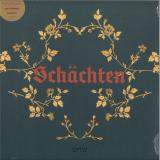
Erik K Skodvin's feature-length score to Thomas Roth's thriller "Schächten" feels like the epitome of all his musical projects, conjuring a dark cinematic trip through 1960's post-WWII Vienna in a film that touches on topics such as law, justice & revenge.

Releasing a soundtrack as a stand-alone album can be challenging; and "Schächten" is by no means a typical listening experience. The record contains 24 more or less short pieces evolving through dramatic movements, underlaying menace and deep emotive scenes. One thing that stands out is the linear atmosphere throughout the story which creates a wholeness that keeps your attention to the very end. Set in wintery Austrian landscapes in dimly saturated colours, the film's dramatic events with dark political undertones feels like a perfect situation for Skodvin's atmospheric collages - perhaps sounding closer than ever to his early works as Svarte Greiner or Deaf Center. Cello, violin, piano, analogue synth and plenty of hardly recognizable instrumentation come together in a record that feels very organic in its subdued tones. The score also features percussion by Andrea Belfi as well as a Chopin piano interpretation by Kelly Wyse to the bizarrely schizophrenic piece "Judenfreund".

With the contemporary world sliding into darkness again, listening to the soundtrack feels like coming to terms with ones own anxieties - something that in the end comes through as a cleansing experience. As quoted in the film "Everyone is their own devil. And we make this world our hell".

Short synopsis : "Vienna 1960s - The young Jewish business man Victor has to witness how the prosecution of a Nazi crime against his family fails. The political and legal system is still virtually run by former Nazis with large parts of society being entangled in the past. When Victor also loses his grief ridden father and his girlfriend’s family opposes their relationship and his identity, Victor begins to loose faith in formal justice and takes matters in his own hands."

out of Stock

Order now and we will order the item for you at our supplier.

26,51

Last In: 6 months ago
Hyldon & Adrian Younge - Hyldon JID023

Hyldon, Brazil’s highly revered vocalist, musician and producer, has partnered with Adrian Younge to create a new psychedelic soul album, HYLDON JID023. The duo, highly inspired by Hyldon’s seminal work in the ‘60s and ‘70s, revisits’ the spirit of this epoch while creating a modern-day classic. Hyldon’s unique voice and lyrical depth, combined with Younge’s innovative analogue production, ensures this album will not be forgotten. JID023 is one of the last recordings featuring Hyldon’s long-time collaborator and friend, the late drummer Ivan “Mamao” Conti of Azymuth.

Hyldon, a musical pioneer and early contributor to the “Black Rio” movement is a genius in synthesizing the sounds of MPB, Tropicália and Black American R&B. His unique voice, coupled with his rich arrangements and laid-back grooves set him apart from the contemporaries of the time. In ’75, his remarkable debut album, Na Rua, Na Chuva, Na Fazenda changed the sound of Brazil forever. Hyldon’s earnest and experimental approach in creating that album served as the inspiration for Younge’s production on the new JID023.

Months before Mamão's untimely passing, Adrian Younge and Hyldon invited the legendary drummer to join them at Younge’s Linear Labs studio in Los Angeles. Mamão and Hyldon shared a rich musical history — Azymuth, Mamão’s group, served as the rhythm section for much of Hyldon’s work, including his iconic 1975 LP, Na Rua, Na Chuva, Na Fazenda. Their goal was ambitious: to craft an album that would stand alongside Hyldon’s finest achievements, one that would captivate fans who love his unique blend of psychedelic and soulful “Música Brasileira.” The result is nothing short of remarkable.

“Producing a Hyldon album was a dream come true. I’ve studied his catalogue for so many years and highly respect the way he mixed the sound of The Beatles, with that of Marvin Gaye and Tim Maia. I’m still enamored by the fact that he is even a better singer now than he was, in what many deem, his prime. Also, we greatly miss our dear friend and contributor Mamão, the late drummer of Azymuth. We dedicated this album to his memory, and we wish he could have had the chance to hear the finished album.” – Adrian Younge

Songs such as “Olhos Castanhos” evoke the ethereal nature of The Beatles “Strawberry Fields” as the mellotron flutes and Hyldon’s vulnerable performance captivates our hearts. Mamão’s gritty and funky drumming on “Nhanderuvucu (The Creator of God)” showcase what made him a leading pioneer in Brazil’s samba funk scene. Apart from the remarkable drumming, multi-instrumentalist Younge accomplishes the unthinkable by playing every other instrument on JID023. The experimental fusion of horns, analog synthesizers and acoustic instrumentation on songs like “Viajante de Planeta Azul” take listeners on a funky journey to the blue planet; a fictional space that Hyldon lyrically describes with passion and conviction.

Hyldon JID023 is an unexpected, yet remarkable addition to the canon of Brazilian Music. Hyldon’s emotional resonance, coupled with Younge’s sophisticated production and Mamao’s outstanding drumming make this a standout album within the deep catalogue of Jazz Is Dead.

out of Stock

Order now and we will order the item for you at our supplier.

29,37

Last In: 11 months ago
Spekki Webu - Neural Network LP 2x12"

Beyond the Bridge proudly presents the latest EP from Dutch sonic architect Spekki Webu, titled "Neural Network," set to release on April 15, 2025. As the founder of Mirror Zone, Webu masterfully conjures a spectral world where time collapses and frequencies bend, inviting listeners on a mind-expanding journey through sound. His ritualistic compositions transcend conventional boundaries, merging past, present, and future into a singular, fluid moment. The eight-track EP delves into an abstract landscape of high-intensity frequencies and textural flux. Webu's sonic manipulations challenge linearity, evoking cyclical movements that oscillate between chaos and order. Each track serves as a kinetic force, pulsating with raw energy and enveloping the listener in immersive sonic architecture. The release also features two transformative remixes from Beyond the Bridge label head K.O.P. 32 and acclaimed producer Feral, each expanding the boundaries of interpretation into new dimensions. credits releases April 15, 2025 All tracks written, produced, and mixed by Spekki Webu at Into The Unknown in The Hague. Additional production by Feral and K.O.P. 32. Mastering by K.O.P. 32 at Pacific Sound Network in Seoul. Visuals by Anton Braun. ? Beyond the Bridge 2025.

out of Stock

Order now and we will order the item for you at our supplier.

20,80

Last In: 7 months ago
Mike Parker, Steve Bicknell - In The Years Ahead EP 180g

Reclaim Your Cities next frequency-jammer comes in the form of a heavyweight split 4-tracker, courtesy of two true techno pioneering figures: Mike Parker and Steve Bicknell.

The continued influence of these two artists on both our early raving days and now as a team working on providing you the most exciting, boundary-pushing tech wares is second to none. As you'll experience from the four jams constitutive of this unparalleled mindtrip of an EP, 'In The Years Ahead' is the living evidence the steadfastness of Parker and Bicknell's vision remains absolutely untouched. Zeroed in on taking ravers on an entrancing ride across pulsating corridors of whirring machine funk, sizzling acid and shape-shifting waves of sound, both sides of this EP share the best lot of both producers' uniquely innovative approach to rhythm and production.

Parker's opening cut, 'Solar Limb' is a textbook example of his complex, and heavily layered sound-design. An unflinching swing keeping time, brutal kicks punching holes in your head like giant steel hammers, the track may evolve slowly, repeating its post-industrial mantra over and over again, its flame doesn't flicker one iota. Switching onto red-level dance floor menace, 'Badlands' pulls out the heavy artillery: an overkill bombardment of puncturing 909 drums, vortical winds blowing in the back like some solar storm of sorts, and this ebb-and-flow of FX-drenched synth ripples branded on your cortex like odd signs of cult belonging. Bicknell's takeover starts with the rugged and wild 'Chaotic World', whose title is definitely not usurped. Enter a blazing maelstrom of frantic synth assault knocked askew, intense bass tectonic movements and smashing arpeggios on the path of war. The track develops a massive momentum, swelling from primordial raw matter into weirdly arranged modular constructions, like that of Kubrick's monolith emerging with ominous presence. 'In The Years Ahead' serves up a much distinctively elegant, glossy type of textural experience, synths playing pong in a hall of mirrors, interlacing and distorting as the percussive line unfolds its linear train-like groove. It dashes across landscapes of hypermodern glass and concrete with unrelenting horsepower, from techno's early sanctuary right up onto tomorrow's temple of unmapped potentialities.

This much special release, so dear to our heart, comes clad in a beautiful piece of design, and will be pressed to 180g audiophile quality vinyl for an enhanced listening experience.

out of Stock

Order now and we will order the item for you at our supplier.

13,24

Last In: 23 days ago
SOFTGRID - KNOCK
  • A1: Perc
  • A2: Please Come Back And Knock
  • B1: Music Of Spheres
  • B2: Asset
  • B3: Feelu

Long time PPU contributor, video producer, and designer, SOFTgrid steps into the fold with their EP “Knock”. Includes “FEELU” as featured in the 2024 summer blockbuster Bad Boys IV : Ride Or Die starring Martin Lawrence & Will Smith.

Demoscene and Cracktro enthusiast, SOFTgrid started life navigating the dark waters of text user interfaces, with early memories of Bulletin Board Systems, and as time and technology progressed, they eventually obtained the various bits of software needed for their creation, this was by means of WAREZ servers in private chat rooms far from town hall.

SOFTgrid is most at home organizing their existence to a grid, be it pixels or the linear movement of sound on a timeline. ASCII and ANSI are their preferred means of expression, SID and PAULA chips their preferred means of communication.

pre-order now18.10.2024

expected to be published on 18.10.2024

17,86
LTJ XPERIENCE - AIN’T NOTHING BUT A GROOVE LP 2x12"

Thanks to the success of his productions and his remixes, all the works printed on vinyl made by Luca LTJ Xperience Trevisi have been snapped up among his fans and DJs from all over the world.

From his past catalog there was still a complete album released only in Compact Disc and in digital format in 2013: Ain't Nothing But A Groove, left behind not because it had anything less than the others but simply to alternate new releases with catalog ones.

Now it is finally being printed.

The album, strictly in the DJ Friendly version, double vinyl with only two tracks on each side, contains some of his Nu Disco Funk pearls such as: What I Feel, Linear Funk and Get Down. Luca LTJ Trevisi (LTJ Xperience) began his career as a DJ and producer in the 80s.

As resident DJ of two of the most famous Italian clubs, the Kinky in Bologna and the Cap Creus in Imola, he was one of the first Italian DJs to play House Music and to revive that particular selection of Black Music called Rare Groove mixed with Jazz and Latin-Bossa who gave birth to the Acid Jazz movement at the end of the 80s.

His first official release was in 1988 and was titled First Job, paired with Kekkotronics, and was also the first album from Irma Records. The song was included in many compilations and many DJ playlists around the world. In the following years, among his singles we find some song forms that anticipated the Breakbeat genre such as Do n't Stop The Sax and Funky Superfly. He produced Tameka Starr's single Going In Circles, also for Irma Records, which has become a classic of the Downtempo/R&B genre.

In the mid-90s he produced some Italian Acid Jazz groups such as Bossa Nostra and Live Tropical Fish and began to select Rare Grooves compilations that have become classics such as Groovy and Suono Libero. At the same time he also started playing outside Italy, in particular at the Blue Note and the Jazz Café in London, at the
Giant Step in New York and at the Montreaux Jazz Festival in Switzerland. In 1999 he released his first album under the pseudonym LTJ Xperience entitled Moon Beat which featured Ohm Guru in
the production and Taka Boom and Jackson Sloan as vocal guests. Two tracks from the album have become club classics:
the Brazilian House version of Sombre Guitar and the chill out Moon Beat. His second album in 2003 entitled When The Rain Begin To Fall features Joe Bataan in the reinterpretation of his most famous song Ordinary Guy which has become a Gilles Peterson classic.

After some singles including Organ Mind / I Love you (Larry Heard's favorite track) he dedicated himself to the world of the Nu Disco genre, releasing 5 albums in the genre to date. The latest Deepening of A Groove contains Bad Side with the American singer Anduze on vocals, which is one of his most popular hits, adored by Moodyman so much that he included it in the music of Playstation's Gran Theft Auto which sees him as the protagonist with his avatar.

out of Stock

Order now and we will order the item for you at our supplier.

25,17

Last In: 5 months ago
Items per Page:
N/ABPM
Vinyl