Our label is thrilled to share yet another mind-blowing electro/proto-techno track by Art Programming (Art P), following the release of "Genscher Pull N Push". This track was originally the final piece on their self-titled album, released on cassette in 1983 under the P.A.P. label from Bremen.
To this day, the track remains almost completely unknown within collector's circles. However, let's take a moment to imagine what might have happened had the recording been released as a vinyl 12" back in 1983. Could it have been a game changer? We will never know for sure. Nevertheless, one thing is certain: with its punchy Roland 808 rhythms, and catchy synth lines and vocoder, it undoubtedly qualifies as a classic German electro track, and one of the earliest techno/proto-techno recordings.
At almost 8 minutes in length, this track includes one of the most exhilarating breaks in electro music of that era, showcasing extensive drum editing and effects. It strongly resembles the sound that Detroit would become famous for in the years to come, but make no mistake - this record was produced straight out of Bremen, a relatively small city in Northern Germany.
For the flip side of the single, we enlisted Alexander Arpeggio, the owner of Mond Musik und Eine Welt label, to edit the track while preserving its original spirit. As a member of the acid techno project Aufgang B and the synth-pop minimal duo OTTO, he not only has a deep understanding for this kind of music but also possesses the ability to give the song a different feel with greater dancefloor appeal. He has slightly reduced the tempo of the track and emphasized the instrumental and break parts, resulting in an exciting remix that is DJ-friendly and has everything you could ask for.
The 12" release comes with the original Art Programming logo in a vintage style, packaged in a generic black sleeve with hype sticker. It is limited to only 200 copies. This is a serious gem that you won't want to miss out on, so act fast!
Suche:lines
- 1: Make Me Say It Again, Girl (Ft. Beyoncé)
- 2: Long Voyage Home
- 3: The Plug (Ft. 2 Chainz)
- 4: Sexy Face
- 5: My Love Song
- 6: Great Escape (Ft. Trey Songz)
- 7: Last Time
- 8: Keys To My Mind (Ft. Quavo And Takeoff)
- 9: There’ll Never Be (Ft. Earth, Wind & Fire, El Debarge)
- 10: Disappear
- 11: Consolidate
- 12: Right Way
- 13: Friends And Family (Ft. Snoop Dogg)
- 14: Biggest Bosses (Ft. Rick Ross)
Green Vinyl[39,08 €]
Rock and Roll Hall of Fame® inductees, Songwriters Hall of Fame inductees, and GRAMMY® Award-winning music legends The Isley Brothers proudly present their anxiously awaited new album, Make Me Say It Again, Girl. It marks the duo’s first full-length LP since 2006 and thirty-first original album overall. They originally set the stage for the record with a recreation of The Isley Brothers classic 1975 love ballad, “Make Me Say It Again, Girl,” joined by none other than Beyoncé. It recently catapulted to #1 on the Billboard Adult R&B Airplay Chart, standing out as their first #1 since “Contagious.” It incited a flurry of critical applause from the likes of The FADER and Vulture who proclaimed, “For this one, Bey is out of Club Renaissance, trading lines with Isley over a smooth, polished track.” Make Me Say It Again, Girl THE ALBUM places the pair’s classic sound in the spotlight for a whole new era. Whether it be the cinematic scope of “Long Voyage Home” or R&B escapism of “Disappear,” they lean into the hallmarks of their signature style with undeniable energy. They’ve also brought a few friends—both old and new—along for the ride. El Debarge and Earth, Wind & Fire team up with The Isley Brothers for the generational banger “There’ll Never Be,” while Rick Ross flexes with pure lyrical fire during “Biggest Bosses.” Elsewhere, Quavo and Takeoff ignite the irresistible and infectious “Keys To My Mind.” After more than 60 years of creating massive hits, The Isley Brothers continue to produce timeless and impactful music showing why they are international treasures who are firmly woven into the fabric of our culture.
- 1: Make Me Say It Again, Girl (Ft. Beyoncé)
- 2: Long Voyage Home
- 3: The Plug (Ft. 2 Chainz)
- 4: Sexy Face
- 5: My Love Song
- 6: Great Escape (Ft. Trey Songz)
- 7: Last Time
- 8: Keys To My Mind (Ft. Quavo And Takeoff)
- 9: There’ll Never Be (Ft. Earth, Wind & Fire, El Debarge)
- 10: Disappear
- 11: Consolidate
- 12: Right Way
- 13: Friends And Family (Ft. Snoop Dogg)
- 14: Biggest Bosses (Ft. Rick Ross)
Black Vinyl[35,50 €]
Rock and Roll Hall of Fame® inductees, Songwriters Hall of Fame inductees, and GRAMMY® Award-winning music legends The Isley Brothers proudly present their anxiously awaited new album, Make Me Say It Again, Girl. It marks the duo’s first full-length LP since 2006 and thirty-first original album overall. They originally set the stage for the record with a recreation of The Isley Brothers classic 1975 love ballad, “Make Me Say It Again, Girl,” joined by none other than Beyoncé. It recently catapulted to #1 on the Billboard Adult R&B Airplay Chart, standing out as their first #1 since “Contagious.” It incited a flurry of critical applause from the likes of The FADER and Vulture who proclaimed, “For this one, Bey is out of Club Renaissance, trading lines with Isley over a smooth, polished track.” Make Me Say It Again, Girl THE ALBUM places the pair’s classic sound in the spotlight for a whole new era. Whether it be the cinematic scope of “Long Voyage Home” or R&B escapism of “Disappear,” they lean into the hallmarks of their signature style with undeniable energy. They’ve also brought a few friends—both old and new—along for the ride. El Debarge and Earth, Wind & Fire team up with The Isley Brothers for the generational banger “There’ll Never Be,” while Rick Ross flexes with pure lyrical fire during “Biggest Bosses.” Elsewhere, Quavo and Takeoff ignite the irresistible and infectious “Keys To My Mind.” After more than 60 years of creating massive hits, The Isley Brothers continue to produce timeless and impactful music showing why they are international treasures who are firmly woven into the fabric of our culture.
Volume 2[15,92 €]
Dub techno don Steve O'Sullivan's Mosaic label is back with a new dubs series and vol 1 kicks things off with a real doozy on lovely red wax. The boss himself offers up a Bluetrain special edition dub of Hidden Sequence's 'Synapse' which is all icy lines and liquid rhythms which make you think of some frozen lake on a misty morning. Sub Basics (Temple of Sound, Lion Charge Records) opens up with a fresh dub laden track with rippling chords, tons of echo and rolling drums on 'Quarters.' Both are timeless dub outings, as you would expect from this label.
- A1: Zake - Ll1
- B1: Coppice Halifax - Ll1 (Beige Mix)
- C1: Warmth - Ll2 (Faded Mix)
- C2: Aural Imbalance - Ll1 (Night Mix)
- C3: Influx - Ll1 (Acid Mix)
- D1: Innesti - Ll1 (Adrift Mix)
- D2: Asc - Llo (Line 1.5 Mix)
- D3: Aural Imbalance - Ll2 (Lull Mix)
- E1: Bvdub - Ll1 (Litsot Mix)
- F1: Zake - Ll2
- F2: Innesti - Ll1 (Calm Light Mix)
- F3: Nitechord - Llo (Lines Mix)
Another week, another new release from the unstoppable ambient powerhouse that is zake. His latest full-length LL has two new cuts by the American maestro with remixes from a hefty selection of equally prolific producers all served up on his home label Past Inside the Present and no fewer than six sides of vinyl.
Across this immersive two hours of music, there is a mix of ambient, drone, drum & bass, electronica, and deep techno from Warmth, Aural Imbalance, ASC and Bvdub. It is yet another essential release from zake and co.
The state51 Conspiracy is proud to announce Wacław Zimpel’s long-awaited fourth solo album, ‘Train Spotter’, due for release on 31 March 2023 on state51 Records.
In the seven years since the release of his debut solo album, ‘Lines’, Wacław Zimpel has developed from his idiosyncratic approach to jazz to growing into a potent and inventive force in the field of electronic music.
‘Train Spotter’ was created for a specific brief from The City of Warsaw: to capture the Sound of the City of Warsaw. But, as Zimpel soon found out, the sounds of a city don’t exist in isolation; they’re part of a wider environment that is itself undergoing upheaval against a background of internal and external forces.
“Train Spotter is about my experience of a city that recently went through a pandemic, endless anti-government demonstrations against human rights violations against women’s right to choose and the LGBTQ community, as well as waves of war refugees from Ukraine and the extraordinary solidarity of people willing to help and unite across political divides to help others in need.”
Spread over six tracks, the manipulated samples are blended with Zimpel’s own electronic production flourishes and playing to create a seamless blend that’s uniquely his. Recording a variety of mechanised and repetitive sounds including tramlines, baggage carousels and bouncing basketballs in municipal parks among many other found sources, Zimpel fed the results through a host electronic equipment including synthesisers, keyboards and plug-ins.
For all its production methods, ‘Train Spotter’ bears an organic warmth that reflects the city that inspired it. But what also adds to the sonic intrigue is a rise in intensity within each of the individual tracks that themselves become ever more forceful as the album continues.
- A1: Tramps!
- A2: Feel Of Time
- A3: Housewives
- A4: Blue Feather Boa
- A5: A Job For Derek
- A6: What A Life
- B1: Kind Of Beyond
- B2: Sportswear Couture
- B3: Typhoon
- B4: Peacock Punk
- B5: We Live Here
- B6: Boudicaaa
- C1: Dark Green
- C2: It's In Our Hands
- C3: Take The Toys From The Boys
- C4: Climbing The Walls
- C5: It's No Choice
- C6: March To Greenham
- D1: Peacemaker
- D2: Battle Lines
- D3: Life On Earth
- D4: We Will Fight
- D5: Women Standing Strong
A seismic, cinematic double dose from two sonic veterans with previous in Wire, Electrelane, and Better Corners. MEMORIALS’ kaleidoscopic debut covers broad musical territory, encompassing protest songs, fuzz-flooded pop, searing drone, and psychedelic freakouts whilst carving out a sound that is uniquely their own.
Both halves of this dynamic double album were originally conceived as individual film soundtracks but once the multi-instrumental duo of Verity Susan & Matthew Simms brought ‘Music For Film’ into a live space, the desire to shape it into a cohesive whole was more than they could resist. The resulting, intoxicating, musical odyssey can be viewed independently from the associated films and stands proudly as an ambitious artistic statement.
“The music we like and admire ranges from challenging to really tuneful, and we try to bring all that together in a way that sounds natural.” - MEMORIALS
‘Music For Film: Tramps! & Women Against The Bomb’ – is scheduled for release on May 12th 2023 via The state51 Conspiracy. The limited double LP (500 only) comes in an embossed reverse board sleeve and indie shop editions will also include an exclusive poster.
Hailing from the seaside communities surrounding Enoshima, a small island located 50 km southwest of Tokyo, Maya Ongaku is a ragtag collective of local musicians whose brand of earthy psychedelia transcends widely beyond the roots of their inner souls. The name derives not from any kind of ancient civilization, but rather a neologism defined as the imagined view outside one’s field of vision. The band—currently a trio of Tsutomu Sonoda, Ryota Takano, and Shoei Ikeda—finds sanctuary at the Ace General Store, a beachy vintage shop and salon-like space just hidden from sight from the bustling, touristy riverside Subana Street. Between discussions on music and art, curating the vinyl section and manning the register, and chatting up with locals young and old, the members find time to jam and record their spontaneous ideas in the studio tucked away in the back. It’s in this unlikely setting where Maya Ongaku finds its origins, the culmination of what Sonoda describes as 自然発生 (shizen hassei), meaning spontaneous generation, or the supposed production of living organisms from nonliving matter.
Approach to Anima, the group’s debut album released on Guruguru Brain, finds Maya Ongaku building a foundational groove while tapping into their innermost psyche. Sonoda’s malleable guitar and vocals, Takano’s sinuous bass lines, Ikeda’s floating woodwinds, and a sprinkling of delicate percussion—all coalesce into an aural experience that’s assertive yet abstract, calm but unsettling. The slow building, sax-laden “Approach” serves as an introduction to Maya Ongaku’s world, while the appropriately-named “Water Dream” floats its way toward the gentle finale of “Pillow Song.” It’s a concise distillation of their many interests and influences, from Neo-Dada and Fluxus, to where contemporary art intersects with the development of modern recording technology in the ‘60s and ‘70s.
As the title suggests, Approach to Anima is not intended to be a terminus; it’s merely the beginning of an exploration. The three childhood friends that comprise Maya Ongaku are always looking beyond the confines of the idyllic but rapidly gentrifying enclave of their beloved Enoshima. Feeding off of the energy that still radiates from the triumphant, decade-long journey of their label bosses’ band Kikagaku Moyo, who rose to global prominence from scrappy beginnings busking on the streets of Takadanobaba, they hope to go wherever inspiration takes them, to anywhere around the globe where their music can find a home.
Ultimately, Maya Ongaku’s uninhibited world-building will make it possible for us to see the unseen, expand the possibilities of the naked eye—all through the unbridled vibrancy of their music.
Fantastic masterpiece, considered one of the best Italo-Disco songs ever. A mega-classic produced by Stefano Zito and Carlo Favilli (the latter passed away too soon) characterized by a heartbreaking melody and lush strings that exemplify the mood and rhythm of the Italo-Disco style with the use of some sounds of pre-bleepy keyboard and siren that technically make it one of the very first rave songs ever, inspiring the style of many artists that came later, like Duft Punk. However, many of them don't even come close with their imaginative computers to that bassline and string sounds that melted the souls of many of us back in that distant April 1983, even if it seems that part of the melodic line has been copied not very subtly by Casco from that of El Deux's Computer-Madchen released in 1982 in Switzerland, where Salvatore Cusato was working as a club-DJ. On the flip another excellent remix version by Danilo Braca of the song revisited a few years later. The confirmation of the wisdom and foresight of its producers, aware that the BPM would soon be lowered by a lot. In the more than 8 minutes of "Cyberlover" the constant melancholy background together with the drum/bass/synth lines are preserved intact, giving us a complete reissued product.
From Elvis in Memphis retains the distinction of being the most cohesive, passionate, mature, and emotionally invested record Elvis Presley ever made. Named one of the 500 Greatest Albums of All Time by Rolling Stone, the white-soul landmark features backing by "The "Memphis Boys" and teems with rhythm-heavy country, gospel, R&B, and blues. Lauded for its natural, open sonics, the 1969 set now comes across with remarkable clarity, presence, and warmth courtesy of a premium restoration befitting a king.
Mastered from the original master tapes, pressed on MoFi SuperVinyl at RTI, and strictly limited to 10,000 numbered copies, Mobile Fidelity's UltraDisc One-Step 180g 45RPM 2LP box set of From Elvis in Memphis unearths the ravishing inner detail, sticky rhythms, and brilliant arrangements of Chips Moman's inspired production. In short, this unparalleled reissue unlocks the spirit and gestalt of the recording and takes you inside American Sound Studio. It also brings you up close and personal with Presley's singing – widely considered by many to represent the finest of his career – located dead-centre amidst the instrumental hurricane. Equally impressive are the contributions of the aforementioned Boys, and how their Southern-brewed playing – a balance of leisure with swiftness, grandiosity with concision, freedom with control – dovetails with Presley's vernacular.
The lavish packaging and gorgeous presentation of the UD1S From Elvis in Memphis pressing befit its extremely select status. Housed in a deluxe box, it features special foil-stamped jackets and faithful-to-the-original graphics that illuminate the splendor of the recording. No expense has been spared. Aurally and visually, this UD1S reissue exists as a curatorial artifact meant to be preserved, pored over, touched, and examined. It is made for discerning listeners that prize sound quality and production, and who desire to fully immerse themselves in the art – and everything involved with the album, from the images to the finishes.
Sharing much in common with the full, rich, orchestrated Stax Records sound, From Elvis in Memphis oozes with choice nuances and distinctive flourishes that on this ultra-hi-fi edition not only arise with previously unheard transparency and sharpness, but complement and serve the whole. Take the specific tonalities and blending of violas, cellos, and horns that communicate mood and serve as counterpoints. Or lively performances of the backing quintet, and how the piano and Hammond organ trace the lines of the melodies and Presley's lead. Listen to the uplifting support provided by the cadre of backing vocalists (more than a dozen credited), unrivalled in Presley's canon and a precursor to the approach he'd soon adopt in Las Vegas.
Of course, From Elvis in Memphis precedes the icon's transition into his glitzy jumpsuit phase – and follows his merciful move away from the hoary soundtrack work that consumed nearly a decade of his creative life and prompted a rebirth that began in 1968. As the bridge between eras, the record seizes on Presley's rejuvenated attitude and commitment to quality, facets that drip from the fervency with which he delivers every word. For the same reasons, and for the fact it traces back to Presley's original roots and hip-shaking guise, the album further remains a cornerstone of American music history.
Writing about the work's 40th anniversary for Rolling Stone, James Hunter correctly observed: "From Elvis in Memphis represented the full-on immersion in the Memphis idea of Elvis Presley, the American singer second only to Frank Sinatra for the ability to conjure a particular sonic universe with his merest vocal utterance. And from the album's first song, in which a bluesy Elvis espies a woman 'Wearin' That Loved On Look,' to its last, in which a more straight-up-pop Elvis regrets the injustices of life 'In the Ghetto,' his fully engaged, newly energized voice finds its most logical album setting in years."
Incredibly, Presley and company completed more than two dozen cuts for From Elvis in Memphis. One, "Suspicious Minds," turned into the vocalist's final chart-topping single and lingers as one of his most beloved rock n' roll numbers. Even though it never formally appeared on the record, the non-album song is included here as a bonus track and attains newfound depth, energy, and swagger. Coupled with the other dozen tracks – including the sultry "Power of My Love," balladic take of Dallas Frazier's "True Love Travels on a Gravel Road," and driving cover of Hank Snow's I'm Moving On" – it makes for the finest Elvis listening experience available.
Reissue des ersten von drei Alben, die auf James Bronsons Boutique-Label Touché aus San Francisco in dessen 20-jähriger Diskografie erschienen: 'Happiness Is... Takin' Care of Natural Business... Dig?' ist gleichzeitig die einzige LP des US-Pianisten Al Tanner, ein wahrer Heiliger Gral des Blues-Jazz, ausgegraben, entstaubt und mit ausführlichen Linesnotes aufgefrischt von Jazzman. Die CD enthält zwei zusätzliche Bonustracks, die dem 180g Vinyl als Download-Code beiliegen.
Fresh off the critically acclaimed “Capichone EP” on Peach Discs, Nachtbraker takes us on a blazing journey! The tight drum patterns, vigorous and heartwarming pads, bolstered with his signature bass lines, will have you reminiscing on 90’s Dutch House Music.
In the driver’s seat, anthemic title track “Dondoni” gears up with a vivacious synth pad and galvanic bass line whilst, in the passenger seat, “Barkuchi Fus" goes full throttle on multi-layered melodies and pads. In the back seat we find the original mix of “Don’t Worry” with a cleverly alternating arrangement and intricate sound design.
Rounding out the package, you’ll find Treviso (IT) based Slow Life affiliate Paolo Mosca flips “Don’t Worry” into an epic feast of arpeggios and melodies on some nifty and steadfast drum
Selected by Jim O’Rourke for his Tone Glow list of 25 albums that “never got their due”, Org was founded in the early 90’s by Espen Jensen and Kjetil D Brandsdal who would later go on to variously record as Elektrodiesel, Noxagt and Ultralyd in the swirl of the highly active Norwegian underground. “Org" was the only album the pair recorded as a duo, pressed in a meagre edition of just over 100 copies which disappeared almost as soon as they were made, lodged in the memory of the select few who have managed to hear it in the years since.
Made up of three long tracks, the near 20-minute ‘001’ opens the album with an extended organ zone-out matched with scraping factory machinery saturated into a dense cloud of harmonic fuzz. There's something transcendental about the sound that intersects with microtonal Alice Coltrane (particularly the unfairly maligned organ-only edition of "Turiya Sings"), as well as Pauline Oliveros and Ramleh. It’s music that pulls you in subconsciously; before you know it, you're fixating on the uncomfortable grind of metal on metal, buried mechanical rhythms and liturgical organ vamps that wind between industrial cacophony and sacred ritual music. For its last few seconds, we go into a full death metal tearout that fades out before it takes full flight, a glorious wtf.
‘002’ connects between minimalist drone styles and shoegaze, distorting fuzzed organ into pliable, dreamlike warbles that end up sounding like Kevin Shields' ‘Loveless’-era glides, or even Sunn O))) at their most devotional. Never losing the numbing overdriven mettle, its a piece that sounds spiritually entwined with Matthew Bower's Skullflower - a minimalist re-reading of high-contrast guitar music that takes all the psychoacoustic power and none of the annoying posturing.
For ‘003’, subaqueous organ is joined by synth and drum machine, sounding like the inspirational spark for Religious Knives' screwed 'n chopped cosmic psychedelia. The choice of sounds links it to Antena's foundational electro samba recordings too, but the overwhelming drone - a constant on all three compositions - connects the music to minimalist spirituals that have simmered beneath the DIY/avant garde for decades.
‘Org’ sits heavy on the nerves with overproof levels of mulched amp worship and ungodly, palms-down organ chords and wheezing, bezonked lines of melodic thought. 25 years out of sight and marinading in the archives, with the benefit of hindsight we can better understand the role these sounds played in the development of music in the contemporary sphere. It’s an important piece of the puzzle, one that makes valuable connections that, over time, have looked progressively more faint.
Available for the first time since originally released in 2006 via Stones Throw, Dudley Perkins & Madlib are pleased for the reissue of their sophomore collaborative LP, Expressions (2012 A.U.), their acclaimed follow-up to their 2003 debut effort, A Lil’ Light. And albeit the former can be accused of being excessively avant-garde, it’s Expressions where both Perkins and the Beat Konducta find a more fluid symmetry.
In everything from his collaborations with MF Doom and the late Jay Dee to his more recent pairing with Freddie Gibbs, Madlib is easily one of hip-hop's golden revolutionaries. At times his production has been accused of being sparse, but that's not the case with Expressions. This time around, Madlib's production is hitting all the funky corners with layered grooves that evoke the attitudes and emotions of A Tribe Called Quest's The Low End Theory.
Perkins's objective to keep the grooves flowing on Expressions is laid down with first lines of opener "Funky Dudley": "A little bit of funk and a dash of soul/ A little bit of George borrowed from my Ol' gran' pappy's stack of old school/ One nation under a groove." From there on the funk samples dance famously with Dudley's vocal style, which cross-pollinates the worlds of D'Angelo and Ol' Dirty Bastard. From "Get on Up" to the James Brown vocal sample in "Dolla Bill," Expressions uses Perkins's voice as if it were a sample itself, incorporating it in the production and the rhythms.
Madlib's production works flawlessly, his semi-psychedelic influence on R&B, soul and hip-hop keeping Perkins's style fresh and original. All the parts seem to be in place on Expressions as producer and emcee work side-by-side to create a cohesive sound that not only represents the creativity of the underground but could also awaken the tired ears of the mainstream.
Tucked in the heart of Koreatown, Los Angeles, lies The Libra Hotel—the titular architecture of Nick Malkin's new album and site of his musical and psychogeographic exploration. Unlike most musical "site-specific" studies, Malkin remains wholly ambivalent to the documentarian approach, instead sharpening an auteur-like focus on the site as a conceptual and highly expressive backdrop. The Libra is musically explored as a space that houses a noir fragmentation of identity—the exhausted trope of a complicated protagonist walking through rain-soaked street corners and fumy neon lights—where an inner monologue is rendered in both miniature and at a cosmic scale. Casting aside stifling tropes around field recording, ambient, and improvised music, Malkin's work finds its own unique fidelity and emotional core through the assembly and reassembly of memory. Nearly every sound on the album—from frayed saxophones, lambent pianos, and dissected jazz drum kits—are multiplied, shattered, and reconstituted into shapes that adorn The Libra in a motion-blurred fog. The narrative of the Hotel suddenly appears as if out of the mist, with intersecting characters interacting within its walls by happenstance. Adminst the languid set pieces, wraith-like sonic grains gravitate around wide subbass beams that give structural form to The Libra, a narrative tension like when a scene is shot from hundreds of different perspectives: an image both luminous and veiled.
Much like Frank Sinatra's own spatial residency immortalized on "Live at The Sands," "At The Libra Hotel" showcases an exuberant view of entertainment, hospitality, and a form of masculinity, one that can quickly detourn into darkness. Knowing this, Malkin extracts a melancholic core out of The Libra locale. The flickering shadows of American decadence are shown in their ephemeral honesty, lines that trace how even in everyday life virtue is tested, sanity is tested, even reality is tested within the confines of desire, within the night. The album is draped in fleeting textures, carefully arranged with a trance-like microtonality, the faint inflections and articulations of a jazz band cascading into dissipated stillness. Voicemails about changed locations and covert eavesdropping on guests' whispered conversations provide an atmosphere of missed connection and voyeurism—a purloined letter of desire receding into a vanishing point. Like the music itself, The Hotel, a chapel perilous at the intersection of desolation row, the center of it all, yet simultaneously at the edge of town, becomes a structure between libidinous virtuality and actuality—our inevitable half-light.
Ultimately, the pensive atmosphere of "At The Libra Hotel," powerfully asserts a plea for the kinds of intimacy only possible in transient spaces. Here, memory cascades into a force that feels like something supernatural, perhaps even religious, yet always subject to the infidelity of our imagination. Here, the album opens into its primary psychodrama, the transient nature of subjectivity itself and how this becomes fractured in the tumult between our commitments and desires. Within this nocturnal space, to quote Louise Bourgeois, "you pile up associations the way you pile up bricks. Memory itself is a form of architecture."
- 01: Introduction / Purple Haze Feat. Zdechly Osa
- 02: Slayaz / Elf Island
- 03: Fifi Feat. Lil B
- 04: House On The Hill
- 05: Pet Cemetery
- 06: The Cheshire Cat
- 07: Wipeout
- 08: Afro Samurai / Quest
- 09: Cat Kingdom
- 10: Magic Carpet
- 11: Pinocchio Feat. Jehst
- 12: The Horsemen
- 13: Ice King Feat. Lealani
- 14: Cat In Oz
- 15: Heaven's Gates
- 16: Outsiders
- 17: Psychosis City
- 18: Age Of Aquarius
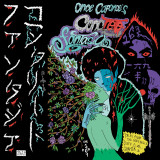
Psych-rap enigma Onoe Caponoe returns with his fifth studio album ‘Concrete Fantasia’ on High Focus Records. In crystal clear communication with the mothership; littered with striking references to fantastical realms and uncommon lore, but very much anchored in the inner city blocks and smoggy roadsides that inform his everyday, ‘Concrete Fantasia’ is a dark fantasy tape that expertly blurs the lines between genres, tones, moods and character profiles.
Of this world and out-of-this-world perfectly poised; Onoe offering up escape portals, before quickly pulling the listener back in with wave-upon-wave of catdelix riptides. ‘Concrete Fantasia’ is something of a tug-of-war; peppering movie samples, vignettes and complex go-betweens tickling the senses, combining with a cacophony of mind-bending lyricism resulting in a singular journey, with Onoe confidently filling the shoes of both author and narrator.
Pinocchio ducking feds in the hood, an Ice King ruling over a frostbitten kingdom, The Cheshire Cat trying to clean up Alice’s act, sweet serenades to off-shore mermaids, the trials and tribulations of life in a haunted trap house, big booty witches, flying carpets and beyond, ‘Concrete Fantasia’ is a real trip through the imaginative mind of Onoe Caponoe. With an eclectic line-up of featured artists and productional talent propping up the fictional cast, ‘Concrete Fantasia’ has all the makings of an alt-rap odyssey for the ages.
- 01: Introduction / Purple Haze Feat. Zdechly Osa
- 02: Slayaz / Elf Island
- 03: Fifi Feat. Lil B
- 04: House On The Hill
- 05: Pet Cemetery
- 06: The Cheshire Cat
- 07: Wipeout
- 08: Afro Samurai / Quest
- 09: Cat Kingdom
- 10: Magic Carpet
- 11: Pinocchio Feat. Jehst
- 12: The Horsemen
- 13: Ice King Feat. Lealani
- 14: Cat In Oz
- 15: Heaven's Gates
- 16: Outsiders
- 17: Psychosis City
- 18: Age Of Aquarius
Psych-rap enigma Onoe Caponoe returns with his fifth studio album ‘Concrete Fantasia’ on High Focus Records. In crystal clear communication with the mothership; littered with striking references to fantastical realms and uncommon lore, but very much anchored in the inner city blocks and smoggy roadsides that inform his everyday, ‘Concrete Fantasia’ is a dark fantasy tape that expertly blurs the lines between genres, tones, moods and character profiles.
Of this world and out-of-this-world perfectly poised; Onoe offering up escape portals, before quickly pulling the listener back in with wave-upon-wave of catdelix riptides. ‘Concrete Fantasia’ is something of a tug-of-war; peppering movie samples, vignettes and complex go-betweens tickling the senses, combining with a cacophony of mind-bending lyricism resulting in a singular journey, with Onoe confidently filling the shoes of both author and narrator.
Pinocchio ducking feds in the hood, an Ice King ruling over a frostbitten kingdom, The Cheshire Cat trying to clean up Alice’s act, sweet serenades to off-shore mermaids, the trials and tribulations of life in a haunted trap house, big booty witches, flying carpets and beyond, ‘Concrete Fantasia’ is a real trip through the imaginative mind of Onoe Caponoe. With an eclectic line-up of featured artists and productional talent propping up the fictional cast, ‘Concrete Fantasia’ has all the makings of an alt-rap odyssey for the ages.
- 01: Introduction / Purple Haze Feat. Zdechly Osa
- 02: Slayaz / Elf Island
- 03: Fifi Feat. Lil B
- 04: House On The Hill
- 05: Pet Cemetery
- 06: The Cheshire Cat
- 07: Wipeout
- 08: Afro Samurai / Quest
- 09: Cat Kingdom
- 10: Magic Carpet
- 11: Pinocchio Feat. Jehst
- 12: The Horsemen
- 13: Ice King Feat. Lealani
- 14: Cat In Oz
- 15: Heaven's Gates
- 16: Outsiders
- 17: Psychosis City
- 18: Age Of Aquarius
Psych-rap enigma Onoe Caponoe returns with his fifth studio album ‘Concrete Fantasia’ on High Focus Records. In crystal clear communication with the mothership; littered with striking references to fantastical realms and uncommon lore, but very much anchored in the inner city blocks and smoggy roadsides that inform his everyday, ‘Concrete Fantasia’ is a dark fantasy tape that expertly blurs the lines between genres, tones, moods and character profiles.
Of this world and out-of-this-world perfectly poised; Onoe offering up escape portals, before quickly pulling the listener back in with wave-upon-wave of catdelix riptides. ‘Concrete Fantasia’ is something of a tug-of-war; peppering movie samples, vignettes and complex go-betweens tickling the senses, combining with a cacophony of mind-bending lyricism resulting in a singular journey, with Onoe confidently filling the shoes of both author and narrator.
Pinocchio ducking feds in the hood, an Ice King ruling over a frostbitten kingdom, The Cheshire Cat trying to clean up Alice’s act, sweet serenades to off-shore mermaids, the trials and tribulations of life in a haunted trap house, big booty witches, flying carpets and beyond, ‘Concrete Fantasia’ is a real trip through the imaginative mind of Onoe Caponoe. With an eclectic line-up of featured artists and productional talent propping up the fictional cast, ‘Concrete Fantasia’ has all the makings of an alt-rap odyssey for the ages.
Reformed Society joins the roster of Brussel's, Belgium's Basic Moves this June with a 2x12'' EP, comprising six original compositions from the New Delhi born now Barcelona based artist. After many years sharing music, Basic Moves boss Walrus welcomes Indian artist Harsh Puri onto the imprint for a special double pack vinyl release. The material was gradually reduced down to the six compositions that make up BM19 after received over a hundred demo tracks from Harsh the past few years.
Much of the release is inspired by UK tech house of the late nineties and the turn of the millennium and embraces a heads down, dance floor focused aesthetic throughout.
Opening the release is 'Constant State Of Hustle', perfectly setting the tone with an amalgamation of bubbling synthesizer tones, a choppy bass groove, sporadic pads and a heavily swung drum groove. 'Touch' then shifts focus over to fluttering stab sequences, bright chords, airy strings and a crunchy rhythm section before 'Hammer The Keys' embraces the core essence of the early Tech House sound, fusing organic percussion with multilayered machine funk melodies, all infused with an underlying acid feel.
Next up is 'Hug Pit' which dives into deep realms via ethereal, cinematic pad textures, wandering resonant synth lines and shuffled drums. The aptly named 'Adrenaline Rush' follows next, picking up the pace again courtesy of a gnarly bass melody, squelchy synth tones and a robust drum machine workout. 'Dream Shuttle' then rounds out the release, employing hazy atmospheric textures and a bumpy bass groove alongside dynamic, crisp drums.
Debut vinyl by Cruz Perro Maldito, a Tenerife based trio forever imbued in the collective imagination and folklore myths of the magical and misty mountain of Agua García, located in Tacoronte district at the foot of Teide Volcano (Tenerife/Canary Islands). Their music is an explosion of free jazz improv where sophisticated sound textures emerg-ing from modular synths and processed guitar create abstract and random rhythmic patterns with complex saxophone lines guiding the ensemble from quiet to menacing passages of sudden bursts of noise and frenzy.
Entitled Truquetin Resorte, the album takes inspiration from the rich history of mechanical automata, such as Talos, the bronze giant who defended the island of Crete and was eventually defeated by Jason and his Argonauts. Or Apega de Nabis, a replica of King Nabis’ wife whom crossed unsuspecting victims with its iron spikes hidden in the device's lower arms, hands and breasts.
Or even René Descartes and his infamous daughter- like Automaton replica, an eerie creation from the renown philosopher to evoke his dead daughter
These myths and more serve as reminder of a mechanical world’s past, a world of complex automata stories with me-chanic ‘imitating’ beings as its problematic protagonists. An eerie counterpoint to our current uber modern digital world and its rapid advancing A.I.s.