Bristol's Tara Clerkin Trio return to World of Echo and the EP format for a five song collection of quixotic, emotional redolence. But do not mistake their absence for inertia. If their musical output has been a little sparse during those in-between years, limited to a few solo ventures and an astonishing ten minute long piece as a trio, their time has otherwise been richly spent: continuous writing and recording, extensive live performances across Europe and Japan, a cultivation of local and more far-flung artistic connections (musical and otherwise), and a monthly NTS show that, through the voice of others, speaks most obviously to their own unorthodox interests. It's the conflux of that winding activity that leads indirectly to On The Turning Ground, 26 minutes of probing, thoughtful composition that draws from no one specific source. Their inspirations might be centreless, but the trio still possess a very obvious anchor in the form of their hometown. Bristol stands as a city of multitudes, heterogenous and vibrant in such a way as to allow it to renew and remake time and again. Tara Clerkin Trio drink from that same well, duly reflecting a rich musical heritage built on fwd-facing electronic subcultures and experimental urges.
As such, On The Turning Ground finds them subject to their own subtle internal evolution, the pervasive sense that you've caught them mid-bloom, on their way to becoming but never anything but themselves. The two instrumental pieces that bookend the EP stand as a perfect case in point, displaying an increasing mastery of compositional space. Pensive and restrained, 'Brigstow' and 'Once Around' both emanate an interstitial quality that's not so much after- as in-between-hours, miniature dub-folk symphonies held together by the kind of tacit understanding that remains the preserve of only the closest of family units. If those two tracks are shaped by a sense of shifting temporality, then the three vocal-led pieces that comprise the record's core feel like a gentle ossifying of aesthetic into something approaching their own unique form of avant-pop. 'Pop' is, of course, a broadly subjective concept, but there's no avoiding the overt sparkling melodicism of songs like 'Marble Walls' and 'The Turning Ground', undeniable re-directions of that late 90s impulse to bend pop sensibilities into off-centre terrain, to render the familiar new again. This is what Tara Clerkin Trio do, gently pulling the ground from under your feet, turning you to face something you'd not quite seen before. To view the world as they do: sideways, sometimes, all of the time.
Поиск:lo fi
Все
- 1: It All Depends On The Pleasure Man
- 2: Watching Heroes Come And Go
- 3: Slide On
- 4: So It Goes
- 5: Let's Start Over Again
- 6: Taoist Tale
- 7: Welcome To Mass Media
- 8: Song
- 9: Advertisement For Amerika
Orange Vinyl with exclusive illustrated notes/lyric insert ltd to 300 w/w.“Zimmerman conjures up a kind of Arcadian folk surrealism that is utterly his own” MOJO Never released before collection featuring Ian A Anderson & Maggie Holland recorded 72-80 is among Tucker’s finest - Free-ranging, Playful, Intimate - his Songpoet imagination unbound and in full bloom now on colour Vinyl for first time with (exclusive to this version) illustrated lyric insert with notes from Tucker.Recorded between 1972-80 this is the first ever release for ‘I Wonder If I’ll Ever Come True’ a stunningly beautiful, homegrown collection by Songpoet Tucker Zimmerman and friends. The range and depth is astonishing. From the heady surreal journey of ‘It All Depends’ Upon the Pleasure Man’, to the uplifting Gene Clark-esque 'So It Goes’, to some of his most beautiful & touching love songs in ‘Let’s Start Over Again’ & ‘Song’. Only one song has seen the the light of day before now - ‘Taoist Tale’ from his 1984 album ‘Word Games’. This recording from a decade earlier loses no power in its folkier stripped down style driven by Tucker’s strong narrative.
While living in bucolic seclusion in Belgium with Marie-Claire, Tucker invited visiting musicians (Derroll Adams, Wizz Jones, Maggie Holland, Dave Evans, Ian Anderson) into his home studio to play and live tape whatever songs he had at hand. Maggie Holland and Ian A Anderson feature, while Tucker found a freeing simplicity in just guitar, ’70s organ, bass and piano. We are so grateful to Ian A Anderson, who carefully kept and curated these recordings from 50 years ago. “Every time I would leave, Tucker would hand me another tape full of songs”. Ian worked with Tucker and ourselves to present this wonderful album. The collection is among Tucker’s finest - free-ranging, playful, intimate - his Songpoet imagination unbound and in full bloom. The ethos, the playing, the freedom, feels like Ronnie Lane’s time in the Welsh Borders. Unhurried, liberated, down-home and cosmic. Extraordinary music made among friends.
"Startling collection of intimate, home-recorded songs from the cult singer-songwriter adored by David Bowie and Big Thief alike.
When I first interviewed Tucker Zimmerman back in 2015 neither of us had any idea that, a decade later, he would be venerated by a new coterie of young fans, touring with maximal folk-rockers Big Thief and recipient of a concerted reissue campaign by the wonderful Big Potato Records. Last year I eulogised the “Arcadian folk surrealism” of his 1974 LP *Over Here In Europe but, if anything, this informal collection of intimate home-studio recordings is even better. Recorded between 1973 and 76 whilst living in Belgium and hosting such visiting folk musicians as Derroll Adams, Wizz Jones, Maggie Holland, Dave Evans, and Ian A. Anderson this is the kind of assured, organic freewheeling folk music that has the mellow, introspective rough-edged feel of some lost private-press LP, the kind rightly revered by Endless Boogie’s Paul Majors as “real people” music. A true find.” Andrew Male MOJO 4/5
“Here's a charming oddity: an unreleased album dating from the mid-Seventies by an American-born songwriter beloved of David Bowie and, more recently, Adrianne Lenker of the folk-rock band Big Thief. Zimmerman's a bohemian type who eschewed the big time for a life of gigging around Europe. He, his wife, Marie-Claire, and a handful of friends recorded these songs in seclusion in the Belgian countryside, and what songs they are. Slide On could have come from the Byrds when they discovered country music, Let's Start Over Again captures the dreamlike experience of being in love with unsettling clarity. This is a real unearthed gem.” 4/5 The Times
Multi Culti seasonal balance returns with Equinox III Kicking things off Guadalajara-based Bofo Dab (known for their blog 'Drops a Banger') does what their name suggests. This one has been getting caned by the Keinemusik crew, legions of phone-holders' shazam-prayers will only now be answered. It's a restrained big-room horn-loaded banger. Mehmet Aslan slides in to the proceedings with an awesome FM-sounding heads-down slice of clubby introspection. Long-time cult-hero Gilb'R of Versatile records fame spaces out the side with a deep, sparkly, live synth jam. On the flip, Mytron brings a fun stripped-back cover of a stone-cold classic with Higher (state of consciousness, that is). Brazillian hotboy Niev sounds right at home on the label with the aptly titled 'Professor Banjo.' Yuki Miyauchi lends an ethereal 90s bleep-inflected chunk of vibe with 'Donkey Conga.' Finally, fellow Japanese but London-based DJ Himitsu drops the deep, rollicking 'Waterfall.'
- 1: Twenty Circles To The Ground
- 2: All Falls Together
- 3: All Gone, All Gone
- 4: Almost Let You In
- 5: In The Avalon/Little Killer
- 6: Don't Take My Night From Me
- 7: Each Star Marks A Day
- 8: Lenore's Lullaby
- 9: The Lily And The Brakeman
- 10: Now, Divide
- 11: What You Reckon, What You Breathe
- 12: For As Long As It Will Matter
- 1334: Blues
- 14: Wooden Heart
Nehmt Euch einen Moment und lässt Euch die Kataloge dieser Meister des amerikanischen Folk auf der Zunge zergehen: MAGNOLIA ELECTRIC CO., CENTRO-MATIC, SONGS: OHIA, SOUTH SAN GABRIEL. Und lasst uns ganz ehrlich sein: Eine Dosis des künstlerischen Egos und ein wenig Eitelkeit können einen höheren Dienst erfüllen. Auf dieser Kollaboration von Jason Molina und Will Johnson scheint der jeweils andere Künstler sein Gegenüber und dessen Talent zu befeuern und sowohl die Performance als auch die Kreativität auf neue Höhen zu befördern. Im brüderlichen Teilen von Ideen werden Molina und Johnson zwei Poeten unter Poeten, die sich in ihrer Werkstatt daran machen, eine einzige, übergeordnete Elegie zu erschaffen. Der einzigartige Stil und die typische Produktion jedes einzelnen Musikers fügen sich hier zu einer gemeinsamen Schnittmenge zusammen. Der dokumentarische Ansatz eines Jason Molina richtet sich ganz häuslich in den subtilen Störungen und Produktionstricks eine Will Johnson ein, während der kräftige Tenor von Molina einen perfekten Tanzpartner in der sanften Reibeisenstimme von Johnson findet. Während die individuellen Performances hier bereits atemberaubend sind, ist die Zusammenkunft beider das, was den Zauber von "Molina&Johnson" ausmacht.
Carlos Giffoni reconnects with Thurston Moore for two sides of loose-limbed axe noise, oscillator worship and hard-phased, Spacemen 3-style feedback.
Giffoni’s been on a roll recently. Since the No Fun founder returned to the scene with »Vain¡, a genius set of synth mutations that appeared in iDEAL back in 2018, he’s been slowly ramping up the activity, dropping the celestial »Dream Walker« on Stephen O’Malley’s Ideologic Organ in 2024 and following it with »Pendulum«, a bumper compendium of collaborations, just a few weeks back. For those who remember Giffoni’s first trip round the block, he was always able to hold his own chopping it up in person, not just by mail.
Just scrub through his early catalog and you’ll see collabs with Nels Cline and Chris Corsano, Merzbow, Jim O’Rourke and Lasse Marhaug, and of course, Thurston Moore. The two rekindle their thing on »IGUANA’« picking up where 2001’s fabled »4 Guitars Live« performance left off. Here, Giffoni straddles a tabletop synth and FX while Moore attacks his signature Jazzmaster with a drumstick and a screwdriver – vibes fully intact.
Moore is on blistering form, sounding as if he’s taken a step back to refresh his approach since the early ‘00s when he could be spotted moonlighting on any number of basement-adjacent noise sides. Sawing at his strings and turning the guitar into a shrieking resonator, he leaves only faint vapours of the classic Sonic Youth sound as opiating accents on his animalistic wails and rumbles. On the opening half, his whammy – assisted shreds are balanced out by Giffoni’s off-world whirrs and airlocked vibrations, building a dense wall of noise towards an unexpectedly elegiac conclusion. At some point, Giffoni’s rasping churr transforms into a simmering shudder and Moore’s into hymnal drones – squint a bit and you could almost call it pretty.
Of course, they ramp things up on the flip, dissolving the melancholia with smokey white noise and twangy, post-Derek Bailey chimes that Giffoni accompanies with aggy oscillations. Like every great taped noise set, the recording quality is crucial - »IGUANA« was captured from the pit by Guillermo Hernandez Avendano, the dad of Lia Miranda who provides the cover photo. It’s that kinda show.
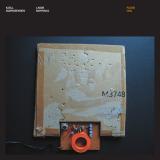
Some years ago, Kjell Bjørgeengen and Keith Rowe attempted to convert video signals into sound by setting up Rowe’s pickups next to an old CRT monitor, turning its magnetic field into a sound generator. Rowe further developed the system with David Jones at Alfred University, slimming down the setup using a copper coil, a circuit board, a video input, and a telephone pickup. Jones named it the »Flood Coil«, and it’s that instrument you can see on the album’s front cover and that lies at the core of these recordings, made without any physical live input from the artists themselves. In essence, it’s generative music in its purest form.
Bjørgeengen’s video feed is generated by oscillators, then routed into Marhaug’s pedals and then back into the Flood Coil, so any visual shifts alter the sound, and any modification to the sound changes the video. The duo have played this setup live many times, but for this studio version they left the system to do its thing without any intervention for two minutes at a time before moving onto the next idea. They recorded hours and hours using this process and then selected 18 highlights for this album, extracting harsh noise, power electronics, lulling feedback drone, and peculiar rhythmic snippets to show the scope of their technique.
A wall of growling, hi-octane Pulse Demon-style noise opens the set, gradually exposing us to more asymmetric textures, shifting through unstable repetitions that transform Merzbow’s metal-inspired screams into »Aaltopiiri«-era rhythmic noise. It’s remarkable, actually, how much Marhaug and Bjørgeengen can squeeze from the system, chancing on shivering, lower-case chugs and pops, galloping drums, soundsystem subs, and grinding blast beats that sound like Napalm Death’s »Scum« piped through a broken amp stack. It ain’t pretty, but noise/industrial freaks will revel in the fierce delights inside.
Following his debut appearance on HABITAT in 2024 with his standout ‘My Eyes Are Failing’ remix, Echonomist returns to serve up his ‘Dominator’ EP - a five-track release that captures the Greek artist’s unmistakable tension, groove, and analogue character, paired with high-caliber remixes from Fango and Toto Chiavetta. With previous releases on Innervisions, Exit Strategy, TAU, and Kompakt, Echonomist has steadily built a reputation for fusing raw emotion with forward-leaning sound design. His prolific output and effortless ability to experiment with various styles have long made him a respected figure within the global electronic landscape. Now, with his ‘Dominator’ EP, he brings that creative force back to Mind Against’s imprint in commanding form.
Opening with the title track, ‘Dominator’ immediately sets the tone: bustling energy, driving drums, and siren-like synths cut through a deep, Detroit-leaning atmosphere. ‘Modulator’ follows with a pulsing, oscillating bassline and rattling percussive breaks that coil around warped vocals. On ‘Use Your Illusions’, the pace becomes chuggier as he combines raw industrial drums with a thudding kick, dubby chords, and fizzing synths. The package is then elevated by two heavyweight reinterpretations, with Fango’s remix of ‘Dominator’ pushing the cut into a more intense, pressure-driven space, upping the ante with amplified rhythmic density. To close, Toto Chiavetta delivers an electro-laden rework, sculpting the track into a dense, atmospheric journey that prioritizes ever-evolving groove and textural depth.
Echonomist 'Dominator’ EP drops via HABITAT on 10th April 2025.
The culmination of an incredible six months of touring the new ‘Aria’ live show, Marsh shares his ‘Aria EP’.
Originally birthed as an audio-visual live concept designed to showcase Marsh’s growing catalogue and the many talented vocalists he has worked with, ‘Aria’ began as two UK shows - the first at London’s premium new venue, HERE at Outernet, followed by a night at New Century in Manchester.
More recently the EP has been supported by a run of eight North American shows including dates at New York’s Webster Hall, Los Angeles’ Fonda Theatre, and a set at Montreal’s Piknic Électronik festival. The ‘Aria’ live show reached its final stop at iconic Colorado venue Red Rocks Amphitheatre for Anjunadeep Open Air - a particularly snowy and enchanting performance for all those lucky enough to be there.
The full EP features two brand new Marsh tracks; ‘Mercy’, a hard-hitting club record known for getting the crowd moving on ‘Aria’ tour dates, and ‘Hope’, a softer track with uplifting vocal samples.
The ‘Aria EP’ is out November 15 on Anjunadeep.
- A1: Healer
- A2: Florence
- A3: Wasn’t Enough
- A4: Lailonie
- A5: Don’t Wait
- A6: Amor
- A7: There For Me
- A8: My Stripes
- B1: Over & Over
- B2: Healer (Guy J Remix)
- B3: Foss
- B4: Beech Street (Simon Doty Remix)
- B5: Foss (Eelke Kleijn Remix)
- B6: Carme
- B7: Beech Street
Brighton-born, Cincinnati-based producer Marsh a.k.a Tom Marshall. ‘Lailonie’ is Marsh’s second studio album and debut Anjunadeep LP. After joining Anjunadeep back in 2018 via ‘Explorations 07’ with ‘Black Mountain’, Marsh has gone on to release a string of well received original EPs including ‘Prospect’ with label mate Nox Vahn, ‘Eu Topos’ and his latest ‘Lost In You’ as well as remixing some of the biggest artists in dance music including Above & Beyond and Armin van Buuren.
Marsh has previously released on Silk Music, where he released his debut album ‘Life On The Shore’ in 2017; and Enhanced Music’s progressive house imprint Colourize. Over the past 2 years, Marsh has become a firm Anjunadeep fan favourite all the while establishing himself as a future star of the electronic scene with a steady stream of tastemaker backing from Joris Voorn, Rufus Du Sol, Kölsch and BBC Radio 1’s Pete Tong and Phil Taggart. Recent years have seen him tour globally with Above & Beyond as well as share the bill with legends like Sasha & Digweed and Guy J.
- A1: The O&Apos;Jays - I Love Music (Dave Lee&Apos;S Sweet Music Mix)
- A2: Patti Labelle - Music Is My Way Of Life (Dave Lee&Apos;S Funk In The Music Mix)
- B1: Earth, Wind &Amp; Fire - Can&Apos;T Let Go (Dave Lee&Apos;S Elevated Mix)
- B2: Cheryl Lynn - You Saved My Day (Dave Lee&Apos;S Tell The World Mix)
- C1: Gladys Knight &Amp; The Pips - Bourgie&Apos;, Bourgie&Apos; (Dave Lee&Apos;S Super Bourgeosie Mix)
- C2: Pockets - Come Go With Me (Dave Lee&Apos;S Found A Place Mix)
- D1: Phyllis Hyman - You Know How To Love Me (Dave Lee&Apos;S Extended Disco Mix)
- D2: Jean Carn - Time Waits For No One (Dave Lee&Apos;S Extended Disco Mix)
Remixed With Love has set the benchmark for disco reworks for over a decade, with Dave Lee universally recognised as the most trusted name in the field when it comes to respectfully updating dancefloor classics from the original multi-tracks.
With original vinyl editions long deleted and constant demand from DJs and collectors, this brand-new one-off, vinyl-only release has been made possible via a fresh licensing deal with Sony Music, allowing eight of the most requested mixes from the catalogue to be pressed together for the first time.
This is not a repress; it is a bespoke, limited selection, and once the pressing has sold through, it cannot be repeated.
- 1: Once, There Was An Explosion
- 2: Alone We Have No Future
- 3: Bridges
- 4: Soulless Meat Puppet
- 5: Beached Things
- 6: Chiral Carcass Culling
- 7: The Face Of Our New Hope
- 8: John
- 9: An Endless Beach
- 10: Heartman
- 11: The Severed Bond
- 1: Claws Of The Dead
- 2: Fragile
- 3: Stick Vs Rope
- 4: A Final Waltz
- 5: Strands
- 6: Lou
- 7: Bb's Theme
- 1: Flower Of Fingers
- 2: Cargo High
- 3: Demens
- 4: Decentralized By Nature
- 5: Mules
- 6: Porter Syndrome
- 9: Stepping Stones
- 10: Frozen Space
- 11: The Timefall
- 7: Chiralium
- 8: Spatial Awareness
After two co-headlining tours over the past decade, (the) Melvins are continuing their long tradition with us of teaming up with another band on an album. Next up – Napalm Death! This isn’t just some split release with the bands each getting a side. Savage Imperial Death March is a full collaboration with both Melvins & Napalm Death playing together on all the tracks.
This release originally came out on super-limited CD and vinyl via AmRep in 2025 (tour and AmRep store only). This will be an extended version with 2 extra songs, brand new artwork from Mackie Osborne, new vinyl variants, and will be the official release for the first time at record stores, DSPs and more.
Napalm Death are credited as pioneers of the grindcore genre by incorporating elements of crust punk and death metal. Even after exerting an indelible influence on the entire world of heavy music for nearly 40 years, there is still no band on Earth that sounds like Napalm Death. Not just pioneers, but an enduring benchmark for invention and fearlessness in heavy and experimental music of all kinds, the Birmingham legends are still hurtling forward at full pelt.
The Melvins are one of modern music’s most influential bands. Having formed in 1983, the group — founded by vocalist/guitarist Buzz Osborne, with drummer Dale Crover joining a year later — has been credited with merging the worlds of punk rock and heavy music, forming a new subgenre all their own. Over their 40-plus-year career, they’ve released more than 30 original albums, numerous live records, and far too many to count singles and rarities.
A cocktail of rebellious queer vocal fragments, deceptive percussive granules and swaying hammered vibrations, upsammy and Valentina Magaletti's first collaboration trembles with suspense. The seeds of 'Seismo' were sown following a commission from Amsterdam's Rijksmuseum to soundtrack an exhibition of work from the Museum Boijmans van Beuningen in Rotterdam and the duo didn't want to approach their collaboration flippantly. So, wandering the museum's maze of rooms, they recorded various improvised percussive sounds with their arsenal of microphones, using the space to inform various rhythms and textures that were sculpted later into electroacoustic vignettes. This was just the starting point, though; as Magaletti and upsammy began performing together, the project evolved and 'Seismo' began to take shape. The duo had struck on a salient aesthetic concept, using mostly digital and acoustic mallet instruments to blur the boundary between their roles and create friction between the synthetic and the authentic. And the finished record is a phantasmagoric push-and-pull between its various conflicting elements: harmony and dissonance, randomness and predictability, openness and constraint. 'Seismo' isn't the first time that upsammy has studied her environment in search of revelation. On her acclaimed second album, 2024's 'Germ in a Population of Buildings', the Amsterdam-based DJ, producer and multidisciplinary artist erected her complex, unorthodox rhythms and eerie melodies around a modernist frame of field recordings collected in various cityscapes, countering heavyweight basslines with subtle, microscopic sounds. London-based Italian vanguard Magaletti, meanwhile, has applied her unique logic to innumerable projects at this point, working with everyone from batida icon Nídia and hardcore-dub outfit Moin to French writer Fanny Chiarello and British bass scientist Shackleton. For years she's approached the drums with criticism, attempting to challenge any preconceptions, something that's most visible on 2020's 'A Queer Anthology of Drums'. And both artists' thoughtful perspectives are welded together seamlessly on 'Seismo', a dizzying suite of eight eccentric statements that's fragile but never insecure, gauzy but not indistinct. An unnerving sense of space characterizes 'It Comes to an End' as Magaletti's in situ improvisations herald for upsammy's microscopic glitches and chiming pitch-bent melodies. It's almost unbalancing to witness the track's impossible dimensionality, the interplay between reverberant marimba hits and bone-dry synths, or percussion that's been recorded and processed in consciously different settings. A new architecture emerges in the sound itself that the two artists scan and explore meticulously, testing its boundaries with undulating hybridized rhythms on the invigorating 'Superimposed' and offsetting the powdery drums with liquified smacks and alien voices. The duo's vibrations are knotted with piano flourishes on 'Hyperlocalize', balanced with artificial clanks and clangs that disappear into the track's sonorous atmosphere, replaced by whispers and half-hallucinated insectoid chirps. 'Seismo' is an album that feeds off the energy generated by its juxtapositions: the tension and anticipation that's melted by rapid, hyperactive movement and the finely drawn rhythms disrupted by a layer of indistinct, barely perceptible microsounds. It's a collaboration that sounds like two minds challenging each other but not wrestling, each peering from their own distinct vantage point and imagining a third landscape shaped by optimistic, queer vibrations.
As Nathan Fake rises from the nocturnal subterranea and rave catharsis of his previous records, on Evaporator, he resurfaces into the domain of daylight, bringing a tangible sense of air rushing against your face, of big skies, and endless landscapes.
The idea of pop accessibility that trickled into 2023’s Crystal Vision is refracted here through the prism of sweeping ambient, deep electronica, and trance uplift. Evaporator is Fake’s idea of “airy daytime music”, with each track a different barometer reading across the album’s varying atmospheres, which range from vibrant sunbursts, bracing rainscapes, and fine mists of clement melodics. “It’s not overtly confrontational electronic club music,” states Fake. “It’s quite pleasant, it’s accessible. As I was progressing through making the tracklist, I called it a daytime album. It doesn’t feel like an afterparty album.” For the past decade Fake has been gingerly introducing collaborations with heroes and friends alike into his lone, idiosyncratic working process.
Border Community alumni Dextro AKA Ewan Mackenzie transmutes his ferocious drumming for Pigs Pigs Pigs Pigs Pigs Pigs Pigs into the blurred choral thump of ‘Baltasound’. ‘Orbiting Meadows’, meanwhile, is his second collaboration with Clark, an eerily idyllic duet where microtonal 18EDO piano clangs slowly twirl around wailing pads. Evaporator marks the junction point of old technology and ever fresh creativity for Nathan. The trusty “dinosaur” age software, particularly Cubase VST5, that has powered two decades of music is rarely updated. “I used to sort of feel a bit ashamed of using such old software, and then I kind of had an epiphany – that’s just how I work”, comments Fake. “That’s just how I play. I’m very fond of these old tools, and I get the most joy out of them, but now I’ve incorporated new technology too.” When an artist accumulates so much synergy with their instrument, music making becomes instinctual. By Fake’s account, much of Evaporator just fell into place. The album title arrived randomly in his head (“it felt completely perfect. Airy.”), ideas looped and developed until things locked into place and just felt right. ‘The Ice House’ is a fleeting glimpse of the sonic world he taps into in this creative state, its glassy FM synths built around a counterpoint between rough-hewn crystalline arpeggios and sparse yet gravitas-bearing bass. “That riff I just wrote out on the keyboard, I just played it forever and ever and ever.
The original track ended up being really short. Here you go, and it’s gone!” These unplanned channellings of sound call forth records from Fake’s past while he looks ahead, perhaps getting at the very essence of his musicianship. The opener ‘Aiwa’ (“the breeziest,” he muses) reminds of the introspection that characterised Providence, excited by the fire and grit of Steam Days’ textural experiments, its chunky slams and clatters surging into a flood of harmonic buzzing as they reach out for old wisdom. ‘Hypercube’ stampedes in a similar chronological confluence, infusing an incessant synth line reminiscent of the golden age of rave with the crackling, ecstatic energy of modern festival anthems. Like the vaporisation of liquid to particles, everything that Evaporator presents has a mutant desire to be amorphous. Sounds rarely settle; the irradiated garage beat of ‘Bialystok’ is pitched downwards to driving, rebounding effect, while ‘You’ll Find a Way’ warps static into shivering energy, cinematic synth strings building anticipation into a gradual gush of chords. This translates into a more expansive stereo field than Fake has explored before.
‘Slow Yamaha’ saves the wildest, most kinetic transformations for last with a cornucopia of crispy melodies and fried drums; a sibilance of cymbals on the left, a susurrus of shakers on the right, and kaleidoscopic lasers pulsing and fizzing all around. Evaporation culminating in pure excited atoms.
2025 Reissue.
Münchenbuchsee, a suburb of Bern, Switzerland. Stephan Eicher is the youngest of three children. His father, a radio and TV repairman, is also a jazz violinist and a sound tinkerer in his spare time. In the family home's converted fallout shelter turned studio, Mr. Eicher experiments with homemade sequencers, tortures handcrafted drum machines, and abuses reel-to-reel tape recorders—all under the fascinated gaze of young Stephan.
The boy quickly develops a musical curiosity, exploring sound through various experiments and wanderings. Alongside his younger brother Martin, Stephan crafts audio plays on a homemade multi-track recorder (essentially several cassette decks hooked together!), which they write, record, add sound effects to, and perform for family and friends. Just a couple of nice kids, really...
Then comes 1972, and Lou Reed's Transformer album changes everything for the Eicher kids. For 13-year-old Stephan, it's a revelation—especially "Vicious", the opening track, which he plays on repeat for months. He convinces his father to buy him an electric guitar. Not stopping there, his father also builds him a tube amp using an old radio.
Then comes adolescence. A rough one. Stephan leaves home at 16 and moves to Zurich. With obvious artistic talent, he persuades his art teacher to help him get into F+F, a radical, alternative art school—despite his young age. Accepted, he starts learning video techniques, determined to become a filmmaker.
At F+F, Stephan organizes Dada-style happenings and concerts with a group of friends known as the Noise Boys. Among them: one of his teachers on bass, Veit Stauffer on drums (who would later found ReR/Recommended Records), his girlfriend Sacha on vocals, and Stephan on guitar. In one of their early performances, they release a remote-controlled mouse covered in dull razor blades into the audience to create panic and chaos. Keeping with this aggressive, confrontational spirit, they once played a concert while wearing headphones blasting Tristan and Isolde, trying to perform their own songs simultaneously—to maximize the cacophony. The goal was always the same: clear the room.
Their “songs,” if you can call them that, followed suit. Take "Hungeriges Afrika", for instance—performed entirely with power drills and some drum feedback.
To make ends meet, Stephan returns to Bern on weekends to work as a waiter at the Spex Club, the city’s main punk venue. On September 16, 1980, during a show by proto-electro group Starter, the police raid the club and arrest everyone. Stephan, who manages to avoid arrest, seizes the opportunity to “borrow” Starter’s gear left behind. He suddenly finds himself in possession of a Roland Promars synth, a Korg MS20, and a gorgeous CR78 drum machine, which he runs through a Big Muff distortion pedal to get that perfect gritty sound.
He then sets out to reinterpret some Noise Boys tracks, reworking them during impromptu sessions recorded on a dictaphone (yes, a dictaphone—now the lo-fi sound makes more sense, doesn’t it?). He ironically titles the resulting cassette "Stephan Eicher spielt Noise Boys" ("Stephan Eicher plays Noise Boys"). This gem features seven tracks, which are the ones reissued here.
Back in Zurich, he visits his friends Andrew Moore and Robert Vogel, who have a DIY cassette duplication setup. They make 25 copies of Stephan Eicher spielt Noise Boys for Stephan and his friends. Robert encourages him to visit Urs Steiger of Off Course Records and play him the tape.
Without much hope, Stephan shows up at Urs’s office. But Urs is instantly hooked and suggests releasing a 7” single. Due to space constraints, they reluctantly drop two of the seven tracks ("Hungeriges Afrika" and "One Second"). As for the musical score featured on the cover—it was randomly chosen and remains a mystery to this day. Calling all music theory nerds!
The 7-inch is pressed in 750 copies and released in the first week of December 1980—a date Stephan remembers well, as it’s the same week John Lennon was killed. Smartly, Urs sends a promo copy to François Murner, Switzerland’s answer to John Peel, who hosts a show on alternative station Sounds. Murner falls in love with the record and starts giving it airtime. To Stephan’s surprise, sales follow—and people actually seem interested in his music.
Even this modest underground success scares Stephan a bit. He stops making music for a year and moves to Bologna, where he works as a programmer at Radio Città, a feminist radio station.
Meanwhile, Stephan’s younger brother Martin, who’s also involved in the punk scene, joins the band Glueams as a singer and guitarist. Glueams, named after the fanzine run by two of its members (drummer Marco Repetto and bassist GT), eventually rebrands as Grauzone. Stephan is invited to their shows to project hacked Super 8 visuals live on stage.
Urs Steiger, now working on a compilation titled Swiss Wave – The Album, asks Grauzone to contribute alongside bands like Liliput, Jack and the Rippers, The Sick, and Ladyshave (Fall 1980).
For the album, Martin tasks Stephan with producing their recording sessions. Under Stephan's artistic direction, two tracks emerge: "Raum" and "Eisbär". During "Eisbär", Martin plays a minimalist bass line borrowed from post-punk band The Feelies (just an open string). Drummer Marco Repetto struggles to keep time. Later that evening, unhappy with the takes, Stephan builds a four-bar drum loop from a ¼-inch tape and uses it instead of the flawed original. He then adds bleepy synths and wind sounds to complete the track’s icy vibe before handing it over to Urs.
The Swiss Wave – The Album compilation is released quietly at first, but things snowball thanks to "Eisbär", which eventually becomes a smash hit—selling over 600,000 singles.
Meanwhile, Stephan plays in a rockabilly band called SMUV (named after Switzerland’s social security agency) and begins producing artists, including the debut album of Starter (1981), which includes a more pop-oriented version of "Minijupe".
By early 1982, Stephan starts spending time with the post-punk girl band Liliput (formerly Kleenex). They’re older than him, and he happily drives them around in his Renault Major, acting as their roadie.
By 1983, Grauzone—signed to the major label EMI, which turned out to be a misstep—is falling apart. Stephan begins to pivot toward a more mainstream pop sound with his debut solo album Les Chansons Bleues.
But that... is already another story.
The earliest foundations of the Detroit Harmony group ‘The Gaslight’ came when future lead singer Oliver “Butch” Cheatham via an introduction by his sister Jackie joined a group known as ‘The Young Sirs’ who recorded, “There’s Something The Matter (With Your Heart/African Love” for Magic City during 1969. The group included Oliver’s future brother -in-law Allen Cocker (Jackie’s future husband).
Oliver and Allen went on to form a new vocal quartet with Curtis “Kippy” Anderson and Michael Eatmon. Under the group name of ‘The Gaslight’ they signed to Uptight Productions Incorporated, a local production company founded by local businessmen Marvin Figgins and Arnold Wright. The Gaslight were the only vocal harmony group signed to Uptight Productions and as such, it was they who made the most recordings across two label imprints Grand Junction and Black Rock. The Gaslight’s first single “I Can’t Tell A Lie/Here’s Missing You” was released on Grand Junction (GJ1001) in 1970, For the groups second single Figgin’s placed them under the guidance of legendary producer/songwriter, the late George McGregor under whom they recording “Drifting Away/If You See Her” Grand Junction (GJ1002) released in 1971 For their next release Figgin’s switched the group to his Black Rock label to record “Out Of My Hand/I’m Only A Man” Black Rock (2002) under the pseudonym of Butch & The Newport’s With “Butch” being Oliver’s nickname. A later, second release of “I’m Only A Man” but with a different flip side “I’m Gonna Get You” came out on Grand Junction (GJ1100) in 1973 with the performing artist credits reverting back to ‘The Gaslight’.
Upon leaving Uptight Production’s the group found a new home when George McCregor took them to a new fledgling label T.E.A.I (an abbreviation for “Tellin’ Everybody About It”) owned by ‘The Dramatics’ Road Manager Charles Underwood. ‘The Gaslight’s’ first and only release for T.E.A.I, was the mellifluous 1975 double sider “Just Because Of You/It’s Just Like Magic”. Underwood had precured a working relationship with Polydor Records who picked the release up for national distribution three months later. As good as the record was due to poor promotion it failed to make any notable noise and eventually sank with the group soon after breaking up.
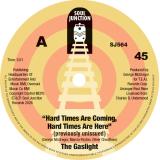
During Soul Junction’s later dealings with the late Oliver Cheatham, respected UK Collector Andy Rix mentioned he owned a three track acetate containing the two mentioned T.E.A.I/Polydor tracks plus a third unissued dance track “Hard Times” which through a licensing deal with Charles Underwood Soul Junction now present to you on a three track 45, released under its full title “Hard Times Are Coming, Hard Times Are Here” backed with a previously unissued mix of “Just Because Of You” alongside the issued 45 version of “It’s Just Like Magic”.
- A1: Chairman Of The Board - Life And Death In G&A (Part 2)
- A2: Curtis Mayfield - (Don't Worry) If There Is A Hell Below, We're All Going To Go
- A3: The Temptations - Psychedelic Shack
- A4: The Chambers Brothers - Time Has Come Today - Single Version
- A5: Brutal Force - The Number For Groove
- B1: Isaac Hayes – Hyperbolicsyllabicsesquedalymistic **
- B2: Bobby Womack - California Dreamin
- B3: The Five Stairsteps - Dear Prudence
- B4: Ebony Rhythm Band - Drugs Ain't Cool
- B5: Doris - You Never Come Closer
- C1: Terry Callier -You Goin' Miss Your Candyman
- C2: Rodriguez - Sugar Man
- C3: Patti Drew - Hard To Handle
- C4: Marlena Shaw - Liberation Conversation
- C5: El Michels Affair - Murkit Gem
- C6: Janko Nilovic - Drug Song
- D1: Kylie Auldist - Nothin' Else To Beat Me **
- D2: Khruangbin - Maria También
- D3: Christian Madden & The Enemy Chorus - Twice As Thick
- D4: Gabriels - Love And Hate In A Different Time
- D5: Michael Kiwanuka - Black Man In A White World
- D6: Mrcy – Purple Canyon
‘Soul Psychédélique’, released on Two-Piers, takes you on a journey into the world of Psychedelic Soul & Funk, from its early beginnings in the 1960s and 1970s to the current crop of artists championing the more Psychedelic, Trippy end of the Soul sound today.
‘Soul Psychédélique’ brings together legends of the Soul Psych scene, such as Curtis Mayfield, The Chambers Brothers, Marlena Shaw, The Temptations, and the brilliant ‘Sugar Man’ by Rodriguez. Place alongside Soul Titans like Isaac Hayes, Bobby Womack, Chairman of the Board, Terry Callier all delivering stunning Psychedelic Nuggets for your Listening pleasure. Throw in some covers like ‘Dear Prudence’ by The Five Stairsteps, ‘Hard to Handle’ by Patti Drew and ‘California Dreamin’’ Bobby Womack and finish with some brilliant modern-day exponents of the scene like Khruangbin, Gabriels and Michael Kiwanuka. The result is a crazy ride through the world of Psychedelic Soul and Funk. If you ain’t dancing and smiling by the end - what the hell is wrong with you!
‘Soul Psychédélique (The Best of Lounge & Exotica 1954-2022)’ is the fourth instalment in the ‘Psychédélique’ Compilation series on Two-Piers, following the critically acclaimed ‘Pop Psychédélique (The Best of French Psychedelic Pop 1964-2019)’, ‘Garage Psychédélique (The Best of Garage Psych and Pzyk Rock 1965-2019)’ and ‘Lounge Psychédélique (The Best of Lounge & Exotica 1954-2022)’ and is available on 2LP Coloured Vinyl
- A1: Sweet Fruity Brunch - Red Parrot (Scruscru 12" Remix)
- A2: Bralan Arias, Craftsmanship - Rhythm Roulette (Scruscru Remix)
- A3: Fred Aster - Matine (Scruscru Remix)
- B1: Delfonic - Gift Of Love (Scruscru Rework)
- B2: Dj Legeres - Walktowalkin (Scruscru Mustplayable Remix)
- B3: Nico Cortazzo - Empyrean Jazz (Scruscru Remix)
The super rework magician Scruscru has been cooking up more goodness for Volume two of Blur's ReWax EP, and it's packed with disco-meets-jazz house class. First up, he tackles Sweet Fruity Brunch's 'Red Parrot' and makes it into a rolling jam with lush pads. Elsewhere, 'Rhythm Roulette' has punchy drums but plenty of piano euphoria, 'Matine' becomes a coy and funky number and 'Gift Of Love' is a romantic heart 'WalkToWalkIN' is a shuffling and jazzy vibe and 'Empyrean Jazz' closes with some spiritual percussion and gentle horns that will always seduce once the lights go low.
- 1: Fuenarinu
- 2: Kaendaiko
- 3: Tsubakishishaku No Yuigon
- 4: Tengindoujiken
- 5: Kindaichikousuke Nishie Yuku
- 6: Ougonno Furuuto (Flute)
- 7: Yubi
- 8: A=X, B=X A=B
- 9: Chi To Suna
- 10: Tabiyukumonoyo
- 11: Akuma Fuewo Fukite Owaru
We've got a bit of an obsession with Hozan Yamamoto here at Mr Bongo! A legend of Japanese jazz, he is rightly regarded as a true master and was recognised as a "living national treasure" by the Japanese government in 2002. Over five decades he pushed the genre into new directions, absorbing fusion, funk, spiritual jazz and many other sounds, resulting in a discography studded with gems of rare beauty. Exploring his back catalogue has taken us on an engrossing journey that now sees us reissuing another work from this ground-breaking musician.
Though not translating perfectly into English 'Akuma Ga Kitarite Fue Wo Fuku', (kitarite has not been a modern expression in Japanese) roughly means 'The Devil Comes Playing The Flute' / 'The Devil Is Coming While Blowing The Whistle' or 'Devils Flute’. It is the original soundtrack to Kôsei Saitô’s 1979 mystery and suspense movie, ‘Devil’s Flute’. The film is based on a story by the famous author, Seishi Yokomizo, and is centred around a much-loved fictional Japanese detective, Kosuke Kindaichi. A Japanese Sherlock Holmes that has been popular for generations.
Hozan Yamamoto was invited to compose the soundtrack directly by the producer of the film, Haruki Kadokawa. Mr Kadokawa also hired keyboard player and producer Yu Imai as assistant producer on the project, resulting in a stunning cosmic, breaks and beats-laden, funk, disco soundtrack extravaganza.
When it comes to the soundtrack and the technology of the time, Hozan Yamamoto and Yu Imai got inventive, tripped out, funked up, and experimented, creating a quirky soundtrack masterpiece that needed to be heard more outside of Japan. Differing from the more traditional Japanese music orientation of some of his other albums such as 'Beautiful Bamboo-Flute' (also released on Mr Bongo) the album showcases a number of genres, from lush atmospheric incidental music to disco and funk grooves, experimental nuggets, drum and flute workouts, to neo-classical and more.
A special record that showcases the further depths of this wonderful musician's talents.
Ashley Tindall, AKA Skeptical, returns in peak form with Blimp EP — the fourth release on his Rubi Records imprint — delivering four meticulously crafted cuts of uncompromising drum & bass.
Opening with the title track, Blimp sets the tone with a deep, steppy wobbler that nods subtly to the title track from his second Rubi Records release, Capsize EP. All the signature Skeptical hallmarks are here: hypnotic, pared-back metronomic drums and shimmy-inducing, undulating subs that demand movement. Yet this time there's a noticeable shift — warm, underlying melodic pads bring an unexpected emotional depth. It's not dreamy, but it is more introspective than we're used to, showing another layer to his sonic palette.
So Good flips the script entirely. A dark, cinematic growler, it leans into ghosted vocal fragments and a futuristic film-noir aesthetic. Tense, claustrophobic rhythms and sinister textures create an unsettling atmosphere — tailor-made for those lights-out, pressure-heavy dancefloor moments.
Third comes the undeniable monster of the EP, Technology. Trademark "stink-face" Skeppiness is in full effect from the first bar. Disjointed sci-fi stabs and eerie pads collide with clinical, almost militaristic drum programming, all anchored by a devastatingly weighty bassline. Movement isn't optional — this is pure Skeptical, uncompromising and lethal.
Closing the EP is Bad Generation, a sound system–influenced weapon that finds Skeptical operating at his dubwise best. Fusing minimal D&B with heavyweight, roots-inspired rhythms is no easy task, but here it's executed with effortless authority. It's equally suited to shelling down a rave or getting lost in a deep, eyes-closed session.
Four tracks. Four distinct moods. 100% Skeptical.
Blimp EP confirms once again that his sound continues to evolve — sharper, deeper, and more refined with every release.
Support: Ben UFO, Joy Orbison, Gilles Peterson, dBridge, Break, DLR, Doc Scott, Mefjus, Kasra, Kings of the Rollers, Alix Perez, Jubei, Dub Phizix, Flight, Tasha, Loxy, Lens.