After an extended interval between releases, Data Arts Group owner/operator Document Swell (real name Simon Cotter), presents his first full length LP "Hybrid Emotion". Document Swell's first musical contribution to Data Arts Group is also the first vinyl release for the label and brings DAG into the new world of 2022 and beyond. Song-writing, and sound sketches for "Hybrid Emotion" took place over a time span of approximately 5 years in various bedroom studios and life-phases throughout northern Melbourne/Naarm, as well as small setups in the Berlin localities of Templehof and Schöneberg. Arranging and mixing was completed in Northcote, throughout that period of ample time in Melbourne's Covid-19 lockdowns. The album spans a rich tapestry of ideas and moods which can be perceived as something between Document Swell's classic playful dance floor style to a more reflective and brooding tone.
The opening track "River Heart", is built of rudimentary pitched percussion, warm Juno pads and randomised Blofeld synthesis to construct an electronic impression and nostalgic sense of life by the river. The title track "Hybrid Emotion" brings the album closer to the realm of the club with relaxed house grooves and moody but spirited melodies, along with hybridised vocal samples."Why Then Here" pushes the album's character towards something less human, with a more synthetic affection portrayed by repetitive vocal samples and individualistic synth tangents. "Now and Then" realigns the trajectory to a warmer and more predictable landscape with chugging Balearic rhythms, glassy synths and jottings of lush electric guitar. On the flip side, "Day of Thunder" drops things down into an animated variety of industrial darkness, with heavy weight kick drums, metallic percussion and bleak vocal messaging. "Little G", an ode to a well loved cat, lightens things up instantly with playful synth noodlings, disco beats and clatter from pots and pans. "Vergangenheit" exhibits Simon's explorations into the acid world, with 303 squawks, cassette crunched drums and shadowy synth pads. The closing track "Epic Sands" ends the album, not with an end note, but a sense of ongoing possibilities.
Search:loca
‘Bye Bye’ is a three-track offering from Philadelphia-based
sextet Blood, that rarely stays put in one style for long.
All three songs were recorded by the band throughout the
pandemic, providing a uniting force whilst touring remained
impossible.
The tracks are a testament to the unforgiving and rewarding
process of self-recording. The band found great relief in
finally having the time to flesh out an experimental
atmosphere without the constraint of paid studio time.
Blood are proud of the work they’ve made, but it is
imperative to mention that all three tracks were brought to life
in a way not formerly thought possible, by the mixing
brilliance of Nancy Conforti.
‘Money Worries’ finds Blood slingshotted over an open letter
to their landlord. What starts as a clear threat to an obvious
albeit deserving villain, soon caves into an acoustic respite,
in which the nightmare of financial ruin becomes lullaby.
Blood began as a solo project of current lead singer Tim
O’Brien in the winter of 2017. After going through several
line-up changes throughout 2018, the current iteration began
making waves in the bijou punk scene of Austin. They were
considered “a live staple in their own prospective scene” and
“one of Austin’s buzziest new acts” by press nationally and
locally.
After twice touring the US, Blood were poised for a big 2020
when plans were altered drastically by the pandemic. They
then self-released their debut EP, ‘Why Wait Til’ 55, We Might
Not Even Be Alive’, in April of that year.
In 2021, the sextet made a move to West Philadelphia and
began recording their upcoming release, ‘Bye Bye’, while
also playing shows throughout the North Eastern United
States. At this time, the group live in a seven-bedroom house
with a converted basement for recording and rehearsing.
The Entertains were a vocal group from Cleveland Ohio whose line up at different times varied between four to five members. Initially signed to Belkin Productions in Cleveland the group were persuaded by Nick Holiday to move to his Pittsburgh Steel Town Records Label. The group had already been working on two songs penned by C-Way Productions Richard Calloway who had strong links with Cleveland through his work with Jesse Fisher and Lester Johnson at Way Out Records. The two songs in question being “Love Will Turn It Around” and Why Couldn’t I Believe Them”, demo cuts of both songs where touted around to several major labels with 20th Century showing some serious interest, but the owner reputedly turned down 20th Century’s advances and instead chose to release the songs on his own Steel Town Label. Recorded at Jerree’s Studio in New Brighton P.A with the musical arrangements being provided by Don Groton, The Entertains 45 received limited local airplay reputedly due in part to Holiday’s refusal to provide a set of Dining Room furniture for an influential local radio promotion man. Greater radio play was eventually received with “Love Will Turn It Around” gaining air time on WANN, Annapolis Maryland’s largest Black radio station, courtesy of Disc-jockey Charles “Hoppy” Adams. For a time, a popular tune throughout Baltimore, Washington and Delaware without breaking out nationally. Wider appreciation of the Entertains 45 would come from foreign shores as copies of the 45 found their way in the UK. The effervescent dance side of the 45 “Love Will Turn It Around” was heavily championed by Legendary DJ Colin Curtis and became a firm favourite with the dancers within the Highland Room of the Blackpool Mecca and subsequent Northern Soul venues of the time. The Entertains line up on the Steel Town sessions where Donald Rice, Howard Rice (the cousin of Donald) Alfred Wilson and Andrew Wright the lead vocalist on all The Entertains songs. During 1978 Richard Calloway held a second recording session on The Entertains again at Jeree’s Studio’s which yielded a further two songs “I’ll Answer You With Love” and “Your Love I Give It Up” which due to lack of finance at the time of their conception remained in the can. These two songs have now been brought to life through Soul Junction’s licensing deal with C-Way Production’s in the format they originally intended for. The A-side of the release is the emotional charge stepper “I’ll Answer You With Love” with the opening monologue parts been performed by Howard Rice. While the B-side “Your Love I Give It Up” is a punchier up-tempo version of Richie Merrett’s earlier C-Way Records recording “I Gave It Up”, the flipside to “You’ll Always Have Yesterday Standing By” (C-way 103).
In later life Donald Rice would perform with Lonnie Turner Jr a former member of the Detroit groups The Mighty Lovers (Boo-Ga-Loo and Soulhawk) and Innervision (Private Stock and Ariola America) and his daughter Africa Turner in a vocal combo known as The Ambassadors Of Soul, sadly Donald has now passed. It is believed that the other members of The Entertains are still out there performing solo or as members of other different groups.
In their first outing since They Can't Be Saved, released on Skam in 2020, they enlist British rapper King Kashmere, who features on two tracks. Where James Ruskin has appeared
on Tresor Records for his seminal albums Point 2, Into Submission, The Dash and his recent Siklikal EP, the only appearance of Mark Broom on the label is a 2002 remix of
The Golden Apple by Eddie “Flashin” Fowlkes.
The duo unveiled this new work and collaboration with King Kashmere in a live show for a 30th Anniversary event for
Tresor Berlin televised on Arte, performing amidst a battery of lights and fogged-up refraction. It demonstrated their
rough-hewn fundamentals, roving melodies and investigative power, newly advanced by voice.
Death Switch is the first appearance by King Kashmere, savaging questions on segregation and suering, encoding
into our brains the much-repeated refrain - “You wanna know, why they wanna flip the death switch“. Spinning Globe
captures Kashmere in a gritty flow over a swaggering beat, bouncing and resonant. This unsanded voice lends an
enhanced texture and tension to the highly-processed sonic palette of Broom and Ruskin, accumulating with innate mettle.
Elsewhere, Appi dredges depths as widescreen beats lurk, digital artefacts pave the way to a hauntingly melancholic
coda. Lacovset features singer Ella Fleur who has worked with Mark Broom on his solo release Fünfzig. It enacts a
pointillist gated vocal alongside dolphin-like percussive communications. On LFIVE, the duo embalms their sonic textures with digital eects that flutter austerely with
syncopation in the crosswind of a beat that recalibrates at points.
An urgency slowly draws in on title track Slinky through fizzing electronics and fractured drums all corroded. Eem
locates a semblance of euphoria, with a tranceinducing release led by swirling arpeggios. Closer KZAP finds
the calmest moment on the record, with its wafting, nebulous synths and swamped hip hop beat.
Slinky finds an ever-evolving project, The Fear Ratio shapeshifting by bringing in the voice into their work and
continually pushing with their incredibly-eected rhythmic styles and peculiar, wandering synthesis.
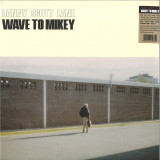
Wave to Mikey, the fourth album from the Los Angeles-based actor, musician and photographer Danny Lane is a nocturnal, neon-lit ode to the friendships that shape us. “I made this album for my friend Mikey from back home,” Danny explains. “We were pretty much inseparable for a large part of our lives, and our musical and social minds were always in sync in a special way. Then with age, we drifted apart, especially since I moved to Los Angeles. This album is just a little wave hello to an old friend and a kindred spirit.”
Equal parts avant-garde composition, instrumental city-pop, ambient, Kankyō Ongaku (environmental music) and Fourth World music, Wave to Mikey is an impressionistic and reflective cycle of eleven richly detailed memory portraits. Throughout the album, the influence of Jon Hassell, Arthur Russell, Hiroshi Yoshimura and Yellow Magic Orchestra hangs in the air like late-night mist, adding character but never overshadowing the rhythmic ambience of Danny’s musical visions.
Wave To Mikey began as a series of sketches on analog synthesisers, guitar, sample and found percussion sketches, initially recorded in Danny’s home studio. Once he’d located the vibe, Danny called on his friends E Talley II, Solange collaborator John Carroll Kirby and Destroyer session musician Joseph Shabason, who respectively added flute, spiritual synth textures and saxophone to the record.
For Glossy Mistakes founder Mario G.R., who originally discovered Danny through his photography, Wave To Mikey captures a vivid feeling of melancholy and peace. “He's able to encapsulate emotions in a very straightforward way, either in his portrait or songs,” Mario says. “I think that's a kind of virtue or skill given to talented artists, no matter the field.”
Born and raised in Staten Island, New York, Danny began playing music with his friends when he was thirteen, before putting that passion on pause to study Fine Arts (Theatre) at Rider University in Lawrence Township in pursuit of an acting career. Acting led him to photography, after playing a photographer in a film, he was inspired to pursue the medium. Danny began shooting photos on film for magazines and lifestyle brands, spent a stint living in New York’s Chinatown neighbourhood, and eventually relocated to Los Angeles in 2017.
Four years ago, Danny started recording and releasing music under his own name, leading to the trilogy of releases that preceded Wave To Mikey, How To Empty A Cup (2019), Memory Record (2019) and CAPUT (2021). Over the course of these releases, he’s revealed himself to be a sophisticated composer and producer with a studied ear from years spent digging through record bins for ambient, experimental, new age, jazz and electronica records from around the globe, with a particular emphasis on Japan.
“Music is something that’s always been involuntary for me,” Danny reflects. “It’s unconditional, always there. It’s something I just have to do. I’ve taken breaks and it’s always gloomy when I’m not playing. I just want to get better and better and understand more and more.”
Here at Glossy Mistakes, Wave To Mikey marks our second contemporary album release, following on from Evenings by Japanese composer Metoronori. We’re proud to be able to present Danny, Metoronori and other modern musicians' work alongside reissues of classic works from Stevia aka Susumu Yokota, Akira Ito, Yuji Toriyama & Ken Morimura, and Takashi Kokubo.
Mastered by Damian Schwartz, Wave To Mikey will be released on Vinyl LP Glossy Mistakes on June 27 2022. Besides the regular black vinyl, a limited clear vinyl will be available in an edition of 100 copies. Both editions come packaged with original cover art photography shot by Danny.
A soundtrack of Sudan's revolution and the first ever international release of the Beja sound, performed by Noori and his Dorpa Band, an unheard outfit from Port Sudan, a city on the Red Sea coast in eastern Sudan and the heart of Beja culture.
Beja Power! is a living archive of the finest, most heartfelt Beja songs—a six-track portal to another time and place, of melodies long forgotten and never before interpreted by an electric and brass-driven ensemble. Few older Beja recordings were produced. Even fewer, if any, remain.
Electric soul, blues, jazz, rock, surf, even hints of country, speak fluently to styles and chords that could be Tuareg, Ethiopian, Peruvian or Thai—all grounded by hypnotic Sudanese grooves, Naji's impeccable, airy tenor sax, and of course, Noori's tambo-guitar, a self-made unique hybrid of an electric guitar and an electric tambour, a four-string instrument found across East Africa.
A truly ancient community, Beja trace their ancestry back millennia. Some say they are among the living descendants of Ancient Egypt and the Kingdom of Kush. They are even depicted in the hieroglyphics. Beja melodies—nostalgic, hopeful and sweet, ambiguous and honest—are thousands of years old. Yet their sounds are also reminiscent of Dick Dale's 1963 "Misirlou" and jazz great Charlie Rouse's 1968 "Meci Bon Dieu". This album could be 6,000 years, 60 years, or 6 months old.
Along with his Dorpa Band, formed in 2006, Noori's instrumental Beja music forms the latest link in an unbroken chain of an inherited, arresting sound that is local as it is global, a gift of a storied past and the exchanges of the well-traveled Red Sea.
Ostinato Records is honored to bring the nearly forgotten Beja sound in all its nostalgia, sweetness, honesty, and power, recorded and mastered to maintain the warmth of Sudan's signature aesthetic, to your sound system.
Camisole is proud to unveil another part of the french cold wave history with the reissue of "Paroles Absurdes" LP by White Pain.
Hailing from Lyon the band began as a duo with Patrick Saveau and Patrick Gravier in 1984.Active figures in the underground scene of their city, they played some gigs and even had their own show on the local radio station.They developed a small following around them and recruited other members to record this album in 1986.
"Paroles Absurdes" is driven by the feeling that you can't escape your fate. Saying Words that you sometimes regret but you feel to be true.This testimony infuses this whole album.However, positive assumptions flow from time to time and left their more pop appeal roll into some songs.
This reissue also includes the first two tracks of the group only released on tape in 1985.As a duo, White Pain was a synth and drum machine band inspired by early 80's german pioneers like DAF or Din a Testbild.They used to have a raw, powerful, and dark sound quite unique in France at this time."Vienna" is probably the best way to resume their first intention.
- A1: Alberto Radius - California Bill
- A2: Mario Lavezzi - In Alto Mare
- A3: Beppe Cantarelli - Se Il Mio Canto Sei Tu
- B1: I Ricci - Vienimi A Pigliare
- B2: Eduardo De Crescenzo - Alle Sei Di Sera
- B3: Im Porto - Smettila (Po-Para) (Po-Para)
- B4: Barnaba - Bianco E Nero
- C1: Enzo Cervo - Solo Mo
- C2: Peppino Di Capri - Mo
- C3: Franco Camassa - Non Andar Via
- C4: Stefano Pulga - La Mia Nave
- D1: Massimo Stella - C'e Una Donna Sola
- D2: Gino D'eliso - Ti Ricordi Vienna?
- D3: Enzo Carella - Contatto
- D4: Serafini - Serafini
Between the late 70s and the early 80s, pop music was in a transitional phase. After a return to the roots of punk, rock was morphing into new wave, while disco was rapidly declining and the electronic revolution, already on the rise, was ushering in the transition from analog to digital. This period also saw the emergence and relatively brief flowering of a commercially dominant style that mixed soul influences (especially Stevie Wonder and Ear th Wind & Fi re) , folk/pop songwriting and jazz sensibilities in equal measure, creating a hybrid easy on the ears but also emotionally and musically rich. It was the style represented by artists like Christopher Cross, Michael McDonald, Gino Vannelli and Kenny Loggins, who were all influenced by black music. They belonged to a larger trend that took place in all major music producing countries, including Italy where, like so many other things, the style was not merely imported or copied, but reshaped into a specifically local version based on the nation's tastes and cultural traditions. In Italy, a soulful and sophisticated approach to pop music was embraced not only by established names like Mina, Alan Sorrenti and Loredana Berté, but also, and perhaps most importantly, by an entire generation of writers, arrangers and musicians who had grown up listening to early fusion, to Steely Dan's refined recordings, and to Quincy Jones's productions. So, with this compilation we hope to give new exposure to artists and songs that, despite having moderate or little success when first released, must be regarded as among the creative peaks of Italian pop music. "Paisà Got Soul" features pop veterans Peppino Di Capri, Mario Lavezzi and Alberto Radius alongside atypical singer-songwriters (Enzo Carella, Enzo Cervo, Gino D'Eliso), Italo-disco heroes (Stefano Pulga), international hit composers (Beppe Cantarelli, who has co-written for Aretha Franklin and Mariah Carey), Brazilian-born naturalized Italians (Jim Porto) and complete unknowns (Franco Camassa, I Ricci, Massimo Stella).It brings together little gems that in most cases are no longer available on the market, or only available in their original and now very rare vinyl format. We believe they all deserve to be rediscovered today, partly because of the recently renewed interest in "yacht rock", as this music style has been retrospectively named, and partly because they provide further evidence that Italian artists rework international music styles in creative and original ways.
Compiled and conceived by David Nerattini partnered by Pierpaolo De Sanctis
- A1: Jim-Stick Revelation - Night Of The Witchdoctor
- A2: Buddy Emmer - That Summer Nite
- A3: Febop – Twilight
- A4: Clarence Grant Orchestra - There Is A God
- A5: Bob Payne - Side By Side
- B1: Forest - Crazy Days
- B2: Coal Kitchen - Bumpin In The Kitchen
- B3: Hot Stuff - Hustle Bustle
- B4: Love Machine - Tell Me
- B5: Tell Tale - Another In The Closet
Busy is Good is an assemblage of rare-groove and jazz-funk cuts pulled from 45s of the 70s and 80s. A project that celebrates pure creative expression, these under-appreciated tracks reflect the individual efforts of artists both of their time and ahead of it; local legends who challenged convention and produced work steeped in ambition.
From the seductively smooth “Twilight,” by New York’s own Febop, to the blistering key breaks and infectious funk of Bob Payne’s “Side By Side”, this anthology highlights the fusions and crossovers that occurred in jazz, rock, funk and soul at the time. Buddy Emmer’s jazz-kissed breezer “That Summer Nite” and Forest’s synth-pumped AOR cut “Crazy Days” further traverse the many styles that bloomed in the 70s and 80s.
A.B. Crentsil is a heavyweight of Highlife music and the main vocalist of Sweet Talks, one of the most popular Ghanaian bands of the 1970’s. In 1992, musician Charles Amoah and producer Richie Osei Kuffour offered him the opportunity to explore a new popular sound: Bürger Highlife. Little did he know these studio sessions would give birth to the biggest song of his career.
Charles Amoah, who had released his Sweet Vibrations LP in 1984 to great acclaim, extensively toured in Europe with bands such as Black Earth and Saraba, was eager to bring a new sound to Crentsil, an artist he had admired for years. Throughout the 1980’s, Highlife had been changing pretty radically, following the same evolution as Congolese Soukous, Caribbean Zouk and most popular black music
genres of that era: Heavy use of drum machines, synths and digital technology was conveniently replacing big bands and expensive
analog studios and equipments. Mostly recorded, produced or mixed in Germany, this new breed of electric Highlife dubbed ‘Bürger Highlife’ could be defined as a fusion of Disco, Jazz, Funk and Pop with the popular Highlife beats, rhythms and lyrics.
According to A.B. Crentsil, the name was a reference to the ever present American cultural influence on Ghanaian musicians. Charles
Amoah has his own take: “I initially called this particular kind of Highlife ‘Ethno Pop’. Bürger is the German word for citizen, and that’s how Ghanaian musicians living and working in Germany were calling each other”.
The music for both “Obi Baa Wiase'' and “Sika Be Ba” was entirely composed and played by Charles Amoah, using minimal equipment: a
DX7 synth, a Korg M1, a Yamaha RX5 drum machine, and an Akai 1000 sampler. A.B. Crentsil provided the lyrics for both tunes on the spot. Obi Ba Wiase’s message is one of gratitude and faith: it says we should appreciate our life way more and follow the example of people who have a lot less but still praise God all day.
Charles remembers fondly Crentsil’s larger than life personality: "A.B. slept a lot, he really loved sleeping. His lack of punctuality was easily dismissed by his wonderful sense of humour and it wasn't uncommon to find musicians rolling with laughter on the studio floor."
Charles also remembers vividly the "Obi Baa Wiase" session: he could feel the magic in the air while working on the soon to be hit, and
knew something special was happening. A.B. asked for a break in the middle of the session, which Charles adamantly refused until the song was finished and the magic fully captured.
Success was not immediate, and Charles was first a little concerned by the lack of buzz following the immediate release of the Gyae Me
Life Ma Me album. But a few months down the line, the situation took a new turn. "Obi Baa Wiase" was making its way into radio playlists,
weddings and festive celebrations. It was covered by local bands, and soon most of Ghana and its European and American diasporas were hooked. It became A.B. Crentsil’s most requested song at live events for the following decades.
As producer Richie Moore wrote on the album back cover : "A perfect integration of two musical geniuses, the result of which are the
scintillating tracks of music on this record… so all you party fans go onto the floor and dance the body music"
Folksongs and Ballads by Tia Blake & Her Folk-Group, is more than just a “lost classic”. As clear and honest as can be, Folksongs and Ballads is a magnetic record, a refuge like only Nick Drake, Nico, and a few others have been able to create. A graceful, delicately minimalist approach to classic Appalachian and British folk songs.The perfect balance between melancholy and daydream. Originally released only in France in 1971, Ici Bientôt is very pleased to present the first-ever reissue on vinyl.
When she recorded her only album, Tia Blake was nineteen years old and had just arrived in Paris a year and a half beforehand. She spent most of her time at Disco’Thé, a record shop in the Latin Quarter, a free space, peaceful and inspiring, a hub for students as well as the local artistic community.
There, Tia would occasionally sing—when she managed to overcome her shyness. Two young guitarists who were passionate fans of folk music and regulars at the shop began to accompany her, forming “Her Folk Group.” One year later, they cut 11 tracks at Pierre Barouh’s Studios Saravah.
Folksongs and Ballads is composed of traditional tunes that have been covered many times, but they’re not the best-known folk standards. A collection of stories ranging from the Middle Ages to the 1960s, bringing together sublimely doleful ballads, lamentations for a lost lover, and an unexpected, brilliant version of the road anthem “Plastic Jesus.”
Tia Blake's haunting, unaffected voice captivates and comforts us, wrapping us in its cool embrace. Meanwhile, the tasteful, stripped-down, mellow acoustic arrangements provided by the guitarists, reminiscent of Bert Jansch and John Renbourn, occasionally supported by a kena flute, have created the space Tia Blake needed to reinvent these traditional songs.
Folksongs and Ballads is a timeless record, deep and unique, a longtime companion for repeated listening, in the vein of works by Sibylle Baier, Bridget St. John and Vashti Bunyan.
Black Truffle is pleased to present Landscape and Voice, a radical new work (and rare vinyl release) from major Japanese sound artist Toshiya Tsunoda. Undoubtedly one of the most influential artists working with location recordings since the 1990s, Tsunoda’s work possesses a rigorously searching quality that sets him apart from his contemporaries. Tsunoda is known to many listeners for the subtle atmospheric poetry of his early Extract from Field Recording Archive series, which focussed on vibrations recorded in various indoor and outdoor environments in his native Miura Peninsula, often inside pipes, bottles and other vessels. In more recent years, his work has explored the implications of his claim that field recording should be seen as ‘depiction’ rather than ‘documentation’. He has explored disorienting editing and processing in his works with Taku Unami, and, perhaps most radically, represented Maguchi Bay as a kind of kinetic sculpture for shaking speakers by removing all but the inaudible low frequencies from a field recording (Low Frequency Observed at Maguchi Bay).
One of the recurrent concerns of Tsunoda’s recent work, as he explains in the crystalline liner notes accompanying this release, is ‘exploring how I can establish a subjective relationship with an environment, rather than seeing it merely as an object to be recorded’. This has taken various forms, from documenting simultaneously an outdoor environment and the blood flowing through the listener/recorder’s body (captured with a stethoscope) on The Temple Recordings, to representing his own experience of the landscape as made up of ‘grains of space and time’ by inserting looped fragments into field recordings in Grains of Spring.
On Landscape and Voice, this meeting between subject and object becomes an almost mystical union between the natural and the human. As with all of Tsunoda’s work, a relatively simple concept leads to compelling, thought-provoking results. Landscape and Voice combines vowel sounds spoken by six voices with short, looped fragments of field recordings, their noise character suggesting consonants: voice and landscape thus join together in something like words. The record consists of three pieces, each using a different, richly evocative field recording, which periodically freezes, catching on a looped fragment to which is synchronised an abruptly looped spoken vowel sound. The lengths between these interruptions vary, as do the tempi of the loops. The interruption of these lushly immersive recordings of the world – bristling with bird song, rushing water, distant traffic, and clinking metal – only serves to intensify them, as if the depicted environment itself had been returned to the listener each time it abruptly reappears. At the same time, the constant interruption creates an uncannily frozen effect, as if the recorded environment were an object rather than a stretch of recorded time. When combined with the bare human presence of the vowel sounds, the result is both austere and magical. Pressed on 45RPM for maximum fidelity, in a gorgeous sleeve designed by Lasse Marhaug with liner notes from the composer, Landscape and Voice is a radical proposition from one of the deepest thinkers in contemporary sound.
- A1: Dassai Menace (The Virgil) (The Virgil)
- A2: Lost (Feat Tom Misch & Frida Touray)
- A3: Brushstrokes (Feat Cleveland Watkiss)
- B1: Crazy (Feat Natalie Williams)
- B2: Breakout (Feat Lameduza)
- B3: American Gods (Feat Natalie Duncan)
- B4: Azimuth
- C1: Paradise (Feat Lameduza)
- C2: Dark (Feat Greentea Peng)
- C3: Yoshi's Highway (Feat Lady Blackbird)
- C4: The Start Of No Regret
- D1: Sunlight (Feat Lady Blackbird)
- D2: Dollis Hill Rufige
- D3: Reflection
The album, which features some incredibly exciting and varied names including neo soul up-and-comer Greentea Peng, American jazz & soul vocalist Lady Blackbird (on ‘Sunlight’) and British blues vocalist Natalie Duncan, shows off both the rich history and calibre of Goldie and James Davidson’s individually but also how they can create something together that’s so cohesive and forward thinking. The sound the duo have been able to create is also partly due to their geographical locations over the past 18 months, bouncing ideas between Davidson’s studio in Bournemouth on the south coast and Goldie’s house in Phuket, Thailand; showing two songwriters and producers at the top of their game responding to a year and a half in very different atmospheres but similar trying circumstances.
Lead single from the album ‘Dassai Menace’ (released with double A-side ‘Fathoms’) was picked up by Virgil Abloh who used it to soundtrack his Louis Vuitton SS22 fashion film ‘Amen Break’ (watch here), with Goldie walking in the accompanying catwalk show. Goldie will also be in residence throughout the month of February 2022 on BBC Radio 1 alongside the likes of world renown DJ’s Sama' Abdulhadi, Folamour, Or:la, LCY and Scratcha DVA.
Tresor Records is proud to announce 333 Mirrors from Torus, the artist alias of Joeri Woudstra. Coupled with its catalogue number
333, it indicates the large-scale conceptual thoughts behind the record, typical of Woudstra's practice. As an artist, he sets out to
frame re-interpretable references that trigger some subconscious recognition in listeners, with no set way to interpret them but leading to singular feelings and thought processes. The eect, a combination of static electronic sounds and looser field recordings, speaks to each listener differently.
333 Mirrors is, in part, the continuation of a project called These Cars Do Not Exist, made with videographer Mark Prendergast during the Covid-19 limbo. The live performed short film sold out selected popup cinemas in 2020 in a short sprint of shows. Two of the tracks on that project, Sound of the Drums and Chroniko, are re-imagined on 333 Mirrors, emanating as versions created in live performances. Set to be released as a single, Chroniko VIP will be accompanied by an enduring theme from that project, the three-winged bird, this time deceased. On 333 Mirrors, in exploring the ambient, stretched sonic universe of this project more, Woudstra moves from these three winged birds to the phoenix, finding a rebirth on the b-side with tracks that inhabit a similar sound as Deep Mid, Torus's inclusion on the recent Tresor 30 compilation. The sound of Torus places importance on the multi-faceted approach to sampling, pushing the idea behind the practice beyond usual boundaries. How to break the unwritten rules? Woudstra looks within by resampling previous Torus releases and reverse-engineering the sounds of the most revered pop and electronic musicians alive today, references that trigger recognition, melancholy and nostalgia in the listener.
3000 Mirrors features a staccato arpeggiating rigid pattern, the sonic eect of standing in front of a strobe until it becomes the anchor. Silence and interruption are used as a device to explore the physically uncomfortable, more the central compositional tool than the disrupted harmonic structures. Woudstra has never stepped foot in Tresor, so when writing this record, an enduring question spoke to him, what is Tresor when you have never been? How do you sample the essence of an unknown location? The closing track, Omnia, is the sound of anticipation, where the rave beckons. This imagined industrial space is calling for you.
The music world is most fortunate that the past two decades have witnessed the rediscovery of mind-opening music that went under-recognized when originally released, and the wellspring of musical content produced by a generation of brilliant musicians. One such musician was the late great drummer Steve Reid, whose reissued eclectic recordings on his own Mustevic Sound label gave his career a second wind.
Though teased on a well-received compilation, one Mustevic release never saw reissue: New Life Trio’s Visions Of The Third Eye, a tremendous collaborative effort between Reid, guitarist Brandon Ross and bassist David Wertman.
Due to overwhelming demand, Early Future Records and Finders Keepers Records are proud to announce a second limited edition pressing of the classic and final Mustevic recording. The release also includes a 20-page written zine featuring an in-depth testimonial and interview with Brandon Ross, and an explorative essay by Finders Keepers’ Andy Votel, as well as a wealth of archival photos, scores and reviews.
Reid’s long and varied career began in his native New York City, where he was involved early on as a member of the Apollo Theater House Band and the R&B scene of the 1960s, including recordings with Martha Reeves and James Brown. In the late 1960s, Reid spent three years in West Africa absorbing musical traditions and experimenting with artists such as Fela Kuti, Guy Warren and Randy Weston. After a stint in prison for dodging the draft as a conscientious objector, the drummer came out swinging in the 1970s. He worked regularly as a session and Broadway musician even while immersing himself into the jazz world, from the straight-ahead styles of Freddie Hubbard and Horace Silver to the otherworldly sounds of Sun Ra and Charles Tyler.
The do-it-yourself ethos of the New York Loft Scene inspired Reid to create his own label, Mustevic Sound, on which he began releasing his own recordings and those of a couple of friends. One of these trusted friends was David Wertman, a young bassist from New York who released his own Kara Suite on Mustevic in 1976.
New Life Trio’s story began when Wertman moved from New York to the more sedate but creatively vibrant town of Northampton, Massachusetts. Here Wertman met Brandon Ross, a young guitarist from New Jersey who had relocated there with his brother to join a coterie of New York expats who had found a comfortable, collaborative environment amidst the liberal college towns in the area, including avant-garde legends Archie Shepp and Marion Brown. Wertman and Ross became friends and began to perform together regularly, both formally and informally.
A string trio of Wertman, Ross and violinist Terry Jenoure was set to record, but Jenoure dropped out just prior to the date. This led Wertman to call his friend Steve Reid to come join the two at the Tin Pan Hollow Studios in Vermont to record what would become Visions Of The Third Eye on December 6, 1978. Originally conceived as an all-acoustic date, the recording would morph slightly when Ross added electric guitar muscle on a number of pieces. Reid would then take the helm and release the recording in 1980, giving a very auspicious birth to what has now become a classic spiritual jazz recording.
Fast forward to 1995…..New Life Trio gets a belated second wind from Stuart Baker’s inclusion of the Ross-voiced “Empty Streets” on his Universal Sounds of America compilation. The brief, haunting lead track just hinted at what the full Visions Of The Third Eye album had to offer. Audience awareness resulted in the pursuit of out-of-print original LPs, thus the rarity of Visions Of The Third Eye led to it becoming a kind of “holy grail” record for collectors of jazz and creative music. The album’s cover image was even incorporated into the cover of Freedom, Rhythm & Sound (SJB, 2009), a wonderful coffee table book presenting album covers from those revolutionary decades in Black creative music. The recording’s legend was cemented.
New Life Trio’s legend continues to grow partly due to the brevity of its existence. The triumvirate of Reid, Ross and Wertman would never work together again. Each member would continue along his own path, finding success in numerous projects. Reid’s career was reinvigorated with the reissue of the bulk of his Mustevic Sound recordings in the early 2000s, which led him to a rewarding partnership with Four Tet’s Kieran Hebden until Reid’s untimely passing in 2010. Wertman balanced life between Florida and Massachusetts as a regular in the local jazz scene, recording numerous projects with his wife, Lynne Meryl, before passing away in 2013. The fantastically creative Ross has remained active in the New York creative music scene with a number of projects, most notably with Henry Threadgill, Cassandra Wilson and Harriet Tubman, a wildly eclectic co-led band with underpinnings of rock, dub and free jazz.
Tape
New recordings by Spanish director and visual artist Carlos Casas. Sound and Radio Frequencies captured in location in Mont Aigu. Part of Fieldworks#26.
Having initially met more than a decade ago at a local community radio station, sometimes doing guest slots on each other’s live, improvised noise shows, Cormac Culkeen and Dave Grenon knew they had a mutual interest in working with sonic textures. They listened to each other’s bands for a handful of years, and in 2017, “made good on a threat” that they’d been making for quite a long time: to start a band. At Cormac’s gentle but clear urging—declaring that they’d gone ahead and booked a space in which to record a video—the two wrote their first song, “Sebaldus,” an ambitious 12-minute trip, which also serves as the fireworks finale to their self-titled debut album. With surges of pathos that smooth out into something more soothing in turn, Cormac goes: “The hunter, you’ve seen him / The archer, his arrows are strong / And hunger, you’ve known her / I know the winter is long.” The track is as much about enduring a Canadian winter as it is about the eponymous 8th century hermit, shot through with sublimated desire. As Cormac put it, Joyful Joyful’s songs are “a little bit outside of time.” But while the lyrics beg close, oblique reading unto themselves, there’s also a distinct sense that they’re only one of many more ways that the duo shapes sound. Cormac, whose voice is like a sea with irregular tides, lights up about an idea in traditional sean-nós Irish music that songs already exist and are out there; it’s up to the singer to become the conduit. This belief in music as something to be channelled, and something more than sound, resonates with the singer’s fundamentalist religious past. To paraphrase: lots of group singing, harmonies, no instrumentation, totally unmediated, no priest, congregational—not choral, not a performance, not about talent, the spirit moves through people. “Of course that informs how I think about singing,” Cormac says. So, when they were exiled from the church because of their queerness, they took the music with them, dislocating it from its dogmatic bounds but not from its transcendent potential. This record might be thought of, then, as a kind of queering of sacred, devotional traditions—or at the very least, a space where all of these things can be held at once. Perhaps perceivable by some as contradictions, these intersecting influences create the conditions for an incredibly singular sound. Dave is steady and exploratory in his handling of this multiplicity, arranging sounds as they’re revealed, corralling them, coaxing them into form. “Because Dave is there,” Cormac says, “I get to sing three times higher, and three times lower, and faster, and backwards, and all of these sounds! That are there. They’re all there.” When asked about early musical memories, Cormac recalled an immediate fascination with harmony: from demanding that the first person they ever heard singing it explain what they were doing, to always (still, to this day) singing in harmony with their twin sister around the house, to being part of a children’s choir that sang soprano in Handel’s Messiah—not realizing until they entered the room with all the other ranges that their learned melody was but one part of the whole. Just as tellingly, Dave reflects on his early attraction to “abstraction and becoming abstract,” describing childhood afternoons messing with microphone and speaker feedback loops, producing long, enduring sounds with almost undetectable variations. In a way unique to the coalescing of these two listeners, notions of harmony are central to their output. Dave samples field recordings, old keyboards and synths, and vocal drones, running the live singing through four or five parallel effects chains, sampling and treating everything again in the moment. “Another way to put it is that Cormac’s voice comes into the board and then comes back out shifted, delayed, and shattered; Cormac and I hear it, live with it, and respond,” Dave says. This work is contingent not only on a deep intuition (neither of them read sheet music) of polyphony and due proportion (something St Thomas Aquinas famously listed as an attribute of beauty) but also on their connection to each other and ability to read subtle cues. Dave says they’d hold each other’s hands while performing if it was more convenient to do so, riffing on something else Cormac mentioned about traditional Irish singing: that someone would always hold the singer’s hand, for fear that without a tether to the ground they might find themselves utterly lost, unsure how to return. Joyful Joyful doesn’t shy away from offering such experiences of departure; they’re willing to unsettle their audiences because they themselves are unsettled. Their shared penchant for spooky, heavy music, and self-described “omnivorous” listening practices equip them with an array of sonic concepts that support this effort; Diamanda Galás, The Rankin Family, Pan Sonic, Pauline Oliveros, Keith Fullerton Whitman, Yma Sumac, and Catholic hymnody were just a few that came up. Observing their audience gives them insight about the effect of each song—something they considered while arranging the album. Its arc is marked by soft, sometimes sudden oscillations between cacophony and euphony, day and night (listen for insects), and from sexual, visceral entanglements to more ephemeral, celestial ones. Front to back, it arouses expansion, unraveling. Of lightning, Vicki Kirby writes: “quite curious initiation rites precede these electrical encounters. An intriguing communication, a sort of stuttering chatter between the ground and the sky, appears to anticipate the actual stroke.” By all accounts, something similar seems to happen at Joyful Joyful shows, between those on the stage and those off it, between what’s earthly and what’s beyond. “A lightning bolt is not a straightforward resolution of the buildup of a charge difference between the earth and a cloud … there is, as it were, some kind of nonlocal communication effected between the two,” writes Karen Barad, extrapolating on Kirby’s thought. Cormac acknowledges that while they and Dave play a role in this mysterious charge that comes about, they’re not solely responsible. However ineffable it may be, it’s undoubtedly a form of communion—and a sensuously shocking one at that
- A1: Bleeding Hearts
- A2: Waiting For You
- A3: No Regrets
- A4: Money Street
- A5: Love Blind
- B1: North Beach
- B2: What I Don't Like
- B3: Secret
- B4: Too Late
- B5: You Don't Rock
- B6: Price Of Sex
- C1: I Can See
- C2: Red Blue Jeans
- C3: Always Comes Back
- C4: I Walk The Line
- C5: Modern Living
- C6: Down At The Beach
- C7: New Year
- D1: Wanna See You Cry
- D2: Heart Of Stone
- D3: The Last Word
- D4: Snow Gorilla
- D5: Sex Attraction
- D6: How Could You Ever
An appealing blast of West Coast new wave, with good songs played with
blistering intensity
The late 1970s and early 1980s were an explosive and exciting period for
music and the local San Francisco music scene was no exception
Jack Casady had been playing constantly from 1965-1972 as Jefferson Airplane,
continuing on as Hot Tuna on through 1977. Hot Tuna took a bit of a break and
SVT was born of this period, and these recordings represent this period so well.
Brian Marnell, Paul Zahl, Bill Gibson, Nick Buck and Jack Casady made some
exciting and somewhat furious music during this time period, bringing back such
memories of all of their live shows
180g vinyl pressing.
During the late 2010s, music lovers around the world began obsessively listening to increasingly esoteric albums on Youtube. More often than not, they’d leave the browser on autoplay. This was how Facundo Arena, the composer and producer behind The Kyoto Connection, discovered the technonaturalistic pleasures of Kankyō Ongaku (environmental music), a distinctly Japanese interpretation of European, British and American minimalist composition and ambient music. “It was a kind of algorithmic magic,” he says.
Upload by upload, the utopian music of Hiroshi Yoshimura and his 80s Japanese contemporaries transported Facundo back to his childhood. When he was five, his father placed him in karate lessons and began watching martial arts movies with him. From those early experiences, Facundo became fascinated Japanese history, tradition, and culture, particularly that of Kyoto - the cultural capital of Japan. Kankyō Ongaku reminded him of hearing the sounds of Japanese folkloric instruments as a young boy, and suddenly, the way the influence of Japan had manifested in his music made sense. “I had the sensation that for many years, I’d been doing something similar to the style,” he explains.
Inspired, Facundo used an iPad and an old Akai cassette deck to record Postcards, his homage to Japanese minimalism and Kankyō Ongaku. By this stage, he was twelve years deep with The Kyoto Connection, the musical project he launched in 2005 in his hometown of Buenos Aires, Argentina. Over that late 2000s and 2010s, Facundo, later on joined by collaborators Rodrigo Trado (drums), Jesica Rubino (violin) and Marian Benitez (vocals, now his wife), released numerous D.I.Y albums. Project by project, they followed the threads between 80s synth-pop, ambient, new age, house, techno and acoustic composition.
Postcards introduced The Kyoto Connection to listeners around the world and brought Facundo into our orbit. During Argentina’s covid lockdown, Facundo received a set of soundscapes recorded in Kyoto by the Japanese musician and sound designer Masafumi Komatsu. Over several insular months, he decorated them with synthesisers, samples and subtle rhythms, creating The Kyoto Connection’s next album, The Flower, The Bird and the Mountain to be released via Isle Of Jura offshoot Temples Of Jura.
Ostensibly made up of twelve distinct tracks, listening to The Flower, The Bird and the Mountain feels more akin to spending calm, meditative time in twelve specific environments. Although the foundations they rest on are recordings made in geographic locations around Kyoto, Facundo has yet to visit Japan. As a result, the landscapes he paints sit somewhere between fiction and fact, richly pictorial sonic imagination juxtaposed with echoes of reality. Regardless, as his bubbling melodies and glistening synthesisers glide against Masafumi Komatsu's recordings, Facundo guides us into a blissful zone of tranquillity well worth spending time within.
HIGHLIGHTS! Acting as an artistic ambassador for Cuba, the Orquesta Revé made several tours abroad, traveling to Peru in 1971. This extremely scarce LP was recorded for MAG in Lima and comprises mostly Cuban songs -like the outstanding Vicente Rojas' original 'Mi Son Combinado'- and also a rare cover of Jorge Ben's 'Domingas'. Quite an invisible record even for hardcore collectors, and almost impossible to find in any condition, "De Habana a Lima" is now reissued for the first time. More: In 1956, the percussionist and composer from Guantanamo, Elio Revé, founded the orchestra popularly known as La Revé, which in the space of a few years became the Cuban music group par excellence for foreign audiences. Elio, dubbed the father of changüí for his seminal work on this genre, is also considered one of the forerunners of salsa music and his orchestra included musicians of the stature of vocalist Ibrahim Ferrer; pianists Chucho Valdés, César Pedroso and Juan Carlos Alfonso; and bass guitarist Juan Formell, who left the group in 1969 to form Los Van Van. Acting as an artistic ambassador for Cuba, the Orquesta Revé made several tours abroad in the seventies, traveling to countries such as Spain, Belgium and the People's Republic of Angola, and these journeys are well documented on the internet. However, little is known about their trip to Peru in 1971_ The local record label MAG quickly signed the Cuban groups that arrived in the Peruvian capital and that the head of the label, Manuel Guerrero, agreed to record. The La Revé LP was followed by a Los Compadres album the following year. "De Habana a Lima..." comprises a dozen songs labeled changüis, mostly written by Cuban composers, the exception being the closing track: 'Domingas', an original song by Brazilian artist Jorge Ben. In contrast, the album opens with the distinctly Cuban song 'Guajira guantanamera'.