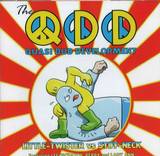
"Cyberspace. A consensual hallucination experienced daily by billions of legitimate operators, in every nation (...,) Lines of light ranged in the nonspace of the mind, clusters and constellations of data." Liar attempts to translate this definition from the very author who first coined the term, William Gibson, to a 4D vantage point. As such, he imagines not only every single point in infinite 3D space theoretically collapsed to a single point upon digitally trivializing distance, but, furthermore, the collapse of every discrete instance of said 3D space into a single, non-linear event, upon digitally trivializing time. Hence, "Cybertime". Functionally, this equates to music that, seemingly, effortlessly splices DNA from digital conceptualists as Fatima Al Qadiri or Oneohtrix Point Never, from retrofuturists such as Bok Bok or Surkin, from 90's hardcore stalwarts such a Special Request or Zomby, and from sound design heavyweights such as Amon Tobin or Noisia, all towards achieving a unified, stable construct of antique, classical, retro, contemporary and futurist sonic vocabulary.
Opener "Erumpo Ortus" is, potentially, the most cinematic of the six. With the opening sample beckoning one to "dance like there's no tomorrow", it's ostensibly driven by hundred-handed tribal drumming and monolithic choral manipulations. At its basis a simple oldskool electro beat, overall it's a rousing overture, most committed to the release's origin- and time-defiant aesthetic.
The title track is Liar's most grime-leaning track since "Alpha" (although, again, barely so). The sluggish-bass-driven, instrumental grime backbone is expanded upon with junglist references, a healthy serving of rave, and a Night Slugs-indebted sound palette. As it progresses, it becomes half adult vaporware, half "Jock Jams" revivalism, and all love letter to Golden Age sci-fi.
"Hekatonkheir" is a genre-obsolete piece of bass histrionics. Beginning with a titanic bellow that segues into cinematic orchestration, it timely explodes into dozens of distinct sounds thrashing about, nevertheless, as one single congruous beast. This volley of sound design goes through several distinct sections with operatic flair and pomp, sometimes seeming like a cut from Don Davis' work for the The Matrix trilogy, sometimes seeming like a saccadic dream sequence, sometimes seeming like a rhythmically-subverted neurofunk banger, and frequently punctuated by ethereal vocals chanting about Iapetus, the third moon of Saturn.



![Deadmau5 - While (1<2) [doppel-cd]](https://www.deejay.de/images/l/7/2/150172.jpg)