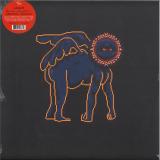
Introducing ''Sleek Vibra,'' the debut vinyl EP from Alessandro Gramaccioni (AFM), a compelling young Italian artist whose unique sonic vision has been forged through his involvement with the Amen Rave collective and a previous digital EP on Lapsus Records' CEE imprint. This powerful six-track offering for Adepta Editions sees AFM expertly fuse and reimagine a spectrum of genres, weaving together IDM, rave-oriented sounds, bass music, techno, and Afro-Arab rhythms. The result is an immersive sonic tapestry, where memory and tangible form converge into a cohesive audio-tactile experience. ''Sleek Vibra'' invites listeners on a futuristic journey through shadowy sonic landscapes, where the mechanical relentlessly intertwines with the organic. This intense sonic declaration holds nothing back, painting a vivid and uncompromising picture of sonic annihilation in its wake.
Beats News
Tracks include unearthed fragments of BLADDER FLASK, circa ’80s by Richard Rupenus, a founding member of THE NEW BLOCKADERS.
STEVEN STAPLETON, ANDREW LILES, RICHARD RUPENUS.
New studio album “Backside” on vinyl by Nurse With Wound, includes unearthed fragments of Bladder Flask by Richard Rupenus, circa ’80s, also released on Cd in 2024 (there is also a DIY “lathe cut”).
Cover art by Babs Santini.
The paths of Nurse With Wound and Bladder Flask first crossed in 1980 and the following year Bladder Flask’s debut album One Day I Was So Sad That The Corners Of My Mouth Met & Everybody Thought I Was Whistling (Orgel Fesper Music) was distributed by United Dairies.
Following the aborted project for a second Bladder Flask album, scheduled for 1981, some forty years later, Richard Rupenus approached Steven Stapleton to use fragments of old recordings he’d unearthed from “Bladder Flask”, an invitation that Stapleton accepted, and rather than simply remixing or reworking existing Bladder Flask tracks, Steven Stapleton and Andrew Liles have succeeded in reinforcing Nurse With Wound and Bladder Flask’s sense of the absurd in this new opus “Backside”.
“As the closest release style-wise to classic old NWW in decades, the album’s opening track ‘Backside’ could almost be a relic of the early 1980s, full of squeaky and crunchy noises, big plate reverbs, lots of plunderphonics meets musique concrete type cut-up work, bizarre vocals and all sorts of unfathomable sonic elements. It’s quite an intense listen, but totally enjoyable. ‘Chernobyl Picnic’ feels more like ‘Cooloorta’-era NWW, as it involves more use of extended tones, with lots of liberally chopped-up and totally messed about sounds, much of it fried and modulated in the most fascinating ways, a kind of harsher and more multi-faceted ‘Soliloquy For Lilith.’ An excellent release, especially for jaded old NWW fans who want more in the style of ‘the good old days’ (Alan Freeman)”.
Next from the label that brought you "You Time", "Unrest Hazard 1" and "First Sign of Trouble" is a sizzling 5 track slice of 12" from renowned DJs and producers who get the crowd jumpin and pumpin, Deejay Atlas and K Super. The pair are known for an impressive back-catalogue of tracks the last few years on Ruff Cutz, SweetBox, Parallax and more, as well as for running the Certain Sounds label and parties in Manchester, UK.
This one takes a look at the less glamorous side of northern England's rave scene, the goings on under a dark night sky at a free party in a field somewhere near Manchester. Illustrated through tunes that possess the brooding spirit of 1993 and 1994 jungle and ferocious vocals, albeit as always when it comes to Erupt, with a modern twist for the 2020s that tells a story of the here and now.
Also featuring appearances from Buda and Wild Swan, as well as an EXCLUSIVE fifth track that you won't find on any digital releases of this EP!
* Limited edition 12' vinyl pressed on transparent red wax, housed in a full colour sleeve inspired by classic Philly Blunt artwork.
* Fresh Blunts Vol. 1 brings that same energy to a new generation of DJs and selectors, with four dancefloor-focused cuts that pay tribute to the label's roots while pushing forward with modern production values.
* On the A-side, Bladerunner steps up with 'Chronic' and 'Straight Up' — his first solo release on the label in over a decade. With his deep ties to the scene (Dread, V, Souped Up, Kings of the Rollers), these tracks are a masterclass in classic jungle flavour with upfront punch.
* The flip introduces Chimpo & Sl8r to the Philly Blunt catalogue, blending grime, jungle, and Manchester's unmistakable underground sound. Having previously released on labels like Metalheadz, V Recordings, The North Quarter, and Hospital, their debut here shows just how wide the Philly Blunt family now reaches.
* Launching the brand-new Fresh Blunts vinyl series, Philly Blunt Records continues its legacy of heavyweight jungle and drum & bass. Originally founded in 1994 as a raw, party-focused sister label to V Recordings, Philly Blunt helped define the sound of mid-90s jungle with anthems like Leviticus' 'Burial', Dillinja's 'Sky', and Firefox's 'Buck Rogers'.
* Strictly limited run!
The story of Bonobo is one that's become uncommon in contemporary music. There was no sudden, viral internet sensation, no one-off big hit, no abrupt, accidental alignment with the zeitgeist. Instead, over the course of four albums, myriad tours, singles, remixes and production work for other artists, he quietly but very definitely became one of the most important artists in electronic music. The hard work paid off, and culminated in 2010's 'Black Sands,' a masterful album that married Green's inimitable melodic genius and musicianship to bleeding edge electronics, bass and infectious drums.
After a year plus of touring the hypnotic, extended live versions of Black Sands, he finally found time last year to embed himself in his New York studio and write his fifth studio album. Now, in 2013, he stands ready to take things up yet another notch. 'The North Borders' is a long stride forward - both a natural evolution and a continuation of the electronic palette of Black Sands. Thematic, resonant, addictive and perfectly formed, it's a thrillingly coherent statement piece.
It's also an album that shows just how far electronic music has come. Its richness of texture, emotive force and all round depth are facets found more often within, dare we say it, classical music. If there's a renaissance taking place within this scene, Simon Green could make a strong claim to being one of its key driving forces.
As with previous albums, The North Borders features a careful balance between vocal tracks and instrumentals, ensuring that the productions themselves get room to breathe and shine. When Green discovered that he and Erykah Badu shared a mutual appreciation for each other's work, he leapt at the chance to collaborate. The resultant 'Heaven for the Sinner' is one of the album's triumphs, a transcendental, incanted vocal masterclass married to a brilliant two-step glitch and a yearning melody.
NYC folk underdog Grey Reverend appears on album opener 'First Fires,' providing a raw, emotion-laid-bare growl that sets the tone for an album that's joyously unselfconscious. Bonobo has a long history of unearthing new talent, Black Sands having launched the solo career of guest vocalist Andreya Triana. The North Borders sees him do so once again. The startling, ethereal vocals of new collaborator Szjerdene are sprinkled across the album, and Green has yet again found the perfect voice to express where he's at. 'Transits' sees her vocal weave around a garage beat that's somehow fragile and purposeful all at once, a gradually emerging hook rising from the depths of the song.
'Emkay' is a stunning example of the album's marriage of addictive, urban-inflected drums to rise-and-swell melody that never fails to move the listener. Opening single 'Cirrus' sees a clockwork-precise rhythm drive a chiming, insistent melody that builds to one of the record's great emotional climaxes. This is where Green excels, he knows how to invest electronic music with immense feeling.
The North Borders - like all great records - is an album that demands to be listened to as such, a body of work with its own internal logic, themes and narrative arc. Bonobo's abilities are at an all time high, and The North Borders everything his growing army of fans will have hoped for - a sheer delight.
Chuck E is the amazing Jimmy Ryan aka The Good 2 Bad & Hugly. This is a repress of his 1994 EP that came out on White Records. Jimmy also had a stint as the A&R at Ruff Kut! Records. Proper banging UK jungle flavours!
Following his 2019 debut on the label with Amphibious / Lucid Dreams, Bristol-based producer Drone returns to System Music for another exploration into the darker corners of sonic frequencies and low end pressure.
Entitled Flooded EP, this is Drone’s biggest project to date and features 4 original, epic tracks accompanied by an incredible remix from SP:MC. The EP kicks off with 20k, an introduction laden with off-kilter, haunting eeriness and pulsating bass and percussion. Next up is Entropy, a truly ethereal track. Spatially beautiful yet isolating and cold. The title track, Flooded, is a monster of a track which intimidates and excites with eyes down and gun fingers raised. Rounding off the body of work is Fear which hits hard with crisp drum patterns and a throbbing bassline, almost evoking a sense of nostalgia, tying it in seamlessly with a typically electrifying remix from SP:MC
LIVE AT OBLICUO is a label of Abstract Electronica, experimental, downtempo releases. It's a collection of live concerts which takes place at Barcelona's OBLICUO HIFI Bar.
The Easy Mountain Listening album Live at Oblicuo records the performance at OblicuoHIFI in Barcelona on January 5, 2024
The atmosphere is densely populated by a crowd of gentle ghost sounds where uncertainty empowers tranquillity. Music to crack meanings of a deeper sea where broken textures need no repair. Its like Squarepusher in slowmotion is being sucked by Oval most hidden layers. There are no beats, and no easy way out in each these four adventures in the spatial self. Synthetizers sounds like blades floating underwater and the Phoenix will return again after seeming to disappear.
The musical project is called Easy Mountain Listening, and it features Warren Walker on Eurorack and Francesco Geminiani on the Buchla Easel. They both come from the jazz saxophone world, and one summer day in 2023 they got together for the first time to experiment with synthesizers. They recorded for a few hours and that first session, completely improvised, was magical. Something really fit, and that recording became their debut album, published on Foehn Records in June 2024.
Warren Walker
Tenor Saxophonist, synthesist, composer and producer Warren Walker comes from Grass Valley, California before moving to Paris, France in 2007. He operates in an effervescent musical universe that is in constant flux and infuses jazz with widescreen inspirations.
Francesco Geminiani
Tenor Saxophonist, electronic musician and composer Francesco Geminiani comes from beautiful Verona (IT) before moving to Switzerland, NYC and Paris. An endless musical curiosity drives him across styles and melodies, sharing the stage with great human beings across the New and the Old World. Inspired by the masters, he embraces impressionism to connect with the curious listener.
Im Sommer 1968 traf sich der 18-jährige Genesis P-Orridge (damals Neil Andrew Megson) mit Freunden in einem bescheidenen Dachgeschoss, um mit Klängen zu experimentieren. Das Ergebnis war "Early Worm", eine Sammlung von Aufnahmen, die die aufkeimende Kreativität eines Künstlers einfing, der später eine Schlüsselfigur der Avantgarde-Musik werden sollte. Diese Sessions, die 1969 auf ein einziges Acetat gepresst wurden, zeigen eine furchtlose Erforschung von Geräuschen, Improvisationen und Tonbandexperimenten, die Einflüsse von Psychedelia, Fluxus, John Cage und Beatnik Bohemia widerspiegeln. "Early Worm" ist ein Zeugnis für P-Orridges frühes Engagement, musikalische Grenzen zu überschreiten. Die rohen und ungefilterten Klanglandschaften des Albums bieten dem Hörer einen seltenen Einblick in die Gründungsmomente, die schließlich zur Gründung von COUM Transmissions, Throbbing Gristle und Psychic TV führen sollten. Remastered und in einer limitierten Vinyl-Pressung, mit Linernotes geschrieben von Genesis Breyer P-Orridge, die den Zeitgeist des UK Undergrounds der späten 60er Jahre in Erinnerung rufen. "If nothing else, (Early Worm) revealed that P-Orridge's approach to music was defiantly left-field from the start: noise, improvisations and tape experiments that sounded a little like a more chaotic version psychedelic folkies the Incredible String Band." . The Guardian
Utopia is an unimaginable alter world that is created by Mastering Black’s universe of sonic escapism.
When I have been overwhelmed with the amount of work that I've been doing in the past years, I have decided that I needed a certain get away - a certain sacred space for me to pursue the reason why I actually signed up for this in the beginning. Music composing that love is!
Earlier this year , during a trip in African island group Cabo Verde, we went to this night excursion to the Viana desert. We have taken some random photos shot some videos of the Moon thru a telescope. That didn’t struck me as an amazing experience yet I was there many distorted feelings in my mind trying to enjoy and forcing myself trying to be in the moment.
So when I have looked at these pictures back on a calmer state when I was home In NL , I've seen the vast amount of breather - a space - enough that is needed in life to let the blood flow in vein the way it’s suppose to flow. Envisioning your life from moon to create clarity - looking to life on earth - to understand what our mistakes are as human beings - or learning from 8 years old’s pure heart - that’s when my 8 year old daughter collaborated with the fist opening track to summarize the main purpose of our life - love or so called Utopia!
- Īlker (October 2023)
Soms is haat het enige waar je over hoort, maar er is in deze wereld meer liefde dan je je ooit kunt voorstellen.
- A1: Riddles Of The Sphinx Sequence 1
- A2: Riddles Of The Sphinx Sequence 2
- A3: Riddles Of The Sphinx Sequence 3
- A4: Riddles Of The Sphinx Sequence 4
- B1: Riddles Of The Sphinx Sequence 5
- B2: Riddles Of The Sphinx Sequence 6
- B3: Riddles Of The Sphinx Sequence 7
- B4: Riddles Of The Sphinx Sequence 8
- B5: Riddles Of The Sphinx Sequence 9
- B6: Riddles Of The Sphinx Sequence 10
REPRESSED !!
Exhumed '77 OST frond 'Riddles Of The Sphinx'...magick Mike Ratledge unfurls coils of ARP, Moog &VCS-AKS via Denys 'Lucifer' Irving's hacked Z-80 sequencer...these post-Soft Machine plumes spiralin stasis to the frame pans and lockdown Maddox's
& Mulvey's dialogue like SE17 dunes...the concentric riddle of the missing original master tapes...film reel audio prised from the BFI vaults & transferred straight to zeros & ones by hieroglyphic
happenstance...this acrobatic dredge has revealed more than enough mercury to further protract the riddles within..."You've got my number if you need anything"...IBM 'The film's ground-breaking electronic score, by The Soft Machine's Mike Ratledge, was composed on synthesisers which were developed in collaboration
with Denys Irving (the man behind the mysterious and controversial 1970s band Lucifer).'Film extract (Official BFI Trailer: http://youtu.be/UlBaUd5Y58M)
Please note: The digital will be available to
download from Monday 28th of October. The
vinyl will start shipping from Friday 8th of
November....
múm are returning with a new album on Morr Music. »History of Silence« is the first full body of work by the Icelandic collective since 2013's »Smilewound« and their seventh studio album to date—recorded, deconstructed, put back together again, refined and finished over the course of two years. Vibrantly oscillating around a carefully curated palette of electronic and analogue sounds, the eight new tracks reflect the group's continuous strive to explore sonic spaces through subtle yet gripping songwriting.
For a long time now, múm have been exploring the idea of distance in their music. In the beginning, this was born purely out of necessity. Founded in Iceland in the late 1990s, the members soon began embarking on journeys across the world—collectively while touring, but also individually, exploring new places to live and create. Settling in, moving on, catching up: The concept of distance soon became an integral part of the collective's process. »History of Silence« leans into this idea, with space and time becoming indispensable pillars of the arrangements. While being coherent and structured, they echo their origins from different seasons, cities, and spaces—neatly stitched together with unparalleled craftsmanship. They breathe an overall airy and intimate atmosphere, yet resonate with the structural heft of time.
On »History of Silence« time manifests in unexpected, liberating, and mesmerizing ways. It does not move reliably forward; it drifts, takes twists and turns, even disappears completely. Electronic textures blur into acoustic sounds, voices flicker and dissolve, melodies stumble and repeat. The arrangements often feel like they’re wandering, gently resisting direction. »Our Love is Distorting,« for instance, begins with a subtle piano motif, playing hide and seek with feedback noises, digital artefacts, and lush—yet very quiet—string arrangements, before gradually forming into a distinctive song. It's a perfect illustration of múm's general approach on this album. »Mild at Heart« turns this idea upside-down, flowing freely from start to finish with moments of silence sprinkled in—serving to emphasize the musical elements. The music on »History of Silence« moves like weather: unexpected, intimate, quietly detailed. Contrasted with vivid phrases, rhythmic shifts, and small hooks, the album offers a new angle of compositional clarity and vision.
Work on »History of Silence« began at Sudestudio in southern Italy. Additional recordings were made in Reykjavík, Berlin, Athens, Helsinki, New York, and Prague. The strings were recorded by Sinfonia Nord at the Hof concert hall, Akureyri, arranged and conducted by Ingi Garðar Erlendsson, who has worked with the band for many years. The orchestral elements don’t dominate the record—instead, they surface gently, adding depth and resonance to the songs without disturbing the songs' fragility.
Contrary to what the album title suggests, »History of Silence« is a collection of bold and colorful songs, no matter how muted they might sound at times. They tickle like a feather drifting through the wind, ending up in unexpected places, stimulating long-forgotten thoughts and feelings, intimate moments of introspection. The songs move through the echoes those moments leave behind: the emotional traces of things unsaid, the weight of stillness. Offering closeness by means of distance and much-needed support.
múm are returning with a new album on Morr Music. »History of Silence« is the first full body of work by the Icelandic collective since 2013's »Smilewound« and their seventh studio album to date—recorded, deconstructed, put back together again, refined and finished over the course of two years. Vibrantly oscillating around a carefully curated palette of electronic and analogue sounds, the eight new tracks reflect the group's continuous strive to explore sonic spaces through subtle yet gripping songwriting.
For a long time now, múm have been exploring the idea of distance in their music. In the beginning, this was born purely out of necessity. Founded in Iceland in the late 1990s, the members soon began embarking on journeys across the world—collectively while touring, but also individually, exploring new places to live and create. Settling in, moving on, catching up: The concept of distance soon became an integral part of the collective's process. »History of Silence« leans into this idea, with space and time becoming indispensable pillars of the arrangements. While being coherent and structured, they echo their origins from different seasons, cities, and spaces—neatly stitched together with unparalleled craftsmanship. They breathe an overall airy and intimate atmosphere, yet resonate with the structural heft of time.
On »History of Silence« time manifests in unexpected, liberating, and mesmerizing ways. It does not move reliably forward; it drifts, takes twists and turns, even disappears completely. Electronic textures blur into acoustic sounds, voices flicker and dissolve, melodies stumble and repeat. The arrangements often feel like they’re wandering, gently resisting direction. »Our Love is Distorting,« for instance, begins with a subtle piano motif, playing hide and seek with feedback noises, digital artefacts, and lush—yet very quiet—string arrangements, before gradually forming into a distinctive song. It's a perfect illustration of múm's general approach on this album. »Mild at Heart« turns this idea upside-down, flowing freely from start to finish with moments of silence sprinkled in—serving to emphasize the musical elements. The music on »History of Silence« moves like weather: unexpected, intimate, quietly detailed. Contrasted with vivid phrases, rhythmic shifts, and small hooks, the album offers a new angle of compositional clarity and vision.
Work on »History of Silence« began at Sudestudio in southern Italy. Additional recordings were made in Reykjavík, Berlin, Athens, Helsinki, New York, and Prague. The strings were recorded by Sinfonia Nord at the Hof concert hall, Akureyri, arranged and conducted by Ingi Garðar Erlendsson, who has worked with the band for many years. The orchestral elements don’t dominate the record—instead, they surface gently, adding depth and resonance to the songs without disturbing the songs' fragility.
Contrary to what the album title suggests, »History of Silence« is a collection of bold and colorful songs, no matter how muted they might sound at times. They tickle like a feather drifting through the wind, ending up in unexpected places, stimulating long-forgotten thoughts and feelings, intimate moments of introspection. The songs move through the echoes those moments leave behind: the emotional traces of things unsaid, the weight of stillness. Offering closeness by means of distance and much-needed support.
múm are returning with a new album on Morr Music. »History of Silence« is the first full body of work by the Icelandic collective since 2013's »Smilewound« and their seventh studio album to date—recorded, deconstructed, put back together again, refined and finished over the course of two years. Vibrantly oscillating around a carefully curated palette of electronic and analogue sounds, the eight new tracks reflect the group's continuous strive to explore sonic spaces through subtle yet gripping songwriting.
For a long time now, múm have been exploring the idea of distance in their music. In the beginning, this was born purely out of necessity. Founded in Iceland in the late 1990s, the members soon began embarking on journeys across the world—collectively while touring, but also individually, exploring new places to live and create. Settling in, moving on, catching up: The concept of distance soon became an integral part of the collective's process. »History of Silence« leans into this idea, with space and time becoming indispensable pillars of the arrangements. While being coherent and structured, they echo their origins from different seasons, cities, and spaces—neatly stitched together with unparalleled craftsmanship. They breathe an overall airy and intimate atmosphere, yet resonate with the structural heft of time.
On »History of Silence« time manifests in unexpected, liberating, and mesmerizing ways. It does not move reliably forward; it drifts, takes twists and turns, even disappears completely. Electronic textures blur into acoustic sounds, voices flicker and dissolve, melodies stumble and repeat. The arrangements often feel like they’re wandering, gently resisting direction. »Our Love is Distorting,« for instance, begins with a subtle piano motif, playing hide and seek with feedback noises, digital artefacts, and lush—yet very quiet—string arrangements, before gradually forming into a distinctive song. It's a perfect illustration of múm's general approach on this album. »Mild at Heart« turns this idea upside-down, flowing freely from start to finish with moments of silence sprinkled in—serving to emphasize the musical elements. The music on »History of Silence« moves like weather: unexpected, intimate, quietly detailed. Contrasted with vivid phrases, rhythmic shifts, and small hooks, the album offers a new angle of compositional clarity and vision.
Work on »History of Silence« began at Sudestudio in southern Italy. Additional recordings were made in Reykjavík, Berlin, Athens, Helsinki, New York, and Prague. The strings were recorded by Sinfonia Nord at the Hof concert hall, Akureyri, arranged and conducted by Ingi Garðar Erlendsson, who has worked with the band for many years. The orchestral elements don’t dominate the record—instead, they surface gently, adding depth and resonance to the songs without disturbing the songs' fragility.
Contrary to what the album title suggests, »History of Silence« is a collection of bold and colorful songs, no matter how muted they might sound at times. They tickle like a feather drifting through the wind, ending up in unexpected places, stimulating long-forgotten thoughts and feelings, intimate moments of introspection. The songs move through the echoes those moments leave behind: the emotional traces of things unsaid, the weight of stillness. Offering closeness by means of distance and much-needed support.
Das Avant-Rock-Sextett aus Beirut verschmilzt auf diesem großartigen Nachfolger seines gefeierten 2023er Debüts "Mais Um" Psych/Kraut, Improv/Skronk, Elektronik, Gothic und Jazzelemente mit traditionellem ägyptischem Gesang und moderner arabischer Poesie. Produziert von Radwan Moumneh (Matana Roberts, Sarah Davachi, Jerusalem In My Heart). Der Titel des zweiten SANAM-Albums ist ebenso vielversprechend wie die Musik der libanesischen Band. "Sametou Sawtan" bedeutet aus dem Arabischen übersetzt "Ich habe eine Stimme gehört". Spukhaft oder spirituell, wie auch immer man die Phrase liest, sie spricht von der Fähigkeit von Klang und Sprache, innezuhalten, Aufmerksamkeit zu stehlen und uns für den Moment zu öffnen. In ähnlicher Weise vermischt die Musik von SANAM zarte Rasereien und feuerverbrannte Balladen, indem sie frei fließende Rock- und Jazzgerüste mit der tief verwurzelten arabischen Tradition verbindet. Sie in vollem Flug zu hören bedeutet, in der Gegenwart gehalten zu werden und sich neu zu orientieren, um einen offenen Horizont zu eröffnen. Die Arbeit an "Sametou Sawtan" begann im Frühjahr 2024. Die ersten Ideen, die in den Tunefork Studios in Beirut entstanden, wurden im April während eines Aufenthalts in Beit Faris, einem mittelalterlichen Haus in der Küstenstadt Byblos, weiter ausgearbeitet. Das Sextett: Sandy Chamoun (Gesang), Antonio Hajj (Bass), Farah Kaddour (Buzuq), Anthony Sahyoun (Gitarre, Synthesizer), Pascal Semerdjian (Schlagzeug) und Marwan Tohme (Gitarren), wurde vom Produzenten Radwan Ghazi Moumneh (Jerusalem In My Heart) unterstützt. Die letzten beiden Tracks des Albums sind Aufnahmen aus den Beit Faris-Sessions, während der Rest in den La Frette Studios in Paris während der Europareise der Band im Sommer 2024 aufgenommen wurde. Die Platte verarbeitet Gefühle der Distanz und der Entwurzelung. "In den letzten fünf Jahren hatte ich das Gefühl, dass jeder den Libanon verlässt", erklärt Chamoun. "Das Album handelt nicht wortwörtlich davon, sondern von der Vorstellung, dass dich etwas verlässt. Eine Distanz zu den Ereignissen, obwohl du in ihnen lebst, eine Distanz zu deinem Haus, obwohl du in ihm wohnst." Ob in der sehnsüchtigen Ballade "Goblin" oder dem langsam brennenden, autotune-überladenen Freakout von "Habibon", Sametou Sawtan fängt das Streben nach festem Boden in einer Welt ein, die diesen nur selten bieten kann . Das Album hat die hypnotisierende Intensität des SANAM-Live-Erlebnisses, während es der Musik Nuancen, Tiefe und eine enorme dynamische Bandbreite verleiht. Wie bei ihrem Debüt sind die Texte vieler Tracks entliehen, Worte, die in neue Kontexte gestellt werden, um die Gegenwart zu verarbeiten. "Hamam" interpretiert ein ägyptisches Volkslied neu. In "Hadikat Al Ams" treibt der krachende Hardrock-Stampfer den Text des zeitgenössischen libanesischen Schriftstellers Paul Shaoul an. Und sowohl "Sayl Damei" als auch der Titeltrack verwenden Gedichte des iranischen Dichters und bahnbrechenden Mathematikers Omar Khayyam aus dem zwölften Jahrhundert. "Wenn man etwas von Omar liest, fühlt man eine Verbindung zur Gegenwart", sagt Chamoun. "Das Gefühl, dass es keinen klaren Weg gibt." "Sametou Sawtan" enthält auch zwei Lieder mit Chamouns eigenen Texten, darunter den Opener "Harik". Es war die Keimzelle des Albums, geschrieben von Chamoun im Februar 2024, wobei die Band den Track um ihre Worte herum aufbaute. Es beginnt mit einem Schauder, zerfetzter Elektronik und einer keuchenden Stimme, die das Schlagzeug durchdringt, bevor sich die Band zu einem triumphalen Aufstieg aufschwingt. Es geht um Eintauchen in "ein unendliches Feuer", verrät Chamoun. Den Text zu "Tatayoum" schrieb sie allein, bevor sie ihn der Band vorlegte. Er spiegelt eine andere Art von Intensität wider, "eine Schleife, eine Besessenheit", wie sie sagt. Buzuq webt durch schwebende Elektronik und drängende Trommeln, während Chamoun arabische Worte rezitiert, die die Liebe beschreiben. Die unaufhörlichen Energien, die in diesen Tracks erforscht werden, sind nicht unbedingt negativ. Sie vergleicht deren Intensität mit der eines Schriftstellers, der in einem Gedankengang gefangen ist, im Guten wie im Schlechten. "Es geht nicht darum, deprimiert oder traurig zu sein", sagt Chamoun. "Es ist eine Falle, aber sie kann auch magisch sein." "Sametou Sawtan" wurde von Farah Fayyad mit ikonischen Grafiken und Design versehen.
2025 Repress
Fresh his Keysound D&B opus Blue, Sully returns to Astrophonica with four pristine slabs of breakbeat science. "Flock" places the full strength melodic elements over the faraway amen echoes in a way that's not dissimilar to early Good Looking. "Helios" is a much colder flashback to the darker corners of jungle's formative dance; all breathy minor key chords and vapour trails of paranoia countered neatly by a precision dub vocal sample. "Crystal Cuts" recalibrates the focus to the drums by way of broad jazz chord strokes while "Hours/Miles & Still" concludes affairs on an emotional electronica tip where the breakbeats thanks to a beautifully arresting intro. Powerful.
Il prodotto è esaurito. Ti invieremo una email appena come nuovo è disponibile se si fa clic su "in Stock Mail"
STANDFIRST Titanic, the project spearheaded by Mabe Fratti and Hector Tosta (aka I. la Católica), return with a sumptuous and life-affirming new album.
In her sensational 1929 biography Tiger Woman, dancer and socialite Betty May claimed her ‘coster’s eye’ meant she liked to wear as many colours as possible. “Colours to me are like children to a loving mother. Each is my favourite, yet I can never bring myself to deny the others by preferring one.” May’s bold and inclusive strategy is one that manages to transfer itself, almost a century later, to Hagen, the new record by Titanic.
Many will know Titanic as the Mexico City-based brainchild of cellist and singer Mabe Fratti and multiinstrumentalist Hector Tosta who is now operating under the pseudonym, I. la Católica, (taken, rather unusually, from the name of the street the pair live on). With Hagen, and their previous release, Vidrio, (2023), the pair are creating a distinctive signature sound in modern alternative pop music. Nobody else sounds quite like them. Both records have an open hearted nature and simple, winning melodies that play off against a taste for drama, spectacular orchestration and a feeling of otherworldly mystery. Hagen is the more ambitious, sometimes more mystical effort. From the opening handclaps of ‘Lágrima del Sol’, (a wonderfully uptempo playground chant translating as a tear from the sun but, surely, not referencing the brand of pineapple wine?), the record dances its way through various mid-to-late-eighties inspirations, lush and widescreen passages of melancholy and vertiginous contrasts.
Mystery is often found in the simple but slightly odd song titles. English translations of various track titles give, ‘you swallowed the gum’, ‘leak’, ‘a tear from the sun’, ‘raising the trophy’ ‘digging dimensions’, ‘the owner’, ‘the decapitated hen’ and ‘the trap is exposed’. All denote striking images, metaphysical hints and emotional cues or simple, even childlike actions. Though Fratti and Tosta don’t reveal its provenance, the album’s title could even be a crafty play on words: the listener would be forgiven in thinking the moments of brash contrast and eyebrow raising theatricalism in the music constitute a musical nod to German punk chanteuse, Nina Hagen.
On Hagen, singer and cellist Mabe Fratti once again displays her brilliant knack of speaking to us directly. There is never the suspicion of her playing to the gallery, and the directness of many of the lyrics don’t allow it. Parallel to this, Fratti has an almost magical ability to give Hector Tosta’s melodies, and her and Tosta’s lyrics ones imbued with an insight and meaning that feels otherworldly. Tosta admitted it was “pretty wild to hear Mabe take the interpretations to a different place” and the listener can pick up on the delight Fratti takes in (literally) adding a voice to the many narratives.
Two examples can be shown here: ‘Gotera’ (Leak) uses harsh slashes of cello and tough, gunfire-like guitars and drums and multiple vocal lines that could be acting as a Greek chorus. They play off brilliantly against Fratti’s soft, slightly baleful vocal take that delivers lyrics such as: ‘nobody knows where the leak is / but I know where it is / they fight in front of the door and / nobody can go in’. With ‘La Gallina Degollada’ the somewhat blithe melody melody line, sung with what could be sarcastic brio by Fratti, plays against an itchting rhythm and rasping guitar part. The punch comes when you see that the song is about a chicken that has been decapitated and read lyrics such as: ‘I already saw it, it moved, the decapitated chicken’ / ‘could it be that I'm broken’ and ‘Two people hurt each other by thinking that they no longer agree’/ ‘Hours pass and the chicken represents what scares me’.
There may be death and fights to deal with, but there is also a quality of chirpy self-reliance about Hagen that is a key part of its nature. Like Betty May and her colourful outfits, Hagen’s sound often revels in its own sense of richness. Throughout, the record delivers vaulting string sections or glutinous guitar squeals that could, like the powerful, driving ‘Escarbo Dimensiones’ (Digging Dimensions) have come directly from a glossy 1980s TV series. Fratti sees this “glam sound” developed by Tosta on the aforementioned track and ‘Te Tragaste el Chicle’ (You Swallowed The Gum), as moments that were truly “revealing” for the album as a whole during its making.
What else? The thud and thump of ‘La Trampa Sale’ (The Trap is Exposed), and its sudden change of tempo and mood betrays a monstrously ambitious piece of music, the players almost greedily creating the sounds. Other moments are heart wrenching: ‘Libra’ ends on a poppy chord switch that cleverly ramps up the emotion inherent in the music’s notation. You could almost imagine a teenager in a bedroom forty years ago, rewinding the track over and over on a small, cheap cassette player, unable to get enough of that sugarsweet switch. Elsewhere, Oneohtrix Point Never adds stardust and an unearthly sense of space on the changeable, slightly moody meditation, ‘Pájaro de Fuego’ (Firebird). The record ends with ‘Alzando el Trofeo’ (Lifting the Trophy), a track that could soundtrack a state wedding, what with its beautiful cascading piano parts, a sugary vocal and short triumphal guitar riffs that add a rich patina to the overall sound. Fratti: “When I doubled those vocals on ‘Alzando el Trofeo’ I felt there was an epiphany happening, right at that moment.”
Making a good record is a team game. Tosta and Fratti recall seeing Randall from Circular Ruin Studios in NYC “tweak the drums in ‘Libra’ to make that amazing effect of the gated reverb”, or the shaping of ‘Gotera’, “when (recording engineer) Nate Salon added some synths to the track.” Drummer Eli Keszler, “an amazing and versatile player” had the songs down pat in a couple of days” and, according to Tosta, Oneohtrix Point Never “just came to one of the sessions and we hung out, and after all the recordings he and Nate were together in some studio and out of nowhere they sent us some beautiful tracks for ‘Pájaro de Fuego’! Fratti concurs. “He decided that he wanted to record because he was listening to the record (Nate works closely with him) and he really liked it! It was a total honour, indeed!”
Bedazzled by the playing, the skyscraping ambition in the arrangements and the giddy moments of contrast thrown up by Hagen, we could allow ourselves a brief moment of flippancy and state that Titanic’s new record is Yacht Rock meets Aeschylus, full-on. It’s also worth speculating that, in this hyper-sensitive, intemperate age, Titanic’s music has the power, however fleetingly, to heal hurts. Hagen is a brilliant showcase for a fresh and enriching form of pop music: displaying a magpie eye for what glints and plundering what has gone before.
Like Vidrio, Hagen was partially and additionally recorded at Fratti and Tosta’s house, aka Tinho Studios in Mexico City, as well as Golden Girl Studios & Circular Ruin Studios in New York City. Mixing was done by Santiago Parra in Pedro y el Lobo Studios, Mexico City and mastered by Rafael Anton Irisarri at Black Knoll Studios, New York City. The recording engineer was Nate Salon.
Hagen featured Mabe Fratti on cello, vocals & backing vocals, I. la Católica on guitar, keyboards, prepared piano, bass & backing vocals, drums by Eli Keszler and synths in ‘Pájaro de Fuego’ from Daniel Lopatin and Nate Salon.
All compositions on Hagen are written by I. la Católica, except ‘Escarbo Dimensiones’ & ‘Pájaro de Fuego’, which were composed by I. la Católica and Mabe Fratti. The record was produced by I. la Católica and co-produced by Nate Salon & Mabe Fratti. And all lyrics are by I. la Católica except ‘Escarbo Dimensiones’, ‘Gotera’, ‘Gallina degollada’ & ‘Pájaro de Fuego’, which were written by I. la Católica & Mabe Fratti.
Sparky, raw and untiringly nuanced, Dugnad Rec continue their bold additions to the world of jazz. As expected from the Tore Ljøkelsøy Kvartett, this jam-packed album arrives in one compositionally refined and mature expression. The work is filled with a playful and often cheeky vitality, yet remains underscored by a professorial consistency that marks it with the unmistakable stamp of intellect and class. One should expect nothing less.
As if scripting a film, each song seems to carve its own scene, earnestly shedding light onto all characters involved; yet doing so without favouritism. No role is unimportant, no instrument misses its moment in the limelight. Percussion leads but is equally impartial to a backseat, piano saunters in and out with stutters of brass that evolve into increasingly bold and enigmatic phrases, each element playing off the stable and resonant metronome of the double bass. Despite all this, nothing is ever rushed.
In this sense, the Tore Ljøkelsøy Kvartett have transformed a quartet into an orchestra, playing on the plethora of personalities that each instrument is made capable of.
Some songs pride themselves on a foreign, dissonant structure such as the opening tracks, while others lean on the security of a stable foundation and more familiar time sequence. Filled with nooks and crannies, red herrings and surprises, no listener can ever get too comfortable. Songs vary in length, from two-minute improvised interludes to eleven-minute marathons and each range with respective intensity.
Final sentiments in the closing chapter provide a faintly nostalgic narrative before releasing one last exhale of pent-up emotion. The ending sequence leads us away towards a gate of our own finding; giving light to a world of sensation that may otherwise have laid dormant.
The album marks a clear interest and understanding of human curiosity, wafting aural intrigue toward the out-turned ear of any willing listener. The coherence of the group is nourished by the fact that each member knows the other both as a musical personality, with their own capabilities and strengths and also as a human, with a unique temperament and interests. Combining such an elixir of minds has culminated in this free, exciting and often rose-scented approach that can proudly be said to characterise the Tore Ljøkelsøy Kvartett.
Il prodotto è esaurito. Ti invieremo una email appena come nuovo è disponibile se si fa clic su "in Stock Mail"
Distant Images is D.K.'s fourth release on Antinote and we can say quite safely that Dang Khoa Chau fueled a few identifiable obsessions over the years - for those familiar with his work, it probably won't feel like uncharted territory when they'll hear a somehow well-known guitar in the background of the title-track.
.
What time spent collaborating with D.K. also showed us is how much his sound magnified itself and its textures sharpened for the past three years. We now know for sure that his music only seems versatile on the surface as Distant Images confirms that the Paris-based musician has been, in fact, digging deeper in the same direction, each new record working like a diaphragm, always more precisely adjusted to capture his inner vision. It feels, for instance, like D.K.'s music is constantly trying to reach a higher level of evanescence from one record to an other, a process which possibly accelerated after a visit from Suzanne Kraft - who he recorded an album with, earlier this year (coming out on Melody As Truth).
With Distant Images, D.K.'s sound also took a step further into reality - the most attentive ears will hear seagulls on Distant Images while rain is softly falling on Leaving - and slightly departed from the digital universes that his previous records seemed to set in motion. From the most abstract songs - like the Steve Reich-ian Shaker Loops
- to the most evocative ones, the five compositions on Distant Images are like stained glass, gently filtering natural light. It is therefore no coincidence if, of all the senses, the titles of the songs mostly refer to Sight: close your eyes while listening to the cinematographic Days Of Steam and visions of an industrious city might appearbefore you.
The beauty that emanates from Distant Images is of a diaphanous kind and the record a collection of kaleidoscopic moments.
- A1: Dj Sotofett & Jaakko Eino Kalevi (With Thomas "Paleo's Buddy" Mende) Ibiza Dub
- A2: Main Bar Mix
- B1: Dj Sotofett & Phillip Lauer Feat Jeks Space Dub
- B2: Nimbus-Mix
- B3: Spaced Outtro
- C1: Dj Sotofett & Karolin Tampere Feat Maimouna Haugen Nondo Original Mix
- C2: Nondo Riddimix
- D1: Dj Sotofett & Gilb'r Drippin' For 97 Mix 97
- D2: Riddim-Run
- D3: 97-Drop-Outtro
Concocted in a share house in the South of Brisbane in the mid-80s, a small collective of well-acquainted musicians including Jon Anderson, Rainer Guth, Gary McFeat & Rod Owen gathered to compose film soundtracks, music for pictures, therefore ‘Picture Music’. To this end, a ‘spec’ tape of Picture Music recordings would be produced to give to potential clients and or sold to local stores. A distinct album comprising a collection of ambient, minimal-jazz and experimental music.
If there is a red thread running through the Picture Music album, it is its "late night" ambience. The wrath of the sub-tropical summer heat of Brisbane is not kind on electronic equipment, which would crash regularly by day. So, all recording was done in the relative cool of the late evening, in a room only dimly lit by lamp and candle. The Picture Music collective would make music and party all through the night, departing around sunrise. They would sleep through the heat of the day, only to return in the evening for more of the same.
This 2021 reissue of their self-titled 1987 cassette, was taken from the original master tapes and remains an evocative representation of the music that resulted from the late-night, dimly-lit, atmospheric-enabled environment, that sparked the creativity of a group of like-minded friends in a tiny corner of Brisbane. Dedicated to the memory Rainer Guth.
It's difficult to ''label'' the songs of this authoritative and necessary official reissue (after the shameful fake of 10 years ago). ''Zombi'' and ''In the Land of the Zombi'' are two electro disco-funks from 1979, therefore from three years before was born the ''Italo-Disco'' style, certainly more powerful, aggressive and more electronic than the ''Made in Italy'' disco style of the 2nd half of the 70s (Fratelli La Bionda, Pino Presti, Claudio Simonetti, Celso Valli and others.). The creation of the original 7" by Salvatore Ida, great musician and bandleader - to whom this excellent reissue is dedicated - was a sort of game for the authors of the two pieces: Federico Ida and Massimo Ida, were protagonists 4 years before of the Italian progressive rock scene with the sister Silvana Ida, Marcello Surace and Franco Vinci thanks to the immeasurable and acclaimed album ''Apoteosi''. So The Zombies were destined to pair with another easy '79 joke by the Ida brothers: ''Let's Go'' and ''Mustang'' by Sandwich, also reissued on 12inch by Best Record Italy. The Zombies comes out with the original artwork of the time, but in a full embossed picture sleeve and released in the classic black vinyl and on red vinyl with black shades (limited edition with red copies numbered manually (1/250: 2/250 and so on...) What else to add except that: the two long versions of ''Zombi'' and ''In the Land of the Zombi'' were re-edited by Massimo Berardi, always diligent and active, as well as tidy and aware of where he was putting his hands, are fundamental in order to complete this 12" fully remastered by Dom Scuteri.
Vol.1[16,39 €]
‘BEAST’ is the 4th installment in the series of Ameel Brecht's sleep-inspired compositions.
Where the earlier parts of this series focused primarily on ‘in between phases’ and manifestations of sleep, this penultimate volume shifts its attention to the absence of sleep. Without sleep, never resting, never dreaming, what would we experience? A monochrome fever-quality fog, a void of unrealities.
Wonderful Dave Huismans (A Made Up Sound) prod. deepest leftfield house / ambient collages, grooves & excursions. First of the initial two volumes in a small new 12" series - each ltd to 300 vinyl copies cut @ D&M, with stamped colored sleeves & labels designed by Bernie van Vlijmen.
Part earthy, part swampy, 001’s A-side 'Wetlands' is an epic triptych; a shifting 120bpm groove with drips of percussion being the only somewhat constant factor throughout its 10 minutes of continuous movement and exploration, coming full circle near the very end. The B-side dials the pace further down, first on the introverted yet heartfelt 'Chapel' (B1) with its intricate patchwork of sampled pads and warped, eroded loops over a driving 4/4 downbeat, then in the barely-there structure of deepest house remnants + ambient haze in 'Below Surface' (B2), drifting even further off the grid.
The visual concept for the ex_libris series comes courtesy of Bernie van Vlijmen, who translated the round and fluid character of the music into a palette of muted natural colors and stamped shapes emerging through a designed process balancing chance and intent, inspired by nature’s unpredictable rhythms and hydrostatics in particular: guided by its own quiet logic, no two outcomes alike, like waves crashing. Organic and alive, as if they surfaced on their own.
Il prodotto è esaurito. Ti invieremo una email appena come nuovo è disponibile se si fa clic su "in Stock Mail"
Wonderful Dave Huismans (A Made Up Sound) prod. warm & moving leftfield house / beat collages & excursions. Second of the initial two volumes in a new 12" series - each ltd to 300 vinyl copies cut @ D&M, with stamped coloured sleeves & labels designed by Bernie van Vlijmen.
On 002’s opener 'Running Out' (A1), midtempo percussion & chimes take their time settling into their groove in a playful back & forth, before pulling back halfway through and letting the light in for a heartstring-tugging finale. Offbeat oddity 'Cascade' (A2) chirps, blips, stretches and hisses like a living organism, building intensity towards its climax and release, while the loving embrace of 'Walrus' marks an empathic high point in the series so far, its warm and delicate 11-minute narrative unfolding across the entire B-side.
The visual concept for the ex_libris series comes courtesy of Bernie van Vlijmen, who translated the round and fluid character of the music into a palette of muted natural colors and stamped shapes emerging through a designed process balancing chance and intent, inspired by nature’s unpredictable rhythms and hydrostatics in particular: guided by its own quiet logic, no two outcomes alike, like waves crashing. Organic and alive, as if they surfaced on their own.
Il prodotto è esaurito. Ti invieremo una email appena come nuovo è disponibile se si fa clic su "in Stock Mail"
With this new work, Heine Christensen aka ghost and tape continues his explorations into the world of Eurorack. This ever-changing instrument has had a profound impact on his practice, pushing the boundaries of his (re)sampling and sound construction techniques. On Pardinyas, we hear the most minimal and abstract ghost and tape to date. Snippets of melody come and go, almost as if they’re playing a game of hide and seek, but before you even realize it, the abstraction has turned into a meaningful reality. Pardinyas marks a new chapter for ghost and tape, offering a subtle yet focused evolution of his sound, and once again, an ode to composing with sound.
Il prodotto è esaurito. Ti invieremo una email appena come nuovo è disponibile se si fa clic su "in Stock Mail"
The first and last Inga Copeland album"
The 2013 album, pressed in a limited qty. Features: Scratcha DVA / Scratchclart .
Premium material from the artist now recording as LOLINA. Big TIP!!!
Keefy G has been lighting up the dancefloors of his native West Yorkshire and beyond for some time now. His sets are as slick as his hair and here he branches out with some fresh slabs of wax on the mighty Dungeon Meat's new Slabs label. It's a hook-up that makes sense given that he grew up listening to sets by label founders Tristan and Brawther and his own take on their template is compelling indeed. 'Like Dis' is rock solid deep house with crisp drums and slamming bass. 'Wildstyle' lays down another heavy house groove with glitchy perc and well-treated vocals that add plenty of sleaze.
Il prodotto è esaurito. Ti invieremo una email appena come nuovo è disponibile se si fa clic su "in Stock Mail"
*all original recordings from mid 90s Estonian released cassettes. Fascinating interpretations of the UK breakbeat and Jungle sounds recorded when the world felt like a much bigger place.
Since hearing the first breakbeats via the Finnish radio nightly shows introducing the burgeoning UK scene, Virko Veskoja, later head figure of Lu:k, was completely swept away by this new technological language that sounded like machines trying to initiate contact with people. The fluttering rhythm patterns, strings and vocal lines haunting the pathways of the infinite network. Like hip hop taken over by Skynet.
Reimagining it all in mid-90’s Estonia, a fresh and dirt-poor republic newly welcomed to the family of sovereign states on the outskirts of Eastern Europe, was challenging, to say the least. Finally, with the help of entry level music programs, custom-made soundcards and self-built computers by the other Lu:k-head Tõnis Valk, Lu:k took the first tentative steps in the history of Estonian jungle.
Eight Lu:k cuts have been compiled into a handy selection, a true sign of the times when uncertainty came with certain hope and optimism – new territories to chart, new frontiers to conquer. A time of innocence captured so sublimely in Lu:k’s music.
The compilation starts with menacing orchestration that sounds like the birth of a civilization, like in „2001: A Space Odyssey“, or the arrival of Godzilla, only to give way to sweeeet strings and the inimitable Minnie Riperton in “Lovin U”, combining all the essential elements of Lu:k in a track that has remained uncorroded by time since its inception in 1994.
The following “Demo 3” is its antithesis – fast and nervous, a harbinger of the darker days of neurofunk and techstep ahead. More in line with the social realities of the time, when something (or someone) could materialise out of thin air and attack you just as violently as those beats here.
“La:v” was Lu:k’s signature track throughout their brief career that went on only for a few years, 1994-1997. Lifted to heaven’s by Petula Clarks’s wonderful vocals, it perfectly captures the pure essence of creation. “I made it in my bedroom. Something like that just came out. Sorry”, says Virko apologetically.
From the themes of love we are led towards darker scenarios again with “Drunk-Drive”, a more vengeful cut reminiscent of early Ram Records’ nocturnal dangers, skylines shaped by basslines. Previously only available on the uber-rare “Raadiomaja valvelauas” CD compilation from 2005.
“In the Limelight” is lifted from their second album “Dreams in Drums” from 1996 (only released on cassette), and if it’s meant to address their new-found underground celebrity status in Estonia, there is surprisingly little elation here – the track rather consists of introspective strings and beats that sound almost melancholic.
Out of the remaining three tracks, “Proov2mix” and “Kadunud leitud” are the result of a treasure hunt amongst the old, obsolete harddrives – little nuggets that were condemned to obscurity until now. Between them, another vocal-led cut “010”, a non-album track only featured on two comps until now, is a strong reminder of Lu:k’s prodigious ability to handle vocal lines and morph them together with their own weaving synthetic melodies, strong pads and commanding beats.
Lu:k’s music has been largely unavailable for the better part of this century, with original tapes and CD’s changing hands for a small fortune. This vinyl release couldn’t come at a better time, bringing a seminal chapter of Estonian dance music’s mythical history to light again, both for the old-school acolytes and new converts.
All music by Virko Veskoja
Returning with its final instalments, Die Schachtel's Decay Music series extends its explorations of inspired contemporary experimental efforts of the ambient, ethereal, and emotively abstract with Luigi Turra and Elio Martusciello’s “Liminale” and Sergio Armaroli and David Toop’s “And I Entered Into Sleep”, two astounding electroacoustic gestures of blurred space and time, plumbing complexity of meaning bound to sonority. Creatively groundbreaking and inspired, radically rethinking the terms of what ambient music can be perceived to be, they stand among the most striking efforts to appear within the series to date.
An aural bridge between two distinct generations of Italian experimental musicians, “Liminale” is the debut collaborative outing from the creative partnership of Luigi Turra and Elio Martusciello. Active within the context for roughly two decades, Turra (b. 1975) is a reductionist/electroacoustic composer, noted from his tense deployment of concrete and acoustic sources — particularly small sounds and noises — whose work threads the balance between silence, tactile auditory perception, and aleatoric music. Martusciello (b. 1959), on the other hand, is a musician and composer working across the fields of acousmatic and electroacoustic composition, sound installation, multi-media and audiovisual art, and computer music improvisation, who is widely celebrated for both his solo efforts and his collaborations with Eugene Chadbourne, Mike Cooper, Alvin Curran, Chris Cutler, Rhodri Davies, Iancu Dumitrescu, Michel Godard, Tim Hodgkinson, Lawrence D. "Butch" Morris, Jérôme Noetinger, Tony Oxley, Evan Parker, Z'EV, and others.
A single, nearly 40 minute work, extending across the two sides of the LP, “Liminale” — as its title eludes — is an exploration of the liminal through sonic means: “places that exist on the threshold, transitional spaces suspended between a before and an after, between the real and the evanescent” conceiving the soundscape as “a liminal place, a space to be inhabited without the certainty of where it leads.” Unfurling like a labyrinth navigated in darkness, the piece’s first half is marked by sparseness and restraint, as slow-paced guitar tones and harmonics thread silences and resonant ambience within a sprawling sense of space, delicately populated by tiny sounds, fleeting punctuations drawn from undeterminable sources, vocal utterances, and the unexpected appearance of intoxicating piano tones.
As “Liminale” progresses into its second half, Turra and Martusciello enter a more densely populated notion of the in between. No less defined by the presence of space and mystery, discreet textures rustle and writhe within passages of pure concrete abstraction and a fragmented, stretched sense of musicality: long-tones, metallic pulses, minimal vibrations, processed vocalizations, guitar harmonics, and deconstructed piano melodies, buried in spectral, gauzy hazes drifting from beyond arm’s reach within an imagistic and immersive landscape of profoundly meditative scope, where each sonic element flirts the line between emergence and disappearance.
Intimate, fragile, and achingly beautiful, “Liminale”, Luigi Turra and Elio Martusciello’s debut collaboration, is a masterstroke in sound-craft and composition, revealing the potency of meaning locked within transitional spaces and the undefined, and imbuing silence with monumental gravity and weight. Mastered for vinyl by Giuseppe Ielasi, and taking electroacoustic minimalism to an etherial extreme, “Liminale” is issued as the ninth entry in Die Schachtel’s Decay Music series, highlighting inspired contemporary experimental efforts of the ambient, ethereal, and emotively abstract.
Scavenger tones and scrambled cassette residue drift across the surface of Compressed Knowledge, a quietly astonishing new work by Philadelphia-based sound artist Tyler Games, operating here as Radio Species. Following releases on Regional Bears, Irrational Tentent, and his own now-defunct Born Physical Form imprint, Games works in a space between musique concrète, tape collage, and microsound, using an economy of gesture to create a suite of fundamentally elusive compositions. Harmonic loops stutter and fold in on themselves, hazy rhythms break free from their clocks, snatches of speech cut out mid-thought as a layer of room tone and tape gunk holds everything in suspension. There’s a sense of broadcast without a source, flickering across half-tuned frequencies––hinting at formal structures while continually slipping away from them. The result is not archival in the traditional sense, but archaeological: these tracks are partial objects, pulled from the noise floor of memory. In its refusal to resolve into stable meaning or musical form, this is work that draws from traditions of sound ethnography, experimental documentation, and concrète montage––where listening itself becomes a mode of speculative reconstruction.
The Rhythm Section – raves first super group - consisting of Ellis Dee, Rennie Pilgrim, Newton and Ritchie T. The group disbanded in 1993 after the rise of jungle as the guys didn’t want to go in that direction and felt their job was done in building the rave scene to what it was. But then in 1995 they had a request to reform and tour America as the rave culture was growing out there. So, they did reform, minus Ritchie T, and embark on a rather rave induced tour of the US with all the antics that you would expect from those guys!
They also wanted to make some new music for the tour and The Sequel album was born. Though written in 1995, they guys purposely kept the sound retro, calling upon their knowledge of the late 80s and early 90’s London warehouse scene.
Released originally as a limited edition double album which commands a high price on Discogs, this is the second part of the album – part one being the 180g blue vinyl release on Vinyl Fanatiks last year.
Returning with its final instalments, Die Schachtel's Decay Music series extends its explorations of inspired contemporary experimental efforts of the ambient, ethereal, and emotively abstract with Luigi Turra and Elio Martusciello’s “Liminale” and Sergio Armaroli and David Toop’s “And I Entered Into Sleep”, two astounding electroacoustic gestures of blurred space and time, plumbing complexity of meaning bound to sonority. Creatively groundbreaking and inspired, radically rethinking the terms of what ambient music can be perceived to be, they stand among the most striking efforts to appear within the series to date.
Reconfiguring the notion of bridge building on a multitude of terms, it feels fitting that the tenth and final installment of Die Schachtel’s Decay Music series, Sergio Armaroli and David Toop’s “And I Entered Into Sleep”, was co-created by an artist whose work featured in the first suite of LPs issued by Brian Eno’s Obscure Records in 1975, the groundwork toward which Decay Music’s own efforts nod. Since that auspicious debut, “New and Rediscovered Musical Instruments” — his split with Max Eastley — David Toop has been regarded as a pioneer in British experimental and improvised music: a sonic voyager who has continuously challenged the sources and materiality of sound through rigorously thoughtful performances, a vast catalog of recordings, and a steady flow of highly influential texts. Be it as a member of Alterations, his group breaking group with Peter Cusack, Terry Day, and Steve Beresford that ran between 1977 to 1986, or through is noteworthy work with artists like Rie Nakajima, Thurston Moore, Paul Burwell, Rhodri Davies, Lee Patterson, Ryuichi Sakamoto, Akio Suzuki, Elaine Mitchener, and numerous others, collaboration has always played a central role within Toop’s singular practice, but few can claim the sprawling sense of beauty and intimacy that’s achieved by “And I Entered Into Sleep”, his first recorded outing with Sergio Armaroli.
A composer, percussionist, vibraphonist, and multidisciplinary artist, Armaroli has been issuing radical and forward-thinking musical gestures for decades, working as one of Italy’s most noteworthy interpreters of composer’s like Giacinto Scelsi, John Cage, Franco Evangelisti, Giancarlo Schiaffini, and Walter Branchi, as both a solo performer and member of the highly regarded Rib Trio, as well as forging a singular practice as a composer, intertwining his efforts as a painter, concrete percussionist, fragmentary poet and sound artist, within a total art, rooted “within the language of jazz and improvisation” as an “extension of the concept of art”. Like Toop, Armaroli’s career has been populated by many collaborators, notably with Riccardo Sinigaglia, Alvin Curran, and Walter Prati, among others, setting the stage for a remarkable meeting between the pair.
Featuring Armaroli on vibraphone and prepared vibraphone and Toop on electronics, “And I Entered Into Sleep” is “a sonic journey, a Proustian suggestion à la Recherche, into the unconscious between electronic and acoustic sounds”. Using a bell that sounds at the beginning of Proust’s “À la Recherché du Temps Perdu”, which reappears more than 3,000 pages later — signaling a transition of phases, as well an auditory trigger of memory — as a departure point, as an association to the percussive vibraphone pulses that thread the album’s two sides, the pair weave a striking interior world of immersive psychological depth. Feeling almost subaquatic at times, like captured glimpses of rumbling, shadowy ecosystems lost within murky ambiences, before washing ashore in a series of pointillistic, highly detailed alien landscapes of the mind, each artist’s markedly different sound-sources, and treatment of the subsequent material elements, dance in abstract grace, incorporating subtle nods to minimalism, free jazz, and musique concrète within its seamless total form of sparse texture and tone.
Easily one of the most striking and memorable releases by either artist to appear in recent years, Sergio Armaroli and David Toop’s “And I Entered Into Sleep” traverses uncharted realms at the borders of literary reference, sound art, ambience and abstraction through delicately musical sounds, revealing new depths at every turn. Issued as the tenth and final album in Die Schachtel’s Decay Music series, highlighting inspired contemporary experimental efforts of the ambient, ethereal, and emotively abstract.
repressed !
Jasper Byrne Aka Sonic (sonic & Silver / Accidental Heroes) Spent The Late 90s & 00s Dropping Releases On Pretty Much Every Legendary D&b Label Going (reinforced, Metalheadz, Renegade Hardware, Formation, Virus, Soul:r And His Own Space Recordings), Before Mysteriously Disap-pearing To The Far East & Re-emerging Years Later As A Hit Indy Computer Games Developer (lone Survivor) & Soundtrack Artist (hotline Miami).
After A Chance Encounter With Dead Man's Chest At A Gig In La (where Jasper Had Been Working On A Game And Wholeheartedly Soaking Up The Local Low End Theory Music Scene), It Quickly Emerged The Two Had Shared Similar Musical Stories, Straying From Previous D&b Careers And Into The Musical Wilderness, Only To Drift Back Toward The Tempo With A New Found 'outsider' Approach And Eerily Familiar Conclusions..
After Teasing Us With 2018's 110174 Mixtape (ltd Edition Cassette Only Release) And His Appear- Ances On Blunted Breaks Vol.1, 2019 Sees Sonic Mark His Return To The World Of Dance Music Proper With This Two Part, Heavyweight Ep For Western Lore.
Blending Techno, Footwork, La Bass, Hardcore, Synthwave And D&b Under A Loose Jungle Tekno Framework, 110174 Sees Sonic Crafting Beats, Breaks & Bass With An Artisanal Deftness Rarely Seen.
- A1: Eyes Unclouded / 05 20
- A2: Another Skin To Wear / 05 28
- A3: Poise / 06 13
- A4: Arpeggino / 05 15
- B1: You Know This Isn't Going To End Well / 05 22
- B2: Yonghegong Lama Temple Exit F / 05 38
- B3: Anhedonic / 05 38
- B4: 8Am On The Train To Work You Ask Me To Send You Something That Makes Me Happy (For Maarten) / 06 01
For Dutch artist Stefan Vincent, the feeling of melancholy also offers the opportunity for beauty to be found. “Decay and loneliness can serve a purpose. Depression can teach you things. To feel deep sadness also means the ability to feel profound
emotions.” he says. With this in mind, his debut album on MUSAR Recordings, “Post- Melancholy”, unpacks the twists and turns of grappling with this emotion, drawing from breaks, electro and IDM to make his most intricate work to date, after previous releases on Token, Dynamic Reflection, Symbolism, and Non-Series. Throughout “Post-Melancholy” Vincent traces the wave of melancholy and how it moves through the body, which allows for lighter moments alongside darker moods. Perhaps the lightest track on the album is its acidic-breaks opener, “Eyes Unclouded”, with its soaring acid lines and dazzling synths, which acts as a false pretense for the rest of the album. Tracks like “Poise”, “Arpeggino” and the meditative “Yonghegong Lama Temple Exit F” also break up the intensity. However, nestled between the more pacey, bass-weighted tracks on the album, these lighter openings still feel like tear-jerkers.
The more common associations of melancholy show up on tracks like “Another Skin To Wear” and “You Know This Isn’t Going To End Well”, which all create a more ominous feel via IDM and the polyrhythmic structures of drum’n’bass. Particularly on “Another Skin To Wear”, which borrows its name from a Radiohead lyric, the track's swooping motion feels realistic to melancholy’s chaotic and often unpredictable path. But, like all great storytellers, Vincent leaves the most poignant moment of the album for last with the rolling “8AM on the Train… (For Maarten)” devoted to his dear friend, Maarten, who sadly passed away at the young age of 36. This LP is dedicated to Maarten de Vries (1986-2022)
Simon Hafner AKA Sun People is an adventurous maverick in quick rhythms. His productions are well known for being fascinatingly hybridised. Footwork meets jungle meets techno meets electro meets dub! After his smashing debut LP on dBridge's Exit Records he is releasing his new EP on Candy Mountain. 'Emotional Distortions' is a unique EP centered around his deft beat programming and takes us on a contemporary dance floor journey of uncompromised fearless groove. This is next level production! Not to be missed for the serious d&b, dubstep, broken beat and electro freaks out there!!!
As we continue the five part journey to say goodbye to the Telomere Plastic series, we as always, are excited to share with you Telomere 020.2.
This second VA, features producers, Anderson, Aspetuck, Bænglund and Watch Patrol.
We begin off the record with ‘Funk Inspector’ from Bænglund. The track name here sums it up pretty well. Full on quirky funk in the airwaves. A delicious cut to keep everyone on there toes!
Next on the A2 we have Aspetuck with his ‘As the Fog Rolls In’, Starting off with a bubbly soundscape the track progresses into a hypnotic acidic journey keeping the mood deep and melancholic. Handle this one with care!
On the B1 we have Anderson who delivers another deep and beautifully crafted soundscape. This is a timeless tune that takes you on a sonic journey from start to finish. This will work wonders on the dance floor and during your introspective moments laying in bed with your headphones bumping.
Lastly, we close out the release with the one and only Watch Patrol who we have all dearly missed. We hope you enjoy this slowed down IDM breakbeat gem!
Very limited black copies as always with a few colored copies available via the Wex bandcamp, be quick!
- A1: Schicksal Power Hate Destruction (03:41)
- A2: Ratbau Ordinateur (05:06)
- A3: Palais Des Bauzards It’s Disgusting (Remix) (04:29)
- A4: A Thunder Orchestra Shall I Do It? (04:02)
- A5: M.bryo Let’s Go To War (04:18)
- A6: The Arch Ice In Your Eyes (03:11)
- B1: Genetic Factor The Lizard King, Empty Highway (05:02)
- B2: Elektronische Machine Tanz 86 (04:11)
- B3: No Honey From These Dreams (04:32)
- B4: Paschen’s Law Magnifying Transmitter (06:20)
- B5: Bene Gesserit Les Aliens (06:03)
VOL. 3[23,95 €]
Limited reprint of the sold-out Volume 3 from the Underground Wave series, featuring Belgian and Dutch wave, synth, and minimal artists. Most tracks were previously only on cassette. Walhalla Records is dedicated to reviving the 80s/90s cassette scene by releasing rare material, often for the first time
Emerging from the Kansai underground with a sense of ritual and restraint, G Version III returns with a slab of meditative pressure, carved for sound systems. Following last year’s cassette release on Digital Sting, the Kyoto-based producer deepens his exploration of experimental steppers and sacred low-end science.
TRK 1 treads heavy—medium-tempo four-to-the-floor steppers, soaked in 80s/90s UK dub DNA and wired with flickers of celestial synth energy, edged with something unknown.
TRK 2 drifts off-grid—a 100bpm oddity conjuring sacred synth rituals and off-beat spatial tension. Droning and eerily weightless, it hangs like a vapor of frozen scent in an echo chamber.
Flip the plate and TRK 3 and 4 ignite—raw, unrelenting steppers built to test the physical limits of the rig. No compromise, no decoration—just ritual voltage for the floor.
Riddim Chango’s 16th release channels something ancient through circuitry, born for the weight.
After a brief hiatus from regular releasing (yet closely following the hit 36-tracker VA compilation), Motive Hunter Audio steps back into Jungles spotlight with The Pressure - EP from ARKYN, available on an ultra-sleek marble grey double-sided 12 vinyl, as well as all digital streaming platforms + Bandcamp.
The release thoroughly embodies a modern rendition of Hardcore Jungle Technos unmissable resurgence, yet matched with an evident ode to the genres roots. Piano-stabs-galore and 4x4 kicks guide you through two sides of controlled mayhem, the epitome of a club-ready release. ARKYN calls up SYNTAX & DJ B for collaborations, both effortlessly adding their touch sonically and also with the bonus of a closing track as his alter-alias DJ TUF - channelling his influence from the Dutch early rave scene.
Having already had support from artists at the top of their game, internationally and on the airwaves - there is no way of shying from the fact that these have been some of the most sought-after dubs in Modern Jungle.
The first release of Alienata's label is coming from Artificiero, which is the alias of Alfonso Alfonso (Murcia, Spain), an experienced musician who has released nine records with his psychedelic rock band Schwarz. 'Masa Negra' will be his first album with this new project.
In it, Artificiero delivers a sort of 'electronic esoterica', an inner ritual where repetitive beats and drones have an important roll. A ceremony where textures are more prominent than melody.
- A1: Space Drift
- A2: Memory Loss
- A3: Siren-Call
- A4: Harmonisers Of The Spheres
- A5: Telepathy Beyond Time
- A6: Older Than Time
- A7: Congestion Hoe-Down
- A8: Shadowland
- A9: Celandine & Columbine
- A10: The Dying Of The Light
- A11: Cloud
- A12: Darkness At Noon
- A13: Future Perfect
- A14: The Killing Skies
- B1: Into The Depths She Calls
- B2: Lazy Summer Afternoons
- B3: Insects Revolt
- B4: Blood Runs Cold
- B5: Post Apocalypse Fog
- B6: Fish Don’t Cry
- B7: Ghost In The Abbey
- B8: Insects Dance
- B9: Dreams Of Magic & Cornfields
- B10: Devil’s Lightening
- B11: Danger Hurts
- B12: Why Me?
First ever release of pioneering radiophonic / experimental / electronic / soundtrack composer you may never have heard of but really should have by now. 26 tracks in all.
As we began the mammoth task of whittling down material for this album Elizabeth recalled the time she met Delia Derbyshire. It was during a party for existing and former Radiophonic Workshop composers at BBC Maida Vale in the early 1980s. Delia introduced herself with typical energy and exuberance proclaiming "It's up to you now - I'm passing the baton. Show these men how we get things done". That must have been quite an honour and responsibility for a young, female composer establishing herself within the male-dominated environs at Delaware Road.
Looking back over a musical career spanning almost five decades, it's clear Elizabeth rose to the challenge and made her mark. She was consistently in demand with television and radio producers, composing for an array of ground-breaking, critically acclaimed and popular BBC projects. Whilst Delia's legacy has achieved mythical status with her position as an innovator and feminist icon secured, the majority of Elizabeth's recorded work remains unavailable so her contribution to the output of the Workshop and evolution of British electronic music is somewhat under-appreciated.
Perhaps this record will help start to remedy the situation. Included are early tape experiments, home demos and non-BBC commissions from the early 1970's to the late 2000s. Having listened to 260+ digital audio tapes from Elizabeth's personal archive we have barely scratched the surface but hope to provide an indication of the breadth of her compositional and sound design skills.
Classically trained in cello and piano, Elizabeth graduated from the University of East Anglia with a degree in Music in 1973. She was mentored by Tristram Cary who helped her to become UEA's first recipient of a Masters in Electronic Music and later awarded an Honorary Doctorate by Staffordshire University. Joining the BBC as a studio manager in 1975, Elizabeth transferred to the Radiophonic Workshop in 1978. One of her first tasks was to create special sound effects for Blake's 7 using tape loops, the EMS 100 and trusted VCS3.
Her celebrated score for The Living Planet in 1982 featured early use of the PPG synthesizer and earned an Emmy nomination. Over the following years studio technology evolved rapidly, but Elizabeth transitioned from analogue recording techniques to newer digital platforms with relative ease, using samplers, midi sequencing and computer controlled workstations.
With an incredible 1,400 commissions to her name, she created special sound for The Day Of The Triffids, Lord Of The Rings, countless radio dramas including Iris Murdoch's The Sea, The Sea, Harold Pinter's Moonlight, all of Howard Barker's plays, productions of King Lear, Wordsworth's Prelude and The Pallisers. The success of The Living Planet led to further work for the BBC Natural History Unit followed by numerous commissions for The Natural World. At one point in the late 1980's at least five of her signature tunes were being broadcast every week including Points Of View, Horizon, Doctors To Be and Everyman.
After the closure of the Workshop in 1996 Elizabeth became freelance, arranging Faure's Pavane for the BBC World Cup '98 coverage (reaching no. 9 in the UK singles chart). She wrote additional music for Monty Python's Holy Grail DVD, scored Michael Palin's Full Circle and Sahara TV series, The Lost Gardens Of Heligan and The Human Body with Robert Winston.
Retiring from the music industry in the late 2000's, Elizabeth recently returned to her East Anglian roots and now lives near the coast. She walks daily, listening to all kinds of music, new and old, on her beloved air-pods.
- B3:
- A1: El Algo-Ritmo (De La Musa-Raña)
- A2: Body To Body / Forbidden Pleasures
- A3: Delito Y Castigo
- B1: Erlösung
- B2: Reptilian Bakalas Mutant Komando
- B4: Memoria Colectiva
- C1: Megafan De Haus Arafna
- C2: No Pleasures In My Life
- C3: Disko Filinky
- C4: Modern Jazz For The Greys Of The Future
- D1: La Patera Interestelar
- D2: La Asquerosa Naturaleza Humana
- D3: Epitafio ¿Dónde Estás Bela Lugosynth?
- D4: Bonus La Body Música
Estado de Bienestar is the bold new solo project from Nico Cabañas, co-founder of the record label Oráculo Records and Ombra Festival. Emerging from a period of personal transformation, the project marks a departure from Cabañas’s earlier ventures — including Synths Versus Me (“So Far”, 22 Recordings) and Almax und Forte (“Nois d’Avui”, Oráculo Records). The latter had already begun shaping the sonic direction Cabañas now fully embraces: a raw, visceral, and fully analog “proto” sound. Chapters 1 and 2 of Estado de Bienestar offer a genre-defying journey through twisted, reimagined darkwave. As if curated by a seasoned digger, subgenres collide and dissolve — EBM blends seamlessly with breakbeat, industrial goth meets trip-hop, and dub-industrial collides with jazz, creating a rich and unpredictable listening experience. Presented in ONE-OFF truly limited edition of 300 copies lacquered pressed on 180 gr. high quality solid ORANGE and YELLOW vinyls. All tracks have been specially remastered and mastered for vinyl by Daniel Hallhuber at Young and Cold Studios (Germany).
f b3 HiddenTrackDeMierd@
[f] b3 [HiddenTrackDeMierd@]
[f] b3 [HiddenTrackDeMierd@]
With a little work and a lot of love, we present this limited edition selection of wonderful Lords Of the Null Lines remixes for your enjoyment...limited to 300 copies, this will be gone in the blink of an eye...featuring the epic remix from Photek, the difficult to find remix from Aquasky & Masterblaster, the unique Acen, and the pounding NRG remixes, this EP is a must have for all old skool and jungle heads....
This is the much sought after and finally repressed Tango remix of Disturbance. A deep and dark classic, it has been on most collectors wish list for decades. Flipped with Half Stepper, this little 10" was one of the most influential and important slices of atmospheric jungle form back in the day, and now appears lovingly remastered from DAT for the first time since the early 90's
This brand new EP from Hyper-On Experience maintains the incredible inventiveness we have come to expect from Hyper-On, but this time, blends it with some of the EZ Rollers style. Each track is the very definition of authentic and innovative old skool and jungle, and this is sure to be a much love classic in years to come!
Il prodotto è esaurito. Ti invieremo una email appena come nuovo è disponibile se si fa clic su "in Stock Mail"
- A1: Mg1 (0 43)
- A2: Ionic Funk (20Xxx Battle Music) (4 32)
- A3: Krystle (Url Cyber Palace Mix) (3 26)
- A4: Ginger Claps (3 06)
- A5: Ghost (3 04)
- B1: Undercover Investigator (Gabbertrap Mix) (2 06)
- B2: Out By 16 Dead On The Scene (3 28)
- B3: Post Rave Maximalist (2 57)
- B4: Phase A (2 52)
- B5: Freewill (Phase Beta) (2 09)
- C1: Excruciating Deth (Phase Y) (4 54)
- C2: Hidden Power (Phase D) (8 16)
- C3: Mg2 (1 04)
- D1: Nightsaber (4 13)
- D2: Lifeforce2 (3 18)
- D3: Wlfgrl Acid (3 13)
- D4: Phantasy13 (3 16)
Machine Girl's debut album celebrates its tenth anniversary with a long-awaited reissue, which marks the first time it arrives on CD as well as vinyl. Originally released in 2014, WLFGRL fused footwork, jungle, digital hardcore and rave into a chaotic, euphoric sound that helped launch a global underground movement. The album's packed with raw intensity and plenty of breakcore influence so it introduced a new generation to extreme electronic music and to celebrate its return, a one-off livestreamed show at Brooklyn's Trans-Pecos accompanied the release. As we are reminded listening back now, WLFGRL is a real high-water mark in outsider music culture.
Trip-hop royalty Morcheeba make a blistering return with a stunning 11th studio album Escape The Chaos.
“This whole record is a process of trying to reconnect with what really matters. whether it’s what in your heart or with the world, putting your feet on grass and feeling the earth beneath you” says Ross Godfrey.
“For me, ‘We Live and Die’ is about my duration in the band and the music world and life in general,” Skye says of the lead single. “The lines become blurred after all this time. In a way, it’s a homage to the thirty years of being in Morcheeba which is 60% of my existence.”
Formed in London in 1995 the legendary band have extensively toured the globe, sold over 10 million albums worldwide and left their mark as one of the most influential acts of recent times. Releasing their acclaimed debut album Who Can You Trust? in 1996, the band have gone on to release a string of successful studio albums, including 1998’s platinum selling Big Calm, produced an album for Talking Heads’ David Byrne and produced soundtracks for Oscar-winning director Steven Soderbergh.
In their 30th year Morcheeba are as relevant as ever and are set to mark the celebration in style.
- A1: Coaster - Simon Park
- A2: Rippling Reeds - Wozo
- A3: Leaving - Sam Spence
- A4: Northern Lights 1 - John Cameron
- A5: Spaghetti Junction - Peter Reno
- A6: Space Walk - Rubba
- A7: Prospect - Paul Hart
- B1: Tomorrow's Fashions - Geoff Bastow
- B2: Blue Movies - Brian Wade
- B3: Videodisc - Trevor Bastow
- B4: Interface - Astral Sounds
- B5: Starways - Brian Chatton
- B6: Optics - Unit 9
- B7: Atomic Station - Wozo
- C1: Future Prospect - Adrian Baker
- C2: Planned Production - Warren Bennett
- C3: Future Perspectives - Anthony Hobson Aka Tektron
- C4: Waterfall - Chameleon
- C5: Telecom - James Asher
- C6: Eagle - Simon Park Aka Soul City Orchestra
- C7: Astral Plain - Alan Hawkshaw
- D1: Drifting In Time - Paul Williams
- D2: Earth Born - Brian Bennett
- D3: Soft Waves - Harry Forbes
- D6: Infinity - John Cameron
- D7: Morning Dew - Andy Grossart & Paul Williams
- D4: Topaz - Astral Sounds
- D5: Eternity - Alan Hawkshaw
Nothing said new or modern or futuristic quite like a synthesiser in the 70s and 80s. If you were shooting an advert and you wanted your product or your company to appear forward-thinking and ahead of the game, then you would want something electronic, something out of the ordinary. When TV producers and advertising directors started searching for music that sounded like “Tubular Bells” – and then Tomita, and later Jean Michel Jarre – music libraries such De Wolfe, Bruton, Parry and Chappell had to have the tracks readily available.
Compiled by Bob Stanley, “Tomorrow’s Fashions” varies from advertising jingles and TV themes to space exploration and gorgeous, beatless ambience. Though it’s 40-to-50 years old there’s a real freshness to this music. Older jazz players Brian Bennett, John Cameron, Alan Hawkshaw and others seized the chance to operate a synth; younger pups including John Saunders and Monica Beale were simply intrigued by the new technology being wheeled into the studios. There’s a tangible sense of adventure.
“Tomorrow’s Fashions’” brand of electronica anticipated new age and ambient music. It also had both a direct and indirect influence on pop – the early Human League and the future sounds of Warp Records are all over this collection. Electronic library tracks have been sampled by everyone from MF Doom to Kendrick Lamar.
One person’s primitive and experimental is another person’s space-age lullaby. This was music made in the shadows – in Soho’s secretive music library studios – that has now become desirable and influential. The chances are chunks of it will be sampled and used on hit records that have yet to be written. If the musicians’ aim was to soundtrack tomorrow’s fashions, they couldn’t have got it more right.
- A1: Lee - Crystalline
- A2: Holon - Island Of Solitude
- A3: Titch Thomas - Stalwart Acid
- A4: Cpsl - Goes On
- B1: Scape One - Solsense
- B2: Roel Funcken - Burient Down
- B3: Ir - Charlie
- B4: Antonio Sa - Panteacid
- C1: Fluctuosa - Gecko Feet
- C2: Mopfunk - A4 7December
- C3: Mariska Neerman - Trickster
- C4: Viewtiful Joe - Fast Paced Melodyne
- D1: Sound Synthesis - You Left Me
- D2: Jonny3Snares - Artex Ceiling
- D3: Lloyd Stellar - Forsaken Emotions
- D4: Vertical67 - A Beginning Without An End
Guachinche Records is a label that has taken on board the best of the Andalusia and Tenerife breakbeat scenes. Led by the experienced groups Mutantbreakz and Bubble Couple, the label is known for its good taste, variety and good judgement when it comes to selecting the music that makes up its catalogue. All those years experience of broken beats have inevitably led to the release of this brilliant GUACH001 The label first vinyl offering is a compilation album that offers a perfect summation of its essence and quality.
The record opens with a sure-fire hit by the legendary Rasco, who, together with Bubble Couple, has created Old Groove. Featuring piano and the kind of baselines to stick in the memory and make your hair stand on end, it's a track that many of you have been waiting to get hold of in vinyl format. The trip continues in the hands of Suga 7, who offers a true taste of the Canary Islands on his classy track Hideaway, a sheer delight with the high tempos and playful basses so beloved of the Islanders.
We then move on to the B-side, which features an absolute gem of a sound by the duo Mutantbreakz. A musically elaborate track with quality touches and passages of guitar, piano and vocals, it grabs you right from the start of a sonic trip that will prepare you for the final denouement Raverman brings things to a close with the epic Sayonora and a slice of acid electro-trance. This striking ending rounds off the kind of record that doesn't come along every day.
Mastered by Simon Davey at the Exchange Vinyl in London.
ZUG is without a doubt one of the leading and most compelling forces in contemporary European body and minimal electronic music. Once again joining forces with Oráculo Records, they present a retrospective that traces the arc of their already extensive and influential career. The result is a powerful compilation that blends previously unreleased material with some of their most iconic tracks to date—specially remixed and remastered for this edition. Every piece captures ZUG’s signature approach: a fusion of machine precision and raw physicality that transcends genre limitations. Tailored for fans of truly experimental, humanized electronica, primal drum patterns, and proto, body-shaking basslines, this release is a visceral listening experience from beginning to end. This is body music in its purest form. Presented in a ONE-OFF, truly limited edition of 300 copies, lacquer-cut and pressed on 180g high-quality solid BLACK vinyl. All tracks have been specially remastered and mastered for vinyl by Daniel Hallhuber at Young and Cold Studios (Germany).
“Recorded at BBC Broadcasting House and partially aired on BBC Radio 3’s Late Junction, the first studio encounter between London-based duo Exotic Sin and Swiss percussionist Julian Sartorius is now published in full on this album from Sagome.
Winding through six distinct and interconnected paths, the trio effortlessly create a shared language in this expansive improvised session.
Listening back two years later — the session was recorded on March 24, 2023 — it’s evident how they build at a relaxed pace, offering space for the listener to enter into their evolving sound. Anchored by piano, delicate wood, metal, and air instruments, a fluid system of interactions develops: repeating, deepening, but not fixating. The direction of travel is not cyclical or linear and the pace insists on forward confidently, avoiding the trap or comfort of recurring motifs.
Percussion is not a timekeeper, but a key element, introducing new textures that even on the final track Path 6, trace out a horizon that feels more like a blurred beginning than a definitive end.
In Session, Exotic Sin moves into a lighter, perhaps more playful language for improvisation than on their debut album Customer’s Copy. This could be influenced by Sartorius’ tactile approach to sonic materials or the more stripped-back nature of the improvised session, with less emphasis on synthesised and electric sounds. While the emotional imprint from their debut album—murkier and insistent—remains, it has been aired out to dry. In Session, their sound-world is broad and moves with levity.”
Andrea Zarza Canova – April 2025
Music by
Kenichi Iwasa (electric and acoustic percussion, trumpet, horns, thumb piano, effects).
Naima Nefertari (piano, Yamaha keyboard, flute, bells, percussion).
Julian Sartorius (drums, percussion).
Recorded and mixed live for Late Junction at BBC Broadcasting House, London, on the 24th of March 2023 by Joe Yon and John Boland.
Mastered by Giuseppe Ielasi.
Produced by Silvia Malnati at Reduced Listening for BBC Radio 3.
Extracts from the session were played on Late Junction on the 14th of April 2023.
Artwork by Josef William Back.
Graphic design by Nicola Tirabasso.
Beau Wanzer + Rezzett = BOREZ
By now an essential part of the Mindgames story, Kloke follows up his LP with Tim Reaper on Hyperdub with 4 tracks of Jungle vitality. As always with Andy's productions, there are fragments of memories that you can't quite identify embedded in the tunes framework, but the Kloke magic is using these familiar elements to build new tunes that enhance and embody this era of sound perfectly albeit with a distinctly recognisable identity. Of course this is the raison d'être of the Jungle revivalist producer set, but very few have mastered it like Kloke.
Slightly more floor-centric than his last Mindgames set, Mindgame 8 has a rugged vibe with punchy b lines and jagged breaks, doubling down on it's embedded authenticity.
- A1: Phantoms & Monsters (Quintet - Voice & Strings) (4 20)
- A2: A Witch & A Devil (3 56)
- A3: Truth Is For Losers (2 50)
- A4: Schmutzig (2 37)
- A5: My Friend The Monster (4 08)
- A6: The Madness Of The Summer (4 51)
- B1: Morn (Quintet - String Quartet) (4 39)
- B2: Noon (6 11)
- B3: Night (11 27)
- C1: Flight (Piano Solo) (20 30)
- D1: Break (7 30)
- D2: Moon (13 40)
Black Vinyl[23,32 €]
I fell into a deep sleep of reason Everything broken and hence when I woke up from that deep sleep of reason it all made sense
A Unique Artistic Partnership This project represents a distinct and carefully considered artistic endeavor. Developed by Mark Springer (Rip, Rig and Panic) and Neil Tennant (The Pet Shop Boys), it combines a suite for piano, quartet, and quintet with vocals, accompanied by lyrics offering thoughtful introspection. The collaboration explores the intersection of divergent creative approaches-one characterized by radical expression, the other by meticulous craftsmanship. The result is a work that invites reflection and demonstrates the potential of disciplined artistic dialogue.
The Sources of the Project Neil Tennant: I bought a book of Goya's print series Los Caprichos which had inspired Mark's music and saw that the artworks were a satirical, cruel, nightmarish portrayal of the politics, corruption and culture of his era, exploring his dreams - or nightmares - while exposing the double standards of the ruling establishment. The lyrics I wrote for "Sleep of Reason", in response to Los Caprichos, are intended to be sardonic and dreamlike, looking back to Goya's nightmares but then reflecting on my experiences in 21st Century popular culture and media in which I have located the "monsters" Goya saw in his dreams. It often feels like we're living in an era dominated by monsters with their grotesque egos hollering through social media, unfiltered and untruthful, leaving a trail of wreckage behind them. Maybe it's always felt like that.
Il prodotto è esaurito. Ti invieremo una email appena come nuovo è disponibile se si fa clic su "in Stock Mail"