After almost two years of work, we're glad to invite you to a new journey through the fog of time and enjoy the upcoming reissue of the great Ambient/Folk record from 1984. A well-known to collectors but extremely rare record by Jon Iverson a multi-instrumentalist from Palo Alto and his college friend, mandolinist Tom Walters. They shared a love for singer/songwriter fare and gigged around campus playing covers of Neil Young, CSN, and Loggins/Messina in the late '70s.
"First Collection" was recorded during the Spring of 1984 in a small garage that had been converted to a one-room apartment in the seaside community of Los Osos, California.
With an instrumentation of 12-string guitar, piano, mandolin, analog synthesizers, and sampler, the duo has recorded nine bright, weightless, and diverse compositions where electronic experiments mix with ethnic rhythms, sweeping through inspired folk reminiscent of the work of William Ackerman, John Fahey, Master Wilburn Burchette, and Robbie Basho, to homemade pastoral space folk exuding sophisticated, pale, lunar sonic moods that somehow might remind of the work of Roedelius from the early 80s.
Equipment used for tracking included a rented 1/2" 8-track Otari MX5050 analog tape machine and assorted mics. With only a few thousand albums pressed, First Collection has become a collectable in some circles.
Now, almost forty years later, First Collection has been remixed and remastered from the original 1/2" tapes for this release.
Buscar:mach one
First time available on cassette. Gap Girls led by Jacob Rubeck of Surf Curse. Gap Girls is the synth-pop project of Los Angeles DIY scene mainstay Jacob Rubeck. As half of the electrifying indie rock duo Surf Curse, Rubeck is no stranger to a good hook, but when he trades jangly guitars for synths, an entire new world opens up. On his new album Forever Love, Forever After, that world is one of love, hope, and welcomeness. In contrast to the shadowy wistful sounds of Gap Girls’ previous effort ‘Street Desires,’ ‘Forever Love, Forever After’ sounds like an uplifting triumph of love, in all its mysterious shapes and forms. With punchy drum machines, shimmering synths, and chest-rumbling bass, these songs are pure synth-pop bliss for letting love in.
Pääkallo's mission is to bring surf guitars, Finnish melancholy, and macabre lyrics skills all together. The band includes members of Deathchain, Jess and The Ancient Ones and ex-Cosmo Jones Beat Machine, from occult rock fame through swamp blues to death metal. New selftitled album comes out in March 2023.
The second Abstract Cuts release is an EP split four ways, but with new, unconventional approaches to the dancefloor at the heart of each submission and all using vintage drum machines and samplers. The Robot Dance Connection's 'Powers Of Ten' (R2d2 live edit) kicks off side one, shiny high frequency polish played off against a gorgeously stubborn techno beat, before the slinkier and smoother 'Gold Saucer' by Brunzi offers an equally danceable but less angular counterpoint. Flip it over and Tomska's 'Lethal Overdose' (Touch dub 2022) offers rushing sonics, off kilter snare damage and four to the floor thump, before Emille's 'Jeu Froid' completes the set in grimy basement style.
The incongruous, yet glorious, creative partnership between Nancy Sinatra and Lee Hazlewood was well underway when the two singular artists reunited to record 1972’s Nancy & Lee Again, a follow-up to their bestselling duet debut, Nancy & Lee. Nancy, the eldest daughter of Frank Sinatra, had been working with the Oklahoma-born songwriter since 1965, when she topped the pop charts with “These Boots Are Made For Walkin’.” Over the next five years, the two artists forged a prolific relationship in the studio, with Hazlewood writing and producing many of Nancy’s solo hits. Soon, the duo found success with a series of duets, including “Sand,” “Summer Wine,” and “Some Velvet Morning” – all of which appeared on their highly-influential 1968 debut.
Not long after the critical acclaim and chart success of Nancy & Lee died down, however, Hazlewood unexpectedly relocated to Sweden, leaving his musical partner in the proverbial dust. America, meanwhile, was in the midst of a cultural shift, as the Vietnam War waged on. By the turn of the decade, the musical landscape had changed significantly. “Trivial music and not profound music became unimportant,” recalls Nancy, speaking to Hunter Lea. “It was a tough time.” And yet, despite the circumstances, the stars somehow aligned for the duo to record some of their most magnificent music together.
Returning to Los Angeles for the project, Hazlewood – who reprised his role as producer – chose to take a new direction with the duo’s sophomore album. Nancy recalls, “It was more dramatic; it was more fun to do, more challenging to do…. It was more grandiose.” For the lush, orchestral arrangements, they collaborated with Larry Muhoberac (an original member of Elvis Presley’s TCB band, whose early ‘70s credits also included Barbra Streisand, Neil Diamond, and Lalo Schifrin) and Clark Gassman, who had worked on Hazlewood’s 1970 LP, Cowboy in Sweden. Backing vocals from brothers John and Tom Bahler, who remain two of the most recorded singers in history, added additional texture to several songs.
The big sound that Nancy describes above is exemplified in the album’s cinematic opener, “Arkansas Coal (Suite).” Clocking in at nearly six minutes long, the dynamic overture tells the tale of an ill-fated coal miner (sung by Hazlewood), while Nancy adjusts her vocals to sing as both the miner’s daughter and his wife. Hazlewood’s knack for vivid, nuanced storytelling shines throughout Nancy & Lee Again, particularly in “Paris Summer,” which details the conflict that a married woman faces, as she engages in a passionate affair. Another highlight is the country-inspired hit, “Did You Ever,” which was released as the album’s lead single. After it landed at No.2 on the U.K. pop charts, the song served as an alternate title track in several countries, including LP pressings in the U.K., Germany, and Canada.
One of the most emotionally-charged moments on Nancy & Lee Again is a cover of Dolly Parton’s “Down From Dover.” The heartbreaking tune tells the tale of a pregnant teenager, who has been abandoned by her lover and her family and ultimately gives birth to a stillborn baby. While Parton’s 1970 version was sung from the teenager’s point of view, Hazlewood and Sinatra transformed the country song into a duet. Hazlewood, who offers the man’s side of the story, sings in a notably deeper octave than his signature baritone.
Another poignant selection is “Congratulations,” which describes a soldier coming home from Vietnam. “His face has grown old and his eyes have grown cold/And they tell you of where he has been/Congratulations, you sure made a man out of him,” Hazlewood sings, pointedly. Nancy, who performs as the vet’s wife, argues that the song had a deeper meaning for her duet partner. “Lee started out a hawk, he was an army guy, so he was all for the war in the beginning. We didn’t talk about it, but at some point, he changed radically. ‘Congratulations’ was almost like an apology from him. I don’t want to put words in his mouth, but it was as though he was saying ‘I’m really sorry.’”
The song “Friendship Train” could also be interpreted as an apology of sorts – this time to Nancy. “You’ve been hurt and I’ve been hurt/Now we’re living pain,” the tune opens. When Hazlewood moved to Sweden without telling his longtime musical partner, Sinatra was understandably upset. “I felt pretty betrayed. I mean, who does that? Who just up and disappears like that? I’ll never understand it,” she reveals. But the uplifting duet – a slice of ‘70s pop perfection – offers reaffirming words of love between friends. “Lee felt things very deeply and tended to express his feelings in song instead of in real life,” explains Nancy.
The 10-track album closes with the stripped-down “Got It Together.” Backed by an acoustic guitar, the song is equal parts playful and candid, as the duo has an impromptu, spoken-word conversation about their lives. “I wish that we’d quit getting so old,” laments Nancy, who later shares her wish to have children (she would do so in the next few years). Hazlewood, meanwhile, attempts to remedy his past wrongdoings – this time asking his partner, “Can I go back to Sweden?” With that, Nancy gives her blessing.
This definitive reissue of Nancy & Lee Again also includes two bonus tracks. Both are stylistic departures for the duo – but fit right in with the psychedelic pop of the era. The first one, “Think I’m Coming Down,” is a harmony-filled reflection on a toxic relationship. “I think that was one of [Lee’s] drug things. I don’t mean that he used drugs; I mean that he was trying to be part of that culture. Trying to be hip,” explains Nancy, who delivers an emotive vocal performance on the solo track. Also included is “Machine Gun Kelly,” penned by a staple of the 70s singer-songwriter movement, Danny Kortchmar (James Taylor, Carole King, Linda Ronstadt). Recorded several months after the release of the album, the song found Nancy reuniting with Billy Strange, who arranged many of her solo albums, as well as Nancy & Lee. Sinatra and Hazlewood first performed “Machine Gun Kelly” during their residency at Las Vegas’ Riviera Hotel in February 1972 (later released as a concert documentary on Swedish television). While the recording has long remained a career favorite of Nancy’s, it would be decades before it was officially released.
Nancy & Lee Again remains a creative high point in the careers of Sinatra and Hazlewood and, upon its release, garnered rave reviews from Billboard, Record World, and Cash Box, among others. Yet, Nancy & Lee Again never received the spotlight it so utterly deserved. “We didn’t have label support at all in those days,” recalls Nancy. “Without the strength of a label, records die. We were old. We were old-fashioned. We were just not what was happening. It’s a very ageist kind of business.” Nevertheless, she adds, “I think it’s a very good album. I think it’s timeless.” Now, after years of being a sought-after rarity, this gem in the Sinatra-Hazlewood canon can finally get its due.
Five decades later, Nancy’s legacy only continues to grow, as new generations discover her impressive catalog (which boasts nearly 20 studio albums – her duets with Hazlewood among them – and dozens of charting singles, including the theme song to the 1967 James Bond film, You Only Live Twice). In 2020, Sinatra was recognized by her peers when “These Boots Are Made For Walkin’” was inducted into the GRAMMY® Hall of Fame. That same year, Sinatra partnered with Light in the Attic for Nancy Sinatra: Start Walkin’ 1965-1976, a definitive survey of her most prolific period. LITA has also reissued Sinatra’s classic debut, Boots, and her iconic, 1968 album with Lee Hazlewood, Nancy & Lee. The label looks forward to celebrating Nancy over the coming years with a variety of special releases, exclusive merchandise, and more.
The incongruous, yet glorious, creative partnership between Nancy Sinatra and Lee Hazlewood was well underway when the two singular artists reunited to record 1972’s Nancy & Lee Again, a follow-up to their bestselling duet debut, Nancy & Lee. Nancy, the eldest daughter of Frank Sinatra, had been working with the Oklahoma-born songwriter since 1965, when she topped the pop charts with “These Boots Are Made For Walkin’.” Over the next five years, the two artists forged a prolific relationship in the studio, with Hazlewood writing and producing many of Nancy’s solo hits. Soon, the duo found success with a series of duets, including “Sand,” “Summer Wine,” and “Some Velvet Morning” – all of which appeared on their highly-influential 1968 debut.
Not long after the critical acclaim and chart success of Nancy & Lee died down, however, Hazlewood unexpectedly relocated to Sweden, leaving his musical partner in the proverbial dust. America, meanwhile, was in the midst of a cultural shift, as the Vietnam War waged on. By the turn of the decade, the musical landscape had changed significantly. “Trivial music and not profound music became unimportant,” recalls Nancy, speaking to Hunter Lea. “It was a tough time.” And yet, despite the circumstances, the stars somehow aligned for the duo to record some of their most magnificent music together.
Returning to Los Angeles for the project, Hazlewood – who reprised his role as producer – chose to take a new direction with the duo’s sophomore album. Nancy recalls, “It was more dramatic; it was more fun to do, more challenging to do…. It was more grandiose.” For the lush, orchestral arrangements, they collaborated with Larry Muhoberac (an original member of Elvis Presley’s TCB band, whose early ‘70s credits also included Barbra Streisand, Neil Diamond, and Lalo Schifrin) and Clark Gassman, who had worked on Hazlewood’s 1970 LP, Cowboy in Sweden. Backing vocals from brothers John and Tom Bahler, who remain two of the most recorded singers in history, added additional texture to several songs.
The big sound that Nancy describes above is exemplified in the album’s cinematic opener, “Arkansas Coal (Suite).” Clocking in at nearly six minutes long, the dynamic overture tells the tale of an ill-fated coal miner (sung by Hazlewood), while Nancy adjusts her vocals to sing as both the miner’s daughter and his wife. Hazlewood’s knack for vivid, nuanced storytelling shines throughout Nancy & Lee Again, particularly in “Paris Summer,” which details the conflict that a married woman faces, as she engages in a passionate affair. Another highlight is the country-inspired hit, “Did You Ever,” which was released as the album’s lead single. After it landed at No.2 on the U.K. pop charts, the song served as an alternate title track in several countries, including LP pressings in the U.K., Germany, and Canada.
One of the most emotionally-charged moments on Nancy & Lee Again is a cover of Dolly Parton’s “Down From Dover.” The heartbreaking tune tells the tale of a pregnant teenager, who has been abandoned by her lover and her family and ultimately gives birth to a stillborn baby. While Parton’s 1970 version was sung from the teenager’s point of view, Hazlewood and Sinatra transformed the country song into a duet. Hazlewood, who offers the man’s side of the story, sings in a notably deeper octave than his signature baritone.
Another poignant selection is “Congratulations,” which describes a soldier coming home from Vietnam. “His face has grown old and his eyes have grown cold/And they tell you of where he has been/Congratulations, you sure made a man out of him,” Hazlewood sings, pointedly. Nancy, who performs as the vet’s wife, argues that the song had a deeper meaning for her duet partner. “Lee started out a hawk, he was an army guy, so he was all for the war in the beginning. We didn’t talk about it, but at some point, he changed radically. ‘Congratulations’ was almost like an apology from him. I don’t want to put words in his mouth, but it was as though he was saying ‘I’m really sorry.’”
The song “Friendship Train” could also be interpreted as an apology of sorts – this time to Nancy. “You’ve been hurt and I’ve been hurt/Now we’re living pain,” the tune opens. When Hazlewood moved to Sweden without telling his longtime musical partner, Sinatra was understandably upset. “I felt pretty betrayed. I mean, who does that? Who just up and disappears like that? I’ll never understand it,” she reveals. But the uplifting duet – a slice of ‘70s pop perfection – offers reaffirming words of love between friends. “Lee felt things very deeply and tended to express his feelings in song instead of in real life,” explains Nancy.
The 10-track album closes with the stripped-down “Got It Together.” Backed by an acoustic guitar, the song is equal parts playful and candid, as the duo has an impromptu, spoken-word conversation about their lives. “I wish that we’d quit getting so old,” laments Nancy, who later shares her wish to have children (she would do so in the next few years). Hazlewood, meanwhile, attempts to remedy his past wrongdoings – this time asking his partner, “Can I go back to Sweden?” With that, Nancy gives her blessing.
This definitive reissue of Nancy & Lee Again also includes two bonus tracks. Both are stylistic departures for the duo – but fit right in with the psychedelic pop of the era. The first one, “Think I’m Coming Down,” is a harmony-filled reflection on a toxic relationship. “I think that was one of Lee’s drug things. I don’t mean that he used drugs; I mean that he was trying to be part of that culture. Trying to be hip,” explains Nancy, who delivers an emotive vocal performance on the solo track. Also included is “Machine Gun Kelly,” penned by a staple of the 70s singer-songwriter movement, Danny Kortchmar (James Taylor, Carole King, Linda Ronstadt). Recorded several months after the release of the album, the song found Nancy reuniting with Billy Strange, who arranged many of her solo albums, as well as Nancy & Lee. Sinatra and Hazlewood first performed “Machine Gun Kelly” during their residency at Las Vegas’ Riviera Hotel in February 1972 (later released as a concert documentary on Swedish television). While the recording has long remained a career favorite of Nancy’s, it would be decades before it was officially released.
Nancy & Lee Again remains a creative high point in the careers of Sinatra and Hazlewood and, upon its release, garnered rave reviews from Billboard, Record World, and Cash Box, among others. Yet, Nancy & Lee Again never received the spotlight it so utterly deserved. “We didn’t have label support at all in those days,” recalls Nancy. “Without the strength of a label, records die. We were old. We were old-fashioned. We were just not what was happening. It’s a very ageist kind of business.” Nevertheless, she adds, “I think it’s a very good album. I think it’s timeless.” Now, after years of being a sought-after rarity, this gem in the Sinatra-Hazlewood canon can finally get its due.
Five decades later, Nancy’s legacy only continues to grow, as new generations discover her impressive catalog (which boasts nearly 20 studio albums – her duets with Hazlewood among them – and dozens of charting singles, including the theme song to the 1967 James Bond film, You Only Live Twice). In 2020, Sinatra was recognized by her peers when “These Boots Are Made For Walkin’” was inducted into the GRAMMY® Hall of Fame. That same year, Sinatra partnered with Light in the Attic for Nancy Sinatra: Start Walkin’ 1965-1976, a definitive survey of her most prolific period. LITA has also reissued Sinatra’s classic debut, Boots, and her iconic, 1968 album with Lee Hazlewood, Nancy & Lee. The label looks forward to celebrating Nancy over the coming years with a variety of special releases, exclusive merchandise, and more.
The electronic music producer and DJ whose catalogue of collaborations namechecks acts as diverse as Agoria, Green Velvet, Roman Flugel to Nitzer Ebb, Depeche Mode and David Holmes is set to release his 6th studio album The Strand Cinema on the 24th March on his own label PKR.
The last five years have seen an evolutionary shift for the electronic musician, undertaking more soundtrack work, including for film (Nightride on Netflix, Rough), radio (The Northern Bank Job BBC R4) and theatre (East Belfast Boy).
The Strand Cinema album is a tribute to the art deco cinema building , The Strand, where Phil’s recording studio is. A stirring and beautiful record, it seamlessly traverses the worlds of contemporary classical to beautifully elevated dance music with a recognisably cinematic influence. Managing to sound both grand and expansive, as well as minimal and introspective – it’s a record that explores the macro and the micro.
The opening track “Strand Cinema”, begins with a steady, gentle, looping pulse, almost recalling the kosmische ripples of Cluster, before sweeping and enveloping strings enter, resulting in a track that manages to sound both grandiose and tender in one fell swoop.
Lead single “Atlantic” perhaps most perfectly encapsulates the various sonic worlds that Kieran is operating in, merging a bordering on euphoric dance beat layered with infectious melodies, while remaining anchored to organic sounds, as strings and percussion collide with the driving and hypnotic groove of the track.
“Strike the Match” showcases Kieran’s talents for detail, in a track that feels almost palpably textural and rich in complexity but without feeling overly busy or superfluous; while “Elephant in Castle” utilises intense, almost gargling electronics, that drone with a foreboding and ominous tone, but also produces fractured moments of light, beauty and poignancy.
Created during Covid Kieran’s method was “To literally be like a tuning fork and ask: What's in my chest? If I were to describe what's inside me, and what's going on in the outside world, If I had to score that in a film, what would it sound like right now? I guess I sort of soundtracked my own life”
“One positive side of lockdowns was that we spent more time in natural surroundings where I’d make field recordings. I’d also record acoustic sounds: cello, violin, percussion, guitar etc and then create my own sample bank from all these single one-note sounds. So, creating your own loops and drones. The album was created from organic sounds manipulated by machines; melted, mangled and hacked with computers but machines only sound as good as the human spirit put into them.
The idea of nature and humans versus technology is the concept behind the album’s A/V show which debuts in Belfast in March before touring. Featuring works by 11 artists from across the worlds of film, animation, advertising, architecture, computer science and dance such as Scottish BAFTA nominated Simone Smith, LA based director Frederico Marzio Vitetta who is famous for skateboarding films like ‘Wet Dream’ with Spike Jonze, to futuristic CGI from BAFTA nominated Kris Kelly and a video from contemporary dancer Oona Doherty. onscreen visualisations that explores The visuals explore nature and technology along a timeline from past, present to future with cinema as a loose reference point with varying degrees of utopian versus dystopian moods.
Here you have the second EP part of Minimono "Half Way Trough" mini saga.
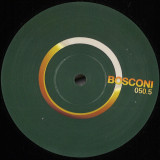
Bosco050.5 follows the sound of the previous one serving four most exciting electro, italo-disco and acid infected floor burners!
"Run it Back" is a simple and dry tune, has those big cutting edge sounds typical of the early 2000 80's contaminated electro.. perfect for your starting set or in recreating that unique atmosphere.
On the A side follows "Half Way Trough", an effortlessly driving tech-acid house tune, strangely compelling, with a timeless feeling.. looking like an essential weapon for any dancefloor.
B side starts with the spicy electro-disco tune "Over The Machines" epic and functional at the same time with evocative arpeggios and a mechanical vocodered speach.
The Ep ends with the cyberfunk stomper "Revolution" , a twisted electro funk groover in typical Minimono vein.
Fabio Della Torre and Ennio Colaci celebrate this 50th.5 release on Bosconi in great style, remodernising the sound that they used to like when they first met in the early 2000, under the influence of those Berlin labels like Areal, Sender, Festplatten, Funkhaus, Beautycase, Lasergun, Gigolo.. and all of those labels who trademarked the sound of those unforgettable Berlin day
Balearic believers rejoice! Japanese tropical-fusioneers Coastlines are back with the worldwide vinyl release of Coastlines 2. The follow-up to their classic debut, this is the sound of Coastlines's global influences. If the dedication to intricate sonic details is particularly Japanese, the overarching feel captures the sprawling grandeur of the international balearic community. As they put it, Coastlines 2 presents "a more precise and beautifully polished magic hour." If that isn't Balearic, we don't know what is.
Takumi Kaneko and Masanori Ikeda don’t radically alter their sumptuous template with this second LP; and we wouldn't want them to. Yet with a more focused flow from first track to last, both Coastlines and Be With feel this is an even stronger album than their first. One thing that hasn't changed is the use of instrumentals instead of words to express their themes; namely, "the emotional expression of being soaked."
Opener "Tenderly" is appropriately titled, a gentle Latin shuffle easing you back into the Coastlines sound. An organ-heavy synthy exotica that's in step with Lovelock's contemporaneous "Washington Park". Their über-horizontal take on Hawkshaw & Bennett's "Mile High Swinger" (from Synthesiser And Percussion, reissued by Be With!) evokes cocktails-by-the-pool as the sun slowly sets. The blunted deep jazz-funk swing of "Alicia" is a rearranged reimagining of the Gabor Szabo song from his classic Jazz Raga LP. This here sounds like an outtake from The Chronic.
As the sun goes down, "Combustione Lenta" soundtracks the relaxing slow burn of an idyllic bonfire on an isolated beach. Displaying a beautiful new side of Coastlines, we're treated to Moments In Love vibes and melancholic guitar arcs. The piano-laden early morning wonder of "Night Cruise" started life as a completely different song, but the duo found a particularly good loop from the initial sketch and reconstructed it into this sophisticated 80s instrumental soul groove. "Waves And Rays" is all undulating acid waves and lighthouse light. A chopped and screwed steel drum G-Funk with soaring synths and nods toward the squelchy machine soul of Mtume and Jam & Lewis. Yes, *that* good.
The bouncy futureboogie cosmic chug of "Sky Island" represents the beginning of the sunrise, casting images of 80s Japanese fusion and definitely one to play out early doors to get the crowd stepping. "Area Code 868" is the strutting staccato sound of Joe Sample waking up in the Caribbean to craft his piano funk drenched in sunshine. Accordingly, the tentative, naive melodies of "Sand Steps" represent that vivid feeling first thing in the morning, as you step on to the sandy beach in the sunshine and take a deep breath. The world is yours.
The emotional, organ-piano-steel drum-driven "Song For My Mother" is a slo-mo show of sincere gratitude to all the great mothers. "Yasmin's Theme" is Coastlines's Brazilian homage, recalling for them that early summer feeling. It's propelled laconically by the carnival beat of batucada`s big bass surdo drum and complimented by sweeps of warm keys and radiant vocal harmonies. Blissful beatless closer "Asafuji" conjures a scene from a wonderful morning spent with the people of Shizuoka, the symbolic mountain of Japan, Mt Fuji and its inhabitants. It sounds like Dâm-FunK jamming with Sabres Of Paradise.
Coastlines 2 was painstakingly crafted, across the pandemic, at Masanori's rented place in Tokyo and then brought back to his home studio and worked on slowly and repeatedly. With limited time to see each other, the duo became more united in their "consciousness with natural progress."
Mastered by Simon Francis and cut by Cicely Balston at Air Studios, this magnificent double LP has been pressed by the good people at Record Industry.
Elias Devoldere is the drummer in bands such as Nordmann, Hypochristmutreefuzz, Suwi, Robbing Millions, and John Ghost. Following an ep, Kaiku, released last summer, Bloomed > Exploded is his debut full length as a solo artist. Besides writing and singing, he composed, played, recorded, and produced the bulk of the ten songs himself. 'Everything blooms', he explains the title of his first album. 'Until it explodes, and something else is able to grow from it'. In this case, what came full cycle is an intimate coming-of-age album of intangible atmospherics, crisp melodies, and understated rhythmical patterns.
BLOOMED >
'As a kid, I just wanted to play football, you know?', says Elias. 'But when I was eight years old, my parents made me choose between drawing school and music school'. And thus began a dedication to rhythm for Elias. At 18, he enrolled at the Royal Academy of Fine Arts in his hometown of Ghent, opting for a jazz education. 'Not because I aspired to become a master 'jazz drummer', but to learn music, to become a good musician'. It was at the academy that, after an impromptu jam session, Nordmann first came together. The exhilarating instrumental quartet went on to win second place at the prestigious Humo's Rock Rally in 2014, and released three albums to critical acclaim, with a new one in the works.
Devoldere, in the meantime, had completed his degree with a craving - ironically - for music. 'I was in over my head with jazz for such a long time, and went on an epic discovering spree. Moses Sumney, James Blake, Kendrick Lamar, Connan Mockasin... Lots of stuff I had missed over the years. In a way, I reconnected with the kind of music I was into before jazz dominated my life. Pink Floyd was my first love, for instance, and later Radiohead proved to be a game changer. Diving back into those kind of sounds, I was feeling the urge to follow my old dreams, of being a solo artist - or something more than 'just' a drummer, anyway. So I bought a guitar, an interface for my laptop, and started writing'.
EXPLODED
When he released his 5 track ep Kaiku in the summer of 2021, it summarised a lot of firsts for Elias. First time writing lyrics, first time as a lead vocalist, first time recording his own songs all by himself. The songs had been around for a while, but taking those leaps took a long time. 'Making the ep helped me to find my voice, in every way possible'. Still, in the aftermath of the pandemic, the songs on Bloomed > Exploded sprouted in a time of upheaval. 'Musically the album is quite serene, gentle even. But the themes speak of internal unrest and uncertainty. There are a lot of questions on the album, as it turned out. Duality, as the title suggests, coming from the struggle between a wish to turn everything upside down and a search for peace. Honestly: the prospect of my 30th birthday was messing with my head too'.
Recording during a period of solitude in France, Elias initially relied heavily on synthesizers and drum machines. 'Explode / Boalis was one of the first songs I wrote for this album, and pivotal for its atmosphere, based mostly on electronic elements. Later, I did use 'real' drums on most of the other songs, though, and contributions from other musicians, but the overall mood is very cohesive'. 'Pure', that's how Bruno Ellingham, the UK engineer who mixed the album, described it. Much to the delight of Elias, who reached out to Ellingham because of his previous work with bands such as Massive Attack and Portishead. 'Hearing the end result, I thought he really captured the essence of the original demo's. For me, that adds to this album being a sincere reflection of my true self. 'Take a dive/ Into the place where it's more quiet', as I sing in the last song, that kind of sums it up for me'.
- 1: Sea Breeze
- 2: Hercules
- 3: Heat Haze
- 4: Bicycle Ballet
- 5: The Downs
- 6: Ramblers' Dance
- 7: Greyfriars
- 8: Blackfriars
- 9: St Nicholas
- 10: St Katherine
- 11: St Leonard
Oliver Cherer is back with a new Gilroy Mere record which follows on from his other much lauded Clay Pipe releases (The Green Line, Adlestrop and last year’s D Rothon collaboration, Estuary English).
Over the last two decades Ollie has released numerous collections of music in an ever shifting array of modes, from folktronic, singer-songwriter styles through psychogeographic electronica to jazz-tinged, confessional ghost-pop and most recently, the “guitar tainted machine rock disco” of Aircooled.
Gilden Gate is an album of two halves. Side 1 ‘Rising’ celebrates the sun-drenched beaches, pastures and heaths of rural Suffolk, whereas Side 2 ‘Falling’ explores the underwater world of the lost city of Dunwich and its five church spires.
Oliver says:-
“A few years ago I discovered the lost city of Dunwich. I’d made a trip to Suffolk to shoot a short film about Sizewell Nuclear Power Stations and stayed in the old Coastguard’s Cottage on Dunwich Beach within sight of Minsmere Nature Reserve and the power plants. It’s a wild, sleepy place of pines and heath and North Sea winds and a strangely mysterious air – Sutton Hoo is nearby and Eno’s reference to the very beach that I was staying on made perfect sense. In the small museum at Dunwich I learned that this tiny hamlet had once been a major medieval city of international trade. It seemed unlikely and even now, knowing Dunwich as a small village, I find putting what I know about the place into perspective as a city a certain kind of impossible.
It seems that over a period under the influence of the weather, natural erosion and market rivalry the thriving harbour port was inundated by the North Sea and eventually slipped into and under it. The city of churches was lost and all the spires engulfed and toppled. What remains are the few houses, and the ruin of Greyfriars crumbling inexorably down the cliff and exposing the bones of buried monks as the graveyard follows the building’s stones into the sea.
There are local legends surrounding the site including stories of fishermen hearing the bells of lost churches and seeing the ghostly, lighted city beneath their boats as they return to the shore.
Gilden Gate is named for one of the entrances to the old city and is a musical meditation on Dunwich past and present. Frances Castle’s beautiful sleeve art depicts the surface and the sub-marine, the warm and the cold, the past and the present. The glass rises and the glass falls and in the background there are sirens, fog horns, church bells and Eno, and on the sea bed there are the scattered remains of a once great city.”
Soundway releases a storming compilation of Cameroonian-born, Nigerian-based super producer Nkono Teles’ solo work.
The pioneer of West African electronic music was known for being tapped by over 100 other musicians to produce or arrange their music, from King Sunny Adé, Guy Lobe, even Steve Monite’s
album “Only You” and more. Having already appeared on Soundway’s best-selling compilation “Doing It In Lagos”, here more of Nkono’s
limited solo work is carefully remastered and reissued on
vinyl for the first time. One of a small handful of pioneers of the Nigerian electronic music scene in the 1980s (alongside the likes
of Jake Sollo & William Onyeabor), Teles was known for being tapped by over 100 musicians to feature on, produce or arrange their music. The list of ‘80s Nigerian records that his sound and style embellished
is seemingly endless: Steve Monite (he arranged and produced the music on the Only You album recently re-issued by Soundway), Dizzy K, Peter Abdul, Odion Iruoje, Steve Black, Rick Asikpo, Feladey, Charly Boy, Majek Fashek & Sonny Okosuns, to name just a few,
all engaged his enigmatic production and keyboard services throughout the 1980s. He became known as the first person in Nigeria to push the use of the drum machine into popular music and created a unique and original boogie-funk sound combining these new
beats with guitars and an array of new and affordable synthesiser sounds that started appearing in the early 1980s.
"Dans cent ans" is not a record: it’s a talisman.
Flavien Berger doesn’t make music, he makes time machines.
In 2015, he released his first album, Leviathan, which he’d imagined like a moment suspended into the bowels of present time.
In 2018, Contre-Temps, his critically acclaimed second album, was narrated like a flashback.
Dans Cent Ans (“In 100 Years”) ends this trilogy and launches into the future with the grace of a poisonous serpent.
Flavien had just finished producing Pomme’s last album and was simultaneously scoring Céline Devaux’s feature film Tout le monde aime Jeanne, when he recorded this album, during six months of isolation.
In the garret of a Belgian house in construction, these 12 tracks were born, close to the sky, both direct and mysterious.
Because Flavien Berger knows how to make machines sound sensual (a key example is the pop song “D’ici là”) and dares to interweave electronics, chanson and art music, organic instruments and synthetic choirs, without ever falling into parodic territory.
Because his voice, more precise, unreverbed, and close-mic’d than ever, sings to our ears – using multisyllabic rhymes (“Trop ivres pour te plaire / Tropiques du cancer”) and surrealist imagery (“la neige restera rose” – “the snow will remain pink”) – stories that feel unknown yet obvious.
And like both previous albums ended with a long eponymous track like a breath of air, “Leviathan” and “Contre-temps”, so does “Dans Cent Ans”, a 15-minute long saga where vocals, wind instruments and machines converse, as if Debussy, Etienne Daho and a Sufi Dervish met in a dream.
After listening to this album, the vertigo of love and the collision of times are one and the same.
In one hundred years, music will survive us all, and its dangerous beauty will awaken other lives. In the meantime, Flavien Berger keeps stunning ours.
Right Diagonal' kicks off with the title track which presents a potent wall of sound that undulates across a pensive current. Distant vocals, frazzled signals and stuttering drum patterns work together to build a fantastically unheimlich vibe. The Crosser version then projects sound into a spacious, chilly warehouse as reverberated flashes of sound depict futuristic machines at work.
'Conjugated In Boring Crimes' then follows up with a dense, shuddering recording. Growls and whispers swell beneath more dystopian sonics before 'Safe Resist' rolls out as a jagged Techno experiment. A steady kick propels a rich, metallic sound palette before 'One Man Clearing' renders another scene of murky futurism.
'Farewell Seesaw' then follows up with a subtle Electro track peppered with hypnotic vocals and a distant, snappy snare. The 'Clubmix' version then delivers what it promises as urgent drums whip up a menacing, heady dance floor vibe.
'Night Voodoo' then brings things to a close as cinematic sweeps suffuse a sawtooth sequence and thick, bubbling bass tones. Frazzled hats bleed through in giving the track a certain live feeling which brings the record to a close.
"Dans cent ans" is not a record: it’s a talisman.
Flavien Berger doesn’t make music, he makes time machines.
In 2015, he released his first album, Leviathan, which he’d imagined like a moment suspended into the bowels of present time.
In 2018, Contre-Temps, his critically acclaimed second album, was narrated like a flashback.
Dans Cent Ans (“In 100 Years”) ends this trilogy and launches into the future with the grace of a poisonous serpent.
Flavien had just finished producing Pomme’s last album and was simultaneously scoring Céline Devaux’s feature film Tout le monde aime Jeanne, when he recorded this album, during six months of isolation.
In the garret of a Belgian house in construction, these 12 tracks were born, close to the sky, both direct and mysterious.
Because Flavien Berger knows how to make machines sound sensual (a key example is the pop song “D’ici là”) and dares to interweave electronics, chanson and art music, organic instruments and synthetic choirs, without ever falling into parodic territory.
Because his voice, more precise, unreverbed, and close-mic’d than ever, sings to our ears – using multisyllabic rhymes (“Trop ivres pour te plaire / Tropiques du cancer”) and surrealist imagery (“la neige restera rose” – “the snow will remain pink”) – stories that feel unknown yet obvious.
And like both previous albums ended with a long eponymous track like a breath of air, “Leviathan” and “Contre-temps”, so does “Dans Cent Ans”, a 15-minute long saga where vocals, wind instruments and machines converse, as if Debussy, Etienne Daho and a Sufi Dervish met in a dream.
After listening to this album, the vertigo of love and the collision of times are one and the same.
In one hundred years, music will survive us all, and its dangerous beauty will awaken other lives. In the meantime, Flavien Berger keeps stunning ours.
Veils Of Transformation 1972 - 1980 is a collection of the earliest works of Gregory Kramer, one of the 20th century masters of textural electronic music. This collection is available on CD and cassette with liner notes from Gregory Kramer and Kaitlyn Aurelia Smith, who first brought this fascinating work to the attention of Important Records.
“Greg is one of the pioneers of electronic music and these pieces are unique opportunities to discover how intricate and dynamic early synthesizers are.” Kaitlyn Aurelia Smith
Kramer developed a musical language focused on continuous transformation of timbre, yielding a continuity of attention. This musical language, formed of timbral change, is a compelling aesthetic in its own right and a source of meditative experience. The four works on this album share a deep sense of order derived not from organizing pitches or rhythms, but from the evolution of timbre itself.
Gregory Kramer (b. 1952) is a pioneering electronic composer, inventor, researcher, teacher and author. In 1975 he co-founded Electronic Musicmobile, a synthesizer ensemble later renamed Electronic Musicmobile, a series of synthesizer concerts in New York from which he formed the Electronic Art Ensemble, a highly regarded all electronic quartet. His work extended to developing synthesizers and related equipment. Kramer also co-founded the not-for-profit arts organization Harvestworks in New York City. He is recognized as the founding figure of the intensely cross-disciplinary field of data sonification. Since 1980, Kramer teaches Buddhist meditation.
The four compositions collected here each represent Kramer’s unique approaches:
The structure of Meditations on 32 Parts of the Body (1978) is derived from the means of its production. Recording 5 people chanting an ancient meditation text, then layering to gradually achieve more than one million voices. The layering was all done using analogue tape recorders. The decomposition of the sound reflects the anomalies of tape machines out of sync, and the build up of artifacts from the audio tape itself, such as uneven response curves and tape hiss, are all engaged as musical materials.
Role (1972) was generated using one complex patch on a large hybrid Buchla 200/100 system. Emerging from a zeitgeist that valued pure synthesis as a combined artistic and technological research. At the time this piece was realized its as exceedingly difficult to produce electronic sounds that were internally complex.
Blue Wave (1980) is built on Kramer’s timbral development technique Veils Of Transformation which allows for disparate timbres to be woven into a continuously developing sound.
Monologue (1977) is a virtuosic performance of a massive patch on a Buchla/Electron Farm hybrid electronic instrument. Built into the patch is a pathway for continuous transformation of voice and voltage-controlled synthesizer. The blunt, raw and sometimes harsh sounds of this piece reflect an attitude prominent among composers that music can, or even should, be difficult, contrary to what’s already been done and, by all means, new.
Homage to Tarab is a journey between cultures, times, places and of course sounds that were molded within the middle eastern orient that had shaped The Hallways' musical perception. All out of tremendous respect to their legacies. Described in one short sentence, Experimental Arabic Drone Music. Picture dark synths, alianted rare drum machines meet ancient organ lamentations, beats the bubble from deep within and such that floats around spaces in circles while constantly changing. Ones that feel like flying on top of a magic carpet ride over deserts, mosques, ancient prayer books while in the background the dimming lights of a mysterious asphalt and concrete covered city.
Critically acclaimed rock group EELS announce
vinyl reissues of earlier records ‘End Times’, ‘Hombre Lobo’ and ‘Tomorrow Morning’, released via E Works / PIAS.
EELS will hit the road this Spring for the longawaited Lockdown Hurricane tour of Europe and North America, starting in March in Nottingham. The reissues follow EELS’ critically acclaimed
2022 record, ‘Extreme Witchcraft’, which found
praise at MOJO, NME, The New York Times,
Stereogum, SPIN and more. EELS have had one of the most consistently acclaimed careers in music. The ever-changing
project of principal singer / songwriter E (Mark Oliver Everett), EELS have released 14 studio albums since their 1996 debut, ‘Beautiful Freak’. In 2008, E published his highly acclaimed book,
‘Things the Grandchildren Should Know’, and starred in the award-winning ‘Parallel Worlds, Parallel Lives’ documentary about the search to understand his quantum physicist father, Hugh
Everett III. Single LP on standard weight black vinyl in a
gatefold sleeve with matt machine varnish.
Critically acclaimed rock group EELS announce
vinyl reissues of earlier records ‘Hombre Lobo’,
‘End Times’ and ‘Tomorrow Morning’, released via
E Works / PIAS. EELS will hit the road this Spring for the longawaited Lockdown Hurricane tour of Europe and
North America, starting in March in Nottingham. The reissues follow EELS’ critically acclaimed 2022 record, ‘Extreme Witchcraft’, which found praise at MOJO, NME, The New York Times,
Stereogum, SPIN and more. EELS have had one of the most consistently acclaimed careers in music. The ever-changing
project of principal singer / songwriter E (Mark Oliver Everett), EELS have released 14 studio albums since their 1996 debut, ‘Beautiful Freak’. In 2008, E published his highly acclaimed book,
‘Things the Grandchildren Should Know’, and starred in the award-winning ‘Parallel Worlds, Parallel Lives’ documentary about the search to understand his quantum physicist father, Hugh
Everett III. Single LP on standard weight black vinyl in a
gatefold sleeve with matt machine varnish.