
quête:makossa

- A1: Manu Dibango - Weya
- A2: Fehintola Anikulapo Kuti - Sorrow, Tears & Blood
- A3: Matata (Air-Fiesta) - I Feel Funky (Air-Fiesta)
- A4: Alvin Cash & Scott Bros Orchestra - Keep On Dancing (Instrumental)
- B1: King Sunny Ade & His African Beats - Ja Fun Mi (Instrumental)
- B2: Oneness Of Juju - African Rhythms
- B3: Lafayette Afro Rock Band - Soul Makossa
- B4: The Nite-Liters - Afro-Strut
- C1: Mulatu Astatke - Yegelle Tezeta
- C2: Tony Allen & The Afro Messenger - No Discrimination
- C3: The Rwenzori's - Handsome Boy (E Wara) (E Wara)
- C4: Ofo The Black Company - Allah Wakbarr
- D1: African Music Machine - Black Water Gold (Pearl) (Pearl)
- D2: The Headhunters - God Make Me Funky
- D3: Ice - Time Will Tell
- D4: Wisdom - Nefertiti
16

- A1: Manu Dibango - Soul Makossa
- A2: Roger Damawuzan & Les As Du Bacnin - Wait For Me
- A3: The Wings - Gone With The Sun
- A4: Ebo Taylor & Uhuru Yenzu - Love And Death
- A5: Marumo - Khomo Tsaka Deile Kae
- B1: Orlando Julius - Disco Hi-Life
- B2: Peter King - African Dialects
- B3: Super Elcados - Get Up And Do It Good
- B4: Bukky Leo & Black Egypt - Ake Bo Je
9

12
The strange and majestic musical beast that is Africadelic was Dibango’s follow-up to Soul Makossa, but it was initially released on Louis Delacour’s library music label, Mondiaphone, before “Soul Makossa” became an international phenomenon. As a
Mondiaphone release, it was aimed at television and film producers seeking atmospheric background music, so the original titles are simply “Theme No 1,” “Theme No 2,” etc, with corresponding rhythmic notations such as “3/4 Africain,” “Afro Beat 12/8” and “Medium Soul Beat,” though once “Soul Makossa” hit the stratosphere, subsequent reissues bore actual song titles. In any case, the album is simply wonderful, a driving mix of Afro soul, funk and jazz, with an undercurrent of Latin percussion throughout, given further shades by rock guitar and soul organ, as heard on “African Battle” and the title track; opener “Soul Fiesta” builds
dramatic percussive tension before Dibango drops a killer vibraphone riff, while “African Carnival” makes the most of the full horn section, Dibango’s sax soloing giving room for complex polyrhythmic percussion breaks. “Oriental Sunset” has beautiful vibraphone from
Dibango too, as well as a thrilling flute melody, “Monkey Beat” and “Wa Wa” are funky soul struts and “Percussion Storm” has the band marching off into the African sunset as Dibango unleashes another killer vibraphone melody. Listening back to the album now, it is hard to believe that the whole shebang was written in a couple of days and committed to tape within the space of a week, but that is all more testimony to the greatness of Manu Dibango, one of African music’s true pioneers. Play loud and often for best effect!

8
Nkumba System, new project led by guitarist Guillo Cros (Romperayo) provides a vibrant fusion of catchy percussions, Afro-Colombian songs and Cameroonian guitar picking style linking Central Africa to the Caribbean! Nkumba System is about to fill the dancefloors with debut album ¡Bailalo Duro!, recorded between Bogotá and Paris.
On the imaginary highway of Guillo Cros, makossa crosses paths with cumbia, Zairean rumba combines with that of Cuba and last but not least, currulao melts into Malian desert blues. Cros' journeys led him to meet the Cameroonian singer Mama Ohandja, alongside whom he trained for several years. Thereafter, he resided in Bogotá from 2014 to 2019, collaborated with Pedro Ojeda in the band Romperayo and “Los Propios Bateros” (7” NYCT). His current project Nkumba System was born in 2018, inside Colombia's effervescent tropical music scene. The original line-up includes bassist Jhon Socha (Romperayo, la Makina del Karibe), singerpercussionist Leonel Merchan (La Phónoclórica) and Kike Narvaez on drums. Several singles were
released on local labels Tambora Records and Palenque Records, preceeding the arrival of Cameroonian guitarist Simba Daniel Evousa in the band. The drummer Pedro Ojeda, travelling companion in Romperayo, is invited on the track “Mujer hermana”, as well as the Malian singer Mamani Keita on “Paisano”. The album is mixed in
Amsterdam by sprawling musician Alex Figueira (Fumaça Preta, Conjunto Papa Upa, Music With Soul), in his studio Barracão Sound, and comes as a Limited Pressing.

We are back on Boogie Butt with a soul track just like back in the days, this time with a Lord Funk & Samm Culley collaboration. We’re bringing back to your ears this giant artist, who crosses decades of music with its great personality and many groovy songs.
Samm Culley is an R&B, soul & funk keyboard player and a dope songwriter. His music career started within the band Tiny Tim & The Hits with Tom Price & Bill Collier. This trio soon left Tiny to form their own group The Diplomatics with Irving Waters as the lead singer. They later on became the legendary Skull Snaps.
Over the years, Samm co-produced and/or played with many unforgettable famous artists such as Hot Chocolate, The Fatback Band, George Kerr, Patrick Adams, Vaughan Mason, Reggie Griffin, De-De, Van Mc Coy, Lloyd Price & even later in Hip Hop music with Marley Marl or Freddie Foxxx.
“Let It Go” brings you back in 1970 with a great killer dance floor track for Bboys and soul lovers: the dru break is hot and on the same time, the guitar hook and bassline make you feel James Brown on the scene. Close your eyes and easily imagine John Shaft dancing on “Soul Makossa”.
The B side is the instrumental reworked by our well-known Lord Funk, with Samm on bass. Enjoy & play loud!

8
For its second release, NUBIPHONE is proud to present you SUNSHINE, a privately pressed Afro-Jazz-Folk UFO album recorded in 1980 by the Cameroonian Singer, Musician, Actress, Seamstress & Poetess LIZA NGWA. Individually-numbered Official Deluxe Edition, limited to 500 copies! Comes with a beautiful exclusive poster, a handwritten insert from Liza Ngwa herself with the lyrics of the album and a download card.

A doctor by day and a musician by night, Leon x Leon has been producing songs in his
Parisian home studio since 2013, where house, italo-disco and boogie are mixing. When he
was younger, he was immersed in music by taking jazz drum lessons at the conservatory,
and especially by seeing his father, a sound engineer, who had been building his own
synthesizers since the 1970s. As a tribute, he used one of these unique synthesizers on a
title of the disc.
After a remarkable remix of Cerrone's "Funk Makossa" and several tracks on various from
'Red Laser Disco', he released his project My Solar Brass on the same English label in
2017. Organizer of many Parisian parties, he also participated in the founding of the
publishing label 'Good Plus". With the release of Rokanbo on Cracki Records, Leon x
Leon signs a mature EP with the influence of different styles.
The first eponymous title is a manifesto mixing Acid, House and Zouk. As soon as we
launch the track, the pop & acid 80's sounds takes us to another world... A UFO from the
Islands! The other parts of the EP don't leave us in the lurch! 'Formant Sweep' delivers a
soft and groovy bass that responds to an endless, spatial synthetic takeoff. On 'Red
Footpath', the harder kick cleverly blends with an atmospheric blanket and a bright, lively
flute solo straight from an abandoned piece of bamboo on a deserted beach. After that,
'Jungle Juice' lets a crazy keyboard solo resonate in the middle of tropical fauna and flora,
and finally on 'Horizon', the EP ends in beauty with an airy atmosphere. This last piece
sounds like a beautiful sunset at the end of a long summer day.
Through all these tracks, Rokanbo EP offers us a clever contrast between synthetic notes
and the warmth of tropical groove, and places our gaze towards the horizon, seeking the
groove to disturb its line on the infinite sea.
5
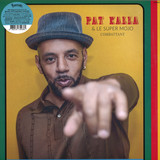
Favorite Recordings proudly presents Combattant, first EP by Pat Kalla produced by Bruno Patchworks' Hovart (aka VOILAAA).
PAT KALLA is a musician, singer and storyteller. Patrice of his birth name, in tribute to the great Lumumba! Lover of words, French language, and music of course. Born in Lyon, from a Cameroonian father, musician and political activist, and a French and literary mother, he explores from his childhood the Soul, the Slam, the Funk ... and the art of telling stories, life being a great one...
After years of touring alongside many bands (Conte & Soul, Legend of Eboa King, Mento Cloub, Voilaaa Sound System), and several acclaimed titles on the two albums by Voilaaa, he comes back with this project to put a bit of primordial lightness in a rainy world: A tribute to the African culture in honor of a father with "Sawa" origins, the tribe from the people of Makossa.
Jojo Ngallé, Moni Bilé, Pain, Manu Dibango, Franco, Rochereau, Kabaselé, Fela, François Nkotti & The Black Style, all these legends' vinyls have turned on the family turntable and the collection has whetted the child's appetite. Through this new trip, he revisits styles that are sometimes little known to Western audiences, such as High-Life, Makossa, Angolan Music, Afrobeat, Afro-Disco and others. We could talk about Franc CFA', we could talk about Jacques Foccart, but we will rather dance, because "the dancer seems naive, but his feet must be connected with earth to understand history..."
Backed by the "Super Mojo Disco", a hyperactive band from Lyon with deep groove and positive energy, Pat Kalla offers us an anti-crisis project, where swaying and feel-good humor is mandatory! An album soon in the crates, beware « c'est médicament » (it's medicine)!!

- A1: Love Is Serious Business
- B1: Knock On Any Door
ALFIE DAVISON first came to prominence in the early seventies as a DJ on the New York dance scene breaking cutting edge singles such as Soul Makossa' by Manu Dibango. Eventually he hit with his own song -- Who's Gonna Love Me' -- recorded by The Imperials and breaking the U.K. Top 20 in December 1977. Davison did record his own version which saw a release in the U.S.A. on the RCA imprint, but it failed to chart.
However, it was his sublime single - Love Is Serious Business' - that propelled him into the Northern Soul Hall of Fame. Released on Mercury Records in 1979, in both 7 and 12-inch formats, it was an instant hit in the North of England where it packed the floor at Wigan Casino courtesy of the forward-thinking DJ Richard Searling who, at the time, favoured the rare 12-inch import.
Sadly, the song failed to chart despite a favourable reception in the trade magazine Billboard, although, oddly, it was reviewed in the Pop', rather than the Soul' section. Davison was completely unaware of the serious' club action that the song received in the U.K. and he never performed it in public, until Ian Levine met up with him at the dawn of the new millennium, in Brooklyn, for the filming of The Strange World Of Northern Soul'.
Alfie Davison passed away in 2014 and leaves behind a small but precious legacy that will be forever cherished in the Hearts and Souls of Northern Soul fans worldwide.

Muyei Power or Orchestre Muyei (muyei means 'our country') was one of the top dance bands of the1970s in Sierra Leone. Soundway Records' first collection of music from this West African country ('Muyei Power: Sierra Leone in 1970s USA') is an album of rock-infused, 'afro' music from a group that traveled the world throughout the mid 1970s. Fusing elements of electric Congolese and Nigerian music with fast, syncopated, uptempo modernised arrangements of traditional music, Muyei Power produced a series of unique single-only releases that have been unavailable for 35 years. The rare recordings featured here are a glimpse of a dynamic and powerful band at the very height of its powers.
Even though lyrically Orchestre Muyei focused on traditional themes and songs, the arrangements and formulation of the instrumental side of things still very much reflected the mixed nature of urban Sierra Leone music, exemplified by a small collection of bands that also included Afro National, Sabanoh 75 and Super Combo.
For the early part of 1970s the band toured extensively throughout Sierra Leone, Liberia and Côte d'Ivoire before making a handful of 45s in local TV and radio studios. The recordings featured here however come from a period of touring the college circuit in California during late 1975 and early 1976. Later that year, as they played the colleges of the east coast, they gave the tracks to the owner of the African Record Centre in Brooklyn, New York. He initially released two of them on his in-house Makossa Records label as 7-inch 45rpm singles in 1976. The tracks from 1975/6 were then not heard of again until 1979/80 when the African Record Centre released many of them on a series of Makossa Records 12's that sounded far superior than the records that had been released a few years earlier.
Orchestre Muyei Power finally split up in 1979 leaving no proper album releases and only a handful of recordings for us to enjoy all these years later.
