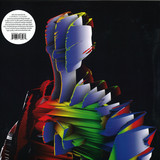
Omar Di Bongo is an audio-visual project that melts video feedback from Hugo Saugier with two figures of french underground techno scene, Somaticae (In Paradisum, Tanzprocesz...) known for his dark cutting edge techno, and C_C (Small But Hard, Kvitnu...) master of no input mixer feedbacks, and savage analog industrial beats. Their music merges industrial music with tribal polyrythms, and makes us dive into a certain kind of psychedelia between hallucination and dementia. Reduced to the essence, their productions bring back techno to its core, the trance dimension, often fogotten in many modern musics of this genre.
Cerca:man make music
*The No Man Is An Island EP is a single cut from the debut album of the same name by Aalko, a new project by Kebko Music founder Akiko Kiyama. Renowned for her minimal techno track featured in Richie Hawtin's seminal DE9 Transitions album, the Japanese producer reveals her another side under this new alias. The project has already created a stir as Aalko has garnered support from Gilles Peterson on his BBC 6 Music radio show and premiered a live performance at MUTEK's Tokyo launch, where she drew the audience into an inspiring frenzy.
Aalko is a culmination of Kiyama's recent practices in a wider musical spectrum that go beyond the confines of her minimalistic techno characteristics. It conjures her distinctive soundscape where a variety of styles coexists: she demonstrates her knack for breaks, ambient and irregular time signatures, her acute ears for unadulterated tone and texture of sounds standing out in sharp relief.
Taking a floor-oriented side out of the No Man Is An Island cassette album, this single cut features three tracks that work wonders in a DJ context. "Body & Soul" is an erratic rhythm experiment jumping between several beat styles. "Mixture" offers Kiyama's unique interpretation on syncopated dynamics of breaks. Wrapping up the EP is 'B.I.C', a long-awaited exclusive track that ranked among Gilles Peterson's top 20 tracks of 2017. Its dubby functionality makes it a powerful tool that can work at various stages of the night.
These tracks give the nod to Kiyama's peculiar self full of sonic idiosyncrasies, showing no fear of breaking accepted conventions.
There were several groups within the Detroit music scene that shared the name of 'The Holidays'. From the 1950's through to the late 1960's our version of The Holidays who took their name from a group members car, a 1954 Oldsmobile 'Holiday', would record for the Star-x, Markie, Master and Holiday record Labels. Founding member James Holiday would also briefly pursue a solo career with releases on the Markie, Syco and Blue Rock labels respectively.
In 1969 James joined by his brother Jack, a baritone saxophonist and the former leader of the band within influential Detroit DJ 'Frantic' Ernie Durham's legendary Gold Room at the 20 Grand Theatre. The brothers together, with Maurice White and former Contours member Joe Billingslea formed 'The New Holidays' who recorded the 'Popcorn' Wylie produced song Maybe So, Maybe No' (Soul Hawk 1008). This current in demand 45 featured If I Only Knew' on the flipside, an excellent cover version of a previous Jimmy (Soul) Clark recording If I Only Knew Then (What I Know Now)' This was recorded at a later session to Maybe So, Maybe No' and featured a slightly different line up with Joe Billingslea making way for a youthful Elliot Smith.
By 1972 The Holidays found themselves without a label, so they formed their own, Marathon Records. Their initial release was the excellent double sider I'm So Glad (That I Met You)/Too Many Times' (Marathon 257). Both songs were written by James Holland and Sylvester Potts another former member of the Motown group 'The Contours' and were recorded under the artist name of 'The Fabulous Holidays.
Into 1973 and their next release was the soulful ballad Getting Kind Of Serious' (Marathon 18475) a Fritz Hale and Fredrick Charles Hawkins composition backed with an instrumental version. Followed by Ego Tripping' (Marathon 18475) an upbeat funky little mover backed with the ballad Lazy Day' written by James Holland, Anthony Hawkins and Fritz Hale.'
During 1975 The Holidays resumed their acquaintance with former record store owner Ronald Holmes a collaboration which led to the release of another excellent double sider This Is Love b/w The Love We Share' on the Rob-Ron (RR-75) label. The Love We Share' was recorded twice. Firstly as the issued 45 version under the shortened title of The Love We Share' and as an unissued longer version under the title of (Been Together Too Long) The Love We Share' with slightly different lyrics. During 1976 a further Holland/Holmes collaboration saw the release of the message song Procrastinate (Why Do We)' (Ron-Hol 76). After this release Ronald Holmes and the Holidays parted company.
During late 1976 into 1977 the Holland brothers wrote and produced two further songs which they recorded with Charles Hawkins (a founding member of the Psychedelic Rock and Funk Band, 'Black Merda') The up tempo dance track You Make Me Weak' and the less frenetic Lost Love' although never issued at the time both songs can be found on the recently released Soul Junction cd album Getting Kind Of Soulful' (SJCD5012). A later discovery of a alternative take of You Make Me Weak' (Take 2) is now available on vinyl for the first time backed with their uptempo dancer I'm So Glad (That I Met You)' The Motorcity continues to yield its long lost legacy.
After the success of his recent comeback EP entitled Exiles EP, the Icelandic artist Cold shows us that he is here to stay and ready to make his mark in the international techno scene.
Dub Safari offers us intricate soundscapes and otherwordly chords which are impeccably assembled into five minimal techno masterpieces. A side starts with a dreamy voyage where ethereal pads seamingly blend with punctuating kick and a acid bassline. Second cut gives us a darker experience. A pulsating groove where chords and percussions offer an interesting sonic playfulness. B-side offers three minimalistic techno tracks ready for both the dancefloor as well as for dancefloor within your mind. Thule Records is considered by many to be a pioneers in the field of dub-influenced techno music and was a starting point for many of Iceland's most renowned electronic musicians"
Visible Cloaks' Lex proposes a utopian dream language and its accompanying sound, a limitless, delicate space developed by fluid musical techniques and subconscious voices. The six pieces comprising Lex simulate a more peaceful future, their mysteries telling a new tale in an unknown but imaginable melodic language. Visible Cloaks are the Portland-based musicians Spencer Doran and Ryan Carlile. Utilizing software-based composition rooted in randomization, MIDI-translation and chance operations, the duo has established an improbable humanist mode of music from esoteric processes. Following their self-titled debut album, Visible Cloaks offered Reassemblage, an album simultaneously honoring the post-Yellow Magic Orchestra school of avant musical adventure and diverging from it. Veering from the paths cleared by Japanese and Italian electronic pop and ambient artists of the mid-80s / early-90s, Reassemblage established Visible Cloaks' own camp in a forest of deep sound canopied by trees grown from synthetic seeds.The sound represented on Lex is webbed with sculptural arrangements and interpolated by the sounds of alien speech. These strange and serene utterances were created by Doran feeding a chain of multiple dialects and accents through a language translation software to create an auditory poetry of an evolved place and time.
Lex features both the final version of this process and earlier, simplified experiments with it ( Keys'). The idea - building on 'fourth world' or 'global village' type concepts - was to create a projected language that was a fusion of many,' Doran explains. The result was a very disorienting form of non-language that amplifies the lapses in meaning that occur with the inaccuracy of auto-translation software.'
Permutate Lex, a companion short film to Lex made by Visible Cloaks in collaboration with artist Brenna Murphy (who also created the artwork for Reassemblage and several virtualist videos for the album), is an integral counterpart, both visualizing an aesthetic alive with human form and guiding the sonic experience of the first five pieces: Wheel,' Frame,' Transient,' Keys,' and title track Lex.' World,' the longest piece presented on Lex, is redrawn from a generative composition originally produced for an installation Doran made with Murphy.
The original work incorporates LFOs and randomized MIDI-information, and was intended to variate indefinitely. In this 'fixed' version, World' provides a more conclusive view into the impossible musical environments Visible Cloaks make real. Longer than any track on
Reassemblage, World' expresses the deepening, patient intimations suggested by Lex.
Doran says the Lex attempts to communicate the essence of a world distant enough that it can't be captured or comprehended from the present, appearing only surreal and inscrutable.' The statement reveals a broader musical philosophy fueling this new moment, an awakened voice woven through complex melodic shapes and phrases establishes communication between listeners and the unknown, here presented by Visible Cloaks as sounds coloring the very edge of the envisionable.
Granny13 opens with Nicola Ratti's 'Odd Doubt'. With the use of a modular system and tape loops, a broken rhythm is obtained by parallelism between single sound signals as LFO one or processed tapes.On the second side, Giovanni Lami's 'Johnny Leech' is made with a small bunch of equipment, just a chaotic hand-made synth (cacophonator) and a memoryman, working mainly on static electricity and leakage current in the synth used without any kind of power supply.
Reviews
The Wire
''Two Italian mucisians share a split single of glitchy fun and everyone goes some happy. Lami s piece uses a defective unplugged synthesizer to make huzzing chitters that have a kind of rhythm in spots. Ratti s contribution is a bit more structured it sounds like a record of accordion miniatures broken into pieces, then glued back together with little pieces of felt stuck onto it. Which would definitely be a pretty hep thing to hear.''
Textura
''Some releases qualify as art objects as much as musical collections, a case in point this recent seven-inch vinyl outing featuring material by Nicola Ratti on one side and Giovanni Lami on the other. That shouldn't be interpreted to mean that the musical content isn't worthy of one's time, as it assuredly is, but more to emphasize how striking the sleeve artwork by Opora is and how effectively it complements the musical content.Mastered by Giuseppe Ielasi and issued in an edition of 150 copies, the release opens with Odd Doubt, a concise experimental setting by the Milan-born Ratti, who's issued material on labels such as Anticipate, Preservation, Die Schachtel, and Entr'acte and who's presently working with Ielasi in the project Bellows, with Attila Faravelli as Faravelliratti, and with Enrico Malatesta and Faravelli in ~Tilde. Though Ratti started out as a guitar player, his current focus is more on beat-analog experimentation and sound installation. In Odd Doubt, Ratti's modular system and tape loops generate broken rhythms that varyingly call to mind dub-techno, even if dub-techno of an extremely wonky variety. Off-beat chords, crackle, and snare strikes add to the dubwise flavour of the material, though ultimately it registers as more of an experimental exploration than straight-up dub exercise.The flip side features Johnny Leech by Lami, a one-time photographer now known as both a field recordist and a musician focusing on soundscaping and sound-ecology. In his contribution to the seven-inch, Lami's chaotic hand-made synth (cacophonator) and memoryman give birth to blustery smears of static electricity that ultimately mutate into an Oval-like array of ripples and scratches. Johnny Leech is so removed from anything conventionally musical, it makes Odd Doubt sound like a Top 40 pop song. Like Ratti's piece, Lami's is short, so short, in fact, it gives the impression of being an excerpt from a larger sound art work. Here's a release where the abstract nature of the musical content matches its visual presentation.December 2014''
Vital Weekly 951
''Granny Records is from Greece, but the two musicians here are from Italy, of which I don't I heard from Giovanni Lami before. His piece is called 'Johnny Leech' and he uses a hand-made synth known as the cacophonator and a memory man (a delay machine), 'working mainly on static electricity and leakage current in the synth used without any kind of power supply'. It makes up for a nice piece of chaotic lo-fi sound, which is put forward through methods of improvisation. Quite a nice piece and it fits the format very well. The crackling of vinyl surely adds an extra layer. Nicola Ratti uses a modular synth and tape loops, of what seems to be percussive material, but the rhythm is broken down and the whole thing has a nice gentle feel to it, even when it bumps, clicks and glides, but the synth makes it more subtle. Here too one could say this perfect for a 7": one doesn't have the idea that this is cut from a longer part as is not unusual with this kind music. Especially Ratti seems to have worked out his music as a composition, which is very nice. (FdW)''Vital Weekly 951''Granny Records is from Greece, but the two musicians here are from Italy, of which I don't I heard from Giovanni Lami before. His piece is called 'Johnny Leech' and he uses a hand-made synth known as the cacophonator and a memory man (a delay machine), 'working mainly on static electricity and leakage current in the synth used without any kind of power supply'. It makes up for a nice piece of chaotic lo-fi sound, which is put forward through methods of improvisation. Quite a nice piece and it fits the format very well. The crackling of vinyl surely adds an extra layer. Nicola Ratti uses a modular synth and tape loops, of what seems to be percussive material, but the rhythm is broken down and the whole thing has a nice gentle feel to it, even when it bumps, clicks and glides, but the synth makes it more subtle. Here too one could say this perfect for a 7": one doesn't have the idea that this is cut from a longer part as is not unusual with this kind music. Especially Ratti seems to have worked out his music as a composition, which is very nice. (FdW)''Vital Weekly 951''Granny Records is from Greece, but the two musicians here are from Italy, of which I don't I heard from Giovanni Lami before. His piece is called 'Johnny Leech' and he uses a hand-made synth known as the cacophonator and a memory man (a delay machine), 'working mainly on static electricity and leakage current in the synth used without any kind of power supply'. It makes up for a nice piece of chaotic lo-fi sound, which is put forward through methods of improvisation. Quite a nice piece and it fits the format very well. The crackling of vinyl surely adds an extra layer. Nicola Ratti uses a modular synth and tape loops, of what seems to be percussive material, but the rhythm is broken down and the whole thing has a nice gentle feel to it, even when it bumps, clicks and glides, but the synth makes it more subtle. Here too one could say this perfect for a 7": one doesn't have the idea that this is cut from a longer part as is not unusual with this kind music. Especially Ratti seems to have worked out his music as a composition, which is very nice. (FdW)''
Blurt are perhaps the act who have played live at Optimo more than any other. Active for close to 40 years they are one of the UK's all time great acts, phenomenal live and on record and supremely underrated.
Blurt mainman Ted Milton is a living legend. Now in his 70s but more vibrant on stage than most artists 50 years his junior, he is a man of many talents; artist, poet, musician, performer....
In 1984 he released a solo 12'; 'Love Is Like A Violence', a no doubt accidental dancefloor gem completely out of kilter with any other music of the era that now makes total sense in 2017. Dubbed-out stabs, programmed rhythm, trademark sax squeals and a more subdued than normal vocal that is strangely reminiscent of Vincent Price. Thee definition of a cult classic and much in demand, side A of this 12' presents the A and B side (the equally outre 'It's Only Recently That Stalins Have Begun To Roost') of this mighty 12' on one side of vinyl.
'The Ruminant Plinth' is but one of multiple classic tracks in the Blurt catalogue and is a long, long time personal favourite that takes pride of place of the other side. Tribal hypno rhythms, chicken wire guitar, sax and Milton's voice on fire, this was a genuine party starter on the Optimo dance floor on Sunday nights Glasgow. So louche it should probably be banned.
12' vinyl release in full picture sleeve designed by Glasgow artist Andrew Beltran.
- A1: Trying To Find A Way
- A2: The Gembhre
- A3: Shimmy Shewobble
- A4: Parlour Blues
- B1: Thank You My People
- B2: Travelin' Man
- B3: Lullabye
Around the time of this recording, Stanley Cowell had achieved a degree of prominence as the pianist for the advanced bop quartet Music Inc., which he co-led with trumpeter Charles Tolliver, as well as for unusual projects like his Piano Choir. With Regeneration he chose another path, essentially trying to produce a jazz-infused pop album with strong African roots, perhaps owing a little bit to Stevie Wonder. He assembled an extremely strong cast of musicians for the venture, including Marion Brown, Billy Higgins, and Ed Blackwell, as well as several African string and percussion masters and, by and large, succeeded conceptually if not commercially. A few songs use vocals in a fairly standard pop framework, and, while they are performed capably enough, the lyrical content leaves something to be desired in typical mid-'70s fashion. But much of the rest of the music makes up for this with, among other things, a delightful fife and drum piece by Brown and strong bass work by Bill Lee (Spike's dad). Regeneration is an interesting, often enjoyable album which, aside from its own small pleasures, provides a snapshot of some of the cross-fertilization in genres occurring at the time.
- A1: Boogie Man Skank
- A2: Don´t Stop Jammin
- A3: Full Time
- A4: Natural Resource
- A5: Snap Back
- B1: Zip Bag
- B2: Good Morning Midnight
- B3: Dewey Like This
- B4: Holiday Hold Up
- B5: Wild World
- C1: Gutta Love
- C2: Confession
- C3: Mi Nah Easy
- C4: Cheese Cake
- C5: Big City Dweller
- D1: Buck A Shot
- D2: Kingston Chronic
- D3: Bad To The Bone
- D4: Bubble Like Perrier
- D5: This Wall Will Fall
"Good Morning Midnight" is the second studio album of French MC Biga*Ranx. Driven by the unstoppable flow of the artist, this album drags us into his special universe navigating between Reggae Digital, Hip Hop and Bass Music. As he says so well, Biga*Ranx wanted to "invent his own music". This album has 20 surprising songs from the artistic melting pot of Biga*Ranx. The proof is with the title Cumbia "Buck A Shot" which transports us directly to Colombia, or "Bad To The Bone" with Reggae-Trap influences. However the Reggae soul is still present on the entire record, as evidenced by "Boogie Man Skank" or "Confession". For the composition he used different talented beat-makers like the English of Vibronics or the Danish producers of Maffi. The French scene is also well represented by Manudigital, Tom Fire, Atili Bandalero or Barbés.D. Biga*Ranx loves to sing life simply, always in a personal approach. He approaches the themes of his generation by adding a touch of positivism and fighting spirit, approaching the original message of reggae.
Muscle and Mind is the return of Oscar Mulero to long plays, after Grey fades to Green and Black Propaganda. 'Muscle' and 'mind' may seem antagonistic terms in real life, but in terms of music they make sense together, especially when talking about techno.
The coalition of introspection and abstraction is not incompatible with the rough and the percussive, and this
album is a good example of this. The underlying message behind the title refers to the reflection of mental states in the body, the genesis of emotions where body and mind are managed by the sense of hearing.
Throughout these twelve tracks, one can dive into the musical world of this producer whose discourse mutates in every album, always intricate, always meticulous. Darkness acts as a thread and repetition as hypnotic therapy. But now, he sets his usual hard sound aside and looks for a much more cared for and precise sound , where there is room even for a harmony and musicality that go hand in hand with danceability.
The combination of atmospheres and rhythms is constant throughout the album. Each of the cuts has been prepared with few sonic elements. He takes elements away one by one, and keeps exclusively the necessary.
A record that has been developed during endless hours in airports and travelling, absorbing influences from all over the planet. Made in solitude but surrounded by people who don't know what you are really doing on that computer. To close the circle, the album was mixed in professional studio using solid state technology, which gives this work a unique warmth that cannot be achieved in a domestic environment.
Muscle and Mind will be released on vinyl and CD. The digital version will include extra tracks which will also be published in an EP. This will precede the album with edited tracks from the album and remixes by Stanislav Tolkachev and SHXCXCHCXSH.
Muscle and Mind is the return of Oscar Mulero to long plays, after Grey fades to Green and Black Propaganda. 'Muscle' and 'mind' may seem antagonistic terms in real life, but in terms of music they make sense together, especially when talking about techno.
The coalition of introspection and abstraction is not incompatible with the rough and the percussive, and this
album is a good example of this. The underlying message behind the title refers to the reflection of mental states in the body, the genesis of emotions where body and mind are managed by the sense of hearing.
Throughout these twelve tracks, one can dive into the musical world of this producer whose discourse mutates in every album, always intricate, always meticulous. Darkness acts as a thread and repetition as hypnotic therapy. But now, he sets his usual hard sound aside and looks for a much more cared for and precise sound , where there is room even for a harmony and musicality that go hand in hand with danceability.
The combination of atmospheres and rhythms is constant throughout the album. Each of the cuts has been prepared with few sonic elements. He takes elements away one by one, and keeps exclusively the necessary.
A record that has been developed during endless hours in airports and travelling, absorbing influences from all over the planet. Made in solitude but surrounded by people who don't know what you are really doing on that computer. To close the circle, the album was mixed in professional studio using solid state technology, which gives this work a unique warmth that cannot be achieved in a domestic environment.
Muscle and Mind will be released on vinyl and CD. The digital version will include extra tracks which will also be published in an EP. This will precede the album with edited tracks from the album and remixes by Stanislav Tolkachev and SHXCXCHCXSH.
- A1: Canto De Amor Jayeechi
- A2: Quitiplás
- A3: Punto Oriental
- A4: Rumba Callejera
- A5: Percusión Con Platos
- A6: Tamboritas De Fulía
- A7: Jujuta
- A8: Tambor De Palma
- B1: Saludo A San Juan Bautista
- B2: Campana De Los Diablos De Chuao
- B3: Canto De Pilón
- B4: Joropo Estribillo
- B5: Marimba Indígena
- B6: Carrizos Con Baile
- B7: Tambor De Los Diablos De Yare
- B8: Canto Yekuana
"After a concert of Kenyan singer Ogoya Nengo in Berlin in 2015 in a pleasant conversation Guillermo Lares told me about his father, Oswaldo Lares, a studied architect who, parallel with his professional activity, began to make field recordings of the traditional and indigenous Venezuelan music from the early 1960s onwards up until today.
His search and fascination for finding the musical roots of his country led Oswaldo Lares to visit the rural villages outside Caracas, investigating the many and varied musical cultures of the region and the complex relationship between Venezuelan folk music and its various origins, including the African (mu´sica afrodescendiente).
The vast amount of music documents in the form of sound recordings, photographs and videos accompanied by notes and studies reflect the scope of this entirely self- taught sound engineer's work and represent a passionate documentary, making his work today one of the most comprehensive and systematic that has ever been assembled by a single person in Venezuela. Oswaldo Lares as an ethnomusicologist remained an amateur in the most direct meaning of the word: amare. Whereas most studied ethnomusicologists travel around the world to explore far away continents and foreign cultures, Oswaldo began to devote much of his spare time to the generally overlooked folk traditions that existed right in his very neighbourhood.
Currently Guillermo Lares has started to promote his father's work through the Achivolares Foundation, turning it into a living archive that preserves an essential part of Venezuelan musical memory. It is a pleasure and honor of our label TAL to support the invaluable work of Oswaldo and Guillermo Lares with this album."
- A1: Tony Esposito - Je-Na
- A2: Radio Band - Radio Rap (Instrumental)
- A3: Miro - Safari Of Love
- A4: Tullio De Piscopo - Medium Rock
- A5: Markus Stockhausen & Jasper Van't Hof - Aqua Sansa
- A6: Roberto De Simone - Ii Coro Delle Lavandaie (Leo Mas & Fabrice Balearic Voodoo Mix)
- B1: Paolo Modugno - Danza Nell'acqua
- B2: Paolo Modugno - Racconti Dell'arbre Du Tenere
- B3: Blindboy - I Dream (Joe Morris 'Wolves Of Asha' Mix)
- B4: Enzo Avitabile - Devozioni Dialettali (Leo Mas & Fabrice And Gemolotto Ex Voto Remix)
- B5: Roberto Aglieri - Danza N. 1 #2
- B6: Roberto Aglieri - Sogno Di Mezzogiorno
- B7: Roberto Aglieri - Ticino (Parte 4 (Il Merlo) - Bonus Track)
"This release is individually 200 hand-numbered limited edition CASSETTE (100 PINK and 100 SMOKE TRANSPARENT) with a sort of 'greatest hits' of (almost) all Archeo releases (AR001-AR011) + an unreleased bonus track from Roberto Aglieri (Ticino parte 4 - Il merlo), celebrating 3 years of the label, from 2014 to 2017 - selected with love by Manu- Archeo (AR001C).
Archeo Recordings is a reissue record label that regenerates old, lost, obscure and forgotten rare gems of predominantly Italian music but also all over the world of the 70s, 80s and 90s.
All outputs are licensed by the artists and the vintage labels; audio tracks are remastered in their original form; the sleeves and center labels are graphically recreated for today but all based on the original images.
Archeo would like to make the music available to a wider audience of collectors, DJs, music lovers of a forgotten time.
All releases are hand-numbered limited edition vinyl. The first copies of each release are pressed in coloured vinyls."
- A1: Tony Esposito - Je-Na
- A2: Radio Band - Radio Rap (Instrumental)
- A3: Miro - Safari Of Love
- A4: Tullio De Piscopo - Medium Rock
- A5: Markus Stockhausen & Jasper Van't Hof - Aqua Sansa
- A6: Roberto De Simone - Ii Coro Delle Lavandaie (Leo Mas & Fabrice Balearic Voodoo Mix)
- B1: Paolo Modugno - Danza Nell'acqua
- B2: Paolo Modugno - Racconti Dell'arbre Du Tenere
- B3: Blindboy - I Dream (Joe Morris 'Wolves Of Asha' Mix)
- B4: Enzo Avitabile - Devozioni Dialettali (Leo Mas & Fabrice And Gemolotto Ex Voto Remix)
- B5: Roberto Aglieri - Danza N. 1 #2
- B6: Roberto Aglieri - Sogno Di Mezzogiorno
- B7: Roberto Aglieri - Ticino (Parte 4 (Il Merlo) - Bonus Track)
"This release is individually 200 hand-numbered limited edition CASSETTE (100 PINK and 100 SMOKE TRANSPARENT) with a sort of 'greatest hits' of (almost) all Archeo releases (AR001-AR011) + an unreleased bonus track from Roberto Aglieri (Ticino parte 4 - Il merlo), celebrating 3 years of the label, from 2014 to 2017 - selected with love by Manu- Archeo (AR001C).
Archeo Recordings is a reissue record label that regenerates old, lost, obscure and forgotten rare gems of predominantly Italian music but also all over the world of the 70s, 80s and 90s.
All outputs are licensed by the artists and the vintage labels; audio tracks are remastered in their original form; the sleeves and center labels are graphically recreated for today but all based on the original images.
Archeo would like to make the music available to a wider audience of collectors, DJs, music lovers of a forgotten time.
All releases are hand-numbered limited edition vinyl. The first copies of each release are pressed in coloured vinyls."
It has become a tradition for The Maghreban to make records commemorating the passing of cats he knew and loved. One of these tracks is for Martha.One of the tracks someone said sounded like "too many pots and pans". The other one he made using Elka X705 organ sounds.
It's a shame that these tracks together make for such a tepid, middling, unremarkable record. Not his best work by any stretch. Perhaps there is different music around the corner.
The latest release from Bjarki Runar's bbbbbb label sees Bjarki delving back into his vast archives and shines a light on a bizarre detour during the early days of the label that involved
a peculiar commission from the Icelandic state. Bjarki introduces the story; 'It was back in 2015 and we were only just putting together the original plans towards making bbbbbb a label. While this was happening, I got a call from a friend who was
working for a local tech start-up and marketing company. They'd been contacted by the Icelandic Ministry of Fisheries and Agriculture who came to them with a weird proposition.
They were looking at the idea of marketing Icelandic lamb as this user-exclusive commodity for high end restaurants, the same way they do with Kobe beef in Japan. His marketing company was going all in with this idea of creating an elite herd of sheep that would get the 5-star treatment - fresh food and beer, shampoo and geothermal baths for their fleece, and entertainment such as TV and music for when they were in the hills. That's where I came in'. The initial meeting between Bjarki and the marketeers however didn't go as smoothly as they hoped; 'When I met my friend and his team, they were going to have music pumped through a series of remote speakers across the hillside' Bjarki explains. 'But when they showed me what they were going to play to them, I almost fell of my chair laughing! It was all this
cheesy, easy listening, orchestral Icelandic bullshit. I said to them 'This is nonsense! Why are you bringing me into this project if that's all you're going to be playing' In the end, I told
them I would completely redo all the sounds and music they were going to be using. I was going to drag the Icelandic sheep into the 21st Century'. Bjarki was as good as his word. Over the summer of 2015, he spent several weeks at farm
locations near Kirkjubæjarklaustur and Reykholtsdalur, walking the hills and playing a variety of sounds and beats to various flocks of sheep to see what the best approach was. It
was tough going at first; 'At the beginning, I was working totally blind', Bjarki explains. 'Imean how can you possibly know what sort of modern music and sounds Icelandic sheep
would go for' But Bjarki persevered and he found certain sounds and tones made the sheep more active and engaged.
From this point, he began to make tracks that would encapsulate what the lambs were drawn to the most. 'A track like Soda 'Sugarlicious' for example, came about when I started
playing Candy Crush on the hillside. As I kept playing, the sheep began to gather around me showing interest in the bright chintzy sounds coming from my laptop and that deep voice that
would keep speaking to you. I simply put together a track that was all shiny colours and heavy on the chimes. The sheep fucking loved it!' A track like 'Drab' meanwhile was suited
for less sunny moments. 'I got caught in a nasty rainstorm, so I started playing these synth lines I had made, along with an improvised kick drum. The mix of the softness of the tones
along with the hit of the bass cased the sheep to follow me all the way back to the farm I was staying at. The farmer wasn't too impressed with that, but the flock was completely
hypnotized'. In the end Bjarki, amassed several tracks ranging from soft ambient to gnarly hardcore bangers to present to the Ministry. But in the end, they decided not to go with the whole
proposal. 'These people were fools', Bjarki says. 'They just couldn't get their heads around doing something completely different, that was a bit of fun yes, but was completely done in a
serious manner. We all spent weeks doing this stuff so yeah, it was a bit gutting'. In the end though, there is a silver lining to this story as these efforts were not wasted for we can now hear the best of Bjarki's efforts from this admittedly weird project on a limited 12'release that marks a storming 2017 for the bbbbbb label.
As one of FUSE's original residents, Rich NxT played a major part in the brand's evolution, helping take it from that Sunday morning afters to being one of the most respected event brands and labels on the planet
Ever since the age of 10, Rich NxT has been involved in creating his own music. Thanks to his early training as both a drummer and keyboardist, NxT has an inherent musicianship fully apparent in his sound and style of production. Taking influence from the London rave scene of the early 90s spanning drum n bass and jungle and later the minimal and tech-house scenes of Europe, NxT's output found a platform on the now world-class FUSE London label (launched in 2011). A core artist for the label, with five solo EPs and a collaboration alongside Seb Zito, Rich NxT has been integral to FUSE's trademark sound with his debut EP 'Bristle' and 'Quixotic' EP two of the labels defining moments. NxT and Zito's chemistry in the studio is clear with a further two collaborations on FUSE sister label Infuse. Alongside his own productions, NxT's remix catalogue includes Seb Zito's 'Never' with Enzo Siragusa and his original breakthrough remix of Jon Maker's 'Seeker', which was championed by tINI and many other leading DJs in the minimal house scene.
By the end of 2016, a residency at Amnesia Ibiza with HYTE x FUSE alongside dates at Off Week in Barcelona and several stand out events on FUSE's 8th birthday tour including an epic after hours set at Berlin's Hoppetosse proved NxT is on top of his game. NxT also launched his own imprint NxT Records that year, another platform for his own consistently quality output. Several releases down the line, NxT's distinctive style layered with intricate percussion, obscure synths and ethereal pads combined with punchy snares and atmospheric vocals is marking out the producer and label as a prime source for DJs and vinyl lovers. 2017 sees the launch of a second vinyl only imprint What NxT, a home for musical discoveries that end up buried deep in his own record bag. Featuring both emerging talent and established artists from the UK and beyond, What NxT All roads lead to the rave.
Re-issued again, with new liner notes. A wonderful, rare record wrapped in a mysterious yet playful ambiance. Or maybe it's just the impression that the Japanese language often gives me. ''Suiren'' is an odd jazz-fusion-wave tune that sounds like its boiling, waiting to burst but somehow manages to stay in control. Like the nervous tick of a leg fidgeting under the table of a restaurant on a first date. Yasuaki Shimizu is a Japanese composer, producer and saxophone player born in 1954. He worked with Ryuchi Sakimoto on certain arrangements, with the South Korean artist Nam June Paik on art+sound installation pieces and even DJ Towa Tei (of Deee-Lite fame). ''Suiren'' was released in 1981 and is the opening title on the sought-after ''Kakashi'' album and is my personal favorite on this overall brilliant record. It weaves behind new wave, jazz, fusion, ambient and experimental music.Repetitive and hypnotizing, punctuated by exclamation marks on most first mesures, the muted triangle percussion hits me straight in the heart. About 90 seconds into the song, the saxophone makes its appearance and the song goes from ''this is cute'' to ''oh, this is some serious shit!''. Shimizu's saxophone frees the song from the rest of the elements which are more calculated and repetitive.A joyful, mysterious slow-moving train ride led by the artist's mellow voice that rocks us with this calming but funky lullaby. Every phrase is punctuated by the xylophone there to energize the piece, albeit very subtely.
The 'industry' of dance music can be as soul-crushing as any other. Those thrills and spills of late, loud nights come with a best-before expiry date, after which even the most seasoned selector-producer-scenemaker begins to wrinkle their nose. To have experienced it all over 15+ years and seek to see it unfold again through fresh eyes, what sort of lunatic would willingly put themselves through that V would. So it's a new character, but who was the mysterious V in a past life Make your own conclusions. A little digging will lead you toward the origin story, but sometimes the pleasure comes from the unknowing. Opt to enjoy the Silence. Silence, however, is not the focal point for V. In fact, this new form is a way to discard baggage and revitalise the process of music making. Tremors had become to show up in recent years on record labels in Glasgow and London, flickers of subterranean volcanic activity. Yet what proved to be rising was no big bang, nor even a phoenix from the ashes - but closer perhaps to a Nautilus. A relic by some standards but a pretty point of curiosity to others, slowly bobbing to the surface. Something ever-present and familiar to thousands, yet with mysteries left to be revealed. But hey - what does V stand for anyhow For Vilnius By origin and by where the heart lies, yes, although V for Vedett is also an acceptable answer given the artist's transposed second home of Belgium; so too is V for Volkswagen, given the production work put in around Frankfurt as of late. For Vendetta Too strong, although V does bear a grudge match against hobbyists and dilettantes. If you're going to be a new name in town, you may as well be a new name in town with years of hidden history, right For Vishnu Perhaps this is the one. V's tangle of arms extend forward in many directions: some clutching 303s and LinnDrums; others pushing fingers i
Melodies International proudly moves forward with an elusive piece of mid-tempo Chicago soul originally performed by Gloria J. Jennings in 1977.
Gloria was signed to Stage Productions as a gospel singer with pure and raw talent she had developed in the choir of her father's Southern Baptist Church. She was 16 years old at the time. To tutor her for R&B vocals, Willie C. Nance of Stage Productions spent 3 months taking the artist back and forth for vocal training 25 miles each way, 3 days per week.
At the time, Mr. Nance had made plans to work with singer and songwriter Theresa Eagins to record Know What You Want'. However, two days before the recording was set to begin, Ms. Eagins refused to move forward with the recording as she chose to take her religious faith more seriously and forgo the singing of secular music. Hence, Stage Productions turned to Gloria Jay to perform a song that would go on to move people thousands of miles away, many years later.
One of them was Patrick Forge: Back around 1990 I had a residency upstairs at the Wag Club on a Friday night alongside Paul Martin (he was Gilles P's A&R right hand man at Talkin Loud), the night was called Respect and we played mainly Soul, Boogie and Jazz-Funk. Many years later I bumped into Paul at a record shop and he quizzed me about a tune I used to play at the end of the night at Respect. Hhe described it as being an independent Soul seven inch on a red label, slow to mid tempo... and more to the point a bullet of a record. It piqued my curiosity so much I burrowed through my seven inches and even made Paul a compilation of likely contenders, his response was lovely selection, but it's not on there!'. Damn, a mystery! Many moons later whilst I was living in Japan, my tenant in my London flat said she'd found an old mixtape I'd done for her way back when and was desperate to know the identity of something she was calling the choo choo song'. Eventually when I was back in London she played the mixtape and I quickly identified her tune as Fabrica' by Cesar Mariano, however letting the tape play some time later a familiar descending chord sequence catapulted me back to those Friday nights at The Wag, and Gloria Jay's plaintive vocals reminded me of a record that had been absent from my life for far too long. I've no idea what happened to my original copy, I hunted another one down straight away, and I've kept it close ever since. Know What You Want' is a song that goes deep in such a simple, unaffected, almost naive way, Gloria's voice is both sweet and raw, it's built on simple chords and obvious instrumentation, but it's so much greater than the sum of its parts.
Know What You Want' is soul music, pure and unadulterated, there's nothing getting in the way of the feeling, it's straight from the heart.' Carefully re-mastered from the tapes, MEL008 comes forth in its original 7' format with a 14'x14' poster.