Moxie’s On Loop imprint proudly presents ‘Manifold’, the highly anticipated debut solo EP from Amaliah. The rising Londoner delivers on her burgeoning ravey promise, unleashing a remarkable trio of percussive club tracks that link UK house aesthetics with global soundsystem influences, and comes with a wonderfully knotty remix from celebrated producer Call Super.
Borne Fruits founder Amaliah has rightfully ascended through the musical ranks of her native city to emerge as one of its most exciting voices. As a DJ and producer, she intersects at the exhilarating crossroads of contemporary house sounds, soundsystem culture and UK club influences to packed dancefloors weekly across the UK and EU. The Manifold EP flexes Amaliah’s parallel trajectory as a wicked tunesmith, offering her long-awaited and most substantial musical offering to date for Moxie’s much-loved On Loop imprint.
Opening track “Helix” curls a percussive membrane around its funky core, pumping along with nocturnal rave menace punctured by sirens and grotty synths. Next up, “Me So” shimmers with bubbling assuredness, diffusing Detroit-inspired melodies atop a bumpy house stepper that spurts with synthetic glee along its way. “Spooky Dub” greets us on the flip, wasting no time in igniting its punchy dembow groove while peppering its rubbery bassline amongst some dub-drenched fx. It briefly retreats for a half-step breakdown before re-launching us straight back to dancefloor salvation. Can You Feel The Sun’s Call Super sees us out with a typically psychedelic labyrinth-like remix of “Helix”, refracting a minimalised Electro groove through a magnificent fairground ride of wide-eyed sound design and intimate melodics.
Early support from Saoirse, Call Super, Parris, Moxie, Niks, Roza Terenzi, ISAbella and featured in Pangaea’s BBC Radio 1 Essential Mix.
Cerca:manifold
- 1
DESCRIPTION
FALK Records will be releasing 'Spaces' from Icelandic experimental producer AAIIEENN this August.
AAIIEENN is the solo project of electronic musician Hallmar Gauti Halldórsson. Halldórsson first came to
music though being a mover and shaker in Iceland's punk and hardcore scene where he was the 'harsh
noise guy' with local band Distill the World. With AAIIEENN however, Halldórsson moved away from the
guitars and screaming to a fully electronic world of experimental synth music and gorging on the
mathematical possibilities and expanses of arpeggio/sequencer driven ambient music.
'Calab-Yau' and 'Continuous Property 1' drip shards of pure crystalline sound into deep crevasses as
harmonic droplets ping of gleaming surfaces coated with spongiform bass. The light and effervescent
'Euclidean' evokes classic Ambient Works Aphex Twin, while 'Manifold' is more direct with a muscular and
sturdy bassline. Spaces closes with the fluttering and lush ambient sounds of 'Zariksi' that are carried into
the skies by a pulsing and gliding techno beat.
- A1: La Mosca
- A2: Desfile Na Praia
- A3: Funk Sin Cuenta
- A4: Al Son
- B1: Salir Del Agujero
- B2: Los Bsoaso De Paris
- B3: Quando Lembro
- B4: 6X8 En La Mañana
- B5: San Bon
ElCalefón
Salir Del Agujero
El Calefón's 1985 LP Salir Del Agujero is a rare bird.
Self-produced and privately released in Zurich, the albumdocuments one of the very few South American groups that were resident in Europe at the time, and certainly the only such band working in Switzerland. Co-founded by two Argentinians in Europe – the multi-instrumentalist, vocalist and composer Coqui Recaand the guitarist Pablo Miguez–the group consisted of Argentinian and Brazilian musicians, most of whom were present initially Europe as tourists, but had stayed on, without official sanction, as immigrants.Their music gathered its primary influences from the varied sounds of their home countries, fusing these elements drawn from the manifold indigenous styles of Argentina and Brazil with the international sounds of rock,jazz, pop and pan-Latin music.
Honed and polished by the steady gigging through which the group earned their living in Zurich, the music that appeared onSalir Del Agujero was sophisticated, original and filled with light. Resonating with a freshness undiminished in forty years, the album brims with possibility and hums with tropical warmth, bearing testament to the open-hearted musical freedoms of a mercurial musical era.
While some guys will tell you now it’s all computers, at Turbo we know in our hearts that everything in life can be understood as a funhouse mirror. Sascha Funke’s massive 2017 hit “MZ” is one of the most iconic house records ever released on our label, and thus deserving of the ultimate honour: a remix pack reflecting each of the manifold facets of a modern dancefloor classic from the most prestigious and respected angles imaginable.
As studious Turbo watchers have no doubt clocked*, we have paid access to the halls of European power, where you get to make backroom deals with Emmanuel Macron and British Seinfeld as Opus’ “Live is Life” blares over a gigantic bluetooth speaker. And, yeah, you’ll probably run into the most celebrated European producers of our time. Pional, Axel Boman, Mano Le Tough, and Roman Flügel — these are the kinds of names you only see once you’ve reached the highest levels of success, be it in dance music production or purchasing the hottest tickets in town on your favorite mobile device. We called each on these titans to anoint “MZ” into the modern pantheon of club anthems, and you can bet your last eurobond that they delivered. But we also wanted some new blood, so we turned to rising Lithuanian superstar DJ JM. JM is now a deep part of the Turbo family, and he’s made the theoretical space between bad-boy cousin and beloved nephew fully his own with what we hope Rolling Stone Magazine will call “a distinctively modern edge."
*Clocking is a cool way of noticing things. Try it sometime!
Gwenan takes us on an unusual excursion on her new EP, marking the sixth release on Snaretrade Records. Through four windows, we peek into scenes from an unknown script, cleverly disguised as club fare. The A-side starts out bustling and hasty, then takes us out for a melancholy moment in the sun. The B-side has us pause at home in a little skit brewed on a modular rig, before sliding off into the depth of night, where brooding thoughts come out to show their teeth. A remarkable and playful journey, in which Gwenan pays homage to her favourite author, with nods to her youth growing up in Wales.
- A1: Bleu Nuit - Spanish Harlem
- A2: Sepia - Stress
- A3: Bleu Nuit - En Bas De Chez Toi (Live)
- A4: Les Espions - Casse-Tête Jungle
- A5: Avel Nevez - Naufrage (Partie 1)
- B1: Claude Robert Hit Orchestra - Dance The Disco Sound
- B2: Marie-Ange Cousin - Molle Ouate
- B3: Quai 21 - Music Man
- B4: Maderson - Tourne La Page
This compilation features tracks released between 1978 and 1988 in Western France.
Through this compilation, we strove to highlight a little-known regional scene, characteristic of the diverse and sometimes opposing music movements of the 80s. Through this musical journey across the Brittany, Normandy, and Pays-de-la-Loire regions, we sought to showcase a resolutely indie aesthetic, sometimes conceived in some of France’s most unusual studios, such as a bunker and a caravan.
We’ve found it difficult to make attribute an established, well-defined genre to some of the tracks featured on this compilation. They draw, each in their own way, from the rock scene that dominated the 80s in France, from countercultures, from American stars who shone on the country’s radio stations and in its record stores, and even from local folk music.
While one could hear an harmony across the tracks featured on Le Grand Ouest, channeling this manifold energy onto a record required extensive research through the Brittany, Normandy, and Pays de la Loire regions’ discographies. Over the three years since the release of Le Grand Sud-Est, we have meticulously researched the references of artists, musicians, studios, labels, and publishers from each region. We sought to trace each artist to identify and listen to all their works from that period, and, when possible, collect unreleased recordings, left as demo cassettes on the artists' dusty shelves.
The synthesis of this research, presented here under the title Le Grand Ouest, hopes to remind us of the timelessness of the indie scene in our country, through the lens of the 80s Western France’s scene. Whereas Le Grand Sud-Est exhibited the funkiest sides of the Provençale and Rhône-Alpes scene, Le Grand Ouest leans towards a more mellow, introverted music, an expression of groups of friends united by the joy of playing together.
The first 500 copies of the record come with an extensive booklet with unpublished photos, press clippings, and texts for each track.
Melbourne based producer, DJ and co-founder of Sumac Records, Jon Watts delivers his Butter Sessions debut, Music for 3 CDJs. With over 10 years experimenting as an artist, Jon has an established history with the Australian underground scene. Music for 3 CDJs, showcases two contrasting sides, revealing his ability to seamlessly navigate manifold sounds.
The A-side presents three distinct tracks, thread together with restless percussion and a propulsive force. The introduction to the EP, Prohaasation, is a medley of techno and electro fabrics which progressively build before abruptly halting -- generating suspense for the track to follow. The feverish William gasps and screeches in tones that peak and fall, accompanied by audio maintained throughout; reminiscent of a malfunctioning fax machine. Now It's Done is a choppy and disjointed piece yet coherent in its structure that makes for a rewarding conclusion to the release's first chapter.
Subtlety and minimalism prevail for side B, as Jon gifts us with loops that swirl and churn. AMB 4 marks the first deviation from the narrative of Side A; sounding like hypnotic swelling from the bottom of a deep well. AMB 5 follows suit, divulging more of the picture. Carved out of a sound bed of field recordings, the nine and a half minute piece enchants with its repetitive arc, a spaciousness mirrored in the EP's farewell. The last track Piano 1, is an intricate study of a singular piano chord, examining the layers of the chord's sustain that are disclosed. A testament to Jon's unadorned restraint and confirmation of the old adage that less is really more.
Mia Zapata was the greatest rock singer of her time. She may have likely been the greatest blues singer in punk rock history, the woman who married the 78 and the '78. Tragedy did not make this true. Mia Zapata made this true, and the ferocious, spring-loaded shrapnel frame that was built around her by Andy Kessler (guitar: metronomic and furious), Matt Dresdner (bass: fluid, punching, beat-addicted and melodic), and Steve Moriarty (drums: martial and explosive) - who, with Mia, combined to form The Gits - made it true. The Gits were formed at Antioch College in Yellow Springs, Ohio in mid-1986, grabbing and swapping pieces of art, thrash, noise, punk rock, classic rock, and all the sorts of magical silly and bookish jingle bells that an old-school liberal arts education handed you; for the next few years they worked on turning it all into something tough, sensitive, both brutal and kind. Andy, Matt, Mia, and Steve moved to Seattle in middish 1989, landing in a house on Capitol Hill where they (and fellow travelers) wood-shedded and rehearsed for the next few years. The Gits put out three EPs in 1990 and '91 before signing with C/Z Records and releasing their first full-length album, Frenching the Bully. Seattle quickly claimed the quartet as their own and embraced the Gits blend of ferocious fangs and soft heart, the slug/slap of the guitars, and the gorgeous, soft underbelly of the poetic emotions. These qualities not only fit in with the doe-eyed/sharp-clawed grunge ethos but earned the Gits the respect of their peers, including Nirvana, who tapped them to open a major local show in 1990. Then other stuff happened, and their frantic, confessional barbed-heart snowball began rolling up hill very, very fast; the Gits "quickly" (hah! After half a decade learning to implode and explode hearts and stomping their boots on manifold beer-softened, Marlboro-weeded wood stages!) inspired rapture, awe, and the levitation that happened when peak emotion meets peak grindage in front of amps spitting out something that sounded like the mad marriage of Bolan swagger and Dischord tension_ all fronted by a genuinely incomparable woman who held her heart in her mouth and shared it, in all its celebration and fear, without hesitation. The Gits were an angry, inflamed slinky fully in tune with and tuned by the Bessie Patti Smith of her time, truly the only singer who could summon Joplin, Poly Styrene, Sam Cooke, Iggy Pop and Ian MacKaye all in the same goddamn song. In 1993, less than four weeks after accepting an offer from Atlantic Records, Mia died. I leave it at that, because this is not about death; it's about an extraordinary life. I do not say, "You should have been there," I say, "We are lucky so many of us were, and I am so glad we have this extraordinary evidence of the power and gifts of Mia and the Gits that you now can hold in your hands." And I note that Frenching the Bully, this extraordinary testament to the soul, shock, fury and feeling of the Gits, has been long out of print on vinyl and CD, and this new edition - remastered by legendary Seattle engineer Jack Endino - joyfully rectifies that. -Tim Sommer
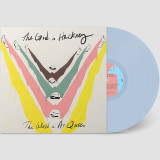
'The World in Air Quotes' is a genre-shifting style-melting kaleidoscope of art-rock, jazz, techno, folk & industrial. The God In Hackney sound like very little else from the early 2020's and whilst 'The World In Air Quotes' innovative progenitors are manifold - Eno, Coil, The Durutti Column, 1980s ECM jazz to name a few - it sounds beholden to none of them.
The God In Hackney's first album 'Cave Moderne' was Andrew Weatherall's album of the year for NTS Radio.
The God In Hackney's second LP, 'Small Country Eclipse', was album of 2020 for critic Sukhdev Sandhu of The Colloquium for Unpopular Culture: "Mordant music: stuttering, dread, black humour. A record that felt truly independent, beholden to no genre, out of step with all centres and signposted nodes."
'The World In Air Quotes' is The God In Hackney's 3rd album and their most musically emotive and lyrically inventive to date. It's an album that resonates with feelings about climate change, isolation, extinction, the social impact of technology, the flattening of history—and illuminates the darkness with imaginative rhythm, melody, noise & poetry. Songs range from widescreen, anthemic rock, to strange intricately arranged jazz-influenced songs, to abstract, textural electronic pieces. There's a strain of dark and surreal comedy too that runs through the lyrics and some of the choices the band makes in their sounds and arrangements.
The core God in Hackney quartet of Andy Cooke, Dan Fox, Ashley Marlowe and Nathaniel Mellors has expanded to include American multi-instrumentalists and composers Eve Essex (Eve Essex & The Fabulous Truth, Das Audit, Peter Gordon & Love of Life Orchestra, Peter Zummo, Liturgy) and Kelly Pratt (Father John Misty, David Byrne/St Vincent, Beirut, and Lonnie Holley among many others), signalling a new and ambitious direction for the band.
The album cover features original artwork by Iranian-American artist Tala Madani, recently the subject of a career survey exhibition at the Museum of Contemporary Art, Los Angeles.
Advertising:
The Wire, Maggot Brain
Reviews & features:
Maggot Brain - forthcoming feature
Hi-Fi+ Magazine - album review in April 2023 issue
Dereck Higgins (You Tube review)
Sonosphere - interview / feature
Weirdo Shrine - interview
It's Psychedelic Baby - interview
Spettacolo (Italy) - feature.
Ghettoblaster Magtazine (USA) - feature
Airplay:
Gilles Peterson - BBC Radio 6 Music
Steve Lamacq - BBC Radio 6 Music
Dublab - playlisted & featured in Dublab Recommends (Los Angeles)
Cian Ó Cíobháin - RTE Raidió na Gaeltachta (Ireland)
WFMU - playlisted
Resonance FM - The Wire presents Adventures In Sound & Music
Human Pleasure Radio (New Zealand)
Pete Wiggs & James Papademetie - The Seance (Repeater Radio, Sine FM & others)
Peter Hollo's Utility Fog - FBI Radio (Australia)
Jonathan Lethem & Sam Sousa on Radio Free Aftermath (KSP Claremont 88.7)
Life Elsewhere
WRPB Princeton
In Memory of John Peel
Mike Watt's Watt from Pedro Show
- 1: The Purging Fire
- 2: Snakes & Vultures
- 3: Cult Of A Dying Sun
- 4: The Wanderer
- 5: Blood Sand Ash
- 6: Sphere (Imprisonment)
- 7: Mirrors
- 8: Blank
On their sophomore full- length, "Cult of a Dying Sun", Uada expand their scope and range of hypnotic craft. Balancing sharp riffs with spectral melodies in a manifold of haunting yet distinctive black metal dirges. A sharp spear in the heart of the brightest star. Epic, atmospheric, deadly
- A1: Lady
- A2: Shakara (Oloje)
- B1: Gentleman
- B2: Water No Get Enemy
- C1: Zombie
- C2: Sorrow Tears And Blood
- D1: No Agreement
- D2: Roforofo Fight
- E1: Shuffering And Shmiling
- F1: Coffin For Head Of State
- F2: Itt
- G1: Army Arrangement
- H1: O.d.o.o
4LP vinyl boxset - pressed on opaque red, green, blue and yellow vinyl housed in printed inner sleeves with disco holes within a hardbound book jacket. The back cover is a Ludo board and the package contains Ludo game pieces, dice and instructions on how to play.
The Best of the Black President is the 13 track guide to Fela Kuti’s massive and manifold creative career. Fela was a musician, arranger, producer, political radical, outlaw and the originator of Afrobeat. This is the first time the complete compilation is available on vinyl. It is a 4 LP set, with updated cover art in a hardbound book jacket and printed inner sleeves. The individual LPs are pressed on red (sides A/B), green (sides C/D), blue (sides E/F) and yellow (sides G/H) vinyl. This edition features a Ludo game board as the back cover and comes with a perforated set of game pieces, dice, and instructions on how to play. Limited edition of 3000 for the world.
The release of this special edition coincides with the 12 episode podcast on the life and legacy of Fela, Fela Kuti: Fear No Man, produced by the Obamas and hosted by Jad Abumrad (Radiolab, Dolly Parton’s America). The series features dozens of interviews including Burna Boy, Paul McCartney, Questlove, Ayo Edebiri, David Byrne, Santigold, and President Obama himself. It was initially released on Audible on 9/15/25 and had a wide release across all podcast platforms on 10/15/25
Mia Zapata was the greatest rock singer of her time. She may have likely been the greatest blues singer in punk rock history, the woman who married the 78 and the '78. Tragedy did not make this true. Mia Zapata made this true, and the ferocious, spring-loaded shrapnel frame that was built around her by Andy Kessler (guitar: metronomic and furious), Matt Dresdner (bass: fluid, punching, beat-addicted and melodic), and Steve Moriarty (drums: martial and explosive) - who, with Mia, combined to form The Gits - made it true. The Gits were formed at Antioch College in Yellow Springs, Ohio in mid-1986, grabbing and swapping pieces of art, thrash, noise, punk rock, classic rock, and all the sorts of magical silly and bookish jingle bells that an old-school liberal arts education handed you; for the next few years they worked on turning it all into something tough, sensitive, both brutal and kind. Andy, Matt, Mia, and Steve moved to Seattle in middish 1989, landing in a house on Capitol Hill where they (and fellow travelers) wood-shedded and rehearsed for the next few years. The Gits put out three EPs in 1990 and '91 before signing with C/Z Records and releasing their first full-length album, Frenching the Bully. Seattle quickly claimed the quartet as their own and embraced the Gits blend of ferocious fangs and soft heart, the slug/slap of the guitars, and the gorgeous, soft underbelly of the poetic emotions. These qualities not only fit in with the doe-eyed/sharp-clawed grunge ethos but earned the Gits the respect of their peers, including Nirvana, who tapped them to open a major local show in 1990. Then other stuff happened, and their frantic, confessional barbed-heart snowball began rolling up hill very, very fast; the Gits "quickly" (hah! After half a decade learning to implode and explode hearts and stomping their boots on manifold beer-softened, Marlboro-weeded wood stages!) inspired rapture, awe, and the levitation that happened when peak emotion meets peak grindage in front of amps spitting out something that sounded like the mad marriage of Bolan swagger and Dischord tension_ all fronted by a genuinely incomparable woman who held her heart in her mouth and shared it, in all its celebration and fear, without hesitation. The Gits were an angry, inflamed slinky fully in tune with and tuned by the Bessie Patti Smith of her time, truly the only singer who could summon Joplin, Poly Styrene, Sam Cooke, Iggy Pop and Ian MacKaye all in the same goddamn song. In 1993, less than four weeks after accepting an offer from Atlantic Records, Mia died. I leave it at that, because this is not about death; it's about an extraordinary life. I do not say, "You should have been there," I say, "We are lucky so many of us were, and I am so glad we have this extraordinary evidence of the power and gifts of Mia and the Gits that you now can hold in your hands." And I note that Frenching the Bully, this extraordinary testament to the soul, shock, fury and feeling of the Gits, has been long out of print on vinyl and CD, and this new edition - remastered by legendary Seattle engineer Jack Endino - joyfully rectifies that. -Tim Sommer
Spectral Bounce’s fifth instalment comes courtesy of L.A.’s rave archivist and dancefloor operative Dreams, A.K.A. Jesse Pimenta. Throughout his decade-long career the California native has inspected, dissected and concocted all manner of dance musics, leaving his mark with drops on Apron Records, Pinkman, BANK NYC and his own imprint Dance Data. On SPEC05 — Dangerous When Wet — he hijacks the synapses with 4 accomplished productions, plotting a high BPM course through manifold styles using the raw aesthetic that characterises his output.
“Losing Control” is a frenetic dancefloor invitation, immediately locking into a pacing groove. Beneath wild hand drums, Dreams plays with an insistent 303 bassline alternating between rasping buzz and oily squelch, while stern vocals are layered on top of breaks that have been processed to a viscerally satisfying end.
Taking things from delirious dance circle to underwater biosphere, the EP’s eponymous track explores a submerged 1980s Miami. Weighty & enveloping, “Dangerous When Wet” is pure aquatic pop-n-lock — hydraulic electro for a drowned world. Ocean floor caustics are transmuted into auditory form: arpeggios bubble up; drones shimmer mystically; hi-hats hiss like air from an open valve. Amongst the sonar bleeps, a barrage of pummeling low-end is sure to give subwoofers a workout.
“XTC Messenger” delivers an infectious paranoid dispatch, astutely balancing the sensual with the deranged. A slow-mo dial tone unfolds languidly, running counter to nervously twitching high frequencies. Its punchy percussion is tuned for maximum dopamine release; the track’s abrupt vocal chops and mechanical kick-snare pulsation evoke the leather jackets and jagged edges of 1980s industrial discotheque.
“Pressure Points” closes the EP on a heady and mesmerising polymetric trip. The parting track is a lithe yet spacious number, propelled by a rattling break. Here Dreams follows from track 2, creating an immersive environment in which sounds tightly twist and twirl. Shifting oscillators call out like tiny creatures as the bass throbs and wriggles further into your brain, long after the needle hits the runout groove.
- A1: Tocotronic - Pure Vernunft Darf Niemals Siegen (Superpitcher / Wassermann Mix) (Edit)
- A2: Kaito - Everlasting (Edit)
- A3: Terranova - Paris Is For Lovers (My Love) Feat Tomas Høffding (Edit)
- A4: Justus Köhncke - Timecode (Edit)
- A5: Heiko Voss - I Think About You (Edit)
- B1: Leandro Fresco / Thore Pfeiffer - Neo (Edit)
- B2: The Bionaut - Everybody’s Kissing Everyone (Edit)
- B3: Ada - Lovestoned Feat Raz Ohara (Edit)
- B4: Superpitcher - Mushroom (Edit)
- B5: Rex The Dog - Prototype (Edit)
- C1: Dettinger - Blond 1 (Edit)
- C2: The Field - Over The Ice (Edit)
- C3: Robag Wruhme - Calma Calma (Edit)
- C4: Saschienne - Unknown (Dixon Mix) (Edit)
- C5: Max Würden - Circles (Edit)
- D1: Gas - Pop 1 (Edit)
- D2: Triola - Ag Penthouse (2 Epoche) (Edit)
- D3: Thomas Fehlmann - Making It Whistle (Edit)
- D4: Scsi-9 - All She Wants Is (Wighnomy Bros Mix) (Edit)
- D5: Jürgen Paape - Reval 1 (Edit)
- E1: The Modernist - Pearly Spencer (Edit)
- E2: Aril Brikha - Berghain (Edit)
- E3: T Raumschmiere - Augen Zu (Edit)
- E4: Reinhard Voigt - Superskunk (Edit)
- G1: Mike Ink - Rosenkranz (Edit)
- G2: Reinhard Voigt - Stille Hände (Edit)
- G3: Forever Sweet - The Bionaut (Edit)
- G4: Wassermann - W I.r. (Sven Väth Mix) (Edit)
- G5: Blank Gloss - Coiling (Edit)
- H1: Michael Mayer / Matias Aguayo - Slow (Edit)
- H2: Wighnomy Bros - Wurz + Blosse (Edit)
- H3: John Tejada - Unstable Condition (Edit)
- H4: Sam Taylor-Wood Produced By Pet Shop Boys - I’m In Love With A German Film Star (Gui Boratto Mix) (Edit)
- H5: Jürgen Paape - So Weit Wie Noch Nie (Edit)
- I1: Matias Aguayo - Walter Neff (Edit)
- I2: Voigt & Voigt - Tischlein Deck Dich (Edit)
- I3: Gui Boratto - Beautiful Life (Edit)
- I4: Kölsch - Goldfisch (Edit)
- I5: Gusgus - Rivals (Dj Hell Mix) (Edit)
- K1: Closer Musik - Maria (Edit)
- K2: Wassermann - Fackeln Im Sturm (Edit)
- K3: Jürgen Paape - Take That (Edit)
- K4: Superpitcher - Happiness (Michael Mayer Mix) (Edit)
- K5: Markus Guentner - Regensburg (Edit)
- E5: Schaeben & Voss - Dicht Dran 1 (Edit)
- F1: Dj Koze - Brutalga Square (Edit)
- F2: The Orb - Masterblaster (Edit)
- F3: Michael Mayer - Pride Is Weaker Than Love (Edit)
- F4: Laurent Garnier - From The Crypt To The Astrofloor (Edit)
- F5: Anna & Kittin - Forever Ravers (Edit)
Over the decades, the image of Kompakt as a pirate ship has taken root in our minds, braving the dangers of the seven seas of the music market. Sometimes it glides with a tailwind through calm waters, sometimes it has to survive violent storms. When we set sail in 1993, we never would have dreamt that our journey would still be going on after more than three decades and with 500 releases to date.
In our fast-paced business, the 500 mark is rarely reached, so we want to celebrate it with a lavish 5LP box set. In a democratic process, we have selected 50 pearls from the thousands of tracks released over the last 33 1/3 years and pressed them onto 5 brightly coloured vinyls. Alongside many Kompakt evergreens, there are also some real rarities from the early ‘Kompakt Sound of Cologne’, which have been lovingly remastered here to shine in new splendour.
The box also contains a 144-page book that tells the story of Kompakt from 1993 to today with detailed texts and images. In addition to the manifold musical and graphic achievements of Kompakt, the multidisciplinary links to the visual arts are also highlighted here.
The Bonus Picture Disc opens with the symbolic tolling of 500 bass drums, followed by 50 locked grooves from the 5 Kompakt founders, looping into infinity at 133 1/3 BPM, and the ‘33 1/3 Years Loop Opera’ – in which the loops are combined into one track that, in its reduced essence, is more than the sum of its individual parts. The magic of groovy loop minimalism and the ‘art of omission’ are once again brought to the proverbial point.
On 23 May 2025, the big KOMPAKT 500 art exhibition will open at the venerable Kölnischer Kunstverein to coincide with the release. The entire visual cosmos of Kompakt will be shown here in an unprecedented way on three floors, with the participation of many renowned artists. Of course, there will also be dancing and partying at the vernissage party, with DJ sets and live shows by the Kompakt Allstars.
The last one turns off the bass drum.
Im Laufe der Jahrzehnte hat sich in unseren Köpfen das Bild von Kompakt als Piratenschiff festgesetzt, das den Gefahren der sieben Weltmeere des Musikmarktes trotzt. Mal gleitet es mit Rückenwind durch ruhige Gewässer, mal muss es heftige Stürme überstehen. Als wir 1993 die Segel setzten, hätten wir uns nicht träumen lassen, dass unsere Reise nach über drei Jahrzehnten und mittlerweile 500 Veröffentlichungen immer noch andauert.
Die 500 ist in unserem schnelllebigen Geschäft eine selten erreichte Katalognummer und soll daher mit einer üppigen 5LP-Box gebührend gefeiert werden. In einem demokratischen Prozess haben wir aus den tausenden Tracks der letzten 33 1/3 Jahre 50 Perlen ausgewählt und auf 5 knallbunte Vinyls gepresst. Neben vielen Kompakt-Evergreens finden sich auch einige echte Raritäten des frühen “Kompakt Sound of Cologne”, die hier liebevoll remastered in neuem Glanz erstrahlen.
Die Box enthält außerdem ein 144-seitiges Buch, das mit ausführlichen Texten und Bildern die Kompakt-Geschichte von 1993 bis heute erzählt. Neben den mannigfaltigen musikalischen und grafischen Errungenschaften von Kompakt werden hier auch die multidisziplinären Vernetzungen zur bildenden Kunst beleuchtet.
Die Bonus Picture Disc wird mit einem symbolischen Glockenschlag von 500 Bassdrums eröffnet, gefolgt von 50 Endlosrillen der 5 Kompakt-Gründer, die sich bei 133 1/3 BPM in die Unendlichkeit schleifen sowie der “33 1/3 Years Loop Opera”, in der die Loops zu einem Track zusammengefügt werden, der in seiner reduzierten Essenz mehr ist als die Summe seiner Einzelteile. Die Magie des groovenden Loop-Minimalismus und die “Kunst des Weglassens” werden einmal mehr auf den sprichwörtlichen Punkt gebracht.
Am 23. Mai 2025 eröffnet parallel zum Release die große KOMPAKT 500 Kunstausstellung im ehrwürdigen Kölnischen Kunstverein. Der gesamte visuelle Kosmos von Kompakt wird hier unter Beteiligung vieler namhafter Künstler*Innen in nie gesehener Form auf drei Etagen gezeigt. Selbstverständlich darf zur Vernissagenparty auch getanzt und gefeiert werden zu DJ Sets und Liveshows der Kompakt Allstars.
Der Letzte macht die Bassdrum aus.
Double LP pressed on yellow and sky blue vinyl ("Feld & Fluss") Dorfromantik is a relaxing building strategy and puzzle game in which you place tiles to create ever-growing, idyllic village landscapes. With Dorfromantik, you can immerse yourself in a quiet, peaceful world at any time and take a break from everyday life. At the same time, the game offers a challenge for those who are looking for one: To beat the highscore, you need to carefully plan and strategically place your tiles. The original superchill Dorfromantik soundtrack by Laryssa Okada (Manifold Garden OST), Pygoscelis and Only Sound is totally living up to game's intention and atmosphere. It is inspired by the warm and nostalgic memories of a childhood spent between city and countryside. These soothing and relaxing tracks created from a wide arrangement of different instruments and musical styles will take you on a peaceful but nonetheless dynamic journey through joyful soundscapes. Dorfromantik was developed by four students from the Berlin University of Applied Sciences (HTW Berlin): Luca Langenberg, Sandro Heuberger, Timo Falcke and Zwi Zausch. The full version of the video game was officially launched in April 2022. It is the winner of multiple prizes and received positive reviews throughout the press. The physical boardgame even won the acclaimed "Game of the Year" award in 2023. What a whirlwind of success! Time to sit down, relax and listen to the unmatched Dorfromantik soundtrack on beautiful, coloured vinyl.
The Ick — a sense of sanity amidst the storm of information. This album by Archetype is an abstract scream for something quite fragile — a polarizing society, disruptive isolation, and the fading collective experience. Utilizing dramatic vocals, industrial trip-hop, and post-punk-leaning electronics, Archetype marks the new moniker by the ever-versatile Viennese Rotterdammer, Leonard Prochazka. Following his manifold of concept-driven, instinctive musical output, Archetype's "The Ick" releases in 2024, following "Strapazen und Genesung" as Geier Aus Stahl on Knekelhuis in 2022.
Theresa Stroetges returns to Karaoke Kalk with her second album for the Berlin-based label, her fifth solo full-length with her Golden Diskó Ship project in total. Having released records with the Indian-German band project Hotel Kali as well as Painting, a group dedicated to audio-visual concepts, »Oval Sun Patch« sees her embrace influences from club culture, advanced electronic music, and pop more firmly than ever before. Over the past 15 years, Golden Diskó Ship has served a vessel with which the Berlin-based multi-instrumentalist has traversed a variety of genres and circumnavigated all conventions in the process. With »Oval Sun Patch,« Stroetges again sets sail into unknown waters with what is perhaps her catchiest album so far—beat-driven, playful, atmospheric, and at times thoroughly anthemic. This is the sound of Golden Diskó Ship moving forward.
A life lived in transit, the vastness of bodies of water and the isolation of islands as well as more generally notions of processes and progress have been recurring motives throughout Stroetges’ previous records and also mark »Oval Sun Patch.« In fact, the foundation for the six pieces was laid when she was working abroad and at times close to the sea. The massive three-part album closer »Earth Before The Space Race« was conceived as a multi-channel audio-visual performance piece during a 2021 residency at Zaratan Arte Contemporânea in Lisbon. The others were written in the following year during two other residencies when Stroetges first spent time in Austria at the sound art festival Klangmanifeste in Lindabrunn and then visited Portugal once more for a stay at Goethe-Institut in Lisbon. With the help of Shelley Barradas, who lent her a guitar, and Julia Klein, who helped her setting up a temporary studio in the Goethe-Institut Portugal’s auditorium, she made the preliminary recordings of what would later become this album.
»Oval Sun Patch«, later refined in Berlin and mixed in close collaboration with London-based engineer Hannes Plattmeier, is a direct result of Stroetges having to work with what was available to her at the time of writing and recording. While her distinct guitar playing—evocative yet funky, complex but catchy—once more features heavily and she uses her voice in manifold ways to sometimes harmonise with herself or creating complex canons as counterpoints to her her own lead vocals, the electronic gear she worked with dominates the album both compositionally and sonically. Stroetges’ music has always displayed a passion for club culture and advanced electronic music, but on »Oval Sun Patch« she proves once and for all how well these influences can be integrated into her unconventional approach to songwriting.
However, the punchy beat and Moroder-like bassline that form the backbone of »Dolphins With Soft Helmets,« the throbbing house and techno grooves underneath »Ephemeral Carnivores« and »Well-Oiled Machine« as well as the jittery IDM rhythms of »Google Your New Name« and her nods to trip-hop with »Tiny Island« do not so much follow established formulas as they use them as a starting point for wild experimentation instead. Stroetges juxtaposes complex rhythms with interlocking melodies and rich harmonies in ways that continue to surprise throughout and still leave enough space for the occasional wistful guitar or vocal passage. Nowhere does this approach feel more epic than on the 12 ½ minutes long »Earth Before The Space Race,« which takes its time to unfold, changing its pace and mood throughout.
»Oval Sun Patch« is an album about change. The lyrics describe constant transformations of sceneries, relationships, physical and emotional states as well as the climate throughout its running time. Stroetges in the meanwhile leads the way as a singer, songwriter and producer who lets her music evolve constantly. This is sound, moving forward.
The eighth and latest slate of refined retro-futuristic synth-pop by Liz Wendelbo and Sean McBride aka Xeno & Oaklander is named after and inspired by "the study of what not to do, a negative image of a positive, the other side, the other:" 'Via Negativa (in the doorway light)'. Recorded in the fall of 2023 at their modernist Connecticut home fashioned into a two-story synthesizer laboratory and mixing studio, the album is uniquely visionary in spirit yet precision in execution, a contrast central to the duo’s enduring chemistry. Embryonic piano sketches were translated to nuanced modular systems, which McBride weighted with "harmonic padding," tuned percussion, and a spectral transfer device capable of "rendering spasms of rhythmic overtonal filigree." Despite the technological complexity of their craft, emotively the songs require no deciphering – these are technicolor widescreen anthems of the cybernetic age.
The eponymous opening track sets the pace, soaring sleekly over glittering synths and call-and-response vocals about arias, shattered light, and faces in stereo. From there the record expands and contracts, cycling through a gallery of moods and masks, animated by the band’s fascination with drama, "the idea of personae," and theatrical characters. Track by track, a murky, tragic backstory reveals itself: forlorn figures navigating a treacherous mercury mine, alternately poisoned by fumes or buried in collapsing caverns. The tension between Teutonic, utopian synthetic pop and lyrical narratives of ghosts in silos, ruined mills, and the traumas of mineral excavation creates a compelling friction, alternately futurist and obsolete, elevated and subterranean. Wendelbo describes the music’s polarities perfectly: "The heavy machinic din of extraction in contrast with the enchantment of the mined precious gems and metals."
From bilingual odes to bloodstones ("O Vermillion") to cosmic chrome dance floor classics ("Lost & There" "The present tense can never feel real / So many pasts conspire in the burning sun") to strutting EBM sensualities ("Actor's Foil"), Xeno & Oaklander re-prove themselves masters of the axis of technology and poetry, snaking cables and synesthesia, mining melodies and myths across 15 years of focused artistry. Theirs is a muse still gilded and gleaming, burnished red and silver, attuned to "the unobservable, the unfamiliar, that which you don’t see directly."
The eighth and latest slate of refined retro-futuristic synth-pop by Liz Wendelbo and Sean McBride aka Xeno & Oaklander is named after and inspired by "the study of what not to do, a negative image of a positive, the other side, the other:" 'Via Negativa (in the doorway light)'. Recorded in the fall of 2023 at their modernist Connecticut home fashioned into a two-story synthesizer laboratory and mixing studio, the album is uniquely visionary in spirit yet precision in execution, a contrast central to the duo’s enduring chemistry. Embryonic piano sketches were translated to nuanced modular systems, which McBride weighted with "harmonic padding," tuned percussion, and a spectral transfer device capable of "rendering spasms of rhythmic overtonal filigree." Despite the technological complexity of their craft, emotively the songs require no deciphering – these are technicolor widescreen anthems of the cybernetic age.
The eponymous opening track sets the pace, soaring sleekly over glittering synths and call-and-response vocals about arias, shattered light, and faces in stereo. From there the record expands and contracts, cycling through a gallery of moods and masks, animated by the band’s fascination with drama, "the idea of personae," and theatrical characters. Track by track, a murky, tragic backstory reveals itself: forlorn figures navigating a treacherous mercury mine, alternately poisoned by fumes or buried in collapsing caverns. The tension between Teutonic, utopian synthetic pop and lyrical narratives of ghosts in silos, ruined mills, and the traumas of mineral excavation creates a compelling friction, alternately futurist and obsolete, elevated and subterranean. Wendelbo describes the music’s polarities perfectly: "The heavy machinic din of extraction in contrast with the enchantment of the mined precious gems and metals."
From bilingual odes to bloodstones ("O Vermillion") to cosmic chrome dance floor classics ("Lost & There" "The present tense can never feel real / So many pasts conspire in the burning sun") to strutting EBM sensualities ("Actor's Foil"), Xeno & Oaklander re-prove themselves masters of the axis of technology and poetry, snaking cables and synesthesia, mining melodies and myths across 15 years of focused artistry. Theirs is a muse still gilded and gleaming, burnished red and silver, attuned to "the unobservable, the unfamiliar, that which you don’t see directly."
The eighth and latest slate of refined retro-futuristic synth-pop by Liz Wendelbo and Sean McBride aka Xeno & Oaklander is named after and inspired by "the study of what not to do, a negative image of a positive, the other side, the other:" Via Negativa (in the doorway light). Recorded in the fall of 2023 at their modernist Connecticut home fashioned into a two-story synthesizer laboratory and mixing studio, the album is uniquely visionary in spirit yet precision in execution, a contrast central to the duo's enduring chemistry. Embryonic piano sketches were translated to nuanced modular systems, which McBride weighted with "harmonic padding," tuned percussion, and a spectral transfer device capable of "rendering spasms of rhythmic overtonal filigree." Despite the technological complexity of their craft, emotively the songs require no deciphering - these are technicolor widescreen anthems of the cybernetic age. The eponymous opening track sets the pace, soaring sleekly over glittering synths and call-and-response vocals about arias, shattered light, and faces in stereo. From there the record expands and contracts, cycling through a gallery of moods and masks, animated by the band's fascination with drama, "the idea of personae," and theatrical characters. Track by track, a murky, tragic backstory reveals itself: forlorn figures navigating a treacherous mercury mine, alternately poisoned by fumes or buried in collapsing caverns. The tension between Teutonic, utopian synthetic pop and lyrical narratives of ghosts in silos, ruined mills, and the traumas of mineral excavation creates a compelling friction, alternately futurist and obsolete, elevated and subterranean. Wendelbo describes the music's polarities perfectly: "The heavy machinic din of extraction in contrast with the enchantment of the mined precious gems and metals." From bilingual odes to bloodstones ("O Vermillion") to cosmic chrome dance floor classics ("Lost & There" "The present tense can never feel real / So many pasts conspire in the burning sun") to strutting EBM sensualities ("Actor's Foil"), Xeno & Oaklander re-prove themselves masters of the axis of technology and poetry, snaking cables and synesthesia, mining melodies and myths across 15 years of focused artistry. Theirs is a muse still gilded and gleaming, burnished red and silver, attuned to "the unobservable, the unfamiliar, that which you don't see directly."
- A1: Un Buen Sueño Feat Carmen Cano
- A2: N'goni Feat Mikkel Nordsø & Anders Pomsaing
- A3: Aire Feat Antonio Jimenez Muñoz
- B1: Golden Hour Feat Jade Praize
- B2: Dance First Think Later Feat Paul Powell
- B3: Island In The Sun Feat Santino Surfers
- C1: Soul Free Feat Chilani, Walther & Olio
- C2: Harmonized Feat Mathias Heise
- C3: Let Me Show You
- C4: Faz Favor Feat Rodrigo Sha & Pere Navarro
- D1: Universal Language Feat Mathias Heise
- D2: Anta Lika Feat Reinhard Vanbergen
- D3: Noche De Primavera Feat Troels Hammer & Rodrigo Sha
Dj Pippi & Willie Graff present their sophomore LP Universal Language, continuing their pioneering experiments with the Balearic sound.
This duo of Ibizan royalty began their collaboration 17 years ago, connecting through a special enthusiasm for the freedom and diversity of Balearic music. Odd singles here and there found their way to the labels such as Compost, Leng and Archipelago but not until 2022’s Follow Your Dreams (Music For Dreams) did a longer release see light of day.
Now following up that celebrated debut, Pippi and Graff present a fresh batch of soulful, luxurious and highly original Balearica. Twelve tracks escort us through the duo’s manifold styles, modulated with subtle layers of eloquent instrumentation and effervescent synths.
Starting with the nebulous Latin-flavoured drama of ‘Un Buen Sueno’ featuring vocalist Carmen Cano. On through ‘N’Goni’, a luscious synth-chugger laden with the effortless artistry of guitarist Mikkel Nordsø.
There’s the shaded machine funk of ‘Golden Hour’, which introduces vocalist Jade PraiZe; the impossibly infectious sun-drenched house cut ‘Soul Free’; the beatless bliss of ‘Harmonized’; the downtempo exotica of ‘Let Me Show You’; the Balearic bossa of ‘Faz Favor’; or the timeless easy-breezy nothing-but-good-times title track.
The Bratislava-based band 52 Hertz Whale release their new album Present Sense Impression in a collaboration of the labels Weltschmerzen and Full Moon Forum.
Three years since their album I've Met a Lot of People, the band brings forth a lot of new ideas, finding a new resonant space, and utilising the fierceness // savageness of their live shows, in an intimate stare at contemporary guitar music.
52 Hertz Whale is a band well known in the Central European music context. Their ferocious sound, mixing the intensity of post-punk, heavy guitar wails, and melancholic // stark vocals of Dominik Prok has been tearing down the fixtures of many festivals and venues, all the while being a great example of a band driving at 200mph nonstop. On Present Sense Impression, the band, composed of Dominik Prok, Dominik Fabian, Patrik Nagy, Tomáš Tabiš and Adrián Krišák, have arrived at a record full of manifold manifestations of their live sound, but at times recalling the more marginal waves of 80s pop // rock sound. Resolute drums, heavyweight guitar and bass riffs now deem closer to the lightness of early ethereal darkwave, just to indulge in the classic melancholic heaviness they are known for only seconds after.
Some of the songs have been produced by "Prague's favorite rock'n'roll enfant terrible" Lazer Viking as well as Pulp Studio's Jakub Hríbik, and one features a special guest - the cemballo virtuoso Marcel Comendant. The traditionally stunning artwork was created by the accomplished Martin Mesaroš.
Present Sense Impression is the 20th album released under the Slovak romantic // experimental label Weltschmerzen focused on emotionally hypercharged, humanely intertwined, and acutely sounding contemporary music. This time in collaboration with the czech label Full Moon Forum. It releases August 26th on limited edition baby pink, standard edition black vinyl and on all streaming platforms.
The creation and release of this record have been supported using public funding by the Slovak Arts Council, and SOZA. Fullmoon Forum project was supported by the Ministry of Culture of the Czech Republic.
- Road To Love
- How About Me
- Singin' To The Music
- Rainy Jane
- Look At Me
- Say It Again
- I Really Love You
- Love Me For A Day
- Sitting In The Apple Tree
- Take My Love
- Pretty Little Girl
- Welcome To My Love
- Girl (Mono)
- I'll Believe In You (Mono)
- Take My Love (Mono)
- Road To Love (Mono)
- How About Me (Mono)
- I Really Love You (Mono)
7A Records is proud to present Davy Jones "The Bell Records Story". A lavish reissue of Davy Jones' self-titled album remastered with 6 bonus tracks. The CD version comes with a big 36 page colour booklet, extensive liner notes from Monkees historian Mark Kleiner and rare and previously unseen pictures. This reissue gives fans the opportunity to reassess an album that was unfairly neglected by record buyers at the time of its initial release in the fall of 1971.
Prior to entering the studio with producer Jackie Mills, Jones had recorded a batch of more somber and adult contemporary-sounding demos than the eventual Bell recordings of big band sunshine pop. While the latter played quite squarely into Jones’ established image; the former suggested another path that may (or may not) have launched Jones into a more fecund musical and commercial direction. Who can say? At the end of the day, we have these recordings and their manifold (and for too long overlooked) pleasures to enjoy, a worthy entry in the broad category of early seventies sunshine pop and in the specific canon of Davy Jones and Monkees-related recordings. Here is primetime Davy Jones, singing like an angel, and pointing to a love that leads to joy for all mankind. This release comes with a Booklet & Liner Notes & Photos
»Arches« is the first collaborative album by brothers Simon and Tobias Lanz. It was written for and performed on self-built prototypes of wind instruments that were inspired by the classic pipe organ, but allowed the two composer-performers to go beyond its limitations in several ways. The music on this 40-minute long album for the Swiss Hallow Ground label was conceived and recorded by the two co-founders of the CRTTR collective and label during an artist residency in May 2022 in their home town of Bern. More than a mere document of a performance however, »Arches« combines the artists’ interest in exploring uncharted new creative and tonal ground inside of and beyond the realm of drone music with their background in visual art and design as a conceptually concise whole.
Simon and Tobias have a combined background in electronic music as well as a shared penchant for drone music. They hence designed these novel instruments in a way that allows for microtonal tuning to be able to overcome the restrictions inherent to the dominance of a twelve tone-based scale in Western music and work with a sonic palette that is much wider and nuanced than that of the conventional pipe organ. Furthermore, the physical design of these instruments widely differs from that of those which inspired them. This allows—or more precisely, forces—the musicians to freely invent and explore entirely novel playing techniques.
These factors, of course, also have an impact on the compositional process, which by design needs to be unconventional. The Lanz brothers worked with a graphic score for the four movements of the piece that forms »Arches« so as to adequately visualise the manifold tonal nuances of their instruments. This graphic score in turn was reinterpreted for the album release by Ramon Keiming, adding another dimension to it. Read from left to right, this remix of the score allows the listeners to follow an interpretation of the evolution of these dronescapes while the record plays, urging them to add their own interpretation.
This retroactive visualisation and thus spatialisation of the music is perfectly in line with its performance, which at all times factored in the acoustic affordances of the Prozess Bar in Bern. In many different ways, the Lanz brothers now invite their audience to join them there and explore the near-infinite possibilities of their curious instruments together with them. Much like Hallow Ground label mates such as Kali Malone or FUJI||||||||||TA, they are dedicated to enriching and expanding upon the musical and sonic qualities of pipe organs, but with widely different aesthetical results. To call »Arches« a unique record with an unheard-of sound is not hyperbole, but only factually correct.
The sophomore album from NYC musician and singer-songwriter Kyle Avallone, is a collection of nostalgic meditations that take you out of the smoky bar and into the gray daylight of a seaside town. It is a cinematic dreamscape steeped in warm vocals, lush synthesizers, and sweeping steel guitars. Throughout the ten songs, tender narratives play like home movies on a living room wall, revealing little worlds and distilled memories.
Recorded at Studio G in Brooklyn with Jeff Berner (Psychic TV), Avallone reaches beyond the lo-fi sleaze of his 2020 debut, Last Minute Man, for a higher fidelity and grander sound palette. “After making a record by myself on an old four-track tape machine, it felt like a natural progression to go into a proper studio and play music with my friends". The core band consists of Mark Perro (The Men) on keys and Russell Hymowitz on bass, who both sing backing vocals, along with David Christian on drums. On several tunes, pedal steel played by Jon “Catfish” DeLorme (The Nude Party) dances around Avallone’s baritone voice, delivering a twang that is distinctively more New York than Nashville.
Inspired by the conversational storytelling of artists like Terry Allen and Lou Reed, Avallone was moved to capture the drama and mystery of his own life experiences. The characters we meet here are flawed. Mistakes are made and lies are told. Love is either lost or on the line. Dreams manifold as both echoes of the past and hopes for the future – the faded glow of childhood impressions in “Down the Hill”; the single mothers’ kitchen table reverie in “Going to the Beach”; the lament for summer’s end in “Vacant Sea”.
The post-industrial Ruhr-Area has been an indisputable part of Germany's techno landscape since the very beginning. More than 30 years after techno's golden era and after a manifold challenging pandemic, the scene and its sounds are blooming like never before. Ahmet Sisman and his project The Third Room can be described as key factors for both the area's ongoing, sustainable dedication to electronic music and its current success, being more and more embedded in cultural contexts and society overall.
It's unsurprising that the first album of Ahmet Sisman, the multitalented artist and man of action, is a well-considered mix of familiar and pioneering sounds, enriched by countless influences within and beyond technos constantly evolving sub-genre scenery. With a sophisticated 50/50 mix of four on the floor strikes and innovative breaks, Sisman manages to hit a sweet spot between raw but groovy, experimental but subtle nostalgia, melodious but noisy.
All this is already worthy of a listen, but placed in context, it perfectly fits the musical approach of the Ruhr-Areas biggest transcendental techno project - The Stone Techno Series and Festival. Like the bound-breaking release series of the last two years, 'The Third Space' maintains the metallic and fierce sound vision of a coal mining tradition with everlasting impact. The time travel through industrialization and renaturation continues here with T3R008 and gains a whole new dimension from Sisman's skilled handwriting.
Guiding weary travelers through an enchanting interdimensional odyssey, Work The Peripheral’s debut long player ‘Like Lava’ finds a treasured home on Companion. Building on the foundation of four exceptional self-released EPs, WTP continues his exploration into the world of ambient trance. ‘Like Lava’ unfolds across nine tracks that expand and contract through imagined astral landscapes, showcasing WTP’s deft ability to create deep and absorbing techno trips. Hypnotic in manifold ways, ‘Like Lava’ is a release made for getting lost in. Each track referencing the next, this hour-long journey glides through blissful realms of trance, ambient techno and house - deep basslines, muted breaks and spacious subdued percussion are unified by WTP’s characteristic ubiquitous and sparkling atmospheres.
This is an expert expression of the Companion ethos. By drawing inspiration from the likes of Robert Leiner, Speedy J and Index ID, WTP wields the language of tripped out 90s electronica to allow spellbound listeners the time to contemplate, space to travel and a place to dream.
2022 Repress
14 years since it was originally released on Rephlex Records, Dopplereffekt's Calabi Yau Space (2007) finally gets a reissue on vinyl thanks to WeMe Records (following on their amazing reissue of Linear Accelerator). This album sees Dopplereffekt move even further out into their very own exploratory realm, where music and quantum physics meet. Eight tracks that when first released seemed challenging but with repeated exposure a strange almost supernatural event occurred as these new sounds and patterns gradually revealed a beauty and even simplicity about them. This is a brave album, epic in vision. An essential record for all fans of Techno in the sense that the term was originally intended.
Ingredient is the elegant collaboration of Toronto poets, composers, producers and dear friends Ian Daniel Kehoe and Luka Kuplowsky. Their self-titled release is an enigmatic electronic avant-pop record attuned to the micro and macro perspectives of the natural world. Ingredient is an album whose lyrics are more poem than lyric, and whose songs exist in a merger of house music, philosophically-minded lyricism and contemporary R&B. One might recall electronic and art-pop luminaries such as Yukihiro Takahashi, The Blue Nile, and Arthur Russell, or connect it to contemporaries like Nite Jewel, Westerman and Blood Orange. A distinct world of dance, of questions, of secrecy and ultimate softness.
Eight years of friendship forges strange telepathy.
In the summer of 2020, Ian Daniel Kehoe was entrenched in a new feeling of heaviness; psychosomatic symptoms had started to proliferate; stress made new pores across the body, bending sensitivity into pain. His days were met with confusion, detachment, sleeplessness and pain without causation. Disfigured, he felt that what had been central and centering was blown out to the periphery of things. In a moment of self-preservation he reached out to his dear friend Luka Kuplowsky to make an album together. For Kehoe, it was an instinctual grasp for the anchoring truthfulness of deep friendship and the potential for a dedicated creative collaboration. Kuplowsky’s presence was light, supportful and curious, eager to explore musically the sounds they were mutually drawn to: house music, ambient pop, dub. The duality between Kuplowsky and Kehoe – between the Aflight and the Unmoored – is a portrait of a friendship whose exchanges came easy and produced an outpouring of song. Creation and therapy crisscross. In email correspondence that catalogs their process of collaboration, affection abounds: “feels bare without the Luka Licks”, or “Love you so much”, or “Kinda just overwhelmed with deadliness coming in at all angles.” When their voices first come in together on “Wolf,” that harmony arrives in a dramatic avant-pop sound that is bold and wondrous.
Kuplowsky and Kehoe both arrive at Ingredient as established artists whose works are committed to language’s propensity to provoke and mystify. Kuplowsky’s 2020 album Stardust is an idiosyncratic and otherworldly blend of pop and jazz romanticism grounded by Cohen-esque vocals and a stirring philosophical curiosity. Kehoe’s entrance into the new decade has hatched four records of pop experimentation, most recently 2022’s Yes Very So, a euphoric and bold album of poetic synth-pop and meditative ambient instrumentals. Kuplowsky and Kehoe’s union as Ingredient is a beautiful and unusual chemistry that integrates their distinct approaches while bringing forth a newness: a sound that alternates between cinematic technicolor and dubbed out fogginess; a lyricism that exchanges their lucid and clear poetics for a playful and obtuse verse. The album intuitively taps into the opposing emotional states of Kuplowsky and Kehoe during the conception of the record, contrasting the buoyancy of trumpeting keyboards (“Resurface”), angelic synthesized voices (“Come”), and rolling bass (“Photo”) with the record’s underlying darkness of whirring buzzsaw textures (“Transmission”), whooping sirens (“Wolf”) and murky ambience (“Illumination”). Lyrically, this duality arises in the record’s flux between openness (“Variation”, “Raindrop”) and existential dread (“Wolf”). “Illumination” most clearly crystalizes this opposition, reconciling the verses’ neurotic yearning for enlightenment with the chorus’ liberating doctrine of negation: “no more devotion… no more delusion”. Amidst the gradations of light and dark, Kuplowsky and Kehoe trade indelible, lush melodies as though their voices are made of a substance that melts easily one into the other. The harmony of poetry, sound, and texture cuts through your brain fog like a wet diamond.
Ingredient’s self-titled record was assembled by Kuplowsky and Kehoe over the course of six months in a home studio they frequented daily. Amidst synthesizers and drum machines they composed, re-composed, and workshopped a wide array of music, ultimately focusing on a set of eight songs that lived in a shared musical and philosophical world. Recording days often ended in basketball games at a local court or a rooftop commune over a pot of tulsi tea and a crossword puzzle. Kuplowsky brought in the Blue Cliff Record – the classic anthology of Chan Buddhism – whose inscrutable and sublime insights remained constant throughout the recording process as an activator of reorientation and reflection. While Kehoe was frequently rendered physically immobile by bouts of anxiety, a patience and mutual caring governed the pace of their creation; rest, stretching and meditation became equally important as the act of arrangement. Invited into their intimate circle of composition was Thom Gill, whose heavenly voice uplifts “Variation” and “Raindrop,” and Karen Ng, whose alto sax simmers and dances around the funky strut of “Raindrop.”
The lyrics on Ingredient reflect the persistence of change, the infinite variability of nature where randomness and divergence are no accidents. In Daoism, duality, in the form of Yin and Yang, is not contradictory as it is in Western idealist philosophy, but rather composes the eternal and lived paradox of our changeless-changing universe: changeless because all is change, and changing because the dynamism of the Dao makes each moment transformational. Kuplowsky and Kehoe refract this way of seeing the world, as in Variation: “Variation in the natural world / there it is.” Ingredient is an experience of the manifold ways of saying there it is of the transformational world, and there it is, unfolding. Elsewhere, change and ephemerality is addressed through the record’s preoccupation with non-human perspectives, reorienting the listener to the wolf, the mouse, the emerald frog, the centipede, the bird, the fly in the lamp. The album cover visualizes this fascination with the striking image of a reddish-orange frog atop a defamiliarized landscape of dark green leaves. Mirroring the exploratory process of the record’s collaboration, the frog also signals the amphibian’s natural inclination to leap into boundless potential. Kuplowsky and Kehoe’s lyrics manifest philosopher and ecologist Timothy Morton’s concept of “the mesh,” drawing attention to the “vast, entangled web” of interconnectedness that connects all life forms and interweaving the songwriters’ shared wonder into the Animal’s unknowability. As Luka narrates in the breakdown of the dance-floor ready “Photo,” “the closer we observe things, the further they retreat into abstraction.” In Ingredient’s ecosystem, perception is a reversible fractal where the world’s minutest details mirror the shape of the cosmos.
According to the Dao, the path to healing starts by reorienting perception away from the self and toward the self’s subsumption in Totality. For Kehoe, collaborating with Kuplowsky became the reorientation necessary for the self-preservation he was seeking, opening up a shared creative practice to navigate and soften the complexity of his psychological shattering. The album begins with Kuplowsky intoning “colossal faith” which bounces around the stereo field in a cloud of echo, and it is the enormity of “faith” that centers both Kuplowsky and Kehoe’s collaboration and their inquisitiveness in the vast mysteries of our very being. Truth in Ingredient is not an essential nugget, but a bending of the light – it is the equivocal entanglement of how we are in nature as nature, but with a plea or prayer under our breath that marks our felt distance from what we are a part of: “carry me towards the mountains of my birth / returning to the nest / the silence of the earth.”
Beautifully drunken it hums, the piano in “PianoPiano”, the last tune of “How to Spread Lies”, the first EP by Roman Flügel for the Hamburg based label Dial in the year 2010. Or take “Strich”, a peculiar electrical slow-motion grinder, out on his “Mutter” EP for Klang Electronic in 2006. Since long, the renowned Berlin based DJ and producer is investigating in spheres beyond the dance, the groove, the ecstasy. Zones, where the molecules harmonize, senses relieve, and the soul quietens. All his last albums, “All The Right Noises” (Dial), “Themes I-XIII” (ESP Institue), “Eating Darkness” (Running Back) have moments of tension and relaxation in a deep harmonious connection.
Now “Balmy Evening”, a sundown record for sunup’s. Eleven notions in adventurous journey music, embracing the freedom of structure, blurring the musical pulse into harmonic meditation and mysteriously grooving zones, leaving all unnecessary accessories behind. A quality, that many of his collaborative and solo productions from past 30 years comprise. Still, most of them squint on the dance floor, where jack is king. Not so “Balmy Evening”, where real party bangers are absent. There are moving tunes like the slow Kraftwerk-melody-leaning funkateer “Duftschulter”, or the artificially jacking “Greenhouse”, where nervous Synth patterns ball along soft breaks and decreet kicks. Also, “Super Sonne”, an odd, seemingly improvised synth conversation might ask some souls out for a dance.
But all others, like “Atmosphere”, “Frei”, Dolphins, “Goth”, or “Ambienteuse”, rather seek for the tranquil in each one’s spirit. Listeners need be ready for surprises. Ready for impulsive ideas, linked to a harmonious flow, always ready to grow. An album full of silence, utterly loud, beautifully diverse humming, displaying a playful, exploratory side of a celebrated club music producer, to whom atoms dance in manifold ways.
- 1: L'anomalie
- 2: Assault
- 3: Steinmeck
- 4: Histoire D'un Conflit
- 5: Hémizygote
- 6: Critique De L'effacement
- 7: Le Bouffon Moderne
- 8: Tonalités Cosmiques Pour Anorexie Mentale
- 9: White Horse Against Ufo's
- 10: Eine Andere Magische Stadt
- 11: Loop
- 12: Loop
- 13: Loop
- 14: Loop
- 15: Loop
- 16: Loop
- 17: Loop
- 18: Loop
- 19: Loop
- 20: Loop
- 21: Loop
- 22: Loop
The music on this long-awaited solo vinyl album by legendary tape artist Jérôme Noetinger was recorded live in the studio with no overdubs. Signals were sent through tube broadcast monitors and picked up with room microphones. Produced by Tobias Levin. Cover by Meeuw.
Long-time touchstone of international experimental music presents his monolithic (and first) solo vinyl »Sur Quelques Mondes Étranges« on Felix Kubin’s Gagarin Records. Jérôme Noetinger is known to most for the audio-visual trio Cellule d’Intervention Metamkine, alongside his countless recorded & live collaborations, compositions for radio & stage, and breathtaking multi-channel diffusions in the acousmatic tradition.
Discovering the ReVox B77 tape machine as his tool for live electro-acoustic music in 1987, Noetinger has doggedly investigated his instrument over 35 years, establishing him as a vital contemporary composer/performer of the medium. His work is radical and interrogatory, using a pan-historical array of analogue devices to construct soundworlds which sidestep digital monochrome, landing in a galaxy of simmering malfunction, dynamic physicality & rhythmic debris. Programming Le 102 in Grenoble for over a decade, as well as directing Metamkine distribution for over three, his encyclopaedic knowledge of manifold sonic traditions is on display here; unified by a staunch discipline, impressive dedication and flat rejection of empty trends.
The results synthesise his tireless timbral research into 11 striking sonic investigations which combine modern studio possibilities with years of performance experience worldwide. An ominous malaise hovers over proceedings; yet it never feels nihilistic, presenting solutions which electrify the listener with ecstatic discovery. The perceptual orchestration therein - from throwing our ears right against the body of the tape machine to flinging them into cavernous space alive with the aurally strange - is both delirious & calming. Noetinger is all too aware things are bad, but his drive for discovery and joyous belief in music somehow coruscates brilliantly through contemporary gloom.
Meticulously recorded & produced with Tobias Levin in Hamburg, Sur quelques mondes étranges presents a detailed & rich vocabulary both real & unreal: gesture & repetition, structure & collapse, familiar & uncanny all dance with each in the most pumping discothèque concrète in this universe. This is a powerful and exacting statement from an elegant composer & extraordinary musician who has humbly dedicated his life to his practice.
– Anthony Pateras
Note price increase and cat number change from last time around. In 1968, Don Cherry had already established himself as one of the leading voices of the avant-garde. Having pioneered free jazz as a member of Ornette Coleman's classic quartet, and with a high profile collaboration with John Coltrane under his belt, the globetrotting jazz trumpeter settled in Sweden with his partner Moki and her daughter Neneh. There, he assembled a group of Swedish musicians and led a series of weekly workshops at the ABF, or Workers' Educational Association, from February to April of 1968, with lessons on extended forms of improvisation including breathing, drones, Turkish rhythms, overtones, silence, natural voices, and Indian scales. That summer, saxophonist and recording engineer Göran Freese who later recorded Don's classic Organic Music Society and Eternal Now LPs invited Don, members of his two working bands, and a Turkish drummer to his summer house in Kummelnäs, just outside of Stockholm, for a series of rehearsals and jam sessions that put the prior months' workshops into practice. Long relegated to the status of a mysterious footnote in Don's sessionography, tapes from this session, as well as one professionally mixed tape intended for release, were recently found in the vaults of the Swedish Jazz Archive, and the lost Summer House Sessions are finally available over fifty years after they were recorded. On July 20, the musicians gathered at Freese's summer house included Bernt Rosengren (tenor saxophone, flutes, clarinet), Tommy Koverhult (tenor saxophone, flutes), Leif Wennerström (drums), and Torbjörn Hultcrantz (bass) from Don's Swedish group; Jacques Thollot (drums) and Kent Carter (bass) from his newly formed international band New York Total Music Company; Bülent Ates (hand drum, drums), who was visiting from Turkey; and Don (pocket trumpet, flutes, percussion) himself. Lacking a common language, the players used music as their common means of communication. In this way, these frenetic and freewheeling sessions anticipate Don's turn to more explicitly pan-ethnic expression, preceding his epochal Eternal Rhythm dates by four months. The octet, comprising musicians from America, France, Sweden, and Turkey, was a perfect vehicle for Don's budding pursuit of "collage music," a concept inspired in part by the shortwave radio on which Don listened to sounds from around the world. Using the collage metaphor, Don eliminated solos and the introduction of tunes, transforming a wealth of melodies, sounds, and rhythms into poetic suites of different moods and changing forms. The Summer House Sessions ensemble joyously layers manifold cultural idioms, traversing the airy peaks and serene valleys of Cherry's earthly vision. In the Swedish Jazz Archive quite a few other recordings from the same day were to be found. Some of the highlights are heard as bonus material on the CD edition of this album. The octet is augmented by producer and saxophone player Gunnar Lindqvist, who led the Swedish free jazz orchestra G.L. Unit on the album Orangutang, and drummer Sune Spångberg, who recorded with Albert Ayler in 1962. The bonus CD also includes a track without Cherry featuring Jacques Thollot joined by five Swedes including Lindqvist, Tommy Koverhult, Sune Spångberg, and others. With liner notes by Magnus Nygren and album art featuring a cover painting by Moki Cherry: Untitled, ca. 1967-68. Track list: 1. Summer House Sessions 2. Summer House Sessions.
The new Cristian Vogel album "1Zhuayo" sounds as if non-musicology & ultra-blackness is not an end or a destination to be arrived at, but as if it is the point of departure, much like tomorrow relates to the day after tomorrow. As if we have left the space of certainties and are moving instead into one of manifold possibilities. They are anticipated in the micro-structures of sound, which is the process of playing with and against the software. Beyond genre delimitation and fragmentation, it is non-music in the post, without itself immediately becoming a cliché, like deconstructed club music or hyperpop. Without being superficially conceptual, the musical material alone succeeds in creating a different, coherent, sonically possible world.
Reordering musical elements, patterns, and machines, Permutation is a duo of music producers from Barcelona who bridge inuences from electro and techno to 90s IDM and ambient electronica. Their second release presents three tracks developing a nuanced sonic palette of syncopated electro rhythms and intricate percussion immersed in a
dreamy contemplative atmosphere.
RIYL: David Byrne, Guy Clark, Bob Dylan, The Flatlanders, Randy Newman, John Prine, Lucinda Williams, Townes Van Zandt. The first-ever vinyl reissue of Allen’s manifold, moving fourth album, remastered from the original analog tapes. Deluxe LP edition features 140g virgin vinyl; a gatefold jacket, inner sleeve with restored, new, and alternate art and photos by Terry and Jo Harvey Allen and friends, insert with lyrics and original notes & DL. Deluxe CD edition features a trifold jacket & inner sleeve. On his manifold fourth album, acclaimed songwriter and visual artist Terry Allen contemplates kinship the ways sex and violence stitch and sever the ties of family, faith, and society with skewering satire and affection alike. Bloodlines compiles thematically related but disparate recordings from miscellaneous sources both theatrical and historical: two songs written for plays; two full-band reprises of selections from Juarez; the irreverent hellfire-hitchhiker-on-highway ballad “Gimme a Ride to Heaven Boy” (featuring Joe Ely); and the poignant eponymous ode to the arteries of ancestry and landscape (the debut recording of eight year-old Natalie Maines, later covered by Lucinda Williams). Since 1970, when they met in Allen’s studio in his hometown of Lubbock, Texas, one of songwriter and visual artist Terry Allen’s great foils and friends was the sometimes cantankerous but always brilliant art critic and writer Dave Hickey, with whom he sparred on topics musical, visual, and beyond (and to whom this reissue is dedicated in memoriam, in the wake of his passing in 2021.) Hickey, a fellow Texan paddling against the currents of the hermetic New York centric art world, was an accomplished songwriter in his own right, and he and Terry pushed each other to refine their respective practices. In 1983, the two were thick as thieves brothers in blood and Hickey’s wry but big-hearted presence haunts the history and periphery of Bloodlines, the album Terry released in June of that year. Hickey’s commercial doubts notwithstanding, critical recognition was not in short demand. In a 1984 review of Bloodlines, the L.A. Herald Examiner called Allen “one of the most compelling American songwriters working today … making the most unique art-pop of our time,” elsewhere comparing him not only to Moon Mullican and Jerry Lee Lewis, but also to the Velvet Underground and Philip Glass (probably the first time that unlikely quartet ever appeared together in one sentence). In 1983, against all odds, such sentiments were growing in underground prominence, as Allen’s records gained a fanatical word-of-mouth following they weren’t easy to find in those days. Recorded piecemeal at Caldwell Studios in Lubbock, in sessions spanning August 1982 through January 1983, Terry self-released it, like all his previous records, on his own Fate Records imprint. Despite his frustration with the protracted timeline and some anxiety about the correspondingly higher budget, the production on Bloodlines courtesy, once again, of master guitarist Lloyd Maines is slicker, cleaner, and more dynamic than prior efforts, and it reached a broader audience than ever before. UK label Making Waves reissued it in 1985, facilitating semi-reliable European distribution for the first time as well as a 1986 UK tour, on which the great BJ Cole filled in for Lloyd on pedal steel. No veteran country songwriter sounds more attuned to the national mood. His songs still feel like little guidebooks for staring down a harsh universe. – The Washington Post // It has always been a fool’s errand to frame Allen in terms of other artists there was nobody like him before he showed up, and the subsequent 40 years have been equally light on plausible peers. Uncut
To a degree, all musicians are a product of their environment, the places they record and the venues they play. For proof, check out the alumni of the n-wave era CBGBs venue in New York, Cabaret Voltaire’s Western Works studio in Sheffield or more recently London’s Total Refreshment Centre.
We can now add to that list the Constellations Workshop in Colwick, Nottingham, a project that provides employment through making studio furniture, for out-of-work musicians. It was here, after-hours, that the music on Brown Fang’s impressive and ear-catching debut album took shape.
Both members of Brown Fang, bassist John Thompson and guitarist Henry Scott AKA Henry Claude, have a long association with the Constellations Workshop. Though their musical projects are manifold – Thompson having toured with the likes of The Nectarine No9 and The Selecter, with Scott being both a mainstay of Nottingham jazz circuit and recording ambient music as Fang Jr – the work provided by the community-minded project has kept their heads above water and allowed them a space to record in when the shutters go down and the bandsaws get switched off.
Yet the music showcased on Sherwood Pines is more morning-fresh and sun-kissed than industrial and sawdust-sprinkled. Combining the pair’s brilliant musicianship – think languid bass guitars and Pat Martino-esque jazz guitar licks – with saucer-eyed electronics, occasional downtempo drum machine rhythms and plenty of glistening special effects, the set’s eight tracks are as blissful and becalmed as an early morning saunter through Sherwood Forest on a misty autumn morning.
For proof, check epic opener ‘Tracing Paper’, a slow-build ambient soundscape in which bubbly electronic lead lines and colourful chords sashay around Scott’s sparkling, laidback guitars, and the beguiling ‘That’s All You Can Think’, a subtle tribute to Steve Reich masterpiece ‘Electric Counterpoint’ in which slow-burn, stretched out synthesizer sounds wave in and out of a gradually evolving cycle of delay-laden electric guitar motifs.
The band’s love of classic American minimalism – as well as a shared love of the Duratti Column and Robert Fripp – comes to the fore on ‘HDMI I Love You’, which boasts a deliciously dubby bassline, Tangerine Dream style synths and the deepest of ambient chords, while ‘I Nearly Married a Human’ and ‘Fridgewords’ balance bespoke electronics – languid, dewy eyed and comforting – with Scott’s gorgeously laidback, slow-release guitars.
Every great album needs a triumphant conclusion, and Sherwood Pines is no different. You can hear everything that makes Brown Fang great on ‘Goodbye Donkey Jacket’, from the pin sharp, effects laden jazziness of Scott’s guitars and the fluid dexterity of Thompson’s bass, to the pleasingly spacey pulse of the synths and the gentle rhythms of the soft-focus machine drums. It’s a confident, ear-catching conclusion to a debut album that’s been years in the making.
How can one explain the lasting popularity of the bass clarinet in musical circles from Vienna to Brussels? Perhaps because its frequency range articulates an alternative to conventions of popular music, where "bass" is reserved primarily for rhythmic impulses and the very foundation of the music. Viennese bass clarinetist Susanna Gartmayer's playing can by no means be reduced to just this, rather, it scutinizes the entire sound universe: she can do rhythm and drone, not to mention melody and noise, often all at once. Who would be a more fitting collaborator than Stefan Schneider, with his minimalist rhythms and subtle cosmic exploration?
Together, Schneider and Gartmayer form the project So Sner, which owes its existence to a concert in 2015 at the Approximation Festival in Düsseldorf. Gartmayer's bass clarinet polyphonies so impressed Schneider that he quickly suggested a collaboration. That same year, they began recording the album "Reime" in Kraftwerk's former Kling Klang studio, which in 2015 became workspace and concert venue simply called Elektro Müller. The second part was recorded in the summer of 2020 in Düsseldorf-Kaiserswerth at Stammhaus church, whose interior wood paneling facilitated organic acoustics.
Susanna Gartmayer has been active as a musician and composer in various realms between experimental rock music, improvisation and multimedia sound performance since the early 2000s, releasing the album "Smaller Sad" with Christof Kurzmann and "Black Burst Sound Generator" with Brigitta Bödenauer in 2020. In addition to his solo project Mapstation, Düsseldorf-based musician and producer Stefan Schneider has been pursuing new avenues of experimental music in the here and now for over 20 years, in numerous collaborations with Sofia Jernberg, Krautrock pioneer Hans-Joachim Roedelius, or visual artist Katharina Grosse among others.
So Sner's sound is equally oriented towards experiment and tradition, whose roots can be traced back to the UK of the early 80s: an era in which soul and synth, jazz and industrial, avant-garde and polyrhythm were blended with the help of intellectualism and punk attitude in such a way that manifold sketches of possible music emerged which are only being colorized today. Like So Sner - from the very first stomp to the very last drop.
Olaf Karnik, Cologne, October 2021
- A1: Outset
- A2: Serene (Keno Remix)
- A3: Night Of The Hunter (Keno Remix)
- B1: Mirage (Feat Triberg)
- B2: Well Done Snowdome Esplode A Vie (Keno Remix)
- B3: Through The Stream
- C1: Manifold (Keno Remix)
- C2: Whisker
- C3: Fall From Grace
- D1: Winterbourne
- D2: Her Image In Focus (Keno Remix)
- D3: Vibrant Hydrant (Keno Remix)
Having released his debut album Around The Corner in 2018, as well as a critically acclaimed LP in collaboration with Los Angeles-based musician Tristan de Liège two years later, Keno aka David Hanke's latest opus, Out Past The Current, brings together not only some of his finest remixes from the past four years but also a handful of new and exclusive works.
Once again Hanke's love for more downtempo styles is on show - a passion that has immersed the producer into the electronic music scene since the early 2000s. Developing his own style over the last few years with lush instrumentations, more complex songwriting and distinctive drum programming, his songs and remixes ease the mind with echoes from the past.
Spiralling through the space-time continuum, Alberta Balsam's debut EP amalgamates clipped breakbeat with lithe IDM and sawtooth electro. Inspired by the visionary author Ursula K. Le Guin, the vinyl is presented by Dekmantel Records together with a transcendental sci-fi narrative. Printed on a poster-inlay designed by British artist Alex Morgan, the story tells of a quest for survival on a planet ravaged by ecological collapse.
In a bid to rescue all lifeforms from impending destruction, a lone holobot frantically consults her neurobiological interface. Humans can no longer subsist on Earth: waterways are contaminated, and the unbreathable atmosphere has taken on a toxic purple, almost holographic hue. Faced with environmental apocalypse, she turns skyward, to take root among the stars. With nods to the utopian futurism, attunement to nature and alien visions of pioneering electronic artists such as Drexciya and Delia Derbyshire, Alberta transmutes a synergy that's entirely her own. Higher Dreams journeys elsewhere on a passage that's equal parts intergalactic and introspective, questioning how, on the brink of the abyss, we can find hope.
Blasting off the A-side with 'Atuan Tombs' – a reference to Le Guin's masterful Tales From Earthsea series – a cyborg voice narrates plundering through the skeletal remains of an urban landscape. Hollowed out kick-drums thunder in 'Cascade;' glitched-out beats that shatter into incandescent, intricate melodies. On the B-side, the titular track crescendos, it’s biblical vocals conveying the gravitas of an approaching dystopia. Yet Higher Dreams is far from doom-inducing – the EP closes off with ‘Suspended in the Manifold,' the vibrant Roland TR-808 rhythm fuelled by the colossal power of a solar flare.
Renowned for her live hardware-based sets, Alberta flexes her immeasurable skill as a tech-savvy producer adept at constructing danceable, yet simultaneously lush and expansive interludes. Having trained as an epidemiologist, the theme of care reverberates through her music. Crucially, she regards dance as medicine – a primordial remedy to sustain our interconnected existence.
Green Vinyl
Following breakout releases on Love-Hz, Heresy, Genosha and Meta4 Recordings, rising industrial hardcore producer Strange Arrival makes his debut on PRSPCT Recordings. Inspired by a range of science fiction literature, cinema and narrative video games, Anticitizen channels the eerie atmospheres of post-apocalyptic wastelands and the artist's own feelings of isolation into a moody, rollicking four-track self portrait in sound. This one is for all the anticitizens out there!
Dalmata Daniel presents the new album by Dutch West Coast mid-veteran Roberto Auser as an opening act in the label's LP series that comes with colored sleeve and limited to 200 copies. Also includes a hand-numbered riso-print as insert.
Auser (born Derk Reneman) has been into cinematic (or b-videomatic) electro for more than a decade now, with releases on Viewlexx, Pinkman, Gooiland Electro/Enfant Terrible and more, ranging from atmospheric and hypnotic to tight and grim, but always loaded with a vision of a storyteller. In a Dutch way, for sure. Though Second Sun is, again, an audiovisual trip, that's not the primary concept here - it's probably the purest album-like experience of Robert Auser so far, presenting most of his characteristics and sounds, and also new elements, still, all are coherent and organic parts of Reneman's projective language of electronics.
Laurel Halo, Donato Dozzy and Teheran sound artist Tegh give us their "Glassforms Versions"alongside a new edit by Max Cooper. The works of Philip Glass are reflected and refracted in a myriad of ways by some of the most renowned electronic artists alive, making for a blissful, multi-dimensional listening experience.
Textextext - (add your write up)
With "Glassforms", Max Cooper and Bruce Brubaker set out on an intimate, nuanced exploration of the works of Philip Glass. The resulting recordings, developed in a fluctuating exchange between the American pianist and the Irish scientist-artist, are an astounding testament to the innovation that artistic collaboration can achieve and what depths are yet to discover in Philip Glass' compositions. The two artists did not just rework, but fundamentally rewired the original songs using algorithmic software to process and augment the musical data it received from Brubaker's piano live on stage.
When approaching his remix, Donato Dozzy also tapped into that inspiration to create something new rather than just reworking it, which is one of the core motives that emanates from "Glassforms". The Italian producer and label owner is known for his drive to explore: he develops installations for public spaces and museums, uses obscure musical instruments and collaborates with classical singers or visual artists. "I chose "Two Pages" for it's hypnotic feel in the notes repetition", he says, "but I did not want to merely sample the piano, but instead ask someone I trust and admire to carve it from scratch and even go further." So he followed the lead of Brubaker and Cooper and teamed up with the renowned Italian percussionist and jazz musician Daniele Di Gregorio to completely rewire "Two Pages" into a gorgeous piece of endlessly modulating ambient electronica.
Laurel Halo, the second remixer on "Glassforms Versions", does not need a long introduction either: the American musician is at the forefront of electronic music in 2020, a bright star today after releasing her debut "Quarantine" on Hyperdub in 2012. Her remix of "Opening" brings to mind the string section of an orchestra tuning their violins before the performance - forever. They glide in and out of tune, sometimes individually, then together, then are accompanied by keys that are most likely a ghostly representation of Brubaker's piano, sampled and pitched down, but sound almost jazzy in the context of Halo's remix. It's a blissful listening experience, calling to mind her recent collaboration with cellist Oliver Coates on "Raw Silk Uncut Wood" and showing a deep understanding of Philip Glass' work.
Sound artist Tegh is the third on the remix bill - the electronic musician from Teheran delivers his take on "ƒTwo Pages", once again showcasing how versatile, how inherently complex the works of Philip Glass are. They can be interpreted in a myriad of ways - Tegh's version is a bounding, brooding piece filled with raw energy that feels like it is performed live, just for you, every single time you listen. His version is, at first, much more focused on the underlying moods, electronic undercurrents of the original than Dozzy's version, and yet, when the piano finally does break through, it becomes clear that we are listening to Philip Glass, reflected manifold: through the piano of Bruce Brubaker, the synths of Max Cooper, and then again through the mind of the artist Tegh.
Concluding the new "Glassforms Versions" is a previously unheard edit of "Two Pages". It's difficult to edit a piece of minimalistic beauty without losing it's essence, but Max Cooper - after many efforts and close conversations with Bruce Brubaker - managed to bring these shorter edit into a satisfying, conclusive form.
Tripeo raises a voice for change on his new album “Green Is the New Red“ (BASLP03). “The great thing about (electronic) music is that it’s the most universal art form there is“, says the Dutch producer. “It transcends lingual and cultural barriers more than any other cultural expression and can be a catalyst for change.“
The sound of the coming revolution is manifold: Starting off with A1 “Hope in the Dark“, a soft melody unfolds. B2 “Shifting the Overtone Window“ stands out as the most bass-heavy track, with techno as its musical blueprint. Further into the album, C3 “Fridays For Future“, the artist openly states his sympathy with the global youth movement. His vision for the protest is lo-fi in sound and courageous in mood.
Never angry, this album creates urgency without uttering a word.
After the solo album Paths Of The Errant Gaze in 2016 Reinier van Houdt returns to Hallow Ground with Igitur Carbon Copies - an album based on the unfinished gothic tale Igitur, a collection of texts that eventually was abandoned by its author Stéphane Mallarmé in 1869.
Connecting with Mallarmé's obsessions about chance and destiny, Igitur Carbon Copies is the fragmentation of all the roots that ran under its predecessor Paths Of The Errant Gaze and brings these to a provisional close: guided by David Tibet's voice reading the reworked text we descend through spheres of deserted anthems, disembodied voices, morse signals, crank calls, corroded tapes, radio statics, stones, while doing counting games. Here the acoustical spaces are manifold, blended or shifted in a heartbeat, where far and near, up and down are relative, where Riemann's god is pointless and angels are enjoying their space. Here perception is a vice that constantly hallucinates realities.
Reinier van Houdt started experimenting with taperecorders, radio's and objects at a young age. Later he studied piano at the Liszt Academy in Budapest and the Royal Conservatory in The Hague. He developed a fascination for all matters that defy notation: sound, timing, space, physicality, memory, noise, environment - points beyond composition, interpretation and improvisation. He has built himself an unusual repertoire that consistently resulted from personal quests; from composing with non-musical sources, from collaborations with composers and musicians, from research in archives or from unorthodox studies of classical music. He has collaborated with artists like Francisco López, Maria de Alvear, Robert Ashley, Luc Ferrari, Annea Lockwood, Alvin Curran, John Cage, Christian Marclay, Walter Marchetti, Charlemagne Palestine and joined the legendary outsider-collective Current 93 in 2012.
- 1: Lamb With A Wolf Mask
- 2: Museum Of The Two Of Us
- 3: Nari Yuko Jin
- 4: Nobody`s Gold
- 5: My Black Jacket
- 6: Friendly Enemies
- 7: The End Of Metaphor
- 8: Dirty Dirtiness
- 9: The Place Where Designers Go To Die
- 10: Bean Tale
- 11: The Night Before The Typhoon
- 12: Gangsters, Seoul
- 13: Day Drinking At A Seaside Town
- 14: Bats We Are
The demons of night are out again: Seoul's one-stop shop creative collective Byul.org returns this fall with its third international album, entitled Nobody's Gold, out via Alien Transistor (worldwide) and the group's own Club Bidanbaem imprint (South Korea). Comprising 14 new songs, it's a dizzying, haunting affair that channels the group's manifold influences and references points (from post-punk to Stockhausen and back via club culture) and yet sounds intriguingly coherent.
Moving in and out of the shadows, Nobody's Gold breaks forth as pure sonic landscape - a universe of its own, folding and unfolding into both more experimental patterns, yet also with occasional hooks and dark catchy structures, gracious build-ups flickering among the hazy roar and thunder. After the screak and squeal of 'Lamb with a Wolf Mask,' the foreboding sounds of 'The Museum of The Two of Us' segue into a synthesized party tune about a missing friend being chased by police ('Nari Yuko Yin'), one of several vocal tracks with a sinister edge. Taking things up another notch, 'Friendly Enemies' is probably the closest this group will ever get to creating a stadium-ready anthem. On the other end of the spectrum, 'The Place Where Designers Go To Die' is a magnificent void with an immense and irresistible undertow...
Never too jolly (not even while 'Day Drinking at a Seaside Town' or during takeoff via epic pop tune 'Bats We Are'), Nobody's Gold compiles soundscapes with a very tangible, corporeal presence - iridescent sonic sculptures placed in unlikely settings (e.g. outer space, see: 'Dirty Dirtiness'), born at the fringes where night blends into day and vice versa.
Inspired by everyday life, half-remembered drug/club experiences, Pascal Quignard's disturbing La haine de la musique, Stockhausen and Bill Evans, the new LP sees the collective remain true to its DIY foundations while repeatedly questioning our listening habits and 'the exaggerated love for the concept of love,' as they put it.
Founded around the dawn of the millennium as a group of poetry-loving friends who'd occasionally meet for drinks, Byul.org has long become an extremely prolific and versatile collective within Seoul's scene: Main song-writer TaeSang Cho and his mates Yu Hur, Jowall, YunYi Yi, SuhnJoo YI, HyunJung Suh, and SoYoon Hwang went from publishing to recording, from releasing tunes to design, art direction and more. Although their list of clients includes Atelier Herme`s and the Venice Biennale (they did the Korean Pavilion twice), the group still remains a drinking circle of close friends at its core: Pals who simply like to create and carouse and dream and live and perform and play tunes together.
"phantom Dancehall" Is The Exploration Of The Greensleeves / Vp Records Catalogue By Dj Spooky Aka Paul Miller. The Musical Tapestry Is Built On Samples From Familiar (and Not So Familiar) Reggae Tracks Over Electronic Beats And Melodies Produced By Miller And Protégé Stephen Levitin (stage Name Apple Juice Kid). Selected Tracks Include The Keyboard Work Of Alex Thompson Aka Fourth Shift. Guest Vocals From Walshy Fire (major Lazer) And Dancehall Newcomer Sanjay Added To Vocal Samples Of Busy Signal, Lady Saw And Garnett Silk Give The Project An Eclectic, Modern Dancehall Flavor!
Paul Miller, Better Known By His Stage Name Dj Spooky Is A Music Producer, Arranger, Dj, Author And Performance Artist. His Unique Brand Of Experimental Hip-hop, Dubbed 'illbient' Has Resulted In Collaborations With A Diverse Range Of Artists Including Ryuichi Sakamoto, Kronos Quartet, Lee "scratch" Perry And Killa Priest. With Remix Projects For Trojan Records, Manifold Records And Six Degrees Among Others To His Credit, Miller Created "phantom Dancehall" For His Exploration Of The Greensleeves/ Vp Records Reggae Catalogue.
For Fans Of: Major Lazer, Dj Shadow, Kevin Yost
It's been over 10 years since the release of Gui Boratto's breakthrough full length debut 'Chromophobia'. As to what its title suggests, he shook up the techno game with a contrast of lushly coloured minimal grooves and melody, whilst many will recall that the album included the highlight single Beautiful Life' which became a dance floor anthem for that era. Four albums in and countless EPs and remixes under his belt, the Brazilian producer's unique savoir-faire in carving out a functional album out of diversely routed singles and features is back at it on his fifth studio LP, 'Pentagram'. Here Gui Boratto lays down a nuanced 12-track narrative that reinvigorates his signature sound into a refreshingly different perspective that feels all too familiar - including the return of Beautiful Life' vocalist (and Gui Boratto's wife) Luciana Villanova on the single "Overload".
Through his signature kaleidoscopic approach, Boratto delivers an album built as a far-reaching hub-and-spoke system, broadly inclusive as can be. From the opening cut, 'The Walker' - hot on the trail of Tears For Fears 'Elemental' (one of Boratto's "favourite 80's bands") - to the hi-NRG euphoria of 'Forgotten' and its pounding tech alter ego 'Forgive Me'. "I was going into 2 different directions", Boratto says, "the typical indie- electronic-rock' Boratto kind of production like It's Majik' or Like You' and a much more techno approach." He goes on, "I decided to split them into two twin sister songs. When I play live I always put these two songs together."
The Brazilian Producer further embraces the pop-friendly essence of his past work on tracks like 'The Phoenix', featuring vocalist Nathan Berger, and 'Overload', both melding acidulous synthlines with laser-precise breaks, vox hooks and drops calibrated for extended radio and club use, although sieved through his distinctive rainbow-hued musical prism. For the symbolists out there, the album's pared-down closer '618' duration accidentally happens to equate the proportions of the said pentagram. "Coincidence" Boratto questions, and capsulises, "not so ufanista and supporter of Brazilian neo-concretism, but I guess the brazilian sculptor Lygia Clark also inspired me a lot. Not the meaning of her sculptures, but the shape of the hinge of most of her work. I've wanted to transmit the scientific pentagram's point of view. It's not a religious kind of thing."
Whereas 'Spur' (a field-tested 808 and 909-heavy "purist track", "very, very old school" Boratto insists) and 'Alcazar' are sheer smooth-edged four-to- the-floor epics, the album also shares its lot of startling moments, such as with the John Barry'esque 'Scene 2' (with a hint of Amon Tobin, 'Easy Muffin' style, throw in) and its refined string-laden buildup, 100% fitted for a 007 opening credit sequence, or with 'Hallucination' (feat B.T.) and the further James Holden-ish title-track 'Pentagram' (think 'The Idiots Are Winning'), "one of those exercises I did when I got my Buchla modular synth" Boratto analyses, "I think I've used more then 30 different snares, with different delays and reverbs. The whole song is alive". And so is 'Pentagram' in its entirety: alive and definitely just as manifold and hopeful as its architectonics are the stuff of science and dreams all at once.
Es ist zehn Jahre her seit der Veröffentlichung von Gui Borattos bahnbrechendem Debütalbum - Chromophobia . So wie der Titel vermuten ließ, war das Album mit seinen kontrastreichen Minimalgrooves und den üppig gefärbten Melodien ein Schocker im besten Sinne. Ihr erinnert euch sicher noch an die Hit-Single - Beautiful Life , eine Dancefloor-Hymne aus dieser Zeit. Nach vier Alben und unzähligen EPs und Remixen ist das einmalige Savoir-faire des brasilianischen Produzenten, aus vielfältigen Singles und Features stimmige Alben zu schaffen, auch auf seinem fünften Studioalbum - Pentagram zu hören. Hier legt Gui Boratto ein Zwölf-Track-Narrativ vor, das seine Handschrift auf erquickende Weise wiederbelebt. Wiederbelebt wird auch die Stimme von - Beautiful Life (die der Frau Gui Borattos gehört) auf dem Stück - Overload .
Durch seinen charakteristisch kaleidoskopischen Ansatz liefert Boratto ein Album, das gebaut ist wie die Speichen deines Fahrrads, von dem Opener - The Walker - direkt auf der Spur von Tears For Fears - Elemental (einer von Borattos - favourite 80's bands ) - zur Hi-NRG-Euphorie von - Forgotten und seinem stampfenden Counterpart - Forgive Me . - Ich bin in zwei unterschiedlichen Richtungen gegangen , sagt Boratto: - den typischen ,Indie-Electronic-Rock'-Weg wie in - It's Majik oder - Like You und den Techno-Weg. Er fügt hinzu: - Ich hab mich entschieden jedem Track seinen Zwillings-Track an die Seite zu stellen. Immer wenn ich live spiele lege ich die zwei Stücke zusammen.
Der brasilianische Produzent erschließt weiter die Pop-Essenz seiner vergangenen Arbeit auf Tracks wie - The Phoenix (feat. Nathan Berger) und - Overload . Beide kombinieren zwitschernde Synthi-Melodien mit lasergenauen Breaks, Hooklines, Drops und sind wie gemacht für die Rotation und den Club. Und für die Symbolisten da draußen: die Länge des reduzierten Closers - 618 beträgt zufälliger Weise genau die Proportionen des besagten Pentagramms. - Fügung , fragt Boratto und fasst zusammen: - Ich bin kein Anhänger des brasilianische Neo-Konkretismus , aber ich glaube die brasilianische Künstlerin Lygia Clark hat mich sehr inspiriert. Nicht die Bedeutung ihre Skulpturen aber die Form der meisten ihrer Arbeiten. Ich wollte den wissenschaftlichen Blickwinkel auf das Pentagramm übersetzen. Nicht im religiösen Sinne oder so."
Während - Spur (ein erprobter - purist track auf der Basis von 808 und 909, - sehr, sehr old school , wie Boratto betont) und - Alcazar glatte Vierviertel-Epen sind, hält das Album auch Überraschungsmomente bereit. Z.B. das John Barryschen - Scene 2 (auch eine Spur von Amon Tobins - Easy Muffin ist darin zu hören) und seinem Streicher-Aufbau, der hundertprozentig geeignet wär für eine Eröffnungssequenz in einem Bond-Film. Auch - Hallucination (feat. B.T.) oder der James-Holden-hafte Titeltrack - Pentagram (wir denken da an - The Idiots Are Winning ) wäre da zu nennen. - Einer dieser Übungen, die ich gemacht habe, als ich meinen Buchla-Modular-Synthesizer bekommen habe, war , erinnert sich Boratto, - mehr als 30 verschiedene Snares, Delays und Reverbs zu verwenden. Der ganze Song sollte am Leben sein. Und so ist - Pentagram im Ganzen: lebendig und sicher genau so vielfältig wie sein Bauplan, der auch der Wissenschaft und den Träumen zugrundeliegt.
Good news, kids: Now you can play a different Kitjen record every day of the week, because just as last summer, we have some hot Dutch jams coming your way for Kitjen 007: Utrecht's own Stijn Sadée, who has been making moves in the Dutch scene for a while and runs the infamous Club Sauvage night, brings us three mystically exotic joints that showcase his manifold sources of inspiration and will bang your gong this summer. None other than Hessen's love doctor Gerd Janson stops by to seal the deal by turning "Affetto" into a 12 minute dancefloor journey. Pack light!
- A1: Prince Fatty Meets Nostalgia 77 - Little Steps Dub
- A2: Figub Brazlevic - Shadows In The City
- A3: Guts Featuring Tanya Morgan & Lorine Chia - Score 20
- B1: Mankoora - Sonor Tropical
- B2: Green Street - Don't Deny It
- B3: Cro-Magnon - Mysterious Vibes
- B4: Slakah The Beatchild - Ain't Nothing Like Hip Hop
- C1: Nautilus - Root Down
- C2: Shawn Lee Featuring Hmegga Watts - We Got The Jazz
- C3: Shin Sight Trio - You Got Soul
- D1: Suff Daddy - Paper-Proclamation (Pat Van Dyke Remix)
- D2: Dj Cam Quartet - Mental Invasion
- D3: Indigo Jam Unit - Sepia
'Oonops Drops' is the eponymous name of DJ Oonops' monthly broadcast on Brooklyn Radio (NYC). It's not your average radio show without talk and comments for which he invites renowned guests with their exclusive mixes from around the globe to create timeless and thematic episodes. In the last sixty shows he got visited by artists like Morcheeba, Guts, Nickodemus, The Herbaliser, Nostalgia 77, Boca 45, Blundetto, Chinese Man and many more.
Born in 1977 he got in contact with music at an early stage and soon discovered his medium of choice: vinyl. Oonops is a dj, selector, digger and is known for his smooth mixing skills to rock parties in his unmistakable wildstyle of jazz, soul, funk, hip hop, beats, edits, reggae, dub and afro. He shared the stages with acts like Nightmares on Wax, The Beatnuts, Jeru The Damaja, Ebo Taylor, Myron & E, Akua Naru and The Artifacts to name just a few.
As a longtime friend of the label and as a resident of its own club night he now gets his own compilation series to showcase his manifold taste in digging, selecting and mixing. His matter was to create a compilation of manifold genres of undiscovered, previously unreleased and for the first time on vinyl delicacies for any avid and discernable listener and dj. Especially for the vinyl lovers he dug many tracks which are treats for every set from warm-up until peak time. This compilation will stay for a long time in the bags.
Spatial Cues is a series of split singles sounding out main(void)'s and Kon Janson's shared musical space. Operating out of Berlin and London, the two artists join forces to showcase their mutual vision of techno music.
CUES003 explores the darker side of the series with a focus on low frequencies, echoing percussions, and vast spaces, evoking a deep introspective motion.
Diffracting a manifold of sounds around its massive kick drum, CUES003 A builds and releases tension through a dramatic sequence of smooth swells and intense surges.
Grounded by its captivating groove, CUES003 B evolves around the sinister funk of fierce FM bass stabs, leading up to a powerful break that introduces a razor-edged hi-hat.
A handful of cables, laptops and a few dusty machines are all it takes to make music. On Stiff Little Spinners Vol. 8 this is proven once again with seven exclusive tracks by Thomas Atzmann, Rampue, Kalipo, Krink, Paradise Hippies, Gimmix and Monopohl. The eighth edition of the Stiff Little Spinners compilation is ready for the next demolition party with a mix of modern deep house, slow jams & dreamy techno future classics. 01 Thomas Atzmann - Skagerrak After a longer release break, Thomas Atzmann delivers the first sure shot of this record. Skaggerrak convinces from the beginning with spheric ambience and tom-tom grooves, dissolving in a wash of big synth emotions. 02 Rampue - Der König und der Vogel King Rampue dishes out an A+ Slow Jam. Minimalistic in the beginning, this track leadsyou directly via screwed vocals to a cosmic breakdown of intoxicating emotions. All of it with a beautifully relaxed bpm. 03 Kalipo - Gernkraftwerk The manifold producer is on the ticket as per ususal - this time with a detroit-y neo trance attack. With the appropriate volume this tune can lead to loss of gravity. 04 Krink - Dazed This track is tuning feedback into filters and synth stabs in your face as if there was no tomorrow. Some tunes will always instill hope that's it's possible to dance forever and never go home. 05 Paradise Hippies - Prosecco Mate The last hippies of Hamburg bring proof that two rad dudes together make an extremely rad pair.
After his manifold debut in 2009, followed by a second album "True Life / In Flames" with focus on the grand piano, Dial Records is pleased to announce Christian Naujoks's third solo album WAVE, a dedication to one of the artist's essential instruments: the electric guitar.
Inspired by The Durutti Collumn, John Fahey, Vincent Gallo, Azalia Snail and David Grubbs, and many others, Christian Naujoks breaks the boundaries between songwriting and minimalism, folk music and contemporary art. The recordings at Electric Avenue Studios were accompanied by engineering master Tobias Levin, known for his works on Kreidler, Faust, Felix Kubin, Pantha Du Prince & The Bell Laboratory, just to name a few. With WAVE Naujoks and Levin created a sound-seductive state of the art production, ten post-minimalist guitar pieces with an appearance of the artist's signature piano style on two of the songs.
Christian Naujoks recently worked on productions with his band Sky Walking (with RVDS and Lawrence) and released a piano tape on Martin Hossbach's imprint. After a series of concerts at Berlin's Berghain and HAU, the Golden Pudel Club in Hamburg, performances and collaborations around the globe including Israel, Mexico, Vietnam and the Philippines, he returned back to his studio in Hamburg in 2015 where the WAVE started.
- 1