
Search:manual

- A1: The Velvet Note Lounge (Skit)
- A2: Hollow Tips
- A3: Cut Throat Game
- A4: Playas Need Love (Feat. Rocci)
- A5: True Playas
- A6: I'm Not Yo Daddy
- A7: Boulevard Nights (Feat. Jason Joshua & Rocci)
- A8: Playing The Fool (Skit)
- A9: Money Don't Stop For You (Feat. Rocci)
- B1: Shake Junt Hoes
- B2: Pushin On Some Paper
- B3: Chain Swangin (Feat. Mikey The Magician)
- B4: Scrapin Tha Corner
- B5: Never Listen
- B6: Don't Lose Hope
- B7: Cadillac Burnin (Feat. Rocci)
- B8: Goodbye & Goodnight (Skit)
17
also available
Tape[15,50 €]
Ramirez returns with THA PLAYA$ MANUAL II, the long-awaited sequel to his cult classic that helped solidify his place as one of underground rap’s most distinctive voices. Steeped in Southern-fried funk, Bay Area swagger, and Memphis-style menace, this new chapter finds Ramirez sharper, smoother, and more seasoned—delivering game like a streetwise sage with a gold grill grin.
Where the original Playa$ Manual was gritty and raw, THA PLAYA$ MANUAL II sounds like a player who's leveled up. The beats knock harder, the flows glide slicker, and the game is deeper. Ramirez weaves tales of betrayal, come-ups, late-night drives, and cold-hearted reality with the same charismatic cool that made him a standout in the $uicideboy$-adjacent G59 movement—but this time with a more refined, cinematic approach.
From trunk-rattling bangers to syrupy smooth cuts that soundtrack late-night escapades, THA PLAYA$ MANUAL II feels like a ride through Ramirez’s world with tinted windows up and the bass on max. It’s a record for the hustlers, the heartbreakers, the loners, and the legends in the making.
This is more than a sequel—it’s a statement: the playa’s still active, and the manual’s been updated.

- A1: The Velvet Note Lounge (Skit)
- A2: Hollow Tips
- A3: Cut Throat Game
- A4: Playas Need Love (Feat. Rocci)
- A5: True Playas
- A6: I'm Not Yo Daddy
- A7: Boulevard Nights (Feat. Jason Joshua & Rocci)
- A8: Playing The Fool (Skit)
- A9: Money Don't Stop For You (Feat. Rocci)
- B1: Shake Junt Hoes
- B2: Pushin On Some Paper
- B3: Chain Swangin (Feat. Mikey The Magician)
- B4: Scrapin Tha Corner
- B5: Never Listen
- B6: Don't Lose Hope
- B7: Cadillac Burnin (Feat. Rocci)
- B8: Goodbye & Goodnight (Skit)
17
also available
Vinyl[24,33 €]
Ramirez returns with THA PLAYA$ MANUAL II, the long-awaited sequel to his cult classic that helped solidify his place as one of underground rap’s most distinctive voices. Steeped in Southern-fried funk, Bay Area swagger, and Memphis-style menace, this new chapter finds Ramirez sharper, smoother, and more seasoned—delivering game like a streetwise sage with a gold grill grin.
Where the original Playa$ Manual was gritty and raw, THA PLAYA$ MANUAL II sounds like a player who's leveled up. The beats knock harder, the flows glide slicker, and the game is deeper. Ramirez weaves tales of betrayal, come-ups, late-night drives, and cold-hearted reality with the same charismatic cool that made him a standout in the $uicideboy$-adjacent G59 movement—but this time with a more refined, cinematic approach.
From trunk-rattling bangers to syrupy smooth cuts that soundtrack late-night escapades, THA PLAYA$ MANUAL II feels like a ride through Ramirez’s world with tinted windows up and the bass on max. It’s a record for the hustlers, the heartbreakers, the loners, and the legends in the making.
This is more than a sequel—it’s a statement: the playa’s still active, and the manual’s been updated.
8
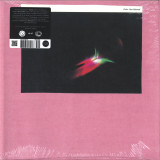
On his third album as Etelin, Alex Cobb explores the intricacies of separation and belonging using field recordings and electronics, reconfiguring the dividing line between what is artificial and natural in the process. Maintaining a sense of playful reverence and lurking melancholy in its glitchy pastoralism, Patio User Manual hums with a meticulous and singular energy. From the loops and static pulses of "The Chemistry of Cobalt" to the tension and release of "Electrical Sailing," the listener is pulled into a sound world at once ambivalent and radiant, reaching its denouement in the lovely melody that closes the final track, "Picnic at Gas Station Park". Although the album might bring to mind the nuanced and imaginative ambient music published by labels such as Mille Plateaux, Sonig, and Silent Records in the 1990s, it is, in the end, a world of its own and very much of today. The patio as a stage for alienated life, pyrrhic in its isolation, deceptive in its promise of distinction. Orientation as disorientation, often unseen inside the frame but felt in the bones. What is out there, anyway, other than the thing we fear the most?
"Another day of weird weather and screens. What type of perfume did Philip Johnson wear when he designed Glass House? Is it actually possible to flee to the country when you’ve internalized a lifetime of intellectualized urban living? When you buy a DIY patio kit, you get instructions for how best to embed concrete or brick or flagstone into the natural world. The patio will make you enjoy your environment more. It will become yours. You can stand on it and think “this is Mine.” The structuralists talked about the importance of fixed camera position, but didn’t properly interrogate it because to do so would be impossible. It’s hard to believe that it really wasn’t long ago that computer music seemed exciting, novel, even radical. We’re now thoroughly estranged from eating what’s in season. Walking around the woods in southern Ohio in spring, I thought about the curious imperative of the patio, how my kids get excited about picking oyster mushrooms, the dynamics of switched capacitor filters, and how adequacy is tethered to doubt." - AC, May 2024

Cleveland death metal legends-in-waiting 200 Stab Wounds have returned with Manual Manic Procedures, a superlative sophomore effort that follows 2021’s Slave to the Scalpel, their tour de force debut. The new album is a brutal slab of old school death metal with a contemporary edge. Not for the faint-hearted, Manual Manic Procedures may well be the album that puts classic gore-themed ferocity back into the metal community’s collective consciousness. The band's debut, "Slave to the Scalpel" saw 200 Stab Wounds insinuate themselves into the minds of extreme metal fans, leading to praise from Pitchfork for their “unpretentious brilliance, pitch-black sense of humor” and an “aesthetic that’s built around a chugging, groovy riff that stomps down a path of destruction.” Manual Manic Procedures sees the band upping the ante both musically and lyrically. Ultimately, for 200 Stab Wounds, it’s all about creating art that they enjoy. “I know that if we like it, our fans will like it,” says Buhl. “That's really all that matters to us. And if we keep touring, it's just gonna get bigger and bigger. Then everyone's happy, far as I'm concerned.” The songs on Manual Manic Procedures are not safe for work – perhaps unsafe most anywhere. But that’s its dark charm in a world where even heavy music can play it too safely. 200 Stab Wounds have crafted Manual Manic Procedures for themselves and like-minded brethren: thrill-seekers, carnage cravers, horror fans, and aficionados of the most extreme metal. Above all, 200SW created a future death metal classic.

Cleveland death metal legends-in-waiting 200 Stab Wounds have returned with Manual Manic Procedures, a superlative sophomore effort that follows 2021’s Slave to the Scalpel, their tour de force debut. The new album is a brutal slab of old school death metal with a contemporary edge. Not for the faint-hearted, Manual Manic Procedures may well be the album that puts classic gore-themed ferocity back into the metal community’s collective consciousness. The band's debut, "Slave to the Scalpel" saw 200 Stab Wounds insinuate themselves into the minds of extreme metal fans, leading to praise from Pitchfork for their “unpretentious brilliance, pitch-black sense of humor” and an “aesthetic that’s built around a chugging, groovy riff that stomps down a path of destruction.” Manual Manic Procedures sees the band upping the ante both musically and lyrically. Ultimately, for 200 Stab Wounds, it’s all about creating art that they enjoy. “I know that if we like it, our fans will like it,” says Buhl. “That's really all that matters to us. And if we keep touring, it's just gonna get bigger and bigger. Then everyone's happy, far as I'm concerned.” The songs on Manual Manic Procedures are not safe for work – perhaps unsafe most anywhere. But that’s its dark charm in a world where even heavy music can play it too safely. 200 Stab Wounds have crafted Manual Manic Procedures for themselves and like-minded brethren: thrill-seekers, carnage cravers, horror fans, and aficionados of the most extreme metal. Above all, 200SW created a future death metal classic.

In "A Dysfunctional Success" Eric Goulden writes with an acute eye for detail about growing up in the 60s and 70s in suburban South East England, discovering music and girls; life as an art student in the frozen north eastern town of Hull; the formation and dissolution of bands with desperate equipment, a homemade ethos and not much idea; his move to London in 1976 and subsequent recording debut on the newly formed Stiff Record label. This is an honest coming of age story from both sides of instant pop success: bands, squalid flats, menial jobs, making records, the rise to the point of fame and falling off into poverty and alcoholism in Thatcher"s Britain, where Goulden ultimately survived the 1980"s to achieve his own kind of success. Twenty-one years after its original publication, in a time when pop stars telling their own hard stories was a comparative rarity, A Dysfunctional Success rings truer than ever, reminding readers how we all come from somewhere, pay a high price for our dreams, and enjoy modest glories in return for staying the course. "I think I was hoping for insight into the early Stiff Records days, which I didn"t get. What I got was much better, and a great deal more interesting: a shambling, acutely observed, very funny-sad-true-sharp autobiography ..." Neil Gaiman Broschur Ca. 240 Seiten engl. Language

9
Operating Manual for Floating in Space is a project by Mylan Hoezen, researching the ecstasy of our existence through manually operating a sequence of bodily movements. This record is the soundtrack to the performative operations performed by Lili Ullrich, Bergur Thomas Anderson, Ratri Notosudirdjo, Noelle Lakshmi and Alex Chater at Roodkapje Rotterdam in September last year. Musical direction by Bergur Thomas Anderson. Limited to 200 copies with operating manual insert and transparent moonrock sticker.

7
FIRST EVER VINYL PRESSING OF JOHANN'S 2006 ALBUM - DELUXE GATEFOLD SLEEVE, 2 x CLEAR LP - TWO BONUS TRACKS, DOWNLOAD CODE INCLUDED
Never before pressed on vinyl, IBM 1401, A User's Manual, is one of Jóhann Jóhannsson's most loved works. Released in 2006, the decade since its release has seen Jóhann establish himself as one of the most important composers in the World today, most notably scoring movies such as Arrival, Sicario and The Theory of Everything.
Inspired by the work his father did in the sixties when chief maintenance engineer of one of Iceland's first computers, Jóhann originally wrote IBM 1401, A User's Manual to accompany a dance piece by long-standing collaborator and friend, Erna Ómarsdóttir. For this album release, he rewrote it for a sixty-piece string orchestra, with a new final movement (built around a poem by Dorothy Parker) and incorporating both electronics, and reel-to-reel recordings made by his father and friends in 1971 of an enormous IBM 1401 mainframe computer singing the hymn Ísland Ögrum Skorið by Sigvaldi Kaldalóns as it was being decommissioned.
The first ever pressing of IBM 1401, A User's Manual comes in a deluxe gatefold sleeve, having been reworked by Chris Bigg (v23) from his original design. Pressed on clear vinyl, two album tracks recorded in 2010 with the City of Prague Philharmonic Orchestra at the Rudolfinum, Dvorák Hall in Prague have also been added and are exclusive to this release.

8
Artwork by TZU TING WANG, Layout/Concept by Fiona Luigi
5 years since Midnight Shift's first release in 2012, the label assembles a collective of artists, most of them are in advance of their full EPs releasing later.
Representing the sounds of the label is this manual of secret moves, up in the sleeves. The mystic motley crew also comprises the alternate sides of familiar faces — Amato (The Hacker), Terry Lamborgini (Marco Bernardi), INNYSTER (Seixlack), Hodge in a new formation with Gramrcy, and an electro moniker from an undisclosed artist: Thermocline. From abstract acrobatics to the abrasive and the ultimate gob smack to the floor — The Midnight Manual.

8
A Complex Web - The Story of THE SHINING PATH...began in 1982 when Peter Miller (aka Dr. William S Ray - vocals, tapes, guitar) met Andrew Millar (aka Maurice Spectograph the Nose-y Pieman - program execution) in Gold Coast, Australia. While sharing a similar taste in music, they decided to form a band, so DIVE POSITION was born. Equipped with a Korg synthesiser and Tascam 4-track recorder, they 'wanted to have the 'sound' of Kraftwerk, the groove of Can, and the 'menace' of Throbbing Gristle', ending up with 'a cross of Suicide and the Residents', as Peter recalls. In a local record shop they met Stig Andre Leonardson (aka Vincent Blackshadow), who joined the duo on percussion and drum machine programming. Their motto was 'Now is Then'. DIVE POSITION then became THE FATAL CHARM around 1984, and THE FATAL CHARM became THE SHINING PATH who eventually released their only album 'Basic Training Manual' in an edition of only 250 copies, most probably in 1986. The band then started to drift apart, and shortly after Andrew sadly passed away - this re-issue of 'Basic Training Manual' and the upcoming compilation 'Now is Then' comprised of previously unreleased DIVE POSITION and THE SHINING PATH material is dedicated to his memory.

10
Odd Beholder, the project of Zurich-based musician Daniela Weinmann, releases the full-length debut album "All Reality Is Virtual" this fall.
"All Reality Is Virtual" is an intelligent, tenderly flowing and weird pop album, colourful, assertive. It deals with the strange temptations of our time: from tinder to AI, from offline loneliness to obsessive self-marketing. "I noticed that the main temptation of a digitalized life is the idea that everything can be measured, recorded and therefore known." says Weinmann. "But I yearn for surprise, for wonder. The unknown, the uncontrollable is appealing to me."
Odd Beholder have released two highly acclaimed EPs already, "Lighting" and "Atlas". Followed by the "Remixes" EP. Those remixes have been contributed by friends made along the way and artists Odd Beholder became fans of: The/Das, Fejká, Hundreds, Alessandro Giannelli, Kalipo, Thomas Atzmann. After having played tours in China, Germany, Switzerland and Italy, Daniela Weinmann teamed up with swiss musician and producer Martin Schenker to finish producing Odd Beholder's debut album. "All Reality Is Virtual" will be out Oct. 19th, 2018 on Sinnbus and Mouthwatering Records.

10
Odd Beholder, Das Projekt Der In Zürich Lebenden Musikerin Daniela Weinmann, Veröffentlicht Das Debüt-album "all Reality Is Virtual".
"all Reality Is Virtual" Ist Ein Intelligentes, Fließendes Und Sonderbares Pop-album, Bunt Und Bestimmt. Es Setzt Sich Mit Den Seltsamen Versuchungen Unserer Zeit Auseinander: Von Ki Bis Tinder, Von Der Offline-einsamkeit Bis Zum Obsessiven Selbstmarketing. "mir Ist Aufgefallen, Dass Die Versuchung Eines Digitalisierten Lebens Vor Allem Darin Besteht, Dass Alles Gemessen, Aufgezeichnet Werden Kann Und Damit Bekannt Ist", Sagt Weinmann. "aber Ich Sehne Mich Nach Überraschung, Nach Verwunderung Und Zufall. Mir Gefällt Das Unbekannte, Das Unkontrollierbare."
Odd Beholder Haben Mit "lighting" Und "atlas" Bereits Zwei Tolle Eps Veröffentlicht. Darüber Hinaus Erschien Im Frühjahr 2018 Mit "remixes" Eine Fein Säuberlich Zusammengestellte Ep Mit Ausgewählten Bearbeitungen Von Freund_innen, Die Odd Beholder Unterwegs Gefunden Haben Oder Von Denen Sie Fans Geworden Sind: The/das, Fejká, Hundreds, Alessandro Giannelli, Kalipo, Thomas Atzmann. Nach Touren In China, Italien, Deutschland Und Der Schweiz, Hat Daniela Weinmann In Zusammenarbeit Mit Dem Schweizer Musiker Und Produzenten Martin Schenker Das Debütalbum Aufgenommen. "all Reality Is Virtual" Von Odd Beholder Erscheint Am Im Oktober 2018 Als Lp, Cd Und Digital Auf Sinnbus Und Mouthwatering Records.

13
Ikonika's third album 'Distractions' builds on 2013's 'Aerotropolis', and the title answers the question Why has the album taken so long' In the last few years she's been building up a strong CV of remixes, from Chvurches to Dawn Richard, Austra and Junior Boys, as well as DJing and working on this album. 'Distractions' distils the character of Ikonika's music productions across a wider set of styles than previous albums, and she subtly fuses and switches elements from contrasting genres, giving the whole set a uniqueness and consistency that puts it in its own lane. Furthermore what sits at the centre of 'Distractions' more than ever is her love of R&B and hip hop, in all its forms, which has opened the door to bring in a selection of guests in a way she's not fully explored before. From the full throttle blend of grime and 80s synth soul 'Noblest' with Andrea Galaxy, to the reflective 'Sacrifice' with up and coming MC Jammz, a slowjam that merges dubstep with hip house drums. The final vocal track is the languid 'Hazefield' co-produced with Sweyn J and featuring Jessy Lanza on vocals. Its mix of mechanic clunk and minimalist, lulling funk could only happen in 2017. The LP artwork takes its inspiration from West London's Golden Mile, a stretch of the Great West Road where the A4 meets the M4, and the road takes on the character of the arcade game Poll Position, with art deco factories and illuminated, hi-tech signage selling lifestyle products. It's this kind of mix of futuristic and industrious with a touch of gentle glamour that the album exudes.

4
Lunar Disko presents...
Time marches on with two Various Artist EPs to celebrate the 20th release on Lunar Disko Records. Eight tracks encompassing the modus operandi of the label since the beginnings
Part 2 features another selection of Lunar Disko favourites, with the return of DJ Overdose and Raiders of the Lost ARP, while two of Ireland's finest in Tr One and Automatic Tasty complete this stellar line-up.
..and time is still marching on

6
Dennis Huddleston is 36, a prolific ambient producer who releases albums on a prolific basis but never lets the quality levels dip. He often roams around different labels and for this one lands on Pure Life with six more sublime and subversive sounds. 'Pre-Dream Condition' is a slow awakening that sharpens your senses then 'Manual Dream Transmission' continues the heavenly ascent with lush arps shimmering across an infinite horizon. 'A Bright & Tranquil Light' is soft focus and beautiful and 'Night Language' brings sharper melodic focus with 80s nostalgia ripping through the keys. Two more long-form and unhurried but dense ambient soundscapes close out a pure escape.

8
Diagonal welcomes Scott Gordon to the fold. Scott has previously released on Editions Mego as one half of Oto Hiax, a collaborative project with Mark Clifford of Seefeel (Warp Records). He's also released a series of EPs and one album under his Loops Haunt alias via the Black Acre imprint. For his Diagonal debut, Scott offers up "Metals", a double EP of sorts: two sides of wax with two separate titles, "And Away" on side one backed with "Tilts" on side two. Each set is a study in using mechanical means to seek tone, rhythm and texture via unexpected objects and instruments. Both sides feature Scott's custom made Spinning Plate Instrument SPI. The SPI is a large, motorised vertical frame that spins a series of metal plates. These can be struck via midi - mechanical 'beaters'. These recordings also feature Scott playing the SPI manually. The results are both gripping and provocative. Mastered by Russell Haswell. Direct Metal Mastering (DMM) to vinyl.
10
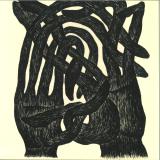
In 2018, Rian Treanor left his home in Rotherham, UK, and headed to Kampala for a residency at Nyege Nyege's villa studio. The mind-expanding experience inspired his critically acclaimed 2020 full-length "File Under UK Metaplasm", but that wasn't the end of the story. Treanor also spent time working alongside Acholi fiddle player Ocen James, developing an improvisation-heavy collaboration that would push both musicians' idiosyncrasies into completely new places. Treanor wanted this collaboration to be as tactile and reactive as a live performance with traditional instruments, so he set about working on a digital process that would synchronize with James' approach. Using physical modeling techniques, Treanor created an instrument that explored the tunings and sounds of the a'dungu, an arched harp, and the nah or nag. With Ocen playing his rigi rigi, a single string violin, they intuitively experimented with the spectral properties of sound, using texture and acoustic contours as their structural framework. They were able to develop a sound together that was unconventionally rooted in traditional Ugandan culture, but shuttled into different dimensions of noise, computer music and radical UK rave. "Saccades" is the buffer between two vastly different sonic universes, united in respect and sprightly curiosity. Treanor's hyperactive computer-controlled rhythms are immediately identifiable on opening track 'Bunga Bule', but the sound palette is distinct: it's more flexible and less digital. James' expressionistic fiddle strokes are a revelation, contorted into hoarse squeals and rough vibrations that rub and flex off Treanor's tin can shuffle.

RedNilo is an Italian-Moroccan duo composed of Reda Zine and Danilo Mineo, two musicians based in Bologna linked by a deep passion
for world music, particularly African music. Their ongoing and tireless musical exploration has led them to collaborate for over a decade
on numerous artistic and recording projects. Their new album, eponymously titled RedNilo, features six tracks characterized by a sound
reminiscent of Gnawa, Hassani, Tuareg, and experimental rock. The psychedelic, raspy riffs of the electric guitar, the repetitive rhythms
of the percussion, and the rhythmic-melodic lines of the guembri represent and evoke their journey. The resulting sound material is the
culmination of their journey and their encounters with masters, artists, griots, artisans, and instrument makers in the Draa Valley in
southeastern Morocco, bringing together the two musicians' urban and experimental backgrounds and souls. The album's artwork was
designed by Moroccan artist Aali Wica, initiator and mentor of their spiritual and artistic journey to the southern African continent,
across the long black snake.
Réda Zine, a musician and documentary filmmaker born in 1977 in Casablanca, launched his musical career in the 1990s, contributing
to L'Boulevard, Africa's largest independent festival. Raised in the Casablanca medina, he was introduced to Gnawa music by various
Maallems. After studying at the Paris 3 Sorbonne University, he founded Café Mira, a project that has performed at several international
events.
From 2011 to 2014, Zine was artistic director for Creative Commons (Middle East and North Africa), where he won the #CC10 Korea
award in 2012 with the project "It will be Wonderful," which brought together musicians from over 12 countries. He has also been
involved in exhibitions on music and censorship, participating in events in major cities such as Paris, Buenos Aires, and Seoul. In Italy,
he continued his musical research with the Hardonik project and was part of the Afrobeat group Voodoo Sound Club, recording the
album Mamy Wata. Zine collaborates with artists such as Seun Kuti and has initiated educational activities related to Gnawa music,
contributing to initiatives such as the African Symphony Laboratory for improvisers. He is the co-founder of Fawda, a Gnawa-based
project, and is part of the Gnawa Rumi collective, which explores the music of the Moroccan diaspora in Italy. He directed the documentary "The Long Road to the Hall of Fame" about Public Enemy, which won an award at the Pan African Film Festival in 2015.
Danilo Mineo graduated as a national educator from the AMMnationalscholl music academy in Milan, with a thesis entitled "Afro-Cuban
Music and the Rhythm Section." Over the years, he has attended workshops and masterclasses with international artists and masters
of percussion and drums, including Horacio El Negro Hernandez, Airto Moreira, Trilok Gurtu, Luis Agudo, Arto Tuncboyaciyan, Dudu
Tucci, Dom Famularo, Karl Potter, Rodney Barreto, and Eno Zangoun, exploring the rhythmic language of various musical genres and
styles.
In addition to publishing several educational manuals for percussionists, music critics consider him a versatile percussionist, active in
various musical productions and recordings: Mop Mop, Fawda, Guglielmo Pagnozzi "Voodoo Sound Club," Fabrizio Puglisi "Guantanamo," Panaemiliana, The Mixtapers, and many others, with whom he has performed at numerous national and international music festivals (in Europe and Africa). As a percussionist and side man he has recorded numerous albums and collaborated with Italian and
international artists including: Giancarlo Schiaffini, Gianluca Petrella, Roy Paci, Roberto Freak Antoni, Famoudou Konate, Melaku Belay, Baba Sissoko, Kalifa Kone, Jamal Ouassini, Deda, Dj Lugi, Bioshi.

The third chapter in CLIKNO's MAT (Music / Art / Text) EDITIONS series features four extended deep Minimal Techno tracks by Dr.Nojoke, titled wrongwrongrightright.
This release is accompanied by Dana Widawski's SelfMade 1-4, a series of four fayence-style plates created using traditional techniques to convey unconventional, socio-critical themes, and a text, solo moral judgement, by Marianne Klausen—a manual for a performance on moral judgment that explores the meanings and values of concepts like good, bad, wrong, and right—fusing auditory and visual art with writing into a unified experience.
At the core of Dr.Nojoke's wrongwrongrightright lies a deep, hypnotic quality, woven through layers of rhythm, melody, and noise, creating a transcendental pulse for the dancefloor. Notone on the A-side takes a more straightforward, acidic approach, while Cornips on the flipside is a deep minimal groover with a funky interplay of sounds. The second record dives even deeper with two more obscure tracks, Volasuri and Jilimuz, appealing to fans of Voices From The Lake and similar artists.
CLIKNO … art for dancing

6
Not so long ago in 2017, the first release on Michiel Claus' and Ailsa Cavers' Basic Moves saw the light of day and especially the shine of night. Produced by founding father Walrus, BM01 set the tone for a record label that focuses on releasing hidden archives from the 90s, whilst combining them with modern club music from the here and now. By highlighting the musical heritage of the Belgian electronic music scene, the label illustrates the continuity between past and present, history and shaping identities of 21st-century artists, undeniably building on the strong foundations of their forerunners. Seven years and nineteen releases later, Basic Moves is rounding off the series with BM20, a final double 12'' by one of the major figures from the Belgian underground: Circadian Rhythms also known as Dj Deg. After many years of collecting, deejaying and producing music, his musical spectrum ranges from synth, library and wave, to jazz, funk and disco, from house to techno. His journey started in clubs like Bocaccio (1988 - 1993), and La Gait? (1979 -1989), where young Deg came across deejay's like Olivier Pieters or Eric Beysens who made him choose the path of becoming a devoted disc jockey himself. BM20 is a sonic witness of Deg's first musical encounters with his machines, revealing a withdrawn selection of six bedroom patchwork tracks produced between the years of '93 & '99, a time without the internet or user manuals to help you solve the riddles of technology. Though only at the very beginning of his creative process, Deg's unique personality is nevertheless already clearly identifiable: blending techno with jazz, where the sharp edges of 16-step drum-sequences are smudged and bent in different directions. In the lower countries, the second half of the 90s was a period of fast & funky, happy Detroit, 140 BPM techno. Whenever Deg was not oscillating between record shops or gigs and had a moment on his own, mostly during morning hours after the club, he would spend his leftover energy in the studio. Either by himself or with his loyal ally Mike DMA, he would benefit from these moments to slow down and give space to a different, introverted sound - processing moods, feelings and thoughts. This record therefore gathers only a few of many (unrecorded) one-shot live sessions which were never intended to be shared - and only existed for the love of music and its power to take you beyond all things known. Thank you Deg for sharing your music and giving us a glimpse of your universe. Without your productions, your memorable warm-ups and closing sets - many of us would not be where we are now, and Basic Moves might never have been founded. As a last note to a closing song, BM20 is about being fully committed to the music and the club, a medium and place of fruitful settings for encounters, creativity and growth. Where dreams and ideas have a chance to exist, being almost ready and thought out to shape future times to come - and many party nights. Gurl, December 2023

It's difficult to ''label'' the songs of this authoritative and necessary official reissue (after the shameful fake of 10 years ago). ''Zombi'' and ''In the Land of the Zombi'' are two electro disco-funks from 1979, therefore from three years before was born the ''Italo-Disco'' style, certainly more powerful, aggressive and more electronic than the ''Made in Italy'' disco style of the 2nd half of the 70s (Fratelli La Bionda, Pino Presti, Claudio Simonetti, Celso Valli and others.). The creation of the original 7" by Salvatore Ida, great musician and bandleader - to whom this excellent reissue is dedicated - was a sort of game for the authors of the two pieces: Federico Ida and Massimo Ida, were protagonists 4 years before of the Italian progressive rock scene with the sister Silvana Ida, Marcello Surace and Franco Vinci thanks to the immeasurable and acclaimed album ''Apoteosi''. So The Zombies were destined to pair with another easy '79 joke by the Ida brothers: ''Let's Go'' and ''Mustang'' by Sandwich, also reissued on 12inch by Best Record Italy. The Zombies comes out with the original artwork of the time, but in a full embossed picture sleeve and released in the classic black vinyl and on red vinyl with black shades (limited edition with red copies numbered manually (1/250: 2/250 and so on...) What else to add except that: the two long versions of ''Zombi'' and ''In the Land of the Zombi'' were re-edited by Massimo Berardi, always diligent and active, as well as tidy and aware of where he was putting his hands, are fundamental in order to complete this 12" fully remastered by Dom Scuteri.

Turntable section
Type
Direct Drive Manual Turntable
Turntable Speeds
33-1/3, 45 rpm (with switch 78 rpm)
Starting Torque
0.18 N・m / 1.8 kg・cm
Build-up Characteristics
0.7 s. from standstill to 33 1/3 rpm
Wow And Flutter
0.025 % W.R.M.S.
Turntable Platter
Aluminium diecast
Diameter : 332 mm
Weight : Approx. 1.8 kg (Including slipmat and slipsheet)
Tonearm Section
Type
Universal Static Balance
Effective Length
230 mm
Overhang
15 mm
Tracking Error Angle
Within 2° 32' (at the outer groove of 30 cm record)
Within 0° 32' (at the inner groove of 30 cm record)
Offset Angle
22°
Arm-height Adjustment Range
0 - 6 mm
Stylus Pressure Adjustment Range
0 - 4 g (Direct Reading)
Head Shell Weight
Approx. 7.6 g
Applicable Cartridge Weight Range
(without auxiliary weight)
5.6 - 12.0 g
14.3 - 20.7 g (including head shell)
Head Shell Terminal Lug
1.2 mmφ 4-pin terminal lug
Terminals
Audio Output
PHONO (Pin Jack) x 1, EARTH TERMINAL x 1
General
Power Supply
AC 110 - 240 V, 50 / 60 Hz
Power Consumption
8 W
Approx. 0.2 W (Standby)
Dimensions (W x H x D)
453 x 169 x 353 mm
Weight
Approx. 9.6 kg
Accessories
Turntable, Slipmat, Slipsheet, Dust cover, EP record adaptor, Balance weight, Head shell, Screw set for cartridge, PHONO cable, PHONO earth lead, AC power supply cord, Owner's Manual
Mit dem SL-1200MK7 erweitert Technics sein erfolgreiches Sortiment an DJ-Plattenspielern nun um ein Modell in Silber. Der neue SL-1200MK7 verfügt über die gleichen technischen Merkmale und den gleichen Bedienkomfort wie der SL-1210MK7, der sich seit Verkaufsstart im Januar 2019 zum Liebling der Vinyl-DJ-Community weltweit entwickelt hat.
„In den letzten Jahren wurde von DJs, internationalen Musikveranstaltern und unseren Vertriebspartnern vermehrt der Wunsch an uns herangetragen, das Technics Plattenspieler-Line-up zu erweitern und weiterzuentwickeln. Auch eine Silberversion des DJ-Plattenspielers, der für so viele Anwender auf der ganzen Welt die erste Wahl ist, stand auf der Wunschliste ganz oben“, sagt Frank Balzuweit, Produkt-Manager von Technics Europa. „Diesem Wunsch sind wir gerne nachgekommen und bieten mit dem SL-1200MK7 jetzt allen Interessenten ihr geliebtes Arbeitsgerät in der Optik ihrer Wahl an“, so Balzuweit.
Der SL-1200MK7 in Silber verfügt über dieselben technologischen und funktionalen Merkmale wie der SL-1210MK7 in Schwarz:
- Eisenkernloser Direktantriebsmotor mit leistungsstarkem Drehmoment und einer stabilen Rotation
- Präziser und robuster Tonarm, der die Musikinformationen der Schallplatte präzise wiedergibt
- Zweilagiges Chassis mit verbesserter Schwingungsdämpfung
- Stabiles Gehäuse und schalldämpfende Isolationsfüße zur Eliminierung von Vibrationen, auch unter erschwerten Bedingungen
- Anlaufdrehmoment / Bremsgeschwindigkeit-Einstellfunktion
- Pitch-Regler-Funktion für genaue und stabile Pitch-Anpassung
- Reverse-Play-Funktion erweitert die Flexibilität von DJ-Stilen
- Stylus Illuminator mit hoher Helligkeit und langlebigen LED-Leuchten
Features
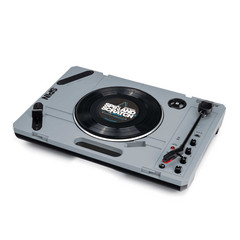
Portable turntable for vinyl lovers & scratch artists
Mobile fun with your turntable, anywhere you go
Outstanding for mobile scratching and cutting
Out of the box: comes with 7'' scratch vinyl, pre-installed 45-mm-crossfader & cartridge, integrated speaker, Bluetooth audio receiver, USB recording function, slipmat, and dust cover
High-grade 7''-scratch-record: professionally recorded samples for scratching and beats for juggling
Bluetooth audio streaming: wireless streaming of music or beats to the device
Smart USB recording: direct recording of scratches & cuts to USB in MP3 format
Can also be used for digitizing vinyl
Integrated speaker on the turntable's left
3 selectable speeds (33 1/3, 45 & 78 rpm)
Extremely stable tone arm with transport lock
Cartridge with excellent tracking features
Precise 45-mm-crossfader with two-rail glide technology
Crossfader can be installed on preferred side (both-way)
Two headphones connections for listening and monitoring
AUX input facilitates connection of several turntables (daisy chain)
Easy battery charging via USB PSU or USB power bank (sold separately)
Installed start/stop button
Precise speed adjustment via pitch control with +/-20 %
Tone control to adjust low frequencies by +/- 10 dB
Volume control for AUX input and master/headphones
Power LED indicates the turntable's operational status
7'' record puck adaptor with holder
Anti-skip rubber feet for secure stand
Especially sturdy and portable shape factor with optional battery operation
Additional protection thanks to dust cover; can be transported via carrying handle when closed
Locking of dust cover for safe transport
Can be operated with regular USB PSU (5 V, 2 A), USB power bank or batteries (sold separately)
Batteries can be inserted into battery compartment on the device's bottom 2x Li-Ion 18650 (sold separately)
Incl. 7'' scratch vinyl, pre-installed cartridge, slipmat, dust cover, puck adapter, USB cable, instruction manual and Super Spin Duck Looper app
Technical Data
Belt drive
Inputs: AUX 3.5 mm stereo, Bluetooth audio
Outputs: master RCA, USB (USB-A), headphones 3.5/6.3 mm stereo
Recording format: MP3 with 192 kbit/s
Recording quality: 16 bit / 44.1 kHz
Battery type: 2x Li-Ion 18650 (batteries sold separately)
Power supply: 5 V, 2 A micro USB (PSU sold separately)
Dimensions: 370 x 95 x 260 mm
Weight: 2 kg

The AT-LP140XP fully manual professional DJ turntable features a high-torque direct-drive motor and anti-resonant, mass-damped, die-cast aluminium platter to ensure stable, on-axis rotation at 33-1/3, 45, and 78 RPM. It is equipped with an S-shaped tonearm with height adjustment, adjustable tracking force (counterweight) and adjustable dynamic anti-skate control.
Audio-Technica has been a leader in phono cartridge design for more than 50 years, and that expertise shows in the durable, high-output AT-XP3 DJ cartridge with 0.6 mil conical bonded stylus included with the turntable. It comes pre-mounted to an AT-HS6 universal ½"-mount headshell.
Designed to connect to components with a dedicated phono input, the turntable comes with a detachable dual RCA output cable which supplies a strong 5.5 mV phono output.
Additional professional features include a start/stop button; forward and reverse play; selectable high-accuracy quartz-controlled pitch lock and pitch change slider control with +/-8%, +/-16%, and +/-24% adjustment ranges; a stroboscopic platter with speed indicator; a retractable plug-type stylus target light; and a removable hinged dust cover.
Experience high-fidelity audio and professional DJ performance
Direct-drive, high-torque servo motor with speed stabilization
Fully manual operation
Adjustable dynamic anti-skate control
Selectable 33/45/78 RPM speeds
Professional anti-resonance, mass-damped, die-cast aluminium platter with felt mat
AT-HS6 universal ½"-mount headshell and AT-XP3 DJ cartridge with 0.6 mil conical bonded stylus
Balanced S-shaped tonearm with hydraulically damped lift control, height adjustment, and lockable rest
Dedicated phono-level output (5.5 mV)
Stroboscopic platter with speed indicator
Forward/reverse operation and variable pitch control with quartz speed lock
Retractable plug-type target light for easier cueing in low light
Damped base construction for reduced low-frequency feedback coloration
Includes: detachable RCA output cable (dual RCA male to dual RCA male), power cable, 45 RPM adapter, counterweight, felt mat, and removable hinged dust cover
Turntable
Bauart 3-speed, fully manual operation
Motor High-torque DC motor
Antriebsart Direct drive
Geschwindigkeiten 33-1/3 RPM, 45 RPM, 78 RPM
Plattenteller Die-cast aluminium
Features
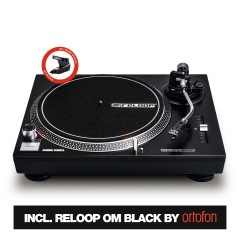
NEW in the MK2 version:
Newly developed top panel and reinforced housing construction
Reworked metallic buttons with improved feel & tactile response
Precision Pitch with selectable ranges of +/-8 %
Superior finish in deep black metallic
Quartz-driven DJ turntable with direct drive
Perfect for beginners
USB audio output for digitizing your records easily
Precise motor control with 2 speeds selectable (33 1/3 & 45 rpm)
Precision-engineered, die-cast aluminium platter with stable rotation
Statically balanced s-shaped tone arm with hydraulic lift and anti-skating - mechanism
Universal connection for pick-up systems (SME)
Extendible needle illumination
Built-in phono pre-amplifier (no grounding necessary)
Switchable phono and line level output
Shock-absorbing feet for vibration isolation
Sturdy, heavy construction with optimized damping features
Prepared for dust cover (available as optional accessory)
Incl. platter, OM Black pick-up system (by Ortofon), headshell, slipmat, counterweight, power cord, operating instruction manual
Technical Data
Turntable:
Type: direct drive turntable
Drive: quartz-driven direct drive
Motor: 8-pol., 2-phase, brushless DC motor
Turntable speeds: 2 speeds, manual (33 1/3, 45 RPM)
Starting torque: > 1kg/cm
Brake time: 50 dB (DIN-B)
Brake system: electronic brake
Platter:
Material: aluminium die-cast
Diameter: 332 mm
Tone arm:
Type: universal, statically balanced, s-shaped
Effective length: 230.5 mm
Overhang: 16 mm
Tracking angle error: < 3°
Applicable pick-up weight: 3.5 – 8.5 g (incl. headshell 13 – 18 g)
Anti-skating range: 0 - 7 g
Connections:
1x PHONO/LINE out (gold-plated)
General:
Power supply: AC 115/230 V, 60/50 Hz (US/EU)
Power consumption: 13 W
Dimensions: 450 (w) x 352 (d) x 144 (h) mm
Weight: appr. 6.76 kg

- A1: Mind Mapping
- A2: 030
- B1: Fügung (Feat Laura Merino)
- B2: Flow Dreaming
- C1: Structural Understanding
- C2: Quiet Reflection
- D1: Geruda Dub
- D2: Boiling Range
- E1: Interlude
- E2: Karl-Marx-Allee (Zentaskai & Jeremy Reinhard)
- F1: Dynamic System (Zentaskai Vs Palawan)
- F2: Apeiron (Zentaskai & Sebastian Klenk)
- F3: Parallel 30 (Zentaskai & Apoena Feat Yucuma)
13
ZentaSkai unveils stunning, high-concept house album on Mask Records.
ZentaSkai undertook a period of research into the underlying structure and organisation of the human brain before writing ‘The Architecture Of The Mind’. The Berlin-based artist then took what had been learned and kept it in mind when writing the music that marks Mask's first album release. It comes with extensive background notes on each track, and an operational manual of sorts - notes from the artists as to the effects each piece will have on those who hear them.
"The message conveyed by this album is that life itself is filled with music, but our egos often prevent us from being in harmony with this symphony. Inner chaos and silence can be challenging to bear, leading us to seek solace in external noise. We have constructed a barrier between our inner and outer worlds, causing us to lose touch with the rhythm of harmony. However, by embracing the illusion of separation and dancing to good music, we can rediscover harmony with ourselves and our environment. To fully experience the essence of the album, it should be played loudly on a proper sound system or high-quality headphones. By immersing themselves in the music, individuals can engage with its transformative power and potentially find a deeper connection with their own minds and surroundings." - ZentaSkai.
The gorgeous 'Mind Mapping' opens up with deep and dubby drums and lush harmonies that soothe you to your core, '030' then has more raw, heavy drums with many layers of glowing synths, glassy melodies and organic found sounds. 'Fügung' keeps the deep and introspective moods coming before the crisp tech of 'Flow Dreaming' ups the ante with more drive and layers of vocal whispers, hi-hats and smeared dub chords.
Elsewhere the likes of 'Quiet Reflection' lean into the groove with swirling pads and one-word vocal sounds drifting through the air over propulsive drum loops, and 'Boiling Range' suspends you in deft synth loops amongst the stars over a prickly house beat.
The superb synth craft and well-designed grooves continue through the dusty deep house of 'Karl-Marx-Allee' and minimal dub of 'Dynamic System' before the elegant melodic techno of 'Apeiron' and dreamy synthscapes of 'Parallel 30' close the album in a reflective fashion.
This is a deeply evocative album with a fully realised concept that is as thought-provoking as it is immersive.

11
Welcome to Recreational Kraut, the latest release on the recently relaunched Source Records label. This collaboration between Jordan Czamanski (aka Jordan GCZ) and David Moufang (aka Move D) links back to the ambient experimental beginnings of Source Records in the early 90s, as well as to Conjoint, a project exploring the borders of
improvised music based on ambient, experimental electronics and jazz featuring Karl Berger, Jamie Hodge, Gunter “ruit” Kraus and David Moufang. Recreational Kraut was recorded live in in three sessions in Jordan’s Amsterdam studio in 2018 and 2019. As the title suggests, the album §irts with the term and the “genre” krautrock and it’s prolonged, often improvised instrumental passages.
The equipment used in the late 60s and early 70s was often rather conventional like electric piano, old synthesizers and electric bass guitar - all present on the album’s opener “recreation parts 1-3”. The two instruments shaping the album and giving it a coherence, despite the varied styles and tempos are Czamanski’s Fender Rhodes and Moufang’s lyra-8, an 8 oscillator drone synthesizer which is played
manually via touch sensors, giving it a very expressive sometimes violin-like other times outer-worldly, atonal character. Recreational Kraut’s 11 tracks span beat-less ambient soundscapes to jazzy psychedelia, as well as hints of house, techno, broken beat and funk. Let yourself submerge in the gravitational ¦elds of Recreational Kraut


12
2025 Repress
On his fourth album proper, Now Here No Where, Danish producer Kölsch (aka Rune Reilly Kölsch) is charting new terrain. Fans of his ‘years trilogy’ – 1977, 1983 and 1989, released on Kompakt over the past decade – were privy to a kind of sonic diary, an autobiography, tracking the artist’s early years through three albums of superior, meticulously rendered techno. Calling in collaborators where needed – most notably, the strings of Gregor Schwellenbach – there was still something deeply personal going down, not quite hermetic, but internally focused; the albums proved not only Kölsch’s mastery of his chosen form, but also his capacity to make techno personal, individual, and to trace histories of the self through music. But on Now Here No Where, Kölsch finds his feet firmly planted in the present. Reflecting on his new album, he notes, “It is fascinating to write about memories and feelings that have had years to manifest and develop, but how would I approach current emotions?” It’s a good question: our past coheres through the narratives we build around memories, but the moment we’re in, the newness of the now-ness, is harder to navigate; this story is as yet untold. For Kölsch, this makes Nowhere Now Here “an album about life in the year 2020. A time defined by confusion, misinformation and environmental challenges. It is an emotional interpretation of personal and mental challenges, observations and personal growth.” Kölsch does this with music that effortlessly balances emotional heft with the dancefloor’s brimming desires. It’s a space that Kölsch has navigated for a while now – one of techno’s breakthrough acts, an in-demand DJ across the globe and a prolific and restlessly creative producer, he’s also Kompakt’s biggest-selling act – but Now Here No Where ratchets up the lushness, making for a delirious drift across twelve tracks that are at once perfectly poised and deeply trippy. “Great Escape” is an elegant swoon, an opener that pivots on a sigh and a prayer; then “Shoulder Of Giants” bustles into view, subliminal clatter and an aching violin line giving way to a riff that glows with fluorescence and iridescence. “Remind You” combines an odd ECM jazziness with notes from a twenty-first century torch song; “Sleeper Must Awaken” mines huge buzzing synths and lets them float, in and out of sync, with reduced, ticking beats; “Traumfabrik” (dream factory – there’s a giveaway) is oddly lush, the tones malleable and plastic, morphing across a glitching undertow. There are sad, emotional washes of strings throughout the penultimate “While Waiting For Something To Care About”, while “Romtech User Manual”’s patterns twist and shape in the light. Throughout, Kölsch never keeps his eye off the dancefloor, and you can tell this is his still his home. “The amount of energy and joy I experience every time I perform, has a profound effect on me. It has inspired me so much of late and has become an integral part of my musicality.” “The way we join in expressing our hope for the future every weekend has given me so much,” Kölsch concludes. The club as a temporary autonomous zone, as a space both of freedom and of politics; somehow, that’s all here, Now Here No Where. “Most of all, it is an album about hope.”
Auf seinem vierten Album “Now Here No Where” betritt der dänische Produzent Kölsch (alias Rune Reilly Kölsch) neues Terrain. Seine Trilogie mit den Jahreszahlen 1977, 1983 und 1989, die in den letzten zehn Jahren bei Kompakt erschienen war, hatte seine Fans durch eine Art akustisches Tagebuch, eine Autobiografie geführt, die die frühen Jahre des Künstlers über die Länge von drei großartig produzierten Techno-Alben nachgezeichnet hatte. Wo es nötig war, wurden Kollaborateure hinzugezogen - allen voran für die Streicher, arrangiert von Gregor Schwellenbach -, dennoch zeichnete die Musik immer auch etwas zutiefst Persönliches aus, etwas nicht Hermetisches, auf eine bestimmte Art immer auch nach Innen fokussiert. Die Alben bewiesen nicht nur, wie sehr Kölsch die von ihm gewählte äußere Form beherrscht, sondern auch seine Fähigkeit, Techno zu etwas Persönlichem und Individuellem zu machen und der eigene Geschichte durch Musik näher zu kommen.
Auf “Now Here No Where” steht Kölsch nun mit beiden Beinen fest auf dem Boden der Gegenwart. Mit Blick auf sein neues Album stellt er fest: "Es ist faszinierend, über Erinnerungen und Gefühle zu schreiben, die Zeit hatten, sich zu manifestieren und zu entwickeln, aber wie nähere ich mich meinen aktuellen Emotionen?”. Eine gute Frage: Unsere Vergangenheit wird im Innersten zusammengehalten durch Geschichten, die aus Erinnerungen entstehen, aber der Moment, in dem wir uns befinden, die Neuheit des Neuen, ist schwieriger zu beschreiben; die Geschichte ist noch nicht erzählt. Für Kölsch ist “No Here Now Where” daher "ein Album über das Leben im Jahr 2020. Eine Zeit, die von Verwirrung, Desinformation und ökologischen Herausforderungen geprägt ist. Es geht dabei um die emotionale Interpretation von persönlichen und mentalen Herausforderungen, von Beobachtungen und der eigenen, individuellen Weiterentwicklung".
Kölsch tut dies mit Musik, die mühelos kleine Gefühlsausbrüche mit den großen Sehnsüchten der Tanzfläche in Einklang bringt. Es ist dieser Zwischenraum, in dem sich Kölsch schon seit einiger Zeit bewegt, als weltweit gefragter und gefeierter Live Act, DJ und so unermüdlicher wie kreativer Produzent (nicht umsonst ist Kölsch der “biggest-selling-artist” bei Kompakt), doch “Now Here No Where” treibt all das noch weiter auf die Spitze: ein enormer Sog entsteht, der uns über zwölf Tracks hinweg gefangen hält wie ein perfekt ausbalancierter Trip. Der Opener "Great Escape" ist pure Eleganz, ein Track, der irgendwo zwischen Seufzer und Gebet hin und her schwankt; dann drängt "Shoulder Of Giants" ins Blickfeld, ein unterschwelliges Geklapper, eine wehende Geige, schließlich ein schillernder Riff, der in der Dunkelheit zu leuchten und zu glühen scheint.
"Remind You" kombiniert seltsamen ECM-Jazz mit einem sentimentalen Liebeslied des 21. Jahrhunderts; "Sleeper Must Awaken" schürft im Bergwerk riesiger Synthesizer, mal im Takt, mal aus dem Takt ticken die minimalen Beats; "Traumfabrik" ist ungewöhnlich “lush”, die einzelnen Töne, geschmeidig und modelliert, zerfließen in einem glitzernden Abgrund. Das vorletzte Stück "While Waiting For Something To Care About" wird von traurigen, emotionalen Strings untermalt, während sich die Strukturen von "Romtech User Manual" im Licht drehen und immer wieder neu formieren. Die ganze Zeit über behält Kölsch die Tanzfläche im Auge, und man merkt ihm an, dass sie immer noch sein Zuhause ist: "Die Menge an Energie und Freude, die ich bei jedem Auftritt erlebe, hat eine tiefe Wirkung auf mich. Sie hat mich gerade in letzter Zeit stark inspiriert und ist zu einem integralen Bestandteil meiner Musik geworden.”
"Die Art und Weise, wie wir an jedem Wochenende gemeinsam unsere Hoffnung auf eine bessere Zukunft zum Ausdruck bringen, hat mir viel gegeben", so Kölsch abschließend. Die Vision des Clubs als eine temporäre autonome Zone, als ein Raum von großer Freiheit aber auch von politischen Ideen, das ist irgendwie alles hier drin, Now Here No Where. "Es ist vor allem ein Album über Hoffnung."

BOSS AXIS - GOLIATH EP - BlackFoxMusic 029 The ministers
of melody are back! Good things sometimes need their time.
And if you count the gap since boss axis' last release one thing
is immediately clear: when its about years, this is not just
"good" - its awesome! The titletrack "goliath" on the A side isn't
just named like a giant - with the huge break of 2mins in the
middle and the catchy melodic bassline it's a perfect peaktimemonster to burn down nearly every danceoor. "Goliath" also
gets a new dress by northern germanys Rauschhaus who
already releases on Traum Schallplatten or Paul Hazendonk´s
Manual Music. And this dress seems to be a short and breezy
summer-wear with openair-character. On the B side you'll nd
the dreamy "lost bridge" wich don't has to hide from the A side.
We don't know wich bridge they mean, but if everything what
they lose sounds like this techhouse-styled and groovy
dancetrack, we hope they lose some more... Last but not least
"the secret": with a classic sample wich is already used in a
classic early 90s ravetrack from suspicious the massive break
climbs to the top to explode with a stompy kickdrum and let
move every feet around the globe.

After a long development with several releases for Labels like Microtonal and Inclusion Records
Sascha finally decided to set up his own playground to release music with heart and emotions.
The debut EP is pretty much showing his large variety of producing unique music.
Played & supported by Laurent Garnier, Toni Rios, Max Cooper, Slam (Soma), Alexi Delano, Paco Osuna (Plus 8),
Anderson Noise, Alex Flatner (Cocoon, Poker Flat), Patrick Kunkel (Cocoon), Tim Xavier (Clink),
Kolombo (Kompakt, Systematic), Carlos Sanchez (8bit Supernature), Patrick Lindsey, Franco Bianco (Argentina),
Hanne and Lore, Microtrauma (Traum), Alec Troniq (Ipoly), Beatamines, Summer - Brendon Collins (Manual Music),
Fine Cut Bodies (Chi Recordings, Resopal), Turm 3 (Seenplatte), Laurent N. (France) and more

- A1: Full Blood Count Analyzer
- A2: Automated Instrument Rinse System
- A3: Mri Scanner
- A4: Anaesthetic Machine
- A5: Meti Human Patient Simulator - Mannequin Breathing
- A6: Simman Essential Mannequin
- A7: Cardiac Monitor
- A8: Lee Silverman Voice Treatment
- A9: Haemoglobin A1C Analyzer
- A10: Anaesthetic Machine 2
- A11: Infusion Pump (Alaris Plus)
- A12: Heater Fan
- A13: Phacoemulsifier – Suction And Ultrasound During Cataract Surgery (Two Perspectives)
- A14: Robotic Pharmacy - Manually Restocking Supplies
- A15: Ct Scanner
- A16: Pharmacy Label Printer
- A17: Dialysis Machine
- A18: Draeger Oxylog 3000 Plus
- B1: Meti Human Patient Simulator – Powering Up Of Bellows That Control Mannequin&Apos;S Artificial Lungs
- B2: Orthopantomograph Op 2000
- B3: Helium Cooler For Mri Scanner
- B4: Coagulation Analyzer
- B5: Meti Hps Mannequin
- B6: Ophthalmology
- B7: Sysmex Sp1000I Automated Slide-Maker
- B8: Agv (Automatic Guided Vehicle)
- B9: Ultrasound Scanner
- B10: Operating Theatre
- B11: Beckman Coulter Access 2 Analyzer
- B12: Geiger Counter (Berthold L4)
- B13: Automated Mailroom (Opex Mail Matrix)
- B14: Wall Mounted Suction Unit
- B15: Dialysis Machine 2
33
also available
Tape[13,66 €]
Death Is Not The End reissue Mark Vernon's sought-after 2013 collection Sounds of a Modern Hospital on vinyl & cassette formats.
Whilst every effort has been made to record the subject in as great a degree of isolation as possible, the sound recordings you will hear on this record were made in a real working hospital and not under controlled conditions. Therefore, on occasion, you may hear some unavoidable background noise, conversations and other extraneous sounds.
All recordings were made by Mark Vernon at Forth Valley Royal Hospital, Larbert, Stirling Community Hospital and Falkirk Community Hospital between 2011 and 2013.

- 01: Full Blood Count Analyzer
- 02: Automated Instrument Rinse System
- 03: Mri Scanner
- 04: Anaesthetic Machine
- 05: Meti Human Patient Simulator - Mannequin Breathing
- 06: Simman Essential Mannequin
- 07: Cardiac Monitor
- 08: Lee Silverman Voice Treatment
- 09: Haemoglobin A1C Analyzer
- 10: Anaesthetic Machine 2
- 11: Infusion Pump (Alaris Plus)
- 12: Heater Fan
- 13: Phacoemulsifier – Suction And Ultrasound During Cataract Surgery (Two Perspectives)
- 14: Robotic Pharmacy - Manually Restocking Supplies
- 15: Ct Scanner
- 16: Pharmacy Label Printer
- 17: Dialysis Machine
- 18: Draeger Oxylog 3000 Plus
- 19: Meti Human Patient Simulator – Powering Up Of Bellows That Control Mannequin&Apos;S Artificial Lungs
- 20: Orthopantomograph Op 00
- 21: Helium Cooler For Mri Scanner
- 22: Coagulation Analyzer
- 23: Meti Hps Mannequin
- 24: Ophthalmology
- 27: Ultrasound Scanner
- 28: Operating Theatre
- 29: Beckman Coulter Access 2 Analyzer
- 30: Geiger Counter (Berthold Lb124)
- 31: Automated Mailroom (Opex Mail Matrix)
- 32: Wall Mounted Suction Unit
- 33: Dialysis Machine 2
- 25: Sysmex Sp1000I Automated Slide-Maker
- 26: Agv (Automatic Guided Vehicle)
also available
Vinyl[22,48 €]
Death Is Not The End reissue Mark Vernon's sought-after 2013 collection Sounds of a Modern Hospital on vinyl & cassette formats.
Whilst every effort has been made to record the subject in as great a degree of isolation as possible, the sound recordings you will hear on this record were made in a real working hospital and not under controlled conditions. Therefore, on occasion, you may hear some unavoidable background noise, conversations and other extraneous sounds.
All recordings were made by Mark Vernon at Forth Valley Royal Hospital, Larbert, Stirling Community Hospital and Falkirk Community Hospital between 2011 and 2013.

- A1: The Whip Hand
- A2: Aegis
- A3: Dyslexicon
- B1: Empty Vessels Make The Loudest Sound
- B2: The Malkin Jewel
- B3: Lapochka
- C1: In Absentia
- C2: Imago
- C3: Molochwalker
- C4: Trinkets Pale Of Moon
- D1: Vedamalady
- D2: Noctourniquet
- D3: Zed And Two Naughts
Noctourniquet And then everything went black, at least for a while, at least for The Mars Volta. In the months and years following their fifth full-length, Octahedron, Omar kept on at his usual fearsome creative pace. In fact, he ramped up his output considerably, starting up his own Rodriguez Lopez Productions label and releasing a slew of solo albums. It was a practice he’d begun shortly after De-Loused’s release, with his solo debut A Manual Dexterity: Soundtrack Volume One, but as the decade reached its close, Omar grew to rely upon his solo recordings as an outlet for his prolific creativity, these albums often exploring musical pastures far beyond even The Mars Volta’s wide-ranging parameters. Before choosing to release music under his own name, Omar would always play it to Cedric first, to see if the frontman thought it had potential to become Mars Volta music. Shortly after Octahedron’s completion, Cedric flagged one batch of tracks Omar had cut with Deantoni Parks, a brilliant drummer and composer who’d briefly occupied the Mars Volta drumstool in-between Jon Theodore and Thomas Pridgen’s tenures, and whose volcanic creativity and unique, unpredictable approach to rhythm and composition had quickly made him one of Omar’s favourite artistic foils.
As with the music that made up Octahedron, the new tracks Cedric had optioned for The Mars Volta often veered far from the riotous, Grand Guignol visions of their earlier releases. It possessed the punchy, song-based focus of Octahedron, though this was a considerably darker, more menacing strain of pop, with synthesisers figuring heavily in the productions. Cedric took the tracks in 2009 and set about writing songs to the music. But no more new Mars Volta music would be heard until 2012. The years that passed in-between were nonetheless momentous, and busy, witnessing an unexpected reunion of the members of At The Drive-In, and Cedric joining his own side-project, Anywhere. But there wasn’t any sign of life within the Mars Volta until Omar, Cedric and their bandmates took to the road for a series of live shows in the spring of 2011, billed as The Omar Rodriguez-Lopez Group, debuting the songs that would become Noctourniquet. The album followed the next year, and it remains one of The Mars Volta’s finest, its electronic textures staking out unfamiliar but fertile new ground.
An unsettling, subtly turbulent listen, Noctourniquet found Cedric sketching out a story about “some sort of device that stops the darkness from bleeding”, drawing influence variously from the nursery rhyme Solomon Grundy, the Greek myth of Hyacinthus and the song Birth, School, Work, Death by British underground rockers The Godfathers. It was an album of dystopian futurism, signalled by the paranoid cyber-rock of opener The Whip Hand and its unnerving chorus, “That’s when I disconnect from you”. But it was also an album of inspired, unexpected moves and uncanny invention, like how Dyslexicon seemed to eerily evoke Blondie’s Rapture, before rushing headlong into its bruising chorus, tempos shifting restlessly throughout like quaking earth beneath the listener’s feet, or how Aegis put a brave new spin on The Mars Volta’s trademark rewiring of salsa’s overdriven passions, or how Cedric had never sounded as scary as he did on The Malkin Jewel’s mutant burlesque shuffle. Tracks like Molochwalker were sleek and concise in a way The Mars Volta had never really attempted before – which was all part of Omar’s plan.
“It had all been guitar, guitar, guitar, overdubs, everything fighting for space in the same frequency,” he explains. “So for Noctourniquet, it was all about subtracting elements, of sticking to how I made demos.” Deantoni’s presence helped revivify the group, playing against cliché and expectation, and taking each song in unexpected directions. “I’d beatbox a rhythm for him to play, to go with my guitar part, and he’d come back with three or four alternate options. It was so great.” Similarly, Cedric had never sung better than on Noctourniquet, staking out a fearsome spectrum from the chilling Tom Waitsian growl of The Malkin Jewel to the keening, beautiful vocalisation on Vedamalady, rising to match some of Omar’s most deft, most immediately effective and melodic songs yet. Indeed, Noctourniquet is the sound of a band discovering new ways to do familiar things, renewing their commitment to their mission, finding fresh inspiration a decade in, and shaking off any complacency that might have come with ten years of acclaim and success.

- 1: Crocodile Clock
- 2: Babe Pig In The City
- 3: The Summer That I Hit The Wall
- 4: Easterly
- 5: The Gates
- 6: Neck
- 7: Crows 03:0
- 8: Deansgate
- 9: Billy
- 10: Split The Difference
- 11: Goodnight Zoo
“Innovative, hooky and full of depth” - Far Out Magazine
“Songs that lodge into your brain in the opening ten seconds” - Brooklyn Vegan
“Breezy, melodic… a clear ear for a hook” - UNCUT
“Playful and unexpected, emotional but not overstated” - CLUNK
‘Crows’ is the new single from Bristol’s Langkamer and the first to be revealed from their new album ‘No’, which is due for release on 22nd January 2026. Their fourth album in as many years, ‘No’ saw the prolific band taking to the mountains at the invitation of veteran producer Remko Schouten (Pavement, Personal Trainer, Bull). The much loved Bristol band holed up for a week in the wilds of Southern Spain at his brand new Zarzalico studio. Over a week, under the Murcian heat, they laid down the perfectly formed eleven tracks that make up ‘No’.
Since the band’s conception, Langkamer have worked out of anywhere affordable and available, whether it be the basements of renowned venues (‘West Country’, ‘Red Thread Route’, ‘Langzamer’) or secluded cottages (‘The Noon And Midnight Manual’). Over the years, their frenetic pace and quality of writing has earned them fans across the world, plaudits at UK media, and built an ever-growing musical community around them - not least via Breakfast Records - the independent label that is home to Getdown Services - formed by Langkamer’s Dan Anthony and Josh Jarman in 2006 alongside acclaimed singer-songwriter Jasmine 4.T.
To call Langkamer ‘your mid-level indie bands favourite mid-level indie band” sells them short. They have always scraped by on irregular incomes, plagued both by daily financial pressures and the occasional cash sinkhole so well known to any musician in the current impossible climate. Once Schouten offered to host them at his new studio (Zarzalico), they couldn’t refuse. A relentless recording schedule found the group only breaking for the daily long lunch and to occasionally fire an airgun across the hills. If the last half a decade had been a pressure cooker of constant touring and recording, their brief time in the remote Zarzalico could not have been more symbolic. Lead single ‘Crows’ perfectly captures this nervy balance and is a wiry slice of atmospheric proto-punk, drawing from the shadows of the late-70s UK landscapeit also defies these conventions, striking an anthemic chord from beginning to end. From the scaling chromatic guitars at the breakdown, to the final chants of ‘suffer’ and ‘struggle’, there’s a loud desperation and defiance to ‘Crows’ that lends it an unparalleled urgency. As singer/drummer Josh Jarman states:
“Crows is a song about the crazy shapes we contort ourselves into trying to create art in the era of late-stage capitalism. Working a thousand jobs. Writing songs with the left hand while writing emails with the right hand. Your day is already doomed the moment you open your eyes. Everything’s a bad omen.”.
With ‘No’ arriving early next year, ‘Crows’ is the perfect introduction to Langkamer, a band that has only taken new bold steps with each release, always hiding a keen experimentalism behind a charming hook. It is also the surest sign yet that they are ready to step up, and take on the road once again vision unclouded.

- Obsolete
- Violence Voyager
- Earthshaped
- Congratulations Champion
- Human Bean Instruction Manual
- Steps
- Massive Everything
- Infinite Trolley
Pickle Darling has always existed just outside of the periphery. In a heightened time of fast music, algorithmic consumption and rapid virality, Lukas Mayo (they/them) has remained focused on the album. Their discography is a reflection of their creative evolution, and they deliberately look for ways to push sonic boundaries from release to release. Since debuting with Bigness in 2019 followed by Cosmonaut in 2021, Mayo has curated a catalog that is deeply personal and strangely tactile, where tiny, unexpected details_an off-kilter loop, a whispered aside, the warmth of an old Casio_become as crucial as melody itself. Their 2023 LP Laundromat was a precise and polished expansion of that world, a record that felt like it had been carefully placed behind glass. Their forthcoming fourth album, Battlebots, by contrast, is unruly and full of static: a collection of songs that feel like they could only ever exist on scratched CD-Rs passed between friends. Self-recorded in their home studio in Christchurch, New Zealand, it finds Mayo taking a scalpel to their own songwriting. Songs were stretched, chopped, reversed. Some ideas started as "unlistenable garbage" before morphing into something unexpectedly beautiful. If a song felt too straightforward, Mayo had to mess it up. That friction of old and new, organic and digital, melody and noise is what drives Battlebots. Drawing inspiration from a strange, scattered lineage: Four Tet's Rounds, The Books, Neneh Cherry's Broken Politics, The Wrens' Three types of reading ambiguity, but also the emotional directness of 2000s pop like Madonna's Ray of Light and Robyn's Body Talk, the result is an album that feels like a glitch in the system, pushing against past constraints while embracing the weird, beautiful mess of making something new.

Standard redefined The professional RMX-95 4+1 channel club mixer blurs the lines between analogue workflow and digital technology. The RMX-95 is a cutting-edge, extraordinarily versatile creative tool thanks to its dual-USB 2.0 interface, redesigned effects section, optional MIDI mapping of all controls and smooth integration of the djay Pro DJ software. The club mixer has a familiar and user-friendly interface, making it suitable for both professional and hobby DJs.
Surgical sound manipulation in every detail Will you go for ''Classic'' or ''Kill''? The RMX-95's 3-band EQ can be adjusted to allow maximum sound control for unique results. Echo, Reverb, Flanger, Phaser, Vinyl Brake, Loop Roll, Noise, Pitch Shift, Delay, Ping Pong Delay, Tape Delay, Bit Crusher and Transformer are just some of the many studio-quality effects included in the brand-new Beat FX unit. The dedicated FX frequency control (LPF/HPF) lets you apply the effects to a specific frequency range for a more unique sound. And that's not all: Each channel also features a bipolar filter unit (LPF and HPF) with real-time resonance adjustment. This allows for even more complex sound productions. Two digital displays show parameter changes in real time for precise control that goes beyond hearing. Connections galore The RMX-95 also excels in terms of connectivity: Four CD, two line, and two phono inputs are available on the four input channels. The separate microphone channel has two microphone connections (1 x jack, 1 x jack/XLR combination jack) and an additional AUX input. The master output offers RCA or balanced XLR cable connections. The booth output has two jack connections for stereo operation. However, it can also be used in mono mode.
A recording device can be connected to the Rec output via RCA jacks to record DJ sets regardless of the master output level. Last but not least, the DJ mixer has two jacks for headphones. Crisp cuts and smooth blending The adjustable curve of all faders provides DJs with the creative flexibility they want while mixing. Turntablists and scratch wizzards can also upgrade the crossfader with the contactless RMX innoFADER. Maximum flexibility: dual-USB audio interface Superior 24-bit sound quality is provided by the ten inputs and outputs of the high-quality dual-USB 2.0 interface. The two USB ports allow smooth transitions between DJs and maximum flexibility when using different setups in a single club night. In addition, the active USB hub enables the connection of additional USB devices. Fully digital architecture The RMX-95's digital architecture transforms the DJ mixer into an individually mappable MIDI controller. As part of this, the setup menu provides a wealth of customisable options, such as EQ frequency range, Neural Mix EQ mode, audio interface routing, and zone routing for the booth output. DVS-enabled for djay Pro & Neural Mix The RMX-95 works with Algoriddim djay Pro via plug and play. The DJ app's ground-breaking Neural Mix function lets you isolate beats, melodies, and vocals in the mix in real time. The RMX-95 supports djay Pro's advanced DVS integration with Mac, PC, iPhone and iPad.
The DJ software is also compatible with streaming services like Apple Music, Tidal, SoundCloud, Beatport and Beatsource. Indestructible design The club mixer's sleek black metal surface is not only eye-catching but also highly durable. The solid metal housing and hard-wearing metal shafts in all of the built-in potentiometers and switches provide a long service life, even with heavy club use. An internet connection and a separate Apple Music, Tidal, Beatport, Beatsource or SoundCloud subscription is required to use this service.
Professional 4+1-channel DJ club mixer - DUAL 10 In/Out USB 2.0 audio interface with superb, 24-bit sound quality
New Beat FX unit with multiple effects in studio quality: Echo, Reverb, Flanger, Phaser, Vinyl Brake, Loop Roll, Noise, Pitch Shift, Delay, Ping Pong Delay, Tape Delay, Bit Crusher,Transformer - FX frequency control (LPF/HPF) for manipulating effects in selected frequency band -
Sound filters: Bi-polar filter unit with LPF and HPF - Realtime resonance control for channel filters - Active USB hub to connect USB accessories
3-band EQ with adjustable behaviour (classic/kill) -
Two digital displays showing real-time information of parameter changes -
Digital mixer architecture with extensive adjustment options - Extensive setup menu, including:
- EQ frequency range (low, high)
- Neural Mix EQ mode
- Audio interface routing
- Booth output zone routing (matrix)
- Cue solo option
- RMX innoFADER compatible
- Adjustable linefader and crossfader curves
- MIDI-compatible control elements
- 2x High-retention USB 2.0 port, especially durable
- 2x Headphone outputs via 6.3/3.5 mm stereo jack with split cue
- 2x Mic inputs with dedicated MIC ON button
- Booth output in stereo or mono
- High-quality and hard-wearing, pure black metallic finish
- Sturdy construction in a metal housing with bolted metal shafts
- Kensington lock to secure the device
- Incl. instruction manual, power cord and USB cable
- Frequency Range: 20 Hz - 20 kHz +2/-3dB - Inputs: 7x line RCA, 2x phono RCA, 1x mic combo-XLR/jack, 1x mic 6.3mm jack (TR), 2x USB port - Outputs: master XLR (balanced), master RCA (unbalanced), booth (TRS) (balanced), rec RCA (unbalanced), 1x headphones 6.3mm jack, 1x headphones 3.5mm jack - EQ range classic at 70 Hz, 1 kHz, 13 kHz: -26 dB/+9 dB - EQ range isolator at 70 Hz, 1 kHz, 13 kHz: -90 dB (total kill)/+9 dB - EQ range mic at 100 Hz, 10 kHz: -12 dB/+ 12dB - EQ headphones at 100 Hz, 10 kHz: -29dB - Power Source: AC100-240V, 50/60Hz - Power Consumption: 29 W - Dimensions: 322(W) x 387(D) x 107.5(H) mm - Weight: 6.8 kg
dimensions (LxWxH) in mm
445x442x153
dimensions outerbox in mm
460x452x327

- 1: Brace For Impact
- 2: Swerve
- 3: Á Bruit Secret
- 4: Afk
- 5: Piping
Hampus Lindwall’s Brace for Impact might just be the first album of post-internet pipe organ music. It’s an album of five new contemporary classical compositions, all performed by the composer himself on the 78-stop grand organ at St. Antonius church in Düsseldorf, Germany. Featuring the electric guitar of SUNN O)’s Stephen O’Malley on the title track. A highly visceral forty-five minutes of music with undeniable elemental power.
As 2024 came to a close, in New York and Paris chords rang out from thirty-two-foot pipes for the first time in half a decade. Following twin fires in 2019, the grand organs at the cathedrals of St John the Divine and Notre-Dame, amongst the largest instruments in their respective countries, had finally been restored. The news was justly celebrated in the international press, but the incidents were far from isolated. In England, the city of Norwich hailed the return of its cathedral’s five manual organ in 2023 and just two years earlier York Minster heralded a “once-in-a-century” refurbishment of its own 5,000-plus pipe instrument. Meanwhile, further organ restoration projects are ongoing at churches in Liverpool, Bradford, Bristol, Winchester, and Washington DC. Significant as they are to their respective communities, they’re also emblematic of a wider rebirth for one of humanity’s oldest musical instruments.
The organ is having a moment. Over the last few years, albums by the likes of Kali Malone, Ellen Arkbro, Anna von Hausswolff, FUJI|||||||||||TA, and Áine O’Dwyer, as well as projects in the visual arts by Sollmann Sprenger, Cory Arcangel, Massimo Bartolini and many other talented artists, have given a new prominence to the old ecclesiastical stalwart. The pipe organ bears historical traces which stretch back to the third century BC. But that doesn’t mean it can’t speak to a contemporary moment haunted by algorithms and networked culture. Hampus Lindwall’s Brace for Impact is an album of organ music for today.
A comprehensive overview of soul music from the great state of Illinois, this 732-page, two volume set chronicles over 3200 artists, 1200 record companies, and 10,000 individual releases between the years of 1960 and 1990. From Chicago to Cairo, East St. Louis to Kankakee, from The Accents to Ze-Majestiks, Soul Music Of Illinois serves as discography, field manual, atlas, telephone directory, and coffee table book, all presented in glorious full-color and wrapped in handsome woven linen. Product dimensions: H - 11.25” / L - 10.25” / W - 2.6” / Weight - 10lb 3oz.
