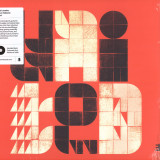
Two musical giants, guitarist Lionel Loueke and bassist Dave Holland, unite their individual talents into one harmonious recording,igniting creativity, honouring cultural roots, and showcasing music's powerful role in fostering unity amidst societal division.
United is an inspiring testament to the power of collaboration, blending Loueke's masterful guitar work with Holland's deep,resonant bass. Both musicians have profoundly impacted the global jazz scene—Loueke, known for his innovative fusion of WestAfrican traditions with modern jazz, has played with a who’s who of virtuosic and celebrated artists, most notably serving asHerbie Hancock’s guitarist for over 15 years, and collaborating with legends like Wayne Shorter, Sting, Terence Blanchard, MarcusMiller, and Esperanza Spalding. Holland, one of the most influential bassists and composers in jazz, has shaped contemporaryjazz since the late 1960s, performing with icons like Miles Davis, Chick Corea, John McLaughlin, Pat Metheny, Sam Rivers, andJack DeJohnette. Though Loueke and Holland have worked together many times in various groups, this album marks their firstcollaboration as a duo. The result is nothing short of extraordinary.
The Man With The Horn is the 1981 album by Miles Davis, which he recorded after persuasion by his nephew Vince Wilburn, a drummer in a Chicago group that played music that combined funk, soul, and fusion jazz. Miles also met the saxophonist Bill Evans, the bass guitarist Marcus Miller and called the drummer Al Foster. The studio result was a hybrid record, divided between the Chicago group’s pieces that he himself referred to as “bubble gum music” and a very free jazz-rock. However, it's less somber and dense than the damp jungles he wandered through without direction during the 1970s. The hit “The Man With The Horn” and its sugary-sweet refrain received a lot of airplay on FM stations. Jazz lovers, rejoicing in Miles’ return, delighted in the rest of the repertory. But it was Mike Stern’s incandescent solo on “Fat Time” that everyone relished. The Man With The Horn is available as limited edition of 1500 individually numbered copies on gold and black marbled vinyl.
Star People is a 1983 album by the famous jazz trumpeter and composer Miles Davis. It is the first to feature electric guitarist John Scofield, who was recommended by saxophonist Bill Evans, and the last to be produced by long-standing collaborator Teo Macero. Bassist Marcus Miller plays on five of the tracks. Electric guitarist Mike Stern features on most of the pieces, and drummer Al Foster and percussionist Mino Cinelu round out the rhythm section. Davis played trumpet and Oberheim synthesizer simultaneously (without using overdubs), and on separately recorded interludes for the over-18-minute-long blues composition ""Star People"". Star People is available as limited edition of 1500 individually numbered copies on orange and white marbled vinyl.
*REMASTERED ROUGH TRADE 4 TRACK E.P LIMITED TO JUST 500 COPIES*
Everything on “Up Home!” is bigger, richer; the guitars are huge, as though they’re being played through the clouds, massive gusts of blue-green noise that move across the stereo spectrum like weather systems. “Baby Milk Snatcher” is built around face-flattening dub bass, with glinting piano and shards of guitar ricocheting through the song. “W.O.G.S.” is delirious to the point of expiration; “One Way Mirror” is their attempt at weird, lopsided ‘anti-funk’, the song’s melody crushed by avalanches of six-string interference. And the closing “Up” is AR Kane’s masterpiece, a disembodied thud pulsing at its heart as a six-note guitar melody spirals ever onward, Ayuli’s voice lost in its own reverie, hymning escapism via references to Jamaican political activist Marcus Garvey’s ‘black star line’.
• Jon Dale, lead review in Uncut Magazine
who grew up together in Stratford, East London. From the off the pair were outsiders in the culturally mixed (cockney/Irish/West Indian/Asian) milieu of the East End, with Alex and Rudy’s folks first generation immigrants from Nigeria and Malawi, respectively. The two of them quickly developed and fostered an innate and near-telepathic mutual understanding forged in musical, literary and
artistic exploration. Like a lot of second-generation immigrants, they were ferocious autodidacts in all kinds of areas, especially around music and literature. Diving deep into the music of afro-futurist luminaries such as Sun Ra, Miles Davis, Lee Perry and Hendrix, as well as devouring the explorations of lysergic noise and feedback from contemporaries like Sonic Youth and Butthole Surfers, they also thoroughly immersed themselves in the alternate literary realities of sci-fi and ancient history (the fascination with the arcane that gave the band their name), all to feed their voracious cultural thirsts and intellectual curiosity.
It was seeing the Cocteau Twins performing on Channel 4 show the Tube that spurred A.R. Kane into being - “They had no drummer. They used tapes and technology and Liz Fraser looked completely otherworldly with those big eyes. And the noise coming out of Robin’s guitar! That was the ‘Fuck! We could do that!
The duo debuted with the astonishing ‘When You’re Sad’ single for One Little Indian in
1986. Immediately dubbed a ‘black Jesus & Mary Chain’ by a press unsure of WHERE to put a black band clearly immersed in feedback and noise, what was immediately apparent for listeners was just how much more was going on here – a tapping of dub’s stealth and guile, a resonant umbilicus back to fusion and jazz, the music less a conjuration of past highs than a re-summoning of lost spirits.
The run of singles and EPs that followed picked up increasingly rapt reviews in the press, but it was the ‘Up Home EP’ released in 1988 on their new home, Rough Trade that really suggested something immense was about to break. SimonReynolds noted the EP was: Their most concentrated slab of iridescent awesomeness and a true pinnacle of an era that abounded with astounding
landmarks of guitar-reinvention, A.R. Kane at their most elixir-like.
If anything, the remastered ‘Up Home’ is even more dazzling, even more startling than it was when it first emerged, and listening now you again wonder not just about how many bands christened ‘shoegaze’ tried to emulate it, but how all of them fell so far short of its lambent, pellucid wonder. This
remains intrinsically experimental music but with none of the frowning orthodoxy those words imply. A.R. Kane, thanks to that second generation auto-didacticism were always supremely aware about the interstices of music and magic, but at the same time gloriously free in the way they explored that connection within their own sound, fascinated always with the creation of ‘perfect mistakes’ and the possibilities inherent in informed play.
pas en stock
Dernière livraison il y a 2 ans réapprovisionnement sans garantie
Now available at a new lower price. Pressed On Opaque Yellow Vinyl With Japanese Stylized Insert And Deluxe Obi Strip. Remastered From The Original Analog Tapes. The first live Miles Davis electric band release since 1977’s very dark and heavy Dark Magus. The album features live performances from shows at Boston’s Kix Club. The double vinyl release contains reimagined versions of songs from The Man With the Horn (1981), tunes from the pre-electric Gil Evans collaboration Porgy and Bess (1959), and a dedication to the Boston venue called Kix. While this was one of the first live Miles Davis performances in over half a decade it certainly did not show!!! This album features R&B legend Marcus Miller on bass, Mike Stern on guitar, Bill Evans on saxophone, Mino Cinelu on percussion, and electric band alumni Al Foster on drums. Produced and edited by long time Miles collaborator Teo Macero
PRESSED ON OPAQUE YELLOW VINYL WITH JAPANESE STYLIZED INSERT AND DELUXE OBI STRIP
Remastered From The Original Analog Tapes
The first live Miles Davis electric band release since 1977’s very dark and heavy Dark Magus. The album features live performances from shows at Boston’s Kix Club. The double vinyl release contains reimagined versions of songs from The Man With the Horn (1981), tunes from the pre-electric Gil Evans collaboration Porgy and Bess (1959), and a dedication to the Boston venue called Kix. While this was one of the first live Miles Davis performances in over half a decade it certainly did not show!!! This album features R&B legend Marcus Miller on bass, Mike Stern on guitar, Bill Evans on saxophone, Mino Cinelu on percussion, and electric band alumni Al Foster on drums. Produced and edited by long time Miles collaborator Teo Macero.