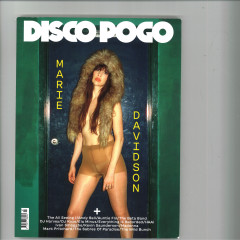
Our Spring/Summer ‘25 issue features a deep dive on Madonna’s New York nightclub roots and her links with the dancefloor ever since plus a rare interview and photo shoot in LA with DJ Harvey and our third cover is the super cool Marie Davidson.
Plus we have features on Auntie Flo, Pan Amsterdam, Ela Minus, Tryouts, Mark Pritchard & Thom Yorke, DJ Koze, Andy Bell, Everything Is Recorded, The Sabres of Paradise, The Wild Bunch, Kevin Saunderson, HAAi and lots more.
184 pages of quality music journalism by the world’s best music writers plus beautiful photography and design in a glossy print magazine.
Issue 6 is completely sold out and we expect this issue to do the same so please order asap to secure copies.
Поиск:marie j
Все
Reissue of the 3rd album of Patrick Jean-Marie recorded in 1985, Produced by Mambo Chick for Symbole Records.
Introducing “Women” by Kat-Tet, a unique musical gem straight from Guadeloupe, 1985. This rare album, the only studio-recorded masterpiece by the brilliant pianist Patrick Jean-Marie, transports us to a soundscape where every note is a journey.
It was a true opportunity for Patrick Jean-Marie and his band to showcase their talents, recorded under professional conditions, resulting in a sound of exceptional quality. The meticulous attention to orchestration is evident throughout, revealing a solidly crafted masterpiece.
Following the bold experiments with Atika and a solo album in 1983, “Women” marks a new chapter in Patrick Jean-Marie’s career. The album showcases a more structured approach that allows Kat-Tet to create a magical space for organized solos and climax. The dialogue between Patrick Jean-Marie’s piano and Luther François’s alto saxophone is constantly surprising and some powerful bridges by Patrick Jean-Marie are unforgettable.
A true classic in its genre, “Women” by Kat-Tet LP was an “hard-to-find” treasure in the vinyl world.
Today, Symbole is thrilled to bring this exceptional album back into the spotlight, sharing the beautiful and timeless music from Guadeloupe, 1985, with a high taste of Jazz !
- A1: Dick Dale & The Del-Tones - Misirlou
- A2: Isaac Hayes - Main Title Truck Turner
- A3: Johnny Cash - So Doggone Lonesome
- A4: Annibale E I Cantori Moderni - Trinity (Titoli)
- A5: The 5 6.7.8'S - Woo Hoo
- A6: Link Wray & His Ray Men - Rumble
- B1: Joe | Tex - I Gotcha
- B2: The Tornadoes - Bustin' Surfboards
- B3: Keith Mansfield - Funky Fanfare
- B4: Dee Clark - Hey Little Girl
- B5: The Robins - Since I First Met You
- B6: Charlie Feathers - Can't Hardly Stand Itdisc
- C1: Jim Croce - I Got A Name
- C2: Christophe - Sunny Road To Salina
- C3: Ricky Nelson - Lonesome Town
- C4: Nick Perito - The Green Leaves Of Summer
- C5: Joe Tex - The Love You Save (May Be Your Own)
- D1: Elvin Bishop - She Puts Me In The Mood
- D2: Johnny Cash - I Walk The Line
- D3: Al Green - Let's Stay Together
- D4: David Hess - Now You're All Alone
- D5: The 5 6.7.8'S - I'm Bluedisc
- E1: Buffy Sainte-Marie - The Circle Game
- E2: The Coasters - Down In Mexico
- E3: The Hurricanes - Out Of Limits
- E4: Vince Tempera - Sette Note In Nero
- E5: Lilian Harvey & Willy Fritsch - Ich Wollt' Ich Wär' Ein
- D1: Johnny Cash - Born To Lose
- D2: Frank Mills - Music Box Dancer
- D3: The Village Callers - Hector
- D4: The 5 6.7.8'S - I Walk Like Jayne Mansfield
- D5: Isaac Hayes - Title Theme From Three Tough Guys
- D6: Zarah Leander - Davon Geht Die Welt Nicht Unter
THE VINYLBOX COLLECTION IS BACK REDISCOVER ALL THE BEST SONGS FROM THE CULT MOVIES OF QUENTIN TARENTINO. STARRING : JOETEX, ISAAC HAYES, DICK DALE, ELVIN BISHOP, JOHNNY CASH, AL GREEN, RICKY NELSON, LINK WRAY, ...
2025 Repress
Wide Yonder’ is a truly remarkable album, offering as much depth and soul as it’s predecessor, yet sounding ultimately fresh and different. Above all, the ten tracks show an artist that’s willing to take risks, find in- spiration in new places and move beyond the sound of his previous album. Trentemøller: ‘Of course I didn’t want to make the same record twice. So the album is for me a logic development from ’The Last Resort’’. Instead he just started to collect new ideas, without thinking too much about the direction the music would take him: ‘The only thing I knew was that I’d want the music to sound more organic and analog.’ Compared to the intimate electronic mood pieces of ‘The Last Resort’, the ten tracks on the new album indeed have a more strange, mystic and dramatic vibe, with a lot of dynamics, distorted, driving twang- guitars, real and electronic drums mixed with haunting synths. With ‚Into The Great Wide Yonder‘ Trentemøller is not only exploring new moody and atmospheric universes, but combines his sense for glorious soundscapes with a firm melodic and tonal touch. The original chord progressions and feel for melodies is fundamental to him, and that‘s also the reason why most of the instruments are played by Trentemøller himself on this album. ‚I like the possibility to be surprised that chords and melodies change into something new. The music that I like most lets the themes and sounds come back in different disguises‘. The Danish multi instrumentalist and producer shows an unexpected talent for finding vocalists that fit the mood of his songs. The first single of the album, the beautifully tender ‘Sycamore Feeling’, featuring Marie Fisker, is a typical highlight. In fact, all the vocal tracks are stunning. Trentemøller chose to collaborate with the English artist Fyfe Dangerfield from UK based Guillemots and Danish singers Solveig Sandnes and Josephine Philip from the debuting Danish indie girlduo Darkness Falls. They all manage to add their own sound and flavour to the album, while their voices blend perfectly with Trentemøller’s atmospheric songs. This is an album that keeps growing for a long time, as every track works its way stealthily under your skin. The sound of ‘Into The Great Wide Yonder’ might be one step ahead of his previous work, but we still easily recognize the hand of Trentemøller, in this inspired collection of songs and atmospheres. The sonic richness, sharp contrasts and daring musical colours are vintage Trentemøller. Into The Great Wide Yonder’ might demand more from the listener than ‘The Last Resort’, as it ended up being quite a dramatic album. This album is more noisy, there’s more happening.‘ But getting to know the tracks definitely is a rewarding experience, as the album will keep growing and growing for a long time to come and its safe to say that Anders Trentemøller has managed to create
- A1: Megan Leber - Tides
- A2: Mattheis - Swell (Pye Corner Audio Remix)
- A3: Marie K - Silver Lining
- B1: Mattias El Mansouri - Transcendence
- B2: Cooper Saver - Cloudburst
- C1: Kems Kriol - Blimund
- C2: Martinou - Glider
- D1: Human Space Machine - Second
- D2: Koraal - This One
- E1: Eversines - Rhapsodia
- E2: Erik Luebs - Toward Entropy
- F1: Mathilde Nobel - May + Be (Oceanic Remix)
- F2: Mary Lake - Evergloom
- F3: Gotu Jim - De Last
Limited Edition[31,89 €]
Nous'klaer Audio proudly presents Paerels III (aka Pearls 3), the third and final edition of its beloved 3x12" compilation series. This release brings together a refreshing splash of sounds, unbound by genre, blending deep-listening pieces with driving techno, rave-tinged house, and a few playful surprises. Contributions come from both familiar faces and new voices on the label, with some tracks pulled from the archives and others fresh out of the studio - curated by label-head Oberman. Featuring artists like Megan Leber, Mattheis with a remix from Pye Corner Audio, Marie K, Mattias El Mansouri, Cooper Saver, Kems Kriol, Martinou, Human Space Machine, Koraal, Eversines, Erik Luebs, Mathilde Nobel with an Oceanic remix, Mary Lake, and lastly Gotu Jim.
- A1: Bleu Nuit - Spanish Harlem
- A2: Sepia - Stress
- A3: Bleu Nuit - En Bas De Chez Toi (Live)
- A4: Les Espions - Casse-Tête Jungle
- A5: Avel Nevez - Naufrage (Partie 1)
- B1: Claude Robert Hit Orchestra - Dance The Disco Sound
- B2: Marie-Ange Cousin - Molle Ouate
- B3: Quai 21 - Music Man
- B4: Maderson - Tourne La Page
This compilation features tracks released between 1978 and 1988 in Western France.
Through this compilation, we strove to highlight a little-known regional scene, characteristic of the diverse and sometimes opposing music movements of the 80s. Through this musical journey across the Brittany, Normandy, and Pays-de-la-Loire regions, we sought to showcase a resolutely indie aesthetic, sometimes conceived in some of France’s most unusual studios, such as a bunker and a caravan.
We’ve found it difficult to make attribute an established, well-defined genre to some of the tracks featured on this compilation. They draw, each in their own way, from the rock scene that dominated the 80s in France, from countercultures, from American stars who shone on the country’s radio stations and in its record stores, and even from local folk music.
While one could hear an harmony across the tracks featured on Le Grand Ouest, channeling this manifold energy onto a record required extensive research through the Brittany, Normandy, and Pays de la Loire regions’ discographies. Over the three years since the release of Le Grand Sud-Est, we have meticulously researched the references of artists, musicians, studios, labels, and publishers from each region. We sought to trace each artist to identify and listen to all their works from that period, and, when possible, collect unreleased recordings, left as demo cassettes on the artists' dusty shelves.
The synthesis of this research, presented here under the title Le Grand Ouest, hopes to remind us of the timelessness of the indie scene in our country, through the lens of the 80s Western France’s scene. Whereas Le Grand Sud-Est exhibited the funkiest sides of the Provençale and Rhône-Alpes scene, Le Grand Ouest leans towards a more mellow, introverted music, an expression of groups of friends united by the joy of playing together.
The first 500 copies of the record come with an extensive booklet with unpublished photos, press clippings, and texts for each track.
Since its founding back in 2014, Blume has carved a unique place in cultural landscape, issuing free-standing works, spanning the historical and contemporary, that represent singular gestures of creativity within the field of experimental sound. Joining their broad efforts in building networks of context and understanding that already includes the works by Werner Durand, Sarah Hennies, Bruce Nauman, John Butcher, Jocy de Oliveira, Mary Jane Leach, Valentina Magaletti, Alvin Curran, Julius Eastman, Alvin Lucier, and others, Blume return with the first ever vinyl release to attend to James Tenney’s legendary “Postal Pieces”, Marking the first ever appearance of five of the suite’s works - “Maximusic, for Max Neuhaus” (1965), “Having Never Written a Note for Percussion, for John Bergamo” (1971), “FFor Percussion Perhaps, or... Night, for Harold Budd” (1971), “Cellogram, for Joel Krosnick” (1971), and “Beast, for Buell Neidlinger” (1971) - on vinyl, drawing upon recordings made in 2003, by the Amsterdam based ensemble, The Barton Workshop, under the direction of James Fulkerson. Among the most important and highly regarded efforts in Tenney’s canon of compositions, as well as within the history of 20th Century music, these five pieces represent a crucial bridge between Fluxus-oriented conceptualism, minimalism, and the microtonal complexities that would emerge in their wakes. Issued in a highly limited vinyl edition of 300 copies, it includes exact replicas of the original postcard graphic scores, and features newly commissioned liner notes by Bradford Bailey, Blume’s brand new edition takes great steps to centring Tenney at the eye the storm during some of experimental music’s most important years.
A student of composition under Carl Ruggles, John Cage, Harry Partch, and Edgard Varèse - remaining close to all of them, and later performing in both Cage and Partch’s ensembles - as well as acoustics, information theory, and tape music composition under Lejaren Hiller, James Tenney carved a wide path within the contexts of experimental and avant-garde music during the second half of the 20th Century. Not only was he a tangible bridge between the generations of composer’s who laid much of the groundwork and the later movements of Fluxus, Minimalism, and the broader practices of experimental music, but Tenney is credited as having contributed one of the earliest applications of gestalt theory and cognitive science to music in 1961, before helping to pioneer the field of computer music at Bell Labs, during the following years.
Over the course of his career, Tenney produced music of such complexity and sophistication - paying little mind to the seductions of taste or dominant tropes of its own moment - that his work and legacy have largely remained under-recognised by the broader publics that have attended to most of his peers. Perhaps more pertinently, the body of work he produced can be perceived as too varied and complex to fit neatly within standard creative histories or critical frameworks, comprising harmonically complex works for acoustic instrumentation, musique concrète, the groundbreaking 1961 “plunderphonic” composition, “Collage No.1 (Blue Suede) (for tape)” - sampling and manipulating a recording of Elvis Presley - as well as algorithmic and computer synthesized music. Even here, within this single decade, a clear image of Tenney’s endeavours remains elusive. In addition to penning important theoretical texts, he collaborated and / or played with Max Neuhaus, La Monte Young, Steve Reich, Philip Glass, Michael Snow, Terry Riley, and numerous others; was an active member of Fluxus; starred in and composed music for Stan Brackage’s films; regularly worked with the Judson Dance Theater; co-founded and played in the ensemble, Tone Roads, with Malcolm Goldstein and Philip Corner; was a vocal advocate of the works of Conlon Nancarrow and Charles Ives, playing a significant part in the revival of both of their legacies; and regularly collaborated as a composer, musician, and actor with his then-partner, the artist Carolee Schneemann, notably co-starring in her film, “Fuses” (1965) and her legendary 1964 performance, “Meat Joy”, as well as creating sound collages for her films “Viet Flakes” (1965) and “Snows” (1970). Curiously, for a relatively absent figure in the historical and critical narratives, Tenney seems to have been the thread that bound multiple generations and disciplines of avant-garde practice in New York during this period.
Tenney was deeply invested in the quality and perception of sound. By 1970, this led him back to composing exclusively for acoustic instrumentation (though sometimes processed with tape delay) - in most cases utilising non-well tempered tuning systems to explore harmonic perception - a practice that he would remain steadfast to for the remainder of his life. This development roughly corresponded with his relocation to California, at the outset of the 1970s, following an invitation to teach at the newly founded music department at California Institute of the Arts (CalArts) in Valencia. Finding himself in regular contact with the harpist Susan Allen and the artist Allison Knowles, as well as at a great distance from many of his friends, in 1971 he completed (with the assistance of Knowles and Marie McRoy) “The Postal Pieces”, a project he had begun in 1965.
A suite of eleven compositions, “The Postal Pieces”, stands among Tenney’s well known and celebrated compositions, and illuminates the dualities embraced by the composer, notably his use of sound to develop consciousness in and of others, and his willingness to draw on elements and observations of everyday life; citing his strong dislike of writing letters as being the primary inspiration for their inception. In lieu, he conceived to send his friends - John Bergamo, Allison Knowles, Pauline Oliveros, La Monte Young, Harold Budd, Philip Corner, Joel Krosnick, Buell Neidlinger, Susan Allen, Max Neuhaus, and Malcolm Goldstein - short scores on the back of postcards. The suite is composed around three themes: Tenney’s concept of swell form (utilizing repetition and progressing through a structurally symmetrical arch), intonation, and the desire to produce “meditative perceptual states”.
A hugely important addition to Blume’s ever expanding efforts in context building and networks of creative practice, James Tenney’s “Post Pieces” is issued in a highly limited vinyl edition of 300 copies, which includes a exact replicas of the original postcard graphic scores, and features newly commissioned liner notes by Bradford Bailey.
- A1: Blue Beach - Welcome To Your Beach
- A2: Never Find A Girl (To Love Me Like You Do)
- A3: By The Pool
- A4: Roll Over, Beethoven - Out Of The Beach
- A5: In The Shade
- A6: Looking Across The Street
- A7: Long Distance Look
- B1: Hot Afternoon
- B2: Crying In The Sun
- B3: The Next Time
- B4: Miss B B. Walks Away
- B5: Sleep Walk
- B6: Standing There
For the first time since its inception 36 years ago, Steve Hiett’s elusive Down On The Road By The Beach is finally made available outside of Japan. Most recognized in the fashion sphere as an English photographer and graphic designer, Hiett‘s transportive audio portraits amplify his serpentine guitar to the infinite blue, recorded across Paris, Tokyo and New York with no coastline in sight. Now widely celebrated as a desert island disc, very little is actually known of its unfathomable genesis.
A career devotee of Brian Wilson’s ground breaking harmonies, Hiett shot The Beach Boys for Rolling Stone - as well as The Doors, Miles Davis and Jimi Hendrix (in one of his final performances at the 1970 Isle Of Wight Festival) - while establishing himself as a fashion photographer. Decamping to Paris in 1972, he began what would become 20-year collaborations with Vogue Paris and Marie Claire, printing his signature warm, saturated and vibrantly hued snapshots.
In 1982, representatives from Tokyo’s Galerie Watari visited him to propose a solo exhibition. Asking if he could insert a 7” of original music into the back of the exhibition catalogue, Hiett laid down ‘Blue Beach - Welcome To Your Beach’ in a Parisian radio station, playing all of the instruments himself, and two more cuts in New York with Yoko Ono, The Doobie Brothers and Steely Dan hired-gun Elliot Randall. Once dispatched, the phone began ringing off the hook with requests for him to fly to Tokyo. Assuming these long-distance callers were wanting him to check proofs for the book, it wasn’t until he arrived that he discovered CBS/Sony had facilitated an entire album. Heitt hastily gripped some petty cash, bought a guitar and retreated to his hotel room to start writing.
Entering the studio the following day, he was further surprised by a waiting room of session players known as Moonriders - one of Japan’s most acclaimed rock bands of the 1980s. Intimidated by their indecipherable sheet music, Hiett suggested Randall join them and with money being no object for major labels at the time, his wingman was on the next plane out of New York to finalise the high production indulgence. Near-ambient arrangements that float in a space between The Durutti Column, Steve Cropper and Ashra, Down On The Road By The Beach also crowns Hiett the master of recontextualization with his zero-gravity blues visions of Roll Over Beethoven, Santo & Johnny’s Sleep Walk and the 1967 Eddie Floyd soul hit Never Found A Girl.
Produced in coordination between Be With, Efficient Space and the artist, this definitive reissue is restored from original masters with vivid reproductions of the Down On The Road By The Beach exhibition catalogue, intended to accompany its original release, and extensive liner notes penned by fellow Steve Hiett obsessive Mikey IQ Jones.
After the standout success of last year’s maiden edition, Drumcode returns with volume two of its acclaimed Elevate compilation featuring no less than seven label debutants. The compilation’s manifesto is simple. Platform a broader range of emerging artists on Drumcode and help elevate the next generation to make strides in their careers. At the same time, the project gives fans a taste of the future and a sneak peak of some of the names you can expect to see featuring on the label and at showcases over the coming year and beyond.
Ozone were a group on Motown between 1980 and 1983. They were put together by Charles Alexander Glenn from Nashville where he had a band The Endeavors. He then brough his best musicians to Los Angeles where Billy Preston recommended to Motown they become the touring band for Teena Marie. They also played for Luther Vandross and then recorded five albums for Motown. “(Our Hearts) Will Always Shine, also credited as “Our Hearts (Will Always Shine)” on Motown has become a timeless and in demand modern soul record, copies of the 7” original now commanding in excess of £300. It has a Gene Page (of Barry White fame) string arrangement and is produced by the group with Michael Stokes (Creative Source, Enchantment, Magic Lady, LTD, Active Force etc)
The A side 'Lip Locked' is an animated collaboration between Parris and Untold, is certified fast house compatible and comes stripped back to the classic raw elements of synth stab, vocal, sub bass and kick drum.
Early support by Ben UFO and Marie Montexier.
'Just Look at the Rain' sees a rare solo outing for Untold spinning crunchy breakbeats and guitar stabs into something both old school and new.
ORO was set up in 2014 as a sub-label of Hemlock for the more 'out there' material and has released music from Brian Routh (R.I.P), Untold, IVVVO and Lord Skywave.
Parris runs the label Can You Feel The Sun with Call Super and has just wrapped up a busy summer with performances at Love International, Houghton and Glastonbury festivals, as well as touring the US and Columbia.
In 2023 Untold founded and began running the modular synth brand Laine.
The wax is hot. The tunes are massive. Oath’s sub-label, Last Year at Marienbad, dispenses a foursome of punchy house tracks for its fifth release, lovingly crafted by some of the genre’s finest producers.
‘The Way We Flow’ by Sam Paradise pairs detuned, lo-fi samples with thumping kicks, and muffled drums. Just when those innocent lo-fi elements simmer, the drums slam back into your periphery harder than ever, making for an absolute dancefloor smasher.
‘De Nuit (3 A.M)’ by Nu-Cleo descends deeper. Swinging drums and chocolatey, indulgent keys lay the basis for a hypnotic acid bassline. Real tension builder.
Flipping over to the B-Side – careful, it’s hot – is ‘She Wrote’ by Gloved Hands. Seemingly just a ride through a well-made bouncing synth and house groove combo at first, this track soon shows off Gloved Hands’ knack for leftfield flavours. There’s an unexpected trap-esque vocal that gets re-contextualised for the club alongside piercing synths and a bulging broken beat.
‘Hard Deep’ by Rick Wade is an obvious one. The stalwart of the house scene serves up another of his zesty, masterful grooves. Shimmering, effortless keys steer a tight drum groove while a subtle bassline nestles between the kick’s low end.
Four cuts from four house experts. Is there much more a dancefloor could ask for?
Drumcode is set to release ‘Elevate’ a 10-track compilation showcasing cuts from a fresh array of label family and friends, including BEC, Juliet Fox and rising talent Chelina Manuhutu, Tini Gessler and DJ Dee. The project is also testament to techno’s global appeal with artists coming from Japan, China and Australia, as well as across the UK and Europe.
Always with an eye on the future, ‘Elevate’ sees a total of seven artists make their Drumcode debut split across three vinyl EPs. The third and final part sees Tini Gessler, Marie Vaunt and BEC let loose three future Drumcode classics.
Drumcode is set to release ‘Elevate’ a 10-track compilation showcasing cuts from a fresh array of label family and friends, including BEC, Juliet Fox and rising talent Chelina Manuhutu, Tini Gessler and DJ Dee. The project is also testament to techno’s global appeal with artists coming from Japan, China and Australia, as well as across the UK and Europe.
Always with an eye on the future, ‘Elevate’ sees a total of seven artists make their Drumcode debut split across three vinyl EPs. The third and final part sees Tini Gessler, Marie Vaunt and BEC let loose three future Drumcode classics.
Bingo Club demands no rules for entry. Everyone knows your name. The hours are endless and the dress code remains
unspoken.
Martin Rousselot opened the doors to the Bingo Club at the dawn of the 2020's. Joined by Neysa Barnett, Vassili
Yatchinovsky, Marie-Paule Bargès and Emile Larroche, Bingo Club puts down its signature sound-stamp and juggles with
styles of different kinds; if five songs throb to the clank-clank of New York trains, five more drift lazily like Marseille's sailspotted waves.
Group signifiers and visual tropes are reduced to a molten wash of melodies and images that, whether heard or seen, unite
kindred spirits.
Whether as a duo or as a soloist, in English or in French, a warm mix of soothing voices is blanketed by soft rock
instrumentation. The videos are filmed with an analogue camera across the four corners of the globe.
A first EP, "Separated," released in 2020, sees a collaboration with Al Carson (Weyes Blood, Ariel Pink, Jessica Pratt...). In
2021 the single "Someday," featuring Annie Lime & Jonas San, comes out. In 2022, Bingo Club presents its debut album «
Better Lucky Than Beautiful », produced and mixed in Paris at Studio CBE by David Mestre (Sebastien Tellier, Chassol, ...).
The album is a collection of ten songs, written in different times and places, like a musical travel diary or sound-postcards.
Drumcode is set to release ‘Elevate’ a 10-track compilation showcasing cuts from a fresh array of label family and friends, including BEC, Juliet Fox and rising talent Chelina Manuhutu, Tini Gessler and DJ Dee. The project is also testament to techno’s global appeal with artists coming from Japan, China and Australia, as well as across the UK and Europe.
Always with an eye on the future, ‘Elevate’ sees a total of seven artists make their Drumcode debut split across three vinyl EPs. The third and final part sees Tini Gessler, Marie Vaunt and BEC let loose three future Drumcode classics.
- A1: Green Light Go! (Feat Andy Cooper)
- A2: Mash Up The Sound
- A3: Stanky Funk (Feat Bootie Brown)
- A4: Tear The Place Up (Feat Andy Cooper)
- A5: Hypnotise
- A6: Reconcile (Feat Charles Morgan)
- B1: Never Gonna Let Go
- B2: Interpretación De Mamá
- B3: Vamonos (Feat Andy Cooper & Marietta Smith)
- B4: Sometimes I Wonder
- B5: Push Right Through (Feat Andy Cooper &Amp; Marietta Smith)
- B6: Treat You Right
- B7: Take Another Look At It (Feat Marietta Smith)
"Le Disque De l'Art Gué" highlights in a 10-track compilation the avant-garde and dreamlike work of Fizzè, in between medieval ballad, acoustic industrial and psychedelic world music. It includes original tracks from "Kulu Hatha Mamnua" and "Manoeuvres d'Automne" albums released in 1987 + unreleased materials and remixes by Fizzè.
Compilation, concept and production by Fizzé, Orsett & Fischer
Analog mastering by Tim Stollenwerk
Drawings, obi strip and insert layout by Anne-Marie Gratton
The record cover represents the acrylic painting "Till" by Alex Rabus
Last year the Atlanta artist releaed her debut EP Swan, made with producer Marshall Vore who is known for his work with folk dynamo Phoebe Bridgers. The five song col¬lection found a supportive home with Royal Mountain Re¬cords, and drew remarkable acclaim for a debut EP, earning praise from outlets like NPR, FADER, Nylon, Paste, Under The Radar, Coup De Main and Line of Best Fit among many others.
When I’m Alone is the debut album from Girlpuppy. Across the record, Harvey weaves in several cinematic allusions: a Keanu Reeves look alike pops up in “Teenage Dream,” named for the alternate title of an ‘80s movie he stars in;