Back in the late 80s label owner Olivier Ducret entered 11 Wardour Street in London, home of the mighty Brain Club, a gallery · club · bar owned by Sean McLusky and Mark Wigan, where many (acid) house and techno visionaries played their early live on Thursday night to less than 50 people, that was quite intimate: Orbital, Simon Lovejoy, Mr Monday, If?, Doi-Oing, Nexus 21, Funtopia, Hi-Ryze, Adamski, 808 State, Ultramarine and of course, Mixmaster Morris's Irresistible Force and Irdial's RAMJAC Corporation. The energy and the creativity was incredible, at its peak, everything was fresh, innocent, naïve, new and oh so exciting. Boundaries in genre did not exist, and everyone was welcome aboard, no superstar, no business, just pure great fun. The crowd was eclectic, you could bump into Mark Moore or Neneh Cherry while the oung guns Andrew Weatherall or Steve Bicknell were spinning. This is most possibly where it all started for me & the label and this unique recording captures it all like no other, like a time capsule, impressively, and amazingly, a classic slice of British rave history unearthed via Switzerland. Just close your eyes and go back to the phuture.
Cerca:mark force
- A1: Opening Titles
- A2: The Painting
- A3: High King And Queen Of Narnia
- A4: Reepicheep
- A5: Land Ahoy
- A6: The Lone Island
- A7: Lord Bern
- A8: The Green Mist
- A9: Market Forces
- A10: 1St Sword
- A11: Eustace On Deck
- B1: Duel
- B2: The Magician’s Island
- B3: Lucy And The Invisible
- B4: Coriakin And The Map
- B5: Temptation Of Lucy
- B6: Aslan Appears
- B7: The Golden Cavern
- C1: Temptation Of Edmund
- C2: Dragon’s Treasure
- C3: Dragon Attack
- C4: Under The Stars
- C5: Blue Star
- C6: Aslan’s Table
- D1: Into Battle
- D2: Sweet Water
- D3: Ship To Shore
- D4: Time To Go Home
- C7: Liliandil And Dark Island
- C8: The Calm Before The Storm
The Chronicles of Narnia: The Voyage of the Dawn Treader is a 2010 fantasy-adventure film based on The Voyage of the Dawn Treader (1952), the third novel in C. S. Lewis’ fantasy series The Chronicles of Narnia. It is also the third and final installment in the original Chronicles of Narnia film series. Set three years after the events of Prince Caspian, the film follows the two youngest Pevensie children, Edmund and Lucy, as they return to Narnia to join the new king Caspian in his quest to rescue seven lost lords and to save Narnia from a corrupting evil that resides on a dark island.
Composer David Arnold scored the film, with themes composed by Harry Gregson-Williams (who scored the first two films). It was Arnold’s fourth collaboration with director Michael Apted. He created specific themes for the characters The Dawn Treader and Reepicheep, and used themes from the previous films for the opening and closing scenes as well as recurring characters, to ensure that the film is consistent with the franchise. The score was performed by an 87-piece orchestra and a 40-piece choir, resulting in an epic soundtrack with just the right magical touch to compliment this film.
The Original Soundtrack to The Chronicles of Narnia: The Voyage Of The Dawn Treader is available on black vinyl and includes an insert.
A new hub solely for the Icelandic talent’s unreleased material, BJARKI will also serve as a platform to launch a wealth of forthcoming audiovisual projects in the coming months, with the label logo designed by Paul Nicholson, NUMBER 3, and all artwork designed by Thomas Harrington Rawle - the creative behind the Care More project. Operating and creating its own storyline with every release, intertwining projects between Harrington Rawle and Bjarki across various mediums, the imprint will also drop a series of offshoot white label releases while being reactive and unveiling random drops across its upcoming schedule. Delivering his first solo release since ‘Oli Gumm’ on трип in 2018, late-February marks the first release on the new label as he unveils his four-track ‘I Wanna Go Home’ EP.
“I want to share more of my unreleased works, especially the tracks that I have created specifically for parties in each city I play. People impact my work a lot, and I would like to share this music directly before or after the show. I don’t see any other way than to set up my own channel or label where I can share all these ideas. Next year will be a lot about sharing stuff and being in direct contact with the audience.” - Bjarki
Opening the label with authority, ‘I Wanna Go Home’ welcomes a quartet of cuts showcasing the genre-spanning polymath at his best, delivering a medley of serious yet playful productions which arc back to previous material while also looking ahead to the future. A creative force with an unrelenting swathe of experimental ideas, influences and directions, this new eponymous imprint looks set to home some of Bjarki’s finest and most unpredictable material to date.
On a balmy Brazilian night in February, 1981, a crowd gathered in Rio de Janeiro's Gávea neighbourhood under the iconic dome of the city's Planetário (Planetarium). Alongside musicians like Helio Delmiro and Milton Nascimento (who were in the audience that night), they were there to see the great "Bruxo" (sorcerer) Hermeto Pascoal live in concert, with his new band formation which would become known simply as "O Grupo" (The Group).
Growing up on a farm in Brazil's northeastern state of Alagoas, Hermeto has always been deeply in tune with, and inspired by nature. In his youth he would make his own flutes to play call and response with the birds and frogs. He would build scrap-metal instruments in his blacksmith grandfather's forge, and sit for hours by the lake listening to the sounds of nature. On the Planetário Da Gávea recordings though, Hermeto is cast as the "sorcerer" or the "cosmic emissary" (as the great Brazilian guitarist Guinga once called him), exhibiting an intuitive sense of harmony and melody beyond that of our own world.
"Tudo e Som" (All is Sound). It's a phrase Hermeto regularly returns to, and it points to the fact that not only can music be made from anything, but also alludes to something much more profound. It's an understanding of the universe as being in a state of constant movement, forever vibrating at the quantum level, like the string of a guitar, or a saxophone's reed. "Tudo e Som" is a declaration of the mystical and spiritual power of sound, as a fundamentally vibrational force.
The series of concerts at the Planetário marked the birth of "O Grupo" which would last with the same line-up (apart from Zé Eduardo Nazário) for the next eleven years. Every member of O Grupo was a phenomenal musician in their own right. It was one of saxophonist/flautist Carlos Malta's first gigs with the group, and the concert unusually featured two drummers, Zé Eduardo Nazário and Marcio Bahia. Nazário, from São Paulo, had played with Hermeto during the mid-70s (as well as with Milton Nascimento, Egberto Gismonti and Toninho Horta, to name a few). Bahia though had just joined the group. Acclaimed keyboard player Jovino Santos Neto was on keyboards, piano and organ, and the great Itiberê Zwarg (who remains in Hermeto's band to this day), played bass. Rounding the group off was the percussionist Pernambuco. During this period (up until the early 90s) the group would rehearse for hours on end, virtually seven days a week, with a total dedication to music and Hermeto's musical vision.
Most of the compositions performed that night at the Planetário had never been recorded before, and many are unique to this album, including the wild 'Homônimo Sintróvio', the exaltant 'Samba Do Belaqua', 'Vou Pra Lá e Pra Cá' and 'Bombardino', which features Hermeto's wonderfully absurd call and response mouthpiece soliloquy. Then there's the stunning 7/4 Samba 'Jegue' which builds with inventive dissonance, before releasing yet another celestially colourful, celebratory refrain. The show also features the first recorded performances of 'Era Pra Ser e Não Foi' and 'Ilza na Feijoada' (inspired by Hermetos' wife Ilza's famed black bean and meat stew), which Hermeto later recorded on his 1984 studio album "Lagoa Da Canoa Município De Arapiraca".
Dubbed by Miles Davis as "one of the most important musicians on the planet", a Hermeto Pascoal live show was (and still is) an experience like no other. Across the recording of the Planetário concert, wild improvisation meets groovy, virtuosic vamping on progressive, extended psychedelic jams. The tracks are generally built around a beautiful, transcendent melody; instantly recognisable as being Hermeto's, and for the most part, the musicians then solo over extended two chord vamps. There's a plethora of powerfully delivered rhythms, wild solos and the performances are punctuated by Hermeto's unpredictable, at times comical sonic antics.
Over forty years since this historic happening, Far Out Recordings is overjoyed to release this magical recording of Hermeto Pascoal e Grupo Live at Planetário Da Gávea, on double vinyl LP, CD and digitally for a February 4th 2022 release.
Jimpster’s lockdown LP was made throughout 2020 and finally sees the light of day at the end of February 2022 having been delayed around 6 months due to the ongoing vinyl pressing hold ups. Birdhouse is the revered producers seventh full length LP and can be considered a full circle as he takes a step away from the dance floor to revisit his early inspirations of jazz, 70’s fusion, library music, ambient and sample-based downtempo electronica. With its soulful touches, vocal and live musician features and trademark warm Jimpster production, we also think it could be his most accomplished and accessible yet.
The opening title track sets the tone for what’s to come with rustling percussion, widescreen choral samples, dub FX and drifting pads all coming together to create a sense of optimism. The first of six vocal features comes next. Ascension with UK vocalist Oliver Night (featured on IG Culture’s recent Earthbound LP) is a simple soul jam with live bass from Nick Cohen and Jimpster’s beloved Fender Rhodes joining the lo-fi drum groove.
Next up we’re treated to Voodoo featuring brilliant young NYC MC/poet/producer who first grabbed Jimpster’s attention with his mind-melting track Signs, released in 2020 on Youngbloods. Yoh’s sung (not sung) vocal flow adds a new dimension to the Jimpster sound and is hopefully the first of many more collaborations to come with this perfect pairing. Still Believe takes us on a tripped-out journey into slo-mo, lopsided MPC beats punctuated with otherworldly vocal samples, live bass and Rhodes making for an immersive late night mood.
The first of two tracks on the LP featuring London vocalist and songwriter Cairo drops next entitled Beautiful Day. Another incredibly talented young artist introduced to Jimpster through a mutual friend, Cairo adds a deep and uplifting vibe making for a track you’ll come back to time and time again. A slow-burning nu-soul groove which will draw you in with its warm glow. Lazarusman is a Johannesburg-native poet and vocalist known for his collaborations with Stimming, Joris Voorn and Booka Shade. Here he delivers a poem called Heavy, perfectly punctuating the haunting reverb-drenched horn, Detroit-esque chord stabs and filtered drums.
Future Paradise drops the BPM's further still for a slow-stepping synth ride mixing up rising arpeggios, dubby flugel horn FX and the lushest of strings. It’s been 15 years since Jimpster and Capitol A last joined forces on Left n Right from Jimpster’s Amour LP. Known for his work with Jazzanova, King Britt, Mark De Clive-Lowe and 2008 club anthem Serve It Up on Mantis, the San Francisco native MC delivers his inimitable flow to a blunted jazzy hip hop groove making for one of the LP highlights.
Up next, Rain is an intimate and understated slice of contemporary soul music which pushes another spellbinding Cairo vocal front and centre, underpinned by loose, crunchy beats, dusty keys and moogy flourishes. Picking up the pace, Doors Of Your Heart sees Jimpster get busy chopping up a funk groove whilst Nick Cohen lays down another killer live bass line. Lush keys, modular synths and some crazy FX processing take this into the stratosphere and call to mind some of his earliest productions in the late 90’s on his seminal LP Messages From The Hub.
Winding things down, Jimpster continues to revisit some of the sounds and flavours of his earliest work on Tell You, which goes seriously deep with touches of cinematic big band horns and a looped up vocal sample. Closing out the LP we have the aptly titled Full Circle complete with sublime Metheny/Mays-style pads, muted synth arps and subtle FX to drift away to.
Kapingbdi came together in Liberia, West Africa, during the late 1970’s and had their own unique style. This six to seven-piece band played original compositions in a vibrant mix of African Rhythms, Soul, Spiritual Jazz, Funk and Rock. Led by Kojo Samuels on sax, flute and vocals “Born in The Night” presents the essential tracks from their rare studio LPs produced between 1978-1981. The work has been carefully edited and remastered in 2019 for vinyl LP and a 6-Page Digipack CD, which includes two additional recordings. Kapingbdi toured through Europe and the U.S. and were the only Afro funk band to ever come out of Liberia.
Kapingbdi hail from Liberia, West Africa and have their own imitable style. They effortlessly combine traditional African music in a modern mix of Jazz, Funk, Soul and Rock. The band is a fusion of the old and the new.
The word "Kapingbdi" is taken from the Sierra Leone language Mende and means "born in the night". Kojo Samuels was given the name by his Latin teacher whilst attending high school in Freetown, They often meet and debate at night in the city and soon after Kojo is called Kapingbdi. The name serves as a description of his origin. Born In Lagos, Nigeria in 1943. The son of slave children. His mother from Nigeria and father from Sierra Leone who moved the family to Liberia, during the 1950’s.
Kojo has played music for as long as he can remember. He starts with the harmonica and later becomes a drummer and percussionist in his first band at school. During his art studies 1965-1972, he tours Germany and works as an art teacher in the USA. His band Kapingbdi is reorganized five times and consists of up to seven musicians. In a VW-Bulli he drives the group from concert to concert and if the drummer fails, he jumps in himself. Between 1978 and 1981 three Kapingbdi LPs are produced for the independent label Trikont, recorded in Hamburg and Munich. During this creative period, the band plays at festivals in Africa and Europe. In 1984, the band tours the United States and shortly after, they came to an end.
At their best, Kapingbdi would rouse the audience with original compositions like "Human Rights", justice for all, especially for South Africans, and "You Go Go You Go Come". The officials and employees in the government departments have no time for the common man, for any questions such as job search, scholarship or similar, he receives the answer "go, come back tomorrow" and the same thing the following day. Or "Now Is The Time For Cry For Love." Now it is time to scream for love and finally, time for humanity and justice. Despite immense difficulties, the musicians consciously live and work in Africa and are at home in Liberia.
On April 12, 1980, ordinary soldiers and non-commissioned officers organize a coup against the government. This is an attempt to put an end to a policy of exploitation of the Liberian people. Whilst efforts to eradicate poverty, lawlessness and illiteracy are obvious throughout the country, Liberia is still Americanized to a high degree. This is evident, as the radio programs of that time almost exclusively played American disco music. Under these conditions, the people seek a reconnection to their folk music, and Kapingbdi were aware of this. Kojo tried many times to come together with traditional Liberian musicians. This passion takes him north of the country. Meeting and playing with the old hornblowers and playing music on traditional instruments, such as the elephant tusk.
Kapingbdi make high quality tape copies of their own vinyl LPs and patiently try to displace all unauthorized tapes from the domestic "market". Nevertheless, it is hard to make a living through music in Liberia. Kapingbdi, is now celebrated. The radio plays are in abundance, but royalties are not forthcoming. Their musical link is the feeling of Afrobeat and Highlife, which is found in each of the many Kapingbdi pieces. They embody Jazz, which is understood to be the most refined example of black music outside of Africa. In Liberia, Jazz is virtually impossible to hear. Bright shining names such as John Coltrane, Charlie Parker or Miles Davis were widely unknown. Thus, the Black Jazz, including its Back-To-Africa movement of the 60’s and 70‘s, passes by without leaving a trace in Africa itself.
Kojo's claim at the time, was to make African music with the depth, sensitivity and the freedom of the technical level of Jazz. This makes Kapingbdi the torchbeares. The underpaid prophets in small Liberia. It is the passion with which the founder of the band continues to work on their music for years. Tirelessly, stimulating and encouraging his fellow musicians. This is ultimately responsible for the success of Kapingbdi in Liberia itself. The local audience seems to listen to the band in fascinated astonishment. One wonders about the ability to develop as demonstrated by Kapingbdi on the basis of their music. It is African and unusually jazzy, danceable and better than the American disco music heard on the radio.
Rather than chase the money and the job opportunities in Europe, Kapingbdi are firmly rooted in Africa. The musicians live in Monrovia, the capital of Liberia, at the Kabingbdi workshop, located in the Congotown area on the eastern edge of the sprawling city. Kojo works here as a sculptor, painter, batik artist and musician. The sales revenue that his activities generate, gives him the opportunity to support the development of African Jazz music. The highest percentage of funds are from Germany and Kojo’s work ethic is “to work on your own thing“. The stance taken aims to support the welfare of Liberians and Africans. The other musicians of the group live in a second house that is nearby.
For the sake of consistency, Kapingbdi is a full-time band. However, the revenue, from all of the sources, could not keep them afloat. Equally, as important to the group are Kojos's knowledge of traditional African music and his sculpting skills. His knowledge is shared with others at the afternoon workshops. It is here that they discuss new lyrics, engage in political debate and the self-imposed task of improving conditions in Africa. At times the debate became heated, especially during rehearsals. This was regarded as good and integrative, sowing the seeds of innitiative to keep the band together.
From 1980 to 1985 Kojo also opened and ran the club "Panjebota", located on the grounds of the U.S. Consulate in Monrovia. Almost every evening Kapingbdi perform the song "Wrong Curfew Walk", whose lyrics lament the killing of citizens during the curfew imposed by the Liberian government. When the head of state Samuel Doe hears the song, he behaves agressively and forces Kojo to close the "Panjebota". Kojo had already moved on. Soonafter he meets Fela Kuti at the Africa-Festival and plays concerts in Germany with Cecil Taylor's workshop band.
Kapingbdi is for thinking, dreaming, dancing. What they sing about is what they have experienced. Kojo Samuels is 76 years old today and still follows his vocation as a critical musician, artist and activist.
Ekkehart Fleischhammer / Sonorama 2019 (with the help of original press sheets and the memories of Kojo Samuels)
Cloakroom celebrate their tenth anniversary as a band with their new album, Dissolution Wave. Dissolution Wave is a concept - a space western in which an act of theoretical physics—the dissolution wave—wipes out all of humanity’s existing art and abstract thought. In order to keep the world spinning on its axis, songsmiths must fill the ether with their compositions. Meanwhile, the Spire and Ward of Song act as a filter for human imagination: Only the best material can pass through the filter and keep the world turning. This is the universe that Cloakroom guitarist/vocalist Doyle Martin conceived as a way of processing the last few years. “We lost a couple of close friends over the course of writing this record,” he says. “Dreaming up another world felt easier to digest than the real nitty-gritty we’re immersed in every day.” With lyrics based on an imagined cosmology, Dissolution Wave also marks a grand expansion of Cloakroom’s dreamy space-rock palette. Written from the perspective of the album’s protagonist—an asteroid miner who writes songs by night—”A Force at Play” has an airy, pastoral feel. Meanwhile, the melancholy title track captures the miner’s regret as they lament that they signed up for such a long stint on the job, while closer “Dissembler” describes their anxiety about the revelator who will judge their work. “If you don’t write a good enough song in this universe, you run the risk of being forgotten and lose the opportunity to return as a meaningful form of life,” Martin explains. The stakes have never been higher!
In remembrance of Pete Birch, AKA Woosh, AKA The Peaceful Ones and founder of Spirit Wrestlers. Four ambient pieces, three of which were released as part of Pete's 52 Card Trick series on the Spirit Wrestlers Bandcamp site, plus another piece which was a favourite of Pete's but was never finished in time.
Collected together on vinyl for the first time, all profits from the sale of this record will be donated to the Spirit Wrestlers Foundation. Set up after Pete's passing, the Foundation promotes the belief that ""Music is the Healing Force of the Universe"", that ""Love Is the Most Important Thing"" and helps causes that were close to his heart. Nx
As the world circles the abyss at gathering speed, WIEGEDOOD have returned to provide a perfectly vicious soundtrack. Formed in 2014, the Belgian trio have built an unassailable reputation as purveyors of visceral and bleak black metal in its purest and most destructive form. Since unveiling their debut album “De Doden Hebben Het Goed” in 2015, WIEGEDOOD have blazed an unending trail for musical darkness, bolstering their burgeoning notoriety with some of the most apocalyptic live performances in recent memory, and producing two subsequent albums – “De Doden Hebben Het Goed II” and “III”, released in 2017 and 2018 respectively – which hammered home the band’s unique creative powers. Emerging once more, this time from the involuntary solitude of a plague-bound world, WIEGEDOOD are back with their fourth studio album, “There’s Always Blood At The End Of The Road”. A ferocious tour-de-force, born of frustration and the ever-burning flame of hatred for the modern world, the new record marks a significant departure for this most ruthlessly singular of modern metal bands. “Musically I think we’ve made our most uncomfortable record so far. It’s once again faster than anything we’ve done before, and more unforgiving than the whole trilogy combined”, says vocalist/guitarist Levy Seynaeve. “To me, it feels like a soundtrack, for a movie yet to be made. A movie about the filthiest and most disgusting parts of human nature and society, and about the struggle we lead within, trying to overcome the fact we are all made from that same filth.” “There’s Always Blood At The End Of The Road” is available as: Ltd. CD Edition, 2x 180g LP (with etching on side D) that come in a Wide Spined Sleeve and 2 printed Discobags, Digital Album.
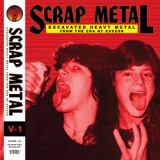
By now you’re probably familiar with our wildly popular Brown Acid series of rare, lost and unreleased proto-metal and stoner rock singles from the 60s-70s. In the endless pursuit of those glorious gems, we often uncover equally brilliant rarities from the late-70s to late-80s Golden Age of Heavy Metal that also just must be heard, but they don’t fit the series’ aesthetic. Scrap Metal, Volume 1 collects some of the greatest unknown and lost Heavy Metal tracks, long buried beneath the avalanche of the era’s classic output.
We all know the old adage that history is told by the winners. But sometimes the losers tell the best stories. And while none of these bands found fame and fortune, this artifact and the volumes to come are testament to the enduring power of heavy music. You can hear the blood, sweat and beers that went into each of these singles. The recordings may be low budget, but the inspiration and talent is immutable. Not only are the amps turned up to 11, the boyish sexual innuendo is cranked to 69. You can hear the convergence of influences — NWOBHM, thrash, glam metal, doom, etc — colliding at once as the era birthed a wellspring of subgenres.
Many of these singles are self-released and were thus limited to a small run of copies. Those that remain are hoarded by collectors and sold for exorbitant amounts. We’ve collected the best of the best for you here. As with Brown Acid, all of these tracks are licensed legitimately and the artists all get paid. Because it’s the right thing to do.
LINER NOTES:
Rapid Tears launch this series with the perfect christening. The Toronto, ON quintet’s 1981 single “Headbang” is such the pinnacle of heavy metal madness that it almost sounds like a spoof. There’s also enough of the rapid-fire sputum that inspired Metallica to bang the head that doesn’t, as such, engage in said practice, to be found on the band’s sole full length Honestly. But “Headbang” is a straightforward glammy anthem for the ages.
Air Raid’s “69 In A 55” may be lyrically so sophomoric that it’s actually pretty clever, but this 1983 Bay Area power metal single is loaded with sleek Judas Priest riffs and interwoven melodies that are downright sublime. The band’s sole release, the 2-song Rock Force 7” features a curious band photo in which 3 band members — dolled up in Crüe makeup and leather — are sexually menacing the lead singer/guitarist tied to a bed. Another low budget highlight is when singer/guitarist Tommy “Thrasher” Merry imitates a delay effect on his vocals as he sings, “tonight!...tonight...night.”
Hades’ “Girls Will Be Girls” has a real demo cassette feel to its vastly uneven mix, but the energy to the performance makes this an undeniable keeper. The long running Paramus, NJ quintet’s 1982 2- song debut 7” titled Deliver Us From Evil features this blistering thrasher dominated by shimmering leads and confident vocals that show why the band went on to near-fame on Metal Blade Records.
Resless don’t need no T to prove that they’ve got “The Power” with this 1984 driving mid-tempo rocker in the vein of Mötley Crüe and Ratt. The River Vale, NJ quartet’s tight crunch wails all over Bon Jovi posers but it’s the band’s unique and subtle deployment of background vocals that gives this rager its staying power.
Pittsburgh, the Steel City, is home to Don Cappa, a band that pays tribute to the burgh, the metal, and the awesomeness of both with “Steel City Metal.” Their lone single, issued in 1987 with only 300 copies released, sounds like the work of some serious steel driving men, with a drummer who might’ve forgotten to wear a hard hat one too many times on the construction site.
The Beast has more of a punk feel to their aggressive “Enemy Ace” track from the 4-song Power Metal EP from 1983 — something like Dr. Know meets D.O.A. But their look, artwork and lyrics all prove that Heavy Metal is where their hearts lie. And this hook filled monster delivers repeated lines like, “I command them all in my lofty realm,” with commendable conviction.
Dead Silence from Denver, Colorado, debuting in 1984 is not to be confused with Dead Silence from Denver, Colorado, who also debuted in 1984. The former a workman’s hard rock bar band, the latter a political peace punk band and neither knowing of the other’s existence throughout their tenure. The pre-internet days were a marvel, indeed.This Dead Silence spits out a slick, Nugent tinged rocker called “Can’t Stop” about life on the road.
The Danger Zone is, by all accounts, not the place to be. And, Hazardous Waste of Boston, MA saw fit to add their two cents on the matter with this 1986 single that combines Van Halen’s flashy musicianship with NWOBHM aggression that sounds so awesome it teeters on itself entering the “Danger Zone.”
Czar’s heavy, doomy “Iron Curtain” single from 1982 hearkens to the sleazy sounds of Saint Vitus and Pentagram with its cranked up DOD Distortion pedal in a Peavey combo amp guitar tone and meaty, barking vocals. The upstate NY quintet only issued this 2-song single, but its driving rhythm, nosedive whammy-bar guitar solos and comparatively mature Cold War subject matter show they had real potential.
Not much is known about Real Steel’s majestic “Viking Queen” from 1987, other than it rocks hard and the 7” 45 sells for upwards of a grand on the collectors market. The Flint, Michigan band recorded at the home studio of local radio personality Bill Lamb, who primarily released Christian Gospel recordings. So, perhaps the band was struck down by a bolt of lightning shortly after this rare single’s release. Whatever the case may be, it’s a must have for fans of classic metal mayhem.
Marooned at home during Melbourne's 2020 lockdown, with no bandmates in sight, Mark Monnone had no option but to take matters to his cassette 8-track and set to work on the follow-up to Monnone Alone (the quartet)'s 2019 powerpop tour de force Summer of the Mosquito. The former-Lucksmiths bassist then gave his home-recorded tapes to Gareth Parton (The Go! Team, Foals, Breeders) to mix the whole glorious mess into something worthy of human consumption. The resulting ten tracks on Stay Foggy bounce blindly from glum to whimsical, from blurred to razor-sharp, showcasing Monnone's disorientated hopes, dreams and lockdown inertia with an off-the-cuff beach party twist.
The forthcoming latest edition of the popular compilation series featuring long-lost vintage 60s-70s proto-metal and stoner rock singles, Brown Acid: The Thirteenth Trip will be available on Halloween 2021. Check out the first single "Run Run", released in 1970 by Montreal hard rockers Max is available to hear & share via Metal Injection HERE. (And, direct YouTube and Bandcamp)
The Brown Acid series is curated by L.A. label RidingEasy Records and retailer/label Permanent Records. Read interviews with the series curators via Paste Magazine HERE and LA Weekly HERE.
About The Thirteenth Trip:
Max, from Montreal, QC — originally known as Dawn, before Tony Orlando & Dawn forced a name change — kick things off with “Run Run” from their lone 1970 single. It’s a hard-hitting rocker with scale climbing crunching guitars and powerful Bonham-esque drumming. Sadly, the band didn’t last long due to poor management and various other factors, so this is the only surviving document according to guitarist Gerry Markman. And what a document it is, paired with the A-side “The Flying Dutchman.”
You might remember Ralph Williams and the Wright Brothers from their track “Never Again” on Brown Acid: The Tenth Trip. Here they make their return to the series with the A-side of their 1972 Hour Glass Records 45, which sounds like Blue Cheer mangling Roy Orbison’s “Pretty Woman” (that’s right, several years before Van Halen actually did so.) Alas, Ralph and these Wright Brothers soon disappeared from terrestrial airspace.
“Feelin’ Dead” is extremely heavy blues from this also extremely rare 1974 single by Detroit, MI’s Master Danse, which was only released as a promo 45. Think Led Zeppelin’s “Since I’ve Been Loving You” and you’re on the right track. A little dose of Hendrix acid blues and a heartfelt groove, and you’ll wonder why this single never even made it to official release. The unavoidable tell in the lyric, “help me get this damn thing out of my arm” hints at the post-Vietnam heroin epidemic as a potential clue why we never heard more from Master Danse.
Folks, Gary Del Vecchio is “Buzzin’” hard on this one, and from what sounds like an in-studio party of yelps and chatter at the start of the song, it seems that the whole band was in on the festivities. The funky blues riff, reminiscent of Led Zeppelin’s “Heartbreaker” and rollicking rhythmic changes certainly keep the buzz a rollin’.The recording is technically credited as Gary Del Vecchio with Max, though not the same band as the one that kicks off this Trip.
John Kitko’s 1973 heavy psychedelic rager “Indecision” is the only recording known to exist by the mysterious artist. The Twin Record Productions release features a different artist, Tom Poff on the B-side, which is truly a shame, considering the smoldering ashes Kitko leaves of the turntable by song’s end. It starts out more like a late 60s Acid Rock jam before leaping into a blazing double-time gallop, whipped into a frenzy by wailing, neck-pickup guitar squeals and Kitko’s barely audible howls.
Tampa, FL’s Bacchus made their Brown Acid debut way back on the very first Trip with “Carry My Load.” This 1972 B-side, “Hope” is a huge sounding swinging rocker replete with roadhouse piano bolstering the chunky riffs and confident vocals. After relocating to Southern California a few years later, the band morphed into Fortress, an 80s melodic metal act whose Hands In The Till album of Pomp Rock on Atlantic Records still draws chatter today.
Orchid’s “Go Big Red” is perhaps the most garage-y sounding offering here, with loose rhythms and straightforward stop-and-start riffing. Nonetheless, the stomping energy and fried-amp guitar tone make this one a charming skull thwack. The band’s 1973 single on American records, backed with a cover of Johnny Russell and Voni Morrison’s “Act Naturally” (popularized by Buck Owens and the Buckaroos) is their only release, so the world never did see this Orchid fully blossom.
By the title alone of Dry Ice’s “Don’t Munkey with the Funky Skunky” you know you’re in for a good time. The 1974 barnstormer seems aimed to the novelty tunes crowd, with its kooky lyrics and silly-voiced spoken catchphrase break, “peeyew, you’ll be sorry if you do.” But, the Ohio band’s maniacal drumming, crunching guitars and, of course, drug euphemistic lyrics make it a shoo-in for the Brown Acid series of erudite rock’n’roll.
Good Humore’s swaggering 1976 rocker “Detroit” is a slick and smooth paen to the Motor City. It most likely doesn’t predate “Detroit Rock City” by Kiss, also released in 1976, and it has more rock’n’roll swing, but it could fit comfortably alongside the era’s arena anthems. Not much else is known about the one-off release on P.V. Records, but songwriter Mike Moats is noted to also have been a recording engineer in later years and this well produced track sounds like a labor of love.
The forthcoming latest edition of the popular compilation series featuring long-lost vintage 60s-70s proto-metal and stoner rock singles, Brown Acid: The Thirteenth Trip will be available on Halloween 2021. Check out the first single "Run Run", released in 1970 by Montreal hard rockers Max is available to hear & share via Metal Injection HERE. (And, direct YouTube and Bandcamp)
The Brown Acid series is curated by L.A. label RidingEasy Records and retailer/label Permanent Records. Read interviews with the series curators via Paste Magazine HERE and LA Weekly HERE.
About The Thirteenth Trip:
Max, from Montreal, QC — originally known as Dawn, before Tony Orlando & Dawn forced a name change — kick things off with “Run Run” from their lone 1970 single. It’s a hard-hitting rocker with scale climbing crunching guitars and powerful Bonham-esque drumming. Sadly, the band didn’t last long due to poor management and various other factors, so this is the only surviving document according to guitarist Gerry Markman. And what a document it is, paired with the A-side “The Flying Dutchman.”
You might remember Ralph Williams and the Wright Brothers from their track “Never Again” on Brown Acid: The Tenth Trip. Here they make their return to the series with the A-side of their 1972 Hour Glass Records 45, which sounds like Blue Cheer mangling Roy Orbison’s “Pretty Woman” (that’s right, several years before Van Halen actually did so.) Alas, Ralph and these Wright Brothers soon disappeared from terrestrial airspace.
“Feelin’ Dead” is extremely heavy blues from this also extremely rare 1974 single by Detroit, MI’s Master Danse, which was only released as a promo 45. Think Led Zeppelin’s “Since I’ve Been Loving You” and you’re on the right track. A little dose of Hendrix acid blues and a heartfelt groove, and you’ll wonder why this single never even made it to official release. The unavoidable tell in the lyric, “help me get this damn thing out of my arm” hints at the post-Vietnam heroin epidemic as a potential clue why we never heard more from Master Danse.
Folks, Gary Del Vecchio is “Buzzin’” hard on this one, and from what sounds like an in-studio party of yelps and chatter at the start of the song, it seems that the whole band was in on the festivities. The funky blues riff, reminiscent of Led Zeppelin’s “Heartbreaker” and rollicking rhythmic changes certainly keep the buzz a rollin’.The recording is technically credited as Gary Del Vecchio with Max, though not the same band as the one that kicks off this Trip.
John Kitko’s 1973 heavy psychedelic rager “Indecision” is the only recording known to exist by the mysterious artist. The Twin Record Productions release features a different artist, Tom Poff on the B-side, which is truly a shame, considering the smoldering ashes Kitko leaves of the turntable by song’s end. It starts out more like a late 60s Acid Rock jam before leaping into a blazing double-time gallop, whipped into a frenzy by wailing, neck-pickup guitar squeals and Kitko’s barely audible howls.
Tampa, FL’s Bacchus made their Brown Acid debut way back on the very first Trip with “Carry My Load.” This 1972 B-side, “Hope” is a huge sounding swinging rocker replete with roadhouse piano bolstering the chunky riffs and confident vocals. After relocating to Southern California a few years later, the band morphed into Fortress, an 80s melodic metal act whose Hands In The Till album of Pomp Rock on Atlantic Records still draws chatter today.
Orchid’s “Go Big Red” is perhaps the most garage-y sounding offering here, with loose rhythms and straightforward stop-and-start riffing. Nonetheless, the stomping energy and fried-amp guitar tone make this one a charming skull thwack. The band’s 1973 single on American records, backed with a cover of Johnny Russell and Voni Morrison’s “Act Naturally” (popularized by Buck Owens and the Buckaroos) is their only release, so the world never did see this Orchid fully blossom.
By the title alone of Dry Ice’s “Don’t Munkey with the Funky Skunky” you know you’re in for a good time. The 1974 barnstormer seems aimed to the novelty tunes crowd, with its kooky lyrics and silly-voiced spoken catchphrase break, “peeyew, you’ll be sorry if you do.” But, the Ohio band’s maniacal drumming, crunching guitars and, of course, drug euphemistic lyrics make it a shoo-in for the Brown Acid series of erudite rock’n’roll.
Good Humore’s swaggering 1976 rocker “Detroit” is a slick and smooth paen to the Motor City. It most likely doesn’t predate “Detroit Rock City” by Kiss, also released in 1976, and it has more rock’n’roll swing, but it could fit comfortably alongside the era’s arena anthems. Not much else is known about the one-off release on P.V. Records, but songwriter Mike Moats is noted to also have been a recording engineer in later years and this well produced track sounds like a labor of love.
What happens when you put four of the most creative musicians from the Norwegian jazz scene in lockdown? They create. In march 2020, when the corona pandemic forced Norway into lockdown, Flukten found their oasis. Flukten springs out of one thing - the will to create music. Flukten consists of musicians from some of the most critically acclaimed jazz groups in Norway: Hanna Paulsberg Concept, Atomic, Moskus, GURLS, Wako, Espen Berg Trio, Hullyboo, Skadedyr and Trondheim Jazz Orchestra.After Flukten's debut concert last year one music critic wrote: "if there is one band debut that really has left their mark in soul and heart, it is this".With a musical reference library filled with the likes of John Scofield, Joe Lovano, Per "Texas" Johansson, Salif Keita and Paul Motian, they take detours through hip hop, soul and folk music from all over the world. Here, all spontaneous whims can be cultivated and explored. Flukten gives you dirty jazz that makes you move, and soft, fine tuned jazz that makes you think. This is music that celebrates life and embraces the unbelievable. In February 2021, the four musicians entered the recording studio with the same open attitude as when they first jammed together. On Flukten`s debut album you hear saxophonist Hanna Paulsberg's eternal vocabulary and multifaceted tone unfold completely without compromises. You hear guitarist Marius Klovning somewhere in the middle of John Scofield, sharp soul, western and Norwegian folk music. Hans Hulbækmo's drumming is tempting to compare with the playing of a solo pianist in his melodic repertoire. Bassist Bárdur Reinert Poulsen drives everything with his punchy, hard swinging hand, but also provides us with emotional solos.Together, Flukten are an explosion of joyful playing from some of Norways most talented musicians. The songs of Flukten's debut album span from playful melodies to dissonant harmonies. Sometimes it's a composition based on a voice memo of someone humming. Other times we hear snapshots from improvisations in the vivid studio atmosphere. The music dances, other times it is like a soft caress. Suddenly they fly into ecstasy. This album is the sonic equivalent to jumping from a hot sauna and into cold water. The music wakes you up. This is music that could only appear this exact moment from these exact musicians. Maybe you spend hours lying on the floor, lost in a book. Maybe you get drunk, or you run into the woods? We all need to escape now and then.
Green Vinyl
Have you ever wondered what would happen if the Spice Girls smoked crack and joined forces with the Power Rangers on acid? Meet BĘÃTFÓØT. These punk-infused electronic poltergeists and big-beat acid trio are Udi Naor, drummer and founding member of electronic duo Red Axes, Adi Bronicki (who also fronts Israeli garage-punk-folk band Deaf Chonky) and ace of all trades guitarist Nimrod Goldfarb.
The band have been launching warped stoner-acid-pop out of Tel Aviv with maniacal intent and are producing post-punk rave bangers that will scorch every dance floor with a huge lethal smile. BĘÃTFÓØT
are a DIY supergroup who describe themselves as sitting somewhere between Aqua, Beastie Boys and The Prodigy.
Their music endeavours feel akin to being hurtled through a kaleidoscopic waterslide, overflowing with the spirit of 90’s youth culture. The radioactive trio are DJ’s, musicians, songwriters and producers with a diverse range of individual projects and talents, their combined sonics map your journey across the hazy astral spectrum of hip-hop, big beat and rave music. Morph these radioactive pieces with the no New Release Informationnonsense attitude of punk-rock and the venomous spitting flow of golden-era rap and you might just come close to fabricating the freakish sound of BĘÃTFÓØT.
The band’s self-titled debut is set for release on 17th September on Manfredi Romano aka DJ Tennis’ Life and Death. Founded in 2010, the imprint curates soulful dance music with a post-rock aesthetic.
This refreshingly original and experimental LP from BĘÃTFÓØT marks a new direction for Life and Death this year and beyond.
“BĘÃTFÓØT” takes unsuspecting listeners on a wild ride of unprecedented musical madness (firmly without seatbelts). Fizzy synthesiser programming stimulates you effervescently through the album like the welcomed sting of sour sweets, surprising accompaniments appear in the form of manipulated vocal lines and quirky samples, all jovially mixed together in a gummy melting pot of wild conceptualisation and starry eyed rhythms.
Thirteen tracks of unprecedented dancefloor mutations send us triumphantly into the candy-covered kingdom of BĘÃTFÓØT with open arms and infinite imagery of fanciful gutter-glam escapades. This project fulfills the role of a musical bulldozer, flattening all previous conceptions of what it means to belong to a genre and leaving behind a hot mess trail of anarchic musical fragments in its wake. The undying spirit of the nineties.
With fans that include legendary Irish born singer, songwriter and producer Roisin Murphy, BĘÃTFÓØT are a breath of fresh air set to be igniting dancefloors this summer.
A new label from Kinfolk records founder - and a 14 of a Soft Rock - Christopher Galloway is upon us.
This first release sees the beautiful sounds of Torn Sail/Huw Costin revamped by the mighty production force that is Mark Rayner and Matt Horobin, aka Shrinkwrap.
Shrinkwrap are a production team that have been in the wilderness for a number of years but are much lauded by The Idjut Boys - amongst others - which has seen them release on Discfunction and U-Star.
Being close friends with Huw Costin, they decided to get together and re-work the track Gain On Gains that featured on Torn Sail's 2017 long player, This Short Sweet Life.
These two re-works see Shrinkwrap take the original into an extended/after-hours bliss out of epic proportions and an ambient dub.
Added to the package is an unreleased on vinyl mix of Costin's Disconnected cut from 2015. This is a more folk-infused affair that once again ventures into epic territory thanks to the production skills of Rayner and Horobin.
A lovely EP to kick off this new label.
Watch this space...
In the beginning, there was chaos_ A while later in the Heavens, where angels reigned, there was once held a great symposium, a glorious feast. Everyone was happy and having a great time, until Lucifer, fairest and mightiest of all the angels, brought in suspicious and strange substances, offering them freely with both hands for everyone to take. All were fooled by the Ancient Serpent, starting to misbehave and act in contradiction to the Heavenly Laws. The Almighty God, enraged upon learning about the mutiny, threw everyone down on earth to suffer eternally in hunger, ugliness and desperation. Vulnerable now to each and every temptation, they are ready to perpetuate Good and Evil, while building their new earthly Kingdom in any way they can. Angelic chants, Demon's screams, witches dancing and woeful mortal suffering are recounted in this album's songs, embellished with mesmerising hymns and sharp riffs. Chaos is always close and all that remains is the human revolution against the forces of evil. "Battlefields of Satan's servants, witch-hunt for our ways, face off reality and eat TV today. Lucifer, Forever Grey". - Bill Politis - "The Unknown Secretary" comes to further unsettle the turbulent waves of music and burn its own mark in history. Today, five years after its original release, Heavy Psych Sounds reissues this retro gem, serving it once again straight into your record case.
Session Victim and Erobique join forces once again for a beautiful cover version of Mark- Almond's "The City", starring Jamie Lloyd's enticing vocals and featuring Linnart Ebel's subtle rhythm guitar. Ever since Hauke Freer stumbled over Mark- Almond's final studio album Other People's Rooms at Montreal record store Death Of Vinyl a few years ago, the pair would regularily finish DJ nights with this 1978 recording of their hit single "The City" - and since then, the idea of recording their own rendition had been tossed around frequently. Carsten "Erobique" Meyer was not the first but really the duo's only choice to see this through and well, just listen to the impeccable Rhodes/Clavinet combination he came up with. However, it is Sydney's Jamie Lloyd who steals the show and takes the song into his realm, putting his very own stamp and character on this certified classic. Long time collaborator Linnart Ebel complete's the band with his ever subtle rhythm guitar. The two, three, four, five man house, not house band branches out for all the right reasons and this is the result.
- 1: Spencer Krug - Red Dress
- 2: The Besnard Lakes - Good Morning, Captain
- 3: They Hate Change - The Seeming And The Meaning
- 4: Angel Olsen - Cold Blooded Old Times
- 5: Bruce Hornsby - Feel The Pain
- 6: Jamila Woods - Fast Car
- 7: Nap Eyes - Car
- 8: S. Carey - Weight Of Water
- 9: Pink Mountaintops - The Concept
- 10: Cut Worms - One For The Catholic Girls
- 11: Okay Kaya - Nightswimming
Midway through his long, earnest and often very, very
funny essay on the role playing game ‘Dungeons &
Dragons’ in the September 2006 issue of The Believer,
writer Paul La Farge proposes that ‘Dungeons & Dragons’
is not a game at all but rather a ritual. La Farge notes the
marked difference between game and ritual. Whereas a
game seeks to demonstrate how unequal or distinct
players / teams are from one another, rituals seek to do
the very opposite.
And so, across the 25-year history of Jagjaguwar - an
independent record label curiously named using a
‘Dungeons & Dragons’ name generator - we find this idea
of ritual as a conjoining practice. We see it early on when
Jagjaguwar join forces with a midwestern label called
Secretly Canadian for a powerful fusion. We see it in
familial relationships and collaboration among Jagjaguwar
artists and the ways those artists’ most treasured
collaborators make their ways to the Jagjaguwar game
board.
‘Join The Ritual’, a piece of Jagjaguwar’s 25th Anniversary
celebrations, looks to pay homage to the labels and artists
that, whether they know it or not, invited Jagjaguwar to the
table, to this wild, dark magic ritual of music. We’re talking
about independent titans like Drag City, Too Pure, K
Records and Touch & Go. We’re talking about heroes like
R.E.M., Slint, Stereolab and Tracy Chapman. These songs
captured the imaginations of founders Darius Van Arman
and Chris Swanson - and ultimately, opened up worlds to
them.