wAFF takes charge of the second release on his new Nature label with four stylish new cuts.
First up is Mesmerized feat. Shyam P, a slinky seven minute deep rolling tune with subtle synth craft and airy hi hats. A vocal adds an extra hypnotic layer and then SummerZ is another seductive sound with warm chords smeared over a killer groove. It's got a summery vibe but will also pump the party. To The Floor then cuts loose on nice boom bap drums, with vocal and chord stabs adding detail and its easy to see this one making its mark in the club. Slut Drop closes out with an infectious and rubbery bassline and rich chord work. It's heartfelt and full of soul.
This is a fresh sound as ever from wAFF.
Buscar:mark i
Iconic female fronted metal band from The Netherlands. Formed in the late 90s by the later Epica founder Mark Jansen. The band split up shortly after their eponymous self-titled album “After Forever” in 2008. Keyboard player Joost Van Den Broek became a famous producer for Epica, Blind Guardian and many more, while singer Floor Jansen joined Nightwish and recently also the German TV show Sing Meinen Song (Sing My Song). Fans never forgot After Forever and even if their last album came out in the pre-streaming days, it gained over 15 million streams.
The re-issue of their swansong “After Forever” (2007) is remastered by Joost Van Den Broeck and includes liner notes by all bandmembers, as well as the two rare Japanese bonus tracks: the beautiful piano ballad "Lonely" and "Sweet Enclosure" which keeps their high standard of progressive symphonic metal with an oriental flavor and catchy melodies.
'É O Que Ela Quer' is a groovy Brazilian version of The Zombies' classic 'She's Not There' recorded by the obscure Mini Trio in 1970 and released as a 7" only that should be in every DJ record box. First time reissue. Although the appeal of the post-Hair/Beatlesque hippie hook of 'Hare Krishna' on the A side of this rare single, the real gold lies on the flipside. 'É O Que Ela Quer' is a groovy Brazilian version of The Zombies' classic 'She's Not There' recorded by the obscure Mini Trio in 1970 and released as a 7" only. The band was most likely a studio group recording international hits for the local Brazilian market and their take on the 1964 classic adds a terrific dancefloor potential to the Zombies song. Very hard to find, especially in good condition, this record now gets a proper reissue for the first time.
Julian Jeweil returns to Drumcode for his first EP in two years with the inspired six-tracker ‘Boreal’ split across two records.
The Frenchman has been a vital member of the extended Drumcode family since 2017 when he debuted with the fantastic ‘Rolling’ EP. Since then, highlights have included playing main stage at Drumcode Festival and dropping the critically acclaimed ‘Transmissions’ album in 2019.
His ‘Boreal’ EP marks his fifth outing on the imprint. Part I kicks off with the title track, a truly special record, striking the sweet spot between euphoria and melancholy, as airy pads and stirring waves of melody stamp it with a timeless feel.
On the flip, ‘Time’ is a propulsive weapon built around a steely industrial backbone and is a necessary tool for every set. ‘Reverse’ closes out part one in style - a low-slung beast that builds up intergalactic energy throughout.
The 5th anniversary of Bravers was marked by a vinyl release and the start of a distinctive label. These European artists have done a lot for the electronic scene and are gathered under the auspices of the Bravers in this debut. They have been welcome guests at their parties and have opened up boundaries to new sounds.
The A1 is the combined work of Kovyzain D and Alexander. In ‘Modularity’ they've united shades of Belgium new-beat and EBM and have added rhythmic and futuristic synths. The result - a perfect closing track for a journey through the industrial and cosmic layers of electronic music.
A2 ‘Proven Witch Psalm’ is done by British sound producer Antoni Maiovvi. The track was written upon his arrival to the US and was designed to be a relentless funk of machine abuse and futurist analog arpeggios.
B side starts with the track ‘Espace’ done by Marselle’s musician Millimetric. He decided to explore the theme of space conquest, the fears and difficulties of interstellar voyages. This is captured through the use of a futuristic mixture of sturdy bassline and electronic anxious sirens.
B2 track ‘Vardi’ by Moscow DJ and Bravers founder Anton Levdikov is a mixture of arpeggiator roaring bass and Industrial stabs. The sound is complemented by a new-beat and Italo’s sound legacy.
Madre Lingua is a collection of songs born via the constant interactions among the Artists that gravitated around Mother Tongue in the first two years since its opening.
On the back of this continuous exchange of musical ideas and vibes MT’s own Patrick Gibin full time coordinator and producer of many of the songs here worked on this project like painting a blank canvas inviting Tiombé Lockhart, Kaidi Tatham, K15, Mark de Clive-Lowe, Tommaso Cappellato, EDB, Gary Superfly and the mysterious 黒舌 (Infectious Madness) to bring their colourful and heartfelt contributions to this unique collection of songs.
To celebrate the 3 years anniversary of Mother Tongue and remind us all the sheer quality of the Madre Lingua album project from last year, MT’s own Patrick Gibin curated this special remix double A-sider!
Patrick himself teamed up once again with Kaidi Tatham to refreak the EDB & Gary Superfly collaboration ‘Pressure’….the result is pure nasty and rude house vibes aimed at the dancefloor!
On the flipside Mark De Clive Lowe gave a spacey and beatless twist to the electronic opus ‘Apollo 3000’ another big favourite from Madre Lingua moving things into more abstract territories!
The best of both worlds on a single phat 12 inch!
Dirty machine gun funk, dripping in fudgy acidic grooves on this twisted heater from native London badass Shy One. Techno collides with Jazz Fusion across three jams recorded straight out the box and cut exclusively onto wax for Eglo Records. This 7" marks the first in a series of releases from the kinetic, undefinable talent.
- A1: Seventh Mirror
- A2: Ionization
- A3: Cloud Chamber
- A4: Harmonic Oscillator
- A5: Transfiguration
- A6: Urzeit
- A7: Cybernetic Dreams
- B1: Interference
- B2: Computer Garden
- B3: Pyramid
- B4: Halide Crystals
- B5: Integratron
- B6: Imaginary Forces
- B7: Phantom Lfo
- B8: Opticks
- C1: Mannequin
- C2: Mind In Light
- C3: Palantir
- C4: Vertigo Of Flaws
- C5: Exit Syndrome
- C6: Stasi
- D1: Atomic Voyage
- D2: Ultraviolet
- D3: Violence Cascades
- D4: Traumsprache
- D5: Zeitgeber
- D6: Prism
- D7: Threnody
- D8: Mind Oscillation
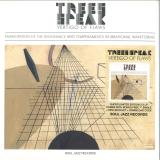
Trees Speak are back!
Speak’s new album, “Vertigo of Flaws: Emancipation of the Dissonance and Temperaments in
Irrational Waveforms” comes as a double-vinyl edition, single CD and digital release. The limitededition first pressing only of the vinyl includes a bonus 45 enclosed in an 8-page 7”x7” booklet
insert housed within the gatefold sleeve with cover artwork created by Soviet Union propaganda
artist Lazar Markovich Lissitzky in 1911.
Trees Speak are back!
This new release is a vast leap into an ocean of space and sound, a quantum leap into cybernetics, biology, anti-gravity,
time travel, dream speech and transfiguration. A seriously next step release!
Showing no signs of slowing down their rapid creative pace – incredibly this is their fourth album in the space of just over
one year – ‘Vertigo of Flaws’ is a mighty 29 tracks, one and a half hours of music across one double album that is surely
going to be a defining point in their musical career, a giant leap into the sonic unknown, an epic exploration of intensity
and sound.
Alongside their now trademark German krautrock motoric-beat rhythms, angular New York post-punk attitude, tripped-out
60s spy soundtrack, psyche-rock, and 70s synthesizers and vocoders, here you will also hear a new cosmic spacial
awareness (both personal inner space and galactic outer space) and a truly wilful pushing of sonic boundaries - as police
sirens, static noise, alarms, radio signals, avant-garde voices, and orchestral string quartets, all collide to add beautiful
dissonance to uber-powerful, intense, addictive and propulsive rhythms - in the process creating a truly unique
soundscape that Trees Speak have made wholly their own.
If you ever wanted to hear Can, Hawkwind, Destroy All Monsters, Pere Ubu, electric eels, John Cage, Liquid Liquid,
Tangerine Dream, Suicide, Neu!, Laurie Spiegel, Art Ensemble of Chicago, John Barry, Mother Mallard’s Portable
Masterpiece Company, Sun Ra, Stockhausen, John Carpenter, Electro-Acoustic and Musique Concrete and Mars in one
band - then this is it!
Trees Speak are Daniel Martin Diaz and Damian Diaz from Tucson, Arizona and their music often draws on the cosmic nighttime magic of Arizona’s natural desert landscapes. ‘Trees Speak’ relates to the idea of future technologies storing
information and data in trees and plants - using them as hard drives - and the idea that Trees communicate collectively.
Special guests from the hyper-creative hub of the Tucson music scene on this release are Gabriel Sullivan, Ben Nisbet, Saul
Millan, Stephani Guilmette, and Davis Jones.
The album Vertigo of Flaws was recorded in Brooklyn, New York, and Tucson, Arizona during the plague of 2021.
Extract from Vertigo of Flaws sleevenotes:
‘As we travel through space and time, avoiding the discarded remains of the industrial period, the
deconstruction of social norms through the expression of art, music, and philosophy guide the human
experience towards the unknown.
All that remains are musical echoes scattered throughout the universe, like ancient vibrations that now
populate the cosmos. These waves now show signs of decay. Melody, beauty, tonality have all but fallen
away as dissonance blossoms. As John Cage wrote in 1937,
“Whereas, in the past, the point of disagreement has been between dissonance and consonance, it will be,
in the immediate future, between noise and so-called musical sounds. New methods will be discovered,
bearing a definite relation to Schoenberg’s twelve-tone system and present methods of writing percussion
music and any other methods which are
free from the concept of a fundamental tone”.
Similarly, George Van Tassel claimed the Integratron as capable of
rejuvenation, anti-gravity, and time travel. So, what remains of the
“people”? We have adopted from them our own Zeitgeber: their pulses
now guide our sun, our planets, our earths, and are the new circadian,
diurnal, and ultradian rhythms of the galaxy. Traumsprache, dream
speech, is now the internal language of trees.
Decaying metal and machines liberated the note unto nature’s table,
and we sip the delicious nectar of music once more irrational, elaborate,
violent, vast. The past is the future, musical disintegration its own rebirth.
We are nature, once more the computer of the Universe.’
Biz Markie was one of the true titans of the early East Coast hip hop scene - a staple of Marley Marl's Cold Chillin' label with a cheeky demeanour which showed even the toughest hip-hop didn't have to be moody. 'Just A Friend' originally dropped in 1989 and became a mainstream hit in the US, breaking Markie to the world and ensuring the success of his second LP, The Biz Never Sleeps. Nearly a year since he passed away, Cleopatra have revisited one of his most enduring classics and given it a fresh airing on this tidy 7". If you don't already have it and you take your old-skool hip-hop seriously, don't sleep on this one.
Fractal head rearrangement from Keith Fullerton Whitman on his first vinyl release in what feels like years, here blessing Japan’s NAKID label with a new instalment in his forever-evolving Generators project, arcing from bleeping post-Kosmische sounds into completely unexpected drum mutations in footwork and grime modes. It’s properly head melting gear that links the algorithmic mind-fukkery of Laurie Spiegel with the floor-bending rhythmic experimentation of Mark Fell, Rian Treanor or Jana Rush, and the first in a three part series that offers some of the strongest gear we’ve heard from one of the very best in the game.
Modular synth scientist, critic and historian Keith Fullerton Whitman first debuted his »Generators« set in 2009, using a modular setup to create non-repeating melodic patterns that basically came close to generating themselves. Over the course of hundreds of live shows (and a handful of releases on Root Strata, Editions Mego and other labels), Whitman glacially honed his process and allowed the concept to slither down different avenues, mutating as it picked energy from the various venues it was situated in. His rigorous method meant ‘Generators’ was never played out the same way twice, veering from psychedelic Kosmische experimentation to obliterated, off-grid Techno.
In 2019, on the tenth anniversary of the project, Whitman was invited by the GRM in Paris to set up in Studio C, where he avoided the arsenal of pristine, museum-worthy modular synthesizers and instead reprogrammed his classic ‘Generators’ patch. Recorded in a single take using luxe analog- to-digital convertors, the result is a 45-minute durational piece, split into two distinct sides for this release.“Very little manual interaction happened,” Whitman explains. The music is, as its title suggests, generative, and at this point basically sounds as if it reached its most advanced, final form. The first few minutes of the opening side mine the original theme, with clocked LFO shapes triggering oscillator blips in mind-expanding non-looping patterns. Soon, percussion enters the matrix, at first wrong-footing us with a 4/4 fake-out - possibly nodding to the piece’s 2010 Root Strata iteration - before splitting into staccato polyrhythmic abstractions of the most loose- limbed and deadly variety.
General MIDI drums can sound almost hilariously boxed-in, but handled by Whitman they show off a plastic cultural sheen to piercing effect, deployed in a way that re-draws the rhythmic bass music of someone like Jlin while nodding to Mark Fell and Rian Treanor’s quasi-generative dance explorations. These comparisons take on even more weight on the second side, where Whitman opens up his filters to allow the synth bleeps to sing even more loudly, introducing that all- important clap/hat interplay that dialogues with Atlanta and Chicago simultaneously.
Featuring Squirrel Flower and Liam O’Neill (SUUNS). Recommended If You Like: Mount Eerie, Low, Richard Swift, the Weather Station, Lomelda, Fleet Foxes, Squirrel Flower, L’Rain. Cedric Noel is a songwriter, bassist, collaborator and producer currently based in Montréal, Québec. The newest longplayer from Tio'tiá:ke/Montreal staple Cedric Noel lands with a stunning sense of surety and self. Hang Time stands as a high water mark for a songwriter who's spent the past decade quietly expanding the borders of his music. Longtime fans will recognize the fluid elements of the album’s open-ended rock formations: reflective strumming, soaring choruses, searing guitar lines, subtle bass grooves; all occasionally dissolving into pools of pure ambience. New listeners will find surprises throughout: threads of folk pop, ambient and sound collage fasten the foundations of this expressive whole. However, what’s most striking on Hang Time is Noel’s newfound sense of voice, both literal and metaphorical. Written primarily in 2017-18 during an intense period of self-reflection, this collection of songs finds Noel wrestling profoundly with his sense of identity, self and place. The album’s material was captured faithfully at The Pines, a beloved downtown Montreal studio whose doors shuttered shortly after amidst the strain of the pandemic. Noel worked closely and patiently with friend and engineer Steve Newton, ensuring the songs had the time and space needed to come fully to fruition. Hang Time features subtle rhythm work from drummer Liam O’Neill (SUUNS) and guest spots from Brigitte Naggar (Common Holly) and Tim Crabtree (Paper Beat Scissors) among others. The album opens in mid-air with ‘Comuu’, a song that implores a becoming-more while hovering triumphantly. Then follows a suite of songs (‘Headspace’, ‘Keep’, ‘Stilling’) that recall the heart-rending power of y2k-era Low, albeit with a more vigorous beat. On ‘Bass Song’, an intimate duet with musician Ella Williams (Squirrel Flower) that explores the depths of interpersonal constriction. At the crux of the album sits ‘Born’, a deceptively pleasant-sounding song that explores the confounding emotionality of adoption before fading into a distended soundfield. Throughout the back half of the album, Noel double’s down on this commitment to his genuine, proud, Black self. The most confrontational track, ‘Allies’ finds him refraining “Are you on my side?” as a trailing guitar solo interweaves a Malcolm X soundbite, eventually engulfing the composition. Glorious lead single ‘Nighttime (Skin)’ traces the artist’s sense of ancestral dissociation through to a triumphant moment of pride in self-acceptance. Throughout Hang Time, Noel finds a way to ask hard questions (both of the listener and himself) in ways that are compassionate, open and honest. The ebb and flow of tension and tenderness that moves within these tracks helps to grow the heart and redefine what Black music can be in 2021.
Marking over 16 years as an artist, Robert James unveils his debut album Battle of The Planets. A milestone in any musician’s career, the LP illustrates the breadth of Rob’s tastes and influences, exploring the rugged terrain of planet electronica. Ranging from breaks and electro to house and techno, Battle of The Planets was made during lockdown, a period of creativity and isolation for many artists around the world. Across 10 skillfully produced cuts Rob takes us on an intrepid adventure into the cosmos, where mysterious atmospheres and uplifting melodies sit side by side with captivating dance floor rhythms. Many shades of his personality come through on this album, all tied together by his unique sonic identity; informed by his years spent on the dance floor, behind the decks and in the studio. On Battle of The Planets Robert James presents a distillation of his extensive knowledge and experience into one succinct, highly engaging body of work.
AOW is a new collaborative project from Dan Ghenacia and Tolga Fidan emerging from a new period of creativity and inspiration for the Lisbon-based artists.
Long time friends and fellow lynchpins of the European house and techno scene, Ghenacia and Fidan started working closely together through 2020 and 2021 while sharing studio space at Boa Lab. They found themselves at the heart of an artistic community of musicians, designers and engineers, which took shape around Ghenacia’s experiments with alpha wave generation, inspired by Bryon Gysin’s Dream Machine.
Ghenacia and engineer Anine Kirsten developed a modern update on Gysin’s 1950s design, which has been installed at exhibitions in London, Lisbon and Paris. At its heart, the project explores the natural hallucinatory effects of alpha wave projections on the eyelids, and the therapeutic benefits of the experience. Out of this spirit of psychedelically-charged experimentation, Ghenacia and Fidan have been working beyond the confines of their typical club-oriented material, creating ambient soundtracks to artist exhibitions in Boa and auditory backdrops to Alpha Wave Experience installations.
AOW bridges the gap between this new period of creativity and Ghenacia and Fidan’s life-long passion for electronic dance music. Compared to the strictures of house and techno they’re best known for, the three tracks on Hear the Light explore a more open, inquisitive sound with roots in UK electronica and West Coast psychedelic breaks (a seminal scene when Ghenacia was in the Bay Area in the 90s). Crucially though, it’s not a pointedly retro sound, but rather a result of rich streams of inspiration meeting and passing through crisp, modernist production techniques to offer something
genuinely fresh on the ears.
Working outside of their comfort zones and guided by creative philosophies springing from research, shared experience and community, Hear the Light marks a new step forward for Ghenacia and Fidan, with many more developments promised for the future.
Iconic singer Mavis Staples is an alchemist of American music, and during her 70+ year career one of her most beloved musical mo?ments was her riveting performance in Martin Scorsese's film' The Last Waltz,' performing "The Weight" with The Band, a moment that forged a life-long friendship between her and Levon Helm. Staples came to Woodstock, NY to perform as part of Helm's re?nowned Midnight Ramble series, and the ensuing concert-available now for the first time on the rousing new ANTI- Records release Carry Me Home-would mark a personal high watermark for both artists. Captured live in the summer of 2011, Carry Me Home showcases two of the past century's most iconic voices coming together in love and joy, tracing their shared roots and celebrating the enduring power of faith and music. The setlist was righteous that night, mixing vintage gospel and soul with timeless folk and blues, and the performances were loose and playful, fueled by an ecstatic atmosphere that was equal parts family reunion and tent revival. Read between the lines, though, and there's an even more poignant story at play here. Nei?ther Staples nor Helm knew that this would be their last performance together-the collection marks one of Helm's final recordings before his death-and listening back now, a little more than a decade later, tunes like "This May Be The Last Time" and "Farther Along" take on new, bittersweet meaning. The result is an album that's at once a time capsule and a memorial, a blissful homecoming and a fond farewell, a once-in-a-lifetime concert-and friendship-preserved for the ages. Staples and the night's soulful crew of backup singers handle the vast majority of the vocal work here, but it's perhaps album closer "The Weight," which features Helm chiming in with lead vocals for the first time, that stands as the concert's most emotional moment. "It never crossed my mind that it might be the last time we'd see each other," says Staples. "He was so full of life and so happy that week. He was the same old Levon I'd always known, just a beautiful spirit inside and out." "My dad built The Midnight Rambles to restore his spirit, his voice, and his livelihood," says Helm's daughter, Amy, who sang backup vocals with her father and Staples at their performance. "He'd risen back up from all that had laid him down, and to have Mavis come sing and sanctify that stage was the ultimate triumph for him."
- A1: Nothing It Can (2022 Remaster) 04 52
- A2: Your Zenith (2022 Remaster) 02 10
- A3: In Everything Was Given (2022 Remaster) 04 30
- A4: Nature People (2022 Remaster) 01 26
- B1: Bold Advances (2022 Remaster) 03 12
- B2: Equal Ourselves (2022 Remaster) 04 03
- B3: Ours Everyday (2022 Remaster) 03 18
- B4: Ideals Or Hopes (2022 Remaster) 03 47
Originally released in 2012 on the artist's own Unseen label only in digital formats, Moiety by Helios aka Keith Kenniff is finally getting its well deserved physical release in a new 2022 vinyl edition, remastered by Taylor Deupree.
In 2012, Kenniff shared this free, digital-only collection called Moiety, which marked a notable shift in pace, both in output and style. Slower, more meditative than past work, Moiety honed in on Kenniff's proclivity as an ambient producer. Moiety is a stunning piece of work, largely instrumental with vocals as an instrument rather than a voice. It's a visceral listen with cinematic scope. No surprise that the opener "Nothing It Can" is one of Helios' most streamed tracks in his whole catalog.
First album by this duo, known separately for their work in Mouse on Mars
and Gastr del Sol.
Two long-form pieces, utterly different from one another: one hyper-detailed
electronic music and sound poetry, and the other live-in-the-studio electric
guitar and laptop paint-peeling.
The exciting first chapter in a long-anticipated collaboration
David Grubbs and Jan St. Werner met in the mid-1990s when Grubbs was
playing with Gastr del Sol and The Red Krayola and St. Werner in Mouse on
Mars and Microstoria. After years of exchanging ideas, ‘Translation from
Unspecified’ marks their first time locking horns as a duo, and it’s clear this
deck-clearing collaboration was long overdue.
In January 2020 Grubbs arrived at Mouse on Mars’ Berlin studio Paraverse
with a guitar and ‘Translation from Unspecified’, an open-ended, seemingly
self-generating poem suggesting AI, one of the themes in St. Werner’s recent
work. This became the side-length title track, a winding corridor of electronic
fanfares and spontaneous musical miniatures urging Grubbs’s slow and
steady recitation to grow wings and graduate into song.
Who knows where this idiosyncratic mise-en-scène - day-glo, extrovert
electronics and task-oriented human - came from? Reference points - distant
ones - might include Robert Ashley and Paul De Marinis’s ‘In Sara, Mencken,
Christ and Beethoven...’ and the sound poetry of Anton Bruhin.
Flip the record and you have ‘Soixante Ooze’, a live-in-the-studio duo for
guitar and computer more recognizably St. Wernerian and Grubbs-like that
reconfigures elements of the title track before finally morphing into needlepinning monoliths of sound.
David Grubbs has released fourteen solo albums and appeared on more
than 200 releases. He was a member of the groups Gastr del Sol, Bastro,
and Squirrel Bait and has performed with Tony Conrad, Pauline Oliveros,
Luc Ferrari, Will Oldham, Loren Connors, the Red Krayola, Royal Trux, and
many others. His newest book is ‘Good night the pleasure was ours’ (Duke
University Press, 2022).
Jan St. Werner is an artist and electronic music composer best known as
one half of the group Mouse on Mars. He has collaborated with Oval’s
Markus Popp as Microstoria and written music for installations and films by
visual artist Rosa Barba. In 2013, St. Werner released ‘Blaze Colour Burn’,
the first of a series of experimental recordings called ‘the Fiepblatter
Catalogue’. Recently his work has prioritized installation and interventions
with spatialized sound, including a number of collaborations under the name
Dynamische Akustische Forschung (DAF).
Am 20. Mai erscheint das neue Album „The Heart Is Strange“ von xPropaganda, dem gemeinsamen Projekt der ehemaligen Propaganda Mitglieder Claudia Brücken und Susanne Freytag.
Nachdem sich die ursprüngliche Formation von Propaganda 1987 aufgelöst hatte, verfolgten die einzelnen Bandmitglieder von Propaganda verschiedene Soloprojekte und musikalische Abenteuer. Im Frühjahr 2018 fanden sich Claudia und Susanne als xPropaganda wieder zusammen und spielten zwei ausverkaufte Headline Shows in London. Durch diese Erfahrung kreativ inspiriert, traf sich das Duo anschließend mit dem „A Secret Wish” Produzenten Stephen Lipson, um neue Musik zu schreiben.
Die Ergebnisse dieser Sessions, die sich über zwei Jahre erstreckten, sind auf dem neuen xPropaganda Album „The Heart Is Strange” zu hören. Es ist die erste Veröffentlichung nach dem Relaunch des ZTT-Labels und lässt den Stil und die Leidenschaft der Propaganda-Klassiker aufleben, während es mühelos zeitgemäß klingt. Mit seinen markanten Beats, die durch Claudias und Susannes ausdrucksstarken, leidenschaftlichen Gesang wunderbar unterstrichen werden, gehören „Chasing Utopia“, „No Ordinary Girl“ und „Don’t (You Mess with Me)“ zu den herausragenden Stücken.
„The Heart Is Strange“ erscheint als 1CD, Ltd. 2CD und als 1LP.
- A1: Let Go
- A2: Dead Inside
- A3: Severed
- A4: Lumps
- A5: Pass Out Of Existence
- A6: Abeo
- B1: Sp Lit
- B2: Painting The White To Grey
- B3: Taste My
- B4: Rizzo
- B5: Sphere
- C1: Forced Life
- C2: Options
- C3: Jade
- C4: Without Moral Restraint
- D1: Severed (2021 Remix)
- D2: Sp Lit (2021 Remix)
- D3: Painting The White To Grey (2021 Remix)
- D4: Tase My… (Prev. Unreleased Demo)
- D5: Fascination Street
- E1: Let It Go (Live Orlando 2002)
- E2: Lumps (Live Orlando 2002)
- E3: Severed (Live Orlando 2002)
- E4: Sp Lit (Live Orlando 2002)
- F1: Silence (Live Orlando 2002)
- F2: Forced Life (Live Orlando 2002)
- F3: Dead Inside
- F4: This Present Darkness
Pass Out of Existence is the debut studio album by American heavy metal band Chimaira, released on October 2, 2001. According to vocalist Mark Hunter, as of 2003, the band has sold 44,000 copies of the album in the United States alone. Pass Out of Existence features an altogether different sound when compared to the band's later albums, leaning more towards nu metal rather than the groove metal style featured in later material. Its heavy use of electronics has also been noted.