Directed by David Robert Mitchell, the supernatural horror film It Follows tells the story of a teenager (Maika Monroe) who finds herself haunted by nightmarish visions and the inescapable sense that something menacing is after her. The film was met with much critical acclaim and established Monroe as the movie industry’s newest “scream queen”.
It Follows features a stunning, electronic-driven score, heavy with pulsating synths and dread in equal measure. It was composed by the renowned musician Disasterpeace. This electro, 80s influenced score is a character in itself in the movie, and will haunt the listener long after the film has stopped rolling.
Поиск:mea
Все
“A fidgety, unique prospect, and one it’s impossible
to take your eyes off” - DIY
“Ghost Car know how to put together a bubblegum
take of garage-pop goodness, that’s for sure” -
DORK
London-based international punk quartet Ghost
Car announce their debut album, 'Truly Trash’, a
riotous, quick-witted collection of 11 garage-rock
bangers.
The album provides Ghost Car with a platform to
rage against political injustices, as their unified
battle cries attack patriarchal inequality,
homophobia, racism and toxic relationships.
‘Truly Trash’ is a call to reclaim autonomy and to
revolt against the powers that uphold an archaic
nationalist system.
Press - Reviews & features in New Noise Magazine, RNR.
Radio - 6 Music Steve Lamacq Roundtable, Amy Lamé,
Radio X X-Posure.
Online - Reviews, features & premieres for The Line of
Best Fit, Loud & Quiet, New Noise Magazine, Vive Le
Rock, Get In Her Ears, Louder Than War, Raw Meat.
Tourdates - November 24 The Lexington London,
December 9 The Hope & Ruin Brighton.
The third and most seasoned Drugdealer album, Hiding In Plain Sight, almost didn't happen at all. Frustrated and insecure with his own singing voice prior to the pandemic, Drugdealer founder and primary songwriter Michael Collins was nearly ready to throw in the towel. Due to a frequent impulse to hand over the microphone to friends and collaborators like Weyes Blood, Jackson MacIntosh, and his trusty musical companion Sasha Winn, Collins became increasingly unsure of himself as a singer. While attending Mexican Summer's annual Marfa Myths festival, a chance encounter with artist and composer Annette Peacock changed his outlook. Collins says, "I was so inspired by Annette. But similarly to all these other vocalists I'd worked with, I didn't feel like I had it in me." he recalls. "I told her my plight, then I played her a song, and she told me I wasn't singing high enough for my speaking voice. When I returned to LA, I started coming up with new progressions, which I'd modulate up three half steps. It forced me to find a new way to sing." "Madison," is the first song Collins wrote singing in this suggested range. His newfound confidence as a yarn-spinning vocalist in the gruff tenor tradition of Nick Lowe, or even Van Morrison, is readily apparent, with Conor "Catfish" Gallaher's pedal steel adding a dusting of cosmic country to Collins' down-hard love song. When Collins wrote the would-be AM Gold hit, he was summoning an imaginary vision of a love that had eluded him in reality. Tim Presley sings on the second song, "Baby," and Collins had a clear role in mind for the California avant-rock mainstay. "I love White Fence so much, but I also wanted to hear Presley sing a song that sounded like an early '60s sock hop band who had never tried drugs in their life." Meanwhile, Kate Bollinger floats an effervescent lead vocal over the Rhodes-driven groove in “Pictures of You.”. Taking inspiration from a canon of gruff but soulful rock vocalists like Phil Lynott, Collins looks back on his nocturnal meanderings through LA's warrens of bars and clubs ("New Fascination"). He’s right up front in the mix, detailing a search for love in all the wrong places.
In the summer of 2000, school friends Mark Lawton, Jon Pearce and Jamie Lenman won a battle-of-the-bands competition and used the prize money to record the five tracks that would become their first professional release, entitled Pilot. Then called Angel, before the EP was released on local label Badmusic they changed their name to Reuben and were over the moon when the record received notices in Kerrang and even a spin from Steve Lamacq on Radio One. “We were just a school band, but we definitely had grand plans,” says Lenman, now a successful solo artist in his own right. “We changed our name because we knew we’d have to do it at some point, and we didn’t want the EP to get forgotten.” Despite selling out several modest runs on CD, Pilot was never issued on vinyl, and so to celebrate the 21st anniversary of its release, the five original tracks have been re-mastered and pressed onto wax. But more than this – after a chance discovery of five extra tracks on a DAT tape in a loft, Pilot has been bumped up to album status with the inclusion of a second side. “I always thought we’d only recorded those five tracks before Mark left – I’d completely forgotten about the recordings from the end of the same year,” says Lenman. “They were just demos of new material, they were never meant to be packaged together with the tracks from Pilot – in fact, you can already hear how the sound was starting to change in just six months. But they do make a nice set, and I guess if that original line up of the band had made a full album before Racecar, this is maybe what it might have sounded like.” The album inlay itself boasts a hoard of unseen photos from both recording sessions, unearthed after two decades, as well as the original EP inlay and the unused cover art credited to Angel instead of Reuben – hence Pilot Angel.
A true love letter to house music, Larson presents his account of the ubiquitous dance music genre diving deep into its origins. Connecting the dots with some of the genre’s most beloved innovators such as Larry Heard, Boo Williams, Ron Trent, Chez Damier or Chris Brann, the Belgian producer pays tribute by adding his own emphases. Setting a bright mood, at times aiming for the dance floor, at others comforting the listener into a casual vibe, Larson is not seeking, but spontaneously drawing attention with his graceful sounds, stripped to the bone and built on an intuitive factor.
Larson hails from Liège, the South Belgian city known for its meat balls and the mighty river La Meuse, and works as a sound editor in movie production. Recognised by those-who-know as one of the most quintessential figures of Liège’s burgeoning underground nightlife scene, the time is now for Larson to step forward. His 2x12” debut release dubbed ‘Interlace Joy Motions’ is one for the house heads, shifting between 121 and 130 BPM and showcasing the diverse sounds the producer has in store.
Opening track Our Inner Sun has smiles written all over. A simple yet effective piano loop, warm strings and a delicately running acid baseline are all Larson needs to set the standard for the beauty that is yet to come. Effortlessly entertaining for close to seven minutes, here is the essence of timeless house music at work.
Pushing up the speed up to 129 BPM, A2 brings the brand new label’s title track, Larson’s take on the many meanings the name may represent. Designed for jubilant dance floor action, Hi Scores is punchy and elegant at the same time.
On the flip side, Slack Breeze is an eleven-minutes-long breezy electro trip paying homage to Detroit music pioneer Juan Atkins and offers two mixes, nicely manufactured as one auditive whole on the vinyl record with a useful visual marker in between. Be aware of the slight tempo drop between the bold Club mix and the more laid back Sensual mix.
In a cultured and charming manner, Lethal Dance opens the second 12”. Driven by a fab bassline and soft as silk string arrangements, here is a slow burner for moments lost track of time. High Jazz Travel on C2 continues this trip to lofty spaces, speeding up the pace but holding on to Larson’s well crafted dream universe, with its mellow aura almost turning into a debonair lullaby for grown-ups.
Adding another layer to the cake is Chris ‘Funk’ Ferreira, the C12 resident DJ and ½ Senga Ferreira. Also active as the mixing engineer of this double 12”, on the D1 the Brussels based producer takes up the role as remixer with his stomping and energy building ‘Magic Force’ version of Hi Scores, contributing the single vocal sample to the EP. Things come to an end with Souvenir d’Enfance, a playful and innocent conga driven house track, cherished as a safe and sound childhood memory, forever in our hearts just as this excellent debut by Larson.
Reissue of the breakthrough sophomore album by the rising Belarussian post-punk/synthpop band // The second LP by Belarussian trio Molchat Doma, Etazhi, meaning "Floors", was first released in 2018 on Berlin-based Detriti Records. It became a viral hit, garnering over one million views on YouTube and becoming a legitimate phenomenon on Bandcamp. The band may fly under the radar in their native Belarus, but they've reached huge audiences across Europe and beyond. Six separate vinyl pressings of the album have sold out in quick succession, and Sacred Bones Records is now thrilled to bring the record back in print for good. Molchat Doma (translated as "Houses Are Silent"), founded in 2017 in Minsk, Belarus, stands at the intersection of post-punk, new-wave and synth-pop. Dark yet danceable, and with a heavy dose of goth ethos, their music is reminiscent of the masters that predate them, but make no mistake: Molchat Doma creates a sound and meaning that is immediately recognizable as all their own. The band is comprised of Egor Shkutko, who sings the Russian lyrics in his deep monotone, Roman Komogortsev on guitar, synths, and drum machine, and Pavel Kozlov on bass and synths. RiYL: Depeche Mode, New Order, Drab Majesty, Black Marble
RAW SPACE" is rooted in chaos and chance, sensuality and intensity - it's an album that's able to sound alarmingly freeform and tightly controlled simultaneously. Already established as a genre-disrupting DJ, and even dubbed "demon of the Nile" by Ugandan politicians after an exuberant performance at Nyege Nyege festival in September 2019, Kampala-based sonic hypnotist Authentically Plastic brings a digger's literacy, an activist's intent, and an artist's playfulness to their jagged debut album. As both a DJ and a producer, Authentically Plastic is drawn to the idea of chance as a creative tool - to push against the idea of the all-knowing genius, and approach artistry instead as a facilitator, unraveling parallel mismatched rhythmic events. Their musical process is to start with chaos, then attempt to mold those fleshy structures into polyrhythmic mutations, pulling influence from East Africa's innovative musical landscape and augmenting it with an exploratory sense of surrealism. On opening track 'Aesthetic Terrorism', rough-hewn industrial rhythms chug mechanically against course, dissonant synth blasts and acidic arpeggios. There's a faint sparkle of Detroit's chrome-plated Afro-futurism, but bathed in neon light, reflecting Africa's contemporary electronic revolution. Authentically Plastic's productions have a sense of thematic coherence, but their myriad influences are torched into cinders, leaving inverse impressions and ghost rhythms: the tuned overdriven clatter of 'Anti-Fun' echoes Ugandan kadodi modes, yet simultaneously mirrors the rugged out-zone grit of Container or Speaker Music; standout centerpiece 'Buul Okyelo' meanwhile is as rhythmically cross-eyed as Slikback or Nazar, but juxtaposes kinetic dancefloor thumps with chaotic microtonal ritual cycles. Writing "RAW SPACE", Authentically Plastic found themselves fascinated by sonic flatness. They realized that in Western art, there's an obsession with depth of field that carries into music, robbing it of intensity. The album is an example of the power that can be reclaimed when you let go of depth, letting sounds rub together carnally and spawn something fresh and unexpected.
- A1: The May 4Th Movement Starring Doodlebug
- A2: Black Ego
- A3: Dog It
- B1: Jettin
- B2: Borough Check
- B3: Highing Fly
- B4: Dial 7 (Axioms Of Creamy Spies) (Axioms Of Creamy Spies)
- C1: The Art Of Easing (Ny 21 Theme)
- C2: Kb's Alley (Mood Dudes Groove)
- C3: Graffiti
- C4: Blowing Down
- D1: 9Th Wonder (Blackitolism) (Blackitolism)
- D2: For Corners
Clear with Purple Center Vinyl[68,28 €]
GOLD DUO[52,52 €]
CLEAR/PURPLE[52,52 €]
* Dazed and Amazed Duo Color Vinyl * Fully printed inner sleeves * Liner notes by Larry Mizell Jr. // The album is named for the combs used to maintain an Afro hairstyle, and that's significant. The group's Ishmael "Butterfly" Butler said it summed up what they wanted to do with it: "It means the utilization of the natural, a natural style," he has said. Like with 1993's debut _Reachin' (A New Refutation of Time and Space)_, 'utilizing the natural' meant creating hip hop that blended jazz with the formidable rap skills of the aforementioned Butterfly, Craig 'Doodlebug' Irving and Mary Ann 'Ladybug Mecca' Vieira. Unlike that debut, it meant broadening to include guests such as Gang Starr's Guru, Jeru the Damaja, and Jazzy Joyce. Following the gold-selling commercial success of their debut, they here set out to prove their artistic prowess. This is intelligent, alternative hip hop that sounded like party music. Its lyrics are dense with wit, social commentary and politics - and its original inner sleeve was modeled on the newspaper of the Black Panther movement.
- A1: Plays Albert Ayler 1 10 01
- A2: Plays Albert Ayler 2 09 45
- B1: Plays John Cassavetes 1 09 58
- B2: Plays John Cassavetes 2 09 57
- C1: Plays Hubert Fichte 1 10 01
- C2: Plays Hubert Fichte 2 09 59
- C3: Plays Cornelius Cardew 1 04 01
- D1: Plays Cornelius Cardew 2 04 03
- D2: Plays Robert Johnson 1 04 04
- D3: Plays Robert Johnson 2 04 00
Ekkehard Ehlers' seminal plays series was originally released on three 12inches (Staubgold) and two 7inches (Bottrop-Boy) in very limited runs. The entire series was previously only available as a CD compilation or digitally. Keplar finally presents it on double vinyl for the first time, featuring a new cover artwork.
Domestic ethnology: Ekkehard Ehlers plays.
‘Play’ is a word in English with many meanings attached. Each one sends you down a different cognitive pathway. When I think of ‘playing’, in the sense of a game, I think of an activity involving more than one person. When Ekkehard Ehlers plays, he is very much on his own. Or, at least, alone but at the same time keeping intimate company with the artistic innovators named in his titles. Robert Johnson. John Cassavetes. Albert Ayler. Cornelius Cardew. Hubert Fichte. Is he playing with them, against them, about them, for them, to them? This can never be known.
It is certainly a mistake to try to hear the ‘work’ of these originals in the sounds played by Ekkehard. They’re not cover versions. They’re hardly tributes in the conventional sense. Cassavetes and Fichte are not even musicians, although music played an important part in both their careers. Sure, there are little nods and flashes of recognition – tiny guitar licks among the minimal beats of ‘Robert Johnson 2’; rich bowed instruments in ‘Albert Ayler’, recalling the violin, cello and double bass arrangements on Ayler’s 1967 Live in Greenwich Village LP; the elongated organ lines of ‘Cornelius Cardew 1’ gesturing towards passages in Paragraph 1 of the British composer’s 1971 Marxist monolith, The Great Learning. Ekkehard is not so much playing these figures as allowing himself to be played by them.
Playing as an activity also suggests freedom. Maybe the only thing all five named persons have in common is that they were all quiet radicals. In music, literature and cinema, they all stepped, without self-promotion or fanfare, into unmapped territories. Once there they found it necessary to invent new languages in order to survive. Necessity was the mother of their inventiveness. They were also uncomfortable avant gardists. Lonely types, fighting their corners out on the margins, with little reward, often misunderstood, ridiculed or ignored.
All died unfairly young. Fichte a victim of HIV/AIDS, Cassavetes of cirrhosis of the liver. (‘Cassavetes 2’ sounds like a tender farewell played across the 59 year old alcoholic director’s death bed.) The deaths of Johnson, Ayler and Cardew have never been satisfactorily explained, and remain shrouded in myths and conspiracy theories. The pioneering expeditions of all five began in that spirit of playful freedom, but inexorably drew them towards the heart of darkness.
So these ‘plays’ are micro-dramas, sonic soliloquies, monolog-ins to the private accounts of various geniuses in Ekkehard’s ‘follow’ list. Hacked sensibilities. Artistic manifestos boiled down and distilled, skinned and dried in the digital smokehouse. (Ekkehard Ehlers Flays.) Each of these plays was originally floated out into the world alone on its own disc. The collected works play well as a team – a tranquil, introspective experience where each artist has his own identifiably unique sound character. As an album, Plays is a ‘Plattenragout’ – a ‘record stew’ – which was the title of Hubert Fichte’s LP review column in the leftist culture magazine konkret in the 1960s. The novelist’s work investigating the cultures of South America and the Caribbean islands has been called ‘domestic ethnology’. The writer himself referred to his ‘ethnopoesie’. Ekkehard Ehlers’s intuitive electronic portraits are a form of domestic ethnology in themselves. Invoking another of Ekkehard’s musical aliases, they are portraits of cultural ‘autopoiesies’ – creators whose works were strong enough to have their own self-regenerating life force. (by Rob Young)
All tracks written and produced by Ekkehard Ehlers.
Featuring Stephan Mathieu, Joseph Suchy, Anka Hirsch.
Tracks A1 to C2 originally released on three 12inches via Staubgold.
Tracks D1 to D4 originally released on two 7inches via Bottrop-Boy.
Plays originally released as CD compilation in 2002 by Staubgold.
Mastered by Rashad Becker.
Cut to vinyl by Lupo, Berlin, 2022.
Redesigned by Sandra Kastl, 2022.
Photos by Ludger Blanke
West Mineral return with a followup to Mister Water Wet’s 2019's subtropical ambient slow-burn debut ‘Bought the Farm’, expanding Iggy Romeu's horizons to contrast feverish Afro-Caribbean ambient jazz with jaunty illbient and atmospheric freakouts. Low-lit heat that’s highly recommended if yr into Nick León, Carlos Niño, Kelman Duran, Gonçalo F. Cardoso.
Mister Water Wet continues to excavate the tropical soundscapes that simmer the producer's Kansas City home with his Puerto Rican roots, on a new album of extended vignettes and mood pieces that cross a late 90’s Mo Wax instrumentals vibe with present day feelings of displacement and ennui.
LP opener ‘Bory’ tunes us into Water Wet’s weirdly fuzzed frequencies, where tremeloed strings and found sounds resemble what might have been a lost dean blunt x dean hurley sound design concept for Inland Empire, while ‘I Saw the Green Flash' opens a swirl of strings and traditional rhythms caught in a reflecting pool of canned classical orchestrals and 1950s theremin wails. 'Good Apple’, meanwhile, cranks up the mood with aged x looped piano paired with an undulating, bass-heavy shuffle that wouldn't sound out of place on a Kelman Duran x Martin Denny mixtape.
'When Kennybrook Burned to the Ground' leans into heady jazz vapours, spreading crackle over pitch-fucked horn samples, but it’s the producer's weird use of percussion that keeps us gripped: scattering his arrangements across the grid, mimicking an ensemble of players deployed in irregular formations. Romeu embraces trip-hop on 'Any Other Time', blending Afro-Caribbean percussion with a swung downtempo beat, while ‘Isthmus’ reminds us of the clatterbox plunder of Moonshake’s PJ Harvey hookup ‘Just a Working Girl’ - with all its asymmetric hooks.
The extended closing track 'Losing Blood' takes a leaf out of Fennesz's glitched rulebook, stretching and folding disintegrating loops through an 11 minute descent into the elegiac aether.
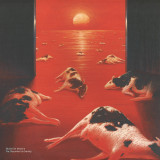
The Discomfort Of Evening is the incredible and original soundtrack by prolific Belgian composer Michiel de Malsche to 2020 International Booker Prize winner The Discomfort of Evening by Marieke Lucas Rijneveld. Visceral and virtuosic, Rijneveld's novel follows Jas, a girl growing up in a devout Christian family that runs a Dutch dairy farm, whose brother dies in an accident after she wishes he would die instead of her rabbit. Lost in grief, her family falls apart as she becomes consumed by increasingly dangerous fantasies.
Michiel de Malsche has captured the atmosphere and spirit of Rijneveld's book perfectly, moving through moments of confrontation and introspection, sinking into spirals of despair, stasis and subtle hope and change. Brooding ambient basslines, driven by droning murmurs, are offset with melismatic electro-acoustic pieces that embody the novel's haunting and dissonant world, whilst also incorporating manipulated field recordings such as animal sounds and a church service, allowing for a full manifestation of Jas’s world in a completely new way.
De Malsche achieves this by rallying an unusual combination of acoustic instruments (16 in total) played by top-of-their-field musicians, creating a truly unique sound world and tonal palette, including an Ondes Martenot, a 7-stringed Chinese instrument called a guqin, a marimba, a string 6-tet, a toy piano and a bass flute.
De Malsche always confronts all emotional levels of his source material head-on, making his soundtrack into much more than just a fever dream. It is a precise description of, and accompaniment to, a devastatingly impactful book.
Michiel De Malsche is a Belgian composer, multi-instrumentalist and sound designer. He studied classical composition at the conservatories of Rotterdam and Ghent. His music has been performed all over the world and he has composed and produced dozens of soundtracks for contemporary dance, theatre, movies and documentaries.
Besides his work as a contemporary classical composer, he is active as a studio musician and producer in the world of electronic music.
Somewhere between Simon & Garfunkel and the Kings of Convenience, Meaning of Tales bring benevolent and empathetic music in their own style.
Music that will evoke memories of youth for some, without any nostalgia but with infinite tenderness, and will teleport others to nature at sunset. Music that proves Aristotle right: so much will it soften our morals and delight our hearts.
- 1: Merry Christmas Baby
- 2: It’s Beginning To Look A Lot Like Christmas
- 3: Christmas Isn’t Canceled (Just You)
- 4: Merry Christmas (To The One I Used To Know)
- 5: Rockin’ Around The Christmas Tree
- 6: Glow (Feat. Chris Stapleton)
- 7: Santa Baby
- 8: Santa, Can’t You Hear Me (Feat. Ariana Grande)
- 9: Last Christmas
- 10: Jingle Bell Rock
- 11: Blessed
- 12: Christmas Come Early
- 13: Under The Mistletoe (Feat. Brett Eldredge)
- 14: All I Want For Christmas Is You
- 15: Christmas Eve
GRAMMY-winning global superstar Kelly Clarkson has released When Christmas Comes Around…, her ninth studio album via Atlantic Records. The 15-track collection sees Clarkson reunite with long time collaborators Jason Halbert, Jesse Shatkin and more for a mix of new original songs and Christmas classics.
The album features a mix of new original songs and Christmas classics, alongside show-stopping collaborations with Ariana Grande (“Santa, Can’t You Hear Me”), Chris Stapleton (“Glow”) & Brett Eldredge (2020’s hit single “Under The Mistletoe”). When Christmas Comes Around… marks the latest album from Clarkson since 2017’s Meaning of Life and her second holiday offering following 2013’s Wrapped In Red.
Kelly Clarkson is among the most popular artists of this era with total worldwide sales of more than 25 million albums and 40 million singles. The Texas-born singer-songwriter first came to fame in 2002 as the winner of the inaugural season of American Idol. Clarkson’s debut single, “A Moment Like This,” followed and quickly went to #1 on Billboard’s Hot 100, ultimately ranking as the year’s best-selling single in the U.S. Further, Clarkson is one of pop’s top singles artists, with 19 singles boasting multi-platinum, platinum and gold certifications around the world, including such global favourites as “Miss Independent” and “Because of You.” Clarkson has released eight studio albums (Thankful, Breakaway, My December, All I Ever Wanted, Stronger, Wrapped In Red, Piece By Piece, Meaning of Life), one greatest hits album, and two children’s books (New York Times Top 10 best seller River Rose and the Magical Lullaby and the follow up River Rose and the Magical Christmas). She is the recipient of an array of awards including three GRAMMY Awards, four American Music Awards, three MTV Video Music Awards, two Academy of Country Music Awards, two American Country Awards, one Country Music Association Award, and two Daytime Emmy Awards. She is also the first artist to top each of Billboard’s pop, adult contemporary, country and dance charts.
The classic sci-fi series teleports to Demon Records for two thrilling full-cast radio adventures.
From 1977 to 1981, a heroic band of freedom fighters waged war against the merciless Terran Federation,
spearheaded by Supreme Commander Servalan. In the mid-1990s Terry Nation’s intergalactic epic switched from BBC
TV to radio with two new adventures, The Sevenfold Crown and The Syndeton Experiment. Both now come to vinyl
for the first time, alongside cast interviews and extracts from Zen and the Art of Blake’s 7.
Presented across 3 x 140g vinyl discs in three colours, these full-cast dramas star Paul Darrow as Avon with Jacqueline
Pearce as Servalan, Michael Keating as Vila, Steven Pacey as Tarrant, Paula Wilcox as Soolin, Angela Bruce as Dayna,
and Peter Tuddenham as Orac and Slave. Written by Barry Letts (Doctor Who) they feature incidental music by Jeff
Mearns as well as the familiar strains of Dudley Simpson’s iconic theme music.
The removable slipcase cover reveals a trio of coloured LPs - plus a frameable art print - in a widespine sleeve. The
discs are presented in individual sleeves which, when place side by side, reveal a landscape scene of Scorpio in flight.
Full cast and credits are accompanied by graphics illustrating the tech of Blake’s 7.
Make sure you’re Down and Safe with this exclusive limited edition.
A prehistoric tribe dances around the fire. Young revelers lose themselves on a packed dancefloor. Explorers fly a rocket toward another galaxy. In the TIMEBEING universe, these things are all connected. From the earliest days of humanity, people have strived to expand their reality beyond the limitations of the here and now_and have used technology to make it happen. Their methods and machines may have changed across the centuries, but the drive remains constant, vibrating through history and occupying a space where time loses all meaning. "The art of making music is the art of manipulating time," says Uji. "I have had experiences where time shifts dramatically; sometimes it slows down to a halt, while moments seemingly become infinite. This is where the magic happens. This is when the fabric of what we call reality begins to show its seams." An Argentintian electronic producer and ethnomusicologist, Uji has been navigating those seams for more than two decades, initially as one half of the pioneering duo Lulacruza, but more recently with his own solo work. TIMEBEING continues that lineage, but also elevates it, taking shape as a interdisciplinary multimedia journey that includes a new album, an accompanying short film, an immersive live show and the birth of a new decentralized community of like-minded artists, creators, seekers, and dreamers. Mesmerizing and deeply psychedelic, the TIMEBEING LP certainly reflects the rich sound palette of Latin America_and its intersection with various strains of electronic music_but Uji taps into traditions_both musical and spiritual_that can't be hemmed in by borders and boundaries. Transcendence is the goal, and the album moves through fantastical spaces that may or may not exist: a metallic jungle, a Balkan spaceship, a cloud that morphs into a tumultuous whirlpool. All the while, Uji criss-crosses history, consulting elders and futurists alike as he throws open the doors of perception and pens a new mythology about what it means to be human. FOR FANS OF: Floating Points, Four Tet, Oneohtrix Point Never, Actress, Nicola Cruz, Dengue Dengue Dengue, Nicolas Jaar, Mount Kimbie, Mucho Indio.
We Jazz Records presents the second volume of their reworks albums dealing with source material from the Helsinki-based label's catalog. This time around, it's Carl Stone's turn to tackle the source albums at hand and filter the label's output through his musical lens.
We Jazz Reworks is an idea that repurposes some of the label's output 10 albums at a time. That is, the label invites producers whose music they love on board, and one by one, they tackle 10 albums worth of source material, of which they are free to use as much or as little as they choose. The series evolves chronologically, so this volume being number two, the source material is pulled from We Jazz LPs numbers 11 through 20. The artist has complete freedom.
Volume 2 in the series happens with Carl Stone, a legendary figure in creative music. His career spans decades of unlimited musical innovation. Stone's recent output on Unseen Worlds, the label who has also been instrumental in issuing some of his remarkable earlier work, ranks among the most original art of our time and renders notions such as "genre" virtually meaningless.
Here, We Jazz originals by Terkel Nørgaard, OK:KO, Jonah Parzen-Johnson and more are met here with a fresh sense of discovery, spun around and delivered ready for the turntable once again.
Carl Stone says:
"It was wonderful that We Jazz gave me carte blanche to work with any materials from the set of ten releases in its catalog. This freedom to work with everything could have been a mixed blessing though, as it could be a challenge to try to deal with so much musical information. In the end I did what I almost always do: Let my intuition be my guide and to seize upon any musical items that seemed to fit into an overall approach."
"To make a new piece I usually start with an extended period of what really is just playing, the way a child plays with toys. Experimentation without necessary expectation, leading to (hopefully) discovery of things of musical interest, then figuring out a way to craft and shape these into a structured piece of music. Each track uses a different approach, which I found along the way during this play period."
This conceptual approach becomes complete with the design, in which album graphics are treated in a similar fashion, reworking what's there. This time around, the artwork is reinvented by Tuomo Parikka, a regular cover collage contributor for the We Jazz Magazine.
CURACAO BLUE TRANSPARENT VINYL, INSIDE OUT SLEEVE, OBI W/ LINER NOTES, PRINTED INNER SLEEVE WITH SOURCE ALBUM DESIGN REFLECTIONS.
Several things happened before a warm day when I met the four members of Frankie Cosmos in a Brooklyn studio to begin making their album. Greta Kline spent a few years living with her family and writing a mere 100 songs, turning her empathy anywhere from the navel to the moon, rendering it all warm, close and reflexively humorous. In music, everyone loves a teen sensation, but Kline has never been more fascinating than now, a decade into being one of the most prolific songwriters of her generation. She's lodged in my mind amongst authors, other observational alchemists like Rachel Cusk or Sheila Heti, but she's funnier, which is a charm endemic to musicians. Meanwhile Frankie Cosmos, a rare, dwindling democratic entity called a band, had been on pandemic hiatus with no idea if they'd continue. In the openness of that uncertainty they met up, planning to hang out and play music together for the first time in nearly 500 days. There, whittling down the multitude of music to work with, they created Inner World Peace, a collection of Greta's songs changed and sculpted by their time together. While Kline's musical taste at the time was leaning toward aughts indie rock she'd loved as a teenager, keyboardist Lauren Martin and drummer Luke Pyenson cite "droning, meditation, repetition, clarity and intentionality," as well as "'70s folk and pop" as a reference for how they approached their parts. Bassist/guitarist Alex Bailey says that at the time he referred to it as their "ambient" or "psych" album. Somewhere between those textural elements and Kline's penchant for concise pop, Inner World Peace finds its balance. The first order of business upon setting up camp in Brooklyn's Figure 8 studios was to project giant colorful slides the band had made for each track. Co-producing with Nate Mendelsohn, my Shitty Hits Recording partner, we aimed for FC's aesthetic idiosyncrasies to shine. The mood board for "Magnetic Personality" has a neon green and black checkerboard, a screen capture of the game Street Fighter with "K.O." in fat red letters, and a cover of Mad Magazine that says "Spy Vs. Spy! The Top Secret Files." On tracks like "F.O.O.F." (Freak Out On Friday), "Fragments" and "Aftershook," the group are at their most psychedelic and playful, interjecting fuzz solos, bits of percussion, and other sonically adventurous ear candy. An internal logic strengthens everything, and in their proggiest moments, Frankie Cosmos are simply a one-take band who don't miss. When on Inner World Peace they sound wildly, freshly different, it may just be that they're coming deeper into their own. Inner World Peace excels in passing on the emotions it holds. When in the towering "Empty Head" Kline sings of wanting to let thoughts slide away, her voice is buoyed on a bed of synths and harmonium as tranquility abounds. When her thoughts become hurried and full of desire, so does the band, and she leaps from word to word as if unable to contain them all. As a group, they carry it all deftly, and with constant regard for Kline's point of view. Says Greta, "To me, the album is about perception. It's about the question of "who am I?" and whether or not the answer matters. It's about quantum time, the possibilities of invisible worlds. The album is about finding myself floating in a new context. A teenager again, living with my parents. An adult, choosing to live with my family in an act of love. Time propelled us forward, aged us, and also froze. If you don't leave the house, who are you to the world? Can you take the person you discover there out with you?" - Katie Von Schleicher
Das siebte Studioalbum der ehrwürdigen Rock-Institution Titus Andronicus wurde produziert von Titus Andronicus Singer-Songwriter Patrick Stickles und dem preisgekrönten kanadischen Produzenten Howard Bilerman (ARCADE FIRE, LEONARD COHEN, THE WHOLE NINE YARDS) in dessen hotel2tango Aufnahmestudio in Montreal. Mit "The Will To Live" laden Titus Andronicus den Hörer auf eine Reise von der Angst zum Glauben, von der Wut zur Akzeptanz, von der Trauer zur Dankbarkeit ein, immer auf der Suche nach dem mythischen Ideal des ultimativen Rock. In Anlehnung an maximalistische Rock-Epen von "Who's Next" bis "Hysteria" hat die Band ihr bisher reichhaltigstes, dichtestes und härtestes Album geschaffen, das die Weite und den Umfang ihres meist gefeierten Werks erreicht und gleichzeitig ihren ehrgeizigen Angriff effektiver als je zuvor gestaltet. "It may strike some as ironic we had to go to Canada to record our equivalent to "Born In The USA," sagt Stickles, "but the pursuit of Ultimate Rock knows no borders." Titus Andronicus kehrten im November 2021 auf die Bühne zurück, um den Jahrestag ihres bahnbrechenden zweiten Albums "The Monitor" von 2010 zu feiern. Die Tatsache, dass sie dieses Material vor einem ekstatischen Publikum spielten, ließ Stickles entschlossen zurück, ein Album abzuliefern, das dieselben Höhen erreichen würde, wobei sie sich diesmal weniger auf das unbekümmerte Feuer der Jugend verließen, sondern mehr auf die Erfahrung und die Perspektive, zu der eine Band erst mit tausend Shows im Gepäck gelangt. Um diesen Grad an Konzentration und Klarheit zu erreichen, musste Stickles an der Schnittstelle zwischen Triumph und Tragödie stehen. Er schreibt seine neu gefundene häusliche Glückseligkeit und seine unerschütterliche mentale Gesundheit für seine persönliche Stabilität in letzter Zeit ebenso zu wie die Ausdauer der mittlerweile am längsten bestehenden Besetzung von Titus Andronicus - Liam Betson an der Gitarre, R.J. Gordon am Bass und Chris Wilson am Schlagzeug - die alle auf dem 2018er Album "A Productive Cough" und dem 2019er Album "An Obelisk" vertreten sind. Auf der grausameren Seite der Medaille entstand "The Will To Live" zum großen Teil als Versuch, den vorzeitigen Tod von Matt "Money" Miller, dem Gründungs-Keyboarder der Band und Stickles' engstem Cousin, im Jahr 2021 zu verarbeiten. Das Ergebnis erweist sich als Meilenstein für Titus Andronicus, ein ehrgeiziges, nach vorne gerichtetes Werk, das an der Schnittstelle von Triumph und Tragödie steht, angetrieben von neu gefundenem Fokus und Klarheit, und das eine einzigartig begabte Rock'n'Roll-Band auf dem Höhepunkt ihrer kreativen Kräfte zeigt.