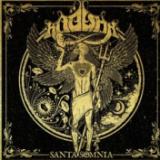
Santa Somnia is an imaginary saint, shaped like a medieval folktale figure, who steals the sleep and childhood creativity of his victims to feed a kingdom of oblivion and torment. The album's lyrics follow the journey of a protagonist stripped of rest and innocence, wandering through a decaying dreamworld reminiscent of Dark Souls, Bloodborne, and Elden Ring. Santa Somnia becomes an allegory of lost hope and the crushing weight of adulthood, drawing further thematic influence from the bleak darkness of Kentaro Miura's Berserk. Santa Somnia is a sonic trip through a crumbling psyche-- drenched in despair and shadows-- ruled by the struggle against madness brought on by sleeplessness, the inner torment of depression, and the inevitable, sometimes merciful, pull of death.
The influence of FromSoftware and Berserk emerges through the album's cryptic, oppressive storytelling, where the line between nightmare and reality barely exists. While rooted in the band's earlier works, the sound of Santa Somnia blends the crushing weight of doom metal with classic and thrash metal elements and injections of punk- rock melody, mirroring the emotional instability and mental agony woven throughout the lyrics.
Suche:mel
- 1: The Gallopers
- 2: Dr Love
- 3: Tears For Leda
- 4: The Back Of Your Bike
- 5: The Tears Of Cora Pearl
- 6: The Rose Tattoo
- 7: Don't Come Crying To Me
- 8: Witch Hazel
- 9: Old Flame
- 10: Carmilla
- 11: The Bride Wore Black
- 12: Madame X
- 13: Away With The Fairies
- 14: The Moon Doesn't Mind
Tears Before Bedtime is the sparkling new album by the Would-be-goods, Jessica Griffin’s band of pop adventurers. Since The Camera Loves Me, their cult classic 1988 debut for the legendary él Records, they have blazed a musical trail through indie guitar pop, with a garage band edge and forays into other territories - glam rock, tango, French chanson… The result is unique and timeless.
The songs on Tears Before Bedtime balance delicacy and power. Perfect pop melodies are delivered in Jessica’s gorgeous and idiosyncratic voice. Her lyrics are intelligent and wry, wistful and witty. Every song tells a story, taking us on a journey through space and time, from belle époque Paris to a 1960s London biker café, from a riverbank in ancient Greece to a 1970s teenage bedroom.
Listening to a Would-be-goods album is like wandering through a gallery of portraits. Innocence gives way to experience. Danger lurks amid the lights of the funfair in the 1950s carousel whirl of The Gallopers. The sinister Dr Love promises heaven but sends you down to hell, to the sound of a last dance in a smoky soul basement. A nymph meets a god in disguise in a garage-band take on a Greek myth (Tears for Leda). The Rose Tattoo is the tale of a doomed love in a sultry Southern state. Don't Come Crying To Me flames an ex-lover to the sound of Bollywood horns and shivery guitar. In Madame X a portrait painter vents his fury on a spoilt socialite beauty. The album closes with a sweetly jazzy lullaby (The Moon Doesn't Mind).
The Would-be-goods began playing as a full band in the 2000s and have been previewing some of these songs at recent shows in England, Scotland, France, and Spain. The album was recorded in London with Jessica on guitar and vocals, Peter Momtchiloff (Heavenly, Talulah Gosh) on guitar, Debbie Greensmith (Thee Headcoatees and many others) on drums, and Andy Warren (The Monochrome Set, Adam and the Ants) on bass. Guest musicians have contributed organ, piano, vibraphone, cello, trumpet, and flute to make this the richest-sounding Would-be-goods record yet.
- 1: After Hours
- 2: Wasting Time
- 3: First Love (Never Dies)
- 4: Photograph
MOVIE MOVIE is based out of NYC and features members of the bands TWIN GUNS, THE ELECTRIC MESS, and THE ABOVE. The band combine elements of power pop, '60s, '70s and '80s garage, classic, alternative and glam rock, but they have a sound all their own, with a focus on strong hooks and melodic vocals. "After Hours" is a 1980s New Wave comedy about a party girl on the downtown scene whose claim to fame is a bit part in a popular movie, where she uttered the immortal line, "Won't you look at the time," but she wouldn't give you the time. "Wasting Time" is an existential road picture in the mind of the protagonist, set across heartland America and a sunny beach in the Caribbean, but in reality he never leaves the girl, or town, and in the end ponders his wasted years. "First Love (Never Dies)" is a romantic drama that spans decades, about an aging rocker who reflects on his first teenage love, a girl he has never stopped thinking about. He tries to track her down and reconnect after all these years, only to find she is now married to his old childhood rival.
"Photograph" is a future arthouse hit, shot in stark black white, about the disintegration of a relationship seen from two different perspectives, captured in an old photograph, in which the truth is revealed in the looks on their faces. "Coming Attractions" is MOVIE MOVIE's second EP, after their debut six track EP, "Now Playing" (2022), on Ghost Highway/ KOTJ Records, and they have two full LPs, "Storyboards" (2023), and "In 4-D!" (2024), both Topsy-Turvy Records.
You‘re feeling great, just bought new records and you’re ready to toss ‘em on the decks and let ‘em spin. Nevermind your bank account has you on a strict diet of yum yum noodles instead of that expensive, slow, regional stuff you normally get. „Anyway it was a good choice, I love records. It’s an investment..“ you are telling yourself while sliding the record out of its sleeve. „Cheap Fast Worldwide“ — black letters on a white background. You put the needle on the disc.
Punchy drums bathe in lush chords and you’re pulled into a smooth, lounge vibe. Tonight it’s caviar, not yum yum noodles. A playful bassline bounces in, with a nod towards disco roots and a modern twist. An unmistakable cheesy 90s melody is the cherry on top.
Aptly named, the inner track on this side greets you when a „One, two, three, quattro“ rings out over a tight, breaky groove. Meanwhile, rather deep, monotonous pads carve out space for your mind to wander…
As you flip it over, things start to shift. Strange melodies and dirty drums tease the unknown. Out of nowhere, the pitch drops, and a low, driving bassline takes hold. It pushes forward with a relentless energy that keeps you on the edge, unsure of what’s coming next.
A highly sophisticated fade out leads you to the last track — a raw and infectious drum groove laced with choppy vocal snippets and warm crackles. Stripped back, yet the beautiful chords slice through, adding depth and the right sense of movement, taking you deeper into the night.
Vancouver-based instrumentalist Kutcorners pays a fine tribute to the legendary jazz-funk king Bob James at the same time as showcasing his fine edit skills on this fresh 7" for The Freshest Recordings. Opener 'Full Circle' swirls with immediately recognisable melodies from James that have been used in all sorts of records over the years. They're carried by a mid-tempo house groove for a breezy late-night sound. On the B-side is a 119bpm funky and broken beat house number, 'DiscoPlanetBob', with more familiar references and playful drums that will get any floor vibing.
The one and only Scruscru calls on his most trusted friend for his latest in the Local Sugar Diggers series which is a treasure trove of re-edits & reworks of old and rare records. Love is in the air on the opener 'Os Sons Do Rio' which has swooning, sentimental strings and MPB vocals that remind of all the greats. The instrumentals are rich, the melodies florid, the sound truly elegant and intoxicating and sure to transport you to a party by the beach somewhere in Brazil. 'Sozinha Mulher' is a little more laidback and lazy in its slowly unfurling groove with clear, cloudless blue skies up above and subtle horns and vocal coos all encouraging you to move.
- A1: First Sequence
- A2: Second Sequence
- A3: Third Sequence
- A4: Fourth Sequence
- A5: Fifth Sequence
- A6: Sixth Sequence
- B1: Seventh Sequence
- B2: Eighth Sequence
- B3: Ninth Sequence
- B4: Tenth Sequence
- B5: Eleventh Sequence
- B6: Twelfth Sequence
- C1: Symmetry Systems (Porcelain)
- C2: Symmetry Systems (Gold)
- C3: Symmetry Systems (Amber)
- C4: Symmetry Systems (Violet)
- D1: Symmetry Systems (Indigo)
- D2: Symmetry Systems (Emerald)
- D3: Symmetry Systems (Shadow)
- D4: Symmetry Systems (Midnight)
- E1: Imagine The Truth
- E2: Axiom Haze
- E3: Discrete Time
- E4: Reality Engine
- E5: Blissgrid
- F1: State Space
- F2: Principle Dilution
- F3: Everything & Nothing
- F4: Echo Diffusion
- F5: Beyond The Hyperreal
Threewave is the complete synth trilogy from 36 and it unites three releases into a single, evolving statement shaped over five years. Spanning the Wave Variations, Symmetry Systems and Reality Engine releases, the project is rooted in self-imposed limitations and a carefully refined melodic palette that gave rise to a suite of interconnected transmissions. Minimalist sketches give way to warm, AI-era-inspired nostalgia, but always grounded by a distinctly human sensibility. Melancholic keys and glowing atmospheres balance precision with emotion before expanding into themes of perception, artificial intelligence and imagined realities. Together, these works make for a defining chapter in 36's partnership with the legendary Past Inside the Present.
- A1: Roudi Vagou - Gleisende Lichter
- A2: Roudi Vagou - Halb So Schwer
- A3: Roudi Vagou - So Sueß
- A4: Roudi Vagou - Lila Gibt Es Nicht
- A5: Roudi Vagou - Iss Mich Ganz Auf
- A6: Roudi Vagou - Grenzueberschreitung
- A7: Roudi Vagou - Aufgeben Ist Kein Verzicht
- B1: Läuten Der Seele - Komischer Anruf
- B2: Läuten Der Seele - Punkt Mitternacht
- B3: Läuten Der Seele - Nur Fuer Uns Zwei
- B4: Läuten Der Seele - Mineralwasserflasche 1
- B5: Läuten Der Seele - Glaskopf Mit Watte
- B6: Läuten Der Seele - Rathausdach
- B7: Läuten Der Seele - Ein Kitzeln In Den Graebern
- B8: Läuten Der Seele - Mineralwasserflasche 2
- B9: Läuten Der Seele - Mondraetsel
Across an extensive suite of enchanting miniatures, Matthias Kremsreiter and Christian Schoppik present the hypnagogic vision of Taghelle Nacht. Recording under their respective Roudi Vagou and Läuten der Seele aliases, Kremsreiter and Schoppik combine their distinct but equally accomplished instrumental practices into a new collaboration that weaves swooning samples amongst instrumental passages. They lead us through 16 vignettes that revel in the cognitive dissonance and seductive magic of moonlight at midnight.
Both artists have past form within the folds of contemporary experimental electronic music in Germany. Kremsreiter's work as alibikonkret has manifested on DIY tape releases created with a methodical, technically-minded approach. Debuting his Roudi Vagou pseudonym on Taghelle Nacht, he pivots to a more playful, instinctively felt method that allows the compositions to flow with a natural cadence. Schoppik has been a key figure in the celebrated dark-ambient-folk scene, not least as part of the group Brannten Schnüre. His work as Läuten der Seele includes the acclaimed 'water trilogy' of LPs between 2022 and 2024, with a greater emphasis on instrumental, atmospheric production, and a last, stunning collaborative album with Nový Sv?t's Jota Solo.
On Taghelle Nacht the precise ingredients of each piece soften at the edges as tape loops and swathes of reverb seal the joints between spellbinding melodic refrains. Opening track and lead single 'Gleisende Lichter' sets the tone with ghostly murmurs, spine-tingling string refrains and splashes of cymbal that cut through the gloom with stark clarity. A lilting romanticism stirs at the heart of the orchestral samples that populate the likes of "Grenzu?berschreitung" - old-world beauty sometimes buried in dust, elsewhere rendered with startling clarity. 'So Süß' lets buzzing, sustained drones and dissonant sweeps of extended technique glide in and out of each other. Granular processing subtly breaks apart the mellow swell on 'Komischer Anruf', and forlorn sax calls out into heavy-hearted space on 'Glaskopf Mit Watte'. At every turn a new scene is painted, distinct from the last and yet all bound up in the pervasive, pale blue light cast over the sleeping landscape Kremsreiter and Schoppik have sculpted.
Snatches of song drift by like dreamlike fragments, and achingly tender flourishes fleetingly appear and retreat - ideas and expressions momentarily caught in the light before retreating into the shadows once more. This is the evocative world of Taghelle Nacht - an unsettling depiction of the surreal blend of memories and imagination that merge into each other once the sun goes down.
Im Gegensatz zu den früheren Alben der Lost Boys, die innerhalb eines bestimmten Zeitraums produziert wurden, entstand „Pale Bloom“ langsam und versuchte, einen Schöpfungsmythos in seinem Bernstein einzufrieren – eine Ursprungsgeschichte, die uralt und komplex ist, voller Geheimnisse und Metaphern, die weder einer Klärung noch eines Endes bedarf. Jede Veröffentlichung der Lost Boys wagt sich in neues musikalisches und lyrisches Terrain vor. Von allen greift „Pale Bloom“ am weitesten zurück in die Kindheit und findet unbewusst die Rhythmen und Erzählstile, die in den Zwängen einer religiösen Erziehung verwurzelt sind. Beim Durchforsten der vergessenen Akkorde, Refrains und Melodien aus alten Kinderreimen und Volksliedern entdeckten sie den Wunsch, diese überlieferten Klänge in Richtung persönlicherer Wahrheiten zu verändern. Dieser Impuls ist auf dem gesamten Album präsent und in Krugers ebenso klangvoller wie euphorischer Stimme zu hören, wenn sie die verschiedenen lyrischen Formen um ihre eigene Sehnsucht, Trauer und Begierde herumlegt und sie darauf vorbereitet, in der üppigen und großzügigen Subversion der erinnerten Rhythmen der Band zu landen. Im Gegensatz zu ihrem Auftritt auf „Heaving“ und „A Human Home“ sind die Streicher hier weniger affektiert und haben einen eher düsteren und ernsten Charakter angenommen. Sie streben nach einer komplexen Art von Himmel, der durch das Gewicht und die Bodenständigkeit der Grooves ermöglicht wird, die sowohl stoisch als auch ausdrucksstark sind. Die Gitarren bewegen sich frei zwischen weitläufigen, voluminösen Räumen und sind ebenso knirschend wie sanft. Kruger nahm das Album mit ihren Bandkollegen und ihrem engen Mitarbeiter André Leo über einen Zeitraum von sechs Monaten in verschiedenen Studios in Berlin auf. Das Album wurde von Simon Ratcliffe gemischt.
AGT Records are back for number 008 and the smoke machine is on full blast.
Christian Llopis put out a handful of releases in the early 2000’s, each capturing the progressive machine-groove of the time, but with his own signature twist and turn that made his sound stand apart from his contemporaries. The Lobster Tan EP, first released in 2005 on Play. Out. Right. Now. Recordings, shows offhis unique style perfectly.
Each track has its own distinct personality while maintaining a relentless momentum that throws each kick drum into the next. The title track ‘Lobster Tan’ has an almost elastic groove in the low end, balanced deftly with swirling samples and melody lines. ‘Simulation’ is a more heady offering, perfect for those late night/ early morning moments where the heads are down and the lights are low. The
mood is sinister, and its growling bassline and vocal samples barrel the tune forwards. Pick of the bunch is ‘Back in the Day’, a tribal roller that combines organic melody lines and pads with an ever-evolving bassline that will refresh any discerning dance floor back into life.
Llopis is an expert at keeping things subtle while moving the gears, and this release is a prime example of prog done right. We are happy to have this one back on the shelves, all in good time.
Haven Trax welcomes a standout 12" from Dutch mainstay Michel de Hey. On the A-side, he delivers a warm and rolling house cut with a catchy piano melody, featuring the soulful vocals of Michael Sebastian -- a track that blends depth and emotion with undeniable floor appeal. The B-side sees Michel join forces with Orlando Voorn for a rawer, more stripped-back club workout. Two generations of Dutch electronic music finding common ground in groove, texture, and timeless dancefloor energy.
OK EG are a quietly influential force in electronic music, renowned for their masterful sound design, organic textures and meticulous arrangements. Forward thinking, always explorative and genre agnostic, the duo are at the leading edge of the Australian sound. Now entering the 10th year of their collaboration, Melbourne based producers Lauren Squire and Matthew Wilson have arrived with their own imprint called GEKO. GEKO is a platform for the duo to stretch out, freed from outside influences and in total control of the creative vision. This is high functioning dance music that bristles with confidence, expressed in vivid colour. Hypnotic, transportive and completely their own. The process is hybrid, analog machines connected directly to digital workflows. Two minds in sync.
Integrate marks the debut release for both new UK electronic music label System One & label head D. Howard* No stranger to the music having worked with some of the most well known electronic acts over the last 30 years, Integrate marks the first time D.Howard has gone studio side to empty the contents of his mind
Integrate spans a range of classic influences over its 7 tracks. The warm vintage pads and arpeggiated acid sequences of Helford Dawn recall a touch of Warp era Black Dog. Solaris take a spacey electro driven trip adrift on evocative & reflective chords while Aja takes the beat further, melancholic & eerie atmospheres sits atop a lithe acid bass line and crisp drum programming
Dear James pays tribute to the much regarded producer James Rekab Baker who sadly passed away in September 2025 James was the first person to hear this project & his enthusiasm and support was the push needed to start System One and release the music. The track is a soulful melodic deep tech cut reminiscent of early Dutch techno and has received great reactions from radio DJs such as Damo B, Colin Dale, Luke Una, Ross Allen, Paul ‘Apiento’ Byrne & Ollie Chubb at NTS and Quinn Paranoid London (Rinse FM)
System One is a new label dedicated to soulful electronic music, late night grooves & intergalactic beats, drawing its inspiration from the early 90s techno & ambient sounds of Uk, Frankfurt, Detroit & beyond
System One - Bass, Beats, Pads & Bleeps
- A1: Eden
- A2: Sun
- A3: Hawaii Oslo
- A4: Pour Trois
- A5: Biesy
- B1: Luka
- B2: Glass
- B3: Today It Came
- B4: Esja
- B5: Now, Run
Hania Rani is a pianist, composer and musician who splits her life between Warsaw, where she makes her home, and Berlin where she studied and often works. She has written for strings, piano, voice and electronics and has collaborated with the likes of Christian Löffler, Dobrawa Czocher and Hior Chronik, and released an album with her Polish group teskno last year. She has performed at some of the most prestigious venues in Europe - from the National Philharmony in Warsaw, to Funkhaus in Berlin, to The Roundhouse in London (where she made her debut at the Gondwana 10thanniversary festival last October) and at festivals such as Open'er, Scope Festival and Eurosonic. Her compositions for solo piano were born out of a fascination with the piano as an instrument, and her desire to interpret its sound and harmonic possibilities in their entirety and in her own way.
LP comes with heavy weight reverse board sleeve including a double sided printed insert plus digital download code.
Esja is her debut solo album and for Rani it is her first, real, personal statement as an artist. "No hiding behind the "collaborations" or "projects" anymore. For the very first time, finally - just me, as I am".
Recorded at Rani's apartment in Warsaw (the piano room has a beautiful reverb and the space has become part art studio and part sound laboratory for Rani) and at her friend Bergur Þórisson'sstudio in Reykjavik, Esja is a series of beautiful melodic vignettes. Sensual, sensitive, rhythmic, atmospheric, free but harmonious, beguiling and hypnotic, collectively they project a sense of unlimited space and time.
Expect support from accross the media spectrum from Mojo to Uncut and Gilles Peterson and Mary Ann Hobbs on 6 Music to Radio 3 and beyond. Full servicing to the Gondwana Records datebase.
Finnish dub-techno craftsman TM Shuffle, head of Vuo Records, resurfaces with a deep and distilled EP that goes straight for the late-night heart of the dancefloor. Rooted in Tampere’s raw, analog dub sound, his productions have long balanced weight and warmth, smoked-out chords, rolling low-end and subtle shuffle that keeps the groove in constant motion.
The lead track “Kellari” dives into basement mode: pressure-cooker drums, slow-burning stabs and a humid, lived-in atmosphere that feels equally at home on a huge system or in headphones at 4 a.m. On the second original cut, TM Shuffle links up once again with long-time collaborator Monoder, the alias of Jussi-Pekka Parikka, known for his dubbed-out explorations on labels like Statik Entertainment and Pakkas-Levyt since the early 2000s. Their joint track stretches time, letting echo, tape hiss and distant melodic fragments float around a rock-solid groove, channelling years of shared studio language into one focused, hypnotic flow.
On the flip, Anton Kubikov (SCSI-9) steps in with a lush reinterpretation of Kellari. A true Russian techno veteran with a catalog that spans Kompakt, Force Tracks, Mayak and beyond, Kubikov melts the original into a widescreen, dream-state trip, soft-focus pads, gentle yet insistent percussion and that unmistakable rolling pulse that made his work so enduring. The remix doesn’t just extend the track; it opens a new dimension, turning the basement pressure into a slow-rising, celestial drift.
Pressed on limited coloured vinyl, this EP is built for selectors who like their dub techno deep, human and timeless, a record that will quietly live in bags for years and keep resurfacing whenever the room calls for true late-night elevation.
Monsieur Van Pratt is one of the leaders of the edit game and his Illegal Disco is all the proof you need. This latest drop finds him tap into vintage Japanese rare grooves and flip them with his signature style. 'Space Scrapper' is up first and is the sort of comic cut that will have you wide-eyed as it reworks a celebrated Japanese musician and vocalist. 'Time Machine' is a big, stomping disco cut with rubbery bass riffs and Japanese city pop vocals riding next to cursing synths. It's a bright but steamy sound for when things really heat up. Last but not least is another showstopper with 'Feel So Fine' layering wispy cosmic melodies with cool-as-you-like disco drums and carefree vocals. Lovely stuff.
No Fuss is back with a 14th outing that levies up to its name of dealing in only quality, fad-free sounds. Saison kicks off here with 'The Truth' which is a deep, lithe and soulful sound laced with soft acid, before DJ Romain's 'I'm Gonna Love You' taps into 90s New York house depths with neat organ stabs. On the reverse, Manuel Sahagun gets loopy with his bumping and raw 'Rouff' and its deft melodic curlicues while classy house operator Toni Lionni's remix of Deepmore's 'Babe' is a prime slice of serene and gently back-lit deep house hypnosis.
DJ Support by Fabrizio Mammarella, Sean Johnston (ALFOS), Erol Alkan, Ame, Fango, Jaye Ward, SHMLSS, Camilo Miranda, Marco Passarani, Logan Fisher, Massimiliano Pagliara, Otto (Bordello a Parigi), Phil Mison, Giulia Gutterer, Pete Herbert, Franz Scala, Lauer, Pedro Bertho, Feel Fly ...
New music from legendary Adriatic DJ and producer Verdo is as rare as an MP3 in the golden age of disco. Which is why you should be hella excited for GRATIS CLUB, his first full-length album and a love letter to the iconic club he once called home in Senigallia.
A true Loyal Hell Yeah Recordings member and consummate musician, Verdo brings his signature piano melodies to Italo disco, hi-NRG, and trance magic across X cuts that are equal parts dancefloor propulsion and cosmic exploration.
GRATIS CLUB captures the energy, eccentricity and euphoria of the club Verdo played and directed, translating the pulse of a local institution into a timeless, high-voltage record. With previous releases on Danny Was A Drag King and this label, including his 2020 Symmetry EP, Verdo continues to prove he’s one of Italy’s best-kept secrets with this new album.
Opener and lead single ‘Let In The Light' is pure Italo disco adrenaline: shimmering arps soar over lush chords and retro analogue drums, igniting the dancefloor. Second single ‘Boulevardier’ is introspective yet radiant with rugged synths spiralling inward while shiny 80s chords inject colour and retro soul, all carried by supple, marching drums. 'Eyes Melody' is an ascent to a higher state with acrobatic drums and bass and more luminous synth magic, 'Ballad' has a more downbeat and late-night feel with pensive pads and sad vocoder, then the title cut is bold, bright and unabashed in its stomping disco brilliance. 'Our Love Come Back' has a sense of yearning that surely translates the sadness felt at the closing of Gratis Club, then 'Lest We Forget' is a reminder of how pumping and sweaty the main room got with Verdo in the booth. 'Little Blue's is the gentle comedown and comforting hand that leads you home in a reverie.
GRATIS CLUB is a pure hit of unbridled Italo disco joy.
Força Maior combines the vital saxophone explorations of Pedro Alves Sousa with the infinitely subtle electronic processing of Pedro Tavares. Sousa (aka Má Estrela) is known for manipulating his woodwind through guitar pedalboards & amplifiers, creating far-from-ordinary sonics rooted in unceasing curiosity. For his part, Tavares (aka funcionário) conjoins video & sound work to create space for the pensive wanderings where memory and imagination interlace.
The album Morte Lilás was recorded over a week in June 2023 in Pedro Alves Sousa's family farm, located in the village of Ferreirim, near Lamego, in Portugal. The partly abandoned farm served as the residency, studio, and inspiration for the album: it is a 400-year-old granite farm that belonged to a member of the "40 conspirators"—a group that led the revolution for Portugal's independence from Spain in the 17th century.
Morte Lilás is a remarkable album of committed meditation. Each day on the farm was a recording day for the two Pedros: Sousa on sax & electronics, Tavares on sampler & processing. Apart from slight sonic incursions from the surrounds—the birds on 'Quinta à tarde'—and the sporadic use of sine tones, the source sounds all start from the saxophone. It is then processed both by Sousa & Tavares. The album unfolds as a saxophonic tapestry that breathes with quiet intensity. Each piece invites close listening, revealing fine gestures and tonal shifts that shape a contemplative, ambient space. Força Maior move with calm precision.
The album opens with the unhurried overture 'Quinta à Tarde' a Portuguese pun on Eno's Thursday Afternoon that announces the textures at play. Sousa's breathy entrance is paired with a soft, delicately shifting, backdrop. As the track progresses, time seems to stretch. The arrangement resists urgency, favouring subtle evolution over dramatic turns. Pensive layers shift & drift, creating a sense of suspended motion that brings the listener into the environs of Morte Lilás. 'Quinta à Tarde' is a long-form fade, shifting emphasis from Sousa to Tavares.
'Cubos' continues the gauzy feel, but with a more up-tempo tilt. Rhythmic clicks & pings setup a swung time for the sax to interpose melodic lines that are fed back & bent with cascading delays. Força Maior in distilled form.
Força Maior is in top form on the title track 'Morte Lilás', a sprawling centrepiece that showcases their command of atmosphere & emotional pacing. By turning up the reverberation & leaning into a continuous format, they dissolve the gap between hypnotic trance & articulate reverie. Then, a moment of stillness. The track pauses, not abruptly but like a tide pulling back, revealing the contours beneath. What follows is a return to the album's more relaxed architecture: understated rhythms, softened textures, and a sense of spaciousness that opens space for reflection. It is a transition that feels organic, as if the song itself needed to exhale before settling back into its contemplative groove.
'Menta' is another short-form miniature of the band's signature contours: beautiful loops of air pressure gradients that carry an emotive weight & light.
The album closes with 'Cascata do Inferno'. The title suggests violence, but the music whispers instead—an atmospheric cascade of breath & tone that emerges in slow, deliberate waves. Short melodic cycles are matched by shimmering electronic chords. It's a piece that rewards patience, draws the listener in to drift downstream, eyes closed, into the serene turbulence of its current.
The wild lunar landscape of Lanzarote is the dreamy frame in which Populous paints his new album, “Isla diferente”.
An instrumental trip between cumbia and latin ambient music through the mysterious and magical landscape of Lanzarote, with some gloomy vocal interventions from Fuera (Italy), Javier Arce (Costa Rica), Eva de Marce (Mexico) and Esotérica Tropical (Puerto Rico).
An organic mixture of sweet ethereal melodies and experimental electronic sounds which the artist himself labeled as “latin ambient”.