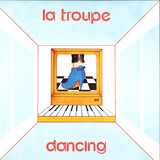
Following the successful slow tempo masterpiece "Just A Moment" by Liquid Mask, we have here another chill Italodisco treasure called "Dancing" by La Troupe, originally released in 1984 via Drums Edizioni. Urgently worthy of a reissue the tracks are fully remastered from the original master tape, courtesy of Gero Merella.
Cerca:mere
Luciano Berio/Pierre Boulez/Olivier Messiaen/Karlheinz Stockhausen
Serenata I / Sonatine / Cantéyodjayâ / Zeitmasze
The avant-garde composer and conductor Pierre Boulez was a titan of post-War experimental classical music. Born in the small cheesemaking town of Montrbrison in central France in 1925, Boulez studied at the Paris Conservatoire with the composer and organist Charles Messiaen and received private tuition from pianist Andrée Vaurabourg; after moving to the Marais district in 1945, he briefly studied with Schoenberg disciple, René Leibowitz, and further influence came from immersion in Balinese gamelan, Japanese classical music and African drumming, among other sources. Earning money by playing an early electronic keyboard called the ondes Martenot on theatre productions, Boulez soon became music director of the Renaud-Barrault theatre company (led by actor/direction Jean-Louis Barrault and his actor wife, Madeleine Renaud), leading to tours of Belgium, Switzerland, Britain and both North and South America. American composer John Cage became an ally, though they subsequently clashed over Cage’s commitment to the role of chance in his compositions, paving the way for an intense and lasting friendship with the German composer, Karlheinz Stockhausen, who arrived in Paris in 1952 to study with Messiaen. In July of that year, the pair attended the International Summer Course for New Music in Darmstadt, leading to contact with Italian composer Luciano Berio and other noteworthy figures. Then, in 1954, with backing from Barrault and Renaud, Boulez began staging a series of concerts of experimental music at the Petit Marigny theatre, titled Le Domaine musical. The pieces collected on this album are all taken from performances staged for the 1957 Domaine musical season, beginning with Berio’s “Serenata I,” conducted by Boulez, which debuted in Paris in March of that year; arranged for flute and fourteen instruments, Berio said that the idea behind the piece was for the solo flute to be confronted by continuously interchanging elements, rather than mere accompaniments or oppositions. Boulez’s own “Sonatine,” composed in 1946 for flute and piano, is a 12-tone piece that evidences Messiaen’s influence, with shades of Asian classical music in places; then, Stockhausen’s monumental “Zeitmasze” or “Time Measures,” a serial composition for five woodwinds, played in different combinations of tempos and speed, was partly inspired by Webern’s principles of homogenous and harmonic textures. Finally, Messiaen’s 1949 work “Cantéyodjayâ,” delivered by pianist Yvonne Loriod, takes it shape from the classical Hindu rhythms of ancient India, as with much of the composer’s oeuvre.
- A1: Pleasure Centre
- A2: In Plain Sight (Feat Ivar)
- A3: Soul Liberator (Feat Sanguita)
- B1: Don't Want This To Be Over (Feat Satchmode)
- B2: Sommeron (Feat Imugi)
- B3: Twilight (Feat Izo Fitzroy)
- B4: Echo Park
- C1: Same Blood (Feat The Palms)
- C2: Say The Word (Feat Nic Hanson)
- C3: 24Hr Fling (Feat Wolfgang Valbrun)
- C4: Sweet Time (Feat Izo Fitzroy)
- D1: Guilty Discomforts (Feat Wolfgang Valbrun)
- D2: Out In The Daylight (Feat Gavin Turek)
- D3: I Think (Feat Berenice Van Leer)
- D4: Naked (Feat Ivar & Berenice Van Leer)
Kraak & Smaak's 6th studio album - 'Pleasure Centre' is the culmination of two years hard work since their critically acclaimed 'Juicy Fruit' LP and their first Kraak & Smaak LP released on their own label – Boogie Angst. As expected it's a glorious record packed with future classics, flitting between funky dancefloor focused jams and more relaxed downtempo affairs.
The album has a definite US West Coast vibe to it and sees them fuse classic 70's and 80's yacht rock, dream pop, and indie influences in with their signature electronic funk sound. And this result is no mere accident or emulation… Working on the demos in their own studio before travelling to LA for a month last year to meet and work with featured artists, they stayed in Echo Park and recorded in local studios and sometimes even in the homes or backyards garages of their collaborators.
Hand- picking the best of the local talent: dance diva - Gavin Turek, indie upstarts - The Palms and dream pop dealer – Satchmode all contribute their talents to the cause.
The Dutchmen have earned a deserved reputation in particular for the A&R side of the industry, with both the discovery and collaboration of new rising acts high on their agenda. Previous successes include working with Parcels, Alxndr London (championed by Annie Mac) Eric Biddines (6Music playlisted) and Cleopold (signed to Nick Murphy fka Chet Faker's own label). And they continue to uncover hidden gems outside of LA on this record too...
Moon Boots collaborator – Nic Hanson, Jalapeno Records' gospel/soul powerhouse - Izo FitzRoy and soul man Wolfgang Valbrun (Ephemerals/Kungs), New Zealand's imugi and previous collaborator and soul songstress - Sanguita are accompanied by regular members of the Kraak & Smaak live band - IVAR and Berenice Van Leer across 15 fantastic new tracks.
'Pleasure Centre' is everything you'd want in an album and everything we've come to expect from these dance stalwarts – innovative, relevant, and modern tracks with great production and exciting guest features that are guaranteed to fire up your own pleasure centre!
k 11 Sweet Time (feat. Izo FitzRoy) clip
In early 2018, Jas Shaw, one half of Simian Mobile Disco was diagnosed with a rare health condition – AL amyloidosis – a disorder of bone marrow cells. Having just completed SMD’s 7th studio album Murmurations and with a special show at the Barbican scheduled for April, things were thrown into confusion. At the time, no one, including Shaw, knew how the prognosis would pan out. Jas had to start chemotherapy almost immediately, which meant cancelling the tour. The duo decided to go ahead with the Barbican show in spite of Shaw’s illness, which was especially poignant as all involved knew it could potentially be SMD’s last ever live performance – in the end it turned out to be a tour-de-force. If this was SMD’s swansong, so be it.
In the year that followed, Jas spent months receiving weekly chemotherapy, learning to live with his condition, and when he felt well enough, spending hours in his studio making music.
The result of this was twofold, firstly a collaborative album with Derwin Dicker (Gold Panda), released as Selling – On Reflection, on City Slang Records Secondly, a growing archive of solo work, which is now ready for release. Entitled “The Exquisite Cops”, this 20+ track growing body of work will see the light of day via SMD’s Delicacies label – with a 2-track single released every fortnight /month and a limited
edition double LP scheduled for 27th September.
At the end of 2018 a difficult year was capped with hopeful news. With his condition in remission, able to stop chemotherapy Jas is able to start DJing and playing live again.
Jas: “The Exquisite Cops tracks seem to have made their own system for creation. Normally I record electronic music like a band would, as a take. So, it’s kind of surprising to me that that this batch of tracks wasn’t made this way. Instead of a single take that gets edited and developed these tracks were all made in bits, usually months apart. Some days I’d make a drum track, often editing it down so that it’s some sort of semblance of a structure; on other days I’d end up just making a synth sound or texture. This wasn’t something that I gave into reluctantly, it’s nice to be able to give a feedback based pad your whole attention rather than just set it up and only attend to it if it gets really out of hand.
The process of matching these misfits together was originally born out of laziness, rather than break open the synths to make something to develop an idea, what if I could just use something that I already had; slack. The interesting thing was that in pulling two takes together that were done months apart, they cast each other in a different light and though sometimes making them fit together was a hatchet job, sometimes they locked up together in an improbable way, making the rough structures that I’d improvised make a different sort of sense; often a more interesting sort of sense.
The more I did this the more it felt like this was not just a slacker’s way to use up offcuts, this resulted in combinations that I’d probably not have chosen if I’d done the tracks in one go. Also, and I know this isn’t something that’s important to everyone, there was a level of fastidious detail that I’d never have got if I’d had the textural and rhythmic elements playing together. It’s a longwinded process but it’s changed how I record and how I think about recordings I’ve made; plus I enjoy all parts of it so why cut it short?”
Free Love, the artists formerly known as Happy Meals return to Optimo Music with ‘Extreme Dance Anthems’ a phantasmic mini album from their hearts to yours.
They say – “We recorded EXTREME DANCE ANTHEMS in our recently moved studio, ‘Full Ashram Celestial Garden’ which is now situated in a building that holds both a church below us and a sex club next door. Most of the tracks were formed from late-night sessions that we started to kind of ritualistically hold inspired from a particular thought or idea that we later cut down and did a live mixdown of. The music is about physicality and the metaphysical – it is about a recontextualisation of the ineffable as a centre point of existence which in turn influences how we engage with everything around us. A celebration of the unquantifiable, unspeakable, indivisible EXPERIENCE as the throne from which all ideas are derived. Even though the world is fucked- we are here.
On the face of it – I realise that this description might just seem like apolitical hippy bullshit but fuck that – as a deliberate result of the modern political landscape, our societies’ individual and collective disengagement with the metaphysical has led us to treat other humans, animals and our environment like resourceful statistics rather than something that actually holds any inherent value. An Inner Revolution of the foundations of our reality in a way that reintroduces the essence of existence, and not merely its describable derivatives, into the conversation of how we should live our lives INFORMS our perception of the world in a way that demands us to ACT. The record is about a kind of gradual awakening between the two of us – a reconnection with the magic around us.
The ineffable is not without moments of illumination- mostly in the form of immediate absurdity: ONE DAY WE WILL ALL BE DEAD BUT HERE WE ARE ALIVE INSTEAD.
The record is called EXTREME DANCE ANTHEMS because it made us both laugh”.
- A1: Like Falling In Love - Ernest Ranglin & The Federal Band
- A2: Profile Cha Cha - Cecil Lloyd & The Starline Troubadors
- A3: I Love Paris - Lennie Hibbert Combo
- A4: T'is Wonderful - Eric Grant Orchestra
- A5: C'est Magnifique - George Moxey
- A6: Go Fife Go - Count Owen & His Calypsonians
- B1: Angelima - Ernest Ranglin
- B2: Estrellita - Lennie Hibbert Combo
- B3: Rhumbina - Cecil Lloyd & The Starline Troubadors
- B4: Sly Mongoose - Ernest Ranglin
- C1: Linstead Market - Baba Motta & Ernest Ranglin
- C2: Wheel And Turn Me - Bertie King
- C3: Come Back Liza - Ernest Ranglin & Baba Motta
- C4: Solas Market - Solas Market
- C5: Brown Skin Gal - Bertie King & Baba Motta
- C6: Mango Walk - Bertie King & Ernest Ranglin
- C7: Aye Aye Aye - Count Owen & His Calypsonians
- C8: Razor Merengue - Eric Grant Orchestra
- D1: Ernest's Tune - Ernest Ranglin
- D2: String Of Pearls - Audley Williams & His Orchestra
- D3: Monday Monday - Winston Turner Quintet
Reaching out to the real roots of the Jamaican sixties musical explosion…
Some of the originators of the genre, including Ernest Ranglin, Lennie Hibbert & Cecil Lloyd, playing in their element and demonstrating just where they're coming from
- A1: Jacques Thollot - Cécile
- A2: Philippe Besombes - La Plage
- A3: Igor Wakhévitch - Materia-Prima
- A4: Mahjun - Les Enfants Sauvages
- B1: Lard Free - Warinobaril
- B2: Etron Fou Leloublan - Le Désastreux Voyage Du Piteux Python
- B3: Jean Cohen-Solal - Captain Tarthopom
- C1: Z. N. R. - Solo Un Dia
- C2: Red Noise - Sarcelles C’est L’avenir
- D1: Pierre Henry - Générique (Thème De Myriam)
- D2: Horrific Child - Freyeur
- D3: Dashiell Hedayat - Fille De L’ombre
- D4: Jean Guérin - Triptik 2
After years of mythology, misinterpretation and procrastination Nurse With Wound’s Steven Stapleton finally chooses Finders Keepers Records as the ideal collaborators to release “the right tracks” from his uber-legendary psych/prog/punk peculiarity shopping list known as The Nurse With Wound List, commencing with a French specific Volume One of this authentically titled Strain Crack Break series. Featuring some Finders Keepers’ regulars amongst galactic Gallic rarities (previously presumed to be imaginary red herrings) this deluxe double vinyl dossier demystifies some of the essential French feee jazz and Parisian prog inclusions from the alphabetical “dedication” inventory as printed the anti-bands 1979 industrial milestone debut.
When Steven Stapleton, Heman Pathak and John Fothergill’s anti-band Nurse With Wound decided to include an alphabetical dedication to all their favourite bands on the back of their inaugural LP the notion of creating a future record dealers’ trophy list couldn’t have been further from their minds. By adding a list of untravelled European mythical musicians and noise makers to their own debut release of unchartered industrial art rock they were merely providing a suggestive support system of existing potential likeminded bands, establishing safety in numbers should anyone require sonic subtitles for Nurse With Wound’s own mutant musical language. Luckily for them, the record landed in record shops in the midst of 1979’s memorable summer of abject apathy and its sound became a hit amongst disillusioned agit-pop pickers and artsy post-punks, thus playing a key role in the bourgeoning “Industrial” genre that ensued. On the most part, however, the list , like most instruction manuals, remained unreadable, syntactic and suspiciously sarcastic... As potential “real musicians” Nurse WIth Wound became an Industrial music fan’s household name, but in contrast many of the names on The Nurse With Wound List were considered to be imaginary musicians, made-up bands or booby traps for hacks and smart-arses. It took a while for the rest of the record collecting community to catch on or finally catch u
Since then, many of the rare, obscure and unpronounceable genre-free records on The Nurse With Wound List have slowly found their own feet and stumbled in to the homes of open-minded outernational vinyl junkies, D’s and sample hungry producers, self-propelled and judged on their own merit, mostly without consultation of the enigmatic NWW map. But, to the inspective competitive collector’s chagrin, one resounding fact recurs, NWW got there first! Via vinyl vacations, on cheap flights and Interrail tickets, buying bargain bin LPs on a shoestring while oblivious to the pending pension worthy price tags after their 40 year vintage, Stapleton and Fothergill, even if you’ve never heard of them, were at the bottom of the pit before “digging” became paydirt. And NOW at huge international record fairs that occur in massive exhibition halls (or within the confines of your one-touch palm pilot) amongst jive talk acronyms such as SS, PP, BIN, DNAP and BCWHES the coded letters NWW have begun to appear on stickers in the corner of original copies of the same premium progressive records accompanied by a customary 50% price hike to titillate/coerce the initiated as dealers extort the taught. Like “psych” “PINA” or “Krautrock” did before, “NWW” has become a buzzword and in the passed decades since its first publication The List has been mythologised, misunderstood and misconstrued. It’s also been overlooked, overestimated and under-appreciated in equal measures, but with a growing interest it has also come to represent a maligned genre in itself, something that all members of the original line-up would have deemed sacrilegious. Bolstered by the subtitle “Categories strain, crack and sometimes break, under their burden,” all bands on the inventory (many chosen on the strength of just one track alone) were chosen for their genre-defying qualities... A check-list for the unchart
Forty years after Nurse With Wound’s first record, Finders Keepers Records, in close collaboration with Steve Stapleton remind fans of THIS kind of “lost” music, that there once existed a feint path which was worn away decades before major label pop property developers built over this psychedelic underground. As long-running fans and liberators of some of the same records, arriving at the same axis from different-but-the-same planets, Finders Keepers and Nurse WIth Wound finally sing from the same hymn sheet resulting in a collaborative attempt to officially, authentically and legally compile the best tracks from the list, succeeding where many overzealous nerds have deferred (or simply, got the wrong end of the stick). Naturally our lavish metallic gatefold double vinyl compendium would only scratch the surface of this DIY dossier of elongated punk-prog peculiarities hence out decision to release volume one in a series which, in accordance with Steve’s wishes, focusses exclusively on individual tracks of French origin, the country that unsurprisingly hosted the highest content of bands on the list. Comprising of musique concrète, free jazz, Rock In Opposition, Zeuhl School space rock, macabre ballet music, lo-fi sci-fi, and classic horror literature inspired prog, this first volume of the series entitled Strain Crack And Break throws us in at the deep end, where the Seine meets the in-sane, introducing the space cadets that found Mars in Marseilles.
Like the Swedish flat-pack record shelves that attempt to house the vast amounts of vintage vinyl that goes into a multi-volume compilation like this, its time to prepare your own musical penchants and preconceived ideas about DIY music and hear them slowly strain, crack and b
A year on from the highly-acclaimed album 'It's A World Before You', Kaidi Tatham brings more new music to First Word Records - a continuation of his previous EP's for the label (2017's 'Changing Times' & 'Hard Times'), here we enter 'Serious Times'.
Kaidi Tatham is one of the most revered multi-instrumentalists in the game. Dubbed by Radio 1's Benji B last year as "the UK's Herbie Hancock", his versatility as a musician is actually more akin to Prince in the sense that he can play most instruments, and play them well. His contributions as a musician, composer & producer have included work with Bugz In The Attic, Amy Winehouse, Slum Village, Mulatu Astatke, Soul II Soul, Moonchild, Leroy Burgess, Amp Fiddler and loads more over the years, additionally to being a key player on Jazzy Jeff's PLAYlist album 'Chasing Goosebumps' along with Masego, Stro Elliot, 14KT, Tall Black Guy, Rich Medina and the like, and various projects alongside Dego (2000 Black) and First Word label-mates Eric Lau, Darkhouse Family & Children of Zeus.
'Serious Times' is another 4-track set comprised of Kaidi's unmistakable style, encompassing broken beat, jazz, boogie and hip hop. The EP starts off with the hype jazz-funk bruk of 'Cost of Living', maintaining the tempo into 'Don't Cry Now' which leads with a sweet latin-tinged piano riff. Onto the flipside, and we're treated to the slinky synth-boogie of 'Sugar' before dropping the tempo down & closing the selection with a warped but jazzy instrumental boom bap piece entitled 'Zallom'.
Kaidi is a national treasure quite frankly, and this EP is another mere taster of this man's endless talents and unique vibes. Some grown folk music, perfect for these 'Serious Times'…
Vinyl & digital released on Friday 19th July 2019 on First Word Records (Worldwide Awards 'Label of the Year 2019').
The Soulpop Continuum – by Arno Raffeiner
Six songs, one sound signature, one vision. Supreme Beats Series by Drei Farben House is an album
that firmly stands in the tradition of the big records of the disco era: a vinyl disc full of kicks and licks,
just as much as two sides in amazing sound quality can hold.
The album is the latest work of Michael Siegle, the Berlin-based producer and owner of Tenderpark
Records. 13 years after Drei Farben House's first full-length on the acclaimed Force Tracks label, it
features contributions by singer and songwriter Mavin and none other than Robert Owens who's voice
shaped house music forever. The trademark sonic elegance of Drei Farben House blends perfectly
with the timbre of the man behind Fingers Inc.'s Mysteries Of Love. Siegle's work as a producer is not
so much about turning this rich heritage upside down, but about refining it and creating a space within
that realm that's very much his own.
The title of the opening song with Owens states it: I’m Remaining Here. And Supreme Beats Series
invites you to come over and stay there, too, in a refuge of class and funkiness. The record offers
dense layers of rhythm, vintage keyboard sounds, chucking guitar, and vocal samples that indulge in a
many-voiced conversation. Not to forget the prominent, singing rather than walking bass lines
performed by the hands of Michael Siegle himself with his bass guitar.
New Release Information
You could think of Supreme Beats Series as a cross-section in time and space. It allows you to take a
closer look at the here and now of a much bigger picture, both aesthetically and socially. Siegle uses
the vocabulary of house music in a way that transcends its conception as merely a genre and speaks
of the historic evolution and the profound roots of this music as a movement. His record takes
inspiration from 60s Motown hits as well as the blue eyed soul of the 80s, you can discover influences
ranging from Philly's pre-disco craze to new jack swing and on to the heyday when house-pop divas
stormed the charts. By drawing these lines, Siegle deliberately opens up the space of a visionary
Soulpop Continuum.
In the 1950s, the American issue of Vogue magazine had their say about Coco Chanel's work and its
ever-lasting impression on fashion and design. They claimed it was all about “infinite variety within
narrow limits,“ and meant that as a compliment, of course. Michael Siegle likes to think about Drei
Farben House in a similar way. And you should, too.
Info about the artwork:
As far as the cover artwork of 'Supreme Beats Series‘ is concerned, the release of Drei Farben
House’s new album shows the second part of an image series which has been started with TDPR
release # 021 and which revolves around architectural photos taken by Achim Valbracht. Tenderpark
art director Till Sperrle and photographer Achim Valbracht like these pictures of various commercial
buildings erected in Berlin in the 1990s to be seen as a critique of investor-driven architecture which
has been dominating Berlin for several decades now.
The fascination of these pictures lies in their ambivalence of staging a normalised and globally
standardised kind of beauty, but at the same time revealing a strong sense of isolation - noticeable not
only but also in the absence of human beings. This new series of images is to some extent a
continuation of art director Till Sperrle's and label manager Michael Siegle’s interest in architectural
photography. However, at the same time the photo series also embodies a new angle on the subject
since all previous picture series on Tenderpark had been an affirmation of socially progressive
architecture which expressed a longing for socio-cultural utopia.
- A1: Turning Invisible In An Imaginary Rose Garden One Evening
- A2: Amhrán An Dreoilín
- A3: Jonny Tries To Catch A Pomegranate
- A4: The Road To Your Door
- A5: Requiem For Joe Dillon / Light A Penny Candle
- B1: Somebody Else\'S Blues
- B2: God Bless Little Peter
- B3: That Go To Sleep Rag
- B4: Mad Sweeney’s Day Off
- B5: Again, But With Feeling This Time
- B6: Start Again (Carry On)
"I love it. SO beautiful"
Josh Rosenthal [Tompkins Square]
Songs For A One-String Guitar is the debut instrumental acoustic guitar LP from Jonny Dillon. Better known for his analogue electronic music productions and all-hardware live sets under the ‘Automatic Tasty’ moniker [Lunar Disko, CPU, Wrong Island], Jonny’s records (bearing heavy acid and electro influences), along with live appearances at venues like Berlin’s Panorama Bar and Kiev’s Closer belie the fact that he has been quietly exploring the musical landscape of the guitar for nearly twenty years.
Recorded as a series of sketches over the last 10 years, Songs For A One-String Guitar represents a snapshot taken over a long exposure; one individual’s private response to a variety of currents and inspirations both musical and emotional. While informed in large measure by the world of Irish traditional music and song (of Sweeney’s Men, Planxty and Seán Garvey) along with that of primitivism and the American Spiritual (of John Fahey, Hank Williams and Mississippi John Hurt) these songs are equally a personal attempt to give expression to an inner landscape, from the experience of sorrow and loss to the promise of redemption and renewal.
The LP opens with ‘Turning Invisible In An Imaginary Rose Garden One-Evening’ a contemplative piece played in free-time; “I’ve been playing this piece for years, and it’s gone by so many different names in that time. It’s a sort of shoe-staring daydream, to my mind at least. I want people to disappear when they hear it, and think it suits the LP to open up slowly and reflectively”. While a contemplative strain underpins some of these songs, others are informed more directly by the experience of grief; “I wrote ‘A Requiem For Joe Dillon’ at the death of my uncle. He used play lots of wonderful songs of his own at family gatherings when I was a child, and while a very gifted and sensitive soul, was also troubled by his own demons. The last time I saw him alive was at my family home with my father; I was going out to see some friends and Joe called me back, gave me a hug and made the sign of the cross with his thumb on my forehead, to bless me. It still chokes me up when I think about it. A song of his ‘Light A Penny Candle’ I included to finish the piece in his honour.” A sense of longing and hope is present in other pieces; “Songs like ‘Again But With Feeling This Time’ and ‘Start Again (Carry On)’ come from a sort of hopeful yearning feeling which is always within me; a melancholic sort of joy in search of redemption. For me, music has the strange capacity to express contrary positions simultaneously; to console, redeem and offer transcendence while also expressing suffering and pain. I don’t know what any of this means, but feel as though I’m trying to find my way home by writing the same song over and over again.”
Songs For A One-String Guitar may seem to represent a departure for those who know Dillon for his electronic productions alone, though the reality is that these songs merely represent a new opening onto an old landscape; they are an invitation to more fully share in one individual’s yearning to find meaning through creative expression. “These songs are very personal to me, so there’s a certain nervousness in my seeing them released. I hope that they prove of some use, and that they do some small good to those who hear them.”
“Built By Humanoid” is Humanoid's second album, a mere 30 years after the debut, though Brian Dougans claims the first album wasn't really him anyway.
Humanoid's classic acid house single, ‘Stakker Humanoid’, highly regarded as one of the key tracks from the era (Richard James (Aphex Twin) sights the Stakker project as a major influence), enjoyed massive success in 1988. Reaching No.1 for 5 weeks in the UK dance charts, performances on Top of the Pops, a John Peel session for the BBC and European tours eventually led to an album deal.
Whilst all this was happening, Brian Dougans (one half of electronic legends Future Sound of London) claims he was returning to his squat in Kings Cross with no electricity or water. He not only became disillusioned with the business, but also became increasingly ill from the conditions he was living in. Around 6 tracks into the album, he left London and record label, Streetsounds, returning to Manchester to recover and regroup his thoughts. However, Steetsounds pressed ahead with the album and it was finished in Brian’s absence with guest performers.
Brian left Humanoid behind and went on to create FSOL with Gaz Cobain becoming leading lights in the burgeoning ambient scene, scoring a top 10 album "Lifeforms" on Virgin Records.
In 2003 Rephlex (Aphex Twin’s label) released a posthumous album of 1988 out takes compiled by Brian.
Recently Humanoid tracks have been popping up on modern compilation albums (Touched Music / Gasman, etc) signalling a possible return.
“Built by Humanoid” is a brand new nine track album of future acid cuts, breaks and electronics, a lot of which is credited to 2 synthesisers co-designed by Brian Dougans and English Electronics company Digitana. It is this innovation that has helped usher Humanoid back into the limelight and consequently the album has a rather new and unique sound and style.
The track ‘Polymath’ is created using a possibility / probability theory that results in a track which at no point repeats itself - 303 tinged acidic bubbles. Meanwhile ‘Traktion’ is a break beat, pulse laden, bass heavy monster. ‘Fu*k It’ is the future sound of 303. Fast, frantic and beat driven. Whilst ‘Post Humans’ combines thumping 909 and 303 into an acid hallucination.
- A1: I Really Do
- A2: Za Za Za Zilda
- A3: Love’s Desire
- A4: New Land
- A5: Now I’m Sad
- A6: Give Me Love
- B1: Quabala
- B2: Oh Mariya
- B3: Your Life Will Burn
- B4: I Was Fooling
- B5: Before My Eyes Go Blind
- B6: Rolling Thunder
British blues-rock quartet Zior had their roots in the bourgeoning R&B scene that arose during the
late 1960s in the southeast coastal city of Southend; they built a strong reputation in live
performance, opting for ‘happenings’ in the style of Hawkwind and Pink Floyd that went beyond
mere musical events. By the time they recorded their self-titled debut album, issued on Larry Page’s
short-lived Nepentha label in 1971, they were clearly influenced by the emergent hard rock/
heavy metal scene of the West Midlands, drawing from Black Sabbath’s discordant riffs and occult
influences, along with shrill vocal attacks in Led Zeppelin mode; there were shades of Steppenwolf
and the odd Doors-sounding keyboard riff as well (and the Black Sabbath link was heightened
by an album design from Keith McMillan, who was responsible for Black Sabbath’s debut cover
too). The resultant Zior is a varied ride through different kinds of rock terrain, from blues rock to
hard rock and on to whimsical psychedelia and prog-rock, making it hard to classify. Though this
debut LP should have heralded a bright beginning, misfortune seemed to dog the band from the
start; other recordings were released under the name Monument, the band members listed under
aliases, and a second album, Every Inch A Man, was issued in Germany after Zior’s breakup in
1973, without the band’s knowledge or permission.
Part of The Optic Sevens Reissue Series
Limited to 500 copies on splatter vinyl Includes Poster & Postcard
The Servants second single, Originally released on Head Records in 1986 as a 12” EP . This is it’s rst appearance as a 7” single.
In 1986 The Servants recorded a John Peel session, got a full page feature in the New Year’s edition of the 1986 ‘NME’ hailing them as the next big thing, appeared on their C86 cassette and played shows with amongst others the Jesus And Mary Chain, Felt, Primal Scream, the Go Betweens, the Pale Fountains and the Wedding Present
Danish drummer Terkel Nørgaard presents his trio consisting of some of the key players in the Copenhagen scene and adding ECM-recording American star trumpeter Ralph Alessi on the lineup. Not merely a "feature", Alessi and the Danes form a coherent band unit capable of producing memorable and highly inspired contemporary jazz which links to the Nordic tradition of dynamic sound ranging from delicate minimalism to powerful avantgarde eruptions. The album Terkel Nørgaard "With Ralph Alessi" will be out via Helsinki's We Jazz Records on May 17.
On the new album, the Danish trio plus Alessi achieve something that can always be regarded a remarkable feat. They deliver a highly inspired set of music which links the album onto the ever-evolving lineage of jazz music, and at the same time introduce a new band capable of stunning the listener in the here and now. Terkel Nørgaard "With Ralph Alessi" will be released on vinyl (black / mint colored), CD and digital formats.
The aptly-titled ‘Sunrise’ sets the deep, confident tone and sound that runs through the release, mixing wholesome, contemplative house chords with a warm, generous acid line emerging organically. On the flip, ‘Sunset’ dives further into this sound, diving back beneath the horizon.Almost beatless, ‘Midnight’ produces more intense oscillations for a weightless trip that transcends mere machine manipulation. Gnork & 130eOa reinstall a subtle groove for their understated but irresistible remix contribution.
Danish drummer Terkel Nørgaard presents his trio consisting of some of the key players in the Copenhagen scene and adding ECM-recording American star trumpeter Ralph Alessi on the lineup. Not merely a "feature", Alessi and the Danes form a coherent band unit capable of producing memorable and highly inspired contemporary jazz which links to the Nordic tradition of dynamic sound ranging from delicate minimalism to powerful avantgarde eruptions. The album Terkel Nørgaard "With Ralph Alessi" will be out via Helsinki's We Jazz Records on May 17.
On the new album, the Danish trio plus Alessi achieve something that can always be regarded a remarkable feat. They deliver a highly inspired set of music which links the album onto the ever-evolving lineage of jazz music, and at the same time introduce a new band capable of stunning the listener in the here and now. Terkel Nørgaard "With Ralph Alessi" will be released on vinyl (black / mint colored), CD and digital formats.
° +
Under pseudonym "Jean Eon,' Johnny Quinn Alston is the artist behind the project _ - / _ EON, a performance endeavor born out of an intense personal and familial experience in 2011.
_ - / _ EON is a portrait of the various manifestations of energy throughout the wide span of time and space we inhabit, from human experience to multidimensional mystery, as well as a peek into the many emanations that eternal power can create.
Jean Eon is merely a human form attempting to channel what bits of existential mystery he can interpret into sensual experiential form. He aspires to be as comfortable as possible with existence as a flawed, but striving, human being, and is not to be confused with the immortal and cosmically balanced EON itself.
_ - / _ EON is larger than Jean, and the EON is also you, we, and everything in between. We are all already avatars of the EON, and this project makes an attempt to shape truths of the great æther from which we are carved and will presumably* return to, however bittersweet or glorious that eternal promise may be.
+ °
* do we ever really die
+ °
The music released under NEW YORK TRAX 08 results from physical expression as . _ - / _ . EON focuses on channeling physiognomy over dictation. The EP explores pre-existing textural combinations discovered and rescued from stone as opposed to built step by step.
The initial inspiration for this EP arose from driving past randomly unfolding rural scenes. A majority of . _ - / _ . EON's resulting work similarly gravitates towards a series of landscapes discovering each other rather than 'arrangements' played on repeat.
In the back of your head, you know those blinking aircraft warning lights on towers, but how mysterious and ominous they look before you discover what they really are On the surface, this project represents the sound of being struck by the sight of something for the first time, and the ominous, transfixing, thrill of not knowing what it is.
Fifth part of the Strata-East Dolphy Series, Glass Bead Games is arguably the crown jewel of the Strata East movement, an amorphous genre that treads an unusual path between post-bop, 70's avant-garde and spiritual jazz, with a groove.
Glass Bead Games is full of revelations at many levels. First, the decade of the 1970s did produce genuinely creative, "human" new music flowing from the jazz mainstream; second, Bill Lee was more than Spike's dad: he was a superlative bassist, a team player of the first order, a powerful catalyst who, if anything, deserves to be better known than his son; third, Billy Higgins was, as so many musicians insist, a once-in-a-lifetime drummer—the bellows inspiriting the collective flame.
Most importantly, Clifford Jordan was an artist of the first order, his playing so effortless and unforced, unselfconscious and focused, mature and wise that, at a time when altissimo fury was all the rage, it's small wonder his authentic voice frequently went unheard. His musical rhetoric is so personally expressive, its substance so compelling, the listener couldn't care less about the extraordinary technique required to convey its captivating message. Compared to some of his more acclaimed peers he's a less aggressive yet paradoxically more directive and shaping influence. The climaxes, rather than spelled out, are merely suggested, registering with deep and lasting impact on the listener. It all comes down to learning the language, those precious little beads. Not every player, including Jordan or the listener, can use it like Shakespeare, but all can learn to read Shakespeare and understand its principles of arbitrariness and serendipity, of invariance and transformation.
Jordan, no less than Shakespeare, requires a like-minded cast of players—in this case four musicians of such redoubtable proficiency that each remains committed to keeping the beads in play. He's not a man content with a mere musical "dialogue" with his fellow musicians nor is he about to take the initiative in pulling his troops up to his level. Instead he begins to tell a musical story that's so compelling his three comrades are inspired equally to contribute to a collaborative narrative. This is brilliant music-making by a Coltrane- influenced successor who feels no obligation to mime the predecessor. It may be the most significant saxophone performance on record since Coltrane and, providing the listener stays with it for any length of time, the most deeply satisfying. Jordan's game—so effortless, unforced, and "level"—erases distinctions between composed and improvised, soloist and ensemble, narrator and narrative, the dancer and the dance. It seems incapable of wearing out its welcome.
By Samuel Chell/All About Jazz
DJ Rubio delivers the latest Man Band 12. A masterful blend of deep broken cuts and raw ambient by the Helsinki resident.
To throw a CANDELA is a popular expression for hosting an impromptu encounter revolving around tobacco, fire and music. CANDELA and fire are used as metaphors of passion, warmth and love, and this is what CANDELEROS transmit in their live performances, delivering their very own unique Afro-Caribbean vibes with a strong identity: folklore and psychedelia given a modern twist in a ritual of catchy drums, surf guitar riffs and South American percussions.
Infusing punk energy into their remarkable interpretation of traditions, the six-piece band embarks on a journey through the vibrant and immensely rich musical culture of the Caribbean, fusing merengue, champeta, salsa, and son, with bullerengue and cumbia; constantly reinventing themselves.
William, Fernando, Urko, Sergio, Alex and Andrés, come from different regions of Colombia and Venezuela. Their paths crossed in Madrid, Spain, where the Latin American family comes together through art and culture, gathering in diverse groups that focus on bringing their common cultural heritage to the world.
Their passion for endless musical improvisation, always crossing the thin line between genres, can be felt in these two tracks selected by Galletas Calientes Records .
A-Side 'La Cumbia Del Chinche' is an experimental, mind-bending cumbia, driven by a heavy mix of electronic and acoustic drums, hissing guacharacas and hallucinogenic guitars.
B-side 'El Boleta' is a totally freaked-out, uptempo merengue; a clever blend of subtle electronic drums, organic and hard-hitting percussions, psychedelic guitars and keys with the iconic ghostly tremolo and trippy reverb of seventies Peruvian cumbia.


